THE GIRL EVERYONE IGNORED ASKED A SINGLE DAD FOR ONE SEAT—WHAT HE LEARNED AFTER DRIVING HER HOME BROKE HIM
The first person who looked at Mara saw the crutches.
The second saw the prosthetic leg.
The third looked directly into her face, then lowered his eyes to his phone and pretended he hadn’t seen her at all.
By the time twelve-year-old Mara Ellis reached the middle of the crowded café, rainwater had soaked through one shoulder of her gray hoodie, her fingers were shaking from the cold, and the place where her prosthetic socket met her left leg felt as if someone had pressed a strip of hot metal against her skin.
Still, she didn’t ask anyone for help.
She only asked for a chair.
And somehow, on that wet Thursday afternoon in Columbus, Ohio, even that seemed like too much.
The café was packed with people escaping the freezing rain. Office workers occupied two-person tables alone with laptops spread beside them. College students leaned over coffees they had finished twenty minutes earlier. A woman in a camel-colored coat had placed her shopping bags on the chair across from her and was scrolling through photographs on her phone.
Mara moved carefully between them.
Click.
Step.
Click.
Step.
Her right sneaker squeaked against the tile.
Her crutches made soft rubber taps against the floor.
She kept her eyes down.
She had learned early that if she didn’t look at people, she didn’t have to watch the exact moment pity crossed their faces.
Or irritation.
Sometimes pity was worse.
Mara paused beside a small table where two middle-aged women were talking.
“Excuse me,” she said.
Neither woman answered.
Mara swallowed.
“Could I—”
One of them finally looked up.
“Oh. Sorry, sweetie. Someone’s sitting there.”
The empty chair between them held nothing but a scarf.
Mara nodded anyway.
“Okay.”
She moved on.
Behind her, the women lowered their voices.
Mara didn’t need to hear the words.
She knew the tone.
She had been hearing versions of it since she was old enough to understand that the world treated children who looked different as though they were either inspirational miracles or inconvenient problems.
Most days she could handle that.
Today was not most days.
She had already walked almost two miles.
Her phone was dead.
The rain had gotten worse.
Her mother thought she was still at school.
And under the silicone liner of her prosthesis, Mara could feel moisture that she knew was not rain.
She refused to think about that.
Thinking about it would make the pain real.
And Mara Ellis had spent most of her twelve years becoming very good at making real things feel temporary.
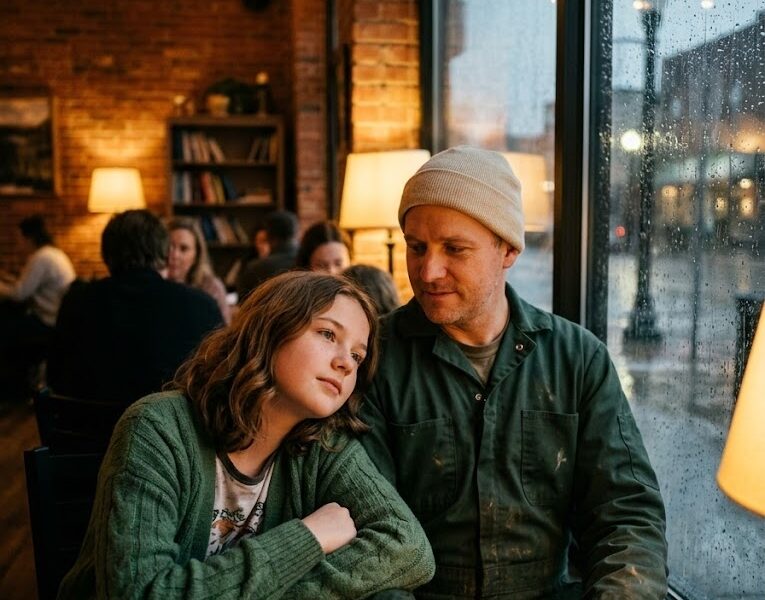
At a corner table near the front window sat a broad-shouldered man in a faded navy work jacket with two children.
He looked to be in his late thirties. Grease stained the side of one hand beneath the fingernails, the kind that never fully disappeared no matter how hard someone scrubbed. His dark hair needed cutting, and exhaustion sat beneath his eyes in pale shadows.
Across from him, a little girl with two crooked braids was carefully tearing the paper sleeve from a drinking straw.
Beside her, a boy maybe six or seven was lining up sugar packets by color.
They had one empty chair.
Mara stopped three feet away.
Her hands tightened around the grips of her crutches.
She could keep going.
There might be another place.
There probably wasn’t.
For the first time that afternoon, her courage slipped.
She stared at the chair.
Then at the man.
“Excuse me?”
He looked up immediately.
Not at the prosthetic.
Not at the crutches.
At her face.
That almost made it harder.
Mara cleared her throat.
“Can I sit here?”
The man glanced at the empty chair.
Then back at Mara.
And said one word.
“Absolutely.”
No hesitation.
No confused glance around the café.
No question about where her parents were.
No awkward smile.
Just absolutely.
He reached over, pulled the chair out, and moved his backpack from beneath it.
“Here,” he said. “Take your time.”
Something in Mara’s chest loosened so suddenly it hurt.
“Thanks.”
She maneuvered herself toward the chair, trying not to let her face show how badly every movement hurt.
But the man noticed.
His name was Rowan Hayes, and if there was one thing eight years of working as an auto mechanic had taught him, it was how to hear trouble before something broke completely.
People were not engines.
Rowan knew that.
Still, pain had a sound.
A hesitation.
A change in breathing.
A tiny tightening around the eyes.
And this kid was hurting.
Badly.
He watched without staring as Mara lowered herself onto the chair.
When her body finally touched the seat, she closed her eyes for less than a second.
But Rowan saw it.
It was not relief.
It was surrender.
The little girl with the braids leaned toward Mara.
“I’m Isla,” she said.
Mara opened her eyes.
“Hi.”
“That’s my brother Grady.”
Grady pushed one of his sugar-packet towers into a neater line.
“I’m seven,” he announced.
Isla rolled her eyes.
“She didn’t ask.”
“I know.”
Mara smiled despite herself.
“I’m Mara.”
Isla pointed carefully toward one of the stickers on Mara’s crutch.
“Is that a dragon?”
Mara looked down at the faded green sticker.
“Yeah.”
“Do you like dragons?”
“They’re better than unicorns.”
Isla gasped as though she had just heard blasphemy.
Rowan almost laughed.
And for the first time since Mara had entered the café, someone around her reacted to something other than her leg.
She relaxed enough to notice how warm the room was.
Rain streaked the windows in silver lines. Cars hissed past outside. Somewhere behind the counter, a milk steamer shrieked. Cups clinked. Conversations overlapped.
Ordinary sounds.
Safe sounds.
Mara placed her crutches carefully against the wall.
Rowan looked at her hands.
Her fingers were bright red.
“You want something warm?” he asked.
Mara immediately shook her head.
“No, thank you.”
“You sure?”
“I’m fine.”
The answer came too quickly.
Rowan knew that answer.
He had given it hundreds of times.
At funerals.
At school meetings.
At work after nights he had barely slept.
Three years earlier, when his wife had died after an illness that moved from manageable to catastrophic in less than two months, people had asked him the same question.
Are you okay?
He had two young children standing beside him.
What was he supposed to say?
No?
So he had learned to say, “I’m fine,” while feeling like someone had removed the center of his body and expected him to keep walking.
He recognized the language.
Different person.
Same sentence.
Rowan didn’t argue.
He turned toward his children.
“I’m getting another coffee. Anybody want hot chocolate?”
Grady’s hand shot up.
“Me.”
“You already had one.”
“A second hot chocolate.”
“No.”
Isla pointed toward Mara.
“Maybe Mara wants one.”
Mara opened her mouth.
Rowan stood.
“Good idea.”
“I really don’t—”
“Whipped cream?”
Mara stared at him.
He smiled slightly.
It was not a pitying smile.
It was the smile of a tired father who had discovered a loophole in an argument.
Mara looked toward the counter, then back at him.
“A little.”
“Good answer.”
When Rowan walked away, Mara felt embarrassment crawl up her neck.
She hated needing things.
Her mother never said that she was a burden.
Not once.
Leona Ellis would have fought anyone who suggested it.
But children did not need adults to explain money problems to them.
Mara understood money from the way her mother paused at grocery store shelves.
She understood it from the stack of envelopes beside the microwave.
She understood it from overheard conversations with insurance companies.
She understood it from the way Leona sometimes sat at the kitchen table after midnight with both hands pressed against her forehead while medical bills lay open beneath the yellow light.
Mara understood exactly how much things cost.
A new prosthetic socket.
Physical therapy.
Special socks.
Doctor visits.
Prescription ointments.
Transportation.
Time away from work.
She knew that every complaint she made became an expense.
So she stopped complaining.
Six months earlier, when her prosthetic had started feeling too tight, she told her mother it was fine.
Two months later, she developed a sore.
She hid it.
When it healed, she considered that proof she had been right.
Now the pain had returned.
Worse.
But she would manage.
She always managed.
Rowan returned with a coffee, a hot chocolate, and a grilled turkey sandwich cut diagonally.
He placed both in front of Mara.
Her expression changed immediately.
“I didn’t ask for food.”
“I know.”
“I can’t pay for that.”
“I know.”
Mara’s jaw tightened.
Rowan caught the shift.
This was not stubbornness.
It was dignity.
He sat across from her and lowered his voice.
“Okay. Here’s the deal. I bought the wrong sandwich.”
Mara stared at him.
Behind her, Isla looked confused.
“You did?”
Rowan gave his daughter a warning glance.
Isla understood and immediately became fascinated with her straw wrapper.
Rowan continued.
“I hate turkey.”
Grady frowned.
“You ate turkey yester—”
Rowan kicked his son gently beneath the table.
Grady stopped.
Mara looked from the children to Rowan.
A reluctant smile appeared.
“You’re bad at lying.”
“Terrible.”
“You bought it for me.”
“Maybe.”
“I said I didn’t need it.”
“No. You said you didn’t ask for it. Different sentence.”
Mara looked down.
Steam rose from the chocolate.
The smell made her stomach tighten.
She had skipped lunch.
Not intentionally.
At least that was what she told herself.
She had saved the six dollars her mother gave her because they were low on milk.
Mara planned to stop at the corner store and buy a gallon on the way home.
Then the school bus had left without her.
Then the rain started.
Then the prosthesis began rubbing.
The six dollars was still folded inside the pocket of her jeans.
She stared at the sandwich.
Her eyes burned.
“Thank you,” she whispered.
Rowan nodded as if she had accepted nothing more important than a napkin.
“Sure.”
Mara ate slowly at first.
Then faster.
She caught herself and slowed down again.
Rowan pretended not to notice.
But Isla did.
“Were you really hungry?”
Mara froze.
Rowan started to intervene, but Mara answered.
“A little.”
Grady looked genuinely concerned.
“My dad gets mean when he’s hungry.”
“I do not.”
“You yelled at the garage door.”
“The garage door broke.”
“You called it a criminal.”
“It trapped my truck.”
Mara laughed.
It came out before she could stop it.
A small sound.
Rowan saw her cover her mouth immediately, as if even laughter required permission.
He wondered when she had learned that.
Outside, the rain continued falling.
Inside, something fragile began to change.
They talked about school.
Mara said she was in seventh grade.
She loved science.
She hated gym.
Isla announced that gym was her favorite class.
“Because you’re nine,” Grady said.
“I’m ten.”
“Same thing.”
“It literally isn’t.”
Mara smiled again.
Rowan asked about the stickers on her crutches.
Each one had a story.
The dragon came from her fifth-grade teacher.
A tiny Saturn came from the science museum.
A faded purple heart came from a nurse after surgery when Mara was four, though she barely remembered it.
The conversation moved easily until Rowan asked one simple question.
“So who’s picking you up?”
Mara stopped chewing.
The warmth disappeared from her face.
“No one.”
Rowan leaned back.
“You taking the bus?”
“No.”
“Someone meeting you?”
Mara lowered her sandwich.
“I’m walking.”
Rowan glanced through the rain-streaked window.
“To where?”
“Home.”
“How far?”
She shrugged.
“Not that far.”
“How far is not that far?”
Mara looked at him.
Her expression had changed.
Guarded now.
“I’m okay.”
There it was again.
Rowan did not like the way those two words sounded anymore.
“How long have you been walking?”
“I don’t know.”
“Mara.”
“I said I’m okay.”
Isla and Grady went quiet.
Rowan immediately softened his voice.
“Hey. I’m not trying to interrogate you.”
Mara looked away.
He followed her gaze.
She was staring at the rain.
“School got out around two-thirty,” he said.
Mara didn’t respond.
Rowan checked the clock on the wall.
It was almost four.
His stomach tightened.
“Your school nearby?”
“Westbrook Middle.”
Rowan knew Westbrook.
It was almost three miles away.
“How did you get here?”
“Walking.”
“All the way from Westbrook?”
Mara’s shoulders rose.
“Yes.”
“With your leg hurting?”
Her eyes snapped toward him.
“How do you know my leg hurts?”
“Because I have eyes.”
Mara went still.
Rowan immediately regretted the wording.
“Sorry. That came out wrong.”
She stared at him.
Then, unexpectedly, laughed once.
“Yeah. Kind of.”
Rowan smiled.
“Occupational hazard. I spend all day figuring out when things are making sounds they shouldn’t.”
“I’m not a car.”
“No. Cars complain sooner.”
That got another small smile.
But it vanished quickly.
Rowan leaned forward.
“Why didn’t you ride the bus?”
Mara’s fingers curled around the paper cup.
She took too long to answer.
“I missed it.”
“How?”
She shrugged.
“Just did.”
That was when Rowan knew she was hiding something.
He didn’t know what.
But he knew the feeling.
Parents developed an instinct for incomplete truths.
“Does your mom know where you are?”
Mara looked down.
“No.”
Rowan’s concern sharpened.
“Does she think you’re at school?”
“She’s working.”
“That’s not what I asked.”
Mara’s cheeks reddened.
“She thinks I took the bus.”
Rowan exhaled.
“Okay.”
“Please don’t call anyone.”
“I don’t even have anyone to call.”
Mara’s hand went toward her pocket.
Her phone.
She pulled it out and pressed the button.
Nothing.
“Battery died.”
Rowan held out his phone.
“Call her.”
Mara didn’t take it.
“She can’t answer at work.”
“Text her.”
“She won’t check.”
“Then at least she’ll know where you are when she does.”
Mara looked frightened now.
Not of Rowan.
Of the idea of her mother finding out.
That confused him.
“What’s wrong?”
“Nothing.”
“Mara.”
“She’ll worry.”
“She should worry. You’re twelve and she doesn’t know where you are.”
“You don’t understand.”
“Then explain it to me.”
Her eyes filled, but her jaw tightened before any tears could fall.
“If she knows I walked, she’ll leave work.”
Rowan paused.
“So?”
“She can’t leave.”
“Why not?”
“Because she already missed Tuesday.”
“Why?”
Mara’s voice dropped.
“Because of me.”
The words landed differently than anything she had said before.
Rowan’s brow furrowed.
“What happened Tuesday?”
“Nothing.”
“Mara.”
“She had to take me to my appointment.”
“What appointment?”
Silence.
Mara looked toward her prosthetic leg.
Rowan felt a cold sensation that had nothing to do with the weather.
“Was something wrong?”
Mara’s mouth trembled.
Then she shook her head.
“No.”
Another lie.
A bigger one.
Before Rowan could say anything, Mara pushed the unfinished sandwich away.
“I should go.”
She reached for her crutches.
The moment she stood, her face drained of color.
Her right hand slipped.
One crutch struck the floor.
Isla gasped.
Rowan was out of his chair before Mara fell.
He caught her beneath the arms.
For one terrible second, Mara’s body went completely rigid.
“Don’t,” she whispered.
“I’ve got you.”
“I’m fine.”
“You almost fell.”
“I stood up too fast.”
“Mara.”
“I said I’m fine.”
Her voice cracked.
Several people were looking now.
The same people who had looked away when she needed a chair.
Mara saw them.
Something like humiliation crossed her face.
“Please,” she said.
Rowan followed her gaze.
He understood.
He picked up the fallen crutch and handed it to her without another word.
Mara steadied herself.
Then Rowan saw it.
A faint red stain at the edge of the fabric where the prosthetic met her leg.
He froze.
“Mara.”
She followed his eyes.
Her expression collapsed.
“No.”
“Are you bleeding?”
“It’s nothing.”
“You’re bleeding.”
“It does that sometimes.”
Rowan stared at her.
“What do you mean, it does that sometimes?”
Mara’s breathing became shallow.
She grabbed her backpack.
“I need to go.”
“No, you need to sit down.”
“I need to go home.”
“I can drive you.”
“No.”
The refusal was immediate and panicked.
Rowan frowned.
“Why not?”
“You have kids.”
“So?”
“You don’t know me.”
“That’s true.”
“My mom told me not to get into cars with strangers.”
“That’s a good rule.”
“Then stop asking me.”
Rowan paused.
Fair point.
He looked at Isla.
Then Grady.
Then back at Mara.
“What if your mom talks to me first?”
“My phone’s dead.”
“Use mine.”
“She’s working.”
“Where?”
Mara hesitated.
“Riverside Medical Center.”
“What does she do?”
“Environmental services.”
“Cleaning?”
Mara nodded.
Rowan handed her his phone again.
“Call the hospital.”
“No.”
“Mara.”
“She could get in trouble.”
Rowan lowered his voice.
“And if you walk another mile with your leg bleeding?”
Mara’s eyes flashed.
“I do it all the time.”
The table went silent.
She seemed to realize what she had admitted.
Rowan felt something inside him tighten.
“All the time?”
Mara looked away.
“How often do you walk home?”
No answer.
“Mara.”
Her shoulders dropped.
“When Mom’s schedule changes.”
“How often is that?”
“Sometimes.”
“How many days this week?”
Silence.
Rowan’s stomach sank.
“How many?”
“Three.”
Isla looked at her father.
Even Grady seemed to understand that something was wrong.
Rowan kept his voice calm.
“Why doesn’t the school bus take you?”
Mara stared at the table.
“It does.”
“Then why are you walking?”
Her fingers started trembling again.
“Because I missed it.”
“Three times?”
She didn’t answer.
“What’s happening?”
Mara wiped one eye quickly.
“Nothing.”
Rowan waited.
He had learned after his wife died that silence sometimes did more than questions.
People filled silence when they were ready.
Thirty seconds passed.
Mara finally spoke.
“There are stairs.”
Rowan frowned.
“At school?”
“At the bus entrance.”
“What does that have to do with missing it?”
Mara stared at her cup.
“Kids wait there.”
Rowan said nothing.
“They block the railing sometimes.”
His chest tightened.
“On purpose?”
Mara shrugged.
“I don’t know.”
“You do know.”
“It doesn’t matter.”
“It matters.”
“One boy takes my crutch sometimes.”
Rowan stopped breathing for half a second.
Isla whispered, “What?”
Mara immediately looked embarrassed.
“He gives it back.”
Rowan’s voice became dangerously quiet.
“Who?”
“Please don’t.”
“Who takes your crutch?”
“It’s not like that.”
“What is it like?”
“They joke.”
“About what?”
Mara’s eyes filled again.
“My leg.”
Rowan looked away.
He needed one second.
Because anger came quickly to him, but he refused to let Mara mistake his anger for anger at her.
Across the table, Isla looked horrified.
“Why would somebody do that?”
Mara shrugged.
“People are stupid.”
Rowan almost smiled at the answer.
Almost.
“Have you told your mother?”
“No.”
“Your school?”
“No.”
“Why?”
“Because Mom has enough.”
That sentence again.
Enough.
Enough bills.
Enough shifts.
Enough fear.
Enough responsibility.
Mara had decided, at twelve years old, that the safest way to love her mother was to disappear inside her own problems.
Rowan had seen adults destroy themselves doing the same thing.
He had nearly done it himself.
“Mara,” he said quietly, “you don’t protect people by letting yourself get hurt.”
She looked at him.
“You don’t know my mom.”
“No. But I know what being a parent feels like.”
Mara glanced at Isla and Grady.
Rowan continued.
“If one of them were hurting and didn’t tell me because they thought I had enough problems, that wouldn’t make my life easier.”
He paused.
“It would break my heart.”
Mara blinked.
Her face changed.
Only slightly.
But Rowan knew he had reached something.
For the first time all afternoon, Mara did not say she was fine.
Instead she whispered, “She cries when she thinks I’m asleep.”
Rowan’s anger disappeared.
“What?”
“At the kitchen table.”
Mara stared at the steam fading from her hot chocolate.
“She doesn’t know I hear.”
Rowan sat slowly.
Mara’s voice became quieter.
“She works mornings at the hospital and nights at a hotel three days a week. She keeps saying it’s temporary.”
“How long has temporary been?”
“Eleven months.”
Rowan closed his eyes for a moment.
“Mara…”
“She’s trying.”
“I know.”
“She’s not bad.”
“I didn’t say she was.”
“She’s a good mom.”
“I believe you.”
“Then don’t make her feel like she did something wrong.”
Rowan felt the words strike somewhere deep.
This child was bleeding because she was afraid an adult might judge her mother.
He understood now.
The fierce defensiveness.
The refusal of help.
The six dollars she kept touching inside her pocket.
She was not afraid of being punished.
She was afraid of someone deciding her mother was failing.
Rowan leaned back.
“Okay.”
Mara looked suspicious.
“Okay what?”
“I won’t make her feel like she did something wrong.”
“You won’t call anyone?”
“I didn’t say that.”
Her expression tightened.
“But I’m not going to treat your mom like she’s the problem.”
Mara looked at him carefully.
“Then what are you going to do?”
Rowan looked toward the blood at the edge of her prosthetic.
“First, we’re going to figure out how to get you home without making that worse.”
Mara shook her head.
“I can walk.”
“No.”
“You can’t tell me what to do.”
“That is technically true.”
“Then I’m walking.”
“And I’m technically allowed to sit here and strongly disagree.”
Despite herself, Mara smiled.
Rowan pointed toward his phone.
“Call your mother.”
“She won’t answer.”
“Then we try.”
After a long moment, Mara took the phone.
She knew the number from memory.
The hospital operator transferred the call twice.
Finally a supervisor answered.
Rowan listened to Mara’s half of the conversation.
“Hi. This is Mara Ellis. Is my mom there?”
Pause.
“Leona Ellis.”
Another pause.
“No, I’m okay.”
Rowan looked at her.
Mara gave him a warning glare.
“Yes, I’m her daughter.”
Pause.
“Can you just tell her I’m safe?”
Longer pause.
“No, please don’t scare her.”
That was when Rowan heard a voice through the phone, faint but frantic.
“Mara?”
Mara closed her eyes.
“Hi, Mom.”
Even Rowan could hear the panic.
“Where are you?”
“I’m okay.”
“Where are you?”
“At a café.”
“What café? Why aren’t you home? I called the school and they said you left. Mara, I’ve been trying your phone for almost an hour.”
Mara’s face changed.
She had not known.
Rowan watched guilt move through her.
“My battery died.”
“Are you alone?”
“No.”
Leona’s voice sharpened.
“Who are you with?”
Mara looked at Rowan.
“A dad.”
Rowan almost choked.
“What does that mean, a dad?”
“He has kids.”
“Mara.”
“A man named Rowan. He helped me.”
“Put him on the phone.”
Mara winced and handed it over.
Rowan took the phone.
“Ms. Ellis?”
“Who are you?”
“My name is Rowan Hayes. I’m at Miller Street Café with your daughter and my two kids.”
“Why is she with you?”
“She asked if she could sit at our table.”
Silence.
Then, “Is she hurt?”
Rowan glanced at Mara.
She stared at him, pleading.
He could lie.
He knew she wanted him to.
Instead he chose his words carefully.
“Her leg seems to be bothering her.”
Mara looked away.
Leona’s breathing changed.
“How bad?”
“I don’t know. There’s a little bleeding.”
On the other end, silence.
Then a broken whisper.
“Oh, God.”
Mara shut her eyes.
Rowan immediately said, “She’s okay right now. She’s sitting down. She ate. She’s warm.”
“I knew that socket was wrong.”
Rowan looked at Mara.
Mara stared at the table.
Leona continued, speaking fast now.
“They were supposed to adjust it Tuesday. Insurance denied the replacement because they said she hadn’t grown enough since the last fitting. The prosthetist added padding, but I knew—God, I knew—”
“Mom,” Mara said.
Rowan handed the phone back.
Leona’s voice broke.
“Why didn’t you call me?”
Mara’s chin trembled.
“You were working.”
“I don’t care.”
“You already missed Tuesday.”
“I don’t care.”
“They warned you.”
“I don’t care, Mara.”
“You could lose your job.”
“I do not care about a job more than I care about you!”
The entire table fell silent.
Mara’s eyes filled instantly.
Leona’s voice softened.
“Baby…”
Mara wiped her face.
“I’m sorry.”
“No. No, don’t apologize. Tell me exactly where you are.”
Mara did.
“I’m leaving.”
“Mom, don’t.”
“I’m leaving.”
“You can’t.”
“I am your mother.”
“Please.”
“I’m coming.”
Mara looked at Rowan desperately.
Rowan understood.
“Ms. Ellis?”
“Yes?”
“If you’re comfortable with it, I can drive Mara home.”
Silence.
“I’ll give you my full name, plate number, whatever you need. My kids are with me.”
Leona hesitated.
Every instinct she had was clearly fighting every other instinct.
Finally she asked, “Can you put Mara back on?”
They spoke quietly for another minute.
Then Mara handed the phone to Rowan again.
Leona gave him the address.
“Please,” she said. “Please take care of her.”
“I will.”
“And… Mr. Hayes?”
“Yeah?”
“Thank you for seeing her.”
Rowan looked at Mara.
He didn’t know why those words hit him as hard as they did.
“Of course.”
The rain had slowed by the time they left.
Rowan helped Grady zip his coat while Isla held the café door.
Mara stood carefully.
Her face tightened again.
Rowan noticed.
“How bad?”
“Three.”
“Out of ten?”
“Sure.”
“That means seven.”
Mara almost smiled.
They stepped outside.
Cold air rushed beneath the awning.
Rowan’s pickup was parked half a block away.
He looked at the distance, then at Mara.
She followed his gaze.
“I can make it.”
“I know.”
That answer surprised her.
He continued, “Doesn’t mean you should have to.”
Mara looked away.
For reasons she could not explain, that sentence nearly made her cry.
Rowan walked beside her, matching her pace.
He did not touch her unless she asked.
He did not rush.
Isla and Grady walked ahead beneath one umbrella, arguing about who was taking up more space.
At the truck, Rowan opened the passenger-side rear door.
Isla climbed into the middle.
Grady took the other side.
Mara stared.
“You want me to sit with them?”
“You can sit up front if that’s easier.”
Mara shook her head.
“No. Here is fine.”
She climbed in slowly.
Rowan placed her crutches in the truck bed beneath the covered cap.
When he got behind the wheel, he caught Mara watching him in the mirror.
“What?”
“Nothing.”
“That was definitely something.”
She hesitated.
“My mom says good people don’t advertise it.”
Rowan started the engine.
“That sounds smart.”
“She says people who keep telling you they’re good usually want something.”
“Also smart.”
Mara looked at him.
“You didn’t tell me you were good.”
“Nope.”
“So I’m still deciding.”
Rowan nodded seriously.
“Take your time.”
For the first five minutes, nobody spoke.
Rain tapped against the windshield.
The heater blew warm air.
Traffic crawled.
Mara leaned her head against the seat.
Isla quietly offered her one earbud.
Mara accepted.
Rowan watched them in the mirror.
Three children squeezed across his backseat.
One was a stranger.
Yet something about the image felt strangely familiar.
His wife, Claire, had always been the one who noticed people.
At restaurants.
At school events.
In grocery store lines.
She had an irritating habit, Rowan used to joke, of making friends with anyone who stood still long enough.
Once, years earlier, Rowan had complained because she spent forty minutes helping an elderly man find his car in a hospital parking garage.
Claire had looked at him and said, “You never regret the forty minutes you give someone. You regret the moments you were too busy to notice them.”
Rowan had forgotten that sentence.
Until now.
At a red light, Mara asked, “Where’s their mom?”
The question was innocent.
Rowan still felt the old pain.
“She died.”
Mara’s eyes widened.
“I’m sorry.”
“It’s okay.”
“How long ago?”
“Three years.”
“What happened?”
“Mara,” Isla said quietly.
Rowan glanced at his daughter.
“It’s okay.”
He looked back at the road.
“She got sick.”
Mara stared at her hands.
“My dad left.”
Rowan said nothing.
Mara continued.
“I don’t know if that’s worse or better.”
“There’s probably no useful answer to that.”
“He sends birthday cards sometimes.”
“That’s something.”
“No money.”
Rowan almost laughed at the bluntness.
Mara noticed.
“What?”
“Nothing.”
“My mom says I’m too honest.”
“Your mom and I might get along.”
Mara looked out the window.
“My dad used to say my leg was hard on him.”
Rowan’s hands tightened on the steering wheel.
Mara continued as if discussing the weather.
“He said the hospital stuff was stressful. He said he wasn’t built for it.”
“How old were you?”
“Eight when he left.”
Rowan’s jaw tightened.
“He told Mom he needed a fresh start.”
Mara gave a small shrug.
“I guess we weren’t fresh.”
Rowan looked at her in the mirror.
“Mara.”
She looked up.
“There is nothing about what happened with your father that says anything about your worth.”
She blinked.
“I know.”
“Do you?”
Mara didn’t answer.
The light turned green.
Rowan drove on.
Leona and Mara lived in a four-story brick apartment building on the east side, the kind built in the 1970s and patched rather than renovated ever since.
The parking lot was cracked.
One exterior light flickered.
A shopping cart sat near the dumpster.
But every third window had autumn decorations taped inside, and someone had planted red flowers in a plastic bucket near the entrance.
Home, Rowan thought, did not always advertise itself well.
When he parked, Mara suddenly became nervous.
“My mom’s going to freak out.”
“She already freaked out.”
“I mean when she sees the blood.”
Rowan turned around.
“Then maybe let her.”
Mara frowned.
“What?”
“She gets to be scared.”
Mara stared at him.
“So do you.”
The words seemed to confuse her.
Before she could answer, the apartment building door flew open.
A woman ran into the parking lot wearing navy hospital scrubs beneath a cheap winter coat.
She looked exhausted.
Dark hair pulled into a hurried bun.
No makeup.
Work shoes still wet at the soles.
But none of that was what Rowan noticed first.
He noticed terror.
Pure parental terror.
“Mara!”
The girl had barely opened the truck door before Leona reached her.
She wrapped both arms around her daughter.
Mara stiffened at first.
Then collapsed into her.
“I’m sorry.”
“Don’t.”
“I didn’t mean—”
“Don’t apologize.”
Leona pulled back and held Mara’s face between her hands.
“Are you okay?”
“Yes.”
Leona looked down.
She saw the blood.
Her face changed.
“Mara.”
“It’s not bad.”
“How long?”
Mara looked away.
“How long has it been bleeding?”
“I don’t know.”
“Mara.”
“Since maybe school.”
Leona closed her eyes.
Rowan got out of the truck.
Isla and Grady stayed inside.
Leona looked at him.
For a moment, Rowan saw embarrassment cross her face.
Not gratitude.
Not yet.
Embarrassment.
She saw herself through his eyes.
The old building.
The bleeding child.
The missed bus.
The single mother in hospital scrubs.
Rowan recognized the look because he had worn versions of it after Claire died.
The fear that people were measuring your failures before they knew what survival had cost you.
He walked toward her.
“You must be Leona.”
She nodded.
“Rowan?”
“Yeah.”
“Thank you.”
“You don’t owe me anything.”
“I know, but—”
“You really don’t.”
She looked at Mara again.
“What happened?”
Rowan glanced at the girl.
Mara tensed.
He remembered his promise.
“I found her in a café needing a place to sit.”
Leona waited.
“That’s it?”
“That’s where we start.”
Something in Leona’s expression softened.
She understood what he was doing.
Protecting Mara without protecting the problem.
“Can you get upstairs?” Leona asked.
Mara nodded.
Rowan retrieved the crutches.
The moment Mara put weight on the prosthetic, she winced.
Leona saw.
“That’s coming off.”
“Mom.”
“No argument.”
“I can walk upstairs.”
“No.”
“There’s no elevator,” Mara muttered.
Rowan looked at the building.
“Third floor?”
“Fourth,” Leona said.
Mara sighed.
“I hate this building.”
Leona’s face tightened.
“I know.”
Rowan looked toward the stairs visible through the lobby door.
Then at Mara.
“Can I carry your bag?”
She hesitated.
“Yes.”
Progress.
Inside, the stairwell smelled faintly of bleach and old paint.
Mara climbed slowly.
Each step took effort.
Rowan stayed behind her in case she slipped.
Leona walked in front, turning every few seconds.
By the second floor, Mara was breathing hard.
By the third, her hands shook.
At the landing, she stopped.
“I need a second.”
Leona’s face crumpled.
“I’m sorry.”
Mara looked up.
“For what?”
“This building.”
“Mom.”
“I keep saying I’m going to find somewhere better.”
“Stop.”
Leona pressed her lips together.
Mara’s voice softened.
“It’s okay.”
Rowan stood silently a few feet away.
There it was again.
Mother apologizing for surviving.
Daughter apologizing for making survival difficult.
Each trying to protect the other.
Neither realizing the protection was crushing them both.
They reached the apartment.
It was small but immaculate.
A faded couch.
A secondhand dining table.
School photos taped to the refrigerator.
A jar full of coins labeled MARA’S COLLEGE FUND.
Rowan saw it and looked away before Mara noticed.
Leona helped her daughter into the bathroom to remove the prosthesis.
Rowan remained in the kitchen with Isla and Grady, who had carried Mara’s backpack upstairs.
He was about to tell the children they should leave when he heard Leona gasp.
“Oh my God.”
Rowan froze.
Then Mara’s voice.
“Mom, don’t.”
“How long has this looked like this?”
“It’s fine.”
“Mara!”
Rowan moved toward the hallway.
“Everything okay?”
No answer.
Then Leona appeared.
Her face had gone pale.
“I need to take her to urgent care.”
“What happened?”
“The skin’s open.”
Rowan glanced past her.
Mara sat on the edge of the bathtub with a towel over her lap, face turned away.
Leona’s hands trembled.
“I knew the padding wasn’t enough.”
She looked at the clock.
“I have to call my supervisor.”
“Go,” Rowan said.
Leona hesitated.
“My car’s at work.”
Rowan blinked.
“You took the bus?”
She nodded.
“I left halfway through my shift.”
“How were you planning to get Mara to urgent care?”
“I’ll call a ride.”
“No.”
Leona looked at him.
Rowan pointed toward his truck.
“I’m already here.”
“I can’t ask you to do that.”
“You didn’t.”
“Rowan—”
“My kids are with me. You’re not inconveniencing some romantic dinner or golf game.”
Grady called from the kitchen, “Dad doesn’t play golf.”
“Thank you, Grady.”
Leona stared at him.
“You’ve already done enough.”
Rowan looked toward the bathroom.
“I don’t think this is about enough.”
For the first time, Leona’s composure cracked.
She lowered her voice.
“I don’t know how I’m going to pay for this.”
Rowan didn’t know what to say.
So he did not insult her with false reassurance.
He simply said, “Let’s get her seen first.”
At urgent care, they waited nearly an hour.
Mara sat in a wheelchair because the nurse would not allow her to put the prosthesis back on.
That humiliated her more than the pain.
She crossed her arms and stared at the floor.
Rowan sat nearby with Isla asleep against his shoulder and Grady watching cartoons without sound on his phone.
Leona filled out paperwork.
Insurance information.
Emergency contacts.
Medication history.
At one point, she stopped writing.
Rowan noticed.
“What?”
“Nothing.”
“You’ve got a kid who says that too.”
Leona gave a tired smile.
“They want the copay.”
“How much?”
She shook her head.
“No.”
“I didn’t ask because I’m offering to pay.”
“Good.”
“I asked because you looked like you’d been punched.”
Leona stared at the clipboard.
“Seventy-five.”
Rowan nodded.
“That’s a lot.”
“It is when you have forty-three dollars until Monday.”
She laughed once.
No humor.
Then immediately looked embarrassed.
“I shouldn’t have said that.”
“Why?”
“Because people hear numbers like that and make assumptions.”
“What assumption am I supposed to make?”
“That I can’t take care of her.”
Rowan looked at Mara across the room.
The girl was pretending not to listen.
“I’ve been in your apartment for twenty minutes,” he said. “I saw a freezer full of labeled dinners, a school calendar with every deadline highlighted, and a jar on the fridge saving money for her college.”
Leona blinked.
“I’m not worried you don’t care for your kid.”
She looked down quickly.
“You don’t know me.”
“No.”
Rowan’s voice softened.
“But I know exhausted when I see it.”
That was the sentence that broke something.
Leona covered her mouth.
A tear escaped.
Then another.
She turned away.
Rowan pretended to study a poster about flu symptoms.
Because sometimes dignity meant letting people cry without watching.
When the doctor finally examined Mara, the diagnosis was what Leona feared.
Pressure injury.
Inflamed skin.
Possible early infection.
No prosthesis until the wound improved.
Follow-up with the prosthetist immediately.
Temporary use of crutches only.
“Absolutely no long-distance walking,” the doctor said.
Mara stared at the floor.
Leona asked, “How long without the prosthetic?”
“Maybe a week. Maybe longer.”
Mara’s head snapped up.
“A week?”
“Possibly.”
“I have school.”
“You can attend school.”
“There are stairs.”
“We can write accommodations.”
Mara laughed bitterly.
The doctor looked at her.
“What?”
“Nothing.”
Rowan, sitting near the door, saw Leona notice the laugh.
A mother knew.
“What stairs?” Leona asked.
Mara froze.
Rowan looked away.
This was not his truth to reveal.
Not yet.
Leona turned toward him.
“Rowan?”
He said nothing.
Mara’s eyes filled.
“Mom…”
Leona looked at her daughter.
“Mara, what stairs?”
The room became very quiet.
Mara stared at her hands.
Then she whispered, “By the bus.”
Leona waited.
Mara swallowed.
“Some kids stand there.”
“What kids?”
“It’s not a big deal.”
“Mara.”
“One boy messes with my crutch.”
Leona stopped breathing.
The doctor looked concerned.
Rowan watched Leona’s face move from confusion to disbelief to fury.
“What do you mean, messes with your crutch?”
“He takes it.”
“What?”
“He gives it back.”
“When?”
“Sometimes.”
“How long?”
Mara began crying.
And once she started, the whole wall came down.
She told her everything.
The jokes.
The stairwell.
The boy who called her “half-speed.”
The girls who laughed when her prosthetic squeaked during gym.
The afternoon someone moved one crutch while she was changing after PE.
The missed buses.
The walks.
The pain.
The blood.
The six dollars she had saved for milk.
Every secret Mara had carried because she thought silence was a form of love.
Leona listened without moving.
When Mara finished, her mother looked destroyed.
“Why didn’t you tell me?”
Mara sobbed.
“Because you’re tired.”
Leona’s face crumpled.
“Oh, baby.”
“You cry at night.”
Leona stared at her.
“I hear you.”
The room seemed to shrink.
Mara wiped her cheeks.
“You’re always worried about money. Every time I need something, insurance says no or we have to call somebody or you miss work.”
Leona stepped closer.
“You thought this was your fault?”
“No.”
“Yes, you did.”
Mara looked away.
Leona knelt in front of the wheelchair.
“Listen to me.”
Her voice shook.
“You are not a bill.”
Mara covered her face.
“You are not an appointment. You are not an insurance claim. You are not the reason I’m tired.”
“Mom—”
“You are my daughter.”
Leona took her hands.
“And if I work a thousand shifts, if I lose every job I ever have, if I have to live in a studio apartment and eat cereal for dinner for the next ten years, none of that is heavier than knowing you were hurting and thought you had to hide it from me.”
Mara sobbed.
“I was trying to help.”
“I know.”
“That’s why,” Leona whispered, crying now too, “it hurts so much.”
Rowan turned his face toward the window.
Isla leaned against him.
“Dad?”
“Yeah?”
“You okay?”
He nodded.
Then stopped.
“No.”
Isla took his hand.
And Rowan thought about Claire.
About how many times he had told his own children he was fine when he wasn’t.
About how often they probably heard him awake after midnight.
How many burdens had Isla and Grady silently picked up because they thought their father needed protecting?
Pain traveled quietly through families.
Sometimes love carried it.
Sometimes love accidentally taught children to hide it.
That night, Rowan drove Leona and Mara home.
The rain had stopped.
At the apartment, Isla hugged Mara without asking questions.
Grady gave her three sugar packets he had saved from the café.
“For emergencies,” he said.
Mara laughed through swollen eyes.
Leona stood beside Rowan in the parking lot after the children went inside.
“I don’t know how to thank you.”
“Then don’t.”
She looked at him.
“You say that a lot.”
“Because people say thank you too much when what they really mean is I’m embarrassed I needed someone.”
Leona stared at him.
“That sounds learned.”
“It was.”
For a moment, neither spoke.
Then Leona asked, “Your wife?”
Rowan looked toward his truck.
“Claire.”
“I’m sorry.”
“Me too.”
“How old were the kids?”
“Seven and four.”
Leona exhaled.
“I can’t imagine.”
“You can.”
She looked at him.
“You’re doing your own version.”
Leona lowered her eyes.
Rowan continued.
“Different loss. Different problems. Same thing every parent does.”
“What’s that?”
“Wake up and try not to let the kids know we’re scared.”
Leona laughed softly.
“That obvious?”
“Only if you’ve done it.”
They stood in silence.
Then Rowan said, “Tomorrow, call the school.”
Leona’s expression hardened.
“Oh, I’m calling more than the school.”
Rowan almost smiled.
“Good.”
“But Mara doesn’t want a scene.”
“She shouldn’t have to manage everyone’s reaction.”
Leona nodded.
“I know.”
This time, she sounded like she was trying to convince herself.
Before Rowan left, Mara appeared at the apartment window above them.
She lifted one hand.
Rowan waved.
And for reasons he couldn’t explain, he drove home feeling as though that afternoon had not ended.
It had opened something.
He just didn’t yet know what.
The next morning, Leona called Westbrook Middle School.
By noon, she was sitting across from the principal, assistant principal, guidance counselor, and a district accessibility coordinator.
Mara stayed home.
Leona arrived wearing the same winter coat she had worn the day before and carried a folder full of medical papers.
She had slept three hours.
She had also brought fury.
Principal Harrison listened quietly while she explained the missed buses.
The stolen crutch.
The bullying.
The inaccessible route to the bus area.
The fact that her daughter had walked miles on a bleeding leg because she was afraid of causing trouble.
When Leona finished, the principal folded his hands.
“Ms. Ellis, I want to start by saying we take these allegations very seriously.”
Leona stared at him.
“Allegations?”
He shifted.
“I simply mean we need to investigate—”
“My daughter has a medical note saying she cannot use her prosthesis because she walked until her skin opened.”
“I understand.”
“No. You understand paperwork.”
The guidance counselor intervened.
“We absolutely want Mara to feel safe.”
“She doesn’t.”
Silence.
Leona opened her folder.
“She has a documented mobility disability. Why is the accessible bus exit sometimes locked?”
The assistant principal glanced at the facilities coordinator.
“We’ve had staffing issues.”
Leona stared at him.
“My daughter is not a staffing issue.”
No one answered.
Then came the piece Leona had not expected.
The accessibility coordinator looked through attendance logs.
“Mara has been marked late to seventh period five times this month.”
Leona frowned.
“Why?”
“That classroom is on the second floor.”
“There’s an elevator.”
The coordinator hesitated.
“There were two outages.”
Leona felt cold.
“How long?”
“One lasted a day. One lasted nearly three.”
“And what was Mara supposed to do?”
“She was provided alternate access.”
“What alternate access?”
Silence.
The guidance counselor checked her notes.
“Apparently… staff assisted her on the stairs.”
Leona’s eyes widened.
“What does that mean?”
No one answered immediately.
“What does that mean?”
Finally, the assistant principal said, “A staff member helped her.”
“How?”
“I wasn’t there.”
Leona pushed back her chair.
“You had adults make my daughter climb stairs on crutches?”
“Ms. Ellis—”
“She never told me.”
“We’re going to review everything.”
“You’d better.”
By the time Leona left the school, her hands were shaking.
She stood in the parking lot staring at her phone.
For eleven months she had blamed herself for not earning enough.
For not finding a better apartment.
For missing doctor appointments.
For saying no to school trips.
For keeping an old car until the transmission failed.
Now she realized something worse.
While she had been working herself toward collapse to protect Mara, her daughter had been learning how to suffer quietly so Leona would not collapse.
And neither of them had noticed what the other was doing.
Her phone rang.
Rowan.
Leona stared at the screen.
She almost didn’t answer.
Then she did.
“Hello?”
“How did the school meeting go?”
Leona blinked.
“How did you know I had one?”
“Mara told Isla. Isla told Grady. Grady announced it at breakfast.”
Despite everything, Leona laughed.
“That family communication system sounds dangerous.”
“It’s extremely efficient.”
She leaned against her car.
The laughter disappeared.
“It was bad.”
“How bad?”
She told him.
The elevator.
The bus exit.
The bullying.
The staff.
Rowan was silent for several seconds.
Then he said, “What do you need?”
The question caught her off guard.
Not what are you going to do?
Not do you want advice?
What do you need?
Leona looked across the parking lot.
“I don’t know.”
“That’s allowed.”
“I think I need to go home and not solve anything for one hour.”
“Also allowed.”
She closed her eyes.
“Mara asked about you.”
“What did she say?”
“She wants to know if your daughter really thinks unicorns are better than dragons.”
Rowan laughed.
“She does. It’s becoming a serious values conflict.”
Leona smiled.
Something warm slipped through the exhaustion.
“Come by Saturday.”
Rowan went quiet.
Leona suddenly worried she had overstepped.
“Mara wants to see the kids,” she added.
“I know.”
Pause.
“We’ll come.”
Saturday became another Saturday.
Then another.
Rowan started picking Mara up from physical therapy whenever Leona’s shift ran late.
Leona protested the first three times.
By the fourth, she only said thank you once.
Isla and Mara became inseparable with surprising speed.
Grady decided Mara’s crutches could be improved with reflective bicycle tape.
Mara let him add one strip.
Only one.
Rowan helped Leona repair a kitchen cabinet hinge.
Leona brought him dinner when his truck needed a new alternator and he stayed late at the garage.
No one called it friendship at first.
No one needed to.
The school investigation confirmed much of what Mara had said.
One student received suspension.
Two others were disciplined.
The accessible exit was required to remain open during arrival and dismissal.
A staff member was assigned to ensure Mara reached transportation safely.
The district approved temporary home transportation while she healed.
The changes came quickly once adults were forced to see what Mara had been living with.
That fact made Leona angry in a new way.
“How many other kids?” she asked Rowan one evening.
They were sitting at her kitchen table while Mara and Isla did homework.
“How many other kids need help but don’t know the right adult to tell?”
Rowan looked toward the girls.
“Probably too many.”
“That’s a terrible answer.”
“I know.”
Mara’s wound healed.
The insurance company still refused to cover a completely new prosthetic socket at first.
Leona appealed.
Denied.
She appealed again.
Denied.
One night, Rowan found her sitting at the table with a letter in her hand.
Mara was asleep.
The kids had gone home with Rowan’s sister.
Leona slid the paper toward him.
“Final internal appeal.”
“Denied?”
She nodded.
“How much?”
“For a new socket, fitting, adjustments? More than I have.”
“That wasn’t my question.”
Leona looked at him.
“Almost eight thousand.”
Rowan whistled softly.
“Insurance will cover part eventually if we can prove enough physical change.”
“How long?”
“Maybe six months.”
“Mara can’t wait six months.”
“I know.”
“Can you finance it?”
“I can barely finance groceries.”
The bitterness in her own voice embarrassed her.
She stood.
“Sorry.”
“Stop apologizing.”
“I hate people seeing this.”
“Seeing what?”
“This.”
She gestured around the kitchen.
“The bills. The letters. The part where I don’t know how to fix something for my kid.”
Rowan leaned back.
“You think I always know how to fix things?”
“You literally repair things for a living.”
“Machines.”
“You seem pretty good at people too.”
“No.”
He shook his head.
“Claire was.”
Leona paused.
Rowan rarely talked about her.
He stared at the insurance letter.
“When Claire got sick, I thought if I learned enough, tracked every medication, showed up at every appointment, researched every treatment, I could stay ahead of it.”
His voice became quieter.
“I thought being useful meant being in control.”
Leona sat again.
“What happened?”
“I learned they’re not the same thing.”
Silence.
“Some things you can’t fix.”
He looked at her.
“But you can stay.”
Leona felt tears rise.
She hated crying in front of people.
Rowan seemed to have an irritating talent for making it difficult not to.
“You stayed for her?” she asked.
“Every second.”
“That mattered.”
“I hope so.”
“It did.”
“How do you know?”
“Because Mara remembers who stayed after surgeries.”
Rowan looked at her.
“She doesn’t remember every doctor. She barely remembers her father being there. But she remembers the nurse who braided her hair. She remembers me sleeping in that terrible chair beside her bed.”
Leona smiled sadly.
“Kids remember who stayed.”
Rowan looked away.
For a moment, Claire felt so close he could almost hear her voice.
You never regret the forty minutes you give someone.
He exhaled slowly.
Then an idea came to him.
Not a solution.
Maybe a start.
The garage where Rowan worked was owned by a man named Victor Ramsey, a sixty-one-year-old former Army mechanic who believed almost every human problem could be improved by coffee and finding someone who knew someone.
Rowan mentioned Mara’s prosthetic situation the next morning.
Victor listened.
Then said, “My niece works for a pediatric mobility nonprofit.”
Rowan stared.
“Of course she does.”
“What’s that supposed to mean?”
“You know everybody.”
“I’m charming.”
“You threatened to fire a parts supplier last week.”
“He sent me the wrong brake rotors.”
Victor waved him away.
“Want the number or not?”
Two weeks later, Leona received a call from the nonprofit.
They had emergency assistance funding.
The prosthetist submitted additional documentation.
A manufacturer offered a reduced-cost component.
The gap did not disappear completely.
But it became possible.
When Leona found out, she called Rowan.
“You did this.”
“No.”
“You called someone.”
“I talked to Victor.”
“Who called his niece.”
“Apparently.”
“Who called the clinic.”
“Sounds like she did most of it.”
Leona laughed.
“You are impossible.”
“So I’ve been told.”
Mara got the new socket six weeks later.
At the fitting appointment, she stood between parallel bars and put weight on the prosthetic.
No sharp pain.
No rubbing.
No blood.
She took one step.
Then another.
Leona stood against the wall crying silently.
Mara looked over.
“Mom.”
“I’m fine.”
Mara froze.
Rowan, standing near the door, started laughing.
Leona covered her face.
“Oh, shut up.”
Mara laughed too.
“No, you don’t get to say that anymore.”
Leona wiped her cheeks.
“Apparently not.”
Mara took another step.
Then another.
Something about her posture changed.
Not dramatically.
But enough.
Her shoulders came back.
Her chin lifted.
For months, she had moved as though apologizing to the world for how much space movement required.
Now she walked like the floor belonged to her too.
Rowan watched her.
And suddenly, without warning, grief struck him.
Claire should have seen this.
He didn’t know why that thought came.
She had never known Mara.
Never known Leona.
Yet somehow he felt Claire would have loved them.
The grief was not sharp like it once had been.
It was softer.
That almost made it worse.
Leona noticed him step into the hallway.
A minute later, she followed.
“You okay?”
Rowan laughed once.
“Apparently we’ve banned that question.”
“No. We banned lying when answering it.”
He looked at her.
Then at the floor.
“I miss my wife.”
Leona nodded.
“I know.”
“Sometimes it comes at stupid times.”
“This doesn’t seem stupid.”
“Mara got a prosthetic fitting.”
“Yes.”
“And somehow my brain decided this was the correct time to fall apart.”
Leona leaned against the wall beside him.
“Maybe you’re not falling apart.”
Rowan looked at her.
“Maybe something good happened and she’s still the person you wish you could tell.”
He swallowed.
That was exactly it.
“I hate that you understood that.”
“I hate being useful.”
He smiled.
They stood in silence.
Then Leona reached for his hand.
Not romantically.
Not yet.
Just human.
He let her.
Inside the room, Mara called, “Rowan! Look!”
He turned.
She was walking without the bars.
Careful.
Uneven.
Smiling.
Rowan squeezed Leona’s hand once and went back inside.
Life did not transform overnight after that.
Leona still worked too much.
Rowan still had evenings when grief made him impatient.
Mara still had hard days.
The boy who bullied her did not become her friend.
The insurance system did not suddenly become kind.
The apartment building did not grow an elevator.
Money remained tight.
Pain remained real.
But secrecy began losing its place in their lives.
When Mara’s leg hurt, she said so.
When Leona was scared about money, she stopped pretending nothing was wrong, though she tried to keep adult burdens in adult hands.
When Rowan missed Claire, he told Isla and Grady instead of hiding in the garage until midnight.
Sometimes they missed her too.
They started talking about her again.
Not like a ghost.
Like a person.
Claire loved lemon pie.
Claire hated folding laundry.
Claire once drove twenty miles in the wrong direction because she refused to admit she had missed an exit.
Claire believed forty minutes of kindness was never wasted.
One Sunday, Mara sat at Rowan’s kitchen table listening to that story.
“What did she mean?” Mara asked.
Rowan looked at the old photograph of Claire on the shelf.
“She thought people are always too busy.”
Mara nodded.
“That’s true.”
“She thought sometimes you have to choose to notice somebody.”
Mara grew quiet.
After a moment she said, “You noticed me.”
Rowan looked at her.
“You asked for a chair.”
“Other people noticed me.”
She glanced down at her prosthetic.
“They just didn’t want to.”
Rowan had no answer.
Mara picked at the edge of a sticker on her new prosthetic.
A green dragon.
Isla had insisted.
“If you had said no that day,” Mara asked, “what do you think would’ve happened?”
Rowan didn’t like the question.
“I don’t know.”
“I would’ve kept walking.”
“Probably.”
“My leg would’ve gotten worse.”
“Probably.”
“Mom would’ve found out eventually.”
“Probably.”
“So maybe nothing huge would’ve happened.”
Rowan studied her.
“What are you asking?”
Mara shrugged.
“People keep saying you changed my life.”
Rowan frowned.
“Who says that?”
“My mom.”
“I’ll talk to her.”
Mara smiled.
“But I don’t think it was like that.”
“What do you think it was like?”
She thought for a moment.
“You gave me somewhere to stop.”
Rowan said nothing.
Mara looked at him.
“I think I needed to stop long enough for somebody to see what was happening.”
That sentence stayed with him.
Months passed.
Then a year.
Mara entered eighth grade.
She joined the robotics club.
She eventually stood in front of the school board with Leona and spoke about accessibility without once lowering her eyes.
She did not tell them she was brave.
She told them doors should open.
Elevators should work.
Bullying reports should be taken seriously.
Transportation plans for disabled students should not depend on whether a child was comfortable begging an adult for help.
She spoke for six minutes.
Rowan sat in the back row beside Isla and Grady.
When Mara finished, the room applauded.
She looked directly at him.
Rowan lifted one thumb.
Mara smiled.
Leona stood beside her daughter with tears in her eyes and did not pretend otherwise.
Afterward, they all went to the same café.
Miller Street Café.
The table near the window was empty.
The same table.
Mara stopped when she saw it.
“So weird,” Isla said.
Grady, now eight, immediately began collecting sugar packets.
Leona looked at Rowan.
“You remember?”
“Of course.”
Mara walked to the chair she had asked for a year earlier.
She touched the back.
For a moment, no one spoke.
Then a woman entered the café carrying a toddler while struggling with a folded stroller.
Several people looked.
No one moved.
Mara noticed.
Without hesitation, she stepped away from the table.
She held the door wider.
“Here,” she said.
The woman smiled gratefully.
“Thank you.”
Mara helped her maneuver the stroller inside.
Rowan watched.
Leona stood beside him.
“You did that,” she whispered.
Rowan shook his head.
“No.”
Leona looked at him.
“She did.”
Mara returned to the table.
Rowan pulled out the chair for her.
She rolled her eyes.
“I can do it.”
“I know.”
“You always say that.”
“Still true.”
Mara sat.
Outside, rain had started.
Soft this time.
Nothing like the storm a year earlier.
Rowan looked around the café.
People drinking coffee.
Checking phones.
Talking about work.
Planning dinner.
Ordinary lives passing beside one another.
He thought about how close he had come to being like everyone else that afternoon.
He had been tired.
He had worked nine hours.
Grady had spilled juice in the truck.
Isla had forgotten a school project.
Rowan had wanted twenty quiet minutes before going home.
He could easily have placed his jacket on the empty chair.
He could have looked at Mara, then looked away.
He could have told himself someone else would help.
He could have done nothing.
And nobody would have called him cruel.
That was the unsettling part.
The world rarely became colder because people made enormous evil decisions.
Sometimes it became colder one empty chair at a time.
One avoided glance.
One door not held.
One question nobody asked.
One person deciding they were too busy to notice another human being struggling three feet away.
Rowan looked at Mara laughing with Isla.
A girl who had once walked through freezing rain because she was more afraid of burdening her mother than she was of pain.
A girl who had once thought survival meant staying quiet.
Now she took up space.
She complained when something hurt.
She argued loudly that dragons were superior to unicorns.
She called Rowan when her mother worked late.
She teased Grady.
She planned to become a biomedical engineer because, in her words, “prosthetic legs should not cost more than cars.”
And when people stared at her now, she sometimes stared back.
Leona sat down beside Rowan.
“You’re doing it again.”
“What?”
“Thinking too hard.”
“That’s not a thing.”
“It absolutely is.”
Rowan looked at her.
Their relationship had changed slowly over the year.
Neither had rushed it.
Both had lost too much to pretend love was simple.
But Leona had a toothbrush at his house now.
Rowan had a spare key to her apartment.
Isla had accidentally called Leona “Mom” once, then cried from guilt afterward.
Leona had held her for nearly an hour.
Nobody replaced anyone.
That was another lesson Rowan had learned.
Love did not erase what came before.
It made room beside it.
Mara lifted her hot chocolate.
“To the chair.”
Isla lifted hers.
“To dragons.”
“No,” Mara said. “That’s a separate toast.”
Grady raised a milk carton.
“To sugar packets.”
Leona laughed.
Rowan lifted his coffee.
“To knowing when to stop talking.”
Everyone looked at him.
“That one was for Grady.”
“Rude,” Grady said.
They clinked cups anyway.
Then Mara grew serious.
“To Mom.”
Leona blinked.
“What did I do?”
“Everything.”
Leona looked down.
“Mara…”
“And Rowan.”
He shook his head.
“No speeches.”
“You can’t stop me.”
“I can leave.”
“You won’t.”
He smiled.
She knew him too well.
Mara looked around the table.
“One year ago, I came in here because I couldn’t walk anymore.”
The others went quiet.
“I thought I needed a chair.”
She looked at Rowan.
“But that wasn’t really what I needed.”
“What did you need?” Isla asked.
Mara thought.
“Permission.”
Leona frowned.
“For what?”
“To not be okay.”
Rowan felt his throat tighten.
Mara shrugged, suddenly embarrassed by her own seriousness.
“Anyway. That’s all.”
“That’s all?” Leona whispered.
Mara took a drink.
“Yeah.”
But it wasn’t all.
Not really.
Years later, Mara would remember very little about the sandwich.
She would forget what color coat Rowan wore.
She would forget which song played over the café speakers.
She would even forget exactly how hard it had been raining.
But she would remember the chair sliding backward.
She would remember Rowan looking at her face instead of her prosthetic.
She would remember asking, “Can I sit here?”
And she would remember his answer.
Absolutely.
Because sometimes lives do not change with explosions.
Sometimes there is no miracle.
No dramatic rescue.
No wealthy stranger writing a life-changing check.
No perfect ending where bills vanish, grief disappears, and everyone who caused harm suddenly understands what they did.
Sometimes life changes quietly.
A stranger moves a backpack.
A father buys a sandwich.
A child finally admits she is hurting.
A mother learns that love does not require pretending to be invincible.
A grieving man discovers that opening one empty chair does not betray the person who once occupied his heart.
And a family begins in a place none of them expected.
Not because anyone saved anyone.
But because, on one cold afternoon, a tired twelve-year-old girl reached the point where she could not take another step.
And instead of looking away, someone made room.
Years later, Rowan would still think about all the people in the café who had seen Mara before he did.
He no longer judged them as harshly as he once had.
Maybe they were distracted.
Maybe they were exhausted.
Maybe they carried invisible wounds of their own.
But he hoped that if any of them remembered that rainy afternoon, they remembered the same thing he did.
The chair had always been empty.
Making room had cost almost nothing.
Yet to the person standing there trembling, it had meant everything.
And sometimes, the difference between someone continuing alone and someone finally being seen is no bigger than a chair pulled gently away from a table—and one human being saying:
“Yes.
You can sit here.”









