THE HOMELESS MAN WALKED INTO A ROCKET FACILITY AND CLAIMED HE COULD FIX THE ENGINE THAT EIGHT EXPERTS COULDN’T—THEN HE ASKED FOR HALF THE COMPANY
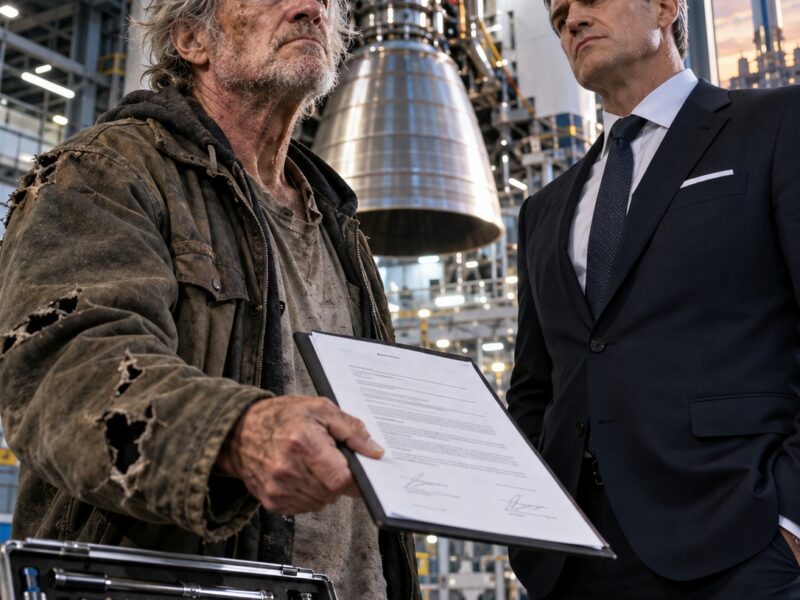
The first thing they noticed about the old man was the smell.
Not the intelligence in his eyes.
Not the way he stopped beneath the enormous engine suspended in Bay Four and looked at it with the quiet recognition of someone seeing an old friend.
They noticed the smell.
Rain. Sweat. Dust. The sour trace of nights spent sleeping somewhere without walls.
A security guard had already reached for his radio when one of the engineers laughed.
“What is this homeless guy doing in here?”
Another man looked up from a tablet. “I thought he came in to beg.”
The old man ignored them.
His name was Eric.
His gray hair hung unevenly around a face that had once appeared in engineering journals, government briefings, and photographs taken inside restricted test facilities. Now a weathered canvas coat covered his shoulders. One boot was splitting near the toe.
Nobody recognized him.
That was understandable.
Twenty years can erase a face.
Ten years of humiliation can erase almost everything else.
Eric stared past the engineers toward the machine dominating the center of the hangar.
It was magnificent even wounded.
Steel lines curved around the combustion chamber. Sensor cables disappeared beneath insulated housings. Cooling lines ran along the engine like arteries around a mechanical heart.
Red warning tags hung from several access panels.
The machine had failed during a manned-launch test.
Tomorrow morning, government inspectors were coming.
If the engine could not be returned to operational condition, the manufacturer responsible for it would default on one of the largest contracts in its history.
Hundreds of employees could lose their jobs.
The company could collapse.
And Eric knew something none of the people laughing at him knew.
He had helped build the machine they could not repair. Văn bản đã dán (1)
He stepped closer.
A younger engineer blocked him.
“Sir, you can’t be here.”
Eric’s eyes remained on the engine.
“I can fix it.”
For a moment, nobody spoke.
Then the room exploded with laughter.
“You can what?”
“I can fix your engine.”
One engineer leaned against a workstation, grinning. “Of course you can.”
Another raised his coffee cup.
“And if he fixes it, I’m the head of NASA.”
More laughter.
Eric had heard laughter like that before.
Not exactly the same voices.
But the same tone.
The sound people made when they had already decided who you were.
A broad-shouldered engineer stepped forward.
“You filthy bum. Get out before I have security drag you out.”
Eric finally looked at him.
“I was a chief rocket engineer.”
The laughter weakened.
Only slightly.
Eric continued.
“I worked on the first generation of full-flow liquid-oxygen systems that led to this engine.”
The engineer stared at him.
Then laughed harder.
“Sure you did.”
Eric’s jaw tightened.
There had been a time when men waited for him to speak before touching a valve.
There had been a time when young engineers crowded into test bays simply to watch him work.
There had been a time when his signature could stop a launch.
Then he had refused to approve a replacement system he believed was overpriced and less safe.
The disagreement should have remained technical.
It hadn’t.
Reports appeared with his name attached to decisions he said he had never made. Meetings happened without him. Rumors spread. People who had spent years praising him suddenly stopped returning calls.
Then came the investigation.
Then the dismissal.
Then the blacklist.
Eric fought it until fighting consumed everything he owned.
His savings disappeared first.
His house followed.
Friends became sympathetic acquaintances, then unanswered numbers.
Eventually even his name became something he avoided saying.
Until three nights ago.
Eric had been sitting inside a bus terminal watching rain crawl down the windows when a television above the vending machines interrupted its programming.
A rocket engine had malfunctioned during a launch operation.
The engine would be returned to its manufacturer for emergency overhaul.
Eric had stared at the footage.
At the plume.
At the shutdown sequence.
At the numbers flashing briefly across the television screen.
And something buried beneath years of defeat had moved inside him.
He knew that engine.
More importantly, he knew what everyone else was probably going to misunderstand about it.
So he had spent the last of his cash getting there.
Now he stood fifteen feet from the machine.
And they were telling him to leave.
“I can fix it,” Eric repeated.
The laughter was interrupted by a voice from behind them.
“What’s all this noise?”
Everyone turned.
Jack Mercer came down the metal stairs from the observation deck with the expression of a man who had not slept properly in two weeks.
Jack owned the company.
At least technically.
The banks owned pieces of it. Investors owned expectations. The federal contract owned the rest of his life.
His daughter Sophia followed him.
She was in her early thirties, an aerospace engineer herself, dressed in dark slacks and a white shirt with the sleeves rolled to her elbows.
Jack looked around.
“Is the engine fixed?”
Nobody answered.
His expression darkened.
“We hand that unit over tomorrow. If it isn’t operational, we’re finished. Do you understand me? Not delayed. Finished.”
One engineer pointed toward Eric.
“Jack, you’re going to love this. This bum says he can fix it.”
Jack stared.
His face hardened.
“How did you get in here?”
Eric didn’t answer.
Jack gestured toward the door.
“Get out.”
“I’m not here for money.”
Jack gave him a tired look.
“Then what are you here for?”
“The engine.”
“You don’t even know what you’re looking at.”
“I know exactly what I’m looking at.”
Jack stepped closer.
“Do you?”
His anger had been building for fourteen days, and Eric had arrived at exactly the wrong moment.
“That is one of the most advanced rocket propulsion systems ever built. I’ve brought in eight specialists. They’ve worked around the clock. They’ve run every diagnostic we have.”
Jack pointed at the engine.
“They couldn’t fix it.”
Then he pointed at Eric’s torn coat.
“And you walked in off the street telling me you can?”
“Yes.”
Jack stared at him.
“Who the hell are you?”
Eric’s answer was quiet.
“The man who can keep your company alive.”
Silence.
Sophia studied him differently now.
Not because she believed him.
Because he hadn’t looked at her father when he said it.
He had looked at the engine.
Jack laughed once without humor.
“You know what? Fine.”
“Dad,” Sophia said.
Jack raised a hand.
“No. I’m tired of experts telling me what can’t be done.”
He turned toward Eric.
“You want to make a miracle?”
“I don’t need a miracle.”
Something in Eric’s voice irritated him.
Jack stepped closer.
“If you repair that engine before the government team arrives, I’ll give you fifty percent of this company.”
The room went silent.
Even Eric looked at him now.
One engineer nearly dropped his tablet.
“Jack.”
Sophia stared at her father.
“Dad, that’s hundreds of millions of dollars if the company survives.”
Jack’s eyes remained fixed on Eric.
“Exactly.”
The mockery had become a wager.
And wagers become dangerous when desperate men make them.
Eric glanced toward the engine.
Then back at Jack.
“Fifty percent.”
Jack smiled.
“If you fix it.”
Sophia stepped between them.
“No.”
Jack frowned.
She lowered her voice.
“The federal contract has an unauthorized-modification clause. If he damages that engine, we don’t just lose the contract. We could face a federal investigation.”
Jack’s smile disappeared.
He knew she was right.
So did everyone else.
He looked at Eric again.
“Fine. There’s another condition.”
Eric waited.
“You sign a liability agreement. If you damage the engine, if your work causes the deadline to be missed, or if your modifications create a safety violation, responsibility falls on you.”
Sophia turned sharply.
“Dad.”
But Jack had already made the calculation.
If Eric was a fraud, the contract would scare him away.
If he was insane, the lawyers would protect the company as much as possible.
And if, by some impossible chance, he was telling the truth—
Jack didn’t allow himself to finish that thought.
Eric asked one question.
“If I fix it, will you honor the fifty percent?”
Someone laughed behind him.
Jack extended his hand.
“If you fix that engine, I’ll give you half the company.”
Eric looked at his hand.
He remembered another room.
Another contract.
Another signature.
Another group of men assuring him that paperwork meant exactly what it said.
He remembered losing everything.
For one second, the old fear returned.
A voice from ten years ago seemed to whisper inside him.
You’re finished.
You’ll never get back.
No one will believe you.
Eric took Jack’s hand.
“Write the agreement.”
Thirty minutes later, the contract was lying on a steel worktable.
Eric signed it.
Sophia watched the pen move across the paper.
“You understand what you just did?”
“Yes.”
“If you’re wrong, this could destroy what’s left of your life.”
Eric handed the pen back.
“There isn’t much left.”
Something in that answer silenced her.
She looked at his hands.
Dirty.
Scarred.
But steady.
Not the hands of a drunk.
Not the hands of a man panicking after signing away his freedom.
Jack took the contract.
“You have two days.”
Eric looked at the engine.
“I won’t need two days.”
A few engineers laughed again.
One of them stepped forward.
“Old man, do you even know how many components are inside that system?”
Eric said nothing.
“Do you know the internal architecture?”
Silence.
“Do you even know where the ignition control is?”
Eric turned toward him.
“I know every detail.”
The engineer smirked.
“Right.”
Eric walked toward the engine.
“Because I helped build it.”
The smile vanished from Sophia’s face.
Eric placed one palm against the cold outer shell.
For everyone else, it was metal.
For him, it was memory.
“Hello, old friend,” he whispered.
Then he closed his eyes.
And began.
The official diagnostic report was almost three hundred pages long.
Eric barely looked at it.
That offended everyone.
Professor Miller’s consulting team had concluded that the internal hardware system had suffered catastrophic thermal damage. Replacement would cost approximately seventy-two million dollars.
Jack’s company didn’t have seventy-two million dollars.
Which meant Miller’s diagnosis wasn’t merely technical.
It was a death sentence.
Eric moved around the engine slowly.
He touched the casing.
Knelt near the lower coolant assembly.
Ran two fingers along a junction.
Sophia followed him.
“What are you looking for?”
“Something that doesn’t belong.”
“What?”
“Cold.”
She frowned.
“The engine hasn’t run.”
“Exactly.”
He stood.
“Fire it.”
Several people spoke at once.
“What?”
“No.”
“Absolutely not.”
Eric walked toward the control station.
“The cooling system is the problem.”
One engineer laughed.
“You determined that by touching the shell?”
“Yes.”
“You’re insane.”
“Maybe.”
Eric looked at Jack.
“Fire it at minimum thrust.”
Sophia stepped forward.
“Dad, ignition with an unresolved fault could cause a blowout.”
Eric looked at her.
“If I’m wrong, stop it immediately.”
“That isn’t reassuring.”
“It isn’t supposed to be.”
Jack stared through the reinforced window toward the engine.
Every rational instinct told him to stop.
But rational experts had already spent two weeks failing.
Tomorrow morning, rational consequences were going to bankrupt him.
“Minimum thrust,” Jack ordered.
Sophia looked at him.
“Dad.”
“Do it.”
The warning alarm sounded.
Personnel moved behind the protective barrier.
Eric didn’t.
Sophia noticed.
“Get behind the glass.”
“I need to be here.”
The engine ignited.
The hangar changed instantly.
A deep mechanical roar rolled through the structure.
The floor vibrated.
Numbers began climbing across the monitors.
Eric stood near the engine.
Then, to everyone’s horror, he reached toward the casing.
“What is he doing?”
“He’s going to burn himself.”
Eric pressed his gloved hand against a section of the outer shell.
Moved it six inches.
Stopped.
Moved again.
His eyes narrowed.
The engine shut down.
Silence rushed into the bay.
Eric removed his glove.
His hand trembled slightly.
Not fear.
Recognition.
“I found it.”
Professor Miller’s lead consultant scoffed.
“The hardware is destroyed.”
Eric shook his head.
“The hardware is fine.”
The consultant grabbed the report.
“Look at the thermal readings.”
“I saw them.”
“Then you know the hardware is fried.”
“No.”
Eric pointed toward the cooling assembly.
“Your sensors are lying to you.”
That produced another wave of disbelief.
Eric crouched.
“The coolant valve bolts are loose.”
Nobody laughed this time.
Jack approached.
“Loose?”
“When ignition begins, the coolant flow destabilizes. Temperature distribution becomes inconsistent. The sensors interpret the abnormal thermal pattern as internal hardware failure.”
Sophia’s eyes narrowed.
“If that’s true…”
“The seventy-two-million-dollar replacement fixes something that isn’t broken.”
The consultant stepped forward.
“You’re accusing Professor Miller’s diagnostic system of being wrong?”
“No.”
Eric stood.
“I’m accusing you of believing it more than the machine in front of you.”
The words landed hard.
The consultant’s face reddened.
“Our scanners operate at tolerances your eyes couldn’t even perceive.”
“Then why didn’t they find the loose bolts?”
Silence.
Eric looked at Jack.
“Tighten the coolant assembly. Reprogram the startup sequence. Cryogenic injection needs to begin half a second before ignition.”
Sophia stared at him.
“Half a second?”
“Yes.”
“That timing window is incredibly narrow.”
“Only if you don’t understand the flow rate.”
The consultant shook his head.
“This is fantasy.”
Eric ignored him.
“I need the manual service kit.”
Nobody moved.
“The what?” Jack asked.
“The physical tool kit shipped with the engine.”
An engineer laughed uncertainly.
“There isn’t one.”
“Yes, there is.”
“We’ve serviced this unit for weeks. Everything is digital.”
Eric looked toward a storage corridor.
“Silver sealed container. Blue spare-parts label.”
Sophia suddenly looked up.
She remembered something.
A lecture.
A professor mentioning redundant mechanical service equipment designed for sensor failure.
She turned toward two engineers.
“Check storage.”
The consultant scoffed.
“You’re actually doing this?”
Sophia didn’t answer.
Ten minutes later, the engineers returned carrying a silver container.
The room became very quiet.
Jack looked at his staff.
“You didn’t know we had this?”
Nobody answered.
Eric opened the case.
Inside lay a series of precision mechanical tools most of the younger engineers had never used.
He picked up one.
Sophia inhaled sharply.
She recognized the configuration.
More importantly, she recognized how he held it.
Not like someone remembering instructions.
Like someone remembering himself.
Eric removed an access plate.
He worked without consulting a manual.
His fingers moved through cramped spaces with eerie certainty.
Turn.
Pause.
Measure.
Adjust.
Reset.
An engineer whispered, “How does he know where everything is?”
Another answered, “He shouldn’t.”
Sophia watched Eric’s hands.
Then she saw the movement.
A particular sequence.
Tool angle.
Counterpressure.
Quarter rotation.
Reposition.
Her heart began beating faster.
She had seen it once.
Not in person.
In an old engineering lecture.
“This can’t be…”
Jack heard her.
“What?”
Sophia stepped closer to the glass.
“That’s the Repton assembly technique.”
Nobody spoke.
“The what?”
“A manual micro-adjustment method.”
She swallowed.
“My professor said almost nobody could perform it. It was developed during early full-flow engine testing.”
The consultant rolled his eyes.
“Old academic mythology.”
Sophia shook her head.
“No.”
She watched Eric make another adjustment.
“There was one engineer who mastered it.”
Jack looked from his daughter to the homeless man working inside the engine.
“Who?”
Sophia didn’t answer immediately.
Because the answer felt absurd.
Professor Eric Hale had once been considered one of the brightest propulsion engineers of his generation.
Then he had disappeared.
Some said retirement.
Some said scandal.
Some said fraud.
Eventually his name stopped appearing in textbooks.
Sophia stared through the glass.
“No.”
Jack grabbed her arm lightly.
“Sophia.”
She whispered:
“Professor Eric.”
Jack looked at the man in the torn coat.
“That guy?”
“It can’t be him.”
Eric paused.
For a second, his hand remained inside the engine.
His eyes closed.
Twenty years disappeared.
He was young again.
Standing beneath harsh lights in a government test bay.
Professor Leo beside him.
The engine unfinished.
Everyone exhausted.
Someone yelling that they were out of time.
Leo laughing.
Eric tightening the same assembly by hand.
The first successful ignition.
The roar.
The cheering.
Then the years afterward.
The compromises.
The pressure.
The meeting where executives asked him to approve the expensive replacement architecture.
His refusal.
The retaliation.
His fall.
Eric opened his eyes.
The past was gone.
Only the machine remained.
“Never thought I’d see you again,” he whispered.
Sophia heard him.
“Who are you?”
Eric didn’t answer.
He finished tightening the assembly.
Then he moved to the control system.
Minutes became an hour.
Then two.
The mockery slowly disappeared.
Nobody laughed anymore.
Even the consultant watched in silence.
Finally, Eric closed the access panel.
He stood.
His back hurt.
His hands were shaking.
But his eyes were clear.
“Done.”
Jack stared.
“That’s it?”
“The cooling layer is stabilized.”
“You’re saying the engine is fixed?”
Eric looked toward the control room.
“There’s only one way to know.”
The consultant recovered his voice.
“Exactly.”
His smile returned.
“Fire it.”
Sophia turned.
“No.”
Everyone looked at her.
She pointed toward the engine.
“If he’s wrong, the combustion chamber could fail catastrophically.”
Jack looked toward the clock.
Less than eighteen hours remained before the federal team arrived.
“If we don’t test it,” he said quietly, “we’re dead tomorrow anyway.”
Sophia looked at Eric.
For the first time since he entered the building, nobody saw a homeless man.
They saw the person holding the fate of the company.
Eric entered the control room.
The consultant whispered to another engineer.
“Watch. The moment it starts, those readings will go red.”
Eric placed his hand on the control panel.
Sophia noticed something else.
He didn’t search for anything.
His fingers moved automatically.
Power.
Coolant.
Pressure.
Ignition sequence.
Exactly half a second.
She felt cold.
Jack stood behind him.
“Eric.”
It was the first time he had used his name.
Eric looked back.
Jack’s voice was quieter.
“Are you certain?”
Eric looked through the glass at the machine.
“No engineer is ever certain.”
That answer terrified Jack more than confidence would have.
Eric continued.
“But I know what I saw.”
He turned back.
The warning system activated.
Red lights began rotating.
Personnel withdrew.
The test bay doors locked.
Eric started the countdown.
“Three.”
Sophia held her breath.
“Two.”
The consultant smiled.
“One.”
Eric initiated ignition.
The engine erupted.
The building shook.
A wall of sound slammed through the reinforced chamber.
Numbers climbed.
Green.
Green.
Green.
Then suddenly—
Red.
Multiple indicators flashed simultaneously.
The consultant laughed.
“I told you.”
Sophia moved toward the emergency shutdown.
“Combustion overload.”
Another warning appeared.
Then another.
Jack’s face drained of color.
“What happened?”
The consultant pointed toward Eric.
“He destroyed it.”
Alarms screamed.
“Shut it down!” someone yelled.
Eric didn’t move.
“Eric!”
Jack grabbed his shoulder.
“The chamber is overloaded.”
Eric stared at the coolant timing.
0.5.
Exactly.
Pressure rising.
Temperature rising.
Then—
stabilizing.
One red indicator turned amber.
Then green.
Another followed.
Then another.
The alarm stopped.
Nobody moved.
The roar continued.
Steady.
Deep.
Perfect.
Sophia stared at the screen.
“Dad…”
Jack couldn’t answer.
Thrust climbed to target.
The chamber remained stable.
Coolant pressure held.
Temperature stayed inside tolerance.
The engine that eight specialists had declared effectively dead was running.
Not barely.
Not temporarily.
It was running beautifully.
Someone whispered:
“Oh my God.”
Eric stood in front of the controls with both hands resting against the console.
No celebration.
No smile.
Only silence.
Because everyone else was seeing a miracle.
Eric was seeing an old friend breathe again.
Jack slowly turned toward the engineers who had laughed when Eric entered.
Nobody met his eyes.
Then he looked at Eric.
“You really built this.”
Eric shut down the engine.
The roar faded.
For several seconds, the only sound was cooling metal ticking inside the test chamber.
“Yes.”
Sophia stepped toward him.
“Professor Eric Hale?”
He looked at her.
She had her answer before he spoke.
The consultant’s face changed.
The name meant something to him too.
Eric removed his hands from the console.
“I haven’t been called Professor in a long time.”
Jack stared at the liability agreement lying on the desk.
Hours earlier, that paper had been a joke.
A trap.
A way to frighten a homeless man out of the building.
Now it represented half his company.
Jack picked it up.
The room waited.
Eric watched him carefully.
He had learned what promises were worth when money entered the room.
Jack looked at the agreement.
Then at the engine.
Then back at Eric.
“You saved this company.”
Eric said nothing.
“You saved the contract.”
Still nothing.
Jack understood.
This wasn’t about gratitude.
It was about whether he was the kind of man who kept his word after discovering how expensive his word had become.
He extended the agreement.
“Fifty percent.”
The consultant stepped forward.
“Jack, you can’t seriously—”
Jack turned.
“Stop.”
One word.
Enough.
He looked at Eric again.
“And the CTO position, if you want it.”
Eric stared at the paper.
Half a company.
A title.
An office.
Things he once would have thought mattered.
He thought instead about the bus terminal.
The rain.
The television above the vending machines.
The years when nobody returned his calls.
The nights when people walked past him without looking.
He thought about how quickly human beings decided someone’s value from clothing, status, or whether the world still applauded when that person entered a room.
Sophia approached.
“What happened to you?”
Eric looked at her.
That question hurt more than the insults had.
He glanced toward the engine.
“I said no to the wrong people.”
She waited.
“They wanted me to support a replacement system I believed was more expensive and less safe. I refused.”
“And they destroyed your career?”
“They didn’t do it all at once.”
His voice softened.
“That’s not how people destroy you.”
The room became still.
“They remove one opportunity. Then another. They make people afraid to hire you. They turn your reputation into a question nobody wants to answer. Eventually, the phone stops ringing.”
He looked down at his coat.
“And after enough years, people believe where you ended up proves what they said about you.”
Nobody knew what to say.
Eric looked toward the engine again.
“But machines don’t care about rumors.”
Sophia’s eyes filled.
Eric smiled faintly.
“A loose bolt is still a loose bolt, whether the man pointing at it is wearing a lab coat or sleeping at a bus station.”
Jack lowered his eyes.
Hours earlier, he had called him a bum.
Now he could barely look at him.
Eric took the contract.
But he didn’t sign anything else.
Not yet.
Outside the facility, dawn was beginning to lighten the horizon.
The government inspection team would arrive soon.
Employees who had spent the night preparing for bankruptcy were receiving messages that the engine had passed its first full test.
Nobody knew what would happen to Eric’s old case.
Nobody knew whether the people who had driven him from aerospace would ever answer for it.
Nobody knew whether half a company could repair ten lost years.
Some things could not be restored by money.
Some damage had no replacement part.
Eric walked back into Bay Four alone.
The engine stood silent beneath the lights.
He placed his palm against its metal shell one last time.
Twenty years earlier, that machine had represented everything he believed his life would become.
That morning, it represented something smaller.
And perhaps more important.
Proof.
Not proof that he was a genius.
Not proof that the people who mocked him were fools.
Proof that being discarded did not mean becoming worthless.
Behind him, Sophia stopped at the entrance.
She didn’t interrupt.
Eric looked at the scars across his hands.
Then at the engine.
“Funny thing about failure,” he whispered.
Sophia heard him.
“What?”
Eric turned.
For the first time since walking through the facility doors, he looked less like a homeless man.
Not because his clothes had changed.
They hadn’t.
Not because someone had given him a title.
Nobody had.
Something inside him had simply stopped hiding.
He gave Sophia a tired smile.
“Sometimes everybody thinks you’re broken because they’re measuring the wrong thing.”
Outside, the sun rose over the aerospace complex.
Inside, the engine cooled quietly.
And on a steel desk in the control room lay a contract promising half a company to a man they had tried to throw out only hours before.
But Eric didn’t look at it.
He looked through the hangar doors toward the morning.
Because after losing his career, his home, his reputation, and nearly himself, the most valuable thing he had recovered that night wasn’t written in a contract.
It was the certainty that had once made him stand beneath an impossible machine and believe he could make it fly.
And this time, nobody could blacklist that.









