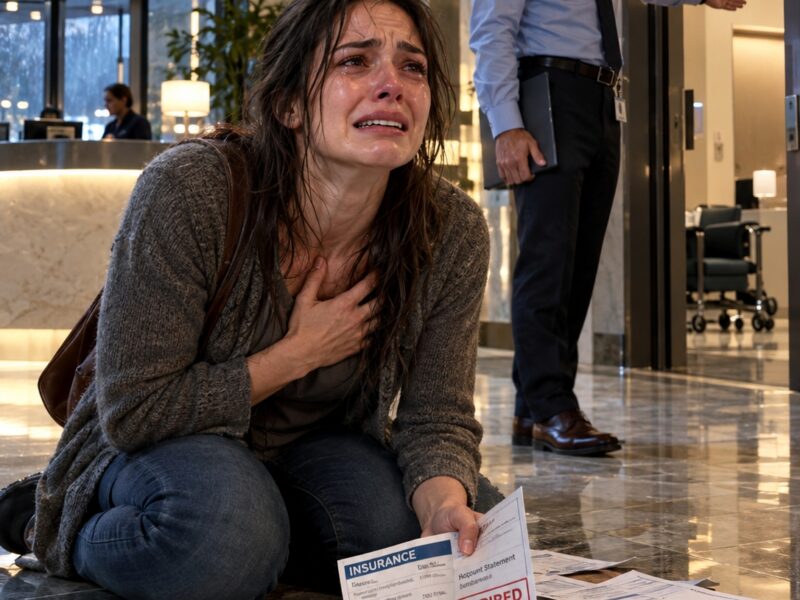
The Hospital Turned Her Away—Then the CEO Saw Her Name and Realized She’d Been Hiding His Daughter for Nine Years

At 7:41 on the first Monday morning of November, Meera Caffrey stood outside an emergency room counting her own breaths.
Twenty-seven.
Twenty-eight.
Twenty-nine.
Too many.
Cold rain blew sideways off the Ohio River, striking the glass entrance of Kincaid Memorial Hospital hard enough to sound like handfuls of gravel.
Meera pressed one palm beneath her breastbone.
The pressure was getting worse.
She knew what that could mean.
She had once been a registered nurse.
Which was exactly why she was terrified.
But when she finally walked through the emergency-room doors with chest pain, shortness of breath, an expired insurance card, and $3,180 in unpaid hospital bills, nobody took her to an exam room.
They took her to a financial counseling office.
Blue plastic chairs.
A brochure rack.
A box of tissues.
No oxygen.
No cardiac monitor.
No nurse.
And when Meera whispered that she could barely breathe, the man standing across from her smiled professionally and told her there was a county clinic across town that opened at eight.
Meera stared at him.
“I need an EKG.”
The smile never moved.
“The clinic is very experienced with patients in your situation.”
Patients in your situation.
Meera understood exactly what he meant.
Poor.
Uninsured.
Behind on her bills.
Disposable.
She turned toward the emergency lobby.
She managed three steps.
Then the floor tilted beneath her.
Her folder fell open.
Bills scattered across polished stone.
Past-due notices.
Pharmacy receipts.
Her daughter’s inhaler invoice.
A red-stamped FINAL NOTICE from the same hospital whose emergency department had just quietly suggested she go somewhere else.
Meera dropped into a chair.
And for the first time in years, she cried where strangers could see her.
“Nobody wants to treat me.”
Nine minutes later, the automatic doors opened.
A tall man in a rain-darkened charcoal coat walked inside.
He was the CEO of the hospital.
He saw the bills on the floor.
He saw the woman struggling to breathe.
Then he picked up one sheet of paper.
And read her name.
MEERA CAFFREY.
The color drained from his face.
Because nine years earlier, Meera Caffrey had vanished from his life with six words that had never stopped haunting him.
Please don’t look for me.
And now she was sitting inside his hospital, barely able to breathe.
But that wasn’t what frightened him most.
What frightened him was what she whispered when the medical team finally came running.
She grabbed his sleeve.
Pulled him close.
And said:
“Whatever happens… don’t call your father.”
Then the emergency-room doors closed between them.
And Ellery Kincaid realized that whatever had happened nine years ago had never really ended.
It had only been waiting for her to come back.
Three hours earlier, Meera had been standing beneath fluorescent warehouse lights at Tri-State Grocers, scanning cases of canned vegetables.
It was 3:07 a.m.
She remembered the time because the handheld scanner had frozen again.
She bent to lift a case of tomatoes from a pallet.
That was when she felt it.
A pressure beneath her sternum.
Not sharp.
Not dramatic.
Almost polite.
Then came the strange sensation that someone had quietly removed half the oxygen from the room.
Meera straightened.
Waited.
Breathed.
The pressure remained.
“Too much coffee,” she whispered.
She had said things like that to patients once.
Not because she believed them.
Because frightened people sometimes needed thirty seconds before they were ready to hear the truth.
By five, she was breathing faster.
By six, climbing the stairs to her apartment left her gripping the railing outside 3B.
Niles Lockridge opened the door across the landing.
Seventy-four years old, retired river mechanic, permanently suspicious of anyone wearing expensive shoes.
“You look terrible.”
“Good morning to you too.”
“I mean medically terrible.”
“I’m tired.”
“You’re gray.”
“I’m always gray at six in the morning.”
“No, you’re usually mean at six in the morning. Today you’re gray.”
Despite herself, Meera smiled.
Then the smile disappeared when another pressure wave tightened across her chest.
Niles saw it.
“Hospital.”
“No.”
“That wasn’t a question.”
Meera looked through her apartment door.
Lenny was asleep on the couch beneath a blanket covered in faded yellow stars.
Eight years old.
One braid had come loose during the night.
An unfinished school project sat on the coffee table beside her.
Meera lowered her voice.
“I don’t have insurance.”
“You have lungs.”
“I also have rent.”
“You’re breathing like you ran upstairs.”
“I did run upstairs.”
“You walked.”
Meera looked at him.
Niles looked back.
Neither moved.
Finally, she grabbed the manila folder from the kitchen counter.
“If I’m not back before school—”
“I know.”
“Her inhaler is—”
“Top cabinet.”
“Emergency numbers—”
“On refrigerator.”
“Don’t let her eat strawberry jam.”
“She hates strawberry jam.”
“I know. I’m her mother.”
“And I’ve lived across from you for six years.”
Meera paused.
“Thank you.”
Niles waved her away.
“Go.”
So she went.
Not because she believed the hospital would help.
Because the nurse she used to be had finally become louder than the woman she had spent nine years turning herself into.
Kincaid Memorial smelled exactly as she remembered.
Disinfectant.
Floor wax.
Coffee.
Fear.
Behind registration sat a woman with warm brown eyes and a badge reading:
MARIBEL SANTOS — PATIENT ACCESS
Maribel looked up once.
Then immediately stood.
“You okay?”
“No.”
The answer sounded embarrassingly small.
Maribel pulled a chair closer.
“Sit. Tell me what’s happening.”
“Chest tightness. Shortness of breath. Started around three.”
“Dizziness?”
“A little.”
“Any history of clots?”
“No.”
“Leg swelling?”
Meera hesitated.
“My left calf hurt yesterday.”
Maribel’s expression changed.
Her fingers moved faster.
“Insurance?”
There it was.
Meera put the damp folder on the counter.
Inside was her driver’s license, an expired employer health card, two pharmacy receipts, and the bill from the night Lenny’s asthma had sent them to Kincaid Memorial the previous spring.
$3,180.
Maribel examined the card.
“Do you have active coverage?”
“I don’t think so. The staffing company changed carriers.”
“That’s okay. We can sort that out.”
Meera nearly laughed.
Nothing involving American healthcare and unpaid bills had ever felt like something people simply “sorted out.”
Still, Maribel printed a wristband.
She fastened it gently around Meera’s arm.
Then reached for the triage phone.
She never got to pick it up.
“Morning, Maribel.”
A man had appeared beside her.
Pressed blue shirt.
Perfect tie.
Perfect teeth.
Mid-forties.
The expression of a man who had practiced concern so many times he no longer needed to feel it.
Maribel stiffened.
“Bryce.”
His badge read:
BRYCE CRANWELL — DIRECTOR, REVENUE ACCESS OPERATIONS
He looked at the computer.
Then the expired insurance card.
Then the balance.
Then Meera.
In that order.
“Ms. Caffrey?”
“Yes.”
“I’d like to help you resolve a financial-clearance issue before triage.”
Meera stared at him.
“I’m having chest pain.”
“I understand.”
“No. I don’t think you do.”
Maribel said quietly, “Bryce, I was about to call clinical.”
He ignored her.
“We have a county clinic on Third Street that works extensively with uninsured patients. They open at eight.”
“I can’t breathe.”
“We’re not refusing care.”
“Then send me to a nurse.”
“We’re simply trying to make sure you receive care in the most appropriate setting.”
There were sentences designed to communicate.
And there were sentences designed to leave no fingerprints.
Meera had heard enough hospital language to know which kind this was.
“I need an EKG,” she said, “not a payment plan.”
Bryce lowered his voice.
“The clinic is very good with situations like yours.”
Something cold moved through her.
Situations like yours.
Not symptoms.
Not chest pain.
Not possible embolism.
A financial category.
He gestured toward a narrow room off the side hall.
Meera followed because sick people sometimes obey authority simply because resisting requires oxygen.
The room contained six blue molded chairs.
A brochure rack.
A tissue box.
Posters about payment assistance.
No monitor.
No oxygen.
No nurse.
Meera stood in the doorway.
Then turned around.
“I’m going back.”
“Of course.”
Bryce stepped aside.
No physical barrier.
That somehow made it worse.
Back in the lobby, strangers avoided looking at her.
An older man wearing a Colts cap stared at his shoes.
A security guard shifted his weight.
Maribel stood behind the desk with her jaw tight.
Meera made it three steps.
Then the floor moved.
Her folder fell.
Papers scattered.
She reached for the counter and missed.
Someone gasped.
She landed in the nearest chair.
Her body was telling her to conserve oxygen.
Her pride was telling her to stand.
Neither won.
Instead, tears came.
Quietly at first.
Then harder.
“Nobody wants to treat me.”
She wasn’t talking to Bryce anymore.
She wasn’t talking to Maribel.
She wasn’t talking to anyone.
Sometimes humiliation becomes unbearable only after it is given a sentence.
Then the automatic doors opened.
And the past walked in through the rain.
Ellery Kincaid never used the executive entrance on Monday mornings.
His mother had taught him that.
“Executives who use private doors too often,” Augusta Kincaid once told him, “eventually start believing private versions of reality.”
She had been dying when she said it.
Cancer had taken weight from her body but none of the precision from her voice.
So every Monday, Ellery entered through the hospital’s main doors.
No entourage.
No umbrella.
No assistant.
Just a charcoal coat and the habit of noticing things people stopped noticing once their offices moved upstairs.
That morning, he noticed the papers first.
Then the woman.
She was bent slightly forward, one arm across her ribs.
Her shoulders rose too fast.
Clinically too fast.
He changed direction.
Maribel saw him.
Her face shifted.
Bryce saw him next.
His shifted more.
Ellery ignored both.
He crouched beside the scattered papers.
Picked up the nearest bill.
Saw the name.
Everything inside him stopped.
Meera Caffrey.
For one impossible second, the hospital vanished.
He was twenty-six again.
Fourth-floor oncology.
Two in the morning.
His mother under a thin cotton blanket.
A young nurse beside him.
Dark hair.
Tired eyes.
Steady hands.
“Don’t watch the monitor,” she had whispered.
“What?”
“Watch her chest. Count the blanket going up and down. Machines can make you panic. Watch her.”
Meera.
He looked up.
The woman in the chair was older now.
Thinner.
Hair twisted into a rough knot.
Gray beginning at one temple.
But there was no question.
“Meera?”
Her eyes found his.
Recognition was immediate.
Relief was not.
Fear was.
That frightened Ellery more than anything else.
He watched her chest.
Counted.
Thirty breaths in one minute.
“Maribel.”
His voice was quiet.
“Call clinical response.”
Bryce stepped forward.
“Mr. Kincaid, she’s self-pay and has an outstanding balance—”
Ellery did not even look at him.
“She is breathing thirty times a minute.”
Silence fell across the lobby.
Maribel grabbed the phone.
Meera tried to stand.
Ellery extended one hand but stopped before touching her.
“Stay seated.”
“I’m fine.”
“No.”
“You don’t know that.”
“No,” he said. “But I know what thirty looks like.”
The clinical doors burst open.
Dr. Karina Holloway arrived with two nurses and a stretcher.
One look at Meera was enough.
“Left calf swelling?”
Meera nodded.
“Yesterday.”
Karina’s face sharpened.
“Move.”
They transferred her.
As the stretcher turned, Meera suddenly reached out.
Her fingers closed around Ellery’s sleeve.
Weak grip.
Strong intention.
He bent down.
“Please.”
Her voice was barely there.
“Don’t call anyone.”
“Meera—”
“Don’t call your father.”
The doors closed.
Ellery remained standing in the lobby.
One of her bills was still in his hand.
Nine years earlier, Meera had left him a note.
No explanation.
No address.
No phone number.
Only:
I can’t be the person you need. Please don’t look for me.
He had obeyed.
He had hated himself for obeying.
Now she had returned half unable to breathe.
And the first person she feared was Benedict Kincaid.
His father.
At 9:17, Karina came through the emergency doors carrying a tablet.
Ellery stood.
She raised one hand.
“If you ask for protected medical information, I will embarrass you in your own lobby.”
“I’m not asking for her chart.”
“Good.”
He swallowed.
“Is she alive?”
Karina studied him.
Something in his face must have answered a question she hadn’t asked.
“She’s stable.”
His lungs released.
“She has pulmonary emboli.”
Ellery’s expression changed.
“Both lungs.”
“How bad?”
“Significant. She’s on anticoagulation. We caught it before she became hemodynamically unstable.”
“How close?”
Karina looked toward the side hallway.
“Close enough.”
She lowered the tablet.
“Another hour sitting around untreated and this conversation might be different.”
Ellery followed her gaze.
The blue-chair room.
“What is that room?”
Karina asked.
Ellery stared at it.
“I’m beginning to wonder.”
He sat in the emergency waiting room for the next four hours.
Not his office.
Not the executive conference room.
A molded plastic chair.
At eleven-thirty, Maribel approached carrying coffee.
She placed it beside him.
“Mr. Kincaid?”
“Yes?”
“She isn’t the first.”
He looked up.
“First what?”
Maribel glanced toward Bryce’s office.
Fear crossed her face.
Then disappeared.
“Nothing.”
She walked away.
Ellery didn’t stop her.
People frightened of speaking rarely needed to be dragged into courage.
They needed a door left open.
But he never forgot what she said.
At three-twenty, the automatic doors opened again.
The old man in the Colts cap returned.
This time he had an eight-year-old girl beside him.
Pink rain boots.
Brown braid.
A paper bag hugged against her chest.
The girl saw Ellery.
“You work here?”
“Sometimes.”
“My mom’s here.”
“I know.”
The old man examined Ellery’s coat.
Shoes.
Badge.
Then said nothing.
The girl sat beside him and opened the bag.
Reading glasses.
Phone charger.
Saltines.
“She forgets to eat when she’s scared.”
Something tightened inside Ellery.
“What’s your name?”
“Lenny.”
“Lenny what?”
“Lenny Augusta Caffrey.”
Augusta.
Ellery stopped breathing.
His mother’s name.
Nobody used Augusta.
His mother herself had hated it most of her life.
Then during her final year she began saying it sounded less like a woman who owned silver and more like somebody who could survive winter.
Ellery looked at the girl.
Brown hair.
Small serious mouth.
Gray eyes.
His eyes.
No.
He corrected himself immediately.
Grief could create resemblance anywhere.
“How old are you?”
“Eight.”
“Nine in August,” the old man added.
Ellery counted backward.
Once.
Again.
His pulse changed.
Lenny opened the saltines.
“Is my mom going to die?”
Most adults would have lied.
Ellery had spent too much time beside dying people to do that.
“The doctors are working very hard.”
“That’s not what I asked.”
He looked at her.
“No.”
She waited.
“I don’t know yet.”
Her expression didn’t change.
“When I know, I’ll tell you the truth.”
Lenny considered him.
Then nodded.
The old man looked at Ellery differently after that.
Across the hallway, behind a glass door, Bryce Cranwell lifted his phone.
Ellery didn’t hear the call.
He didn’t hear Bryce lower his voice.
He didn’t hear him say:
“No, sir. Not Ellery.”
A pause.
“The senior Mr. Kincaid.”
Another pause.
Then:
“She’s back.”
Meera woke Tuesday morning to the click of a heparin pump.
Her first word was Lenny’s name.
The nurse smiled.
“With Mr. Lockridge.”
“She okay?”
“She ate crackers and made us promise to tell you.”
Meera almost smiled.
Then remembered.
“Is he here?”
The nurse didn’t ask who.
“He was.”
Ellery returned at eleven.
He knocked.
Waited.
Only entered when Meera nodded.
He stopped at the foot of the bed.
For several seconds neither spoke.
She looked smaller beneath the white blanket.
But alive.
That fact temporarily took every intelligent sentence from him.
“Thank you,” she finally said.
“For yesterday.”
“Dr. Holloway saved you.”
“Your name got me through those doors.”
“No.”
She looked at him.
“I won’t let you make that true.”
Something in the answer unsettled her.
Nine years ago, Ellery had solved problems before anyone could ask.
Car.
Money.
Private appointment.
Better room.
He had grown up in a family where pain was managed through control.
He had mistaken provision for listening.
Now he simply stood there.
Meera picked up her medication sheet.
Read every line.
Ellery waited.
He remembered that too.
She hated being spoken to while reading medical instructions.
When she finished, he said, “Yesterday, I counted your breathing.”
Her fingers stopped.
“Thirty.”
Silence.
“I watched your coat,” he added. “Not the monitor.”
Meera looked up.
Nine years collapsed.
“Watch the blanket,” she whispered.
“Not the monitor.”
For one brief second, something warm moved between them.
They both felt it.
They both distrusted it.
Then Ellery said:
“Her middle name is Augusta.”
The warmth vanished.
Meera gripped the paper.
“Not here.”
“Meera.”
“Not while I’m in a hospital bed with a needle in my arm.”
He stopped.
“My father and I had one conversation,” she said. “One. And that conversation ended everything.”
“What did he say?”
“Not today.”
Ellery wanted to push.
The old Ellery would have.
Instead he nodded.
And left.
Because she asked him to.
Downstairs, Maribel was waiting.
She carried a battered spiral notebook.
Coffee stain on the cover.
Bent wire.
She handed it to him.
Inside were names.
Dates.
Times.
Symptoms.
Forty-one entries.
Beside every one:
COUNTY CLINIC — THIRD STREET.
Ellery looked up.
“Forty-one?”
Maribel nodded.
“I couldn’t stop him.”
Her voice broke.
“So I stopped forgetting.”
Ellery turned pages.
Chest pain.
Shortness of breath.
Abdominal pain.
Dizziness.
Bleeding.
Neurological symptoms.
Then one name stopped him.
Dale Hupp, 61. Chest pain. February 3. Sent to county clinic.
“What happened?”
Maribel swallowed.
“His wife called two weeks later.”
“For what?”
“To cancel his follow-up.”
Ellery waited.
Maribel’s eyes filled.
“She said he was dead.”
Something cold settled beneath Ellery’s ribs.
Then he remembered a document.
Three years earlier.
PATIENT ACCESS RESTRUCTURING INITIATIVE.
Improved front-end efficiency.
Reduce uncompensated emergency utilization.
He had signed it.
Later, when he checked the digital audit log, he would discover he had spent forty-seven seconds reviewing it.
Forty-seven seconds.
He had never walked downstairs to see what “efficiency” looked like.
Now he knew.
It looked like blue chairs.
Upstairs, someone delivered white lilies to Meera’s room.
No card.
She almost asked the volunteer to take them away.
Then she saw the folded sheet hidden between the stems.
A photocopy.
Old.
Nine years old.
An incident report.
Her name.
Across the middle, written in red ink:
STILL OPEN.
Meera’s hands began shaking.
She knew the handwriting.
Benedict.
She opened her wallet.
Behind her driver’s license was a faded hospital wristband.
KINCAID, AUGUSTA.
She had carried it for nine years.
Not because she loved Benedict.
Because she had loved his wife.
Because Augusta Kincaid had died holding Meera’s hand.
Because in the final hours of her life, Augusta had asked for one person.
Not her husband.
Ellery.
And there was something Ellery still didn’t know about that night.
At seven, he returned carrying tea.
The bed was empty.
IV removed correctly.
Gauze carefully taped over the site.
The nurse looked apologetic.
“She signed out AMA.”
“Against medical advice?”
“She waited for counseling.”
“She has clots in both lungs.”
“She knows.”
On the pillow lay her hospital bracelet.
Cut cleanly in half.
Ellery called Niles.
“She came home?”
“Briefly.”
“Where is she?”
“Work.”
Ellery stared at the wall.
“At ten o’clock at night?”
“Warehouse.”
“She could die.”
“I told her.”
“And?”
Niles was silent for a moment.
Then:
“She needs money more than she fears dying.”
The line hit harder than Ellery expected.
“That’s been true for a long time.”
At 10:40 p.m., a black sedan pulled behind Tri-State Grocers.
Ellery found Meera at a conveyor.
Scanning boxes.
One hand gripping the rail.
Every few cases she stopped to breathe.
He did not grab the scanner.
He did not summon her supervisor.
He did not threaten anyone.
He sat on the edge of the loading dock.
His expensive charcoal coat collected diesel dust.
Meera stared at him.
“What are you doing?”
“Sitting.”
“You’re insane.”
“Possibly.”
“Go home.”
“No.”
“Ellery.”
He looked toward the trucks.
“Tell me what you’re afraid of.”
She said nothing.
Then he added the sentence that changed something between them.
“I won’t fix it unless you ask me.”
Meera went completely still.
That was new.
She lowered herself onto the dock beside him.
“I can’t tell you everything.”
“Okay.”
“Not yet.”
“Okay.”
“If I go back to a hospital, it’s not yours.”
“Okay.”
“County.”
“Okay.”
“Different doctor.”
“Okay.”
“You do not access my chart.”
“I won’t.”
“I pay my own way.”
He hesitated.
Her eyes hardened.
“All of it,” he said.
“No secret bills paid?”
“No.”
“No phone calls?”
“No.”
“No favors?”
“No.”
She studied him.
“Okay.”
They went to Deaconess Midtown.
Meera was admitted under another medical team.
Ellery stayed out of her chart.
By Thursday, she was properly discharged with oral anticoagulation and an assistance program she had chosen herself.
Then her landlord called.
“November’s covered.”
Meera froze.
“What?”
“Paid by Kincaid’s office.”
That evening she mailed Ellery a check for forty dollars.
It was everything she could spare.
With it was a note.
Rent is mine. Thank you for asking next time.
Ellery read it twice.
Then called the landlord.
“Refund the payment.”
His assistant looked surprised.
“That was meant kindly.”
Ellery stared at Meera’s note.
“Kindness without permission is still control.”
Thursday evening, Meera let him visit the apartment.
One hour.
No more.
It was above a laundromat.
Small.
Warm.
Lenny sat at the kitchen table doing fractions.
She looked up.
“Can you do math?”
Ellery removed his coat.
“I run three hospitals.”
“That’s not what I asked.”
Niles laughed from the doorway.
Ten minutes later, Lenny tapped the worksheet.
“Wrong.”
Ellery frowned.
“Which one?”
“Both.”
He checked.
She was right.
Niles laughed harder.
At the stove, Meera turned away so nobody saw her smile.
For an hour, Ellery experienced something he had not expected.
Normality.
Cheap kitchen chairs.
A buzzing refrigerator.
Homework.
A child complaining about fractions.
A neighbor stealing crackers without asking.
It felt more intimate than any penthouse dinner he had attended in years.
Later, Meera walked him toward the stairs.
The bulb above them buzzed.
Ellery stopped two steps below her.
That made them almost eye level.
“Meera.”
She knew.
He saw it.
“Is she mine?”
Silence.
He waited.
Meera did not answer.
She didn’t need to.
His breathing changed.
She looked at him.
“Come Saturday.”
His hand tightened around the railing.
“I’ll tell you everything.”
“When?”
“Saturday.”
“Why not now?”
“Because I spent nine years having other people decide when I was allowed to be afraid.”
Her voice remained steady.
“This time, I decide when I speak.”
Ellery nodded.
“Saturday.”
He walked downstairs.
Across the street, a silver Lincoln idled beneath a dead streetlamp.
Niles watched from behind his curtain.
Same car Tuesday.
Same car Wednesday.
Same car Thursday.
He wrote the license plate number on the edge of his newspaper.
The next afternoon, someone knocked on Meera’s door.
Three slow knocks.
She opened it.
And saw Benedict Kincaid.
Seventy-three.
Silver hair.
Camel overcoat.
A cane he barely needed.
For one second, Meera was twenty years old again.
Young.
Pregnant.
Terrified.
Benedict looked at her.
“Hello, Meera.”
She began closing the door.
Then Lenny came running from the kitchen.
“Mom, where’s—”
She stopped.
Benedict looked at her.
Lenny smiled politely.
“Hi. I’m Lenny Augusta Caffrey.”
Benedict’s face went gray.
His hand closed around the doorframe.
Only for a second.
Then the old control returned.
“We should talk privately.”
Meera put one hand on Lenny’s shoulder.
“Go finish your homework.”
When Lenny disappeared, Meera faced Benedict.
“The last time I talked to you privately, I lost nine years.”
Benedict said nothing.
“This time,” Meera told him, “I choose the room.”
Saturday morning, she chose the blue-chair room.
The same room where uninsured patients had been quietly redirected away from emergency care.
Maribel stood against one wall with her notebook.
Niles sat in the corner.
Bryce Cranwell entered at nine.
Benedict came behind him.
Ellery appeared last.
He stopped at the doorway.
Looked only at Meera.
“Do you want me here?”
That question mattered.
She breathed slowly.
Fully.
“Yes.”
He entered.
Meera sat in one of the blue chairs.
Then looked at Bryce.
“Say it.”
Bryce forced a laugh.
“Ms. Caffrey, there seems to have been a misunderstanding.”
“Say it the way you said it to forty-one people.”
Maribel opened the notebook.
Bryce saw the pages.
His smile disappeared.
“There’s a county clinic on Third Street.”
Silence.
Meera waited.
Bryce’s eyes moved toward Benedict.
Then something inside him broke.
“He told me the ER was a leak.”
Ellery looked at his father.
Benedict’s jaw tightened.
Bryce continued.
“Keep it quiet. Keep the numbers clean.”
He swallowed.
“Those were the words.”
Ellery stared at Benedict.
“You ordered this?”
Benedict did not answer immediately.
Then he looked past his son.
At Meera.
And said:
“She killed your mother.”
The room seemed to lose air.
Maribel covered her mouth.
Niles removed his Colts cap.
Ellery did not move.
Meera stood.
“My medication dose was forty minutes early.”
Benedict’s expression hardened.
“Because the previous dose hadn’t been charted,” Meera continued. “I discovered the error. I reported it myself.”
“You were responsible for—”
“Augusta had no adverse reaction.”
Benedict’s cane struck the floor.
“She died.”
“Nine days later.”
Meera’s voice shook now.
“From metastatic cancer.”
“You were careless.”
“I made a charting error.”
“You—”
“I reported it.”
Her voice rose.
For the first time, Benedict stopped talking.
“The incident was reviewed. Augusta suffered no harm from that dose.”
“You don’t know—”
“I was there.”
Meera stepped toward him.
“I was there when she died.”
Benedict’s face tightened.
“She died holding my hand because you didn’t answer your phone.”
Silence.
Then Meera turned toward Ellery.
“This is the part I never told you.”
He looked at her.
She could see nine years of questions in his face.
“I was twenty.”
Her voice softened.
“New nurse.”
She swallowed.
“Pregnant.”
Ellery closed his eyes.
Just once.
Meera continued.
“Your father called me into his office after your mother died.”
Benedict said, “Be careful.”
Meera looked at him.
“No.”
One word.
Nine years late.
But finally hers.
“You told me if I stayed near Ellery, you’d make sure the licensing board heard about Augusta.”
Ellery opened his eyes.
“You told me the incident would follow me to every hospital where I applied. You told me your wife died because I was careless.”
Benedict’s face was stone.
“And then,” Meera said, “you told me Ellery believed you.”
Ellery looked at his father.
Then back at Meera.
“I never believed that.”
“I know.”
“Meera, I never—”
“I know now.”
Those two words hurt more than accusation.
She wiped her cheek.
“But I didn’t know then.”
Her gaze moved around the room.
“To be clear, Benedict threatened me.”
She placed a hand against her own chest.
“But keeping Lenny from you was my decision.”
Ellery looked down.
“I was scared. I decided fear for both of us.”
Her voice broke.
“That part belongs to me.”
Ellery remained still.
No shouting.
No dramatic accusation.
No attempt to touch her.
He stayed.
That was all.
Meera looked at Maribel’s notebook.
“I’m putting everything in writing.”
Benedict’s expression changed.
“The forty-one cases.”
She looked at Bryce.
“What happened to me.”
Then at Benedict.
“What happened nine years ago.”
Finally she faced Ellery.
“And I’m signing my name.”
Ellery nodded.
Meera took a breath.
Then said the words he had waited nine years without knowing he was waiting for.
“Lenny is yours.”
Ellery’s knees nearly gave.
His hand found the back of a chair.
He did not speak.
Meera continued before emotion could take the room away from her.
“What she knows, and when she knows it, is my decision until we decide otherwise together.”
“I understand.”
“How fast you become part of her life is up to her.”
“I understand.”
“You don’t buy your way in.”
“I won’t.”
“You don’t use hospital lawyers against me.”
“I won’t.”
“You don’t punish your father through us.”
Ellery looked at Benedict.
A long look.
Then back at Meera.
“I won’t.”
She nodded.
Only then did Ellery turn to Bryce.
“This room closes today.”
Bryce stared at him.
“Go home.”
“Ellery—”
“Monday. Counsel and compliance present. Bring every policy, script, email, metric, directive and training document connected to patient diversion.”
No public spectacle.
No theatrical firing.
Evidence first.
Process.
Accountability.
Bryce stood.
Benedict followed.
At the doorway, Benedict stopped.
“Ask her why she hasn’t worked as a nurse in nine years.”
Meera’s face changed.
“Ask her,” Benedict continued, “what’s still in her file.”
Then he left.
Ellery looked at Meera.
She waited for the question.
It never came.
“You said Saturday was yours,” he said.
Then he walked out.
For the first time in nine years, Meera understood that the man she had loved might actually have learned how to stay without taking control.
But Benedict’s final words had reopened the oldest fear in her life.
Because Meera had never checked whether he had been telling the truth.
By Sunday night, all forty-one cases in Maribel’s notebook were under formal review.
The diversion policy was suspended.
Outside counsel issued a litigation hold.
Emails preserved.
Access logs locked.
Billing records copied.
Clinical reviewers assigned.
Monday at seven, Ellery sat behind the registration desk.
No tie.
Cold coffee.
A man entered with a bleeding hand wrapped in a dish towel.
The clerk began:
“Insurance?”
Ellery interrupted.
“Clinical first.”
The clerk looked at him.
“Everything else later.”
He stayed at registration for two weeks.
Not because CEOs should triage patients.
Because he needed to understand exactly where policy became behavior.
On Wednesday, nurses stopped staring.
Friday, someone left him a donut.
In the afternoons, Ellery and Maribel began visiting families from the notebook.
Some had recovered.
Some had been treated elsewhere.
Some refused to speak.
Some wanted attorneys.
Every answer was respected.
The hardest door belonged to Vonda Hupp.
Dale Hupp’s widow.
She lived in a small white house with a wind chime on the porch.
She poured coffee without asking.
“Dale said the young man was polite.”
Ellery said nothing.
“He came home from your hospital and said, ‘They’re busy, hon. I’ll go to the clinic Monday.’”
Vonda stared into her coffee.
“He never made Monday.”
Ellery did not ask forgiveness.
He listened.
Thirty-one years of marriage.
Bowling shirts.
Bad jokes.
Sunday breakfasts.
The empty half of a bed.
Two hours later, Vonda walked him to the porch.
“You’re the first one who came.”
Driving back, Ellery thought about Benedict.
His father had always been loud.
Ellery had built an identity around being different.
Quiet.
Measured.
Reasonable.
But quiet from a distance was still absence.
He had signed the memo.
Never walked the hallway.
Meera had told him not to look for her.
He never drove to her door.
Perhaps he and his father were not as different as he had spent his adult life needing them to be.
Bryce eventually cooperated.
The truth was less cinematic than anyone wanted.
He wasn’t a monster.
That was almost worse.
He had received pressure from above.
Keep uncompensated utilization down.
Protect margins.
Improve metrics.
He developed scripts.
Expanded them.
Rewarded employees who kept numbers clean.
He wanted promotion.
Recognition.
Approval.
Forty-one people became categories on spreadsheets because ambition rarely announces itself as cruelty.
Sometimes it arrives as efficiency.
Consequences followed.
Termination.
Regulatory reporting.
Civil claims.
The hospital self-reported potential federal emergency-care violations.
External monitoring followed.
Settlements followed where appropriate.
But while Kincaid Memorial began repairing its policies, Meera was still trying to repair herself.
She tired folding laundry.
The warehouse would not medically clear her to return.
Paychecks stopped.
December rent approached.
One night, after Lenny went to sleep, Meera opened her laptop.
She found the state nursing-license website.
Typed:
MEERA CAFFREY
For nine years, she had done this.
For nine years, she had never clicked far enough.
Benedict’s voice always returned.
Still open.
Still open.
Still open.
This time she clicked.
Her license status appeared.
ACTIVE.
No public discipline.
Meera stared at the screen.
She refreshed it.
Same answer.
Active.
The next morning, she applied to the Third Street county clinic.
The same clinic Kincaid Memorial had used as a dumping ground.
One question stopped her.
Have you ever been subject to professional disciplinary review?
Meera checked yes.
She explained everything.
The interview went well.
The nurse manager offered her a position pending background review.
Meera made it to her car.
Then cried behind the steering wheel.
Not because she had the job.
Because for the first time in nine years, she had asked for one.
Three days later, the phone rang.
“I’m sorry, Ms. Caffrey.”
Meera’s hand tightened around the phone.
“We received information concerning a prior clinical incident. We’re withdrawing the offer pending clarification.”
When she checked the mailbox, an envelope waited inside.
No return address.
The same photocopy.
The same red handwriting.
STILL OPEN.
Meera sat at her kitchen table with her head in her hands.
Ellery learned from Niles.
Twenty minutes later, he was outside her door.
His phone already in his hand.
“Let me call the clinic.”
“No.”
“Meera, the information is false.”
“I know.”
“I can explain it.”
“No.”
“If my father interfered—”
“If you fix this, it becomes yours.”
He stopped.
Meera looked at him.
“I need one thing in my life that belongs to me.”
Slowly, Ellery put his phone away.
It was the hardest promise he had kept yet.
Lenny noticed everything.
Children usually do.
She noticed conversations stopping when she entered rooms.
She noticed Niles watching the street.
She noticed her mother crying when she thought nobody was looking.
She noticed Ellery appearing more often.
And she noticed that whenever his name came up, the air in the apartment changed.
That night, Lenny pulled a memory box from the closet.
Inside:
A lock of baby hair.
A crayon drawing of a towboat.
Her newborn bracelet.
BABY GIRL CAFFREY
Mother:
M. CAFFREY
Father:
Blank.
When Meera entered, she had a speech prepared.
Lenny spoke first.
“Did my dad know about me and not want me?”
Every prepared sentence disappeared.
Meera sat beside her.
“No.”
“Then where is he?”
Meera took the bracelet.
Held it carefully.
“Your dad is Ellery.”
Lenny’s expression went still.
“He didn’t know you existed.”
“Why?”
“That was my choice.”
“Why?”
“Because I was scared.”
“Of him?”
“No.”
“Then why?”
Meera’s eyes filled.
“Because sometimes adults make decisions when they’re afraid and convince themselves they’re protecting everybody.”
Lenny looked at the blank space on the bracelet.
“Was it because of me?”
“No.”
Meera answered immediately.
“Not one day. Not one second. None of it was because of you.”
Lenny did not cry.
She closed the box.
Turned toward the wall.
Meera stayed beside her until her breathing slowed.
She knew better than to demand forgiveness from a child simply because the truth had finally become inconvenient to keep hiding.
Sunday afternoon, Maribel arrived with an older woman.
Silver hair.
Church coat.
Sharp eyes.
“Meera, this is Philippa Gaither.”
Meera recognized the name immediately.
Fourth-floor oncology.
Twenty-two years.
Philippa sat at the kitchen table and placed a folded document in front of her.
Meera opened it.
Original incident review.
Her vision blurred before she reached the bottom.
CLOSED.
NO PATIENT HARM.
CHARTING SYSTEM CONTRIBUTING ERROR.
RN COMMENDED FOR PROMPT SELF-REPORT.
Signed.
Dated nine years earlier.
Before Benedict threatened her.
Before she quit.
Before she disappeared.
Meera read it once.
Twice.
Three times.
“It was closed,” Philippa said.
Meera looked up.
“When?”
“Before the end of that year.”
“No.”
“Yes.”
“He told me—”
“I know what he told you.”
Meera’s mouth opened.
Nothing came out.
“You could have worked,” Philippa said softly. “Any day.”
That sentence broke her.
Meera covered her face.
She cried for jobs she never applied for.
Hospitals she never entered.
Shifts she never worked.
Years spent scanning warehouse boxes because she believed one powerful man had permanently erased the nurse she had been.
She cried because the cage had never actually been locked.
She had simply been terrified to touch the door.
Monday morning, she called Ellery.
“I need a ride.”
“Where?”
“My answer changes if you ask questions.”
“When should I be there?”
“Twenty minutes.”
He arrived in eighteen.
She gave him the address only after getting into the car.
Benedict’s house.
Ellery looked at her.
“Do you want me inside?”
“No.”
“Okay.”
“Wait in the car.”
“Yes.”
Benedict lived above the river in a house of glass and stone.
He opened the door himself.
Meera entered.
She did not sit.
She placed Augusta Kincaid’s faded wristband on the polished table.
Benedict stared at it.
“You never read her chart.”
His face changed.
“At 2:40 that morning, she asked for you.”
Benedict’s fingers twitched.
“I called you three times.”
No response.
“You didn’t answer.”
His hand moved toward the wristband.
Stopped.
“She left you a message.”
“What message?”
“I wrote it in the chart.”
Benedict looked at her.
“Nobody asked me.”
His voice was suddenly smaller.
“What did she say?”
Meera looked straight at him.
“She said, ‘Tell Ben to let the boy be quiet. Quiet isn’t weak. Quiet is listening.’”
Benedict sat.
Outside, river wind pushed against the windows.
“She asked for me?”
“Yes.”
“And you were there?”
“Yes.”
He looked at his hands.
“I couldn’t forgive you for being there.”
Meera said nothing.
“Because I wasn’t.”
Still she said nothing.
Benedict’s voice lowered.
“After Augusta died, that hospital was all I had left of her.”
His eyes moved toward the river.
“I couldn’t stand losing another bed. Another service. Another dollar.”
He swallowed.
“So I made numbers everything.”
Meera thought of the blue chairs.
Apparently Benedict did too.
“The room,” he whispered.
“That was me.”
Meera did not tell him she forgave him.
Because she didn’t.
“I want one thing.”
“What?”
“Call the clinic.”
Benedict looked up.
“Now.”
He picked up his phone.
“In front of me.”
He called.
He told the nurse manager the information concerning Meera was false.
The incident had been closed nine years earlier.
No patient harm.
No active discipline.
He admitted that he had misrepresented its status.
He did not ask them to hire her.
Meera would not have allowed that.
He only corrected the lie.
Two weeks later, after an independent review and medical clearance, Third Street hired her.
For the first time in nine years, Meera Caffrey put on navy scrubs again.
Her badge read:
MEERA CAFFREY, RN.
She stood in front of the bathroom mirror for a long time.
Then Lenny appeared behind her.
“You look different.”
“Good different?”
Lenny shrugged.
“You look like you.”
Meera nearly cried.
Instead she laughed.
“Good enough.”
Ellery kept showing up.
Not dramatically.
That mattered.
Saturday library reading hour.
Science fair.
Second row.
On time.
He learned that Lenny hated strawberry jam.
He only needed to learn it once.
He learned she loved riverboats.
Whales.
Mechanical pencils.
He bought her an expensive science kit exactly once.
She thanked him politely.
Then went back to building a cardboard towboat with Niles.
When the smokestack collapsed, Ellery sat on the kitchen floor and held the cardboard steady while she taped it.
That mattered more.
In February, Meera woke at two in the morning with chest pain.
She went to the emergency room.
Tests showed no new clot.
Ellery came only after she called.
He waited outside the exam room.
He did not enter.
After discharge, they sat in his car.
No music.
Meera looked at him.
“You didn’t come in.”
“You didn’t ask.”
“Old you would have.”
“I know.”
She stared through the windshield.
“Thank you.”
Their hands rested on the console.
Close.
Neither reached.
Not yet.
In March, Lenny walked into the kitchen carrying her newborn bracelet.
She placed it in front of Ellery.
Beside it she placed a ballpoint pen.
“Mom said the blank part belongs to me.”
Ellery looked at Meera.
Meera nodded.
Lenny pushed the bracelet toward him.
“You can write it.”
Ellery’s throat tightened.
“If you’re staying,” Lenny added.
He looked at her.
“Not just now.”
Ellery picked up the pen.
His hand shook.
Slowly, in the blank space beside Father, he wrote:
ELLERY KINCAID
Lenny examined it.
Then nodded.
No dramatic hug.
No tears.
She picked up the bracelet and ran across the hall to show Niles.
The moment the door closed, Ellery put his face in his hands.
Meera watched him.
She did not rush to comfort him.
After a minute, she reached across the table.
Placed two fingers over his wrist.
That was intimacy now.
Not rescue.
Not money.
Not control.
Choice.
Months passed.
The hospital investigation confirmed forty-one diversions.
Six involved symptoms that should have triggered immediate emergency medical screening.
Kincaid Memorial entered a corrective-action agreement.
Several families received settlements.
Outside monitoring was imposed.
Ellery testified before the board.
Benedict resigned as chairman.
Not because his son demanded it.
Because the independent directors did.
The board retained Ellery as CEO after a confidence vote, but imposed additional compliance oversight.
For several days, he considered resigning.
Meera found him sitting at her kitchen table one evening.
“I should leave.”
She continued chopping vegetables.
“Why?”
“I signed the policy.”
“Yes.”
“I should have known.”
“Yes.”
“I didn’t.”
“No.”
He looked at her.
“You’re not helping.”
She set down the knife.
“Don’t leave because shame feels cleaner than repair.”
Ellery stared.
“Is that advice?”
“No.”
She returned to the vegetables.
“It’s a complaint.”
He almost smiled.
“Stay and fix what you signed.”
So he did.
Benedict began visiting the apartment once a month.
Only when invited.
No expensive gifts.
No checks.
No attempts to purchase affection.
He sat at the kitchen table.
Listened.
Lenny told him about whales.
Spelling tests.
Riverboats.
He was not forgiven.
But eventually, he stopped asking to be.
That was a beginning.
Meera and Ellery moved slowly.
Their first dinner alone happened six months after the pulmonary emboli.
Meera chose a diner.
Ellery ordered coffee.
She ordered pie before dinner.
“You always did that,” he said.
“You remember?”
“I remember everything inconvenient.”
She smiled.
They talked about the nine lost years.
They did not romanticize them.
Meera asked the question she had carried for almost a decade.
“Why didn’t you look for me?”
“You told me not to.”
“That’s true.”
Ellery stared into his coffee.
“I also let my father make one phone call. He told me you wanted nothing to do with me. I accepted it.”
“That’s also true.”
“Were you angry?” she asked.
“For years.”
“At me?”
“At myself.”
Meera shook her head.
“Dangerous answer.”
“Why?”
“Because it lets you avoid being angry at me.”
Ellery considered that.
Then nodded.
“I was angry at you too.”
Meera smiled.
“Good.”
Then she laughed.
It was one of the most intimate moments they had shared.
Honest anger.
Not rescue.
Their first kiss came weeks later outside the laundromat.
Ellery asked.
Meera said yes.
Halfway through, she pulled back laughing.
“What?”
She pointed upstairs.
Niles was watching through the blinds.
“Go away, Niles!”
The curtain snapped shut.
Ellery looked offended.
“He is a terrible spy.”
“He’s seventy-four.”
“He’s an excellent spy.”
Meera laughed.
Then kissed him again.
No promise beyond that night.
Neither needed one.
By autumn, Meera was working full-time at Third Street.
She ran walk-in intake.
Taught patients about anticoagulants.
Explained discharge warnings.
Told frightened people when they needed to go to an emergency room immediately.
Her lungs were clear.
Follow-up every three months.
She still tired more easily in the evenings.
She stopped apologizing for that.
She paid the old Kincaid Memorial balance through a payment plan she chose herself.
Across town, the blue-chair room still physically existed.
But it had changed.
A nurse was stationed nearby around the clock.
Any patient arriving with symptoms received medical screening first.
Insurance later.
Maribel became patient access manager.
Every family in her notebook was contacted.
Some accepted restitution.
Some declined.
Some hired lawyers.
Some wanted nothing more to do with Kincaid Memorial.
All of those decisions were respected.
Dale Hupp’s widow mailed Maribel a Christmas card.
A red cardinal on the front.
Maribel pinned it above her desk.
Ellery remained CEO.
Every Monday morning, he still entered through the front doors.
But now he stopped.
Sat with registration staff.
Night nurses.
Environmental-services workers.
Security.
People whose names rarely appeared in executive reports.
He listened before reading numbers.
People still called Ellery Kincaid the quiet one.
The meaning had changed.
At home, Lenny called him Ellery for months.
Nobody corrected her.
Then one afternoon, while Ellery was sitting at the kitchen table helping Niles repair a lamp, Lenny shouted from her bedroom:
“Dad, where’s the tape?”
The apartment stopped.
Ellery’s hand froze.
Niles stared very seriously at the lamp.
Meera looked down at her coffee.
Lenny stuck her head around the corner.
“What?”
Ellery’s face had gone blank.
“You heard me.”
“Yes.”
“Do you know where the tape is?”
He swallowed.
“Second drawer.”
“Thanks.”
Her bedroom door closed.
Ellery sat down.
Niles suddenly became fascinated with the newspaper.
Meera said nothing.
Nobody made the moment bigger than Lenny had intended.
That restraint became another kind of love.
Exactly one year after Meera collapsed in the lobby of Kincaid Memorial, rain again blew sideways off the Ohio River.
At 7:50 in the morning, the door of the Third Street clinic opened.
A tall man in a charcoal coat entered.
He took a number from the dispenser.
Sat like everyone else.
Meera stepped into the waiting room carrying a clipboard.
She stopped.
“Ellery?”
He smiled.
“Morning.”
“What are you doing here?”
“Waiting.”
“For?”
“You.”
She narrowed her eyes.
Then sat beside him.
Two fingers touched the inside of his wrist.
She watched his chest.
Counted.
“Twelve.”
“You’re fine.”
“I’m not here for me.”
Ellery reached inside his coat.
He removed a folded sheet of paper.
The edges had gone soft from being handled too often.
Meera recognized it before he opened it.
Her handwriting.
Her note.
Nine years old.
I can’t be the person you need. Please don’t look for me.
Beneath those words, Ellery had written a new sentence.
You were. I’m looking.
Meera read it.
Then read it again.
Her eyes filled.
She held out her hand.
Ellery gave her the pen.
Beneath his sentence, Meera wrote one word.
Found.
No diamond.
No kneeling.
No speech.
No audience.
But both of them understood.
That evening, three hospital wristbands hung beneath magnets on Meera’s refrigerator.
Augusta Kincaid’s faded band.
Meera’s self-pay band from the morning she almost died, cut in half and taped back together because Lenny insisted broken things could still be evidence.
And one tiny newborn bracelet.
BABY GIRL CAFFREY
Mother:
M. CAFFREY
Father:
ELLERY KINCAID
The following Saturday, Meera returned to Kincaid Memorial.
Lenny had spent the morning helping Ellery fold blankets for a volunteer cart.
As Meera crossed the lobby, the automatic doors opened.
A woman stepped inside.
Soaked jacket.
Pale face.
One hand pressed against her chest.
In the other was an expired insurance card.
For one terrible second, Meera was back there.
Blue chairs.
Scattered bills.
Nobody wants to treat me.
She stopped.
But before anyone could ask the woman about coverage, Maribel came around the desk.
She knelt in front of her.
Looked at the card.
Then gently pushed the woman’s hand down.
“Honey, put that away.”
The frightened woman stared at her.
“But my insurance—”
“Later.”
Maribel reached for the clinical phone.
“We’re going to take care of you first.”
Meera stood there for half a second.
Then continued walking.
She did not need to intervene.
She did not need Ellery to appear through the rain.
She did not need a powerful man to notice the right woman at exactly the right moment.
The system had learned how to move without a miracle.
Near the entrance, Ellery waited beside Lenny.
Pink rain boots.
Brown braid.
Lenny saw her mother and waved.
Outside, wind drove November rain against the hospital glass.
Inside, a nurse came running for the frightened woman.
Nobody asked for her credit card.
Nobody directed her toward the blue chairs.
Nobody told her to try somewhere else.
Meera looked at Ellery.
He did not ask whether she was proud of him.
He did not ask whether what he had done was enough.
Some things could never be made enough.
Augusta was still dead.
Dale Hupp was still dead.
Nine years were still gone.
A little girl had grown up without knowing her father because adults had allowed grief, fear, money and power to make decisions that belonged to her.
Repair did not erase consequence.
Love did not erase betrayal.
Forgiveness did not restore time.
But perhaps healing had never meant pretending nothing had broken.
Perhaps it meant refusing to keep breaking the same thing.
Lenny slipped one hand into Ellery’s.
Then reached for Meera with the other.
“Mom?”
“Yes?”
“Can we go?”
Meera looked once more toward the registration desk.
Maribel was still beside the frightened woman.
Clinical staff were already moving.
Exactly as they should.
Meera smiled.
“Yes.”
The three of them walked toward the doors.
Outside, the Ohio River disappeared beneath rain and November fog.
Inside, the blue chairs were empty.
And this time, quiet did not mean nobody cared.
It meant someone was finally listening.









