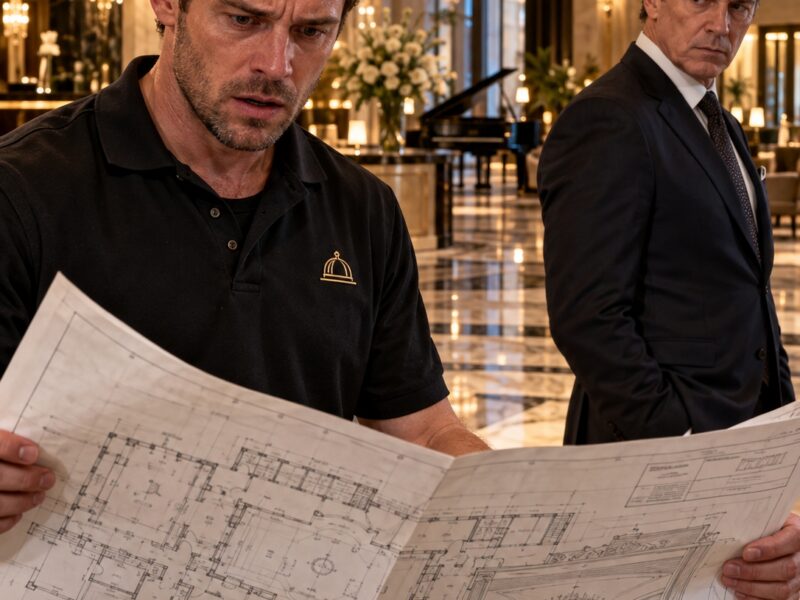
The Hotel Heiress Whispered Four Words to a Maintenance Man—Then the Entire Ballroom Learned Who He Really Was
The ballroom went quiet before the music stopped.
Not completely.
Four hundred people could not become silent all at once. Silence moved through the Grand Ballroom of the Stratton Hotel in sections—first the tables nearest the dance floor, then the bar, then the cluster of executives beside the twenty-foot windows overlooking the San Antonio River.
People noticed because Nadia Kelton never danced.
And Clark Tierney was the maintenance man.
At least, that was what his badge said.
Clark stood in the center of the polished marble floor wearing a black staff polo that cost less than one bottle of champagne being served that night. Thirty seconds earlier, he had been carrying a tray of empty glasses toward the service corridor.
Then another employee had bumped his shoulder and laughed.
“Twenty bucks if you ask the Ice Queen to dance.”
Clark had looked across the room.
Nadia Kelton sat alone at the center table.
Thirty-seven years old. CEO of Kelton Hospitality Group. Daughter of the late Frank Kelton. Owner, on paper, of eleven hotels and properties across Texas and Louisiana worth roughly $220 million.
She wore a black evening dress without jewelry except for a thin silver watch.
Everyone else around her seemed to be performing happiness.
Nadia looked as though she had forgotten performances were required.
Clark put down the tray.
“You’re actually doing it?” his coworker whispered.
Clark didn’t answer.
He crossed forty feet of marble.
People began noticing him halfway there.
A bartender stopped polishing a glass.
A regional manager interrupted himself in the middle of a sentence.
One of the board members glanced at Clark’s staff polo, then at Nadia, already anticipating the humiliation.
Clark stopped in front of her.
Nadia slowly raised her eyes.
He extended one hand.
“Would you like to dance?”
Someone near the bar actually laughed.
Then stopped when Nadia looked in that direction.
She turned back to Clark.
For several seconds, she said nothing.
Her gaze dropped to his hand.
Then returned to his face.
And she placed her hand in his.
That was when the room began going silent.
Clark led her onto the dance floor.
The band kept playing because professional musicians understood that when something strange happened at a $220 million hospitality company’s annual gala, the safest decision was to keep playing until someone important told you otherwise.
Clark rested one hand lightly against Nadia’s back.
She placed hers on his shoulder.
They moved once.
Twice.
Then Nadia leaned toward him.
Her lips stopped an inch from his ear.
She whispered something.
Four seconds.
No more.
Clark stopped moving.
His fingers tightened around hers.
Nadia pulled back.
For the first time that evening, the expression on Clark Tierney’s face changed.
It wasn’t embarrassment.
It wasn’t surprise.
It looked almost like fear.
Not fear of her.
Fear of being seen.
They stared at each other beneath the thirty-one-foot ceiling while four hundred people pretended not to watch.
Then the music carried them forward again.
No one in that ballroom knew what Nadia had whispered.
No one knew why the maintenance technician suddenly looked like a man whose past had just walked through a locked door.
And no one understood that the most powerful person in the room wasn’t necessarily the woman who owned the hotel.
Because eight years earlier, before anyone called Clark Tierney a maintenance man, he had drawn the first line of that ballroom with a pencil.
And two days before the gala, Nadia Kelton had found his name buried in the basement.
Clark’s apartment was six blocks south of the River Walk, on the second floor of a narrow building with faded brick and an exterior staircase that complained whenever anyone heavier than a child climbed it.
At 6:11 the next morning, he stood barefoot in the kitchen making coffee.
The apartment was so small that he could open the refrigerator while touching the sink.
He liked it that way.
Small spaces didn’t pretend to be more than they were.
His son Jude was already sitting at the kitchen table.
Nine years old.
Brown hair that never stayed flat.
A bowl of cereal going soft in front of him.
And beside the bowl, a structure made from cardboard, masking tape, two coffee stirrers, and part of a tissue box.
Clark poured coffee.
“What is it?”
Jude shrugged.
Clark smiled slightly.
That was their ritual.
Jude built things.
Clark asked what they were.
Jude refused to define them.
Clark never pushed.
After Ellen died, there had been enough people asking Jude how he felt, whether he was sad, whether he remembered his mother, whether he wanted to talk.
Clark had learned something from watching his son survive grief.
Not everything needed a name immediately.
Sometimes a thing needed to exist before anyone decided what it was.
He nodded toward the cardboard structure.
“Need more tape?”
“Almost out.”
“I’ll get some.”
Jude took another spoonful of cereal.
Then he looked up.
“Did you work late?”
Clark paused.
“Gala.”
“You hate galas.”
“I work at a hotel.”
“That wasn’t my question.”
Clark looked at him.
Nine years old.
Already dangerous.
“I survived.”
Jude considered that.
“Did rich people break anything?”
“Mostly glasses.”
“That seems inefficient.”
Clark laughed once.
It surprised him.
Jude went back to his cereal.
Clark looked at the cardboard building.
It had three columns across the front.
The middle one had been moved slightly off center.
Not enough for most people to notice.
Clark noticed.
He noticed everything like that.
Sometimes he wished he didn’t.
They left the apartment at 7:18.
Jude walked on the inside of the sidewalk.
Clark walked closest to the street.
Neither had ever discussed the arrangement.
At the intersection with Alamo Street, Jude adjusted his backpack.
“See you.”
“Three fifteen.”
“I know.”
“Straight home.”
“I know.”
“And—”
“Dad.”
Clark stopped.
Jude gave him the exhausted expression of a nine-year-old being oppressed by basic parental concern.
Then he crossed toward school.
Clark watched until the double doors closed behind him.
Only then did he turn toward downtown.
The Stratton occupied nearly a city block.
Twenty-two stories of pale Texas limestone and glass, with an east façade designed to catch morning light and a rooftop bar that travel magazines kept putting on lists.
Guests saw luxury.
Clark saw load.
Compression.
Movement.
Stress.
Expansion joints.
Water pressure.
Acoustic geometry.
He could stand in the lobby and tell from the vibration beneath his shoes whether the freight elevator was carrying six hundred pounds or twelve hundred.
He knew that the east foundation settled differently from the west by fractions of an inch.
He knew that the ballroom ceiling reached exactly thirty-one feet at the crown.
He knew the lobby columns were angled two degrees—not because someone had made a mistake, but because two degrees was enough to frame the river from the east entrance without blocking the reception desk’s sightline.
Nobody had taught him those things after he took the maintenance job.
He knew them because they had once existed only in his head.
Then on tracing paper.
Then on a computer screen.
Then in steel.
Clark entered through the employee entrance at 7:54.
“Morning, architect.”
He stopped.
Luis from banquet services grinned at him.
Clark’s expression hardened.
“What?”
“Last night. Dancing with the boss. Very architectural.”
Clark kept walking.
Luis laughed behind him.
Apparently, no one knew.
Good.
Clark had spent years becoming invisible.
He had gotten good at it.
But on the nineteenth floor, Nadia Kelton was already looking at a set of drawings with his name printed in the lower-right corner.
CR TIERNEY, AIA.
SENIOR DESIGN ARCHITECT.
HALVERSON & RAY.
She had found them because of Mabel Dunn.
Mabel had worked at the Stratton for twenty-four years and possessed the unnerving ability to remember where paperwork had been stored by people who were now dead.
Officially, she was senior operations coordinator.
Unofficially, she was the institutional memory of the hotel.
Three weeks earlier, the Stratton’s insurance carrier had requested a complete property records audit.
Updated floor plans.
Structural certifications.
Original specifications.
Renovation histories.
Inspection records.
The sort of request written in four pages of polite corporate language that translated roughly to: Find everything.
So Mabel went downstairs.
The basement archive was a windowless room lined with gray metal shelves.
On her second afternoon there, she pulled a cardboard tube from behind a box of 2019 plumbing inspections.
STRATTON ORIGINAL DESIGN — 2017.
She carried it upstairs.
Unrolled the first sheet.
Placed coffee mugs on the corners.
Then froze.
She knew the name.
Tierney.
There was only one Tierney working at the hotel.
Mabel walked to her computer and opened Clark’s personnel file.
Maintenance Technician — Facilities.
Hire date: December 2022.
A single note appeared beside the hiring authorization.
Per F. Kelton.
Frank Kelton himself.
No credentials attached.
No employment history.
No explanation.
Mabel returned to the drawings.
Sheet two.
Clark’s name.
Sheet three.
Clark’s name.
She opened all forty-seven.
The ballroom.
Lobby.
Mechanical floors.
Guest corridors.
Service corridors.
Structural transitions.
Window systems.
Roofline.
Every sheet carried the same name.
The man who changed filters on the fourteenth floor had designed the hotel.
Mabel didn’t call Nadia.
She simply carried the first drawing upstairs, entered the CEO’s office, and laid it across her desk.
Nadia looked up.
“What am I looking at?”
Mabel tapped the title block.
Nadia read it.
Then read it again.
Her face changed almost imperceptibly.
“Bring me the rest.”
That night, long after most of the offices emptied, Nadia sat alone in the conference room surrounded by Clark Tierney’s work.
She had spent eleven years in corporate finance in New York before her father’s death dragged her back to San Antonio.
Fourteen months earlier, Frank Kelton had collapsed at his desk on the nineteenth floor.
Three weeks later, Nadia inherited a company with 1,400 employees who had loved her father and were not certain what to do with her.
Frank remembered birthdays.
Nadia remembered EBITDA margins.
Frank walked through hotel kitchens and tasted sauces.
Nadia read operating reports.
Frank called employees by their children’s names.
Nadia sometimes struggled to remember the names of executives she had met six times.
The staff called her the Ice Queen.
She knew.
People assumed quiet people didn’t hear things.
They were wrong.
Nadia had simply stopped defending herself.
Grief had made conversation feel expensive.
But that night, she found herself talking silently to a man who wasn’t in the room.
Clark.
His handwriting filled the margins.
Beside the ballroom lighting plan, he had written:
Warmest color temperature available. People should feel like they’re standing in late afternoon, not under a ceiling.
Nadia read the sentence three times.
Who wrote that?
Not a maintenance technician.
Not someone thinking only about steel and concrete.
She pulled another drawing.
A note beside the guest corridor:
Sightline should reveal the river gradually. Don’t give everything away at the entrance.
Another.
Mechanical vibration must disappear before guest corridor. Luxury is often the absence of things people shouldn’t have to notice.
Nadia sat back.
She had walked through the Stratton hundreds of times.
For the first time, she realized she had never actually seen it.
Someone had made hundreds of decisions so she would never have to notice the decisions.
And that someone was downstairs fixing light fixtures.
At 11:36 p.m., Nadia returned to her father’s office.
She hadn’t changed much since Frank died.
His old photograph remained on the shelf.
His brass letter opener.
A ceramic coffee mug with a crack near the handle.
She opened the locked lower drawer.
Inside was a folder marked:
STAFFING — CONFIDENTIAL.
A handwritten note rested inside.
Nadia recognized her father’s handwriting immediately.
He built this building. Keep him close.
Nothing else.
She felt a pressure behind her ribs.
Then she found the second document.
A role-reclassification form.
Previous designation:
Design Consultant — Property, per F. Kelton.
New designation:
Maintenance Technician — Facilities.
Effective date:
November 3, 2023.
Twenty-two days after Frank Kelton died.
Authorization:
Kent Hodge.
VP, Property Development.
No CEO signature.
No HR review.
No board notation.
No explanation except two words.
Staffing realignment.
Nadia stared at the document.
Kent had worked for her father for eighteen years.
Kent controlled renovation budgets.
Contractor relationships.
Capital expenditures.
Every physical change made to every property in the Kelton portfolio passed through his office.
Frank had trusted him.
So Nadia had trusted him.
And twenty-two days after Frank died, before Nadia had even finished moving into her father’s office, Kent had taken the man who designed the Stratton and turned him into a maintenance technician.
Why?
Two nights later came the gala.
Which was why, when Clark crossed the ballroom because some idiot had dared him to ask the Ice Queen to dance, Nadia had already decided what she would do.
She had watched him approaching.
She had watched executives smirk.
She had watched him extend his hand.
And she had thought of forty-seven drawings.
Of her father’s handwriting.
Of the reclassification form.
Of a man standing inside something he had created while everyone around him believed he merely repaired it.
So she said yes.
And when they reached the center of the floor, she leaned toward him.
“I know you built this room.”
Clark stopped.
For one second, eight years disappeared.
The polo.
The tray.
The maintenance badge.
The years of silence.
Everything disappeared.
There was only the room.
His room.
And the woman standing inside it who somehow knew.
Then Nadia added quietly:
“I thought I’d imagined it.”
Clark looked at her.
“You didn’t.”
They finished the dance.
Neither asked another question.
But after that night, pretending became impossible.
The following Thursday, Nadia found Clark in the ballroom standing twelve feet above the floor on a lift, adjusting the rigging above the east chandelier.
She waited.
Clark noticed her, lowered the platform, and stepped off.
Nadia looked toward the ceiling.
“The arch over the east section isn’t symmetrical with the west.”
Clark went still.
There were perhaps five people alive who knew that.
“You’ve been reading the drawings.”
“That isn’t an answer.”
“The east wall carries more load from the mechanical floor. The arch is shallower by two degrees.”
“Why?”
“Load distribution.”
“Only that?”
He looked at her.
“No.”
“What else?”
“It redirects sound.”
She waited.
Clark glanced toward the glass wall.
“If both arches were identical, sound would scatter harder against the east glass. Two degrees sends more of it toward the center.”
Nadia looked up.
“You designed this room.”
Clark picked up his wrench.
“I designed the building.”
The answer landed harder.
Nadia stepped closer.
“Then why are you repairing chandeliers?”
He didn’t answer.
“Clark.”
He slid the wrench into his belt.
“What happened?”
“Nothing that matters now.”
“Someone changed your job title three weeks after my father died.”
That got him.
Not much.
A slight movement around the eyes.
But Nadia saw it.
“You know.”
“Yes.”
“How long?”
“Long enough.”
“And you said nothing?”
“To whom?”
“To me.”
“You had been CEO for three weeks.”
“I became CEO fourteen months ago.”
“And until recently you had never spoken to me.”
Nadia absorbed that.
It was true.
Clark looked toward the ceiling.
Late-afternoon sunlight came through the west windows and warmed the underside of the arch.
Exactly as he had planned years earlier.
Nadia followed his gaze.
“Why did you stay?”
That question was harder than the others.
Clark’s wife had still been alive when he designed the Stratton.
Ellen had brought Jude, then barely a year old, to the Halverson & Ray office one Tuesday because daycare closed unexpectedly.
Clark remembered Jude asleep against her shoulder while he drew the first roof profile.
He remembered Ellen putting coffee beside his drafting table.
He remembered her saying, “You look happier when you’re building something.”
Then cancer rearranged everything.
Medical leave.
Bills.
Missing deadlines.
A partnership track that disappeared politely, then permanently.
By the time Frank Kelton found him again, Clark no longer cared what title appeared beside his name.
Frank offered him a consulting position tied directly to the Stratton.
“Buildings change,” Frank had told him. “Owners forget why things were designed the way they were. Stay close.”
Then Frank died.
Kent changed the paperwork.
Clark stayed anyway.
Because Ellen was gone.
Because Jude needed stability.
Because the building remained.
“The building needed someone who understood it,” Clark finally said.
Nadia waited for more.
None came.
Clark walked toward the service corridor.
She remained beneath the arch.
She had expected bitterness.
Ambition.
A demand for restitution.
Instead, he had answered with the building.
That disturbed her more than anger would have.
Because Nadia suddenly understood him.
She had told herself she stayed in San Antonio because she inherited a company.
That wasn’t true.
She stayed because her father’s absence had created a hole, and she was terrified that if she left, everything he had built would slowly be dismantled by people who remembered its value but not its meaning.
Clark had stayed for exactly the same reason.
Neither of them had been protecting a job.
They had been protecting something left behind by someone they loved.
And upstairs, Kent Hodge had just learned Nadia had visited the maintenance level three times in two weeks.
He called his assistant.
“Pull Tierney’s shift logs.”
“All of them?”
“Everything.”
Then he made a second call.
“Move the East Wing presentation forward.”
“How far?”
“Ten days.”
There was a pause.
“That doesn’t give the board much review time.”
Kent looked through his office window toward the Stratton’s east wing.
“That is the point.”
The $3.8 million East Wing renovation had been his project from the beginning.
New suites.
New fixtures.
A redesigned lobby bar.
Reconfigured executive rooms.
Kent had selected the contractors.
Kent had controlled the budget.
Kent had controlled the schedule.
And Kent understood something Nadia did not yet understand.
Clark Tierney wasn’t dangerous because of what he knew about architecture.
He was dangerous because he knew what the building was supposed to contain.
Which meant he could recognize what had never been built.
Sunday morning, Clark walked through the tenth floor.
He wasn’t supposed to review construction plans.
His job description didn’t authorize structural assessment.
But buildings didn’t care about job descriptions.
He stopped outside Suite 1014.
Renovation markings had been taped to the wall.
The plan called for removing the partition between 1014 and 1015.
Clark stared at it.
Then looked upward.
“No.”
He unlocked the room.
Walked inside.
Measured from the exterior wall.
Counted his steps.
Measured again.
The wall appeared ordinary.
It wasn’t.
Behind it, concealed by drywall and fire-rated insulation, sat a transfer beam Clark had specified during the original design.
Grade 50 steel.
Twenty-four inches deep.
Full-penetration welds.
It redirected approximately forty percent of the vertical load from floors eleven through fourteen.
The contractor’s renovation survey had missed it.
If the wall configuration were altered without reinforcement, the building wouldn’t collapse dramatically.
That would almost have been easier.
Instead, it would fail slowly.
Settlement.
Cracked tile.
Warped doors.
Misaligned glazing.
Stress migrating through connections over eighteen months or two years.
By the time anyone realized the cause, repairing it could cost three times the renovation itself.
Clark stood alone in the unfinished suite.
He could remain silent.
Nobody had asked him.
Kent had already made it clear that Clark’s expertise officially did not exist.
Then Clark imagined Jude’s cardboard structures.
A nine-year-old understood something adults often forgot.
If you removed the wrong piece, everything above it had to find somewhere else to put its weight.
Monday morning, Nadia arrived at 6:37.
At 6:42, she found a single sheet of paper on her desk.
FACILITIES OBSERVATION — EAST WING, FLOOR 10.
No signature.
No name.
The language was clinical.
Transfer beam.
Lateral support.
Load redistribution.
Settlement threshold.
Recommended independent structural review before demolition.
Nadia knew immediately who wrote it.
At 7:15, she called Kent.
“I’m postponing the East Wing board presentation.”
Kent entered her office forty-seven minutes later.
“On what basis?”
Nadia handed him the memo.
He read it.
His expression barely moved.
“This is unsigned.”
“That doesn’t make the beam disappear.”
“A maintenance employee made an unauthorized assessment outside his scope.”
“Did your contractor identify the beam?”
Kent placed the paper down.
“The renovation drawings were prepared by licensed professionals.”
“That wasn’t my question.”
His eyes sharpened.
“You’re delaying a $3.8 million capital project because a maintenance technician left an anonymous note?”
Nadia leaned back.
“No. I’m delaying it because someone who knows this building better than your contractor says your contractor missed something.”
“You’re allowing an employee to operate outside the chain of command.”
“I’ll decide what I’m allowing.”
“This is insubordination.”
Nadia looked at the memo.
“No, Kent. This is information.”
He left without closing the door.
That afternoon, Nadia requested four years of renovation invoices.
She didn’t tell Kent.
But Kent found out anyway.
And by Friday morning, he was preparing Clark Tierney’s termination.
Nadia began staying later.
She told herself it was because of the audit.
That was only partly true.
After nine, the Stratton changed.
Without hundreds of guests moving through it, the building developed its own sounds.
Air moving through ducts.
Elevator cables.
Water pressure shifting.
Steel cooling.
One Wednesday night, Nadia found Clark kneeling in the east corridor removing warped baseboard.
“You’re still here.”
“So are you.”
“I own the company.”
“That doesn’t make insomnia a business strategy.”
She almost smiled.
Almost.
Clark noticed.
He returned to the baseboard.
“Walk me through the building.”
He looked up.
“What?”
“I want you to show me what I’m not seeing.”
“You have facilities reports.”
“I don’t want a report.”
“What do you want?”
Nadia considered the question.
“To understand what I inherited.”
Clark stood.
He wiped dust from his hands.
Then he showed her.
The lobby corridor curved eleven degrees so guests naturally walked toward increasing daylight.
The columns angled two degrees to frame the river.
The freight elevator shaft sat farther from the guest corridor than standard practice because vibration traveled through shared walls.
A narrow service hallway widened by eighteen inches near the kitchen because banquet carts always collided there in the original operational model.
The ballroom entrances were positioned so arriving guests saw people before they saw empty tables.
“You thought about all this?” Nadia asked.
“That was the job.”
“No. The job was designing a hotel.”
Clark looked at her.
“That is designing a hotel.”
They stopped behind the kitchen.
The ceiling was lower there.
Painted cinder block.
Exposed utility access.
Nothing glamorous.
“Your father understood that,” Clark said.
“What?”
“Most owners look at revenue per available room. Your father looked at the structure.”
Nadia’s face tightened slightly.
“He understood you.”
Clark didn’t answer.
Outside, the River Walk glowed amber through the windows.
The building made a faint metallic sound.
Nadia turned.
“What was that?”
“Steel contracting.”
“You can hear that?”
“I used to.”
“Used to?”
Clark looked toward the wall.
“After enough years, you stop hearing familiar things.”
Nadia thought of her father’s office.
His coffee mug.
His photograph.
The way grief could become so constant that eventually it stopped feeling like pain and started feeling like architecture.
She said nothing.
Neither did Clark.
But when they separated that night, Nadia trusted him more than the executive her father had trusted for eighteen years.
And Kent knew it.
Mabel kept digging.
Thirty-eight invoices.
One contractor appeared again and again.
Hodge Renovation Group LLC.
The name bothered her.
She searched Texas corporate records.
Registered owner:
Vern Osgood.
Mabel stared at the screen.
She knew that name too.
Vern was Kent Hodge’s brother-in-law.
The company had been created seven months before its first Stratton invoice.
Total billings over four years:
$2.1 million.
Mabel began comparing invoices against receiving records.
Fourteen contained material discrepancies.
She compared inspection charges with visitor logs.
Inspectors who supposedly performed work at the Stratton had never entered the hotel.
She found projects billed twice.
Then three times.
A seventh-floor bathroom renovation appeared under three separate invoices from three entities.
Only one contractor had actually performed it.
Some invoices were dated before the underlying work had even been approved.
And each one had passed through Kent’s authority.
Mabel sat alone beneath the archive’s fluorescent lights, staring at the numbers.
Then she whispered:
“Oh, Frank.”
Because suddenly she understood why Frank had wanted Clark close.
And she understood why Kent had waited until Frank was dead to make Clark disappear.
The next morning, Nadia found two stacks on her desk.
The invoices.
And Clark’s reclassification.
Fraud explained the demotion.
The demotion explained the fraud.
Kent hadn’t merely stolen money.
He had erased the one man capable of looking at the physical building and knowing whether the work on an invoice actually existed.
Clark’s credentials had been buried.
His authority removed.
His history disconnected from the Stratton.
Because nobody asks the man changing a light bulb whether a $180,000 structural invoice makes sense.
Nadia sat motionless.
Then called outside counsel.
“Tomorrow morning. Nine.”
Kent arrived at 8:55.
Leather portfolio.
Perfect tie.
Controlled expression.
Eighteen years inside Kelton Hospitality had taught him how power behaved.
Unfortunately, it had also taught him to believe it belonged to him.
He sat opposite Nadia.
Mabel’s evidence rested between them.
Nadia touched the corporate filing.
“Vern Osgood.”
Kent glanced down.
“Subcontractor.”
“Your brother-in-law.”
Silence.
“Thirty-eight invoices.”
Kent folded his hands.
“Construction billing has variance.”
“Two point one million dollars.”
“Nadia—”
“Don’t.”
The single word stopped him.
She pushed several invoices forward.
“This work was billed twice. This material was never received. These inspections never occurred. Four invoices were submitted before the work had even been authorized.”
“Your father approved every capital budget I submitted.”
“My father approved budgets.”
Nadia leaned toward him.
“He didn’t approve theft.”
Kent’s jaw hardened.
“You don’t understand how these projects operate.”
“Then explain this.”
She placed Clark’s reclassification form on top of the invoices.
For the first time, Kent’s expression changed.
Only slightly.
Enough.
“You changed Clark Tierney’s designation twenty-two days after my father died.”
“He was overqualified.”
“So you demoted him?”
“I corrected a staffing anomaly.”
“Without HR approval.”
“I had operational authority.”
“Without CEO authorization.”
“The company was in transition.”
“Exactly.”
Kent said nothing.
Nadia’s voice became quieter.
“You waited until my father was dead.”
“That is offensive.”
“You waited until he couldn’t stop you. Then you took the architect who designed the Stratton and changed his title to maintenance technician.”
“Tierney was already performing facilities work.”
“My father hired him as a design consultant.”
“Your father was sentimental about people.”
Nadia stared at him.
Kent realized the mistake too late.
“My father,” she said, “was many things. Stupid wasn’t one of them.”
“I didn’t say—”
“You didn’t have to.”
She pushed the documents toward him.
“You didn’t bury Clark because he was overqualified.”
Kent remained still.
“You buried him because he could read the building.”
His face emptied.
“He could look at an invoice and then look at a wall and know whether the work existed.”
“Nadia—”
“He could see a contractor’s mistake without opening the drywall.”
She stood.
“He could expose you.”
Kent stood too.
“I’ve been with this company eighteen years.”
“And you’ve been stealing from it for four.”
“You have no idea what I’ve protected here.”
“Then the investigators can ask.”
That landed.
“Investigators?”
“The board has the evidence.”
Kent stared at her.
For years, he had entered every room as though he owned the threshold.
That morning, for the first time, the door behind him no longer looked like something he controlled.
“You’re making a mistake.”
Nadia looked at him.
“No.”
Her eyes dropped to Clark’s reclassification form.
“You made it twenty-two days after my father died.”
Kent picked up his portfolio.
He walked out.
The door closed softly.
By 4:30 that afternoon, the board had voted six to one to suspend Kent Hodge pending a full investigation.
The matter was referred to federal authorities in San Antonio and to the Texas Attorney General’s office.
Hodge Renovation Group was placed under review.
Every active Kelton Hospitality renovation contract was frozen pending independent audit.
And before the business day ended, Clark Tierney’s personnel record changed.
Maintenance Technician — Facilities disappeared.
Design Consultant — Property returned.
But Nadia wasn’t finished.
The following morning, she called Clark upstairs.
He entered her office at 8:03.
“You wanted to see me?”
“Close the door.”
He did.
Nadia explained everything.
Thirty-eight invoices.
$2.1 million.
Vern Osgood.
Kent.
The unauthorized reclassification.
The board vote.
Clark listened without interrupting.
When she finished, he looked past her.
A photograph of Frank Kelton stood on the shelf.
“You knew he changed my title?” Clark asked.
“I know now.”
Clark nodded.
“You don’t seem surprised.”
“I wasn’t stupid.”
“Then why didn’t you fight it?”
“For what?”
“Your career.”
Clark’s eyes returned to hers.
“My wife was dead. My son was six. I had a paycheck and a building I understood.”
Nadia said nothing.
“There are seasons,” Clark continued, “when winning an argument is not the most important thing.”
Something in Nadia’s expression softened.
“I restored the designation.”
“I didn’t ask you to.”
“I know.”
She slid a folder across the desk.
Clark didn’t touch it.
“What is that?”
“Director of Property Design and Engineering.”
He almost laughed.
“That’s a large title.”
“It comes with a large amount of work.”
“That part sounds more believable.”
“I want you overseeing design and structural review across the portfolio.”
“Eleven properties.”
“Yes.”
“You’ve seen my apartment?”
“No.”
“Good.”
Nadia’s mouth moved slightly.
Again, almost a smile.
Clark looked at Frank’s photograph.
“What would he say?”
“I’ve spent fourteen months asking myself that question.”
“And?”
“I think he’d tell me to stop asking.”
Clark looked at her then.
For a moment, Nadia was not a CEO.
She was simply a daughter sitting in her dead father’s office trying to decide whether protecting what he built meant preserving his decisions or finally making her own.
Clark understood the distinction.
“I need time.”
“Take it.”
The East Wing renovation remained frozen.
Independent structural engineers arrived two days later.
Within forty-eight hours, they confirmed Clark’s warning.
The transfer beam was exactly where he said it was.
It carried roughly forty percent of the vertical load above the affected area.
The original renovation plan would have compromised lateral support.
Estimated future structural damage:
Approximately $700,000.
Potential operational disruption:
Months.
Kent had called Clark’s memo insubordination.
The engineers called it the reason the building had been spared a serious failure.
That night, Clark walked through the Stratton alone.
He entered the dark ballroom.
Emergency lights cast amber strips across the marble.
He walked to the center.
The same place where Nadia had whispered into his ear.
He looked up.
Thirty-one feet.
Two-degree offset.
Acoustic curve.
Everything remained where he had placed it eight years earlier.
He had spent years telling himself titles didn’t matter.
Mostly, that was true.
But standing there, Clark understood that something else had hurt.
Not losing the title.
Being erased.
There was a difference.
A title told people what to call you.
Being remembered told you that your work had mattered.
He thought of Ellen.
She had never seen the completed Stratton.
Cancer had taken her before the grand opening.
She had seen models.
Renderings.
Photographs from construction.
She had watched him obsess over lighting temperatures and column angles and corridor widths.
Once, when Clark complained that nobody would ever notice half the decisions he was making, Ellen had said:
“Isn’t that the point?”
“What?”
“If you do it right, people won’t notice the building. They’ll notice how they feel inside it.”
Clark had forgotten that conversation.
Or thought he had.
Standing beneath the arch, he remembered every word.
The next morning, Nadia found him there.
Sunlight entered through the east glass.
Low.
Warm.
A single band of light stretched across the floor.
“What did my father see in this place?” she asked.
Clark didn’t turn immediately.
“The same thing he saw in you.”
Nadia stopped.
“What is that?”
“Something that would hold.”
For several seconds, neither moved.
The building warmed around them.
Stone.
Steel.
Glass.
Expansion so small it could barely be measured.
Then came the faint sound Nadia had heard during their walk.
She looked upward.
“The steel?”
Clark nodded.
For the first time, she smiled without stopping herself.
“I heard it.”
“I know.”
She stepped beside him.
“What about the job?”
Clark looked across the ballroom.
“I’ll take it.”
“The title?”
“No.”
She waited.
“The work.”
Nadia nodded.
“Good.”
He started toward the doors.
“Clark.”
He turned.
“Thank you.”
“For what?”
Nadia looked around the room.
“For staying.”
Clark didn’t answer.
He didn’t need to.
Three weeks later, Jude entered the Stratton for the first time.
It was a Saturday.
Clark had deliberately avoided telling him where they were going.
The boy walked through the east entrance, looked upward, and immediately slowed.
“Whoa.”
Clark put his hands in his pockets.
“Too much?”
“No.”
Jude stared at the columns.
Then the windows.
Then the corridor.
“You work here?”
“Yeah.”
“You fix all this?”
Clark looked ahead.
“Something like that.”
They crossed the lobby.
Near the concierge desk, several framed architectural drawings had been mounted behind glass.
Nadia’s decision.
Clark had objected.
Nadia ignored him.
Jude approached the first drawing.
He leaned forward.
His eyes moved across the lines.
Then stopped at the title block.
C. R. TIERNEY, AIA.
Jude looked at Clark.
Then back at the drawing.
Then at the lobby.
He turned slowly, comparing paper to reality.
The columns.
Windows.
Curving corridor.
“Dad?”
“Yeah?”
“You drew this?”
Clark swallowed.
“Yes.”
“All of it?”
“Not every detail. A lot of people built it.”
“But you designed it.”
“Yes.”
Jude looked at the drawing again.
Clark waited for excitement.
Questions.
Maybe anger that he had never been told.
Instead, Jude stepped closer until his shoulder touched Clark’s arm.
That was all.
And somehow that was worse.
Clark looked away.
Nadia appeared across the lobby.
She stopped when she saw them.
She didn’t interrupt.
Jude eventually wandered toward the ballroom doors.
He pressed his face against the glass.
Nadia walked over.
“Your son?”
“Jude.”
“He likes the building.”
“He builds things.”
“What kind of things?”
“Doesn’t tell me.”
Nadia glanced toward him.
“Smart.”
“Cardboard. Tape. Whatever he finds.”
“How long?”
“Since he was six.”
Nadia looked at Clark.
Something about his expression made her ask no more.
Then she turned toward the blueprints.
“The gala.”
Clark looked at her.
“What about it?”
“I found your name two days before.”
“I figured.”
“No, you didn’t.”
He raised an eyebrow.
Nadia continued.
“I spent most of that night reading the drawings. Every note. Every decision.”
Clark looked mildly horrified.
“All of them?”
“All of them.”
“There are forty-seven sheets.”
“I know.”
“You need hobbies.”
“So I’ve been told.”
He laughed quietly.
Nadia looked toward the ballroom.
“I read the note about the lighting.”
Clark knew exactly which one.
“Warmest color temperature available,” she said. “People should feel like they’re standing in late afternoon, not under a ceiling.”
He looked down.
“When your coworker dared you to ask me to dance, I’d already decided I would say yes.”
Clark looked at her.
“You heard him?”
“Half the ballroom heard him.”
“That makes it worse.”
“A little.”
“The dare was his idea,” Nadia said. “Saying yes was mine.”
Clark watched Jude through the glass.
Then asked the question that had been sitting between them for weeks.
“What exactly did you whisper?”
Nadia followed his gaze toward Jude.
“I said, ‘I know you built this room.’”
Clark nodded.
“And then?”
“I said I thought I’d imagined it.”
“You didn’t.”
“I know that now.”
Jude came running back.
He pointed at one of the drawings.
“That looks like mine.”
Clark followed his finger.
The roof profile.
A triangular peak.
Simple.
Clean.
Clark had drawn that line eight years earlier on a Tuesday afternoon.
Jude had been one.
Ellen had still been alive.
The future had still looked predictable.
Clark placed his hand on his son’s shoulder.
“It does,” he said.
Jude studied the drawing.
“Did you know it would look like this?”
Clark considered the question.
“No.”
Jude frowned.
“But you designed it.”
“I knew what I wanted it to become.”
“That’s the same thing.”
“No.”
Clark looked around the lobby.
“It really isn’t.”
Six months passed.
Investigations continued.
Kent never returned to the Stratton.
The East Wing project restarted under independent oversight.
Clark redesigned the renovation around the original structural system rather than pretending it wasn’t there.
The transfer beam was reinforced.
The suites were reconfigured.
The final project came in roughly $400,000 below the revised budget.
Nadia didn’t miss the irony.
The company saved money by respecting the building instead of fighting it.
Clark’s new office remained mostly empty.
One desk.
Two chairs.
A drafting table.
A photograph of Ellen and Jude.
No awards.
No framed credentials.
Nadia once asked why he hadn’t decorated.
“I have eleven hotels to inspect.”
“That wasn’t the question.”
“You ask too many questions.”
“You answer too few.”
They had become good at conversations like that.
Not romantic.
Not exactly.
Something quieter.
Neither tried to name it.
Maybe because both had learned what happened when life was named too quickly.
Then October returned.
The annual Kelton Hospitality Gala filled the Grand Ballroom again.
Four hundred guests.
Champagne towers.
Polished marble.
Warm light.
The same ceiling.
The same river beyond the glass.
But Clark wasn’t standing near the service corridor.
He wasn’t holding a tray.
He wasn’t wearing a maintenance polo.
He sat at the center table beside Nadia in a dark jacket Jude had approved three hours earlier.
His son sat near the window.
Jude had been invited personally by Nadia.
Clark had objected.
Nadia had ignored him again.
At 9:15, the band changed tempo.
Something slower.
Clark looked across the ballroom.
The employee who had dared him the year before was working behind the bar.
Their eyes met.
The man lifted his glass.
Clark shook his head.
The bartender grinned.
Then Clark stood.
Nadia looked up.
He extended his hand.
For an instant, the room seemed to remember.
The same man.
The same woman.
The same gesture.
Except nothing was the same.
A year earlier, people had watched because a maintenance worker had crossed a social boundary.
Now they watched because they understood there had never been a boundary except the one printed on an employee badge.
Nadia reached for his hand before he had fully extended it.
Clark smiled.
“You’re getting faster.”
“I hate wasting time.”
“That is absolutely not true.”
“Don’t ruin the moment.”
They moved onto the floor.
His hand settled against her back.
Hers rested against his shoulder.
The room watched.
But this time, there were no smirks.
No whispers.
No secondhand embarrassment.
Recognition was quieter than judgment.
Jude sat at the table near the window.
He had stolen two coffee stirrers and several cocktail napkins.
By the time Clark noticed, his son had already built something.
Four tiny columns.
A folded roof.
A door torn from a sugar packet.
Nadia saw it too.
“Runs in the family.”
“Apparently.”
They turned slowly beneath the arch.
“You know,” Clark said, “you never told me why you were sitting alone that first night.”
Nadia’s expression changed.
“Everyone wanted something.”
“And I didn’t?”
“You wanted twenty dollars.”
Clark laughed.
“You knew about that too?”
“I told you. Everyone heard him.”
“I never collected.”
“Terrible financial decision.”
“You’re the finance expert.”
They turned again.
The band softened.
Outside, San Antonio moved along the river.
Cars crossed bridges.
Tour boats drifted through reflected light.
People entered restaurants.
Others left bars.
The city knew nothing about the small histories contained inside one hotel.
It didn’t know Frank Kelton had once written five words on hotel stationery because he was afraid a gifted man might disappear.
It didn’t know Kent Hodge had waited twenty-two days after Frank’s death to erase that man from a personnel system.
It didn’t know Mabel Dunn had opened the right cardboard tube in a basement archive.
It didn’t know that thirty-eight invoices could hide $2.1 million but could not hide forever.
It didn’t know a nine-year-old boy built cardboard structures at a kitchen table because perhaps some instincts arrived before explanations.
And it didn’t know that the man dancing beneath the ballroom arch had once believed the safest way to survive grief was to become invisible.
Buildings remembered anyway.
That was the thing Clark had learned.
People could change titles.
Files could be altered.
Names could disappear from office doors.
Someone could reduce a career to two words on an HR form.
Maintenance Technician.
But steel remembered where the load belonged.
Windows remembered the angle they had been given.
Corridors carried people along paths imagined years before those people arrived.
Light entered exactly where someone had decided it should.
And every evening, when the ballroom filled, sound still traveled inward because Clark Tierney had once decided that voices should move toward one another instead of away.
Some things could be buried.
Not everything could be erased.
Nadia moved closer.
A year earlier, at this exact spot, she had leaned toward his ear and whispered the sentence that broke open the life he had carefully made small.
This time, she said nothing.
She didn’t need to.
Clark looked past her toward Jude.
The boy was concentrating on his tiny structure, adjusting one of the coffee-stirrer columns by perhaps half an inch.
Then Jude stopped.
He tilted his head.
Moved it slightly again.
Clark smiled.
“What?” Nadia asked.
“Nothing.”
She followed his gaze.
Jude looked up.
For a second, father and son stared at each other across the ballroom.
Jude pointed at the little column.
Then moved it slightly off center.
Two degrees, perhaps.
Maybe less.
Clark couldn’t tell from that distance.
But he understood the instinct.
He nodded.
Jude nodded back.
Then returned to building.
The music continued.
Nadia and Clark turned beneath the arch.
Warm light settled over the floor exactly as Clark had intended eight years earlier, back when Ellen was alive, Jude was too young to hold a pencil, Frank Kelton still walked these halls, and Clark believed life could be designed with enough care.
He knew better now.
You could design steel.
You could calculate load.
You could predict how sound would move through glass and how limestone would expand beneath a Texas sun.
You could not design what people would lose.
You could not calculate grief.
You could not engineer loyalty.
You could not draw a plan precise enough to guarantee that the people you loved would remain inside it.
All you could do was decide what you would hold when the weight shifted.
Clark had thought he stayed at the Stratton because the building needed him.
Perhaps that had been true.
But standing there with Nadia’s hand in his and Jude building something fragile beside the window, he understood the other half.
He had needed the building too.
Not because it remembered who he had been.
Because it had survived becoming something he had never planned.
So had Nadia.
So had Jude.
So had he.
Outside, the river continued beneath the bridges, indifferent and dark.
Inside, the ballroom glowed.
The columns remained two degrees off center.
The ceiling remained thirty-one feet high.
The east arch remained intentionally imperfect.
Nothing structural had changed.
And perhaps that was why the change felt so enormous.
A year earlier, Clark Tierney had entered this room through a service door carrying empty glasses.
A woman everyone called the Ice Queen had taken his hand.
She had whispered that she knew who he was.
Now he stood beneath the ceiling he had drawn, beside the woman who had finally learned how to hear the building breathe, while his son constructed another impossible little building out of things everyone else would have thrown away.
No one whispered this time.
No one needed to.
The room already knew their names.









