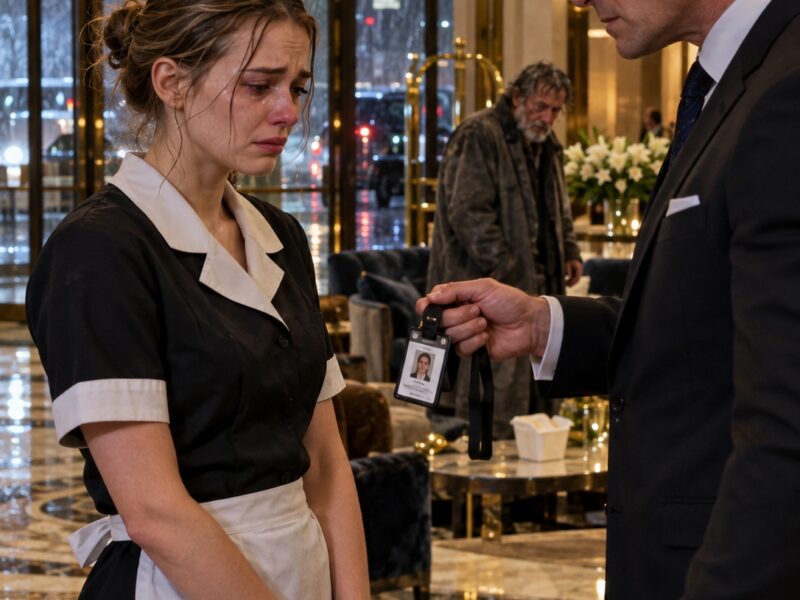
THE HOTEL MANAGER FIRED A HOUSEKEEPER FOR FEEDING A HOMELESS MAN—BY 9 A.M. THE NEXT MORNING, THE MAN WALKED BACK IN AND EVERY EXECUTIVE STOOD UP
“Take off your badge, Rachel. You’re finished here.”
Victor Crane said it loudly enough for the entire Sterling Grand lobby to hear.
The pianist near the marble staircase missed a note.
A bellman stopped with one hand on a brass luggage cart. Two guests waiting beside the elevators turned their heads. Even the rain beating against the enormous glass doors seemed to soften for half a second, as if the whole hotel had decided to listen.
Rachel Moore stood beside a housekeeping cart with a folded towel still tucked beneath one arm.
Across the lounge, an older man sat in a damp coat, both hands wrapped around a paper container of food Rachel had given him less than twenty minutes earlier.
Victor extended his hand.
“Your badge.”
Rachel looked at it.
Then she looked at the man.
His gray hair was wet. Water had darkened the shoulders of his old coat. His shoes looked as if they had been walking through rain for hours.
He had said almost nothing.
He hadn’t begged.
He hadn’t bothered a guest.
He hadn’t even asked Rachel for food.
He had simply been cold.
And Rachel had made the mistake, at least in Victor Crane’s eyes, of noticing.
“Mr. Crane,” she said quietly, “the storm is getting worse.”
Victor’s jaw tightened.
“I didn’t ask for a weather report.”
“He can leave when it slows down.”
“No.”
Rachel glanced toward the glass entrance.
Rainwater ran down the windows in silver sheets. Wind pushed against the doors hard enough to make them shudder in their frames.
Victor stepped closer.
“I gave you a direct instruction. You ignored it. Then I gave you a warning. You ignored that too.”
“He wasn’t hurting anyone.”
“That isn’t your decision to make.”
Rachel’s fingers closed around the plastic edge of her employee badge.
Victor held out his hand again.
“Badge.”
The older man slowly stood.
“I can go.”
His voice was calm.
That somehow made the moment worse.
Rachel turned toward him.
“No. Sit down.”
“Rachel,” Victor warned.
She didn’t look at him.
The older man studied her face.
“You’ve already done more than enough.”
“Then finish eating before it gets cold.”
Victor gave a short, humorless laugh.
It was the laugh of a man who had just decided he needed to make an example out of someone.
“Fine.”
He pointed toward Rachel’s chest.
“Take off the badge.”
For one terrible second, Rachel couldn’t make her fingers work.
She needed that badge.
Not because she loved housekeeping.
Not because she had dreamed as a child of pushing carts through luxury hotel corridors while wealthy guests walked past carrying shopping bags that cost more than her monthly rent.
She needed it because the badge meant a paycheck.
The paycheck meant groceries.
It meant her share of the rent at the small apartment she shared with her mother.
It meant keeping the electricity on without choosing which bill could survive another week unpaid.
It meant health insurance.
Bus fare.
A little money tucked away in an envelope marked EMERGENCY inside the second drawer of her dresser.
It meant survival.
Rachel finally unclipped the badge.
The tiny piece of plastic felt absurdly heavy.
Victor took it from her.
“You’re finished here.”
The older man watched the exchange without moving.
Something had changed in his expression.
The tiredness was still there.
So was the rainwater dripping from his coat.
But his eyes were suddenly sharp.
Very sharp.
He looked directly at Victor.
“You may want to remember her name.”
Victor glanced at him as though a piece of furniture had spoken.
“Why would I?”
The older man wiped rainwater from his sleeve.
“Because tomorrow,” he said, “you’ll wish you had.”
Victor almost smiled.
Rachel didn’t.
Because she had no idea that by nine o’clock the next morning, the same man would walk back into the Sterling Grand—
and Victor Crane would finally understand exactly whom he had thrown into the rain.
Four hours earlier, nobody had been paying attention to the man in the wet coat.
That was exactly why he had noticed everything.
The Sterling Grand occupied nearly half a city block, an old stone hotel restored into the kind of luxury property where the lobby smelled faintly of cedar, polished brass, and expensive flowers.
A crystal chandelier hung three stories above the marble floor.
Fresh white orchids stood on black tables.
Soft piano music floated from the lounge.
Employees wore immaculate uniforms.
Guests rarely carried their own bags.
Everything about the hotel communicated the same message:
You have arrived somewhere important.
The older man had entered through the revolving door shortly after five that afternoon.
He was wet.
Not theatrically wet.
Not conveniently damp.
Soaked.
His gray coat had absorbed the rain until the fabric sagged against his shoulders. His trousers were splashed near the ankles. His hair was flattened against his forehead.
He paused inside the entrance.
Warm air hit his face.
For several seconds, he simply stood there.
People moved around him.
A young couple hurried toward the elevators.
A businessman checked his phone.
A bellman rolled three suitcases past.
A woman in a cream coat handed her umbrella to an attendant.
Nobody asked the older man whether he needed anything.
Then Victor Crane saw him.
Victor was forty-eight, tall, meticulously groomed, and always dressed as if someone might photograph him without warning.
His tie was perfect.
His shoes were polished.
His silver nameplate sat precisely level on his jacket.
He crossed the lobby with a practiced smile that disappeared before he reached the older man.
“Excuse me.”
The man turned.
Victor looked him over.
Not at his face.
At his coat.
His shoes.
The worn cuffs of his shirt.
“What exactly are you doing in here dressed like that?”
The man’s expression barely changed.
“I came inside to get warm.”
“This is a private hotel.”
“I’m aware.”
“It isn’t a shelter.”
A few feet away, Rachel Moore was replacing bottled water on a housekeeping cart.
She stopped.
Victor lowered his voice, but not enough.
“People like you don’t belong in a place like this.”
The older man looked at him for several seconds.
Then he said something that made Rachel glance up.
“You don’t even know who I am.”
Victor sighed.
“I know you’re making paying guests uncomfortable.”
Nobody had complained.
Rachel knew that because she had been standing there.
Victor pointed toward the entrance.
“You need to leave.”
The older man looked through the glass.
The rain had become heavier.
“I only need a few minutes.”
“You’ve had them.”
Victor walked away.
The man remained where he was.
For perhaps ten seconds.
Then he picked up the small worn bag at his feet and started toward the doors.
Rachel watched him.
She tried not to.
That was something hotel employees learned quickly.
Do not stare.
Do not become involved.
Notice everything, react to almost nothing.
But there was a slight tremor in the man’s right hand.
Rachel saw it when he reached for his bag.
“Sir?”
He stopped.
“Are you all right?”
“I’m all right.”
Rachel came closer.
“No, you’re freezing.”
“I’ve been colder.”
“That doesn’t answer the question.”
For the first time, something almost like amusement appeared in his eyes.
Rachel pointed toward the small guest lounge beside the fireplace.
“Come on.”
“Your manager already told me to leave.”
“Then let him be angry with me.”
“That sounds like a dangerous career strategy.”
Rachel almost smiled.
“Sit down before you make yourself sick.”
He hesitated.
She could see pride fighting exhaustion in his face.
Rachel knew that expression.
She had seen it on her mother during the year after her father died, when every offer of help sounded like an accusation that they couldn’t manage alone.
So Rachel didn’t ask again.
She simply pulled out a chair.
Eventually, the man sat.
The fireplace was decorative, but warm air from a vent nearby moved across the lounge.
Rachel crouched slightly.
“Have you eaten anything today?”
“I’ll be all right.”
“That means no.”
“It means I’ll be all right.”
Rachel opened the bottom compartment of her cart.
Inside was a paper container she had bought during her break.
Chicken.
Rice.
Roasted vegetables.
Her dinner.
She placed it in front of him.
The man looked at it.
Then at her.
“This was supposed to be your dinner.”
“I’ve missed dinner before.”
“And what will you eat?”
“I’ll figure it out.”
He didn’t touch the food.
“Why are you helping me?”
Rachel glanced across the lobby.
People were walking past.
Some saw them.
Most didn’t.
“Because everyone else keeps looking through you.”
The man’s expression changed.
Only slightly.
But Rachel saw it.
She pushed the container closer.
“Eat while it’s warm. I have to finish this floor.”
He looked down at the food.
“Thank you, Rachel.”
She blinked.
Then remembered the name stitched onto her uniform.
“You’re welcome.”
She turned away.
She had taken three steps when he said her name again.
“Rachel.”
She looked back.
“Thank you.”
This time, she understood he wasn’t talking about dinner.
She nodded and continued working.
Neither of them noticed Victor Crane watching from across the lobby.
Rachel had worked at the Sterling Grand for three years.
She knew which elevator made a clicking noise before reaching the tenth floor.
She knew Mrs. Whitmore in Suite 1102 wanted two extra pillows but would never ask twice.
She knew the air-conditioning unit in Room 612 had been failing for weeks despite maintenance insisting it had been fixed.
She knew Diane from housekeeping had arthritis in her left knee and hid it because she was afraid management would reduce her hours.
She knew Evan, the young bellman, sent half his paycheck home to his parents.
Rachel knew the hotel from underneath.
Victor knew it from the lobby.
That was the difference between them.
For Victor, excellence was what guests could see.
For Rachel, it was everything that prevented them from seeing what was going wrong.
“Here you go, ma’am.”
Rachel caught the handle of an elderly woman’s suitcase before it tipped.
“Oh, thank you. I almost lost that.”
“I’ve got it.”
“The elevators?”
“Straight ahead, then left.”
The woman smiled.
“You’re kind to everyone, aren’t you?”
Rachel gave a small shrug.
“I try to be.”
A voice came from behind her.
“Rachel.”
Victor.
“Room 814 needs fresh towels.”
“I’ll take them now.”
“And straighten your cart.”
Rachel looked at the cart.
Nothing was wrong with it.
“Yes, Mr. Crane.”
She turned.
Victor’s eyes moved toward the lounge.
The older man was eating.
Slowly.
Victor’s mouth hardened.
He called Evan over.
“Find Rachel after she finishes upstairs.”
“Yes, sir.”
“Tell her that man leaves now.”
Evan glanced toward the lounge.
“He isn’t bothering anybody.”
Victor stared at him.
Evan immediately straightened.
“Yes, Mr. Crane.”
Rachel was halfway down the eighth-floor hallway when Evan found her.
“Rachel.”
She looked up from a stack of towels.
“What?”
“Crane says the man downstairs has to leave.”
She stopped.
“Right now?”
“He said this is your warning.”
Rachel exhaled.
“He hasn’t bothered anyone.”
“I know.”
“Did a guest complain?”
“Not that I heard.”
Rachel looked toward the elevator.
Evan lowered his voice.
“Just be careful.”
That sentence followed employees around the Sterling Grand.
Be careful.
It rarely meant there was actual danger.
Usually it meant Victor Crane was nearby.
Rachel returned downstairs.
The older man had eaten perhaps half the meal.
“Mr. Crane says you have to leave.”
He immediately closed the container.
“Then I should go.”
“No.”
He looked at her.
“Finish your food first.”
“Rachel.”
Victor’s voice cut across the lobby.
Mrs. Whitmore had just arrived, and Victor had been greeting her with his brightest professional smile.
The smile vanished as soon as he turned toward Rachel.
“I gave you one instruction.”
“He was finishing his food.”
“I don’t care. Get him out.”
Rachel felt several guests watching.
“He’s not bothering anyone.”
Victor walked closer.
“Give him two minutes,” Rachel said.
“I’m not asking for your opinion.”
His voice dropped.
“Do what you’re told.”
Rachel felt heat rise into her face.
Not embarrassment.
Anger.
But she swallowed it.
She needed the job.
That fact lived inside every decision she made.
“Yes, Mr. Crane.”
Victor walked away.
The older man stood.
“You shouldn’t get yourself in trouble.”
Rachel looked at him.
“I’m not in trouble.”
“You’re a terrible liar.”
That almost made her laugh.
Almost.
“Finish eating.”
“I think your manager disagrees.”
“My manager disagrees with oxygen when it enters the lobby without permission.”
The older man smiled for the first time.
It transformed his face.
For one second he didn’t look helpless at all.
Then the expression disappeared.
“What’s his name?”
“Victor Crane.”
“And yours is Rachel Moore?”
She nodded.
“Why?”
“No reason.”
But he remembered both.
The Sterling Grand became more chaotic as the evening progressed.
The service elevator stopped working shortly after six.
Housekeeping began carrying linens up the stairs.
Room 612 called again about the air conditioning.
A family on the seventh floor complained about hot water.
Diane appeared in the lobby carrying a stack of sheets almost high enough to block her face.
“Mr. Crane,” she said, breathing hard, “housekeeping says the service elevator is still down.”
“Then tell them to use the stairs.”
“They’ve been carrying linen all afternoon.”
“Then they can keep carrying it.”
Diane stared at him.
“My team is doing everything they can.”
“I need solutions, Diane, not complaints.”
“They need an elevator.”
“Then make sure maintenance fixes it.”
“They’re already working on the air-conditioning problem in 612.”
Victor gave her a cold look.
“Why are you explaining your problems to me instead of solving them?”
Diane pressed her lips together.
“Yes, Mr. Crane.”
The older man had heard everything.
When Rachel passed through the lounge, he asked quietly, “Is he always like that with the staff?”
Rachel glanced toward Victor.
“Mr. Crane cares a lot about appearances.”
“That wasn’t my question.”
“It was my answer.”
The man nodded slowly.
His phone vibrated.
Rachel started to move away, but she heard him answer.
“Hello?”
A younger voice came through faintly.
“Dad, are you still at the hotel?”
“Yes.”
“You said you were only stopping by.”
“I know.”
The man looked across the lobby.
His eyes settled briefly on Victor.
“I need a little more time.”
“Did you find what you were looking for?”
The man paused.
“Not yet.”
Rachel walked away before hearing more.
She assumed his daughter was worried about him.
She never wondered why a homeless man carried a phone that looked newer than hers.
She never wondered why he had said he was “stopping by.”
She had already made the same mistake Victor had made.
She had created a story about him based on what she saw.
The difference was that Rachel’s story made her kinder.
Victor’s made him cruel.
By seven, the rain was pounding the windows.
Victor found the man near the lobby again.
“You.”
The older man looked up.
“This lobby is not for people like you.”
“I’m not bothering anyone.”
“You’re distracting my guests.”
“Your guests seem remarkably resilient.”
Victor’s eyes narrowed.
“Take your things and get out.”
Rachel heard him from twenty feet away.
She stopped.
Victor saw her.
“Rachel. I told you to deal with this already.”
“I was working.”
“He hasn’t caused any trouble.”
“I don’t care.”
Victor pointed toward the entrance.
“Since you helped him, you handle it.”
Rachel turned toward the older man.
“Come on.”
He stood.
“I’ll walk you to the doors.”
“You don’t have to apologize for him.”
Rachel looked at Victor.
“I’m not apologizing.”
She picked up the man’s bag.
“I’m making sure you’re treated like a person.”
Victor heard it.
His face tightened.
Rachel didn’t wait for the response.
They walked toward the entrance.
Before they reached it, an elderly guest struggled with a large suitcase.
“Oh, goodness.”
Rachel instinctively stepped over.
“I’ve got it.”
“You’re all right,” the woman said. “I’ve been fighting with this thing all day.”
Rachel steadied the suitcase.
The older man watched her.
When the woman was safely on her way, he said quietly, “You know he could fire you for this.”
“I know.”
“And you’re still helping me?”
“You needed help.”
“Why stay here if he treats you like that?”
Rachel’s hand remained on the suitcase handle for a moment.
Because there were a hundred answers.
Because quitting was a luxury.
Because rent didn’t care about dignity.
Because grocery stores did not accept principles as payment.
Because her mother had already sacrificed enough.
“Because I need the job,” Rachel said.
Then she looked at him.
“But I don’t need to become like him.”
The older man went very still.
Something in that sentence reached him.
Rachel saw it.
She just didn’t understand why.
Before he could answer, Diane appeared carrying another stack of linen.
Rachel immediately crossed to her.
“Give me some.”
“Rachel, no.”
“You’ve been carrying these upstairs for hours.”
“I’m fine.”
“You’re limping.”
Diane lowered her voice.
“And you’re already in trouble.”
“Then another sheet probably won’t change my life.”
The older man watched Rachel take half the stack.
Victor appeared almost immediately.
“Rachel.”
She closed her eyes for half a second.
“Why is he still here?”
“Diane needed help. I was taking him out.”
“I gave you one job.”
Victor pointed toward the entrance.
“Stop deciding which orders matter.”
Rachel said nothing.
“Take him outside now. If I find him in that lounge again, you’re finished.”
“I understand.”
This time, Victor waited.
Rachel and the older man approached the doors.
A gust of wind struck the glass.
Outside, rain swept almost horizontally across the street.
The older man reached for the door.
Rachel caught his arm.
“You can’t go back out in that.”
“I’ll manage.”
“You’re already soaked.”
“I’ve survived worse.”
“No.”
He studied her.
“Rachel.”
“Come back inside.”
“You heard him.”
“At least until the rain lets up.”
“You could lose your job.”
Rachel stared through the glass.
A car passed, spraying water across the curb.
Thunder rolled somewhere beyond the buildings.
Then she looked at the man.
“I’m not sending you into that storm.”
He seemed almost frustrated with her.
Not because he wanted to leave.
Because he understood what she was risking.
“You really are willing to lose your job for a stranger?”
Rachel shook her head.
“You’re not a stranger right now.”
“What am I?”
“A cold man who needs somewhere dry.”
She turned back toward the lounge.
“Come on.”
He followed.
“Your dinner’s still there.”
“Rachel, you’ve already done more than enough.”
“Then finish eating before it gets cold.”
They reached the table.
The man sat.
Rachel had barely taken one step away when Victor’s voice came from behind her.
“I gave you a direct order.”
Nobody moved.
Rachel turned.
Victor stood in the middle of the lobby.
His face was completely calm now.
That frightened her more than anger would have.
“You ignored me.”
“I couldn’t send him back into that storm.”
“That was not your decision.”
“It became my decision when you told me to do it.”
Victor stared at her.
Rachel knew the exact second the argument ended.
Not because he understood her.
Because he decided to punish her.
“Then you’re done here.”
Diane stopped near the concierge desk.
Evan looked over.
Claire, one of the senior guest-service employees, froze beside the elevators.
Victor extended his hand.
“Hand me your badge.”
And that was how Rachel Moore lost her job.
Not for stealing.
Not for insulting a guest.
Not for missing a shift.
Not for incompetence.
She lost it because she refused to push a freezing man into a storm.
After Victor walked away, the lobby slowly began breathing again.
Rachel stood beside her cart.
No badge.
No job.
No idea what she would tell her mother.
The older man rose.
“I’m sorry.”
Rachel looked at him.
“This cost you your job.”
“You didn’t make that decision.”
“He made it because of me.”
“He made it because he could.”
The man said nothing.
Rachel pushed the cart toward the housekeeping corridor.
“What will you do now?” he asked.
She stopped.
For the first time that evening, fear finally broke through her anger.
Tomorrow.
Tomorrow was rent.
Tomorrow was applications.
Tomorrow was explaining why she had been fired.
Tomorrow was sitting across from another manager while someone called Sterling Grand to ask whether Rachel Moore was eligible for rehire.
She forced herself to breathe.
“I’ll collect my things.”
“And then?”
“Go home.”
“And tomorrow?”
“Start looking.”
“You’re not scared?”
Rachel looked at him.
“I am.”
It was the first completely vulnerable thing she had said all night.
“I just can’t stop moving.”
The man nodded.
“Rachel.”
She waited.
“You did the right thing.”
Her eyes burned.
That almost made it worse.
“Doing the right thing doesn’t pay very well.”
“No,” he said quietly. “Sometimes it doesn’t.”
Rachel walked away before he could see her cry.
Her locker contained almost nothing.
A sweater.
A phone charger.
Two granola bars.
A photograph of Rachel and her mother at Lake Michigan the previous summer.
A cheap pair of shoes she used when cleaning banquet rooms.
Three years reduced to one canvas tote bag.
Rachel was closing the locker when Claire appeared.
“I heard.”
Rachel kept packing.
“News travels fast.”
“Victor made his decision.”
“That doesn’t make it right.”
Rachel zipped the bag.
Claire leaned against the locker beside her.
“Do you want me to speak to him?”
“No.”
“I’ve worked with Victor longer than you have.”
“Exactly.”
Claire frowned.
“What does that mean?”
“Don’t put your job at risk too.”
“He shouldn’t be able to treat people like this.”
Rachel looked at her.
There was more behind that sentence than tonight.
Everyone knew it.
The impossible schedules.
Complaints dismissed until guests became angry enough to threaten reviews.
Maintenance problems hidden rather than fixed.
Employees warned about “attitude” whenever they questioned a decision.
Victor had spent years creating a hotel that looked calm from the outside because everyone underneath him had learned to absorb the chaos silently.
Rachel picked up her bag.
“He can because nobody stops him.”
Claire looked toward the hallway.
“Maybe somebody finally will.”
Rachel almost laughed.
“Who?”
Claire didn’t answer.
“I’ll walk you out.”
“You don’t have to.”
“I know.”
Claire took one side of Rachel’s bag.
“I want to.”
They walked through the employee corridor.
When Rachel entered the lobby for the last time, the older man was gone.
She felt strangely disappointed.
She had not expected anything from him.
Still, she had hoped to say goodbye.
At the doors, Claire hugged her.
“Call me when you get home.”
“I will.”
“I mean it.”
“Okay.”
Rachel stepped into the rain.
Behind the glass, Victor Crane stood beneath the chandelier giving instructions to a bellman.
He never looked at her.
Rachel reached home shortly after eight.
Her mother was in the kitchen.
“Rachel?”
Rachel put her wet bag down.
Her mother looked at the clock.
“Why are you home so early?”
Rachel removed her coat.
“Mom.”
Something in her voice changed the older woman’s expression.
“What happened?”
Rachel sat at the kitchen table.
“I got fired.”
Silence.
Not dramatic silence.
Worse.
The kind created by someone mentally calculating bills.
Her mother slowly sat opposite her.
“What happened?”
“An older man came into the hotel.”
Rachel looked down at her hands.
“He was soaked. Victor told him to leave.”
“And?”
“I gave him my dinner.”
Her mother closed her eyes.
“Rachel.”
“He was freezing.”
“You needed that job.”
“I know.”
“What did Victor say?”
“That I had to throw him out.”
“And you wouldn’t.”
Rachel shook her head.
Outside, rain tapped against the apartment windows.
Her mother rubbed her forehead.
For several seconds she said nothing.
Rachel knew what she was thinking.
Rent.
Insurance.
Groceries.
Everything Rachel had been thinking.
Finally her mother asked, “Was there somewhere else he could go?”
“I don’t know.”
“Did he threaten you?”
“No.”
“Did Victor?”
“Not exactly.”
Her mother looked at her daughter for a long time.
“You really would do it again, wouldn’t you?”
Rachel swallowed.
“Yes.”
Her mother sighed.
Not with disappointment.
With fear.
“I raised a very inconvenient woman.”
Rachel laughed despite herself.
Then the laugh broke.
Her mother reached across the table.
Rachel took her hand.
“I’m sorry.”
“Don’t apologize.”
“We’re going to be short this month.”
“We’ll figure it out.”
“I can start applying tomorrow.”
“You will.”
“I’ll call the Riverside. Maybe the Hilton downtown.”
“You will.”
Rachel nodded.
Her mother squeezed her fingers.
“But tonight, you’re going to eat something.”
Rachel looked toward the refrigerator.
“There isn’t much.”
“There’s soup.”
“You hate that soup.”
“I hate being hungry more.”
Rachel laughed again.
This time her mother smiled.
For a few minutes, being fired felt survivable.
Then Rachel’s phone rang.
Unknown number.
She almost ignored it.
Something made her answer.
“Hello?”
“May I speak with Rachel Moore?”
“This is Rachel.”
“Ms. Moore, my name is Michael Hayes. I’m calling from Mr. Arthur Caldwell’s office.”
Rachel sat straighter.
She knew the name.
Everybody at the Sterling Grand knew the name.
Arthur Caldwell.
The owner.
Not the general manager.
Not Victor’s supervisor.
The man whose company owned the Sterling Grand and several other luxury properties.
Rachel’s mother saw her expression.
“What?”
Rachel raised one finger.
Michael continued.
“Mr. Caldwell would like you at the Sterling Grand tomorrow morning at eight-thirty.”
Rachel thought she had misheard him.
“I’m sorry?”
“Eight-thirty tomorrow morning.”
“But I was fired tonight.”
“I’m aware, Ms. Moore.”
Rachel’s stomach dropped.
“Then why does Mr. Caldwell want me there?”
There was a short pause.
“I wasn’t given permission to discuss that.”
“Am I in trouble?”
“I can’t answer that.”
That was not reassuring.
“The instruction still stands. Please be at the hotel at eight-thirty.”
Rachel looked at her mother.
Her mother mouthed, Who is it?
Rachel whispered, “Caldwell’s office.”
Her mother’s eyes widened.
Rachel returned to the call.
“All right.”
“Thank you, Ms. Moore.”
“Mr. Hayes?”
“Yes?”
“Does Victor Crane know?”
Another pause.
“He knows Mr. Caldwell is coming.”
That answer was somehow worse.
The call ended.
Rachel lowered the phone.
Her mother stared at her.
“What does the owner of the Sterling Grand want with you?”
Rachel looked toward the rain-darkened window.
“I have absolutely no idea.”
Across town, however, someone did.
The older man from the Sterling Grand stepped out of a black sedan in front of a quiet stone house.
A woman opened the door before he reached it.
“Finally, Dad.”
Arthur Caldwell walked inside.
His daughter stared at his wet clothes.
“You’re soaked.”
“I noticed.”
“You said you were only stopping by the hotel.”
“I was.”
“For four hours?”
Arthur removed his coat.
His daughter took it from him.
“Did you find what you were looking for?”
Arthur paused.
He thought about Victor Crane.
The service elevator.
Diane carrying linen.
The unresolved complaint from Room 612.
The way employees lowered their voices whenever Victor approached.
Then he thought about Rachel Moore handing over her dinner.
“I found more than I expected.”
His daughter’s expression changed.
“What happened?”
Arthur sat.
“A housekeeper lost her job tonight.”
“For what?”
“Because she wouldn’t send me back into the rain.”
His daughter stared at him.
“They fired her for helping you?”
“Yes.”
“Does she know who you are?”
“No.”
“Did Victor?”
Arthur almost smiled.
“No.”
His daughter sat opposite him.
“So what are you going to do?”
Arthur reached for his phone.
“Tomorrow morning, I’m going back.”
He dialed.
“And I want Rachel there when I arrive.”
Michael Hayes answered almost immediately.
“Mr. Caldwell.”
“Michael. I’ll be at the Sterling Grand at nine tomorrow morning.”
“Yes, sir.”
“Notify management.”
“Should I tell them the purpose of the visit?”
“No.”
Arthur’s voice hardened.
“Don’t tell them anything.”
“Understood.”
“One more thing.”
“Yes?”
“Have HR pull Rachel Moore’s file.”
Michael began typing.
“Rachel Moore.”
“Yes.”
“Housekeeping?”
“For now.”
Arthur looked toward the rain beyond the window.
“Contact her tonight. I want her at the hotel by eight-thirty.”
“I’ll handle it.”
Arthur ended the call.
His daughter watched him.
“What are you going to do to Victor?”
Arthur leaned back.
“That depends.”
“On what?”
“On whether tonight was an exception.”
“And if it wasn’t?”
Arthur’s face became unreadable.
“Then Victor Crane has much bigger problems than Rachel Moore.”
Victor received Michael’s call less than ten minutes later.
“Victor Crane speaking.”
“Mr. Crane. Michael Hayes from Mr. Caldwell’s office.”
Victor immediately straightened.
Even alone, his posture changed.
“Mr. Hayes.”
“Mr. Caldwell will be at the Sterling Grand tomorrow morning at nine.”
Victor’s face drained slightly.
“Tomorrow?”
“Yes.”
“Is there a particular reason?”
“Mr. Caldwell asked that management be present.”
“Of course.”
The call ended.
Victor stared at his phone.
Then he moved.
Fast.
“Claire!”
She appeared from the guest-services desk.
“What happened?”
“Caldwell is coming tomorrow.”
She stopped.
“Arthur Caldwell?”
“At nine.”
Victor checked his watch.
“I want maintenance on every public area tonight.”
“They’re already—”
“I don’t care what they’re already doing.”
He pointed toward the elevators.
“Every inch gets checked before eight tomorrow morning.”
Claire watched him.
“What about the service elevator?”
“Fix it.”
“Room 612?”
“Move them if necessary.”
“The staffing schedule—”
“Fix everything.”
Victor lowered his voice.
“And nothing gets overlooked.”
Claire stared at him.
A thought occurred to her.
“Why is Caldwell coming?”
Victor looked at her.
“If I knew that, Claire, I wouldn’t be asking you to make this place perfect.”
She walked away.
Victor stood beneath the chandelier.
For the first time all evening, he looked nervous.
He still had no idea that the problem Arthur Caldwell was coming to inspect could not be repaired overnight.
Because the problem was Victor himself.
Rachel barely slept.
At 2:14 a.m., she checked her phone.
At 3:06, she got up for water.
At 4:20, she searched Arthur Caldwell’s name online.
His photograph appeared immediately.
Rachel froze.
She enlarged it.
Gray hair.
Older.
Distinguished.
Dark suit.
The face was familiar.
But the photograph was several years old and professionally lit.
Rachel stared.
“No.”
She searched another image.
Her pulse quickened.
Same eyes.
She sat back.
The homeless man.
Not homeless.
Arthur Caldwell.
The owner of the Sterling Grand.
Rachel covered her mouth.
Every conversation replayed at once.
Everyone else keeps looking through you.
Why are you helping me?
Because everyone else keeps looking through you.
You really are willing to risk your job for a stranger?
You’re a cold man who needs somewhere dry.
Rachel felt sick.
Not because he was rich.
Because she suddenly wondered whether the entire thing had been a test.
Had he planned it?
Had he dressed that way intentionally?
Had she been observed?
Evaluated?
Her mother appeared in the doorway.
“You’re awake.”
Rachel turned the laptop.
Her mother looked at the photograph.
“That’s him?”
Rachel nodded.
“That’s the man.”
Her mother stared.
“The owner?”
“Yes.”
“Oh.”
Rachel shut the laptop.
“I don’t know whether to be relieved or furious.”
“Why furious?”
“What if it was a test?”
Her mother considered that.
“Would it change what you did?”
“No.”
“Then sleep.”
“I can’t.”
“Then lie down and fail to sleep somewhere more comfortable.”
Rachel almost smiled.
Her mother turned away, then stopped.
“Rachel?”
“Yes?”
“Whatever happens tomorrow, don’t become someone different because you found out he had money.”
Rachel looked at the dark laptop screen.
“I won’t.”
“Good.”
Her mother went back to bed.
Rachel remained at the table.
Because now she understood something Victor didn’t.
Tomorrow morning wasn’t a routine visit.
Arthur Caldwell had seen everything.
And he was coming back.
At 8:27 a.m., Rachel entered the Sterling Grand.
The hotel looked immaculate.
Almost suspiciously immaculate.
Fresh flowers had replaced flowers that had already been fresh.
The brass gleamed.
Maintenance workers disappeared through a side corridor.
Three managers stood near the front desk speaking in low voices.
Victor saw Rachel.
His expression went from confusion to anger.
“What are you doing here?”
Rachel stopped.
“Mr. Caldwell’s assistant called me.”
Victor stared.
“Why would Caldwell’s office call you?”
“I don’t know.”
That was technically true.
She knew who Arthur was now.
She still didn’t know why he wanted her there.
Victor stepped closer.
“I fired you last night.”
“I remember.”
“Then stay out of the way.”
Before Rachel could respond, a man in a navy suit crossed the lobby.
“Ms. Moore?”
“Yes?”
“Michael Hayes.”
Rachel recognized the voice.
Victor immediately changed.
“Mr. Hayes. Good morning.”
Michael barely looked at him.
“Morning.”
He turned back to Rachel.
“Mr. Caldwell requested you personally.”
Victor’s face changed.
“Requested her?”
“Yes.”
“May I ask what this is about?”
Michael looked at his watch.
“You’ll know at nine.”
He gestured toward the elevators.
“Have the executive boardroom ready.”
“It is.”
“Good.”
Michael turned to Rachel.
“Ms. Moore comes with me.”
Rachel followed him.
She could feel Victor staring at her until the elevator doors closed.
Inside, Rachel exhaled.
Michael noticed.
“Nervous?”
“A little.”
“You don’t need to be.”
“That sounds like something people say immediately before explaining why someone should be nervous.”
Michael smiled.
“I can see why he noticed you.”
Rachel turned.
“Mr. Caldwell?”
Michael’s expression told her he had already said too much.
The elevator opened.
“Boardroom is this way.”
Rachel followed.
The room overlooked the city.
A polished walnut table stretched almost the entire length of it.
Water glasses stood at every seat.
Rachel felt ridiculous in the simple blouse she had worn because she no longer had a uniform.
Michael pulled out a chair.
“Have a seat.”
Rachel remained standing.
“Why am I here?”
“Mr. Caldwell asked that you be present.”
“That’s all anyone keeps telling me.”
“It’s all I’m authorized to tell you.”
Rachel sat.
Through the glass wall, she saw Victor enter the outer office.
He looked at her.
Then at Michael.
Then at the empty chair at the head of the table.
At exactly nine o’clock, the boardroom door opened.
Victor stood.
So did every manager.
Rachel stood too.
Arthur Caldwell walked in wearing a charcoal suit.
Clean.
Dry.
Completely transformed.
Yet unmistakably the same man.
Victor smiled.
“Good morning, Mr. Caldwell.”
Arthur looked directly at him.
“Good morning.”
Then his eyes moved to Rachel.
For a second, neither spoke.
Victor noticed.
Confusion flickered across his face.
Arthur walked farther into the room.
Victor stepped forward.
“We weren’t expecting a personal visit, but I assure you the Sterling Grand is operating at the standards—”
Arthur removed a folder from Michael’s hand.
“Mr. Crane.”
Victor stopped.
Arthur opened the folder.
“These complaints go back six months.”
Victor’s smile disappeared.
Rachel looked at the pages.
Arthur continued.
“Service failures. Maintenance delays. Staffing complaints. Guest-care incidents.”
Victor cleared his throat.
“We’ve been handling those internally.”
“Have you?”
“Yes.”
Arthur turned a page.
“Room 612?”
Victor hesitated.
“Maintenance issue.”
“Reported repeatedly.”
“We’ve been addressing it.”
“Service elevator?”
“Temporary outage.”
“Employee complaints regarding staffing?”
Victor’s eyes moved around the room.
“We operate a demanding property.”
Arthur nodded.
“That is true.”
Victor relaxed slightly.
Then Arthur continued.
“Which makes competent management particularly important.”
The relaxation vanished.
Arthur closed the folder.
“I spent several hours in this hotel yesterday.”
Victor blinked.
“I wasn’t aware.”
“I know.”
Arthur’s voice was quiet.
“That was the point.”
Rachel watched Victor slowly understand.
Arthur looked at him.
“Do you recognize me now?”
Victor’s face went pale.
His eyes dropped briefly to Arthur’s coat.
Not the coat he was wearing now.
The one he remembered.
The wet gray coat.
Victor’s mouth opened.
“Mr. Caldwell…”
Arthur waited.
“I didn’t know.”
The room became perfectly silent.
Arthur nodded once.
“No. You didn’t.”
Victor swallowed.
“If I had known—”
“That,” Arthur said, “is precisely the problem.”
Nobody moved.
Arthur placed both hands on the table.
“You believe your mistake was failing to recognize the owner of this hotel.”
Victor said nothing.
“It wasn’t.”
Arthur’s voice remained calm.
“Your mistake was believing a person deserved dignity only if he could prove he belonged here.”
Victor’s eyes flicked toward Rachel.
Arthur saw it.
“And when one of your employees disagreed, you punished her.”
Victor recovered enough to speak.
“She ignored a direct instruction.”
“Yes.”
“She undermined management in front of guests.”
“She prevented an elderly man from being pushed into a severe storm.”
Victor’s jaw tightened.
“With respect, sir, hospitality requires maintaining standards.”
Arthur stared at him.
“Hospitality.”
The word hung in the room.
“Do you know what that word means, Victor?”
Victor didn’t answer.
Arthur looked around the boardroom.
“This company sells rooms. Beds. Meals. Events. But none of those things are what hospitality actually is.”
His eyes returned to Victor.
“Hospitality is how people feel when they are inside your doors.”
Victor remained silent.
Arthur opened another file.
“I also spoke with employees.”
Victor’s face changed again.
“Diane from housekeeping.”
Rachel looked up.
“Evan from bell services.”
Arthur continued.
“Guest services. Maintenance. Front desk.”
Each name seemed to remove another layer of Victor’s confidence.
Arthur slid the papers across the table.
“This isn’t about one evening.”
Victor looked down.
“These reports describe a pattern.”
“I can explain—”
“I’m sure you can.”
Arthur’s voice was not loud.
That made it final.
“But explanations are not the same thing as leadership.”
Victor looked at Rachel again.
This time there was anger there.
Rachel felt it.
Arthur did too.
“Don’t look at her.”
Victor immediately faced forward.
“Rachel didn’t create these problems.”
Arthur tapped the folder.
“She revealed them.”
Victor inhaled slowly.
“What are you saying?”
Arthur straightened.
“I’m saying every issue in this report will be corrected.”
He closed the file.
“And effective today, you are no longer general manager of the Sterling Grand.”
Victor stared at him.
Nobody breathed.
“Mr. Caldwell—”
“Michael will discuss the transition with you.”
“Arthur, please.”
It was the first time Victor used his first name.
Arthur’s expression did not change.
“You may go.”
Victor remained frozen for another second.
Then he gathered his papers.
His hand shook.
He walked toward the door.
As he passed Rachel, he stopped.
“I didn’t know who he was.”
Rachel looked up at him.
Victor seemed to need her to understand.
As though that fact could save him.
Rachel thought about the storm.
The paper container of food.
The words people like you.
Then she said quietly, “I know.”
Victor left.
The door closed.
Rachel thought the meeting was over.
Arthur looked at her.
“Rachel, please stand.”
Her stomach tightened again.
She stood.
Arthur came around the table.
“I owe you an apology.”
Rachel blinked.
“Sir?”
“What happened last night should never have been allowed to happen.”
“You didn’t fire me.”
“No.”
Arthur paused.
“But my name is on the building.”
Rachel didn’t know what to say.
Arthur continued.
“Your position is restored effective immediately.”
Rachel exhaled.
It felt as though she had been holding her breath since the previous night.
“Thank you.”
“That isn’t all.”
Rachel looked at him.
“I reviewed your file.”
Her fear returned.
Arthur almost smiled.
“Three years. Excellent guest feedback. No disciplinary issues before last night. Repeated commendations from supervisors other than Mr. Crane.”
Rachel glanced toward Claire.
Claire smiled.
Arthur continued.
“You’ve also repeatedly volunteered to train new employees.”
“They usually just need somebody to show them where everything is.”
“That is called leadership when executives do it.”
A few people laughed softly.
Rachel’s face warmed.
Arthur extended a folder.
“I would like you to enter our guest-care development program.”
Rachel stared at it.
“I’m housekeeping.”
“You were housekeeping.”
She looked at him.
“I don’t have management experience.”
“Neither did any manager before someone gave them their first opportunity.”
Rachel took the folder.
Arthur lowered his voice.
“Yesterday, when you thought I had nothing to offer you, you gave me your dinner.”
Rachel swallowed.
“When you believed nobody important was watching, you helped Diane.”
Rachel glanced toward the door.
“When helping me could cost you your job, you helped anyway.”
Arthur paused.
“I can teach someone hotel operations.”
He looked directly at her.
“It is much harder to teach them to see people.”
Rachel’s eyes filled.
She blinked quickly.
“I don’t know what to say.”
“Say you’ll think about it.”
Rachel looked down at the folder.
Then she remembered standing in her kitchen telling her mother she would start applying for jobs in the morning.
She remembered the fear.
The badge in Victor’s hand.
The rain.
She looked back at Arthur.
“I don’t need to think about it.”
Arthur smiled.
“Good.”
Applause began somewhere behind her.
Rachel turned.
Claire was clapping.
Then Diane.
Then Michael.
Then others around the table.
Rachel laughed through the tears she had been fighting since the previous night.
Arthur leaned closer.
“One more thing.”
“Yes?”
“The dinner was good.”
Rachel laughed harder.
“That was supposed to be mine.”
“I remember.”
“You owe me dinner.”
Arthur nodded solemnly.
“That seems fair.”
The changes at the Sterling Grand did not happen overnight.
That mattered to Rachel.
Real change rarely arrived with applause.
The service elevator still needed repairs.
Room 612 still required a new air-conditioning unit.
Schedules still had to be rewritten.
People still made mistakes.
Guests still complained.
Employees still became tired.
But slowly, the atmosphere changed.
Complaints stopped disappearing.
Maintenance requests were tracked.
Employees were encouraged to report problems without being treated as though noticing something wrong was itself an act of disloyalty.
Diane finally admitted her knee was getting worse.
Her schedule was adjusted.
Evan received additional training.
Claire was included in operational meetings she had previously been excluded from.
And Rachel?
Rachel learned.
Fast.
She learned reservation systems.
Guest recovery.
Vendor procedures.
Staff scheduling.
Emergency protocols.
She learned that a hotel could look completely calm from the lobby while twenty small disasters were unfolding behind closed doors.
She also learned something more important.
Management did not automatically turn people into Victor Crane.
It simply revealed what they believed power was for.
Some people used authority to make themselves larger.
Others used it to make the room safer for everyone else.
Rachel decided early which kind she wanted to become.
Several weeks after Arthur’s visit, she stood near the lobby desk wearing a new uniform.
“Good morning, Rachel.”
She turned.
Arthur Caldwell was walking through the entrance.
No disguise.
No wet coat.
No mystery.
Just Arthur.
“Good morning, Mr. Caldwell.”
He looked toward an elderly woman struggling with a suitcase.
Before he could say anything, Rachel was already moving.
“Let me help you with that.”
The woman smiled.
“Oh, thank you. I’d appreciate it.”
“Of course.”
Rachel lifted the suitcase.
“The elevators are this way.”
Arthur watched her walk away.
Michael stood beside him.
“She hasn’t changed.”
Arthur smiled.
“That’s why she’s here.”
Three months later, employees were called into the lobby shortly before the evening shift.
Rachel assumed it was another operational announcement.
She stood beside Diane.
“What’s happening?”
Diane shrugged.
“Maybe the elevator broke again.”
“Don’t say that out loud.”
Claire stepped in front of the group.
Arthur stood beside her.
Rachel frowned.
Arthur looked at the employees.
“I’ll keep this brief.”
He turned toward Rachel.
Her stomach tightened.
That reaction, she discovered, might never disappear.
“Three months ago, I watched one employee make a decision that cost her a job.”
The lobby became quiet.
“She made it without knowing who was watching.”
Rachel looked down.
Arthur continued.
“Since then, she has completed the first stage of our guest-care development program ahead of schedule.”
Rachel’s head snapped up.
Claire was smiling.
Arthur held out a new badge.
“Effective today, Rachel Moore is the Sterling Grand’s new Assistant Guest Services Manager.”
For several seconds, Rachel didn’t move.
Diane nudged her.
“Go.”
Rachel stepped forward.
Arthur handed her the badge.
It was heavier than her old one.
Or maybe Rachel was simply more aware of what a badge could mean now.
Authority.
Responsibility.
The ability to say yes when someone else might say no.
The ability to protect people below you instead of impressing people above you.
“Thank you, Mr. Caldwell.”
Arthur smiled.
“I expect you to make mistakes.”
Rachel blinked.
“That wasn’t the speech I expected.”
Several employees laughed.
Arthur continued.
“You’ll make plenty.”
“Very encouraging.”
“But there is one mistake I don’t expect you to make.”
Rachel waited.
Arthur looked around the lobby.
“Never forget what this building looks like from the other side of the desk.”
Rachel closed her hand around the badge.
“I won’t.”
And she meant it.
That evening, the hotel was busy.
A wedding party arrived late.
A child spilled juice near the elevators.
Someone complained about pillows.
Someone else lost a phone.
A reservation had been entered incorrectly.
Nothing dramatic happened.
That was the strange thing about life after moments that change you.
Eventually, ordinary problems return.
Rachel was helping a couple find their reservation when she noticed a man standing near the revolving doors.
Older.
Not Arthur.
His coat was worn.
He looked uncertain.
A new employee approached him.
“Can I help you, sir?”
The man glanced around.
“I’m sorry. I just came inside for a minute. It’s cold out there.”
The employee hesitated.
Rachel watched from across the lobby.
For half a second, she saw herself three months earlier.
She saw Victor.
She saw Arthur soaked by the rain.
She saw the badge leaving her hand.
The new employee looked toward Rachel.
Maybe he was waiting for instructions.
Rachel walked over.
The older man immediately became nervous.
“I’m leaving.”
“You don’t have to.”
He looked at her.
Rachel gestured toward the lounge.
“You can warm up for a few minutes.”
“I don’t want any trouble.”
“You’re not causing any.”
She turned to the employee.
“Could you get him some coffee?”
“Of course.”
The man looked at Rachel.
“I can’t pay for it.”
Rachel smiled.
“I didn’t ask you to.”
For a moment, he simply stared at her.
Then he whispered, “Thank you.”
Rachel nodded.
“You’re welcome.”
She returned to the front desk.
Arthur was standing near the elevators.
She hadn’t seen him enter.
He had seen everything.
Their eyes met.
Arthur said nothing.
Neither did Rachel.
They didn’t need to.
The elevator doors opened.
Arthur stepped inside.
Before they closed, he gave her a small nod.
Rachel looked down at the badge pinned over her heart.
Three months earlier, another badge had been taken from that exact place because she had chosen compassion over obedience.
At the time, it had felt like losing everything.
Now she understood something she hadn’t understood while standing frightened and unemployed in the middle of the Sterling Grand lobby.
Victor Crane had believed the most important person in a luxury hotel was the person wealthy enough to belong there.
Arthur Caldwell had spent years wondering whether the people running his hotels understood something deeper.
Rachel had answered the question without knowing she was being asked.
A person should not need an expensive suit before you see him.
A title before you respect him.
Money before you feed him.
Power before you protect him.
And sometimes the moment that appears to destroy your future is only revealing what kind of future you were meant to build.
Rachel looked across the lobby.
The older man sat near the window with both hands around a warm cup of coffee.
Outside, rain had begun tapping softly against the glass.
Inside, nobody asked him who he was.
Nobody asked what he owned.
Nobody asked whether he belonged.
For Rachel Moore, that was enough.
Because she had learned the difference between a beautiful hotel and a hospitable one.
A beautiful hotel was marble, crystal, polished brass and perfect flowers.
Hospitality was much simpler.
It was seeing someone the rest of the world had decided not to see.
And opening the door anyway.









