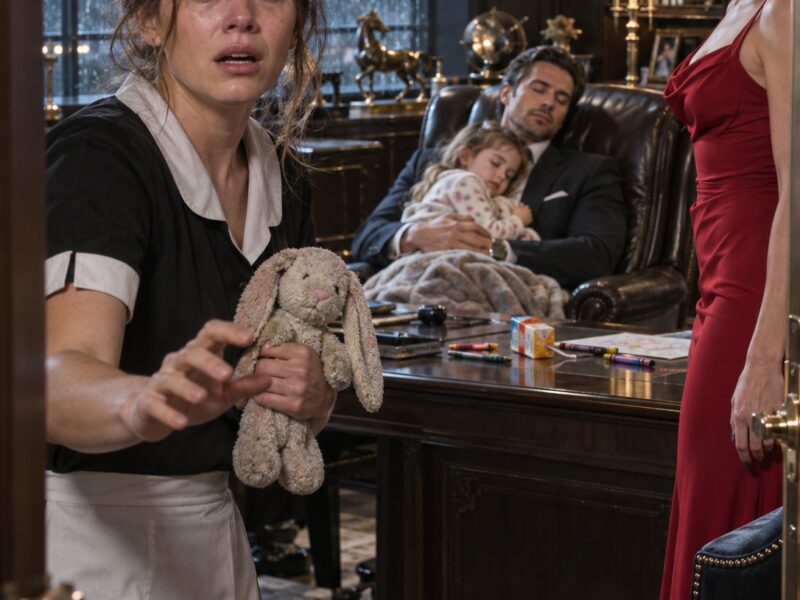
THE HOUSEKEEPER BROKE ONE RULE—THEN FOUND HER BILLIONAIRE BOSS ASLEEP WITH HER DAUGHTER IN HIS ARMS

At 11:17 on a rain-dark Tuesday morning, Jenna Cole opened the second-floor linen closet and realized her four-year-old daughter was gone.
The juice box slipped out of her hand.
It hit the polished oak floor with a soft cardboard thud, rolled beneath a brass laundry cart, and began leaking apple juice into the expensive runner rug Mrs. Pruitt had specifically warned the staff never to stain.
Jenna did not notice.
She stared into the narrow closet where Norah had been sitting twenty minutes earlier with a purple crayon in one hand, a stuffed rabbit beneath her arm, and strict instructions not to move.
Now the little folding blanket was empty.
Crayons lay scattered near the baseboard.
The stuffed rabbit was face down on the floor.
And the door was open.
“Norah?”
Jenna whispered the name because shouting inside Ashford House was practically a disciplinary offense.
Then she stopped caring.
“Norah?”
Louder this time.
Nothing answered except distant thunder.
Her heart began pounding so violently that she could feel it behind her eyes.
She checked behind the stacked towels, beneath the laundry counter, inside the bathroom across the hall even though the room was obviously empty. She ran to the guest suite, then the gallery, then the west staircase.
No yellow dress.
No little white sneakers.
No Norah.
Every terrible possibility a mother could invent arrived at once.
The front drive.
The indoor pool.
The service elevator.
The kitchen range.
The storm gathering beyond the glass walls.
The private road where delivery trucks came around the bend too fast.
And beneath all of that terror came another thought, smaller and uglier because she hated herself for having it.
If Mrs. Pruitt found out Jenna had brought a child into the estate, she was going to lose her job.
If she lost her job, she would lose the apartment.
If she lost the apartment, she had nowhere to take Norah.
“God,” Jenna breathed, gripping the banister as she hurried down the hall. “Please. Just let me find her.”
She had broken one rule because she had been trying to survive one impossible Tuesday.
She had no idea that three floors above her, Norah Cole was curled against the chest of the one man in the house who could fire Jenna with a sentence.
And Julian Ashford—the man employees lowered their voices around, the man newspapers called disciplined, ruthless and emotionally unreadable—was holding the child as if he had been waiting thirty-five years for someone to trust him enough to fall asleep in his arms.
Jenna’s disaster had begun at 4:52 that morning.
Her phone vibrated on the milk crate she used as a nightstand, pulling her from three hours of sleep.
The studio apartment was dark except for the green numbers on the microwave clock. Norah slept sideways beside her, one small foot pressed against Jenna’s hip because sometime after midnight she had climbed out of her toddler bed after a nightmare.
Jenna reached blindly for the phone.
“Hello?”
“Jenna?”
She recognized Mrs. Alvarez immediately.
Her neighbor sounded like she was crying.
Jenna sat up.
“What happened?”
“My mother fell in the bathroom. The ambulance is here. I have to go with her.”
Jenna’s stomach tightened before the woman even finished.
Mrs. Alvarez had watched Norah during Jenna’s shifts for eight months. She took twelve dollars an hour when she could have asked for twenty. She kept a plastic cup with Norah’s name written across it in permanent marker. She knew which cartoons Norah loved and exactly how much cinnamon to sprinkle on her oatmeal.
More importantly, she was the only person in the city Jenna trusted with her daughter.
“I’m so sorry,” Mrs. Alvarez said. “I know you work today. I just—”
“Don’t apologize. Go take care of your mom.”
“But Norah—”
“I’ll figure it out.”
That was the phrase Jenna used whenever she had absolutely no idea what she was going to do.
I’ll figure it out.
She had said it when Norah’s father disappeared before their daughter’s first birthday.
She had said it when the restaurant where Jenna worked closed with forty-eight hours’ notice.
She had said it when rent went up by three hundred dollars and her checking account contained sixty-two.
She had said it when she accepted the housekeeping position at Ashford House despite knowing the commute required two buses and a twelve-minute walk.
I’ll figure it out.
It had become less a statement than a prayer.
After ending the call, Jenna opened every childcare contact in her phone.
The first sitter didn’t answer.
The second had the flu.
The third was already watching three children.
At 5:21 she called a twenty-four-hour childcare center and nearly laughed when the woman quoted the emergency drop-in rate.
At 5:37 she opened her banking app.
$184.23.
Friday was payday.
Thursday was rent.
Her car had died eleven months earlier and never been replaced.
There was nobody else.
Jenna sat on the edge of the bed with the phone in her hand while Norah slept beside her, curls spread across the pillow, utterly unaware that her mother was trying to calculate how many ways a life could collapse before breakfast.
Calling out was not an option.
Not that week.
Friday night, Ashford Holdings was hosting its annual executive board dinner at the estate, which meant every member of the household staff had spent the previous ten days polishing silver, inventorying wine, steaming linens and being reminded by Margaret Pruitt that perfection was not an aspiration.
It was employment.
Two days earlier, Mrs. Pruitt had gathered the staff in the service kitchen.
“If someone suddenly discovers an illness between now and Friday,” she had said, adjusting the pearl pin at her collar, “please have the courtesy to discover another job as well.”
She had smiled after saying it.
Nobody else had.
Jenna had never missed a shift.
She had never been late.
She had covered for coworkers without complaint, cleaned vomit from imported rugs after charity events, scrubbed wine from marble grout at midnight, and learned which staircases creaked so that she could move through the mansion without disturbing its owner.
None of that guaranteed anything.
Jobs like Jenna’s were secure only until someone wealthier became inconvenienced.
She looked down at her sleeping daughter.
Then she made the worst decision she could think of.
And the only decision available.
At 6:48 a.m., wearing her housekeeping uniform beneath a thrift-store raincoat, Jenna stood outside the service entrance of Ashford House gripping Norah’s hand.
The estate sat on seventeen acres outside Boston, hidden behind wrought-iron gates and a private road lined with white oaks. The main house was an architectural contradiction—old limestone wrapped around glass additions so clean and expensive they seemed almost invisible.
Norah stared upward.
“Is this a castle?”
“No.”
“Looks like a castle.”
“It’s a house.”
“A giant castle house.”
Jenna crouched beneath the stone awning as rain misted around them.
“Norie, listen to me.”
Norah immediately became serious.
Whenever Jenna used that voice, she knew the world had rules.
“We’re playing a game today.”
“What game?”
“The quiet mouse game.”
“I like mice.”
“I know. That’s why I picked it.”
Norah grinned.
Jenna brushed damp curls from her forehead.
“Wherever Mommy puts you, you stay there. You color. You eat your snacks. You watch cartoons with the headphones. And you do not leave unless I come get you.”
“What if I have to pee?”
“You tell me first.”
“What if there’s a fire?”
Jenna almost laughed.
“If there’s a fire, you can definitely leave.”
“What if there’s a dinosaur?”
“Norah.”
“Okay.”
“Can you do this?”
Her daughter nodded solemnly.
“Quiet like a mouse.”
Jenna kissed her forehead.
“Exactly.”
Then she looked toward the service door.
Pinned to the staff bulletin board inside was a handwritten rule Jenna had read so many times she could see it even with the door closed.
NO CHILDREN ON THE PROPERTY DURING WORKING HOURS.
NO EXCEPTIONS.
Her stomach twisted.
“Mommy?”
“Yes?”
“You look scared.”
Jenna forced a smile.
“I’m not scared.”
Norah studied her.
Children knew lies by instinct.
But she took Jenna’s hand anyway.
That was the first secret they carried into Ashford House together.
The second was that Jenna was already afraid of losing far more than a job.
Julian Ashford was thirty-five years old and, depending on which financial magazine you read, worth somewhere between 2.8 and 3.4 billion dollars.
Jenna knew this because people talked.
She also knew he owned ports, logistics companies, commercial real estate, two private aircraft and a minority stake in a professional basketball team.
What she did not know was whether he liked coffee.
Or music.
Or dogs.
Or anything.
In eight months, she had seen him perhaps twelve times.
He left before sunrise.
He returned after dark.
He spoke to staff politely but rarely.
He never hosted friends.
He never raised his voice.
In some ways, the absence of anger made him more intimidating.
Men who screamed could be understood.
Julian Ashford seemed to have trained himself not to reveal enough emotion for anyone to understand him at all.
The staff had theories.
A chauffeur claimed Julian had not taken a vacation since his father died.
One of the gardeners insisted he sometimes stood alone beside the greenhouse after midnight.
A former chef said Julian had ended a Christmas party halfway through because someone played a song his mother used to love.
Nobody knew which stories were true.
The only thing everyone agreed on was that Ashford House had been cold long before Julian inherited it.
Above the main fireplace hung a portrait of three men.
Julian’s father, grandfather and great-grandfather.
Dark suits.
Straight backs.
Severe mouths.
They appeared less like a family than three consecutive warnings.
Norah had noticed the portrait the first time Jenna sneaked her through the main hall that morning.
“Why are they mad?”
“They’re not mad.”
“They look mad.”
“They were serious men.”
“Why?”
Jenna hesitated.
“I don’t know.”
Norah looked at the painting again.
“They should smile.”
Jenna pulled her gently onward.
“Quiet mouse, remember?”
“Right.”
For the first three hours, the plan worked.
Jenna hid Norah in a wide linen room off the second-floor guest wing where nobody had reason to go before Friday.
She made a nest from folded blankets.
She gave her crackers, apple slices, two juice boxes, headphones, crayons and the stuffed rabbit she called Mr. Buttons.
Every fifteen minutes, Jenna found an excuse to return.
At 8:15 Norah was coloring a purple horse.
At 8:31 she was eating crackers.
At 8:47 she complained that quiet mice were boring.
At 9:05 Jenna read half a picture book while pretending to inventory towels.
At 9:38 Norah fell asleep.
At 10:21 she woke up and asked when they could go home.
“After Mommy finishes.”
“How long?”
“A little while.”
“That means long.”
Jenna kissed her.
“You’re doing great.”
At 10:52, Mrs. Pruitt called Jenna downstairs to help unpack a shipment of Italian table linens.
At 11:16, Jenna climbed back upstairs carrying a fresh juice box.
At 11:17, she found the empty room.
Norah had awakened, heard something in the hallway and gone looking for her mother.
Instead, she found a staircase she had never seen.
Then another.
Then a hall lined with abstract paintings.
Then a dark wooden door standing slightly open.
Behind it sat Julian Ashford.
He had returned unexpectedly after canceling a morning flight to Manhattan.
The board dinner was three days away, and the numbers on his computer screen refused to stay in focus.
Normally, Julian could read a balance sheet faster than most executives could explain one.
That morning he had reread the same paragraph five times.
He loosened his tie.
Closed his eyes.
Opened them.
Nothing changed.
Friday’s dinner was supposed to reassure the board that Ashford Holdings remained stable after a year of aggressive acquisitions and ugly press speculation.
Julian had spent half his adult life making powerful people believe he could carry any amount of pressure without bending.
The performance had become so successful that he sometimes believed it himself.
Then a small voice said, “Why are you sad?”
Julian looked up sharply.
A little girl stood in his doorway.
Yellow dress.
White sneakers.
Wild brown curls.
A purple crayon in one hand.
For several seconds, Julian wondered if exhaustion had finally produced hallucinations.
“Excuse me?”
“You look sad.”
She stepped inside.
Julian stared.
There were no children in Ashford House.
There had never been children in Ashford House.
Not since he was one.
“Where did you come from?”
“Downstairs.”
“That doesn’t answer my question.”
She shrugged.
“It answers a little.”
Despite himself, something moved at the corner of Julian’s mouth.
The girl noticed.
“There.”
“What?”
“You almost smiled.”
Julian leaned back slowly.
“And who are you?”
“Norah.”
“Norah what?”
“Cole.”
The name registered.
Cole.
One of the housekeepers.
He had seen Jenna Cole moving through the west hall, usually with an armful of sheets or a cleaning cart. Brown hair pulled back. Quiet voice. A habit of disappearing from rooms before he could properly notice her.
“Where is your mother?”
“Working.”
“Does she know you’re here?”
Norah’s confidence faltered.
“I was supposed to be a mouse.”
Julian waited.
“A quiet mouse.”
“I see.”
“But I got bored.”
“That sounds less like a mouse.”
“I know.”
She twisted the purple crayon between her fingers.
Then her eyes dropped.
“Am I in trouble?”
The question hit Julian with surprising force.
Not because of what she asked.
Because of how she asked it.
Her shoulders had already pulled inward.
Her eyes were waiting for the face adults made before punishment.
He had known that feeling.
Once.
Long ago.
A memory surfaced without invitation: Julian at ten years old standing beside a shattered crystal decanter while his father asked, not loudly but far worse, “Are you planning to cry?”
Julian had swallowed the tears immediately.
His father had nodded.
“Good. Self-control is the first difference between men who inherit power and men who lose it.”
Julian looked back at Norah.
She was four.
Maybe five.
Too young to learn that fear made adults easier to manage.
“No,” he said.
Her eyes lifted.
“You’re not in trouble.”
“Really?”
“Really.”
She stepped closer.
“Then why are you sad?”
“I’m not.”
Norah tilted her head.
Julian almost felt offended.
“What?”
“My mommy does that.”
“Does what?”
“Says she’s not sad when she’s sad.”
“I assure you, I’m fine.”
“She says that too.”
This time he did smile.
Barely.
But it happened.
Norah brightened as though she had personally accomplished something significant.
“I knew it.”
Julian shook his head.
“You’re extremely persistent.”
“What’s persistent?”
“It means you don’t stop.”
“Oh.”
She considered this.
“My mommy says stubborn.”
“I suspect your mother and I would agree.”
Norah walked around his desk without being invited.
“What are those?”
“Financial projections.”
“What’s that?”
“Something very boring.”
“Then why do you look at them?”
Julian glanced at the screen.
For the first time all morning, the absurdity of his life became clear.
“I’m beginning to ask myself the same question.”
Thunder exploded over the estate.
Norah flinched.
The purple crayon dropped.
Before Julian could react, she hurried around the desk and climbed directly into his lap.
He froze.
Her arms went around his waist.
She pressed her face against his shirt.
Another rumble rolled through the windows.
Julian’s hands hovered uselessly in the air.
He had negotiated labor disputes.
Restructured billion-dollar debt.
Dismissed senior executives without hesitation.
He had stared down men twice his age while entire companies depended on which one blinked first.
He had absolutely no idea how to hold a frightened four-year-old.
“Thunder,” Norah whispered.
“Yes.”
“I don’t like it.”
“That seems reasonable.”
“You’re supposed to hug.”
Julian looked down at the top of her head.
“I am?”
“Yes.”
“Is that the rule?”
“Yes.”
Slowly, awkwardly, he lowered his arms around her.
Norah relaxed immediately.
“There.”
Julian swallowed.
Something about the trust in that small body against him made his chest ache in a way he did not understand.
She did not know who he was.
She did not know what the house cost or what newspapers called him.
She did not know his father’s name.
She did not care about his reputation.
To Norah, he was simply a man sitting alone in a big room during a storm.
“You don’t have to be sad by yourself,” she murmured.
Julian went very still.
Outside, rain slammed hard against the windows.
Norah’s breathing gradually slowed.
Five minutes later, she was asleep.
Julian should have called staff.
He should have found Jenna Cole.
He should have returned to the twelve emails waiting unanswered on his computer.
Instead, he sat there.
One arm around the sleeping child.
The other resting carefully across the chair.
Then, for the first time in months, Julian Ashford closed his eyes without immediately thinking about everything that might collapse if he stopped paying attention.
Forty minutes later, Jenna reached the third floor.
She was shaking.
She had checked the laundry rooms.
The kitchen.
The conservatory.
The rear terrace.
She had almost alerted security twice and stopped herself both times because explaining why she needed security would mean explaining how Norah got inside.
Then she noticed Julian’s office door.
It was open.
Not much.
An inch.
Maybe two.
Jenna stopped.
The staff did not enter Julian Ashford’s office without permission.
Even Mrs. Pruitt knocked and waited.
Jenna approached.
“Norah?”
No answer.
She pushed the door wider.
Then forgot how to breathe.
Julian Ashford was asleep in a leather chair beside the window.
His tie was undone.
His head rested against the chair.
And curled against his chest was Norah.
One tiny hand had fisted in the front of his white dress shirt.
Julian’s arm encircled her automatically even in sleep.
Jenna stared.
She had expected broken glass.
Anger.
Security.
Termination.
She had not expected tenderness.
Norah looked safer than she had all morning.
That somehow made Jenna’s eyes burn.
She stepped quietly inside.
Her first instinct was to take her daughter and disappear before Julian woke.
She bent down.
Norah stirred.
Julian’s eyes opened.
Jenna jerked backward.
“I’m sorry.”
The words came too fast.
“Mr. Ashford, I am so, so sorry. She wandered away. I was looking everywhere. I’ll take her right now.”
Julian blinked, orienting himself.
Jenna reached toward Norah.
The child tightened her grip on his shirt.
Julian looked down.
Then back at Jenna.
“She said I looked sad.”
Jenna froze.
“I’m sorry?”
“She said I looked sad.”
His voice was low from sleep.
Then, with an almost embarrassed honesty that Jenna had never expected to hear from him, he said, “She wasn’t wrong.”
Jenna did not know what to do with that.
She straightened slowly.
“Sir, I understand if you need to report this to Mrs. Pruitt.”
Julian’s expression changed.
“Report what?”
“I brought Norah onto the property.”
“I gathered that.”
“There’s a rule.”
“I’m aware of the rule.”
“I had no childcare this morning. My neighbor had an emergency. I tried everyone I knew. I shouldn’t have brought her, but I couldn’t miss work and—”
“Stop.”
Jenna’s mouth closed.
Julian shifted carefully so he would not wake Norah.
“How long have you worked here?”
“Eight months.”
“And how many shifts have you missed?”
“None.”
“Been late?”
“No.”
“Had disciplinary issues?”
“No.”
“Then why are you standing in front of me as if you committed a crime?”
Jenna looked at him.
Because people like you can survive inconvenience, she thought.
People like me get destroyed by it.
Out loud she said, “Because I need this job.”
Something in Julian’s face softened.
He looked at her properly for the first time.
Not at the uniform.
Not at the name tag.
At her.
There were shadows beneath her eyes.
Her hair had started falling out of its knot.
One cuff of her uniform was damp from the leaking juice box she had picked up during the search without even realizing it.
“How old is she?”
“Four.”
“You’re raising her alone?”
Jenna hesitated.
“Yes.”
“No family nearby?”
“No.”
“And no childcare today.”
“No.”
Julian glanced toward the rain.
“So you brought her because the alternative was missing work.”
“Yes.”
“And you believed missing one day would cost you your job.”
Jenna said nothing.
She did not need to.
His jaw tightened.
“In eight months,” he asked, “has anyone in this house ever asked what you needed in order to do your job?”
The question was so strange that Jenna almost laughed.
“That’s not really how housekeeping works, sir.”
“Maybe that’s the problem.”
Another roll of thunder trembled through the windows.
Norah shifted against Julian.
Without thinking, his hand settled more securely along her back.
The gesture seemed to surprise him as much as it did Jenna.
“My mother left when I was ten,” he said.
Jenna looked at him.
Julian kept his eyes on Norah.
“She moved to Europe. Sent birthday cards for three years. Then stopped.”
“I’m sorry.”
“My father considered sympathy inefficient.”
There was no self-pity in his voice.
That made it sadder.
“He believed children became strong through deprivation. Less affection. Fewer expectations. No dependence on anyone.”
Jenna looked around the beautiful office.
Suddenly it felt less like wealth and more like evidence.
“I haven’t held a child since I was one,” Julian said.
He gave a humorless little breath.
“I didn’t expect it to feel…”
He stopped.
“Feel like what?” Jenna asked before she could stop herself.
Julian looked at her.
“Peaceful.”
The office door opened.
Jenna spun around.
Mrs. Pruitt stood there.
Her gaze moved first to Jenna.
Then to Norah.
Then to Julian’s arm around the sleeping child.
The housekeeper’s expression barely changed.
That was somehow worse.
“Mr. Ashford.”
Julian’s face closed slightly.
“Mrs. Pruitt.”
“I was informed Miss Cole had been away from her assigned rooms for nearly an hour.”
Jenna’s stomach dropped.
“I can explain—”
“The child was with me,” Julian said.
Mrs. Pruitt’s gaze shifted.
“The household policy on children exists for good reason.”
“I’m sure it does.”
“Liability. Disruption. Security.”
“There is no security concern.”
“With respect, sir, consistency is important. If other employees believe—”
“Then perhaps other employees should believe we’re capable of making humane decisions.”
Silence.
Mrs. Pruitt’s mouth tightened.
Julian continued.
“Miss Cole’s childcare collapsed unexpectedly. She came to work anyway because she believed staying home would cost her employment.”
Mrs. Pruitt’s eyes flicked toward Jenna.
“That was not explicitly stated.”
“It didn’t need to be.”
“Sir—”
“The rule changes today.”
Jenna stared.
“So does our emergency childcare policy.”
Mrs. Pruitt blinked once.
“We don’t have one.”
“Exactly.”
The temperature in the room seemed to drop.
Julian spoke calmly.
“Speak with HR. Draft something reasonable. Paid emergency leave. Backup childcare reimbursement. Bring it to me tomorrow.”
Mrs. Pruitt’s posture stiffened.
“Of course.”
Then she looked toward Norah.
“Miss Voss will likely have concerns.”
The name entered the room like a knife.
Julian’s eyes narrowed.
“Why would Camille have concerns about my employee’s childcare?”
Mrs. Pruitt paused.
“I only meant…”
“Yes?”
“Nothing, sir.”
But something had shifted.
Jenna saw it.
Julian saw it too.
Mrs. Pruitt excused herself.
The door closed.
Norah slept through all of it.
Jenna swallowed.
“Who’s Camille Voss?”
Julian looked at her.
“My fiancée.”
And suddenly the warmth that had begun spreading through the room became dangerous.
Three nights later, Camille Voss arrived at Ashford House wearing red.
She always looked as though someone might photograph her at any moment.
Her hair was glossy.
Her jewelry was understated in the way only extremely expensive jewelry could be.
Her smile was practiced enough to appear effortless.
The annual board dinner began at seven beneath chandeliers imported from Venice before Jenna was born.
Forty guests filled the formal dining room.
Silver reflected candlelight.
Waiters moved silently between chairs.
Men whose names appeared on buildings discussed freight routes, interest rates and regulatory exposure over wine that cost more per bottle than Jenna’s grocery budget for a month.
Jenna stayed mostly in the service hall.
That was where people like her became invisible.
She preferred it.
At least she told herself she did.
Around eight thirty, Mrs. Pruitt entered carrying an empty champagne tray.
Camille was passing through the side corridor on her way to the powder room.
Mrs. Pruitt stopped.
They exchanged a few quiet words.
Jenna was far enough away that she heard only fragments.
“…Tuesday…”
“…private office…”
“…child…”
Camille stopped walking.
“What child?”
Jenna’s hands froze around a stack of dessert plates.
Mrs. Pruitt lowered her voice.
Jenna could not hear the response.
But she saw Camille’s expression.
The pleasant social mask stayed in place.
Only her eyes changed.
“A housekeeper brought her daughter here?” Camille said.
Mrs. Pruitt nodded.
“And Julian allowed it?”
Another nod.
Camille’s lips thinned.
“He held her?”
Jenna looked away before either woman noticed her.
Later, while collecting coffee cups near the drawing room, she saw Camille watching Julian.
He stood near the fireplace speaking with an elderly board member.
The man said something Jenna did not hear.
Julian laughed.
Actually laughed.
The sound was brief.
Unpracticed.
Human.
Camille stared at him as if the laugh belonged to someone else.
Then she noticed Jenna standing in the doorway.
For a second, neither woman moved.
Camille smiled.
Jenna immediately understood that the smile was not kindness.
Over the next three weeks, Ashford House changed in ways so small that most visitors would never have noticed.
Jenna noticed.
Julian began leaving his office door open.
He came home before eight.
Then before seven.
Sometimes at six.
When he crossed the kitchen, he stopped to ask staff how their day had gone.
The first time it happened, one of the cooks thought she was in trouble.
Mrs. Pruitt implemented the emergency childcare policy with the rigid efficiency of someone following an instruction she had not personally endorsed.
Jenna received reimbursement for Mrs. Alvarez’s backup caregiver.
It should have solved everything.
But emergencies do not respect policies.
Twice more that month, childcare fell through.
Both times, Jenna brought Norah.
Both times, Julian somehow appeared.
He was casual about it.
Too casual.
Once he walked through the sunroom where Norah was coloring and claimed he needed to inspect the window seals.
Jenna glanced at him.
“The window seals?”
“Yes.”
“You personally inspect window seals?”
“Occasionally.”
“Since when?”
Julian looked toward Norah.
“Recently.”
Another afternoon, he arrived carrying a wooden puzzle still wrapped in tissue paper.
Norah looked up.
“What’s that?”
“A puzzle.”
“For who?”
Julian hesitated.
“For the household.”
Norah frowned.
“Houses don’t do puzzles.”
Jenna bit the inside of her cheek.
Julian surrendered.
“It’s for you.”
“I knew it.”
She tore open the paper.
Ten minutes later, Julian was on the floor in a three-thousand-dollar suit trying to figure out why a wooden giraffe would not fit into the slot Norah insisted belonged to it.
“You’re doing it wrong,” she informed him.
“I run an international logistics company.”
“What’s that?”
“It means I move complicated things from one place to another.”
“Then move the giraffe.”
Jenna laughed.
Julian looked up.
Something passed between them.
Small.
Warm.
Dangerous.
Jenna stopped laughing first.
It became easier for Norah.
She had none of her mother’s instinct for hierarchy.
To her, Ashford House was not a monument to power.
It was a giant building with too many rooms, excellent cookies and a sad man who was becoming less sad.
At first she called him Mr. Ashford.
Then Mr. Sad Man.
Julian objected.
“You cannot call me that in front of the board.”
“Why?”
“Because I have a reputation.”
“What’s that?”
“Something adults spend too much time protecting.”
Norah considered this and nodded.
“Okay, Mr. Sad Man.”
Three days later, she changed his name again.
“Julian.”
He looked up from his phone.
“What?”
“Your name is Julian.”
“Yes.”
“So I’m calling you Julian.”
“Most people don’t.”
“Why?”
He seemed unable to answer.
Jenna stood in the sunroom doorway.
In eight months, she had never heard anyone beneath executive level use his first name in the estate.
Even Camille usually called him “Jules” with a polished intimacy that somehow still sounded formal.
But Norah said Julian as if his name had no weight.
No money.
No history.
Just a name.
Julian’s face changed.
The guardedness slipped.
For a moment he looked younger.
And Jenna understood something that frightened her.
Her daughter was not merely charming him.
She was reaching a part of him nobody else seemed to know existed.
The realization should have made Jenna retreat.
Instead, she found herself watching him more.
The way he crouched when Norah spoke so they were eye level.
The way he pretended not to know where Mr. Buttons was hiding even when the stuffed rabbit’s ears were sticking out from behind a cushion.
The way he listened.
Really listened.
Men had listened to Jenna before when they wanted something.
Julian listened as though what people said might change him.
One evening Jenna stayed late to help clean after a private dinner.
The kitchen emptied after ten.
She stood at the deep farmhouse sink scrubbing a copper pan that was already clean because her mind had drifted elsewhere.
“You’re going to remove the metal itself if you keep doing that.”
Jenna jumped.
Julian stood in the doorway.
No jacket.
Sleeves rolled to his forearms.
“You scared me.”
“Sorry.”
She turned back to the sink.
“I’m almost done.”
“You’ve been done for at least five minutes.”
“Occupational habit.”
He stepped into the room.
“You don’t have to call me sir when nobody’s around.”
Jenna looked over her shoulder.
“What should I call you?”
He gave her a look.
She smiled despite herself.
“Right. Julian.”
Something in his expression softened at the sound of his name.
He leaned against the counter.
“I wanted to thank you.”
“For what?”
“For Norah.”
Jenna turned fully.
“I didn’t exactly bring her here for your benefit.”
“I know.”
He smiled faintly.
“That’s probably why it mattered.”
Jenna dried her hands.
“What do you mean?”
Julian looked toward the dark window.
“When people do things around me, I usually understand the reason.”
“Money?”
“Sometimes.”
“Influence?”
“Often.”
“Fear?”
His eyes returned to hers.
“More often than I’d like.”
“And Norah?”
“She wanted somewhere to hide from thunder.”
Jenna’s face softened.
“Yes.”
“And then apparently she decided my emotional development was her responsibility.”
“That sounds like her.”
Julian laughed quietly.
“She’s made this house feel different.”
Jenna lowered her eyes.
“She has a gift for that.”
“For what?”
“Finding the soft part in people who forgot they had one.”
Julian studied her.
“What about you?”
Jenna frowned.
“What about me?”
“Who finds yours?”
The question landed too close to something she kept buried.
She looked away.
“No one, really.”
“That doesn’t sound fair.”
“Life isn’t.”
“I know.”
“You know differently.”
Julian absorbed that without offense.
“You mean because I have money.”
“I mean because if your refrigerator breaks, you buy another one. If mine breaks, Norah and I eat cereal for three days while I figure out whether repairing it means the electric bill is late.”
Julian said nothing.
Jenna instantly regretted the sharpness.
“I’m sorry.”
“Don’t be.”
“I shouldn’t have said that.”
“Why?”
“Because you’re my employer.”
“That doesn’t make it untrue.”
Their eyes met.
The kitchen suddenly felt smaller.
Neither of them noticed Camille standing beyond the swinging door.
She had entered through the formal hall ten minutes earlier.
Nobody had announced her because nobody ever thought Julian’s fiancée needed permission to enter.
She heard enough.
Who finds the soft part in you, Jenna?
No one.
That doesn’t sound fair.
Camille’s manicured fingers tightened around the doorframe.
For three years, she had believed she understood Julian better than anyone.
He was disciplined.
Private.
Predictable.
Affection embarrassed him.
Vulnerability annoyed him.
Marriage between them would work precisely because neither expected sentimental performances from the other.
They respected each other.
Their families approved.
Their worlds matched.
Nothing messy.
Nothing surprising.
Nothing dangerous.
Then a housekeeper with tired eyes and a four-year-old daughter arrived, and suddenly Julian was asking questions Camille had stopped asking years ago.
Three days later, Jenna entered the east hallway carrying fresh towels and found Camille waiting beside a marble console table.
“Jenna.”
The fact that she knew her name immediately put Jenna on guard.
“Miss Voss.”
Camille smiled.
“Could we talk?”
The hall was empty.
Jenna set the towels down.
“Of course.”
Camille approached.
“Julian tells me your daughter has become something of a regular guest.”
Jenna heard the accusation beneath the polite words.
“Only when childcare falls through.”
“And Julian enjoys having her here.”
“Norah likes him.”
“That’s not what I said.”
Jenna lifted her gaze.
Camille’s smile vanished.
“Julian Ashford is going to be my husband in four months.”
Jenna said nothing.
“I have spent three years building a life with him.”
“Then I don’t understand why you’re talking to me.”
Camille’s expression hardened.
“Don’t you?”
“No.”
“Let me make it simple.”
She stepped closer.
“You work here.”
Jenna went still.
“Your daughter does not belong here.”
Something hot flashed through Jenna’s chest.
“You can say whatever you want to me. Leave Norah out of it.”
“I would gladly leave her out of it if you had.”
Jenna stared.
Camille lowered her voice.
“You think I haven’t seen what’s happening?”
“What exactly do you think is happening?”
“He leaves meetings early.”
“That has nothing to do with me.”
“He comes home before dinner.”
“I don’t control his schedule.”
“He spent two hours on the floor doing a puzzle with your child.”
Jenna’s face changed.
Camille saw it.
“This is not about a puzzle,” Jenna said.
“No. It’s about weakness.”
The word disgusted her.
“Julian is under pressure. His father died. The board is difficult. For a few weeks, your daughter made him feel something novel.”
“Kindness?”
“Distraction.”
Jenna’s jaw tightened.
Camille leaned in.
“Men like Julian sometimes become fascinated by people who represent lives they never had. It doesn’t mean they actually want those lives.”
“And what life do I represent?”
Camille’s eyes dropped briefly to Jenna’s uniform.
She did not answer.
She did not need to.
Jenna felt the humiliation like a slap.
Camille continued softly.
“Remember your place, Miss Cole.”
“My place?”
“Yes.”
“And where is that?”
“Not beside him.”
Jenna’s breathing changed.
“Neither you nor your daughter is going to unravel my life because Julian is having a sentimental crisis.”
“And if I don’t stay away?”
Camille’s eyes became almost pleasant again.
“Then I imagine Mrs. Pruitt can find a housekeeper who understands boundaries.”
Jenna looked at her for a long moment.
Then she picked up the towels.
“I understand boundaries perfectly.”
“Good.”
Jenna walked away.
Only after turning the corner did she realize her hands were shaking.
That night, she lay beside Norah in their apartment and stared at the water stain above the bed.
Norah slept with Mr. Buttons beneath her chin.
Jenna thought about Julian laughing in the sunroom.
She thought about his question in the kitchen.
Who finds the soft part in you?
Then she thought about Camille’s voice.
You work here.
She hated Camille for saying it.
She hated herself more because some part of her believed it.
Jenna had survived by understanding which doors were not meant for her.
Romance was not the issue.
It could not become the issue.
Julian belonged to a world where engagements appeared in newspapers.
Jenna belonged to a world where she checked supermarket coupons before deciding whether Norah could have strawberries.
The tenderness between them was real.
That did not make it safe.
By morning Jenna had decided.
No more Norah at the estate.
No more unnecessary conversations with Julian.
No more standing in kitchens after hours.
She would go back to being invisible.
It would hurt less if she chose it herself.
Two days later, her phone rang at 2:14 in the afternoon.
Jenna was changing sheets in the west guest room.
Mrs. Alvarez’s name appeared on the screen.
She answered immediately.
“Hello?”
“Jenna.”
The neighbor sounded panicked.
Jenna straightened.
“What happened?”
“It’s Norah.”
Everything inside her stopped.
“What happened?”
“She fell off the porch steps. She landed on her arm. I don’t know if it’s broken. She’s crying, Jenna.”
The fitted sheet fell from Jenna’s hands.
“I’m coming.”
She ended the call and ran.
Rules disappeared.
Camille disappeared.
Professionalism disappeared.
There was only Norah.
Jenna reached the main staircase too fast and nearly collided with Julian coming up.
He caught her arms.
“Jenna.”
She pulled away.
“I have to go.”
“What happened?”
“Norah fell.”
His expression changed instantly.
“Where?”
“At Mrs. Alvarez’s. I have to get there.”
“Is she hurt?”
“Her arm. I don’t know.”
Jenna headed for the foyer.
Julian followed.
“I’ll drive you.”
She stopped.
“No.”
“Why?”
“I can get a ride.”
“How?”
She had no answer.
“Jenna.”
“I’ll call a car.”
“That will take ten minutes.”
“I said I can—”
“I’ll drive you.”
The firmness in his voice was not authority.
It was concern.
That made it harder.
“Julian—”
“Please.”
She looked at him.
He already had his keys.
“Let’s go.”
From the upper landing, Camille watched them leave.
She had arrived unexpectedly with fabric samples for the wedding reception.
Julian did not see her.
Jenna did not see her.
Camille stood motionless as Julian abandoned a scheduled investor call, walked straight past his fiancée and raced out of the house for another woman’s child.
Something inside her went cold.
The drive took eighteen minutes.
Jenna remembered every second.
Every red light felt cruel.
Every slow driver became personal.
She twisted her hands in her lap until her knuckles hurt.
Julian drove quickly but carefully.
“She’s going to be okay.”
Jenna stared through the windshield.
“You don’t know that.”
“No.”
“Then don’t say it.”
He nodded.
“You’re right.”
Silence.
Then, a minute later, he said, “Kids fall.”
Jenna looked at him.
“So I’ve heard.”
“Bones are resilient.”
“Are you secretly a pediatrician?”
“No.”
“Then please stop giving medical opinions.”
To her surprise, he smiled.
“Understood.”
At the next light, he spoke more quietly.
“But I do know Norah.”
Jenna turned.
“She’s tough.”
Her eyes filled immediately.
Julian kept looking ahead.
“She’s tougher than either of us.”
A tear escaped.
Jenna wiped it away angrily.
Julian pretended not to notice.
That kindness nearly broke her.
Norah was sitting on the porch steps when they arrived.
Her face was wet with tears.
Her right arm was tucked against her body.
“Mommy!”
Jenna ran.
She dropped to her knees and gathered Norah carefully against her.
“I’m here. I’m here.”
“It hurts.”
“I know, baby.”
Julian crouched beside them.
Norah saw him.
“Julian?”
“Hey, troublemaker.”
“I fell.”
“So I heard.”
“I didn’t cry a lot.”
“You can cry as much as you want.”
Norah looked at him.
“Really?”
“Absolutely.”
He glanced at Jenna, then gently addressed Norah.
“Can you wiggle your fingers?”
She did.
“Good. Can you move your elbow?”
She tried and winced.
Jenna inhaled sharply.
Julian’s face tightened.
“We’re going to have a doctor look at it.”
At the emergency room, he stayed.
Jenna expected him to leave after they checked in.
He did not.
An hour passed.
Then two.
His phone vibrated continuously.
He declined calls without looking.
At one point Norah pushed Mr. Buttons into his hands.
“Hold him.”
Julian accepted the stuffed rabbit.
“Why?”
“He’s scared.”
“Of hospitals?”
“Yes.”
Julian nodded solemnly.
“Understandable.”
For the next forty minutes, one of the wealthiest men in Massachusetts sat in a molded plastic emergency-room chair holding a faded stuffed rabbit as though entrusted with state secrets.
Jenna watched him from across the waiting area.
Something in her chest shifted.
Not because of the money.
Not because he had driven them.
Because nobody had asked him to stay.
He stayed anyway.
Norah had a severe bruise and a mild sprain.
No fracture.
When the doctor gave them the news, Jenna nearly collapsed from relief.
Outside, in the parking garage, Norah fell asleep in the back seat before Julian even started the car.
Jenna closed the rear door quietly.
Julian walked around to the driver’s side.
“Thank you.”
“You don’t need to thank me.”
“I do.”
He leaned against the car.
“You look like you want to say something else.”
Jenna looked toward Norah through the window.
Then she made a decision.
“Camille threatened me.”
Julian stopped moving.
“She what?”
“She found me in the hallway last week.”
Jenna told him.
Everything.
Remember your place.
Your daughter doesn’t belong here.
Neither of you will be welcome if this continues.
Julian listened without interrupting.
The longer she spoke, the stiller he became.
When she finished, his expression was not shocked.
That unsettled Jenna.
“You believe me?”
“Yes.”
“That quickly?”
“Yes.”
“Why?”
He looked away.
“Because this isn’t the first time Camille has tried to manage a problem before discussing it with me.”
Jenna’s stomach tightened.
“I’m not a problem.”
His eyes returned to hers.
“No.”
The word was immediate.
“You’re not.”
Neither spoke for several seconds.
Then Julian said, “I need to talk to her.”
“Please don’t make this worse for me.”
“Jenna.”
“I mean it. You break off some social arrangement, she still has friends, influence, people who can make calls. I still need work.”
Julian’s jaw tightened.
“Is that really what you think I’d allow?”
“It’s not about what you allow.”
“What is it about?”
“People like Camille don’t need permission to make someone like me disappear.”
The sentence sat between them.
Julian looked stricken.
Not offended.
Stricken.
Because he understood she was right about a world he had rarely been forced to see from the bottom.
“I won’t let that happen.”
Jenna gave a tired laugh.
“You keep saying things like you can control everything.”
“I’m trying to control the things I should have controlled years ago.”
“What does that mean?”
He looked toward the sleeping child in the car.
“It means my conversation with Camille is overdue.”
Camille arrived at Ashford House that evening believing Julian intended to apologize.
She found him waiting in the formal sitting room.
Her engagement ring caught the light as she walked in.
“You canceled the Hendricks call.”
Julian stood near the fireplace.
“Yes.”
“For the housekeeper’s daughter.”
“Her name is Norah.”
Camille stopped.
There it was again.
That tone.
Flat.
Certain.
“You walked out of a strategic call because a four-year-old bruised her arm.”
“I left because a child I care about was hurt.”
Camille stared.
“You care about.”
“Yes.”
“And Jenna?”
Julian’s eyes lifted.
“This conversation is about what you said to her.”
Camille laughed once.
Quietly.
“So she told you.”
“She shouldn’t have had to.”
“I was protecting us.”
“From what?”
Camille’s composure cracked.
“Do not insult me.”
“I’m asking.”
“From exactly what is happening right now.”
“What is happening?”
“You’re changing.”
Julian looked at her.
“That’s the first honest thing you’ve said tonight.”
Camille blinked.
“I have spent three years supporting you.”
“No.”
“I stood beside you when your father died.”
“You stood beside me at the funeral.”
“I handled reporters. I handled donors. I handled that disastrous shareholders’ weekend in Maine.”
“Yes.”
“I redesigned my entire life around this marriage.”
“That’s the problem.”
Her face hardened.
“What problem?”
“You redesigned a life.”
Julian’s voice remained quiet.
“We never built one.”
Camille stared at him.
“That is an unbelievably cruel thing to say.”
“It’s cruel because it’s late.”
He crossed the room.
“We have calendars. Events. Houses. Guest lists. We know where we’ll spend Christmas three years from now.”
“That’s called commitment.”
“Do you know what I’m afraid of?”
Camille opened her mouth.
Julian continued.
“Do you know what I do when I can’t sleep?”
Silence.
“My favorite memory of my mother?”
Camille looked away.
“The last time I cried?”
“Julian—”
“You don’t.”
“Because you never told me.”
“Did you ever ask?”
The question stopped her.
Julian swallowed.
“In three years, you never once asked how I was really doing.”
“You hate talking about feelings.”
“I thought I did.”
“And now what? A housekeeper taught you otherwise?”
“No.”
His gaze went toward the doorway as though he could still hear Norah’s footsteps in the hall.
“A four-year-old did.”
Camille’s face changed.
Julian looked toward the portrait above the fireplace.
Three Ashford men stared down.
“My father told me love was a liability.”
Camille was silent.
“He said attachment created leverage.”
Julian laughed without humor.
“I believed him.”
“Your father built everything you have.”
“He also died without a single person in this house knowing how to grieve him.”
“That’s unfair.”
“Is it?”
Julian looked back at her.
“When Norah climbed into my lap during that storm, I didn’t know what to do.”
His voice grew quieter.
“She had to tell me to hug her.”
Camille’s eyes flickered.
“She told me I didn’t have to be sad by myself.”
His throat tightened.
“And I realized I had been sad by myself my entire life and calling it strength.”
Camille looked almost frightened.
Not by Jenna.
Not by Norah.
By the fact that Julian believed what he was saying.
“You’re ending three years because a child hugged you?”
“No.”
“Then why?”
“Because when you heard about that child, your first instinct was not to wonder why an employee had no childcare.”
Julian’s gaze hardened.
“It was to protect your position.”
Camille went still.
“And you threatened her mother.”
“I told her the truth.”
“No.”
“You think class disappears because you’re having some emotional awakening?”
“No.”
“You think Jenna is going to understand your world?”
“I don’t know.”
“You think your board will?”
“I don’t care.”
“You will.”
“Maybe.”
“What about your name?”
Julian looked toward the portrait again.
“That’s the first thing I’m tired of protecting.”
Camille’s breathing became shallow.
“So this is it?”
Julian looked at her.
“I think it ended a long time ago.”
Tears appeared in her eyes.
He had rarely seen Camille cry.
For a moment, guilt struck him.
She was not a monster.
She had simply learned the same lesson he had.
Build the life people admire.
Control every variable.
Never need anyone enough for them to hurt you.
Perhaps that was why they had seemed compatible.
They had mistaken shared damage for stability.
Camille removed the ring.
The Ashford family diamond had belonged to Julian’s grandmother.
She placed it on the mantle.
The small click echoed through the room.
“I hope,” she said, “that when this fantasy ends, you remember you chose it.”
Julian looked at the ring.
“So do I.”
Camille walked out.
The front door closed a minute later.
For the first time in generations, an Ashford engagement ended without scandal, shouting or lawyers.
Just a ring beneath three unsmiling portraits.
And a man wondering whether he had destroyed the life everyone expected from him—or finally stopped destroying the one life that was actually his.
News traveled quickly through a house full of people trained to hear everything while appearing to hear nothing.
By breakfast, the cook knew the engagement was over.
By lunch, the groundskeeper knew.
By afternoon, the chauffeur had heard three different versions.
Mrs. Pruitt said nothing.
Jenna heard from a dishwasher.
She nearly dropped a tray.
“What?”
“They ended it.”
Jenna’s face went cold.
“When?”
“Last night.”
She walked away before the woman could say more.
For the next three days, Jenna avoided Julian more aggressively than before.
She changed her route when she heard him in a hallway.
She took lunch outside.
She left the moment her shift ended.
Norah noticed.
“Where’s Julian?”
“Busy.”
“He’s always busy.”
“Yes.”
“But he still comes.”
“Not every day.”
“Most days.”
Jenna tightened Norah’s coat.
“We’re going home.”
“Is he sad again?”
The question hurt.
“I don’t know.”
Norah frowned.
“We should check.”
“No.”
“Why?”
“Because sometimes adults need space.”
“Space like astronauts?”
“Exactly.”
Norah considered that acceptable.
Julian was less convinced.
On Friday, he found Jenna leaving through the service entrance.
“Are you avoiding me?”
She stopped.
“No.”
“You’ve used the east staircase fourteen times this week.”
Jenna stared.
“How do you know that?”
“I’ve seen you.”
“That’s unsettling.”
“Jenna.”
She sighed.
“Fine.”
Rain had stopped, but the pavement was wet.
She folded her arms.
“I heard about Camille.”
“I assumed you would.”
“You shouldn’t have ended your engagement because of me.”
“I didn’t.”
“Julian—”
“I ended it because of me.”
“That’s convenient.”
“It’s true.”
She looked away.
“You were engaged to her before I got here.”
“Yes.”
“You had a life.”
“I had an arrangement.”
“She said you were throwing away three years.”
“I was.”
Jenna looked back sharply.
Julian continued.
“Three years that should have ended sooner.”
“Why didn’t they?”
“Because it worked.”
“What does that mean?”
“It looked right.”
Jenna laughed sadly.
“That must be nice.”
“What?”
“Getting to leave something because it only looks right.”
His brow furrowed.
“For people like me, sometimes looking right is the luxury.”
Julian fell silent.
Jenna stepped closer.
“You can decide you don’t want the engagement. You can cancel dinners. Change policies. Take a week off. Buy another house. Start over.”
“Jenna—”
“I don’t get to make mistakes that expensive.”
Her voice cracked.
“I have Norah.”
“I know.”
“No, you don’t.”
The words came harsher than she intended.
Julian absorbed them.
Jenna shook her head.
“If I fall in love with the wrong person, my daughter lives with the consequences.”
Julian’s expression changed.
Neither of them moved.
Jenna realized what she had said.
If I fall in love.
She looked away immediately.
Julian did not rescue her from it.
That made the silence unbearable.
“I should go.”
“Okay.”
Jenna started walking.
“Jenna.”
She turned.
Julian’s voice was soft.
“I would never ask you to risk Norah for me.”
The sincerity in his face frightened her more than any promise would have.
Because she believed him.
The weeks that followed were strange.
No dramatic declarations.
No secret kisses.
No scandalous nights.
Just two adults trying not to turn tenderness into recklessness.
Julian gave Jenna space.
Real space.
He did not use his position to create meetings.
He did not appear in the kitchen at night.
He never mentioned Camille unless Jenna asked.
And because he did not chase, Jenna slowly stopped running.
Norah did what Norah always did.
Ignored adult complications.
One afternoon she found Julian reviewing contracts in the garden.
She climbed onto the bench beside him.
“My mommy likes you.”
Julian nearly dropped his pen.
“Does she?”
“Yes.”
“How do you know?”
“She does this.”
Norah demonstrated a strange expression involving narrowed eyes and a half smile.
Julian stared.
“What is that?”
“Her face.”
“I see.”
“She only does it with you.”
“Interesting.”
“But she’s scared.”
That removed the amusement from his face.
“Of me?”
“No.”
“Of what?”
Norah shrugged.
“Bad things.”
Julian looked across the lawn.
Jenna was kneeling beside a rose bed collecting Norah’s abandoned crayons.
He understood more than the child could explain.
One year earlier, Jenna had lost a restaurant job.
Before that, Norah’s father had left.
Before that, there had probably been other disappointments Julian would never know unless she chose to tell him.
Love was easy to romanticize when losing it did not threaten housing, childcare, work or a child’s stability.
Julian had believed courage meant taking risks.
Jenna had taught him that sometimes courage meant refusing them.
He closed the contract.
“Your mother is very smart.”
Norah nodded.
“I know.”
“So I should probably be patient.”
“What’s patient?”
“Waiting without making someone feel bad for needing time.”
Norah thought about that.
“That sounds boring.”
Julian smiled.
“It is.”
Two weeks later, Jenna was in the garden watching Norah chase a white butterfly when Julian approached.
He stopped several feet away.
“Can I sit?”
Jenna looked at the empty bench.
“It’s your bench.”
“That wasn’t my question.”
The respect in the sentence mattered.
“Yes.”
He sat.
For a while they watched Norah.
No pressure.
No performance.
Just a child laughing beneath rose bushes that had been planted before either of them was born.
“I keep waiting for this to fall apart,” Jenna said finally.
Julian turned.
“What?”
“All of it.”
She gestured vaguely toward the estate.
“You. Me. Norah being here.”
“Why?”
“Because things like this don’t happen.”
“They’re happening.”
“That doesn’t mean they last.”
Julian nodded slowly.
“No.”
“I keep waiting for someone to remind me I’m the housekeeper.”
“I don’t want you to be the housekeeper.”
Jenna stiffened.
He corrected himself.
“I mean I don’t want that to be the only thing you are to me.”
She looked at him.
Julian took a breath.
“I don’t know how to do this perfectly.”
“That’s comforting.”
“I’m serious.”
“So am I.”
He smiled faintly.
“I spent most of my life believing that if I could control enough variables, nothing could hurt me.”
“And did it work?”
“No.”
“Good.”
Julian laughed.
Jenna did too.
Then he became serious again.
“I care about you.”
Her smile faded.
“I know.”
“I care about Norah.”
“I know.”
“I’m not asking you to pretend there aren’t complications.”
“There are a lot.”
“An absurd number.”
“Your former fiancée hates me.”
“Probably.”
“Your board might hate me.”
“Half the board hates everyone.”
“That’s not reassuring.”
“I’m trying.”
Jenna looked down at her hands.
Julian continued quietly.
“I’d like the chance to see what this becomes.”
“With me?”
“With you.”
His gaze moved toward Norah.
“With both of you.”
Jenna swallowed.
“What if it goes wrong?”
“Then it goes wrong slowly.”
She looked at him.
“No secrets. No dependence you don’t want. Your job doesn’t become conditional on us.”
“Julian—”
“It doesn’t.”
He was firm.
“If this ends someday, you don’t lose your income because my feelings change.”
Jenna’s eyes filled.
The fact that he understood the fear mattered almost more than the offer itself.
“And Norah?”
“I don’t disappear from her life because adults are uncomfortable.”
Jenna studied him.
“You can’t promise that.”
“You’re right.”
He corrected himself.
“I can promise I won’t use leaving as punishment.”
Her breath caught.
That was different.
More honest.
Julian slowly extended his hand between them.
He did not grab hers.
He waited.
Jenna looked at it.
Then at him.
Then across the garden where Norah had stopped chasing the butterfly and was now watching them shamelessly.
“Your daughter is staring.”
Jenna glanced over.
Norah immediately pretended to inspect a flower.
Jenna laughed.
Then she placed her hand in Julian’s.
His fingers closed gently.
“I’d like to try,” she said.
Julian exhaled as though he had been holding his breath for weeks.
“So would I.”
From across the lawn, Norah shouted, “FINALLY!”
Jenna covered her face.
Julian burst out laughing.
The sound carried through the garden.
Inside the mansion, Mrs. Pruitt stood at a window.
For a long moment, she watched them.
Then she walked into the formal hall.
The old Ashford portrait hung above the fireplace.
Three generations of powerful men.
No smiles.
No women.
No children.
No evidence that anyone in the family had ever held another person simply because they were frightened of thunder.
Mrs. Pruitt looked at the portrait.
For the first time in twenty-two years of service, she wondered whether it had always been ugly.
Six weeks later, the painting disappeared.
Jenna noticed immediately.
She was crossing the foyer when she stopped.
The wall above the fireplace was empty.
“What happened?”
Mrs. Pruitt stood nearby arranging flowers.
“Mr. Ashford had it removed.”
“Why?”
“I believe he finally grew tired of being watched by dead men.”
Jenna smiled.
“What’s going there?”
Mrs. Pruitt’s lips moved almost imperceptibly.
“You’ll see.”
The answer came two weeks later.
A large canvas arrived wrapped in brown paper.
Julian would not let anyone open it until Jenna and Norah were present.
That evening they stood in the hall together.
Norah bounced impatiently.
“What is it?”
“A painting.”
“I know that.”
“Then why did you ask?”
“What painting?”
Julian nodded to the installer.
The paper came away.
Jenna stopped breathing.
It was not a family portrait.
There were no posed bodies.
No formal clothing.
No perfect faces.
It was the garden.
Late afternoon light.
Roses in bloom.
A white butterfly caught in motion above the grass.
And near the center of the painting, a small girl in a yellow dress reached upward with one hand.
Her face was turned away.
But Jenna knew.
“Is that me?” Norah whispered.
Julian crouched beside her.
“What do you think?”
“I’m chasing the butterfly.”
“You were.”
“When?”
“The day your mother decided to give me a chance.”
Norah studied the picture.
“Where’s Mommy?”
“Right outside the frame.”
“Where are you?”
“Same place.”
“Why?”
Julian smiled.
“Because it’s not a picture of us.”
“What is it?”
“A picture of the moment.”
Norah looked confused.
Jenna understood.
It was not a portrait of who belonged to the house.
It was a portrait of when the house had finally begun to belong to people.
Jenna’s eyes filled.
Julian reached for her hand.
This time she took it without hesitation.
That fall, Jenna enrolled in night classes at a community college.
She had once wanted to study early childhood education.
Life had interrupted before she finished.
Julian offered to pay tuition.
Jenna refused.
They argued.
Then compromised.
Ashford Holdings expanded its employee education reimbursement program to cover all household staff.
Jenna used the same benefit available to everyone else.
“That,” she told Julian, “I can live with.”
He smiled.
“I’m learning.”
“You’re slow.”
“I’ve been told.”
Norah started pre-K.
Julian learned that getting a child dressed before eight in the morning was harder than negotiating port contracts.
One Thursday, Jenna walked into the kitchen and found him studying an online tutorial titled EASY BRAIDS FOR BEGINNERS.
Norah sat at the table.
Her hair looked as if it had lost a fight.
Jenna stared.
“What happened?”
Julian remained defensive.
“There are more variables than the video suggested.”
Norah touched the crooked braid.
“I like it.”
“It’s sideways,” Jenna said.
“She says it’s artistic.”
“I said it looks like a snake.”
Julian pointed at her.
“You said it was a nice snake.”
Jenna laughed so hard she had to lean against the counter.
Julian watched her.
A year earlier, that kitchen had been where he asked who found the soft part in her.
Now he knew the answer was not him alone.
Norah did.
Mrs. Alvarez did.
Her classmates did.
Jenna herself was learning to.
Love had not rescued her.
That mattered.
She was building a life sturdy enough that love could enter without becoming another form of dependence.
Julian understood this.
Or at least he was trying.
His own changes spread beyond the house.
Paid family leave expanded across Ashford Holdings.
Backup childcare became part of employee benefits.
Executives complained about the cost.
Julian told them the cost of replacing exhausted employees was higher.
The board approved it.
Mrs. Pruitt surprised everyone most.
She had ruled Ashford House through order for more than two decades.
Rules had made sense to her because rules were clean.
People were not.
But Norah worked on her the way water works on stone.
Slowly.
Persistently.
By winter, Mrs. Pruitt kept animal crackers in her desk.
She claimed they were for “unexpected guests.”
Nobody believed her.
At Norah’s fifth birthday party, the rose garden filled with children.
There were balloons tied to the hedges.
Pink paper crowns.
Cupcakes.
Juice boxes.
A magician Julian regretted hiring almost immediately after the man released two doves inside the conservatory.
Jenna stood beneath the terrace awning watching a dozen children run through a space that had once seemed designed specifically to suppress joy.
Mrs. Pruitt walked past carrying a tray.
“Mrs. Pruitt?”
“Yes?”
“Did you ever think this house would sound like this?”
The older woman stopped.
Children screamed happily near the fountain.
Someone dropped a cupcake.
A little boy was attempting to climb a stone urn.
Mrs. Pruitt’s eye twitched.
“No.”
Jenna laughed.
“Do you hate it?”
Mrs. Pruitt looked toward Julian.
He was kneeling beside Norah’s birthday cake wearing a paper crown because Norah had declared that the birthday queen required a king.
His tie was already smeared with pink frosting.
Mrs. Pruitt’s expression softened.
“No,” she said.
“I don’t believe I do.”
Later, after the guests went home and the garden fell quiet, Jenna stood alone in the front hall.
The new painting glowed beneath the soft wall lights.
One year.
That was all.
A year since she had stood outside the service entrance terrified someone would discover her daughter existed.
A year since she had hidden Norah among folded towels because she had believed survival depended on making herself and her child small enough not to inconvenience wealthy people.
A year since Julian Ashford had been a name on her paycheck and a shadow in hallways.
Now Norah’s yellow dress occupied the wall where three generations of Ashford men once watched the house with stone faces.
Jenna heard footsteps.
Julian came up behind her.
“Everybody asleep?”
“Norah made it halfway through one story.”
“Impressive.”
“She ate three cupcakes.”
“That explains it.”
Jenna smiled.
Then she looked back at the painting.
“One year ago, I thought finding Norah in your office was the worst thing that could possibly happen.”
Julian stood beside her.
“So did I.”
She looked at him.
“No, you didn’t.”
“I thought having a child appear in my office was extremely unusual.”
“You gave her a hug.”
“She ordered me to.”
“True.”
They stood quietly.
Jenna touched the edge of the frame.
“I was terrified someone would find out she was even in this house.”
Her voice softened.
“Now there’s a painting of her where your great-grandfather used to be.”
Julian slipped his arm around her waist.
Jenna leaned into him.
There had been a time when she would have stiffened at that touch, even alone.
Now the gesture required no thought.
That was perhaps the greatest change.
Not passion.
Not wealth.
Safety.
“I used to think the biggest mistakes were the ones that destroyed the plan,” Jenna said.
Julian looked down at her.
“And now?”
“Now I think sometimes the plan is the thing that needs destroying.”
He smiled.
“That sounds expensive.”
“For you, maybe.”
Julian laughed.
Then his eyes moved toward the painting.
“My father would have hated this.”
“The painting?”
“The whole year.”
Jenna became quiet.
“Does that bother you?”
“It used to.”
He stared at the small painted figure reaching toward the butterfly.
“When I was twelve, I got sick at boarding school.”
Jenna waited.
“Nothing serious. Fever. Flu.”
His voice became distant.
“They called my father because I kept asking to go home.”
“What did he say?”
“He told the school nurse to keep me there.”
Jenna’s chest tightened.
“Julian.”
“He said if I learned that discomfort could get me rescued, I’d spend my life expecting rescue.”
Jenna closed her eyes briefly.
“And you believed him.”
“For a long time.”
He looked at her.
“But Norah taught me something he never did.”
“What?”
“That comfort and weakness aren’t the same thing.”
Jenna swallowed.
Julian’s voice lowered.
“You can hold someone without carrying them.”
The words settled inside her.
Maybe that was what they had both been learning.
Jenna had feared love because she thought it meant dependence.
Julian had feared love because he thought it meant vulnerability.
Both had been wrong in different directions.
Sometimes love was neither rescue nor surrender.
Sometimes it was simply staying.
Sitting in a hospital waiting room.
Holding a stuffed rabbit.
Driving eighteen minutes through traffic.
Learning a terrible braid.
Creating policies because one frightened employee should never again have to choose between a paycheck and her child.
Sometimes love looked almost disappointingly ordinary.
And perhaps that was why it lasted.
A floorboard creaked above them.
Tiny footsteps followed.
Jenna looked toward the staircase.
Norah appeared at the top wearing dinosaur pajamas.
“Why are you awake?”
“I need water.”
“You have water beside your bed.”
“I need different water.”
Julian whispered, “Different water is important.”
Jenna elbowed him.
Norah came downstairs.
She stopped halfway.
Her eyes went to the painting.
Then to Julian.
“Are you sad?”
The question was the same.
A year later.
Same child.
Same man.
Everything else different.
Julian looked at Jenna.
Then back at Norah.
“No.”
Norah narrowed her eyes suspiciously.
“Really?”
“Really.”
She descended the remaining stairs.
“Good.”
Julian crouched.
Norah wrapped her arms around his neck.
He hugged her without hesitation.
No hovering hands.
No uncertainty.
No memory telling him comfort was dangerous.
Just a man holding a child.
Jenna watched them beneath the painting.
A strange ache moved through her, but it was not fear.
It was grief for all the years Julian had lived without this.
Grief for all the years she had believed she had to survive everything alone.
Maybe everyone carried a version of Ashford House inside them.
Rooms locked because somebody left.
Portraits of old rules still hanging long after the people who made them were gone.
Doors nobody opened because they had forgotten the reason they were closed in the first place.
Julian had inherited an empire built on ships, contracts and money.
But the most powerful thing he inherited had been silence.
For years, he obeyed it.
Then a four-year-old girl in a wrinkled yellow dress walked through the wrong door during a thunderstorm and asked one question no adult around him had been brave enough to ask.
Why are you sad?
That question had cost him an engagement.
Changed a company.
Changed a house.
Changed Jenna’s future.
Changed his.
But perhaps the real miracle was smaller.
That night, after Jenna carried sleepy Norah back upstairs, Julian remained in the foyer.
Rain had begun outside.
Soft at first.
Then harder.
Thunder rolled somewhere beyond the hills.
A year earlier, that sound had brought a frightened child running into his arms.
Now Julian stood beneath the painting and listened.
He remembered his father saying pain should be endured quietly.
His grandfather had believed the same.
And probably his great-grandfather before him.
Three generations of men had confused silence with strength.
The portraits were gone.
The rule was gone.
The engagement was gone.
The life everyone had planned for Julian Ashford was gone.
Yet for the first time, he did not feel as though he had lost anything.
Footsteps sounded behind him.
Jenna returned.
“You coming upstairs?”
Julian turned.
There was no title between them now.
No uniform.
No board.
No audience.
Just Jenna.
“Yes.”
She held out her hand.
He took it.
Halfway up the staircase, another thunderclap shook the windows.
Julian glanced automatically toward Norah’s room.
Jenna noticed.
“She’s asleep.”
“I know.”
“You still checked.”
He smiled.
“Habit.”
Jenna squeezed his hand.
“A good one.”
They continued upward.
Behind them, Ashford House settled into the storm.
Not silent anymore.
Never silent in quite the same way again.
Because sometimes the thing you are certain will ruin everything is only terrifying because it refuses to preserve the life that was already hurting you.
Sometimes the rule you break is the rule that should never have existed.
Sometimes the person standing furthest outside your world is the first one who sees what that world has done to you.
And sometimes love does not arrive looking impressive at all.
Sometimes it arrives at 11:17 on a Tuesday morning wearing white sneakers and a yellow dress.
It walks through a forbidden door.
Climbs into the lap of a man who has forgotten how to be held.
And, with the fearless honesty only a child can possess, tells him the one truth his entire empire was built to deny.
You don’t have to be sad by yourself.









