The Janitor Everyone Ignored Was the Only Man My Daughter Couldn’t Make Leave—Then a Navy Commander Walked In and Called Him “Chief”
“I quit.”
The words cracked through the marble foyer three minutes before midnight.
“I don’t care what you pay me, Mrs. Whitlock. Double it. Triple it. I am not spending one more night in this house.”
A suitcase slammed against the bottom stair.
Marin Whitlock stood beneath a chandelier that had once belonged to a Boston hotel, watching the twelfth household employee in eight months drag two suitcases toward the front doors of her Maine estate.
Outside, rain scratched against the twenty-foot windows.
Inside, nobody moved.
Not Cordelia Ames, the house manager.
Not the security guard standing near the west corridor.
Not Marin.
And certainly not the eight-year-old girl standing barefoot behind the curved banister above them.
Tilly Whitlock wore white pajamas patterned with tiny blue stars.
Her fingers were wrapped around the railing.
Her face showed nothing.
That was what frightened Marin most.
“Tilly,” Marin said carefully. “Go back to bed.”
The departing caregiver gave a bitter laugh.
Tilly didn’t look at her mother.
“She said she would stay too.”
The woman stopped with one hand on the front door.
Marin felt something cold move through her chest.
“Tilly—”
“She said it on Monday.”
“Tilly, enough.”
“She said she wasn’t like the others.”
The caregiver turned around.
“I tried, Mrs. Whitlock.”
Her voice broke.
“I really tried.”
Then she opened the door and disappeared into the rain.
The lock clicked behind her.
Another adult gone.
Another bedroom that would be empty by breakfast.
Another name Tilly would never say again.
Marin closed her eyes.
She had negotiated acquisitions worth hundreds of millions of dollars without blinking. She had fired executives twice her age. She had once sat through a twelve-hour hostile board meeting while three investors tried to remove her as CEO of Whitlock Maritime & Defense Systems.
None of it had prepared her for the humiliation of being unable to help her own child.
“Come downstairs,” she said.
“No.”
“Tilly.”
“No.”
Cordelia stepped forward.
“Miss Whitlock, perhaps—”
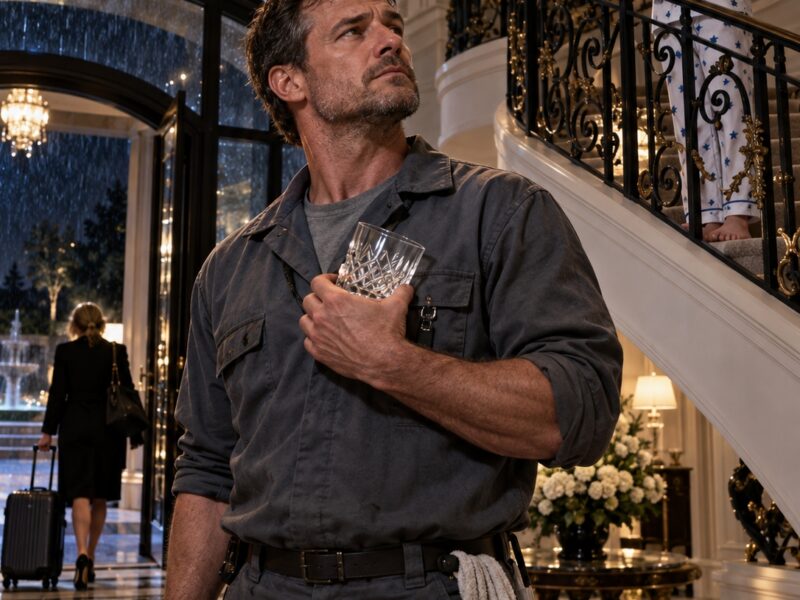
Tilly reached for the drinking glass sitting on the narrow table beside the banister.
Cordelia froze.
“Miss Tilly.”
Marin’s heart jumped.
“Put that down.”
Tilly looked toward the foyer.
But not at Marin.
She was looking at someone else.
Near the bottom of the staircase, half-hidden behind a cleaning cart, a man in gray work clothes was kneeling on the marble floor.
He was picking up pieces of a broken tumbler.
Kalen Voss.
Cal, when anyone bothered remembering his name.
Forty-one years old.
Night maintenance.
Facilities.
Janitorial support.
One of those employees who became almost invisible inside houses like the Whitlock estate because his work was most noticeable only when it wasn’t done.
He arrived early.
Left late.
Never complained.
Never lingered near family conversations.
Never looked impressed by wealth.
Marin had probably spoken to him fewer than ten times in the six months he had worked there.
“Mr. Voss,” she said. “Leave that until morning.”
Cal examined a shard of glass in his gloved hand.
“Someone could step on it.”
“I said leave it.”
He looked at her.
Then he dropped the shard into the waste container and continued cleaning.
That irritated her more than it should have.
Upstairs, Tilly lifted the second glass.
Cal noticed.
For the first time, he stopped working.
“Tilly,” Marin warned.
Her daughter looked directly at Cal.
Then she pushed the glass over the railing.
Marin gasped.
Cordelia shouted.
The glass fell twelve feet.
Cal moved.
One second he was beside the cleaning cart.
The next, he had crossed the foyer and caught the glass against his chest before it struck the marble.
Silence swallowed the house.
Even Marin forgot to breathe.
Cal looked at the glass.
Then he looked up.
No anger.
No shock.
No lecture.
“You done testing me?”
Tilly blinked.
Marin stepped forward.
“Mr. Voss.”
But Tilly ignored her.
“How long before you quit?”
Cal placed the glass carefully on his cart.
“I’m not your caregiver.”
“Everyone quits.”
Three words.
No tears.
No trembling.
Yet Marin felt them like something breaking.
Cal studied the child above him.
Most adults saw what Marin had spent eighteen months being told to see.
Defiance.
Behavioral dysregulation.
Oppositional tendencies.
Complicated grief.
Attachment disturbance.
Cal seemed to see something else.
Fear.
He rested both hands on the handle of his mop.
“Then I guess we’ll find out.”
Tilly stared at him.
“So you’re staying?”
“I have floors to finish.”
“That’s not what I asked.”
“I know.”
He picked up the bucket.
Then he walked away.
Tilly remained at the railing long after he disappeared.
And Marin had no idea that the quiet man her daughter had just challenged had once made the same decision in places where staying could get a person killed.
For now, though, Kalen Voss was only the janitor.
And that was exactly how he wanted it.
By morning, the storm had moved out over the Atlantic.
The Whitlock estate sat above the Maine coastline in cold gray light, all stone chimneys, cedar roofs and windows facing an ocean that looked almost black beneath the winter sky.
The caregiver’s room had already been stripped.
Sheets folded.
Closet empty.
Bathroom counter bare.
Tilly noticed.
She always noticed.
At breakfast, Marin sat across from her daughter with untouched coffee beside her hand.
“You cannot keep doing this.”
Tilly pushed a strawberry around her plate.
“Doing what?”
“Driving people away.”
“They leave anyway.”
“That isn’t true.”
“Miss Avery left.”
Marin inhaled.
“Miss Avery’s mother became ill.”
“Miss Nolan left.”
“She moved.”
“Mr. Peters left.”
“He wasn’t the right fit.”
Tilly looked up.
“They all packed bags.”
Marin had no answer.
Three names.
Three exits.
Three small funerals no one called funerals.
Eighteen months earlier, Tilly’s father, James Whitlock, had died after a sudden cardiac event during a sailing trip.
He was forty-three.
He had kissed Tilly on the forehead that morning.
Promised pancakes the next day.
Promised they would finish the wooden sailboat they had been building together.
Then a Coast Guard officer had appeared at the house instead.
At first Tilly cried constantly.
Then she stopped.
That was when Marin became afraid.
So she did what powerful people often did when confronted by something they could not control.
She hired experts.
The best child psychologist in Portland.
A grief specialist from Boston.
Private tutors.
Behavioral consultants.
Caregivers with postgraduate degrees.
Each arrived with warm voices, polished résumés and a plan.
And Tilly learned something from every one of them.
Not how to heal.
How long adults lasted.
Three tantrums?
Seven sleepless nights?
Two ruined dresses?
A broken lamp?
How many times could she say something cruel before sympathy hardened into irritation?
How long before the professional smile disappeared?
She discovered a rule nobody realized she understood.
If she made people leave first, she never had to wait for them to choose to leave her.
That afternoon, Cal was polishing brass fixtures outside Tilly’s bedroom when the door slammed.
Cordelia appeared carrying linens.
“Do not concern yourself with Miss Whitlock.”
Cal kept polishing.
“Wasn’t planning to.”
“She has professionals.”
“Seems like she’s had a lot of them.”
Cordelia stopped.
“That is not your concern.”
“You already said that.”
She walked away.
Ten minutes later, something slid beneath Tilly’s bedroom door and struck the opposite wall.
Cal looked down.
A wooden sailboat.
Small enough to hold in both hands.
One mast had snapped.
He picked it up.
The break was fresh.
He could have placed it on a table and continued working.
Instead, he sat on the floor.
From his maintenance pouch he removed wood glue, painter’s tape and a small clamp.
He aligned the mast.
Inside the bedroom, silence.
Five minutes passed.
Then ten.
“You’re supposed to tell me to come out.”
Tilly’s voice came through the door.
Cal kept working.
“Am I?”
“Everyone does.”
“Sounds crowded.”
A pause.
“My mom says I can’t stay in here all day.”
“Your mom’s probably right.”
“Then make me come out.”
“No.”
Another pause.
Longer.
“Why not?”
Cal tightened the tape around the mast.
“Because it’s your room.”
“You’re not going to tell on me?”
“About what?”
“Throwing the boat.”
Cal placed it beside the door.
“Boat already knows.”
Silence.
Then something almost like a laugh.
The door opened half an inch.
One gray eye appeared.
Cal did not smile.
He pushed the sailboat gently across the hardwood.
Tilly pulled it inside.
“You fixed it.”
“That’s usually what happens when something breaks.”
Her eye narrowed.
“Not always.”
Cal stopped.
There it was.
The sentence beneath the sentence.
He could have told her everything would be okay.
Adults loved saying that when they had no idea whether it was true.
Instead he nodded.
“No. Not always.”
The door opened another inch.
It wasn’t much.
But in the Whitlock house, two inches was practically a miracle.
The following morning Tilly informed him that the repair was terrible.
“The sail is crooked.”
Cal was kneeling beside his cleaning cart replacing a wheel.
“Mast is straight.”
“The sail isn’t.”
“Sounds like a sail problem.”
“You fixed it wrong.”
“Then you should fire me.”
She studied his face.
He knew what she was waiting for.
Irritation.
He gave her none.
“Maybe I will.”
“Get in line.”
Her mouth twitched.
The door closed.
That became the beginning of what Cordelia privately called Tilly’s campaign against the janitor.
Cal called it Wednesday.
At ten, Tilly poured orange juice across a floor he had just polished.
“That was an accident.”
Cal studied the upright glass beside her plate, then the orange puddle six feet away.
“Impressive accident.”
“Are you mad?”
“Should I be?”
“Miss Nolan got mad.”
“I’m not Miss Nolan.”
He cleaned it.
No lecture.
No punishment.
No wounded performance about respect.
After lunch, every key disappeared from the maintenance office.
Cal found Tilly reading a book upside down.
“Seen my keys?”
“No.”
“All right.”
He walked away.
Tilly lowered the book.
“You’re not going to look?”
“Eventually.”
“What if somebody stole them?”
“I hope they enjoy opening boiler rooms.”
Ten minutes later he found the keys arranged neatly inside his mop bucket.
Still no anger.
That afternoon she escalated.
Cal had just mopped the upstairs gallery when Tilly appeared carrying blue craft paint.
They stared at each other.
She opened the jar.
“Think carefully,” Cal said.
“Why?”
“Blue stains grout.”
She poured it anyway.
Cal closed his eyes.
One second.
Then he got another bucket.
Tilly followed him.
“You’re supposed to yell.”
“Am I?”
“Normal people yell.”
“I’ve met normal people.”
He squeezed out the sponge.
“Overrated.”
She crouched beside him.
“Why don’t you get mad at me?”
“I get mad.”
“You don’t look mad.”
“Feelings don’t have to drive the car.”
“That doesn’t make sense.”
“Give it a few years.”
She thought about that.
Then, near sunset, she found his mop leaning beside the staircase.
Marin was crossing the foyer below when she saw Tilly wrap both hands around the handle.
“Tilly.”
The girl pushed.
The mop crashed down fifteen steps.
Cordelia gasped.
Marin’s face hardened.
“Tilly Elizabeth Whitlock.”
Cal emerged from the hallway.
He looked at the mop.
Then Tilly.
Then the mop again.
He walked downstairs, picked it up and inspected the handle.
“That one was personal.”
Tilly stared.
Cal turned the mop solemnly in his hands.
“We’ve been through a lot together.”
A sound escaped her.
Marin froze.
Tilly covered her mouth.
Then it happened again.
A laugh.
Not polite.
Not forced.
A real eight-year-old laugh.
Cal rested the mop against his shoulder.
“Glad my suffering entertains you.”
“It’s just a mop.”
Cal nodded gravely.
“That’s what people say before they lose someone important.”
Tilly laughed harder.
Marin had to turn her face away.
She had spent eighteen months paying people to help her daughter.
Nobody had made Tilly laugh.
The janitor had done it with a mop.
And Marin hated how much that frightened her.
Because hope was dangerous when you had already watched your child lose too much.
Two days later, Cal’s daughter arrived at the estate.
She was ten, wore scuffed sneakers and a red knit hat, and marched down the gallery holding an old phone.
“Dad.”
Cal turned.
“Piper.”
“Your phone died again.”
“Battery has principles.”
“It has age.”
Tilly appeared from behind a doorway.
“Who is she?”
“Piper Voss.”
The girl extended a hand.
“His daughter.”
Tilly stared at Cal.
“You have a daughter?”
“Ten years now. Couldn’t return her.”
Piper rolled her eyes.
“He tried.”
Tilly laughed.
That afternoon the girls sat together drawing impossible houses.
Piper drew a purple roof.
Tilly added a waterslide from the second floor.
Cal repaired the strap on Piper’s backpack.
Marin watched from the hallway.
She noticed differences she normally would have been embarrassed to notice.
Piper’s jacket came from a thrift store.
Tilly’s cashmere sweater cost more than Cal probably earned in a week.
Neither child cared.
“Do you have a driver?” Tilly asked.
Piper pointed at Cal.
“Yep.”
Cal frowned.
“I am not your driver.”
“He drives a truck that makes a weird sound whenever it turns left.”
“That truck has character.”
“It has a loose heat shield.”
“Traitor.”
Later Piper removed her hat.
Her braid fell apart.
“Dad.”
“No.”
“You don’t even know what I’m asking.”
“I can see your hair.”
“Fix it.”
Cal stared at the tangled strands as if someone had handed him an explosive device.
Tilly watched, fascinated.
He separated the hair.
Lost one section.
Started over.
“You’re making it worse,” Piper complained.
“I’m creating volume.”
“You’re creating a bird’s nest.”
Tilly giggled.
Marin almost walked away.
Then Tilly asked the question.
“Is your mom bad at braiding too?”
Everything stopped.
Piper looked down.
Cal’s hands became still.
Tilly immediately understood.
“Sorry.”
Cal resumed braiding.
“It’s okay.”
“Where is her mom?”
Cal tied the elastic.
“Gone.”
“Did she leave?”
He met Tilly’s eyes.
“No.”
Tilly understood the word in a way children should not have to.
“But it still hurt like she did,” Cal added.
Tilly looked at Piper.
Then at him.
“Does it stop hurting?”
Cal took his time.
“Not exactly.”
“Then what happens?”
“You get stronger around the hurt.”
Tilly stared at the floor.
“My dad died.”
“I know.”
“Everybody gets weird when I say it.”
“People get scared of sadness.”
“Are you?”
“No.”
“Why?”
Cal’s answer was quiet.
“Because sadness is just love with nowhere to go for a while.”
Behind the doorway, Marin closed her eyes.
She had heard grief explained in clinical language.
Stages.
Trauma responses.
Attachment models.
None of it had sounded like that.
Tilly moved closer to Piper.
“Your braid is crooked.”
Piper touched it.
“I know.”
“Everybody’s a critic,” Cal muttered.
The girls laughed.
And Marin began to understand why her daughter trusted him.
Cal never tried to convince Tilly that pain wasn’t real.
He simply refused to be frightened by it.
That should have comforted Marin.
Instead, three days later, it became the reason she nearly destroyed everything.
Before that happened, however, Tilly discovered the green metal box.
Cal had left the maintenance room unlocked.
Tilly claimed it was an accident.
Piper did not believe her.
“You’re snooping.”
“I’m investigating.”
“That’s snooping with better vocabulary.”
Tilly dragged a stool beneath the top shelf.
A dark green metal box sat there.
Scratched.
Old.
Initials carved into the lid.
K.V.
“Maybe don’t,” Piper said.
“Why?”
“Because it’s his.”
That argument almost worked.
Almost.
Tilly opened it.
Inside lay dog tags.
A folded photograph.
A faded military patch.
A small American flag.
Tilly lifted the photograph.
Eight men stood beneath a hard white sun.
Uniforms.
Weapons.
Dust.
One of them was Cal.
Much younger.
Same eyes.
Different smile.
“What is this?”
“Put it back.”
Cal stood in the doorway.
Both girls froze.
Tilly lowered the photograph.
“I’m sorry.”
He stepped inside.
His expression wasn’t angry.
That somehow made her feel worse.
“Were you a soldier?”
“A long time ago.”
Piper looked at him.
“You never showed me that picture.”
“There aren’t many.”
Tilly touched the patch.
“Were you brave?”
Cal sat on the stool.
“Sometimes.”
She frowned.
“Sometimes?”
“Sometimes I was scared.”
“Then how were you brave?”
He lifted one dog tag and rubbed his thumb over the stamped letters.
“Being brave doesn’t mean you stop being scared.”
“What does it mean?”
His eyes moved to the photograph.
“Sometimes it means you stay anyway.”
Tilly became very quiet.
“Did people leave you?”
Cal’s jaw tightened.
“Some did.”
“Because they wanted to?”
“No.”
“Then why?”
“Because sometimes life makes choices before we’re ready.”
She looked at the photograph.
“Are those your friends?”
“They were my team.”
“Where are they?”
Cal did not answer.
Tilly understood enough not to ask again.
He closed the box.
“This stays between us.”
“I won’t tell.”
Cal studied her.
“Can I trust you?”
She blinked.
Adults were constantly demanding that Tilly trust them.
Nobody ever asked whether she could be trusted.
She straightened.
“Yes.”
Cal handed her the box.
“Top shelf.”
She carried it carefully.
For the first time since her father died, an adult had given her something more meaningful than instructions.
Responsibility.
And without knowing it, Tilly had just learned the sentence she would need when everything fell apart.
Sometimes bravery meant staying anyway.
Friday afternoon, Whitlock corporate counsel Thaddeus Crane arrived carrying a leather folder.
He sat across from Marin in her office.
“We need to discuss the janitor.”
“His name is Cal.”
“That is exactly the problem.”
Marin looked up.
Thaddeus opened the folder.
“Your daughter is becoming emotionally attached to an employee who has no childcare credentials, no therapeutic qualifications and security clearance limited to facilities access.”
“He has done more for her in ten days than half the specialists I hired in eighteen months.”
“That makes this more concerning, not less.”
Marin’s expression cooled.
“Explain.”
“You are confusing emotional relief with stability.”
“She laughed.”
“I understand.”
“No. I don’t think you do.”
“I understand perfectly. And when the board asks why an unvetted maintenance employee developed unrestricted personal access to the CEO’s daughter, what should I tell them?”
“He does not have unrestricted access.”
“Practically speaking, he does.”
“She finds him.”
“That distinction disappears the moment something goes wrong.”
Marin looked toward the windows.
Rain was beginning again.
Thaddeus lowered his voice.
“He may be a decent man. But decent men can still be inappropriate solutions.”
Marin hated the phrase.
Solution.
As though Tilly were a defective asset.
But fear has always been talented at disguising itself as reason.
By five o’clock, Marin made the decision.
Cal would not be fired.
He would simply be reassigned to the carriage house and east maintenance buildings.
Half a mile away.
Temporary.
Responsible.
Safe.
Cordelia delivered the order.
Cal was standing on a ladder changing a light.
“Beginning tomorrow, you’re assigned to the east grounds.”
He looked down.
“Why?”
“Operational needs.”
“Tilly?”
“That is not relevant.”
Cal descended.
He could have argued.
Instead he nodded.
“Understood.”
That evening, Tilly sat outside her bedroom holding the repaired sailboat.
Six o’clock passed.
Then seven.
At 7:15 she found Cordelia.
“Where is Cal?”
“Working elsewhere.”
“Did he quit?”
“No.”
“Did Mom fire him?”
“No.”
“Then where is he?”
Cordelia hesitated.
One second.
That was enough.
“She made him leave.”
“Tilly—”
The girl ran.
Marin found her sitting on the bedroom floor.
“Tilly.”
“You sent him away.”
“He was reassigned.”
“Same thing.”
“No.”
“It is.”
“It’s temporary.”
Tilly laughed.
There was no humor in it.
“That’s what people say before they go.”
“He didn’t leave you.”
“He’s gone.”
“Tilly, please.”
The girl stood.
“You said people don’t always leave.”
“I meant—”
“You lied.”
Marin stopped.
“I was trying to protect you.”
Tilly’s eyes filled.
“From what?”
Marin opened her mouth.
Nothing came.
The storm arrived after midnight.
At 12:37, power failed.
The backup generator kicked in six seconds later.
At 12:49, half the east wing went dark again.
At 1:10, security began resetting alarms.
At 1:14, Marin opened Tilly’s bedroom door.
The bed was empty.
For several seconds her mind refused to understand what she was seeing.
Then she saw the missing yellow raincoat.
The missing boots.
The empty shelf.
The wooden sailboat was gone.
“Cordelia!”
The house exploded into motion.
Security checked bedrooms.
Library.
Greenhouse.
Garage.
Kitchen.
Nothing.
Then Marin saw the mudroom door.
Open three inches.
Rain blowing across the tile.
Her legs nearly failed.
“Call everyone.”
Cordelia raised the radio.
“Including Mr. Voss?”
Marin stared into the black night.
Especially Cal.
Half a mile away, his phone rang.
He answered immediately.
Marin barely managed the words.
“Tilly is gone.”
Cal changed.
Not dramatically.
He simply became still.
“What is she wearing?”
“Yellow raincoat.”
“Boots?”
“Yes.”
“What did she take?”
Marin looked around the bedroom.
Then she saw the empty shelf.
“The boat.”
Cal closed his eyes.
“Check the north path. Two people stay at the house. Security covers the road.”
“Cal—”
“I’m going toward the water.”
“Why?”
He was already putting on his coat.
“Scared children don’t run toward strangers.”
He opened the door into the storm.
“They run toward memories.”
Cal crossed the north lawn.
Rain struck sideways.
He didn’t shout Tilly’s name.
He watched the ground.
Small boot print near the hydrangeas.
Broken branch.
Yellow thread caught on cedar bark.
Marin called.
“Did you find anything?”
“Sign.”
“I’m coming.”
“Stay at the house.”
“She is my daughter.”
Cal stopped.
“Then listen to me like a mother, not a CEO. If she turns back, she needs you there.”
Silence.
“All right.”
The path split near the bluff.
One direction led toward the road.
The other curved toward an old boathouse.
Cal crouched.
Small tread marks.
Fresh.
He looked toward the ocean.
“I know where she is.”
The boathouse had belonged to James.
Marin had never demolished it.
Grief turns ordinary places into museums.
Cal reached it fifteen minutes later.
Door open.
Rain hammering the roof.
“Tilly.”
Nothing.
“It’s me.”
A small voice came from behind an overturned bench.
“Go away.”
Cal stopped.
Tilly sat wrapped in her yellow coat.
The wooden sailboat lay across her knees.
Beside her was an old navy jacket.
James Whitlock’s.
“You shouldn’t be here alone.”
“You left.”
“They moved my job.”
“Same thing.”
“No.”
“You were gone.”
Cal lowered himself onto one knee.
“I came back.”
Tilly pressed her face into her father’s jacket.
“Dad didn’t.”
Cal’s expression changed.
“I know.”
“Everybody says he loved me.”
“I’m sure he did.”
“Then why did he leave?”
“Sometimes people don’t get to choose.”
“That’s stupid.”
Cal nodded.
“Yeah.”
She looked up.
“It is.”
Another gust shook the building.
“You said brave means staying.”
“Sometimes.”
“Then Dad wasn’t brave.”
“No.”
His answer came quickly enough to surprise her.
“That isn’t what I meant.”
“Then what did you mean?”
Cal sat on the wet floor.
“I meant bravery is what we do when we still have a choice.”
Tilly’s eyes filled.
“I thought you chose to go.”
“I didn’t.”
“You didn’t tell me.”
Cal lowered his head.
“You’re right.”
That silenced her.
“I should have.”
“Adults always say things are for my own good.”
“Adults get scared too.”
“You?”
“All the time.”
“You don’t look scared.”
“Practice.”
A tiny breath escaped her.
Almost a laugh.
“Were you scared tonight?”
“Yes.”
“Why?”
“Because I thought you might believe I left you on purpose.”
Tilly looked at the sailboat.
“What if everybody leaves anyway?”
Cal’s voice softened.
“Then you don’t stop loving people just because you’re afraid of losing them.”
“That sounds hard.”
“It is.”
“What if I can’t?”
“Then you practice.”
He extended his hand.
“Remember what I told you?”
Tilly sniffed.
“Being brave means staying anyway.”
“That was for both of us.”
She stared at his hand.
Then stood.
One step.
Two.
She placed her hand in his.
No miracle happened.
Her grief did not disappear.
She did not suddenly become healed.
She simply chose to trust someone for one more night.
Sometimes that is the larger miracle.
Twenty minutes later, Marin saw them coming through the rain.
She ran barefoot onto the covered entry.
Tilly broke from Cal and slammed into her.
Marin dropped to her knees.
“I’m sorry.”
She held her daughter so tightly Tilly could barely move.
“I’m sorry. I’m sorry.”
Over Tilly’s shoulder, Marin looked at Cal.
Rain streamed from his coat.
She tried to speak.
He shook his head.
Not now.
This moment belonged to Tilly.
The next morning, Marin called an emergency meeting.
Thaddeus sat at the conference table.
Cal stood near the wall in his maintenance uniform.
“You were recommending disciplinary action against the man who brought my daughter home,” Marin said.
Thaddeus remained composed.
“I’m recommending that we address a serious procedural breach.”
“He found her.”
“That does not erase the fact that Mr. Voss directed security without authorization and entered restricted waterfront property during severe weather.”
Cal spoke.
“He’s right.”
Marin turned.
“Cal.”
“You asked what happened. That happened.”
Thaddeus nodded.
“At least Mr. Voss understands.”
Cal looked at him.
“Understanding doesn’t mean I regret it.”
Silence.
Thaddeus closed the folder.
“You are a facilities employee, Mr. Voss. Whatever connection you believe you have developed with Miss Whitlock does not give you authority.”
“Never said it did.”
“Then perhaps we agree your reassignment should become permanent.”
Marin pushed back her chair.
“We agree on nothing.”
The doors opened.
A tall man in his early fifties entered with two Whitlock Maritime executives.
Commander Elias Hollis.
Retired Navy.
Now a federal defense consultant Marin’s company had been courting for months.
“Commander,” Marin said. “I thought our meeting was in twenty minutes.”
“I was early.”
Hollis took two steps.
Stopped.
His eyes locked on Cal.
All color left his face.
“Voss?”
Cal didn’t move.
Hollis walked closer.
“Chief Voss.”
Thaddeus frowned.
“You know Mr. Voss?”
Hollis stared at him.
“Know him?”
A disbelieving laugh escaped.
“I spent six years trying to find him.”
Cal lowered his eyes.
“Hollis.”
The commander looked at the gray maintenance shirt.
Then the cleaning cart visible outside.
“What the hell are you doing here?”
“Working.”
“Working?”
Hollis turned to Marin.
“You’re telling me the man who brought twelve of us home is cleaning your floors?”
Cal’s voice cut through the room.
“Eleven.”
Hollis stopped.
The pride disappeared from his face.
“Right.”
Cal looked toward the windows.
“Eleven came home.”
Nobody asked about the twelfth.
Nobody needed to.
Hollis faced the table.
“Kalen Voss was a senior Navy SEAL operator.”
Cal’s jaw tightened.
“Hollis.”
“He led men into places I still cannot discuss. When plans failed, communications failed and everybody else started wondering whether they were getting home, Voss was the man you wanted beside you.”
“That’s enough.”
Hollis stopped.
Cal looked around the room.
“I did a job. So did everyone else.”
Thaddeus slowly removed his glasses.
“Why would someone with that background take a janitorial position?”
Cal looked at him.
“Because floors need cleaning too.”
Nobody laughed.
“I didn’t come here for anyone to know my name. I didn’t ask for a title. I didn’t ask anyone to salute me.”
Marin could barely reconcile the man Hollis described with the employee she had walked past for months.
“Why did you leave?”
Hollis looked down.
Cal was silent.
Then he answered.
“Eventually you carry enough people home that you start wondering whether you remember how to live there yourself.”
His eyes lifted toward the ceiling.
Toward the room where Tilly and Piper were eating breakfast.
“I had a daughter who needed a father more than the world needed another story about what I used to be.”
The room became completely still.
Thaddeus had arrived prepared to talk about hierarchy.
Liability.
Credentials.
Status.
Suddenly every word felt embarrassingly small.
Hollis spoke quietly.
“I never forgot, Chief.”
Cal met his eyes.
“I know.”
Then Cal picked up his maintenance clipboard.
No speech.
No triumph.
No demand for an apology.
That was what Marin remembered later.
He had been handed the perfect opportunity to humiliate every person who underestimated him.
He refused it.
Because dignity had never required Cal Voss to prove he stood above anyone.
By late afternoon, his truck was packed.
One duffel.
Two work shirts.
A thermos.
Flashlight.
The green metal box.
Marin found him beside the carriage house.
“You’re leaving.”
“Seems best.”
“Thaddeus withdrew his recommendation.”
“This isn’t about Thaddeus.”
“Then what?”
Cal looked toward the mansion.
“Tilly.”
“She needs you.”
“That’s what worries me.”
Marin frowned.
“She lost her father. I can’t become the man she holds onto because she’s terrified everyone else will disappear.”
“You think staying hurts her?”
“Staying for the wrong reason might.”
Marin looked down.
For once, she had no executive answer.
“I kept hiring people to fix her.”
Cal said nothing.
“Therapists. Tutors. Caregivers. Specialists. I kept thinking if I found the right person, Tilly would become who she was before James died.”
Her voice broke.
“I never asked whether she needed to go back.”
“No.”
“She doesn’t need fixing.”
“No.”
Marin nodded.
“I know that now.”
“Good.”
They turned.
Tilly stood twenty feet away.
Piper beside her.
The wooden sailboat in one hand.
Something else in the other.
“You should be resting,” Cal said.
“I’m tired of people telling me what I should do.”
Piper leaned toward him.
“She practiced that line.”
“I did not.”
“You did twice.”
Tilly glared.
Cal almost smiled.
“What’s in your hand?”
She approached.
Opened her palm.
The faded military patch.
Cal’s smile vanished.
“Where did you get that?”
“Your box.”
Piper immediately said, “I told her not to.”
“You tell him everything.”
“Yes. It’s a terrible personality flaw.”
Tilly held out the patch.
But when Cal reached for it, she pulled her hand back.
“Wait.”
Beneath the sailboat was a cheap wooden frame.
Inside it, Tilly had placed a drawing.
Four stick figures.
A tall man.
A woman.
Two girls.
A badly shaped house.
Beside the drawing was a space where she wanted to place Cal’s military patch.
Above the figures, written in uneven blue letters, was one word.
STAY.
Cal stared at it.
Tilly’s voice became small.
“I know you’re not my dad.”
Marin turned away, wiping her eyes.
Cal crouched.
“I know.”
“And I know you can leave.”
He waited.
“I just wanted one person to stay because they wanted to.”
Cal closed his eyes.
Piper looked at him.
Then shrugged.
“I like the crackers here.”
Tilly nearly smiled.
Cal looked at Marin.
She didn’t offer him a promotion.
Didn’t offer money.
Didn’t invent some impressive title that would make his staying acceptable to people like Thaddeus.
“If you stay,” she said, “you decide what that means.”
Cal looked back at Tilly.
“Tomorrow too?” she asked.
There it was.
The question underneath every broken glass.
Every spilled drink.
Every slammed door.
Every test.
Not:
Do you like me?
Not:
Can you fix me?
Just:
Will you still be here tomorrow?
Cal stood.
He reached into the truck.
Took out the duffel.
Set it on the wet gravel.
“Tomorrow sounds okay.”
Tilly’s shoulders dropped.
As if she had been holding them up for eighteen months.
Piper pointed toward the mansion.
“Does staying include dinner?”
“Pizza,” Tilly said.
Marin laughed through her tears.
“One pizza.”
Piper looked offended.
Cal shook his head.
“One pizza won’t do it.”
“Two,” Piper said.
“Three,” Tilly countered. “I had a hard night.”
Cal looked at Marin.
“Negotiator.”
“My mother’s a CEO.”
“That explains everything.”
That evening, four people sat around the kitchen table instead of the formal dining room.
Marin took off her shoes.
Piper stole the final breadstick.
Tilly protested.
Cal broke it in half.
Cordelia stood in the doorway for a moment.
She looked at Tilly laughing.
At Marin sitting barefoot.
At Cal eating pizza in a clean gray work shirt.
Then she quietly turned off the dining-room chandelier nobody was using.
Outside, the Atlantic rolled beneath a moonless sky.
On the shelf near the kitchen door sat the wooden sailboat.
Its mast was still crooked.
Cal had never corrected it.
Neither had Tilly.
Months later, Marin would realize why.
Some things did not need to return to exactly what they had been before they broke.
Some families did not heal by erasing the crack.
They simply learned where to place their hands when the weather turned bad.
Tilly still missed her father.
Piper still missed her mother.
Cal still sometimes woke before dawn from dreams he never described.
And Marin never stopped wondering how close she had come to driving away the first person who understood that her daughter’s cruelty had never really been cruelty.
It had been a question.
A terrified little question disguised as spilled juice, broken glass, blue paint and slammed doors.
How much of me can you see before you decide I am too difficult to love?
Cal had never answered with promises.
He answered by showing up.
Again.
And again.
And again.
One cold morning near the end of winter, Marin walked into the kitchen before sunrise.
Cal was already there fixing the loose hinge on a cabinet.
Piper slept upstairs after another weekend visit.
Tilly sat at the table in pajamas, working on the wooden sailboat.
Marin poured coffee.
“What are you doing?”
Tilly held up the boat.
One sail had torn.
“I’m fixing it.”
Cal glanced over.
“Careful with the glue.”
“I know.”
“You used too much.”
“I know.”
“You want help?”
Tilly thought about it.
Then shook her head.
“No.”
Cal nodded.
“All right.”
Marin watched her daughter work.
For nearly a year and a half, she had believed healing would look like getting the old Tilly back.
The child who laughed easily.
The child who slept through thunderstorms.
The child who trusted promises because she had never yet learned that people could die between breakfast and tomorrow.
That girl was gone.
Marin finally understood that.
But another Tilly was sitting at the kitchen table.
A girl who knew people could disappear and chose to love them anyway.
A girl who understood that fear could sit in the passenger seat without being allowed to drive.
A girl who had learned that being broken and being ruined were not the same thing.
Tilly pressed the repaired sail into place.
It leaned slightly to the left.
Cal noticed.
He said nothing.
Tilly looked at him suspiciously.
“You think it’s crooked.”
“Wouldn’t dream of saying that.”
“You’re thinking it.”
“I’m thinking about coffee.”
“You don’t drink coffee this early.”
Cal stared at her.
“You’re getting difficult.”
Tilly smiled.
“You staying?”
The question came casually now.
Almost joking.
Almost.
Cal looked at the cabinet hinge.
Then at her.
“Got another one to fix after this.”
“So yes?”
“So I have work.”
Tilly rolled her eyes.
But she smiled again.
Marin stood by the window with her coffee.
Beyond the glass, dawn was beginning over the Atlantic.
Gray first.
Then silver.
Then a thin line of gold.
Behind her came the quiet sounds of an ordinary kitchen.
A screwdriver turning.
A chair scraping.
A child complaining about glue.
Nothing dramatic.
Nothing anybody would put in a corporate report.
Nothing that could be bought.
On the shelf, James Whitlock’s little sailboat stood with its crooked mast and newly repaired sail.
Marin looked at it for a long time.
Once, she would have called the crookedness a flaw.
Now she knew better.
It was evidence.
Something had broken.
Someone had stayed long enough to repair it.
And nobody had pretended the break had never happened.
Tilly looked across the kitchen.
Cal was still there.
Not because he had promised forever.
Not because Marin paid him enough.
Not because a contract required it.
He was there because, on that particular morning, he had chosen to be.
Tomorrow would have to make its own promise.
For Tilly Whitlock, that was finally enough.









