THE JANITOR THEY FIRED BEFORE THE BOARD ARRIVED—THEN THE CHAIRMAN COLLAPSED AND ONLY HE COULD SAVE HIM
At 1:06 in the morning, Dr. Richard Grant looked at the frozen man on the trauma table and said the sentence everyone in the room had been expecting.
“Time of death, 1:06 a.m.”
The monitor showed nothing useful.
The man’s skin had gone the pale, waxy color of winter stone. Melted snowwater ran from his hair onto the sheet beneath his head. His clothes had already been cut away, leaving a broad chest covered with adhesive pads, needle marks, and the desperate evidence of forty minutes of emergency medicine.
Nobody moved.
A nurse lowered her eyes.
Dr. Emily Shaw slowly pulled off one glove.
And then, from somewhere near the doorway, a quiet voice said:
“He’s not dead.”
Every head turned.
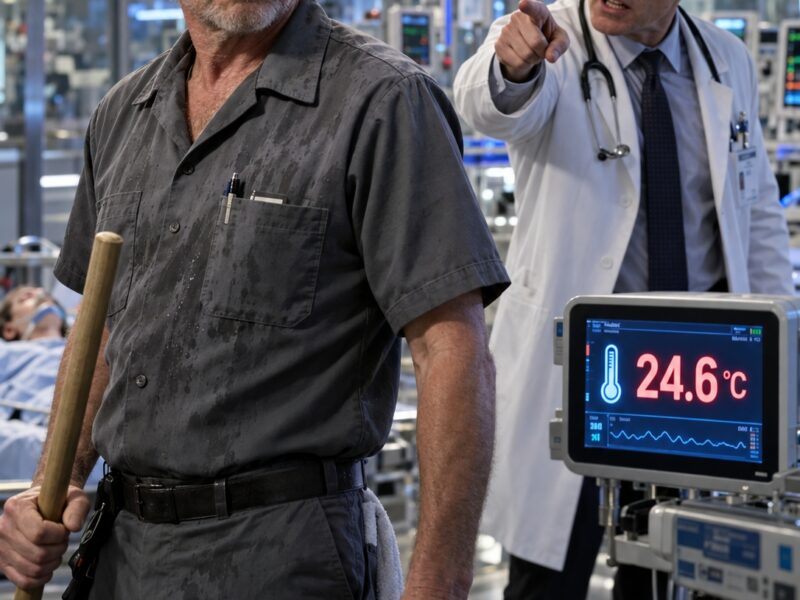
The man standing beside the yellow mop bucket wore gray hospital maintenance clothes.
Walter Hale was fifty-eight years old, silver beginning to show at his temples, his shoulders slightly stooped in the way of someone who had spent too many years trying not to be noticed.
His employee badge said:
WALTER HALE — ENVIRONMENTAL SERVICES.
Grant stared at him.
“Excuse me?”
Walter looked past him at the body.
“Your thermometer stops at thirty-four degrees Celsius.”
Grant’s face hardened.
“Get out.”
“You never got his real temperature.”
For half a second, no one in the trauma bay seemed to understand what the janitor was saying.
Then Emily looked at the thermometer.
Thirty-four.
Exactly.
Not thirty-three point nine.
Not thirty-three.
Thirty-four.
The bottom limit of the device.
Walter stepped closer.
“He’s colder than your thermometer can read.”
Grant gave a short, humorless laugh.
“I said get out of my trauma bay.”
Walter didn’t move.
“Use an esophageal probe.”
The laughter vanished.
Emily looked from Walter to Grant.
Grant’s jaw tightened.
“He has no pulse. No measurable blood pressure. We’ve shocked him repeatedly. We’ve given epinephrine. We’ve been working on him for almost forty minutes.”
Walter’s eyes remained on the patient.
“Then find out how cold he actually is before you declare him dead.”
There was something about the way he said it.
Not arrogance.
Not panic.
Certainty.
Emily reached for the probe.
Grant caught her wrist.
“Shaw.”
She looked at him.
“What if he’s right?”
Grant stared at her long enough to make the hierarchy in the room perfectly clear.
Richard Grant was Chief of Emergency Medicine at Ashford Memorial Hospital. He had spent fifteen years climbing toward the office everyone knew he wanted next.
Chief Medical Officer.
The board vote was Friday.
People did not embarrass Richard Grant in his own trauma bay.
Especially not nurses.
Especially not junior doctors.
And certainly not janitors.
But Emily pulled her wrist free.
“Thirty seconds,” she said.
She inserted the probe.
The number appeared.
24.6°C.
Silence.
Emily whispered, “Oh my God.”
Walter moved.
Not quickly.
That was what Emily would remember later.
Everyone else in the room had been rushing for nearly an hour. Walter moved like a man who had suddenly stepped into a place he knew better than anyone.
“Nobody is dead until they’re warm and dead.”
Emily stared at him.
Grant recovered first.
“Resume compressions. Charge again.”
“No.”
Grant spun around.
Walter pointed at the defibrillator.
“Stop the shocks.”
“What?”
“Stop the epinephrine too.”
Grant stepped toward him.
“You do understand you are a janitor?”
“Yes.”
“Then stop giving medical orders.”
Walter finally looked at him.
“A heart that cold can’t respond normally to what you’re giving it.”
Grant’s nostrils flared.
Walter continued.
“You’ve already pushed multiple doses of medication into a circulation that barely exists. Warm him incorrectly, circulation comes back too quickly, and those drugs can hit his heart all at once.”
The room had gone completely still.
Emily felt something strange crawling up the back of her neck.
Because those weren’t the words of a man who had watched medical dramas on television.
They weren’t even the words of someone who had once taken a first-aid class.
Grant apparently heard it too.
“Who the hell are you?”
Walter glanced at the patient.
“Someone telling you that he still has a chance.”
Grant pointed toward the door.
“Security.”
Emily stepped between them.
“Wait.”
“Dr. Shaw.”
“The bypass team.”
Grant stared at her.
“What about them?”
“If we can put him on cardiopulmonary bypass—”
“They aren’t in-house overnight. It takes an hour to assemble them.”
Walter answered quietly.
“He doesn’t have an hour.”
Grant laughed again.
“So what exactly do you suggest, Mr. Hale? Since apparently we’re holding grand rounds for Environmental Services.”
Walter looked at the man’s chest.
“Use his chest.”
Emily stopped breathing for a second.
Walter pointed to either side of the rib cage.
“Two thoracostomy tubes. Warm saline in, drain it out. Rewarm the core directly.”
Grant stared at him.
“You want to perform internal lavage in my trauma bay?”
“I want him alive.”
Grant looked around the room as if expecting someone else to recognize the insanity of what was happening.
No one spoke.
Finally, Grant spread his hands.
“Fine.”
His voice had turned cold.
“Let the janitor play doctor.”
Walter looked at Emily.
“Get the tubes.”
Grant stepped back.
“When he stays dead, Shaw, this is on you.”
Emily’s hands trembled as she opened the sterile kit.
A nurse reached for warming blankets.
Walter stopped her.
“Not yet.”
She froze.
Grant snapped, “Now what?”
“Don’t aggressively warm his arms and legs first.”
“Why?”
Walter looked at Emily.
“Cold blood is pooled in the extremities. Heat the limbs first, vasodilation sends it back toward the heart.”
Emily understood.
“Afterdrop.”
Walter nodded once.
“And he may not survive it.”
Something changed in Emily’s face.
She was no longer looking at Walter as a janitor.
She was looking at him as a question.
A very dangerous question.
Walter handed her the scalpel.
“You do it.”
Emily stared at him.
“No.”
His expression didn’t change.
“You do.”
“I’ve never done this technique.”
“You know chest tube placement.”
“Not like this.”
“Fifth intercostal space.”
She swallowed.
Walter touched his own side.
“Above the rib. Never below. The neurovascular bundle runs underneath.”
Emily’s hand stopped trembling.
She made the incision.
Walter guided her without touching the patient.
One tube.
Then the other.
Warm saline began moving through the chest cavity.
Minutes passed.
Twenty-four point six became twenty-five.
Twenty-six.
Twenty-seven.
Twenty-eight.
The room stopped feeling like a place where a man had died.
It began feeling like a place where something impossible might happen.
At thirty degrees, Walter finally looked at the defibrillator.
“Now.”
Grant crossed his arms.
Walter nodded toward Emily.
“One shock.”
Emily charged.
“Clear!”
The body jumped.
The monitor flickered.
Nothing.
Then—
A beat.
Another.
Weak.
Irregular.
But unmistakable.
A nurse covered her mouth.
Emily stared at the monitor.
“We have electrical activity.”
“Check a pulse,” Walter said.
She pressed two fingers against the carotid artery.
Her eyes widened.
“I have one.”
Nobody celebrated.
For several seconds, they simply stood there listening to the electronic beeping of a heart they had already pronounced dead.
Grant looked at Walter.
Walter was already stepping backward.
Returning to the edge of the room.
Returning to his mop.
As if nothing had happened.
Grant finally spoke.
“That was reckless.”
Walter said nothing.
“If he’d died, that’s on you.”
Emily looked at Grant.
“He didn’t die.”
Grant turned on her.
“You think that makes this acceptable?”
Before Emily could answer, an older nurse whispered beside her:
“That’s the new janitor.”
Emily glanced over.
“What?”
“Mrs. Lane hired him herself.”
Across the room, Walter squeezed dirty water from the mop.
And for the first time that night, Emily wondered why the former Chief Medical Officer of Ashford Memorial had personally hired a janitor no one seemed to know.
By morning, Richard Grant wanted the same answer.
He found Margaret Lane in her old office.
Margaret was sixty-seven, silver-haired, sharp-eyed, and technically retired, though nobody at Ashford Memorial seemed brave enough to tell her that retirement meant she wasn’t supposed to keep showing up.
Grant shut the door.
“So you’re Margaret’s new hire.”
Walter was cleaning the hallway outside.
Margaret continued reading a chart.
“Good morning, Richard.”
“He mops floors.”
“So?”
“He doesn’t touch my patients.”
Margaret finally looked up.
Grant planted both hands on her desk.
“Your janitor took over my trauma bay last night.”
“Did he?”
“You know damn well he did.”
Margaret leaned back.
“Is your patient alive?”
Grant blinked.
“That isn’t the point.”
Margaret’s expression changed almost imperceptibly.
“It’s the only point I care about.”
Grant straightened.
“He stays away from patients.”
“He stays employed.”
“You retired, Margaret.”
“I remember.”
“You don’t run this hospital anymore.”
“No. I just remember when it was run for patients.”
Grant’s mouth tightened.
“The board votes on Chief Medical Officer Friday.”
Margaret said nothing.
Grant smiled.
“And after Friday, you won’t be making hiring decisions anymore.”
He opened the door.
Walter was pushing the mop cart past.
Grant stopped him.
“Where did you learn that technique?”
Walter glanced at him.
“Television.”
Grant almost smiled.
“Television.”
“Lots of educational programming.”
Grant stepped closer.
“Television doesn’t teach you which side of a rib contains the neurovascular bundle.”
Walter’s eyes changed for just a fraction of a second.
Then the janitor shrugged.
“Maybe I watch better television than you.”
He pushed the cart away.
Grant watched him go.
The joke should have made Walter seem ridiculous.
Instead, it made Grant uneasy.
And unease was something Richard Grant hated.
By Friday afternoon, Ashford Memorial looked less like a hospital and more like a hotel preparing for a wedding.
Flowers appeared in the lobby.
The floors were polished twice.
Administrative staff who normally wore comfortable shoes arrived in suits.
The reason was Harold Whitman.
Chairman of Ashford Memorial’s board.
Whitman would attend the hospital foundation gala downtown, then visit the emergency department at nine that evening.
Grant had spent weeks preparing.
If Whitman liked what he saw, Grant believed the Chief Medical Officer vote was his.
At 3:26 p.m., he stood in the lobby giving instructions.
“The board comes through here at nine.”
A supervisor nodded.
“The photographer arrives at eight-forty.”
“Board first. Photographer second.”
Grant glanced at the floor.
“And clean this again.”
The supervisor hesitated.
“It was just cleaned.”
Grant looked toward Walter.
“Then clean it twice.”
Walter said nothing.
He simply pushed his mop across a floor already bright enough to reflect the ceiling lights.
That was when a woman hurried through the sliding doors carrying a sleeping little boy.
“Please.”
She looked terrified.
“My son has a fever. He won’t wake up properly.”
Emily came toward her.
The boy was six.
His name was Noah.
His cheeks were flushed crimson, his dark hair damp with sweat, his small body limp against his mother’s shoulder.
Grant glanced at him.
“How long?”
“Since last night. But today he just keeps sleeping.”
Grant touched Noah’s forehead.
“Flu.”
The mother stared at him.
“Are you sure?”
“Half the city has it.”
“He’s never been like this.”
“Fluids. Acetaminophen. Rest.”
The mother didn’t move.
“Doctor, he barely answers me.”
Grant glanced toward the lobby.
An administrator was signaling about the board arrangements.
He sighed.
“Ma’am, I’ve seen a hundred cases like this this week.”
“But—”
“His vitals are acceptable. Keep him hydrated. If his fever worsens, bring him back.”
Emily watched the mother’s face.
Something bothered her.
But Grant was already walking away.
“No,” he told the administrator. “The board first. Then the photographer.”
Noah’s mother shifted him in her arms.
“Okay, baby.”
His head fell against her shoulder.
“We’re going home.”
Walter had been cleaning near the waiting area.
He watched them pass.
The mop stopped moving.
There were tiny marks on Noah’s lower leg.
Purple-red.
Walter stared.
Then he abandoned the mop.
“Ma’am.”
The mother didn’t hear him.
She walked through the doors into the rain.
Walter followed.
“Hey!”
Grant saw him.
“Hale!”
Walter kept going.
Rain hammered the ambulance entrance.
Noah’s mother turned as Walter caught up.
“Who are you?”
“Someone who wants you to wait.”
She tightened her grip on her son.
“What?”
“His leg.”
“What about it?”
Walter crouched.
The spots were clearer now.
He looked toward the doors.
“Someone get me a drinking glass.”
Emily had followed them outside.
“What are you doing?”
Walter looked at her.
“Please.”
She ran inside.
Grant came storming after her.
“You cannot chase discharged patients into the parking lot!”
Walter ignored him.
Emily returned with a clear glass.
Walter pressed it against Noah’s skin.
“Watch the spots.”
The mother leaned closer.
“What am I looking for?”
“If they fade under pressure, that’s one thing.”
“And if they don’t?”
Walter didn’t answer.
He pressed harder.
The skin around the marks whitened.
The marks remained dark.
Walter stood.
“Carry him.”
The mother stared.
“What?”
“Run.”
Something in his voice erased every other question.
Emily took Noah.
They rushed back through the doors.
Grant followed.
“What exactly do you think you’re doing?”
Walter turned toward the nurses’ station.
“Possible meningococcal infection. We need a bed.”
The mother went white.
“Meningitis?”
Grant shook his head.
“That’s a leap.”
Walter looked at Noah.
“He doesn’t have days.”
Then he looked at the mother.
“He may have hours.”
Her knees nearly buckled.
“What does that mean?”
“It means we don’t waste another minute.”
Emily was already moving.
“Cultures, lumbar puncture setup—”
“Antibiotics.”
Grant stared at Walter.
“Before confirmation?”
“Before.”
Grant scoffed.
“You don’t give broad-spectrum antibiotics because a janitor pressed a glass against a rash.”
Walter’s voice stayed low.
“Every hour you delay treatment, he risks losing something he may never get back.”
Emily looked at Grant.
Then at Noah.
Then she made a choice.
“Start the antibiotics.”
Grant stepped toward her.
“Shaw.”
She didn’t stop.
Noah’s mother stood beside the bed, crying silently as the IV was placed.
Walter backed away.
He had done what he needed to do.
Or so he thought.
Twenty minutes later, preliminary findings supported exactly what he feared.
The boy had meningitis.
Emily found Walter outside the room.
“You were right.”
Walter stared through the glass.
“How is he?”
“Stable for now.”
The mother came out.
Her face was wet with tears.
She took Walter’s hand.
“Thank you.”
He looked uncomfortable.
“You don’t need to—”
“You brought him back.”
Walter looked toward Noah.
“You listened.”
“No.”
She squeezed his hand.
“You did.”
Then a voice behind them said:
“Who brought that child back into my emergency department?”
Grant.
Nobody answered.
He already knew.
At 5:58 p.m., Walter was told to report to administration.
Grant stood in the corridor holding a printed document.
Staff members had begun gathering for the board visit.
Walter approached in his gray uniform.
Grant held out his hand.
“Badge.”
Walter looked at him.
“Excuse me?”
“Practicing medicine without a license. Physical contact with patients. Interference with physician care. Overriding a discharge decision.”
Walter’s eyes went to the paper.
Grant tapped it.
“Badge.”
Emily stepped forward.
“He saved that boy.”
Grant didn’t look at her.
“Tonight is your last shift, Hale. I want you out of this building before the board arrives.”
“Mrs. Lane said he stays,” Emily said.
Grant smiled.
“Mrs. Lane is at the gala.”
He raised the document.
“And this time, I have it in writing.”
Walter slowly removed his badge.
Emily looked furious.
“He saved a six-year-old child.”
Grant turned.
“One more word and you’re next.”
Emily opened her mouth.
Walter stopped her.
“Don’t.”
She stared at him.
“You need this job,” he said.
Her voice cracked.
“So do you.”
Walter looked at the badge in his hand.
For a moment, something passed over his face.
Not fear.
Grief.
A kind of grief so old that Emily suddenly understood the hospital meant something to him she couldn’t see.
Grant held out his palm.
Walter placed the badge in it.
“Good luck Friday,” Walter said.
Grant smiled.
“It is Friday.”
Walter glanced toward the lobby.
“Then I guess we’ll both find out how lucky you are.”
At 7:36 p.m., Harold Whitman arrived early.
Grant nearly ran to greet him.
“Mr. Whitman.”
Whitman was seventy-two, broad-shouldered despite his age, dressed in a black tuxedo beneath a raincoat.
He had left the gala ahead of schedule.
Grant smiled.
“Welcome to the best-run emergency department in the state.”
Whitman looked around.
“We’ll see, Richard.”
Grant laughed a little too loudly.
Walter was near the exit with a cardboard box containing his few belongings.
A thermos.
Work gloves.
An old paperback.
A framed photograph turned facedown.
Grant saw him.
“Ignore that. Staff issue.”
Whitman glanced toward Walter.
“Handled,” Grant added.
Then Whitman stopped walking.
His hand went to his chest.
His face changed.
“Mr. Whitman?”
Whitman staggered.
“It’s…”
He inhaled sharply.
“Tearing…”
Grant caught his arm.
“Where?”
Whitman grimaced.
“Right through my back.”
Then he collapsed.
The lobby exploded into movement.
“Get a stretcher!”
“Move!”
“Call the trauma team!”
Walter’s cardboard box slipped from his hands.
The photograph fell onto the floor.
He didn’t notice.
Whitman was rushed into the emergency department.
Grant took control immediately.
“Possible acute coronary syndrome.”
Emily attached the monitor.
“Pressure one-eighty systolic.”
“Get aspirin. Start the protocol.”
Whitman groaned.
Grant looked at the ECG.
“Push heparin.”
Walter had reached the doorway.
He froze.
“No.”
Grant turned.
Walter stepped into the room.
“Don’t give him heparin.”
Grant’s face went red.
“Security.”
Walter looked at Emily.
“Check blood pressure in both arms.”
Grant pointed at the door.
“Get him out of here!”
Walter didn’t move.
“Both arms.”
“Shaw, if you listen to him again, you are finished.”
Emily looked at Walter.
Then Grant.
Then at the man on the table.
Walter said quietly:
“Do it.”
Emily swallowed.
“Then I’m finished.”
She wrapped the cuff around Whitman’s left arm.
“One-eighty.”
Then the right.
The number appeared.
“One-ten.”
The room changed.
Grant stared at the screen.
Walter spoke first.
“His aorta is tearing.”
Emily went pale.
Walter pointed toward the heparin.
“Give him that blood thinner and he can bleed out.”
Grant looked at Whitman.
The pain.
The pressure difference.
The radiation into the back.
All of it suddenly formed a different picture.
Not a heart attack.
An aortic dissection.
Walter stepped closer.
“Rule one when the symptoms fit: compare both arms before anticoagulation.”
Grant said nothing.
Walter looked toward the operating wing.
“He needs surgery.”
Emily nodded.
“Tonight.”
A call was made.
The answer came back almost immediately.
The cardiothoracic surgeon, Dr. Morales, was forty minutes away.
Grant looked at the clock.
“We transfer him.”
“Where?” Emily asked.
“St. Mary’s.”
Walter shook his head.
“He won’t survive the ride.”
Grant turned on him.
“We have no surgeon.”
Whitman groaned.
His pressure was dropping.
The nurse looked up.
“One hundred systolic.”
Emily stared at the monitor.
“It’s falling.”
Grant’s voice rose.
“Nobody in this building can do that operation.”
Walter looked at Whitman.
Then he looked at his own hands.
For years, he had hidden them inside rubber cleaning gloves.
Hands that had carried trash bags.
Hands that had polished rails.
Hands that had wrung filthy water from mops.
Now they were trembling.
Not because he didn’t know what to do.
Because he did.
Walter closed his eyes.
And somewhere behind them, another operating room appeared.
Another night.
Another patient.
A woman named Ellen.
His wife.
He opened his eyes.
“I can.”
Grant stared at him.
“You’re a janitor.”
The voice behind them belonged to Margaret Lane.
She had returned from the gala.
Her evening coat was still wet from the rain.
She walked into the room.
“No, Richard.”
Everyone looked at her.
“He’s a surgeon.”
Silence.
Grant laughed once.
It sounded almost frightened.
“What?”
Margaret looked at Walter.
“Dr. Walter Hale.”
Emily stared at him.
Margaret continued.
“Cardiothoracic surgery.”
Grant shook his head.
“No. Absolutely not.”
“His license is valid.”
Walter looked down.
Grant turned toward Margaret.
“You expect me to believe this?”
“He renews it every year.”
“Why?”
Margaret’s eyes stayed on Walter.
“You’ll have to ask him.”
Grant stepped closer.
“He has no privileges here.”
Margaret looked toward the administrator standing at the door.
“Emergency privileges.”
The administrator hesitated.
Margaret’s voice sharpened.
“Now.”
Whitman’s pressure dropped again.
Emily whispered:
“Walter.”
He looked at her.
Not Walt.
Not the janitor.
Not the strange man who knew too much.
Walter.
She held out a surgical cap.
“Please.”
Walter didn’t take it.
His breathing changed.
Margaret walked closer.
“Walter.”
He stared at the cap.
“I haven’t operated in fifteen years.”
“You haven’t forgotten.”
“You don’t know that.”
“I do.”
“Margaret—”
“He’ll die.”
Walter flinched.
Those two words reached somewhere no command could.
He looked at Whitman.
Then at his hands.
For fifteen years, Walter Hale had believed those hands had lost the right to hold a scalpel.
Now a man was dying because Walter was afraid to test whether that punishment had lasted long enough.
Margaret leaned toward him.
“It’s time.”
Walter took the cap.
The operating room lights were brighter than he remembered.
Or maybe he had simply spent too many years looking at hospital floors.
Someone tied the gown behind him.
Someone snapped gloves over his hands.
Walter stood motionless for one second.
Then another.
Emily watched him.
The hesitation vanished.
His shoulders straightened.
His hands stopped shaking.
And the janitor disappeared.
“Scalpel.”
The instrument touched his palm.
His fingers closed around it automatically.
Muscle memory was too simple a phrase for what happened next.
This wasn’t memory.
This was identity.
“Incision.”
His voice was different.
Controlled.
Precise.
“Prepare bypass.”
The team responded.
“Pressure?”
“Eighty-six.”
“Keep me updated.”
Grant watched from behind the glass.
He had spent the week making sure the lobby floors shone for Harold Whitman.
Now the chairman of the board lay with his chest open while the man Grant had fired was holding his life between gloved fingers.
Inside the operating room, Walter saw only anatomy.
The damaged aorta.
The tear.
The race against pressure, blood loss, and time.
Yet beneath everything was another operating room.
Another night.
Ellen.
He forced the memory away.
Not now.
“Clamp.”
A nurse placed it in his hand.
“Bypass established.”
Walter nodded.
“Good.”
Emily stood nearby, barely breathing.
She had seen surgeons work before.
Walter was different.
Not flashy.
Not theatrical.
He didn’t bark.
He didn’t need to.
Every movement had purpose.
Every instruction arrived half a second before the team needed it.
This was not a janitor who happened to know medicine.
This was a surgeon who had spent fifteen years pretending he wasn’t one.
Hours seemed compressed into moments.
Finally, Walter looked at the repaired section.
“Come off bypass slowly.”
The anesthesiologist nodded.
The heart filled.
A beat appeared.
Then another.
Walter stared at it.
For a moment, nobody in the room spoke.
Emily realized he was holding his breath.
The rhythm strengthened.
Walter exhaled.
“He’ll live.”
Those words traveled through the hospital faster than any official announcement could.
By the time Walter stepped out of surgery, nurses were waiting in the corridor.
Nobody applauded.
It would have felt wrong.
They simply looked at him differently.
A woman stood at the end of the hall.
Noah’s mother.
Walter stopped.
She approached slowly.
“Dr. Hale?”
He looked almost embarrassed by the title.
“You saved my son.”
Walter nodded toward the pediatric floor.
“How is he?”
“Awake.”
For the first time all night, Walter smiled.
Small.
Almost invisible.
“He asked for pancakes.”
“That’s a good sign.”
She stared at him.
Then recognition entered her face.
“Boston.”
Walter’s smile disappeared.
She studied him.
“2011.”
Emily looked between them.
The woman whispered:
“They said you’d never pick up a scalpel again.”
Walter looked away.
“They were almost right.”
She reached for his hand.
“Thank you.”
Walter tried to pull away gently.
She held on.
“Twice now.”
The board meeting began before sunrise.
Harold Whitman was recovering in intensive care, awake enough to ask what had happened.
Margaret told him.
Then Emily told him the rest.
By seven-thirty, Grant had been summoned.
He entered the conference room looking exhausted.
Margaret sat at one end.
Emily stood near the wall.
Walter had refused to attend.
Whitman appeared on a video monitor from intensive care.
His voice was weak.
“Before anyone says anything else…”
Grant straightened.
Whitman continued.
“I’ve been told a six-year-old boy came into this emergency department last night.”
Grant glanced at Emily.
“Sir, I can explain—”
“Dr. Grant diagnosed influenza.”
Grant swallowed.
“The presentation was consistent—”
“And sent him home.”
“It was a clinical judgment.”
Whitman stared at him from the monitor.
“Walter Hale ran into the rain and brought him back.”
Grant said nothing.
“The child had meningitis.”
Margaret folded her hands.
Whitman continued.
“And then you fired Walter for saving him.”
Grant leaned forward.
“Sir, that is a gross simplification. Mr. Hale was an Environmental Services employee practicing medicine without hospital authorization.”
Whitman stared at him.
“You sent a dying child home.”
Grant’s jaw tightened.
“He had a nonspecific presentation during an influenza outbreak.”
“You nearly killed me.”
Grant went silent.
Whitman’s voice became colder.
“And you fired the one man who saved both of us.”
“Sir—”
“If Walter hadn’t stopped the heparin, what would have happened?”
Grant didn’t answer.
Emily did.
“You could have bled to death.”
Whitman looked at Grant.
“So this is no longer about a janitor violating protocol.”
Grant’s face had gone pale.
Whitman reached toward something offscreen.
When his hand returned, he was holding his hospital identification card.
He looked at Grant.
“Badge.”
Grant stared.
Nobody moved.
Whitman repeated the word Walter had heard hours earlier.
“Now.”
Grant slowly unclipped his badge.
The irony landed in the room without anyone needing to say it.
Whitman looked toward Margaret.
“The Chief Medical Officer vote is canceled.”
Grant swallowed.
“Harold—”
“Effective immediately, Dr. Grant, your employment is terminated.”
Grant’s face changed.
Years of ambition disappeared in a sentence.
Whitman continued.
“And the state medical board will receive a complete report concerning the pediatric discharge.”
Grant looked at Emily.
Then Margaret.
Neither rescued him.
Finally, he placed the badge on the table.
For the first time in years, Richard Grant had nothing left to say.
Later that morning, Margaret found Walter sitting alone behind the hospital.
The rain had stopped.
His cardboard box sat beside him.
The old photograph was in his hands.
Margaret sat down.
Neither spoke for a while.
Finally, she looked at the picture.
Ellen Hale.
Walter’s wife.
She had been forty-nine when the photograph was taken.
She was laughing.
Walter traced the edge of the frame.
Margaret asked the question everyone else wanted answered.
“Why?”
Walter didn’t pretend not to understand.
“Why mop floors?”
He looked through the glass doors at the hospital.
“My wife came in on my night.”
Margaret closed her eyes.
She knew the story.
But she let him tell it.
“There was no one else.”
Walter’s voice had lost all the certainty it carried in the operating room.
“I was on call.”
He stared at the photograph.
“She had an aortic catastrophe.”
His throat tightened.
“I operated.”
Margaret said nothing.
“I did everything I knew how to do.”
He looked down at his hands.
“And she died on my table.”
The words sat between them.
Walter had spent fifteen years trying to make them smaller.
They had never become smaller.
“I couldn’t save her,” he whispered.
“So I decided I didn’t deserve to save anyone else.”
Margaret turned toward him.
“But you couldn’t leave.”
Walter gave a tired smile.
“No.”
Hospitals were strange places.
People came to them because they were terrified of death, yet death lived in every hallway.
Walter had tried moving away.
He had tried teaching.
He had tried consulting.
He had tried staying home.
But every time he heard an ambulance siren, some part of him turned toward it.
Every time he smelled antiseptic, he remembered who he had been.
He couldn’t operate.
But he couldn’t stay away.
“So you gave me a mop,” he said.
Margaret smiled.
“It was all you’d accept.”
Walter nodded.
“It was as close as I could stand to be.”
Margaret looked at Ellen’s photograph.
“She would’ve hated this.”
Walter almost laughed.
“She hated most of my dramatic decisions.”
“She would’ve hated you hiding.”
That hurt more.
Walter stared at the picture.
For fifteen years, he had called his life penance.
Maybe Ellen would have called it cowardice.
Maybe grief could disguise itself as humility.
Maybe refusing to use a gift was not always an act of remorse.
Sometimes it was simply another way of being afraid.
Margaret stood.
Walter looked up.
“Where are you going?”
“Back inside.”
“You’re retired.”
Margaret smiled.
“Apparently not enough.”
Walter shook his head.
“I was fired.”
Margaret raised one eyebrow.
“By a man who was fired himself.”
“He had it in writing.”
“So will I.”
Walter laughed softly.
Margaret started toward the door.
Then stopped.
“Looks like I’m still making hiring decisions.”
Walter stared after her.
His phone rang.
Emily.
He answered.
“Hello?”
“Can you come upstairs?”
“Why?”
“Someone wants to see you.”
Walter found the hypothermia patient awake in intensive care.
The man looked terrible.
But alive.
Very much alive.
He recognized Walter immediately.
“Thanks.”
Walter stood beside the bed.
“For what?”
“They told me.”
His voice was weak.
“They said I was dead.”
Walter looked at the monitor.
The heart beat steadily.
The man smiled.
“You were the only one who said I wasn’t.”
Walter thought about that.
Then shook his head.
“You weren’t.”
The patient laughed, then winced.
Walter turned toward the door.
Emily was standing there.
She held something in her hand.
A white coat.
Walter stopped.
“No.”
She smiled.
“Margaret said you’d say that.”
“I’m not putting that on.”
“You operated last night.”
“Emergency.”
“You saved Noah.”
“Interference.”
“You saved this man.”
“Bad judgment.”
Emily held the coat out.
“Dr. Hale.”
Walter stared at it.
For fifteen years, the sight of a white coat had felt like an accusation.
Now it looked strangely ordinary.
Fabric.
Buttons.
Pockets.
Nothing more.
Maybe that was what healing looked like.
Not forgetting.
Not forgiveness arriving all at once.
Just discovering that the object you feared no longer had power over you.
Walter reached toward it.
Then the overhead speaker crackled.
“Dr. Hale?”
He froze.
The entire hallway seemed to freeze with him.
“Dr. Hale, Bay Three. Chest pain.”
Emily smiled.
Walter looked down at the coat.
Then toward the emergency department.
Somewhere behind those doors was another frightened person.
Another family waiting for an answer.
Another doctor who might miss something.
Another chance to be wrong.
Another chance to fail.
For years, that last possibility had been enough to keep Walter hidden.
Not anymore.
He took the coat.
They walked toward the elevator.
Emily pressed the button.
“What do we know?”
“Chest pain. Sudden onset.”
“Age?”
“Sixty-four.”
“Radiation?”
“Back and shoulder.”
Walter gave her a look.
Emily smiled.
“I know.”
The elevator opened.
They stepped inside.
Downstairs, the emergency department was waking into another morning.
The polished lobby Grant had prepared for the board was already dirty again.
Wet footprints crossed the tile.
A coffee cup had been abandoned beside a chair.
A child was crying.
A nurse was arguing with a printer.
An ambulance backed toward the bay.
Normal life had returned.
Messy.
Loud.
Unimpressed by titles.
Walter stepped off the elevator.
A young orderly pushing a cleaning cart recognized him and moved aside.
“Morning, Walt.”
Walter stopped.
For a second, he looked at the mop.
Then at the white coat folded over his arm.
“Morning.”
Emily hurried ahead.
“Bay Three.”
Walter followed.
The patient was clutching his chest.
A resident reached for the standard cardiac orders.
Walter entered.
The resident looked up.
“Doctor?”
The word still felt strange.
Walter approached the bed.
“What happened?”
The patient described the pain.
Walter listened.
Not just to the words.
To the pauses.
The fear.
The things people said when their bodies knew something their minds didn’t yet understand.
He looked at Emily.
She was already holding the blood pressure cuff.
“Both arms?” she asked.
Walter smiled.
“Both arms.”
Outside, morning sunlight broke through the clouds and reflected from the hospital windows.
Walter Hale had spent fifteen years cleaning rooms where other people saved lives because he believed one death had canceled every life he might still save.
He had been wrong.
Grief had not made him useless.
Guilt had not made him humble.
And punishment had never been the same thing as love.
Somewhere in his locker was an old pair of rubber gloves.
Somewhere in his cardboard box was Ellen’s photograph.
He would keep both.
Not because he intended to return to hiding.
Because there were parts of ourselves we did not need to erase in order to move forward.
The janitor had mattered.
The surgeon had mattered.
The husband who failed to save the woman he loved mattered too.
All of them had walked into Bay Three that morning.
Walter pulled on a fresh pair of medical gloves.
The resident began presenting the case.
Walter listened.
Then he reached for the patient’s wrist.
Fifteen years earlier, those hands had held his wife’s heart and felt it stop.
Last night, they had held another man’s life and felt it continue.
Walter finally understood that neither moment erased the other.
That was the terrible bargain of medicine.
You could do everything right and still lose someone.
You could arrive after everyone else had given up and still bring someone home.
And sometimes the difference between those two endings was nothing more glamorous than one person refusing to stop looking.
Emily read the first pressure.
Walter waited.
She moved to the other arm.
Outside the bay, the hospital carried on around them.
Phones rang.
Doors opened.
Stretchers rolled.
Somewhere, Noah was asking his mother for pancakes.
Upstairs, Harold Whitman was breathing beneath a repaired aorta.
And in another room, a man who had been pronounced dead at 1:06 a.m. was watching the sunrise.
Walter looked at the second blood-pressure reading.
Then he looked at Emily.
“All right,” he said quietly.
“Let’s make sure we don’t miss anything.”
And this time, when someone called him Doctor, Walter Hale turned around.









