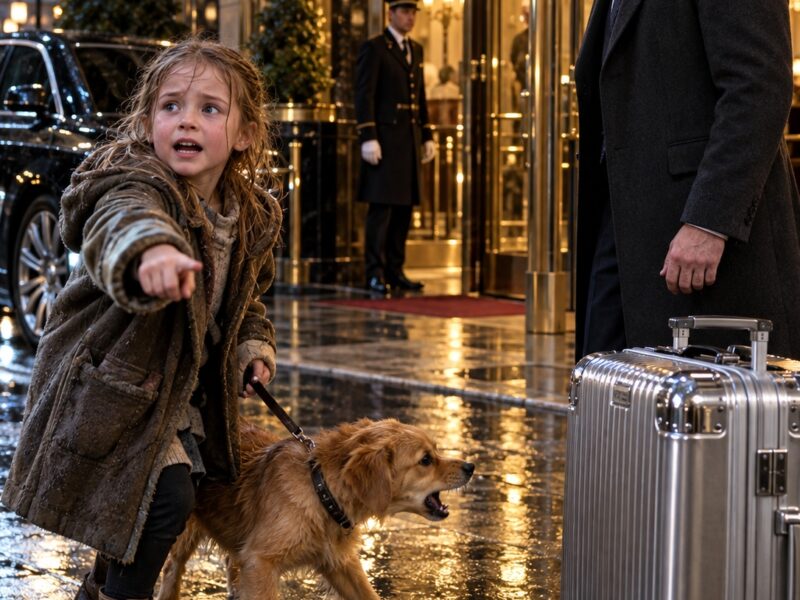
The Little Girl Said, “There’s Something Wrong With Your Suitcase”—Then Her Dead Father’s Dog Started Barking

“There’s something wrong with your suitcase.”
Dante Moretti stopped on the wet Boston sidewalk.
The voice belonged to a little girl.
She couldn’t have been older than six. Her coat was too large for her, the sleeves swallowing half her hands, and she was gripping a worn leather leash with both fists as if it were the only thing keeping her upright.
At the other end of that leash, a small golden-brown dog had planted all four paws against the pavement.
He wasn’t barking at Dante.
He was barking at the aluminum suitcase beside Dante’s shoes.
Again.
Again.
Again.
Sharp. Furious. Certain.
People outside the Harbor Grand Hotel began turning to look.
Dante’s longtime associate, Marco Russo, moved one hand toward the inside of his coat.
Dante caught his wrist.
“Don’t.”
Marco froze.
The little girl pulled harder on the leash.
“Biscuit, please.”
The dog refused to move.
His teeth were showing now.
Dante looked down at the aluminum case.
There were arbitration documents inside. A sealed envelope. A legal pad. A pen his father had given him twenty-two years ago.
Nothing else.
Nothing a dog should care about.
Then Dante noticed the collar around Biscuit’s neck.
Old leather.
Six small metal rivets.
And beside the buckle, scratched crudely into the metal, were two letters.
D. M.
Something cold moved through him.
He crouched slowly.
The dog stopped barking.
But he never took his eyes off the suitcase.
Dante looked at the child.
“How long have you had him?”
The girl swallowed.
“Two days.”
“Where did you get him?”
“I didn’t.”
Dante waited.
“He picked us.”
There was something about the way she said it that made Marco look at Dante.
Dante asked one more question.
“What’s your name, sweetheart?”
The girl tightened her fingers around the leash.
“Sophie.”
A pause.
“Sophie Miller.”
And for the first time in four years, Dante Moretti felt the dead reach into the world of the living and touch him.
Because he knew the name Miller.
He just didn’t know yet how much blood had been spilled to keep it buried.
Three nights earlier, rain had come sideways through Dorchester.
Sophie Miller walked home from the free after-school program at St. Monica’s carrying a paper bag of day-old bread against her chest.
Thursday was bread day.
Thursday was also the night her grandmother added extra water to Wednesday’s soup and called it dinner.
Sophie understood more about money than a six-year-old should.
She knew not to ask for cereal with cartoon characters on the box.
She knew her grandmother’s winter boots leaked.
She knew that when Ruth Miller said, “Maybe next month,” it usually meant no.
And she knew never to complain about the oversized blue coat Ruth had found at a thrift store the previous winter.
“It gives you room to grow,” Grandma always said.
Sophie suspected it gave her room to grow until high school.
She was passing Harrow Alley when she heard the whimper.
She stopped.
Grandma had rules.
Stay on the inside of the sidewalk.
Never talk to strangers.
Never get into anyone’s car.
Never go into an alley.
Sophie obeyed almost every rule Ruth gave her.
Almost.
Another whimper came from behind the dumpster.
Sophie stepped closer.
A small golden-brown dog was curled against the brick wall, soaked through and trembling so violently that the metal pieces on his collar clicked against one another.
“Oh.”
She crouched.
The dog lifted his head.
There was something strange about his eyes.
Not frightened.
Not wild.
Tired.
Almost as tired as Grandma looked when she came home from cleaning offices at six in the morning.
“Hi,” Sophie whispered.
The dog stared at her.
“Are you lost?”
His ears moved.
Sophie looked around.
Nobody came running.
There was no owner calling from the street.
She knew she couldn’t bring home a dog.
They could barely afford themselves.
So she stood.
“I’m sorry.”
She walked away.
After three steps, she heard paws behind her.
She turned.
The dog stopped.
“You can’t come.”
He sat.
Sophie walked again.
The dog followed.
Seven blocks later, he was still at her left ankle.
Not wandering.
Not sniffing garbage cans.
Not chasing pigeons.
Walking beside her as if someone had spent years teaching him exactly where he belonged.
Ruth was standing over a pot of soup when Sophie opened the apartment door.
“He followed me home.”
Ruth turned.
“No.”
“Grandma—”
“No.”
“I think he was already mine.”
Ruth stared at her granddaughter.
Then at the dog.
Then at the wet paper bag containing their bread.
“Absolutely not.”
The dog walked into the kitchen.
He crossed the cracked linoleum.
Then he sat directly in front of Ruth.
Square.
Silent.
Patient.
Ruth’s wooden spoon lowered.
Something changed in her face.
“One night,” she said.
Sophie’s eyes widened.
“Really?”
“One. We see what happens tomorrow.”
Sophie dropped to her knees and hugged the wet animal.
“I’m calling you Biscuit.”
Later, she carried him down the hallway toward the room she shared with Ruth.
They passed the narrow shelf beside the wall.
A framed photograph stood there.
Daniel Miller at twenty-nine.
Kind eyes.
Crooked smile.
Sophie’s chin.
Her father.
Biscuit saw the photograph.
His body went completely still.
Sophie didn’t notice at first.
“Come on.”
The dog did not move.
His eyes remained fixed on Daniel.
His tail did not wag.
He did not bark.
He simply stared.
As if photographs could become doors.
As if somewhere inside his small animal memory, a voice had just spoken a name he had spent years trying not to forget.
The following morning, Ruth examined Biscuit’s collar.
There was no tag.
No address.
No phone number.
Only those two scratched letters.
D. M.
Sophie leaned over the kitchen table.
“Daddy Miller.”
Ruth looked at her.
“What?”
“That’s what it means.”
Sophie smiled.
“Daddy Miller.”
Her face brightened with the simple certainty only children possess.
“He belonged to Daddy, Grandma.”
Ruth’s thumb stopped moving.
“He came back.”
Ruth turned toward the stove before Sophie could see her face.
Her hands were shaking.
Four years earlier, Daniel Miller had died in a hit-and-run on Columbia Road.
No driver had ever been identified.
No car had ever been found.
Three nights before he died, Daniel had sat in that same kitchen and told Ruth something she had spent four years trying to forget.
If anything happens to me, destroy my hard drives.
And keep Sophie away from anyone who works for Hail Securities.
Ruth had asked what he meant.
Daniel had looked toward his sleeping two-year-old daughter.
Then he had said something worse.
“I found something I wasn’t supposed to find.”
Three days later, he was dead.
And the dog Daniel had once owned disappeared the same week.
Ruth had never told Sophie.
She had told herself silence was protection.
Now a golden-brown dog with Daniel’s initials scratched into its collar was sitting in her kitchen.
And when Ruth quietly said, “Sit,” the dog sat before she finished the word.
She tried another command.
“Up.”
Biscuit rose instantly.
Ruth gripped the edge of the sink.
This was no stray.
That afternoon, Sophie took Biscuit to the Dorchester library.
The librarian, Mrs. Alhorn, began to object until she noticed how the dog walked.
Always at Sophie’s left heel.
Always watching her.
Always stopping when she stopped.
“Service dog?” Mrs. Alhorn asked.
Sophie shook her head.
“He’s my friend.”
Mrs. Alhorn had worked there twenty-nine years and knew when rules deserved to lose an argument.
She let them stay.
Everything was ordinary until Sophie walked toward the drinking fountain.
Three steps from a door marked STAFF ONLY, Biscuit stopped.
His body stiffened.
The hair along his spine rose.
A low vibration came from his throat.
Not quite a growl.
Not quite a bark.
Sophie pulled gently.
“Come on.”
Biscuit refused.
His eyes remained locked on the door.
That night, after Sophie fell asleep, Ruth pulled an old shoe box from beneath her bed.
Daniel’s handwriting was still on the lid.
Inside was a leather leash.
Old.
Scuffed.
Six small metal rivets.
Ruth touched it.
Then she closed the box.
Across Boston, a black sedan stopped outside the Harbor Grand Hotel.
Dante Moretti stepped out carrying an aluminum suitcase.
He was forty-three, though grief had put gray at his temples before forty.
Four years earlier, Dante had possessed everything men around him considered power.
Money.
Influence.
Loyalty.
A family name that opened doors and frightened the men standing behind them.
Then his house burned.
His wife Elena died in the fire.
So did their eight-month-old son, Nicholas.
The city investigator blamed faulty wiring.
Dante hired another investigator.
That man found something different beneath the remains of the living-room sofa.
A small blackened electronic component.
Something that should never have been there.
Dante spent four years searching for an answer.
He never found one.
Eventually, grief did what bullets had failed to do.
It hollowed him out.
He stopped eating with other people.
Stopped celebrating birthdays.
Stopped going into the room that had once been Nicholas’s nursery.
He worked.
He slept badly.
He woke.
He worked again.
Marco Russo had watched all of it.
Now Marco followed Dante into the Harbor Grand.
“I don’t like Boston this week,” Marco said.
“You’ve never liked Boston.”
“I like it less when three separate sources tell me someone’s listening.”
Dante glanced at the aluminum case.
“If someone wants to listen to tomorrow’s arbitration, they’ll hear men arguing about distribution contracts.”
Marco didn’t smile.
The next afternoon, Dante was outside the hotel waiting for a car when Biscuit saw him.
Or rather, saw the suitcase.
That was when Sophie Miller apologized for her dog.
That was when Dante heard her name.
And that was when something inside the story changed direction.
Upstairs in Suite 2204, Dante emptied the suitcase onto the bed.
Nothing unusual.
He pressed along the lining.
Nothing.
He checked the seams.
Nothing.
Still, he called a man named Elias Vance.
Elias arrived three hours later carrying a black equipment case.
He had studied engineering at MIT because Dante’s father had quietly paid the tuition after Elias’s own father died.
He repaid debts by being very good at things respectable men pretended not to understand.
He swept the suitcase with a handheld detector.
Three minutes later, it chirped.
Elias stopped.
“Knife.”
Dante handed him one.
Elias cut the stitching inside the lid.
From beneath the fabric, he extracted a thin black chip.
Dante stared at it.
“What is that?”
“A passive skimmer.”
“For what?”
“Everything.”
Elias set it beneath a magnifier.
“Phones. Laptops. Bluetooth. Hotel key cards. Anything within ten feet. It doesn’t broadcast continuously, which makes it harder to detect. It collects. Somebody comes close later with the right reader and downloads everything.”
Marco’s jaw tightened.
“How long?”
Elias studied the solder.
“Weeks.”
Dante thought about every meeting he had attended.
Every room he had entered.
Every conversation held near that case.
Then he thought of a little dog barking on a Boston sidewalk.
“Who builds these?”
“Three companies can manufacture this exact hardware.”
Elias hesitated.
“One is here.”
Dante already knew the answer before he heard it.
“Hail Securities.”
The room became very quiet.
“Marco.”
“Yes?”
“Find Sophie Miller.”
Marco looked at him.
“And?”
“Her grandmother is raising her.”
“How do you know?”
“I asked questions.”
Dante turned toward the window.
“Bring the grandmother to me.”
Then he reconsidered.
“No.”
Marco waited.
“I’ll go to her.”
Marco climbed four flights to Ruth Miller’s apartment first.
He knocked gently.
Ruth opened the door with the chain still fastened.
“Mrs. Miller?”
“Yes?”
“My name is Marco Russo.”
Nothing changed in her expression.
“I’d like to speak with you about your granddaughter’s dog.”
Her fingers tightened around the door.
Marco slid a cream business card through the gap.
There was only one name on it.
Dante Moretti.
Ruth read it.
The color drained from her face.
The chain came off.
“Come inside.”
Sophie was drawing Biscuit at the kitchen table.
Ruth touched her shoulder.
“Take your picture to the bedroom, honey.”
Sophie looked at Marco.
Biscuit did not react to him.
That seemed to reassure her.
When the bedroom door closed, Ruth sat across from Marco.
“Ask.”
“Where did the dog come from?”
“Sophie found him.”
“Your son’s full name?”
“Daniel Patrick Miller.”
Marco leaned forward slightly.
“Did Daniel work for Hail Securities?”
Three seconds passed.
Ruth looked at Biscuit.
Then back at Marco.
“I think you should bring your boss.”
Dante arrived the following morning.
Biscuit walked around his ankles once.
Then sat beside him.
Ruth noticed.
So did Dante.
“My granddaughter’s dog barked at your suitcase,” Ruth said. “Why?”
“Because something was inside it.”
He told her about the surveillance device.
When he said Hail Securities, Ruth’s coffee cup trembled.
Dante saw it.
“That dog was trained,” he said.
Ruth closed her eyes.
For four years, she had carried Daniel’s warning alone.
Now the past had walked into her kitchen wearing a dark sweater.
“My son worked at Hail for six years.”
Dante said nothing.
“Data security.”
Still nothing.
“Three nights before Daniel died, he came here. He told me he had discovered something at work. Something he wasn’t supposed to see.”
Ruth looked toward Daniel’s photograph.
“He told me that if anything happened to him, I was to destroy his hard drives.”
Dante’s voice softened.
“And the dog?”
“He disappeared the same week Daniel died.”
Dante looked down.
Biscuit had placed his head across Dante’s shoe.
Something in Dante’s face changed.
“May I examine his collar?”
Sophie was called inside.
Dante knelt so he wouldn’t tower over her.
“My name is Dante.”
“I know.”
He almost smiled.
“Your dog did something very brave yesterday.”
Sophie looked down at Biscuit.
“He does lots of things.”
“I believe you.”
Dante pointed gently toward the collar.
“I think somebody taught him to be brave. May I look at it?”
“You can look.”
“Thank you.”
“Not take.”
“I won’t take it.”
Dante turned the collar carefully.
Five rivets were solid.
The sixth moved.
Barely.
He looked up.
“Marco.”
Elias arrived minutes later.
He opened the rivet with tools designed for watchmakers.
Inside was a cavity.
Inside the cavity was a chip no larger than a grain of rice.
Ruth covered her mouth.
Elias placed it into a shielded pouch.
Sophie watched all of them.
Then she asked the only question that mattered to her.
“Did Daddy give Biscuit to me?”
No one answered immediately.
Ruth knelt and pulled Sophie into her arms.
“I think he tried to, sweetheart.”
Sophie pressed her cheek against Ruth’s shoulder.
“I think he’s been trying for a very long time.”
Elias worked through the night.
At five in the morning, the chip opened.
Four hundred encrypted entries appeared on his screen.
Names.
Dates.
Payments.
Recordings.
Judges.
Senators.
Prosecutors.
Government contractors.
Officials.
People whose private mistakes had been converted into currency.
Every entry had a status.
ACTIVE.
SETTLED.
LEVERAGE.
Dante stood behind Elias.
“Who created this?”
Elias opened the metadata.
Then stopped.
“Daniel P. Miller.”
Dante leaned closer.
The file had been created days before Daniel died.
At the top of the archive was another name.
OWNER: V. HAIL.
Victor Hail.
Dante knew him.
Everyone in certain circles knew him.
Publicly, Victor sold sophisticated security systems to corporations and governments.
Privately, he had approached powerful families with offers.
Information.
Leverage.
Secrets.
Dante had always believed Victor was selling intelligence.
Now he understood.
Victor wasn’t selling information.
He was selling people.
The politicians.
The judges.
The businessmen.
Every one of them was a door Victor could open when he needed something.
And Daniel Miller had found the keys to the entire building.
Dante stared at the creation date again.
Four days before Daniel’s death.
The hit-and-run had not been random.
“Marco.”
“Yes.”
“Move Ruth and Sophie.”
“Where?”
“Prince Street.”
Marco’s face changed.
That address was known to almost no one.
“Tonight?”
“Now.”
Dante looked at the chip.
“And the dog goes with them.”
That evening, Ruth finally told Dante the rest.
Daniel had brought Biscuit home as a puppy.
He had secretly trained him at a working-dog facility outside Boston.
Hail’s surveillance devices used a distinctive industrial resin.
Daniel had trained Biscuit to recognize the scent.
He intended the dog to detect devices planted in briefcases, offices and luggage.
Then Daniel realized someone inside Hail had noticed what he was doing.
He placed Biscuit in long-term boarding.
Paid cash.
Left one instruction.
The dog could not be released to anyone.
Not even Ruth.
Only Sophie.
On her eighteenth birthday.
Three nights later, Daniel was killed.
Eleven months before Sophie found Biscuit, the kennel owner called Ruth.
Biscuit had escaped.
Ruth had assumed he was gone forever.
Now she looked toward the living room where Sophie slept with Biscuit curled beside her.
“He was looking for her,” Ruth whispered.
Dante stared into his soup.
“For eleven months?”
“I think so.”
Dante looked at the sleeping child.
“No.”
Ruth looked at him.
“He found her.”
At one in the morning, Biscuit growled.
Sophie woke.
Ruth was already standing in the hallway.
Two men waited outside the apartment.
Dark coats.
Gloves.
One carried a pry bar.
They did not knock.
Ruth understood immediately.
She grabbed Sophie.
“Not a sound.”
The kitchen window had been painted shut for years.
Ruth forced it open with a screwdriver.
Sophie went through first.
Then Biscuit.
Then Ruth.
Behind them came the crack of the apartment door breaking.
They descended four flights of rusted fire escape.
At the bottom, a sedan waited in darkness.
The passenger window lowered.
Marco Russo.
“Get in.”
Ruth stared at him.
“How long have you been here?”
“Long enough.”
She understood.
Dante had left a man outside without telling her.
The sedan accelerated away.
Upstairs, Victor Hail’s men tore Ruth’s apartment apart.
They found Daniel’s photograph.
His old leash.
A watch strap.
They did not find what they had come for.
Because Ruth had forgotten something even existed.
At Prince Street, Sophie was given a small yellow bedroom.
A stuffed bear sat on the pillow.
“Is this mine?” she asked.
“For as long as you need it,” Dante said.
Ruth went downstairs and cried silently at the kitchen table.
Dante sat across from her.
He did not tell her everything would be fine.
He knew better than to make promises grief could overhear.
Eventually Sophie appeared.
She climbed into Ruth’s lap.
“Biscuit told us before the men came.”
Dante looked at the dog.
Then at Ruth.
“Hail knows we have the chip.”
Ruth wiped her eyes.
“Can he open it?”
“Not completely.”
“Why?”
“Daniel separated the decryption key.”
Dante leaned forward.
“He would have hidden it somewhere he believed Sophie could eventually find.”
A sleepy voice came from Ruth’s shoulder.
“Daddy gave me a music box.”
Ruth went still.
The memory returned at dawn.
A wooden box.
Daniel winding the brass key.
A toddler Sophie laughing as You Are My Sunshine played.
“It’s under my bed.”
Marco returned to the damaged apartment.
Inside Daniel’s old shoe box, beneath the leather leash, he found the music box.
Sophie opened it herself.
The melody began.
Ruth saw the paper first.
Taped beneath the lid was a handwritten string.
Thirty-two characters.
Elias entered them.
The archive opened.
His expression changed.
“What?”
Dante asked.
Elias stared at the screen.
“The four hundred files were history.”
“And?”
“The active roster is eighty-nine.”
Eighty-nine people currently being blackmailed.
Recordings.
Hotel footage.
Bank transfers.
Payment ledgers.
Private communications.
Victor Hail had turned human weakness into an empire.
Sophie sat on the kitchen floor holding Biscuit’s paw.
“Shake.”
Biscuit offered it.
She laughed.
Dante looked at her.
Six years old.
Borrowed pajamas.
A dog beside her.
A dead father’s music box on the table.
And enough information hidden inside that box to destroy some of the most powerful people in America.
For the first time, Dante understood something Daniel must have understood before dying.
The most dangerous object in the room was not the data.
It was Sophie.
Because she was the last living person Victor Hail could threaten to make the truth disappear.
That night, Sophie found Dante sitting awake on the stairs.
She carried the music box.
“Can’t sleep?” Dante asked.
She shook her head.
“Me either.”
She sat below him.
The music played quietly.
“It makes me think about Daddy.”
Dante waited.
“But I don’t remember him.”
Her voice did not break.
That made it worse.
“I know the picture. I don’t know him.”
Dante looked at the wall.
“I had a wife.”
Sophie turned.
“Elena.”
He swallowed.
“And a son. Nicholas.”
“How old?”
“Eight months.”
“What happened?”
“There was a fire.”
Sophie listened.
“The city said it was an accident. I hired another investigator. He found something under the sofa. Something electronic.”
Dante looked at his hands.
“I never found out who put it there.”
Sophie was silent.
“So I blamed myself.”
“Why?”
“Because I wasn’t home.”
“That doesn’t make it your fault.”
Dante looked at her.
She shrugged in the uncomplicated way children sometimes dismiss the lies adults have spent years building prisons around.
“Grandma says people who miss somebody too much forget to breathe.”
A tiny smile touched Dante’s face.
“You should breathe.”
He did.
And somewhere else in Boston, Victor Hail was opening a file containing photographs of Dante’s burned home.
Victor saw the second investigator’s report.
He saw the blackened electronic component beneath the sofa.
And he smiled.
The next morning, Dante received a photograph.
Elena Moretti’s grave.
A fresh white lily lay across the stone.
There was no note.
There didn’t need to be.
The message was obvious.
I did it then.
I can do it again.
Dante set his coffee cup on top of the photograph.
Then he called Marco.
One hour later, the kitchen on Prince Street was filled with men Dante trusted.
Victor wanted the chip.
So they would give him one.
Elias built a duplicate.
Same shape.
Same solder.
Same resin.
A perfect decoy.
Dante would take it to an abandoned warehouse on Pier 9.
Alone.
At least, that was what Victor would believe.
Sophie overheard the plan.
“Biscuit should go.”
Dante turned.
“No.”
“He finds the bad things.”
“Not tonight.”
“You need him.”
Dante knelt.
“This time I already know where the bad thing is.”
Sophie looked unconvinced.
“I need you to do something more important.”
“What?”
“Keep Biscuit safe.”
Her eyes narrowed.
“If he comes with me, I can’t promise I’ll bring him home.”
Dante paused.
“If he stays with you, I promise I’ll come back for both of you.”
Sophie studied him.
Finally she nodded.
Dante handed her the music box.
“Keep this safe too.”
“When do I give it back?”
“Tonight.”
He stood.
“It still owes us another song.”
The warehouse was dark except for one hanging bulb.
Dante arrived carrying the same aluminum suitcase Biscuit had barked at days earlier.
At 6:42 p.m., four men entered.
They searched the building.
They found nothing.
At 6:45, Victor Hail walked in.
Perfect coat.
Perfect gloves.
Perfect smile.
“Mr. Moretti.”
“Victor.”
Victor rested one hand on the suitcase.
“Give me the case and the key, and I let your household sleep.”
Dante’s expression did not change.
“My household already sleeps.”
He looked at Victor.
“Yours doesn’t.”
Victor opened the case.
Inside was the decoy chip.
Beside it, a copy of Daniel’s key.
Victor examined both.
Satisfied, he closed the case.
“A pleasure.”
He turned away.
“Victor.”
Hail stopped.
“Daniel Miller’s daughter is six.”
Silence.
“She asked me whether her father would be proud of her.”
Dante watched him carefully.
“I want you to answer her.”
Victor paused.
Half a second.
Too long.
The warehouse exploded with light.
Headlights flooded every entrance.
Unmarked cars blocked the exits.
Victor’s men reached toward their coats.
Then stopped.
A federal judge stepped from the first vehicle.
From another came the Boston police commissioner.
Then a senator’s chief of staff.
Then a defense contractor.
Then Antonio Castellano.
Then Rocco Benedetti.
Men who had hated each other for years.
Men who had one thing in common.
Every one of them had found his own name inside Victor Hail’s files.
Elias had spent forty-eight hours doing what Daniel Miller had died trying to do.
He had distributed the truth.
Victor could threaten one man.
Maybe five.
Maybe twenty.
But once eighty-nine people knew they were all prisoners inside the same cage, the cage stopped working.
Then came the final betrayal.
Victor’s operations chief walked across the warehouse.
She held out a flash drive.
“A backup,” she said.
Victor stared at her.
“You kept one?”
“I learned from you.”
The federal judge unfolded a warrant.
“Victor Hail, you are under arrest.”
The charges continued.
Racketeering.
Blackmail.
Wire fraud.
Conspiracy.
Murder.
Daniel Patrick Miller.
For the first time, Victor Hail had nothing to say.
There was no gunfight.
No cinematic execution.
Dante did not shoot him.
That would have been too easy.
Instead, Victor Hail was destroyed by the one thing he had spent his life believing belonged only to him.
Information.
They buried him inside his own ledger.
Before dawn, Dante returned to Prince Street.
Ruth was waiting in the kitchen.
Two cups of tea sat on the table.
“Is it finished?”
Dante sat.
“Yes.”
Ruth closed her eyes.
Only for a moment.
Then she opened them again.
“Sophie?”
“Upstairs. She woke every hour and wound the music box.”
Dante looked toward the ceiling.
“I established a trust for her.”
Ruth said nothing.
“Enough for school. College. Enough that you don’t have to clean offices at night anymore.”
Still nothing.
“No obligation. Nothing in return.”
Ruth finally looked at him.
“That isn’t what she needs from you.”
Dante understood.
Money was easy for men like him.
Time was expensive.
Footsteps came down the stairs.
Sophie entered wearing socks too large for her feet.
Biscuit followed.
She saw Dante.
Her face changed.
“You came back.”
“I said I would.”
Sophie climbed into the chair beside him.
Then she leaned against his arm.
Ruth said nothing.
She simply took a third plate from the cupboard.
She cracked eggs into a pan.
Dante stared at the plate.
For four years, he had eaten alone.
At desks.
At counters.
Standing beside sinks.
Anywhere that prevented him from remembering an empty chair.
Now Sophie was eating beside him.
Ruth was standing at the stove.
Biscuit lay across his shoe.
Dante picked up his fork.
And for the first time since Elena and Nicholas died, he ate breakfast at a table where someone else was eating too.
Six weeks later, winter covered Boston.
Victor Hail had been indicted.
Hail Securities was dismantled.
Officials resigned.
Others testified.
Investigations spread through Washington and Boston.
Daniel Miller’s death was officially reopened as a homicide.
But Sophie knew almost none of that.
She returned to school.
Every morning, Biscuit walked her there.
Every afternoon, he waited outside the library.
The leash still hung loose most days because he never needed it.
He had spent eleven months looking for her.
He was not going to lose her now.
Dante began visiting on Sundays.
He brought coffee for Ruth.
Never expensive presents for Sophie.
He had finally understood what Ruth meant.
Sophie did not need another wealthy man trying to replace what she had lost.
She needed someone who came back when he said he would.
So Dante brought time.
One Sunday became two.
Two became seven.
On the seventh, Sophie found him reading in the small parlor.
“Stay for supper.”
Dante lowered the newspaper.
“If your grandmother wants me.”
From the kitchen came the sound of a cupboard opening.
Ruth took down a third plate.
That was her answer.
They sat together.
Daniel’s photograph remained on the shelf.
Nobody moved it.
Beside it stood the wooden music box.
Nobody tried to replace Daniel either.
Some losses were not wounds meant to close.
They were rooms inside you that simply learned to have windows.
Halfway through supper, Sophie cut her bread into careful little squares.
“I used to think Daddy sent Biscuit to find me.”
Dante stopped eating.
Ruth looked at her granddaughter.
Sophie did not look up.
“But now I think maybe he sent Biscuit to find you too.”
No one spoke.
Outside, Boston winter light moved slowly across the window.
Dante looked at Daniel’s photograph.
A man he had never met.
A man who had died trying to expose a secret.
A father who had known he might not live long enough to protect his daughter himself.
So he had trained a dog.
Hidden a key inside a song.
And trusted that somehow, someday, the things he loved would find one another.
Dante reached across the table.
He placed his hand gently over Sophie’s.
Biscuit lifted his head from the floor.
For one strange second, Dante wondered whether the dog understood.
Then Biscuit lowered his chin across Dante’s shoe again.
The same way he had done the first morning in Ruth Miller’s kitchen.
Only this time, nobody in the room was afraid of what he might have come to warn them about.
The music box remained open on the shelf.
Silent.
Waiting.
It would not play unless someone reached for it and turned the little brass key.
Maybe grief was like that too.
It never disappeared.
It simply stopped playing by itself.
You learned when to touch it.
When to let it be quiet.
And when you were finally strong enough to hear the song again.
Sophie looked toward the window.
Snow had begun falling over Dorchester.
Biscuit slept beneath the table.
Ruth carried another bowl of soup from the stove.
And Dante Moretti—the man who had once believed surviving meant learning to need no one—sat at a crowded little kitchen table with his hand beside a six-year-old girl’s hand and understood something Victor Hail, with all his secrets and power, had never understood.
Fear could make people obey you.
Secrets could make them useful.
Money could make them stay for a while.
But none of those things could make someone come back.
Only love could do that.
Sometimes it came back as a grandmother who worked nights so a little girl would never know how poor they were.
Sometimes it came back as a stranger who kept a promise before dawn.
And sometimes, after four years of silence and eleven months of searching, it came back on four muddy paws, wearing an old leather collar with two scratched letters beside the buckle.
D. M.
Daniel Miller.
Sophie’s father had been gone for four years.
But in the quietest way possible, he had kept his final promise.
His daughter never had to walk home alone.









