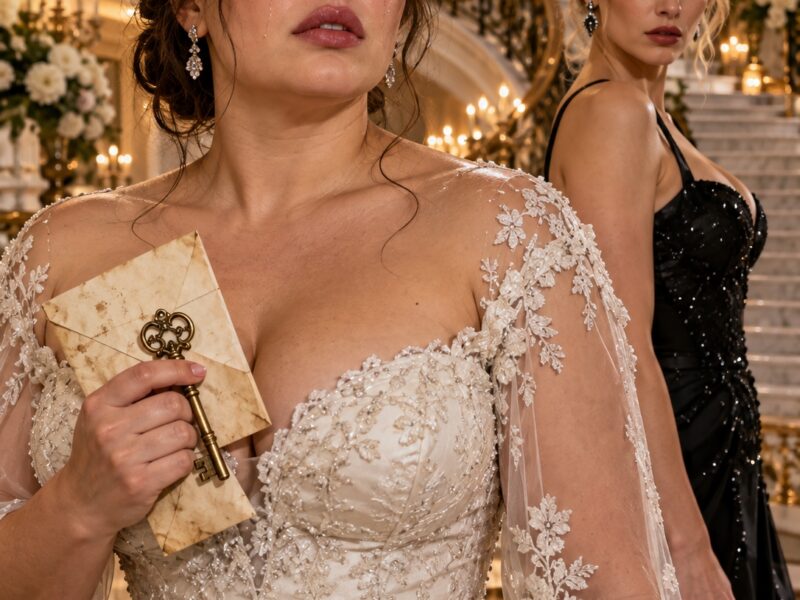
THE MAFIA BOSS REJECTED 20 PERFECT BRIDES—THEN HIS QUIET ASSISTANT PUT ON THE FORBIDDEN GOWN
The first time Cassius Leone truly looked at Nadia Bell, she was wearing a dead woman’s dress.
She was standing barefoot in the private fitting room on the third floor of the Leone estate, her cardigan folded over a chair, her dark hair falling loose around her face, both hands gripping the sides of a forty-year-old silk gown as though she expected someone to drag her out of it.
Three feet away, an elderly seamstress had gone completely pale.
Behind Nadia stood a mirror taller than a church door.
And reflected in that mirror was something nobody in Chicago’s most feared family had seen in four decades.
The gown fit.
No pins.
No hidden stitches.
No altered waist.
No folded fabric disguised beneath a sash.
It simply fit.
Cassius stopped in the doorway.
He had walked into rooms where men had lowered their voices before he said a word. He had watched judges avoid his eyes, politicians remember appointments elsewhere, and men twice his age reconsider threats after hearing his last name.
But at that moment, Cassius Leone forgot to move.
Nadia saw him in the mirror.
The color disappeared from her face.
“Mr. Leone.”
Her hands flew toward the hooks at her back.
“I’m sorry. Mrs. Moretti needed someone to— I was just helping her measure—”
“Don’t.”
One word.
Nadia froze.
Cassius stepped into the room.
Mrs. Moretti looked as if she wanted the marble floor to open beneath her.
“Mr. Leone,” the seamstress began, “I can explain.”
“I wasn’t asking you.”
His eyes never left Nadia.
She swallowed.
The dress was dark ivory rather than white, its silk softened by age, its neckline modest, its sleeves falling from the shoulders with a severe elegance that belonged to another era. Tiny hand-sewn pearls followed the bodice. The waist had been cut for a woman with hips, shoulders, and substance.
For forty years, every prospective Leone bride had been required to wear it.
And for forty years, every woman had failed.
Some had been too narrow through the shoulders.
Some too small through the chest.
Some too short.
Some too tall.
Most simply did not have the proportions for which the gown had been made.
That should have meant nothing.
Instead, in the Leone family, it meant everything.
The dress had belonged to Victoria Leone.
Cassius’s grandmother.
The woman whose portrait still hung above the central staircase.
The woman who had transformed a collection of neighborhood businesses into an empire before half the men now telling stories about her had been old enough to shave.
The family called her the First Lady.
Their enemies had called her worse.
She had died forty years earlier.
And according to a rule she herself had left behind, no woman could become the wife of the Leone heir without first being presented to the family wearing Victoria’s gown exactly as Victoria had worn it.
Unaltered.
That final word had caused twenty years of humiliation.
Twenty prospective brides.
Twenty daughters of powerful families.
Twenty private disasters.
They had pinned the fabric.
Tucked it.
Temporarily stitched it.
Some had dieted for months.
Others had worn padding.
One woman had undergone surgery.
All of them had insisted the gown fit naturally.
Cassius had noticed every lie.
And he had rejected every woman.
Now Nadia Bell—his thirty-year-old executive assistant, who hid inside oversized sweaters and apologized when other people bumped into her—was standing in the center of the room wearing it as though Victoria Leone had ordered it for her yesterday.
Nadia tried to cover herself with her hands.
That somehow made it worse.
She looked humiliated.
Not triumphant.
Not seductive.
Terrified.
“I’ll take it off,” she whispered. “Right now.”
Cassius finally walked closer.
Nadia instinctively moved backward.
“Please.”
He stopped.
Something about that single word changed his expression.
Not because she sounded afraid of the dress.
Because she sounded afraid of him.
Cassius looked toward Mrs. Moretti.
“Leave us.”
The seamstress hesitated.
Nadia’s eyes widened.
“Actually, she can stay.”
Cassius looked back at her.
For a second, neither spoke.
Then something almost like amusement touched his face.
“Mrs. Moretti stays.”
The old woman remained exactly where she was.
Cassius circled Nadia slowly, never touching her.
His gaze moved over seams, shoulders, waist, hem.
Nadia’s embarrassment sharpened.
“Could you stop looking at me like that?”
His eyes lifted.
“Like what?”
“Like I’m evidence.”
That stopped him.
For the first time, he really saw the woman inside the gown.
Not her measurements.
Not the impossible coincidence.
Nadia.
She had worked for him for three years.
She remembered which calls he refused after nine at night. She knew he drank coffee black before meetings and forgot to eat whenever negotiations went badly. She knew which hospital received anonymous donations every December and which name was never supposed to appear on the checks.
She knew when his mother’s birthday was.
She knew when his father had died.
She knew that every February 11, Cassius disappeared for four hours and refused to explain where he went.
She knew almost everything necessary to make his life function.
And Cassius realized he knew embarrassingly little about hers.
“You’re right,” he said.
Nadia blinked.
It might have been the first time she had ever heard Cassius Leone admit that so quickly.
He turned to Mrs. Moretti.
“How much was altered?”
The seamstress looked confused.
“Nothing.”
“I mean tonight.”
“Nothing.”
“No temporary pins?”
“No.”
“Padding?”
“No.”
“Hidden fold?”
“Mr. Leone, look at the seams yourself.”
He already had.
His gaze returned to Nadia.
Forty years.
Twenty women.
Hundreds of whispered jokes across Chicago about the impossible Leone bride.
And now this.
Nadia shook her head.
“I know what you’re thinking.”
“I doubt that.”
“You think this means something.”
Cassius said nothing.
“It doesn’t.”
“Why?”
“Because it’s a dress.”
There was almost anger in her voice now.
“Fabric doesn’t choose people. Dead women don’t choose people. And I am definitely not whatever everyone in this house has spent forty years trying to turn that thing into.”
She gestured at herself.
Cassius’s expression hardened.
“Don’t do that.”
“Do what?”
“Talk about yourself like they do.”
The words landed harder than either expected.
Nadia looked away.
Then the elevator at the end of the corridor chimed.
Mrs. Moretti’s face changed.
Someone was coming.
And suddenly Cassius understood the real problem.
This room had cameras outside it.
Staff had seen Nadia enter.
Security knew Cassius was here.
By morning, someone would talk.
By breakfast, five families would know.
And by lunch, every man who had spent years positioning a daughter beside Cassius Leone would understand that a woman nobody had considered competition had just done the one thing their daughters could not.
Cassius looked at Nadia.
“Take the dress off.”
Relief flooded her face.
Then he added, “And don’t leave the estate.”
Her relief vanished.
“What?”
“Cassius,” Mrs. Moretti warned softly.
He ignored her.
Nadia stared at him.
“I have an apartment.”
“You also have no idea what just happened.”
“A dress fit me.”
“No.”
His voice was quiet.
“Twenty alliances just failed in the same room.”
And that was the moment Nadia understood that the most dangerous thing she had done in her entire life was fit into a piece of silk.
By seven the next morning, the story had crossed Chicago.
By eight, Nadia’s phone had forty-three missed calls.
By nine, Aldo Rizzo was standing in Cassius Leone’s office.
He arrived without an appointment.
Nobody stopped him.
Aldo was sixty-eight, silver-haired, immaculately dressed, and dangerous in the way certain old men became dangerous after surviving everyone who had once underestimated them.
His daughter Gemma had been the favorite.
Everyone knew it.
The Rizzos controlled construction contracts, trucking routes, unions, clubs, judges, and enough legitimate businesses to make journalists use the word “entrepreneur” with straight faces.
A Leone-Rizzo marriage would have ended two generations of hostility.
Gemma had been raised for it.
Educated for it.
Prepared for it.
She had spent six months being fitted for a reproduction of Victoria’s gown because the original was considered too fragile for repeated handling.
The reproduction had required twelve discreet alterations.
Nobody was supposed to know.
Cassius knew.
So did Nadia.
Because Nadia scheduled the fittings.
Aldo closed Cassius’s office door behind him.
Then he placed a single brass cartridge on the desk.
Not dramatically.
Almost politely.
Cassius looked at it.
“You always did have a weakness for theater.”
“You will present Gemma tonight.”
“No.”
“You haven’t heard the alternative.”
“I saw the bullet.”
Aldo smiled.
“Then we’re saving time.”
Cassius leaned back.
“The gown fit Nadia.”
“The secretary.”
“My assistant.”
“The fat girl who brings coffee.”
Something changed in Cassius’s eyes.
It was subtle enough that another man might have missed it.
Aldo did not.
He smiled again.
“Oh.”
Cassius said nothing.
“That’s interesting.”
“Careful.”
“Three years she works outside your office and suddenly an antique dress makes you sentimental?”
“The dress made me observant.”
“She is nobody.”
Cassius looked at the cartridge again.
Then pushed it across the desk with one finger.
“That’s the mistake everyone keeps making.”
Aldo’s smile disappeared.
“My daughter has been promised this position.”
“By you.”
“By both families.”
“Not by me.”
“You reject Gemma publicly, you humiliate my house.”
“Then perhaps you shouldn’t have told the city she was already chosen.”
Aldo leaned forward.
“You think tradition protects you?”
“No.”
Cassius finally looked him directly in the eyes.
“I think men who confuse tradition with ownership eventually discover they own less than they thought.”
For several seconds, neither moved.
Then Aldo straightened his jacket.
“You will present my daughter tonight.”
“The gown chose.”
Aldo gave a humorless laugh.
“Silk does not choose.”
“Then you have nothing to worry about.”
Aldo stared at him.
Cassius stared back.
Finally Aldo picked up the cartridge.
At the door, he stopped.
“You’re willing to start a war over a servant?”
Cassius’s answer came without hesitation.
“No.”
Aldo glanced back.
“I’m willing to finish one over the assumption that you get to decide who matters in my house.”
Aldo left.
Ten minutes later, Nadia submitted her resignation.
Cassius found out because the email landed in his inbox with the subject line:
EFFECTIVE IMMEDIATELY.
He read it twice.
Then a third time.
It was six sentences long.
Professional.
Grateful.
Clean.
Exactly the kind of resignation written by someone who had already decided that explaining herself would only invite an argument.
Cassius stood.
His security chief, Marco, looked up.
“Where are you going?”
“To stop my assistant from doing something stupid.”
Marco glanced toward the cartridge Aldo had left behind.
“Which assistant?”
Cassius looked at him.
Marco raised both hands.
“Understood.”
But Nadia had already packed her desk.
Three notebooks.
Two pens.
A framed photograph of her mother.
A ceramic mug with a chipped handle.
A cardigan.
That was apparently all three years of her life at Leone Holdings amounted to.
She carried the box toward the elevator.
Gemma Rizzo was waiting.
Nadia stopped.
Gemma wore cream trousers, a cashmere coat, and the expression of a woman who had never once entered a room wondering whether she belonged there.
Two guards stood twenty feet away.
Neither intervened.
Gemma looked at the cardboard box.
“That was quick.”
Nadia pressed the elevator button.
“Move.”
Gemma laughed softly.
“Look at you.”
Nadia said nothing.
“Twenty-four hours in a dead woman’s dress and suddenly you have a spine.”
The elevator remained somewhere above them.
Nadia pressed the button again.
Gemma stepped closer.
“I want to understand something.”
“I don’t care.”
“Did you plan it?”
Nadia finally looked at her.
“Plan what?”
“All of this.”
“Spilling wine on your dress?”
Gemma’s eyes narrowed.
“I didn’t spill it.”
“I know. A waiter did.”
“Maybe you paid him.”
Nadia actually laughed.
It surprised both of them.
Gemma’s face hardened.
“You think this is funny?”
“No. I think the idea that I spent three years arranging your fittings, moving Cassius’s meetings, calling designers, fixing your seating charts and listening to you complain about champagne temperatures because I had a secret master plan to steal an antique dress is insane.”
“You wanted him.”
Nadia went still.
Gemma saw it.
And smiled.
There.
The wound.
“I knew it.”
“You don’t know anything.”
“I know women.”
“No, Gemma. You know competition.”
The elevator chimed.
The doors opened.
Gemma stepped between them.
“You think he looked at you differently because the gown fit?”
Nadia’s fingers tightened around the box.
“Get out of my way.”
“He did.”
Gemma’s voice softened.
“He looked at you and suddenly you existed.”
That one hurt.
Because it was true.
Nadia hated her for knowing it.
Gemma leaned closer.
“That’s what you’re really afraid of, isn’t it?”
Nadia said nothing.
“You’ve spent your whole life pretending you don’t care whether anyone sees you.”
Gemma’s gaze traveled deliberately over Nadia’s body.
“You wear clothes two sizes too big. You stand behind people in photographs. You apologize before you speak. You laugh when someone makes you the joke because God forbid they realize it hurts.”
Nadia’s throat tightened.
Gemma smiled.
“And now one powerful man looked at you for five minutes and you think you’ve changed.”
“I don’t think that.”
“Yes, you do.”
Nadia tried to step around her.
Gemma blocked her again.
“He’ll wake up.”
Nadia looked at her.
“He’ll wake up tomorrow or next week or six months from now, and he’ll realize what everyone else already knows.”
Gemma lowered her voice.
“A dress can fit your body, Nadia. It can’t make you one of us.”
For years, Nadia had developed an entire survival system around moments like this.
Smile.
Look down.
Say something self-deprecating before the other person can.
Leave quickly.
Cry somewhere private if necessary.
Never let them know they found the soft place.
She felt that old instinct now.
Her shoulders curled.
Her chin lowered.
Gemma saw it happen.
And her smile widened.
“There she is.”
Nadia hated herself for the tears burning behind her eyes.
“Go home,” Gemma whispered. “Take off Victoria Leone’s dress. Put your cardigan back on. Carry your little box to your little apartment and be grateful you got close enough to important people to pretend for one night.”
The elevator doors began to close.
Gemma stepped aside.
Nadia entered.
She did not look back.
But as the doors met, she heard Gemma say one last thing.
“Cassius will be embarrassed he ever looked at you.”
The doors closed.
And Nadia believed her.
That was the worst part.
She believed every word.
She spent the afternoon packing.
Her apartment in Lincoln Square was small enough that she could hear the radiator knocking from every room.
Nadia liked it that way.
Small rooms had always felt safe.
Nothing could surprise you from too far away.
She folded sweaters into a suitcase she did not need to pack.
She wasn’t going anywhere.
But packing felt like movement, and movement felt better than sitting still.
At 8:17 p.m., someone knocked.
Nadia froze.
Nobody visited without texting.
The knock came again.
Not pounding.
Not demanding.
Three patient taps.
She looked through the peephole.
Cassius Leone stood in the hallway.
Alone.
Nadia closed her eyes.
Of course.
She opened the door but left the chain on.
“You can’t be here.”
“Apparently I can.”
“Your security?”
“Downstairs.”
“Your car?”
“Also downstairs.”
“That’s not what I meant.”
“I know.”
Nadia looked at him through the narrow opening.
“What do you want?”
“To come inside.”
“No.”
Cassius glanced at the chain.
“Fair.”
That irritated her more than anger would have.
“You’re not going to threaten me?”
“No.”
“Tell me I can’t resign?”
“You can.”
“Then why are you here?”
His expression changed.
“To tell you why the dress matters.”
Nadia almost closed the door.
“I don’t care.”
“Yes, you do.”
“That’s incredibly arrogant.”
“Yes.”
That nearly made her smile.
Nearly.
Cassius continued.
“After I tell you, if you still want to leave, I won’t stop you.”
Nadia studied him.
“What do you want from me afterward?”
“One answer.”
“To what?”
“A question.”
She stared at him for another moment.
Then removed the chain.
Cassius entered.
He seemed absurdly large inside her apartment.
Not physically.
Socially.
Everything about him belonged to marble foyers and armored SUVs, not mismatched dining chairs and grocery coupons held to a refrigerator with magnets.
His gaze fell on the half-packed suitcase.
“You were actually leaving.”
“I resigned.”
“I thought you were angry.”
“I am.”
“Good.”
She frowned.
“Good?”
“Anger is better than shame.”
Nadia folded her arms.
“Don’t psychoanalyze me.”
“I wouldn’t know how.”
“Then say what you came to say.”
Cassius remained standing.
“That gown wasn’t made for a thin woman.”
Nadia blinked.
Of all the things she expected, that wasn’t one.
“My grandmother was five foot eight. Broad shoulders. Full hips. Strong arms. She hated corsets and refused to wear anything that stopped her from breathing.”
Nadia said nothing.
“The portrait lies.”
“What?”
“The artist narrowed her waist.”
Something bitter touched Cassius’s mouth.
“My grandfather demanded it. Apparently even Victoria Leone wasn’t allowed to look entirely like herself once men decided to turn her into a legend.”
Nadia slowly lowered her arms.
Cassius continued.
“The photograph in my study doesn’t lie. That’s why I recognized the fit.”
He took his phone from his pocket.
A photograph appeared.
Black and white.
A woman stood outside the Leone estate sometime in the 1970s or early 1980s, laughing at someone beyond the frame.
She was not delicate.
She was beautiful, but not in the polished way Gemma was beautiful.
She looked substantial.
Alive.
Her hips filled the skirt.
Her shoulders held the neckline exactly where Nadia’s had.
She stood with one hand planted on her waist as if the world had interrupted her and would have to wait.
Nadia stared.
“She looks…”
“Like you?”
“No.”
Nadia handed the phone back.
“She looks like she never apologized.”
Cassius was quiet.
“Exactly.”
Nadia turned toward the window.
“Then why all this nonsense for forty years?”
“The unaltered rule?”
“Yes.”
“I don’t know.”
She looked at him.
“You don’t know?”
“My grandmother wrote it into the family charter shortly before she died.”
“And everyone obeyed it without knowing why?”
“You’ve met my family.”
Fair point.
Cassius stepped closer.
“Twenty women came through that house.”
“Twenty-one if you’re counting me.”
“I’m not.”
“Why?”
“Because you didn’t ask to be tested.”
That silenced her.
“They changed themselves for that gown,” he said. “Some physically. Every one of them lied about altering it because they wanted the position badly enough.”
“And you rejected them for lying?”
“Partly.”
“What was the other part?”
Cassius looked at her.
“I’ve spent my entire life surrounded by people who become whatever they think I want.”
The answer came without drama.
That made it more convincing.
“Men laugh at jokes they don’t understand. Women pretend to like food they hate. Executives tell me plans are working until the building is already burning. People enter my office as themselves and leave as versions of whatever they think will keep them useful.”
His jaw tightened.
“I couldn’t marry that.”
Nadia’s voice softened despite herself.
“So you turned a dress into a personality test.”
“My grandmother did.”
“And what did I pass?”
Cassius looked at the oversized sweater she had put back on.
“You didn’t.”
Nadia frowned.
“You were dragged into the test against your will.”
For the first time that day, she laughed.
A real laugh.
Small, surprised, unwilling.
Cassius watched it.
Something passed between them.
Nadia immediately looked away.
“Don’t.”
“Don’t what?”
“Make this romantic.”
His expression sharpened.
“I wasn’t.”
“Good.”
“I was thinking your laugh sounds different when you’re not at work.”
That was worse.
Nadia picked up a sweater.
“Question. You said you had one.”
Cassius nodded.
“The presentation is tomorrow night.”
“I know.”
“Three hundred guests.”
“I scheduled them.”
“Five families.”
“I made the seating chart.”
“Aldo Rizzo has threatened war if Gemma isn’t presented.”
Nadia stopped folding.
“And?”
“I want you beside me.”
She stared at him.
“No.”
“I haven’t finished.”
“You don’t need to.”
“Nadia.”
“Absolutely not.”
“I am not asking you to marry me.”
“Fantastic. Somehow that does not make this less insane.”
“I’m asking you to attend.”
“In Victoria’s gown?”
“Yes.”
She laughed again, but this time there was no humor in it.
“Why? So three hundred rich criminals can stare at the fat secretary who accidentally won Cinderella?”
Cassius’s face went cold.
“Never call yourself that in front of me again.”
Nadia looked at him.
“Which part?”
“You know which.”
“Why? Because you don’t like the word?”
“Because I don’t like hearing you use someone else’s cruelty as your own vocabulary.”
The apartment went silent.
Nadia looked down at the sweater in her hands.
“You don’t understand.”
“Then explain.”
“People like Gemma don’t invent that voice.”
Cassius waited.
“They borrow it.”
Her eyes remained lowered.
“From boys in school. From relatives. From women at stores who say, ‘We probably don’t have anything for your shape.’ From men who are nice until their friends walk in. From people who tell you you’re pretty ‘for a bigger girl’ and think they gave you a compliment.”
Cassius didn’t interrupt.
“So after a while,” Nadia continued, “you learn the safest way to survive is to agree first. Make the joke first. Hide first. Then nobody gets the satisfaction of seeing you surprised.”
She finally looked at him.
“That dress fitting me doesn’t erase thirty years.”
“No.”
The answer startled her.
Cassius stepped closer.
“But maybe tomorrow isn’t about erasing them.”
“What is it about?”
“Giving them one day where they don’t decide.”
He held out his hand.
Nadia looked at it.
“I don’t belong in that room.”
“You’ve been in that room for three years.”
“Carrying folders.”
“And listening.”
“Pouring coffee.”
“And listening.”
“Being ignored.”
Cassius nodded.
“Exactly.”
Nadia looked up.
Something in his expression frightened her more than desire would have.
Respect.
“You know where every body is buried,” he said.
“Metaphorically, I hope.”
Cassius’s mouth moved.
“Mostly.”
She rolled her eyes.
Then he became serious again.
“They think invisible means powerless.”
He extended his hand farther.
“You know better than anyone how much people reveal when they think the person beside them doesn’t count.”
Nadia looked at his hand.
“They’ll tear me apart.”
“Yes.”
She raised her eyes sharply.
Cassius did not soften it.
“They will.”
“Great sales pitch.”
“I won’t lie to you.”
“Why should I walk into a room full of people who want me humiliated?”
“Because for once, walking into that room would be your decision.”
His hand remained between them.
Not grabbing.
Not commanding.
Waiting.
Nadia stared at it for a long time.
Then she thought of Gemma.
There she is.
She thought of every sweater bought one size larger than necessary.
Every photograph she had stepped out of.
Every idea she had whispered to a louder colleague and later heard repeated in a meeting as though it belonged to someone else.
Every room she had survived by becoming furniture.
Slowly, Nadia placed her hand in his.
Cassius closed his fingers around hers.
And somewhere in the city, before Nadia had even agreed aloud, Aldo Rizzo received a phone call telling him Cassius Leone had gone personally to her apartment.
By midnight, he had changed his plans.
The next evening, Nadia stood at the top of the Leone staircase wearing Victoria’s gown.
Three hundred people looked up.
The silence reached her before the faces did.
Then came the whispers.
“That’s her?”
“The assistant?”
“My God.”
“Cassius has lost his mind.”
“She’s actually wearing it?”
“It fits.”
That last whisper traveled differently.
Not mocking.
Disturbed.
Because everyone knew.
The gown fit.
Nadia’s hand tightened around the marble railing.
Below, the five members of the Commission sat at a long table beneath the portrait of Victoria Leone.
Gemma stood near her father.
She wore black.
Not mourning black.
War black.
Cassius waited at the bottom of the stairs.
He did not come up to rescue Nadia.
He had promised he wouldn’t.
“This walk is yours,” he had told her.
Now she hated him for keeping his word.
Her first step felt impossible.
Then another.
Halfway down, someone laughed.
Nadia nearly stumbled.
She heard Gemma’s voice inside her head.
He’ll be ashamed.
Her shoulders began to curl.
Then she felt the gown resist.
Not magically.
Structurally.
Victoria’s bodice had been built with rigid boning that forced the spine upright.
Nadia almost laughed at the irony.
Even dead, Victoria Leone apparently refused to let women slouch.
So Nadia lifted her chin.
And walked.
When she reached the floor, the oldest member of the Commission raised one hand.
Dominic Caruso was eighty-one and had survived three federal investigations, two heart attacks, and at least one assassination attempt nobody officially remembered.
“Miss Bell.”
Nadia stopped.
“A servant does not marry into blood.”
Cassius moved.
Nadia glanced at him.
“No.”
He stopped.
She looked at Dominic.
“I’m not marrying anyone tonight.”
A murmur moved through the room.
Dominic leaned back.
“Then what exactly are you doing?”
Nadia looked around.
Three hundred faces.
People she had served.
Scheduled.
Called.
Apologized to.
Waited for.
People who had said things in front of her because they assumed assistants had no memories.
Her fear did not disappear.
She simply became tired of obeying it.
“You’re right,” Nadia said.
The room quieted.
“I’ve poured coffee in this room.”
Someone smirked.
“I’ve carried coats. I’ve fixed reservations after your mistresses showed up at the wrong restaurants. I’ve changed meeting times when wives weren’t supposed to see certain names on calendars.”
The smirk disappeared.
Cassius lowered his head to hide something dangerously close to a smile.
Nadia continued.
“I’ve spent three years being the person nobody noticed.”
She looked directly at Dominic.
“And the interesting thing about being invisible is that people stop hiding things from you.”
Nobody moved.
“I know who lies about money.”
One man shifted.
“Who lies about loyalty.”
Another stopped smiling.
“Who shakes before a negotiation. Who drinks before noon. Who calls Cassius an arrogant bastard and then kisses his ring five minutes later.”
A few people glanced sideways.
Nadia’s voice steadied.
“You spent forty years searching for a woman worthy of Victoria Leone.”
She looked at the portrait.
“But maybe your mistake was deciding beforehand what worthy was supposed to look like.”
Silence.
Gemma’s face had gone white with anger.
Dominic Caruso studied Nadia.
Then, unexpectedly, an elderly woman at the rear of the room began clapping.
Once.
Twice.
Slowly.
Her husband tried to stop her.
She slapped his hand away and kept clapping.
Another woman joined.
Then another.
The applause did not become thunderous.
It didn’t need to.
Nadia had entered expecting laughter.
Instead, enough people stood to make the ones remaining seated uncomfortable.
And for the first time in her life, Nadia felt what happened when a room adjusted itself around her rather than demanding she adjust herself to it.
Then she felt something beneath her ribs.
Hard.
Small.
Wrong.
Her smile disappeared.
There was an object inside the dress.
Later that night, Nadia locked her bedroom door.
She removed the gown carefully.
The hard shape was still there, hidden inside the boning along the left side.
She ran her fingers over the seam.
One section of thread felt different.
Newer than the surrounding stitches.
No.
Not newer.
Different.
Hand-sewn after the original construction.
Nadia found a pair of manicure scissors.
Her hands trembled.
She cut one thread.
Then another.
A narrow pocket opened.
Something wrapped in dark oilcloth slipped into her palm.
Nadia stopped breathing.
Inside were two things.
A brass key.
And a letter.
The paper was yellow with age.
The handwriting was elegant.
She unfolded it.
The first sentence made her sit down.
If you are reading this, then the gown has finally found the woman I was waiting for.
Nadia read it again.
Then continued.
Victoria Leone had written the letter.
Not as a sentimental message to a future bride.
As evidence.
They will tell you I died peacefully.
Nadia’s fingers tightened.
They will say my heart failed while I slept.
The next sentence changed everything.
They are lying.
Nadia stood so quickly the chair tipped backward.
She kept reading.
Victoria described a celebration forty years earlier.
A political alliance.
Wine.
A silver ceremonial cup.
A sickness that began within minutes.
She had survived long enough to understand what had happened but not long enough to expose it safely.
She named the man responsible.
Aldo Rizzo.
Nadia stared at the name.
“No.”
She read it again.
Aldo Rizzo.
Gemma’s father.
The man who had spent decades trying to join his family permanently to the Leones.
The man currently demanding his daughter marry Cassius.
Nadia’s heart began pounding.
Victoria’s final instructions explained the gown.
She had suspected she would be killed.
She had also known that anything hidden in a safe could be found.
Anything given to a lawyer could be intercepted.
Anything entrusted to a man inside the organization could be bought.
So she hid her final evidence inside the one object the family would preserve forever.
Her wedding gown.
Then she created the rule.
It could never be altered.
Not one seam.
Not one panel.
Not one piece of boning.
Nothing.
The rule had never been about beauty.
It had been about protecting evidence.
The brass key opened a private vault beneath the oldest section of the Leone estate.
Victoria had hidden records there.
Names.
Accounts.
Payments.
Proof.
Nadia’s eyes moved to the final paragraph.
If you found this because you refused to alter yourself to wear what belonged to me, then perhaps you understand what I learned too late.
Powerful men will call obedience tradition when it benefits them.
Do not confuse the two.
Nadia stopped.
Below that was one final sentence.
If Aldo Rizzo is still alive, do not let him attend your wedding.
A cold sensation moved through her.
Her wedding.
Then Nadia remembered something.
The presentation ceremony had changed.
After her speech, Dominic Caruso had pulled Cassius aside.
Tradition demanded that if the gown had finally fit an unaltered wearer and the Commission recognized her, the formal union could proceed immediately if both parties agreed.
Cassius had refused to answer without Nadia.
He had found her in the garden.
No guards.
No audience.
“No,” Nadia had said before he even spoke.
Cassius had nodded.
“Fine.”
That had irritated her.
“You’re supposed to argue.”
“Why?”
“Because everyone in your family argues.”
“Do you want me to?”
“No.”
“Then we’re doing well.”
She had looked at him.
“Are you actually asking me to marry you?”
“Yes.”
“We’ve never been on a date.”
“I’ve had three years of lunch meetings with you.”
“Those were work.”
“You chose the restaurants.”
“Because you don’t read reviews.”
“You know my schedule better than I do.”
“That is literally my job.”
“You know when I’m lying.”
“Also my job.”
“You tell me when I’m wrong.”
“That may eventually get me killed.”
“It hasn’t yet.”
“Terrible proposal.”
“I haven’t proposed.”
Nadia blinked.
Cassius stepped closer.
“I’m asking whether you’d be willing to find out if there is something between us worth choosing after everyone stops telling us what the dress means.”
That silenced her.
“No contracts?”
“No.”
“No family agreement?”
“No.”
“No ‘the gown chose you’ nonsense?”
His mouth curved.
“I promise never to say the sentence ‘the gown chose you’ again.”
“Good.”
“Unless it annoys you.”
“Cassius.”
“Fine.”
She had looked at him for a long time.
Then said, “One date.”
He nodded.
“One.”
Their first date became breakfast at two in the morning because an emergency meeting ran late.
The second was takeout on the roof of Leone Holdings.
The third ended with Cassius admitting he had known Nadia hated lilies for two years because she always moved them away from her desk.
She asked why he never said anything.
He answered, “I thought you knew I noticed.”
She nearly cried.
That was when she realized the problem.
She was falling in love with him.
Not because he was powerful.
Because beneath all that power, Cassius had become careful with her.
Months passed.
The city slowly stopped treating Nadia as a novelty.
Gemma disappeared from social events.
Aldo became quieter.
Too quiet.
And eventually Cassius proposed for real.
No gown.
No audience.
No family.
He did it in Nadia’s apartment while she was eating Chinese food from a carton.
She stared at the ring.
“Are you serious?”
“Unfortunately.”
“That’s your proposal?”
“I had a speech.”
“What happened?”
“You have noodles on your shirt.”
She looked down.
He laughed.
Nadia threw a napkin at him.
Then she said yes.
Now, three months later, Victoria’s letter was in her hands.
And their wedding was tomorrow.
Nadia did not sleep.
At sunrise, she called Cassius.
No answer.
Again.
No answer.
She called Marco.
Voicemail.
She called the estate security desk.
A guard answered.
“Put Cassius on.”
“He’s in the south wing, ma’am.”
“Get him.”
“Is something wrong?”
“Yes.”
Silence.
“Ma’am?”
“Do not let Aldo Rizzo into this house.”
Another silence.
Then the guard said something that made Nadia’s blood turn cold.
“Mr. Rizzo arrived twenty minutes ago.”
The line went dead.
The Leone estate looked beautiful that afternoon.
That frightened Nadia more than anything.
White roses climbed the staircase.
Candles flickered in every window.
Music drifted through the ballroom.
Three hundred guests arrived in black cars and stepped onto the marble as if nothing in the world could touch them.
Aldo Rizzo stood among them.
Smiling.
Nadia tried three times to reach Cassius.
Each attempt failed.
Someone needed him.
Someone needed her.
Hair.
Photographs.
Flowers.
Veil.
Jewelry.
Every minute another pair of hands touched her.
For the first time, Nadia understood how easy it would be to kill a bride inside a wedding.
Nobody questioned strangers approaching her.
Everyone assumed someone else had authorized them.
She wore Victoria’s gown.
The brass key hung beneath it on a chain.
The letter rested against her skin.
The ceremony began at six.
Nadia walked toward Cassius.
He watched her approach.
Not the dress.
Her.
When she reached him, he whispered, “You look terrified.”
“I need to tell you something.”
“Now?”
“Yes.”
His amusement vanished.
“What?”
Before Nadia could answer, the priest began.
She looked toward the guests.
Aldo was standing near the rear.
Gemma beside him.
Gemma would not look at her.
That was strange.
Then Nadia noticed the exits.
Men.
Rizzo men.
One beside each.
Her pulse accelerated.
The priest continued speaking.
Nadia heard almost none of it.
Then an attendant carried forward a silver cup.
Old.
Heavy.
Engraved with the Leone crest.
Nadia stopped breathing.
The founder’s cup.
The same cup described in Victoria’s letter.
Wine was poured.
Aldo watched it.
Not the couple.
The cup.
Nadia looked at Gemma.
Gemma’s eyes were wet.
And suddenly Gemma looked directly at Nadia.
Very slightly, she shook her head.
Once.
Nadia understood.
The trap wasn’t coming.
They were already inside it.
The priest handed the cup to Cassius.
He smiled at Nadia.
She could hear her heartbeat.
Cassius lifted the cup.
For thirty years, Nadia had survived by swallowing words.
Don’t complain.
Don’t embarrass anyone.
Don’t make a scene.
Don’t be difficult.
Don’t be loud.
Don’t take up space.
Cassius raised the silver rim toward his mouth.
Nadia thought of Victoria dying while people toasted around her.
She thought of the letter against her skin.
She thought of Gemma’s terrified eyes.
And something inside her finally broke.
“STOP.”
Her voice cracked across the ballroom.
Cassius froze.
Three hundred heads turned.
Nadia stepped forward.
“Don’t drink that.”
Cassius lowered the cup.
“What happened?”
She took it from his hand.
“It’s poisoned.”
Chaos erupted.
Chairs scraped.
People shouted.
Security moved.
Aldo did not.
Cassius grabbed Nadia’s arm.
“How do you know?”
She pulled Victoria’s letter from inside the gown.
“Because your grandmother told me.”
Silence spread outward from them.
Even Aldo’s expression changed.
Nadia turned toward the Commission.
“Forty years ago, Victoria Leone did not die in her sleep.”
Dominic Caruso stood.
“What are you saying?”
“She was murdered.”
Aldo laughed.
Too quickly.
“This is absurd.”
Nadia looked at him.
“She named the man who poisoned her.”
Now nobody moved.
Nadia held up the letter.
“Aldo Rizzo.”
Gemma closed her eyes.
Aldo’s face hardened.
“A forty-year-old piece of paper?”
“In Victoria’s handwriting.”
“Forgery.”
“It was sewn inside her gown.”
“Convenient.”
“Along with this.”
Nadia lifted the brass key.
For the first time, Aldo lost control of his face.
Only for a second.
But Cassius saw it.
So did Dominic.
Aldo recovered.
“I have no idea what that opens.”
Nadia looked at the cup in her hand.
Then something became very clear.
She walked toward him.
Cassius started after her.
Nadia raised one hand.
He stopped.
She reached Aldo.
He stared down at her.
The woman his daughter had called a servant.
The assistant he had dismissed without learning her last name.
Nadia offered him the silver cup.
“Then drink.”
Aldo stared at it.
Nadia held it closer.
“It’s only wine.”
Nobody breathed.
“Drink to our marriage.”
Aldo did not move.
“You just said my accusation was absurd.”
Silence.
“So prove it.”
Aldo looked at the cup.
And his right hand began to shake.
Tiny.
Almost invisible.
But Nadia had spent her life noticing things nobody else noticed.
“So that’s what fear looks like on you,” she said.
Aldo’s eyes snapped to hers.
Dominic Caruso stepped away from the Commission table.
“Aldo.”
Aldo said nothing.
“Drink.”
Still nothing.
Then Gemma spoke.
“No.”
Her father turned.
Gemma was crying now.
“No more.”
“Be quiet.”
“You told me nobody would die.”
A sound moved through the ballroom.
Aldo’s face went gray.
Gemma covered her mouth as though she could pull the words back.
Too late.
Cassius stared at her.
“What did he tell you?”
Gemma shook her head.
Her father took one step toward her.
“Gemma.”
She backed away.
“You said the cup would make them sick. You said the wedding would be stopped and the Commission would blame Nadia.”
Aldo’s voice became deadly calm.
“Enough.”
“No.”
For perhaps the first time in her life, Gemma Rizzo disobeyed her father in public.
“You’ve been telling me since I was twelve that I was going to marry a Leone. You told me my entire life depended on being chosen by a man I barely knew.”
Her voice broke.
“And when he didn’t choose me, you looked at me like I had failed you.”
Aldo moved toward her.
Security stepped between them.
Gemma stared at Nadia.
“I hated you because you proved something I couldn’t survive knowing.”
Nadia said nothing.
“You didn’t steal my life.”
Gemma wiped her face.
“There was never a life there to steal.”
Aldo suddenly reached inside his jacket.
The room exploded into movement.
Cassius pulled Nadia backward.
Marco struck Aldo’s arm.
A weapon hit the marble and slid beneath a chair.
Men shouted.
Rizzo guards reached for their jackets.
Then stopped.
Because Dominic Caruso was standing.
And the other four members of the Commission had stood with him.
“Anyone who draws,” Dominic said, “dies before he clears leather.”
Nobody moved.
Aldo looked around.
For decades, rooms had bent around his fear.
Now the fear belonged to him.
Dominic pointed toward the doors.
“Take him.”
Aldo laughed.
“You think this ends me?”
“No,” Nadia said.
Everyone looked at her.
She held up the key.
“This does.”
The vault was opened before midnight.
Beneath the oldest wing of the Leone estate, behind a steel door hidden inside what had once been Victoria’s private wine cellar, they found four decades of records.
Ledgers.
Photographs.
Letters.
Bank transfers.
Names.
Aldo’s name appeared again and again.
So did the names of men who had helped bury Victoria’s murder.
The evidence did more than destroy Aldo Rizzo.
It exposed an entire architecture of fear.
Some men were arrested.
Others fled.
Businesses collapsed.
Alliances changed overnight.
The Commission survived, but not unchanged.
And Nadia discovered something strange about power.
From a distance, it looked permanent.
Up close, most of it was people agreeing to pretend.
Once enough people stopped pretending, powerful men became ordinary remarkably fast.
Three nights after the wedding that never finished, Nadia found Gemma sitting alone on the rear steps of the estate.
Her makeup was gone.
She looked younger.
Smaller.
Human.
Nadia almost walked away.
Gemma spoke first.
“Are you going to enjoy this?”
Nadia stopped.
“Enjoy what?”
“Seeing me like this.”
Nadia considered the question.
A few months earlier, perhaps she would have imagined this moment differently.
Gemma humiliated.
Gemma begging.
Gemma finally made to feel everything she had made Nadia feel.
But standing there, Nadia felt mostly tired.
“No.”
Gemma laughed bitterly.
“That’s disappointing.”
“I imagine it is.”
“You should hate me.”
“I did.”
“Past tense?”
Nadia sat several feet away.
“I don’t know yet.”
Gemma stared into the dark garden.
“I meant what I said to you at the elevator.”
“I know.”
“I wanted it to hurt.”
“It did.”
Gemma swallowed.
“My father used to weigh me every Sunday.”
Nadia turned.
Gemma laughed without humor.
“Funny, isn’t it?”
“No.”
“He’d say a Leone wife had to be disciplined. Perfect. He had photographs of Victoria everywhere. That portrait with the tiny waist.”
Nadia understood immediately.
“He didn’t know it was altered.”
“Neither did I.”
Gemma rubbed her palms together.
“I’ve been hungry since I was fourteen.”
For the first time, Nadia saw the cruelty from the other side.
Gemma had spent her life making women small because someone had spent hers teaching her that smallness was the price of love.
It did not excuse her.
But it explained the shape of the wound.
“You told me to go back to my corner,” Nadia said.
Gemma nodded.
“I know.”
“Because you needed me beneath you.”
Another nod.
“Probably.”
Nadia stood.
Gemma looked up.
“What happens to me?”
Nadia thought about it.
Then answered, “You live.”
Gemma frowned.
“That’s it?”
“That’s not nothing.”
“My father—”
“Will answer for what he did.”
“And me?”
“You didn’t poison the cup.”
“I knew something was planned.”
“And you warned me.”
“Barely.”
“You still did.”
Gemma’s eyes filled.
Nadia looked down at her.
“You spent years making other women feel small because someone convinced you there was only room for one woman to matter.”
Gemma looked away.
“I’m not going to continue that tradition for you.”
Nadia started toward the house.
“Nadia.”
She stopped.
Gemma’s voice was almost a whisper.
“Why?”
Nadia turned.
“Because I know what that corner feels like.”
Then she left Gemma sitting beneath the dark windows of the house she had once believed she would rule.
The wedding happened six weeks later.
Smaller this time.
Thirty-two guests.
No Commission table.
No political alliances.
No armed men at the doors.
No ceremonial cup.
Nadia almost chose another dress.
Almost.
Then, on the morning of the wedding, she walked into the great hall and stopped in front of Victoria’s gown.
It was no longer behind glass.
Nadia had ordered the case removed.
Beside the gown hung Victoria’s letter, framed beneath museum-quality glass.
Not the evidence.
That belonged with prosecutors.
The final paragraph.
Powerful men will call obedience tradition when it benefits them. Do not confuse the two.
Cassius found Nadia standing there.
“You don’t have to wear it.”
“I know.”
“Mrs. Moretti has the other one ready.”
“I know.”
He came beside her.
For several moments they looked at the gown together.
“Do you still think it chose you?” Cassius asked.
Nadia gave him a warning look.
“You promised never to say that.”
“I promised unless it annoyed you.”
“You are becoming unbearable.”
“I’ve been unbearable for years. You were just on payroll before.”
She smiled.
Then her expression softened.
“No,” she said.
“No what?”
“I don’t think the dress chose me.”
Cassius waited.
“I think Victoria built a door.”
Nadia touched the glass over the letter.
“And then she waited forty years for someone to notice it.”
Cassius looked at her.
“You noticed.”
“I notice everything.”
“I know.”
There was something about the way he said it.
Not joking.
Not flattering.
Knowing.
Nadia looked back at the gown.
“I want to wear it.”
“You’re sure?”
“Yes.”
“Why?”
She thought about that.
Because once, she might have said because it fit.
That no longer seemed important.
“Because the first time I wore it, I thought it proved I belonged here.”
Cassius remained silent.
“And now?”
“Now I know I don’t need it to prove anything.”
She looked at him.
“So now I can wear it because I like it.”
Cassius laughed.
“Victoria would have liked you.”
“She sounds terrifying.”
“She was.”
“Then I’ll take that as a compliment.”
They married that afternoon.
When Nadia reached the aisle, nobody gasped because the gown fit.
Nobody whispered about her body.
Nobody compared her with twenty women who had come before.
Cassius simply looked at her.
Not at Victoria.
Not at a symbol.
Not at an assistant.
At Nadia.
When she reached him, he offered his hand.
She looked at it.
The gesture brought her back to her apartment months earlier.
The small room.
The half-packed suitcase.
The man who could command almost anyone in Chicago asking instead.
For the first time in her life, you get to choose.
Nadia took his hand.
The ceremony was brief.
When the officiant asked whether she chose Cassius Leone, Nadia smiled.
“I do.”
Not I belong.
Not I obey.
Not the family decided.
I choose.
Afterward, when the guests had gone and evening settled over the estate, Nadia returned alone to the great hall.
She stood before Victoria’s portrait.
The artist had made Victoria thinner.
Nadia could see it now.
Once you knew the lie, it was impossible not to see.
The waist was unnatural.
The shoulders softened.
The arms made delicate.
A powerful woman edited into something easier for history to accept.
Nadia stared at it for a long time.
Then Cassius came up behind her.
“We should replace it.”
Nadia shook her head.
“No.”
“You hate that portrait.”
“I do.”
“Then why keep it?”
“Because people should see what was done.”
Cassius looked at her.
Nadia pointed toward the photograph she had ordered mounted beside the painting.
The real Victoria.
Laughing.
Broad-shouldered.
Full-bodied.
Unapologetic.
“Put them together.”
“The lie and the truth?”
“Yes.”
Cassius smiled.
“That sounds expensive.”
“You can afford it.”
“Now you sound like my wife.”
Nadia turned.
“I am your wife.”
He considered this.
“That’s still strange.”
She hit his arm.
Cassius caught her hand and kissed her fingers.
Then his gaze moved to the gown.
“What happens to that?”
Nadia looked at it.
For forty years, women had approached that dress as a test.
They had starved for it.
Altered themselves for it.
Lied for it.
Feared it.
Some had probably hated their own bodies because silk cut for a dead woman had refused to flatter theirs.
Nadia would not allow another generation to do the same.
“It stays here.”
“Behind glass?”
“No.”
“Then where?”
“In the light.”
And that was where they put it.
Not in the bridal room.
Not inside a locked vault.
In the great hall beneath Victoria’s real photograph, with her letter beside it.
The little brass key was mounted underneath.
Visitors sometimes asked why.
Nadia never gave them the romantic version.
She did not say the dress had chosen her.
She did not say destiny had measured her body forty years before she was born.
She simply told them the truth.
A woman knew powerful men might erase her.
So she hid the truth somewhere their arrogance would never think to search.
Inside a dress.
And twenty women missed it because everyone around them had taught them to worry more about whether their bodies fit the fabric than about what the fabric might be trying to tell them.
Years later, Nadia would still occasionally catch herself stepping aside when someone entered an elevator.
She would still apologize too quickly.
Still reach automatically for the largest sweater on a cold morning.
Thirty years of shrinking did not disappear because three hundred people once watched her stand tall.
Healing was less dramatic than that.
It happened in tiny corrections.
She stopped saying “Sorry” before disagreeing.
She stopped laughing when jokes hurt.
She stopped volunteering to sit in the chair nobody wanted.
She started appearing in photographs.
She bought clothes that fit.
She asked for what she needed without constructing a five-minute apology first.
And Cassius, to his credit, never treated those changes like something he had given her.
Once, at a dinner, a businessman interrupted Nadia three times.
On the fourth, Cassius opened his mouth.
Nadia put one finger on his wrist.
He stopped.
She turned back to the businessman.
“I wasn’t finished.”
The man blinked.
Nadia continued speaking.
That was all.
Later, in the car, Cassius looked at her.
“What?”
“Nothing.”
“You’re smiling.”
“I’m allowed.”
“Why?”
He looked out the window.
“Because you didn’t need me.”
Nadia studied him.
“Does that bother you?”
Cassius turned back.
“No.”
Then he took her hand.
“It’s one of my favorite things about you.”
Years passed.
The city changed.
Names that had once frightened people disappeared from buildings.
The Rizzo empire fractured after Aldo’s conviction.
Gemma left Chicago.
For a while, nobody knew where she went.
Then one December, Nadia received a Christmas card from Portland.
No return address.
The photograph showed Gemma standing outside a small bakery in an apron, flour on her cheek.
She had gained weight.
She looked happy.
On the back she had written six words.
I finally eat when I’m hungry.
Nadia sat at her kitchen table for a long time holding the card.
Then she cried.
Not because they had become friends.
They hadn’t.
Not because the past was forgiven.
Some things did not need to be transformed into friendship to become peaceful.
She cried because she finally understood how many women had been standing in different corners of the same room.
Some were quiet like Nadia.
Some were cruel like Gemma.
Some became perfect.
Some disappeared.
Some starved.
Some learned to hurt first.
All because somebody had convinced them there was not enough space for every woman to exist at full size.
Nadia placed Gemma’s card inside a drawer.
Then she went downstairs.
In the great hall, afternoon light fell across Victoria’s gown.
A young employee was standing in front of it.
She couldn’t have been older than twenty-two.
She wore an oversized blazer and held a stack of folders against her chest.
Nadia recognized the posture immediately.
The girl noticed her.
“Oh. Mrs. Leone. Sorry.”
There it was.
Sorry.
For standing.
For existing.
For being caught occupying three feet of empty floor.
Nadia smiled.
“You don’t have to apologize.”
The girl immediately said, “Sorry.”
Then covered her mouth.
Nadia laughed.
The girl laughed too.
Her eyes moved toward the gown.
“Is it true?”
“Which part?”
“That it fit you perfectly.”
“Yes.”
“And nobody else?”
“Apparently.”
The girl looked impressed.
“That’s incredible.”
Nadia considered correcting her.
Instead she asked, “Do you know what the important part of the story is?”
“The letter?”
“Closer.”
“The key?”
“No.”
The girl frowned.
Nadia looked at Victoria’s photograph.
“The important part is that the dress never made me worthy.”
The young woman looked at her.
“I thought it did.”
“So did I.”
Nadia smiled gently.
“That was the trap.”
She touched the edge of the display.
“I was the same person the day before I put it on.”
The girl remained quiet.
“I knew the same things. I had the same instincts. The same intelligence. The same body. The same heart.”
“Then what changed?”
Nadia looked toward the enormous Leone house.
Toward rooms where she had once entered carrying coffee.
Toward the staircase she had once descended while three hundred people waited for her to fail.
Toward the office where men who once ignored her now waited until she finished speaking.
“Nothing changed about me.”
She looked back at the girl.
“I just stopped agreeing with people who said I was small.”
The girl absorbed that.
Then someone called her name from down the hall.
She instinctively rushed to leave.
Halfway away, she stopped.
Turned.
Straightened her shoulders.
Then walked instead.
Nadia watched her go.
And smiled.
That night, after the house became quiet, she returned to Victoria’s gown one last time.
Cassius found her there eventually.
He always did.
“You know,” he said, leaning against the doorway, “normal people go to bed.”
“I’ve heard rumors.”
“Any intention of trying it?”
“Eventually.”
He came beside her.
Nadia rested her head against his shoulder.
For a while, neither spoke.
Outside, Chicago glittered beyond the windows.
Forty years earlier, Victoria Leone had known she was going to die.
She had hidden a key.
Written a letter.
Created a rule.
Then trusted a future woman she would never meet to understand what she meant.
For decades, everyone misunderstood her.
Men turned her warning into tradition.
Families turned tradition into competition.
Women turned competition against their own bodies.
And the truth sat quietly inside the seam, waiting.
That was the part Nadia thought about most.
Not that she had fit the gown.
That everyone else had been looking at the wrong thing.
They had looked at waistlines when they should have examined stitches.
They had measured women when they should have questioned men.
They had asked who was beautiful enough, thin enough, connected enough, obedient enough to inherit power.
Nobody had asked why Victoria had made alteration forbidden in the first place.
Until the woman nobody noticed put the gown on.
Cassius slipped his fingers through Nadia’s.
“What are you thinking?”
She smiled.
“That your family spent forty years believing a dress was testing women.”
“And?”
“It wasn’t.”
“What was it testing?”
Nadia looked at the old silk glowing beneath the soft lights.
“Whether anyone would finally stop trying to change the woman long enough to find the truth.”
Cassius was quiet.
Then he kissed her temple.
They turned to leave.
At the doorway, Nadia looked back once.
The gown stood exactly as Victoria had left it.
Unaltered.
No pins.
No hidden folds.
No lies.
For most of Nadia Bell’s life, she had believed becoming worthy meant becoming smaller.
Quieter.
Easier.
Less visible.
Then one night, a dead woman’s dress taught her the opposite.
The world had never needed Nadia to shrink enough to fit.
It had needed her to stop shrinking long enough to realize she already did.
And forty years after Victoria Leone hid a truth inside silk, the woman everyone had overlooked finally walked out of the great hall without apologizing for the space she occupied.
This time, nobody asked her to move.









