The Mafia Boss Said His Grandmother Never Invited Strangers—Then He Saw My Name on Her Thanksgiving Note
“I think your grandmother invited me to Thanksgiving.”
Those were not the words I had planned to say to a man who looked capable of making people disappear before dessert.
But there I was.
Twenty-six years old.
Fourteen miles from my dead car.
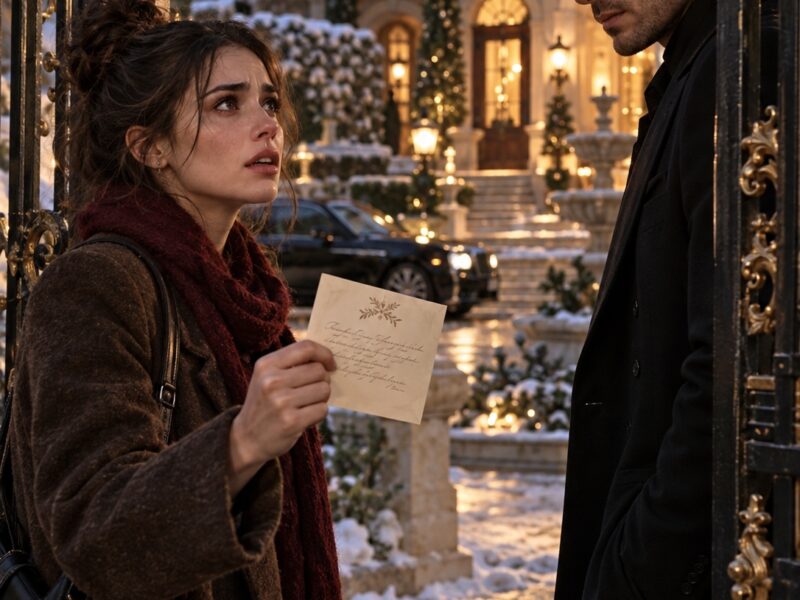
Standing outside a pair of twelve-foot iron gates in rural New York with snow beginning to fall, a lemon pie balanced against my hip, and a handwritten note pinched between two frozen fingers.
The man on the other side of the gate didn’t move.
He was tall—well over six feet—with broad shoulders beneath a black wool coat that probably cost more than my car had before the alternator committed suicide.
Dark hair.
Sharp cheekbones.
A hard jaw.
And amber eyes that moved over me with the unsettling patience of someone accustomed to discovering lies before people finished telling them.
I lifted the note higher.
“See? Thanksgiving. Three o’clock. Don’t bring anything.”
His gaze dropped to the pie.
I cleared my throat.
“There was an addendum.”
Still nothing.
I turned the note around and read the smaller handwriting beneath the invitation.
“If you bring something anyway, make it sweet. I don’t trust your generation with savory food.”
One of his eyebrows moved.
Barely.
It was the first evidence I’d seen that his face possessed functioning muscles.
“Your grandmother wrote that,” I said.
“No.”
I blinked.
“No, she didn’t write it?”
“No.”
“No, I’m not invited?”
“Yes.”
“That’s confusing.”
“You’re not coming inside.”
His voice was low and controlled.
Not loud.
Men like him probably didn’t need volume.
The kind of authority he carried was quieter than shouting.
It lived in the assumption that people would obey.
Unfortunately for him, I had spent seven hours driving, forty minutes waiting beside a dead vehicle, and twenty minutes walking through November wind while carrying a pie I had baked at four that morning in a motel kitchenette.
My capacity for intimidation had frozen somewhere around mile nine.
“My name is Ivy Hartwell,” I said. “Your grandmother met me yesterday at Bellini’s Trattoria on Route Nine.”
His expression changed.
Not much.
But enough.
“You met my grandmother?”
“She interrogated me for approximately eleven minutes.”
“That sounds more believable.”
“She asked where I was going, why I was traveling alone, whether I had family, why my coat was too thin, and why I was eating dinner at a restaurant by myself the night before Thanksgiving.”
His eyes narrowed.
“And you answered?”
“She has terrifying eye contact.”
Something almost happened at the corner of his mouth.
Almost.
Then he looked at the note again.
“Give me that.”
I slid it between the bars.
He read it once.
Then again.
Then he looked at me.
For the first time, he no longer seemed annoyed.
He seemed disturbed.
“My grandmother doesn’t invite strangers here.”
“She invited this one.”
“She hasn’t invited anyone outside this family onto this property in five years.”
The wind cut through my coat.
I hugged the pie closer.
“Well, either your grandmother has undergone a dramatic personality transformation since yesterday, or we’ve discovered an extremely niche Thanksgiving forgery operation.”
His eyes lifted.
I smiled.
He didn’t.
“Mr…?”
“Marquetti.”
Of course.
Because apparently the universe had decided that if I was going to freeze to death outside a mansion, the man refusing me entry needed a surname that sounded like it belonged in a federal indictment.
“Mr. Marquetti, my car is fourteen miles away. My phone is at twelve percent. It’s twenty-eight degrees, and I’m holding citrus custard. So if you’re going to interrogate me, could we possibly do it somewhere my fingers aren’t turning blue?”
He stared at me.
Then a woman’s voice rang across the courtyard behind him.
“Alaric!”
The man closed his eyes.
“Let her in before she dies at the gate!”
The voice was elderly.
Sharp.
Commanding.
“I do not want that on my conscience at my age!”
Alaric Marquetti’s jaw tightened.
I smiled sweetly through the bars.
“That sounds like your grandmother.”
He reached for the lock.
The gates opened.
“Your pie better be good.”
I stepped inside.
“It’s exceptional.”
That was a lie.
I had never made lemon pie before.
But confidence, I had learned, was sometimes just panic standing with excellent posture.
I had no idea that walking through those gates would change two lives.
Maybe more.
And I certainly had no idea why an old woman who barely knew me had just reopened a door her family had kept closed for five years.
The Marquetti estate was nothing like I expected.
I expected marble.
Silence.
Cold rooms designed by people who believed beige was a personality.
Instead, the sprawling Italian-style villa smelled like roasted turkey, rosemary, butter, wood smoke, and something sweet baking somewhere deeper inside.
Autumn garlands framed the massive wooden doorway.
Warm light glowed behind tall windows.
Inside the dining room, antique china and crystal glasses reflected candlelight.
There were security cameras tucked beneath the roofline.
Two men in dark suits stood beside the entrance.
They were not waiters.
I decided not to investigate that thought.
Alaric walked beside me without speaking.
His silence wasn’t rude anymore.
It was observational.
He watched everything.
The way I held the pie.
The way I glanced at the guards.
The fact that I didn’t ask what they were carrying beneath their jackets.
He was building a file on me.
I could practically hear the pages turning.
Inside, a woman in her early fifties was arranging flowers.
She had dark hair streaked with silver and the tired beauty of someone who had once laughed easily and had spent several years forgetting how.
She looked up.
Her eyes went from me to Alaric.
Then back to me.
“Oh.”
That one syllable contained an entire conversation.
“Marta,” Alaric said, “this is Ivy Hartwell.”
“I know.”
I looked at him.
He looked at her.
She suddenly became extremely interested in chrysanthemums.
Before I could ask how she knew my name, a broad, cheerful man emerged from the kitchen carrying a turkey large enough to require zoning approval.
“Sandro,” he announced.
“Ivy.”
“Stranger?”
“Apparently.”
“Good. We needed one.”
Alaric stared at him.
Sandro shrugged.
“Family has heard all my stories.”
Then something small and fast shot around the corner.
A seven-year-old girl with dark pigtails, bright eyes, and a Thanksgiving apron skidded to a stop in front of me.
She examined me.
Then Alaric.
Then me again.
“Are you Uncle Alaric’s girlfriend?”
I nearly dropped the pie.
Alaric didn’t even blink.
“I met her approximately forty-five seconds ago.”
The girl considered that.
“That’s not a no.”
Sandro made a choking sound.
Marta covered her mouth.
“Lucia,” Alaric warned.
“What?”
“Go bother your father.”
“I already did.”
“And?”
“He told me to bother you.”
Sandro suddenly found the turkey fascinating.
I liked Lucia immediately.
Then the kitchen door opened.
And I met Celeste Marquetti.
She was seventy-nine, barely five feet tall, with silver hair twisted into an immaculate bun and a strand of pearls resting against a dark dress beneath her apron.
She carried a gravy boat in one hand.
She looked like someone’s grandmother.
Until she looked at you.
Then she looked like a woman who had spent sixty years entering rooms and quietly deciding what everyone else was going to do.
“You came,” she said.
“You didn’t leave me much choice.”
“Choice is overrated.”
She looked at my pie.
“Internet recipe?”
“Yes.”
“Thought so.”
She took it from me.
“Sandro.”
“Yes, Nona?”
“Put this somewhere it won’t embarrass anybody.”
He accepted the pie.
I stared at her.
Sandro leaned closer.
“She means put it on the table.”
Twenty minutes later, I was wearing an apron.
I still don’t know how it happened.
One moment I was a guest.
The next, Celeste had handed me a knife, Marta had put onions in front of me, and Lucia had appointed herself my assistant despite contributing absolutely nothing except commentary.
Across the kitchen, Alaric was attacking cranberry sauce.
I watched him stir.
Then I watched longer.
Finally I said, “Those cranberries haven’t done anything to you.”
He glanced over.
“They’re fine.”
“They have the consistency of brick mortar.”
“They’re cranberries.”
“They used to be.”
His stare should have intimidated me.
Instead, I walked over.
“Move.”
His eyebrows rose.
“Excuse me?”
“You’re murdering Thanksgiving.”
Marta turned away suspiciously quickly.
Sandro stopped carving the turkey.
Even Lucia went silent.
Apparently people didn’t tell Alaric Marquetti to move.
I held out my hand.
“Wooden spoon.”
For three seconds, nothing happened.
Then he gave it to me.
I added orange zest.
A little brown sugar.
A splash of port.
I stirred gently.
Alaric leaned against the counter.
Up close, I noticed his hands.
Rough.
Scarred.
Not the hands of a man who had spent his life behind a desk.
A pale line crossed two knuckles on his left hand.
Another disappeared beneath his cuff.
He had the face of a wealthy man.
But the hands of someone who had spent years cleaning up things wealth couldn’t prevent.
“You’re very confident,” he said.
“For someone you met forty-five minutes ago?”
“For someone who bought a frozen turkey at a gas station yesterday.”
I froze.
“How do you know about that?”
His mouth shifted.
“Nona.”
I looked toward Celeste.
She was humming.
“Your grandmother conducts background investigations over appetizers?”
“Apparently.”
“That turkey was survival food,” I said. “This is Thanksgiving.”
He tasted the cranberry sauce.
I watched.
“Well?”
He tasted it again.
“Acceptable.”
“You’re welcome.”
And then he smiled.
Barely.
Just one corner of his mouth.
But it changed his entire face.
For half a second, I saw the man underneath all that control.
Then Celeste called us to dinner.
And I forgot about his smile.
Because the moment I entered the dining room, I saw the chair.
It stood at the head of the table.
Empty.
Not unused.
Empty.
There was a difference.
A plate had been placed before it.
A folded napkin.
A glass.
Silverware.
Everything was arranged with deliberate care.
But there was no water in the glass.
No food on the plate.
No one pulled the chair out.
No one even brushed against it.
Celeste seated me beside it.
Something tightened inside my chest.
I didn’t know why.
Not yet.
Dinner began warmly enough.
Sandro told stories about Alaric’s childhood involving a motorcycle, a borrowed helicopter, and a goat that apparently belonged to a rival family.
“It was a misunderstanding,” Sandro said.
“It’s classified,” Alaric replied.
Lucia announced that Alaric had once burned pasta so badly the fire department came.
“The fire department did not come.”
“Nona called them.”
“As a precaution,” Celeste said.
I laughed.
But beneath the laughter, I began noticing things.
Certain names were never mentioned.
Certain stories ended too quickly.
Marta’s smile disappeared whenever the conversation drifted toward five years earlier.
And behind the table hung a portrait of a man who looked like an older version of Alaric.
Same dark amber eyes.
Same strong jaw.
Same strange heaviness in his expression.
Without thinking, I said, “Have you always celebrated Thanksgiving here?”
Silence.
Only two seconds.
But two seconds can become very long when an entire family stops breathing.
Marta lowered her eyes.
Sandro reached for his water.
Alaric looked at Celeste.
Celeste passed me the bread.
“For a very long time.”
The conversation resumed.
My curiosity did not.
After dinner, everyone began carrying dishes toward the kitchen.
The empty chair was slightly in the way.
“I’ll move this.”
I reached for it.
“Leave it.”
Celeste’s voice stopped me.
She didn’t shout.
She didn’t need to.
My hand dropped immediately.
Something had changed in her face.
Not anger.
Pain.
I stepped away.
“Sorry.”
She nodded once and walked toward the kitchen.
For the first time since arriving, I felt exactly what I was.
A stranger.
I found my coat and stepped onto the rear terrace.
Cold air struck my face.
The grounds stretched into darkness beyond the lights.
I had been standing there maybe a minute when the door opened behind me.
“Don’t take it personally.”
Alaric.
“I’m not.”
“You are.”
I turned.
“Fine. A little.”
He came to stand beside me.
For a while, neither of us spoke.
Then he looked through the window toward the empty chair.
“It belonged to my father.”
I said nothing.
“Enzo Marquetti.”
The name carried weight.
Even I recognized it.
Not from anything specific.
From whispers.
Newspaper fragments.
Stories people lowered their voices to tell.
Alaric kept his eyes on the dining room.
“He died five years ago.”
The cold suddenly felt different.
“I’m sorry.”
“He was killed.”
My eyes moved toward him.
“Car bomb. Outside a restaurant in Manhattan.”
There are moments when curiosity becomes shame.
This was one of them.
“I didn’t know.”
“You weren’t supposed to.”
He rested his hands against the stone railing.
“My father ran the family for thirty-one years. He built most of what you see here. The businesses. The property. The relationships.”
“Your family business?”
He looked at me.
I held up both hands.
“I’m not asking.”
“That may be the smartest thing you’ve done since arriving.”
“I fixed your cranberry sauce.”
“Second smartest.”
I smiled despite myself.
He didn’t.
“My father believed this house should be open.”
“Open?”
“To people. Friends. Neighbors. People who needed somewhere to go.”
He looked back through the window.
“Nona hated it.”
I almost laughed.
“That sounds believable.”
“The Thanksgiving before he died, he brought home a woman whose husband had left her. She had nowhere to go. Nona asked him why he kept bringing strangers to family dinners.”
“What did he say?”
Alaric’s face softened.
“He looked at this ridiculous table and said, ‘What’s the point of having a family table if there’s never room for someone who needs it?’”
I looked through the window again.
At the chair.
At the untouched plate.
“At the next Thanksgiving,” Alaric continued, “Nona set his place.”
“And every year since?”
“Yes.”
“No one sits there?”
“No.”
“No one moves it?”
“No.”
“And she hasn’t invited another stranger since he died.”
His eyes met mine.
“Until you.”
The cold seemed to settle deeper.
Suddenly the handwritten invitation in my pocket felt heavier.
“I thought she felt sorry for me.”
“Nona doesn’t do pity.”
“Then why?”
“That’s what I’m trying to understand.”
For once, I had no clever answer.
Because somewhere between a roadside breakdown and lemon pie, Celeste Marquetti had looked at me and decided to reopen a door grief had kept locked for five years.
And I had no idea what she had seen.
By eight that night, leaving became impossible.
Snow buried the driveway.
The weather alert on my phone said roads were closing.
I put on my coat anyway.
“I should probably go.”
Alaric looked out the window.
“You don’t have a car.”
“I have legs.”
“The nearest town is fourteen miles away.”
“I feel motivated.”
From the living room came Celeste’s voice.
“Ivy, sit down.”
I looked toward her.
“You’re staying.”
“I really don’t want to impose.”
“You can and you will.”
She pointed at Alaric.
“Tell her.”
He looked at me.
“She has spoken.”
“This feels like house arrest.”
“We have witnesses,” Celeste replied.
I looked at Alaric.
“Felonies look surprisingly natural on your family.”
That almost earned me another smile.
Five minutes later, I had been installed in a guest room with expensive sheets, a fireplace, and a handmade blanket that smelled faintly of lavender.
Downstairs, someone produced leftover pie.
Lucia demanded charades.
That was how I discovered that Alaric Marquetti—feared businessman, human fortress, and possible nightmare of several federal agencies—was a terrible loser.
Sandro performed Marlon Brando.
I guessed The Godfather immediately.
Alaric accused me of cheating.
“At charades?”
“I haven’t figured out how yet.”
“That sounds like a you problem.”
Lucia climbed onto the couch.
“Uncle Alaric is a loser.”
“Thank you, Lucia.”
“You’re welcome.”
I laughed until cider nearly came out my nose.
When I looked up, Alaric was watching me.
Not suspiciously this time.
Just watching.
And something about that unsettled me more.
Because twenty-four hours earlier, I had expected to spend Thanksgiving alone in a motel room eating frozen turkey with plastic utensils.
Now I was sitting cross-legged on an antique rug in borrowed socks, arguing with a seven-year-old about whether pretending to be a flamingo was a legitimate clue for Jurassic Park.
Somewhere along the way, I had stopped feeling like an intruder.
And judging by Alaric’s expression, he had noticed too.
Maybe that was why the idea of my leaving tomorrow suddenly seemed to bother him.
After midnight, I couldn’t sleep.
I went downstairs for water.
Alaric was sitting alone at the kitchen table.
Two cups of coffee steamed between us.
“Were you expecting me?”
“I expected someone to come looking for pie.”
“Close enough.”
I found the leftovers and sat across from him.
Outside, wind pressed snow against the windows.
For a while, we ate without speaking.
Then he asked, “Were you really going to spend Thanksgiving alone?”
My fork stopped.
Normally, I would have made a joke.
Instead, I nodded.
“My parents are visiting my sister in Arizona.”
“Why weren’t you with them?”
“I had work.”
“That’s not the whole answer.”
“You do this interrogation thing recreationally?”
“I’m curious.”
“That sounds dangerous coming from you.”
He waited.
I sighed.
“I was supposed to meet them later. Then my car started acting up. I told them I was fine.”
“You weren’t.”
“I was functional.”
“That isn’t the same thing.”
No.
It wasn’t.
I stared at my pie.
“I don’t like people worrying about me.”
“Why?”
“Because then I have to admit there’s something to worry about.”
Something changed in his expression.
Recognition.
“That’s a dangerous habit,” he said.
I looked at him.
“Says the man who abandoned his entire future because everyone else needed him.”
The silence that followed was different.
Sharper.
I knew I had hit something.
“You know nothing about my future.”
“You wanted to be an architect.”
His eyes narrowed.
“Lucia.”
“Marta.”
“Traitor.”
“She loves you.”
“That doesn’t make her less of a traitor.”
I smiled.
He didn’t.
“You were going to Milan.”
He looked down.
“Five years ago.”
“Before your father died.”
“Yes.”
“What happened?”
“You know what happened.”
“I know what happened to him. I’m asking what happened to you.”
That landed harder.
His hands tightened around the coffee cup.
“I stayed.”
“That’s what you did.”
His gaze rose.
“It’s not why.”
For a moment, I wondered if I had gone too far.
Then he leaned back.
“When my father died, everything collapsed at once. My mother could barely function. Nona was grieving. Marta had Lucia. There were people waiting to see whether the family would fracture.”
“So you stayed.”
“I had to.”
Maybe it was the hour.
Maybe the storm.
Maybe the strange intimacy of sitting in a silent kitchen while everyone else slept.
But I asked the question nobody in that house seemed willing to ask.
“Do you still have to?”
His jaw tightened.
“That’s complicated.”
“No. It’s painful. Those aren’t always the same thing.”
He stared at me.
I should have stopped.
Instead, I said, “Five years is a long time to keep making the same emergency decision.”
Nothing moved.
Not him.
Not me.
Even the house seemed to hold its breath.
Then he looked toward the dark window.
“When he died, I thought leaving meant losing him again.”
The words came quietly.
Almost reluctantly.
“The business. This house. His routines. The people he protected. Everything he built.”
He swallowed.
“So I stayed because I loved him.”
A pause.
“Then because everyone needed me.”
Another.
“Then because I didn’t know how to leave.”
His honesty stripped the room of every joke I had been hiding behind.
I looked at him.
“I think that’s why I help people.”
He frowned.
“What?”
“If I’m the person helping everyone else, nobody notices when I’m the one who needs help.”
His expression softened.
“That’s a dangerous habit.”
“You already used that line.”
“It still applies.”
For the first time that night, we smiled.
Small.
Tired.
Real.
Then I said something I probably shouldn’t have.
“Maybe staying because you’re afraid to leave isn’t the same thing as choosing to stay.”
The smile disappeared.
But he didn’t get angry.
He just looked at me.
And I realized that perhaps nobody had said that to him in five years.
Not because they didn’t know.
Because they loved him too much to risk hurting him.
Sometimes love protects us.
Sometimes it protects the cage.
The next morning, sunlight turned the snow outside the windows white-gold.
After breakfast, Celeste called Alaric into the living room.
She carried an old leather notebook.
I was in the kitchen helping Marta.
Which meant I had absolutely no business listening.
Naturally, I listened.
“I should have given you this years ago,” Celeste said.
Alaric opened it.
The handwriting belonged to Enzo.
Supply routes.
Business ideas.
Notes on legitimate investments.
Plans.
Then he reached the final page.
He stopped.
Celeste said nothing.
Neither did Marta.
I watched his face from the kitchen doorway.
“What does it say?” he asked.
His grandmother’s voice softened.
“You read it.”
He did.
Then he read it again.
The sentence had been underlined three times.
Build your own life. Not a monument to mine.
Alaric’s fingers tightened around the notebook.
Five years.
Five years of preserving everything his father left behind.
Five years believing duty was the purest form of love.
And there, in his father’s own handwriting, was permission to stop.
Celeste looked at him.
“We loved him so much that I think we misunderstood what remembering him was supposed to mean.”
Alaric didn’t speak.
“You thought changing meant leaving him behind.”
She touched his cheek.
“He never wanted you to become him.”
Then Alaric asked the question I had been wondering since the gates opened.
“Why did you invite Ivy?”
I froze behind the kitchen doorway.
Celeste glanced toward me.
I immediately began washing a perfectly clean plate.
“Because I watched her.”
I slowly stopped washing.
Celeste told him what had happened outside Bellini’s.
Before I entered the restaurant, I had seen a man sitting on the curb in a thin jacket.
His hands were shaking.
I gave him my scarf.
The one my mother had knitted.
Then the last cash in my wallet.
Inside, I held the door for a woman struggling with grocery bags.
Later I helped the restaurant owner stack chairs while waiting for a phone charger.
None of it had seemed important.
I hadn’t even known Celeste was watching.
“You didn’t know those people,” she told Alaric.
“No,” I said quietly.
Everyone looked toward me.
Apparently my espionage career had ended.
Celeste smiled.
“That was the point.”
She looked at Alaric.
“She helped because there was room to help.”
Then her eyes drifted toward the photograph of Enzo.
“She reminded me of someone.”
Alaric followed her gaze.
And something in his face broke open.
Not grief.
Not exactly.
Understanding.
For five years, the estate had been a fortress built around loss.
But Enzo had never wanted a fortress.
He had wanted a home.
Maybe Celeste hadn’t invited me because she thought I needed the Marquettis.
Maybe she had invited me because the Marquettis needed someone from outside their grief to walk through the gate.
By late morning, the roads had cleared.
Alaric drove me home.
His black SUV looked large enough to survive a small war.
Neither of us seemed eager for the ride to end.
When we stopped outside my rental house, I unbuckled my seat belt.
“Thank you for the kidnapping.”
“Your lemon pie was passable.”
I gasped.
“High praise.”
“It wasn’t terrible.”
“From a man who burned pasta badly enough that emergency services were contacted?”
“Nona called as a precaution.”
“Your family has a suspicious definition of precaution.”
He smiled.
A real smile this time.
And suddenly the inside of the car felt smaller.
Quieter.
His eyes dropped to my mouth.
My heart performed an embarrassingly enthusiastic maneuver.
He leaned closer.
I didn’t move.
Neither did he.
Another inch.
His phone rang.
We both froze.
Lucia’s face filled the screen.
Video call.
Alaric closed his eyes.
I covered my mouth.
He answered.
Lucia immediately shouted, “DID YOU KISS HER YET?”
Silence.
I turned bright red.
Behind Lucia, Sandro yelled, “Lucia!”
Alaric stared at his niece like he was researching boarding schools overseas.
I started laughing.
He ended the call.
“I’m changing my number.”
“You may need to change families.”
“Impossible.”
I opened the door.
Then leaned back through the window.
“For what it’s worth?”
He looked at me.
“I don’t think you burned the pasta on purpose.”
His eyes narrowed.
I shut the door before he could answer.
The kiss didn’t happen.
But something else did.
For five years, Alaric had been afraid to imagine what his life might look like if he allowed it to change.
Now he was curious.
Three days later, he asked me to dinner.
I waited eleven seconds before saying yes.
Mostly because ten felt desperate.
Neither of us called it a date.
Celeste did.
Marta did.
Sandro did.
Lucia apparently informed several people at school.
Our first dinner became coffee two days later.
Coffee became another dinner.
Then one freezing Tuesday morning, Alaric appeared outside my house because my replacement car wouldn’t start.
I opened the door wearing pajama pants and one sock.
“You look prepared,” he said.
“I was prepared to remain indoors.”
Twenty minutes later, the car was running.
I offered him coffee.
“So,” I said, “are we still pretending your grandmother didn’t orchestrate all of this?”
“Yes.”
“Why?”
“I don’t want her becoming arrogant.”
“She passed that point around 1973.”
He laughed.
I discovered that sound was rare enough to feel like winning something.
Then I visited Marquetti Holdings.
That was how I discovered their corporate brochure.
I stared at it in horror.
“Who designed this?”
Alaric looked up from his desk.
“What?”
“This.”
“It’s a brochure.”
“It contains five fonts.”
“They’re readable.”
“One is Comic Sans.”
“It’s approachable.”
“It’s a felony.”
I redesigned it for free.
Alaric complained for forty-eight hours.
Then ordered five hundred copies.
By December, we had developed routines neither of us acknowledged as routines.
Roasted chestnuts at the downtown Christmas market.
Espresso after his meetings.
Sunday drives.
Dinner with his family.
Lucia providing unsolicited romantic commentary.
One afternoon she leaned between the front seats.
“Why does Uncle Alaric look at you like that?”
I glanced at him.
“Like what?”
“Like you’re the last piece of lemon pie and he forgot to eat.”
Alaric stared straight ahead.
I pressed my lips together.
Neither of us spoke for several miles.
But the biggest change wasn’t us.
It was him.
He started sketching again.
Buildings appeared on napkins.
Envelopes.
Meeting notes.
Margins of newspapers.
One afternoon I found a drawing on the kitchen counter.
Tall windows.
Clean lines.
A courtyard filled with trees.
It was beautiful.
“This is extraordinary.”
“It’s a napkin.”
He reached for it.
I hid it behind my back.
“It’s extraordinary, and I’m keeping it.”
“Ivy.”
“No.”
He looked at me.
There was something in his eyes I hadn’t seen before.
Not gratitude.
Something deeper.
The expression of a man realizing he had been holding his breath for five years.
And had finally exhaled.
Our first real kiss happened outside my house on a freezing December night.
No Lucia.
No phone calls.
No dramatic declarations.
Just snow.
His hands against my face.
His forehead resting against mine.
And a long silence where both of us understood that pretending had become more difficult than telling the truth.
“Are you going to ask permission?” I whispered.
“No.”
“Good.”
Then he kissed me.
He kissed me like a man who had spent five years believing caution was the same thing as strength.
And I kissed him like a woman who had spent twenty-six years taking care of everyone except herself.
There were no promises.
We didn’t need them yet.
For the first time, neither of us was rescuing the other.
We were simply choosing to stay.
And that made all the difference.
One year later, on Thanksgiving, I carried cranberry sauce into the Marquetti dining room.
I stopped.
The chair was still there.
Enzo’s chair.
The same place setting.
The same position at the head of the table.
But something had changed.
His portrait no longer looked like a shrine.
It stood among dozens of family photographs.
Birthdays.
Christmas mornings.
Lucia missing her front teeth.
Marta laughing.
Sandro asleep in an armchair.
Alaric standing beside me at the Christmas market.
And one photograph of Celeste and me in the kitchen, both wearing aprons and laughing so hard the picture was slightly blurred.
Lucia had taken it.
She had since declared herself official family photographer.
Nobody had the courage to tell her she was terrible.
I looked at Celeste.
“Who are we waiting for?”
She smiled.
That immediately made me suspicious.
“Nona.”
The doorbell rang.
Everyone looked toward the hallway.
Alaric stood.
He opened the front door.
A young woman stood outside.
Maybe twenty-three.
Maybe younger.
Her hair was damp with melting snow.
Her coat was too thin.
Beside her stood a little boy holding tightly to her hand.
The woman’s eyes were red.
Not from cold.
From something deeper.
Something exhausted.
“I’m sorry,” she whispered. “Our car broke down about a mile away.”
She looked past Alaric, embarrassed.
“I just need to use a phone. We don’t want to bother you.”
Alaric looked toward the dining room.
At Celeste.
Then at me.
And before he said anything, I knew.
He turned back to the woman.
“Actually,” he said, “we have an empty seat.”
She shook her head quickly.
“Oh, no. We couldn’t.”
Alaric looked toward his father’s chair.
The chair nobody had touched for six years.
The chair that had become sacred because a family loved a man so deeply they had mistaken emptiness for loyalty.
His voice softened.
“That’s what the chair is for.”
Nobody spoke.
Celeste lowered her eyes.
They were shining.
Six years earlier, that chair had become a symbol of the man they had lost.
Every Thanksgiving they had preserved it exactly as he left it.
Empty.
Untouched.
Protected.
But Enzo Marquetti had never believed an empty chair honored anybody.
He had believed a family table mattered because there should always be room for someone who needed it.
The young woman hesitated.
Her little boy looked toward the food.
That decided everything.
Marta brought another plate.
Sandro extended the table.
Lucia immediately began interrogating the boy about board games.
Celeste moved the silverware.
And the woman sat down.
In Enzo’s chair.
Nobody broke.
Nobody disappeared.
Nobody betrayed his memory.
Instead, something remarkable happened.
The room became fuller.
Later that night, I found Alaric on the terrace.
Snow drifted beneath the lights.
I leaned against him.
His arm came around me automatically.
For a while we watched the flakes disappear against the dark trees.
Then I said, “Your grandmother didn’t invite me last year because she was trying to find you a girlfriend, did she?”
Alaric considered this.
“I’m still investigating.”
From inside the house, Celeste shouted, “I CAN HEAR YOU.”
I laughed.
Alaric pulled me closer.
“Will you come next Thanksgiving?”
I looked up at him.
“Are you inviting me?”
He smiled.
That smile.
The one I had first seen beside a ruined pot of cranberry sauce.
The smile I had spent a year learning how to bring back.
“I thought you stopped being a guest months ago.”
Something in my chest went still.
There was no ring.
No grand speech.
No promise designed for an audience.
I kissed him anyway.
Because sometimes belonging doesn’t arrive with an announcement.
Sometimes nobody tells you exactly when it happens.
You simply look around one day and realize someone remembers how you take your coffee.
There is a coat hanging beside yours.
A child expects you at Christmas.
An old woman criticizes your pie as though you have always belonged in her kitchen.
And a man who once stood behind iron gates telling you that strangers were not allowed now leaves the gate open when he knows you are coming.
Inside, the house was loud.
Lucia was arguing.
Sandro was laughing.
Marta was asking where the extra blankets were.
Celeste was ordering everyone around.
And at the long Thanksgiving table, a frightened young mother and her little boy were eating beside people whose names they had not known an hour earlier.
The chair wasn’t empty anymore.
That was the part I remembered.
Not the mansion.
Not the guards.
Not the Marquetti name.
Not even the first kiss.
The chair.
Because grief had convinced that family that loving someone meant preserving the space he left behind.
But love had never asked them to worship the emptiness.
Enzo had left them a different inheritance.
A table.
A door.
A place for someone who needed one.
I thought about the first night I stood outside those gates with frozen fingers and a terrible lemon pie.
I thought I had arrived because my car broke down.
For a long time, Alaric thought I had arrived because his grandmother had taken pity on me.
Celeste knew better.
Sometimes the person standing outside your door isn’t there because they need to be rescued.
Sometimes they are there to remind you that the door can still open.
And sometimes the empty place in your life isn’t asking to remain empty forever.
Sometimes it is simply waiting for you to become brave enough to make room again.









