The Mafia Boss Watched His Daughter Take the Hand of the Woman Everyone Had Laughed At—Then He Learned Her Name
The cruelest thing Daniel Mercer did that night was not reject Celeste Rowan.
It was the way he looked relieved after doing it.
As though humiliating her had solved a problem.
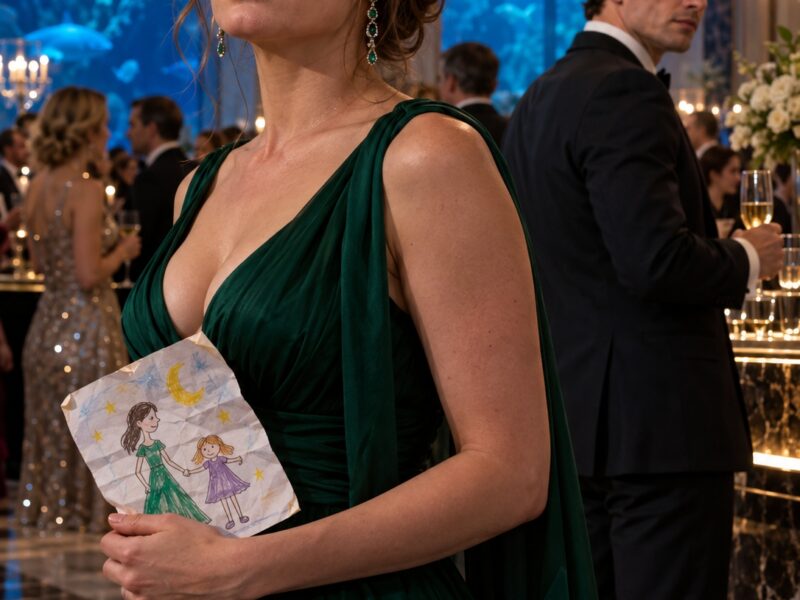
As though the woman standing beneath the blue aquarium lights in a dark green dress had somehow deceived him simply by arriving in the body she had always possessed.
“I think there’s been a misunderstanding,” he said.
Around them, the charity gala continued without missing a beat.
A string quartet played near the marble staircase.
Champagne glasses chimed.
Above the crowd, an enormous glass whale skeleton hung from the museum ceiling, glowing silver-blue beneath carefully placed lights.
Men in tailored tuxedos discussed tax deductions and ocean conservation.
Women in silk gowns spoke about childhood literacy while servers drifted between them carrying crab cakes arranged like jewelry.
Celeste stared at Daniel.
“A misunderstanding?”
His mouth tightened into the kind of apologetic smile that wasn’t really an apology.
“Your dating profile.”
She already knew.
Still, some foolish part of her made him say it.
“What about it?”
Daniel glanced down at her dress.
Then back at her face.
“Your pictures were very flattering.”
For half a second, Celeste heard nothing.
Not the music.
Not the laughter.
Not the clinking glasses.
Just those four words.
Your pictures were very flattering.
Not inaccurate.
Not old.
Not misleading.
Flattering.
As though her face had committed fraud.
As though the curves beneath her dress were evidence against her.
Celeste tightened both hands around her clutch.
She had spent nearly forty minutes choosing that dress.
She had tried on five others first.
Black had felt too apologetic.
Navy had made her look like she was attending a school-board meeting.
Red had required a kind of confidence she hadn’t possessed tonight.
Then she’d pulled on the green one.
Her mother used to say green made her brown eyes look warm.
For one dangerous moment in front of her bedroom mirror, Celeste had believed her.
Now she wanted to disappear inside the aquarium wall.
Daniel exhaled.
“You seem very nice.”
There it was.
The second knife.
Nice.
“You’re obviously wonderful with children,” he continued. “I just think chemistry matters.”
Celeste was a children’s librarian.
She spent her days helping six-year-olds sound out impossible words and comforting toddlers devastated because someone else had taken the dragon stamp.
She knew how to speak gently.
She knew how to give people second chances.
She believed most human beings deserved another page before you decided how their story ended.
But Daniel had just closed the book on her after twenty-three minutes.
And somehow expected her to thank him for doing it politely.
Celeste lifted her chin.
“Then you should leave.”
Daniel blinked.
“Excuse me?”
“You don’t have to stand here pretending you’re doing me a favor.”
His face changed.
Only slightly.
Men like Daniel were comfortable hurting women as long as the women remained embarrassed enough to make the cruelty convenient.
“You don’t need to be dramatic.”
Celeste laughed once.
It came out softer than she intended.
“I’m not being dramatic.”
She looked directly into his eyes.
“I’m being efficient.”
A woman standing nearby turned her head.
Someone else suddenly became very interested in a sculpture.
Daniel’s neck flushed.
He adjusted his cuff.
“Good luck, Celeste.”
Then he walked away.
No apology.
No backward glance.
Within thirty seconds, he was at the bar talking to a blonde woman in silver.
Celeste stayed where she was.
Moving felt impossible.
The dress that had looked elegant in her apartment suddenly seemed too tight.
Too bright.
Too visible.
She became aware of every inch of herself.
Her waist.
Her hips.
Her arms.
The space she occupied.
That was the part people never understood about humiliation.
It didn’t simply hurt.
It made your own body feel like a room you were ashamed to be trapped inside.
Celeste turned toward the enormous aquarium.
Silver fish drifted behind the glass.
Slow.
Weightless.
Unconcerned.
She concentrated on them because crying at a charity gala funded by half of Chicago’s wealthiest families felt like the kind of thing that could somehow end up photographed.
Her mother had taught her to survive difficult rooms by finding one beautiful thing and looking at it until she remembered herself.
Tonight, that beautiful thing was a school of silver fish.
Celeste breathed.
Once.
Twice.
Three times.
Then a small voice beside her said:
“He was mean.”
Celeste froze.
She looked down.
A little girl stood beside the velvet rope.
Six years old, perhaps seven.
She wore a pale blue dress with pearl buttons, white socks, and polished black shoes. Dark hair fell in loose waves around a solemn little face.
In one hand she held a stuffed rabbit by its bent ear.
Her eyes were enormous.
And startlingly direct.
Celeste quickly wiped beneath one eye.
“You probably weren’t supposed to hear that.”
“I hear lots of things I’m not supposed to.”
Despite herself, Celeste almost smiled.
The girl leaned closer.
“My aunt says adults whisper because they’re ashamed of what they’re saying.”
“That sounds like a very smart aunt.”
“She eats cookies before dinner.”
“Then she sounds balanced.”
The girl considered this.
Apparently satisfied, she nodded.
Then she looked toward Daniel.
“He was still wrong.”
Celeste’s smile faded.
“You don’t even know me.”
The child frowned as if Celeste had missed something obvious.
“He looked at you like you weren’t a present.”
Celeste stopped breathing.
The girl hugged her rabbit tighter.
“That means he looked wrong.”
Something beneath Celeste’s ribs cracked.
Friends had told her she was beautiful.
Her mother had called her gorgeous every birthday until the last one she’d lived to see.
Children at the library told Celeste her dresses looked like princess clothes.
She had heard compliments.
But nobody had ever put it quite like this.
The problem wasn’t that Celeste had failed to become something worth wanting.
Perhaps some people simply didn’t know how to recognize a gift.
Celeste crouched slightly.
“What’s your name?”
“Lucia Vale.”
The smile vanished from Celeste’s face.
Vale.
She had heard that name whispered all evening.
Vincenzo Vale.
The donor whose money had funded nearly half of the museum’s new children’s literacy wing.
The man who owned restaurants, commercial buildings, freight companies, security firms and, depending on which rumors you believed, considerably more than appeared on tax documents.
A man whose arrival had caused the museum director himself to abandon a conversation and hurry toward the entrance.
A man nobody seemed eager to discuss loudly.
Celeste glanced toward the staircase.
Two men in dark suits stood nearby.
Not museum security.
Too still.
Too observant.
She looked back at Lucia.
“Did you come with your father?”
Lucia nodded.
“He’s upstairs being serious.”
Celeste nearly laughed.
“Is that something he does often?”
“All the time.”
“Sounds exhausting.”
“It is.”
That finally made Celeste smile.
Lucia brightened as if she had accomplished something important.
Then she reached into the tiny purse hanging from her wrist.
“I made something.”
She pulled out a folded square of paper.
When she opened it, Celeste saw a child’s drawing.
A crooked house.
A yellow moon.
A tiny girl.
A large dark figure.
And a woman beneath the stars wearing a green dress.
Celeste pointed.
“Is that me?”
“Your hair is brown,” Lucia explained seriously. “But I used green because it matches your dress.”
“I love it.”
“Really?”
“Really, really.”
Lucia’s entire face transformed.
And Celeste understood something she had learned long ago at the library.
Children didn’t trust halfway.
When they chose to believe you, they handed you something frighteningly complete.
She was about to ask Lucia what the enormous dark figure represented when the room changed.
No announcement was made.
Nobody shouted.
Yet conversation softened around them.
A waiter moved aside so quickly that the champagne flutes on his tray rattled.
A laugh died halfway across the room.
Celeste felt it before she understood it.
Then she turned.
A man stood about ten feet away.
Tall.
Broad-shouldered.
Black suit.
Dark hair swept back from a face that looked carved rather than handsome.
He wasn’t glaring.
That would have been easier.
His expression was perfectly calm.
The kind of calm that made everyone else nervous.
Two men stood several feet behind him.
He looked first at Lucia.
Then at Lucia’s hand.
Somewhere during their conversation, the little girl had slipped her fingers into Celeste’s.
Celeste immediately released them.
Lucia frowned and grabbed them again.
“Papa.”
So this was Vincenzo Vale.
The man crossed the remaining distance.
“Lucia.”
“This is Celeste.”
Vincenzo’s gaze moved to her.
“Is she?”
“Daniel was mean to her, so I fixed it.”
A muscle shifted in Vincenzo’s jaw.
“Daniel?”
Lucia pointed openly toward the bar.
“That one.”
Celeste nearly died.
Vincenzo followed his daughter’s finger.
Across the room, Daniel was still speaking to the woman in silver.
Then he noticed who was looking at him.
The blood drained from his face.
Celeste felt panic crawl up her spine.
“It’s fine,” she said quickly. “Really. Nothing happened.”
Vincenzo turned back.
“Men who humiliate women in public usually rely on that sentence.”
His voice was low.
Controlled.
More frightening for never needing volume.
Celeste straightened.
“I told him to leave me alone. He did.”
“For you, that may be enough.”
“And if it isn’t enough for you?”
Silence seemed to widen around them.
One of Vincenzo’s men almost smiled.
Almost.
Celeste held Vincenzo’s gaze.
“Then that sounds like your problem, Mr. Vale. Not mine.”
Lucia beamed.
“You talk like Grandma Rowan.”
Vincenzo went still.
Completely still.
Celeste noticed it immediately.
His eyes changed.
“Rowan?”
“Yes.”
He studied her face.
Not her body.
Not the dress.
Her face.
“Your mother was Dr. Elizabeth Rowan?”
Celeste’s chest tightened.
“She died three years ago.”
Something in Vincenzo’s expression fractured.
Not much.
But enough.
“I’m sorry.”
People said those words to Celeste constantly.
She usually thanked them automatically.
But Vincenzo said them differently.
Like he knew grief wasn’t a polite sentence.
Like he’d lived inside it.
“Did you know her?”
His hand settled gently on Lucia’s shoulder.
“She helped my daughter after the accident.”
Celeste looked at Lucia.
Suddenly she remembered a winter years earlier.
Her mother arriving home late.
Sitting in the dark kitchen without removing her coat.
Celeste making tea while Elizabeth stared into the steam.
Some children come back to themselves one breath at a time, her mother had said.
Never rush them.
Lucia looked up.
“Dr. Rowan wore soft scarves.”
Celeste swallowed.
“She did.”
“Lots of colors.”
“Yes.”
“She gave me the purple one.”
Vincenzo looked down sharply.
“You still have it?”
Lucia nodded.
“In my room.”
Celeste’s eyes burned.
Her mother’s kindness had survived in rooms Celeste had never entered.
For a moment, the museum disappeared.
There was only a child.
A memory.
And a dead woman’s purple scarf.
Then a woman’s voice cut through the moment.
“Lucia. There you are.”
A tall woman in ivory silk approached.
Beside her walked an older silver-haired man with the rigid posture of someone accustomed to obedience.
Celeste recognized them from the donor wall.
Marina and Charles Bellini.
Lucia’s maternal grandparents.
Lucia immediately pressed closer to her father.
Vincenzo noticed.
So did Celeste.
Marina opened her arms.
“Sweetheart, you wandered away.”
Lucia didn’t move toward her.
Marina’s smile tightened.
Then her eyes found Celeste.
The assessment took perhaps two seconds.
It still felt like being weighed.
“Vincenzo,” Marina said, “this is exactly what we’ve been discussing.”
“My daughter was within ten steps of security.”
“Security isn’t parenting.”
Vincenzo’s face hardened.
“Not here.”
“Where else can we speak to you?” Charles asked. “Your staff says you’re unavailable. Your attorneys send letters. Your home might as well be a fortress.”
“It is a fortress.”
Vincenzo looked directly at him.
“For reasons you understand.”
Marina’s expression trembled beautifully.
“She needs normalcy.”
“She has it.”
“She has armed men outside ballet class.”
“And she comes home alive.”
Charles leaned forward.
“Don’t confuse survival with care.”
The temperature in the room seemed to drop.
But Celeste wasn’t watching Vincenzo anymore.
She was watching Lucia.
The child’s face had gone blank.
Too blank.
Celeste had seen that expression before.
Children sometimes wore it when adults discussed them as if they weren’t present.
Their shoulders folded.
Their eyes became still.
They tried to disappear.
Celeste crouched beside her.
Not touching her.
Just entering the child’s level.
“Have you seen the jellyfish?”
Lucia blinked.
“What?”
“They look like glowing umbrellas.”
A pause.
“Really?”
“Really. And they don’t have brains.”
Lucia’s mouth twitched.
“Which means they never have uncomfortable conversations at charity galas.”
A tiny laugh escaped her.
When Celeste looked up, Vincenzo was watching her.
Not with gratitude exactly.
With attention.
Marina noticed too.
“And who are you?”
“Celeste Rowan. Children’s librarian at Westbridge Public Library.”
Charles gave her a dismissive smile.
“How charming.”
Vincenzo’s voice came quietly.
“She is Dr. Rowan’s daughter.”
Marina’s expression changed.
Charles looked at Celeste again.
This time carefully.
“Dr. Rowan was very kind to Lucia,” Marina said.
“She was,” Vincenzo replied.
“And she would have wanted what was best for her.”
His hand tightened once.
“Don’t use the dead to decorate your argument.”
Nobody spoke.
Marina stepped back.
“Then we’ll speak through the attorneys.”
“We already are.”
Charles looked at Lucia.
“Good night, sweetheart.”
Lucia said nothing.
They walked away.
Their expensive perfume lingered after them.
Then Lucia whispered:
“I don’t want to live with them.”
Vincenzo dropped to one knee immediately.
That startled Celeste more than anything else he’d done.
This man who frightened rooms lowered himself without hesitation before his daughter.
“You won’t.”
“They said the judge could make me.”
“The judge doesn’t know your father when he’s determined.”
Lucia didn’t smile.
“What if they say you’re too alone?”
Vincenzo stopped.
Celeste looked away.
The silence had suddenly become private.
Too alone.
There it was.
Not the armed security.
Not the mansion.
Not the rumors.
A widower.
A traumatized child.
A household full of employees but no mother.
No soft family photographs to present in court.
No ordinary shape around their grief.
Lucia turned toward Celeste.
“Could you tell them Papa is good?”
Celeste’s heart hurt.
“Honey, I don’t really know him.”
Lucia looked genuinely confused.
“But you know me.”
Child logic.
Simple.
Terrible.
Perfect.
“You knew about jellyfish,” Lucia continued. “And Grandma Rowan. And you didn’t talk over me.”
Her lower lip trembled.
Celeste searched for something useful to say.
Instead she remembered dozens of children sitting across from her on library carpets, looking at her as though she possessed some secret way to make the world less frightening.
She touched Lucia’s stuffed rabbit.
“You know what being brave means?”
Lucia shook her head.
“It doesn’t mean you aren’t afraid.”
Celeste smiled gently.
“It means you keep telling the truth even when your hands shake.”
Lucia stared at her.
Behind the child, Vincenzo Vale looked at Celeste as though she’d opened a locked door without knowing a lock existed.
The gala continued.
But the night had changed.
And Celeste didn’t understand how much until she was preparing to leave.
“Miss Rowan.”
She turned.
Vincenzo stood beside a marble column.
Lucia’s coat rested over one arm.
Something had shifted in his face.
He still looked dangerous.
But now he also looked like a man about to ask for something he hated needing.
“I’d like to speak with you.”
“About what?”
He glanced at Lucia.
“My daughter.”
Every sensible instinct told Celeste to leave.
Instead, twenty minutes later, she found herself inside the museum’s darkened children’s reading room.
Tiny chairs surrounded tiny tables.
Painted foxes and rabbits hid among trees on the walls.
A moon-shaped lamp glowed in the corner.
Lucia sat on a beanbag holding her rabbit.
Vincenzo remained near the door.
Far enough away that Celeste could leave without passing him.
She noticed.
She hated that she noticed.
“My in-laws filed for emergency custody this morning,” he said.
Celeste’s stomach dropped.
“Marina and Charles?”
“Yes.”
“They think they can take Lucia?”
“They think they can convince a judge my world isn’t safe for her.”
Celeste folded her arms.
“Is it?”
Vincenzo looked at her.
Most people probably didn’t ask him questions like that.
“I’ve made it as safe as I know how.”
“That isn’t what I asked.”
A long silence.
“No,” he said finally. “My world isn’t safe.”
The honesty surprised her.
“But neither is theirs.”
“Why?”
“They want the version of Lucia that makes them feel less guilty about losing their daughter.”
Celeste looked toward the child.
Lucia had opened a book but wasn’t reading.
“They’ll argue she needs a traditional home,” Vincenzo continued. “A maternal presence. Emotional stability. Someone in her daily life who isn’t paid to be there.”
“And you’ve raised her behind walls.”
“Yes.”
“In grief.”
“Yes.”
“With armed guards.”
“Yes.”
“You’re not making my argument difficult.”
Something almost like amusement touched his eyes.
Then disappeared.
“I’m not asking you to believe I’m harmless.”
“Good.”
“I’m asking you to believe I love my daughter.”
Celeste said nothing.
His voice lowered.
“I love her more than anything I’ve ever been good at loving.”
That sentence hurt unexpectedly.
He looked toward Lucia.
“But love doesn’t always look gentle in my hands.”
Celeste’s throat tightened.
“Why are you telling me this?”
“Because my attorney believes there is a way to strengthen the case quickly.”
Something in his tone changed.
Celeste felt it before he spoke.
“A temporary marriage.”
She stared at him.
Lucia turned a page.
The moon lamp hummed.
Celeste waited for the punch line.
None came.
“You cannot be serious.”
“I am.”
“You met me less than an hour ago.”
“My daughter trusted you in less than a minute.”
“That is not a legal qualification.”
“No.”
He stepped no closer.
“But you’re Dr. Rowan’s daughter. You’re a children’s librarian. You have no criminal history, no public scandals and no connection to my business. Lucia listens to you.”
Celeste’s eyes narrowed.
“You investigated me.”
“I had publicly available information confirmed.”
“In the last hour?”
“Yes.”
“That doesn’t make me feel better.”
“I didn’t expect it to.”
She almost laughed.
Nothing about Vincenzo Vale seemed careless.
That might have been the most frightening thing about him.
“What exactly are you asking me to do?”
“Live at my home until the hearing concludes. Appear publicly as my wife. Help create the stable family environment my attorneys believe the court needs to see.”
“Create?”
His jaw tightened.
“I chose the wrong word.”
“You chose an accurate one.”
“Yes.”
Lucia was no longer pretending to read.
Hope had appeared in her eyes.
Celeste immediately hated it.
“No.”
Vincenzo’s expression changed.
Not anger.
Pain.
Celeste pointed subtly toward Lucia.
“You cannot put that look in her eyes.”
“I know.”
“No, you don’t. A fake marriage isn’t a photograph you show a judge and put away afterward. Lucia has already lost a mother. You can’t give her the shape of another one and then tell her it was paperwork.”
His silence became heavy.
“I know,” he repeated.
This time Celeste believed him.
Lucia climbed off the beanbag.
She approached slowly.
“If you marry Papa…”
Celeste closed her eyes.
Please don’t.
“…would you read me bedtime stories?”
That was the cruelest question anyone asked Celeste that night.
Because there was nothing cruel in it.
She knelt.
“I don’t know what’s going to happen.”
Lucia nodded bravely.
Her chin trembled.
Celeste touched the bent ear of the rabbit.
“But I can read you one tonight.”
Lucia’s face lit up.
And somewhere inside Celeste, the decision began before her mind agreed to it.
She chose a book about a girl who found the moon floating in a pond.
Lucia curled beside her.
At first, the child left a few inches between them.
By the fourth page, her shoulder rested against Celeste’s arm.
By the final page, she was asleep.
Celeste looked toward the doorway.
Vincenzo was still there.
And for the first time all evening, he didn’t look powerful.
He looked terrified.
Not of enemies.
Not of police.
Not of judges.
Of hope.
Celeste brushed Lucia’s hair from her forehead.
“Tomorrow,” she whispered, “I’ll meet with your attorney.”
Vincenzo closed his eyes.
Just for a second.
“Thank you.”
“Don’t.”
His eyes opened.
“If I do this, I’m doing it for her.”
“I understand.”
“And if this hurts her…”
Celeste stood.
“I will become the biggest problem you have.”
One of his guards outside the room went perfectly still.
Vincenzo stared at her.
Then said:
“I believe you.”
For reasons Celeste couldn’t explain, that frightened her more than laughter would have.
The next morning, Vincenzo’s attorney arrived at Westbridge Public Library before opening.
By noon, Celeste had her own lawyer.
Nadine Park was forty-two, sharp-eyed, unimpressed by expensive suits and apparently immune to intimidation.
She read the proposed agreement twice.
“This is unusual,” she finally said.
Celeste laughed nervously.
“That is one word.”
“But it isn’t careless.”
That was exactly what Celeste feared.
The contract gave her a separate bedroom.
Independent counsel.
The right to terminate the agreement.
Protection of her job through temporary family leave.
No physical intimacy would be required.
No private affection expected.
No one—including Vincenzo—could enter her room without permission.
Most importantly, there was a clause concerning Lucia.
If Nadine believed the arrangement was causing psychological harm to the child, Celeste could end it immediately.
“Did he add this?” Celeste asked.
“Yes.”
“And this?”
“Yes.”
“And the clause about not lying to Lucia in ways that couldn’t someday be explained honestly?”
Nadine nodded.
“He added that too.”
Celeste stared through the library windows.
Children were beginning to gather outside with their parents.
Three days later, Celeste Rowan became Celeste Vale.
The ceremony took place in the library of Vincenzo’s estate beneath a painted ceiling covered in clouds and gold stars.
There were no reporters.
No flowers except a small vase of yellow roses Lucia had chosen.
Lucia wore a yellow dress and guarded the ring box with such seriousness that she refused to let even the judge hold it.
When Celeste slid the plain gold band onto Vincenzo’s finger, her hand shook.
His did not.
He noticed.
Of course he did.
He noticed everything.
But he didn’t squeeze her fingers.
Didn’t pull her closer.
His thumb merely touched the side of her hand for one second.
A quiet message.
I know you’re afraid.
I won’t punish you for it.
Then the judge pronounced them married.
The estate was exactly what Celeste feared and nothing like what she expected.
Stone balconies.
Tall windows.
Dark polished floors.
Perfect gardens.
Security gates.
Men with earpieces.
Doors that opened only after cameras decided you belonged.
Her bedroom was in the east wing.
Cream curtains.
A writing desk.
Bookshelves already stocked with children’s books.
White tulips beside the bed.
And a handwritten note on the pillow.
No one enters without your permission.
Not the staff.
Not security.
Not me.
—V.
Celeste sat on the edge of the bed holding the note.
She had expected luxury.
She hadn’t expected boundaries.
Lucia made the enormous house less frightening.
She gave Celeste a tour with the urgency of a tiny queen introducing a foreign ambassador to her kingdom.
“This is the blue room.”
“Nothing is blue.”
“The vase is.”
“Fair point.”
“This hallway makes noises at night, but it isn’t ghosts. Leo walks loudly.”
“Who’s Leo?”
“Papa’s security man. He thinks he’s quiet.”
A massive man standing twenty feet away pretended not to hear.
Lucia whispered:
“He isn’t.”
Celeste covered a laugh.
“This is Papa’s office. Knock first because everyone is always serious.”
“And your room?”
Lucia pulled her upstairs.
The room had stars painted across the ceiling.
A telescope stood beside the window.
The purple scarf from Celeste’s mother was folded over the back of a chair.
Celeste stopped.
Lucia touched it carefully.
“I told you I kept it.”
Celeste couldn’t speak.
Then Lucia pointed toward a chair beside her bed.
“That’s where the nightmares used to sit.”
“Used to?”
“I put a lamp there.”
Celeste looked at the small yellow lamp.
“Smart.”
“They don’t like yellow.”
“Most nightmares don’t.”
That night, Lucia asked Celeste to stay for a story.
Vincenzo appeared at the doorway halfway through.
Celeste looked up.
“Are you joining us?”
“I wasn’t invited.”
Lucia sighed dramatically.
“Papa.”
He entered.
The first few nights he remained standing near the door.
By the fifth night, he sat beside the window.
By the tenth, Lucia fell asleep with one hand wrapped around Celeste’s fingers and the other clutching Vincenzo’s sleeve.
And that was when the contract began failing.
Not legally.
On paper, every clause remained intact.
But life had a habit of growing through cracks lawyers didn’t know existed.
Celeste discovered Vincenzo drank black coffee but secretly loved cinnamon toast because Lucia made it badly.
Vincenzo discovered Celeste sang while making pancakes and stopped whenever adults entered the kitchen.
So he began entering quietly.
Celeste learned Lucia loved astronomy and hated popping balloons.
Vincenzo learned Celeste kept every picture Lucia drew for her, including one horse with eleven legs.
Lucia learned that when nightmares came, Celeste didn’t force her to explain them.
And Vincenzo didn’t pretend fathers weren’t afraid too.
One rainy afternoon, thunder shook the windows.
Celeste found Lucia beneath the grand piano.
The little girl had her rabbit pressed against her mouth.
Vincenzo stood several feet away.
His face was pale.
“Lucia.”
No response.
He started forward.
Celeste touched his wrist.
“Wait.”
He stopped immediately.
She sat on the carpet beside the piano.
Not underneath it.
Not reaching for Lucia.
She opened a picture book.
Then began reading.
After two pages, Lucia’s breathing slowed.
After four, a small hand appeared from beneath the piano.
Her fingers caught the hem of Celeste’s dress.
Celeste kept reading.
When she glanced up, Vincenzo had turned his face away.
Not quickly enough.
She saw the tears in his eyes.
That night he found her in the kitchen.
Everyone else had gone to bed.
Rain streaked the windows.
“My wife died during a storm,” he said.
No introduction.
No warning.
Just truth placed between them.
Celeste set down her tea.
“Lucia remembers?”
“Not clearly.”
He looked toward the dark window.
“But her body does.”
Celeste understood.
“My mother used to say trauma remembers things the mind can’t explain.”
“She told me something similar.”
He rubbed a hand across his jaw.
“I thought if I controlled every door, every car, every person who came near Lucia, I could stop the world from taking anything else.”
“Did it work?”
A humorless smile.
“No.”
Celeste stood beside him.
Close enough to feel his warmth.
Far enough that neither could call it accidental.
“She doesn’t need a perfect world.”
“No?”
“She needs someone who stays when the world gets loud.”
Vincenzo looked at her.
“And who stays for you?”
The question slipped beneath every defense she had.
Celeste looked down.
She thought of dark clothes.
Smaller portions.
Carefully chosen photographs.
Years of laughing first so nobody else could use the joke against her.
“Usually?”
Her voice softened.
“Me.”
Something changed in Vincenzo’s face.
“That sounds lonely.”
“It’s efficient.”
He recognized the word.
The same word she’d used with Daniel.
Celeste smiled faintly.
Then Vincenzo said something she would remember for the rest of her life.
“There is no corner of this house where you are too much.”
Her eyes rose to his.
He didn’t look away.
No teasing.
No hunger disguised as reassurance.
Just certainty.
Celeste wanted to believe him so badly that it frightened her.
So she did what frightened people often did when hope arrived.
She changed the subject.
The custody hearing came six weeks later.
The courthouse smelled like old paper and floor polish.
Marina and Charles sat opposite them.
Perfect posture.
Perfect clothing.
Perfect grief.
Their attorney never said mafia.
He didn’t need to.
He spoke about Vincenzo’s “associations.”
His “security concerns.”
His “unconventional professional environment.”
Then he turned to Celeste.
Their marriage, he suggested, was suspiciously convenient.
“Mrs. Vale, how long did you know Mr. Vale before agreeing to marry him?”
“Less than a day.”
A murmur moved through the courtroom.
“And you expect this court to consider you a maternal figure?”
“No.”
The attorney paused.
“No?”
“I expect the court to consider Lucia.”
That changed the room.
He recovered.
“Were you compensated?”
“My independent attorney can provide the financial terms.”
“So yes.”
“Yes.”
Vincenzo shifted.
Celeste continued before anyone could turn it into shame.
“My life was disrupted. My privacy changed. My safety changed. Compensation was part of the agreement. Pretending otherwise would be dishonest.”
The attorney frowned.
“Then this was transactional.”
“It began that way.”
“Began?”
Celeste looked at Lucia.
The child sat at the back beside Leo.
Around her neck was Elizabeth Rowan’s purple scarf.
Celeste’s throat tightened.
The attorney leaned closer.
“Mrs. Vale, you’ve known this child for weeks. Her grandparents have known her since birth.”
“Knowing how long someone has existed isn’t the same as knowing them.”
Marina’s face hardened.
Celeste turned toward the judge.
“Lucia likes her sandwiches cut into moons.”
The attorney blinked.
“She says yellow when she means safe.”
Nobody interrupted.
“She won’t sleep if the left ear of her rabbit folds backward.”
Lucia looked down at the rabbit in her lap.
“She loves Jupiter because it has storms nobody can stop.”
Celeste’s voice softened.
“She hates balloons because the sound of them popping reminds her body of something she doesn’t consciously remember.”
Vincenzo stared at the floor.
“When she’s frightened, she doesn’t want people asking her what’s wrong. She needs someone to stay nearby until she decides words are safe again.”
The courtroom had become silent.
“Her father learned that.”
Celeste looked at Vincenzo.
“He checks the hallway before entering her bedroom because Dr. Rowan taught him frightened children need warning before footsteps arrive.”
Vincenzo looked up.
Celeste’s eyes filled.
“He remembers what helps his daughter even when nobody is watching.”
The opposing attorney rose.
“This marriage began as a legal strategy, correct?”
“Yes.”
“And now you expect the court to believe it became something real?”
Celeste looked at Vincenzo.
For once there was no command in his eyes.
No request.
Only trust.
Then she looked at Lucia.
“Children know the difference between being used and being loved.”
Her voice nearly broke.
“Lucia knew before we did.”
The judge didn’t rule immediately.
The waiting was worse than testimony.
Lucia eventually fell asleep against Celeste in the courthouse hallway.
Vincenzo sat on her other side.
For several minutes neither adult spoke.
His hand rested open on his knee.
Celeste stared at it.
Then placed hers inside.
Not for cameras.
Not for attorneys.
Not for the judge.
His fingers closed around hers with extraordinary care.
Like someone had handed him something sacred.
Something he understood he couldn’t own.
Only protect.
An hour later, the ruling came.
Vincenzo retained custody.
Marina and Charles received supervised visitation contingent upon family therapy.
The judge emphasized continuity, emotional attachment and Lucia’s clearly expressed sense of safety.
Marina cried.
Charles stared forward.
Vincenzo didn’t celebrate.
He walked directly to Lucia.
Knelt.
Took her little face between his hands.
“You coming home with me?”
Lucia threw herself around his neck.
Her sob broke through the courtroom.
Celeste turned away because some moments were too private even when they happened in public.
For the next three weeks, the house seemed to breathe differently.
Lucia laughed louder.
The guards smiled more.
Vincenzo came home earlier.
Celeste stopped thinking of the east wing as “her room” and started thinking of it as simply upstairs.
Once, while setting the dinner table, she caught herself humming.
She didn’t stop when Vincenzo entered.
His eyes met hers.
Neither mentioned it.
That was how dangerous happiness arrived.
Not like fireworks.
Like ordinary things you suddenly couldn’t imagine losing.
Then Celeste saw the date on the calendar.
The contract expiration.
The hearing was finished.
The agreement had served its purpose.
Lucia was safe.
Vincenzo no longer needed a temporary wife.
Celeste stood in front of that date for almost a minute.
Then she began packing before dawn.
She folded the green dress last.
The museum dress.
The dress Daniel had made her hate for one night.
Her wedding band lay beside the contract on the desk.
Celeste touched it once.
Then pulled her hand away.
Wanting something didn’t make it yours.
She had learned that early.
Wanting could make people greedy.
Wanting could make them foolish.
Wanting could make a woman stay somewhere she’d only been invited temporarily.
She was closing the suitcase when a small voice came from the doorway.
“No.”
Celeste turned.
Lucia stood there barefoot.
She looked at the suitcase.
Then at the wedding ring.
Then at Celeste.
Understanding arrived on her face all at once.
“Sweetheart—”
“No.”
Lucia’s hands began shaking.
“You said brave means telling the truth when your hands shake.”
Celeste’s heart cracked.
“And my hands are shaking.”
Lucia’s voice broke.
“So the truth is you can’t leave.”
Celeste dropped to her knees.
“The court case is over.”
“I’m not a court case!”
The words shattered something in the room.
Behind Lucia, Vincenzo appeared.
He was wearing yesterday’s shirt.
His hair was uncombed.
He looked as if he hadn’t slept.
His eyes found the suitcase.
Then the ring.
Something in his face closed.
And opened.
Lucia ran to him.
“Tell her.”
“Lucia.”
“Tell her!”
“Go downstairs with Leo.”
“No.”
“Please.”
The word was so quiet that Lucia obeyed.
Not because she wanted to.
Because hearing her father say please hurt too much.
When they were alone, Celeste stood.
“I was going to leave a note.”
“That would have been cruel.”
“I thought staying would be crueler.”
“For whom?”
“For all of us.”
Her voice cracked.
“You asked me to help you keep Lucia. You kept her. That was the promise.”
Vincenzo entered the room slowly.
Then stopped several feet away.
Always leaving her space.
Always.
“The contract ended last night.”
“I know.”
“No.”
His voice was almost a whisper.
“You don’t.”
Celeste frowned.
“I terminated it.”
She stared at him.
“Why?”
“Because I couldn’t tolerate you spending one more day wondering whether my kindness was a legal obligation.”
Celeste couldn’t breathe.
Vincenzo reached into his pocket.
He removed a small velvet box.
Not the plain courthouse band.
Something older.
He opened it.
Inside was a gold ring set with a moonstone.
“It belonged to my mother.”
Celeste looked at him.
“I didn’t give it to you before because you were right.”
“About what?”
“Hope.”
He swallowed.
“Hope can hurt a child when adults handle it carelessly.”
His fingers tightened around the box.
“I won’t be careless now.”
For the first time since Celeste had known him, Vincenzo Vale looked frightened enough that he couldn’t hide it.
“Celeste Rowan…”
Not Vale.
Rowan.
Her name.
Herself.
“I love you.”
Tears filled her eyes.
“Not because you helped me win.”
He took one breath.
“Not because Lucia loves you, although God knows she does.”
Another.
“I love you because you walked into a house built around grief and made room for light without demanding that anyone stop being broken first.”
Celeste covered her mouth.
“I love hearing you laugh in my kitchen.”
A tear escaped.
“I love how you speak to children as if their hearts aren’t smaller simply because their bodies are.”
Another tear.
“I love that you challenge me when I deserve it.”
His voice roughened.
“And somehow comfort me when I don’t know how to ask.”
Celeste was crying openly now.
Vincenzo didn’t move closer.
“I love every part of you the world was stupid enough to make you question.”
Daniel’s voice returned from months ago.
Your pictures were very flattering.
Then Lucia’s.
He looked at you like you weren’t a present.
That means he looked wrong.
Vincenzo held out the ring.
“Marry me again.”
Celeste’s breath caught.
“Not for a judge.”
He stepped no closer.
“Not for security.”
His hand trembled.
“Not for paper.”
For the first time, Celeste saw Vincenzo Vale’s hand shake.
“Marry me because you choose this house.”
His eyes shone.
“This little girl.”
His voice nearly failed.
“And this difficult man who’s still learning how to be gentle.”
Celeste looked at the suitcase.
At the ring.
At the man who had never once asked her to become smaller so loving her would be easier.
“And if I say no?”
Pain crossed his face.
But he answered immediately.
“I’ll take you wherever you want to go.”
He swallowed.
“And this house will still honor what you gave it.”
From downstairs came Lucia’s tearful shout.
“PAPA, DID YOU ASK HER YET?”
Vincenzo closed his eyes.
Celeste laughed.
A real laugh.
Wet with tears.
Too loud.
Too full.
Taking up exactly as much space as it wanted.
“Yes!” she called back.
A pause downstairs.
Celeste looked at Vincenzo.
“He asked.”
She crossed the room.
He didn’t move until she reached him.
Just as he hadn’t moved in the courthouse hallway.
Just as he had never crossed the spaces she hadn’t offered.
Celeste placed her hand in his.
This time there was no judge.
No contract.
No opposing attorney.
No carefully constructed family image.
Just a man holding his breath.
And a woman finally allowing herself to want something without apologizing.
“Yes,” she whispered.
Lucia screamed downstairs.
“REALLY?”
Three security guards apparently came running.
Leo’s voice followed.
“False alarm. Family situation.”
Celeste laughed harder.
Vincenzo’s eyes closed for a second.
Then he slid his mother’s moonstone ring onto Celeste’s finger.
His hands were still shaking.
She looked down at them.
“The terrifying Vincenzo Vale is nervous.”
“Don’t tell anyone.”
“I work with children. I’m terrible at keeping embarrassing stories quiet.”
His mouth finally curved.
Then he touched her face.
Slowly.
Giving her every opportunity to move away.
She didn’t.
When he kissed her, it wasn’t the kiss of a man claiming something that belonged to him.
It was the kiss of a man astonished that someone had chosen to stay.
Years later, people still whispered about Vincenzo Vale.
They whispered about his money.
His power.
The men who guarded his gates.
The businesses carrying his name.
The dangerous things they imagined happened behind doors they would never enter.
But inside the estate, another story grew.
Lucia grew taller.
The nightmares became less frequent.
The purple scarf remained in her room until she was old enough to understand exactly why it mattered.
The estate library became the warmest room in the house.
Celeste filled it with books, cushions, children’s drawings and a reading chair Vincenzo claimed was too small before falling asleep in it one Christmas Eve.
There were still guards.
Still locked gates.
Still difficult days.
Love did not magically make dangerous men harmless.
It did not erase grief.
It did not bring Lucia’s mother back.
It did not return Elizabeth Rowan to her daughter.
It did something quieter.
It taught three wounded people that safety wasn’t the absence of pain.
Sometimes safety was knowing who would remain beside you when pain arrived.
Celeste kept the dark green dress.
For years it hung at the back of her closet.
Not because it still hurt.
Because eventually it didn’t.
It reminded her of a night beneath blue aquarium lights when one foolish man had looked at her and seen too much.
Too much body.
Too much woman.
Too much disappointment.
And a little girl with a bent-eared rabbit had looked at the exact same woman and seen a gift.
Sometimes Celeste still forgot.
Sometimes old habits returned.
She would lower her voice in crowded rooms.
Pull her shoulders inward.
Question whether she was laughing too loudly.
Wonder whether a dress made her too visible.
And whenever Vincenzo noticed, he never told her she was beautiful as though beauty alone could repair what the world had taught her.
He simply reached beneath the table.
Found her hand.
And held it where everyone could see.
Not to prove she belonged to him.
But to remind her of something far more important.
She belonged there.
And she never had to make herself smaller again.









