The Maid Dropped a Silver Tray When She Saw the Portrait—Then the Millionaire Whispered, “That Woman Was Supposed to Stay Buried in the Past.”
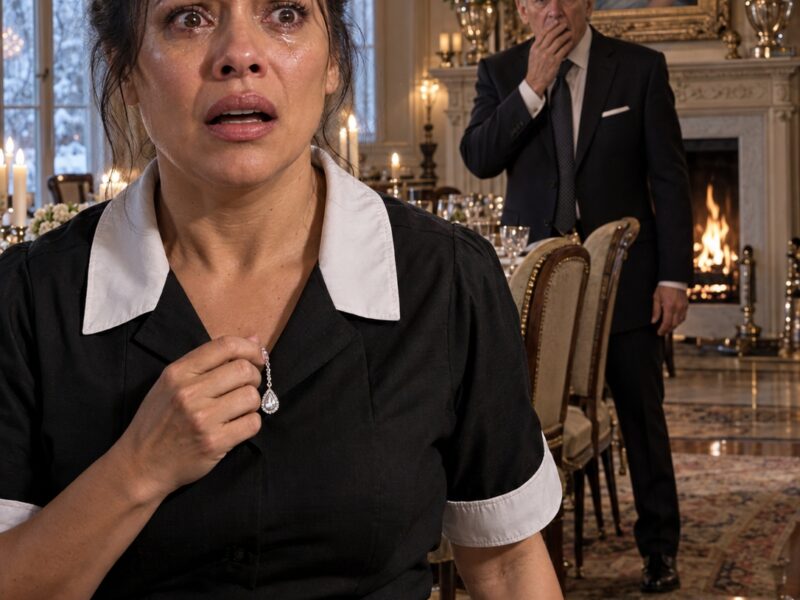
The silver tray hit the Persian carpet with a crash so violent that twelve people stopped speaking at once.
Crystal trembled. A steak knife bounced beneath the walnut dining table. A glass of Burgundy tipped onto its side, sending a dark red stain across a white linen cloth that probably cost more than Elena Morales earned in a week.
But Elena did not bend down to pick up a single thing.
For eleven years, she had worked inside the Ashford estate without once embarrassing herself in front of the family. She had scrubbed marble floors at five in the morning, polished silver until her wrists ached, cleaned fireplaces after Christmas parties that lasted until sunrise, and carried trays past men whose watches could have paid off every debt she had ever had.
She knew how to disappear.
That was one of the first skills poverty had taught her.
But standing beneath the crystal chandelier on that December night, Elena forgot the rules of invisibility.
Her eyes were fixed on the enormous oil portrait above the fireplace.
A young woman in a pale blue dress stared down from the canvas. She had dark hair gathered at the nape of her neck, gentle brown eyes, and the faintest half smile, as though the painter had caught her just before she said something funny.
Around her throat hung a small silver pendant shaped like a teardrop.
Elena stopped breathing.
She knew that pendant.
She knew that face.
And somewhere behind her, millionaire developer Edward Ashford slowly pushed back his chair.
“Elena?”
She heard his voice as if it came from another room.
Her fingers had gone numb.
One of the guests murmured, “Is she all right?”
Elena took one step toward the portrait.
Then another.
She could feel every eye on her, but none of them mattered.
Twenty-three years disappeared.
She was no longer forty-six, no longer a housekeeper wearing a black uniform with her hair pinned back, no longer a single mother worried about rent and her son’s college applications.
She was twenty-three again, standing beside a hospital bed in Newark while her mother took her final breaths.
Sophia had been thin by then. Too thin.
Cancer had turned the energetic woman Elena remembered into someone made of bones, blankets, and apologies.
There had been one photograph on the bedside table.
One.
Sophia as a young woman.
The same dark hair.
The same eyes.
The same silver pendant.
Elena turned toward Edward.
“That woman,” she whispered.
Edward did not move.
“Who is she?”
His expression changed so subtly that most people at the table would not have noticed.
Elena did.
For eleven years, she had studied rich people without meaning to. When you served people who believed you were part of the furniture, you learned what they looked like when they lied, when they were afraid, when they wanted someone removed from a room without causing a scene.
Edward Ashford was afraid.
Not confused.
Not irritated.
Afraid.
“Elena,” he said again, more quietly.
“Who is she?”
The room seemed to shrink around them.
Edward looked at the portrait.
Then he looked at Elena’s face.
And something inside him broke.
“Everyone out.”
The business associates stared at him.
A silver-haired man near the end of the table gave an awkward laugh. “Edward, we haven’t finished discussing the Milford acquisition.”
“I said everyone out.”
His voice was not loud.
It did not need to be.
Chairs moved immediately.
One by one, men and women gathered their phones, jackets, and folders. Nobody asked questions. They avoided Elena’s eyes as they passed her, carrying with them the instinctive understanding that whatever was happening in that dining room did not belong to them.
Within two minutes, the enormous room was empty.
Except for Elena.
Except for Edward.
Except for the woman in the portrait.
Edward crossed to the double doors and closed them.
The click of the latch made Elena’s stomach tighten.
She had spent eleven years being told that the family dining room was private.
Now the richest man she had ever known had locked her inside it.
Edward turned.
“Where have you seen her?”
Elena stared at him.
“My mother.”
The color drained from his face.
“What?”
“That’s my mother.”
“No.”
The word escaped him automatically.
Elena felt anger cut through her shock.
She reached beneath the collar of her uniform and pulled out the chain she had worn since she was twenty-three.
The silver pendant slid into view.
Edward’s knees nearly seemed to weaken.
“No,” he said again.
But this time, it sounded like a prayer.
Elena held the pendant in one shaking hand.
“My mother’s name was Sophia Morales.”
Edward grabbed the edge of the dining table.
For several seconds, neither of them spoke.
The storm outside pressed snow against the tall windows.
Somewhere deeper in the mansion, a grandfather clock began to strike eight.
Edward counted none of the chimes.
“Sophia,” he whispered.
Elena had never heard him say anyone’s name that way.
Not even his late wife’s.
Not even his daughter’s.
It was the voice of a man standing suddenly face-to-face with a ghost.
Then Edward looked at Elena again.
“How old are you?”
The question hit harder than it should have.
Elena lowered the pendant.
“Forty-six.”
“When is your birthday?”
Her pulse accelerated.
“Why?”
“When?”
“January seventeenth.”
Edward closed his eyes.
Elena took a step back.
“What is happening?”
He opened his eyes again, and she saw something that frightened her more than anger could have.
Grief.
Raw, immediate grief.
“Edward.”
He walked toward a built-in cabinet beside the fireplace.
For years Elena had dusted the outside of that cabinet without knowing what was inside.
Edward unlocked it.
From the bottom drawer, he removed a bundle of envelopes tied with a faded blue ribbon.
When he set them on the table, Elena saw the handwriting on the top envelope.
Her entire body went cold.
She knew those loops.
She knew the way the S curved backward.
She had seen that handwriting on birthday cards, grocery lists, school permission slips and notes tucked into lunch bags.
Eat something before class.
Don’t forget your sweater.
I love you.
Elena’s knees buckled.
She caught the back of a chair.
“That’s my mother’s handwriting.”
Edward said nothing.
Elena reached toward the envelopes, then stopped.
They were addressed to him.
Edward Charles Ashford.
Several had never been opened.
One was marked RETURN TO SENDER.
Another had a stain across the corner that looked like water.
Or tears.
“How do you have these?”
Edward stared at them.
“I didn’t.”
Elena looked at him sharply.
“What does that mean?”
“I found them after my father died.”
“When?”
“Nineteen years ago.”
“And you kept them?”
His jaw tightened.
“They were already opened when I found them. Most of them.”
“But you knew my mother?”
Edward looked toward the portrait.
For the first time since Elena had known him, he seemed older than his sixty-eight years.
“Yes.”
The answer landed between them.
Elena could hear the storm.
The fire.
Her own breathing.
“How?”
Edward pulled out the chair opposite her but did not sit.
“Sophia grew up three streets from me.”
Elena blinked.
“What?”
“My family didn’t always live here. My grandfather built the original house, but when I was a boy, my parents spent most of the year in Stamford. Sophia’s father worked for one of my grandfather’s construction crews.”
Elena said nothing.
“We went to the same elementary school for three years. Later, my father moved me to private school.”
His mouth twisted bitterly.
“But Sophia and I stayed friends.”
“Friends.”
Edward looked at her.
“No.”
That single word changed the room again.
Elena’s hands curled at her sides.
Edward continued.
“I loved her.”
The air left Elena’s lungs.
He looked back toward the portrait.
“I loved her before I understood what love was. I loved her when I was seventeen and stupid enough to believe adults eventually did the right thing. I loved her at twenty-two when my father told me I would lose my inheritance, my job, and my place in the company if I embarrassed the family by marrying the daughter of a laborer.”
Elena’s throat tightened.
“What did you do?”
Edward’s answer came slowly.
“The wrong thing.”
He sat down.
“I obeyed him.”
Something fierce rose in Elena.
She saw her mother’s cracked hands.
The duplex where the pipes froze every winter.
The overdue notices hidden inside kitchen drawers.
The nights Sophia worked at a hospital laundry facility and came home smelling of bleach.
“You obeyed him.”
“Yes.”
“And my mother?”
“She left.”
Elena laughed once.
There was no humor in it.
“My mother didn’t just leave places.”
“I thought she did.”
“You thought wrong.”
“I know that now.”
“Do you?”
Edward met her eyes.
Elena pointed toward the letters.
“You had these for nineteen years.”
“I found them after both of us had built separate lives. I was married. Sophia was gone. I didn’t know where she was.”
“You could have looked.”
The accusation echoed through the room.
Edward lowered his eyes.
That was answer enough.
Elena stepped away from him.
All her life she had imagined her father as a blank space.
Her mother rarely spoke about him.
When Elena was seven, she asked if he had died.
Sophia said no.
When she was twelve, she asked if he knew Elena existed.
Sophia became quiet and said, “Some people don’t know what they’re strong enough to love until it’s too late.”
Elena had hated that answer.
At seventeen, she stopped asking.
Now she looked at Edward Ashford and felt something dangerously close to understanding.
Which made her even angrier.
“You asked my age.”
Edward’s fingers tightened around the back of the chair.
“Yes.”
“Why?”
He looked at the unopened letter sitting at the bottom of the bundle.
“I need to show you something.”
He untied the ribbon.
Elena wanted to tell him to stop.
Instead, she watched.
Edward separated three envelopes from the others.
The first was dated May 1979.
The second September 1979.
The third December 1979.
Elena was born in January 1980.
Her stomach twisted.
Edward handed her the September letter.
It was already open.
She pulled out the paper.
The edges were yellow with age.
Sophia’s handwriting filled three pages.
Elena read the first paragraph.
Then the second.
By the third, the letters blurred.
Edward’s voice came softly.
“Elena?”
She raised one hand.
“Don’t.”
She kept reading.
Sophia wrote that she had tried to reach Edward twice.
She wrote that Charles Ashford—Edward’s father—had warned her never to contact him again.
She wrote that Eleanor Ashford had given her money, not as payment to disappear but because Eleanor believed Sophia deserved a chance to start somewhere far from the cruelty of the Ashford family.
Then Elena reached the sentence that split her life into before and after.
I found out three weeks ago that I am carrying your child.
Elena stopped.
She read it again.
Her pulse pounded inside her ears.
I don’t know if your father will let this letter reach you, but I need to believe there is still enough of the boy I loved inside the man you are becoming that you would want to know.
Elena’s grip tightened until the paper shook.
Edward sat motionless across from her.
The rest of the letter described fear.
A pregnancy.
A cheap apartment.
Sophia’s determination to raise the baby whether Edward came or not.
At the bottom was one final line.
If you never come, I will tell our child she was born from love before fear ruined it.
Elena lowered the letter.
Edward looked destroyed.
She felt nothing for him.
That terrified her.
Because she had imagined this moment as a child.
Not this exact room.
Not this exact man.
But she had imagined a father appearing.
He would explain everything.
He would say he had searched for her.
He would have some impossible reason.
Then he would hug her, and the ache inside her would close.
Instead, Elena stared at a millionaire who had lived forty minutes away while her mother counted quarters at supermarket registers.
“You’re saying you’re my father.”
Edward swallowed.
“I’m saying there is a very real possibility.”
“A possibility.”
“I don’t want to tell you something this serious without—”
“Without what? A DNA test?”
He flinched.
Elena laughed bitterly.
“Of course. That’s what rich people do, isn’t it? Everything needs paperwork before it becomes real.”
“That isn’t fair.”
Her eyes flashed.
“Fair?”
Edward stopped.
Elena stepped toward him.
“My mother worked until her fingers split in winter. She died worried about whether I could pay the rent. I started cleaning offices at nineteen. I raised my son without help after his father disappeared. I have spent eleven years in your house washing fingerprints off mirrors you barely look at.”
Her voice shook now.
“And you’re telling me fairness matters?”
Edward said nothing.
“You hired me.”
“Yes.”
“For eleven years.”
“Yes.”
“You looked at me.”
Every word became harder to say.
“You walked past me hundreds of times.”
His eyes filled.
“I didn’t know.”
“But your mother did.”
Edward froze.
Elena saw it instantly.
“What?”
“Elena—”
“Your mother looked at me.”
She remembered Eleanor sitting in the upstairs hall.
Those soft, searching eyes.
The way she sometimes asked Elena questions that made no sense.
Where were you born?
Was your mother musical?
Do you like gardenias?
Once, Eleanor had reached for Elena’s hand and whispered, “You have her fingers.”
Elena had assumed dementia.
Now nausea rolled through her stomach.
“She knew.”
Edward stood.
“I don’t know what she knew.”
“She knew something.”
“We can ask her.”
Elena stared toward the ceiling as though she could see through two floors to the bedroom where Eleanor was recovering from her fall.
Then another thought hit her.
“The fall.”
Edward frowned.
“What about it?”
“She fell tonight.”
“Yes.”
“Right before I was sent into this room.”
Edward said nothing.
Elena’s skin prickled.
She looked at the portrait again.
For eleven years she had never been permitted beyond those doors.
On the one night circumstances forced her inside, she saw Sophia.
Coincidence suddenly felt too convenient.
Elena turned back to Edward.
“Your mother asked for me before the ambulance came.”
He stared at her.
“What?”
Elena remembered kneeling beside Eleanor near the staircase.
The old woman had gripped Elena’s wrist with surprising strength.
Not Margaret.
Not Edward.
Not the doctor.
Elena.
Then, just before the paramedics arrived, Eleanor whispered something Elena had not understood.
The blue room.
At the time Elena thought it was confusion.
Now her heartbeat accelerated.
“She said something.”
“What?”
“Elena?”
She looked at Edward.
“Your mother told me to find the blue room.”
Edward went completely still.
For the first time that night, Elena saw fear return to his face.
But this fear was different.
This was recognition.
“What blue room?”
Edward looked toward the door.
“My father’s old study.”
Elena’s stomach dropped.
“Was it blue?”
Edward did not answer immediately.
“It used to be.”
The room went silent.
Then someone knocked.
Three short knocks.
Edward crossed the room and opened the door.
The head housekeeper stood outside.
Her face was pale.
“Mr. Ashford.”
“What is it?”
“It’s your mother.”
Edward’s expression tightened.
“The doctor said she was stable.”
“She woke up.”
“That’s good.”
The housekeeper glanced at Elena.
“No, sir.”
Edward stiffened.
“She’s asking for Ms. Morales.”
Elena felt cold move slowly down her spine.
The hallway upstairs smelled of antiseptic, old wood, and the lavender sachets Eleanor kept inside every drawer.
Elena followed Edward past family photographs she had dusted for years.
Now every face seemed to be watching her differently.
Edward’s late wife, Margaret.
His daughter, Charlotte, at thirteen.
Edward shaking hands with senators, governors, architects and bankers.
Generations of Ashfords standing beside buildings bearing their name.
Elena suddenly wondered where Sophia had been while all those photographs were taken.
Working.
Hiding.
Surviving.
Eleanor lay propped against several pillows when they entered.
Her white hair spread around her face. Bruising had begun forming along one temple, and a blood pressure cuff wrapped around her thin arm.
She looked fragile.
Until she saw Elena.
Then her eyes sharpened.
“You went in,” she whispered.
Elena stopped near the bed.
Edward moved closer.
“Mother, you need to rest.”
Eleanor ignored him.
“You saw her.”
Elena’s throat tightened.
“The portrait?”
Eleanor began crying.
Not loudly.
Tears simply slipped down the old woman’s cheeks.
Edward stared at his mother.
“What did you know?”
Eleanor closed her eyes.
“Too much.”
“Mother.”
“And too little.”
Edward’s voice hardened.
“Did you know Elena was Sophia’s daughter?”
Eleanor opened her eyes.
She looked directly at Elena.
“I suspected.”
Elena felt the floor tilt beneath her.
“For how long?”
Eleanor’s lower lip trembled.
“The first week you came here.”
Eleven years.
The number exploded inside Elena’s mind.
“You suspected for eleven years.”
“I wasn’t certain.”
“You could have asked me.”
“I was afraid.”
Elena laughed softly in disbelief.
“Everyone in this family seems to have been afraid while my mother did all the suffering.”
Eleanor closed her eyes.
Edward stepped toward the bed.
“Tell me everything.”
His mother stared at him.
“You won’t like the man your father was.”
Edward’s mouth tightened.
“I stopped liking him a long time ago.”
“You still don’t know.”
Silence settled over the bedroom.
Eleanor pointed toward an antique writing desk near the window.
“Second drawer.”
Edward opened it.
Inside were scarves, stationery, and a small brass key.
He turned toward his mother.
“What does this open?”
“The cabinet in the blue study.”
Edward stared at the key.
“That cabinet has been empty since Father died.”
“No.”
His mother’s voice was barely audible.
“You were meant to think it was empty.”
Elena looked between them.
Eleanor reached toward her.
Elena hesitated.
Then she took the old woman’s hand.
Eleanor’s fingers were icy.
“I tried to help Sophia,” she whispered. “But I was a coward too.”
“Why did she leave?”
“Because Charles accused her of stealing.”
Elena’s jaw tightened.
“Edward told me.”
“That isn’t all.”
Edward stepped closer.
“What else?”
Eleanor’s eyes shifted toward him.
“Your father knew about the baby.”
Edward stopped breathing.
Elena felt his hand strike the edge of the desk.
“What?”
“He knew before Sophia left.”
“No.”
“He read her letter.”
Edward shook his head.
“No.”
“He offered her money.”
Elena stared at Eleanor.
“To do what?”
The old woman began to cry harder.
“To disappear.”
Edward turned away.
Elena’s fingers went numb around Eleanor’s hand.
“And my mother refused.”
“Yes.”
“How do you know?”
“Because I was there.”
The room became unbearably still.
Eleanor stared toward the dark window.
“Charles called her into the study. He put a check on the desk. Fifty thousand dollars. It was an enormous amount then. He told her she could take it, leave Connecticut and never contact Edward again.”
Elena imagined Sophia at twenty-two.
Young.
Pregnant.
Poor.
Standing before a man powerful enough to erase her from someone else’s life.
“What did she say?”
Eleanor smiled through her tears.
“She tore the check in half.”
Something inside Elena cracked.
That sounded like her mother.
“She told him her child was not a problem he could purchase.”
Edward covered his mouth with one hand.
Eleanor continued.
“Charles became furious. He told her he would make sure Edward believed she had taken money from us. Then he did exactly that.”
Edward turned.
“You let me believe she stole from us.”
“I tried to tell you.”
“When?”
“You were in Boston. Your father intercepted my calls.”
“For how long?”
“Long enough.”
Edward’s voice rose.
“Forty-six years is longer than enough!”
Eleanor flinched.
Elena stepped between them instinctively.
Not because she wanted to protect Eleanor from the truth.
Because the old woman had fallen hours earlier.
Edward saw what Elena was doing.
His anger collapsed into shame.
He stepped back.
Eleanor looked at the brass key.
“Everything I kept is in that cabinet.”
Edward stared at it.
“What exactly did you keep?”
Eleanor’s eyes closed.
“Proof.”
The blue study had not been blue for decades.
Dark green wallpaper covered the walls now, and shelves of legal books occupied almost every corner.
Elena had cleaned it many times.
She had never known there was a cabinet hidden behind the bookcase.
Edward did.
He pushed on a carved panel beside the fireplace.
Part of the shelving clicked open.
Behind it stood a narrow steel cabinet.
Elena stared at him.
“You knew this was here?”
“I knew the cabinet existed. Father kept company contracts in it.”
Edward inserted the brass key.
The lock resisted.
Then turned.
Inside were six archive boxes.
Edward pulled out the first.
Tax records.
The second held property deeds.
The third contained correspondence.
Then they opened the fourth.
A name was written across the top.
SOPHIA MORALES.
Elena sat down.
She had no memory of deciding to.
Edward lifted the lid.
Inside were photographs.
Bank documents.
Copies of letters.
A hospital form.
A report from a private investigator.
And an envelope with Elena’s childhood address written across the front.
Edward picked up the investigator’s report.
His eyes moved quickly down the page.
Then stopped.
His face went gray.
“What?”
Elena stood.
He did not answer.
“Edward.”
She took the report from him.
The first page was dated February 1980.
One month after Elena was born.
SUBJECT: SOPHIA MORALES.
LOCATION: NEWARK, NEW JERSEY.
DEPENDENT CHILD: FEMALE INFANT, APPROXIMATELY FOUR WEEKS OLD.
Elena’s knees weakened.
She kept reading.
Her grandfather had hired someone to follow her mother.
There were details about the apartment.
Sophia’s job.
The grocery store she used.
The church she occasionally attended.
Even photographs.
One showed Sophia carrying a baby down icy apartment steps.
Elena stared at herself.
Forty-six years younger.
Wrapped inside a white blanket.
Edward was reading over her shoulder.
His breathing became uneven.
There was another document.
A handwritten note from Charles Ashford.
Confirmed. Child likely Edward’s. No action unless contact is attempted.
Edward moved away so abruptly that he knocked over a chair.
“No.”
Elena looked at him.
He pressed both hands against his head.
“He knew.”
His voice broke.
“He knew you existed.”
Elena should have felt satisfaction.
She had proof.
Her mother had not lied.
Her father had not knowingly abandoned her.
But truth did not arrive like justice.
It arrived like wreckage.
She looked at the report again.
Her grandfather had known where she lived.
He had known when she was born.
He had known Sophia worked two jobs.
He had watched.
And done nothing.
Elena whispered, “He could have changed everything.”
Edward sank into a chair.
“Yes.”
“He had money.”
“Yes.”
“He had our address.”
Edward closed his eyes.
“Yes.”
“My mother almost lost our apartment when I was five.”
His face tightened.
“She sold her wedding ring when I was eight.”
Edward looked at her.
“She wasn’t married.”
“I know.”
Elena touched the pendant around her neck.
“It was a cheap gold ring she bought herself because she got tired of men asking questions.”
Edward looked down.
“I’m sorry.”
“Stop saying that.”
His head lifted.
“You don’t get to apologize for him.”
“I’m apologizing for me.”
“You didn’t know.”
“I could have known.”
Elena stared at him.
Edward’s voice cracked.
“I could have asked more questions. I could have gone after her when my father told me she’d taken money. I could have refused the life he planned for me.”
“But you didn’t.”
“No.”
He nodded slowly.
“I didn’t.”
That answer hurt more than an excuse would have.
Elena turned away.
On the desk was a photograph of Sophia at twenty-two.
She stood beside Eleanor in the Ashford garden.
Both women were laughing.
Elena had never seen her mother look that young.
Never seen her unburdened.
She picked up the photograph.
Edward approached quietly.
“She loved that garden.”
Elena did not look at him.
“You remember everything about her.”
“More than I deserve to.”
“You married someone else.”
“Yes.”
“Did you love your wife?”
The question surprised both of them.
Edward took a long time to answer.
“Yes.”
Elena finally looked at him.
“Then how can you say you loved my mother?”
“Because life is cruel enough to let both things be true.”
She studied his face.
“Margaret knew about Sophia?”
“She knew there had been someone before her. She didn’t know everything.”
“And your daughter?”
“Charlotte knows nothing.”
Elena gave a hollow laugh.
“So I have a sister.”
“Half sister.”
“I know how biology works.”
Edward winced.
For one second Elena almost felt guilty.
Then she remembered eleven years of walking past family photographs.
“Where is she?”
“London.”
“What happens when she finds out?”
Edward looked at the file box.
“I don’t know.”
Elena set the photograph down.
“I do.”
He looked at her.
“She’ll think I came for money.”
Edward immediately shook his head.
“She won’t.”
“You don’t know that.”
“She knows me.”
Elena met his gaze.
“So did my mother.”
Edward had no answer.
By morning, Elena had decided the only sensible thing she could do was go back to work.
At 5:42 a.m., she boarded her usual bus.
The storm had weakened, leaving Greenwich under several inches of snow.
People around her carried coffee, backpacks, grocery bags.
Nobody knew that less than ten hours earlier Elena had discovered the identity of her father.
Nobody knew he was worth hundreds of millions of dollars.
Nobody knew that the hands gripping a bus pole belonged to an Ashford by blood.
Elena was grateful.
Normal life felt like oxygen.
She arrived at the mansion at 6:31.
Head housekeeper Judith Monroe met her near the service entrance.
Judith was fifty-eight and had worked for the Ashfords longer than Elena.
She took one look at Elena and lowered her voice.
“You didn’t have to come.”
“Yes, I did.”
“Mr. Ashford told me you could take the week.”
“I don’t want the week.”
Judith studied her.
“Is everything okay?”
“No.”
The honesty surprised them both.
Judith nodded.
“All right.”
Then she handed Elena a cleaning schedule as though nothing had changed.
Elena could have hugged her.
For three hours, she cleaned bedrooms.
She replaced towels.
She wiped fingerprints from a glass banister.
She made a bed.
Ordinary tasks steadied her.
At 10:14, Edward found her vacuuming the library.
He stood in the doorway wearing the same trousers from the previous night.
His tie was gone.
He looked as though he had not slept.
Elena switched off the vacuum.
“What?”
Edward glanced at the cleaning cart.
“You shouldn’t be doing this.”
Something inside her ignited.
“Why?”
He realized the mistake instantly.
“I didn’t mean—”
“Yesterday it was fine.”
“Elena.”
“Yesterday I could scrub your toilets because I was an employee. Today I might have your DNA, so suddenly the work is beneath me?”
“No.”
“Then don’t look at me like that.”
“I don’t know how to look at you.”
The sentence stopped her.
Edward swallowed.
“I’m trying not to make everything worse.”
“You’re not doing very well.”
A sad smile touched his mouth.
“No.”
Elena leaned against the vacuum handle.
“What do you want?”
“I called a laboratory.”
There it was.
Reality in one sentence.
Elena nodded.
“Of course.”
“It can be private.”
“I assumed rich people had deluxe paternity tests.”
He almost laughed.
Almost.
Then his expression softened.
“You don’t have to do it.”
“Yes, I do.”
“Elena—”
“Because if I don’t, every time you help my son, every time you look at me, every time someone finds out, there will be a question.”
Edward did not deny it.
“I want the question dead.”
“All right.”
“One condition.”
“Anything.”
She pointed at him.
“Don’t say anything to Daniel.”
Edward’s face shifted.
“He’s my son.”
“I understand.”
“No, you don’t. He has architecture applications due in three weeks. He has finals. He thinks his biggest problem is whether his portfolio is good enough for Pratt.”
Edward listened.
“I am not dropping a millionaire grandfather into his life until I know what is true.”
“Agreed.”
“And even if it’s true, you don’t buy him.”
Edward’s eyebrows drew together.
“I wouldn’t.”
“No cars. No apartment. No secret trust fund. No calling admissions offices.”
“I would never interfere with admissions.”
Elena stared at him.
Edward sighed.
“Fine. I understand why you said it.”
“Good.”
She turned the vacuum back on.
Edward remained in the doorway.
Elena shut it off again.
“What now?”
He looked uncomfortable.
“My mother wants to speak with you.”
“I’m working.”
“Elena.”
She stared at him.
He corrected himself.
“Whenever you’re ready.”
“Better.”
That afternoon, Eleanor told Elena something no document had shown.
Sophia had returned to the Ashford estate once.
Elena had been nine months old.
“She came to the gate,” Eleanor said.
Elena sat beside the old woman’s bed.
Edward was not present.
“She brought you.”
Elena’s chest tightened.
“Why?”
“She wanted Edward to see you.”
“What happened?”
Eleanor looked ashamed.
“Charles had changed the security staff. He left instructions.”
Elena already knew she would hate the answer.
“What instructions?”
“Never allow Sophia onto the property.”
Elena looked toward the window.
“She stood outside?”
“For nearly an hour.”
“With a baby.”
“Yes.”
“Did you know?”
“Not until afterward.”
Eleanor’s voice shook.
“One of the groundskeepers told me. By then she was gone.”
Elena imagined Sophia at twenty-three, standing beyond the iron gates with a baby on her hip.
The same gates Elena now entered through every morning.
“Did she ever come back?”
“No.”
“Did she ever ask you for money?”
“Never.”
“Did she threaten the family?”
“Never.”
“Did she try to expose Edward?”
“No.”
Elena stood.
Eleanor reached for her.
“Elena.”
She stopped.
“I don’t expect forgiveness.”
“Good.”
The old woman’s eyes filled.
“But there is something you should know.”
Elena turned.
“Your mother could have destroyed us.”
“What?”
“She kept copies of letters. She had proof Charles lied. She could have gone to newspapers. She could have taken Edward to court.”
“Why didn’t she?”
Eleanor looked toward the window.
“Because she said she would not build your life around revenge.”
Elena closed her eyes.
That was the most Sophia thing she had heard yet.
That night, Elena went home and found Daniel asleep at the kitchen table.
His sketchbook lay open beneath one arm.
A half-built architectural model occupied most of the table.
Elena stood in the doorway watching him.
At sixteen, Daniel was already taller than she was.
He had his father’s narrow nose but Elena’s dark eyes.
Or perhaps Edward’s.
The thought made her chest tighten.
She walked closer.
His drawing showed an airy public library with enormous windows and a garden integrated into the roof.
Elena brushed hair away from his forehead.
Daniel woke.
“Mom?”
“Sorry.”
He blinked at the clock.
“Whoa.”
“You fell asleep.”
“I was fixing the west elevation.”
“Your west elevation was drooling.”
He smiled.
Then he noticed her expression.
“What happened?”
“Nothing.”
Daniel sat upright.
“You’re terrible at that word.”
“At what word?”
“Nothing.”
Elena looked away.
Daniel studied her.
“Did something happen at the mansion?”
Her heart stopped for half a beat.
“Why would you ask that?”
“You came home at almost midnight.”
“There was a medical emergency.”
“Is the old lady okay?”
“Yes.”
Daniel nodded.
Then he noticed the pendant around Elena’s neck.
“You’re wearing Grandma’s necklace.”
Elena touched it instinctively.
“I always wear it.”
“Not outside your shirt.”
She looked down.
She had forgotten to tuck it away.
Daniel smiled.
“You look like her in that picture.”
Elena could not answer.
He frowned.
“Mom?”
Her eyes filled.
Daniel stood immediately.
“What’s wrong?”
Elena hugged him.
Hard.
Too hard.
Daniel laughed uncertainly.
“Okay. Is this a nice hug or a someone-died hug?”
“No one died.”
“Then why are you crying?”
Elena closed her eyes against his shoulder.
Because your grandfather lives forty minutes away.
Because your great-grandfather watched me grow up from a file folder.
Because everything I thought I knew about where we came from is changing.
Instead she whispered, “I’m just tired.”
Daniel hugged her back.
“All right.”
And Elena hated herself for lying.
Three days later, the DNA results arrived.
99.9987%.
Biological father.
Edward sat in his attorney’s private conference room holding the report.
Elena sat across from him.
Neither spoke.
The attorney discreetly left.
Edward read the number again.
Then he put the paper down.
His hand covered his mouth.
Elena watched tears fill his eyes.
She felt her own throat tighten but refused to cry first.
Edward looked at her.
“My daughter.”
Elena’s chair scraped backward.
“No.”
His face fell.
“Don’t.”
“I’m sorry.”
“I have a father biologically. That’s what the test says.”
He nodded slowly.
“I understand.”
“No, you don’t.”
Elena stood.
“The word daughter means birthday cards. It means someone teaching you to drive. It means having somebody to call when your car breaks down at nineteen and you’re scared.”
Edward looked down.
“It means my mother not dying believing she failed to give me a family.”
“I know.”
“No.”
Elena’s voice cracked.
“You know facts. I lived it.”
Edward’s eyes closed.
She picked up her coat.
“I need time.”
“You can have as much as you need.”
She reached the door.
“Elena.”
She stopped.
He stood but did not approach her.
“Whatever happens from here, the money is yours if you want it. Not because I’m trying to buy anything. Because legally and morally—”
Elena laughed.
“There it is.”
“What?”
“The Ashford solution.”
His expression tightened.
“Write a check.”
“That isn’t what I meant.”
“I don’t want your money.”
“You’re entitled to—”
“I wanted my father.”
The words left her before she could stop them.
Edward went silent.
Elena stared at him, horrified by her own confession.
She had spent days telling herself she did not care.
But underneath the anger was the oldest wound she carried.
A little girl waiting.
A teenager pretending she had stopped waiting.
A woman insisting she no longer needed what she had never received.
Elena wiped her eyes.
“I wanted him forty years ago.”
Then she left.
Edward did not follow.
For two weeks, he barely spoke to her.
Not because he was angry.
Because he finally listened.
Elena came to work.
He let her work.
He did not appear in rooms simply because she was there.
He did not leave gifts.
He did not deposit money in her account.
He did not ask Daniel’s name again.
Then one Sunday afternoon, someone knocked on Elena’s apartment door.
She opened it and found Edward standing in the hallway.
Alone.
No driver.
No assistant.
No lawyer.
He wore an ordinary wool coat and held a cardboard box.
Elena stared at him.
“How did you get my address?”
The absurdity of the question made his mouth tighten.
“I sign your employment records.”
“Right.”
He looked down at the box.
“I found something.”
She did not invite him inside.
Edward did not ask.
“What?”
“Your mother’s belongings.”
Elena’s chest tightened.
“Where?”
“My mother kept them.”
“Why?”
“She hoped Sophia would come back.”
Elena looked at the box.
“What’s inside?”
“Photographs. Letters. A scarf. A notebook.”
He hesitated.
“And something I think you should see.”
Elena opened the door wider.
Daniel was at Malik Turner’s apartment downstairs working on a school project.
For once, they were alone.
Edward entered.
He looked around the small apartment.
His gaze paused on the water stain above the kitchen window.
Then on the secondhand couch.
Then on Daniel’s architectural models.
His face tightened.
Elena noticed.
“Don’t.”
He looked at her.
“Don’t pity me in my own home.”
“I don’t.”
“You’re doing it.”
“I’m imagining your mother here.”
Elena went still.
Edward placed the box on the kitchen table.
“She deserved better.”
“She deserved respect.”
“Yes.”
“Money might have helped, but don’t confuse the two.”
“I won’t.”
Elena opened the box.
The smell hit her first.
Old paper.
Cedar.
Time.
There were photographs she had never seen.
Sophia at seventeen wearing jeans and sitting on the hood of a car.
Sophia laughing beside a lake.
Sophia at an Ashford company picnic.
Edward stood beside her in several pictures.
Young Edward.
Thin.
Careless.
Alive in a way Elena had never seen him.
In one photograph, Sophia had her head on his shoulder.
“You look happy,” Elena said.
Edward stared at the picture.
“We were.”
She found a scarf.
Blue silk.
Elena lifted it.
“My mother hated blue.”
Edward smiled faintly.
“She used to.”
Elena looked at him.
“What happened?”
“She told me blue made her look washed out.”
“That sounds more like her.”
At the bottom of the box lay an envelope.
Edward’s expression changed.
“That.”
Elena opened it.
Inside was a photograph.
Sophia sat in a hospital bed.
Her hair was damp with sweat.
Her face looked exhausted.
But she was smiling.
In her arms was a newborn baby.
Elena.
The room blurred.
She turned the photograph over.
One sentence was written on the back.
My little girl deserves to know that she was always loved.
Elena stared at the words.
A sound escaped her throat.
Then she broke.
For days she had held herself together through rage.
She had survived the portrait.
The letters.
The DNA report.
The investigator’s file.
But six words in her mother’s handwriting destroyed every wall she had built.
Always loved.
Elena covered her face.
Edward remained where he stood.
He did not touch her.
He did not tell her not to cry.
He did not say Sophia would have wanted forgiveness.
He simply waited.
Minutes passed.
When Elena finally looked up, Edward’s eyes were wet too.
“Why didn’t she tell me?” Elena whispered.
“About me?”
She nodded.
Edward looked toward the photograph.
“Maybe she wanted you to have a childhood that wasn’t shaped by what happened to her.”
“She should have told me.”
“Maybe.”
Elena wiped her face.
“I was angry at her after she died.”
Edward listened.
“I found bills hidden under her mattress. Medical bills. Rent notices. She knew she was sick for months before she told me.”
Her voice broke.
“I thought she didn’t trust me.”
“She was protecting you.”
“I didn’t ask to be protected.”
“No.”
Edward looked at her.
“But parents make that mistake.”
Elena almost laughed.
“You’re giving me parenting advice now?”
He smiled sadly.
“I’m discovering I’m in no position to give anyone advice.”
That was the first moment Elena saw him not as Edward Ashford.
Not as her employer.
Not even as her biological father.
Just as a flawed old man sitting at her kitchen table, carrying forty-six years of regret.
The moment frightened her because it made forgiveness possible.
Then the apartment door opened.
“Mom, Malik’s printer is—”
Daniel stopped.
His eyes moved from Elena to Edward.
Then to the box.
Then to the photograph in Elena’s hand.
He recognized Edward instantly.
Everyone in Connecticut recognized Edward Ashford.
Daniel looked confused.
“Mr. Ashford?”
Edward stood.
Elena’s heart slammed.
“Daniel.”
Her son looked at her.
“What’s going on?”
She had imagined telling him carefully.
After dinner.
With time.
Without Edward in the room.
Instead, Daniel stood six feet away while the truth stared back at him.
Edward took one step toward the door.
“I should go.”
Daniel’s eyes narrowed.
“Why is your boss crying in our kitchen?”
Elena closed her eyes.
There was no clean way out anymore.
“Sit down.”
Daniel did not.
“Mom.”
“Please.”
Something in her voice frightened him.
He sat.
Edward remained standing near the door.
Elena placed Sophia’s photograph on the table.
Daniel looked at it.
“That’s Grandma.”
“Yes.”
“And you.”
“Yes.”
He glanced at Edward.
“I don’t understand.”
Elena sat across from him.
Then she told her son the truth.
Not all of it.
Not yet.
She told him Sophia had once worked for the Ashfords.
She told him about the portrait.
She told him Edward had known Sophia when they were young.
Daniel’s face grew increasingly still.
Then Elena said, “We took a DNA test.”
Daniel looked at Edward.
Then back at her.
“No.”
Elena’s heart broke.
“Daniel—”
“No way.”
“It’s true.”
He stood so quickly the chair nearly fell.
“You knew?”
“Only for a few days.”
“And you didn’t tell me?”
“I was trying to understand it myself.”
Daniel stared at Edward.
“So you’re…”
Edward swallowed.
“Your grandfather.”
Daniel laughed.
A shocked, humorless laugh.
“My grandfather is Edward Ashford.”
Elena stood.
“Daniel.”
“He owns half the new buildings downtown.”
“Not half.”
Everyone looked at Edward.
He immediately regretted speaking.
Daniel stared at him.
Then, despite everything, a laugh escaped Elena.
Daniel looked at her.
She began laughing harder.
It was wrong.
Absurd.
Painful.
But suddenly all three of them were trapped inside the ridiculous reality of Edward correcting a teenager about his real estate portfolio during a family revelation.
Even Daniel smiled for half a second.
Then his face became serious.
“Does this mean we’re rich?”
Elena’s laughter died.
“No.”
Edward said at the same time, “Potentially.”
Elena glared at him.
He raised both hands.
“Sorry.”
Daniel looked between them.
“This is insane.”
“Yes,” Elena said.
“Can I tell Malik?”
“No.”
“Why?”
“Because I don’t know what happens next.”
Daniel looked toward Edward.
“Do you?”
Edward shook his head.
“No.”
Daniel studied him.
“You’re really her dad?”
“Yes.”
“Did you know?”
“No.”
Daniel’s expression hardened.
“How could you not know?”
Edward looked at Elena.
Then back at Daniel.
“Because I trusted the wrong man and didn’t fight hard enough for the right woman.”
Daniel absorbed that.
Then he nodded once.
Not forgiveness.
But understanding.
Edward left ten minutes later.
At the door, Daniel stopped him.
“Mr. Ashford?”
Edward turned.
Daniel looked awkward.
“Did my grandmother really like architecture?”
Edward’s expression changed.
“Your grandmother?”
“Sophia.”
Edward smiled.
“She loved buildings.”
Daniel glanced at Elena.
“Seriously?”
“She used to tell me buildings were promises people made to the future.”
Daniel looked at Edward again.
“That’s kind of cool.”
“Yes,” Edward whispered.
“She was.”
The next morning, Charlotte Ashford landed at JFK.
Edward had called his daughter the night before.
He had not planned to tell her over the phone.
Charlotte knew something was wrong anyway.
By noon, she walked into the mansion wearing a camel coat, black boots and the expression of someone prepared for a funeral.
At forty-one, Charlotte resembled her late mother.
Elegant.
Controlled.
Difficult to surprise.
Edward surprised her.
“I have another daughter.”
Charlotte stared at him.
Then laughed.
Edward did not.
Her smile disappeared.
“What?”
He explained.
Not every detail.
Enough.
Sophia.
The letters.
The pregnancy.
Elena.
DNA.
When he finished, Charlotte sat motionless in the library.
“Your housekeeper.”
Edward hated the way she said it.
“Elena has a name.”
Charlotte stared at him.
“I know she has a name.”
“Then use it.”
Her face hardened.
“Don’t suddenly become righteous with me. You just told me I have a forty-six-year-old half sister who has worked inside this house for eleven years.”
“I know.”
“Does she want money?”
Edward’s jaw tightened.
“She refused it.”
“So far.”
“Charlotte.”
“I’m not being cruel. I’m being realistic.”
“No. You’re being exactly what my father would have been.”
The words struck her.
Edward immediately regretted them.
Charlotte stood.
“You call me from London, tell me my entire family history is apparently fiction, then compare me to Grandfather because I have questions?”
“I’m sorry.”
“You should be.”
She picked up her purse.
“Where are you going?”
“To a hotel.”
“This is your home.”
Charlotte looked around the library.
“Apparently I don’t know what this place is.”
Then she left.
Elena knew none of this when she arrived for work the next morning.
She found Charlotte in the kitchen.
Judith had gone into the pantry.
Daniel had convinced Elena that quitting immediately would make everything stranger, so she was still working temporarily while deciding what she wanted.
Charlotte stood beside the island holding coffee.
They recognized each other.
Elena had seen photographs.
Charlotte had seen employee files.
Neither smiled.
“Elena.”
“Ms. Ashford.”
“Charlotte.”
Elena set down the basket of clean towels.
“Fine. Charlotte.”
An uncomfortable silence followed.
Charlotte looked at Elena’s face.
Elena knew what she was searching for.
Edward.
Sophia.
Proof.
“You look like him around the eyes,” Charlotte said.
Elena almost laughed.
“I was about to say you don’t.”
Charlotte’s mouth twitched despite herself.
Then she looked down at her coffee.
“My father told me.”
“I assumed.”
“I don’t know what I’m supposed to say.”
“You don’t have to say anything.”
“I have questions.”
“Of course you do.”
“Did you know before the other night?”
“No.”
“Did your mother?”
“That Edward was my father? Yes.”
Charlotte nodded slowly.
“And you’re certain about the DNA test?”
Elena stared at her.
Charlotte immediately looked embarrassed.
“That sounded terrible.”
“It sounded exactly how you meant it.”
“I’m trying to understand.”
“So am I.”
Charlotte placed the mug down.
“My father is changing his estate plan.”
Elena’s expression went cold.
“There it is.”
“I’m not accusing you.”
“It sounded like you were warming up.”
Charlotte exhaled.
“I had one family when I got on the plane.”
“So did I.”
The sentence silenced her.
Elena stepped closer.
“You think I woke up wanting your inheritance?”
“No.”
“I woke up three weeks ago worrying whether my son could afford architecture school.”
Charlotte looked at the towels in Elena’s hands.
Elena continued.
“I liked my problems better before I met you.”
Charlotte flinched.
“I’m sorry.”
“Don’t be. Just don’t turn me into a thief because our father’s father turned my mother into one.”
That stopped her.
Edward had apparently not told Charlotte everything.
“What does that mean?”
Elena looked at her.
“You should ask him.”
Then she walked out.
That evening, Charlotte opened the Sophia file.
Two hours later, she found Elena folding laundry.
Her eyes were red.
“My grandfather knew.”
Elena kept folding.
“Yes.”
“He had you followed.”
“Yes.”
“He knew Dad had a child.”
“Yes.”
Charlotte sat down on a bench.
“My father adored him.”
Elena glanced over.
“People can adore someone who hurts them.”
Charlotte looked at her.
“That sounds like experience.”
“It is.”
For a while, neither spoke.
Then Charlotte said, “I’m sorry about this morning.”
Elena folded another towel.
“I’ve heard worse.”
“I imagine you have.”
Charlotte looked toward the doorway.
“My mother spent her life feeling like there was some room inside Dad she couldn’t enter.”
Elena paused.
“She knew about Sophia?”
“Not exactly. But she knew there had been someone.”
Charlotte’s voice softened.
“She once told me marriage doesn’t erase the person someone was before they met you.”
Elena sat down opposite her.
“Did they have a good marriage?”
“Yes.”
Charlotte smiled sadly.
“Complicated. But good.”
“That matters to me.”
“Why?”
“Because I don’t want my mother’s story to turn another woman into the villain.”
Charlotte stared at her.
For the first time, the suspicion left her face completely.
“You really don’t want anything from us, do you?”
Elena thought about the question.
“That isn’t true.”
Charlotte waited.
“I want my mother’s name cleared.”
“From what?”
“Everything your grandfather said about her.”
Charlotte nodded.
“That seems fair.”
“I want the staff here treated like human beings.”
A faint smile appeared.
“You’re making demands now?”
“Yes.”
“What else?”
Elena looked toward the laundry-room door.
“I want Daniel to get whatever opportunities his work earns him. Not because his grandfather is Edward Ashford.”
Charlotte nodded.
“And?”
Elena thought about Sophia’s photograph.
“I want to know who my mother was before surviving became her whole personality.”
Charlotte’s eyes filled.
“That one might be harder.”
“I know.”
“But I can help.”
Elena looked up.
“How?”
Charlotte smiled faintly.
“Dad has thirty-seven boxes of old family photographs stored in a climate-controlled warehouse because he’s insane.”
Elena laughed.
Charlotte laughed too.
And somewhere inside the strange, painful mess their father had inherited from another generation, two women began to become sisters.
Edward changed slowly.
That mattered to Elena.
She would not have trusted anything faster.
He did not announce a foundation at a press conference the next morning.
He did not pose beside Elena for photographs.
He began with smaller humiliations.
He sat in the kitchen and asked Judith how long she had worked for him.
Twenty-seven years.
He did not know.
He asked the gardener, Luis, how many children he had.
Three.
Edward had previously believed he had two.
He discovered one housekeeper was working weekends at a grocery store because her husband needed dental surgery.
Another employee had never taken a paid vacation longer than four days because the old staffing policy punished extended absences.
Edward read every policy.
Then he changed them.
Higher wages.
Full health coverage.
Education assistance.
Paid family leave.
Written overtime rules.
Judith stared at the new employee handbook and told Elena, “If finding out he had a secret daughter was what it took to get dental insurance, you should’ve dropped that tray ten years ago.”
Elena laughed until she cried.
Edward heard about the comment.
He laughed too.
But not everything became easy.
Some nights Elena hated him.
Sometimes he said something harmless and she heard forty-six missing birthdays inside it.
Once, he asked what college she had attended.
“I didn’t.”
The silence afterward lasted too long.
Another time he casually asked whether she had ever been to Paris.
Elena answered, “I had never been on a plane until I was thirty-nine.”
He stopped asking questions that assumed a shared world.
Then he learned to ask better ones.
“What did your mother cook when you were sick?”
“Chicken soup with too much garlic.”
“What music did she like?”
“Aretha Franklin. Loudly.”
“What made her angry?”
“People chewing with their mouth open. Unreturned library books. Men who thought being loud made them correct.”
Edward smiled.
“She still hated that.”
“You knew?”
“She once threw a dinner roll at me.”
Elena laughed.
“Seriously?”
“I deserved it.”
Little by little, Sophia became a whole person between them.
Not a tragedy.
Not a portrait.
Not evidence.
A woman.
She hated blue cheese.
She danced barefoot.
She read architecture magazines even though she could never afford the houses inside them.
She wanted to visit New Orleans.
She cheated at cards.
She once slapped Edward for defending his father.
Elena liked that story best.
Three months after the DNA test, Daniel received an email from Pratt Institute.
He was in the apartment kitchen.
Elena stood behind him.
Edward and Charlotte were on a video call because Daniel had reluctantly allowed them to join.
He opened the message.
His face froze.
Elena gripped the back of his chair.
“Well?”
Daniel turned.
“I got in.”
Elena screamed.
Daniel laughed as she grabbed him.
Charlotte shouted through the laptop.
Edward simply covered his face.
For several seconds, nobody noticed.
Then Daniel looked toward the screen.
“Grandpa?”
Edward lowered his hands.
He was crying.
Daniel smiled.
It was the first time he had called him that.
Edward looked as though someone had handed him forty-six lost years and one second.
“Congratulations,” he whispered.
Daniel’s expression became cautious.
“There’s a problem.”
Elena knew.
Tuition.
Scholarship money would cover part of it.
Not enough.
Edward immediately said, “I can—”
Elena looked at him.
He stopped.
Everyone waited.
Edward cleared his throat.
“I can listen.”
Charlotte laughed.
Daniel did too.
Elena smiled.
“Good answer.”
They worked it out.
Daniel accepted two scholarships.
He took a campus job.
Edward established an educational trust available not only to Daniel but to children and grandchildren of every full-time employee at Ashford Holdings.
Daniel qualified through Elena’s eleven years of employment.
It was a technical distinction.
Everyone knew it.
Elena allowed it.
“Consider it back pay for all the silver you made me polish,” she told Edward.
He smiled.
“Done.”
But the biggest decision came later.
Edward wanted to establish a foundation in Sophia’s name.
Elena resisted.
“I don’t want her turned into a poor dead woman rich people use to feel generous.”
Edward sat across from her in the library.
“Neither do I.”
“Then what would it do?”
“What should it do?”
The question surprised her.
He genuinely wanted her answer.
Elena thought about her mother.
About bus rides before sunrise.
About Daniel drawing buildings they could never afford to enter.
About employees standing outside dining-room doors.
“Help people who are already doing everything right and are still invisible.”
Edward nodded.
“Meaning?”
“Single parents. Families working two jobs who earn too much for certain programs and not enough to survive.”
He took notes.
“Students whose parents don’t know how college applications work.”
More notes.
“Legal assistance for domestic workers.”
Edward looked up.
“Good.”
“Emergency housing.”
He nodded.
“Medical debt.”
“Yes.”
“And nobody gets photographed receiving help unless they want to.”
Edward stopped writing.
“That matters to you.”
“It would have mattered to my mother.”
Then she looked at him.
“And if you put her name on something, tell the truth.”
“All of it?”
“All of it.”
Edward understood.
The first annual report of the Sophia Morales Foundation contained a short history on the opening page.
Sophia was not described as an inspirational poor woman rescued by the Ashfords.
She was described as a woman wronged by them.
Edward wrote the statement himself.
He acknowledged his father’s actions.
He acknowledged his own failure to question the story he had been given.
He acknowledged that wealth had protected one family’s reputation while leaving another woman to carry the consequences alone.
His attorneys hated it.
His public-relations team nearly revolted.
Elena approved every word.
When the report became public, business newspapers called it astonishing.
Some praised Edward.
Some accused him of rewriting history to protect his legacy.
Elena did not care.
Her mother’s name was finally attached to the truth.
One year after the silver tray fell, Edward asked Elena to meet him at the mansion on a Sunday morning.
She almost refused.
“Why?”
“Because I want to show you something.”
“That sentence has ruined my life before.”
Edward laughed.
“Fair.”
Daniel came with her.
Charlotte had flown in from London the previous evening.
Eleanor, now ninety-one, waited in a wheelchair near the dining-room doors.
Judith stood beside her.
Elena stopped.
“What is this?”
Edward opened the doors.
The dining room had changed.
Sophia’s portrait remained above the fireplace.
But it was no longer alone.
Along one wall hung photographs of people who had worked at the estate through the decades.
Cooks.
Gardeners.
Housekeepers.
Drivers.
Caretakers.
Some black-and-white.
Some faded color.
Some recent.
Below each photograph was a small brass plaque with a name and the years they had worked there.
Elena stared.
Judith covered her mouth.
Edward looked embarrassed.
“My family kept photographs of buildings for a hundred years,” he said. “But almost none of the people who maintained them.”
Elena walked slowly along the wall.
There was a young Eleanor with Sophia.
There was Judith at thirty-two.
Luis planting roses twenty years earlier.
A cook named Grace Campbell, 1951–1973.
A chauffeur named Walter King, 1946–1968.
Lives Elena had never known.
People who had made the mansion function while generations of Ashfords took credit for owning it.
Then she reached the center.
A photograph of Sophia.
Not the formal portrait.
The one where she was laughing in the garden.
Beneath it read:
SOPHIA MORALES
1957–2003
She deserved to be remembered for the life she lived, not the injustice done to her.
Elena touched the plaque.
She did not realize she was crying until Daniel put one arm around her.
Edward stood several feet away.
Still waiting.
Always waiting now.
He had finally learned that love did not become meaningful merely because someone felt it.
Sometimes love meant knowing when not to step closer.
Eleanor rolled forward.
“There’s one more thing.”
Elena wiped her face.
“What?”
The old woman pointed toward the dining table.
Five places had been set.
No servants waited near the wall.
No trays stood in the hallway.
Edward pulled out a chair.
Elena stared at it.
For eleven years, she had entered that room only once.
The first time, she had been holding a silver tray.
She had dropped it.
The sound had cracked open nearly half a century of lies.
Now the same room waited in sunlight.
No business associates.
No contracts.
No invisible line between family and staff.
Elena looked at Edward.
He gestured toward the chair.
She did not sit immediately.
Her eyes went to Sophia’s portrait.
For years, Elena had believed poverty had been the great tragedy of her mother’s life.
Now she understood it differently.
Sophia had not been defeated because she lacked money.
She had been wounded because powerful people believed money gave them the right to decide whose love mattered, whose voice counted, and whose child deserved recognition.
And yet Sophia had survived long enough to raise Elena without teaching her to hate.
That was the inheritance.
Not the Ashford name.
Not the estate.
Not whatever money Edward would eventually leave behind.
The inheritance was the refusal to become cruel simply because cruelty had been done to you.
Elena sat.
Daniel took the chair beside her.
Charlotte sat across from him.
Eleanor settled near the fireplace.
Edward took the final place.
For a moment, nobody spoke.
Sunlight passed through the tall windows and scattered across the crystal glasses.
Sophia watched them from the wall.
Daniel broke the silence.
“So are we actually eating, or is this another emotional family meeting?”
Charlotte laughed.
Elena smiled.
Edward shook his head.
“We’re eating.”
“Good. I skipped breakfast.”
A moment later Judith entered carrying a serving dish.
Elena immediately stood.
Judith stared at her.
“What are you doing?”
“Helping.”
“You are not.”
“I worked here longer than you think.”
“And today I am working.”
Elena smiled.
“Then sit after you put that down.”
Judith blinked.
Edward looked at her.
“Please.”
Judith slowly placed the dish on the table.
Then Edward pulled out another chair.
The head housekeeper stared at it.
“Mr. Ashford?”
“Sit.”
“I can’t.”
“Why?”
Judith looked instinctively toward Elena.
The answer was written on her face.
Because employees did not sit in the family dining room.
Because some doors were not locked with keys.
They were locked by habit.
By money.
By generations of people accepting rules nobody remembered creating.
Elena walked to the chair and pulled it farther out.
“Sit down, Judith.”
Judith’s eyes filled.
“You’re going to get me fired.”
Elena looked at Edward.
“Are you firing her?”
“No.”
“Then sit.”
Judith sat.
Everyone laughed.
It was awkward.
Messy.
Nothing like the elegant dinners Edward once hosted.
It was also the first honest meal the room had held in decades.
Months became years.
The Sophia Morales Foundation expanded into three states.
Elena eventually left domestic work, though she refused Edward’s suggestion that she become president immediately.
“I have no idea how to run a foundation.”
“You could learn.”
“So could you.”
Edward smiled.
She began as director of family outreach.
She sat in community centers, public libraries, church basements and cramped kitchens like the one where she had raised Daniel.
She listened to people.
That turned out to be the skill no business degree could teach.
Five years later, the board unanimously asked her to become executive director.
She accepted.
Daniel graduated from Pratt and later earned his architecture license.
His first major project was not a luxury tower.
It was a community center in Newark.
The building included affordable childcare, a computer lab, legal-aid offices, classrooms and a rooftop garden.
Edward offered to fund the entire project.
Daniel said no.
“Why?”
“Because if one billionaire pays for everything, everyone thinks change needs a billionaire.”
Edward considered that.
“What do you suggest?”
“Twenty percent from the foundation. Twenty percent city funding. Grants. Local donors. Businesses.”
Edward smiled.
“You sound like your grandmother.”
“Which one?”
Edward looked toward the plans.
“Sophia.”
Daniel smiled.
Above the entrance, they installed a simple plaque.
THE SOPHIA MORALES COMMUNITY CENTER
Below it were seven words Elena had chosen.
EVERY PERSON DESERVES TO BE SEEN.
On opening day, Elena stood beneath the plaque while children ran through the building.
Edward was eighty by then.
Slower.
Thinner.
Still stubborn.
He stood beside her.
“You know,” he said, “your mother would hate all this attention.”
Elena smiled.
“She absolutely would.”
“She’d tell us to take her name off the building.”
“Probably.”
Edward looked at the children.
“Would you?”
“No.”
“Why not?”
Elena thought for a moment.
“Because for too long, other people decided what parts of her life could be seen.”
Edward nodded.
“And now?”
“Now we decide.”
He looked at her.
There was a question in his eyes.
One he had stopped asking years earlier.
Had she forgiven him?
Elena never gave him a simple answer.
Because forgiveness had not happened in one dramatic moment.
It had happened in fragments.
The first time he listened without defending himself.
The afternoon he gave Daniel advice and did not attach money to it.
The day he changed an employee policy before anyone could praise him.
The morning he admitted publicly that the Ashford family had harmed Sophia.
The hundreds of ordinary Tuesdays when he called Elena simply to ask how she was.
He had not earned the childhood he missed.
No one could.
He had earned something else.
A place in the life that remained.
Elena slipped her arm through his.
Edward looked surprised.
Even after all those years, some gestures still did that to him.
“You tired?” she asked.
“A little.”
“There are chairs inside.”
“I know.”
Neither moved.
Across the courtyard, Daniel was explaining a design feature to a group of teenagers.
A girl of about thirteen held a sketchbook against her chest.
Daniel opened it.
His face lit up.
He pointed toward one of her drawings and began asking questions.
Elena watched.
“What is it?” Edward asked.
“She wants to be an architect.”
He smiled.
“Good.”
Elena looked upward.
The afternoon sun reflected off the glass facade.
For one impossible second, she imagined Sophia standing beside them.
Not the sick woman from the hospital.
Not the young woman frozen in the portrait.
Her mother as Elena remembered her on the best mornings.
Hair loose.
Coffee in one hand.
Laughing because Elena had said something ridiculous.
Elena could almost hear her.
Keep going, baby.
So she did.
Years earlier, Elena had entered a grand dining room believing she was only the woman hired to clean up after other people’s lives.
A portrait forced her to look up.
A letter changed the meaning of her past.
A blood test gave her a father.
But none of those things gave Elena her worth.
That had been Sophia’s final lesson.
Worth did not appear when a millionaire discovered you were his daughter.
It did not arrive with inheritance papers.
It did not depend on whether your photograph hung inside a mansion.
Elena had been valuable on every bus ride before dawn.
She had been valuable while scrubbing floors.
She had been valuable while counting grocery money.
Sophia had been valuable while standing outside the Ashford gates with a baby in her arms.
They simply lived in a world that sometimes confused visibility with value.
Edward eventually learned the difference.
So did the family whose name was carved into buildings all over Connecticut.
And sometimes, late in the afternoon, when Elena visited the old Ashford mansion, she still walked into the dining room alone.
Sophia’s portrait remained above the fireplace.
The silver pendant remained around Elena’s neck.
She would stand beneath the painting and remember the sound of that tray hitting the floor.
For years, she thought that was the moment her life had changed.
Eventually she understood it was something else.
The tray had only made enough noise for everyone else to notice what had already been true.
Sophia had never been a thief.
Elena had never been insignificant.
And a closed door had never been proof that the person standing outside did not belong on the other side.
One evening, shortly before Edward’s eighty-third birthday, Elena found him sitting alone at the dining table.
He was looking at Sophia’s portrait.
She sat across from him.
Neither spoke for several minutes.
Finally Edward smiled.
“I used to imagine what life would have been if I had chosen differently.”
Elena leaned back.
“And?”
“I don’t anymore.”
“Why?”
“Because every version ends with me wanting this one.”
Elena raised an eyebrow.
“This one includes forty-six years without your daughter.”
“I know.”
“And decades of guilt.”
“I know.”
“And Charlotte says you still refuse to throw away expired mustard.”
Edward frowned.
“It’s mustard. It doesn’t expire.”
Elena laughed.
Then Edward’s expression softened.
“I don’t mean I’m grateful for what happened.”
“I know.”
“I mean I finally stopped wishing for a fantasy where nothing hurt.”
Elena watched him.
“What changed?”
“You.”
Her smile faded.
Edward looked toward Sophia.
“And Daniel. Charlotte. My mother. Even Judith.”
He rested both hands on the table.
“You all taught me that regret only becomes useful when it changes what you do next.”
Elena swallowed.
“That sounds suspiciously wise.”
“I’m eighty-two. I’m allowed one sentence.”
She smiled.
Edward reached into his jacket.
For a terrible second Elena thought he was about to hand her another legal document.
Instead, he placed a small envelope on the table.
“What is that?”
“Open it.”
Inside was a photograph.
Sophia at perhaps twenty-one.
She stood in front of the Ashford mansion.
Edward was beside her.
Neither was looking at the camera.
They were looking at each other.
Elena turned it over.
Something was written on the back in Edward’s younger handwriting.
SOMEDAY I’M GOING TO BE BRAVE ENOUGH.
Elena stared at him.
Edward looked embarrassed.
“I found it yesterday.”
“You wrote this?”
“Yes.”
“Were you?”
“Brave enough?”
She nodded.
He looked at Sophia’s portrait.
“No.”
The answer came without defense.
“Not then.”
Elena put the photograph back inside the envelope.
Edward looked at her.
“But maybe people can become brave late.”
Elena reached across the table and covered his hand with hers.
“Maybe.”
Edward blinked quickly.
Then smiled.
The dining room was quiet.
No crystal crashed.
No guests whispered.
No doors closed.
Outside, snow had begun falling over the Ashford estate again, soft against the windows exactly as it had on the night Elena first looked up at the portrait.
But this time she was not carrying a tray.
This time there was no invisible line beneath her feet.
And when Elena looked toward her mother’s painted face, she did not see the beginning of a scandal, an inheritance, or even the secret that had made Edward Ashford her father.
She saw a woman who had been pushed outside a gate and had still raised her daughter without teaching her to live outside herself.
That was why Elena finally understood the strangest part of her story.
The most important door had never been the door to the Ashford dining room.
It had been the one inside her—the door behind which she had hidden every question about whether being poor, abandoned, exhausted, unseen, or unwanted made her less worthy than the people she served.
Sophia had spent her whole life trying to leave that door unlocked for her daughter.
It had taken Elena forty-six years to walk through it.
She squeezed Edward’s hand once.
Then she stood.
“Come on.”
“Where?”
“Daniel’s waiting.”
Edward glanced at the photograph of Sophia.
Elena noticed.
“She’s not going anywhere.”
He smiled.
“No.”
Together they walked toward the dining-room doors.
Elena reached them first.
For a moment her hand rested on the brass handle.
She remembered herself at thirty-five on her first morning at the mansion, standing on the other side of those same doors while Judith warned her never to enter unless the family asked.
She remembered polishing the wood.
Carrying plates past it.
Hearing laughter from rooms that did not belong to her.
She remembered believing that was simply how the world worked.
Some people sat.
Some people served.
Some names were remembered.
Others disappeared.
Elena opened the door.
The hallway beyond was bright.
Edward walked beside her.
Neither looked back.
And above the fireplace, beneath the warm light of the chandelier, Sophia Morales continued smiling from the wall—not as the poor woman an Ashford had once loved, not as the maid accused of stealing, not as the mother of a millionaire’s secret daughter, but simply as herself.
A woman who had been seen too late by the people who should have seen her first.
And remembered, finally, by everyone who came after.









