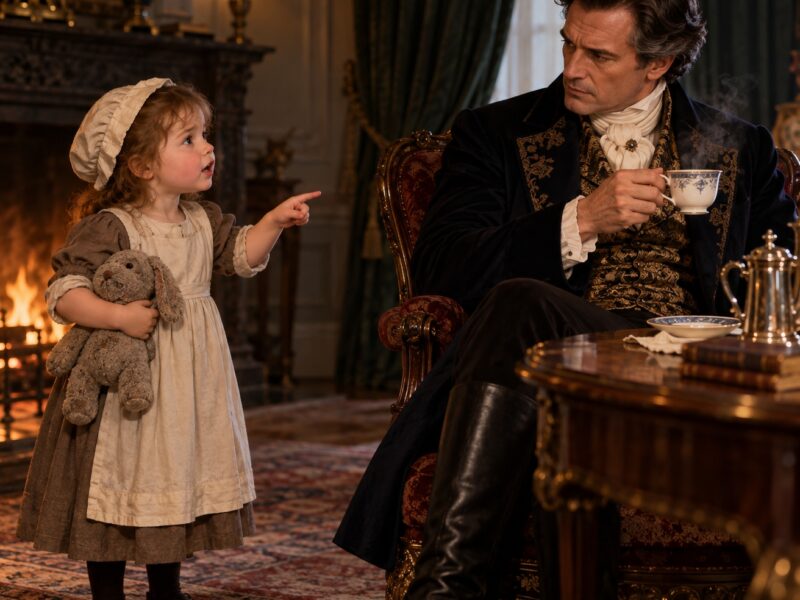
The Maid’s Three-Year-Old Told the Duke His Coffee Smelled Wrong—Five Months Later, Those Same Words Exposed the Man Who Had Been Slowly Poisoning Him
“Your coffee smells bad.”
The Duke dismissed the little girl’s warning without taking another look at his cup.
Five months later, when she said those same four words before seven witnesses, the most trusted man in his household realized that a three-year-old child had uncovered the secret he had spent eleven years protecting.
On the afternoon of April 9, 1815, the east parlor of Marchwood Hall was as dark and quiet as a room prepared for mourning.
Outside, spring sunlight warmed the stone terraces and the gardens of the great estate. Inside, heavy curtains shut out nearly all of it. A small fire burned low in the hearth, and a single lamp stood beside a blue-and-white porcelain coffee pot whose lid had been chipped long ago.
Gideon Vale, the fifth Duke of Marchwood, sat alone in a high-backed chair.
He had spent every afternoon this way for four years, seven months, and nine days.
At precisely half past three, the curtains were drawn. At four, coffee arrived. At five, the tray was removed, and the duke returned to the business of managing an estate that stretched across nineteen thousand acres.
The servants knew better than to disturb him during that hour.
But Bethia Marl was only three years and four months old, and she knew very little about what dukes expected.
She appeared in the doorway holding a gray cloth hare beneath one arm. The toy had a crooked ear that had been sewn back on twice, and Bethia considered it a creature of considerable intelligence.
She crossed the carpet, stopped beside the duke’s chair, and wrinkled her nose.
“Your coffee smells bad.”
Gideon slowly set down the paper he had been reading.
He looked first at the fire, then at the curtains, and finally at the child.
“It is coffee,” he said. “It is intended to smell.”
“Not like that.”
“Indeed?”
“It smells like the cupboard.”
“What cupboard?”
“The one with the keys on the door.”
Gideon regarded her for a moment. Then he reached for the bell.
Mrs. Thurl, the housekeeper, appeared almost immediately. When she saw Bethia standing beside His Grace, her face went pale.
“Miss Marl!”
She hurried forward, took the child’s hand, and drew her toward the door.
Bethia looked back over her shoulder.
“Pudding doesn’t like it either.”
The duke said nothing.
After the door closed, he sat staring at the coffee pot.
It was a Worcester porcelain piece, blue and white, with a small chip hidden at the back of the lid. His late wife had bought it in Hereford during their second year of marriage because she had admired its modest price and the honesty of the merchant who pointed out the defect.
Cecily had loved that pot.
For six years she had poured his afternoon coffee from it herself.
Gideon reached for his cup.
He drank because coffee had been poured. Because it was four o’clock. Because the pot had belonged to Cecily.
And because, somewhere in the years since her death, he had stopped asking whether the things placed before him were as they ought to be.
He noticed nothing.
Two floors above, Susanna Marl was kneeling beside a fireplace, scrubbing soot from the stone.
She had not yet discovered that her daughter had broken the three rules that kept them both employed.
Susanna was twenty-nine years old, a widow, and a woman who had learned to survive without expecting kindness.
Her husband, Jonah Marl, had been a carter. In November 1812, when Bethia was seven months old, his wagon overturned at Py Ford and crushed him beneath it.
He was brought home on the same cart that had killed him.
Susanna had washed his body on their kitchen table because there was nowhere else to lay him.
Nine people attended his burial.
One was the man who dug the grave.
The following morning, Susanna returned to work at Cold Harbor Dairy because there was nothing left in the house to eat.
Eventually, Mrs. Thurl had secured her a position at Marchwood Hall, where she received four pounds a year, her customary allowance of beer, and a cramped attic room beneath the east roof.
When Susanna begged permission to keep Bethia with her, the matter was placed before the duke.
He had answered with one word.
“Yes.”
Susanna had never forgotten it.
Neither had she mistaken it for an invitation to ask for more.
On Bethia’s first morning at the hall, she knelt beside her daughter in the servants’ passage and gave her three rules.
“You must never go into the east corridor after three o’clock.”
Bethia nodded.
“You must never speak to His Grace.”
Another nod.
“And you must never enter the room at the end of that corridor. Even if the door is open.”
Bethia considered this carefully.
“What is inside?”
“Nothing that concerns us.”
“Then why can’t I go?”
Susanna straightened the child’s cap.
“Because there are places in a great house that are not meant for people like us.”
For nine weeks, Bethia obeyed the rules with the exactness peculiar to very young children.
She did not enter the east corridor after three.
She went there before three instead.
She did not address His Grace directly.
She spoke loudly to Pudding whenever the duke happened to pass within hearing.
And when she found the east parlor door standing open one afternoon, she concluded that a door left open could hardly be the same thing as a door she was forbidden to open.
That was how the first conversation began.
Four days later, Bethia returned.
She found the duke asleep beside the hearth, his head tilted against the chair and one hand resting open on his knee.
For a while, she studied him.
Then she took a small square of flannel from beneath Pudding’s arm and spread it across his knees.
It was far too small to keep him warm.
She placed Pudding in the chair beside him, carefully facing the toy toward the fire, and settled on the hearth rug.
When Gideon woke, he found the child watching a narrow beam of sunlight that had slipped through the curtains.
The floating dust had turned gold.
“Why are you here?” he asked.
“Pudding wanted to see the light.”
“I see.”
“He says you are cold.”
“The fire is quite sufficient.”
Bethia looked at the small square of cloth over his knees.
“Then you may give the blanket back.”
For the first time in many months, Gideon found himself almost smiling.
The next morning, Mrs. Thurl discovered Pudding sitting on the arm of the duke’s chair.
The household went into a state of quiet alarm.
By eight o’clock, Susanna Marl stood outside Gideon’s steward’s room, ready to accept dismissal.
She had rehearsed everything she intended to say.
The fault was hers, not the child’s. Bethia was too young to understand the boundaries of a great house. Susanna would leave immediately if His Grace wished it, asking only for the wages already owed.
She delivered the explanation without once raising her eyes.
Gideon listened.
Then he asked, “Where is the hare?”
Susanna blinked.
“Your Grace?”
“The gray animal. One ear has been repaired.”
“Mrs. Thurl has it.”
“It is to be returned to the child.”
“Yes, Your Grace.”
“And the child is to come back.”
Susanna looked up.
“No.”
The duke put down his pen.
Susanna had worked in service since she was eleven. In all those years, she had never interrupted a gentleman, much less refused a duke.
But now that the word had escaped, she would not withdraw it.
“She is three years old,” Susanna said, her voice unsteady but clear. “If she is welcomed into that room today and turned away next Friday, she will not understand what she has done wrong.”
Gideon watched her.
“She will believe something is wrong with her,” Susanna continued. “I have seen what that does to children. I will not allow it to happen to mine.”
The silence lengthened.
“Not for four pounds a year,” she added, “and not for forty.”
Gideon leaned back.
“Then state your terms.”
“My terms?”
“You have refused me. I presume you have conditions under which you would reconsider.”
Susanna stared at him.
Then, slowly, she began.
“One hour in the afternoon, if she chooses. No one is to fetch her if she does not come. No one is to punish her for staying away.”
“Go on.”
“She is not to be given work. Not a message to carry, not a shoe to hold, not a single duty. She is a child in that room, not another servant.”
“Go on.”
“And when she tires of visiting, as children do, she may stop. Nothing is to be said about it, and I keep my position.”
Gideon considered her.
“Agreed.”
“To all three?”
“To all three.”
Susanna struggled for words.
“Your Grace, I—”
“Mrs. Marl, you have come into my room, given me conditions in my own house, and persuaded me to accept them. I should think that quite enough for one morning. There is no need to spoil it with gratitude.”
Susanna left with her hands trembling.
For the first time in years, she had spoken as though her wishes mattered.
And the most powerful man she had ever known had listened.
Bethia did not return for six days.
On the seventh, she appeared shortly before four and informed Gideon that Pudding had visited the cupboard with the keys on the door and disliked it.
On the eighth, she stayed eleven minutes.
On the ninth, she spent nearly the entire hour rearranging the fire irons by height.
Gideon explained why they had been arranged in their original order.
Bethia explained why hers was better.
After a thoughtful silence, he conceded the point.
Mr. Barnabas Ide, who had served as butler at Marchwood Hall for thirty-one years, happened to overhear the exchange.
He had carried a tray into the corridor and stopped outside the partly open door.
For several moments, he listened to the duke discussing fireplace equipment with a three-year-old girl.
Then he quietly carried the tray away.
That evening, he told Mrs. Thurl that something unusual was happening in the east parlor.
“What sort of thing?” she asked.
“I cannot say.”
But a week later, he heard something that he recognized immediately.
Laughter.
The duke had bent to retrieve a fallen spill when the lid of the porcelain pot slipped. He caught it awkwardly against his waistcoat, and Bethia burst into laughter.
Gideon looked at her.
Then, unexpectedly, he laughed too.
Mrs. Peasgood, the cook, heard him from the corridor and nearly dropped the basin she was carrying.
She went down to the kitchen and announced that His Grace had laughed.
No one believed her.
She repeated it twice.
Finally, she sat down on the flour bin.
“I have served in this house for nineteen years,” she declared. “And I have heard that sound only twice before.”
Meanwhile, someone else had heard about the child.
His name was Hugh Derwent.
For twenty-two years, Derwent had served as agent of the Marchwood estate. His father had held the position for thirty-one years before him.
He was a careful man, respected throughout the county.
He attended church, paid for repairs to its porch, remembered tenants’ children by name, and occasionally carried rent for struggling families from his own purse.
There were people in Thrushwater who would have trusted Hugh Derwent with their last shilling.
When the second footman mentioned the child visiting the east parlor, Derwent put down his pen.
“Every afternoon?”
“Yes, sir.”
“At four?”
“Yes, sir.”
Derwent stood and walked to the window.
For some time, he looked toward the great barn at Cold Harbor.
Then he put on his coat and went to the hall.
He found Susanna in the kitchen passage.
“I hear your daughter has been shown a great kindness,” he said pleasantly.
Susanna dipped her head.
“Yes, Mr. Derwent.”
“And what a fortunate little girl she is.”
He gave Bethia a penny.
“Bethia,” he said warmly. “A fine old name. There was a Bethia Derwent buried at Thrushwater many years ago.”
The child examined the coin.
“Pudding cannot spend money.”
“Then you must keep it for him.”
Derwent smiled.
He even remembered to caution Susanna about the steep turn in the servants’ staircase.
Everyone who witnessed the conversation thought it a charming example of his good nature.
Not one of them knew that he had already begun to consider how the child might interfere with a plan he had spent months arranging.
The duke, meanwhile, had begun to allow changes no adult had been able to make.
One afternoon, Bethia asked why the curtains were closed when the sun was shining.
“Because they have always been closed,” Gideon answered.
“That is not a reason.”
“It is the only one I possess.”
Bethia crossed the room and pulled back one curtain by several inches.
A narrow beam of golden light fell across the carpet.
She sat in it without asking permission.
The curtain remained open the next day.
And the day after that.
Soon a little oak chair arrived from a cabinetmaker in Hereford, built just high enough to accommodate a child and her cloth hare.
Gideon denied ordering it.
Unfortunately, the cabinetmaker sent a bill bearing His Grace’s name.
Mr. Ide kept that detail to himself.
There were now two chairs by the hearth.
And every afternoon, there were two cups.
That had been the custom since Cecily’s final illness.
The servants brought the blue-and-white coffee pot, a cup for the duke, and a second cup arranged neatly to its right.
No one had ever instructed them to stop bringing it.
In a house governed by long-established customs, an order that had never been cancelled might as well have been carved in stone.
One afternoon, Bethia pointed to the unused cup.
“Who drinks from that one?”
Gideon did not answer immediately.
The child waited.
Finally, he said, “Her name was Cecily.”
“Is she coming?”
“No.”
“Then why is her cup here?”
Gideon looked at the delicate handle.
“Because I have never told anyone to take it away.”
Bethia considered this.
“May I use it?”
He reached for the milk jug.
“You may.”
He poured a little coffee into the second cup and filled the remainder with milk.
Bethia took one sip.
“That is horrible.”
Gideon raised an eyebrow.
She took another.
“May I have more?”
He laughed softly.
That evening, when the tray was carried away, both cups had been used for the first time in nearly five years.
It was during the following weeks that Gideon finally began speaking about his wife.
Cecily had fallen ill in October 1810.
At first, there had seemed little cause for alarm. She was feverish one day, somewhat improved the next, and dangerously ill by the weekend.
On October 29, she asked to be carried downstairs to the east parlor.
The light was beautiful there in the afternoon.
Gideon carried her himself and settled her into the chair beside the window.
Then a steward came to speak about a drainage problem.
It was an ordinary matter, the sort that required his attention every day.
He went outside to discuss it.
While he stood in the yard examining a ditch, Cecily died.
Twenty minutes before five.
Two hundred feet away from him.
For nearly five years, Gideon had returned to that hour every afternoon, repeating its familiar rituals as though repetition might somehow change the last thing he remembered.
Bethia listened from the hearth rug.
“Were you cross?” she asked.
“Yes.”
“With her?”
“No.”
“Then with whom?”
“With the man who fetched me. With the ditch. With myself, principally.”
Bethia consulted Pudding.
“He says that is silly.”
“Does he?”
“He says you did not know.”
Gideon looked toward the open strip of sunlight.
For the first time, he did not immediately find a reason to disagree.
Some days later, Susanna came to collect her daughter and found Bethia sleeping beneath the little square of flannel.
Gideon invited her to sit.
She did, though with visible uncertainty.
Neither spoke for eleven minutes.
Then Gideon said, “You may take her when she wakes.”
“I know, Your Grace.”
“She appears comfortable.”
“She can sleep anywhere.”
A faint smile crossed his face.
“I have discovered that.”
Susanna looked at the room, the curtains, the porcelain pot, and the cup her daughter had begun to use.
“Your wife was fortunate in some ways,” she said quietly.
Gideon turned toward her.
Susanna’s fingers tightened around the mending in her lap.
“She had a physician within the hour. She had people to nurse her. A proper bed. A household that could stop its ordinary work to care for her.”
“Yes.”
“When she died, the whole parish mourned.”
“Yes.”
“Four hundred people came to the church.”
Gideon said nothing.
Susanna lowered her eyes.
“My husband came home on the cart that killed him. I washed him on our kitchen table. We buried him on Thursday because we could not keep him in the house any longer.”
Her voice remained steady, but she had stopped sewing.
“Nine people attended. On Friday, I went back to the dairy because my child needed food.”
Gideon sat very still.
“For two years,” Susanna continued, “I thought there was something unjust in a grief that could have four hundred mourners when mine had nine.”
“And now?”
“Now I have watched a man with nineteen thousand acres keep a cup on a tray because he cannot bear to say that it is no longer needed.”
She laid down her needle.
“I find I cannot make grief into a competition.”
Gideon looked at her for a long time.
“Nor can I,” he said.
It was the beginning of an understanding neither had expected.
Susanna never pretended that their lives had been equally difficult.
Gideon never pretended that money had made his loneliness disappear.
They spoke about ordinary things: Bethia’s shoes, the damp corner of Susanna’s attic, books Susanna could not read, and the small collection of letters Jonah had left behind.
She owned two gowns, one wedding ring she refused to sell, and a box containing her husband’s writing.
He had learned only a handful of words.
She treasured every one.
When Gideon asked what she missed most, Susanna took some time to answer.
“Someone who must ask how I am,” she said at last. “Not because I am ill or have failed at my work. Simply because he wants to know.”
Gideon had no immediate reply.
But after that afternoon, whenever Susanna entered the room, he began by asking how she was.
At Cold Harbor, Hugh Derwent was making a different kind of inventory.
Behind a removable panel in the chimney breast of his office, he kept a small green pocketbook and a bundle of letters.
One letter came from a legal gentleman in Lincoln’s Inn.
Derwent had read it eleven times.
It explained that seclusion, eccentricity, and melancholy would not alone establish a gentleman’s mental incapacity.
A commission would require stronger evidence.
Public violence.
Credible witnesses.
Actions that could be represented as the loss of reason.
Derwent carefully folded the letter.
Then he opened the pocketbook.
Against the initials S.T., he entered another payment of two guineas.
The entry was neat, properly dated, and indistinguishable in appearance from the rest of his meticulous accounts.
That habit of recording everything would eventually ruin him.
But in June 1815, he still believed himself the most careful man in Herefordshire.
His grievance had begun eleven years earlier.
When the fourth Duke of Marchwood died, Derwent had expected to receive the farm at Cold Harbor, two hundred and forty acres of desirable land that he had long considered his reward for decades of family service.
He had drained one of its fields at his own expense.
He had watched over its tenants.
His wife was buried within sight of the great barn.
He believed the previous duke had intended him to hold it for life at a nominal rent.
But the will contained no such provision.
Instead, it left him forty pounds and an expression of thanks.
The new duke, Gideon Vale, examined the will, paid the bequest, retained Cold Harbor as estate property, and increased Derwent’s annual salary by thirty pounds.
Derwent accepted the increase with elaborate gratitude.
He never forgave it.
Over the following eleven years, he diverted estate money through false timber accounts, fabricated quarry invoices, and dishonest leases.
By his own calculation, he had taken £11,460.
The most valuable deception involved Cold Harbor grazing land.
In November 1813, he prepared a lease for a fictitious tenant named Josiah Verrell of Bristol.
The land was worth approximately £160 a year.
The lease granted it for nine.
Derwent placed the document among forty other papers on an afternoon when the duke was suffering from a headache.
Gideon signed them all.
That signature had become Derwent’s principal protection.
If the duke was competent, Derwent could argue that he had knowingly authorized the arrangement.
If the duke was incompetent, Derwent would be the obvious person to recommend as the estate’s continuing administrator.
But there was a difficulty.
Shortly after Christmas 1814, Gideon had asked to examine four years of quarry invoices.
Derwent understood that the duke had finally begun looking where he had not looked before.
And so Derwent devised a way to make him too ill to continue.
The scheme had another advantage.
A sick, isolated gentleman who signed documents without reading them would make an excellent subject for whispered doubts about his judgment.
If the gentleman could then be provoked into attacking his trusted agent before witnesses, those whispers might become legal proceedings.
The entire arrangement depended upon patience.
Hugh Derwent was very patient.
For several months, everything went according to plan.
Then a three-year-old child began visiting the east parlor.
In early June, Bethia came into the kitchen with news that troubled her mother.
“A man at the pump knew my name.”
Susanna looked up from her washing.
“What man?”
“The one with the yellow horse.”
“What did he want?”
“He asked which window was ours.”
Susanna felt an unpleasant tightening beneath her ribs.
“And what did you tell him?”
“The one with the brown stain.”
Their attic window overlooked the yard. Bethia was proud of recognizing it.
Susanna asked Mr. Ide whether anyone in the household owned a yellow horse.
He knew of none.
The stable hands knew of none.
The village smith had seen no such animal belonging to Marchwood.
Susanna took her daughter upstairs and locked their door.
That evening, she went to the east parlor.
The duke was sitting beside Bethia, who was explaining why Pudding had quarreled with the doll’s chair.
Susanna waited until the child had finished.
Then she told him about the man at the pump.
Gideon listened without interrupting.
When she had finished, he gestured toward the chair.
“Mrs. Marl, please sit.”
“Your Grace?”
“I should like to ask you some questions. And I would rather not ask them while you stand, because standing makes them sound like orders.”
Susanna sat.
The questions continued over the following days.
Gideon asked Mr. Ide who brought the coffee tray.
He asked Mrs. Thurl where the sugar was kept.
He asked Mrs. Peasgood whether his coffee was prepared differently from the way it had been made in former years.
The cook hesitated.
“Only one change, Your Grace.”
“What change?”
“Since January, Mr. Simeon Tap has been taking the tray from the stillroom and carrying it up himself. He said the back staircase was difficult for the kitchen maids.”
Simeon Tap was the nineteen-year-old second footman.
Gideon frowned.
“Since January?”
“Yes, Your Grace. Since you began feeling poorly.”
“I was not poorly in January.”
Mrs. Peasgood looked uncomfortable.
“With respect, Your Grace, you were poorly then. You were poorly at Lady Day, and you are poorly now.”
The duke stared at her.
She twisted her apron in her hands.
“You have grown terribly thin, sir.”
After she left, Gideon went upstairs and stood before the full-length mirror in his dressing room.
For the first time in years, he examined himself carefully.
His coat hung loosely across his shoulders.
His face had grown narrow.
He had lost more than two stone since the previous autumn.
His hands trembled in the mornings.
Twice a week, usually between six and eight in the evening, he suffered bouts of nausea.
Headaches began shortly after five and disappeared before bedtime.
He had forgotten names, lost his place in conversations, and found himself unable to concentrate on accounts he had once understood instantly.
He had attributed these changes to age, grief, and the habits of a solitary life.
Now he began to wonder.
Dr. Elias Munn arrived from Hereford on June 19.
He examined the duke, questioned him carefully, and recorded the timing of his symptoms.
At the end of nearly an hour, the physician closed his notebook.
“I do not like this, Your Grace.”
“Be more specific.”
“Your illness keeps remarkably regular hours.”
“Is that significant?”
“Most illnesses do not keep appointments.”
Gideon looked toward the blue-and-white coffee pot.
He did not drink from it that afternoon.
Eleven days later, Bethia settled the matter in her usual manner.
She was arguing about whether Pudding might sit directly on the fender when Gideon reached for his cup.
The child wrinkled her nose.
“Your coffee smells like Mr. Derwent’s cupboard.”
Gideon’s hand stopped.
“What did you say?”
“The cupboard with the keys.”
“You mentioned a cupboard in April.”
“Yes.”
“Tell me about it.”
Bethia looked impatient.
“There is gray powder in the paper. Mrs. Peasgood’s coffee does not smell like that.”
Gideon carefully placed the cup in its saucer.
His hand had begun trembling.
“Bethia,” he said gently, “sit in your chair.”
She obeyed.
“I am going to ask you four questions. You are not in trouble.”
“Is Pudding?”
“Pudding is in very considerable trouble, but we shall attend to him afterward.”
The child settled the toy in her lap.
“Where is the cupboard?”
“At Cold Harbor. In the room with the maps.”
“When did you see it?”
“When Mama took Mr. Derwent a letter.”
“Was he there?”
“No. We waited.”
“Was the cupboard open?”
“The key was in the door. There was a big paper and a little blue one. Mama told me not to touch them.”
“Did you?”
“No.”
Bethia looked offended that he had needed to ask.
Gideon took a slow breath.
“Was anyone else there?”
“Mr. Derwent came back.”
“And what did he do?”
“He put something away. Pudding did not like the smell.”
The duke sat motionless.
For a moment, the room seemed to have become very cold.
He remembered April.
The little girl standing beside his chair.
Her small, serious face.
The warning he had dismissed.
Then he remembered the physician’s words.
Illnesses do not keep appointments.
That evening, Gideon wrote to his solicitor, Tobias Wren, asking him to bring every quarry invoice since 1811 and every document executed in November 1813.
He ordered the sugar basin from his coffee tray and the original canister from the stillroom sealed separately and secured under witness.
He instructed Mrs. Peasgood to prepare and carry his coffee personally from then on.
And he sent for Susanna Marl.
When she entered, he asked her to sit.
This time, he did not attempt to soften what he had to say.
“I believe someone in my employment has been poisoning me.”
Susanna went utterly still.
“I believe your daughter has told me so twice,” he continued. “And I failed to hear her the first time because she is three years old.”
Susanna’s fingers tightened around the edge of her chair.
“The man at the pump knew her name,” she whispered.
“Yes.”
“Then I must take her away.”
Gideon nodded.
“That would be the safest decision. I will provide everything necessary for you to leave tonight.”
He hesitated.
“But I am going to ask whether you will consider staying.”
Susanna looked at him sharply.
“Why?”
“Because someone has made plans that extend beyond my illness. I intend to learn what they are. And I believe Bethia may be in danger whether she remains here or leaves without protection.”
For a long moment, Susanna said nothing.
Then she straightened.
“I have three conditions.”
Gideon almost smiled despite the seriousness of the moment.
“I should be astonished if you had fewer.”
“Nothing concerning Bethia is to be decided without me. Not by you, not by your solicitor, not by any magistrate. I must be told and asked first.”
“Agreed.”
“You must not ride out to confront Mr. Derwent.”
Gideon’s expression changed.
Susanna saw it.
“He is a patient man,” she said. “I worked in his dairy. He knows how to wait. Whatever he has planned, your anger is part of it.”
Gideon looked toward the window.
“You have considered this carefully.”
“I have considered what happens to children when grown men lose their tempers.”
“Agreed.”
“And when this is finished, if we survive it, I keep my place and my wages. I will not become a woman who was useful once and was then expected to be grateful forever.”
Gideon met her eyes.
“Agreed to all three.”
He paused.
“And I have one condition of my own.”
Susanna waited.
“If you decide to leave, at any hour, for any reason, the carriage and the money are yours. You will not have to explain yourself to me.”
“That is generous, Your Grace.”
“No. It is the only way I can ask you to stay without turning the request into an order.”
Susanna looked down at her hands.
Then she lifted her eyes.
“We will stay.”
For the first time since Jonah’s death, she had made a decision that involved trusting another adult with her daughter’s safety.
It frightened her more than she cared to admit.
And she had no idea how close that decision would bring them to disaster.
When Tobias Wren arrived, he brought two boxes of documents and a clerk.
By nightfall, papers covered the library table.
The solicitor removed his coat, an event his clerk had never witnessed before.
“The quarry accounts are false,” Wren announced.
Gideon remained seated.
“Explain.”
“Several supposed purchasers cannot be found. Other invoices appear to have been written in Mr. Derwent’s own hand. The Cold Harbor grazing lease is to a man who does not appear to exist.”
“Josiah Verrell.”
“Precisely. The annual rent is nine pounds. The land should command approximately one hundred and sixty.”
“And my signature?”
“Is genuine.”
Gideon closed his eyes briefly.
Wren continued.
“That is what makes this dangerous. Mr. Derwent may argue that you knowingly authorized the transaction. Alternatively, he may suggest that you were too unwell to understand what you signed.”
“And if I were to strike him?”
Wren looked up.
“Then you might supply the very evidence he requires to have your capacity formally questioned.”
Gideon thought of Susanna standing before him.
You must not ride out to confront him.
For the first time, he understood the full weight of her warning.
Over the following weeks, the atmosphere at Marchwood Hall changed.
Two strangers were found beneath a hedge near the Thrushwater road.
One had a yellow horse.
A valuable mare in the duke’s stable was deliberately injured.
Letters arrived hinting that Gideon’s mind was failing.
Lady Cordelia Framley, his elderly aunt, appeared uninvited in early July.
She spoke bluntly about the rumors circulating in the parish.
“A housemaid’s child in Cecily’s room,” she said with open disapproval. “Her mother sitting beside you. People say the woman intends to make herself indispensable.”
“She has asked me for nothing.”
“Then she is cleverer than I imagined.”
Gideon looked at his aunt.
“She has refused me twice, and on both occasions her judgment was better than mine.”
Lady Cordelia stiffened.
“The parish believes you are unwell.”
“The parish is correct.”
“Then come to Bath with me. Leave the estate to Derwent and recover your health.”
Gideon was silent for a moment.
“Aunt, that is the most dangerous suggestion anyone has made to me since Christmas.”
Her expression changed.
“Gideon?”
He told her about the coffee.
About the invoices.
About the child.
When he finished, Lady Cordelia sat very still.
“Then why are you not already in London?”
“Because the man responsible would like me to arrive there as a sick gentleman whose word is doubted. I intend to arrive with evidence.”
Lady Cordelia looked toward the little oak chair beside the hearth.
“And the woman?”
“Mrs. Marl has taught me that there is a difference between standing firm and merely refusing to move.”
His aunt said nothing more against Susanna that evening.
But Hugh Derwent had not yet finished.
On the morning of July 21, an unsigned letter arrived at Marchwood Hall.
It claimed that Bethia Marl had been taken to Cold Harbor Barn.
It warned that unless the duke came alone, without servants or a magistrate, the child would be carried to Bristol and disappear.
Gideon read the letter twice.
Then he strode into the yard and ordered a horse saddled.
By the time he reached the archway, his face was white with anger.
He had one foot raised toward the stirrup when Susanna appeared before him.
“No.”
“Move aside, Mrs. Marl.”
“No, Your Grace.”
“The child is at Cold Harbor.”
“The child is in the stillroom.”
Gideon stopped.
Susanna’s face was pale, but she did not move.
“She is under the table with Pudding and a bowl of gooseberries. Mrs. Peasgood is guarding the door with the kitchen poker across her knees.”
Gideon stared at her.
“I checked on Bethia every quarter of an hour after that letter arrived,” Susanna continued. “I knew exactly what he would try.”
Gideon gripped the reins.
“Then he intends to make his threat true.”
“No. He intends you to believe it for as long as it takes to ride to Cold Harbor.”
The horse shifted impatiently.
Susanna stepped closer.
“There will be men waiting. There will be witnesses. Someone will write down every angry word you speak. And when you strike him, as he hopes you will, he will use it to take your estate and your liberty.”
Gideon said nothing.
“You promised me,” Susanna whispered.
“I know.”
“You agreed to my condition.”
His jaw tightened.
“You are asking me to stand here while he threatens your daughter.”
“I am asking you to understand which of us he is truly trying to destroy.”
The words struck him harder than any accusation.
Susanna’s eyes filled, but her voice did not break.
“If you ride out now, I will take Bethia and leave this parish. Not because you were wrong to be angry. Because you will have shown me that you cannot be trusted to keep your word when it becomes difficult.”
Gideon stared at her for several breaths.
Then he slowly lowered his foot to the cobblestones.
He handed the reins to the stable boy.
“You are right.”
Susanna swallowed.
“Please say it again, Your Grace. So the yard can hear.”
Gideon turned toward the waiting servants.
“Mrs. Marl is right,” he said clearly. “I was wrong. And I am obliged to her.”
No one moved.
The duke walked back into the house.
In the privacy of the steward’s room, he sat with his head in his hands and was violently sick.
For twenty minutes, he remained there.
Then he sent for his solicitor, his physician, Mr. Ide, and the head groom.
They would proceed carefully.
They would collect evidence.
They would give Hugh Derwent nothing he could use.
The process was slow and frustrating.
Dr. Munn carried the sealed sugar samples to a chemical specialist in Worcester.
The results confirmed the presence of antimony and another substance with a strong, unpleasant smell in the sugar from Gideon’s tray.
The original sugar canister was uncontaminated.
Someone had been adding the substances after the sugar left the stillroom.
The solicitor traced false invoices, undervalued leases, and payments that led back to Derwent.
A surveyor admitted that he had assigned a value to the Cold Harbor land without ever inspecting it.
Buyers produced receipts showing they had paid much more for stone than Derwent’s records acknowledged.
The duke also wrote private letters to tollkeepers, coach operators, and trusted tenants throughout the surrounding district.
He asked them to report unusual carriage hire or attempts to remove anyone connected with Marchwood.
He instructed them to interfere with no traveler merely on suspicion.
He wanted information, not another offense committed in his name.
For several weeks, Derwent appeared unaware of how much was being uncovered.
Then, on September 3, he changed his approach.
At six in the evening, a boy arrived at the kitchen door carrying a note addressed to Susanna.
Mrs. Peasgood read it aloud.
Susanna’s sister Anne, who lived at Denmore and was seven months pregnant, had supposedly gone into labor early and was dangerously ill.
Mr. Derwent had kindly arranged a gig.
He would drive Susanna himself.
She should bring Bethia because the journey might require an overnight stay.
Susanna felt the blood drain from her face.
She had spoken to Derwent about Anne’s pregnancy months earlier.
He had remembered the details.
Of course he had.
Derwent was waiting in the yard when she came outside.
He sat holding the reins with a rug over his knees and his hat respectfully removed.
“Come along, Mrs. Marl. We must not keep your sister waiting.”
Bethia clutched Pudding.
“Pudding doesn’t like gigs.”
Derwent smiled and lifted her onto the seat.
“Then Pudding must sit in the middle, where the ride is steadier.”
Susanna remained beside the wheel.
“Does Mrs. Thurl know we are leaving?”
“Certainly. I spoke to her as I came through.”
And there it was.
The single mistake.
Mrs. Thurl had left for Hereford at four o’clock and would not return until nine.
Derwent could not have spoken to her.
Susanna looked at her daughter already sitting in the gig.
She understood the danger at once.
A frightened woman who began shouting accusations against a respected gentleman might be dismissed as hysterical before anyone thought to investigate.
A woman who stepped quietly into the carriage, however, might still find a chance to act.
Susanna climbed aboard.
“Mind the turn at the bottom of the drive, sir,” she said. “It washes out badly.”
Derwent gave a reassuring smile.
“I have driven that road for twenty-two years.”
They passed beneath the trees.
At the end of the drive, Derwent turned right.
Denmore lay to the left.
Susanna kept her voice calm.
“Sir, that is not the road to my sister’s house.”
“The other road is flooded.”
“It has not rained for a fortnight.”
Derwent did not answer.
Bethia leaned against her mother’s arm and fell asleep.
The gig continued toward Py Cross.
Beyond it lay the Hereford turnpike.
And beyond that, the road to Bristol.
Susanna held her daughter closer.
She knew now that Derwent had never intended to take them to Anne.
What she did not know was whether anyone at Marchwood had realized they were missing.
At the Py Cross tollgate, the carriage slowed.
The keeper came out with a lantern.
He took an unusually long time to find the proper change.
Derwent grew impatient.
Behind them, far down the road, another vehicle approached with its lamps extinguished.
It was the estate dogcart.
Mr. Barnabas Ide sat beside the head groom, a letter of authority from the duke folded inside his coat.
Ahead, a farmer’s wagon stood across the turnpike with a damaged wheel.
Farther along the road waited Sir Lucian Brace, a magistrate who had received an urgent message that afternoon.
Derwent saw the blocked road too late.
He pulled the reins.
The gig stopped.
Mr. Ide stepped down from the dogcart.
He removed his hat.
“Mrs. Marl, will you please come down? And the child.”
Susanna did not hesitate.
She handed Bethia into the butler’s arms and climbed down herself.
Derwent remained seated.
“There appears to be some misunderstanding,” he said.
Mr. Ide looked at him.
“There does indeed, sir.”
“I was taking Mrs. Marl to her sister.”
“Her sister lives at Denmore, which is behind us.”
“The road is washed out.”
“And Mrs. Thurl is in Hereford, although you told Mrs. Marl you had spoken to her at the hall.”
Derwent’s pleasant expression finally faltered.
“Stand away from my horse.”
“No, sir.”
Derwent climbed down.
As he did, his coat caught on the iron step.
Something fell from his pocket.
A green pocketbook.
A handkerchief.
And a small blue glass vial.
The vial struck the road and rolled across the stones until it came to rest against Mr. Ide’s shoe.
The butler looked down.
For several seconds, no one spoke.
Then Bethia, still in his arms, pointed.
“That is his.”
Her small voice carried clearly through the evening air.
“That is from the cupboard with the keys on the door.”
Sir Lucian Brace approached with his lantern.
He picked up the green pocketbook.
When he opened it, he found a series of carefully written entries.
The same initials appeared again and again.
S.T.
Two guineas.
S.T.
Two guineas.
The payments began in January.
The final entry was dated August 31.
Sir Lucian looked toward the butler.
“Mr. Ide, is there anyone at Marchwood Hall with those initials?”
“Yes, sir.”
“Who?”
“Simeon Tap. The second footman.”
The magistrate closed the book.
Then he turned to Hugh Derwent.
“I think, Mr. Derwent, that you and I have a great deal to discuss.”
For the first time in twenty-two years, the trusted agent of Marchwood had no useful answer.
The following day, September 4, the great hall became the setting for a formal examination before the magistrate.
Seven adult witnesses and officers sat or stood around the long table.
Tobias Wren had arranged the financial records in four bundles.
Dr. Munn carried the chemical report.
Mrs. Thurl sat with the household keys in her lap.
Mr. Ide stood beside the door.
Lady Cordelia watched from the window.
And Simeon Tap, nineteen years old, stood in his livery with his hands clasped behind his back.
Susanna sat near the end of the table.
Bethia played on the floor at her feet.
Her mother had insisted upon being present whenever the child was questioned, and the duke had kept his promise.
For nearly two hours, the evidence was read.
The false lease.
The impossible tenant.
The stolen quarry revenue.
The altered invoices.
The chemical findings.
The record of the coffee tray changing hands.
Hugh Derwent answered almost everything in a calm, reasonable voice.
He had explanations ready.
He had been the estate’s agent for twenty-two years.
He understood the accounts better than most of the men examining them.
Even when his explanations became difficult to believe, he delivered them with the composure of a man accustomed to being trusted.
But he could not explain the green pocketbook.
Sir Lucian opened it before Simeon Tap.
“Come here, young man.”
Simeon obeyed.
“Can you read this entry?”
The footman bent forward.
He shook his head.
“Then I shall read it for you. January 9, 1815. S.T. Two guineas.”
Simeon’s face changed.
The magistrate continued.
“There are forty-one such entries in this book.”
Simeon looked toward Derwent.
“He wrote them down?”
Derwent said nothing.
“He told me nothing was written down.”
The magistrate regarded him.
“Then he deceived you.”
Simeon began trembling.
Sir Lucian waited.
Finally, the young man spoke.
In January, Derwent had offered him two guineas every fortnight to carry the duke’s coffee tray.
He had supplied a small blue vial and told Simeon that the substance it contained was a medicinal tonic.
The duke, Derwent claimed, was embarrassed to be seen taking it.
At first, Simeon believed him.
Later, he suspected something was wrong.
But the money helped support his mother, and Derwent knew precisely how to make a frightened young servant feel that refusing an order would cost his family everything.
Simeon continued adding the substance to the sugar.
He admitted that Derwent had instructed him to use the sugar basin rather than the pot.
He admitted that he had been promised additional money and employment in Bristol.
And he admitted that he had been told to wait at Cold Harbor Barn in July with a notebook and pencil.
“To write what?” the magistrate asked.
“Whatever His Grace said when he came.”
“Did His Grace come?”
“No, sir.”
“Why not?”
Simeon glanced toward Susanna.
“Because Mrs. Marl stood in the archway and told him he was wrong.”
He swallowed.
“And His Grace said she was right. Out loud. So the whole yard could hear.”
A silence settled across the hall.
Hugh Derwent looked down at the floor.
Gideon had not spoken during the examination.
He sat at the head of the table wearing a coat that no longer fitted his wasted frame.
His hands were steady now.
Beside him stood the blue-and-white coffee pot with the chipped lid.
Mrs. Peasgood had brought it in with the tray because he had asked her to.
The sealed sugar basin, preserved as evidence, was also on the table.
Gideon reached for the pot.
He poured a small amount into a cup.
Then he added a spoonful of the contaminated sugar.
The unpleasant odor rose into the warm air.
Bethia looked up from the floor.
She stood, carrying Pudding, and walked toward the duke.
She stopped beside his chair.
“Your coffee smells bad.”
Exactly as she had said in April.
Seven witnesses heard her.
No one laughed.
Gideon looked at the cup.
Then he looked across the hall at Hugh Derwent.
His expression became so cold that Mr. Ide instinctively moved a step forward.
Derwent took a step backward.
The duke did not rise.
He did not raise his voice.
“Bethia,” he said softly, “go back to your chair. You have done nothing wrong.”
The child obeyed.
Gideon set down the cup without tasting it.
“Mr. Derwent,” he said, “in April, this child warned me about my coffee. I told her that coffee was meant to smell, and I sent her away.”
Derwent remained silent.
“Since that afternoon, I have learned what you took from my estate. I have learned what you arranged to be put into my food. I have learned what you intended to do with evidence of my anger.”
He paused.
“And this week, you put a mother and her daughter into a carriage and drove them toward Bristol.”
Derwent opened his mouth.
Gideon raised one hand.
“I have one question.”
The room was utterly still.
“Why did you never ask me for Cold Harbor?”
Derwent’s eyes narrowed.
For the first time that day, the careful agent spoke without preparing his answer.
“Because you would have refused.”
Gideon studied him.
“No,” he said quietly. “I would have granted it. Not because you had a right to it, but because I knew what your family had given mine.”
Derwent stared at him.
Gideon continued.
“You spent eleven years taking by deceit what you might have received through an honest request.”
For a moment, Derwent appeared older than his fifty-one years.
Then the duke turned toward the magistrate.
“Sir Lucian, the matter is yours.”
The proceedings continued until evening.
Hugh Derwent was committed to await trial on the evidence concerning forgery and the administration of a harmful substance.
Simeon’s confession was recorded.
The financial losses were examined.
In the following March, Derwent was convicted on the forgery charges and sentenced to two years’ imprisonment, with restitution ordered from his assets.
He was neither hanged nor transported.
His punishment was severe enough to strip away the life he had constructed, yet far less dramatic than the ruin he had intended for another man.
When he was released in 1818, he went to Bristol and found work keeping accounts.
He lived until 1831.
In Thrushwater, people continued to speak of his generosity toward the church, of the tenants he had helped, and of the kindness he had shown in countless small matters.
Those memories were genuine.
So were his crimes.
The people who had trusted him spent years learning to hold both truths at once.
Simeon Tap was dismissed without a reference, though the duke supplied a modest sum and a letter to a farmer who might employ him away from the hall.
By Christmas, Gideon had regained much of the weight he had lost.
By the following Easter, his hands had stopped trembling.
But his recovery was not celebrated with a grand dinner or a procession of grateful tenants.
It happened slowly, through ordinary mornings and quiet afternoons.
He began reading every document before he signed it.
He reviewed the estate’s leases with his solicitor.
He replaced arrangements that relied too heavily upon a single trusted agent.
He also began leaving the doors of his rooms open.
In October, the heavy curtains in the east parlor were taken down for cleaning.
No one put them back.
The fire was built properly.
The lamp was allowed to remain unlit on bright afternoons.
And Bethia no longer had to slip through the doorway as though she were trespassing.
She came and went with Pudding, the doll’s chair, and whatever new opinion she had formed about the world.
Sometimes she remained for an hour.
Sometimes she stayed five minutes.
The duke never called her back when she chose to leave.
He had promised her mother that much.
He kept his promise.
One afternoon in November, Mr. Ide passed the open door and saw something that made him stop.
The duke sat on one side of a bright fire.
Susanna Marl sat opposite him with her mending.
Bethia slept on the hearth rug beneath a square of flannel, her gray cloth hare tucked under her chin.
Two empty cups stood on the tray.
The afternoon sunlight moved slowly across the carpet.
Mr. Ide looked into the room for several seconds.
Then he walked away without announcing himself.
He had served the family for thirty-one years and understood that some things became less precious when they were explained.
By February 1816, Mrs. Thurl had grown tired of watching Susanna carry coal to eleven fireplaces while the second housemaid waited for work.
She informed Susanna that she was being reassigned to the stillroom.
Susanna protested.
Mrs. Thurl ignored her.
In time, Susanna took charge of the linen as well.
By 1817, she held the household keys for those departments and earned eighteen pounds a year.
She no longer slept in the damp attic room.
She also learned to read.
At first, Bethia practiced her letters at the kitchen table while her mother mended.
Then the child began teaching Susanna the characters she had learned from her hornbook.
It was a humbling arrangement.
Bethia was an impatient instructor.
Susanna often laughed until tears filled her eyes.
One evening in March 1817, she signed her own name on a wage receipt for the first time.
She stared at the ink for several moments.
Then she carefully folded the paper and carried it upstairs.
Gideon examined it as though it were a legal instrument of immense consequence.
“An excellent signature,” he declared.
“It is crooked.”
“Most first efforts of consequence are.”
“It took me nearly five minutes.”
“Then I consider it five minutes well spent.”
Susanna smiled.
She had begun to smile more often.
Gideon had noticed.
He also noticed that he had begun arranging his afternoons around the possibility of her entering the room.
Sometimes they talked.
Sometimes she read aloud from a book, slowly and with frequent corrections from Bethia.
Sometimes neither spoke.
The silence no longer frightened him.
In May 1817, Gideon finally said what he had been considering for six weeks.
They were sitting in the east parlor.
Susanna had a linen inventory on her lap.
The curtains were gone, the windows open, and afternoon light filled the room.
Gideon cleared his throat.
“I am going to tell you three things that are not the reason for what I am about to ask.”
Susanna looked up.
“That sounds rather complicated.”
“I fear it is.”
“Then begin.”
“It is not gratitude.”
She laid down her pencil.
“If it were gratitude, I should have settled money upon you after September 1815. You would have been entitled to accept it and go.”
Susanna said nothing.
“It is not rescue,” he continued. “You were feeding your daughter before I knew you. You were working. You had the courage to refuse me when you believed I was wrong. There is no truthful account of this story in which I rescued you.”
Her expression softened.
“And it is not necessity. You have your position, your wages, and a character that would place you in another respectable household. If you left Marchwood, you could provide for yourself and Bethia.”
Gideon paused.
“I have tried to make certain of that.”
“Why?”
“Because I wanted to ask you something without making it difficult for you to refuse.”
The room became very still.
Susanna’s fingers tightened around the linen list.
“What do you wish to ask?”
Gideon looked directly at her.
“I have come to prefer the afternoons when you are here.”
She did not move.
“I am not an easy man,” he said. “I am exacting, often silent, and inclined to mistake habit for judgment. I spent nearly five years behind closed curtains because I did not know how to live in a room without my wife.”
His voice grew quieter.
“You came into that room with your daughter and expected nothing from me except that I should treat her fairly.”
Susanna looked away.
“You spoke to me honestly when others were afraid to do so. You stayed when staying was difficult. And I find that the happiest part of my day is no longer the hour I spend remembering someone who has gone.”
He drew a breath.
“It is the hour I spend with someone who is here.”
Susanna’s eyes filled.
Gideon did not reach for her.
“I have ordered a great many things in my life,” he continued. “I am trying to learn the difference between ordering and asking.”
He paused.
“So I am asking whether you would consider becoming my wife.”
For several moments, Susanna could not speak.
Then she looked at him with the same expression she had worn two years earlier when she first refused to allow Bethia into his room without conditions.
“I have terms.”
Gideon smiled.
“I should be disappointed otherwise.”
“The first is Bethia. You must ask her. Not tell her. If she does not wish it, then nothing changes.”
“Agreed.”
“The second is Jonah.”
Gideon waited.
“He was her father. He was a good man. He drove a cart and worked until his hands bled. He could barely write, but he wrote me letters because he knew I liked to have something of his when he was away.”
Her voice trembled.
“I will not have my daughter grow up hearing that she has been given a better father.”
Gideon leaned forward.
“No one replaces anyone in this house.”
Susanna looked at him.
“Cecily has not been replaced,” he continued. “And Jonah will not be replaced.”
Tears slipped down Susanna’s cheeks.
“I know you visit Cecily’s grave,” she whispered.
He was startled.
“How?”
“I have put flowers there myself.”
He looked down at his hands.
Then he said, “Thank you.”
Susanna wiped her face.
“And the third?”
“The third is for me.”
She took a moment to steady herself.
“When someone comes with a letter, or a title, or an opinion about what a duke ought to marry, I will not allow myself to be driven away simply because remaining is difficult.”
Gideon reached across the table.
This time, Susanna placed her hand in his.
The following afternoon, Gideon invited Bethia into the east parlor alone.
She came with Pudding and considerable suspicion.
“Your mother and I are thinking of being married,” he told her.
Bethia climbed into the little oak chair.
“Will there be cake?”
“Almost certainly.”
“Will Mama still live here?”
“Yes.”
“Will I?”
“Yes.”
“Will Pudding?”
“I cannot imagine the household functioning without him.”
Bethia considered this.
“Does that mean you will be my papa?”
“If you wish. But you already have a father, and I will never ask you to forget him.”
“Jonah Marl.”
“Yes.”
“He drove a cart.”
“He did.”
“And he is in the churchyard.”
Gideon nodded.
“Your mother will always tell you about him. And so will I.”
Bethia looked at Pudding.
“Then you could be Papa Gideon.”
“I should be honored.”
“Can Pudding come to the wedding?”
“His attendance is essential.”
Bethia thought for another moment.
“Then yes.”
Gideon released a breath he had not realized he was holding.
On September 11, 1817, Gideon Vale and Susanna Marl were married at Thrushwater church.
There were eleven people present.
Susanna had chosen the number herself.
She had once attended a funeral with nine mourners and watched another with four hundred.
Eleven, she decided, was enough for a wedding that belonged to the people inside the church rather than the opinions outside it.
Lady Cordelia gave the bride a piece of lace that had belonged to her mother.
When someone raised the matter of what the parish might think, she replied that the parish could concern itself with its own affairs.
Mr. Ide escorted Susanna to the altar.
He explained that, having helped her out of Hugh Derwent’s carriage two years earlier, he might as well see her safely through the next important journey.
Mrs. Peasgood cried throughout the service.
She blamed the candle smoke.
Bethia carried Pudding down the aisle and placed him on the chancel step, carefully facing the congregation.
The little gray hare’s mended ear leaned to one side.
No one objected.
After the ceremony, Susanna stopped at Jonah Marl’s grave.
She placed a small bunch of flowers upon the stone.
Bethia stood beside her.
Gideon waited.
When they were ready, they walked to Cecily’s grave and left flowers there as well.
No one spoke.
There was nothing that needed explaining.
Later that morning, the wedding breakfast was served in the Marchwood kitchens at the bride’s request.
The staff had prepared enough food to feed twice the number of guests.
Lady Cordelia ate at the long servants’ table and declared that she had not enjoyed a wedding breakfast so much in thirty years.
At four o’clock, Gideon and Susanna returned to the east parlor.
The windows were open.
The curtains were gone.
Sunlight lay across the carpet, turning the floating dust to gold.
Bethia was in the corridor attempting to persuade a kitten to sit in Pudding’s chair.
The kitten strongly objected.
On the table stood the blue-and-white Worcester coffee pot with the old chip hidden at the back of its lid.
Beside it were three cups.
All three had been used.
Gideon looked toward the open doorway.
He remembered a little girl arriving on an April afternoon and telling him that his coffee smelled wrong.
He remembered how easily he had dismissed her.
He remembered the day her mother stood in the yard and refused to let him ride toward a trap.
And he remembered the hardest lesson of his life.
Power could compel obedience.
It could not create trust.
Trust had begun when he listened to someone who had every reason to believe he would not.
Susanna sat down beside him.
“Are you thinking about something?” she asked.
“Yes.”
“Something troubling?”
He looked at the sunlight.
“No. Something I should have learned a great deal sooner.”
She waited.
Gideon reached for her hand.
“That an open door is not much use unless one is willing to let someone come through it.”
From the corridor came a crash, followed by Bethia’s indignant announcement that the kitten had broken an agreement.
Susanna laughed.
Gideon rose to investigate.
For the first time in years, he did not glance at the clock before leaving his chair.
The hour at four o’clock no longer belonged to grief.
It belonged to a family.
And for the thirty-one years that followed, the east parlor remained open, its curtains gone, its fire warm, and its afternoon coffee smelling of nothing but coffee.









