THE MAIL-ORDER BRIDE ARRIVED IN RAGS—THEN MY DAUGHTER ASKED ONE QUESTION THAT CHANGED EVERYTHING
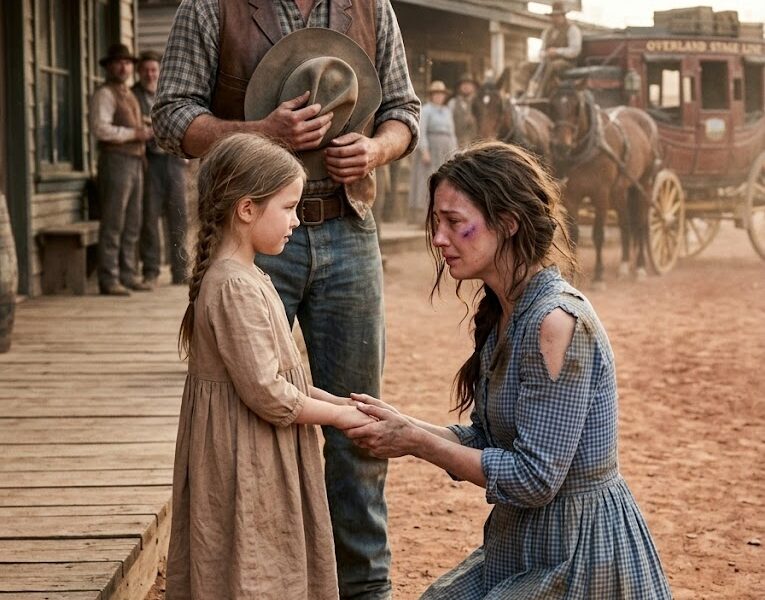
The woman I had agreed to marry stepped off the stagecoach wearing a torn dress, a bruise across her face, and nothing in her hands.
No suitcase.
No money.
No bonnet.
Not even the small brown trunk she had described in one of her letters.
For four months, Naomi Hart and I had written to each other across nearly a thousand miles. I knew how she took her coffee. I knew she hated thunderstorms but loved the smell of rain afterward. I knew she had once been married. I knew grief had taken something from her that she never expected to recover.
But I did not know why she looked as though someone had dragged her through hell before delivering her to Willow Creek.
And I certainly wasn’t prepared for the first thing she said to me.
“I’m sorry.”
Those were her first words.
Not hello.
Not Are you Isaac Ren?
Not Please help me.
Just—
“I’m sorry.”
It was October of 1885, one of those cold Wyoming mornings when the sky looked too blue to belong above such a hard country.
My seven-year-old daughter, Lily, stood beside me outside the stage office, clutching two of my fingers.
She had spent the entire ride into town asking questions.
Would Miss Hart like horses?
Would Miss Hart know how to braid hair?
Would Miss Hart sleep in Mama’s room?
That last question had nearly made me turn the wagon around.
“No,” I had told her.
Lily had gone quiet.
Then, after a moment, she’d asked, “Because Mama still needs it?”
I hadn’t known how to answer.
Two years had passed since I buried my wife, Ellen, on the hill east of the ranch.
Two years, and there were still moments when I opened the bedroom door expecting to see her standing at the washbasin, pinning up her hair.
Grief did strange things to a house.
It didn’t simply make rooms empty.
It made them remember.
That morning, though, I wasn’t thinking about Ellen.
I was staring at the stranger who was supposed to become my wife.
Naomi’s dress had probably once been blue.
Now it was brown with road dust, torn near one shoulder and ripped along the hem. Her dark hair had partly fallen from its pins. A fading purple bruise ran beneath her left cheekbone.
One sleeve had dried blood on it.
Her hands were empty.
She looked at me once, quickly, then lowered her eyes.
“I understand if you’ve changed your mind, Mr. Ren.”
Her voice was controlled.
Too controlled.
The kind of voice people use when they’re trying desperately not to break in front of strangers.
I glanced toward the stagecoach.
The driver was unloading two trunks and several parcels.
None belonged to her.
“Miss Hart—”
“I know how this looks.”
She swallowed.
“I had meant to arrive differently.”
I noticed then that people were watching.
Willow Creek was small enough that a stagecoach arrival qualified as entertainment, and the knowledge that Isaac Ren had ordered himself a bride through a matrimonial newspaper had traveled through town weeks before Naomi did.
Mrs. Callahan stood outside the mercantile.
Two ranch hands leaned against a hitching rail.
The stage driver pretended to check a wheel.
Everyone was waiting to see what I would do with the ruined woman standing in front of me.
Naomi knew it too.
She straightened what remained of her dress.
“You paid for my passage,” she said. “I know that doesn’t obligate you to anything beyond what we discussed, but I also know you expected a respectable woman to arrive.”
“You are respectable.”
Her eyes lifted.
For the first time, something sharp flashed behind the exhaustion.
“You don’t know that.”
“I’ve read your letters.”
“Letters are easier to make respectable than people.”
There was something in the way she said it that bothered me.
Not guilt.
Shame.
And there is a difference.
“Where’s your trunk?” I asked.
Her face changed.
Only slightly.
But I saw it.
Her fingers curled against the torn fabric of her skirt.
“Gone.”
“What happened?”
She shook her head.
“That doesn’t matter.”
“A bruise on your face matters.”
“I’m alive.”
“That wasn’t my question.”
“No.”
Her voice cracked on that single word.
She looked away quickly.
Then she drew a slow breath and seemed to gather whatever dignity the road had left her.
“I don’t have money for another ticket,” she said. “But perhaps there is work in town. I can cook. Sew. Keep house. I can pay you back eventually.”
I stared at her.
“Pay me back?”
“For the passage.”
“Why would you do that?”
“Because you’re not responsible for what happened to me.”
She finally looked directly into my eyes.
“And because I won’t make you feel obligated to marry a woman you wouldn’t have chosen if you’d seen her like this first.”
Something inside me went very still.
Four months earlier, I’d received her first letter in an envelope with Missouri mud dried along one corner.
She had written plainly.
No flirting.
No promises.
No talk of romance.
She had told me she understood I still loved my dead wife because she still loved her dead husband.
She had written one sentence I had read so many times the fold in the paper had nearly split through the words:
A heart can be full of the dead and still have room to be useful to the living.
That sentence was why I had sent the money.
That sentence was why I had driven forty miles into Willow Creek with Lily beside me.
And now the woman who had written it stood in front of me with a bruised face and was trying to make my rejection easier.
“I won’t blame you,” Naomi said.
“Miss Hart—”
“You don’t have to explain.”
“I’m trying to.”
“I’ve caused enough trouble.”
“You haven’t caused me any trouble.”
“I arrived with nothing.”
Her voice was barely audible now.
“Nothing at all.”
And before I could answer, I felt Lily’s fingers slip from mine.
“Lily?”
She didn’t respond.
My daughter walked toward Naomi.
That frightened me more than anything else that morning.
Lily didn’t approach strangers.
Not since Ellen died.
She hid behind me when customers came to the ranch. She refused to speak to the preacher for almost a year. Once, when Mrs. Callahan tried to kiss her cheek, Lily crawled under a table and stayed there until the woman left.
But now she walked directly toward this bruised stranger.
Naomi saw her coming.
Her expression softened.
Lily stopped less than a foot away.
For several seconds, neither of them spoke.
Then Lily tilted her head.
“You have sad eyes.”
Naomi inhaled sharply.
“Lily,” I said quietly.
But my daughter continued.
“My papa has sad eyes too.”
Naomi looked at me.
Then back at Lily.
“My mama died,” Lily explained. “Papa says she’s in heaven.”
The street seemed to disappear around us.
Naomi’s lower lip trembled.
“I’m sorry.”
“Did your mama die?”
Naomi shook her head.
“No.”
“Then why are you sad?”
There are questions adults spend years learning not to ask.
Children ask them before anyone teaches them fear.
Naomi looked as though Lily had reached into her chest and touched something she had spent years protecting.
She slowly knelt in the dirt.
Now they were eye to eye.
“My little boy died,” she said.
I stopped breathing.
Naomi had told me in her letters that she had lost family.
She had never told me there had been a child.
“And my husband,” she continued. “They both went to heaven.”
Lily’s expression changed.
She understood heaven.
Not theology.
Not eternity.
Absence.
She understood that perfectly.
“Your little boy?”
“Yes.”
“Was he little like me?”
“Smaller.”
Naomi’s eyes filled.
“He was still a baby.”
Lily reached up.
With extraordinary gentleness, she touched Naomi’s bruised cheek.
Naomi closed her eyes.
And whatever strength had carried her across Wyoming nearly gave way right there.
Then Lily turned toward me.
“Papa?”
I already knew I wasn’t going to like whatever came next.
“Yes?”
“Can she stay?”
Naomi opened her eyes.
“Lily—”
“She’s sad like us.”
The words landed harder than any accusation could have.
Then my daughter asked the question that changed three lives.
“Can she be our mama?”
Naomi made a small sound.
Not quite a sob.
I crouched beside them.
For one absurd second, all three of us were kneeling in the dirt outside the Willow Creek stage office while half the town pretended not to watch.
I looked at Naomi.
She shook her head immediately.
“You don’t have to.”
“I know.”
“I don’t want the child deciding something she doesn’t understand.”
“Lily understands more than most grown people I know.”
“Mr. Ren—”
“Isaac.”
She fell silent.
I reached for Lily and pulled her close against my side.
Then I looked at the woman I had crossed forty miles to meet.
“I didn’t send for a trunk.”
Naomi stared at me.
“I didn’t send for dresses or money or whatever else you lost.”
“You don’t understand.”
“Then tell me.”
“I can’t.”
“Not yet?”
Her eyes shifted.
Something had happened on that road.
Something worse than losing luggage.
I could see that now.
“Not here,” she whispered.
I nodded.
“Then not here.”
She looked confused.
I stood and offered her my hand.
She stared at it.
“You wrote to me that a heart could be full of the dead and still be useful to the living,” I said. “Do you remember?”
Her eyes filled again.
“Yes.”
“That’s the woman I sent for.”
I held my hand steady between us.
“And unless she’s changed her mind about coming to my ranch, that’s the woman I’m taking home.”
For several seconds, she didn’t move.
Then Naomi Hart put her hand in mine.
I thought that was the beginning of the story.
I was wrong.
The real beginning had happened three days earlier on a lonely Wyoming road, when three armed men stopped a stagecoach—and took from Naomi the one thing she would have fought the whole world to keep.
Naomi didn’t tell me about the robbery until that evening.
First, we went to the mercantile.
She protested when I bought her a dress.
She protested harder when I added stockings, underclothes, a coat and a new pair of boots.
“You don’t need to do this.”
“Apparently I do, because you’re barefoot inside those shoes.”
Her cheeks colored.
“They still function.”
“The sole is hanging off.”
“Only partly.”
Mrs. Callahan hid a smile behind the counter.
I pointed toward a wool coat.
“That one.”
“Isaac.”
“Wyoming winters don’t negotiate.”
Neither did I.
That earned me the first almost-smile I ever saw from Naomi Hart.
It disappeared quickly, but I saw it.
And so did Lily.
“She smiled!” my daughter announced.
Naomi laughed despite herself.
It was a small sound.
Rusty from lack of use.
I remember thinking I wanted to hear it again.
That frightened me.
We ate before leaving town.
Naomi barely touched her food until Lily began stealing potatoes from her plate.
“I saw that,” Naomi said.
Lily froze.
Then slowly returned the potato.
Naomi waited.
Lily waited.
Finally Naomi pushed the plate toward her.
“You may have one.”
Lily grinned.
“You said you saw me.”
“I did.”
“Then why can I have it?”
“Because stealing and asking aren’t the same thing.”
Lily considered this.
“Can I have two?”
“No.”
I nearly choked on my coffee.
On the wagon ride home, Lily eventually fell asleep between us.
Her head tipped against Naomi’s arm.
Naomi went completely still.
“You can move her,” I said.
“No.”
“She sleeps like a sack of grain.”
“I don’t mind.”
Her voice had changed.
She looked down at Lily as if the child’s weight against her side was something holy.
We traveled several miles before Naomi spoke again.
“His name was Thomas.”
“Your boy?”
She nodded.
“He had my eyes.”
I waited.
“Jacob used to complain about it. Said he’d done half the work and gotten none of the credit.”
She smiled faintly at the memory.
Then it vanished.
“Diphtheria came through our county.”
I had heard stories.
Everyone had.
Diseases moved through rural communities like invisible fires.
“Thomas got sick first.”
Her fingers tightened around the edge of Lily’s blanket.
“He couldn’t breathe.”
I said nothing.
Sometimes silence is the only respectful answer to grief.
“I sat beside him for four days. Then Jacob became ill.”
Her voice flattened.
“He knew he was dying before I did.”
The wagon wheels creaked beneath us.
“He made me promise I would keep living.”
She laughed once, bitterly.
“I was angry with him for asking.”
I understood that too well.
“Afterward?”
“I lost the farm.”
“How?”
“Slowly.”
She looked toward the darkening prairie.
“Then suddenly.”
Debts.
Taxes.
Men who knew a widow couldn’t work enough acreage alone.
She didn’t need to explain.
“I became hired help. Laundry. Cooking. Cleaning.”
“And then you saw my notice.”
“Yes.”
“Why answer it?”
She looked at Lily.
“Because you mentioned her.”
That was all.
But it was enough.
The ranch appeared after sunset, windows glowing gold against the dark.
Naomi stared at it.
“That’s home,” Lily mumbled without opening her eyes.
Something passed over Naomi’s face.
Pain first.
Then longing.
Then fear.
When we reached the house, I showed her the spare bedroom.
It was small but clean.
Fresh sheets.
A washstand.
A chest.
She stood in the doorway.
“This is mine?”
“As long as you want it.”
“And after we’re married?”
I hesitated.
“We don’t have to discuss that tonight.”
Her body stiffened.
So I continued before she could misunderstand.
“You don’t owe me marriage because I bought you a coat.”
She turned.
“I came here to marry you.”
“You came here because we exchanged letters and thought we might build something workable.”
“That was the arrangement.”
“Arrangements can change.”
Her face closed.
I realized my mistake.
“Naomi.”
“If you no longer—”
“That’s not what I’m saying.”
I lowered my voice.
“I’m saying you have a locked door.”
She stared at me.
“You have your own room. Your own space. Nobody in this house is going to demand anything from you because you’re stranded or because you think you owe me.”
She didn’t speak.
“I loved my wife,” I continued. “I still do.”
Naomi’s eyes softened.
“And you loved Jacob.”
“Yes.”
“We don’t have to pretend those people never existed just to make this arrangement respectable.”
Her chin trembled.
“Whatever happens between us happens because we both choose it. If nothing happens, you still have a roof. Lily still has someone she already appears determined to keep.”
From the hallway came a sleepy voice.
“I heard that.”
I closed my eyes.
Naomi laughed.
That second laugh lasted longer.
Later, after Lily was asleep, Naomi finally told me about the robbery.
Three men.
Guns.
A stage stopped in open country.
Passengers ordered out.
Money taken.
Jewelry stripped away.
Then her trunk.
“I tried to stop them.”
“Why?”
It was the wrong question.
I saw that immediately.
Naomi looked at me with something almost like anger.
“Because everything was in it.”
“Clothes?”
“No.”
Her eyes shone.
“Not the clothes.”
She turned away.
“My husband’s watch.”
I waited.
“And Thomas’s cap.”
I didn’t understand at first.
“His cap?”
“I knitted it.”
Her voice cracked.
“He wore it for only three months.”
She covered her mouth.
Suddenly the torn dress and bruise meant nothing.
I saw the road.
A trunk breaking open.
A dead man’s watch.
A baby’s clothes falling into Wyoming dirt.
A grieving mother scrambling after the last pieces of a family that no longer existed.
“They took it?”
Naomi nodded.
“I went after the saddlebag.”
“Jesus.”
“One of them hit me.”
She touched her cheek.
“I remember being on the ground. And I remember thinking…”
She stopped.
“What?”
Her answer came so quietly I almost missed it.
“That maybe the world was trying to teach me to stop keeping things.”
I leaned forward.
“No.”
She looked at me.
“Maybe it keeps taking because there’s something wrong with me.”
“No.”
“Isaac—”
“No.”
I had no right to speak so fiercely.
But I did.
“Don’t make cruelty into a lesson you deserved.”
Silence.
Naomi stared at me.
Then tears slid down her face.
She didn’t wipe them away.
I didn’t touch her.
Not yet.
But that night, something shifted.
We were still strangers.
Just not quite as strange to each other.
The next few months changed the ranch so gradually that I didn’t understand what was happening until it had already happened.
First came Lily’s hair.
For two years, I had been losing a private war against my daughter’s hair.
I could rope cattle.
Repair fencing.
Deliver a breech calf in a snowstorm.
But braids defeated me.
Naomi fixed that problem on her first morning.
“Sit.”
Lily obeyed.
That alone was remarkable.
Naomi brushed out the tangles while Lily watched in the mirror.
“Too tight?”
“No.”
“This?”
“No.”
“Tell me if I pull.”
“I won’t.”
“You should.”
“Why?”
“Because if something hurts, you’re allowed to say so.”
I looked up from my coffee.
Naomi caught my eye in the mirror.
For a second, neither of us spoke.
There were whole conversations inside that silence.
Then she braided Lily’s hair.
My daughter ran around the house showing everyone.
Even the ranch hands.
“Miss Naomi did it!”
By the second week, Naomi had taken over the kitchen.
By the third, she’d repaired curtains Ellen had meant to replace.
By the fourth, Lily no longer called her Miss Hart.
She called her Naomi.
I thought that was progress.
Then one evening, I walked past Lily’s room and heard Naomi singing.
I stopped outside the door.
It wasn’t a song I knew.
Lily was under the blankets.
Naomi sat beside her.
“Again,” Lily whispered.
“You’ve heard it twice.”
“Three.”
“Absolutely not.”
“Please?”
Naomi sighed theatrically.
Then began again.
I should have walked away.
Instead I stood in the dark hallway listening.
Two years earlier, I had stood in that same spot listening to Lily talk to a rag doll.
She had told the doll about a pretend mother.
A mother who would brush her hair.
A mother who would sing.
A mother who would be there when she woke.
That night had broken something in me.
It was why I’d placed the matrimonial notice.
Now I stood in the same hallway and heard the imaginary woman become real.
I didn’t realize Naomi had noticed me until she came downstairs.
“You were listening.”
“Maybe.”
“She misses Ellen.”
“I know.”
“I don’t want her to think I’m replacing her mother.”
“You aren’t.”
Naomi looked uncertain.
“Then what am I?”
I had no answer.
That question stayed with me for weeks.
What was Naomi?
Housekeeper?
Friend?
Future wife?
The woman my daughter searched for every morning?
The person whose footsteps I had started recognizing without meaning to?
Some nights after Lily slept, Naomi and I sat on the porch.
We talked about the dead.
Strangely, that was where we became alive.
I told her how Ellen sang badly and confidently.
Naomi told me Jacob snored so loudly their dog used to leave the room.
I told her about Ellen burning biscuits.
She told me about Thomas’s first tooth.
Nothing was forbidden.
We didn’t compete with ghosts.
We introduced them.
And slowly, something extraordinary happened.
Ellen stopped standing between Naomi and me.
Jacob stopped standing between us too.
They seemed, somehow, to stand behind us.
Proof that we had both loved once.
Proof we might still know how.
But neither Naomi nor I dared say that.
Then winter came.
And with it came the night I became certain God was going to take Lily from me too.
It began with a cough.
One cough.
Then another.
By supper, Lily said she was cold.
I touched her forehead.
Hot.
My body reacted before my mind did.
“No.”
Naomi looked up.
“What?”
“No.”
“Isaac?”
I stood so quickly my chair fell backward.
Lily flinched.
“I’m sorry, sweetheart.”
I touched her forehead again as though the answer might change.
It didn’t.
Fever.
Naomi came around the table.
The instant her palm touched Lily’s skin, I saw her face change too.
She knew.
Not that Lily would die.
But what fever could become.
The nearest doctor was miles away.
Snow had been falling since noon.
By midnight, the storm had swallowed the road.
Lily’s temperature climbed.
I sent a ranch hand anyway.
He made it six miles before returning.
“Can’t see the trail.”
I wanted to hit him.
Not because he’d done anything wrong.
Because terror needs somewhere to go.
Naomi caught my arm.
“Isaac.”
“I’ll ride.”
“You’ll get lost.”
“I can’t stand here.”
“Then don’t.”
Her voice was suddenly hard.
“Bring more water.”
I stared at her.
“Now.”
Something in her expression stopped me.
Naomi took command.
Cool cloths.
Water.
Blankets changed.
Fire controlled.
She listened to Lily’s breathing.
Counted her pulse.
Kept her drinking whenever she woke.
Hour after hour.
No panic.
No hesitation.
But once, around two in the morning, I found Naomi alone in the hallway.
Her hands were shaking.
“Naomi.”
“I’m fine.”
“You aren’t.”
She pressed both palms against the wall.
“This is how it started.”
I knew exactly who she meant.
“Thomas?”
She nodded.
Then she looked at me.
And I saw a terror even greater than mine.
“I can’t do this again.”
I stepped toward her.
“You don’t have to.”
“Yes, I do.”
“Naomi—”
“No.”
She wiped her face.
“I couldn’t save him.”
Her voice hardened.
“But maybe everything I learned while losing him wasn’t meant to be useless.”
Then she walked back into Lily’s room.
For three days, Naomi barely slept.
Neither did I.
On the third night, Lily got worse.
She began talking nonsense.
Calling for water when water was already at her lips.
Reaching toward things that weren’t there.
Then, sometime before dawn, she cried out.
“Mama!”
My entire body froze.
Ellen.
For one wild second, I thought Lily saw her.
Naomi bent over the bed.
“I’m here.”
Lily’s hand searched the blanket.
Naomi caught it.
“Mama?”
“I’m here, sweetheart.”
The word left Naomi before she could stop it.
“I’ve got you.”
I stood in the doorway.
Naomi didn’t know I was there.
She pressed Lily’s burning hand against her cheek.
“Mama’s right here.”
Her voice broke.
“You’re staying with me. Do you understand? You’re staying until morning.”
Lily whimpered.
“You don’t get to leave.”
Naomi was crying now.
“I’ve already lost one baby. I am not losing you.”
The words nearly brought me to my knees.
“I couldn’t save him,” she whispered. “So you stay. You stay and let me save you.”
And somehow—
Lily did.
Near sunrise, the fever broke.
I knew before Naomi spoke.
Lily’s breathing changed.
The terrible heat began leaving her skin.
Naomi touched her forehead.
Again.
Again.
Then she made a sound I will remember until I die.
Half laugh.
Half sob.
“Oh, thank God.”
Her shoulders collapsed.
She lowered her head onto the edge of the mattress.
Lily slept.
Alive.
Naomi wept.
Not quietly.
Not carefully.
For the first time since she arrived in Willow Creek, she stopped trying to protect everyone else from her pain.
She cried for Lily.
For Thomas.
For Jacob.
For herself.
For every bedside where she’d begged death and lost.
I crossed the room.
Then I did what I had wanted to do since the day she stepped from that stagecoach.
I put my arms around her.
Naomi stiffened.
Only for a second.
Then she turned into me.
And she broke.
I held her.
There was no propriety in it.
No arrangement.
No careful distance.
Just two exhausted people on their knees beside a sleeping child.
When Naomi finally quieted, she whispered against my shirt.
“I’m sorry.”
I almost laughed.
“What?”
“For this.”
“For what?”
She pulled back.
“For falling apart.”
I wiped a tear from her cheek.
“You arrived in Willow Creek half-beaten to death and apologized for being inconvenient.”
Her mouth trembled.
“You’ve been apologizing ever since.”
“I don’t mean to.”
“I know.”
I looked toward Lily.
Then back at Naomi.
“I need you to stop.”
Her expression changed.
“Stop what?”
“Thinking you’re here because you’re useful.”
She stared at me.
“Isaac—”
“I sent for a woman to help raise my daughter.”
I took a breath.
“And somewhere along the way, I fell in love with her.”
Naomi went completely still.
There.
I’d said it.
The word we had spent months carefully walking around.
“I loved Ellen,” I continued. “I will love her until I die.”
Naomi’s eyes filled.
“I know.”
“But loving her isn’t the same as refusing to live.”
My voice cracked.
“I think I’ve been confusing those things for two years.”
She said nothing.
“And I don’t want you sleeping in that far room because you’re afraid to take up space in my life.”
“Isaac…”
“I want you at the center of it.”
She looked down.
“I’m not Ellen.”
“I know.”
“I can’t be.”
“I don’t want you to be.”
That made her look at me.
“I don’t want another Ellen.”
I touched her face.
“I want Naomi.”
Her tears spilled over.
“The woman who argues over buying boots. The woman who steals half my kitchen and somehow makes me feel like I should thank her for it. The woman who taught my daughter that she’s allowed to say when something hurts.”
Naomi laughed through her tears.
“The woman who just fought death itself for my little girl.”
My throat tightened.
“Lily called you Mama.”
Naomi covered her mouth.
“And you answered.”
“I didn’t mean—”
“Yes, you did.”
She looked toward the bed.
Lily was still asleep.
“Maybe not with your head.”
I took Naomi’s hand.
“But somewhere inside you, you’ve been answering to it for a long time.”
Her eyes closed.
“I loved being Thomas’s mother.”
“I know.”
“When he died…”
She struggled for breath.
“I thought that part of me died with him.”
“It didn’t.”
“I was afraid loving Lily would betray him.”
“No.”
“And then I was afraid loving you would betray Jacob.”
“No.”
“How can you be so sure?”
“Because I had the same fear.”
Silence.
I looked toward the window.
Morning had begun turning the snow blue.
“I’ve been thinking grief was a room I had to keep locked forever or Ellen would disappear.”
Naomi squeezed my hand.
“But she doesn’t disappear because I love you.”
“No.”
“Jacob doesn’t disappear because you love me.”
Her face crumpled.
I leaned closer.
“So I’m done asking you to be useful, Naomi Hart.”
A tiny smile appeared.
“What are you asking?”
“Something selfish.”
“Good.”
That surprised me.
She wiped her eyes.
“You should try it sometime.”
I laughed.
Then I said it.
“I’m asking you to be my wife.”
She inhaled.
“Not because of the newspaper.”
I tightened my hand around hers.
“Not because I paid for a stage ticket.”
Another tear slipped down her cheek.
“Not because Lily needs a mother.”
I leaned my forehead against hers.
“Because I love you.”
Naomi was silent for so long that my courage began draining away.
Then she whispered:
“I came here because I thought I had nothing left.”
I waited.
“I thought if I could just be useful to somebody, that would be enough.”
She looked at Lily.
“But she needed me.”
Then at me.
“And you respected me.”
Her hand rose to my face.
“And somewhere between her braids and your terrible coffee and those long evenings on the porch…”
“My coffee is not terrible.”
“It is criminal.”
I laughed despite myself.
She smiled.
Then the smile became something deeper.
“…somewhere in there, I started wanting more than to be needed.”
“What did you start wanting?”
“You.”
One word.
That was all.
It was enough.
“I love you, Isaac.”
My eyes closed.
“And I’m terrified of how much.”
“Good.”
She laughed.
“That’s your answer?”
“I’m terrified too.”
I kissed her forehead.
“We can be terrified together.”
She looked at me for a long moment.
Then she whispered:
“Yes.”
“Yes?”
“Yes, I’ll be your wife.”
A sleepy voice came from the bed.
“Finally.”
Naomi and I turned.
Lily’s eyes were barely open.
I stared at her.
“How long have you been awake?”
“Long enough.”
Naomi laughed so hard she began crying again.
Lily held out one weak hand.
“Mama?”
Naomi’s laughter stopped.
The room became still.
Lily looked uncertain.
“Is it okay if I call you that?”
Naomi crossed the space between them in an instant.
She sat beside the bed and gathered Lily carefully into her arms.
“Oh, sweetheart.”
Lily rested her head against Naomi.
“Is that yes?”
Naomi kissed her hair.
“That’s yes.”
I stood beside them and thought my heart might split open from the pressure of holding grief and gratitude in the same place.
For years, I had believed surviving loss meant learning to live with less.
I was wrong.
Sometimes surviving means discovering that the empty places don’t stay empty forever.
Sometimes life builds around them.
Naomi and I married that spring.
The whole town came.
Some came because they cared about us.
Some came because Wyoming towns are hungry for weddings after long winters.
And a few probably came because they remembered the woman who had stepped off the stagecoach in rags and wanted to see what she looked like as a bride.
She looked beautiful.
But not because of the dress.
Though the dress was beautiful.
Mrs. Callahan and two other women helped make it, and Naomi protested the cost until I threatened to marry her in the mercantile just to stop the argument.
Lily walked ahead of her down the aisle scattering wildflowers.
She took the responsibility very seriously until halfway down, when she ran out of flowers and simply dumped the remaining basket onto the floor.
Everyone laughed.
Naomi laughed too.
And that was when I saw the woman from the stagecoach again.
Not because she looked broken.
Because she didn’t.
I remembered those empty hands.
Now one held flowers.
The other reached for mine.
Years passed.
The ranch expanded.
So did our family.
Three boys came first.
Then another girl.
Lily complained that she had requested one sister and we’d taken far too long delivering her.
Naomi became the center of the house exactly as I had asked.
But she became something else too.
Whenever a child in Willow Creek became ill, someone came for Naomi.
At first, it was because people remembered what she’d done for Lily.
Then it was because she’d done the same for other children.
She never called herself a nurse.
There wasn’t a proper word for what she became.
She was simply the woman people wanted in the room when a fever wouldn’t break.
The knowledge she had once considered a punishment became a gift she carried from house to house.
But Naomi never forgot Missouri.
She kept Jacob’s memory.
And Thomas’s.
Years later, I found her sitting alone on the porch holding something small.
A knitted cap.
Blue.
I stopped.
“Where did that come from?”
She smiled.
“I made another.”
For years, I had thought she might try.
She never had.
Until then.
“It isn’t his,” she said.
“No.”
“I know that.”
She turned the cap over in her hands.
“For a long time, I thought making another would mean pretending the first one wasn’t special.”
I sat beside her.
“And now?”
“Now I think love doesn’t work that way.”
“No.”
She leaned against my shoulder.
“You taught me that.”
“I think Lily taught both of us.”
Naomi smiled.
“Probably.”
We sat there until sunset.
No dramatic revelation.
No great speech.
Just two older people on a porch watching children run across the yard.
That was our life.
Not a replacement for the ones we’d lost.
Another life.
Different.
No less real.
Ellen remained part of our house.
Jacob did too.
Thomas had a place there despite never setting foot in Wyoming.
Our children knew their names.
Lily grew up saying she had two mothers.
One who gave her life.
And one who arrived when both of them were broken enough to recognize each other.
She eventually married.
The night before her wedding, I found her sitting with Naomi at the kitchen table.
Between them lay an old envelope.
I recognized my handwriting.
My first letter to Naomi.
“You kept those?” I asked.
Naomi raised an eyebrow.
“Every one.”
“Even the bad ones?”
“They’re all bad.”
Lily laughed.
I protested.
Naomi reached across the table and took my hand.
“You weren’t much of a romantic.”
“I was honest.”
“You wrote three paragraphs about fence posts.”
“They needed replacing.”
Lily laughed harder.
Then she became quiet.
“Mama?”
Naomi looked at her.
“Yes?”
“Do you ever wish the robbery hadn’t happened?”
The question surprised all of us.
Naomi looked toward the window.
Decades had passed.
But I knew what she saw.
That lonely road.
The spilled trunk.
Jacob’s watch.
Thomas’s cap.
A stranger’s hand striking her face.
“No,” she said eventually. “I wish it hadn’t happened.”
Lily waited.
“But if you’re asking whether I think it had to happen for me to find you…”
Naomi shook her head.
“No.”
She squeezed Lily’s hand.
“Bad things don’t become good just because something beautiful happens afterward.”
I never forgot that.
Neither did Lily.
Naomi continued.
“The robbery was cruel. Losing Thomas was cruel. Losing Jacob was cruel. Losing Ellen was cruel.”
She looked at me.
“We don’t have to turn pain into some secret gift to justify surviving it.”
Lily’s eyes filled.
“Then what do we do with it?”
Naomi thought for a moment.
“We carry what we can.”
Her thumb moved across Lily’s knuckles.
“And when we see somebody else carrying too much, we take their hand.”
The room became very quiet.
I remembered Willow Creek.
The stagecoach.
Naomi’s ruined dress.
The bruise.
The empty hands.
Most of all, I remembered my seven-year-old daughter walking away from me.
Walking toward a stranger.
You have sad eyes.
Such a small sentence.
Such a small hand.
But that was how our family began.
Not with romance.
Not with fate.
Not even with a wedding.
With recognition.
One wounded person looked at another and understood.
Years later, after our children were grown and the ranch had passed mostly into younger hands, Naomi and I still sat on that same porch.
Her hair turned silver before mine.
She claimed this was because I had caused her unnecessary worry.
I told her she’d arrived worried.
She said that wasn’t the point.
One autumn evening, almost forty years after the stagecoach arrived, Lily came home with her own daughter.
The girl was seven.
Exactly the age Lily had been.
I watched Naomi kneel to button the child’s coat.
For one impossible moment, time folded over itself.
I saw the Wyoming street again.
Dust.
A torn blue dress.
A bruised woman kneeling in front of a motherless child.
Naomi looked up and caught me staring.
“What?”
“Nothing.”
She narrowed her eyes.
“Isaac.”
I smiled.
“I was remembering the first time I saw you.”
“Oh, Lord.”
“You were very dramatic.”
“I had just been robbed.”
“Excuses.”
She laughed.
That laugh.
The one I had first heard inside the Willow Creek mercantile.
Only now it was easy.
Full.
Used often.
Lily’s daughter ran toward the yard.
Naomi watched her go.
Then she slipped her hand into mine.
The same hand she had placed in mine when she thought she possessed nothing.
Her skin was thinner now.
Her fingers crooked with age.
But I still remembered exactly how they had felt that first morning.
Cold.
Trembling.
Unsure.
“I really thought you’d send me back,” she said.
“I know.”
“I had the whole speech prepared.”
“It was a terrible speech.”
“It was gracious.”
“It was ridiculous.”
She smiled.
“I had nothing.”
I looked toward the yard where our grandchildren were playing.
At the house behind us.
At Lily talking with her brothers.
At forty years of noise, arguments, births, funerals, Christmas mornings, muddy boots, sick children, weddings and ordinary Tuesdays.
Then I looked at my wife.
“No,” I said.
“You only thought you did.”
Naomi rested her head against my shoulder.
The evening light stretched across the Wyoming hills.
Neither of us spoke for a while.
We had learned long ago that silence between people who love each other is not empty.
Sometimes it is the fullest thing in the room.
There were people missing from that porch.
There always would be.
Ellen.
Jacob.
Thomas.
Love had never erased them.
It had simply built more rooms around their absence.
And perhaps that was the truth Naomi and I had spent our whole lives learning:
A broken heart does not have to become an empty one.
Sometimes the places carved out by loss become the very places where another person can finally fit.
Naomi Hart had arrived in Willow Creek believing the world had stripped her of everything that made her valuable.
Her money was gone.
Her clothes were ruined.
Her keepsakes had been stolen.
Her family was dead.
Her face was bruised.
Her hands were empty.
And she was prepared to apologize herself right back onto that stagecoach so nobody else would have to carry the burden of her pain.
But a seven-year-old girl didn’t see any of those things.
Lily saw sad eyes.
She saw someone who understood heaven not as an idea but as a place where people you desperately wanted had gone without you.
And because children have not yet learned all the complicated reasons adults invent for keeping distance, Lily did the simplest thing in the world.
She reached out.
She took Naomi’s hand.
She held on.
That was all.
Sometimes I wonder how many lives turn on moments that small.
A door held open.
A chair pulled closer.
A meal offered.
A person allowed to stay.
A child’s hand reaching for someone everyone else has already decided is broken.
Naomi thought she had crossed the country to become useful.
Instead, she became loved.
I thought I had sent for someone to help me raise my daughter.
Instead, I found the second great love of my life.
And Lily?
Lily thought she was asking a sad stranger to stay for supper.
She had no idea she was choosing the woman who would braid her hair, nurse her through fever, argue with her as a teenager, cry at her wedding, hold her first baby and sit beside her through every great joy and grief that followed.
She didn’t know she was choosing her mother.
Children rarely understand the size of the doors they open.
Maybe none of us do.
So when I remember that cold October morning, I don’t remember Naomi’s rags first.
I don’t remember the bruise.
I don’t even remember the shocked faces watching from the street.
I remember two hands.
One belonged to a woman who believed she had nothing left.
The other belonged to a little girl who needed exactly what that woman still carried.
They reached for each other.
And neither let go.
That was how three broken hearts became a family.
Not because the past disappeared.
Not because grief was defeated.
And certainly not because suffering had secretly been good for us.
We simply discovered that losing one life does not always mean the rest of your life has been lost with it.
Sometimes, after everything has been taken and you are standing before the world with empty hands, someone reaches for one of them.
And if you’re brave enough to hold on—
what feels like the end of your story may only be the moment your real home finally finds you.









