THE MAN THEY CALLED A LIGHT-BULB CHANGER SAVED THE CEO—THEN HER BADGE LOGS MADE HIM THE PRIME SUSPECT
Clare Holloway was halfway through a joke about bad corporate coffee when the cup slipped from her hand.
It struck the marble floor of Holloway Dynamics with a hollow plastic crack, bounced once, and rolled beneath the edge of a display table.
For one strange second, nobody understood what they were seeing.
Clare stood beneath the enormous glass atrium of the company she had built, surrounded by nearly ninety employees, eleven board members, senior executives, assistants, attorneys, and people who had spent their careers learning how to remain calm in expensive rooms.
Then her hand went to her throat.
Her face changed.
And her knees buckled.
Someone screamed her name.
Someone else shouted that she had fainted.
Grant Ashcroft, the company’s chief financial officer, began barking instructions at everyone within reach.
“Get the corporate physician down here. Now. Somebody call upstairs. Where is medical?”
But the only man already moving was the man Grant had spent six years pretending not to see.
Evan Ror crossed thirty feet of polished stone before Clare hit the floor.
He dropped beside her, put two fingers near her jaw, and saw the swelling rising beneath her chin.
Her lips were changing color.
Her breaths came in thin, sharp whistles.
Not cardiac arrest.
Not low blood pressure.
Not exhaustion.
Her airway was closing.
“Anaphylaxis,” Evan said.
Nobody moved.
His voice hardened.
“Call 911. Tell them severe anaphylaxis with airway involvement. Now.”
A woman near the front started saying something about waiting for the company doctor.
Evan looked at her.
“She may not have time to wait.”
That ended the argument.
Clare’s assistant, Theo Lasser, stood nearby looking almost gray.
Evan pointed at him.
“Does she carry epinephrine?”
Theo nodded.
“Yes.”
“Where?”
“Her bag. She always—”
“Get it.”
Theo still didn’t move.
Evan said his name.
“Theo.”
That broke whatever paralysis had taken hold of him.
He ran.
Evan turned back to Clare.
“Stay with me.”
Her eyes were open, but terror had replaced comprehension.
She was trying to breathe.
That was all.
Trying.
Failing.
Trying again.
Evan had heard that sound before.
For eleven years, he had worked as a paramedic. He had heard airways narrow in kitchens, restaurants, school cafeterias, hotel rooms, roadside ditches, and once in the back seat of a taxi trapped behind a garbage truck.
Four years earlier, he had left that life after his wife died in a hospital corridor while an ambulance arrived eight minutes too late.
He had promised himself he was finished with emergencies.
Emergencies, apparently, had made no such promise to him.
Theo returned with the bag.
Evan found the injector.
He administered it through Clare’s slacks and began counting.
“Come on, Clare. Stay with me.”
Her fingers caught his sleeve.
Across the circle of frightened faces, Grant Ashcroft stepped forward.
“What exactly are you doing?”
Evan ignored him.
Grant’s voice rose.
“He’s facilities staff. Someone get the medical team down here and let professionals handle this.”
Evan looked up.
Only for a second.
There were moments when contempt could become almost clarifying.
Then he turned back to Clare.
“Twenty-eight… twenty-nine… thirty.”
The ambulance arrived at 8:11.
By then Clare was still critically ill, but air was moving.
The lead paramedic knelt beside Evan.
Evan delivered the handoff automatically—time of onset, symptoms, epinephrine administered, airway response.
The medic studied him briefly.
“You EMS?”
“Used to be.”
The man nodded once.
That was enough.
As Clare was lifted onto the stretcher, her eyes found Evan’s.
There was no gratitude in them yet.
Only recognition.
She knew which face had been above hers while she was suffocating.
Then the doors closed behind the paramedics.
The lobby became quiet.
Evan stood.
Only then did his hands begin shaking.
They always shook afterward.
Never during.
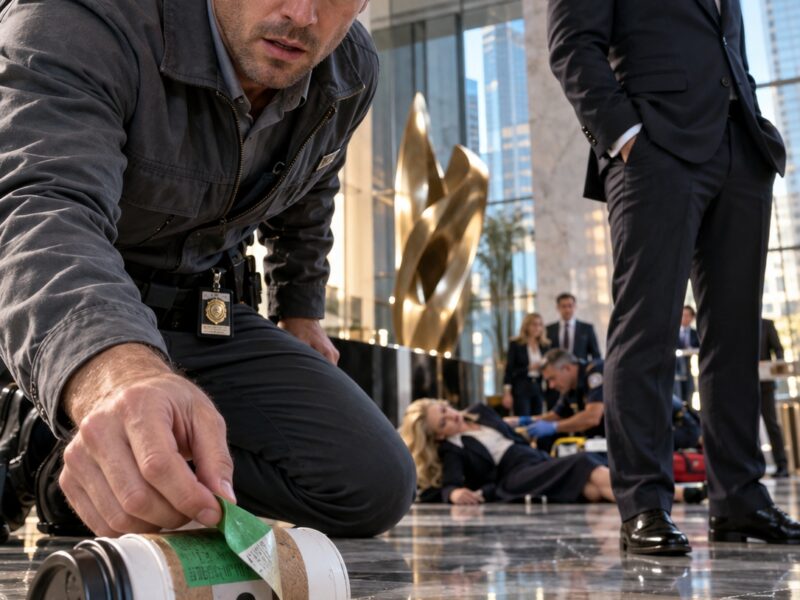
He was about to walk away when he saw a cleaner reaching beneath the display table for Clare’s cup.
“Don’t touch that.”
The cleaner froze.
Evan crouched.
Pale liquid had spread across the marble. Moisture had crept beneath the green label wrapped around the cup, lifting one corner.
Evan knew that label.
He had helped design the executive allergy-control procedure two years earlier.
PEANUT-FREE. EXECUTIVE ALLERGY PROTOCOL.
Clare had a severe peanut allergy.
Her protected meals and drinks were prepared under a separate system.
The label was supposed to mean someone had checked.
The label was supposed to mean safe.
But something was underneath it.
Evan pulled a pen from his pocket and gently rotated the cup without touching it with his hands.
The loosened corner lifted farther.
Beneath the green allergy-safe sticker was another label.
A supplier tag.
Batch number.
Date.
Ingredients.
Evan read the final line.
Then read it again.
Peanut protein.
The shaking in his hands stopped.
Because this was no longer an emergency.
It was evidence.
And somebody had deliberately covered the truth with a lie.
Two hours earlier, Evan had been almost invisible.
At 5:40 that morning, he had entered Holloway Dynamics through the service entrance carrying coffee in one hand and a tablet in the other.
At thirty-nine, Evan held the unimpressive-sounding title of Senior Facilities Compliance Coordinator.
It fit neatly beneath his photograph on an employee badge.
It explained almost nothing.
He kept the building breathing.
He monitored air-handling systems, emergency generators, fire suppression, stairwell pressure, access controls, elevator interfaces, evacuation communications, alarm redundancies, and hundreds of other systems executives noticed only when they failed.
Evan liked that.
Invisible systems were successful systems.
Invisible employees could go home on time.
And home mattered.
His daughter Paige was sixteen.
Four years earlier, she had lost her mother.
Evan had no intention of making her lose her father to a job too.
That was why he had left emergency medicine and taken the facilities position at Holloway Dynamics.
Predictable hours.
Few nights.
Most weekends free.
Dinner at home.
That had been the bargain.
At 5:44 that morning, however, his tablet had shown him something unusual.
At 4:11 a.m., a maintenance override had been activated on the door controller serving the executive suite.
It lasted less than two minutes.
Ordinarily, Evan might have forgotten it before finishing his coffee.
But every maintenance override required a work order.
There was none.
No scheduled repair.
No contractor.
No emergency request.
No night supervisor note.
Nothing.
Evan flagged it.
At 7:20, another small irregularity appeared.
A security camera outside the executive kitchen had stopped recording for roughly ninety seconds.
Not long enough to generate an automatic alarm.
Not long enough for anyone upstairs to care.
But Evan stared at the timestamp.
Ninety seconds was enough time for someone to enter a room, do something, and leave.
He linked the two events in his notes.
Then he went downstairs.
He had no idea those two boring entries would soon become the only reason anyone believed him.
Before Clare’s collapse, Evan had also encountered Grant Ashcroft near the executive floor.
Grant was forty-eight, elegant, polished, and descended from the sort of family whose money seemed older than most buildings.
Evan asked whether Grant’s team had requested the early-morning maintenance access.
Grant looked first at Evan’s badge.
Then at Evan.
“If there’s something wrong with a door, Mr. Ror, fix the door.”
“There’s nothing wrong with it.”
“Then why are we discussing it?”
“Because somebody used a maintenance override without a work order.”
One of the directors beside Grant smiled.
Grant did not.
“Facilities people are paid to keep things working. Try not to turn a door into a federal investigation.”
Evan nodded.
“I’ll look into it.”
Grant smiled faintly.
“I’m sure you will.”
Evan walked away.
He had heard worse.
Grant had once referred to the entire facilities department as “the people we pay to change light bulbs.”
Nobody had objected.
Nobody ever did.
By that afternoon, Evan would remember that conversation differently.
Because by then, somebody was trying to make him look like a murderer.
Naomi Brooks arrived eleven minutes after Evan discovered the second label.
At thirty-six, Holloway Dynamics’ director of corporate security had already spent years as a federal investigator before moving into private industry.
She did not panic.
She did not speculate.
She photographed.
Bagged.
Sealed.
Documented.
Evan told her about the cup.
Then the 4:11 override.
Then the ninety-second camera failure.
Naomi’s pen slowed.
“You logged both?”
“Yes.”
“When?”
“Before Clare collapsed.”
Naomi looked up.
That mattered.
“Show me.”
He did.
By ten that morning, employees knew Clare was at Mercy General in intensive care.
Her condition was serious but stabilizing.
By eleven, the board had invoked the company’s temporary succession provisions.
With Clare incapacitated, operational authority passed to the CFO.
Grant Ashcroft.
At 11:20, Grant sent a companywide message expressing shock, concern, and confidence in Holloway Dynamics’ resilience.
It was beautifully written.
By two o’clock, the story had changed.
And Evan was suddenly inside it.
Naomi brought him into a windowless conference room.
She closed the door.
“Walk me through your morning again.”
He did.
Every minute.
Every floor.
Every system.
When he finished, Naomi turned her laptop toward him.
A surveillance image filled the screen.
Timestamp: 6:52 a.m.
Evan was walking down the corridor outside the executive kitchen.
“That’s you?”
“Yes.”
“Why were you there?”
“The mechanical room is past that corridor.”
“You entered the kitchen?”
“No.”
She clicked.
Another record appeared.
7:04 a.m.
Executive kitchen service entrance.
Credential holder: EVAN ROR.
Access granted.
Evan stared at it.
Then he looked at Naomi.
“That didn’t happen.”
“The system says it did.”
“My badge doesn’t even have standing permission for that door.”
“It apparently did this morning.”
“No.”
Naomi folded her hands.
“Evan.”
“I wasn’t inside that kitchen.”
“I need you to understand my position.”
“I understand your position perfectly.”
“Do you?”
He looked again at the screen.
And then he did.
A man with eleven years of emergency medical training happened to be present when Clare suffered an unusually severe allergic reaction.
He identified it before anyone else.
He knew she carried epinephrine.
He knew what to do.
And company records showed his credential entering the room where her poisoned drink had been prepared less than an hour before she consumed it.
Each fact was true.
Together, they became a lie.
A very convincing one.
Grant understood that immediately.
In a closed board meeting that afternoon, he reportedly laid out the facts without making a single direct accusation.
That was his talent.
He did not need to say Evan had poisoned Clare.
He merely asked questions.
Was it reasonable to allow someone with Evan’s access to remain in the building during the investigation?
Was it significant that he knew exactly what medical event would occur?
Was it strange that the person who saved Clare happened to possess the precise expertise required to save her?
Had anyone considered that perhaps a rescue could be planned as carefully as an attack?
A hero who arrives exactly on time can look suspicious if someone controls the clock.
At 4:15 p.m., Evan was placed on paid administrative leave.
His badge was deactivated.
The security panel that had recognized him for six years stopped recognizing him in less than a second.
Coworkers avoided his eyes.
A woman from accounting whispered, “Good luck,” with the sadness people reserve for someone they expect never to see again.
Grant waited near the lobby.
Near the place Clare had fallen.
As Evan approached, Grant spoke quietly.
“Some men want very badly to be heroes.”
Evan stopped.
Grant continued.
“In my experience, the ones who plan it carefully usually plan everything else carefully too.”
Evan looked at him.
“I spent eleven years watching people die in front of people who were absolutely certain they understood what they were seeing.”
Grant’s expression barely changed.
Evan walked through the glass doors.
They closed behind him.
Six hours after saving the CEO’s life, he stood outside the headquarters where he had worked for six years with no way to get back inside.
At home, Paige knew something was wrong before he finished his first sentence.
She sat across from him at their kitchen table.
“So you saved her.”
“Yes.”
“And they suspended you.”
“Temporarily.”
“That means yes.”
“Paige.”
“Do they think you did it?”
Evan hesitated.
His daughter leaned back.
“Oh my God.”
“They’re investigating.”
“Dad.”
“They have to.”
“No. They have to investigate whoever poisoned her. That is not the same thing.”
He almost smiled.
She sounded like her mother when she was angry.
“That distinction gets complicated.”
“Only when rich people want it to.”
“Where did you learn to talk like that?”
“You.”
“I definitely did not teach you that.”
“You taught me systems protect themselves.”
Evan became quiet.
Paige noticed.
“What?”
“Nothing.”
But it wasn’t nothing.
After Paige went upstairs, Evan remained at the kitchen table.
He pulled out a legal pad.
He wrote one sentence.
A badge log does not prove a person opened a door.
Then another.
It proves a credential communicated with a controller.
Those were not the same thing.
And almost nobody at Holloway Dynamics understood the difference.
Evan did.
The next morning, he called Naomi.
“I can’t discuss an active investigation with its subject,” she said.
“You’re looking at the wrong log.”
Silence.
“What?”
“The log showing my badge entering the kitchen. You’re looking at the wrong one.”
Naomi did not hang up.
So Evan explained.
The company’s ordinary access-control records lived on servers administered by information technology.
Administrators could modify records.
There were controls.
Audit trails.
Permissions.
But ultimately, the trail lived inside the same environment as the record.
Four years earlier, Evan had considered that unacceptable for life-safety investigations.
During a code-compliance review, he had required every door event to be mirrored in real time to a separate recorder.
Read-only.
Independent.
Physically isolated.
It existed because, during a fire, investigators needed trustworthy information about which doors opened.
No executive had cared.
No CFO had read the requirement.
No board member had asked what the machine cost.
But Evan had insisted.
The recorder sat in a locked rack on the second sublevel.
Naomi pulled it that afternoon with two witnesses and an independent forensic technician.
The primary system said:
7:04 A.M. — EXECUTIVE KITCHEN — EVAN ROR — ACCESS GRANTED.
The independent recorder told a different story.
The credential had not been Evan’s physical badge.
It was a provisioned duplicate.
A clone.
Someone had manufactured a second credential against Evan’s identity.
And at precisely 7:04, Evan’s real badge was sixty feet away from a mechanical room on the fourth floor.
Exactly where he said he had been.
Naomi called him.
“You were cloned.”
Evan closed his eyes.
For the first time in two days, he could breathe normally.
“Who requested it?”
Naomi was silent.
“Naomi?”
“Derek Bowmont.”
Evan opened his eyes.
Derek was Grant Ashcroft’s chief of staff.
The relief lasted approximately four minutes.
Because Derek had paperwork.
Excellent paperwork.
The cloned credential had been created two days before the incident as part of a temporary executive-event access request.
Derek explained that catering supervisors needed easier access during the three-day board event.
Using the facilities permission profile had been administrative sloppiness, he admitted.
He apologized.
He offered cooperation.
He offered records.
He offered a process review.
He was so helpful that cooperation itself began to resemble innocence.
Grant seized on it.
A companywide message described the issue as a “serious credential-hygiene failure.”
Evan was formally cleared as a suspect.
But the investigation remained open.
He remained home.
And something continued bothering him.
Clare had collapsed at 8:02.
The board meeting was scheduled for 8:15.
Thirteen minutes.
If someone wanted Clare dead, there were easier places to kill her.
At home.
At a hotel.
In a parking garage.
On a weekend.
Somewhere without ninety witnesses and immediate emergency response.
Instead, they poisoned her inside her own headquarters minutes before an important board meeting.
Evan wrote the times on his legal pad.
8:02.
8:15.
He stared at them.
Then he understood.
This had never been about killing Clare Holloway.
Someone needed her absent.
Naomi met him two nights later at a diner away from the office.
She arrived without her company laptop.
That told Evan everything.
“What was the board voting on?” he asked.
Naomi stirred coffee she never drank.
“Northstar Logistics AI.”
Evan knew the name vaguely.
“Acquisition?”
“Nine hundred forty million dollars.”
He whistled softly.
“Grant’s deal?”
“Fourteen months of work.”
“And Clare?”
“Was going to kill it.”
Naomi slid a folder across the table.
Clare had spent six weeks questioning Northstar’s valuation.
What began as concern about inflated numbers had turned into something more dangerous.
She had requested an independent conflict-of-interest review.
She intended to present her concerns directly to the board at 8:15 that morning.
“If she entered that room,” Naomi said, “Grant lost control of the narrative.”
“And if she didn’t?”
“The CFO held temporary operational authority while she was incapacitated.”
Evan looked through the diner window.
Traffic moved through the wet street outside.
“So she wasn’t supposed to die.”
Naomi said nothing.
“She was supposed to have a medical emergency.”
“Possibly.”
“Public enough that nobody questioned her incapacity.”
“Evan—”
“Severe enough to put her in the hospital.”
“We don’t know that.”
“But survivable.”
Naomi’s expression tightened.
“That’s where your theory becomes dangerous.”
“No. That’s where their theory became dangerous.”
He looked at her.
“Whoever did this treated anaphylaxis like a volume knob.”
Naomi lowered her eyes.
“They calculated how sick she needed to be.”
Evan nodded.
“And decided the risk of killing her was acceptable.”
That was worse than rage.
Rage was human.
This was arithmetic.
Before leaving, Naomi gave him another fact.
The camera had never malfunctioned.
At 6:58 a.m., someone had issued a legitimate maintenance suppression command.
For ninety seconds, the system had been instructed not to record normally.
The account belonged to Derek Bowmont.
Credential clone.
Camera suppression.
Derek.
It looked complete.
Too complete.
Driving home, Evan kept returning to the same problem.
Why would a man earning hundreds of thousands of dollars personally leave his name attached to both critical technical steps of a conspiracy designed to benefit his boss?
Either Derek was extraordinarily stupid.
Or Derek was meant to be discoverable.
On day four, Clare came off the ventilator.
On day six, she could speak normally.
She told investigators her drink had arrived as it always did—sealed, labeled, trusted.
She had taken two swallows.
The third tasted slightly strange.
Then the world narrowed.
But Clare had something else to tell them.
Six weeks before the attack, she had commissioned a confidential ownership trace on Northstar Logistics AI.
The company looked clean.
Too clean.
Behind Northstar sat a holding company.
Behind that, another entity.
Behind that, a private fund.
The beneficial ownership trail took two law firms and four weeks to untangle.
Eventually, it ended at Ashcroft Family Holdings.
Grant’s family.
The CFO had been urging Holloway Dynamics to spend $940 million acquiring an asset in which his own family held an undisclosed indirect financial interest.
Clare had documentation.
At 8:15 on the morning she collapsed, she had intended to place it in front of eleven directors and counsel.
Now the motive was visible.
Then Derek disappeared.
He failed to arrive at work Monday.
His corporate phone was found in a drawer.
His office had been cleared of personal belongings.
His attorney refused requests for an interview.
Within hours, the building had its villain.
Derek had poisoned Clare.
Derek had framed Evan.
Derek had manipulated security.
Derek had fled.
Grant held an all-hands meeting.
He spoke about betrayal.
He spoke about misplaced trust.
He said he had promoted Derek, defended him, and brought him into rooms he had not earned.
“I will carry the responsibility for that failure of judgment,” Grant told employees.
His voice nearly broke.
It was an extraordinary performance.
And for almost everyone, it closed the story.
Almost.
Evan watched the recording twice from his living room.
On the second viewing, he paused it.
Rewound.
Paused again.
Paige walked past carrying laundry.
“You’ve watched that part six times.”
“Have I?”
“Yes.”
Evan stared at Grant’s frozen face.
Then he said, “Derek didn’t know.”
“Know what?”
“What to put in the drink.”
Paige stopped.
Evan stood.
Clare’s medical diagnosis was not stored in the catering system.
That system only carried a protected protocol code.
Her personnel file did not identify the allergen.
Facilities knew because they administered the emergency protocol.
Her assistant knew.
Corporate medical knew.
A few executives who had traveled repeatedly with Clare knew.
Derek could clone a badge.
Derek could blind a camera.
Derek could walk into the kitchen.
But none of those abilities told him which ingredient could close Clare’s throat in minutes.
Grant knew.
He had traveled with Clare eleven times.
Evan called Naomi at 11:07 that night.
“Derek had the keys,” he said.
Naomi was quiet.
“But Grant knew which door mattered.”
Nine days later, Grant requested that the board reconvene.
He argued that Holloway Dynamics needed stability.
Markets were watching.
Northstar could not wait indefinitely.
Clare’s doctors, he noted, had not cleared her to return.
Grant scheduled the vote for the fourteenth.
By then, Evan had been reinstated.
His first morning back was worse than he expected.
People looked at him too long.
Others apologized too quickly.
His operations team had taped a hand-drawn medal to his locker.
It said:
FOR HEROIC LIGHT-BULB CHANGING.
Evan laughed despite himself.
Then Grant passed him in the corridor.
Speaking to two executives loudly enough for Evan to hear, Grant said, “It’s a remarkable organizational problem when a building technician starts believing he understands corporate finance.”
Evan stopped.
For half a second, he considered answering.
Instead, he said, “Good morning, Mr. Ashcroft.”
And walked away.
Because suddenly Evan understood something.
Grant needed him to feel small.
A powerful man does not repeatedly remind an irrelevant man that he is irrelevant.
Unless he is afraid the irrelevant man has noticed something.
Over the next eight days, investigators assembled the pieces.
The cloned credential.
The suppressed camera.
The altered catering order.
The false allergy-safe label.
The Northstar ownership structure.
The Ashcroft family interest.
Still, the evidence touching Grant directly was thin.
Then Evan found another system.
He was reviewing a fire-drill report when he remembered the executive telephones.
The phones were tied into the building’s regulated emergency communications infrastructure.
Certain calls generated automatic compliance metadata.
Not recordings.
No conversations.
Only extension.
Destination.
Timestamp.
Duration.
The kind of boring record nobody deletes because nobody remembers it exists.
Evan requested the extract.
Two days before Clare’s collapse, at 3:51 p.m., a call had been placed from Grant Ashcroft’s private extension to Derek Bowmont.
Duration:
Six minutes and forty seconds.
At 4:02 p.m.—eleven minutes after the call ended—the request to clone Evan’s credentials was submitted.
Evan handed the record to Naomi.
He did not tell her what it meant.
He didn’t have to.
A building remembers.
Doors remember.
Phones remember.
Cameras remember.
Servers remember.
And sometimes the difference between power and truth is simply whether someone thought to preserve the right memory.
On the morning of the fourteenth, Grant Ashcroft arrived early to the twenty-second-floor boardroom.
He arranged his papers.
Checked the presentation.
Greeted each director personally.
At nine o’clock, he began.
The opening slide concerned market timing.
At 9:06, the door behind him opened.
Grant stopped.
Clare Holloway walked into the room.
She was thinner.
Paler.
Her movements were careful.
But she was standing.
Behind her came Naomi Brooks.
Two outside attorneys followed.
And then Evan entered carrying a sealed evidence box and a laptop.
Grant stared at him.
“Why is he here?”
Clare moved slowly toward the chair at the head of the table.
Her chair.
She rested one hand on its back.
“The man you spent six years calling a light-bulb changer,” she said quietly, “is the reason anyone in this company knows who turned off my cameras.”
Nobody spoke.
The presentation lasted two hours.
Evan spoke for nineteen minutes.
He explained how an access log worked.
How credentials could be cloned.
How ordinary records could be changed.
How the independent compliance recorder could not.
He showed the board Evan Ror entering the kitchen at 7:04.
Then he showed them Evan Ror standing elsewhere at precisely the same second.
One identity.
Two credentials.
One manufactured.
Grant fought back.
He was excellent at it.
Derek had acted alone.
The credential duplication was administrative error.
The camera command had been routine.
The phone call meant nothing.
The Northstar family interest was indirect.
Nothing individually proved conspiracy.
And that was true.
Each piece alone had an innocent explanation.
That had been the brilliance of the design.
It was a crime built from harmless-looking fragments, each meant to be examined by different people in different rooms at different times.
But now all the fragments were sitting on one table.
And together, they formed a picture.
Clare opened her laptop.
“One more item.”
She displayed an email.
7:14 a.m., the morning of her collapse.
From Grant.
He had asked her to defer the Northstar conflict review until the following quarter.
Her answer had been sent at 7:19.
Two lines.
No.
The review would proceed.
Forty-eight minutes later, her protected breakfast order was altered.
Grant leaned forward.
“That proves nothing.”
Clare looked at him.
“No. It proves what you wanted.”
“Clare—”
“And this proves what someone did.”
She looked at Evan.
He opened the evidence box.
Inside was the cup.
Still sealed in transparent evidence plastic.
Still stained.
Still carrying both labels.
Evan placed it in the center of the table.
The green label was visible.
PEANUT-FREE. EXECUTIVE ALLERGY PROTOCOL.
Under its lifted corner was the original supplier label.
Peanut protein.
Evan did not make a speech.
He looked around the table.
“The cup was labeled twice,” he said. “Only one label was telling the truth.”
Silence.
Eleven directors stared at an ordinary plastic cup.
And somehow the entire conspiracy became simpler.
Nine hundred forty million dollars.
Shell companies.
A hidden family interest.
A manipulated board schedule.
A cloned credential.
A blinded camera.
A poisoned drink.
A maintenance worker framed because nobody important was expected to know how his own systems worked.
All of it reduced to one physical object.
A lie pressed carefully over the truth.
Grant lost his composure.
Not dramatically.
That would have been easier.
He simply started talking.
He explained one detail.
Then another.
Then corrected himself.
Then contradicted the correction.
His attorney touched his arm.
Grant kept talking.
Two directors stopped looking at him.
Clare did not interrupt.
Neither did Evan.
By noon, Grant Ashcroft had been suspended.
The Northstar acquisition was frozen and later abandoned.
Grant and Derek were referred to the appropriate authorities, and the investigations moved forward slowly, carefully, without the cinematic satisfaction of handcuffs appearing the moment the truth became obvious.
Real consequences rarely arrive on cue.
They accumulate.
Documents.
Interviews.
Subpoenas.
Hearings.
Lawyers.
Months.
Sometimes years.
Clare returned permanently three weeks later.
Holloway Dynamics rebuilt its executive security procedures.
Credential duplication now required approval from two separate divisions.
Camera suppression generated simultaneous alerts to multiple people.
Protected catering orders could no longer be modified through kitchen terminals.
The company changed dozens of policies.
But Evan still came to work with coffee in one hand and a tablet in the other.
Then, one Thursday afternoon, Clare asked him to come upstairs.
Evan assumed she wanted to thank him.
He had prepared himself for it.
He hated being thanked for saving people.
The gratitude always seemed too large for what had happened and too small for what almost had.
Clare slid a folder across her desk.
Evan opened it.
DIRECTOR OF CORPORATE SAFETY AND RESILIENCE.
He looked at her.
“This position doesn’t exist.”
“It does now.”
The role reported directly to the CEO.
Physical security.
Life-safety compliance.
Executive risk.
Emergency resilience.
The salary was more than double his current pay.
Evan closed the folder.
“I don’t want a reward for what happened in the lobby.”
Clare leaned back.
“Good.”
He frowned.
“Because this isn’t one.”
She opened another folder.
Inside were copies of his old compliance reports.
Years of them.
“I read your filings.”
“That sounds like a punishment.”
For the first time, Clare smiled.
“In every one of these, you flagged something nobody wanted flagged.”
“That’s my job.”
“No. Apparently your job was changing light bulbs.”
Evan almost laughed.
Clare continued.
“You wrote down an unexplained override before it mattered. You linked a ninety-second camera interruption before anyone knew it mattered. Four years ago, you demanded an independent door recorder because you thought one day someone might need a record that couldn’t be changed.”
“Fire investigations.”
“You were thinking about fire.”
“Yes.”
“And it exposed a conspiracy.”
Evan looked toward the windows.
Far below them, traffic moved beside the river.
Clare’s voice softened.
“This entire thing depended on one assumption.”
“What assumption?”
“That nobody would pay attention to the small things.”
She pushed the folder toward him.
“I want the person who does.”
Evan looked at the salary again.
Then at the responsibilities.
Then he thought about Paige.
“There’s one condition.”
Clare waited.
“I’m home for dinner most nights.”
Something changed in her expression.
Not surprise.
Understanding.
“My daughter already lost one parent to a job,” Evan said. “She doesn’t lose another one because somebody doubled my salary.”
Clare took the offer letter back.
She uncapped a pen.
“What time is dinner?”
“Six-thirty.”
She wrote something into the margin.
“Then we’ll design the job around six-thirty.”
Evan stared at her.
“You can do that?”
“I’m the CEO.”
“Right.”
“It occasionally has advantages.”
He accepted.
There was no romance afterward.
No secret dinner.
No lingering elevator moment.
No complicated story for the building to invent.
Only respect.
Permanent and quiet.
Two people who had entered the same lobby from opposite ends of American life and understood exactly how close one morning had come to destroying both of them.
Months later, on a cold Monday in October, Evan crossed the atrium where Clare had collapsed.
The marble had been resealed.
The stain from the spilled drink was gone.
Employees hurried around him carrying laptops and coffee.
Executives stepped from elevators.
Phones rang.
The building breathed.
Evan carried the same battered tablet he had always carried.
A damper actuator on the fourth floor had been sending intermittent faults since Friday, and despite his new title, Evan wanted to see the problem himself.
At reception, a young woman looked up.
“Good morning, Mr. Ror.”
Evan stopped.
Only half a step.
But he stopped.
For six years, hundreds of people in that building had passed him without knowing his name.
Some had known his department.
Some knew which extension to call when the conference room was too cold.
Some knew the phrase facilities guy.
One man had called his entire team light-bulb changers.
Now a receptionist who had never been instructed to flatter him simply knew who he was.
Evan smiled.
“Good morning.”
Then he kept walking.
He passed the place where Clare had nearly died.
The place where he had knelt beside her while powerful people shouted useless instructions.
The place where a plastic cup had rolled beneath a table and waited for someone to notice that one label had been pasted over another.
He entered the service elevator.
The doors began to close.
For a moment, he could see the atrium through the narrowing gap—the glass, the marble, the executives, the reception desk, all the visible machinery of a company worth billions.
Then the doors shut.
The elevator started upward.
Somewhere above him, Clare Holloway was running the company.
Somewhere outside, lawyers were still untangling the consequences of what Grant Ashcroft and Derek Bowmont had done.
At home, Paige would expect him at the dinner table by six-thirty.
And on the fourth floor, a small mechanical actuator was reporting a fault most people would have ignored until it became a larger one.
Evan smiled faintly at that.
Because the title on his badge had changed.
The salary had changed.
People knew his name now.
But the work that mattered had never really changed.
Notice the thing that does not fit.
Write it down.
Look underneath what everyone else accepts.
And never assume something is insignificant simply because the people in the expensive offices have decided not to see it.
Twenty-two floors above the lobby, Holloway Dynamics continued moving freight, information, and money through a world too busy to notice most of the systems keeping it alive.
But after that morning, one thing inside the building was permanently different.
Nobody ever called Evan Ror’s people “the ones who change light bulbs” again.









