The Millionaire Fired the Nanny for Making His Disabled Son Walk—Then He Learned Why the Boy Had Been in a Wheelchair for Six Years
“YOU’RE FIRED!”
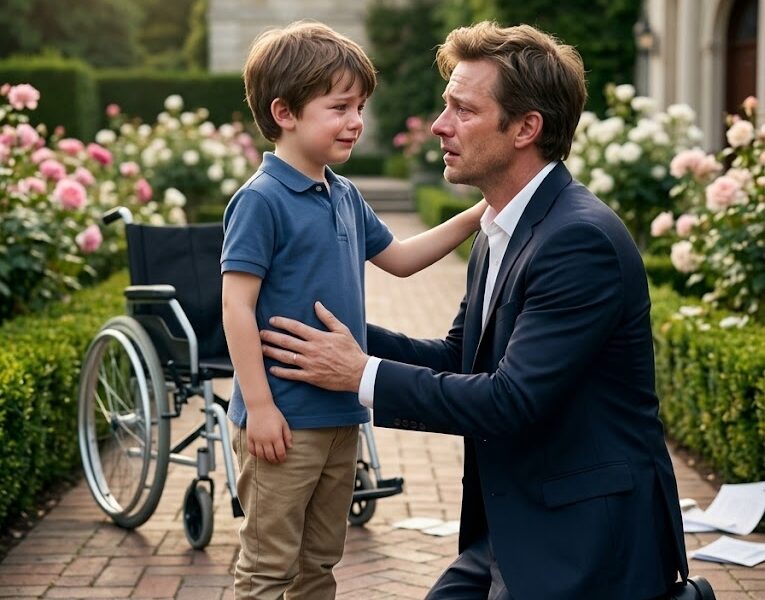
Lachlan McGregor’s voice ripped across the garden so violently that six-year-old Finley dropped both crutches.
The aluminum sticks struck the stone path with two sharp metallic cracks.
Finley’s knees buckled.
Sarah O’Connell lunged forward and caught him before his face hit the ground.
For one frozen second, nobody moved.
Not Sarah.
Not Finley.
Not the billionaire standing twenty feet away with his briefcase lying forgotten beside the driveway.
Lachlan stared at his son as though he had just watched the dead rise.
Finley McGregor was supposed to be unable to walk.
For six years, doctors had told Lachlan the same thing.
His son suffered from a degenerative neuromuscular condition. Physical exertion was dangerous. Walking could accelerate the deterioration. Rest was essential.
Wheelchair.
No unnecessary movement.
No strain.
No risks.
Those rules had shaped Finley’s entire childhood.
And now Lachlan had come home unexpectedly at three in the afternoon and found his son standing in the garden.
Walking.
With the nanny.
“Dad—”
“Don’t.”
The word came out like a gunshot.
Finley flinched.
Sarah felt his small fingers clutch the fabric of her blouse.
Lachlan marched toward them.
His face had gone pale beneath the anger.
“What the hell have you done?”
Sarah slowly helped Finley sit on the stone bench.
“Mr. McGregor, please let me explain.”
“Explain?”
His voice cracked.
That was when Sarah realized something important.
This wasn’t only anger.
It was terror.
Raw, primitive terror.
Lachlan pointed toward Finley’s crutches.
“The doctors said physical activity could destroy what muscle function he has left.”
“They were wrong.”
Silence.
Even the birds seemed to disappear from the garden.
Lachlan stared at her.
“What did you say?”
“The diagnosis is wrong.”
He stepped closer.
Sarah could smell coffee on his breath.
“You have thirty seconds to get away from my son.”
“Dad, Sarah didn’t—”
“Finley, stay out of this.”
The boy’s face collapsed.
Sarah saw it.
So did Lachlan.
But the damage was already done.
Lachlan turned back to Sarah.
“You deliberately ignored his medical protocol. You put a disabled child at risk. You conducted some kind of unauthorized therapy on my property.”
“I helped him.”
“You could have killed him.”
“No.”
Her voice became quieter.
“That’s what somebody wanted you to believe.”
Something changed in Lachlan’s face.
Sarah knew she had crossed a line.
She also knew there was no going back.
Because four weeks earlier, Sarah O’Connell had arrived at the McGregor estate believing she had been hired to care for a disabled little boy.
By her third day, she had begun to suspect something was terribly wrong.
By her fourth week, she was certain.
And what frightened her most was no longer Finley’s condition.
It was the possibility that someone had spent six years making sure nobody discovered the truth.
Four weeks earlier, Finley had been waiting by the enormous living-room window when Sarah first arrived.
He looked smaller than six.
Thin shoulders.
Dark hair falling across a pale forehead.
A blue wheelchair that seemed too large for him.
An astronaut book rested on his lap.
He didn’t say hello.
He simply watched Sarah enter the mansion.
The McGregor estate was the kind of house that made ordinary sounds feel inappropriate.
Marble floors.
Tall windows.
Original paintings.
Furniture nobody seemed to sit on.
Fresh flowers changed every morning.
Everything polished.
Everything expensive.
Everything strangely lifeless.
Sarah had worked around wealthy families before.
She knew money could buy privacy.
Sometimes it bought silence.
Brenda Thompson met her in the foyer.
Brenda was the estate administrator, a stern woman in her late fifties who wore her gray hair in a severe knot and carried herself with the authority of someone who had stopped remembering she was an employee.
“You’re Sarah O’Connell?”
“Yes.”
Brenda looked her over.
Not rudely.
Clinically.
“You understand this is not a rehabilitation position.”
Sarah paused.
“I was told Finley needs daily assistance.”
“He does.”
Brenda began walking.
Sarah followed.
“Bathing. Dressing. Meals. Medication reminders. Companionship. School activities when necessary.”
“And mobility?”
Brenda stopped.
Her expression hardened.
“Finley does not walk.”
Sarah glanced toward the boy by the window.
He was pretending not to listen.
“What exactly is his diagnosis?”
“Probable congenital muscular dystrophy.”
Probable.
The word caught Sarah immediately.
“How recently was he evaluated?”
Brenda’s eyes narrowed.
“You’re his carer, Miss O’Connell. Not his physician.”
“I understand.”
“Good.”
Then came the instruction Sarah would remember for the rest of her life.
“Master Finley must not attempt to walk under any circumstances.”
Sarah frowned.
“None?”
“None.”
“Even assisted?”
“Absolutely not.”
“Physical therapy?”
“No.”
Sarah looked toward Finley again.
He had lowered his eyes to his book.
Brenda continued.
“Dr. Evans has been very clear. Physical exertion could accelerate his condition. Wheelchair at all times. Complete rest whenever possible.”
Something inside Sarah tightened.
She had spent eight years as a pediatric physiotherapist.
She knew neuromuscular conditions.
She knew the difference between weakness and atrophy.
She also knew that a six-year-old child with a suspected progressive disorder should not have gone years without serious reassessment.
But Sarah said nothing.
She needed the job.
Six months earlier, her younger brother Leo had died after an eight-year battle with leukemia.
Sarah had spent his final year caring for him full-time.
She had left her hospital position.
Used her savings.
Sold almost everything worth selling.
Borrowed money.
Stopped thinking about careers and references and retirement accounts because none of those things mattered when the person you loved was dying.
After Leo was gone, the bills remained.
The apartment didn’t.
Neither did her old life.
The McGregor position had been the first job that offered immediate accommodation and decent pay.
So Sarah swallowed her questions.
At least at first.
Then she began watching Finley.
And Finley began watching her.
On her third morning, she dropped a pencil beside his wheelchair.
Finley leaned sideways and picked it up before Sarah could.
The movement was quick.
Controlled.
His trunk stability was better than she expected.
On the fifth day, she noticed him moving his left foot beneath the dining table.
Not much.
But deliberately.
On the sixth, she asked him to push against her palm while helping him dress.
He did.
Weakly.
But he did.
Sarah’s heart began beating faster.
“Can you feel this?”
She touched his calf.
“Yes.”
“This?”
“Yes.”
“Any pain?”
“No.”
“What happens when you try to stand?”
Finley immediately looked toward the bedroom door.
That frightened her more than any medical answer could have.
“Finley?”
“Brenda says I’m not allowed.”
“I know. I’m asking what happens.”
He whispered.
“My legs shake.”
“Anything else?”
“I fall.”
“Does it hurt?”
“Sometimes because I hit the floor.”
Sarah almost smiled.
“That isn’t what I meant.”
“I know.”
A tiny smile appeared on his face.
It was the first one she had seen.
She spent the next several days observing him carefully.
Reflexes.
Range of motion.
Balance.
Muscle response.
Coordination.
Nothing made sense.
Finley was severely weak.
That part was undeniable.
But the pattern of weakness looked less like active degeneration and more like something Sarah had seen many times in children after long hospitalization.
Disuse.
Muscles that had never been allowed to become muscles.
Motor patterns that had never been developed because nobody had permitted the child to develop them.
Sarah went to bed that night unable to sleep.
The next afternoon, while Brenda was away, she asked Finley a question.
“Do you want to try standing?”
The boy stared at her.
For almost ten seconds, he didn’t breathe.
“Am I allowed?”
Sarah hated that question.
Not Can I?
Not Will it hurt?
Am I allowed?
“What do you want?”
Finley looked at his legs.
Then he whispered something Sarah would never forget.
“I want to know if they belong to me.”
She swallowed.
“They do.”
“Then I want to try.”
The first attempt lasted less than two seconds.
Finley screamed.
Not from pain.
From fear.
His knees collapsed almost immediately, and Sarah caught him beneath the arms.
He clung to her.
“I can’t.”
“Yes, you can.”
“I fell.”
“You stood.”
“For two seconds.”
“Yesterday you stood for zero.”
He looked at her.
Sarah smiled.
“That means today was better.”
The next day, he stood for four seconds.
Then seven.
Then twelve.
A week later, Sarah brought out a pair of pediatric forearm crutches she had quietly purchased herself.
Finley touched them like they were magical objects.
“What if Brenda finds out?”
“She won’t.”
“What if Dad finds out?”
That question sounded different.
There was hope inside it.
Sarah noticed.
“You want him to?”
Finley looked away.
“Maybe.”
“Why?”
He hesitated.
“Because maybe if I can walk, he’ll want to be around me.”
Sarah felt something inside her break.
She knelt in front of him.
“Finley, look at me.”
He did.
“Your father’s attention is not something you should have to earn.”
“But he’s always working.”
“That doesn’t mean—”
“He doesn’t love me.”
Sarah went still.
Finley’s eyes filled with tears.
“If he loved me, he’d come home.”
“Finley—”
“If he loved me, he’d eat dinner with me.”
His voice trembled.
“If he loved me, he wouldn’t look at me like he’s sad every time he sees me.”
Sarah had no answer.
Then came the sentence that made her understand how deep the damage went.
“I think he’s ashamed because I’m broken.”
Sarah pulled him into her arms.
“You are not broken.”
“But my legs—”
“Your legs are weak. That is not the same thing.”
“What if they never get better?”
“Then you are still Finley.”
She pulled back and looked directly into his eyes.
“You still deserve love. You still deserve attention. You still deserve a father who knows your favorite book and what you had for breakfast and what scares you at night.”
Finley wiped his face.
“My favorite book is Journey to Mars.”
“I know.”
He blinked.
“You know?”
“You’ve made me read it seven times.”
That made him laugh.
A real laugh.
Then he whispered, “Dad doesn’t know.”
Sarah said nothing.
“He doesn’t know I want to be an astronaut.”
Her anger toward Lachlan McGregor began that afternoon.
It would take her longer to understand the grief beneath his neglect.
Finley took his first independent assisted step seventeen days after Sarah arrived.
One step.
Then he collapsed into her arms laughing.
Two days later, he managed two.
Then three.
Every session happened secretly.
Usually in the garden while Brenda was away purchasing supplies.
Sarah chose soft ground and stone paths with benches nearby.
She monitored fatigue obsessively.
She stretched his muscles.
Massaged his calves.
Tracked his endurance.
She knew she was crossing professional boundaries.
She also knew that leaving him untouched in that wheelchair felt morally worse.
Then one afternoon, after Finley managed three consecutive steps, he began crying against her shoulder.
“I did it.”
“You did.”
“Yesterday was two.”
“I remember.”
“Today was three.”
Sarah kissed his hair.
“Tomorrow might be four.”
He pulled back.
“Five.”
She laughed.
“Ambitious.”
“I’m going to surprise Dad.”
The smile on his face disappeared almost immediately.
“Do you think he’ll be proud?”
Sarah felt the old ache.
“Yes.”
She hoped she wasn’t lying.
That afternoon Finley eventually managed six steps.
By the time Sarah carried him upstairs, he was exhausted.
His head rested against her shoulder.
His eyes were nearly closed.
“I love you, Sarah,” he murmured.
She almost missed a step.
“You’re the best thing that ever happened to me.”
Sarah stopped outside his bedroom.
Leo flashed through her mind.
Hospital lights.
A bald head on a pillow.
A hand that had grown too thin.
The last time her brother had told her he loved her.
She closed her eyes.
“You’re one of the bravest kids I’ve ever known.”
“Braver than Leo?”
“As brave as Leo.”
She tucked Finley beneath his astronaut quilt.
Within minutes, he was asleep.
Sarah stood beside the bed, looking at him.
For the first time since Leo died, caring for someone did not feel like reliving a loss.
It felt like preventing one.
Then a voice came from behind her.
“Touching.”
Sarah spun around.
Brenda stood in the doorway.
Still wearing her coat.
Her arms were crossed.
A thin smile curved her mouth.
Sarah’s stomach dropped.
“How long have you been standing there?”
“Long enough.”
Brenda stepped inside and closed the door.
The click sounded much louder than it should have.
“Long enough to see Finley sweating. Exhausted. Barely able to keep his eyes open.”
“We were playing.”
Brenda laughed softly.
“Do you think I’m stupid?”
Sarah didn’t answer.
“I worked as a nurse before you were old enough to understand what a medical chart was. I know what post-exertion fatigue looks like.”
Sarah’s pulse quickened.
Brenda moved closer.
“You’ve been doing physical therapy with him.”
Sarah lifted her chin.
“I’ve been helping him.”
“You’ve been violating direct medical orders.”
“Those orders are based on a six-year-old diagnosis.”
“That diagnosis saved his life.”
“It may be destroying it.”
The slap came so quickly Sarah didn’t see Brenda’s hand move.
Pain exploded across her cheek.
Sarah staggered sideways.
Brenda leaned toward her.
“Watch your mouth.”
Sarah slowly straightened.
“Did you just hit me?”
“I’m warning you.”
“No. You assaulted me.”
“And if you want to keep this job, you will forget it happened.”
Sarah stared at her.
Brenda’s voice dropped.
“If I see you exercising that boy again, I will make sure you never work with children anywhere in this country.”
“You’re afraid.”
For the first time, Brenda’s expression changed.
Only slightly.
But Sarah saw it.
“Of what?” Brenda asked.
“Of him getting better.”
The silence between them became poisonous.
Then Brenda smiled.
“You have no idea what you’re talking about.”
She turned toward the door.
“Mr. McGregor is coming home early tonight.”
Sarah’s stomach tightened.
“He wants to see Finley before bed. Make sure the boy looks presentable.”
She glanced back.
“And keep your experiments to yourself.”
That evening, Finley put on a new polo shirt.
Sarah combed his hair.
He could barely sit still.
“Do you think Dad will watch the astronaut movie?”
“Maybe.”
“He said he’s coming home early.”
“I know.”
“He never comes home early.”
“I know.”
At six, a black Mercedes entered the driveway.
Finley’s entire face transformed.
“Dad!”
Lachlan McGregor entered the mansion still speaking into his phone.
Forty-two.
Tall.
Impeccable suit.
Dark hair touched with silver.
A man who looked like he had spent years learning how to make rooms obey him.
He ended the call.
“Good evening.”
“Dad!”
Finley opened his arms.
Lachlan walked over and kissed his forehead.
“Hello, Finley. How was your day?”
“Amazing. Sarah and I went outside and I learned—”
“Excellent.”
Lachlan checked his watch.
“Brenda, did the Vega documents arrive?”
Finley’s smile vanished.
“Yes, Mr. McGregor.”
“I need them upstairs.”
Lachlan started toward the staircase.
“Dad?”
He stopped.
“Aren’t we having dinner?”
Lachlan looked back.
Finley’s hands were gripping the wheelchair arms.
“You said you were coming home early for me.”
Something like guilt crossed Lachlan’s face.
“Of course. Give me thirty minutes.”
“Promise?”
“I promise.”
He went upstairs.
Thirty minutes became an hour.
Then two.
Then three.
Finley refused dinner.
At nine-thirty, he was crying in Sarah’s arms.
“He always does this.”
“I know.”
“He promises and then he forgets.”
Sarah rocked him gently.
“He never forgets work.”
She closed her eyes.
“No.”
“Maybe when I walk, he won’t forget me.”
That was the moment Sarah made her decision.
Tomorrow, she would stop hiding.
The following afternoon, Sarah deliberately chose the section of garden visible from Lachlan’s office windows.
Finley noticed immediately.
“Brenda can see us here.”
“I know.”
“Sarah?”
“Trust me.”
He swallowed.
Then nodded.
They practiced for nearly an hour.
Seven steps.
Rest.
Eight.
Rest.
Nine.
Then eleven.
Eleven consecutive steps.
Finley laughed so loudly that Sarah laughed with him.
He stumbled into her arms.
“I did eleven!”
“You did eleven!”
Then Sarah heard a car.
Her blood went cold.
The black Mercedes.
Three o’clock.
Five hours early.
Lachlan stepped out carrying his briefcase.
He walked toward the house.
Stopped.
Looked toward the garden.
The briefcase fell from his hand.
And everything exploded.
Now, kneeling in front of Finley while Lachlan ordered her off the property, Sarah knew she had only one chance.
“I’m not just a nanny.”
Lachlan froze.
“What?”
“I’m a certified pediatric physiotherapist.”
His face changed.
“I worked eight years at St. Jude’s Children’s Hospital.”
“You lied on your application?”
“I took a carer position because I needed work.”
“And that gave you permission to experiment on my son?”
“No.”
Sarah stood.
“It gave me enough knowledge to recognize severe disuse atrophy.”
Lachlan stared at her.
“Your son does not present like a child with progressive muscular degeneration.”
“You don’t know that.”
“I do.”
“You’ve been here four weeks.”
“And Dr. Evans hasn’t physically examined him in four years.”
Lachlan’s expression emptied.
Sarah knew immediately.
He hadn’t known.
“Ask Brenda,” she said.
“What?”
“Ask when Dr. Evans last examined Finley.”
Lachlan looked toward the house.
Then back at Sarah.
“You’re lying.”
“I wish I were.”
His hand moved before either of them understood what was happening.
The slap knocked Sarah onto one knee.
Finley screamed.
“DAD!”
Lachlan froze.
Sarah touched her burning cheek.
For a second, she saw genuine horror on his face.
But rage returned.
“Get off my property.”
Sarah stood slowly.
“Is that what you do every time someone tells you something you don’t want to hear?”
“Sarah!” Finley cried.
Lachlan pointed toward the house.
“Leave.”
“No!”
Finley grabbed his crutches.
“Finley, stop.”
But the boy was already standing.
His knees trembled.
He took one step.
Then another.
Lachlan stopped breathing.
Three.
Four.
Five.
Finley’s face twisted with effort.
Tears streamed down his cheeks.
“Look, Dad.”
Lachlan’s hand fell.
“Finley…”
“I can do it.”
The boy smiled through his tears.
“Sarah taught me.”
Another step.
“I get stronger every day.”
Lachlan’s eyes filled.
“And someday I’m going to run.”
Finley’s voice broke.
“Maybe then you’ll love me.”
Nothing Sarah had said could have wounded Lachlan McGregor like those six words.
He dropped to his knees.
The billionaire who had spent years controlling companies, negotiations, employees and markets covered his face with both hands.
And sobbed.
Finley stared at him.
Then dropped his crutches.
He crawled the final distance and wrapped his arms around his father.
“Don’t cry, Dad.”
“I’m sorry.”
Lachlan clutched him.
“I’m so sorry.”
“I’m getting better.”
“I know.”
“You’ll watch me?”
Lachlan pulled back.
“What?”
“When I practice.”
Finley wiped his father’s tears with his small fingers.
“Will you watch me walk?”
Lachlan broke again.
“Every day.”
Sarah stood several feet away.
Her cheek burned.
Part of her wanted to leave.
Part of her wanted to scream.
But then Lachlan looked at her.
“Is it true?”
“What?”
“The diagnosis.”
“Yes.”
“How can you know?”
“I need his records.”
Lachlan looked toward the mansion.
“Then you’re going to see them.”
A voice interrupted.
“What exactly is happening here?”
Brenda stood on the garden path.
Sarah watched Lachlan stand.
Something about him had changed.
“Brenda,” he said quietly. “When did Dr. Evans last examine my son?”
Brenda hesitated.
Sarah saw it.
So did Lachlan.
“Dr. Evans monitors Finley’s condition continuously.”
“That wasn’t my question.”
“Mr. McGregor—”
“When?”
Brenda’s mouth tightened.
“The last physical evaluation was several years ago.”
“How many?”
Silence.
“Four?”
Brenda said nothing.
Lachlan turned pale.
“Four years?”
“His condition is stable.”
“My son just walked across the garden.”
“That proves nothing.”
“It proves enough to get another opinion.”
“No.”
The word came too quickly.
Everyone looked at her.
Brenda corrected herself.
“I mean, it would be medically irresponsible.”
Sarah stepped forward.
“Give me one week.”
Lachlan looked at her.
“One week for what?”
“An independent neurological evaluation.”
Brenda shook her head.
“Absolutely not.”
Lachlan didn’t even look at her.
“One week.”
Brenda stared at him.
“Mr. McGregor.”
“One week, Sarah.”
Sarah nodded.
Brenda’s face became expressionless.
But that night, after everyone had gone upstairs, she closed her bedroom door and made a phone call.
“Dr. Evans?”
She waited.
“We have a problem.”
Her voice became quieter.
“The new carer isn’t a carer.”
A pause.
“She’s a pediatric physiotherapist.”
Another pause.
“Yes.”
Brenda looked toward the hallway.
“And she’s figured it out.”
Lachlan did not sleep.
At seven the next morning, Sarah found him sitting at the breakfast table surrounded by medical papers.
His tie was gone.
His sleeves were rolled up.
A laptop showed dozens of open research articles.
“I owe you an apology.”
Sarah touched her cheek unconsciously.
“Yes.”
He looked down.
“What I did yesterday was unforgivable.”
“Yes.”
He seemed surprised by the blunt answer.
Sarah sat across from him.
“You were terrified. I understand that. It doesn’t make hitting me acceptable.”
“No.”
“It also doesn’t erase six years of ignoring your son.”
His jaw tightened.
But this time, he listened.
Lachlan stared at his coffee.
“When Khloe died, I blamed him.”
Sarah said nothing.
“My wife.”
His voice became quieter.
“We tried for years to have a child.”
He looked toward the staircase.
“She died after giving birth to Finley.”
Sarah’s anger softened, but did not disappear.
“He survived. She didn’t.”
Lachlan swallowed.
“Every time I looked at him, I saw her.”
“So you stopped looking.”
“Yes.”
The honesty surprised her.
“Then the diagnosis came. Brenda took over everything because I couldn’t function. Doctors. Nurses. Medication. Carers.”
“And you worked.”
“I hid.”
There it was.
Not an excuse.
A confession.
“I thought if I built enough companies, made enough money, kept moving fast enough, I wouldn’t have to feel anything.”
He laughed bitterly.
“I became very successful at everything except being a father.”
A sound came from the staircase.
Finley stood there in pajamas.
Not in his wheelchair.
Holding the railing.
“Dad?”
Lachlan stood immediately.
Finley stared at him.
“You’re still home?”
Three ordinary words.
They devastated him.
“Yes, champ.”
“Why?”
“Because I want to have breakfast with you.”
Finley studied him suspiciously.
“You promised dinner yesterday.”
“I know.”
“You didn’t come.”
“I know.”
Lachlan walked to the bottom of the stairs and knelt.
“I’ve broken a lot of promises to you.”
Finley said nothing.
“So I’m not going to ask you to believe a new one yet.”
That made Sarah look at him differently.
“I’m going to show you.”
Finley’s expression softened.
“Can we have pancakes?”
Lachlan smiled.
“Yes.”
“Sarah makes them shaped like planets.”
Lachlan glanced at her.
“Apparently I have a lot to learn.”
“You do,” Sarah said.
Finley laughed.
And for the first time in years, father and son ate breakfast together.
Brenda entered halfway through.
Her face went pale.
“Cancel my meetings,” Lachlan told her.
“Excuse me?”
“All of them.”
“You have the Wilson acquisition.”
“My son has a medical evaluation.”
“Mr. McGregor, Dr. Evans—”
“Hasn’t examined my son in four years.”
Brenda went silent.
Lachlan closed his coffee cup.
“I also checked your nursing license.”
The color disappeared from her face.
“It expired ten years ago.”
Sarah watched Brenda’s fingers tighten around the chair.
“And I found something else,” Lachlan continued.
“Six years of monthly transfers.”
Brenda’s breathing changed.
“Ten thousand dollars a month from Dr. Evans.”
Finley looked between the adults.
“What does that mean?”
Nobody answered immediately.
Lachlan stood.
“It means Brenda won’t be working here today.”
Her expression turned vicious.
“You have no idea what you’re doing.”
“I’m beginning to understand.”
“You trusted me for six years.”
“That may have been my biggest mistake.”
Dr. Ben Carter spent nearly two hours examining Finley.
Reflexes.
Strength.
Range of motion.
Blood tests.
Imaging.
Motor response.
He reviewed the original diagnosis.
Then he removed his glasses.
“Finley does not have congenital muscular dystrophy.”
Lachlan stopped breathing.
Sarah closed her eyes.
She had expected it.
Hearing it still hurt.
Dr. Carter continued.
“He does have severe muscle atrophy and significant developmental delay.”
Finley looked frightened.
“Am I sick?”
“No.”
Dr. Carter moved closer.
“You are weak because your muscles have not been used enough.”
“Can I get strong?”
“Yes.”
“How strong?”
The doctor smiled.
“With a great deal of work?”
He looked at Sarah.
“Possibly strong enough to run.”
Finley’s face lit up.
Lachlan turned away.
Sarah saw his shoulders begin shaking.
Six years.
Six years of wheelchairs.
Six years of unnecessary immobility.
Six years of watching life happen through windows.
All because nobody had asked whether the first answer was still the right answer.
On the drive home, Finley slept in the back seat.
Lachlan cried silently behind the wheel.
“I did this.”
Sarah looked at him.
“You trusted medical advice.”
“I also disappeared.”
“Yes.”
He glanced at her.
She didn’t soften it.
“You did.”
He nodded.
“What do I do with that?”
“Don’t turn guilt into another way of abandoning him.”
Lachlan frowned.
“What?”
“If you spend the next ten years hating yourself, Finley still doesn’t get a father.”
He looked into the rearview mirror at his sleeping son.
“What does he get?”
“You.”
Sarah paused.
“If you’re willing to stay.”
When they returned to the mansion, Brenda was waiting.
Beside her stood Dr. Evans.
Lachlan didn’t shake his hand.
Dr. Evans attempted professional indignation.
Lachlan answered with bank records.
Emails.
Payments.
Years of correspondence in which Brenda described Finley’s condition while Dr. Evans renewed recommendations without seeing the child.
Sarah felt sick reading them.
It wasn’t merely negligence.
It was a system.
Keep Finley classified as chronically ill.
Maintain expensive medical monitoring.
Continue insurance billing.
Avoid outside specialists.
Keep the father frightened.
Keep the child dependent.
And whenever a carer asked too many questions, replace them.
Lachlan called his attorney.
Then the state medical board.
Brenda left the house threatening him.
“You think this ends here?”
“No,” Lachlan said. “I think it begins here.”
He was right.
Three days later, the headlines appeared.
BUSINESS TYCOON ACCUSED OF NEGLECTING DISABLED SON
Anonymous sources described Lachlan as an absent father.
That part was difficult to deny.
But the articles went further.
They accused Sarah of experimenting on a vulnerable child.
They described the McGregor mansion as a place of isolation and abuse.
Reporters surrounded the corporate offices.
Investors called.
Board members demanded answers.
Finley found one of the articles himself.
“Dad?”
Lachlan turned.
Finley held a tablet.
“What does negligence mean?”
Lachlan’s face collapsed.
Sarah started toward him.
But Lachlan raised a hand.
He knelt before his son.
“It means failing to take care of someone properly.”
Finley looked at the screen.
“They say you neglected me.”
Lachlan swallowed.
“Yes.”
Sarah stared at him.
He continued.
“Some things in that article are lies.”
Finley waited.
“But I did fail you.”
Tears appeared in Lachlan’s eyes.
“I wasn’t there when you needed me.”
Finley whispered, “But you’re here now.”
“I am.”
“Then keep being here.”
Lachlan hugged him.
Finley pressed his face against his father’s shoulder.
“You fell down, Dad.”
Lachlan laughed through his tears.
“I did.”
“Sarah says being strong means getting back up.”
Sarah turned toward the window so they wouldn’t see her crying.
The doorbell rang.
Dr. Michael Abbott stood outside.
He was an elderly pediatric specialist from Metropolitan Medical Center.
He had reviewed Finley’s case.
And he was furious.
Not at Sarah.
Not at Lachlan.
At what had been done to Finley.
Within forty-eight hours, five physicians agreed to publicly support Dr. Carter’s findings.
A press conference was arranged.
But Brenda struck first.
Police arrived at the McGregor estate with a temporary restraining order alleging that Sarah had practiced medicine improperly and endangered a minor.
Finley screamed when they told Sarah she had to leave.
“No!”
Sarah knelt before him.
“Look at me.”
His face was soaked with tears.
“You promised.”
“I know.”
“You promised you wouldn’t leave me.”
“I’m not leaving you.”
“They’re making you go.”
“Temporarily.”
He shook his head.
“I need you.”
Sarah almost broke.
Instead, she took his hands.
“You need yourself more.”
He stared at her.
“You know the exercises.”
“I’m scared.”
“Be scared.”
She touched his cheek.
“And do them anyway.”
Finley sobbed.
Sarah looked at Lachlan.
“Fight for him.”
Lachlan’s face hardened.
“I will.”
Then Sarah walked out of the house.
For three days, she stayed in a cheap hotel across town.
Lachlan sent messages.
He practiced today.
Eight steps.
He asked about you.
Then:
Ten steps.
And finally:
Press conference tomorrow. Dr. Abbott says come.
The conference hall was packed.
Reporters.
Television cameras.
Doctors.
Lawyers.
Finley sat beside his father in a small dark suit.
Brenda sat across the room beside her attorney.
She smiled when Sarah entered.
That smile disappeared twenty minutes later.
Dr. Abbott presented the updated medical findings.
Dr. Carter explained the atrophy.
Financial investigators displayed transfers between Dr. Evans and Brenda.
Emails appeared on a large screen.
Then the doors opened.
An older woman entered with a cane.
“Emma Davies,” she introduced herself.
Brenda turned white.
Fifteen years earlier, Emma had been Brenda’s rehabilitation patient.
According to Emma, Brenda had deliberately interfered with her recovery to prolong treatment and increase financial compensation.
Emma had reported her.
Brenda lost her nursing license.
Years later, Dr. Evans offered her another opportunity.
This time the patient was a baby.
A grieving widower.
A family with unlimited money.
And nobody watching closely enough.
Police officers stepped forward.
Brenda stood.
“No.”
Her attorney whispered something.
“No!”
She looked at Lachlan.
“You weren’t there!”
The room went silent.
“You abandoned him!”
Lachlan stood.
“Yes.”
Brenda blinked.
He didn’t deny it.
“I did.”
His voice trembled.
“I failed my son.”
Cameras flashed.
“But you used that failure.”
Brenda stepped backward.
“You used my grief to control access to him. You used my absence to keep him dependent. And you used his body to make money.”
“I took care of him!”
“You kept him sick.”
“I gave him everything!”
“You took six years.”
The police handcuffed her.
As she was led away, Lachlan turned toward the cameras.
Sarah saw his hands shaking.
“My name is Lachlan McGregor.”
The room quieted.
“And I am guilty.”
Sarah’s heart stopped.
He continued.
“I am guilty of letting grief turn me into a coward.”
Finley stared at him.
“I am guilty of believing that paying for care was the same thing as giving care.”
Lachlan’s voice cracked.
“I am guilty of missing birthdays, dinners, nightmares, stories, ordinary mornings and thousands of moments I can never recover.”
Tears streamed down his face.
“I cannot blame Brenda Thompson or Dr. Evans for those choices.”
Then he looked at Finley.
“But my son gave me something I did not deserve.”
Finley began crying.
“A second chance.”
Lachlan looked toward Sarah.
“And Sarah O’Connell saw my son when the rest of us saw a diagnosis.”
Sarah lowered her eyes.
“She questioned what nobody else questioned.”
Then Finley reached for his crutches.
Sarah noticed first.
“Finley?”
He stood.
The room went silent.
He positioned the crutches.
One step.
Two.
Five.
Ten.
Lachlan covered his mouth.
Finley kept walking.
Fifteen steps.
The longest distance he had ever managed.
When he reached his father, he dropped the crutches.
For one impossible second, he stood unsupported.
Then he fell forward.
Lachlan caught him.
Just as Sarah had caught him in the garden.
Finley wrapped his arms around his father’s neck.
“I walked because you were waiting for me.”
Lachlan buried his face against his son.
And somewhere behind them, hundreds of people began to applaud.
The hardest part did not come with applause.
It came afterward.
Recovery was slow.
Some mornings Finley could walk twenty steps.
The next day, seven felt impossible.
He cried.
He became angry.
He threw a crutch once and immediately apologized to it as though the object had feelings.
Sarah increased his therapy carefully.
Dr. Carter monitored his progress.
Lachlan rearranged his life.
At first, Finley did not trust it.
If Lachlan promised breakfast, Finley watched the clock.
If he promised therapy, Finley expected a phone call to interrupt.
If he promised bedtime, Finley kept asking Sarah, “Do you think he’ll really come?”
But Lachlan came.
Again.
And again.
And again.
Trust did not return because of one apology.
It returned because Tuesday followed Monday and Lachlan was still there.
One evening, Finley asked about his mother.
Lachlan went silent.
Then he took his son upstairs.
To a hallway nobody used.
At the end stood a white door Lachlan had not opened in six years.
Behind it was the nursery Khloe had prepared.
Sky-blue walls.
Planets.
Stars painted across the ceiling.
A white crib beneath a dusty window.
Finley stared upward.
“Mom made this?”
“Every part.”
“She knew I liked space?”
Lachlan smiled sadly.
“She decided you would before you were born.”
Finley laughed.
Sarah turned away to give them privacy.
Then she noticed something behind the door.
A framed letter.
The date was the day before Finley’s birth.
“Lachlan.”
He came over.
Together, they read Khloe’s words.
She had written the letter because she was afraid something might happen during childbirth.
She knew her husband.
Knew grief might make him hide.
Knew he might disappear into work.
And she begged him not to let their child pay for her absence.
If their son faced physical or medical challenges, she wrote, those challenges must never become the definition of his life.
Fight for him.
Especially when fighting is hard.
Lachlan sank onto the floor.
“She knew.”
Finley sat beside him.
“She knew what?”
“She knew I might run away.”
“But you came back.”
Lachlan looked at him.
“Six years late.”
Finley shrugged with the strange wisdom children sometimes possess.
“You’re here now.”
They cleaned the room together.
The crib was removed.
The walls remained blue.
They added shelves filled with astronomy books.
A telescope stood by the window.
And on the ceiling, Khloe’s old stars still glowed when the lights went out.
Six months after Sarah O’Connell had been fired in the garden, she stood outside a new building bearing a name she never expected to see.
THE KHLOE MCGREGOR MEDICAL EVALUATION CENTER
Lachlan had funded it to provide free second opinions and diagnostic reviews for children whose families could not afford specialists.
Sarah joined the clinical team.
Dr. Carter served as medical director.
Dr. Abbott became an adviser.
The investigation into Dr. Evans continued.
Brenda faced criminal charges.
But Sarah rarely thought about either of them anymore.
Because revenge had never been the point.
Footsteps echoed behind her.
Fast footsteps.
Uneven.
Unpolished.
Beautiful.
“Sarah!”
She turned.
Finley was running down the hallway.
Running.
No wheelchair.
No crutches.
His movements were still slightly awkward.
His arms swung too widely.
One foot turned inward when he became tired.
Sarah had never seen anything more perfect.
“Dad! Sarah! Look!”
Lachlan appeared beside her.
Finley reached them breathless.
“I ran from the car.”
“You were supposed to wait for me,” Lachlan said.
“I was too fast.”
“You’re six.”
“Exactly.”
Sarah laughed.
Finley grabbed both their hands.
“Come on. We’re late.”
Hundreds of people were waiting in the auditorium for the center’s opening ceremony.
Finley had insisted on speaking.
He stood behind the microphone.
For a moment, the old fear returned.
Sarah saw it.
His fingers tightened.
Then he looked at her.
She nodded.
Finley looked at his father.
Lachlan smiled.
And the boy began.
“My name is Finley McGregor.”
His voice trembled once.
Then steadied.
“Six months ago, I used a wheelchair.”
The auditorium became silent.
“I thought there was something wrong with me.”
Sarah felt tears rising.
“I thought people didn’t look at me because I was broken.”
Lachlan lowered his head.
Finley continued.
“But Sarah told me something.”
He looked directly at her.
“She said I wasn’t broken.”
His smile appeared.
“I was just weak.”
A few people laughed softly.
“And weak things can become stronger.”
He paused.
“My dad was weak, too.”
Lachlan laughed through his tears.
“He was scared.”
Finley looked at him.
“But he got stronger.”
The audience became completely still.
“So I learned that sometimes people don’t need you to fix them.”
Finley looked toward the families seated before him.
“They need you to see them.”
Sarah’s throat tightened.
Finley stepped away from the microphone.
No crutches waited beside him now.
He simply walked.
Across the stage.
Toward his father.
Lachlan opened his arms.
But Finley stopped just before reaching him.
“Dad?”
“Yes?”
“Mom said I could touch the stars, right?”
Lachlan smiled.
“She did.”
Finley looked toward the ceiling.
Then toward Sarah.
“Do you think Leo can see me?”
Sarah felt the question land in the deepest place inside her.
For six months, she had helped Finley rebuild muscles that had never been given the chance to grow.
Somewhere along the way, the boy had rebuilt something in her, too.
“I think he’d be very proud of you.”
Finley nodded seriously.
“Then we should keep going.”
“Where?”
He smiled.
“Toward the stars.”
He took Lachlan’s hand.
Then Sarah’s.
And the three of them walked off the stage together.
Outside, families continued arriving at the center.
Parents carrying medical files.
Children holding hands.
Some frightened.
Some exhausted.
Some arriving after being told there was nothing more to question.
Sarah watched them through the glass doors.
Once, she had believed miracles were dramatic things.
A cure.
A rescue.
A person returning from the dead.
Leo had taught her otherwise.
Sometimes there was no miracle.
Sometimes you lost the person you loved no matter how hard you fought.
But Finley had taught her something different.
Sometimes a miracle was simply one person refusing to stop looking.
One person asking another question.
One father finally coming downstairs for breakfast.
One frightened child taking one impossible step.
Then another.
Then another.
Lachlan squeezed Finley’s hand.
Finley pulled free.
“Race you!”
Before either adult could answer, he ran down the bright hallway.
His shoes struck the floor in an uneven rhythm.
Tap.
Tap.
Tap.
Sarah watched him disappear around the corner.
Six months earlier, the sound of Finley’s crutches hitting stone had marked the moment everything fell apart.
Now his footsteps filled the building his suffering had helped create.
Lachlan stood beside her.
Neither spoke.
They simply listened.
For six years, people had looked at Finley McGregor and seen a wheelchair.
A diagnosis.
A tragedy.
A limitation.
Sarah had looked at him and seen a little boy asking the simplest question in the world.
Do my legs belong to me?
Now those legs were carrying him toward a future nobody had allowed him to imagine.
Sarah smiled through her tears.
Because Finley had never needed someone to give him a life.
He already had one.
He had never needed someone to give him courage.
He already possessed more than most adults Sarah had ever known.
And he had never truly been invisible.
People had simply forgotten how to see him.
From somewhere down the hallway came his laughter.
Then Lachlan’s voice.
“Finley! Slow down!”
“No!”
Sarah laughed.
And followed them.
Not because everything had been repaired.
Six years could not be returned.
Khloe would not walk through the door.
Leo would not call Sarah again.
Lachlan could never attend the birthdays he had missed.
Finley would carry memories of loneliness long after his legs became strong.
Some wounds did not disappear.
They simply stopped deciding where you were allowed to go.
At the end of the hallway, sunlight poured through enormous windows.
Finley stood inside it, impatiently waving them forward.
“Come on!”
Lachlan started running.
Sarah followed.
And Finley ran faster.
Not away from the wheelchair.
Not away from six stolen years.
Not even away from the people who had failed him.
He ran toward something.
Toward his father.
Toward Sarah.
Toward the life waiting beyond those glass doors.
Toward every ordinary tomorrow he had once been told he might never have.
And this time, when Finley McGregor looked ahead, nobody told him where his limits were.
This time, the boy decided for himself how far he wanted to go.









