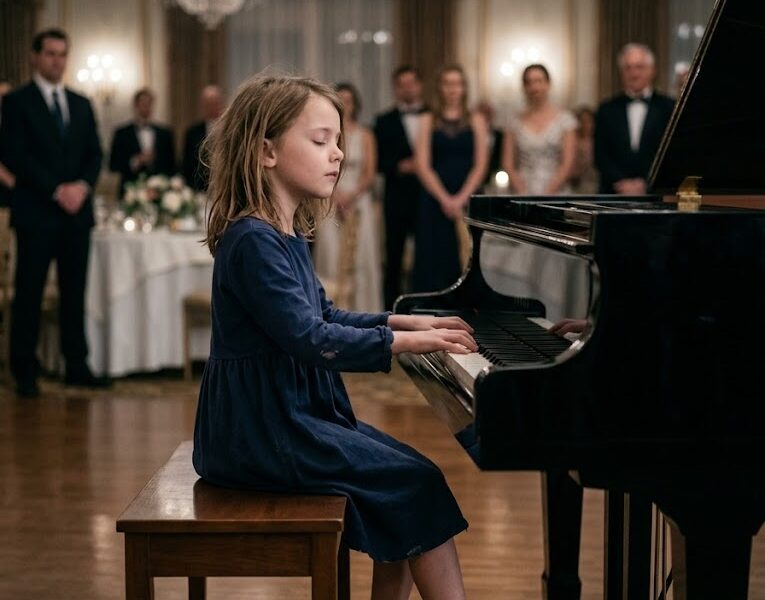
THE MILLIONAIRE MOCKED A 7-YEAR-OLD ORPHAN AT HIS GALA—THEN SHE TOUCHED THE PIANO AND EXPOSED THE ONE THING HE COULDN’T BUY

The first person to laugh was the millionaire.
The second was the woman beside him in diamonds.
By the time the laughter spread through the ballroom, seven-year-old Anna Mercer was already standing beside the grand piano with both hands clenched so tightly that her fingernails had left four pale half-moons in each palm.
She had been told not to touch anything.
Not the champagne glasses arranged like crystal towers.
Not the white roses flown in from California.
Not the gold-trimmed place settings.
And definitely not the black Steinway beneath the chandelier, polished so perfectly that Anna could see her frightened face reflected in its lid.
She had only walked toward it because the room had become too loud.
Then Alexander Gray noticed her.
He stood near the center of the ballroom at the Graymont Hotel in downtown Chicago, one hand in the pocket of a midnight-blue tuxedo that cost more than most foster families earned in a month.
Forty-two years old.
Founder of Gray Capital.
Owner of three hotels, a private aviation company, two downtown office towers, and enough influence that people laughed before they were sure he had made a joke.
He lifted his champagne glass toward Anna.
“Well,” he said loudly, “if you’re going to stare at my piano like that, you might as well play it.”
A few guests turned.
Anna froze.
The woman in diamonds beside Alexander smiled as though she expected something entertaining.
Anna looked toward the side of the ballroom where Ms. Elena Brooks, her caseworker, was speaking with one of the charity organizers.
Anna should have walked away.
Instead, she whispered, “Am I allowed?”
Alexander had already forgotten that she was a child.
He was thinking about the donors surrounding him, the cameras near the floral wall, the absurdity of a small girl in a secondhand navy dress wandering toward a concert piano at a black-tie fundraiser.
So he smiled.
“Allowed?” he repeated. “Sure.”
Someone chuckled.
Anna swallowed.
Alexander tilted his head.
“Tell you what,” he said.
His voice carried farther than he intended.
“Play something that actually impresses me, and maybe I’ll adopt you.”
The laughter came immediately.
Warm.
Easy.
Careless.
It was the kind of laughter wealthy adults produced when they believed everyone in the room understood the rules of the joke.
Anna did not laugh.
Neither did Elena Brooks.
She had heard the sentence from twenty feet away.
Her face changed.
“Mr. Gray—”
But Anna was staring at Alexander.
Not angrily.
Not accusingly.
Hopefully.
That was what stopped Elena.
Hope.
The one thing she had spent two years trying to teach Anna to approach carefully.
Alexander’s smile slowly disappeared.
Because the little girl wasn’t treating his words like a joke.
She believed him.
Anna stepped closer to the piano bench.
“You mean it?” she asked.
The ballroom became strangely quieter.
Alexander glanced around.
The joke had gone too far, but retreat would make him look cruel.
So he gave the kind of answer rich men sometimes gave when they were certain consequences belonged to other people.
“Impress me first.”
Anna climbed onto the bench.
Her shoes did not touch the floor.
And as she placed her trembling fingers above the keys, Alexander Gray had no idea that within the next five minutes, a secret he had buried for thirty-three years was going to crack open in front of two hundred people.
Anna Mercer knew three important things about adults.
The first was that they could leave without warning.
The second was that promises sounded different after people got what they wanted.
The third was that asking for too much made adults uncomfortable.
She had learned these things before she learned long division.
Her earliest memory was not of a mother.
It was of a ceiling fan.
Brown blades turning slowly above a motel bed somewhere outside Milwaukee while a woman Anna believed was her mother packed a red suitcase.
Anna had been three.
“Stay here,” the woman had said.
Anna remembered eating dry cereal from a paper cup.
She remembered cartoons playing too loudly.
She remembered the door shutting.
She did not remember it opening again.
Police found her the following afternoon after a housekeeper heard her crying.
After that came temporary placements.
Emergency foster care.
A county intake center.
A family in Kenosha that lasted eleven months.
Another family near Madison that lasted five.
One home where the foster mother labeled shelves in the refrigerator so the children would know which food belonged to whom.
One where Anna learned to sleep with crackers under her pillow.
One where a foster father complained that piano music on television gave him headaches, even though Anna had never touched an instrument in her life.
Then, at six, she was placed at St. Agnes Children’s Residence outside Chicago while the state searched for a longer-term foster placement.
The building had once been a Catholic girls’ school.
The chapel had been converted into a library.
The classrooms had become bedrooms and offices.
And in the basement beneath the old auditorium sat a battered upright piano nobody wanted.
Three keys stuck.
One pedal was broken.
The wood was scratched.
But the first time Anna pressed middle C, she felt the vibration travel through her fingertip and into her arm.
She pressed it again.
Then the note beside it.
Then another.
Nobody had taught her.
At first, she simply copied melodies she heard in cartoons, church services, hallway radios.
Later, Sister Margaret Hale, a seventy-one-year-old retired music teacher who volunteered twice a week, found her sitting at the piano after lights-out.
“You’ll wake everyone,” Margaret whispered.
Anna jerked her hands away.
“I’m sorry.”
Margaret should have sent her upstairs.
Instead, she sat beside her.
“Play the thing you were just playing.”
“I don’t know what it is.”
“That doesn’t matter.”
Anna looked suspicious.
Adults usually cared very much whether something was right.
Margaret smiled.
“Play it anyway.”
Anna did.
It was twelve measures of something unfinished and uneven.
When she stopped, Margaret did not clap.
She only asked, “Who taught you?”
“No one.”
Margaret stared at her for several seconds.
Then she said something Anna never forgot.
“Then we should probably find out what else nobody has taught you yet.”
For the next year, Margaret gave her lessons.
Nothing formal enough to impress a conservatory.
Scales.
Finger positions.
Simple Bach.
Old American folk songs.
How to listen to a chord until she could feel where it wanted to go next.
Anna practiced whenever she was allowed.
When she was sad, she played.
When other children were chosen for weekend visits and she wasn’t, she played.
When a potential foster mother returned her file because she wanted “a younger child without abandonment issues,” Anna played until her fingers hurt.
Music did not promise to stay.
That was why Anna trusted it.
Then St. Agnes received an invitation to the Gray Foundation’s annual Children’s Futures Gala.
Alexander Gray’s foundation donated millions each year to scholarships, youth housing programs, hospitals, and foster organizations.
The invitation requested that a small group of children attend for photographs and a brief presentation about arts funding.
Anna almost wasn’t chosen.
Elena argued for her.
“She needs to see rooms like this,” she told the director.
“Why?”
“Because she thinks every beautiful room belongs to somebody else.”
And so Anna ended up in the ballroom wearing a navy-blue dress donated by a department store, tights with one tiny snag near the ankle, and black shoes that had belonged to another girl first.
She had been afraid to touch the piano.
Until Alexander invited her.
Now she sat before it while two hundred people watched.
Her first note was wrong.
Not dramatically wrong.
Just wrong enough.
A soft discordant strike that echoed against the high ceiling.
Someone near the bar laughed.
Anna’s shoulders tightened.
A second note came too loudly.
Then a third.
Alexander leaned back against a table.
The diamond-covered woman beside him—Vanessa Shaw, a developer whose company was seeking Gray Capital funding—gave him an amused look.
“Your daughter audition isn’t going well,” she whispered.
Alexander smiled automatically.
But across the room, Elena Brooks was already moving toward the piano.
She knew Anna’s body language.
The lifted shoulders.
The shallow breathing.
The way her left thumb curled inward.
Panic.
“Anna,” Elena said gently.
The girl didn’t look up.
“You don’t have to do this.”
That sentence reached Anna more clearly than the laughter.
You don’t have to.
She had heard versions of it before.
You don’t have to stay if this family isn’t comfortable.
You don’t have to call them Mom and Dad.
You don’t have to be disappointed.
You don’t have to hope.
Anna lowered her eyes to the keys.
Then she remembered Sister Margaret sitting beside her in the basement.
Play it anyway.
Anna closed her eyes.
The ballroom disappeared.
The chandeliers disappeared.
The strangers disappeared.
Alexander Gray disappeared.
And somewhere inside her head, Anna returned to a scratched upright piano beneath St. Agnes.
Her right hand moved.
Three soft notes.
Then four.
A pause.
Her left hand joined.
The melody was not one Alexander recognized.
Neither did anyone else.
Because Anna had written it without knowing she was writing anything.
It began with the same simple notes she used whenever she couldn’t sleep.
A question.
A second question.
Then a chord that almost resolved but didn’t.
The guests closest to the piano stopped talking first.
A waiter carrying champagne paused near a column.
Vanessa’s smile faded.
Alexander glanced toward the instrument.
Anna’s mistakes did not disappear.
Her timing was imperfect.
Her fingers were too small for some of the reaches she attempted.
But something happened between the wrong notes.
Something honest.
The melody became quieter.
Then darker.
Anna leaned into the piano.
She played the sound of waiting beside windows.
The sound of hearing a car in a driveway and wondering whether it was coming for you.
The sound of lying in unfamiliar bedrooms and memorizing ceilings because furniture changed but ceilings were always the last thing you saw before sleep.
Without knowing how, she played every goodbye she had ever swallowed.
The room stopped breathing.
Alexander’s hand tightened around his champagne glass.
The melody changed.
Three notes.
A descending phrase.
Then two gentle chords separated by silence.
His face went white.
Vanessa noticed.
“Alex?”
He didn’t answer.
Anna played the phrase again.
Three notes.
Descending.
Two chords.
Alexander was no longer in the ballroom.
He was nine years old in Lake Forest.
Rain struck a window.
His mother sat at an old walnut piano wearing a green sweater, her dark hair pinned carelessly behind her head.
“Again,” young Alexander had demanded.
His mother laughed.
“You’ll be late for school.”
“Again.”
So she played the little phrase.
Three notes.
Descending.
Two chords.
It had no name.
His mother had invented it.
She called it their secret goodbye because she played it whenever she traveled for medical treatments and didn’t want Alexander to cry.
“I’ll always finish the song,” she used to tell him.
But when Alexander was nine, she left for Northwestern Memorial Hospital and never came home.
Leukemia.
His father sold the piano within a month.
Alexander had not listened to that melody in thirty-three years.
Until now.
His champagne glass slipped half an inch in his hand.
“Where did she learn that?” he whispered.
Vanessa frowned.
“What?”
“That.”
Anna continued playing.
Alexander took one step forward.
Elena saw him.
The arrogance was gone.
He looked afraid.
Anna reached the final passage.
The tune lifted.
Not into happiness.
Into something more fragile.
Possibility.
She pressed the final chord.
Let it ring.
Then opened her eyes.
For almost three full seconds, nobody moved.
No applause.
No coughing.
No glasses clinking.
Anna turned toward Alexander.
The confidence that had carried her through the last minutes disappeared immediately.
She was seven again.
Small.
Waiting.
Alexander stared at her.
Then the ballroom erupted.
People stood.
Applause rolled through the room.
Someone shouted, “Bravo!”
Another guest wiped tears from her face.
Anna flinched at the sudden noise.
But she kept looking at Alexander.
He was the only person whose reaction mattered.
Because he had promised.
Or joked.
Anna still wasn’t sure which.
Alexander put down his glass.
He walked toward the piano.
The applause softened.
Elena intercepted him before he reached Anna.
“Mr. Gray.”
His eyes remained on the child.
“Yes?”
“We need to talk.”
“I know.”
“No.” Elena lowered her voice. “I don’t think you do.”
Alexander finally looked at her.
Elena’s expression was controlled, but furious.
“You told a seven-year-old child in foster care that you would adopt her if she entertained your guests.”
Several people close enough to hear became very still.
Alexander’s jaw flexed.
“I shouldn’t have said it.”
“No, you shouldn’t have.”
“I was joking.”
“That makes it worse.”
Alexander looked past her.
Anna had climbed down from the bench.
She stood with her hands at her sides.
“What happens now?” she asked.
Elena closed her eyes for half a second.
Alexander felt something tear through him.
A joke for him had become a future for her.
He crouched so they were eye level.
Anna watched him cautiously.
“Anna.”
She waited.
“I said something carelessly.”
Her face changed before he finished.
Alexander saw hope collapsing in real time.
“No,” he said quickly. “I’m not saying that because I want to take it back.”
Elena stiffened.
Alexander continued.
“What I mean is… becoming somebody’s family isn’t something a person gets to promise in a ballroom because of a piano performance.”
Anna stared at the floor.
“But you said—”
“I know.”
“You said if I impressed you.”
“You did.”
A few guests laughed softly, but Alexander did not smile.
“You impressed everyone,” he said. “That’s not the point.”
Anna finally looked up.
“Then what’s the point?”
Alexander Gray had negotiated billion-dollar acquisitions.
He had fired executives twice his age without blinking.
He had once spoken for an hour before federal regulators while three law firms sat behind him.
And yet he could not find an easy answer to a seven-year-old girl.
“The point,” he said slowly, “is that if I ever become someone you’re supposed to trust, it should be because I earned it. Not because you played the piano well.”
Anna considered this.
Children who have been disappointed often become experts at identifying hesitation.
“So you’re not adopting me.”
Elena stepped forward.
“Anna—”
Alexander interrupted.
“I want to find out whether I can.”
Elena stared at him.
Vanessa let out a disbelieving laugh from behind them.
“Alexander, this has gone far enough.”
He turned.
Vanessa walked closer.
“Everyone understands you got emotional. It was touching. Make a donation to the home. Fund her music lessons. Whatever makes you feel better.”
Anna’s face became expressionless.
Alexander knew that expression.
It was the look of someone making herself smaller so adults could discuss her as if she weren’t there.
Something inside him hardened.
“Vanessa.”
“What?”
“Stop talking.”
Her eyebrows rose.
“Excuse me?”
“You heard me.”
The nearest conversations died instantly.
Vanessa glanced around, embarrassed.
“You can’t seriously be considering reorganizing your life because a child played a sad song.”
Alexander’s voice lowered.
“That’s exactly the kind of sentence I would have said an hour ago.”
“And?”
“And I’m beginning to understand why that should bother me.”
He turned back to Anna.
Then he asked the question nobody expected.
“Who taught you that melody?”
Anna blinked.
“What melody?”
He hummed five notes.
Anna’s eyes widened.
“Oh.”
Alexander’s pulse quickened.
“Where did you hear it?”
“I didn’t.”
His face changed.
“You must have.”
Anna shook her head.
“I made it up.”
Alexander stared at her.
“No.”
“I did.”
“Anna,” Elena said gently, “maybe Sister Margaret taught you something similar?”
“No.”
Alexander stood too fast.
People around them shifted.
He walked to the piano, sat, and pressed the notes himself.
Three descending notes.
Two quiet chords.
His hands shook.
“This song belonged to my mother.”
Anna came closer.
“Was she a piano teacher?”
“No.”
“Then maybe she made it up too.”
Alexander looked at the little girl.
For one irrational second, grief told him something impossible was happening.
Then reason returned.
Of course melodies repeated.
Five notes were not evidence of fate.
A child composing a similar pattern meant nothing.
Nothing.
And yet he couldn’t make his hands stop shaking.
Elena noticed.
“So this isn’t only about Anna.”
Alexander closed the piano lid.
“No.”
“What is it about?”
He stood.
“My mother died when I was nine.”
Anna’s eyes softened.
Adults frequently spoke around children as if children didn’t understand death.
Anna understood it perfectly.
“Did you miss her a lot?”
Alexander almost gave the socially acceptable answer.
Every day.
Instead he said, “I got very good at pretending I didn’t.”
Anna looked toward the piano.
“Maybe that’s why you laughed.”
The sentence landed harder than any accusation could have.
Alexander frowned.
“Why I laughed?”
“My friend Jason laughs when he’s scared.”
“I’m not scared.”
Anna shrugged.
“Okay.”
A few guests nearby hid smiles.
Alexander almost objected.
Then he looked at the seven-year-old girl wearing secondhand shoes, standing in a ballroom full of people with more money than she had ever seen, after being laughed at by strangers.
And he realized how ridiculous his denial sounded.
“Yes,” he said quietly. “Maybe I was.”
Anna nodded as though the matter were settled.
Elena rested a hand lightly on her shoulder.
“We need to go.”
Anna glanced at Alexander.
He reached for his wallet, stopped himself, and nearly laughed at his own reflex.
Money.
His answer to everything.
Instead, he pulled a business card from inside his jacket and handed it to Elena.
“I want to speak with whoever oversees her placement.”
Elena did not take the card.
“That isn’t how this works.”
“Then tell me how it works.”
“You don’t call tomorrow and order an adoption.”
“I understand that.”
“Do you?”
Alexander met her eyes.
“Teach me.”
That answer surprised her.
For the first time that evening, Elena took the card.
Anna tugged gently at Elena’s sleeve.
“Ms. Brooks?”
“Yes?”
“Are we leaving?”
“Yes, sweetheart.”
Anna looked back at Alexander.
“You’re not going to forget?”
He thought of the melody.
“No.”
But Anna had heard that word from adults before.
She did not smile.
“Everybody says that before they do.”
Then she walked away.
Alexander watched her disappear through the ballroom doors.
An hour later, after the final donor left, he was still sitting alone at the piano.
At 12:43 a.m., he called his assistant.
Daniel Price answered on the fourth ring.
“Alexander?”
“I need you to find someone.”
There was a pause.
“At midnight?”
“Her name is Margaret Hale. She volunteered as a piano teacher at St. Agnes Children’s Residence.”
Daniel was silent.
Then, carefully, “Is this about the little girl?”
Alexander looked at the keys.
“Yes.”
“What are you trying to find out?”
Alexander pressed the five notes again.
“I don’t know yet.”
The following morning, Anna woke at St. Agnes convinced Alexander Gray had already forgotten her.
By breakfast, she had almost convinced herself she preferred it that way.
Hope was easier to survive if you killed it yourself.
Jason Morales, an eight-year-old who slept in the room across the hall, stole the syrup from her tray.
“You were on TV.”
Anna frowned.
“No, I wasn’t.”
He held up a staff member’s phone.
Someone had posted a video from the gala.
The clip showed Alexander making his challenge.
Then Anna playing.
Then the applause.
The caption read:
MILLIONAIRE MOCKS FOSTER GIRL—REGRETS IT IMMEDIATELY.
Three million views.
Anna stared at the screen.
Comments moved beneath the video faster than she could read.
What kind of man jokes about adopting an orphan?
That little girl deserves the world.
He better keep his promise.
Rich people think everything is entertainment.
Somebody protect that child.
Anna handed the phone back.
“Turn it off.”
Jason blinked.
“Why?”
“Because I hate it.”
The adults at St. Agnes soon discovered that Anna’s worst fear wasn’t that Alexander would disappear.
It was that he wouldn’t.
Because if he returned, she would have to decide whether to believe him.
At 10:15 that morning, Elena received a call from Gray Capital’s legal department.
She refused to speak with them.
At 10:24, Alexander called personally.
She answered.
“If you’re calling to offer a donation—”
“I’m not.”
“A scholarship?”
“No.”
“Public relations assistance?”
“No.”
“Then what?”
“I want to start whatever process exists for me to be considered as a placement.”
Elena leaned back in her chair.
“Do you even know the first thing about foster adoption?”
“No.”
“Do you have children?”
“No.”
“Ever been responsible for one?”
“No.”
“Married?”
“No.”
“Long-term partner?”
“No.”
“Do you travel?”
“Frequently.”
“Work hours?”
“Too many.”
“Home prepared for a child?”
“No.”
“Any experience with trauma?”
Alexander was silent.
Elena waited.
“Apparently not enough.”
That answer was better than she expected.
She looked through the glass wall of her office.
Anna sat at a table coloring.
“Mr. Gray, children in care aren’t redemption projects.”
“I know.”
“You met her yesterday.”
“I know.”
“She doesn’t need a wealthy rescuer.”
“I know.”
Elena’s patience broke.
“Stop saying you know.”
Alexander went quiet.
She continued.
“You don’t know. That’s the point.”
Another silence.
Then Alexander said, “You’re right.”
Elena stopped.
“I don’t know. So tell me what I would have to learn.”
For the next fifteen minutes, she explained home studies, background checks, licensing, foster-parent training, psychological evaluations, financial disclosures, interviews, references, agency approval, court oversight.
She explained attachment trauma.
Food insecurity.
Night terrors.
Regression.
Testing behavior.
The possibility that Anna might reject him after months of wanting him.
The possibility that she would steal food from a kitchen full of it.
The possibility that she would break something valuable just to find out whether the object mattered more than she did.
Alexander listened.
Finally he asked, “When can I start?”
Elena rubbed her forehead.
“You’re serious.”
“Yes.”
“You understand none of this guarantees Anna will be placed with you.”
“Yes.”
“And even if you’re approved, Anna gets a voice.”
“She should.”
Elena looked again at the child beyond the glass.
“There’s something else.”
“What?”
“Don’t visit her until I tell you it’s appropriate.”
Alexander’s immediate reaction was irritation.
Then he caught himself.
“Why?”
“Because you’ve already made one reckless promise. I won’t let you make her live emotionally inside a future that may never exist.”
He hated the answer.
Which was how he knew it was probably right.
“Fine.”
Elena hesitated.
“There is one thing you can do.”
“Anything.”
“Don’t disappear.”
Alexander stared at the Chicago skyline through his office windows.
“I won’t.”
Three weeks later, Anna had still not seen him.
She decided she hated Alexander Gray.
It felt safer.
Then one Wednesday afternoon, Sister Margaret entered the St. Agnes music room holding a package.
Anna looked up from the piano.
“What’s that?”
“For you.”
Inside was sheet music.
Mozart.
Debussy.
A beginner arrangement of Gershwin.
No expensive gift.
No jewelry.
No tablet.
No ridiculous designer clothes.
At the bottom was a handwritten card.
Elena had approved every word before delivery.
Anna,
I was told presents are complicated, so I am sending music instead. I started the foster-parent classes. Apparently I am very bad at asking for help and worse at children’s nutrition.
I haven’t forgotten.
—Alexander
Anna read it twice.
Then she turned it over.
Nothing else.
Margaret watched her.
“Well?”
Anna tried not to smile.
“He has ugly handwriting.”
Margaret nodded solemnly.
“Terrible.”
Anna placed the card inside the piano bench.
The following week another arrived.
Anna,
Today I learned that telling a frightened child “there’s nothing to be afraid of” is useless because if they are afraid, clearly something feels frightening.
I suspect you already knew this.
—Alexander
Then another.
Anna,
Home inspection tomorrow. My assistant removed a sculpture from the hallway because the inspector said it could fall on a child.
It cost $80,000.
I suddenly hate the sculpture.
—Alexander
Anna laughed.
The laugh startled her.
Months had passed since anything connected to a possible family had made her laugh.
Then the letters stopped.
One week.
Two.
Three.
No card.
No explanation.
Anna stopped asking.
By the fourth week, she returned all the sheet music to Margaret.
“I don’t want it.”
“Why?”
“I already learned the songs.”
Margaret looked at her.
“That isn’t why.”
Anna’s jaw tightened.
“He forgot.”
Margaret wanted to reassure her.
But she had known Anna long enough not to lie.
“I don’t know.”
That night Anna did not play piano.
Neither the next.
Across Chicago, Alexander Gray was sitting beside a hospital bed.
His father, Charles Gray, had suffered a stroke.
Charles had been the first person Alexander told about Anna.
The reaction had been exactly what Alexander expected.
“You want to adopt what?”
“A child.”
“You’re forty-two.”
“I know my age.”
“You don’t even keep houseplants alive.”
“I employ a person for that.”
“That sentence alone should disqualify you.”
Then Charles discovered Anna was in foster care.
His tone hardened.
“Absolutely not.”
Alexander stared at him.
“What does that mean?”
“You know nothing about where she came from.”
“So?”
“Family history matters.”
“You mean genetics.”
“I mean stability.”
“A seven-year-old abandoned by adults is unstable?”
“I mean you don’t know what problems you’re bringing into your home.”
Alexander’s face went cold.
“She isn’t furniture.”
“I didn’t say she was.”
“You’re discussing her like defective inventory.”
Charles looked away.
“This is emotion. Nothing more. Your mother played piano, the girl played piano, and now you’re trying to repair something that happened thirty years ago.”
The accusation struck close enough to truth that Alexander became furious.
“Maybe.”
Charles stared at him.
Alexander continued.
“Maybe meeting Anna broke something open. Maybe I’ve spent most of my life pretending losing Mom didn’t shape me.”
“That doesn’t make you a father.”
“No. It doesn’t.”
“Then stop this.”
Alexander leaned forward.
“No.”
Two days later, Charles had the stroke.
Alexander spent the next three weeks between Northwestern Memorial and his office.
The letters to Anna stopped.
Not because he forgot.
Because for the first time since he was nine years old, he was terrified his father might die.
And when fear returned, Alexander reverted to the oldest instinct he had.
He shut everyone out.
After surgery, Charles stabilized.
On the first morning he could speak clearly, he looked at his son.
“You look terrible.”
Alexander laughed once.
“So do you.”
Charles lifted one weak hand.
“What happened to the girl?”
Alexander’s smile disappeared.
“What?”
“The girl.”
“I’ve been here.”
“That wasn’t the question.”
Alexander looked toward the window.
“I haven’t written.”
“How long?”
“Twenty-three days.”
Charles closed his eyes.
“Then maybe you’re more like me than I thought.”
Alexander turned.
“What is that supposed to mean?”
Charles struggled to sit higher.
“Your mother died, and I couldn’t stand looking at the piano.”
Alexander stared at him.
“So I sold it,” Charles said. “You begged me not to.”
“I remember.”
“I told myself I was helping you move on.”
“You weren’t.”
“No.”
Charles swallowed.
“I was helping myself.”
The room grew quiet.
“You learned something from that,” Charles continued.
“What?”
“When love scares you, remove the thing that reminds you of it.”
Alexander felt the sentence enter him slowly.
His father looked exhausted.
“Don’t teach that little girl the same lesson.”
Alexander left the hospital forty minutes later.
He drove himself to St. Agnes.
Elena met him outside.
“You can’t just arrive.”
“I know.”
“You missed three scheduled check-ins with the agency.”
“My father nearly died.”
Elena’s anger softened, but only slightly.
“I’m sorry.”
Alexander nodded.
“But Anna doesn’t know that.”
“I know.”
“She assumes you disappeared.”
Alexander looked toward the building.
“Can I see her?”
Elena studied him.
“You don’t get to explain this with a gift.”
“I didn’t bring one.”
“Or a promise.”
“I won’t.”
“Or some speech about being busy.”
“I won’t.”
Elena stared at him another moment.
Then opened the door.
Anna was in the music room.
She sat on the floor beside the piano, reading.
When Alexander entered, she looked up.
No smile.
“Hi.”
“Hi.”
He stood awkwardly.
“You got taller.”
“No, I didn’t.”
“Right.”
Silence.
Alexander took a chair instead of sitting beside her.
“My father had a stroke.”
Anna’s expression shifted.
“Oh.”
“He almost died.”
“Is he okay?”
“Better.”
Anna looked down.
“That was why you stopped writing?”
“Yes.”
“Why didn’t somebody tell me?”
Alexander opened his mouth.
Then closed it.
“Because I didn’t think about what the silence would feel like to you.”
Anna’s fingers tightened around the book.
“You forgot.”
“No.”
“That’s the same thing.”
Alexander wanted to defend himself.
Instead he remembered his training.
The goal is not to correct the child’s feeling. The goal is to understand what the feeling is protecting.
“What did you think happened?” he asked.
Anna shrugged.
“Nothing.”
He waited.
“I thought you got bored.”
Alexander’s chest tightened.
“I’m sorry.”
“You said you wouldn’t disappear.”
“I did.”
“And then you did.”
“Yes.”
Anna looked up, surprised by his answer.
Adults usually argued with her version of things.
Alexander leaned forward.
“I can’t promise I’ll never make you angry. I can’t promise I’ll always know what to do. But I can tell you what I did wrong this time.”
Anna waited.
“I got scared. And when I’m scared, I shut people out.”
“Why?”
“My father taught me.”
“Did he mean to?”
“No.”
“Then maybe you can stop.”
Alexander smiled sadly.
“That’s what I’m trying to learn.”
Anna studied him.
Then she reached under the piano bench and pulled out the first card he had written.
The paper was worn from being unfolded.
“You really have ugly handwriting.”
Alexander laughed.
It was the first time she smiled at him.
The approval process took seven months.
There were background investigations.
Interviews.
Classes.
A home inspection that resulted in Alexander discovering his penthouse was beautiful and almost entirely unsuitable for a child.
The glass coffee table disappeared.
Medications were locked.
Guest rooms were reorganized.
A bedroom overlooking Lake Michigan was prepared, then deliberately left undecorated.
When his interior designer suggested pale lavender walls and a custom princess bed, Alexander said, “No.”
“She might love it.”
“She might hate it.”
“So what do you want?”
“I want her to choose.”
The designer smiled.
“You’re learning.”
Alexander looked irritated.
“I hate when people say that.”
Supervised visits began.
At first Anna barely spoke.
They went to museums.
A bookstore.
A diner where Alexander ordered sparkling water and Anna told him it tasted “like television static.”
He tried it again.
She was right.
On their fifth visit, Anna asked, “Do you have a girlfriend?”
Alexander almost choked on his coffee.
“No.”
“Why?”
Elena, sitting two tables away, hid a smile.
Alexander lowered his voice.
“I haven’t met the right person.”
“Vanessa?”
He stared.
“How do you know Vanessa?”
“She was at the gala.”
“Yes.”
“She doesn’t like me.”
“That makes two of us.”
Anna’s eyes widened.
“You don’t like her?”
“Not anymore.”
“What happened?”
Alexander considered explaining development deals, reputation management, and Vanessa’s suggestion that Anna would become a “brand liability.”
Instead he said, “She thought I cared too much about what other people felt.”
Anna frowned.
“That’s stupid.”
“Exactly.”
She dipped a french fry into ketchup.
“You were mean when I met you.”
Alexander looked at her.
“Yes.”
“Are you still mean?”
“Sometimes.”
“Good.”
“Good?”
Anna shrugged.
“If you said no, you’d be lying.”
Alexander laughed.
The child frightened him with her accuracy.
Their first overnight visit came eleven months after the gala.
Anna arrived at his penthouse with one small duffel bag.
Alexander had expected more.
“Is that everything?”
“Yes.”
“You’re staying three nights.”
“I know.”
She carried the bag herself.
Her bedroom door was open.
Alexander waited outside.
“You can pick the walls, furniture, whatever you want.”
Anna looked around.
Large windows.
White walls.
An empty bookshelf.
A bed covered in simple gray bedding.
On the dresser sat only one object.
Alexander’s first handwritten card.
Anna looked at him.
“You kept a copy?”
“No.”
“Then how—”
“You left it in the music room once. Sister Margaret gave it to me after she found it.”
Anna picked it up.
For the first time, the room seemed less enormous.
That evening Alexander attempted spaghetti.
The smoke alarm went off.
Anna laughed until she cried.
They ordered pizza.
At 1:17 a.m., Alexander woke to a sound in the kitchen.
He found Anna barefoot near the pantry.
She froze.
Both arms were full of food.
Crackers.
Granola bars.
Two apples.
A packet of cookies.
Alexander stared.
Anna’s face drained of color.
“I’m sorry.”
His first instinct was confusion.
His second was concern.
His third—dangerously close to his old self—was to ask why she hadn’t simply requested food.
Then training returned.
Children who experienced food insecurity may hide food even when meals are reliably available.
Alexander leaned against the counter.
“What kind of cookies did you get?”
Anna stared at him.
“What?”
“The cookies.”
“Oatmeal.”
He made a face.
“Terrible choice.”
Her arms tightened.
“Am I in trouble?”
“No.”
“I’m not stealing.”
“I know.”
“I was going to eat them.”
“I assumed.”
Anna looked toward the bedroom.
“Can I take them?”
Alexander swallowed.
“Yes.”
She waited.
“All of it?”
“Yes.”
“Why?”
“Because it’s food.”
Anna’s breathing shook.
Alexander continued gently.
“Tomorrow, I’ll put a basket in your room. You can keep snacks there.”
Her eyes narrowed.
“You’re not mad?”
“No.”
“People get mad.”
“I’m not people.”
Anna almost smiled.
He immediately corrected himself.
“That sounded arrogant.”
“A little.”
He smiled.
“I’m working on it.”
Anna returned to her room.
Alexander stood alone in the kitchen.
On the counter sat thousands of dollars’ worth of imported appliances.
A wine refrigerator he barely used.
A pantry large enough to feed twenty people.
And a seven-year-old child had still believed she needed to hide crackers to survive the night.
That was the moment the idea of adoption stopped feeling sentimental.
Love, Alexander realized, wasn’t the hug in the ballroom.
It wasn’t the applause.
It wasn’t the beautiful photograph everyone shared online.
It was standing barefoot in a kitchen at one in the morning and pretending oatmeal cookies were the most important subject in the world because a terrified child needed to know she would not be punished for being hungry.
Two mornings later, Anna deliberately shattered a porcelain sculpture.
Alexander heard it from his office.
He rushed into the living room.
Pieces of white ceramic covered the floor.
Anna stood beside them.
Her expression was flat.
“I broke it.”
Alexander stared.
The sculpture was one of six pieces by a Japanese artist whose work had doubled in value.
“How?”
“I pushed it.”
He looked at her.
“You pushed it?”
“Yes.”
“Why?”
“Because.”
Alexander felt anger arrive.
Not rage.
But enough.
“You can’t destroy things because you feel like it.”
“I know.”
“Then why did you?”
Anna shrugged.
“I wanted to.”
His jaw tightened.
“Go to your room.”
She did.
Too quickly.
That bothered him.
Elena called later.
Alexander explained.
She asked one question.
“What did Anna look like after it broke?”
“Calm.”
“Exactly.”
“I don’t understand.”
“She wasn’t testing the sculpture.”
“What was she testing?”
“You.”
Alexander closed his eyes.
“She wanted to know if the object was worth more than she was.”
He stared at the broken pieces.
“How do I respond?”
“You set a boundary. She can’t break property. There should be a reasonable consequence.”
“Such as?”
“She helps clean it safely. Maybe loses a privilege. But make sure she understands one thing.”
“What?”
“She can do something wrong without becoming unwanted.”
Alexander was quiet.
That evening he knocked on Anna’s bedroom door.
“Come in.”
She sat on the bed.
He remained near the doorway.
“The sculpture was expensive.”
“I know.”
“You shouldn’t have broken it.”
“I know.”
“You’ll help me decide how to replace it.”
“I don’t have money.”
“You’ll help choose what goes there. And tomorrow you’re helping organize the storage room instead of going to the aquarium.”
Anna nodded.
He turned toward the door.
“That’s it?”
Alexander looked back.
“What else were you expecting?”
She didn’t answer.
Then he understood.
“No.”
Anna’s eyes lifted.
“You’re not going anywhere.”
Her mouth trembled.
“I didn’t ask.”
“I know.”
She looked down.
Alexander stepped into the room.
“I was angry.”
Anna’s shoulders rose.
“But being angry doesn’t make you disposable.”
Her chin began to shake.
“I pushed it on purpose.”
“I know.”
“I wanted to see what you’d do.”
“I know.”
“How?”
“Because Elena is terrifying and explained it to me.”
Anna laughed through sudden tears.
Alexander sat on the floor.
He did not touch her.
He waited.
After almost a minute, Anna slid off the bed and sat beside him.
Her head rested against his shoulder.
Neither spoke.
The following afternoon, Alexander’s father visited.
Charles Gray still walked with a cane after the stroke.
Anna watched him enter.
“You’re the mean grandfather.”
Alexander nearly dropped his coffee.
Charles raised an eyebrow.
“Excuse me?”
Anna looked at Alexander.
“You said he didn’t want you to adopt me.”
Alexander covered his face.
Charles glared at him.
“You told her that?”
“She asked.”
Anna crossed her arms.
“Was he lying?”
Charles looked down at her.
“No.”
“Why didn’t you want me?”
Alexander stood.
“Anna—”
Charles lifted a hand.
“Let her ask.”
He lowered himself carefully onto the sofa.
“Come here.”
Anna remained where she was.
“Why?”
“So I don’t have to shout. I’m old.”
“You’re not that old.”
Charles almost smiled.
“You’ve been talking to my doctor.”
Anna came closer.
Charles folded his hands around his cane.
“I didn’t want Alexander to adopt you because I was afraid.”
“Of me?”
“No.”
He glanced at his son.
“Of him getting hurt.”
Anna frowned.
“Why would I hurt him?”
“You wouldn’t have to mean to.”
Charles searched for the right words.
“When Alexander loves somebody, he doesn’t do it halfway. I knew that about him before he did.”
Alexander stared at his father.
Charles continued.
“And because I lost someone I loved very much, I spent years believing the safest life was one where you didn’t love anyone enough to lose them.”
Anna looked serious.
“That’s stupid.”
Charles nodded.
“Extremely.”
Alexander laughed.
Anna considered him.
“Do you still not want me?”
Charles looked into her eyes.
“No.”
“So you want me now?”
Charles swallowed.
“I think my son would be very lucky if you decided to keep him.”
Anna’s mouth twitched.
“I’m adopting him?”
“Someone has to.”
That evening, after Charles left, Anna played the piano.
Alexander had purchased one six months earlier.
Not the most expensive Steinway available.
The exact model his mother had owned.
Anna sat beside him.
“Your turn.”
“I don’t play.”
“Everybody can play something.”
“Not me.”
She moved over.
“Five notes.”
He knew which five.
Alexander placed his hands on the keys.
Three descending notes.
Two chords.
The secret goodbye.
Anna added her own melody above it.
For the first time since his mother’s death, the tune continued past the place where he remembered it ending.
Alexander stopped playing.
Anna glanced at him.
“Why’d you stop?”
He couldn’t answer.
She waited.
Then she noticed tears in his eyes.
Children often panic when adults cry.
Anna didn’t.
She simply said, “We can play slower.”
Alexander laughed and wiped his face.
“Okay.”
They started again.
The final adoption hearing took place sixteen months after the gala.
The courtroom was smaller than Anna expected.
No chandeliers.
No marble ballroom.
No audience of two hundred wealthy strangers.
Just a judge.
Attorneys.
Elena.
Sister Margaret.
Charles.
Alexander.
And Anna.
The judge looked over the documents.
“Anna Mercer?”
Anna sat straighter.
“Yes, ma’am.”
“You understand why we’re here?”
“Yes.”
“And you’ve had an opportunity to speak privately with your attorney and your caseworker?”
“Yes.”
The judge smiled.
“Do you understand that if I approve this adoption, Alexander Gray becomes your legal parent?”
Anna nodded.
“And that this is permanent?”
Anna glanced at Alexander.
He looked more nervous than he had during any business negotiation in his life.
“Can I ask something?” Anna said.
“Of course.”
“What if he changes his mind later?”
The courtroom became silent.
Alexander looked at her.
The judge answered carefully.
“Adoption isn’t something a parent gets to cancel because parenting becomes difficult.”
Anna continued staring at Alexander.
“But people still leave.”
Nobody in the room breathed normally.
The judge leaned forward.
“Yes. Sometimes people leave. Sometimes families hurt each other. A court order can’t promise that life will never be painful.”
Anna nodded slowly.
Then Alexander spoke.
“May I answer?”
The judge looked at him.
“Go ahead.”
Alexander turned toward Anna.
“I can’t promise you I’ll never disappoint you.”
Anna watched him.
“I can’t promise I’ll always say the right thing. You’ve already seen that I won’t.”
A tiny smile appeared.
“I’ll get angry sometimes. You’ll get angry. You’ll probably break something else expensive just to keep me humble.”
The judge hid a smile.
Alexander’s voice changed.
“But there is one thing I can promise.”
Anna waited.
“You will never have to perform for your place in my life.”
Her smile vanished.
Her eyes filled.
“You don’t have to impress me. You don’t have to be talented. You don’t have to be funny. You don’t have to get perfect grades or play perfect songs.”
Alexander’s own eyes burned.
“You don’t have to earn being my daughter every morning.”
Anna wiped her cheek.
Alexander continued.
“That night at the gala, I told you I would adopt you if you impressed me.”
He shook his head.
“That was the cruelest sentence I ever said because you had already spent your whole life believing love came with an audition.”
Anna began crying silently.
“So I’m changing the promise.”
Alexander took a breath.
“If you want me, I choose you on your worst day too.”
Anna stood.
Court protocol disappeared.
She walked straight across the room and wrapped both arms around his neck.
Alexander held her.
Behind them, Elena was crying.
Charles pretended not to be.
The judge waited.
Then she cleared her throat.
“Anna?”
Anna pulled back.
“Yes?”
“I still need an answer for the record.”
Anna looked at Alexander.
Then at the judge.
“Yes.”
“Yes what?”
Anna smiled.
“Yes, I want him.”
Alexander laughed through tears.
The judge signed the order.
One pen stroke.
A line on paper.
Anna Mercer became Anna Gray.
But healing did not arrive with the judge’s signature.
Three months after the adoption, Anna woke screaming because she dreamed Alexander had taken her back to St. Agnes.
At nine, she hid food again after hearing him mention a three-day business trip.
At ten, she had her first serious recital and vomited backstage because she believed failure might somehow change what he thought of her.
Alexander found her sitting on the floor beside a trash can.
“I can’t do it.”
“Yes, you can.”
“No.”
He caught himself.
Old Alexander would have insisted.
New Alexander sat beside her.
“Okay.”
Anna stared.
“Okay?”
“If you can’t play tonight, you can’t play.”
“I practiced six months.”
“I know.”
“Everyone’s here.”
“I know.”
“You’ll be embarrassed.”
Alexander almost laughed.
“Anna, I’ve been publicly humiliated by Congress, three newspapers, two former business partners, and you.”
She sniffed.
“Me?”
“You told my board I couldn’t make pancakes.”
“You can’t.”
“Exactly.”
She smiled weakly.
Alexander nudged her shoulder.
“This recital doesn’t decide anything.”
“What if I’m terrible?”
“Then we’ll get ice cream.”
“What if I’m amazing?”
“Ice cream.”
“What if I run away halfway through?”
“Still ice cream.”
She looked at him.
“No auditions?”
“No auditions.”
Anna played.
She missed three notes.
Alexander clapped louder than anyone.
At twelve, she found the old viral video from the gala.
She watched it alone.
Alexander discovered her sitting at his kitchen island with his laptop.
“What are you doing?”
Anna paused the video.
“You really were awful.”
Alexander winced.
“Yes.”
“Look at your face.”
“I was there.”
“You look like a villain from a Christmas movie.”
“I think we’ve established that.”
Anna replayed the moment he said the words.
Play something that actually impresses me, and maybe I’ll adopt you.
The laughter followed.
Anna turned off the laptop.
“Did you know people still comment on this?”
“No.”
“Some say you planned everything.”
“Of course they do.”
“Some think I’m an actress.”
“Are you?”
Anna deadpanned.
“Yes. You owe me twelve years of back pay.”
Alexander smiled.
Then she grew quiet.
“If I hadn’t played well, what would’ve happened?”
The question had haunted him too.
“I probably would have laughed.”
Anna nodded.
“And gone home?”
“Yes.”
“And never thought about me again?”
Alexander didn’t answer immediately.
Anna watched him.
“Probably,” he said.
It hurt to admit.
But truth was one of the promises he had learned to make.
Anna looked toward the living room piano.
“That’s weird.”
“What is?”
“That five minutes can change everything.”
Alexander sat across from her.
“The piano didn’t change everything.”
“Yes, it did.”
“No.”
She frowned.
“You did.”
“How?”
“You believed my stupid promise.”
“That doesn’t sound smart.”
“It wasn’t.”
She smiled.
Alexander continued.
“And then, after I disappointed you repeatedly, you kept giving me chances.”
Anna studied him.
“You gave me chances too.”
“That is generally considered parenting.”
“No.”
She shook her head.
“When I hid food. When I broke that sculpture. When I screamed at you because you went to New York. When I told Grandma Elaine I hated living here.”
Alexander raised an eyebrow.
“I didn’t know about the last one.”
Anna grimaced.
“Forget that.”
“Too late.”
She laughed.
Then she became serious.
“You kept me anyway.”
Alexander’s face softened.
“Anna.”
“I know. No auditions.”
“Exactly.”
At fifteen, Anna performed the melody from the gala publicly for the first time.
By then she had become a remarkable pianist.
Not a fantasy prodigy.
Not a child genius who magically conquered Carnegie Hall.
She was something more believable and, in Alexander’s opinion, far more impressive.
Disciplined.
She practiced when she didn’t feel inspired.
She accepted criticism.
She learned theory.
She failed competitions.
Won smaller ones.
Lost to musicians she admired.
She developed a tendency to rush difficult passages when nervous, something her teacher corrected repeatedly.
Music remained part sanctuary, part argument.
For a charity concert benefiting foster youth arts programs, Anna decided to perform the piece that had started everything.
She finally gave it a title.
The Room That Stayed.
Alexander sat in the front row.
Charles sat beside him.
Elena and Sister Margaret were there too.
Before Anna walked onstage, Alexander found her backstage.
“You okay?”
“No.”
“Want to leave?”
“No.”
“You’re certain?”
Anna rolled her eyes.
“Dad.”
The word still had the power to stop him.
He smiled.
“What?”
“Go sit down.”
“Yes, ma’am.”
She caught his sleeve before he turned.
“Wait.”
Alexander looked at her.
“Do you remember what you said that night?”
“Unfortunately.”
“No. After.”
He thought.
“Which part?”
“When you came to the piano.”
Alexander remembered.
From this day forward, you’re not alone anymore.
He nodded.
Anna smiled.
“You were wrong.”
His face fell.
She squeezed his hand.
“I was still alone sometimes.”
Alexander swallowed.
“But you stayed when I was.”
Then she walked onto the stage.
Alexander took his seat.
Anna sat at the piano.
The auditorium darkened.
Her hands hovered above the keys.
For a moment Alexander saw the seven-year-old girl again.
Scuffed shoes.
Trembling fingers.
A ballroom full of strangers.
Then Anna played.
The first notes remained almost identical.
Loneliness.
Waiting.
Questions without answers.
But the composition had grown with her.
Where the original melody had once hesitated, the new version moved forward.
Not because pain had disappeared.
Because Anna had learned pain was allowed to exist beside love.
Alexander listened with his hands clasped.
Halfway through, the old five-note melody appeared.
His mother’s melody.
Three notes descending.
Two chords.
But Anna no longer stopped there.
She carried it forward.
Measure after measure.
The goodbye became an arrival.
When the final note faded, Alexander did not immediately stand.
Neither did the audience.
For a moment, there was the same silence that had filled the ballroom years ago.
Anna looked toward him.
Alexander touched two fingers to his heart.
Then the audience rose.
The applause was thunderous.
But Anna was not waiting for applause anymore.
That was the difference.
Years earlier, she had sat at a piano believing she might be able to play well enough to earn a family.
Now she understood something far more difficult.
Families were not prizes for talented children.
Love was not payment for good behavior.
Belonging was not an audition.
After the concert, Alexander found her near the backstage doors surrounded by friends.
When she saw him, she escaped the crowd.
“Well?”
He pretended to consider.
“You missed a note in measure forty-three.”
Anna punched his arm.
“I’m kidding.”
“You’re horrible.”
“So I’ve been told.”
She hugged him.
Alexander looked over her shoulder at the piano.
“You changed the ending.”
Anna stepped back.
“The old one was unfinished.”
“Your version or my mother’s?”
“Both.”
Alexander nodded.
Outside, Chicago traffic moved beneath a cold autumn sky.
The city did what cities always did.
Cars honked.
Train brakes screamed against steel.
People rushed home.
The world did not stop because a lonely child had found a father or because a lonely man had finally admitted he needed a daughter.
Most lives change quietly.
A sentence.
A wrong note.
A door left open.
A person deciding not to walk away.
Alexander thought often about the cruelty of the words that had brought them together.
Play something for us, little one.
If you can truly impress me, I’ll adopt you.
He never tried to erase them.
Erasing them would have been another form of pretending.
Instead, he allowed them to remain part of their history.
Proof of who he had been.
Proof of what Anna had survived.
Proof that sometimes the beginning of a family did not look noble or beautiful.
Sometimes it began with arrogance.
With laughter.
With a promise made for the wrong reason.
And then came the harder thing.
Keeping it for the right one.
Years later, when reporters occasionally asked Alexander Gray what his most important investment had been, they expected the name of a company.
He always hated the question.
Anna was not an investment.
She was not the child who saved a millionaire.
He was not the wealthy man who rescued an orphan.
Those were simple stories people told because simple stories fit neatly into headlines.
The truth was messier.
Anna had taught him that grief did not disappear when ignored.
Alexander had taught her that some people returned after leaving the room.
Anna had learned that having a father did not erase abandonment.
Alexander had learned that becoming a father did not erase selfishness.
They failed each other in ordinary ways.
They apologized.
They tried again.
They stayed.
And somewhere in Alexander’s home, beneath the photographs and framed concert programs, he kept one object that mattered more than anything purchased at auction.
A cheap white card.
Bent at the corners.
Covered in his terrible handwriting.
Anna,
I was told presents are complicated, so I am sending music instead.
I haven’t forgotten.
—Alexander
On the back, written years later in Anna’s handwriting, were six words.
You forgot once. Then you came back.
Alexander never corrected her.
Because she was right.
That was the part people misunderstood about second chances.
They were rarely given to perfect people.
They were given to flawed ones who returned.
The man in the ballroom had believed money could purchase every meaningful thing.
The little girl at the piano had once believed love had to be earned.
They had both been wrong.
And in the end, the most important thing Alexander Gray ever gave Anna was not his surname, his penthouse, his money, or even the piano beside the window.
It was evidence.
Years of it.
Breakfasts.
School pickups.
Arguments.
Missed notes.
Nightmares.
Burned spaghetti.
Broken sculptures.
Hospital waiting rooms.
Recitals.
Birthdays.
Ordinary Tuesdays.
Every day saying the same thing more convincingly than his first careless promise ever could.
You are still here.
So am I.
And when Anna eventually became old enough to leave home, Alexander discovered the final lesson hidden inside the melody his mother had never finished.
Love was never proven by preventing someone from leaving.
It was proven by giving them a place worth returning to.
On the morning Anna left for college, she carried boxes toward the elevator while Alexander stood in the doorway pretending the dust in his apartment was affecting his eyes.
“Don’t be dramatic,” Anna said.
“I own a multinational investment firm.”
“Yes.”
“I don’t get dramatic.”
“You cried because I threw away a kindergarten drawing.”
“It had historical value.”
“It was a purple potato.”
“It was our purple potato.”
Anna laughed.
The elevator doors opened.
She stepped inside.
Then stopped.
“Dad?”
Alexander looked at her.
She tapped the side of the elevator door five times.
Three taps downward in pitch with her voice.
Then two imaginary chords.
Their melody.
Alexander smiled.
“Finish the song,” he said.
Anna shook her head.
“We already did.”
The doors closed.
Alexander stood alone in the hallway.
For a moment, the silence hurt.
Then his phone buzzed.
A message from Anna.
Forgot my charger. Coming back upstairs.
Alexander laughed so loudly the neighbors probably heard him.
Thirty seconds later, the elevator opened again.
Anna stepped out.
And Alexander understood, perhaps better than ever, what family had finally come to mean.
Not that nobody ever left.
Only that some goodbyes were no longer abandonment.
Some doors closed because the person on the other side knew exactly how to come home.









