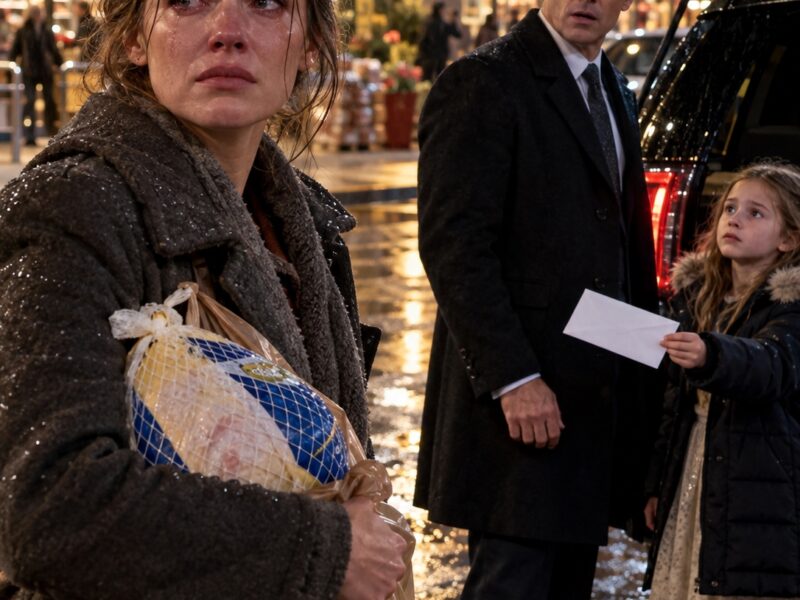
THE MILLIONAIRE OFFERED TO BUY HER THANKSGIVING TURKEY—SHE SAID NO. WEEKS LATER, HE DISCOVERED WHAT HER DEAD HUSBAND’S BEST FRIEND HAD STOLEN FROM HER SON
The first time Eric Thorson understood that money could make a problem worse, he was standing in the hallway outside Greta Lowry’s apartment with enough money in the bank to change her life before breakfast.
He could have paid her rent for ten years.
He could have replaced the dead man’s tools she had pawned.
He could have put fourteen thousand six hundred dollars into her son’s name and made the missing money irrelevant. Instead, Greta stood barefoot beneath a flickering hallway light, a dish towel clenched between her hands, and made him promise not to give her a single dollar. “Don’t pay Mitch,” she said. Eric stared at her. “Don’t pay me. Don’t pay anybody.” Inside the apartment, a cartoon played softly.
Her six-year-old son was laughing at something on television, unaware that two adults were discussing money that had been collected for him after his father died. Eric lowered his voice. “Greta, I can fix this.” Her eyes hardened. “That’s exactly what I’m asking you not to do.” He had built an entire company by fixing things. Broken supply chains. Failed contracts. Lawsuits. Production delays. A shipment of specialty glass stranded three states away.
Problems came into Eric Thorson’s office complicated and left converted into numbers. Numbers could be negotiated. Numbers could be paid. People were harder. Greta looked past him toward the stairwell. “If you pay him off,” she said, “Mitch never has to look my son in the eye.” Eric said nothing. “That’s the one thing I won’t sell.” Then he told her what Mitch had said before leaving his office.
Just one sentence. A sentence that made the color disappear from Greta’s face. “He asked if you’d ever told me how Luke died.” The dish towel stopped moving between her fingers. For several seconds, she didn’t breathe. Eric waited. Something old passed through her expression—not surprise exactly.
Recognition. Pain. And something that looked disturbingly close to guilt. But Greta said nothing. That silence would bother Eric for weeks. Because by then he knew Mitch Kessle had lied about the money. He knew someone had taken $14,600 intended for a fatherless boy. What he did not know was why Greta seemed terrified of the question that had nothing to do with money.
How had Luke Lowry died? And why did the man accused of stealing from Luke’s son believe the answer could destroy Greta? Three weeks earlier, none of them had known each other. It began with a turkey. Two days before Thanksgiving, Lindall’s Market smelled like cinnamon, wet wool, coffee from the kiosk near the entrance, and the cold metallic air that rushed through the automatic doors every time someone came inside. Eric Thorson was still dressed for work. Dark overcoat. White shirt.
Phone in one hand. His eight-year-old daughter, Elsie, controlled the shopping cart. She took Thanksgiving grocery shopping seriously. “The ridged kind.” Eric looked at the cranberry sauce she was holding. “There’s one with whole cranberries.” “No.” “It looks better.” “That’s the problem.” Eric raised an eyebrow. Elsie shook the can. “The ridges are the point, Dad.” “You know cranberries don’t naturally grow in the shape of a can.” “They should.” Eric smiled despite himself. “All right.” She dropped it into the cart triumphantly. For three years, it had been just the two of them. Eric had learned ponytails badly, then adequately.
He knew which socks Elsie hated because the seams bothered her toes. He knew she wanted the hallway light left on when thunderstorms came through Sioux Falls but would deny being afraid if asked. They had developed systems. Quick breakfasts. School drop-offs. Takeout Fridays. Sunday pancakes. Holidays that required no negotiation with anyone except themselves. “Just us,” Eric liked to say. Once, Elsie had loved that phrase. Recently, she had stopped answering it. Eric noticed. He simply didn’t know what to do with the noticing. His phone buzzed near the dairy case. His operations director. A shipment of architectural glass was stuck in Omaha, threatening a project deadline. Eric answered. His voice changed automatically. Lower. Cleaner. More decisive. The voice of the CEO of Thorson Window Company. Elsie rolled the cart a few feet away. She knew that voice meant her father was technically beside her but no longer entirely there. That was when she noticed Milo. He was a first grader at Hawthorne Elementary, small for his age, with a cowlick that never stayed flat. Elsie knew him from school. Milo stood beside a shopping cart containing potatoes, boxed stuffing, canned green beans, rolls, macaroni, and a small pumpkin pie. His mother stood beside him looking at her phone. Greta Lowry was thirty-three and wore a coat too thin for November in South Dakota. Elsie watched her add numbers on the calculator. Then again. Greta glanced into the cart. She looked toward Milo. Then she lifted the turkey out. It wasn’t dramatic. That was what made Elsie watch. Greta didn’t dump it onto some random shelf. She carried it all the way back to the refrigerated case. She placed it exactly where it had been. Then she straightened the turkey beside it. As though even poverty required good manners. “Mom?” Milo had followed her. “Did we forget the turkey?” Greta turned. For half a second, something crossed her face. Then she crouched. “We’ve got plenty, bud.” “But Thanksgiving—” “Potatoes. Stuffing. Green beans. Pie.” She smiled. “And I’m thinking macaroni.” Milo looked uncertain. Greta pointed toward the boxes. “Big decision. Shells or regular?” His face brightened slightly. “Shells.” “Excellent choice. Thanksgiving rules. One vote only.” She stood. She never looked back at the turkey. Elsie did. Her father ended his call a minute later. She grabbed his sleeve. “Dad.” “Hmm?” She pulled him down until his ear was close to her mouth. “She can’t afford a Thanksgiving turkey for her child.” Eric followed his daughter’s gaze. His hand went toward his wallet. That was instinct. A problem. A solution. Transaction complete. Then he saw Greta’s posture. Her shoulders were straight. Her chin slightly lifted. She was arranging cans in the cart while Milo talked. Nothing about her invited rescue. Eric knew that posture. He had worn it after his divorce, when friends had looked at him with the careful sympathy reserved for men whose wives had left and whose houses suddenly had too many empty rooms. He released his wallet. “Stay here.” He approached Greta without anything in his hands. “Excuse me.” She looked up. Eric kept his voice low enough that Milo wouldn’t hear. “I don’t mean to intrude. I just noticed, and if it would help—” He didn’t finish. Color climbed Greta’s neck. She knew. “Thank you.” Her voice remained polite. “But no.” “I wasn’t trying to—” “I know.” She glanced at Milo. “He’s had enough people feel sorry for him this year.” Eric stopped. Greta gave him a small, controlled smile. “We’re fine.” There were many things Eric could have said. He could have explained that he wasn’t pitying her. He could have insisted. He could have slipped cash into her cart. Instead, he nodded. “All right.” And walked away. For perhaps the first time in years, Eric Thorson encountered a problem he had both the means and the desire to solve—and understood that solving it might be an insult. His phone buzzed again. He stepped toward the end of the aisle. His back was turned for less than a minute. That was long enough. Elsie went to the cooler. She found the exact turkey Greta had returned. Then she took a folded white envelope from her coat pocket. In purple marker, written in an eight-year-old’s careful handwriting, were two words: BIRTHDAY MONEY. Twenty-three dollars. She had been saving it for something important. She had never decided what important meant. Until now. The turkey cost $19.84. At the express register, Elsie slid a twenty and three crumpled one-dollar bills toward a teenage cashier. “Can you put this in that boy’s bags?” The cashier looked at her. Elsie pointed. “Please don’t tell them.” Maybe it was the seriousness in her face. Maybe the cashier was young enough to remember being eight. He nodded. Outside, the drizzle had become sharp enough to sting. Eric loaded groceries into his SUV. Elsie sat silently in the back. Across the parking lot, Greta buckled Milo into an aging Corolla. She opened the trunk. Potatoes. Stuffing. Macaroni. Green beans. Pie. Then she froze. A turkey. Small. Cold. Paid for. Greta stared at it. Slowly, she lifted her head. Across the lot stood Eric Thorson. Behind him, through the SUV window, his daughter watched. Greta misunderstood everything. She closed the trunk. Told Milo to stay in the car. Then walked across the parking lot. Elsie saw her coming. Her face wasn’t grateful. It was furious. Greta stopped beside Eric and kept her back toward Milo. “I told you no.” Eric straightened. “I’m sorry?” “In the store.” Rain gathered in Greta’s hair. “I said no, and you went around me.” “I didn’t—” “What kind of man uses his own little girl so a woman can’t refuse him?” Eric genuinely looked lost. Then the SUV’s back door opened. “Dad didn’t do it.” Elsie stepped into the rain. She held the white envelope against her chest. Eric stared. “Elsie?” “It was me.” She held out the envelope. “It was my birthday money.” Nobody spoke. Rain ticked against the SUV roof. Greta looked at the empty envelope. Eric looked at his daughter. And in one strange parking-lot moment, two adults who had become experts at hiding what hurt discovered that an eight-year-old had seen through both of them. Greta crouched. Her anger disappeared. What remained was exhaustion. “That was a very kind thing.” Elsie swallowed. “Are you mad?” “No.” Greta looked toward the Corolla. “I’m keeping the turkey because Milo will be happy.” Elsie smiled. “But I don’t take things I can’t pay back.” “I don’t want money.” “I figured you wouldn’t.” Greta considered her. “Then I’ll think of something better.” She stood. For one second, her eyes met Eric’s. No apology. No gratitude owed. Nothing romantic. Nothing magical. Just two strangers realizing they had both underestimated the child standing between them. Then Greta returned to her car. Her apartment on the west side was small but immaculate. Milo’s paper-plate turkey hung crooked on the refrigerator. Under a magnet beside it was a pink notice. PAST DUE. Greta had unfolded it so often the crease had become soft. After Milo went to sleep, she sat at the kitchen table. Rent. Electricity. Groceries. Gas. Insurance. The numbers ended the same way every time. Two years earlier, Luke Lowry had still been alive. A lineman. Thirty feet above the ground in weather that sent everyone else indoors. After his funeral, the crew had passed a hard hat around the union hall. “For Milo,” they told her. Luke’s best friend, Mitch Kessle, handled everything. Greta had barely been functioning. Mitch arranged paperwork. Made calls. Helped with the funeral. Eventually, he gave Greta a job running the office at his heating-and-cooling company. For a while, she believed Luke had somehow left someone behind to watch over them. Then business slowed. In August, Mitch eliminated her position. Greta hadn’t complained. People struggled. Companies failed. Life did not owe widows special treatment. Above her stove sat a speckled blue roasting pan that had belonged to Luke’s mother. Greta hadn’t touched it since the funeral. On Thanksgiving morning, she took it down. Across town, Eric received a text from Scottsdale. Courtney. His ex-wife. Flights are a mess. So sorry. Tell El I’ll call. Second holiday in a row. Eric stared at the message. Then he manufactured brightness. “Change of plans.” Elsie looked up. “We’re doing takeout.” “Okay.” “It’ll be fun.” “Okay.” That second okay hurt more. At Greta’s apartment, butter melted over turkey skin. Sage filled the kitchen. Milo sat on the floor in front of the oven as though watching a movie. For several hours, the apartment smelled like it had when Luke was alive. At six, Greta covered a plate with foil. Turkey. Stuffing. Pie. Her mother’s old rule came back to her. Never come to someone’s table empty-handed. The Thorson house sat back from the road, every window glowing. Greta nearly turned around. Then Milo said, “Is this Elsie’s house?” She parked. When Eric opened the door, Greta could see the dining room behind him. A table for twelve. Two chairs occupied. Two takeout cartons. The emptiness was so obvious it embarrassed her to notice. “This is for Elsie.” She held out the plate. “It’s her turkey. She should taste it.” Elsie appeared. She accepted the plate with both hands. “Thank you.” Eric said the same thing. But his sounded different. He wasn’t thanking her for dinner. He was thanking her for restoring balance. Elsie looked up. “Does Milo have anybody besides you?” Eric closed his eyes briefly. “Elsie.” Greta didn’t seem offended. She looked toward her son waiting in the car. “He has me.” Then she smiled faintly. “That’s a lot.” On the drive home, the sentence stayed with her. It was true. It should have been enough. Why had it sounded so small? At a red light, her phone buzzed. Her landlord. Balance due December 15. I’m sorry, Greta. I can’t wait longer. The light turned green. A horn sounded behind her. That night, Greta did something she had avoided for two years. She called Mitch. “Happy Thanksgiving,” he said warmly. “How’s my buddy?” “He’s good.” “Tell him Uncle Mitch says—” “Mitch, I need to ask you about the money.” Silence. “What money?” “The crew collection.” Another pause. “The money they raised for Milo.” Mitch sounded genuinely confused. Then sympathetic. “Oh, Greta.” Her stomach tightened. “The funeral,” he said. “The casket. Headstone. Luncheon at the hall. You told me to handle everything.” “With Milo’s money?” “You were in pieces. Nobody expects you to remember all of it.” Greta gripped the phone. “Mitch, I would remember fourteen thousand dollars.” “Was it fourteen?” His voice stayed soft. “I don’t think it was that much.” “Mitch—” “Get some sleep.” “Mitch.” “Hug my buddy for me.” The line went dead. Greta sat at the kitchen table until 2:14 a.m. She reconstructed the weeks after Luke’s death. Casseroles. Coffee. Whispered conversations. Paperwork. People coming and going. Could she have authorized something? Could grief have erased it? That was the cruelty of Mitch’s explanation. It was plausible only because Greta had once been broken enough not to trust her own memory. By morning, she had moved from angry to terrified. What if Mitch was right? What if she was about to accuse Luke’s best friend of stealing from Luke’s child because grief had left holes in her mind? Monday afternoon, she was waiting outside Hawthorne Elementary when Eric appeared beside her. Their children had become friends. Elsie had helped Milo repair a cardboard Mayflower that morning. Or, according to Milo, “I fixed it. Elsie just held it.” Eric smiled. “I heard we have shipbuilders.” Greta almost smiled back. Her phone buzzed. Not Mitch. A pharmacy notification. Still, Eric saw her expression. “Everything okay?” She surprised herself by answering. “Someone owes my son something.” Eric waited. “And now he says it never existed.” “My company has an attorney.” “No.” Eric stopped immediately. Greta noticed. “I don’t want Mitch talking to a lawyer. I want him talking to me.” Eric slid his hands into his coat pockets. “He owes Milo that much.” For once, Eric did not offer another solution. That night Greta remembered something. The union hall. A week after the funeral. Men in Carhartt jackets. Red eyes. A hard hat being passed from hand to hand. Someone counting money. Someone writing. Gary. Gary Bjornstad. Luke’s foreman for eleven years. Saturday morning, Greta drove to Gary’s house. He opened the door wearing flannel and reading glasses. For a moment he stared. “Luke’s Greta.” Nobody had called her that in a long time. “Come in.” His kitchen smelled like coffee and old wood. Greta told him everything. Mitch. The funeral. The missing collection. Gary listened. When she finished, he removed his glasses. Walked to a drawer. And returned carrying a worn green ledger. He placed it on the table. “Fourteen thousand six hundred dollars.” Greta stopped breathing. Gary tapped the cover. “I counted it into Mitch’s hands myself.” The room seemed to shift. “And I’ve got every name.” Sixty-three names. Linemen. Wives. Widows. Twenty dollars. Fifty. One hundred. Four hundred from a man Greta knew had three children and a truck payment. Gary wouldn’t let her take the ledger. “Thirty years I kept crew books. They stay here.” So Greta copied every name by hand. Then she started calling. “This is Greta Lowry. Luke’s wife. I’m trying to account for the collection the crew took up for Milo.” Most remembered exactly. Some cried. One widow talked for forty minutes about losing her own husband. A lineman named Tony Reyes texted Greta an old photograph. Luke at twenty-two. Sunburned. Grinning from the top of a utility pole. For the little guy, Tony wrote. So he knows. Greta stared at the picture until the screen dimmed. Around the fortieth call, another pattern emerged. Mitch’s company was failing. Payroll problems. Repossessed trucks. Loans. “He’s been borrowing from anybody who’ll answer,” one man said. The missing money suddenly had somewhere to go. But Greta still didn’t know why Mitch had taken it. Or why he had convinced himself he had the right. At Hawthorne’s canned-food drive, Eric arrived forty minutes late. Then stayed until nearly everyone else had left. He carried boxes. Taped cartons. Swept broken glass. He never mentioned donating money. Never asked for recognition. Greta noticed. Eric noticed her, too. She coordinated three tables simultaneously while answering volunteer questions without raising her voice. “You’ve done this before.” “I ran an office.” She handed him tape. “Same thing. More peanut butter.” Eric laughed. The sound surprised both of them. Outside, Elsie and Milo slid across frozen puddles. Greta watched. “Can I tell you something?” “Sure.” “After Luke died, everybody said ‘always.’” Eric looked at her. “Always here. Always around. Always take care of you.” She watched Milo spin beneath a parking-lot light. “Within a year, most of them were gone.” “Because they didn’t care?” “No.” That was what hurt. “They got busy.” Life had resumed for everyone except the widow and the child living inside its aftermath. “The biggest promise came from Mitch.” Greta’s voice softened. “He sat on our couch holding Milo and said, ‘I’ll always take care of you two.’” Eric could have told her about Courtney. About divorce. About empty holidays. He didn’t. He listened. And Greta realized, with almost painful surprise, that someone had allowed her to finish speaking. Two nights later, her last call changed everything. “Mitch called me yesterday,” a crew widow said. Greta straightened. “Why?” “Wanted to know what you’ve been saying.” A pause. “Then he asked about some guy in a picture.” “What picture?” “The school Facebook page. You were taping food boxes with some tall guy.” Greta’s stomach tightened. “She said he owns Thorson Window.” The next morning, Mitch Kessle walked into Eric’s corporate lobby. He wore a practiced smile. “I’m a friend of Greta Lowry’s.” Eric brought him upstairs. Mitch surveyed the office as if appraising its value. “I’ll keep this short.” Eric remained standing. “Greta’s a good woman. But she’s not okay.” “Meaning?” “Hasn’t been since Luke.” Mitch shook his head sadly. “She’s fixated on money. Calling people. Upsetting everybody.” “She seems clear-headed to me.” “That’s how it looks.” Mitch leaned forward. “Look, I’m here to fix this.” That word caught Eric. Fix. “You can afford it.” Eric’s expression changed. “Afford what?” “Write her a check. Fourteen grand. Call it a gift.” Mitch smiled. “That’s nothing to somebody like you. She gets her money. I get peace. Everybody walks away happy.” Eric stared at him. Then understood. “That’s why you came.” Mitch’s smile remained. “You’re asking me to pay your bill.” Mitch stood. At the door, he turned. “She ever tell you how Luke died?” Eric said nothing. “Ask her sometime.” That evening, Eric stood outside Greta’s apartment and told her everything. And she made him promise not to rescue her. Then came the sentence about Luke. And Greta’s silence. After Eric left, Greta started laundry. She emptied Milo’s backpack looking for permission slips. A packet of crackers fell out. Then another. A fruit cup. Two small milk cartons. A granola bar. Greta stared. She walked into Milo’s room. “Bud?” His eyes opened. “Why are there crackers in your backpack?” Silence. “Milo?” His answer came in a whisper. “Because groceries cost too much.” Something inside Greta broke without making a sound. She sat on his bed until he fell asleep again. For months, she had believed she was protecting him. The jokes. The macaroni game. The careful smiles. The turkey returned without complaint. She had not kept fear away. She had simply taught him to be afraid quietly. The next morning, she placed the crackers between them. “Money is tight.” Milo looked down. “That part is true.” She took his hand. “But worrying about it is my job.” “Okay.” “We will always have dinner.” The word caught in her throat. Always. She had avoided it for two years. Milo touched the crackers. “Can I keep one?” Greta nearly cried. “Why?” “Just in case.” She nodded. “One.” The rent was due December 15. On December 14, Greta carried Luke’s climbing hooks, leather belt, and hand tools into a pawn shop. The clerk gave her a number. Enough. Barely. She signed. She did not look back. The pink notice came off the refrigerator. The empty place in the closet remained. That weekend Milo had a playdate at Eric’s. In the enormous kitchen, the children ate grilled cheese. Greta was rinsing a mug when she heard Milo. “I still keep one.” Elsie asked, “One what?” “Snack.” “Why?” Eric crouched beside Milo. “You never have to save food here, buddy.” He smiled. “You can always eat at our house.” Always. Greta froze. Milo beamed. Elsie beamed. Greta felt the floor tilt. After the children ran upstairs, she faced Eric. “Don’t promise him always.” Eric blinked. “What?” “You don’t get to say always to him.” “Greta, I was just—” “I know.” Her voice shook. “They never mean anything bad by it.” She gathered Milo’s coat. “Not until you’ve been here long enough to mean it.” Then she left. Eric did not chase her. No phone calls. No flowers. No explanations. Two days later, Greta found an envelope in her mailbox. One handwritten sentence. I promised your son something that wasn’t mine to promise. I’m sorry. E. She put it in her kitchen drawer. Somehow, that apology affected her more than an argument would have. At Hawthorne’s winter concert, Mitch returned. Greta was working the cookie table when she saw him sit beside Milo. He carried a white lineman’s hard hat. Luke’s name was still stenciled on the side. LOWRY. Milo’s face lit up. “Your dad’s,” Mitch said. Greta’s hands went cold. It looked sentimental. She knew better. The message was simple. I can still reach him. Across the gym, Eric stood. He walked down the bleachers. Sat on Milo’s other side. He didn’t threaten Mitch. Didn’t speak. He simply stayed. Mitch left before the lights came up. Christmas passed. Then New Year’s. The second week of January, Gary called Greta at seven in the morning. His voice trembled. “Mitch came by.” “When?” “Tuesday.” Gary inhaled. “He stayed for coffee.” Greta already knew. “The ledger?” “Gone.” By afternoon she learned Mitch had sold his business. He was leaving Sioux Falls Saturday. Friday night, temperatures dropped eleven below zero. Greta drove past Kessle Heating and Cooling. Mitch’s truck was backed against the loading door. One light burned inside. She called Eric. “I need something.” He answered immediately. “Okay.” “It isn’t money.” A pause. “Okay.” “Can Milo stay with you tonight?” “Yes.” No interrogation. No solution. No rescue. Just yes. Before leaving home, Greta took down Luke’s blue roaster. She made pot roast with carrots and too much pepper. The way Luke liked it. Then she covered a plate with foil. Luke used to bring food to crews working holidays. “Nobody should eat alone on a pole,” he always said. At Eric’s house, Milo ran inside with his backpack. Greta drove away. Kessle Heating and Cooling was nearly empty. She knocked. Mitch opened the door. For one instant, he looked as if Luke himself had arrived. “Greta?” “I brought supper.” She stepped inside. Boxes covered the floor. Old invoices. Tools. Receipts. Then she saw it. Green cloth corners. Gary’s ledger. “That’s Gary’s.” Mitch looked down. “It doesn’t matter now.” “It matters to Gary.” “It’s a book.” Greta placed the covered plate on the workbench. Then removed her manila folder. “I copied it.” Mitch stared. “Every name.” She opened the folder. “Ron Astramm. One hundred dollars.” “Greta—” “Tony Reyes. Two hundred.” “Stop.” “Linda Sorum. Twenty-five dollars.” “Greta.” “For Pete, who died in 2009.” Mitch looked at the floor. “Carl Mowen. Four hundred dollars.” Her voice remained calm. “He had three children and a truck payment.” “Stop.” She continued. Name after name. Dollar after dollar. Not numbers anymore. People. Men who had climbed frozen poles with Luke. Women who understood what it meant when a work truck pulled into a driveway at the wrong hour. Widows who gave money to another widow. Around the thirtieth name, Mitch shouted. “Stop!” Greta closed the folder. Silence filled the shop. “You don’t understand.” His voice was raw. “You don’t know what happened that night.” Greta looked at him. “Yes.” Mitch stopped. “I do.” She removed her phone. Opened a message she had kept for two years. Luke’s last text. 11:52 p.m. Covering for Mitch. Home by 2. Mitch’s face collapsed. “He climbed that pole for you.” Greta spoke quietly. “I’ve always known.” Mitch sat down hard. “You knew?” “Yes.” “And you never—” “Blamed you?” Her eyes filled. “Not once.” Mitch covered his face. “I was supposed to be there.” Greta said nothing. “Me.” His shoulders shook. “Not Luke.” For two years, Mitch had carried a version of the story in which everyone secretly blamed him. Especially Greta. Perhaps because blaming himself was easier if he believed everybody else did too. “The shop was ours,” he whispered. Greta frowned. “What?” “Luke and me.” Mitch looked around the empty building. “We talked about it for ten years. Our own company. He kept saying someday.” His mouth twisted. “Then he died covering my shift.” Greta understood before he said it. “If the business failed…” Mitch nodded. “Then he died for nothing.” The sentence hung between them. Ugly. Illogical. Human. “So you used Milo’s money.” “I was going to put it back.” “You used his dead father’s money to save the dream you had with his dead father.” “I thought I could replace it before anybody knew.” “And when you couldn’t?” Mitch looked away. “I kept telling myself one more month.” “And when I asked?” “I panicked.” “You told me grief had ruined my memory.” Mitch shut his eyes. “That was cruel.” “Yes.” “I know.” “No.” Greta stepped closer. “You know now because it failed.” Mitch looked at her. “You made me sit at my kitchen table wondering whether I was crazy.” His eyes filled. “I’m sorry.” “You made me question the weeks after my husband died because that was easier than admitting you stole from his child.” “I know.” “You went to Eric.” “I was scared.” “You tried to make him pay for what you did.” “I know.” “You brought Luke’s hard hat to my son.” Mitch’s face tightened. “That wasn’t—” “Don’t.” He stopped. “Don’t make it prettier.” Silence. Then Mitch said the only honest thing left. “I don’t know who I became.” Greta looked at him for a long time. “I do.” He flinched. “You became a man who confused guilt with love.” Mitch stared. “You promised you’d always take care of us because you couldn’t forgive yourself.” Her voice softened. “That wasn’t love, Mitch.” She glanced at the ledger. “That was guilt wearing a nice face.” Something broke in him. Not dramatically. No screaming. No excuses. Mitch simply seemed smaller. He picked up Gary’s ledger. Held it out. Then tore an old invoice from a pad. On the back he wrote: I owe Milo Lowry $14,600. I will repay every dollar. He signed. Dated it. “I’ll tell him.” Greta took the paper. “When?” “When I can do it without making him take care of me.” That answer surprised her. Mitch wiped his face. “I’ll tell him what his father did.” Greta took Gary’s ledger. At the door, she stopped. The foil-covered plate remained untouched. “Eat while it’s hot.” Mitch looked at her. She left. When Greta reached Eric’s house, every light was on. Milo and Elsie had built a blanket fort beneath the dining-room table. The same enormous table that had once held two takeout cartons. Milo crawled out. “Mom!” He held up a board game. “Can I leave this here?” Greta hesitated. “So we can finish next time?” Next time. Two words. Once, she would have corrected him. Nothing is guaranteed. Don’t assume. Don’t depend. Instead, she nodded. Milo carefully placed the box on Eric’s shelf. Greta watched him. She had just allowed her son to believe there would be a next time. In the kitchen, Eric poured coffee. He didn’t ask about Mitch. He waited. Eventually Greta said, “He admitted it.” Eric nodded. “He’ll pay Milo back.” Another nod. “He told me why.” Eric still didn’t ask. Greta looked at him. “You’re getting better at this.” “At what?” “Not fixing.” He smiled faintly. “Painful learning curve.” They stood in silence. Then Eric looked toward the blanket fort. “After my divorce, I told Elsie we’d be fine.” Greta listened. “Just us.” His mouth tightened. “I built a life that didn’t require anyone.” The dining room beyond him was beautiful. Expensive. Immaculate. And almost never used. “I thought independence would make her feel safe.” He looked at his daughter. “I think I taught her to hide what she needs.” Greta thought about crackers in a backpack. Different houses. Different incomes. Same lesson. Eric turned back. “Stay for dinner.” Greta almost refused automatically. Then Eric added: “I’m not asking because you need it.” He held her gaze. “I’m asking because I do.” That changed everything. Greta stayed. Later, both children fell asleep inside the blanket fort. Milo wore Luke’s hard hat crooked over one ear. Eric and Greta sat at opposite ends of the kitchen table. For once, there was no crisis. No turkey to buy. No rent to save. No stolen money to recover. Nothing to rescue. Which left a much more frightening question. If neither of them needed saving… did they actually want each other? The answer did not arrive that night. It arrived slowly. That was important. The following year was not a fairy tale. It was better. It was ordinary. In March, Greta interviewed for an office-manager position at a dental laboratory. Twice. She took a typing test. Gary provided a reference that she suspected contained the word stubborn. She got the job. Nobody there knew Eric Thorson. Greta had deliberately made sure of that. She wanted one thing in her new life that could never be mistaken for charity. She was good at the job because she had always been good. Money remained tight. She clipped coupons. Checked grocery totals twice. Bought Milo shoes one size larger than necessary. But when the water heater failed in April, she called a plumber. And paid him. When Milo’s class went to the zoo, she signed the permission slip without first opening her banking app. That tiny act nearly made her cry. Mitch’s checks arrived irregularly. One hundred dollars. Two hundred. Sometimes fifty. Every payment went into an account bearing Milo’s name. In May, Mitch returned to Sioux Falls. He met Milo at Gary’s house. Greta watched from the kitchen window while the two sat on the front steps. The conversation lasted nearly an hour. Nobody else heard it. When Milo came inside, he carried Luke’s hard hat. He seemed older. “Uncle Mitch said Dad was the bravest guy on the crew.” Greta crouched. “He said Dad went up because Mitch couldn’t.” Milo looked at the helmet. “Is that why Dad died?” Greta could have lied. Instead, she said, “Your dad died doing his job for someone he loved.” Milo considered that. “Was Mitch bad?” Children asked questions adults spent lifetimes avoiding. Greta sat beside him. “He did something very wrong.” “But is he bad?” She thought of the stolen money. The gaslighting. The ledger. The pot roast left beneath a work light. “I think people can do terrible things without being only terrible.” Milo leaned against her. “Did Dad forgive him?” “I don’t know.” “Did you?” Greta looked through the window. Mitch’s car was disappearing down the street. “I’m working on not needing to hate him.” It was the most truthful answer she had. Summer came. Gary taught Milo and Elsie cribbage. Elsie won constantly. Milo learned to lose without sulking. Gary declared that the most important skill a man could possess. Eric and Greta became something neither of them named for months. It happened in small places. Cheap burgers after school events. Soccer games from folding chairs. Grocery aisles. Eric’s coffee going cold because he forgot where he left it. Greta helping Elsie with a history project. Milo falling asleep in Eric’s SUV after baseball practice. There were no grand declarations. That mattered too. Sometimes Eric slipped. Greta would mention a strange sound in her car. “I’ll have someone look at it tomorrow.” “Eric.” “What?” “Stop.” He knew. “Right.” Or she would complain about a scheduling problem at work. “I know a consultant who—” “Eric.” “Listening.” She would smile. “Thank you.” Greta had her own habits to unlearn. Sometimes she disappeared emotionally. Canceled dinner. Answered texts with one word. Convinced herself she was becoming too comfortable in the Thorson house. Comfort frightened her more than hardship. Hardship was familiar. Comfort created something to lose. Eric learned not to chase her. He waited. And Greta came back. Courtney’s calls with Elsie became more consistent. Once a week. Then twice. Greta never criticized her. Not once. Eric noticed. It told him more about Greta than any declaration could. One September evening, they sat on Gary’s porch while the children chased fireflies across the yard. Eric finally said it. “I’m not here because you couldn’t afford a turkey.” Greta looked at him. “Good.” “Good?” She smiled. “Because I would never stay with a man because I once needed his help.” Eric leaned back. “Good.” “Why are you smiling?” “Because I was hoping you’d say that.” For the first time, nothing was owed. Not gratitude. Not rescue. Not repayment. Not guilt. So they chose each other anyway. The following Thanksgiving, Greta insisted on buying the turkey. She took Milo grocery shopping. Different store. Same cold November air. He selected his favorite rolls. Greta grabbed a can of cranberry sauce. Milo inspected it. “Why that one?” “It has ridges.” “That matters?” “Apparently.” In the checkout line, an elderly man ahead of them counted coins into his palm. Once. Twice. He was short. Milo watched. Greta said nothing. Her son reached into his pocket. Pulled out two dollars from his allowance. Placed them quietly on the counter. The man looked around. Milo was already studying a candy display. Greta saw everything. She did not praise him. Did not turn kindness into a performance. She simply took his hand as they walked toward the car. And held it a little tighter. At Eric’s house, the dining-room table looked different. The extra leaf had been brought upstairs from the basement. For the first time since the divorce, the table stretched its full length. Gary sat at one end in pressed flannel. Elsie’s place was beside Milo’s. The old board game still sat on the shelf where Milo had left it almost a year earlier. Next time had become this time. Then another. Then another. From the kitchen came arguing. “I’ve got the heavy side!” “There is no heavy side!” Elsie and Milo appeared carrying Luke’s mother’s speckled blue roaster between them. Greta laughed. Eric looked around. His house was loud. A year earlier, he would have found that exhausting. Now the silence seemed stranger. There had been no proposal. No ring. No dramatic announcement. And no one had promised always. Greta preferred it that way. Because she had finally understood something. “Always” was easy to say in a warm room. It was easy at funerals. Easy when grief was fresh. Easy when everyone still remembered to call. What mattered was Tuesday. And February. And the second soccer game in the rain. What mattered was remembering how someone took their coffee. Knowing when not to offer money. Knowing when to speak. Knowing when to sit beside a frightened child on a bleacher without saying anything at all. Knowing when another person did not need rescue. And staying anyway. Elsie lowered her side of the roasting pan onto the table. Then she looked at Eric. “Dad.” “What?” “The turkey’s getting cold.” Everyone laughed. Eric walked around the table. He reached Greta’s chair and pulled it out. She looked up at him. For a fraction of a second, she remembered the grocery store. A turkey being returned to a cooler. Her face burning when a wealthy stranger offered help. An eight-year-old girl standing in freezing rain holding an empty birthday envelope. She remembered Luke. The pawn shop. Crackers hidden inside a backpack. Mitch sitting among boxes beneath a single work light. Fourteen thousand six hundred dollars. A green ledger. A white hard hat. A blue roaster. And a handwritten note she still kept in her kitchen drawer. I promised your son something that wasn’t mine to promise. Maybe that had been the beginning. Not the turkey. Not the money. The apology. Because Eric had learned what so many people in Greta’s life had not. Love was not the promise that you would always be there. Sometimes love was having enough humility not to promise what tomorrow had not given you yet. Greta sat. Milo reached immediately for a roll. “Wait,” she said. He froze. Gary laughed. Elsie pointed toward the cranberry sauce. “Did you get the right kind?” Greta held up the can. Ridges. Elsie nodded approvingly. Eric took his seat. For years, that dining room had been kept beautiful by being barely used. Now there were fingerprints on glasses. A napkin had fallen beneath Gary’s chair. Milo was stealing pieces of turkey skin. Elsie was accusing him. Someone had already spilled water. The room was imperfect. Eric loved it. Across the table, Greta caught him looking. “What?” “Nothing.” “That wasn’t nothing.” He smiled. “I was just thinking the house is loud.” Greta glanced around. “Want us to leave?” “No.” His answer came quickly enough to make her laugh. Then Eric looked at Milo. At Elsie. At Gary. Finally at Greta. “No,” he repeated more quietly. “I really don’t.” Greta understood. She did not ask him to promise. He did not offer. Outside, snow began falling across Sioux Falls. Inside, the turkey cooled while everybody talked over one another. And Milo Lowry—who once hid crackers in his backpack because he believed food might disappear—reached for a second helping without checking anyone’s face first. Greta saw it. She looked down at her plate because suddenly her eyes were burning. Eric noticed. He did not ask whether she was okay. He did not reach across the table and make the moment larger than she wanted it to be. He simply passed her the potatoes. Greta took them. “Thanks.” “Sure.” That was all. No rescue. No debt. No promise of forever. Just a chair that had been pulled out. A table with room. A house no longer afraid of noise. And people who had learned that sometimes the strongest form of “always” is never saying the word at all. It is showing up again tomorrow. Then the day after that.
And when tomorrow finally comes, quietly making room.









