The Millionaire Rancher Disguised Himself as a Penniless Drifter to Find True Love—Then the Woman He Chose Discovered the Letter in His Coat
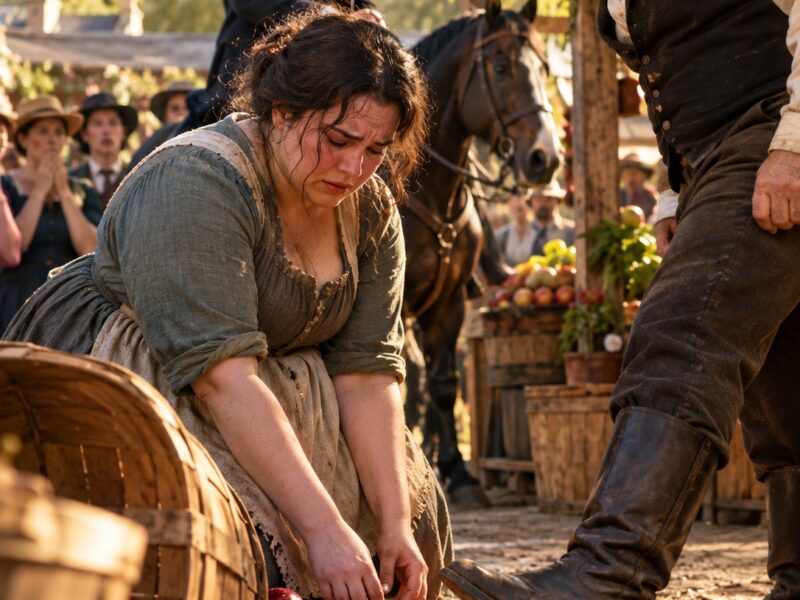
The first time Cole Hadley saw May Callaway on her knees, she was picking crushed berries out of the dirt while her father watched from a chair.
Nobody helped her.
That was the part Cole remembered later.
Not the red juice staining the hem of her faded dress.
Not the October dust clinging to her fingers.
Not even Gerald Callaway’s boot, which had come down slowly and deliberately on the spilled fruit as if destroying something his daughter had worked for were merely another way of reminding her who owned the ground beneath her feet.
What Cole remembered was the silence.
A whole market full of people had seen it.
And everyone had decided it was easier to look somewhere else.
Cole sat motionless on his horse at the edge of Clover Creek Market, one hand wrapped around the reins, watching May gather the ruined berries one by one.
She did not cry.
She did not argue.
She did not look around hoping someone would defend her.
That was worse.
It was the efficiency of her movements that told him this had happened before.
She knew how to survive humiliation without making it more expensive.
Cole Hadley was thirty-two years old, owned twelve thousand acres of some of the finest cattle country in Texas, employed more men than Gerald Callaway probably knew by name, and lived in a house with imported windows his mother had ordered from Philadelphia because ordinary American glass apparently offended her.
His name opened doors.
His money changed voices.
Women smiled at him before he had spoken a word.
And suddenly, watching May Callaway kneeling in the dirt, Cole hated every advantage he had ever carried into a room.
Because for the first time, he found himself wondering what would happen if he carried none of them.
The thought came quietly.
Then it refused to leave.
Could anyone love Cole Hadley if there were no Hadley cattle?
No twelve thousand acres?
No house?
No family name?
No inheritance?
No future worth calculating?
Could a woman look at him when he was simply a man and decide he was enough?
He had wondered that for years.
But that afternoon, for reasons he could not yet explain, he decided to find out.
And the woman he intended to ask without ever actually asking was still kneeling in the dirt.
Three hours later, Cole rode onto Hank Porter’s property and said:
“I need your boots.”
Hank looked up from a fence post he had supposedly been repairing since they were eighteen.
“What?”
“Your boots.”
Hank looked down.
“These are my only boots.”
“I’ll buy you another pair.”
“That changes the conversation considerably.”
“Brown Hendersons. Double stitching.”
Hank’s eyebrows rose.
“You remembered the ones I wanted?”
“Give me the boots.”
Hank slowly began unlacing them.
“I assume there is a woman involved.”
Cole said nothing.
Hank stopped.
“Oh, Lord.”
“There’s nothing to ‘oh, Lord’ about.”
“There absolutely is. You only get this expression when your mother mentions marriage or when someone mistreats a horse.”
Cole dismounted.
Hank waited.
Finally Cole told him.
He described the market.
May.
Gerald.
The spilled fruit.
The boot.
The crowd pretending not to see.
When he finished, Hank remained unusually quiet.
Then he said, “So you’re going to help her?”
“No.”
“That would have been the reasonable answer.”
“I’m going to work there.”
Hank stared at him.
“As Cole Hadley?”
“No.”
Hank stared harder.
Cole removed his coat.
“As nobody.”
There was a pause.
Then Hank sat down on the fence.
“I need you to explain that sentence very carefully.”
Cole had already bought worn canvas trousers from a market laborer. He had an old jacket with frayed cuffs, an ordinary shirt and a borrowed horse that looked respectable enough to stay alive but not respectable enough to suggest money.
“I’ll tell them I’m a drifter. Looking for work.”
“For what purpose?”
“To see what happens.”
“That is not a purpose.”
Cole looked toward the western horizon.
“I need to know something.”
Hank’s amusement faded.
Cole rarely admitted needing anything.
“Know what?”
Cole hesitated.
Then said it.
“If I had nothing, would anyone choose me?”
Hank studied him.
And for once, there was no joke.
The Hadley name had shaped Cole’s entire adult life.
At dinners, mothers placed daughters beside him.
At dances, women laughed before he finished speaking.
Businessmen complimented his judgment while calculating access to his cattle contracts.
Even marriage proposals seemed to hover invisibly behind conversations about weather.
Cole had become very good at identifying desire.
He had simply stopped believing much of it belonged to him.
Hank exhaled.
“And you think May Callaway is the person to answer this?”
“I think she’s the first woman I’ve seen in years who didn’t look at me at all.”
“That’s because she was picking berries out of the dirt, Cole.”
“Exactly.”
Hank rubbed his face.
“This is a terrible plan.”
“I know.”
“Your mother will discover it.”
“She won’t.”
Hank laughed so suddenly a nearby horse lifted its head.
“Eleanor Hadley once discovered I had broken her blue vase when we were eleven, even though you buried it three feet underground.”
“You told her.”
“I was under pressure.”
“You were eleven.”
“She is terrifying.”
Cole changed behind Hank’s barn.
When he emerged, Hank looked him over.
The expensive coat was gone.
The tailored trousers were gone.
His hair had been rubbed with dust.
His shirt hung unevenly.
Hank narrowed his eyes.
“Your hands.”
“What about them?”
“They look like hands that have signed documents.”
“They’ll roughen.”
“Your posture.”
Cole slouched.
Hank winced.
“That looks like a rich man pretending to have poor posture.”
“It’ll improve.”
“You realize poverty is not theater.”
Cole’s expression changed.
“Yes.”
That answer removed the humor from Hank’s face.
Cole mounted the borrowed horse.
“What do I tell your mother?”
“Fence lines.”
“Fence lines?”
“I’m inspecting fence lines.”
“For six weeks?”
“If necessary.”
Hank shook his head.
“She’s going to find you.”
Cole turned his horse toward the Callaway orchard.
Behind him, Hank called:
“What name are you using?”
Cole thought for half a second.
“Jesse.”
Hank groaned.
“Of course it’s Jesse.”
Cole rode away.
By sunset, Cole Hadley had disappeared.
Jesse arrived at the Callaway orchard.
The place announced itself first by smell.
Apples.
Wet cedar.
Wood smoke.
Fermenting fruit.
The farmhouse had seen better years. Two rails were missing from the north fence. The barn roof needed patching.
But the press building was different.
Cole noticed that immediately.
Its boards fitted tightly.
Tools hung in logical order.
The drainage channel had been dug at an exact angle.
Barrels were marked by batch.
The equipment was old but meticulously maintained.
Someone understood this business.
Someone had built intelligence into every inch of it.
Cole already knew who.
Gerald Callaway sat outside the barn.
Naturally.
Cole dismounted.
“Looking for work.”
Gerald barely glanced at him.
“Can’t pay wages.”
“Food and somewhere dry to sleep.”
That got his attention.
Cole added casually, “Heard the Callaway cider operation is the finest in three counties.”
Gerald straightened.
Cole almost smiled.
Vanity, he thought.
Useful.
“People say that?”
“More than once.”
“Well.”
Gerald adjusted his vest.
“Wouldn’t surprise me.”
From inside the press building came the steady wooden rhythm of machinery.
Gerald called:
“May!”
She appeared.
For one dangerous second, Cole forgot the name he had chosen.
She looked different standing.
She was a large woman, broad through the hips and shoulders, dressed in a flour-sack apron with her sleeves rolled to the elbows. Her dark hair was pinned up badly because she had clearly been working too hard to care what it looked like.
Her face was not conventionally delicate.
Nothing about May was delicate.
But her eyes were extraordinary.
Steady.
Direct.
Completely uninterested in impressing him.
Gerald pointed toward Cole.
“This man will handle the heavy work.”
May looked at Cole.
Not flirtatiously.
Not suspiciously.
Just assessing.
“The east barrels need moving.”
Cole nodded.
“Where?”
She turned.
“Follow me.”
No welcome.
No smile.
No question about where he came from.
Cole followed her inside.
The press smelled of apples, cedar and work.
She pointed.
“Those six.”
Cole lifted the first barrel.
May watched him position it.
“Two feet left.”
He moved it.
“Too far.”
He corrected it.
She nodded toward another.
“Next.”
That was all.
An hour later his shoulders burned.
Three hours later his palms had begun to blister.
By dark he had learned two things.
First, May Callaway could work most men into the ground.
Second, being nobody felt unexpectedly like freedom.
No one cared what he owned.
No one cared what his father had built.
No one cared which bank held his accounts.
For the first time in his adult life, Cole entered a room without his name arriving before him.
That night he lay on a narrow cot in the barn, listening to wind move through the orchard.
He should have felt diminished.
Instead he felt lighter.
And that frightened him more than he expected.
On the third morning, May discovered that Jesse knew absolutely nothing about cider.
She had explained the press mechanism once.
Cole had listened carefully.
Unfortunately, careful listening and practical competence were not the same thing.
He turned the wrong valve.
There was a mechanical cough.
May looked up.
Cole looked down.
Then a stream of cold cider exploded directly into his chest.
He froze.
The liquid soaked his shirt, ran down both arms and dripped from his chin.
May stood in the doorway.
Neither spoke.
She looked at the press.
Then at him.
Then at the press again.
Cole waited.
May walked to a shelf, took down a cloth and handed it to him.
“Wrong valve.”
“I gathered that.”
She turned away.
Ten seconds later, from somewhere behind the wall, Cole heard laughter.
Not polite laughter.
Not the controlled little sound women at his mother’s dinners made after something he said.
Real laughter.
May’s laughter.
It escaped her before she could stop it.
Cole stood dripping cider onto the floor and smiled.
He would have turned the wrong valve every morning for the rest of his life to hear that sound again.
After that, the days acquired a rhythm.
Morning chores.
Barrels.
Repairs.
Fruit.
The press.
Cold evenings.
May rarely praised him.
When he did something correctly, she moved to the next task.
When he did something incorrectly, she told him once.
He found the honesty intoxicating.
Nobody had spoken to Cole Hadley that way in years.
One morning while cleaning the south stall, his hand landed somewhere no wealthy cattleman’s education had prepared him to put it.
He became absolutely motionless.
May passed carrying a bucket.
She stopped.
Looked at his face.
Looked at his hand.
Looked back at his face.
“I need a moment,” Cole said.
May walked away laughing.
He washed his hands seventeen times.
Hank arrived later and found Cole carrying dried buffalo chips at arm’s length.
Hank opened his mouth.
“Not one word.”
Hank’s shoulders began shaking.
“I mean it.”
May appeared in the doorway.
“The fire needs fuel, Jesse.”
“Yes.”
“Today, preferably.”
She disappeared.
Hank made it behind the barn before collapsing against the wall.
Cole considered murder.
But something was happening beneath the comedy.
He was learning May.
He learned that she hummed when concentrating.
He learned that she spoke to the press under her breath as if it were a stubborn coworker.
He learned that she saved bruised apples rather than throwing them away.
He learned that anyone hungry enough to come to the gate left with food.
One afternoon he watched her give bread and two apples to an elderly woman walking toward town.
Later he asked, “Do you feed everyone?”
May kept walking.
“If they’re hungry.”
“Why?”
She was quiet.
Then:
“Someone fed me once when I needed it.”
“That’s it?”
“That was enough.”
She said nothing more.
Cole began understanding that May’s kindness had rules.
She never made people explain their humiliation.
Never forced gratitude.
Never asked them to perform suffering before receiving help.
She simply noticed what dignity required and quietly supplied it.
That was why the soap bothered him so much.
Hank had brought supplies.
At the bottom of the saddlebag was a bar of French soap Cole had forgotten to remove.
May found it.
She turned the wrapped bar in her hands.
“This is Parisian.”
Cole’s mind, ordinarily useful under pressure, abandoned him.
“I found it.”
“Where?”
“Road.”
May looked at him.
“Parisian soap.”
“Yes.”
“On the road.”
“It was a remarkable road.”
For a second he thought he saw amusement.
Then she set it down.
“All right.”
That evening, Cole returned to the barn and found the soap placed on the dry shelf above his cot.
The best shelf.
May had not questioned him.
She had not exposed the absurdity of his lie.
She had simply protected something he apparently wanted kept private.
He stood staring at the soap.
That was when guilt entered the experiment.
Until then, his deception had belonged mostly to him.
Now May was beginning to trust Jesse.
And Jesse did not exist.
The problem grew worse the following Thursday.
Three men arrived for cider.
Regular customers.
They took two jugs.
Then one announced he was short on money.
Again.
The others laughed.
One lingered.
“You know, May, if you were friendlier, maybe I’d remember to pay.”
She continued tying the jug.
The man leaned closer.
“Who else is going to give you attention?”
His friends laughed.
“Maybe I’ll marry you someday,” he said. “When I run out of better choices.”
Cole felt something inside him turn cold.
May merely said, “Your balance is twelve dollars.”
The man grinned.
“Put it down.”
They left with the cider.
Cole waited for Gerald to react.
May found her father.
“They still haven’t paid.”
Gerald’s answer came through the wall.
“Then you’ve mishandled them.”
“They owe us for three weeks.”
“You must have done something to put them off.”
Cole stopped working.
Gerald continued.
“You can’t manage simple customers without creating trouble?”
Silence.
Then May returned.
Her face showed nothing.
That frightened Cole more than tears would have.
The following market day, Jesse stood behind May’s stall.
He said nothing.
He did not threaten anyone.
He simply loaded barrels and remained visible.
When the three men arrived, their expressions changed.
The tallest looked at Cole.
Then at May.
Then reached into his pocket.
He paid every cent.
Nobody joked.
Nobody suggested marriage.
They left.
That evening Cole found an extra plate outside the barn.
Bread.
Cold meat.
A second cup.
No note.
He sat on the ground beneath the bare branches and ate every bite.
Twelve thousand acres had never made him feel wealthy.
That plate did.
Then Hank nearly ruined everything.
He arrived one Tuesday with news from Cole’s mother.
“Eleanor has stopped me on the road four times.”
“Tell her fence lines.”
“I did.”
“And?”
“She now has extensive questions about fence lines.”
Cole sighed.
Hank continued dramatically.
“Where is Cole? Why doesn’t Cole write? How many fences can one man inspect?”
Footsteps sounded behind them.
May.
Hank saw her.
Cole saw Hank see her.
And immediately knew disaster was coming.
Hank’s expression became solemn.
“Your mother,” he said to Cole, “is very ill.”
Cole stared at him.
“What?”
“Barely gets out of bed.”
May stopped.
Hank continued with criminal confidence.
“Poor woman.”
“Hank.”
“He doesn’t like discussing it,” Hank told May. “Very devoted son.”
Cole considered strangling his oldest friend.
May’s face softened.
“You should go.”
“She’s fine.”
“Hank just said she can barely get out of bed.”
“Hank says many things.”
But May had already gone inside.
She returned carrying a small cloth purse.
She pressed it into Cole’s hand.
Coins.
Her savings.
Cole looked at her.
“What is this?”
“For the road.”
“May—”
“Go see your mother.”
“I can’t take this.”
“You can.”
Her fingers closed his around the purse.
“Go. Come back when you can.”
Cole could not speak.
He knew what those coins represented.
Hours before sunrise.
Cold mornings.
Market days.
Barrels lifted.
Fruit sorted.
Money Gerald did not manage to take.
May had almost nothing.
And she was giving part of that nothing to him.
Because she believed his mother was sick.
Because she believed Jesse was poor.
Because she believed him.
The lie suddenly felt filthy.
“Thank you,” he managed.
May nodded and returned to work.
The moment she disappeared, Hank turned away.
His shoulders shook.
“Do not.”
“She gave the richest rancher in the territory travel money.”
“Hank.”
“To visit his tragically ill mother.”
“I will sell your horse.”
Hank laughed all the way down the road.
Cole did visit Eleanor.
He arrived without changing.
His mother opened the door.
Three seconds passed.
Her eyes moved from Hank’s battered boots to the dirty trousers, frayed jacket, untucked shirt and finally her son’s face.
She pressed one hand to her chest.
“You smell.”
“Hello, Mother.”
“Like a barn.”
“I’ve been working.”
“Clearly.”
She stepped aside.
“Do not touch the wallpaper.”
Cole entered.
“Do not sit in the green chair.”
He looked toward the blue one.
“Not that either.”
“Mother.”
“Actually, don’t sit on anything upholstered.”
She studied him.
“Those are Hank’s boots.”
“Yes.”
“Of course they are.”
She closed her eyes.
“What are you doing?”
“Working on something.”
“Are you in financial trouble?”
“No.”
“Have you joined a religious movement?”
“No.”
“Have you killed someone?”
“Mother.”
“I am eliminating possibilities.”
Cole almost smiled.
“I can’t tell you yet.”
Eleanor stared at him for a long time.
Then, surprisingly, stopped asking.
She made coffee.
When Cole left, she stood in the doorway.
“Cole.”
He turned.
Her voice was different.
“Are you happy?”
The question stopped him.
In thirty-two years, Eleanor Hadley had asked whether he was successful.
Whether negotiations had gone well.
Whether the ranch was profitable.
Whether he intended to marry.
Never whether he was happy.
Cole thought about cider dripping from his chin.
May laughing behind the wall.
The extra plate.
The Parisian soap placed carefully on the dry shelf.
The cloth purse in his pocket.
“Yes.”
He was startled by how easily the answer came.
“I am.”
Eleanor watched him ride away.
And something in her expression changed.
Before sunrise the following morning, Cole placed May’s coins on the press counter.
No explanation.
When May found them, she stood holding the purse for a long time.
Then looked toward the barn.
She never asked how he had managed to return every coin.
That frightened him too.
Because May noticed things.
By the fifth week, they had developed a language made mostly of silence.
Coffee left on fence posts.
Tools repaired overnight.
Baskets quietly carried.
Evenings sitting beside each other after work.
One night Cole told her about Daniel.
“My brother loved land like this.”
May waited.
“He died when I was twenty-four.”
“How?”
“Fever.”
Cole looked toward the orchard.
“Three days.”
He had not spoken about Daniel in years.
People had offered condolences.
His mother had arranged flowers.
Employees had lowered voices.
But grief had become something Cole carried privately because everyone seemed uncomfortable when it stayed too long.
May did not tell him Daniel was in a better place.
She did not say time healed things.
She did not touch him.
She simply remained beside him.
Finally she said:
“He sounds like someone worth missing.”
Cole swallowed.
“Yes.”
The darkness deepened.
After a while, May spoke.
“My father wanted a son.”
Cole turned.
She kept looking forward.
“He never said it plainly.”
She rubbed her palms together against the cold.
“He didn’t have to.”
The orchard stretched before them.
Every row.
Every tree.
Everything she had built while Gerald accepted praise.
“I’ve known it my whole life,” she said. “The way you know weather. Nobody needs to tell you it’s raining.”
Cole said nothing.
He finally understood something.
May had spent her life becoming useful enough to justify taking up space.
She worked because work was the one argument nobody could completely dismiss.
She gave dignity so instinctively because she knew exactly what life felt like without it.
And Cole had come here believing he was conducting an experiment about himself.
The arrogance of that realization sickened him.
Then Hank told him about Scout.
May had once owned a dog.
A scruffy brown mutt.
Gerald had sold him two winters earlier.
“Which family?” Cole asked.
Hank frowned.
“Cole.”
“Which family?”
Hank gave him the name.
Three days later, Hank rode into the Callaway yard with Scout.
May was carrying apples.
Hank opened the saddlebag.
Scout launched himself into the yard.
The basket fell.
Apples rolled everywhere.
May dropped to her knees.
The dog hit her at full speed.
For one second there was nothing but brown fur, dust and frantic movement.
Then May made a sound Cole had never heard from her.
She laughed.
And cried.
At the same time.
Her arms wrapped around Scout.
The dog trembled against her.
“You came back.”
Scout licked her face.
“You came back.”
She buried her face in his fur.
“You came back.”
Cole stood in the barn doorway.
Hank came beside him.
“Three times what that dog was worth.”
Cole watched May sitting among scattered apples, her hair fallen loose, tears on her face.
“Worth every penny.”
May looked up.
Straight at Cole.
Something passed between them.
Not gratitude.
Something more dangerous.
Recognition.
For the first time, Cole realized he did not want May to love Jesse.
He wanted her to know Cole.
And still choose him.
That meant telling her the truth.
He decided he would.
Tomorrow.
Then tomorrow became the next day.
And the next.
Because each morning she trusted Jesse a little more.
Which made killing Jesse harder.
Meanwhile May had begun noticing things.
His hands bothered her first.
They had calluses now.
Real ones.
But beneath them was skin that had not spent decades doing this work.
He knew too much about water rights.
Too much about cattle contracts.
Too much about land valuation.
Once, while discussing a drainage problem, Jesse casually calculated acreage faster than Gerald’s banker could have.
Another evening he returned smelling faintly of cologne.
May looked up.
“You smell expensive.”
Cole froze.
“What?”
“Tonight.”
She walked past him.
“Expensive.”
He watched her disappear.
The lie was collapsing.
It finally died because of a coat.
May took Jesse’s jacket to repair a torn seam.
A letter slipped from the inside pocket.
She bent down.
Picked it up.
And read the name.
COLE HADLEY.
Below it:
HADLEY CATTLE COMPANY.
May sat very still.
Everyone in that part of Texas knew the name.
Hadley land.
Hadley cattle.
Hadley money.
She looked toward the barn.
For six weeks she had shared food with a man who could have purchased the Callaway orchard without noticing the expense.
She had given him her savings.
She had worried about his sick mother.
She had trusted him with the small humiliations of her life.
And every morning he had awakened knowing she did not know who he was.
May folded the letter.
Placed it back inside the coat.
Finished sewing the seam.
Then waited.
Two days.
She said nothing.
On the third morning they worked side by side.
Cole was adjusting the press.
May did not look at him.
“Cole.”
His hands stopped.
The orchard seemed to go silent.
He slowly turned.
May continued working.
“May.”
“Is that your name?”
“Yes.”
She nodded.
“How long were you planning to wait?”
Cole had imagined this conversation many times.
Every version had contained better words.
None arrived.
“I was going to tell you.”
“When?”
“I don’t know.”
“That isn’t an answer.”
“No.”
Finally she faced him.
“Who are you?”
“Cole Hadley.”
“I know the name.”
He flinched.
She noticed.
Good, some part of her thought.
Let it hurt.
“Why?”
Cole looked at the floor.
Then forced himself to tell her everything.
The women.
The money.
The doubt.
The market.
The decision.
Jesse.
The experiment.
May listened.
Her face became quieter with every sentence.
When he finished, she asked:
“So you came here to find out whether a poor woman could love you honestly?”
Hearing it in her words made him hate himself.
“Yes.”
May laughed once.
There was no humor in it.
“I gave you my money.”
“I know.”
“I thought your mother was sick.”
“I know.”
“I told you things I have never told anyone.”
“I know.”
“You stood there knowing I didn’t know who I was speaking to.”
“Yes.”
Her eyes shone, but she refused to let tears fall.
Cole stepped closer.
“I was asking the wrong question.”
May said nothing.
“The question wasn’t whether you could love me without my money.”
He swallowed.
“It was whether I was worthy of you.”
For one terrible second, he thought the truth might be enough.
May put down her tool.
“Leave.”
“May—”
“Please.”
That word hurt worse than anger.
Cole left.
He returned before sunrise the next morning.
May did not come outside.
He worked alone.
Moved barrels.
Cleared the drainage channel.
Split wood.
Repaired a section of fence.
No speech.
No apology repeated until she was forced to accept it.
When the sun rose, he left.
The next morning he returned.
There was coffee on the fence post.
He stared at it.
May was nowhere visible.
He drank it.
The third morning, she came outside.
They worked side by side without speaking.
After almost an hour, May glanced at the press.
“You’re holding that wrong.”
Cole looked down.
She was right.
He corrected his grip.
“Better?”
“Marginally.”
He almost smiled.
Almost.
She did not forgive him that morning.
But she stayed.
Three days later, Eleanor Hadley arrived.
The carriage stopped at the orchard gate.
Cole was on the barn roof.
He saw it and closed his eyes.
Of course.
His mother stepped down wearing a coat that probably cost more than Gerald’s winter harvest.
She surveyed the farmhouse.
The barn.
The orchard.
The press.
Then her son.
“How charming.”
Cole climbed down.
“Mother.”
“You cannot be serious.”
“I have never been more serious.”
May stepped from the press building.
Her apron was stained.
Sleeves rolled.
Hands marked by berries.
Eleanor looked at her.
May looked back.
Cole had watched powerful men become nervous under Eleanor Hadley’s stare.
May did not.
“She works in an orchard,” Eleanor said.
Cole’s jaw tightened.
“She built the orchard.”
Eleanor looked at him.
“Different thing entirely,” Cole said.
Something almost imperceptible changed in Eleanor’s face.
She returned to the carriage.
But all the way home, she thought about May’s eyes.
Not defiant.
Not frightened.
Simply steady.
Eleanor had spent sixty years around people who wanted something from the Hadley family.
May Callaway had looked at her as though Eleanor’s approval might be pleasant but was certainly not necessary.
Eleanor could not stop thinking about that.
That evening Gerald called May into the kitchen.
“I’ve arranged something.”
May remained standing.
Gerald folded his hands.
“Clifford Mason.”
She knew the name.
A widower.
Older.
Property adjoining theirs.
“He needs a wife,” Gerald continued. “Someone to manage his house. Possibly give him an heir.”
May’s stomach tightened.
Gerald spoke as if negotiating livestock.
“He’s agreed you can continue working the press after marriage.”
“Agreed?”
“You’ll have security.”
“I have work.”
“You’ll have a name.”
“I have a name.”
Gerald’s expression hardened.
“A woman your age should be practical.”
May waited.
Then came the sentence she had heard in different forms her entire life.
“And considering your size, you should be grateful a respectable man is willing.”
He did not say it angrily.
That made it worse.
Gerald genuinely believed gratitude was the appropriate response to being tolerated.
“He’s coming Friday,” Gerald said.
“Be presentable.”
May returned to the press.
She worked until her hands hurt.
Friday morning Clifford Mason arrived.
Cole was repairing the north fence.
He watched the man tour the orchard beside Gerald.
Clifford inspected everything with the eyes of someone calculating ownership.
The trees.
The press.
The house.
Eventually they stopped near the barn.
Clifford’s voice carried through the cold.
“She’s not what I’d choose.”
Cole’s hammer stopped.
“But the work here is good,” Clifford continued. “A man needs someone to keep house.”
Gerald murmured something.
Clifford shrugged.
“I suppose she’ll do.”
Inside the barn, May heard every word.
Cole knew she had.
The wall between them was only wood.
That evening he worked beside her until darkness erased the orchard rows.
Neither mentioned Clifford.
When May finally went inside, Cole remained on the fence.
He looked at the press she had maintained.
The trees she had tended.
The operation Gerald claimed.
The life everyone seemed determined to negotiate around her.
Then he rode to Hank’s house.
Hank opened the door.
Cole said:
“Tomorrow morning.”
Hank studied him.
“What are we doing?”
Cole looked down at his borrowed boots.
“The good boots.”
Hank’s smile disappeared.
“Oh.”
“Yes.”
“The coat too?”
“Yes.”
Hank nodded.
“About time.”
The following morning, May heard horses.
One.
Then another.
Then carriage wheels.
She kept working.
Gerald had told her Clifford would arrive at nine.
She refused to stop before being called.
As long as her hands remained on the press, nothing had changed.
Outside, Gerald stepped from the porch.
He expected Clifford Mason.
Instead he saw a horse worth more than his entire barn.
Then polished boots touched the ground.
A tailored coat.
A familiar face.
Gerald stared.
Recognition arrived slowly.
Then all at once.
“Jesse?”
Cole Hadley straightened.
For six weeks Gerald had allowed this man to sleep in his barn.
For six weeks Gerald had boasted about work he had not done.
Complained about May.
Insulted May.
Blamed May.
Sat in his chair while she carried the business.
And Cole Hadley had seen everything.
Gerald went pale.
“You were in my barn.”
“Yes.”
“You lied to me.”
Cole stopped.
For the first time, he looked directly at Gerald.
“Yes.”
There was no excuse in the answer.
That somehow robbed Gerald of momentum.
Hank dismounted and positioned himself near the press door.
Gerald raised his voice.
“This is my property.”
Hank folded his arms.
“I wouldn’t.”
Gerald stared.
“Wouldn’t what?”
“Whatever you’re about to do.”
Cole opened the press door.
May turned.
And saw him.
Not Jesse.
Cole.
The clothes fit him differently.
The boots.
The posture he no longer bothered disguising.
The quiet authority.
She hated that some part of her still recognized the man beneath all of it.
Cole approached.
Stopped several feet away.
“I came here with nothing because I wanted to know whether someone could love me for myself.”
May said nothing.
“You answered that question every day without knowing I was asking.”
Outside, Gerald was shouting.
Neither looked away.
“I know what I did,” Cole said. “I know what it cost you to trust Jesse.”
May’s jaw tightened.
“I’m not asking you to forget that.”
“Good.”
“I’m not asking you to forgive it because I showed up wearing better clothes.”
“Also good.”
His mouth almost moved.
Then became serious again.
“I’m asking whether, eventually, you might be able to trust Cole.”
Silence.
May looked at him.
Then reached for the tasting cup.
She filled it with fresh cider.
Held it out.
Cole accepted it.
Drank.
May watched his face.
“Still wrong.”
Something broke open inside him.
A laugh.
Relief.
Maybe hope.
“Teach me.”
May’s expression softened by a fraction.
“I’ve been trying for six weeks.”
Cole held out his hand.
He did not grab hers.
He waited.
May looked at it.
Then placed her hand in his.
Outside, Clifford Mason had arrived.
He took one look at Cole Hadley emerging from the press beside May and made a calculation.
Clifford was, if nothing else, practical.
He collected his hat.
Nodded.
And left.
Gerald stood in the yard.
“You cannot simply—”
A second carriage door opened.
Eleanor Hadley stepped down.
Gerald stopped.
She walked toward him.
Not toward Cole.
Not toward May.
Toward Gerald.
Eleanor looked at him with the particular disappointment of a woman who had spent six decades perfecting the art of saying terrible things without opening her mouth.
Gerald’s protest died.
He sat down.
In his chair.
The same chair from which he had watched May work for years.
For once, nobody was listening to him.
Eleanor turned to May.
The two women looked at each other.
Finally Eleanor said:
“I see why he stayed.”
May glanced at Cole.
“He operated the press incorrectly for six weeks.”
Eleanor’s mouth twitched.
Cole looked offended.
“It was not six weeks.”
May looked at him.
“Six weeks.”
“Five and several days.”
“Six.”
Eleanor almost smiled.
“Sunday dinner,” she said.
May blinked.
“Excuse me?”
“Come to dinner Sunday.”
She looked at Cole.
“Both of you.”
Then Eleanor returned to her carriage.
Scout sat beside May and thumped his tail against the dirt.
Hank appeared beside Cole.
“Well.”
Cole did not look at him.
“Go home, Hank.”
“That went significantly better than I expected.”
“Go home.”
“Absolutely not.”
Three months later, Eleanor Hadley sat in Gerald’s old chair beside the barn and destroyed apples.
She called it coring.
May called it vandalism.
“You’re removing too much flesh,” May said.
“I have cored apples longer than you’ve been alive.”
“You have had servants core apples longer than I’ve been alive.”
Eleanor paused.
“That is an unnecessarily technical distinction.”
“It’s the entire distinction.”
On the porch, Cole covered his mouth.
Hank sat beside him wearing his new Henderson boots.
Scout lay across both men’s feet.
Hank listened to Eleanor and May arguing through the barn door.
Then whispered:
“Your mother is losing an argument.”
“I know.”
“About apples.”
“I know.”
“To your wife.”
Cole smiled.
“I know.”
Hank leaned back.
“She hasn’t lost an argument since 1871.”
“Possibly earlier.”
“This is still the best thing that has ever happened to me.”
“Go home, Hank.”
“Never.”
Inside the barn, Eleanor insisted she was right.
May told her she was demonstrably wrong.
Then May laughed.
Cole stopped breathing for half a second.
It was still the same laugh.
Sudden.
Uncontrolled.
The laugh that escaped before May remembered there had once been a time when joy required permission.
Cole closed his eyes.
He listened.
Wood smoke drifted through the winter air.
Apples scented the barn.
Scout shifted against his boots.
Hank was still talking.
His mother was still arguing.
May laughed again.
Cole had once owned twelve thousand acres and believed that made him a man with everything.
Then he had thrown away his name for six weeks because he was terrified no woman could love what remained without it.
He had thought poverty would reveal May.
Instead, it revealed him.
It showed him how little praise meant when people wanted something.
How different kindness felt when nobody expected repayment.
How dignity could be handed to another human being as quietly as a cup of coffee left on a fence post.
How a woman who had spent most of her life being told she should be grateful for scraps could still become the most generous person he had ever known.
And how love was not proven by making yourself smaller so someone could choose you without knowing your worth.
Love required something harder.
Being fully known.
Then standing still while the other person decided what to do with the truth.
Cole opened his eyes.
Through the barn doorway he could see May.
Her hair had come loose again.
There was flour on one sleeve.
Eleanor was holding up a badly mutilated apple and defending it as if addressing Congress.
May shook her head.
Scout lifted his ears.
Then May caught Cole watching her.
“What?”
“Nothing.”
She narrowed her eyes.
“That expression is never nothing.”
Cole smiled.
“I was thinking.”
“Dangerous.”
Hank made a choking sound beside him.
Cole ignored him.
May waited.
Once, he might have found some polished answer.
Something charming.
Something a wealthy rancher knew how to say at Sunday dinners.
Instead he told her the simplest truth.
“I’m happy.”
May’s face changed.
Only slightly.
But Cole saw it.
She looked down at the apple in her hand.
Then back at him.
“Good.”
That was all.
She returned to her argument with Eleanor.
Cole leaned against the porch post.
Years earlier, after Daniel died, he had begun riding the boundaries of the Hadley ranch alone.
North fence.
South pasture.
Creek bed.
High ridge.
Twelve thousand acres in every direction.
He had thought if he rode far enough, worked hard enough, bought enough land or became important enough, eventually he would arrive at whatever place men reached when their lives finally felt complete.
He never did.
Because there was no such place.
There was only this.
A cold Sunday afternoon.
A stubborn mother.
An unwanted dog who had found his way home.
A ridiculous friend who refused to leave.
A cider press Cole still occasionally operated incorrectly.
And a woman laughing inside a barn.
That was the strange thing about home.
Sometimes you could spend half your life searching for it while standing on land carrying your own name.
And sometimes you had to become nobody before you could finally recognize it.
Cole closed his eyes once more.
May laughed again.
This time, she did not stop herself.
And in the cold Texas air, beneath bare apple branches and the faint smell of wood smoke, Cole Hadley finally understood that he had never needed someone willing to love a man who had nothing.
He had needed to become a man capable of understanding what was worth having.
For the first time in his life, he was.
And the sound that proved it was not applause.
Not admiration.
Not the opening of some important door.
It was simply May laughing in the barn—
like a woman who had finally learned that joy was something no one else had the right to take away.









