THE MILLIONAIRE RESTAURANT OWNER PUT ON A WAITER’S UNIFORM TO LEARN HOW THE RICH TREAT THE POOR—THEN ONE CUSTOMER CROSSED A LINE HE COULDN’T TAKE BACK
“Twenty minutes late.”
The words were quiet.
That was what made them dangerous.
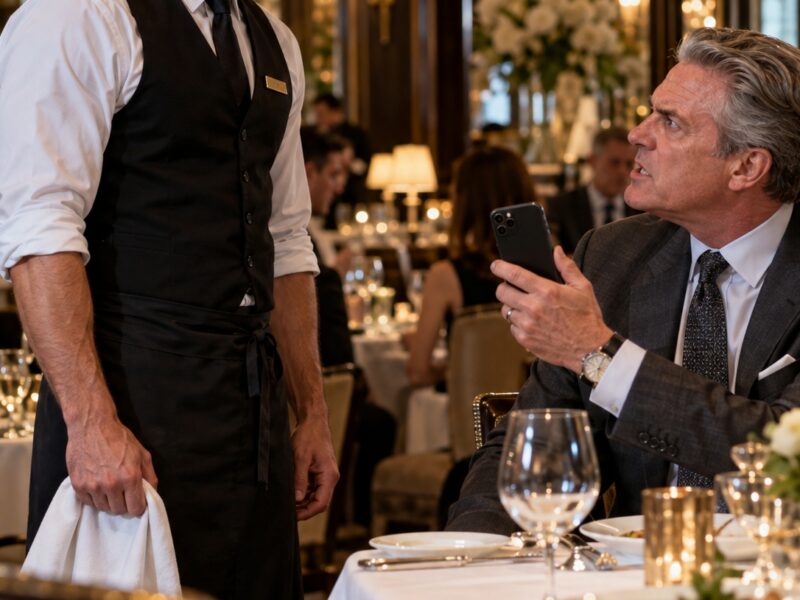
Ethan Cole stood beside Table Twelve with a white serving cloth folded over one forearm and a porcelain plate balanced carefully in his hand. Around him, the dining room continued its elegant afternoon rhythm—the soft clink of silverware against china, the murmur of expensive conversations, the faint notes of a piano drifting from hidden speakers near the bar.
Across the table, Richard Vaughn did not touch the food.
He stared at Ethan instead.
Ethan could feel other diners beginning to notice.
“I’m sorry, sir,” he said evenly. “The kitchen needed a few extra minutes because—”
“Don’t you dare make excuses.”
The room seemed to shrink around those five words.
Vaughn leaned back in his chair.
His charcoal suit probably cost more than the average server in the restaurant earned in a month. A silver watch flashed beneath his cuff as he pointed toward Ethan’s uniform.
“Look at you.”
Ethan said nothing.
“A nobody in a cheap uniform.”
Two tables away, a woman slowly lowered her wineglass.
One of the servers near the service station stopped polishing a spoon.
Vaughn noticed.
And smiled.
He enjoyed having an audience.
“You see where you are,” he said, tapping the white tablecloth between them, “and where I am?”
Ethan’s jaw tightened.
“Yes, sir.”
“Then you see the difference.”
There was something almost casual about Vaughn’s cruelty. That disturbed Ethan more than the words themselves.
This wasn’t anger anymore.
It was belief.
Vaughn genuinely believed the uniform gave him permission.
He leaned closer.
“Waiters like you need to understand something. Men like me don’t wait for people like you.”
A silence spread outward from the table.
Ethan could hear the ventilation system humming overhead.
Then Vaughn said the sentence Ethan would remember long after that afternoon was over.
“I keep people like you beneath my feet.”
For the first time, Ethan looked directly into his eyes.
Not angrily.
Not defiantly.
Just long enough to make Vaughn uncomfortable.
Vaughn’s face hardened.
“Know your place.”
Ethan almost smiled.
Because the man sitting in front of him had no idea where Ethan’s place actually was.
He didn’t know that the chandelier above his head had been selected by Ethan in Milan.
He didn’t know that Ethan had approved the marble beneath his Italian leather shoes.
He didn’t know that the wine cellar downstairs, the chef preparing his meal, the table where he sat, the building surrounding him, and even the name embossed on the menu all belonged to the waiter he had just called a nobody.
Vaughn reached for his phone.
“You know what? I’m done with you. One phone call and you’ll never work in a place like this again.”
Something changed in Ethan’s expression.
The servers noticed it first.
The restaurant manager noticed it next.
Vaughn did not.
Ethan carefully set the plate on the table.
“Then make the call, sir.”
Vaughn paused.
Ethan straightened.
“But before you do…”
His voice remained calm.
“…you should know who you’re talking to.”
And three hours earlier, Ethan Cole had been standing in his mother’s kitchen wondering whether putting on that uniform was the stupidest decision he had ever made.
The morning had begun quietly.
His mother, Margaret, was pouring coffee when Ethan came downstairs carrying a garment bag.
She looked at the bag.
Then at her son.
Then back at the bag.
At thirty-eight, Ethan had built the kind of life people liked to describe with numbers. Revenue. Properties. Valuations. Square footage. Investment portfolios.
His mother still measured his life differently.
Whether he slept enough.
Whether he called.
Whether he looked happy when he walked through the door.
That morning, he didn’t.
“What is that?” she asked.
“A uniform.”
Margaret stopped pouring.
“A uniform?”
Ethan unzipped the garment bag.
Inside was a crisp white shirt, black vest, black trousers, and the dark apron worn by the servers at Cole House, his flagship restaurant downtown.
His mother stared at it.
Then she stared at him.
“Son, why are you doing this?”
Ethan rested both hands on the kitchen counter.
For a moment, he didn’t answer.
Through the windows behind Margaret, early sunlight stretched across the backyard. Somewhere outside, a lawn sprinkler clicked rhythmically.
“I’ve been thinking about something.”
“That usually means I’m about to worry.”
He smiled faintly.
“Probably.”
She folded her arms.
Ethan looked down at the uniform.
“I spend most of my days around wealthy people.”
Margaret raised an eyebrow.
“You are a wealthy person.”
“I know.”
“Quite an important detail.”
“That’s exactly the problem.”
Her expression changed.
Ethan continued.
“When I walk into a room, people know who I am before I introduce myself. They know the restaurants. They know the company. Some of them know what Forbes thinks I’m worth.”
“And?”
“And everybody is nice.”
Margaret frowned.
“Isn’t that generally considered a good thing?”
“Not if they’re only nice because they know what I own.”
That answer quieted her.
Ethan walked toward the window.
“For the past six months, I’ve been watching people differently. Investors. Customers. Executives. People at charity dinners. People at private clubs.”
He turned.
“They’re charming to me. They shake my hand. They remember my name. They ask about you.”
Margaret smiled.
“Well, obviously I’m unforgettable.”
Ethan laughed.
Then the seriousness returned.
“But I’ve seen some of those same people snap their fingers at servers. I’ve watched them talk through housekeepers like they weren’t standing there. I’ve seen a man apologize to me for bumping my chair and then scream at a valet thirty seconds later because his car took too long.”
Margaret’s smile disappeared.
Ethan tapped the uniform hanging beside him.
“So I’m starting an experiment.”
Her eyes narrowed.
“What kind of experiment?”
“I want to know why wealthy people look down on those who have less.”
“Ethan…”
“I want to see how they really treat the people who serve them.”
Margaret studied her son for several seconds.
She had seen that expression before.
When Ethan was seventeen and working two jobs.
When he was twenty-six and mortgaged almost everything he owned to open his first restaurant.
When everyone told him the location was wrong.
When everyone told him fine dining was dying.
When everyone told him he was risking too much.
That expression meant he had already made the decision.
“But why would you do this at your own restaurant?”
“Because it’s the perfect place.”
He removed the white shirt from the garment bag.
“They’ll think I’m just another waiter.”
Margaret looked troubled.
“And that’s what you want?”
“Exactly.”
He buttoned the cuff slowly.
“I don’t want them to see Ethan Cole.”
“Why?”
“Because everybody respects Ethan Cole.”
He looked at his mother.
“I want to know how they treat Ethan when they think Ethan has nothing they want.”
That landed differently.
Margaret leaned against the counter.
“You think clothes will tell you that?”
“No.”
Ethan lifted the black apron.
“People will.”
She watched him put it on.
For most of his childhood, Margaret Cole had worked in uniforms herself.
Hotel laundry.
Hospital cafeteria.
Cleaning offices after dark.
Ethan remembered waiting in a plastic chair when he was nine while she finished wiping conference-room tables at nearly midnight.
He remembered men in suits leaving coffee cups inches from her hand without looking at her.
He remembered one executive throwing a paper towel on the floor while Margaret was standing beside the trash can.
At nine, Ethan had wanted to shout.
Margaret had simply picked it up.
On the bus home, she had told him something he never forgot.
A job tells you what someone does.
It does not tell you what someone is worth.
Maybe that was why she understood what he was trying to discover.
Maybe that was also why she feared it.
She stepped closer and adjusted his collar.
“You may hear things you don’t like.”
“That’s the point.”
“You may learn things about people you wish you didn’t know.”
“That’s also the point.”
Margaret sighed.
“Be careful, son.”
Ethan kissed her cheek.
“I will, Mom.”
An hour later, the owner of Cole House entered his restaurant through the employee entrance.
Nobody applauded.
Nobody rushed to greet him.
Nobody offered him espresso.
That was the first strange thing.
Normally, Ethan entered through the front doors.
The host straightened.
Managers appeared.
Someone inevitably asked whether he needed anything.
This time, wearing a server’s uniform, he came through the loading corridor beside crates of produce and boxes of imported wine.
The kitchen smelled of onions, roasted garlic, coffee, and hot metal.
Steam rose from a dishwasher.
A prep cook hurried past without noticing him.
Ethan stopped for a second.
He liked it.
For once, he was invisible.
Only three people in the building knew what he was doing: his general manager, his executive chef, and Melissa Grant, the floor manager assigned to supervise him.
Everyone else had been told a temporary server named Ethan was filling in for the day.
Melissa met him beside the service station.
She was forty-one, efficient, sharp-eyed, and one of the few employees who had argued with Ethan during management meetings without becoming nervous.
Today she didn’t call him Mr. Cole.
She looked him up and down.
“You’re the new waiter?”
Ethan almost laughed.
“Yes, ma’am.”
“Good.”
She handed him an order pad.
“Then stop standing around.”
He stared at her.
Melissa’s mouth twitched.
“Your idea, remember?”
“I’m beginning to regret giving you this much authority.”
“Table Twelve.”
She pointed.
“Start there.”
Ethan tucked the pad into his apron.
“Got it.”
Melissa caught his arm before he walked away.
Her voice dropped.
“One rule.”
“What?”
“If somebody is rude, you don’t become the owner.”
Ethan nodded.
“You stay the waiter until the experiment is over.”
“Agreed.”
“And if you mess up an order?”
“I take responsibility.”
“If the kitchen messes up?”
“I take responsibility.”
“If someone sends back perfectly good champagne because the bubbles aren’t enthusiastic enough?”
Ethan blinked.
“Has that happened?”
“Twice.”
He stared at her.
Melissa smiled.
“Welcome to the floor.”
Then she walked away.
Ethan turned toward the dining room.
From behind the service doors, Cole House looked different.
He had designed the restaurant to make guests feel insulated from the city outside. Warm amber lighting. Cream limestone. Dark walnut panels. Linen tablecloths. Fresh flowers changed every morning.
He had spent years perfecting every detail.
But he had never experienced the room from this side.
Not really.
He picked up two menus.
“Let’s see what happens.”
The first guests were an older couple celebrating their anniversary.
“Is our table ready?” the husband asked.
“Yes, sir. Right this way.”
Ethan pulled out the woman’s chair.
She thanked him.
Not dramatically.
Not performatively.
Just naturally.
When he returned with water, the husband asked, “How long will it take to get our drinks?”
“I can bring them right away, sir.”
“Wonderful. Thank you.”
Nothing happened.
No cruelty.
No revelation.
Just two people eating lunch.
Ethan almost felt foolish.
Then came another guest.
A businessman in his fifties took one sip of sparkling water and frowned.
“This isn’t cold enough.”
Ethan glanced at the condensation already forming on the glass.
“I’m sorry, sir. I’ll replace it immediately.”
The man handed it over without looking at him.
Not abusive.
Just dismissive.
When Ethan returned, the guest continued talking on his phone and waved him away.
It was such a small gesture that Ethan might once have missed it.
Now he didn’t.
At noon, a young couple entered.
“Good afternoon,” Ethan said.
“Good afternoon.”
“Welcome.”
The woman looked around.
“Beautiful place.”
“Thank you. Right this way. Your table is ready.”
Her husband smiled as they followed.
“This place really is beautiful.”
For some reason, the compliment felt different when Ethan couldn’t claim ownership of it.
“I’m glad you like it.”
He handed them menus.
“Please take your time. I’ll be right here if you need anything.”
“Thank you,” the woman said. “We appreciate it.”
They meant it.
Twenty minutes later, when they ordered, the husband looked Ethan in the eye.
“We’re ready.”
“Of course, sir. What would you like?”
“I’ll have the grilled salmon, please.”
“Excellent choice.”
The woman ordered pasta.
Before Ethan left, she said, “Thank you, Ethan.”
He stopped.
She had read his name tag.
It was absurd how much that mattered.
For years, Ethan had been thanked by governors, CEOs, athletes, investors, celebrities.
Yet hearing a stranger call a waiter by his name felt unexpectedly human.
He wrote something in the small notebook he kept hidden beneath his order pad.
Not everyone changes.
Money does not automatically erase kindness.
The experiment was not supposed to prove wealthy people were cruel.
Ethan didn’t want that conclusion.
He wanted something harder.
The truth.
And the truth, he discovered over the next two hours, lived in tiny moments.
A woman who pushed her chair back and apologized when Ethan nearly tripped.
A man who dropped a fork and snapped his fingers without interrupting his conversation.
A teenager who thanked the busboy three times.
A financier who spoke warmly to Ethan while his client was watching, then became cold the moment the client left.
A woman who complained about a seven-minute wait but quietly added a large tip.
Contradictions.
That was what Ethan found.
People were rarely as simple as generous or cruel.
But power exposed something.
When people believed there could be no consequences for disrespect, some became different.
By early afternoon, Ethan’s feet hurt.
That surprised him.
He had been standing only a few hours.
Some of his servers did double shifts.
His shoulders ached from carrying trays.
His smile required effort.
Three times he had apologized for problems he didn’t create.
Twice customers interrupted him while he was already speaking to someone else.
Nobody knew that the man refilling their water had signed the checks that purchased the building.
And strangely, Ethan had begun to enjoy the anonymity.
Until Richard Vaughn arrived.
Vaughn entered at 2:54 p.m.
Ethan knew him.
Not personally.
By reputation.
Richard Vaughn ran a private investment firm with offices in Manhattan, Chicago, and Miami. He was wealthy enough to be recognized in certain rooms and insecure enough to make sure everyone in those rooms recognized him.
Ethan had seen him twice at fundraising events.
Vaughn had been charming both times.
He had shaken Ethan’s hand firmly.
Complimented Cole House.
Mentioned that they should “do business someday.”
Today, Vaughn walked past Ethan without recognizing him.
That alone fascinated Ethan.
Melissa approached.
“Table Twelve.”
Ethan looked over.
“That’s Richard Vaughn.”
“You know him?”
“He knows me.”
Melissa glanced at Ethan’s uniform.
“Apparently not that well.”
Ethan picked up a menu.
When he reached the table, Vaughn checked his watch.
“Good afternoon, sir.”
“You’re late.”
Ethan paused.
Vaughn had been seated less than two minutes.
“I’m sorry, sir.”
“Do you even know what you’re doing?”
The question came immediately.
“Yes, sir.”
“Because you don’t look like you do.”
Ethan felt Melissa watching from across the room.
He remembered the rule.
Stay the waiter.
“What can I bring you to drink?”
Vaughn ordered without closing his phone.
When Ethan returned, Vaughn was typing an email.
Ethan set down the glass.
No acknowledgment.
Then Vaughn held up one finger.
Ethan waited.
Thirty seconds.
Forty.
Almost a minute.
Finally, Vaughn put down the phone.
“I want the chef to make something special.”
“Certainly, sir. What would you like?”
Vaughn described a variation of an entrée that wasn’t on the menu.
Ethan listened.
When Vaughn finished, Ethan explained politely, “We normally don’t make substitutions on that dish, but I’ll speak to the chef.”
“No substitutions?”
Vaughn looked amused.
“Do you know how much money I spend in restaurants?”
Ethan almost answered.
Instead he said, “I’ll ask the chef personally.”
“You do that.”
In the kitchen, Ethan handed over the ticket.
“Special order for Table Twelve.”
Chef Morales read it.
Then looked toward the dining room.
“Vaughn?”
Ethan nodded.
Morales had worked at Cole House for six years.
“He always does this.”
“You’ve served him before?”
“Unfortunately.”
Morales lowered his voice.
“He doesn’t want special food. He wants people to know he can make us change it.”
That sentence stayed with Ethan.
The kitchen prepared the request.
Vaughn checked his watch every few minutes.
“How much longer?”
“Just a few more minutes, sir.”
Six minutes later, Ethan delivered the plate.
Vaughn looked at it.
He didn’t taste it.
“That’s it?”
“Yes, sir.”
“This isn’t what I asked for.”
Ethan looked carefully at the dish.
It was exactly what Vaughn had requested.
“I’m sorry, sir. What would you like changed?”
Vaughn pointed vaguely toward the plate.
“This.”
Ethan waited.
“This what, sir?”
“The presentation.”
Ethan stared at him.
Vaughn leaned back.
“Take it back. I want it done properly.”
A part of Ethan wanted to ask what properly meant.
Another part understood the experiment depended on silence.
“Of course, sir.”
Back in the kitchen, Morales stared at the returned plate.
“He didn’t touch it.”
“No.”
“What’s wrong with it?”
“Presentation.”
Morales looked at Ethan.
Then at the plate.
Then back at Ethan.
“You designed the presentation.”
“I know.”
Morales nearly smiled.
“Still enjoying your experiment?”
“Less every minute.”
The chef remade the dish.
Ten minutes passed.
Then twelve.
Vaughn called Ethan over.
“How long is this going to take?”
“It needs a few more minutes.”
“I have meetings.”
“I understand.”
“Do you?”
Ethan said nothing.
Vaughn tilted his head.
“People like you always say you understand. You don’t.”
There it was again.
People like you.
Ethan felt something colder than anger.
Curiosity.
He wanted to know how far Vaughn would go.
The second plate left the kitchen.
Before Ethan could reach the table, another guest stopped him with a question about wine.
Ethan answered quickly.
Vaughn saw it.
And took it personally.
“Where is my food?”
“They’re finishing it now, sir.”
“You said that before.”
“Yes, sir.”
“Still waiting.”
“I apologize.”
Vaughn stared at him.
Ethan walked back toward the kitchen.
Behind him, Vaughn said loudly enough for two neighboring tables to hear:
“Unbelievable.”
Ethan’s shoulders stiffened.
He continued walking.
Melissa intercepted him near the service station.
“You can stop.”
“No.”
“Ethan.”
“He hasn’t crossed the line yet.”
Melissa stared at him.
“What exactly are you waiting for?”
“The truth.”
“I think you have it.”
Ethan looked toward Vaughn.
“No. I have impatience.”
He picked up the plate.
“I want to know what’s underneath it.”
Melissa’s expression darkened.
“Sometimes you don’t need to dig deeper after you hit sewage.”
Ethan almost laughed.
Almost.
Then he returned to Table Twelve.
By Vaughn’s calculation, the special order had arrived twenty minutes later than he believed it should have.
He looked at his watch.
“Twenty minutes late.”
“I’m sorry, sir. The kitchen—”
“Don’t you dare make excuses.”
The words cut across the room.
Ethan stopped.
Nearby conversations faded.
Vaughn pointed toward him.
“Look at you.”
Ethan felt every eye around them.
“A nobody in a cheap uniform.”
The line sounded even uglier the second time in Ethan’s memory than it had in the moment.
“Sir,” Ethan said quietly, “I understand you’re frustrated.”
“No. You don’t understand anything.”
Vaughn pushed his chair back.
“You see where you are and where I am?”
Ethan’s fingers tightened around the serving cloth.
Vaughn gestured at his suit.
Then Ethan’s apron.
“See the difference?”
A woman at the next table whispered something to her husband.
Vaughn ignored her.
“People like you are getting worse. No standards. No urgency. No respect.”
Ethan swallowed.
“I’m trying to resolve the problem, sir.”
“Waiters like you should be grateful people like me come through that door.”
Ethan’s eyes shifted toward the entrance.
His door.
Vaughn continued.
“I keep people like you beneath my feet.”
The words seemed to hang in the air.
Ethan remembered his mother coming home after midnight.
Her swollen hands.
Her cafeteria uniform.
Her cleaning cart.
The executive dropping the paper towel.
For one dangerous second, Ethan was nine years old again.
Then Vaughn snapped his fingers.
“Are you listening?”
Ethan returned to the room.
“Yes, sir.”
“Don’t make me wait again.”
Vaughn leaned toward him.
“Know your place.”
Melissa took one step forward.
Ethan gave her the smallest shake of his head.
Not yet.
Vaughn looked almost disappointed that Ethan hadn’t reacted.
So he pushed harder.
“Look at you.”
His gaze traveled deliberately from Ethan’s shoes to his collar.
“A nobody in a cheap uniform.”
A flush rose along Ethan’s neck.
Vaughn saw it.
And smiled.
That smile told Ethan more than every insult before it.
The man wasn’t simply losing his temper.
He was enjoying the hierarchy he believed existed between them.
“You know what?” Vaughn said.
He pulled out his phone.
“I’m done with you.”
Ethan waited.
“One phone call and you’ll never work in a place like this again.”
Now Melissa moved.
So did the restaurant manager.
Ethan raised one hand.
They stopped.
Vaughn mistook their hesitation for fear.
“You think I’m joking?”
“No, sir.”
“I know the owner.”
That almost did it.
Ethan had to bite the inside of his cheek.
Vaughn continued.
“I know people who can make sure no serious restaurant in this city hires you.”
Ethan placed both hands behind his back.
“Then make the call, sir.”
For the first time all afternoon, Vaughn seemed uncertain.
“What?”
“Make the call.”
The restaurant was silent now.
Not restaurant quiet.
True silence.
The kind created when dozens of people simultaneously realize something important is happening.
Vaughn stared at Ethan.
Ethan’s voice lowered.
“But before you do, you should know who you’re talking to.”
Vaughn gave a short laugh.
“Who exactly are you?”
Ethan removed the serving cloth from his arm.
He folded it once.
Then placed it on the table.
“My name is Ethan Cole.”
Nothing happened immediately.
That was the strange part.
Vaughn simply stared at him.
The name needed a second to travel through his mind.
Then another.
Recognition appeared slowly.
His mouth opened.
Before he could speak, Melissa stepped forward.
“Mr. Vaughn.”
Her professional smile was gone.
“This is Ethan Cole.”
She paused.
“He owns this restaurant.”
The color left Vaughn’s face.
His eyes moved around the dining room as though the walls themselves had betrayed him.
Then back to Ethan.
“You…”
His voice cracked.
“You own this place?”
“Yes.”
Vaughn looked at the uniform.
Then Ethan.
Then Melissa.
For the first time since arriving, Richard Vaughn had nothing to say.
Ethan remained standing beside the table.
“Yes,” he repeated. “I own this restaurant.”
Vaughn blinked.
“But…”
He glanced toward the kitchen.
“You were serving tables.”
“I was.”
“Why?”
Ethan took a breath.
“Because I didn’t come here today as the owner.”
Vaughn’s expression tightened.
“I don’t understand.”
“I came here to run an experiment.”
A murmur moved through the dining room.
Ethan looked around at the guests.
Some avoided his eyes.
Others watched openly.
He turned back to Vaughn.
“I wanted to see how people treat someone they believe is beneath them.”
Vaughn’s lips parted.
Ethan continued before he could interrupt.
“I wanted to know whether respect follows the person…”
He touched the front of his inexpensive vest.
“…or the uniform.”
Vaughn looked toward the neighboring tables.
Embarrassment replaced arrogance.
“This is ridiculous.”
“Is it?”
“You deceived me.”
“I wore a uniform.”
“You pretended to be an employee.”
“For one afternoon.”
“That is deception.”
Ethan nodded slowly.
“Maybe.”
Vaughn seized on the admission.
“Then you can’t judge my behavior when you deliberately created a false situation.”
Ethan studied him.
“I didn’t create your behavior.”
That stopped him.
“I brought your water.”
Vaughn said nothing.
“I took your order. I apologized when you were unhappy. I asked the kitchen to remake a meal that was already prepared exactly as you requested.”
Ethan’s voice remained calm.
“You chose everything else.”
Vaughn’s face reddened.
“You don’t understand. I’ve had a terrible day.”
“So?”
The single word was soft.
Vaughn stared at him.
Ethan stepped closer.
“Does having a terrible day give you permission to humiliate someone who can’t fight back?”
“I was frustrated.”
“You called me a nobody.”
“I shouldn’t have.”
“You told me people like me belonged beneath your feet.”
Vaughn looked down.
“You threatened my job.”
“I was angry.”
“You threatened my future.”
No answer.
“And you did all of it because you believed there would be no consequences.”
Vaughn’s jaw moved.
Nothing came out.
Ethan looked around the dining room.
Then back at him.
“That is the part of this experiment I needed to understand.”
His voice grew quieter.
“If you had known who I was when I walked up to this table, would you have spoken to me that way?”
Vaughn immediately said, “No.”
Ethan nodded.
“Exactly.”
Vaughn realized too late what he had admitted.
Ethan let the silence sit between them.
“The food didn’t change.”
He touched the table.
“The restaurant didn’t change.”
He touched his apron.
“I didn’t change.”
Then he looked directly at Vaughn.
“Only what you thought I was worth changed.”
Nobody moved.
Even Vaughn seemed unable to look away.
“The uniform didn’t change who I was,” Ethan said. “It only changed how you saw me.”
Vaughn’s shoulders dropped.
His phone was still in his hand.
The same phone he had threatened to use to destroy a waiter’s career.
Slowly, he placed it on the table.
“I was wrong.”
Ethan waited.
Vaughn swallowed.
“I’m sorry, Ethan.”
Ethan’s expression did not soften immediately.
Not because he wanted revenge.
Because apologies were easy when power shifted.
He had learned that lesson in less than one afternoon.
A man who believed he was speaking to a powerless waiter had offered humiliation.
A man who discovered he was speaking to a wealthy owner suddenly offered remorse.
Ethan needed to know which version was real.
“Would you be apologizing,” he asked, “if I still worked for you?”
Vaughn looked up.
The question hit harder than the reveal.
“I…”
Ethan waited.
Vaughn glanced at the other guests.
“No,” he finally said.
There was no defensiveness left in his voice.
Just shame.
“Probably not.”
Ethan nodded once.
It wasn’t the answer he wanted.
But it was the first honest thing Vaughn had said all afternoon.
Vaughn looked at the table.
“I don’t know when I became that person.”
Ethan could have humiliated him then.
The opportunity was sitting there.
Every person in the room was watching.
Ethan could have told security to escort him out.
He could have banned him publicly.
He could have used the moment exactly as Vaughn had tried to use his own status minutes earlier.
Instead, Ethan pulled out the empty chair opposite him.
He sat down.
The gesture surprised everyone.
Especially Vaughn.
“When did someone last speak to you the way you spoke to me?”
Vaughn looked confused.
“What?”
“When did somebody last make you feel small?”
Vaughn’s face changed.
Ethan saw something beneath the arrogance.
Not innocence.
Not justification.
Something older.
“I don’t know.”
“Think.”
Vaughn looked toward the window.
For several seconds, neither man spoke.
Then he said, “My father.”
Ethan waited.
Vaughn laughed once without humor.
“He used to tell me poor people were poor because they lacked discipline.”
Ethan said nothing.
“He started with nothing. Built a construction company. Made millions. And once he had money, he treated being poor like a moral failure.”
Vaughn rubbed his thumb across the edge of his phone.
“He hated weakness.”
“And you believed him?”
“For a long time.”
Vaughn looked at Ethan’s uniform again.
“Maybe longer than I realized.”
That didn’t excuse what he had done.
Ethan knew it.
Vaughn knew it too.
But understanding cruelty was different from excusing it.
Ethan stood.
“Mr. Vaughn, I don’t need you to respect me because I own this restaurant.”
Vaughn looked up.
“I need you to understand why you should have respected me when you thought I didn’t.”
Ethan turned toward the room.
His gaze moved across servers, diners, bartenders, hosts, busboys.
People with expensive watches.
People wearing aprons.
People whose names appeared on reservations.
People whose names appeared on schedules.
For a few seconds, every invisible line between them seemed embarrassingly artificial.
Ethan looked back at Vaughn.
“Never judge a person by the uniform they wear.”
His voice was no longer angry.
“You never know the story standing in front of you.”
Vaughn nodded.
Ethan started to walk away.
Then Vaughn spoke.
“Ethan.”
He stopped.
Vaughn stood.
Not dramatically.
Slowly.
Like a man learning how heavy his own behavior had become.
“I know saying sorry doesn’t fix it.”
“No.”
“But I am.”
Ethan looked at him.
“Then don’t prove it to me.”
Vaughn frowned.
“Prove it to the next person whose name you don’t know.”
Ethan walked toward the kitchen.
As he passed the service station, Melissa handed him a glass of water.
“You all right?”
Ethan drank half of it.
“I don’t know.”
“That went further than you planned.”
“Yes.”
“Did you get your answer?”
Ethan looked through the service doors.
Vaughn remained standing beside his table.
“I got part of it.”
Melissa leaned against the counter.
“What’s the other part?”
Ethan watched one of the busboys approach Vaughn’s table.
The young man’s name was Luis.
Twenty-two years old.
College student.
Worked evenings to help his mother pay rent.
Vaughn had probably passed him dozens of times without seeing him.
Luis reached for the untouched plate.
“Excuse me, sir.”
Vaughn turned.
For half a second, Ethan saw the old reflex.
The impatience.
The instinct to dismiss.
Then something interrupted it.
Vaughn looked at Luis’s name tag.
“Luis?”
The busboy paused.
“Yes, sir.”
Vaughn handed him the plate instead of pushing it toward him.
“Thank you.”
Luis looked surprised.
“You’re welcome.”
Vaughn hesitated.
“And… I’m sorry for the scene.”
Luis glanced toward Ethan.
Then back at Vaughn.
“No problem, sir.”
When Luis walked away, Ethan exhaled.
Melissa noticed.
“Now?”
Ethan smiled faintly.
“Maybe.”
By closing time, the story had spread through the entire restaurant.
Employees who hadn’t been in the dining room asked what happened.
The bartender had heard one version.
The kitchen had another.
Someone claimed Vaughn had thrown a plate.
He hadn’t.
Someone else claimed Ethan had fired him as a customer.
He hadn’t done that either.
Reality was less theatrical.
And somehow more important.
Ethan changed out of the uniform in his office.
His suit hung on the back of the door.
He put on the jacket.
It fit perfectly.
The fabric was expensive.
The watch on his wrist cost more than some cars.
When he looked into the mirror, Ethan Cole had returned.
Owner.
Founder.
Millionaire.
The man people recognized.
But something about the reflection now bothered him.
He thought about the difference between how people had looked at him at nine that morning and how they looked at him after six.
Same face.
Same voice.
Same man.
Different clothes.
Different perceived value.
He folded the waiter’s uniform carefully instead of leaving it for laundry.
Then he drove to his mother’s house.
Margaret was reading in the living room when he arrived.
She looked over the top of her glasses.
“Well?”
Ethan sat opposite her.
For a moment, he said nothing.
His mother closed the book.
“That bad?”
“Some of it.”
“And some of it?”
“Good.”
He told her about the anniversary couple.
The young woman who thanked him by name.
The teenager who thanked the busboy.
The difficult customers.
The dismissive gestures.
Then he told her about Vaughn.
Margaret listened without interrupting.
When Ethan finished, she sat quietly.
Finally, she asked, “Did you embarrass him?”
“I could have.”
“That wasn’t my question.”
Ethan looked at her.
“No.”
She nodded.
“Good.”
“He embarrassed himself.”
“That’s usually more effective.”
Ethan smiled.
Then his expression became serious.
“Mom, how did you do it?”
“Do what?”
“All those years.”
She knew what he meant.
“People treating you like you were invisible.”
Margaret looked down at her hands.
Age had softened them, but Ethan could still remember the cracks in her skin from cleaning chemicals.
“You learn something when you work around people who think they’re above you.”
“What?”
“That arrogance is usually a costume too.”
Ethan frowned.
She smiled.
“Some people wear expensive clothes because they like expensive clothes. Some wear them because they’re terrified somebody might see how insecure they are underneath.”
She leaned back.
“You don’t have to hate someone to refuse to let them define you.”
Ethan thought about Vaughn.
“I wanted to expose people.”
Margaret nodded.
“And?”
“I think I exposed myself too.”
“How?”
“I didn’t know what my own employees experienced.”
That admission hurt.
“I thought because we paid well, had good benefits, trained managers, that I understood their jobs.”
He shook his head.
“I didn’t.”
Margaret’s expression softened.
“No owner completely does.”
“I should.”
“No.”
She leaned forward.
“You should listen.”
That became the real consequence of Ethan’s experiment.
Not the reveal.
Not Vaughn’s embarrassment.
Not the whispers around the dining room.
Listening.
The following Monday, Ethan called a staff meeting.
Not executives.
Staff.
Servers.
Dishwashers.
Hosts.
Bartenders.
Cooks.
Valets.
Cleaning crew.
Managers attended, but they did not lead.
Ethan walked into the meeting carrying the same waiter uniform folded over his arm.
He placed it on the table.
Nobody spoke.
“I wore this for one shift,” he began.
Several employees smiled.
They had heard the story.
“Four hours.”
He looked around.
“And I learned that four hours isn’t enough.”
The smiles disappeared.
“I learned how easy it is to say customer service matters when you’re not the person being insulted.”
He paused.
“I learned how often our employees apologize for things they didn’t do.”
A few people exchanged glances.
“I learned that we’ve been so afraid of losing difficult customers that sometimes we’ve asked good employees to tolerate behavior nobody should tolerate.”
Melissa stood near the back.
She nodded slightly.
Ethan continued.
“That changes today.”
He announced a new policy.
Employees could refuse service to customers who used discriminatory language, threats, physical intimidation, or repeated personal humiliation.
Managers would support them.
No employee would be required to endure abuse because a guest spent money.
Then Ethan did something harder.
He asked everyone in the room to tell him what else he had missed.
At first, nobody spoke.
Why would they?
He was still the owner.
Even in shirtsleeves, Ethan Cole represented paychecks.
Then Luis raised his hand.
The busboy from Vaughn’s table.
Ethan nodded.
Luis swallowed.
“Sometimes managers tell us not to drink water where customers can see.”
Ethan looked toward management.
“Why?”
“Appearance,” somebody said.
Ethan frowned.
Luis continued.
“And sometimes we don’t get breaks when we’re supposed to.”
Another employee spoke.
Then another.
A hostess described customers touching her waist when she escorted them to tables.
A dishwasher explained that kitchen staff often stayed after clock-out because closing duties took longer than scheduled.
A server admitted she had cried in the walk-in freezer after a customer called her stupid, then returned to the dining room smiling because she feared being written up.
Ethan listened.
The meeting scheduled for forty-five minutes lasted three hours.
By the end, his notebook was full.
That was when Ethan finally understood the flaw in his experiment.
He had begun the day asking why wealthy people looked down on those with less.
But wealth wasn’t the real dividing line.
Power was.
Give someone the belief that another person cannot answer back, cannot leave, cannot risk losing a tip or paycheck, and you learn something about them.
Sometimes something beautiful.
Sometimes something ugly.
The lesson wasn’t that rich people were cruel.
Many of the wealthiest guests Ethan served had treated him with effortless dignity.
The lesson was simpler.
Character reveals itself most clearly when kindness offers no advantage.
Weeks passed.
The uniform remained folded in Ethan’s office.
He didn’t frame it.
He didn’t display it.
He kept it in the bottom drawer of his desk.
Occasionally, before a meeting with investors or executives, he opened the drawer and looked at it.
A reminder.
Not of Vaughn.
Of himself.
Then, one rainy Thursday evening, Richard Vaughn returned to Cole House.
The hostess recognized him.
So did Melissa.
For one second, tension moved through the entrance.
“Do you have a reservation, Mr. Vaughn?” Melissa asked.
“No.”
He looked uncomfortable.
“I was hoping to speak with Ethan.”
“He’s in a meeting.”
“I can wait.”
Vaughn stood near the bar.
Twenty minutes passed.
He didn’t complain.
Thirty.
Still nothing.
Finally Ethan emerged from the private dining room.
He stopped when he saw him.
“Richard.”
Vaughn stood.
“Ethan.”
“What can I do for you?”
Vaughn reached into his coat.
For a second Ethan expected a business proposal.
Instead, Vaughn pulled out an envelope.
“What is that?”
“Nothing dramatic.”
He handed it over.
Inside was a donation receipt.
A substantial one.
The recipient was a workforce-development organization that trained low-income restaurant workers for management careers.
Ethan looked up.
Vaughn quickly said, “I’m not trying to buy forgiveness.”
“Then why show me?”
“Because you told me not to prove anything to you.”
Ethan waited.
Vaughn gave an embarrassed smile.
“I failed at that part.”
Ethan almost laughed.
Vaughn continued.
“But I wanted you to know I heard you.”
“That matters more.”
Vaughn looked toward the dining room.
Luis was clearing a table.
Vaughn recognized him.
“Is that Luis?”
“Yes.”
Vaughn walked over.
Ethan stayed where he was.
He couldn’t hear everything they said.
He didn’t need to.
He saw Vaughn offer his hand.
Luis looked surprised.
Then shook it.
It wasn’t redemption.
Life rarely changed that cleanly.
Richard Vaughn did not become a saint because a restaurant owner embarrassed him.
Ethan knew better than that.
People carried habits for decades.
Pride returned.
Old instincts resurfaced.
Change was usually less like lightning and more like erosion—slow, repetitive, almost invisible until one day the landscape looked different.
But a beginning was still a beginning.
Months later, Ethan stood near the entrance of Cole House on a crowded Saturday night.
He was wearing a suit again.
Guests recognized him.
A businessman approached.
“Mr. Cole! Wonderful restaurant.”
“Thank you.”
The man shook his hand enthusiastically.
Behind Ethan, a young server accidentally dropped a spoon.
It struck the marble floor with a sharp metallic sound.
The businessman turned.
His expression changed instantly.
“For God’s sake, watch what you’re doing.”
The server froze.
Ethan watched the man’s face.
Then he looked down at his own suit.
For just a second, he remembered the apron.
The cheap vest.
The name tag.
Look at you.
A nobody in a cheap uniform.
Know your place.
Ethan bent down.
He picked up the spoon.
The businessman stared at him.
Ethan handed it to the server.
“You’re fine.”
“Thank you, Mr. Cole.”
The young man hurried away.
The businessman cleared his throat.
“I didn’t mean anything by it.”
Ethan looked at him.
He had heard versions of that sentence many times since the experiment.
I didn’t mean it.
I was frustrated.
I was tired.
I was having a bad day.
I didn’t know.
Ethan smiled politely.
“I know.”
Then he added:
“But that’s usually when character matters most.”
The businessman had no answer.
Ethan walked away.
Near the kitchen doors, Melissa was watching him.
“You still think about that day?” she asked.
“All the time.”
“Vaughn?”
Ethan shook his head.
“The uniform.”
Melissa smiled.
“You know, technically, it wasn’t cheap.”
Ethan laughed.
“We pay too much for those?”
“Way too much.”
He looked through the dining room.
A server poured wine.
A busboy cleared plates.
A hostess welcomed an elderly couple.
A dishwasher disappeared behind swinging doors carrying a rack of glasses.
Hundreds of small tasks.
Most unnoticed.
All necessary.
When Ethan had first built Cole House, he had believed the restaurant belonged to him because his signature was on the documents.
He no longer believed that.
A restaurant belonged, in some small way, to every person who kept it alive.
The chef sweating behind the line.
The woman folding napkins before sunrise.
The bartender remembering someone’s anniversary.
The dishwasher still working after the last customer had gone home.
The server smiling at a stranger who might be kind—or might decide, for no reason other than a black apron, that he was beneath them.
Money could purchase the building.
It could purchase marble and chandeliers and rare wine.
It could put a man’s name on the deed.
But money could not purchase dignity.
And it never gave anyone the right to take dignity away from somebody else.
Ethan understood that more clearly now because for one afternoon, the world had forgotten he was wealthy.
Nothing about him had actually changed.
His intelligence had not disappeared when he buttoned the white shirt.
His accomplishments had not vanished beneath the black vest.
His character had not shrunk when he tied the apron around his waist.
Only other people’s perception changed.
And that was the part that stayed with him.
Because somewhere, every day, someone was standing behind a counter, pushing a cleaning cart, carrying a tray, stocking a shelf, driving a cab, washing dishes, delivering a package, or opening a door for someone who would never bother learning their name.
They did not have a secret fortune.
They did not own the building.
There would be no dramatic reveal.
No manager would step forward and announce that the waiter was actually the millionaire owner.
No room would suddenly fall silent.
And that was exactly why Ethan’s lesson mattered.
The waiter should never need to be a millionaire to deserve respect.
The housekeeper should never need to secretly own the hotel.
The cashier should never need to be somebody’s daughter, somebody’s future CEO, somebody important in disguise.
A human being should not need a hidden identity to earn basic dignity.
Late that night, after Cole House had closed, Ethan walked alone through the empty dining room.
The chandeliers had been dimmed.
Chairs sat neatly beneath tables.
The city glowed beyond the windows.
He stopped beside Table Twelve.
The same table.
For a moment, he could almost see Vaughn sitting there again.
Twenty minutes late.
Look at you.
Know your place.
Ethan ran his fingers across the back of the chair.
Then he remembered his mother’s hands.
The cracks from cleaning chemicals.
The nights she came home exhausted.
The paper towel that executive had dropped on the floor.
His mother bending to pick it up.
At nine years old, Ethan had thought the most painful part was that the man had treated Margaret like she was beneath him.
Decades later, he finally understood something else.
Margaret had never been beneath that man.
Not for one second.
The only thing the encounter had revealed was how small he had chosen to become.
Ethan switched off the final light.
The dining room disappeared into darkness.
And somewhere behind him, folded inside the bottom drawer of an expensive desk, an ordinary waiter’s uniform remained.
It no longer represented an experiment.
It represented a question Ethan hoped he would never stop asking:
Who are you when the person standing in front of you has nothing you need?
Because titles can disappear.
Money can disappear.
Status can disappear.
The suit can come off.
The uniform can go on.
And when everything that tells the world how important you are has been stripped away, one thing remains.
How you treated someone when you believed they were beneath you.
That is the part people remember.
And sometimes, it is the truest thing about you.









