The Millionaire’s Mother Mocked Her Faded Dress—Then Her Son Picked Up What Fell From Her Purse
The first laugh came from Margaret Caldwell.
The second came from a woman standing beside her in diamonds.
By the time the third person smiled, Sophia Bennett understood exactly what was happening.
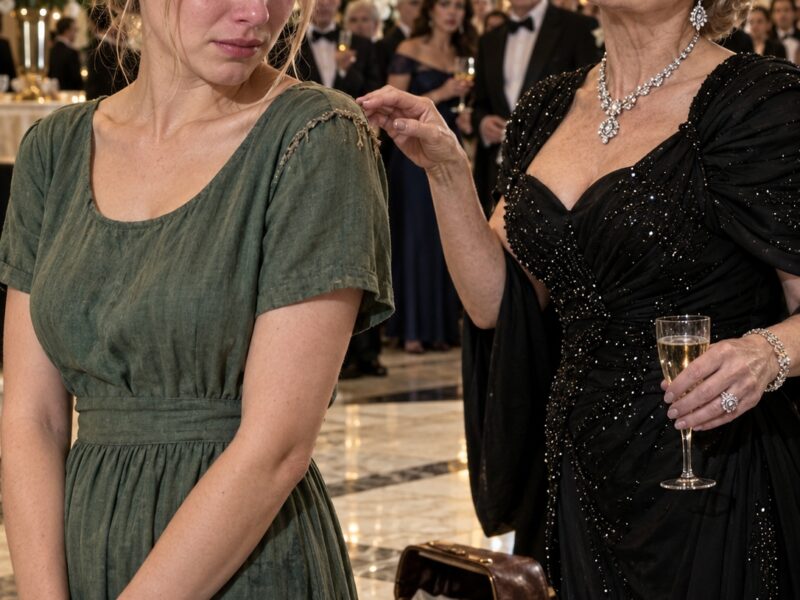
She was standing beneath a chandelier worth more than everything she owned, surrounded by Chicago’s wealthiest families, while one of the most powerful women in the city pointed at her faded green dress and made her the evening’s entertainment.
“My goodness,” Margaret said, letting her gaze travel slowly from Sophia’s inexpensive shoes to the hem of the dress. “They really have relaxed the dress code this year.”
A few people nearby chuckled.
Not loudly.
That somehow made it worse.
Sophia felt the blood rise into her face, but she kept her shoulders straight. Both of her hands tightened around the small brown purse she had carried for almost six years.
“I’m here representing Harbor Light Community Services,” she said.
Margaret’s eyebrows lifted.
“Of course you are.”
There was something in the way she said it that turned four harmless words into a judgment.
Around them, conversations had begun to die.
Men holding champagne glasses glanced over. Women in couture gowns pretended not to stare. A waiter slowed for half a second before remembering he was supposed to remain invisible.
Sophia could feel the entire ballroom noticing her.
And what they noticed first was the dress.
It was green, modest, carefully pressed and several years out of fashion. One shoulder had been repaired so delicately that most people would never have seen the stitching.
Margaret Caldwell saw it immediately.
She reached toward Sophia and brushed two fingers across the fabric.
“This material,” she said softly, “is almost vintage.”
Another small laugh moved through the crowd.
Sophia looked down at Margaret’s perfectly manicured hand resting for a moment against the cloth.
Then she thought of Clara.
Mrs. Clara Whitmore, seventy-three years old, arthritis in both hands, sitting beneath the yellow kitchen light in apartment 4B the night before, threading a needle three times because her fingers kept shaking.
Sophia remembered Clara smiling after repairing the shoulder.
“There,” the older woman had whispered. “Good as new.”
It wasn’t good as new.
They both knew that.
But Clara had said it with so much pride that Sophia had hugged her anyway.
Now a stranger was touching that same stitching like it was evidence of something shameful.
Sophia slowly stepped back.
“Please don’t.”
Margaret blinked.
It was probably the first time that evening anyone had said those words to her.
“Excuse me?”
“I said, please don’t touch my dress.”
The room became strangely quiet.
Margaret’s smile did not disappear.
It sharpened.
“I was only helping.”
“I know.”
Sophia swallowed.
“But I don’t need help with my dress.”
Someone near the bar looked away.
Someone else coughed.
And then Margaret Caldwell gave Sophia the kind of smile wealthy people sometimes gave employees who had forgotten their place.
“Young woman,” she said, “when someone invites you into a room like this, there are certain expectations.”
Sophia’s fingers tightened around her purse.
She could have walked away.
She should have walked away.
But she had spent the last eight hours delivering meals before coming here. She had changed clothes in the charity center’s tiny bathroom because she couldn’t afford a taxi home first. She had skipped lunch after paying her younger brother’s lab fee that morning.
And she had come to the Grand Willow Hotel for one reason.
Not to be admired.
Not to be accepted.
Not to meet billionaires.
She had come because if Harbor Light received enough funding tonight, one hundred and eighty-seven Chicago families could have heat through February.
So Sophia lifted her chin.
“I was invited because of my work.”
Margaret glanced at the dress again.
“Yes,” she said. “That is becoming very clear.”
This time the laughter was louder.
And something inside Sophia nearly broke.
Nine hours earlier, Sophia Bennett had been standing in a South Side community center packing canned soup into cardboard boxes.
Nobody there cared what she wore.
Nobody cared that the soles of her boots were beginning to separate or that her winter coat had belonged to her mother.
They cared that Mrs. Alvarez had insulin in the refrigerator.
They cared that the Parker children had cereal for Monday morning.
They cared that Mr. Dawson’s heat had been shut off twice in three weeks.
Those were the things that mattered in Sophia’s world.
Money was not an abstraction there.
Forty dollars was medicine.
Seventy dollars was groceries.
One hundred and twenty dollars could stop the gas company from turning off someone’s heat.
Sophia knew the exact price of nearly everything because she had spent most of her adult life deciding which necessity could wait.
At twenty-six, she worked mornings as an administrative assistant at a dental office and evenings coordinating outreach programs at Harbor Light.
She made enough to survive.
Usually.
Her rent for a small apartment in Bridgeport consumed almost half her monthly income. The rest was divided between groceries, transit, her mother’s occasional medical expenses, and tuition support for her nineteen-year-old brother, Evan.
Their father, Michael Bennett, had died five years earlier.
A heart attack.
Sudden.
No warning.
He had left for work on a Thursday morning complaining about indigestion and never came home.
Sophia could still remember the hospital hallway.
Her mother sitting beneath a vending machine.
Evan, fourteen at the time, asking why everyone kept whispering.
And the doctor walking toward them with his hands clasped in front of him.
After Michael died, something inside their family shifted permanently.
Their mother, Helen, had once been the loudest person in every room. She sang while cooking. She danced badly to old Motown songs while vacuuming. She embarrassed her children in grocery stores just because she could.
Grief made her quieter.
Sophia became the person who filled the silence.
She paid bills.
She helped Evan with college applications.
She learned which notices could be ignored for ten days and which companies would shut something off immediately.
She learned to sound calm on the phone even when her bank account contained thirty-two dollars.
And somewhere during those years, helping people outside her family became almost instinctive.
Perhaps because she understood how thin the line was.
One unexpected hospital bill.
One lost job.
One dead transmission.
One divorce.
One funeral.
That was sometimes all it took to turn an ordinary family into a family standing in line at Harbor Light.
Sophia never romanticized poverty.
There was nothing beautiful about watching her mother choose between dental work and electricity.
There was nothing noble about counting quarters at a laundromat.
But hardship had taught her something money never could.
People remembered how you treated them when they had nothing to offer you.
That belief was why she was standing in Margaret Caldwell’s ballroom now.
And Margaret had no idea.
Three days before the gala, Sophia had received the email from Harbor Light’s director, Denise Walker.
“You’re going,” Denise announced from her office.
Sophia looked up from a spreadsheet.
“To what?”
“The Caldwell Foundation winter gala.”
Sophia laughed.
Denise did not.
“Absolutely not.”
“You’re representing us.”
“Send Tom.”
“Tom talks too much.”
“He’s charming.”
“He’s exhausting.”
“Send Melissa.”
“Melissa is eight months pregnant.”
Sophia pointed at herself.
“I own exactly one dress.”
Denise leaned back.
“Then wear it.”
“It’s from my cousin’s wedding.”
“Was the wedding indoors?”
“That isn’t the issue.”
“Did the dress survive?”
“Denise.”
The older woman smiled.
Harbor Light had been shortlisted for one of the Caldwell Foundation’s winter community grants. The amount had not been announced, but even the smallest award could keep their emergency heating program alive.
“You know these families better than anyone,” Denise said. “When somebody asks what the money does, you don’t give them statistics. You know names.”
Sophia looked at the application papers on the desk.
One hundred and eighty-seven households.
Seventy-three children.
Twenty-nine senior citizens living alone.
She knew all of them.
“I don’t belong at those things.”
Denise’s expression changed.
“That,” she said, “is exactly why you should go.”
Sophia almost declined anyway.
Then Clara Whitmore heard about it.
Clara lived across the hall from Sophia and treated privacy like an irritating modern invention.
By six that evening, she was knocking on Sophia’s door holding a garment bag.
“No.”
Sophia hadn’t even opened it.
Clara frowned.
“You don’t know what’s inside.”
“A dress.”
“It could be a body.”
“You wouldn’t carry a body.”
“At my age, I’d use wheels.”
Sophia laughed despite herself.
Clara unzipped the bag.
The green dress appeared.
It was elegant in an old-fashioned way, with a soft neckline and a fitted waist. Not glamorous. Not expensive.
Beautiful anyway.
“My husband bought it for me in 1989,” Clara said.
Sophia immediately shook her head.
“Then absolutely not.”
“Why?”
“Because it matters to you.”
“That’s why I want someone to wear it.”
Clara’s husband had been dead for twelve years.
Sophia knew enough not to argue with the particular look in her eyes.
So that Saturday afternoon, Clara repaired the loose shoulder seam while Sophia stood barefoot on an old towel.
“You look lovely,” Clara said.
Sophia studied herself in the cracked mirror.
“I look like I’m going to prom in 1994.”
“You weren’t alive in 1994.”
“Exactly.”
Clara tied the last thread.
“Rich people spend thousands trying to look memorable.”
Sophia glanced at her.
“And?”
“You won’t have to spend anything.”
Sophia had laughed then.
Hours later, standing before Margaret Caldwell, Clara’s joke no longer felt funny.
The Grand Willow ballroom looked less like a charity event and more like a royal reception.
Champagne flowed beneath suspended crystal lights. White roses filled silver vases. A jazz quartet played near a wall of windows overlooking the Chicago River.
Names Sophia had seen in newspapers stood twenty feet away discussing ski homes, mergers and mayoral fundraisers.
At the entrance, she had been asked twice if she was part of the event staff.
The second employee had apologized.
Sophia smiled.
She was used to being misread.
What she was not used to was cruelty performed for an audience.
Margaret Caldwell had mastered it.
At sixty-two, Margaret carried herself with the rigid elegance of someone who had never entered a room without expecting it to adjust around her.
She had been born into money and married into more.
Her late husband, Richard Caldwell, had transformed his father’s regional manufacturing company into an international investment group. After his death, their only son, Jonathan, expanded it again.
The Caldwell name appeared on hospital wings, museums and university buildings across Illinois.
Margaret considered philanthropy part obligation, part legacy and part social architecture.
She knew exactly which families mattered.
Which marriages were strategic.
Which invitations carried meaning.
Which dress designers had waiting lists.
And she knew, almost instantly, when someone did not fit.
Sophia did not fit.
That alone might have been survivable.
But earlier that evening Margaret had received a whisper from one of the event coordinators.
The young woman in green was from one of the small charities competing for funding.
In Margaret’s mind, the conclusion formed quickly.
Sophia was there to ask for money.
And Margaret had spent enough years around polished opportunists to believe she recognized ambition even when it wore inexpensive shoes.
“So tell me,” Margaret said, still facing Sophia, “how does your organization usually approach these events?”
Sophia frowned.
“I’m not sure what you mean.”
“Fundraising.”
“We apply for grants.”
“I understand that.”
Margaret’s gaze drifted briefly toward Sophia’s purse.
“But sometimes smaller organizations can become very… enthusiastic when they gain access to certain circles.”
The implication took a second to land.
When it did, Sophia stared at her.
“You think I came here to meet rich people?”
Margaret offered a graceful little shrug.
“I think everyone comes somewhere for a reason.”
Sophia felt something inside her settle.
The embarrassment was still there.
But beneath it, anger had arrived.
“You’re right.”
Margaret’s smile returned.
“I usually am.”
“I came because three families lost heat this week.”
Margaret’s expression stiffened.
Sophia continued.
“One has a six-year-old girl recovering from pneumonia. Another has an eighty-one-year-old man living alone. The third has a mother with two kids who is working overnight shifts at a nursing home.”
Several nearby guests stopped pretending not to listen.
“If our grant is approved tonight,” Sophia said, “we can restore their utilities Monday morning.”
Margaret took a sip of champagne.
“That’s admirable.”
Sophia waited.
Then Margaret added, “But sincerity and presentation are not mutually exclusive.”
There it was again.
The dress.
Sophia suddenly understood that Margaret was not going to let her leave with dignity.
Not yet.
She looked across the ballroom toward the exit.
For one dangerous second, she imagined walking out.
Then she saw Denise in her mind.
The folders.
The names.
The heating notices.
She stayed.
Margaret mistook that decision for weakness.
“You’re very young,” she said.
“I’m twenty-six.”
“Exactly.”
Margaret glanced around.
“Rooms like this can be overwhelming.”
“They can.”
“And there are rules.”
“Rules about kindness?”
Margaret’s jaw tightened.
“No. About standards.”
Sophia nodded slowly.
“Then maybe we were invited to different events.”
A man nearby nearly choked on his drink.
Margaret’s cheeks changed color.
Before she could respond, someone behind Sophia whispered, “Jonathan’s here.”
The atmosphere shifted.
Margaret looked toward the ballroom entrance.
Sophia did not.
She had no interest in meeting Margaret Caldwell’s son.
She simply wanted this conversation to end.
Jonathan Caldwell had arrived twenty minutes late.
At thirty-five, he had spent most of his adult life becoming exactly the kind of man magazines liked to call disciplined.
He ran Caldwell Global Holdings with a reputation for being difficult to impress and nearly impossible to intimidate.
His suits fit perfectly.
His schedule ran in fifteen-minute blocks.
His employees respected him more than they liked him.
But the public version of Jonathan was incomplete.
What very few people knew was that over the previous year, he had started questioning much of the world he had inherited.
His father’s death had done that.
Richard Caldwell had died from pancreatic cancer eighteen months earlier.
There had been money for everything.
Private doctors.
Experimental consultations.
A hospital suite overlooking Lake Michigan.
And none of it mattered.
Cancer did not care that the Caldwell family owned buildings.
Jonathan had spent his father’s last night sitting beside a bed listening to one of the most powerful men he had ever known struggle to breathe.
After that, certain conversations became unbearable.
Net worth.
Status.
Who had been seated beside whom.
Which club had rejected whose membership.
His mother still cared deeply about those things.
Jonathan increasingly did not.
That was why he had quietly begun visiting several organizations supported by the foundation without media.
Hospitals.
Food banks.
Youth shelters.
One of those visits had taken him to St. Catherine Children’s Hospital four months earlier.
He still remembered Room 614.
A nine-year-old boy named Matthew Reyes was waiting for a heart transplant.
Matthew had been frightened, thin and furious at the universe.
Jonathan had tried to talk to him.
The boy barely responded.
Then a woman arrived carrying three books and a paper bag from a bakery.
Jonathan had stepped into the hallway as she entered.
He never learned her name.
But he watched through the glass as Matthew changed.
The boy smiled.
Actually smiled.
The woman sat beside him for almost an hour reading badly exaggerated voices from a fantasy novel.
Before she left, Matthew hugged her.
Later, Jonathan asked the nurse.
“Family?”
“No.”
“Volunteer?”
“Sort of.”
The nurse smiled.
“She comes every Thursday.”
“From which program?”
“None.”
Jonathan looked confused.
The nurse explained.
The woman had met Matthew while delivering food to another family. After learning he rarely had visitors during weekday afternoons because his mother worked two jobs, she simply started coming.
“Does the hospital pay for the books?”
“No.”
“The food?”
“No.”
“Then who does?”
The nurse gave him a look.
“She does.”
Jonathan had stood in that hallway longer than necessary.
He remembered thinking that generosity looked very different when nobody was taking photographs.
Now, walking into the Grand Willow ballroom, he heard his mother’s voice.
Then he saw the green dress.
At first he could not see Sophia’s face.
He saw only the semicircle of guests.
His mother.
The posture of the young woman standing before her.
And the particular silence that told him something unpleasant had already happened.
Jonathan slowed.
His chief of staff, Daniel Reed, stopped beside him.
“What is it?”
Jonathan didn’t answer.
Then Sophia turned slightly.
He recognized her.
The woman from Matthew’s hospital room.
For a moment, Jonathan thought he might be mistaken.
Different clothes.
Hair pinned back.
Makeup.
But then Sophia smiled tightly at something Margaret said, and Jonathan remembered the same expression she had made when Matthew dropped crumbs all over a hospital blanket.
It was her.
“What is my mother doing?” Jonathan asked.
Daniel looked uncomfortable.
“I just got here.”
Jonathan moved toward them.
He was still several yards away when Margaret reached for Sophia’s dress.
Jonathan stopped.
He heard Sophia say, “Please don’t.”
Then came the exchange about standards.
Then the quiet response.
“Then maybe we were invited to different events.”
Jonathan almost smiled.
His mother did not.
Margaret stepped closer.
Perhaps she intended to answer.
Perhaps Sophia intended to move away.
Neither got the chance.
Margaret’s elbow brushed Sophia’s arm.
Sophia’s purse slipped.
It struck the marble floor.
The sound was surprisingly loud.
Several small objects scattered across the polished surface.
A tube of lip balm.
Two receipts.
A pen.
A folded photograph.
An old transit card.
And a small silver cross.
Sophia immediately crouched.
“I’ve got it.”
Jonathan was already there.
He bent and picked up the cross.
It was not expensive.
The metal had been worn smooth in places.
On the back were three tiny engraved letters.
M.J.B.
Sophia froze when she saw it in his hand.
Jonathan looked up.
“Is this yours?”
“My father gave it to me.”
He held it carefully.
Sophia reached for it.
Then Jonathan noticed something else near the open purse.
A plastic identification badge.
HARBOR LIGHT COMMUNITY SERVICES.
He stared at the name.
Sophia Bennett.
Something moved through his memory.
A report.
A conversation.
Daniel walking into his office three weeks earlier holding financial documents.
Jonathan looked back at Sophia.
“Sophia Bennett?”
She seemed confused.
“Yes.”
Behind them, Margaret exhaled impatiently.
“Jonathan, this really isn’t necessary.”
He ignored her.
“Have we met?”
Sophia shook her head.
“I don’t think so.”
“You volunteer at St. Catherine’s.”
Her face changed.
“How do you know that?”
“Matthew Reyes.”
Sophia stared at him.
“You know Matthew?”
“I met him.”
The room was almost completely silent now.
Jonathan handed her the cross.
“You were reading to him.”
Recognition did not appear in Sophia’s eyes.
She had not noticed Jonathan that day.
For reasons he could not explain, that affected him more than if she had.
He had been accustomed all his life to being recognized.
Sophia had been too busy helping a sick child to notice a billionaire standing ten feet away.
“I read to a few kids there,” she said.
“A few?”
She seemed embarrassed.
“When I can.”
Margaret stepped forward.
“Jonathan.”
There was warning in her voice.
He finally turned.
“What?”
“We’re delaying the program.”
His eyes went to her.
Then to Sophia.
Then to the people watching.
“What happened?”
Margaret’s posture became rigid.
“Nothing happened.”
Sophia stood.
“That’s fine.”
Jonathan looked at her.
She began putting things back into her purse.
“I should find my table.”
“Sophia.”
She stopped.
He had never said her name to her before.
Yet the familiarity of it made Margaret look at him sharply.
Jonathan turned to Daniel.
“Didn’t your team send me a Harbor Light report last month?”
Daniel nodded.
“Yes.”
“What was the donor identification issue?”
Sophia stopped moving.
Daniel glanced at her.
Then at Margaret.
Then back at Jonathan.
“That information wasn’t intended for the event.”
“I know.”
Sophia frowned.
“What donor issue?”
Jonathan studied her.
For the first time, he realized she genuinely did not know what he meant.
That meant Daniel had been right.
The payments were hers.
Jonathan had learned of them almost by accident.
The Caldwell Foundation’s financial analytics department had been reviewing small emergency-assistance grants across partner organizations when an unusual pattern appeared.
Several overdue utility bills had been paid before foundation money arrived.
A grocery account at a neighborhood market had repeatedly been credited.
A school had received anonymous payments covering meal balances.
None were large.
Thirty-eight dollars.
Seventy-two.
One hundred and thirteen.
Fifty-nine.
The transactions appeared under several abbreviated names.
At first the foundation assumed they belonged to a local donor collective.
Then Daniel’s team traced the processing account.
Sophia Bennett.
Jonathan had read the report twice.
The same Sophia Bennett who earned less in a year than several people in this ballroom spent renovating kitchens.
The foundation considered contacting her.
Sophia had explicitly requested anonymity through Harbor Light.
Jonathan decided to respect it.
Until now.
Daniel lowered his voice.
“Jonathan.”
It was a warning.
The information was private.
Jonathan knew that.
He looked at Sophia.
She was becoming pale.
“What report?” she asked again.
Jonathan hesitated.
And that hesitation gave Sophia the answer before he spoke.
Her eyes widened.
“No.”
Margaret frowned.
“What exactly are we discussing?”
Sophia turned to Daniel.
“You traced those payments?”
Daniel answered carefully.
“Only because they intersected with foundation accounts.”
“They were supposed to be anonymous.”
“They still are.”
Sophia glanced around the ballroom.
“Not anymore.”
Jonathan felt immediate regret.
“I’m sorry.”
She looked at him.
The humiliation she had refused to show when Margaret mocked her dress was visible now.
Not because people knew she had helped.
Because they knew something she had deliberately tried to keep private.
“That wasn’t yours to tell,” she said softly.
Jonathan nodded.
“You’re right.”
Margaret looked between them.
“Tell what?”
Nobody answered.
Margaret’s voice hardened.
“Jonathan.”
He faced his mother.
And for the first time that evening, anger showed in his expression.
“What did you say to her?”
Margaret stiffened.
“That is hardly relevant.”
“What did you say?”
Sophia closed her purse.
“Please don’t.”
Jonathan looked at her.
“This isn’t about defending me,” she said.
“It is if she humiliated you.”
Margaret laughed once.
“Humiliated?”
The word echoed.
“I commented on appropriate attire. That is hardly a crime.”
“No,” Jonathan said.
“But it tells me something.”
Margaret’s face changed.
“Be careful.”
For years, that sentence had worked.
At family dinners.
Board meetings.
Private arguments.
Be careful.
Meaning: Remember who you are.
Remember who I am.
Remember what the Caldwell name requires.
Jonathan looked around the ballroom.
Then back at his mother.
For once, he did not care.
“You saw a woman wearing a dress you didn’t approve of,” he said, “and decided that told you everything worth knowing about her.”
Margaret lowered her voice.
“Jonathan, not here.”
“Why?”
“Because this is our foundation gala.”
“Exactly.”
Silence.
Jonathan turned toward Sophia.
She looked like she wanted the floor to open beneath her.
He did not want to turn her into a spectacle again.
So he said only what was necessary.
“This woman has personally covered food, heating and medical costs for families served by organizations we support.”
A murmur moved through the room.
Margaret blinked.
Jonathan continued.
“She has done it repeatedly. Quietly.”
Sophia closed her eyes briefly.
“Jonathan.”
He heard the warning in her voice.
He stopped.
Margaret stared at Sophia.
“How much?”
Sophia opened her eyes.
“What?”
“How much did you donate?”
The question was automatic.
In Margaret’s world, generosity had numbers.
Numbers created rank.
Sophia looked at her for several seconds.
“I don’t know.”
Margaret almost smiled.
“Of course.”
Sophia’s expression changed.
“No. I mean I actually don’t know.”
Margaret’s smile disappeared.
Sophia took a breath.
“Sometimes it was twenty dollars. Sometimes sixty. Once it was two hundred because I had overtime.”
A woman nearby slowly lowered her champagne glass.
“I didn’t keep a total,” Sophia continued. “Because I wasn’t investing. Someone needed groceries.”
Margaret stared.
Jonathan watched his mother process an equation she had probably never confronted.
Twenty dollars meant nothing to Margaret.
To Sophia, it could mean dinner.
Sixty dollars could mean train fare.
Two hundred might mean postponing something she needed.
Margaret looked at the dress again.
This time differently.
“How much do you earn?” she asked.
Jonathan immediately said, “Mother.”
Sophia surprised him by answering.
“Enough.”
Margaret’s eyes moved over the old green fabric.
The worn purse.
The inexpensive earrings.
“You give money away?”
“Yes.”
“Why?”
Sophia almost laughed.
Not because the question was funny.
Because Margaret sounded genuinely confused.
“Because sometimes people need help.”
“So do you.”
The words came out before Margaret seemed to realize how they sounded.
Sophia’s face went still.
There it was.
The assumption beneath everything.
Poor girl.
Charity case.
Someone to pity if she behaved correctly.
Sophia reached for her dignity the only way she knew how.
She told the truth.
“I struggle sometimes,” she said. “That isn’t the same as having nothing.”
Nobody moved.
“I have an apartment. I have work. My brother is in school. My mother is alive. I have people who care about me.”
Her voice shook slightly.
“Some of the families I work with are choosing whether their children eat enough so the heating bill gets paid. So yes, Mrs. Caldwell. Sometimes I give them twenty dollars.”
Margaret said nothing.
Sophia looked down at the dress.
“And sometimes that means I wear something old.”
That line landed harder than any accusation could have.
A server standing near the wall looked at the floor.
Daniel exhaled quietly.
Jonathan’s chest tightened.
Margaret’s face lost color.
Sophia continued before fear could stop her.
“This dress belongs to my neighbor.”
Her voice was quieter now.
“Her husband bought it for her almost forty years ago. She repaired the shoulder herself because she wanted me to have something beautiful to wear tonight.”
Margaret looked at the seam she had touched.
For the first time, shame entered her eyes.
Sophia saw it.
And strangely, that made the whole thing hurt more.
“She spent almost an hour sewing that spot,” Sophia said. “Her hands have arthritis.”
Margaret’s lips parted.
Sophia smiled faintly.
“So when you touched it like it was dirty, I wasn’t embarrassed because the dress is cheap.”
Her eyes filled.
“I was embarrassed because someone gave it to me with love, and for a second you made me feel ashamed of that.”
Nobody laughed now.
Not one person.
Margaret Caldwell had spent decades learning how to control rooms.
She could end conversations with a glance.
She could redirect donors with a sentence.
She could make politicians nervous over dessert.
But standing in front of Sophia Bennett, she had no response.
Jonathan looked at his mother and suddenly remembered himself at seventeen.
He had come home wearing a thrift-store leather jacket he bought with friends as a joke.
Margaret had made him change before dinner because important guests were visiting.
He remembered the exact sentence.
People judge you before they know you.
At the time, she had meant it as advice.
Now he wondered whether she had spent her whole life surrendering to that fear until judgment became a reflex.
A microphone crackled at the far side of the room.
The event director looked helplessly toward Jonathan.
They were twelve minutes behind schedule.
Sophia noticed.
“Please start the program.”
Jonathan looked at her.
“Are you sure?”
“I didn’t come here for this.”
Her voice broke slightly on the last word.
She hated that.
She inhaled.
“I came here because Harbor Light needs funding.”
Jonathan glanced toward Daniel.
“How much is the winter request?”
Daniel answered immediately.
“Two hundred eighty thousand.”
Sophia turned sharply.
“What?”
Denise had never told her the exact number.
Jonathan looked toward the stage.
Then at his mother.
Then back at Sophia.
“Approved.”
The room erupted in whispers.
Sophia stared at him.
“No.”
Jonathan frowned.
“What?”
“No.”
It was the last response anyone expected.
“You can’t approve it because you feel guilty.”
“I don’t.”
“You just watched your mother humiliate me.”
“I’m aware.”
“And now you want to fix it.”
“I want to fund a program.”
“Based on an application?”
“Yes.”
“Did you read it?”
Jonathan paused.
Sophia folded her arms.
“Did you read the entire application?”
Daniel suddenly became very interested in the ceiling.
Jonathan admitted, “No.”
“Then don’t approve it.”
Margaret stared.
Several donors stared.
Jonathan himself looked almost amused despite the tension.
“You’re refusing two hundred eighty thousand dollars?”
“I’m refusing pity.”
“It isn’t pity.”
“Then read the application.”
Her eyes held his.
“Read the budget. Visit the center. Talk to the families. Ask where the money goes. Then decide.”
Jonathan studied her.
Most people in this ballroom spent months trying to get access to him.
Sophia had just rejected almost three hundred thousand dollars because she wanted him to understand what he was buying.
Something inside him shifted.
“All right.”
She blinked.
“All right?”
“I’ll come tomorrow.”
Sophia looked suspicious.
“Tomorrow is Sunday.”
“So?”
“We open at seven.”
Jonathan almost smiled.
“Then I’ll be there at seven.”
Sophia thought he was bluffing.
He wasn’t.
At 6:54 the next morning, a black sedan stopped outside Harbor Light Community Services.
Sophia was carrying two boxes of donated cereal through the front entrance when Jonathan Caldwell stepped out wearing dark jeans, boots and a wool coat that probably cost more than her monthly rent.
She nearly dropped the cereal.
“You’re serious.”
He glanced at his watch.
“You said seven.”
“I thought rich people slept on Sundays.”
“Some of us are deeply troubled.”
Despite herself, Sophia laughed.
It was the first time Jonathan had heard her laugh.
For reasons he did not examine too closely, he wanted to hear it again.
Inside Harbor Light, nobody treated him like a billionaire.
Mostly because Sophia did not introduce him as one.
“This is Jonathan,” she told volunteers.
Denise looked at her.
Then at him.
Then back at Sophia.
“The Jonathan?”
Sophia sighed.
Jonathan offered his hand.
“Unfortunately.”
Denise shook it.
“I saw a video.”
Sophia closed her eyes.
“What video?”
Denise held up her phone.
A guest at the gala had recorded part of the confrontation.
It had already spread online.
Sophia felt sick.
“How many views?”
Denise hesitated.
“Enough.”
Jonathan took out his phone.
Daniel had texted seventeen times.
He had ignored all of them.
The clip was everywhere.
MILLIONAIRE’S MOTHER MOCKS CHARITY WORKER’S DRESS.
BILLIONAIRE SON CONFRONTS SOCIALITE MOTHER.
CHICAGO GALA GOES SILENT AFTER WOMAN’S SECRET DONATIONS REVEALED.
Sophia sat down.
“No.”
Denise touched her shoulder.
“It isn’t all bad.”
“I don’t want to be viral.”
“I know.”
“I don’t want strangers talking about me.”
Jonathan looked at her.
“I’ll have our communications team—”
“No.”
He stopped.
Sophia rubbed her forehead.
“That will make it bigger.”
He knew she was probably right.
She looked at the comments.
Some praised her.
Some attacked Margaret.
Some accused the whole thing of being staged.
Others were trying to identify Sophia’s employer, apartment building and family.
Her stomach turned.
“This is exactly why I wanted those donations private.”
Jonathan’s face tightened.
“I’m sorry.”
She looked up.
“You already apologized.”
“It doesn’t make me less responsible.”
That answer surprised her.
Most powerful men Sophia had encountered were talented at apologizing without accepting blame.
Jonathan seemed genuinely uncomfortable with what he had done.
She put the phone away.
“Then help me with boxes.”
He blinked.
“What?”
“You came to evaluate the program.”
“I did.”
“Start carrying.”
Denise hid a smile.
Jonathan removed his coat.
For the next four hours, Sophia made him work.
He packed grocery boxes.
He checked utility assistance forms.
He helped load donated coats into a van.
He listened while Denise explained why emergency funds disappeared faster every winter.
At ten-thirty, Sophia drove him in Harbor Light’s aging minivan to three homes.
The first belonged to the Hendricks family.
Claire Hendricks was a single mother with two daughters, seven and eleven.
Her husband had disappeared the previous year.
Not metaphorically.
Actually disappeared.
Stopped paying child support.
Moved to another state.
Changed numbers.
Claire worked forty-seven hours a week at a nursing home and still fell behind after her youngest daughter was hospitalized with pneumonia.
Jonathan stood in her kitchen as she explained that she had heated water on the stove to warm the apartment before Harbor Light paid the gas bill.
He looked at the little girl coloring at the table.
Something tightened in his jaw.
The second stop was Mr. Harold Dawson.
Eighty-one.
Widower.
Former bus driver.
Jonathan noticed a photograph of Harold in uniform from 1972.
They talked for twenty minutes.
At one point Harold disappeared into another room and returned with a worn transit badge.
“My wife said I looked handsome in that uniform.”
He laughed.
“She lied for forty-nine years.”
Jonathan laughed too.
Sophia watched him.
He was different here.
Less guarded.
He listened.
Actually listened.
The third family changed something in him.
The Parkers lived in a basement apartment with three children.
Their father, Marcus, had broken his leg at a construction site and been unable to work for eleven weeks.
They were behind on everything.
His wife, Nicole, apologized repeatedly for the state of the apartment.
Jonathan finally said, “You don’t need to apologize.”
Nicole looked at him.
“I know people judge.”
Jonathan went silent.
Sophia noticed.
On the drive back, he stared out the passenger window.
“You okay?” she asked.
He nodded.
Then shook his head.
“I don’t know.”
She waited.
“My mother said something similar last night.”
Sophia kept her eyes on the road.
“She’s not here.”
“I know.”
He looked at her.
“But I’ve lived around people like her my whole life.”
“People with money?”
“People who confuse comfort with merit.”
Sophia glanced at him.
“That sounded rehearsed.”
“It wasn’t.”
“Good line, though.”
He smiled.
They drove another block.
Jonathan finally said, “The grant is approved.”
Sophia looked at him.
“You read everything?”
“Every line.”
“You talked to families.”
“Yes.”
“Budget?”
“Daniel emailed it at four this morning.”
She stared.
“You woke your chief of staff at four?”
“He wasn’t asleep.”
“How do you know?”
“He answered.”
Sophia laughed again.
Jonathan reached into his coat.
“There’s something else.”
Immediately she became suspicious.
“What?”
“The foundation has reserve funding available for long-term neighborhood infrastructure.”
“Jonathan.”
“Hear me out.”
She parked outside Harbor Light.
He continued.
“This organization pays rent on this building.”
“Yes.”
“The roof leaks.”
“Yes.”
“The furnace is older than I am.”
“Probably.”
“The kitchen can serve maybe eighty meals at a time.”
“Sixty-five safely.”
“You serve more than that.”
“Every week.”
He nodded.
“So I want the foundation to purchase a permanent property.”
Sophia stared.
“How permanent?”
“A community center.”
She almost laughed.
“You’ve been here four hours.”
“I know.”
“You can’t decide things like that in four hours.”
“I decide acquisitions worth hundreds of millions in less.”
“That isn’t comforting.”
He smiled.
“I’m serious.”
“So am I.”
She studied him.
“What exactly are you proposing?”
“A building owned by a charitable trust. Harbor Light operates it. Permanent kitchen. Classrooms. Emergency utility office. Children’s area. Storage.”
Sophia’s skepticism began to crack.
Against her will, she pictured it.
A real kitchen.
No leaking ceiling.
Enough space for winter coats.
Private rooms where families could ask for help without discussing eviction notices ten feet from volunteers making coffee.
“How much?”
“Don’t know yet.”
“That means too much.”
“Probably.”
She looked down.
“This can’t be because of last night.”
“It isn’t.”
“You didn’t know we existed yesterday.”
“I knew you existed.”
Sophia looked up.
He corrected himself.
“Your organization.”
She raised an eyebrow.
Jonathan cleared his throat.
“I had seen your reports.”
That was only partly true.
He had seen Sophia’s name.
More often than he wanted to admit.
She looked toward the center.
“Why us?”
He answered carefully.
“Because what I saw today works.”
Sophia said nothing.
“And because people in my world like funding buildings with their names on them.”
She looked at him again.
“So?”
“So maybe the building should have someone else’s name.”
He paused.
“What was your father’s name?”
Sophia stopped breathing for half a second.
“Michael.”
Jonathan nodded.
“The Michael Bennett Community Center.”
Her eyes filled instantly.
She turned away.
“No.”
He misunderstood.
“It was only an idea.”
“No, I mean…”
She pressed her fingers to her lips.
When she looked at him again, tears were sliding down her cheeks.
“My father used to bring groceries here.”
Jonathan went still.
“What?”
“Before I worked here.”
She laughed through the tears.
“That’s how I knew this place.”
Sophia had never told the gala crowd that.
Never told journalists.
Never told donors.
Michael Bennett had worked as an electrician.
He made ordinary money.
He drove an ordinary truck.
Every December, he loaded the back with canned food and blankets.
When Sophia was eleven, he brought her.
She complained because it was snowing.
He made her carry a box.
She asked why they were helping people they didn’t know.
Michael had looked at her and said, “Knowing someone’s name isn’t the price of caring about them.”
She had forgotten almost everything else about that day.
She never forgot that sentence.
Jonathan listened without interrupting.
When she finished, he looked toward Harbor Light’s battered front door.
“Then maybe it’s the right name.”
Sophia wiped her face.
“You don’t get to make me cry two days in a row.”
“Was yesterday technically my fault?”
“Yes.”
“Fair.”
Something gentle passed between them.
Neither named it.
Neither needed to.
Across the city, Margaret Caldwell was having a very different morning.
She had not slept.
At six a.m., she was still sitting in the formal living room of the Lake Shore Drive residence she had shared with Richard for thirty-one years.
Her phone lay face down on the table.
She had stopped reading comments hours earlier.
Cruel.
Snob.
Monster.
Old-money bully.
People who had never met Margaret had decided what kind of person she was from eighty-seven seconds of video.
The irony was not lost on her.
It hurt anyway.
At seven-fifteen, her housekeeper, Teresa Morales, entered carrying coffee.
Margaret looked at her.
“Did you see it?”
Teresa stopped.
She could have lied.
She didn’t.
“Yes.”
Margaret nodded.
Teresa placed the coffee down.
“Everyone has.”
Margaret flinched.
“Do you think I’m horrible?”
Teresa looked startled.
Margaret had never asked her a personal question in sixteen years.
“Mrs. Caldwell—”
“Please.”
Teresa hesitated.
Then sat in the chair opposite her.
That surprised Margaret almost as much as the answer.
“I think what you did was horrible.”
Not you.
What you did.
Margaret stared at her.
Teresa continued.
“I don’t think those are always the same thing.”
Margaret looked down at her hands.
“She made me angry.”
“Why?”
“I thought she was being disrespectful.”
“By wearing a dress?”
Margaret almost snapped back.
Then stopped.
The obviousness of the question embarrassed her.
“My mother believed presentation showed respect.”
Teresa nodded.
“My mother cleaned houses.”
Margaret looked up.
“She owned one good dress,” Teresa said. “Blue. She wore it to every wedding, funeral, graduation and church holiday for twenty years.”
Margaret swallowed.
“Nobody thought she was disrespectful.”
Silence.
Teresa stood.
“Your coffee will get cold.”
At the doorway, Margaret spoke.
“Teresa.”
She turned.
“How long have you worked for me?”
“Sixteen years.”
“Do you think I know you?”
Teresa did not answer immediately.
That was answer enough.
Margaret spent the rest of Sunday thinking about Sophia’s green dress.
Not the dress itself.
The seam.
The old woman’s arthritic hands.
Someone sitting beneath a kitchen light sewing love into fabric Margaret had touched with disgust.
For the first time in years, Margaret thought about clothes from before money had become invisible.
Her own grandmother had grown up during the Depression.
Margaret remembered a photograph of her wearing the same wool coat in six consecutive winters.
When had Margaret begun believing newness was virtue?
When had cost become character?
She did not know.
The answer frightened her.
Monday morning, a photograph appeared on the Caldwell Foundation’s social accounts.
Not of Margaret.
Not of Jonathan.
It showed twelve Harbor Light volunteers unloading food.
The caption announced full funding for the winter program.
Two hundred eighty thousand dollars.
No mention of the gala incident.
No publicity quote from Sophia.
Jonathan had insisted.
Donations began arriving anyway.
Ten dollars.
Twenty-five.
Fifty.
A retired teacher mailed a check for twelve dollars with a note.
I wore hand-me-downs too. Please buy someone soup.
A high school student sent thirty-one dollars from a weekend job.
A woman in Wisconsin mailed a green winter coat.
Within four days, Harbor Light received more than four hundred thousand dollars in small private donations.
Sophia hated being recognized.
She loved what the attention did for the families.
That contradiction exhausted her.
People came to the center asking for selfies.
She refused most.
News stations called.
She declined.
A morning show offered to fly her to New York.
“No.”
Denise stared at her.
“They offered business class.”
“No.”
“You’ve never flown business class.”
“I’ve barely flown economy.”
“That’s my point.”
Sophia laughed.
Still no.
Then something happened she had not expected.
Margaret disappeared.
No statements.
No interviews.
No social-media defense.
No attempt to explain herself.
For almost three weeks, Sophia heard nothing from her.
She assumed that was the end of it.
She was wrong.
It was a snowy Thursday morning when Margaret Caldwell walked into Harbor Light carrying a cardboard box.
Sophia was helping a father fill out an emergency rent form.
She looked up.
For several seconds, she didn’t recognize her.
Margaret wore a navy wool coat.
No diamonds.
No elaborate makeup.
Her hair was still perfect, because some habits survived moral awakenings.
But there was no assistant.
No photographer.
No driver hovering at the door.
Just Margaret.
Holding a box.
Sophia excused herself and approached.
“What are you doing here?”
Margaret looked down at the box.
“I was told you needed children’s coats.”
Sophia stared.
“We do.”
“I brought some.”
“How many?”
Margaret glanced outside.
A delivery van was parked at the curb.
“Three hundred and twelve.”
Sophia almost smiled.
“That’s not ‘some.’”
“No.”
Margaret looked uncomfortable.
Sophia had never seen her uncomfortable before.
It humanized her more than any apology could.
“I can get volunteers to unload them.”
“I’d like to help.”
Sophia looked at Margaret’s shoes.
They were probably worth eight hundred dollars.
“There’s salt outside.”
“I noticed.”
“You’ll ruin those.”
Margaret followed her gaze.
Then, surprisingly, laughed.
It was quiet.
Almost embarrassed.
“That would be appropriate.”
Sophia did not laugh.
Not yet.
They carried boxes for forty minutes.
Margaret was terrible at it.
She lifted with her back.
She complained about tape cutting her fingers.
Twice she nearly slipped.
Nobody treated her like a celebrity.
One volunteer asked her to move because she was blocking canned goods.
Margaret moved.
Sophia watched all of this with guarded curiosity.
Finally, during coffee, Margaret approached her.
“I owe you an apology.”
Sophia leaned against the counter.
“You already know that.”
“Yes.”
Margaret nodded.
“That makes this harder.”
“Good.”
Margaret looked surprised.
Sophia held her gaze.
“Apologies should cost something.”
Margaret absorbed that.
“You’re right.”
Neither spoke for a moment.
Then Margaret said, “I judged you before you said a word.”
“Yes.”
“I embarrassed you deliberately.”
Sophia said nothing.
“I thought you didn’t belong.”
Another silence.
Margaret’s eyes dropped.
“And I was wrong.”
Sophia could have rescued her from the discomfort.
She didn’t.
Margaret needed to sit inside it.
“I have spent most of my life believing that standards protect people from chaos,” Margaret continued. “How we dress. Who we associate with. What we show the world.”
Sophia listened.
“And somewhere along the way, I think I stopped asking whether those standards made me a better person.”
Her voice weakened.
“I only asked whether they made me look like one.”
That was the first thing Margaret had said that reached Sophia.
Margaret looked toward the volunteers.
“I’ve written checks my entire life.”
Sophia nodded.
“I know.”
“I thought that made me generous.”
“It might.”
Margaret looked back at her.
Sophia continued.
“Money can still help people. Motive doesn’t make food less filling.”
Margaret almost smiled.
“But?”
“But writing a check doesn’t automatically make you kind.”
Margaret’s eyes filled.
There it was.
The sentence nobody in her world would say.
Sophia said it without cruelty.
That somehow made it harder.
Margaret whispered, “No.”
A child laughed in the next room.
Someone dropped a carton.
Life continued around them.
Margaret took a breath.
“I’m sorry about the dress.”
Sophia looked down at her sweater.
Then back up.
“My neighbor saw the video.”
Margaret winced.
“What did she say?”
Sophia’s mouth twitched.
“She asked why a woman wearing that much jewelry had so little sense.”
Margaret actually laughed.
Sophia did too.
The tension broke slightly.
Then Margaret asked the question she had feared.
“Can you forgive me?”
Sophia did not answer immediately.
Margaret looked disappointed.
Sophia finally said, “Forgiveness isn’t pretending something didn’t happen.”
“I know.”
“And it doesn’t mean I trust you.”
Margaret nodded.
“I know.”
“But yes.”
Margaret looked up.
Sophia continued.
“I forgive you.”
Tears appeared in Margaret’s eyes.
Sophia’s voice softened.
“Because I don’t want one ugly night to decide who either of us becomes afterward.”
Margaret covered her mouth briefly.
That sentence stayed with her for years.
The Michael Bennett Community Center broke ground five months later.
Jonathan kept his promise.
More importantly, he let Harbor Light design it.
Sophia fought him on almost everything.
He wanted polished stone in the lobby.
She wanted durable flooring.
He wanted a donor wall.
She wanted a children’s reading room.
He wanted a private executive office.
She stared at him until he deleted it from the plans.
“You enjoy this,” he told her.
“Deeply.”
They argued over kitchen capacity, storage, privacy rooms and whether the lobby coffee machine was an absurd expense.
“It costs six thousand dollars,” Sophia said.
“It makes coffee.”
“So does a thirty-dollar machine.”
“This makes better coffee.”
“Are the beans educated?”
Jonathan laughed.
Somewhere between architectural meetings and funding reviews, they became friends.
People noticed.
Sophia ignored them.
Jonathan tried to.
Margaret noticed first.
One evening, after a foundation dinner, she found her son standing near a window smiling at his phone.
Jonathan rarely smiled at his phone.
“Who is she?”
He immediately locked the screen.
“No one.”
Margaret raised an eyebrow.
“You are thirty-five years old. That answer was embarrassing.”
Jonathan walked toward the bar.
“There is no ‘she.’”
“Sophia?”
He stopped.
Margaret smiled.
Jonathan turned slowly.
“Do not interfere.”
“I asked one question.”
“You’re capable of turning one question into a merger.”
Margaret’s smile faded.
“I like her.”
Jonathan looked at his mother.
“She may not like you.”
“That would be reasonable.”
He had no answer.
Margaret glanced toward the dark windows.
“Your father would have liked her too.”
Jonathan’s expression changed.
That mattered.
Richard Caldwell had spent years telling Jonathan that the most dangerous thing about money was not greed.
It was insulation.
Enough money could build walls between you and consequences.
Between you and ordinary fear.
Between you and people willing to tell you the truth.
Sophia told Jonathan the truth constantly.
Especially when he didn’t want it.
That was probably why he trusted her.
But friendship was safe.
Anything beyond it was complicated.
Sophia lived in a world that had already turned her into a symbol once.
Jonathan would not turn her into another headline.
So he said nothing.
Months passed.
The building rose.
Steel.
Brick.
Glass.
Classrooms.
A commercial kitchen.
A small health clinic.
A computer lab.
A children’s library with a painted mural of the Chicago skyline.
Sophia visited almost every day.
The first time the sign went up, she stood across the street in the snow.
MICHAEL BENNETT COMMUNITY CENTER.
She covered her mouth.
Jonathan stood beside her.
Neither spoke.
Sophia finally whispered, “He would have hated this.”
Jonathan looked alarmed.
“What?”
“The attention.”
She laughed through tears.
“He’d say, ‘Why is my name that big?’”
Jonathan smiled.
“What would you tell him?”
“That it wasn’t my idea.”
He looked offended.
“You’re going to blame me?”
“Absolutely.”
They stood quietly.
Cars passed behind them.
Snow caught in Sophia’s hair.
Jonathan looked at her profile and felt the familiar pull he had spent months pretending not to understand.
“Sophia.”
She turned.
He almost said it.
Almost.
Then her phone rang.
The moment disappeared.
It was Evan.
Sophia answered.
Her expression changed instantly.
“What happened?”
Jonathan watched the color leave her face.
“Where?”
Silence.
“I’m coming.”
She ended the call.
“My mom collapsed.”
Everything after that happened quickly.
Jonathan drove because Sophia’s hands were shaking too badly.
Rush hour traffic crawled.
He called ahead to Northwestern Memorial.
Sophia almost protested.
Then stopped.
Some advantages mattered.
By the time they arrived, Helen Bennett was conscious.
Dehydration.
Exhaustion.
A medication interaction.
Nothing catastrophic.
But for Sophia, hospitals were never neutral places.
They smelled like the day her father died.
She stood outside her mother’s room staring at the floor.
Jonathan found her there.
“She’s going to be okay.”
Sophia nodded.
Then she began crying.
Not elegantly.
Not silently.
Her knees nearly gave.
Jonathan caught her.
For months, he had seen her hold everyone else together.
Families.
Volunteers.
Her brother.
His foundation meetings.
Even Margaret.
Now Sophia buried her face against his coat and whispered, “I can’t do another parent.”
Jonathan wrapped both arms around her.
“You’re not.”
“I know.”
“You’re not.”
“I know.”
He said it until she believed him enough to breathe.
When she finally pulled away, she looked embarrassed.
“Sorry.”
“Don’t.”
“I got your coat wet.”
“It has survived worse.”
“It probably costs more than my car.”
“I don’t know what your car costs.”
“Exactly.”
He smiled.
She did too.
Then she realized his hands were still around her.
Neither moved.
Something changed.
Not suddenly.
It had been changing for months.
This was simply the moment they stopped pretending not to notice.
Jonathan lifted one hand and brushed a strand of hair from her face.
Sophia’s breathing slowed.
Then she stepped back.
“I can’t.”
He immediately lowered his hand.
“Okay.”
She looked at him.
“I didn’t mean—”
“You don’t owe me an explanation.”
“That isn’t fair.”
“What isn’t?”
“You being reasonable.”
Jonathan laughed softly.
Sophia looked toward her mother’s room.
“My life is complicated.”
“So is mine.”
“Your complicated comes with a legal department.”
“That helps.”
She smiled reluctantly.
Then became serious.
“I don’t want to become the poor charity girl who dates the billionaire.”
Jonathan flinched.
“I would never call you that.”
“You wouldn’t have to.”
She looked at the hospital television.
The media could do it for him.
Everyone could.
“I spent months getting strangers to stop looking at me like a story.”
Jonathan understood.
And because he cared about her, he did the thing that hurt.
He nodded.
“Then we’re friends.”
Sophia looked at him.
“Friends.”
Neither sounded convinced.
The community center opened on the first Saturday of December.
Snow began falling before dawn.
By eight, families were lining up outside.
There were no velvet ropes.
No champagne towers.
No designer dress code.
Children ran through the lobby wearing winter boots.
Volunteers carried boxes.
Someone burned the first tray of breakfast rolls.
The coffee machine Sophia had fought against broke within forty minutes.
She found Jonathan staring at it.
“Six thousand dollars.”
He sighed.
“Please don’t.”
“Educated beans.”
“Sophia.”
She laughed.
Across the lobby, Margaret was helping children choose coats.
She had been volunteering twice a month.
Quietly.
No cameras.
No press release.
The first few visits had been awkward.
Then less awkward.
One morning, a ten-year-old girl asked Margaret if she was “the coat lady.”
Margaret considered it the finest title she had ever received.
Clara Whitmore came to the opening wearing a purple hat and complaining about the cold.
When she saw the building sign, she cried.
When she saw Margaret, she stopped crying.
Sophia became concerned.
“Clara.”
“I’m behaving.”
“Please behave harder.”
Margaret approached.
Clara looked her up and down.
Margaret braced herself.
Clara said, “That coat is ridiculous.”
Margaret glanced at Sophia.
Sophia covered her face.
Then Clara smiled.
“I’m joking.”
Margaret laughed.
The two women eventually drank coffee together.
Sophia decided the universe had become unstable.
At eleven, Jonathan took the small stage.
There were no politicians behind him.
No board members.
He had refused.
“This building exists because hundreds of people decided community is something you do, not something you claim.”
Sophia stood near the back.
Jonathan’s gaze found her.
He continued.
“Some gave money. Some gave time. Some carried boxes. Some repaired clothing for people who didn’t think they belonged in certain rooms.”
Clara squeezed Sophia’s hand.
“And one man,” Jonathan said, looking at the name above the entrance, “taught his daughter that knowing someone’s name isn’t the price of caring about them.”
Sophia stopped breathing.
She had never given Jonathan permission to quote her father publicly.
She should have been angry.
Instead she cried.
Jonathan stepped away from the microphone.
No dramatic announcement.
No spotlight on Sophia.
He had learned.
Later, when the crowd dispersed, Sophia found him outside behind the building.
Snow covered the alley.
He was standing beneath a bare tree holding two paper cups.
“Coffee?”
She accepted one.
“From the six-thousand-dollar machine?”
“Gas station.”
“Good.”
They stood side by side.
Through the windows, they could see families eating.
Children reading.
Margaret arguing with Clara about glove sizes.
Evan helping a teenager with a college form.
Helen Bennett sitting near the fireplace.
Sophia stared at it all.
“This is too much.”
Jonathan looked over.
“The building?”
“The whole thing.”
She swallowed.
“For years, I kept thinking if I could just get through the next bill, the next semester, the next emergency…”
Her eyes filled.
“I never imagined something good this big.”
Jonathan said nothing.
Sophia looked at him.
“You did this.”
“No.”
“You funded it.”
“Money built walls.”
He nodded toward the windows.
“You did that.”
She shook her head.
“Everyone did.”
“Exactly.”
They smiled.
Then Sophia looked down at the green dress she was wearing beneath her winter coat.
Jonathan noticed.
“You wore it.”
She touched the fabric.
“Clara insisted.”
“It looks different.”
“It’s the same dress.”
“I know.”
She understood what he meant.
Nothing about the dress had changed.
Not the stitching.
Not the faded fabric.
Not the old-fashioned cut.
Only the eyes looking at it.
Sophia stared through the glass.
“I used to think that night was one of the worst things that ever happened to me.”
Jonathan waited.
“Now?”
She thought about it.
“It was still horrible.”
He laughed.
“I appreciate the nuance.”
“But I learned something.”
“What?”
“That dignity isn’t proving someone wrong.”
She looked toward Margaret.
“It’s knowing they were wrong before they ever figure it out.”
Jonathan smiled.
Sophia took a sip of coffee.
“And I learned something else.”
He raised an eyebrow.
“Rich men buy terrible coffee machines.”
He groaned.
She laughed.
Then her expression softened.
“Jonathan.”
“Yes?”
“I was afraid.”
“Of what?”
She looked at him directly.
“Becoming someone else’s story.”
He went very still.
Sophia continued.
“But maybe being afraid of what people will say is just another way of letting strangers decide how I live.”
Jonathan did not move.
Not yet.
“What are you saying?”
Sophia stepped closer.
“I’m saying I still don’t want headlines.”
“Neither do I.”
“I don’t want rescuing.”
“I know.”
“I don’t need your money.”
“I know.”
“And if you ever approve a six-thousand-dollar coffee machine again—”
“Sophia.”
She smiled.
Then kissed him.
It was brief.
Soft.
Nothing like the dramatic moments the internet would have invented if cameras had been there.
There were no cameras.
That mattered.
When she pulled away, Jonathan stared at her.
“You know,” he said, “for someone who spent months establishing boundaries—”
“Don’t ruin it.”
“Understood.”
She leaned against him.
Inside the building, Margaret happened to look through the window.
She saw them.
Her instinct was to react.
To imagine complications.
Families.
Press.
Society.
The old machinery started turning.
Then Margaret stopped it.
She looked away.
And smiled.
A year later, Sophia still lived simply.
Not because struggle was romantic.
Things had improved.
Evan graduated.
Helen’s health stabilized.
Sophia accepted a salaried leadership role overseeing community partnerships for the Caldwell Foundation while remaining on Harbor Light’s board.
She negotiated her contract fiercely.
Jonathan called her terrifying.
She called it market value.
Margaret learned not to comment on anyone’s clothing.
Mostly.
Clara kept the green dress technically registered as a loan and reminded Sophia of this whenever she became too sentimental about it.
The Michael Bennett Community Center served thousands of families during its first year.
Meals.
Heating assistance.
After-school programs.
Job training.
Legal clinics.
Winter clothing.
Sometimes Sophia walked through the lobby early in the morning before anyone arrived.
She would stand beneath the sign carrying her father’s name and remember the ballroom.
The laughter.
The chandelier.
Margaret’s fingers brushing the repaired seam.
For a long time, Sophia had assumed humiliating moments stayed ugly forever.
She eventually learned that memory was more complicated.
Pain could remain pain and still produce something different afterward.
It did not have to become gratitude.
She never thanked Margaret for humiliating her.
Never told herself it had happened for a reason.
Cruelty did not become good merely because people responded beautifully to it.
But Sophia did become grateful for what came next.
For Jonathan choosing to listen.
For Margaret choosing to change.
For Clara’s stubborn generosity.
For strangers giving twelve dollars because twelve dollars was what they could spare.
For her father teaching her years earlier that kindness did not require permission.
One evening, almost two years after the gala, Sophia attended another formal Caldwell Foundation event.
This one was held at the same hotel.
The same ballroom.
The same golden chandeliers.
She almost laughed when she walked inside.
She wore the green dress.
Again.
Not because she couldn’t afford another.
By then she could.
Jonathan had offered to send a car.
She refused and took a cab.
Clara had repaired one more seam.
Margaret stood near the entrance greeting guests.
When she saw Sophia, her eyes immediately dropped to the dress.
For one strange second, the past returned.
Sophia felt it too.
Then Margaret approached.
“You wore it again.”
“I did.”
Margaret gently touched the sleeve.
This time she asked first.
“May I?”
Sophia nodded.
Margaret looked at the stitching.
“Clara?”
“Of course.”
“She does excellent work.”
“She’ll be thrilled you finally developed taste.”
Margaret smiled.
Then her expression became serious.
“I think about that night more than you probably realize.”
Sophia studied her.
“You don’t have to punish yourself forever.”
“I know.”
“That isn’t growth either.”
Margaret nodded.
Across the room, Jonathan was walking toward them.
Margaret looked at Sophia.
“You changed my life.”
Sophia shook her head.
“No.”
Margaret frowned.
“You changed your life.”
Sophia smiled.
“I was just standing there in a dress.”
Jonathan reached them.
“What did I miss?”
Margaret looked at her son.
“Wisdom.”
“From Sophia?”
Margaret nodded.
“Obviously.”
Jonathan offered Sophia his arm.
She took it.
They walked toward their table.
Halfway across the ballroom, Sophia saw another young woman near the entrance.
She was perhaps twenty-two.
Nervous.
Wearing shoes that looked slightly too large and a plain navy dress.
The woman glanced around the room with the unmistakable expression of someone wondering whether she belonged.
Sophia stopped.
Jonathan followed her gaze.
Without saying anything, Sophia walked over.
The woman stiffened.
“Hi,” Sophia said.
“Hi.”
“First gala?”
The woman laughed nervously.
“Is it obvious?”
“Only to someone who remembers her first.”
The young woman looked down at her dress.
“My boss said this was fine, but now I’m not sure.”
Sophia looked at it.
Then at her.
“It’s beautiful.”
The woman exhaled.
“Thank you.”
“Who are you here with?”
“A youth shelter in Rogers Park.”
Sophia smiled.
“Then I want to hear about it.”
They walked together toward the tables.
Jonathan watched from a few steps away.
So did Margaret.
Neither interrupted.
Because that was what everything had finally become.
Not revenge.
Not a billionaire rescuing a poor woman.
Not a cruel socialite being publicly destroyed.
Those versions were simpler.
The truth was harder and better.
A young woman had entered a room where people measured worth in the wrong units.
She had been mocked because her dress was old.
She had been dismissed because her purse was cheap.
She had been underestimated because sacrifice rarely looks impressive from across a ballroom.
But beneath the faded fabric was a daughter still carrying her father’s silver cross.
A sister helping send her brother through college.
A neighbor willing to honor an old woman’s gift.
A volunteer who sat beside frightened children when nobody was watching.
A woman who gave twenty dollars when twenty dollars still mattered to her.
Margaret had looked at Sophia and seen poverty.
Jonathan had eventually seen something else.
So did everyone who came afterward.
But Sophia’s greatest victory was not that wealthy people finally understood her value.
It was that she stopped needing them to.
Years later, when photographs from the opening of the Michael Bennett Community Center hung in its hallway, one picture became Sophia’s favorite.
It was not the ribbon-cutting.
Not the foundation board.
Not Jonathan beside the building.
It showed Clara sitting in a folding chair, laughing while three children played near her feet.
Sophia stood behind her wearing the green dress.
One hand rested on Clara’s shoulder.
The old repaired seam was visible.
Sophia loved that.
She never asked anyone to edit it out.
Because once, that seam had been the thing a powerful woman noticed when she wanted to make Sophia feel small.
Years later, it became the detail Sophia treasured most.
Someone had cared enough to mend what was worn.
That was all.
Maybe that had always been the real story.
People spent their lives trying to look untouched.
Perfect clothes.
Perfect homes.
Perfect marriages.
Perfect reputations.
They hid every torn place because they feared the world would confuse damage with worthlessness.
But Sophia knew better.
She had watched Clara’s shaking hands push a needle through old green fabric.
She had watched her mother survive grief without ever fully becoming the woman she had been before.
She had watched Evan grow into a man while carrying the absence of his father.
She had watched Margaret confront something ugly inside herself and choose not to defend it.
She had watched Jonathan discover that money could open doors without teaching him what mattered once he entered.
And Sophia had learned that being repaired was not the same thing as being ruined.
Sometimes the repaired places were where the love showed.
On the second anniversary of the community center, Sophia arrived early.
Snow had fallen overnight.
Chicago was still blue with morning darkness.
She unlocked the front doors and stood alone in the lobby.
Above her was her father’s name.
She removed the silver cross from beneath her sweater and held it between her fingers.
The metal was warmer now.
More worn.
Still there.
For a moment she could almost hear Michael Bennett’s voice.
Knowing someone’s name isn’t the price of caring about them.
Sophia smiled.
Outside, headlights turned into the parking lot.
Volunteers.
Families.
Another ordinary day beginning.
She slipped the cross back beneath her sweater and opened the doors.
Cold air rushed inside.
A little boy ran past her carrying a backpack.
A mother followed, laughing and apologizing.
Someone in the kitchen shouted that the coffee machine had broken again.
Sophia closed her eyes.
“Jonathan!”
From somewhere down the hall came his voice.
“It wasn’t me!”
She laughed.
And then she looked once more through the glass doors at her reflection.
Simple coat.
Hair tied back.
Silver cross beneath her sweater.
No chandelier.
No audience.
No one judging whether she belonged.
She thought about the girl she had been standing inside the Grand Willow Hotel, trying desperately not to cry while strangers laughed at a dress stitched together by an elderly woman’s shaking hands.
If she could have gone back to that moment, Sophia would not have told her what was coming.
She would not have told her about the grant.
The building.
Margaret’s apology.
Jonathan.
She would have told her only one thing.
Stand still.
Hold your head up.
Let them misunderstand you.
Because the price tag on your dress will never be the measure of your life.
And one day, the same seam they laughed at will remind you of something they could not see beneath all their diamonds—
you were never the poorest woman in that room.









