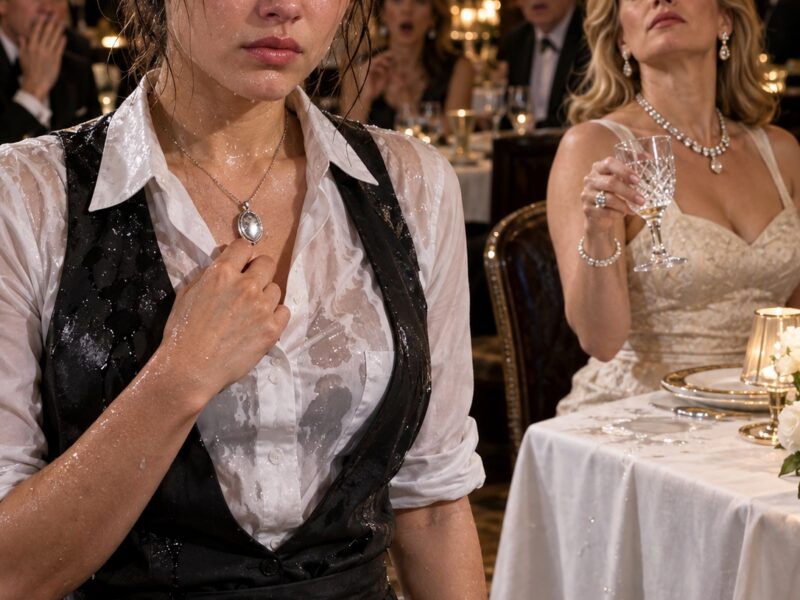
The Millionaire’s Wife Humiliated a Waitress in Front of Everyone—Then Her Husband Saw the Necklace Around Her Neck…

The second glass was not an accident.
Elena Carter knew it before Victoria Hail even lifted it.
She saw the millionaire’s wife curl three manicured fingers around the crystal stem. She saw the tiny smile appear at the corner of Victoria’s mouth. And in the strange, suspended second before the water came down, Elena understood exactly what was about to happen.
She could have stepped back.
She didn’t.
Cold water struck the top of her head and ran through her dark hair, over her cheeks, down the collar of her white uniform shirt. It soaked the fabric against her skin and splashed onto the polished hardwood beneath her shoes.
A drop hung from the silver necklace at her throat.
Then another.
Then the entire dining room went silent.
Not restaurant quiet.
Not polite quiet.
It was the kind of silence that came when fifty people witnessed something cruel and realized, almost at the same time, that they had a choice to make.
Intervene.
Look away.
Or pretend they hadn’t seen it.
Elena heard the soft piano continue playing near the bar.
She heard the air-conditioning.
She heard a fork touch a plate somewhere behind her.
But no one spoke.
Across the table, Richard Hail finally lowered his phone.
His wife set the empty glass down with exquisite care.
“Maybe now,” Victoria said, “you’ll pay attention.”
Elena stood perfectly still.
Nine hours into her second job.
Twenty-six years old.
Three hundred and eighteen dollars short on next month’s nursing prerequisite tuition.
Her younger brother’s school payment due Monday.
Her mother’s necklace cold against her wet skin.
And every eye in Belmont staring at her as if humiliation had suddenly become tonight’s entertainment.
Victoria tilted her head.
“Well?”
Elena felt her hands beginning to tremble.
She folded them behind her back so no one would see.
The restaurant manager, Martin Keller, rushed toward the table from the hostess station.
“Oh my God. Mrs. Hail, I’m terribly sorry—”
Victoria never looked at him.
Her gaze remained fixed on Elena.
“I’m waiting.”
Martin turned toward Elena, panic already hardening into the expression employees knew too well. It was the expression of a man deciding which person had less power.
“Elena,” he said quietly.
That single word told her everything.
Apologize.
Absorb it.
Protect the customer.
Protect the restaurant.
Protect everyone except yourself.
Elena swallowed.
For one dangerous moment, she saw her brother Noah sitting at their small kitchen table that morning, eating cereal while pretending not to notice the overdue electric bill beneath Elena’s elbow.
She saw the community-college tuition portal still open on her laptop.
She saw her mother lying in a hospital bed six years earlier, fingers thin but warm around Elena’s hand.
You take care of your brother.
I know, Mom.
And take care of yourself too.
That second promise had always been harder.
Elena looked at Martin.
Then at Victoria.
Then down at the water dripping from her sleeves.
When she finally spoke, her voice surprised even her.
It did not shake.
“If there was something wrong with your meal,” Elena said, “I would have replaced it.”
Victoria’s eyebrows lifted.
“If you disliked the service, I would have found you another server. If you wanted to speak with my manager, you had every right to do that.”
“Elena,” Martin warned softly.
She kept going.
“But you did not have the right to do this.”
The room seemed to contract.
Victoria gave a short laugh.
“Excuse me?”
Elena reached for the linen napkin on the empty chair beside her and wiped water from her face.
“You heard me.”
Richard’s head came up.
Victoria stared at the waitress in front of her as if a lamp had suddenly spoken.
“I heard a woman who works for tips telling me what rights I have.”
Elena’s jaw tightened.
There it was.
Not anger about the food.
Not dissatisfaction with service.
Something older.
Uglier.
The quiet belief that money had created a ladder between them, and Victoria had mistaken being higher on it for being more human.
Elena looked at the woman’s diamond earrings, then at the place where her own worn black shoes disappeared beneath the soaked hem of her pants.
And something inside her stopped being afraid.
“A uniform is clothing,” she said. “A job is work. Neither one tells you what someone is worth.”
A woman at the next table slowly lowered her wineglass.
Someone near the bar whispered, “Good for her.”
Victoria heard it.
Her face changed.
She turned slightly, taking in the audience for the first time, and Elena understood that public cruelty had been easy for Victoria only as long as the room agreed to behave like furniture.
Now the furniture was watching back.
Victoria folded her arms.
“How inspiring.”
Elena said nothing.
“Do you practice speeches in the employee bathroom?”
“Victoria,” Richard said.
It was the first word he had spoken in several minutes.
His wife glanced at him.
“What?”
Richard did not answer.
He was looking at Elena.
Really looking at her now.
Not at the soaked uniform.
Not at the waitress carrying plates.
At her face.
Elena felt it and instinctively touched the necklace resting against her throat.
A small silver oval.
Nothing expensive.
The back was scratched. The chain had been repaired twice. The clasp had once broken during a bakery shift, and Elena had spent twenty frantic minutes crawling under a refrigerator until she found it.
It had belonged to her mother.
Victoria noticed the gesture.
“Oh, please,” she said. “Don’t turn this into some sentimental performance.”
Elena’s fingers closed around the pendant.
That hurt more than the water.
She looked directly at Victoria.
“My mother gave me this.”
The words came out before she could stop them.
Martin shifted uneasily.
“Elena, maybe we should step into my office.”
Elena ignored him.
“She was a nurse,” she continued. “For almost twenty years. She worked nights because the differential helped pay our bills, and then she came home in the morning and made breakfast like she hadn’t spent twelve hours taking care of strangers.”
Victoria’s expression remained cool.
Elena opened her hand and looked at the little pendant.
“Before she died, she told me something.”
Richard stopped breathing for a second.
Elena didn’t notice.
“She told me never to let another person’s cruelty decide what kind of person I became.”
Victoria rolled her eyes, but less confidently now.
“And?”
“And I’m trying very hard to remember that right now.”
A few people laughed softly.
Not at Elena.
At the precision of the blow.
Victoria’s cheeks flushed.
Martin stepped forward.
“That’s enough. Elena, office. Now.”
The word hit her harder than she expected.
Office.
Three years at Belmont.
Hundreds of double shifts.
Every holiday she had worked because someone else had children.
Every difficult customer she had swallowed her pride for.
Every aching night she had gone home after midnight and opened anatomy textbooks while soaking her feet in a plastic basin.
And this was how it would end.
Not because she had spilled something.
Not because she had insulted a customer.
Because she had refused to pretend that being humiliated was part of her job description.
Elena nodded once.
“All right.”
She placed the wet napkin on the table.
Then she turned.
“Elena.”
Richard Hail’s voice stopped her before she had taken three steps.
Martin froze.
So did Victoria.
Richard stood.
He was fifty-one, broad-shouldered, silver beginning to show at his temples. In magazine profiles, reporters described him as intimidating, disciplined, impossible to surprise.
For most of dinner, he had been exactly that man.
Detached.
Busy.
Half-listening while scrolling through emails.
But now something in his face had changed.
“Elena, right?”
She turned.
“Yes, sir.”
His gaze dropped to the necklace again.
“Your mother was a nurse?”
Elena hesitated.
“Yes.”
“What was her name?”
Victoria exhaled dramatically.
“Richard, what are you doing?”
He didn’t look at her.
Elena answered.
“Margaret Carter.”
The name crossed the table like a match touching gasoline.
Richard went completely still.
For several seconds, no one moved.
Then he sat down.
Not gracefully.
He simply dropped into the chair behind him.
Victoria’s annoyance shifted into confusion.
“Richard?”
He was no longer looking at his wife.
He was staring at Elena.
“Margaret Carter?”
Elena’s stomach tightened.
“Yes.”
“Did she ever work at St. Mary’s?”
Elena blinked.
“Yes.”
“When?”
“Most of her career.”
Richard leaned forward.
“Fifteen years ago?”
“I would’ve been eleven, but yes. She was there.”
He looked at the necklace again.
“What department?”
“Emergency and later critical care.”
Richard’s face had gone pale.
“Elena,” he said carefully, “did your mother have a habit of wearing little silver oval pendants on her night shifts?”
The room disappeared.
For Elena, there was suddenly only this stranger and the impossible question between them.
Her fingers tightened around the necklace.
“She wore this one.”
Richard closed his eyes.
Victoria stared at him.
“Richard?”
He opened them again.
And when he spoke, his voice had lost the polished certainty of a millionaire addressing a room.
It belonged to someone remembering being afraid.
“I knew your mother.”
Elena felt the floor shift beneath her.
“What?”
“I knew her.”
“No, you didn’t.”
“I did.”
“You couldn’t have.”
Richard’s lips parted, but no words came immediately.
He seemed to be searching through fifteen years of memory and finding pieces he had not expected to matter tonight.
Finally, he looked around the room.
At the diners.
At Martin.
At his wife.
At Elena, still standing in a soaked uniform.
Then he said, “I think your mother may have saved my life.”
Victoria’s face emptied.
No one in Belmont made a sound.
And Elena, who had thought the worst part of her night was already over, realized it had only just begun.
Hours earlier, she had awakened to the sound of the smoke detector chirping.
Not because there was smoke.
Because the battery was dying.
It was 6:13 a.m.
Elena lay beneath a thin blanket in the small two-bedroom apartment she shared with Noah and stared at the ceiling.
Chirp.
She closed her eyes.
Chirp.
“Please stop.”
Chirp.
From the hallway, Noah shouted, “I changed it last month!”
“You changed the kitchen one.”
“There’s more than one?”
Elena laughed despite herself.
At seventeen, Noah Carter could explain advanced calculus to a classmate but remained genuinely surprised by ordinary household infrastructure.
She climbed out of bed, dragged a chair into the hallway and removed the battery.
Silence.
“Hero,” Noah called from the kitchen.
“Remember that when you’re rich.”
“I’m going to be an engineer. We’re never rich.”
“Then remember it when you’re moderately employed.”
He grinned when she walked into the kitchen.
He looked like their mother around the eyes.
That still caught Elena off guard sometimes.
Margaret Carter had been gone six years, and grief had changed shape so many times Elena no longer trusted it.
At first it had been violent.
Then heavy.
Then quiet.
Now it hid in ordinary moments.
A laugh.
A familiar expression.
The smell of lavender soap.
A nurse walking through a grocery store in navy scrubs.
Noah pushed a bowl toward her.
“You’re eating.”
“I’m working at the bakery in twenty minutes.”
“That wasn’t an answer.”
“Bossy.”
“You’re the one who raised me.”
The sentence was casual.
It still hurt.
Elena looked away and reached for the coffee.
Beside the mug lay an envelope from Noah’s school.
He noticed where she was looking.
“You don’t need to pay that Monday.”
“Yes, I do.”
“They said there’s a grace period.”
“Noah.”
“Elena.”
“Don’t Elena me.”
“You Elena me constantly.”
She smiled.
Then the smile faded when she opened her banking app.
Rent had cleared.
Utilities would clear Tuesday.
Belmont’s paycheck would arrive Thursday.
Her bakery wages had already been divided in her head before they entered the account.
Groceries.
Bus pass.
Noah.
Always Noah.
Her own future got whatever survived.
Noah watched her face.
“How bad?”
“It’s fine.”
“You do that thing when you lie.”
“What thing?”
“Your mouth disappears.”
“My mouth does not disappear.”
“It’s practically gone right now.”
Elena locked her phone.
“I said it’s fine.”
He leaned back.
“You know I can get a weekend job.”
“No.”
“I’m seventeen.”
“And you have school.”
“So did you.”
The words landed between them.
Elena stiffened.
Noah regretted them immediately.
“That’s not what I meant.”
“I know.”
“Lena—”
“Eat your cereal.”
He looked down.
Elena softened.
Noah didn’t remember all of it.
He had been eleven when their mother died.
Young enough for Elena to become both sister and substitute parent before either of them understood what that would cost.
She had delayed college.
Then left.
Then returned part-time.
Then quit again when rent increased.
She never called it sacrifice.
Sacrifice suggested a clean decision.
Her life had been messier than that.
One necessary choice stacked on another until the person she meant to become existed somewhere in the distance like a city seen from a highway.
Still visible.
Never reached.
Yet.
Noah looked up.
“You’re going to nursing school.”
She glanced at him.
“Where did that come from?”
“Because every time you think about quitting, you clean Mom’s necklace.”
Elena instinctively touched the pendant.
He shrugged.
“You cleaned it last night.”
She smiled faintly.
“I was bored.”
“You had flash cards spread across the table at one in the morning.”
“Very boring.”
He pointed his spoon at her.
“You’re going.”
Elena wanted to believe him.
Instead, she looked at the clock.
“I’m late.”
By 7:02 a.m., she was behind the counter at Maple & Grain Bakery, tying a brown apron around her waist.
By 1:30 p.m., she had served one hundred and twenty-three customers, burned her thumb pulling croissants from the oven and reviewed twenty-seven anatomy terms during breaks.
By 3:15, she was on a bus crossing downtown.
By 4:00, she entered Belmont through the employee entrance and changed into her black pants, white shirt and fitted charcoal vest.
She did not know that ten hours later, the necklace beneath that vest would become the reason a room full of strangers stopped seeing her as invisible.
Belmont was the kind of restaurant where wealth arrived quietly.
No flashing signs.
No velvet ropes.
No enormous gold statues in the lobby.
Just dark walnut, cream-colored walls, handmade glass fixtures and waiters trained never to appear rushed.
The cheapest steak cost seventy-four dollars.
A bottle of wine could exceed Elena’s monthly rent.
Celebrities visited when they wanted privacy.
Politicians used the private dining room.
Business deals were made in booths beneath soft light, often by people whose assistants earned more in a month than Elena did in three.
Elena had learned not to be impressed.
Money looked different up close.
Sometimes generous.
Sometimes lonely.
Sometimes absurd.
Sometimes cruel.
Most nights, it was simply hungry.
At 6:22 p.m., Martin Keller entered the service station holding a printed reservation note.
His expression made the staff straighten instinctively.
“VIP at fourteen.”
Jasmine Brooks, another server, looked over.
“Who?”
Martin lowered his voice.
“Richard Hail.”
A busboy whistled.
Jasmine muttered, “No.”
Elena looked at her.
“What?”
“Not him. Her.”
Martin gave Jasmine a warning look.
She ignored it.
“Victoria Hail.”
Elena recognized the name.
Everyone in the city did.
Richard Hail had turned a struggling logistics company into a collection of investment, real-estate and infrastructure businesses over two decades. His face appeared on finance magazines and charity-gala programs.
Victoria appeared in different publications.
Fashion.
Society.
Luxury travel.
Last year, an anonymous restaurant employee had posted a story claiming she had sent a dessert back three times because the powdered sugar pattern looked “careless.”
Elena had assumed it was exaggerated.
Jasmine leaned closer.
“She made Claire cry six months ago.”
“Why?”
“Her sparkling water wasn’t cold enough.”
“You’re joking.”
“I watched it happen.”
Martin pointed toward Elena.
“You’re taking fourteen.”
Elena looked at him.
“Why me?”
“Because you don’t react.”
“That is not a compliment.”
“Tonight it is.”
Jasmine whispered, “Wear armor.”
Martin heard her.
“Enough. Mr. Hail is an important client. They requested privacy, excellent service, no mistakes.”
Elena looked at the clock.
She had already been awake twelve hours.
“Of course.”
Martin lowered his voice.
“Elena.”
Something in his tone made her look at him.
“I mean it.”
She understood.
Do not become a problem.
She nodded.
“I know.”
At 6:47 p.m., Richard and Victoria Hail entered Belmont.
Victoria wore a cream designer dress, a camel coat and diamonds small enough to look tasteful but large enough to pay Noah’s school expenses for years.
Richard wore a dark navy suit and carried exhaustion like another tailored layer.
They were seated at table fourteen.
Elena approached.
“Good evening. Welcome to Belmont. My name is Elena, and I’ll be taking care of you tonight.”
Richard looked up briefly.
“Thank you.”
Victoria scanned the table.
“Why are there white roses?”
Elena paused.
“I’m sorry?”
“The flowers.”
“Yes, ma’am.”
“They’re white.”
Elena looked at them.
They were, unquestionably, white.
“Yes.”
“I requested ivory.”
Elena had been at work sixteen seconds.
“I can replace them.”
Victoria sighed.
“That would be a start.”
Richard opened the menu.
“Victoria.”
“What?”
“They’re flowers.”
“They have notes for a reason.”
Elena removed the vase.
“I’ll take care of it.”
As she walked away, Jasmine caught her eye from across the room.
Armor, she mouthed.
Elena almost smiled.
The next twenty minutes brought six complaints.
The room was too warm.
The piano was too loud.
The tablecloth had “an industrial texture.”
The sparkling water contained too many bubbles.
The bread was cut unevenly.
The butter was “aggressively cold.”
Elena handled each one.
“Of course.”
“I’ll fix that.”
“Let me check with the kitchen.”
“Absolutely.”
Richard spent much of the time reading something on his phone.
At first Elena resented him almost as much as his wife.
Then she began to notice small things.
The way he closed his eyes whenever Victoria summoned her.
The apology in his expression when Elena returned with a third bottle of sparkling water.
The tension in his jaw when Victoria sent the bread back.
He saw it.
He simply chose not to stop it.
Elena knew that kind of silence.
Cruelty depended on people like Victoria.
But it survived because of people like Richard.
At 7:18, their entrées arrived.
Elena placed Victoria’s sea bass before her.
“Wild-caught sea bass, roasted fennel, saffron beurre blanc.”
Victoria stared at the plate.
Elena waited.
Richard took his first bite of steak.
Victoria still stared.
Finally, she looked up.
“What is this?”
“The sea bass.”
“I know what I ordered.”
Elena kept her expression neutral.
“Is something wrong?”
“The sauce is touching the vegetables.”
Elena thought she had misheard.
“I’m sorry?”
“I asked for the sauce on the side.”
Elena remembered the order.
Victoria had not.
But Belmont had a rule.
The guest’s memory always outranked yours.
“I apologize. I’ll have it remade.”
“I don’t want it remade.”
“All right. Would you prefer something else?”
Victoria leaned back.
“What I would prefer is for the person serving me to listen.”
Elena felt heat climb her neck.
“I understand.”
“Do you?”
“Yes, ma’am.”
“Because you’ve spent the entire night correcting mistakes.”
Most of which were not mine.
Elena swallowed the sentence.
“I’m sorry the evening hasn’t met your expectations.”
Victoria’s eyes traveled downward.
Not subtly.
Elena watched her inspect the small scuff on one shoe, the inexpensive watch on her wrist, the slightly frayed cuff she had repaired herself.
Then Victoria’s gaze stopped on the necklace.
When she looked back at Elena, something had changed.
The dissatisfaction had become contempt.
“Have you ever worked somewhere like this before?”
Elena felt the insult before it was fully spoken.
“I’ve worked here almost three years.”
Victoria blinked.
“That long?”
“Yes.”
“How surprising.”
Richard put down his fork.
“Victoria.”
She looked at him.
“What?”
“Enough.”
“I’m asking a question.”
“No, you’re not.”
For a moment Elena thought he might finally intervene.
Then his phone buzzed.
He glanced down.
And whatever courage had briefly appeared disappeared into the screen.
Victoria turned back.
“How much training do they give you?”
Elena answered calmly.
“Quite a lot.”
“Then perhaps the problem isn’t the training.”
Elena’s fingers tightened around her order pad.
Behind her, a server passed carrying wine.
Music continued.
Nobody else was paying attention yet.
That would change.
“I’ll bring your replacement dish,” Elena said.
“I said I don’t want one.”
“Then may I bring you something else?”
“You may bring me someone competent.”
The words were designed to wound.
They did.
Elena turned toward Martin.
Before she could move, Victoria said, “Wait.”
Elena stopped.
Victoria pointed at the edge of the table.
“There.”
A tiny gray mark sat near the corner of the linen.
So small Elena would have needed to lean closer to see it.
“There’s a stain.”
“I can replace the cloth.”
“How did you not notice it?”
“It was here before your meal arrived.”
“So now you’re blaming someone else?”
“No.”
“You just did.”
Elena looked toward Martin.
He had noticed the tension and was already approaching.
“I’m happy to change it,” Elena said.
Victoria smiled without warmth.
“Can you afford to?”
Elena frowned.
Victoria tapped the tablecloth.
“If you damage these things, does the restaurant take it from your paycheck?”
Richard looked up sharply.
“Victoria.”
“What? I’m curious.”
Elena heard Jasmine stop moving at the nearby service station.
A couple at table sixteen turned their heads.
Elena’s face burned.
But she answered.
“No.”
Victoria looked at Elena’s shoes again.
“Good.”
One word.
That was all.
Good.
Yet Elena understood exactly what she meant.
Good, because you clearly couldn’t pay for it.
Elena’s mother used to say the cruelest sentences were often short because people didn’t need many words when they believed you were beneath them.
Elena removed the plates.
She changed the tablecloth.
She returned.
And she told herself that the evening was almost over.
She was wrong.
At 7:41, Victoria reached for her water.
Her fingers touched the glass.
Then her wrist shifted.
Water spilled across the newly replaced tablecloth.
The glass rolled onto its side.
Victoria gasped.
“Elena!”
Several heads turned.
Elena stared.
She had been standing almost two feet away.
“I didn’t—”
“You bumped me.”
“No, ma’am.”
Victoria’s expression sharpened.
“Are you calling me a liar?”
Elena heard the trap close.
Martin appeared.
“Is there a problem?”
Victoria pointed toward the wet table.
“Your waitress knocked over my water.”
Martin looked at Elena.
She shook her head.
“I didn’t touch the glass.”
Victoria laughed.
“Incredible.”
Richard rubbed his forehead.
“Victoria, I saw what happened.”
His wife turned.
“So did I.”
“You knocked it.”
Her eyes hardened.
“It slipped.”
“Then why are you blaming her?”
Something passed between them.
Not husband and wife.
Two people continuing an argument that had started long before dinner.
Victoria looked back at Elena.
“An apology would be appropriate.”
Elena almost laughed.
Not because it was funny.
Because exhaustion sometimes made absurdity feel dangerous.
She thought about Noah.
Monday.
Tuition.
Rent.
Martin’s face.
Her own dream balanced on the edge of a job she could not afford to lose.
So she apologized.
“I’m sorry the water spilled.”
Victoria’s eyes narrowed.
“That isn’t an apology.”
Elena said nothing.
“I said, that isn’t an apology.”
Martin murmured, “Elena.”
She looked at him.
He gave the smallest nod.
Do it.
Elena breathed in.
“I’m sorry, Mrs. Hail.”
Victoria leaned back.
The victory should have satisfied her.
It did not.
People like Victoria rarely wanted obedience.
They wanted proof that resistance had been removed.
And when Elena’s voice remained calm, something about it seemed to anger her even more.
“You don’t sound sorry.”
Richard pushed his chair back slightly.
“Victoria, stop.”
She ignored him.
Elena looked at the clock behind the bar.
She had seven minutes until she could ask another server to cover the table without violating the rotation.
Seven minutes.
She could survive seven minutes.
Victoria lifted another glass.
Elena saw the movement.
And the evening changed forever.
Now, standing soaked beneath Belmont’s warm golden lights, Elena listened as Richard Hail claimed he had known her mother.
The statement seemed impossible.
Her mother had known thousands of patients.
People came into her life injured, frightened, feverish, grieving.
She helped them.
They left.
Most never knew Margaret Carter had two children waiting in a small apartment across town.
Most never remembered her name.
“You knew my mom?” Elena whispered.
Richard nodded slowly.
“I was twenty-six.”
The same age Elena was now.
“I didn’t have money then,” he said. “Not really. I had a failing company, too much debt and more confidence than sense.”
Victoria stared at him.
“You’ve never told me this.”
“I’ve never told many people.”
Elena stood motionless.
Richard looked down at his hands.
“I was driving home after midnight. I’d been awake for almost two days. There was freezing rain. A truck crossed the line.”
His voice grew quieter.
“I don’t remember the impact. I remember waking up in a hospital unable to breathe properly. I remember blood. I remember thinking I was dying.”
No one at the nearby tables pretended not to listen anymore.
Richard continued.
“My family was out of state. My father’s flight couldn’t leave because of the weather. My mother was already sick.”
He looked at Elena.
“And I was terrified.”
For the first time, Elena saw beyond the expensive suit.
Fear had memory.
It could wait fifteen years inside a man and return in a restaurant because of a silver necklace.
“There was a nurse,” Richard said. “She stayed beside me during the worst night.”
Elena’s throat tightened.
“She held my hand when they put in another chest tube. I was embarrassed because I was crying.”
His mouth moved in something almost like a smile.
“She told me fear wasn’t embarrassing. She said it meant I still wanted to live.”
Elena’s eyes burned.
That sounded like her mother.
Not generally.
Exactly.
Richard leaned forward.
“Later that night, when I was convinced everything I’d built was gone, I told her there was no point.”
He looked at the pendant.
“She touched that necklace and told me, ‘A bad night is not the same thing as a bad life.’”
Elena covered her mouth.
The room blurred.
Her mother had said those words to her too.
During the first year after their father left.
During a night when thirteen-year-old Elena sat on the bathroom floor crying because she had heard her mother arguing with a collection agency.
A bad night is not the same thing as a bad life.
It had become one of Margaret Carter’s private laws.
Elena whispered, “She said that to me.”
Richard nodded.
“Then it was her.”
Victoria lowered her eyes.
Richard stood again.
Slowly this time.
“I tried to find her years later.”
Elena wiped one cheek, unsure whether the water there came from Victoria’s glass or her own tears.
“Why?”
“Because she mattered.”
Richard’s answer came immediately.
“When the company finally succeeded, people started calling me self-made.” He gave a humorless laugh. “I hated that phrase.”
He looked around Belmont.
“No one is self-made.”
His eyes returned to Elena.
“Some people build you with money. Some with introductions. Some with opportunities. And sometimes a nurse sits beside you at three in the morning when you have nothing to offer her, and she reminds you that your life isn’t over.”
Elena could no longer speak.
Richard turned toward his wife.
The temperature in the room seemed to drop.
Victoria’s face had changed.
The arrogance was gone.
In its place sat the first signs of something more painful.
Recognition.
Not of Elena.
Of herself.
Richard’s voice remained quiet.
“That woman’s daughter has spent the evening serving us.”
Victoria opened her mouth.
He continued.
“And I watched you treat her like she was less than you.”
“Richard—”
“I watched.”
The second word was aimed at himself.
Victoria heard it.
So did Elena.
Richard looked down at his untouched dinner.
“I could have stopped this half an hour ago.”
His jaw clenched.
“I didn’t.”
He turned to Elena.
“I’m sorry.”
She stared at him.
He did not reach for his wallet.
He did not perform generosity.
He simply said it again.
“I’m sorry.”
The distinction mattered.
Elena had served rich customers who believed money transformed apology into reimbursement.
Richard did not ask what the humiliation cost.
He acknowledged that it should never have happened.
Martin cleared his throat.
“Mr. Hail, I assure you Belmont takes this situation very seriously.”
Elena looked at him.
Something bitter almost escaped her.
Now.
Belmont took it seriously now.
Now that a millionaire had decided the waitress deserved dignity.
Martin caught the look.
His face tightened.
He understood.
“Elena,” he said, and for the first time that evening there was no authority in his voice. “I should have stepped in.”
She said nothing.
“I should have stopped it the moment it became personal.”
Still nothing.
“I was worried about the table.”
Elena finally spoke.
“I know.”
Three words.
More devastating than anger.
Martin lowered his eyes.
Behind them, Jasmine disappeared into the service station and returned with a clean towel.
She walked straight across the dining room.
Martin opened his mouth.
Jasmine ignored him.
She wrapped the towel around Elena’s shoulders.
“You’re freezing.”
That simple act almost broke her.
Elena had survived six years by refusing to need help.
Need was expensive.
Need was dangerous.
Need was what happened when someone left and you discovered how much of your life had been leaning on them.
But when Jasmine pulled the towel tighter around her shoulders, Elena felt something inside her loosen.
“Thank you,” she whispered.
An older waiter named Samuel appeared beside them carrying his suit jacket.
“Put this on.”
“I’m wet.”
“That’s why God invented dry cleaning.”
A small laugh moved through the room.
Elena laughed too.
It came out half-sob.
Samuel placed the jacket around her shoulders.
Then another sound began.
One clap.
Elena looked toward table nine.
An elderly woman was applauding.
Not dramatically.
Just slowly.
Her husband joined her.
Then the couple near the bar.
Then table sixteen.
Within seconds, applause moved through Belmont.
Elena wanted the floor to open.
She did not feel victorious.
She felt exposed.
Seen too suddenly.
All the things she had spent years hiding—her exhaustion, her pride, her grief, her fear—seemed to have become public.
She looked down.
“Please don’t.”
The applause softened.
Richard seemed to understand.
He raised a hand, and the room gradually settled.
“May we talk somewhere private?” he asked Elena.
Victoria looked at him.
Elena hesitated.
Martin said, “Use my office.”
Richard shook his head.
“Only if Elena wants to.”
That surprised her.
Tonight, everyone had been deciding things for her.
Serve the table.
Apologize.
Go to the office.
Stand still.
Take it.
Now someone was asking.
Elena nodded.
“Five minutes.”
She turned toward Victoria.
For the first time since the water hit her, they looked at each other without performance.
Victoria’s lips parted.
“Elena.”
Elena waited.
But Victoria could not say what came next.
Not yet.
Inside Martin’s office, the sounds of the restaurant dulled.
Elena sat across from Richard, still wearing Samuel’s jacket over her wet clothes.
Martin had left them alone.
The room smelled faintly of coffee and printer toner.
For a moment neither spoke.
Then Richard said, “How did your mother die?”
Elena looked at the desk.
“Cancer.”
“I’m sorry.”
“She fought it for three years.”
“Was she still nursing?”
“Until she couldn’t.”
Richard nodded.
“I wrote to St. Mary’s once. They told me she no longer worked there, but they wouldn’t share personal information.”
“She left during treatment.”
“I hired someone to find her.”
Elena looked up sharply.
He raised a hand.
“Years ago. Not recently. They found several Margaret Carters. I never knew which one was her.”
“Why were you looking that hard?”
Richard stared at the floor for a moment.
“When my mother died, I created a foundation in her name.”
Elena waited.
“She was a teacher. She believed education changed the shape of a family.”
His voice softened.
“And Margaret—your mother—made me think about all the people who carry others through difficult parts of their lives and then disappear from the story.”
Elena understood that feeling too well.
Nurses.
Waitresses.
Teachers.
Drivers.
Cleaners.
People whose names were rarely included when successful people explained how they had survived.
Richard looked at her.
“I wanted your mother to know I remembered.”
“She would have liked that.”
Elena’s eyes filled again.
“She never thought anyone remembered.”
Richard smiled sadly.
“She was wrong.”
Silence settled between them.
Then he asked, “Martin mentioned you’re studying.”
Elena tensed.
“A little.”
“For what?”
“Nursing prerequisites.”
Richard’s eyebrows rose.
“You want to be a nurse?”
“I’ve wanted it since I was sixteen.”
“What happened?”
Elena almost smiled.
“Life.”
He nodded as if that single word explained enough.
She continued anyway.
“My father left when I was fifteen. Mom got sick later. Noah was eleven when she died. I was twenty.”
“And you raised him.”
“He’s my brother.”
“That wasn’t my question.”
Elena looked away.
“Yes.”
“How old is he now?”
“Seventeen.”
“College?”
“Next year, hopefully.”
“And you work here?”
“And at a bakery.”
Richard stared at her.
“Two jobs?”
“I’m not unique.”
“No.”
His response surprised her.
“You’re not.”
Elena looked back.
“There are millions of people doing difficult things quietly,” he said. “I’ve spent enough years around wealthy people to know we have a bad habit of calling someone extraordinary only after we discover their struggle.”
He leaned back.
“You deserved respect before I knew anything about your life.”
That was the first thing he had said all night that made Elena trust him.
Not because it was sentimental.
Because it was true.
She nodded.
“Thank you.”
Richard hesitated.
“Our foundation funds scholarships for students entering health professions.”
Elena’s body stiffened immediately.
“No.”
He looked surprised.
“No?”
“I know where this is going.”
“I don’t think you do.”
“You feel guilty.”
“I do.”
“My mother helped you.”
“Yes.”
“And your wife poured water on me.”
His face tightened.
“Yes.”
“So now you want to fix it.”
“No.”
Elena studied him.
Richard folded his hands.
“I cannot fix tonight.”
She said nothing.
“And paying your tuition because my wife humiliated you would be another kind of insult.”
Elena’s shoulders relaxed slightly.
“Our foundation accepts applicants every year,” he continued. “You can apply.”
“That still sounds like special treatment.”
“You will submit grades, references, financial information, an essay and an interview like everyone else.”
“And if I’m not qualified?”
“You don’t get it.”
Elena blinked.
Richard smiled.
“But if you are qualified, being poor won’t be the reason you lose your chance.”
The room grew very quiet.
Elena imagined nursing school the way she always did.
Not in inspirational images.
In fluorescent classrooms.
Clinical rotations.
Heavy textbooks.
Shoes that didn’t slip.
Her name on an ID badge.
Elena Carter, RN.
The dream hurt because it still felt too specific to abandon.
“What’s the foundation called?”
“The Caroline Hail Education Trust.”
Elena knew it.
Everyone did.
Her hand tightened around the towel.
“I’ve seen the application.”
Richard raised his eyebrows.
“You applied?”
“No.”
“Why?”
She laughed softly.
“The application fee.”
His smile disappeared.
“How much?”
“Forty dollars.”
Richard sat back as though she had said forty thousand.
Elena shrugged.
“Forty dollars is groceries for a few days.”
Neither spoke.
Something about that answer seemed to affect him more than the soaked uniform had.
Not because forty dollars mattered to Richard.
Because he had once been poor enough to remember when it would have.
“I’ll speak to the board about application-fee waivers,” he said.
Elena immediately shook her head.
“Not for me.”
“For everyone.”
She stopped.
Richard nodded.
“You just identified a problem in our scholarship program.”
A strange laugh escaped her.
“I’m not sure getting water poured on me qualifies me as a consultant.”
“It’s been an educational evening.”
For the first time, both smiled.
Then someone knocked.
Martin opened the door.
“Elena?”
She turned.
“Victoria would like to speak with you.”
Elena’s smile disappeared.
Richard stood.
“She doesn’t have to.”
Elena looked at him.
Again, the choice.
She appreciated it.
But some moments could not be escaped without becoming heavier later.
“I’ll talk to her.”
Victoria stood near the private dining corridor.
Alone.
No phone.
No coat.
No diamond handbag.
For the first time that evening, she looked smaller than the persona she carried.
Elena stopped several feet away.
Victoria looked at the jacket around Elena’s shoulders.
Then at the damp strands of hair against her neck.
Her gaze moved to the necklace.
“I’m sorry.”
The words sounded foreign in her mouth.
Elena waited.
Victoria swallowed.
“What I did was disgusting.”
Elena had expected something softer.
A qualification.
A misunderstanding.
A sentence beginning with if.
There was none.
Victoria continued.
“I was angry before I came here.”
Elena’s expression changed.
Victoria immediately shook her head.
“That isn’t an excuse.”
“No.”
“I know.”
Silence.
“My husband and I have been fighting for months,” Victoria said. “Tonight I wanted everything perfect because…” She stopped. “It doesn’t matter.”
“No,” Elena said quietly. “It doesn’t.”
Victoria flinched.
Elena almost felt cruel.
Almost.
Then she remembered the water.
Forgiveness did not require pretending.
Victoria looked toward the dining room.
“I think I’ve spent a long time becoming someone I don’t like very much.”
Elena had no answer for that.
“I saw your shoes,” Victoria said.
Elena stiffened.
“And I judged you.”
“Yes.”
“I saw your uniform.”
“Yes.”
“And I thought I knew what kind of person you were.”
Elena touched the necklace.
“You didn’t.”
“No.”
Victoria’s eyes reddened.
“I’m sorry.”
Elena believed her.
That was inconvenient.
Anger was easier when apologies were fake.
“What happens now?” Victoria asked.
Elena stared at her.
“What do you mean?”
“Do you forgive me?”
There it was.
The hidden request inside many apologies.
Please remove my discomfort.
Please tell me I’m not what I just proved I could be.
Elena chose her words carefully.
“I don’t know you well enough to decide who you are.”
Victoria looked startled.
“I only know what you did.”
“Yes.”
“And I don’t think forgiveness is pretending it didn’t happen.”
Victoria nodded slowly.
“But I also don’t want to carry you around in my head for the rest of my life.”
A tear escaped Victoria’s eye.
She brushed it away.
“So I’m going to try.”
“To forgive me?”
“To leave tonight here.”
Victoria breathed out.
It was not absolution.
It was better.
Elena turned to go.
“Elena?”
She looked back.
Victoria’s voice was barely above a whisper.
“Your mother sounds like she was extraordinary.”
Elena touched the pendant.
“She was.”
Then she walked away.
Belmont did not fire Elena.
Martin offered her the rest of the night off with pay.
She refused at first.
Then Samuel looked at her soaked pants and said, “If you come near my section dripping like a sad Labrador, I’m quitting.”
She laughed and went home.
On the bus, she sat beside the window wearing Samuel’s jacket.
Her phone buzzed thirteen times.
Jasmine.
Are you okay?
Samuel says Richard Hail knew your MOM???
Martin is walking around like he saw God.
Victoria left a $2,000 tip.
Elena stared at the last message.
Then typed:
Split it with the whole shift.
Jasmine replied immediately.
I KNEW YOU WERE GOING TO SAY THAT.
Elena smiled.
A minute later:
Also Samuel says if you don’t wash his jacket correctly he’ll sue.
Elena laughed aloud.
The woman across from her smiled.
For the first time that evening, Elena noticed how exhausted she was.
Her head leaned against the glass.
City lights slid past.
When she reached the apartment, Noah was at the table doing homework.
He looked up.
“Why are you wearing a man’s jacket?”
Then he saw her face.
He stood.
“What happened?”
Elena placed her bag on the chair.
“How much time do you have?”
He closed the laptop.
“All of it.”
She told him.
Not perfectly.
She left out the worst sentence Victoria had said.
She softened the humiliation.
Older siblings who become parents often lie in small protective ways.
But when she reached the part about Richard recognizing Margaret’s name, Noah stopped her.
“Wait.”
“I know.”
“No. Wait.”
“I had the same reaction.”
“He knew Mom?”
“Apparently.”
“How?”
She told him.
Noah stared at the necklace.
For a long time, he said nothing.
Then his eyes filled.
Elena reached across the table.
He wiped them angrily.
“I’m fine.”
“Your mouth disappears when you lie.”
He laughed through the tears.
“Shut up.”
They sat there past midnight talking about Margaret.
Not the dying version.
Not the exhausted version.
Their mother.
The woman who danced badly while making pancakes.
Who kept emergency chocolate hidden behind frozen vegetables.
Who swore in traffic and denied it later.
Who worked night shifts and remembered every school project.
Who had apparently once sat beside a frightened twenty-six-year-old stranger named Richard Hail and altered the course of his life without knowing it.
At 1:14 a.m., Noah said, “You’re applying.”
Elena looked at him.
“For the scholarship.”
She sighed.
“Noah.”
“No.”
He pointed at her.
“You said he told you it’s competitive.”
“Yes.”
“So compete.”
“It’s complicated.”
“You work sixteen-hour days.”
“I don’t work sixteen hours every day.”
“Congratulations.”
“Noah.”
“You’ve spent six years making sure I didn’t lose anything because Mom died.”
His voice broke slightly.
Elena went still.
“I’m not letting you lose this.”
She looked down.
“That’s not your responsibility.”
“No. It’s yours.”
He pushed her laptop across the table.
“Apply.”
Elena stared at the screen.
Then at her brother.
Then at the silver pendant in her hand.
At 1:31 a.m., Elena Carter opened the Caroline Hail Education Trust application.
Forty-seven days later, she nearly deleted the acceptance email because she assumed it was promotional mail.
She opened it while standing behind the bakery counter at 6:54 in the morning.
Dear Ms. Carter,
We are pleased to invite you to the final interview stage…
Her knees weakened.
“Everything okay?” her manager asked.
Elena reread the line.
Then again.
“Yes.”
She covered her mouth.
“Yes.”
Richard kept his promise.
He did not join the selection committee.
He did not call.
He did not send gifts.
The only evidence that their conversation had changed anything appeared quietly on the foundation website two weeks later:
APPLICATION FEES WAIVED FOR APPLICANTS DEMONSTRATING FINANCIAL NEED.
Elena stared at that sentence for a long time.
One person.
One problem.
One small correction.
Maybe that was how meaningful change usually began.
Not with applause.
With someone noticing a door was unnecessarily expensive to open.
Three months later, Elena sat before a panel of five strangers.
None of them mentioned Richard.
None mentioned Belmont.
They asked about grades.
Resilience.
Patient care.
Ethics.
Her mother.
One interviewer said, “Your application states that you delayed your education for family reasons. Why return now?”
Elena thought about Noah.
About Margaret.
About the water running down her face in a silent restaurant.
“Because responsibility can become an excuse if you let it.”
The interviewer leaned forward.
“Explain.”
“I had good reasons for delaying school.”
She folded her hands.
“But eventually, good reasons can still keep you from living.”
No one wrote for a moment.
Elena continued.
“My brother needs me. But he doesn’t need me to disappear.”
She left the interview unsure whether she had ruined everything.
Two weeks later, the email arrived.
Full tuition.
Books.
Clinical expenses.
A living stipend significant enough for Elena to leave one job.
She read it in silence.
Then screamed so loudly Noah dropped a plate.
“What?”
She turned the laptop toward him.
He read.
His mouth opened.
“Are you serious?”
Elena started laughing.
Then crying.
Then both.
Noah crossed the room and lifted her completely off the floor.
“You did it!”
“Put me down!”
“You did it!”
“We’re going to break something!”
“We’re already poor!”
“That doesn’t mean destroy the furniture!”
They laughed until neither could breathe.
Then Noah put her down.
His face changed.
“You’re going to be a nurse.”
Elena looked at the screen again.
For years, the sentence had existed in future tense.
Someday.
Maybe.
If.
Now it had a date.
Belmont threw Elena a small farewell dinner eight months later.
Martin paid.
Samuel complained about the wine.
Jasmine cried before dessert and denied it while crying.
On Elena’s final shift, she stood in the employee hallway holding the same order pad she had carried hundreds of nights.
Three years of her life lived in those rooms.
Birthdays missed.
Feet aching.
Tips counted under fluorescent light.
Customers whose names she forgot.
Coworkers whose lives she would always remember.
Martin approached.
“I owe you something.”
“You already bought dinner.”
“Not that.”
He looked uncomfortable.
Elena waited.
“I changed the staff policy.”
“What policy?”
“Customer abuse.”
She raised an eyebrow.
“There wasn’t one.”
“Exactly.”
He looked ashamed.
“There is now.”
Elena leaned against the wall.
“What does it say?”
“That management intervenes before an employee is required to apologize for harassment, threats, deliberate humiliation or discriminatory behavior.”
“Sounds obvious.”
“It should have been.”
She nodded.
Martin looked toward the dining room.
“That night changed how I manage.”
Elena smiled faintly.
“Good.”
He looked back at her.
“I wish it hadn’t taken that.”
“So do I.”
There was no need to make the moment softer than it was.
Some lessons arrived too late to excuse what came before.
But late was still better than never.
Richard attended Elena’s nursing-school pinning ceremony two years later.
He sat in the back.
No announcement.
No photographers.
No donation check.
Just Richard.
Elena saw him when she walked across the stage.
Afterward, she found him near the exit holding flowers.
White roses.
She laughed.
“You remembered.”
“Ivory wasn’t available.”
She laughed harder.
He handed them over.
“I visited your mother’s memorial.”
Elena’s smile faded.
“When?”
“Last month.”
She looked at him.
“I left flowers.”
“Thank you.”
“I talked to her.”
Elena swallowed.
Richard seemed embarrassed.
“I realize that sounds strange.”
“No.”
She touched the pendant beneath her graduation gown.
“It doesn’t.”
They stood in silence.
Then Richard said, “She would be proud.”
Elena smiled sadly.
“You didn’t know her that well.”
“No.”
He looked toward Noah, who was taking approximately six hundred photographs.
“But I know what she left behind.”
Elena followed his gaze.
Noah had been accepted into engineering school.
He had scholarships of his own.
For the first time in their lives, neither sibling was building a future entirely out of sacrifice.
Elena looked back at Richard.
“Thank you for the opportunity.”
“You earned it.”
“You opened a door.”
He considered that.
“Fair.”
Then he smiled.
“But you walked through.”
Her first year as a nurse almost broke her.
Nothing in school had prepared Elena for the emotional mathematics of a hospital.
You could save someone and still go home sad.
You could lose someone despite doing everything correctly.
You could spend twelve hours caring for strangers and then sit in your car because you lacked enough strength to drive.
You could hate a patient for screaming at you and then discover they were terrified.
You could forgive.
You could fail.
You could begin again the next shift.
One night, Elena entered room 417 and found a wealthy real-estate developer furious because his private room was not available.
“I donate to this hospital,” he snapped.
Elena checked his IV.
“That’s generous.”
“Do you know who I am?”
She almost laughed.
She had heard the question before.
In restaurants.
Hospitals.
Offices.
It always seemed to mean the same thing.
Do you know why the rules of ordinary humanity should not apply to me?
Elena smiled politely.
“Yes, Mr. Dalton.”
He blinked.
She adjusted his blanket.
“And right now, you’re a patient with a blood-pressure reading I don’t like, so we’re going to focus on that.”
He stared at her.
Then, unexpectedly, laughed.
“You’re not intimidated.”
Elena thought about a glass of water.
“No.”
“Why not?”
“Practice.”
Years passed.
Noah graduated.
Elena paid off debts.
She moved into a small apartment with windows that caught the morning sun.
She kept Margaret’s necklace.
She kept Samuel’s old text messages.
She kept the first nursing badge she ever wore.
She did not keep the wet uniform.
That surprised her.
For a while she had thought she might preserve it like evidence.
Proof of what happened.
Eventually she understood she did not need it.
Her memory was enough.
Five years after the night at Belmont, Elena received an invitation.
Belmont’s anniversary dinner.
Jasmine had become assistant general manager.
Martin planned to retire.
Samuel was somehow still complaining about everything.
At first Elena declined.
Then she changed her mind.
She arrived just after seven.
Not in a gown.
Not dramatically transformed.
She came directly from the hospital wearing navy scrubs beneath a long coat.
The hostess recognized her name.
“Elena Carter?”
“Yes.”
Her eyes widened.
“Oh.”
Elena laughed.
“That sounds dangerous.”
“No, I’m sorry. Jasmine said—”
“Elena!”
Jasmine appeared from behind the bar and crossed the room at nearly a run.
She hugged Elena.
“You came.”
“You threatened me.”
“I said I’d call Noah.”
“Exactly.”
Samuel appeared.
Older.
Grayer.
Still unimpressed by existence.
He looked Elena up and down.
“Those are ugly shoes.”
“They’re hospital shoes.”
“They’re ugly at the hospital too.”
Elena hugged him.
“You missed me.”
“Don’t start rumors.”
Martin emerged next.
And for several minutes, Elena forgot everything difficult that had ever happened in the room.
She saw tables she had served.
Corners she had cleaned.
The narrow path to the kitchen she used to walk six hundred times a night.
Places could hold more than one version of you.
Sometimes returning showed you just how far apart those versions had become.
Then Jasmine’s expression changed.
She looked toward the back of the room.
Elena followed her gaze.
Richard and Victoria Hail sat at table fourteen.
The same table.
Elena stopped.
Victoria saw her first.
For one heartbeat, five years disappeared.
Water.
Silence.
Humiliation.
Then Victoria stood.
She looked different.
Not physically, exactly.
Softer around the face.
Less polished in the way people become when they are no longer trying to win every room.
Richard rose beside her.
“Elena.”
She walked over.
“Hello.”
Richard hugged her.
“How are you?”
“Tired.”
“So you’re officially a nurse.”
“Apparently.”
He smiled.
Victoria waited.
Elena turned toward her.
“Hi.”
Victoria smiled carefully.
“Hi.”
Several years earlier, Elena had imagined this moment.
In some versions, Victoria apologized again.
In others, Elena delivered a perfect sentence that made everyone nearby turn and applaud.
In a few, she ignored her entirely.
Reality was quieter.
Victoria gestured toward the empty chair.
“Would you sit for a minute?”
Elena did.
Richard looked between them.
“I’m going to get a drink.”
Victoria frowned.
“You have one.”
“I suddenly need another.”
Elena almost laughed.
When he left, Victoria folded her hands.
“I heard you finished nursing school.”
“Yes.”
“And your brother graduated.”
“Last spring.”
“That’s wonderful.”
“Thank you.”
A pause.
Victoria looked down.
“I think about that night sometimes.”
Elena studied her.
“So do I.”
“I’m still ashamed.”
Elena had not expected the directness.
Victoria continued.
“For a long time, I wanted to convince myself I was having a bad evening.”
Elena remained silent.
“I was.”
Victoria smiled sadly.
“But lots of people have bad evenings without pouring water on strangers.”
Elena’s mouth curved slightly.
“That’s true.”
“I went to therapy after that.”
Elena blinked.
Victoria noticed.
“Not because Richard ordered me to.”
“I didn’t say anything.”
“You thought it.”
Elena laughed.
“Maybe.”
Victoria smiled.
Then her face grew serious again.
“I had spent years measuring myself through status. Rooms. Clothes. Invitations. Who called me. Who didn’t. Who seemed beneath me.”
Her fingers moved over the edge of the table.
“It was exhausting.”
Elena listened.
“And somehow, instead of recognizing that I was miserable, I became cruel.”
“I’m sorry.”
Victoria looked surprised.
Elena clarified.
“I’m sorry you were miserable. I’m not sorry you had to face what you did.”
Victoria nodded.
“That seems fair.”
The piano began playing something Elena remembered from years before.
For a moment neither woman spoke.
Then Victoria said, “You told me that forgiveness didn’t erase what happened.”
“I remember.”
“You were right.”
Elena looked across the room.
A young waitress was laughing with a busboy near the kitchen.
“She didn’t deserve what I did,” Victoria said.
“No.”
“And neither did you.”
“No.”
Victoria’s eyes filled.
“I wish I could change it.”
Elena looked back at her.
“I don’t.”
Victoria stared.
Elena surprised herself too.
“I wish it hadn’t happened,” she continued. “But I don’t want to go backward and rewrite everything anymore.”
“Why?”
“Because I spent years thinking that night changed my life.”
“Didn’t it?”
Elena considered the question.
“It changed some circumstances.”
She touched the necklace.
“It introduced me to Richard. It pushed me toward the scholarship.”
She smiled faintly.
“But it didn’t create my worth.”
Victoria’s eyes lowered.
“I think that took me a long time to understand.”
“It took me a long time too.”
Richard returned with a drink he clearly had not needed.
“Everything okay?”
Victoria looked at Elena.
“Yes.”
Elena nodded.
“Yes.”
Later that evening, Elena stood alone near the service corridor.
Belmont had changed.
New lighting.
Different menus.
Younger staff.
But the floor beneath her feet was the same wood.
She remembered standing there soaked while strangers stared.
At twenty-six, she had thought strength meant not crying.
Not breaking.
Not needing help.
Not losing the job.
Not letting anyone see fear.
She knew better now.
Strength could be a waiter putting a jacket around your shoulders.
A brother pushing a laptop toward you at one in the morning.
A manager admitting he failed.
A wealthy man remembering a nurse who had once held his hand.
A woman facing the ugliest version of herself without demanding that someone else make it comfortable.
Strength could be forgiveness.
And sometimes strength could simply be refusing to forgive quickly.
Elena heard footsteps.
A young waitress approached.
“Ms. Carter?”
Elena smiled.
“Please don’t call me that. I’m already having a complicated relationship with turning thirty-one.”
The girl laughed.
“Jasmine told me you used to work here.”
“I did.”
“She told us what happened.”
Elena sighed.
“Of course she did.”
The waitress looked embarrassed.
“Sorry.”
“It’s okay.”
“She said you became a nurse.”
“Yes.”
The girl hesitated.
“I’m in school too.”
“For nursing?”
“Respiratory therapy.”
Elena smiled.
“That’s great.”
“I almost quit last month.”
The words came quietly.
Elena studied her.
“Why?”
“My dad lost his job. I picked up extra shifts.”
Elena knew that road.
The danger of necessity was how reasonable every delay sounded.
The girl glanced toward the dining room.
“I keep telling myself I’ll go back next semester.”
Elena touched the silver necklace.
Her mother’s voice came from fifteen years away.
A bad night is not the same thing as a bad life.
Elena smiled.
“Can I tell you something?”
The girl nodded.
“Don’t confuse being delayed with being defeated.”
Her eyes filled.
Elena continued.
“And don’t make the mistake I made for years.”
“What mistake?”
“Thinking everyone you love needs you to sacrifice every version of yourself.”
The girl looked down.
“You don’t know my family.”
“No.”
Elena smiled gently.
“But I know what it’s like to keep postponing your life because postponing feels responsible.”
The girl wiped one eye.
“What did you do?”
“I asked for help.”
She laughed softly.
“Eventually.”
Jasmine shouted from across the restaurant, “Elena! Stop mentoring my staff and come eat cake!”
Elena called back, “Your staff approached me!”
“Employee theft!”
The waitress laughed.
Elena squeezed her shoulder.
“Go finish your shift.”
“Thank you.”
As the girl walked away, Elena remained where she was.
Five years earlier, she had left Belmont convinced the most important thing that happened that night was Richard recognizing her mother’s name.
For years, that was how everyone told the story.
The millionaire’s wife humiliated a waitress.
Then the millionaire discovered who her mother was.
Then everything changed.
It was neat.
Dramatic.
Easy to remember.
But it was not quite true.
Richard’s memory mattered.
The scholarship mattered.
The apology mattered.
Yet the most important moment had happened before any of those things.
It happened while Elena stood dripping beneath expensive lights, believing she might lose the job that kept her family afloat.
It happened before anyone knew her mother had been a nurse.
Before anyone knew she worked two jobs.
Before anyone knew she was raising her brother.
Before anyone discovered a reason to admire her.
Elena had looked at a woman with more money and more power and said:
You do not have the right to humiliate me.
That was the moment.
Because dignity that depends on an inspiring backstory is not dignity.
A waitress should not need to be secretly extraordinary before people decide she deserves respect.
A janitor should not need to be a war hero.
A cashier should not need to be raising three children.
A homeless man should not need to have once been a professor.
A frightened patient should not need to be important.
Human beings should not have to reveal their suffering before others agree to treat them as human.
Elena had spent years understanding that.
Richard eventually joined her near the window.
“Thinking?”
“Dangerous habit.”
He smiled.
They looked out at the city.
Traffic moved beneath them.
People hurried along sidewalks, carrying entire lives strangers would never know.
Richard nodded toward her necklace.
“You still wear it.”
“Every day.”
“Do you ever worry about losing it?”
“All the time.”
“Then why wear it?”
Elena thought about Margaret.
Because grief was not meant to be locked away for safekeeping.
Because love could be fragile and still belong in ordinary life.
“Because it wasn’t made for a drawer.”
Richard nodded.
After a moment he said, “I’ve wondered something for years.”
“What?”
“If your mother would have remembered me.”
Elena smiled.
“Probably.”
“You think so?”
“She remembered everybody.”
“That sounds impossible.”
“She was annoying that way.”
He laughed.
Elena looked toward the restaurant.
“I think she would’ve remembered the scared twenty-six-year-old who kept telling her he had a company to save.”
Richard shook his head.
“I was insufferable.”
“You were twenty-six.”
“So were you.”
“Yes.”
“And you were less insufferable.”
“Debatable.”
They smiled.
Then Richard became serious.
“Do you know the strangest thing?”
“What?”
“I spent years wanting to thank Margaret because I thought I owed her for changing my life.”
Elena waited.
“But maybe gratitude isn’t supposed to stop at the person who helped you.”
She looked at him.
“Maybe you pass it on.”
Elena touched the pendant.
“Mom would agree.”
Richard nodded.
Across the room, Victoria was speaking with the young waitress Elena had just encouraged.
The waitress dropped a spoon.
Victoria immediately bent down and picked it up herself.
A tiny act.
Nobody applauded.
Nobody noticed except Elena.
That was probably for the best.
Real change rarely looked cinematic.
It was not always a speech.
Sometimes it was a woman who once poured water on a server kneeling beneath a restaurant table to retrieve a spoon and saying thank you when a fresh napkin arrived.
Small.
Ordinary.
Easy to miss.
Maybe that was how people became better.
Not by becoming entirely different overnight.
By making a different choice than the one they once made.
Again.
And again.
Until the new choice became character.
Elena looked down at her mother’s necklace.
For a second, she could almost hear Margaret’s voice.
Never let another person’s cruelty decide what kind of person you become.
Elena had once thought the lesson meant remaining kind to people who hurt you.
Now she understood something deeper.
It meant cruelty did not get to write your future.
Humiliation did not get to become your identity.
Poverty did not get to decide your dream.
Abandonment did not get to decide whether you trusted.
Grief did not get to decide whether you loved again.
And forgiveness did not mean surrendering the truth.
When Elena finally left Belmont that night, rain had begun falling.
She stepped beneath the awning.
Years ago, water running down her face in that building had felt like shame.
Now she lifted her face toward the rain.
Cold drops touched her cheeks.
Her hair.
Her necklace.
She smiled.
No audience.
No applause.
No millionaire.
No one waiting to discover that she had an extraordinary mother before deciding she mattered.
Just Elena Carter standing beneath the city lights after a long hospital shift, tired and alive and finally living the future she had postponed for so long.
Her phone buzzed.
A message from Noah.
YOU STILL AT BELMONT?
She typed back.
Leaving now.
His reply came seconds later.
DID YOU STEAL ANY SILVERWARE FOR REVENGE?
Elena laughed.
No.
BORING.
She started walking toward the train station.
Another message appeared.
Mom would be proud of you.
Elena stopped beneath a streetlight.
Cars hissed across wet pavement.
For years, those words had made her cry because they reminded her of everything Margaret had missed.
Graduations.
Birthdays.
Noah becoming a man.
Elena becoming a nurse.
Tonight, they felt different.
Not like grief.
Like company.
Elena touched the necklace.
“I hope so,” she whispered.
Then she continued down the street.
Behind her, Belmont’s lights glowed against the rain.
Inside that restaurant remained a table where a woman had once tried to make her feel small.
A table where a man had remembered a nurse.
A floor where coworkers had stood beside her.
A doorway she had once believed she might leave unemployed and humiliated.
It was only a restaurant now.
That was another victory.
Some places lose their power when you survive what happened inside them.
At the corner, Elena waited for the light to change.
A hospital ambulance passed, siren rising through the rain.
She watched it disappear.
Somewhere inside was a stranger having the worst night of their life.
Maybe they were wealthy.
Maybe they were poor.
Maybe someone was waiting for them.
Maybe nobody was.
Maybe they were terrified.
Elena thought about Margaret sitting beside Richard all those years ago.
She thought about how one ordinary act of compassion had traveled through time.
A nurse comforted a frightened patient.
The patient remembered.
Years later, he recognized the nurse’s daughter.
A scholarship door opened.
A waitress became a nurse.
And tomorrow, perhaps, that nurse would stand beside another terrified stranger and say something they would remember fifteen years from now.
Elena smiled as the light changed.
People liked to believe lives changed in giant moments.
Accidents.
Deaths.
Marriages.
Betrayals.
Big checks.
Public confrontations.
But Elena knew better.
Lives also changed in tiny exchanges no one thought to record.
A hand held in a hospital.
A jacket placed around wet shoulders.
A fee removed from an application.
A brother saying, Apply.
A manager deciding next time he would speak sooner.
A woman picking up a dropped spoon.
Kindness moved quietly.
So did cruelty.
Both left fingerprints on people.
The only question was which one you chose to pass forward.
Elena crossed the street.
Rain fell harder.
She did not run.
For once, she had nowhere else she needed to be.
And beneath her coat, against the steady rhythm of her heart, Margaret Carter’s little silver necklace moved with every step.
Not as proof that Elena belonged to someone extraordinary.
Not as proof that she herself was extraordinary.
But as a reminder of something far simpler.
Her worth had never begun the moment Richard Hail recognized her mother.
It had never begun when the scholarship committee chose her.
It had never begun when diners applauded.
And it certainly had never depended on whether Victoria Hail respected her.
It had been there when she woke before sunrise to change a smoke-detector battery.
It had been there behind a bakery counter.
On crowded buses.
In overdue bills.
In late-night textbooks.
In a soaked waitress uniform.
In every unseen hour when no one was clapping.
That was what Elena finally understood.
The world often waits for an impressive reason before treating an ordinary person as valuable.
But ordinary people were never ordinary to the lives depending on them.
Her mother had known that.
Now Elena did too.
And as she disappeared into the rainy city, heading toward a hospital where another long shift waited for her in the morning, she carried forward the only inheritance Margaret Carter had ever truly meant to leave behind.
Not the necklace.
Not even the dream of becoming a nurse.
A way of seeing people.
Not by the uniform they wore.
Not by the account they held.
Not by the table they served.
Not by the name printed on the building.
But by the simple truth that every person standing in front of you was carrying a story you could not see.
And sometimes, the person you dismiss tonight may become the person holding your hand on the worst night of your life.
Elena knew.
Her mother had already proved it.









