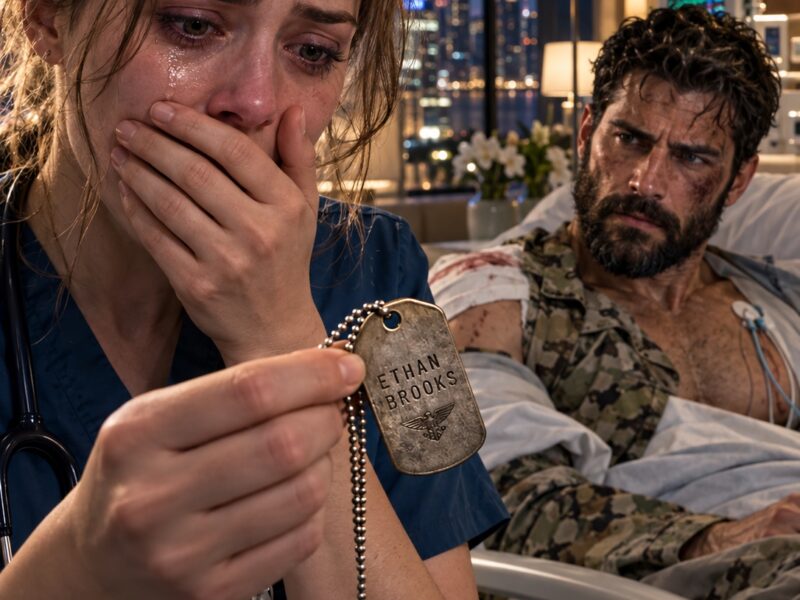
The Navy SEAL Everyone Feared Saw My Daughter’s Dog Tag—And Whispered My Dead Husband’s Name
The first time Jake Navaro died, I was the one kneeling on his chest trying to bring him back.
The strange part was that four years earlier, my husband had died bringing Jake home.
I just didn’t know it yet.
At 2:53 in the morning, Jake was lying on the floor of Room 9 at Milbrook County Hospital, his lips turning blue while a pair of crutches spun slowly to a stop beside him.
“Jake.”
Nothing.
I dropped to my knees.
“Jake, look at me.”
His eyes found mine for perhaps half a second.
Then they rolled back.
His body went still.
I pressed two fingers against his neck.
No pulse.
For one impossible moment, the hospital disappeared.
The fluorescent lights became the hard white lamps of a field hospital on the other side of the world.
The smell of antiseptic became dust and jet fuel.
The man beneath my hands became another man.
Ethan.
My husband.
My best friend.
The father of the little girl sleeping two rooms down the hall.
I heard my own voice from four years ago.
Look at me, Ethan.
I slammed my palm against the emergency button.
“CODE BLUE! ROOM NINE!”
Then I locked my hands over Jake Navaro’s chest and began compressions.
Hard.
Fast.
Again.
Again.
Again.
“Come on.”
People were running toward me now.
Shoes squeaked against linoleum.
Someone shouted for the crash cart.
Another voice called for respiratory.
But I barely heard any of them.
Because I had done this before.
Same hands.
Same words.
Different man.
And somewhere in the back of my mind was the truth Jake had finally confessed only hours earlier.
My husband had died saving him.
And Jake had spent nearly four years trying to repay a debt nobody had ever asked him to carry.
I pushed harder.
“Look at me, Jake.”
His body rocked beneath my hands.
“Not this time.”
I didn’t know whether I was talking to him.
Or Ethan.
Or myself.
Maybe all three.
But to understand why I refused to let the man in Room 9 die, you have to understand why nobody wanted to walk into his room in the first place.
And why my three-year-old daughter did.
The trouble started before sunset.
My phone rang at 5:45 that evening while I was standing barefoot in my kitchen, trying to convince Nora that macaroni and cheese did not count as a vegetable.
I saw Mrs. Patterson’s name and knew.
Some kinds of bad news become predictable when you’ve been alone long enough.
“Ava, honey, I’m so sorry.”
I closed my eyes.
“You’re sick.”
“Flu. Fever too. I can barely stand.”
“It’s okay.”
It wasn’t.
But I had become very good at saying that.
After my mother died the previous spring, there was nobody left to call.
No grandmother ten minutes away.
No sister.
No ex-husband taking alternate weekends.
No daycare in Milbrook that stayed open through a night shift.
Just me and my three-year-old daughter.
So for the third time that month, I packed Nora’s overnight bag.
Pink pajamas covered in tiny white stars.
Her farm-animal coloring book.
Two juice boxes.
A stuffed rabbit whose left ear had been repaired three times.
And the pink plastic stethoscope she carried everywhere because Mommy was a nurse, which naturally meant Nora was a nurse too.
The last thing went around her neck.
A scratched metal dog tag.
BROOKS.
ETHAN.
I fastened the chain and tucked the tag beneath her shirt.
Nora touched it automatically.
“Daddy?”
“Daddy.”
She had never met him.
But she knew his face.
She knew the ridiculous stories.
She knew that he hated olives, loved terrible country music, burned pancakes, and could make her mother laugh just by saluting through a window.
Children build people out of the pieces we give them.
I had spent three years giving Nora enough pieces to build a father.
I didn’t know that before that night ended, a stranger would give her one I never had.
Milbrook County Hospital wasn’t supposed to allow children on patient floors during night shifts.
Everyone knew that.
Including Dolores, our sixty-one-year-old charge nurse, who had five grown children, eight grandchildren, cinnamon gum permanently tucked into one cheek, and a flexible relationship with rules she considered stupid.
When she saw Nora beside me, she pointed toward the staff lounge.
“I never saw a thing, honey.”
“Dolores—”
“Never. Saw. A. Thing.”
Nora saluted her.
Dolores saluted back.
“Doctor Brooks, your office awaits.”
Nora giggled.
I settled her on the couch in the staff lounge, covered her with a blanket, kissed her curls and told her to stay there.
She nodded solemnly.
Three-year-olds are excellent at making promises they have absolutely no intention of keeping.
Before starting rounds, I stopped at my locker.
There was an envelope inside.
Plain white.
No return address.
I knew what it was before I opened it.
Another money order.
Another note.
Five words in careful block handwriting.
From a friend of Ethan’s.
One had arrived every month for almost four years.
The first came through a Navy chaplain after Ethan’s funeral.
I had asked who sent it.
The chaplain wouldn’t tell me.
“He asked to remain anonymous.”
“Why?”
“He didn’t say.”
“How long is this supposed to continue?”
The chaplain had looked uncomfortable.
“I don’t know.”
I never cashed one.
Every money order was in a shoebox beneath my bed.
At first, I told myself I was saving them for Nora.
Later, I admitted the truth.
I hated them.
They felt like pity translated into dollars.
Like someone somewhere believed money could soften the fact that my husband had come home in a flag-draped coffin.
So I put the new envelope in my locker and shut the door.
At 11:03 p.m., the ambulance bay erupted.
The Navy maintained a training range about ten miles outside Milbrook, deep in the North Carolina pines. Everyone in town knew it existed. Almost nobody knew exactly what happened there.
That night, something had gone wrong during a helicopter exercise.
A rope failed.
One of the men fell fifteen feet.
By the time the ambulance doors opened, half the emergency staff was waiting.
He arrived wearing torn green camouflage.
Big man.
Long dark hair damp with sweat.
Thick beard.
Blood at his temple.
One shoulder visibly displaced.
Three fractured ribs.
A broken left ankle bad enough to require surgery.
He looked less like a patient than a man who had been kidnapped by medicine against his will.
“I don’t need morphine.”
The ER physician stared at him.
“You fell fifteen feet.”
“I’ve fallen farther.”
“You have three broken ribs.”
“I’ve had more.”
“You need surgery.”
“My team deploys in three weeks.”
“Not with that ankle.”
The man looked at him with such concentrated hostility that the physician simply wrote something on the chart and walked away.
By midnight, he’d made Kelsey cry while she tried to start an IV.
Marcus, our six-foot-four orderly, looked into Room 9 once and announced, “Nope.”
Within an hour, the fourth floor had named him.
The Bear.
Unfortunately, rookies get bears.
I’d been at Milbrook seven months.
Dolores handed me his chart.
“Congratulations.”
“Why me?”
“Because Kelsey says she’d rather resign.”
“Dolores.”
“And Marcus suddenly discovered religion.”
I opened the chart.
Chief Petty Officer Jake Navaro. United States Navy.
My stomach tightened.
I read it twice.
United States Navy.
I looked through the doorway.
His torn camouflage shirt had been folded on the chair beside his bed.
US NAVY was printed above the pocket.
My hands began shaking.
Not a little.
Enough that the medication cups rattled against the tray.
I gripped the cart.
Breathe in.
Hold.
Breathe out.
Nobody at Milbrook knew.
They knew Ava Brooks, rookie nurse.
Single mother.
Widow.
They didn’t know Petty Officer Ava Brooks.
They didn’t know about the field hospital.
Or the helicopters.
Or Ethan.
I left my cart and slipped into the supply room.
Cool metal shelves pressed against my back.
I shut my eyes.
You’re in Milbrook.
Not overseas.
You’re safe.
Not then.
That isn’t Ethan’s uniform.
And because trauma has a cruel sense of timing, while I was hiding among boxes of gauze trying not to fall apart, my daughter woke up.
Nora had heard nurses whispering all night about a bear in Room 9.
To an adult, this meant a terrifying Navy SEAL.
To Nora, it meant there was apparently a real bear in the hospital and nobody had thought to wake her.
So she went looking.
When I finally stepped out of the supply room, Dolores was waiting.
Her eyes widened.
“Honey, don’t go in there.”
“What?”
“He bites.”
Then she looked past me.
“Oh, Lord.”
Room 9’s door was open.
Nora stood beside Jake Navaro’s bed.
Starry pajamas.
Bare feet.
Pink plastic stethoscope.
The most dangerous-looking man on the floor stared down at thirty pounds of toddler.
“Who let you in here?”
Nora folded her arms.
Then she copied his scowl perfectly.
“Who let you in here?”
The hallway went silent.
I wanted the floor to swallow me.
“Nora!”
Half the night shift appeared in the doorway.
I rushed inside.
“Sir, I’m so sorry. She’s mine.”
Jake didn’t look at me.
He stared at Nora.
She stared back.
Neither blinked.
Then something extraordinary happened.
Jake slowly pushed out his lower lip, narrowed his eyes and copied her expression.
Scowl for scowl.
Nora exploded with laughter.
Dolores went first.
Then Kelsey.
Then Marcus.
Within seconds, the hallway was full of nurses laughing at the man who had terrified them for two hours.
Jake tried to remain angry.
He failed.
“Show’s over,” he growled.
Dolores wiped tears from her cheeks.
“Well, I’ll be damned. The bear smiles.”
Jake looked at Nora.
A tiny movement appeared at the corner of his mouth.
“She stays.”
Nora didn’t need a second invitation.
She climbed onto the step stool and pressed her toy stethoscope against his arm.
“Checking you.”
“Clearly.”
“Your arm is grumpy.”
“My arm?”
“Yes.”
He almost smiled again.
Then Nora leaned closer.
The chain slipped from beneath her pajama collar.
The dog tag swung forward.
It caught the fluorescent light.
And Jake Navaro stopped breathing.
The change was so immediate that I thought something was medically wrong.
His face went white.
Not pale.
White.
His eyes locked onto the tag.
“Ma’am.”
His voice was different now.
Quiet.
“Where did she get that?”
Every instinct inside me tightened.
“It belonged to her father.”
Jake reached toward Nora.
I almost stopped him.
But he didn’t touch her.
He touched the dog tag.
Very gently.
He turned it over.
Read the stamped name.
BROOKS.
His fingers froze.
“What was his first name?”
Something cold moved through me.
“Ethan.”
Jake let go.
The monitor kept beeping.
Beep.
Beep.
Beep.
I had watched men receive terrible diagnoses with more composure.
The Bear looked afraid.
I picked Nora up.
“Come on, baby.”
As I carried her toward the lounge, she waved over my shoulder.
“Bye, grumpy.”
Jake didn’t answer.
I put her back on the couch.
She was asleep before I finished pulling the blanket over her.
Her hand closed around Ethan’s tag.
I stood there staring at her.
Ethan had been dead almost four years.
He had been a helicopter crew chief overseas.
Jake Navaro trained ten miles outside Milbrook.
There was no reason those lives should intersect.
Except for the envelopes.
I suddenly saw the careful handwriting in my mind.
From a friend of Ethan’s.
No.
Coincidence.
It had to be.
When I returned to Room 9, Jake was staring at the ceiling.
“Chief Navaro?”
Nothing.
“Your medication.”
He turned toward the wall.
Then said something I didn’t expect.
“Get me another nurse.”
Not angry.
Broken.
I made it to the supply room before I cried.
Dolores found me.
“He wants another nurse.”
She chewed her gum thoughtfully.
“Kelsey won’t go in.”
“Dolores.”
“Marcus won’t go in.”
“I’m serious.”
“So am I. I’m sixty-one and my knees hurt. He’s yours.”
So I wiped my face.
And went back.
Something had changed.
Jake took his medication without complaint.
He let me check his shoulder.
He answered every question.
“Yes, ma’am.”
“No, ma’am.”
“Thank you, ma’am.”
He never looked at me.
The next morning, surgeons repaired his ankle.
For the next two nights, the Bear stopped growling at everyone.
But every time I entered his room, Jake looked at me like I was evidence of something he’d spent years trying to forget.
What he didn’t know was that I understood that kind of look.
Because almost four years earlier, I had worn the same uniform.
I had been a Navy corpsman assigned to a field hospital overseas.
Ethan Brooks was a crew chief flying rescue missions from the same base.
We had been married four months.
Four months.
Long enough to learn how he slept.
Not long enough to get tired of waking beside him.
Whenever his helicopter lifted off, Ethan leaned out and gave me an exaggerated salute through the hospital window.
I always rolled my eyes.
Secretly, I waited for it.
Then one night the radio cracked alive.
Incoming wounded.
Helicopter inbound.
We ran.
Gloves.
Gowns.
Blood ready.
Trauma bay open.
The first stretcher came through.
I looked down.
Ethan.
There are moments the mind refuses to store normally.
I don’t remember screaming.
I remember his boots.
Dust on them.
I remember somebody cutting his flight suit.
I remember blood soaking through my gloves.
I remember a doctor shouting numbers.
And I remember saying his name.
Again.
Again.
Again.
“Look at me, Ethan.”
His eyes found mine.
“Look at me.”
He squeezed my hand once.
Hard.
Then he died.
Behind a curtain in the next trauma bay, another team was fighting for somebody else’s life.
I never knew whose.
Two weeks later, sitting alone on the edge of my bunk, I found out I was pregnant.
I left the Navy that spring.
I couldn’t hear helicopters anymore.
Couldn’t walk into trauma without smelling Ethan’s blood.
Couldn’t wear the uniform without remembering the moment his hand stopped squeezing mine.
I went home to North Carolina.
Had Nora.
Went to nursing school while my mother watched her.
Then Mom died in her sleep.
And suddenly there were only two Brooks women left.
Me.
And Nora.
Which was why, on the third night Jake was hospitalized, Nora came with me again.
She marched straight into Room 9 as if she owned the place.
Jake looked up.
“The little doctor.”
Nora put the stethoscope against his chest.
She listened with exaggerated concentration.
Then frowned.
“Your heart says grumpy.”
Jake raised an eyebrow.
“My heart talks?”
“Yes.”
“What else does it say?”
“You didn’t do exercises.”
The physical therapist had spent two days trying to make Jake perform shoulder exercises.
He’d refused twice.
Nora held up both hands.
“Ten arm swings.”
Jake looked at me.
I shrugged.
“Doctor’s orders.”
“And one smile,” Nora added.
He stared at her.
Then he did all ten.
Nora counted.
“One, two, three, four, five, seven, nine, ten!”
“You missed numbers.”
“No.”
“Yes.”
“No.”
By then, nurses were gathering in the doorway.
Jake finished his final swing.
Nora pointed at him.
“Smile.”
“No.”
“Doctor’s orders.”
The Bear smiled.
A real one.
It transformed him.
For the first time, I saw the man beneath the beard and anger.
Before Nora left, Jake taught her to salute properly.
Hand flat.
Fingers together.
Touch the eyebrow.
She spent the rest of the night saluting everyone.
Nurses.
Patients.
The janitor.
A vending machine.
I watched her from the hallway.
And for the first time in almost four years, I laughed until tears came without feeling guilty afterward.
After that, Jake began asking the same question when I arrived.
“Little doctor coming?”
Sometimes yes.
Sometimes no.
He always pretended not to care about the answer.
On the fifth night, I noticed something on his chart.
Next of kin: None.
No wife.
No parents.
Nobody.
The man everyone feared had nobody to call if something went wrong.
That bothered me more than it should have.
Later that night, a broad, gray-bearded Master Chief named Hank Dorsey came carrying Jake’s mail.
He stayed twenty minutes.
When he came out, he stopped beside me.
“You’re Nurse Brooks?”
“Yes.”
“The one who got him doing rehab?”
“My daughter deserves most of the credit.”
Dorsey smiled.
Then the smile disappeared.
“He hasn’t been right for years.”
My pen stopped moving.
“What do you mean?”
“Almost four years.”
My heart gave one hard beat.
Dorsey looked toward Room 9.
“Lost somebody.”
I waited.
“A helicopter crewman.”
I stopped breathing.
Dorsey continued.
“Jake was pinned down. Bad situation. That crewman ran into open fire, carried him to the bird and got hit before they got out.”
My fingers tightened around the pen.
“Did the crewman survive?”
Dorsey shook his head.
“Jake did.”
The hallway seemed to narrow.
“Every month,” Dorsey said, “Jake drives to the post office and mails something. Won’t tell me what. Never misses.”
I looked at Room 9.
At one in the morning, I pulled a chair beside Jake’s bed.
He was awake.
Of course he was.
“You knew my husband.”
It wasn’t a question.
Jake stared at me for a long time.
Then finally met my eyes.
“Yes.”
One word.
Four years of questions inside it.
“Tell me.”
His jaw tightened.
“Maybe you don’t want that.”
“I’ve spent four years wanting it.”
So he told me.
He told me about gunfire.
About a ditch he couldn’t climb out of because his leg was torn apart.
About the helicopter that never should have landed.
And a skinny crew chief with a ridiculous grin who jumped out anyway.
Ethan.
“He ran across open ground,” Jake said.
I couldn’t move.
“He got me onto his back.”
Jake stared somewhere beyond the hospital wall.
“He carried me fifty yards.”
His voice dropped.
“He was hit three steps from the bird.”
I covered my mouth.
“He kept going.”
Of course he did.
That was Ethan.
Beautiful.
Infuriating.
Ethan.
Jake swallowed.
“On the flight back, he was holding pressure on my leg.”
“What did he say?”
Jake looked at me.
“He said, ‘My wife’s at that hospital. She’s the best there is. She’ll fix you.’”
The room tilted.
I saw Ethan on the stretcher again.
Then the curtain behind him.
Another trauma team.
Another wounded man.
Jake.
“I was behind that curtain,” he whispered.
My eyes closed.
“I heard you calling his name.”
That hurt more than I expected.
Jake had heard the last words I ever said to my husband.
He reached for the notepad beside his bed.
Wrote something.
Turned it toward me.
Five words.
From a friend of Ethan’s.
The handwriting.
I knew every angle.
Every letter.
Every space.
My stomach dropped.
“You.”
Jake nodded.
“I’m the one sending the envelopes.”
I stared at him.
Then four years of grief found somewhere new to go.
“I never spent it.”
“I know.”
“You don’t know anything.”
“Ava—”
“Not one dollar.”
My voice shook.
“They’re all under my bed. Every money order. Because I didn’t want some stranger paying me because he felt guilty.”
Jake didn’t interrupt.
“I didn’t want pity.”
My eyes burned.
“I wanted my husband.”
Silence.
Jake took it.
Every word.
Then he said quietly, “It isn’t guilt.”
I laughed once, bitterly.
“What would you call it?”
“His paycheck.”
I froze.
Jake’s eyes didn’t leave mine.
“Every month, I send what Ethan would’ve sent home if he’d gotten back on that helicopter instead of me.”
“Don’t.”
“I never considered that money mine.”
“Stop.”
“He gave me the years I’ve had since then.”
I stood so quickly the chair scraped backward.
“I said stop.”
I walked out.
But halfway down the corridor, anger stopped feeling simple.
I looked into the staff lounge.
Nora was asleep.
One hand around her father’s dog tag.
I sat on the floor beside her.
For four years, I’d imagined the anonymous sender as somebody trying to erase guilt.
Now I knew he’d been grieving too.
Dolores found me after two.
“He’s the one.”
She sat beside me.
“The envelopes.”
Dolores was silent.
Then she said, “Honey, a man who does something like that for four years and never signs his name isn’t buying forgiveness.”
I looked at her.
“He’s grieving.”
That was when I remembered the blood thinner.
Jake had refused the injections after surgery.
Two days of refusing.
Eventually the doctor convinced him.
But two days had been lost.
At 2:50 a.m., Jake was awake.
Outside his window, red lights moved over the distant pines.
His team.
Training.
Preparing to deploy without him.
Jake was too proud to use his call button.
He got out of bed.
Crutches.
One step.
Another.
He reached the window.
Then the clot broke loose.
It traveled from his injured leg to his lungs.
The pain hit like a fist through his chest.
His crutches crashed to the floor.
I heard them.
I ran.
And found him dying.
“Jake!”
His eyes found mine.
Then nothing.
No pulse.
“CODE BLUE!”
My hands landed on his chest.
One.
Two.
Three.
“Look at me, Jake.”
The same words.
Four years apart.
The same hands.
Except this time, I knew exactly who was under them.
The man Ethan had carried.
The man behind the curtain.
The man who had spent four years sending pieces of Ethan’s paycheck to Ethan’s daughter.
The man I had been angry with hours earlier.
The man I suddenly could not bear to lose.
The code team flooded the room.
Pads.
Oxygen.
Medication.
Dr. Hayes saw the cast.
“Pulmonary embolism.”
Clot-busting medication was ordered.
We kept compressing.
Five minutes.
Ten.
My shoulders burned.
Fifteen.
Someone quietly said, “Maybe we should—”
“Not yet.”
“Ava—”
“Not him.”
I kept going.
Because four years earlier, Ethan had carried Jake fifty yards after being shot.
Surely I could carry him a few minutes longer.
“Come on.”
My arms shook.
“Come back.”
Then Dr. Hayes raised a hand.
Everyone froze.
He pressed two fingers against Jake’s neck.
One second.
Two.
“I’ve got a pulse.”
Nobody moved.
“I’ve got a pulse!”
My hands fell into my lap.
I sat on the floor.
And cried.
Four years earlier, I couldn’t save the man I loved.
That night, I saved the man he’d died for.
Nora slept through everything.
Dolores had carried her into the lounge when the code began and rocked her in the dark.
Jake was transferred to ICU after four.
When my shift ended, I went upstairs.
I told myself I was checking on my patient.
That was all.
He was unconscious.
Without the scowl, he looked younger.
Not frightening.
Just tired.
Alone.
I sat beside him.
Somewhere around sunrise, I fell asleep holding his hand.
When I woke, Jake was watching me.
“You came back.”
His voice was barely audible.
I laughed through tears.
“You’re my patient, Navaro.”
His thumb moved against my hand.
“Nobody else would take me.”
“That too.”
He smiled.
Our faces were close.
Too close.
One inch.
Maybe less.
Neither of us moved.
Then the door opened.
Hospital manager Mr. Puit stood there.
Security behind him.
And the look on his face told me the universe wasn’t finished collecting payment.
“Miss Brooks.”
I stood.
“A child was found sleeping on this unit during a Code Blue.”
My blood went cold.
“I need your badge.”
Jake tried to sit up.
“Wait—”
“Chief Navaro, this is an administrative matter.”
Mr. Puit looked at me.
“You’re suspended effective immediately, pending review.”
I handed him my badge.
Eight days later, I sat at my kitchen table calculating how quickly Nora and I could become homeless.
One month of rent.
Maybe two.
I wasn’t allowed back at the hospital.
Dolores sent updates.
Off the ventilator.
Sitting up.
Then:
Asking for you.
And:
Asking for the little doctor.
Every night, Nora asked, “Bear okay?”
“Yes.”
Then after she slept, I stared at the shoebox under my bed.
Thousands of dollars.
Money I still refused to touch.
I had lost Ethan.
Then my mother.
Then the Navy.
Now I might lose the life I’d rebuilt.
Wednesday evening, Dolores texted.
Wear something nice tomorrow. Bring Nora. Trust me.
Thursday morning, I sat alone before the hospital board.
Mr. Puit read the violations.
Eleven occasions.
A child on a patient floor.
Unattended in a staff area.
Present during an emergency.
“Do you dispute these facts?”
“No.”
“You understand their seriousness?”
“Yes.”
“Then why?”
I looked at the polished table.
“Because I didn’t have anyone else.”
Silence.
“That’s not an excuse,” I said. “It’s just the truth.”
One board member began talking about liability.
Safety.
Standards.
I had already decided I wouldn’t cry.
Then the doors opened.
Every head turned.
Jake Navaro walked in.
He wore Navy dress blues.
Black walking boot.
Cane.
Still pale.
Rows of ribbons across his chest.
Gold SEAL trident above them.
Commander Tom Ror walked beside him.
Master Chief Hank Dorsey followed.
Then Kelsey.
Marcus.
Dolores.
The entire night shift.
And Nora.
Best dress.
Pink stethoscope.
Ethan’s dog tag.
Mr. Puit stood.
Commander Ror spoke calmly.
“Would you permit Chief Navaro a few words?”
Nobody said no.
Jake walked to my chair.
He put one hand on the back of it.
Then told them everything.
About a Navy corpsman overseas.
About Ethan Brooks.
About a rescue helicopter landing under fire.
About Ethan running out.
Carrying a wounded SEAL.
Getting shot.
Continuing anyway.
“The wounded man,” Jake said, “was me.”
The room became completely still.
He looked at me.
“Ethan’s wife was working the trauma bay that night. She fought to save him.”
His voice tightened.
“Five nights ago, she fought to save me.”
Nobody moved.
“I’m standing here because Nurse Brooks refused to quit when quitting would’ve been easier.”
Then he looked toward Nora.
“And the only reason I completed a minute of rehabilitation was a three-year-old doctor with a plastic stethoscope.”
Everyone looked at her.
Nora saluted them.
Proper Navy salute.
Someone laughed.
Then Dolores stepped forward.
“We covered for Ava because Ava covers for all of us.”
Commander Ror spoke last.
Jake’s team had taken up a collection.
Enough to establish a staff night nursery at Milbrook County Hospital.
So no night-shift nurse would ever again have to choose between abandoning a child and abandoning a patient.
There was one condition.
The nursery would have a name.
The Ethan Brooks Night Nursery.
I covered my mouth.
For once, I couldn’t stop the tears.
The board voted.
Unanimous.
Mr. Puit came around the table.
Held out his hand.
“Welcome back, Nurse Brooks.”
Commander Ror saluted me.
Nora saluted him.
The room erupted.
Later, when everyone had gone, Jake found me near the elevator.
“My team deploys without me.”
I searched his face.
“I’m sorry.”
“I’m not.”
The Navy had reassigned him.
Instructor duty.
The training range in the pines.
Ten miles from Milbrook.
“At least a year,” he said.
“That sounds terrible.”
“Worst orders I’ve ever gotten.”
But he was smiling.
And looking at me.
That night, Dorsey drove us home.
I carried sleeping Nora inside.
When I returned to the porch, Jake was waiting beneath the yellow light.
Cane in one hand.
“You have to stop sending the envelopes,” I said.
“No.”
“Jake.”
“Until Nora goes to college.”
“You can’t replace Ethan.”
His expression softened.
“I know.”
That answer changed everything.
He wasn’t trying to.
He never had been.
I looked down.
“Then deliver them yourself.”
He went very still.
“What?”
“Every month.”
The cane leaned against the railing.
Jake lifted one hand.
Touched my cheek.
Slowly.
Carefully.
His forehead rested against mine.
Neither of us spoke.
For four years, Ethan had been a locked room inside me.
I had thought loving him meant nobody else could ever enter.
Maybe I had been wrong.
Maybe grief wasn’t a room.
Maybe it was a house.
And maybe opening one door didn’t close another.
Jake kissed me.
Slowly.
Like he wasn’t sure he was allowed.
When he pulled away, I grabbed his collar.
And kissed him again.
That one wasn’t careful.
Six weeks later, the Ethan Brooks Night Nursery opened.
Yellow walls.
Rows of small cots.
Toys.
Books.
A framed photograph beside the entrance.
Ethan.
Young.
Grinning.
Alive.
Nora walked to the photograph.
She stood very straight.
Then saluted her father.
Around us, nurses cried.
So did I.
But these tears felt different.
Jake stood across the hallway.
Nora spotted him.
Her little arms folded.
Her face scrunched into the same furious scowl she’d given him in Room 9.
Jake scowled back.
The hallway broke into laughter.
Exactly like that first night.
Later, after most people left, Nora tugged his sleeve.
“Jake?”
“Yeah, Doc?”
“Are you gonna be grumpy forever?”
He picked her up.
She wrapped both arms around his neck.
“Only with you, kiddo.”
Nora laughed.
Jake looked at me over her shoulder.
Behind them was Ethan’s photograph.
For a second, all three of them occupied the same frame.
The husband I had lost.
The daughter he never got to hold.
And the man he’d carried home.
Once, I would have thought the image was cruel.
Instead, I understood something I hadn’t understood in four years.
Jake was alive because Ethan refused to leave him behind.
I was standing there because Jake had refused to forget Ethan.
And Nora would grow up knowing her father had not simply died one terrible night overseas.
He had sent something home.
Not the money.
Not the dog tag.
Not even the stories.
A life.
Jake’s.
And somehow, impossibly, years later, that life had found its way to our door.
I touched the dog tag hanging against Nora’s dress.
The metal was warm from her skin.
For years, whenever I held it, I remembered the moment Ethan’s hand went still inside mine.
That afternoon, for the first time, I remembered something else.
His ridiculous salute through the hospital window.
His grin.
The promise that he would come back.
Ethan hadn’t come back the way either of us expected.
Maybe some promises don’t.
Maybe they travel through other people.
Through a wounded man carried across fifty yards of open ground.
Through anonymous envelopes mailed month after month.
Through a little girl brave enough to walk into the room everyone else feared.
Through two people who believed surviving meant remaining loyal to their grief.
Until one night, on opposite sides of a hospital bed, they discovered that survival could mean something else.
Jake shifted Nora higher against his shoulder.
She yawned.
“Home?” he asked me.
I looked once more at Ethan’s photograph.
Then at Jake.
Then at our daughter.
Our.
The word frightened me.
It also felt strangely gentle.
I took Jake’s free hand.
“Yeah,” I said.
“Let’s go home.”
And we walked down the hallway together while behind us, beside the door of a nursery bearing his name, Ethan Brooks was still smiling.









