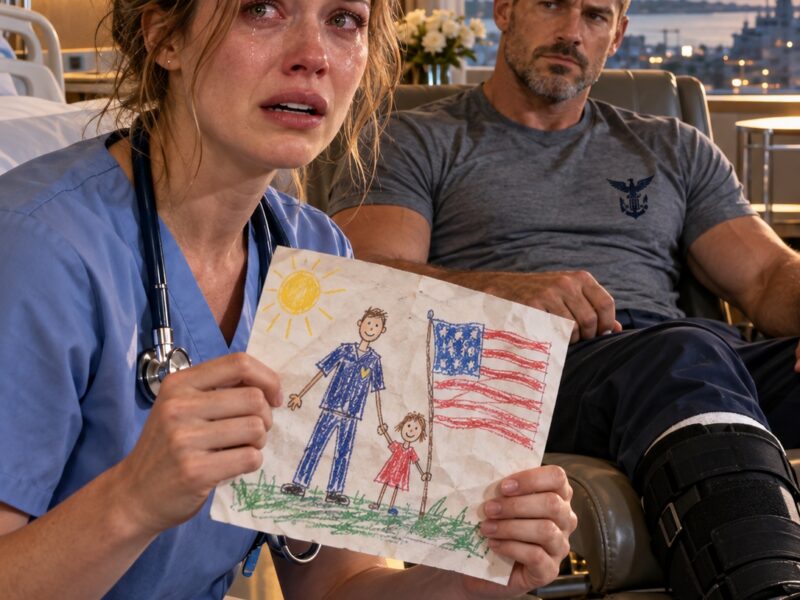
The Navy SEAL Told My Daughter, “You Have the Wrong Room” — Hours Later, She Said One Word That Broke Him
By the time I found Chief Mason Reed on Miller Hill, his lips were blue.
Rain hammered the cemetery hard enough to flatten the dead grass around him. One crutch lay ten feet downhill. The other had disappeared into the darkness. His black orthopedic boot was twisted sideways beneath him, and the two headstones beside his body shone beneath the beam of my flashlight.
MEGAN REED.
GRACE REED.
WIFE.
DAUGHTER.
For one terrible second, I thought I had arrived too late.
“Mason!”
His eyes opened.
Barely.
“Ava?”
My knees hit the mud beside him.
His teeth were chattering so violently that the word broke apart in his mouth.
I had been a registered nurse at Riverside Naval Medical Center for four months.
But the woman kneeling beside him that night wasn’t the nervous thirty-one-year-old rookie who checked every medication twice and ate sandwiches alone in her car because she never knew what to say in the break room.
That woman disappeared the moment I touched his neck.
Something older took over.
Something I had spent four years trying to bury.
I pulled the faded green medical bag from my shoulder and ripped it open.
“Stay with me, Chief.”
His hand caught my wrist.
“Leave me.”
“What?”
“Go home.”
His eyes moved toward the small headstone beside him.
“Go home to your girl.”
I stared at him.
Then I understood.
He hadn’t climbed Miller Hill because he wanted someone to save him.
Maybe he hadn’t come here expecting to leave at all.
I unfolded the emergency blanket.
“Not happening.”
“Ava—”
“I don’t leave people on hills.”
His eyes found mine.
Something changed in them when I said that.
Not recognition exactly.
More like suspicion.
Because Mason Reed had already figured out something nobody at Riverside knew.
I had been trained for places like this.
And there was a reason I had never told anyone.
Four days earlier, none of us had known the other existed.
Then my three-year-old daughter walked into the room everyone else avoided.
And fell asleep on his chest.
Veterans Day at Riverside always smelled faintly of coffee, disinfectant, and crayons.
Peggy Dunn organized the children’s visit every year.
Peggy had been a nurse longer than I’d been an adult. Her reading glasses hung from a beaded chain around her neck, and she called everyone “honey” whether she loved them, pitied them, or was preparing to destroy them professionally.
Her husband had served in Vietnam.
He’d been gone for years, but Veterans Day still belonged to him.
So every November, hospital staff were allowed to bring their children through the wards for an hour with handmade drawings.
I wasn’t scheduled until seven that night, but I brought Lily in at three.
She wore a yellow sweater with a duck stitched across the front and carried a stack of pictures against her chest as if they were classified documents.
Rosa, our elderly neighbor, came with us so she could take Lily home when my shift began.
Lily had spent two days making her favorite picture.
It was supposed to be an American flag.
Technically, it had something red, something blue, several stripes traveling in directions no flag had ever traveled, and a stick figure with enormous arms standing beside it.
“Who’s that?” I’d asked her that morning.
She had looked at me as though the answer should have been obvious.
“Daddy.”
My hand had stopped halfway to my coffee.
Lily had never met Danny.
She knew him through photographs.
Through stories.
Through the olive-green Marine T-shirt I’d kept folded in the bottom drawer even after it stopped smelling like him.
“Daddy’s a Marine,” she added.
I kissed the top of her head.
“Yeah, baby. He was.”
She corrected me immediately.
“He is.”
Three-year-olds don’t understand verb tense when it comes to heaven.
Maybe they’re smarter than the rest of us.
Lily delivered her drawings room by room.
Most patients smiled.
One old sailor cried.
Another insisted on giving her a chocolate bar even after Peggy reminded him he was diabetic and technically shouldn’t have possessed it.
Then Lily reached the last room at the end of the hall.
Room 12.
The blinds were closed.
An untouched lunch tray sat outside.
Peggy’s hand closed around my arm.
“Not that one, honey.”
I looked at her.
“Why?”
She lowered her voice.
“That SEAL hasn’t said one kind word since he got here.”
Too late.
Lily had already pushed open the door.
“Lily—”
She disappeared inside.
I followed.
And that was the first time I saw Mason Reed.
He was thirty-nine and looked as if someone had carved him out of something harder than flesh.
Broad shoulders.
Sandy-brown hair cut close at the sides.
Gray beginning in the stubble along his chin.
A gray Navy T-shirt instead of a hospital gown, because, as I later learned, he had refused the gown too.
His left leg was elevated on pillows, locked inside a black orthopedic boot.
On his forearm was a faded tattoo.
A small star.
A name beneath it.
He turned toward Lily.
His expression could have stopped traffic.
She held up her drawing.
“Are you a Marine?”
“Navy.”
She waited.
He didn’t smile.
“Kid, you’ve got the wrong room.”
Lily studied him.
I knew that look.
She was deciding whether an adult was worth listening to.
Apparently, Mason wasn’t.
She walked around the recliner to his uninjured side.
Then, before either of us understood what she was doing, my daughter climbed directly into the lap of one of the most intimidating men I had ever seen.
“Lily!”
She settled against his chest.
Mason went completely rigid.
“No,” she said.
“No what?”
“You look like my daddy’s picture.”
Then she yawned.
She had skipped her nap.
Within sixty seconds, she was asleep.
I wanted the floor to open.
“Sir, I’m so sorry.”
I moved toward her.
“Let me take her.”
Mason raised one hand.
“Don’t you dare.”
I stopped.
He looked down at Lily.
The anger was still on his face.
But beneath it was something I couldn’t identify.
Not then.
So I sat in the chair near the door.
And waited.
At four, Dr. Whitlock arrived for rounds.
He looked at Lily.
Then at me.
Then at Mason.
His mouth tightened.
“Rookie, get your kid off my patient.”
Mason answered before I could.
“Come back later, Doc.”
Whitlock stared at him.
Mason stared back.
Dr. Whitlock left.
Twenty minutes later, physical therapy came to teach Mason how to use his crutches.
He sent them away too.
But he never moved Lily.
His right hand rested across her back.
Every breath she took lifted his fingers slightly.
Then lowered them.
I watched his face.
I knew that face.
Not him.
The expression.
A man holding himself together through force.
His jaw remained clenched for almost an hour.
Then it loosened.
His head fell back.
His breathing slowed until it matched Lily’s.
And Chief Mason Reed—the man who had refused medication, food, physical therapy, a chaplain, and apparently most of humanity—fell asleep.
Near six, a tall officer appeared in the doorway.
Commander Ray Ellison.
He stopped when he saw them.
Then looked at me.
“Ma’am?”
“Yes, sir?”
He lowered his voice.
“I’ve known that man eleven years.”
I waited.
“He hasn’t slept a full night in eighteen months.”
I looked at Mason.
Ellison placed a bag of oranges on the windowsill.
At the door, he paused.
“Keep an eye on him tomorrow.”
“Why?”
His expression changed.
“Tomorrow’s the hardest day of his year.”
He left before I could ask anything else.
A few minutes later, Mason woke.
For a moment he looked confused.
Then Lily stirred against him.
Her fingers curled into his shirt.
And she whispered one word in her sleep.
“Daddy.”
Mason stopped breathing.
A tear slid from the corner of his eye and disappeared into his stubble.
He didn’t wipe it away.
When he finally spoke, his voice sounded different.
“Ma’am?”
“Yes?”
“Where is her daddy?”
I’d answered that question more times than I could count.
It never became easier.
“He died before she was born.”
Mason looked down at the tattoo on his forearm.
Lily woke several minutes later.
She rubbed her eyes.
Then noticed the star.
She traced it with one finger.
“Who’s that star for?”
Mason swallowed.
“My little girl.”
“Where is she?”
He looked toward the darkening window.
“Heaven.”
Lily nodded.
No fear.
No awkwardness.
No adult need to rescue him from the word.
“My daddy’s in heaven too.”
Mason closed his eyes.
Then Lily added, “Maybe they’re friends.”
His shoulders moved once.
Only once.
But I saw it.
At quarter to seven, Rosa came to take Lily home.
At the doorway, Lily suddenly wriggled free and ran back.
She pressed her crayon flag into Mason’s hand.
“That’s my daddy.”
Mason held the paper carefully by the corners.
“He’s a Marine,” she said.
“I know.”
She left.
I was about to follow when Mason spoke.
“Your husband was a Marine.”
I turned.
It wasn’t a question.
“And you sat in that chair for three hours like somebody who’s done a lot of waiting in bad places.”
I said nothing.
His eyes narrowed.
“You were one of us, weren’t you?”
My stomach tightened.
Nobody at Riverside knew.
Not Peggy.
Not Dr. Whitlock.
Not the nurses who thought I was an anxious rookie who might not last six months.
And I wanted it that way.
Before I could answer, Peggy appeared with the night assignments.
She looked from Mason to me over her glasses.
“Well, honey.”
“What?”
“He let you in.”
She handed me the chart.
“That makes him yours tonight.”
At nine, Mason refused his pain medication.
But he drank the water I gave him.
He ate two of Ellison’s oranges.
And he let me check the circulation in his injured foot without telling me to leave him alone.
Progress.
At 1:30 a.m., I checked his room.
He was awake.
Lily’s drawing stood against his water cup.
At 1:45, his light went off.
At exactly two in the morning, a scream tore through the floor.
Every nurse stood.
I was already moving.
Mason sat upright in the recliner.
Sweat soaked his shirt.
Both hands crushed the armrests.
His eyes were open.
But he wasn’t in Riverside anymore.
“Megan!”
His voice cracked.
“Megan, hold on!”
Two nurses appeared behind me.
Peggy reached for the phone.
Security.
“No.”
She looked at me.
“Two minutes.”
“Ava—”
“Please.”
I knew what a security response could mean for someone like Mason.
Documentation.
Command notification.
Questions.
Fitness evaluations.
One bad night becoming a permanent line in a military record.
I crouched beside him.
I didn’t touch him.
“Chief Reed.”
Nothing.
“Mason.”
His eyes moved without seeing me.
“You’re at Riverside Naval Medical Center.”
His breathing came hard and shallow.
“It’s two in the morning. Your left leg is in a boot.”
“Megan—”
“You’re safe.”
His knuckles remained white.
“Look at me.”
It took almost a minute.
Then his eyes found mine.
Slowly, his hands loosened.
Behind me, Peggy lowered the phone.
I filled his water cup.
Then placed the pain pill in my palm.
“Take it.”
Mason stared at it.
“You can’t outrun this one on that leg, Chief.”
Something almost resembling humor crossed his face.
Then he took the pill.
After that, he talked.
Eighteen months earlier, Mason had driven his wife, Megan, and their three-year-old daughter, Grace, home from a church supper.
It was raining.
The traffic light was green.
A truck ran the red.
It hit their side of the vehicle.
Mason walked away with a cut on his hand.
Megan and Grace didn’t walk away at all.
“The police said there was nothing I could’ve done.”
His eyes remained on Lily’s drawing.
“But you don’t believe them.”
“No.”
“Why?”
“I was driving.”
That was all.
As though those three words explained the entire sentence he’d given himself.
Grace had been three.
Exactly Lily’s age.
Every Sunday after church, she used to climb onto Mason’s chest during football and fall asleep.
“Nobody’s done that since.”
His voice dropped.
“Then your girl walked in like she knew.”
I finally understood the tear.
The rigid hand across Lily’s back.
The three hours he refused to move.
And Commander Ellison’s warning.
“What happens tomorrow?”
Mason looked at the clock.
“It’s already tomorrow.”
He swallowed.
“Grace would’ve turned five today.”
The cemetery was on Miller Hill.
A little white church overlooking the river.
Megan and Grace were buried side by side because Grace had loved watching boats.
Mason had never returned after the funeral.
Then he looked at me.
“You weren’t always a nurse.”
I should have lied.
Instead I said, “I was a corpsman.”
“With Marines?”
“Yes.”
He nodded.
“Thought so.”
“What gave me away?”
“You’ve got the eyes.”
I almost asked what that meant.
I didn’t.
Because I knew.
People who have watched someone bleed while pretending everything will be okay recognize each other eventually.
I didn’t tell Mason the rest.
Not that night.
But for the first time in nearly four years, I’d said the words aloud.
I was a corpsman.
And the world hadn’t collapsed.
At seven, I drove home through gray drizzle.
Lily was eating cereal at the kitchen table while Rosa drank coffee.
I told my daughter that Mason’s little girl had a birthday.
“In heaven?”
“Yes.”
Lily became quiet.
She pulled out her crayons.
Twenty minutes later, she showed me her picture.
Two little girls holding hands on a cloud.
Yellow stars around them.
“For Grace,” she said. “So she has a friend at her party.”
I turned toward the sink before Lily could see my face.
I put the drawing inside a plastic sleeve.
I planned to bring it to Mason that afternoon.
Then I went to sleep.
When I woke shortly before three, I called Riverside.
Room 12 was empty.
Dr. Whitlock had discharged Mason at noon.
He’d taken a cab home.
No goodbye.
I told myself that was good.
He was stable.
He was home.
But one sentence wouldn’t leave me.
Tomorrow’s the hardest day of his year.
By evening, the temperature had fallen to thirty-eight degrees.
Rain came steadily.
At 7:30, my phone rang.
Peggy.
She never called me at home.
“Honey, Commander Ellison just called.”
I stood.
“What happened?”
“He took dinner to Reed’s house. Truck’s gone. Phone’s going straight to voicemail.”
Silence.
“Did he say anything to you last night?”
Yes.
He had.
Miller Hill.
I grabbed my keys.
Rosa came across the hall in slippers when I knocked.
“Lily?”
“Please.”
She saw my face.
“Go.”
Twenty minutes later, Mason’s truck appeared through the rain.
Parked beside the white church.
Empty.
I opened my trunk.
Beneath an old blanket was a green medical bag.
Faded letters were stenciled across it.
H&M 2 SULLIVAN.
I hadn’t used it in years.
I had never been able to throw it away.
I started climbing.
Halfway up Miller Hill, I called 911.
Then my flashlight found a crutch.
Ten feet farther, another.
Then Mason.
Beside Megan and Grace.
His body temperature was falling dangerously fast.
I removed the wet outer layers I could safely remove and wrapped him in the emergency blanket from my bag.
My wool hat went over his head.
My coat over his body.
I knew better than to rub freezing limbs aggressively.
I knew better than to jerk him upright.
Cold hearts can become unstable.
So I lay beside him in the rain and pressed my body against his back.
“Leave me,” he whispered.
“Not happening.”
“Lily needs you.”
“So stay awake.”
He shivered.
“Tell me about Grace.”
Nothing.
“Mason.”
“Pink boots.”
“What?”
“She had pink rain boots.”
“Good. What else?”
“She couldn’t say spaghetti.”
“How did she say it?”
A tiny sound escaped him.
Almost a laugh.
“Pescetti.”
“Tell me another.”
We kept going.
Favorite song.
Favorite cereal.
The stuffed rabbit she’d refused to sleep without.
Anything to keep him conscious.
When his answers began slowing, I remembered the drawing.
I pulled the plastic sleeve from my bag.
Two girls.
A cloud.
Yellow stars.
I propped it against Grace’s headstone.
Mason saw it.
And the man who had faced combat, surgery and eighteen months of grief finally broke.
Not quietly.
He cried until there was nothing military about him.
Nothing controlled.
Nothing left to protect.
I held him in the freezing rain until the paramedics arrived.
The ambulance couldn’t climb the muddy lane.
They carried him down.
One paramedic noticed my bag.
“H&M 2?”
He looked at me.
“Ma’am, where’d you get that?”
“Long story.”
I climbed into the ambulance.
Mason’s temperature was ninety-one degrees.
The ER physician later told me another hour might have killed him.
But hypothermia wasn’t the worst news.
Dr. Whitlock examined Mason’s leg near midnight.
Then pulled the curtain.
“The repair failed.”
Mason stared at him.
“What does that mean?”
“You tore the Achilles again during the fall.”
Silence.
“We operate in the morning.”
Mason looked toward me.
Whitlock continued.
“And I won’t lie to you. At your age, after a second rupture…”
He hesitated.
“You may never pass an operational SEAL physical again.”
Something disappeared from Mason’s face.
“The Navy’s all I’ve got.”
Neither doctor answered.
Mason looked at the ceiling.
Then whispered, “There’s nothing left.”
That sentence frightened me more than finding him on the hill.
The surgery succeeded.
But Mason returned to Riverside as a different patient.
Word spread quickly about Miller Hill.
When I arrived for my next shift, Peggy handed me coffee.
Black.
Two sugars.
Exactly right.
“Thanks.”
She shrugged.
Dr. Whitlock passed me.
For once he didn’t say “rookie.”
He simply nodded.
Mason hardly spoke that night.
Commander Ellison had explained that a medical board would decide his future in spring.
Mason seemed convinced the decision had already been made.
“The Navy’s all I’ve got left, Sullivan.”
I adjusted his blanket.
“You’ve got more than you think.”
He looked at me.
I didn’t explain.
The second night, around three, he finally asked.
“Why did you come up that hill?”
I sat beside him.
And this time I told him everything.
Danny Sullivan had been a Marine sergeant with a crooked grin and absolutely no understanding of his own physical limitations.
I met him at Camp Lejeune after he split his chin playing pickup football.
I was the corpsman who stitched him.
“You always this gentle, Doc?” he’d asked.
“You always this stupid?”
He smiled.
“Only around pretty women.”
I gave him an extra stitch.
We married a year later.
When Danny deployed, I remained stateside.
Six weeks afterward, I discovered I was pregnant.
I told him over a satellite phone connection so bad we kept losing every third sentence.
When he understood, he laughed loudly enough for his entire squad to hear.
“If it’s a girl,” he said, “Lily.”
“Why Lily?”
“Because you hate every name I suggest.”
I laughed.
“Fine.”
Three days later, two Marines in dress blues knocked on my door.
I didn’t need them to speak.
Danny never knew he was right.
We had a girl.
I named her Lily.
“My enlistment ended that summer,” I told Mason. “I didn’t reenlist.”
“Because of Lily?”
“I’d already lost Danny. I wasn’t going to let our daughter lose me too.”
I used the GI Bill.
Nursing school.
Night classes.
Clinical rotations.
Studying at two in the morning while Lily slept against my shoulder.
Eventually Riverside hired me.
I told nobody about the uniform.
Nobody about deployments.
Nobody that men who once called me Doc would barely recognize the woman Dr. Whitlock called rookie.
Mason watched me.
“Why?”
I looked at my hands.
“Because a corpsman has one job.”
“What?”
“Bring everybody home.”
The words stuck.
“And I couldn’t bring home the one who mattered most.”
Mason’s expression hardened.
“You weren’t there when Danny died.”
“I know.”
“It wasn’t your fault.”
I smiled sadly.
“And that crash wasn’t yours.”
He stopped.
“Funny how knowing doesn’t help, isn’t it?”
Neither of us spoke.
Then he said my first name for the first time.
“Ava.”
Something shifted between us.
Not romance.
Not yet.
Recognition.
Two guilty survivors realizing they had been handing themselves the same sentence for different crimes they hadn’t committed.
Mason went home two days later with strict instructions to avoid hills.
Then Commander Ellison mentioned Mason planned to spend Thanksgiving alone eating a frozen dinner.
I invited him.
“No.”
Lily took the phone.
“You have to come.”
Silence.
“I’m making you a turkey hand.”
Another silence.
“Yes, ma’am.”
On Thanksgiving, Ellison dropped Mason at our apartment with a store-bought pumpkin pie.
“From the Chief.”
Mason looked embarrassed enough to fight him.
Lily dragged him through a nine-second apartment tour.
Her room was last.
Beside her bed was Danny’s photograph.
Green Marine T-shirt.
Short hair.
Stubble.
Crooked grin.
Lily pointed.
“That’s my daddy.”
Mason stared at the photograph.
I watched recognition slowly settle into his face.
Lily hadn’t imagined the resemblance.
Not exact.
But enough.
Same military haircut.
Same heavy shoulders.
Same stubble.
Same tired eyes.
“He looks like a good man,” Mason said.
“He is.”
Then Lily did something that nearly stopped my heart.
She ran to my closet.
When she returned, she was carrying the brown box.
“And this is Mommy’s secret box.”
“Lily.”
Mason looked at the faded Department of the Navy shipping label.
His expression changed.
He knew the shape.
Most sailors would.
“Baby, put that back.”
Later, while Lily helped with gravy, Mason stood beside me at the counter.
“What is it?”
I stared at the box.
“A Bronze Star.”
His head turned.
“Yours?”
I nodded.
I had earned it two years before Lily was born.
There had been an ambush.
A road.
Gunfire.
Wounded Marines.
Things I preferred leaving where they belonged.
Overseas.
The paperwork had moved slowly.
By the time the medal arrived, I’d left the service.
Danny was dead.
Lily was three weeks old.
“You’ve never opened it?”
“No.”
“Why?”
Because I had been brave enough to run through gunfire.
But not brave enough to cut tape.
“Opening it makes it real.”
“What?”
“That I came home.”
I looked at him.
“And Danny didn’t.”
Mason didn’t tell me that was irrational.
Didn’t tell me Danny would be proud.
Didn’t say I deserved the medal.
He simply pushed the box gently back toward me.
After dinner, we watched football.
Mason’s boot rested on a pillow.
Lily climbed onto his chest.
By halftime, she was asleep.
I sat at the other end of the couch.
Watching.
Mason looked at me.
I moved closer.
For one suspended second, our faces were inches apart.
Then Mason pulled away.
“I can’t.”
The words hurt.
Then he added, “Not yet.”
And somehow that hurt less.
“I know.”
Later, alone in his dark kitchen, Mason called Commander Ellison.
“Ray?”
A pause.
“There’s a corpsman who never got her ceremony.”
Another pause.
“I need your help.”
I knew nothing about that call.
For several weeks, Mason came every Sunday.
Lily made him watch the same cartoon repeatedly.
He complained every time.
He also knew every song by the third viewing.
During football, Lily would eventually crawl onto him.
And sleep.
At first, it seemed to heal him.
Then it frightened him.
One December Sunday, he looked down at Lily and saw Grace.
The next week, he said his leg hurt.
The Sunday after that, he didn’t come.
Lily waited at the window.
“Is Mason sick?”
I kissed her hair.
“Maybe a little.”
“His leg?”
I looked toward the empty parking lot.
“Somewhere inside.”
She accepted that.
Children sometimes understand broken people better than adults.
Christmas Eve arrived.
Lily had been chosen to play a sheep in the church pageant.
Weeks earlier, she had forced Mason into a pinky promise.
“Front row?”
“Front row.”
She told everyone.
Her teacher.
Rosa.
The grocery clerk.
Probably strangers.
On Christmas Eve, she put on a fluffy white costume with black ears.
I saved Mason a seat.
The organ started.
No Mason.
The lights dimmed.
No Mason.
From the stage, one tiny sheep kept looking toward the doors.
I checked my phone.
Nothing.
What Lily couldn’t know was that Mason was on Miller Hill.
This time, he went in daylight.
He climbed carefully with a cane.
Frozen grass cracked beneath his boot.
Twenty minutes later, he reached Megan and Grace.
Lily’s drawing remained tucked against Grace’s stone.
Two girls holding hands in the clouds.
The yellow stars had faded.
Mason lowered himself between the graves.
For the first time since the funeral, he spoke.
He told Megan about me.
The rookie nurse.
The woman who had climbed the hill in rain.
He told Grace about Lily.
About the sheep costume.
About the front-row promise.
Then he remembered something Megan used to tell him after difficult deployments when he withdrew from everyone.
Don’t you dare stop living, Mason Reed.
He sat there until the winter sky turned orange.
Then checked his watch.
“Oh, hell.”
The pageant had already started.
Halfway through “Away in a Manger,” the church door creaked.
A tall man appeared.
Cane.
Boot.
Red cheeks.
Onstage, one sheep stopped singing.
“Mason!”
Every head turned.
Laughter moved through the church.
Mason limped down the aisle.
I lifted my coat from the empty seat.
He sat.
“Sorry I’m late.”
My eyes burned.
“I had to see two people first.”
I didn’t ask who.
I slipped my hand into his.
He held it for the rest of the pageant.
Lily sang louder than every child in the building.
Snow started before we reached home.
The first real snow of winter.
Lily fell asleep in the car wearing her sheep costume.
I carried her inside.
When I returned, Mason stood on the porch beneath the streetlight.
Snow collected on his shoulders.
“Ava.”
“Yeah?”
“I need you to understand something.”
I waited.
“I’m not trying to take Danny’s place.”
I stepped beside him.
“Nobody’s asking you to.”
He looked at me.
“Then what am I doing?”
“Taking your own.”
For a long moment, neither of us moved.
Then Mason kissed me.
Slowly.
Carefully.
Like happiness was something he needed permission to touch.
I kissed him back.
On New Year’s Eve, Peggy volunteered to take Lily overnight.
Mason brought flowers and held them as awkwardly as a live grenade.
I cooked.
An old love song played on the radio.
He leaned his cane against the wall.
“Dance?”
“With that leg?”
“I’ve survived worse.”
He stepped on my toes twice.
At midnight, we kissed.
And later, for the first time in almost two years, Mason slept an entire night without waking to rain on a windshield.
Morning sunlight came through the curtains.
He opened his eyes.
I was asleep on his chest.
For once, he didn’t look afraid.
Spring came slowly.
So did his recovery.
He hated physical therapy.
I made him do it anyway.
In April, the medical board issued its decision.
Mason would never return to an operational SEAL team.
The news still hurt.
Some dreams don’t become less painful merely because you knew they were ending.
But there was another sentence.
Cleared for instructional duty.
Mason accepted orders at a training command twenty minutes from my apartment.
His new job was teaching younger sailors the skills he’d spent half his life learning.
How to survive.
How to bring the man beside you home.
How to come home yourself.
That last one took him longest to learn.
Then late that summer, Commander Ellison called.
I heard only Mason’s side.
“Yes, sir.”
Pause.
“She has no idea.”
I looked up.
Mason saw me listening.
“I’ll make sure she brings it.”
“What was that?”
He hung up.
“Navy business.”
“Mason.”
“Navy business, Sullivan.”
I should have known.
One year after Lily walked into Room 12, Peggy asked me to arrive early on Veterans Day.
“Short staff gathering.”
I walked into Riverside’s main lobby.
Then stopped.
It was packed.
Nurses from multiple floors.
Dr. Whitlock.
Commander Ellison in dress uniform.
Mason in dress blues.
Lily on his hip.
And on a table beside the podium sat the brown box.
Still sealed.
My box.
I looked at Mason.
“What did you do?”
He smiled.
“Nothing yet.”
Commander Ellison approached the microphone.
Six years earlier, he told the room, Hospital Corpsman Second Class Ava Sullivan had been caught in an ambush on a road overseas.
Two Marines were wounded in exposed ground.
I had crossed through gunfire.
Twice.
Dragged both men behind a stone wall.
Kept them alive for forty minutes until evacuation arrived.
I heard the words as if they belonged to somebody else.
Then someone stood in the third row.
Luis Ortega.
I hadn’t seen him in six years.
Beside him stood a little boy.
Luis walked toward me.
“Doc.”
I covered my mouth.
He hugged me.
“You told me I’d live long enough to meet my son.”
He looked down.
“This is him.”
Something inside me finally gave way.
For years, I’d remembered the people I couldn’t save.
Danny.
Faces from places I didn’t talk about.
Every failure.
Every goodbye.
And standing in front of me was a man I’d saved.
Alive.
A father.
Proof that coming home had meant something.
Mason brought me the brown box.
My hands shook.
For six years, bullets hadn’t frightened me as much as that strip of old tape.
I cut it.
Opened the cardboard.
Mason lifted the Bronze Star.
Then pinned it to my scrub top.
Directly over my heart.
Dr. Whitlock stood first.
Clapping.
Peggy followed, crying so hard her glasses bounced against the beaded chain.
Then the lobby rose.
Nurses.
Doctors.
Sailors.
Patients.
Luis.
His son.
Everyone.
Almost everyone.
Mason had returned to his chair.
Because Lily had climbed onto his chest.
And fallen asleep.
So while an entire hospital stood for me, Mason remained seated with one hand across my daughter’s back.
Exactly where all of this had begun.
Nobody at Riverside called me “rookie” again.
That night, after dinner, Mason did something even more reckless.
He lowered himself onto one knee in my kitchen.
His twice-torn Achilles trembled.
“Mason, what are you doing?”
“This leg’s been through a lot.”
He pulled out a ring.
“Figured it could survive one more bad decision.”
I laughed.
Then cried.
“Ava Sullivan—”
“Yes.”
He blinked.
“I haven’t asked yet.”
“Yes anyway.”
Later, Mason tucked Lily into bed.
Two photographs sat on her nightstand.
One showed Danny in his Marine T-shirt.
Grinning.
Young forever.
The other had been taken that afternoon.
Lily asleep on Mason’s chest in the hospital lobby.
Neither photograph replaced the other.
That mattered.
Mason pulled the blanket beneath Lily’s chin.
He reached the doorway.
Behind him came a sleepy voice.
“Night, Daddy.”
He froze.
I was standing in the hall.
I saw his hand tighten around the doorframe.
For eighteen months, that word had belonged to a grave.
For four years, it had belonged to a photograph in Lily’s bedroom.
Now it hung between two living people who had never planned to need each other.
Mason looked back.
Lily’s eyes were already closed.
He swallowed.
Then answered quietly.
“Night, baby girl.”
He switched off the lamp.
The little nightlight remained, throwing yellow stars across the ceiling.
For a moment Mason stood beneath them.
He wasn’t Grace’s father any less than he had been before.
I wasn’t Danny’s wife any less because I loved another man.
Lily hadn’t forgotten the father whose picture stood beside her bed.
Nothing had been replaced.
That was the truth we had spent so long failing to understand.
Healing wasn’t erasing the dead.
It wasn’t closing a door and pretending the room behind it had never existed.
Sometimes healing was simply making enough space beside grief for something living to sit down.
A little girl with crayons.
A wounded man who thought his life was over.
A woman who had kept a medal sealed because survival felt too much like betrayal.
Two photographs on one nightstand.
Two little girls drawn together on a cloud.
And one word spoken in the dark.
Daddy.
Mason closed Lily’s door halfway.
Then he reached for my hand.
And this time, neither of us let go.









