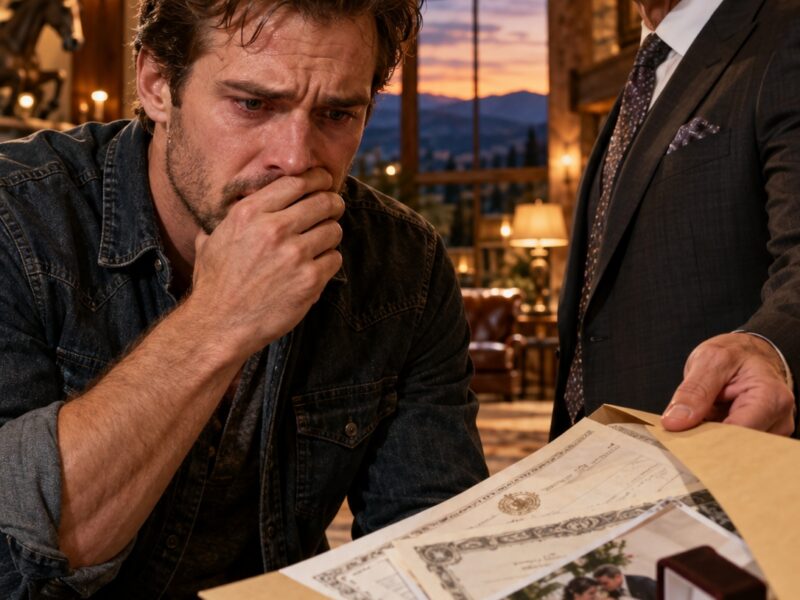
The Night Before Our Wedding, a Stranger Told Me My Bride Had Four Husbands—Then He Asked Me to Pay for Her Silence
The stranger arrived at Whit Danforth’s ranch less than twelve hours before Whit was supposed to marry Cordelia Maddox.
He came at dusk in a dust-covered black Ford, drove straight past the cattle gate as if he had been there before, and stepped out wearing a charcoal suit too expensive for that part of Montana.
Whit was alone in the equipment shed, replacing a cracked leather strap on an old saddle Cordelia had teased him about keeping.
The wedding was at ten the next morning.
Thirty-seven guests.
A white dress hanging in the guest room at Heidi Lund’s house.
Two gold rings inside Whit’s kitchen drawer.
And a chocolate cake Cordelia had insisted they didn’t need but secretly wanted anyway.
Whit had spent most of the evening feeling something he hadn’t felt in years.
Peace.
Then the stranger leaned against the shed door and destroyed it with one sentence.
“You might want to ask your bride about her other four husbands before you put a ring on her tomorrow.”
Whit stopped working.
For several seconds, the only sound was the metallic tick of cooling machinery behind him.
He looked up.
The stranger smiled.
Not broadly.
Just enough.
The kind of smile that told Whit the man had been waiting a long time to see his face change.
Whit slowly placed the leather strap on the workbench.
“Who are you?”
“Asa Crandall.”
“Never heard of you.”
“That doesn’t surprise me.”
Asa glanced around the shed.
The tractors.
The tools.
The ranch equipment.
Then he looked back at Whit.
“But Cordelia has.”
Something inside Whit tightened.
“You have thirty seconds to explain why you’re on my property.”
“I raised her.”
Whit stared at him.
Cordelia had told him she had been orphaned young. She had mentioned a guardian once, briefly, in one of their earliest conversations.
She had never given him a name.
Asa pushed his hands into his pockets.
“You seem like a decent man, Danforth. That’s why I drove all this way.”
“No. You drove here because you want something.”
The smile sharpened.
“Smart, too.”
Whit stepped closer.
“Twenty seconds.”
“All right.”
Asa’s voice became almost sympathetic.
“Cordelia Maddox has been married four times.”
Whit felt his stomach drop.
Asa continued before he could respond.
“Four different men. Four different towns. Money changed hands every time. She disappeared after every marriage.”
“That’s a lie.”
“I expected you to say that.”
“It’s a lie.”
“Ask her.”
Whit’s jaw tightened.
“I know Cordelia.”
“Do you?”
“I’ve known her for more than a year.”
Asa actually laughed.
Quietly.
“A year.”
Whit took another step toward him.
“You should leave.”
“Ask her about Robert Hale.”
Whit stopped.
“Ask her about Thomas Avery. Ask about Samuel Greene. Ask about Peter Collins.”
Four names.
Asa delivered them slowly.
Deliberately.
Like placing photographs on a table.
Then he gave Whit four towns.
Two in Illinois.
One in Indiana.
One in Missouri.
Dates.
Courthouses.
Approximate amounts of money.
Specific enough that Whit’s anger encountered something much more dangerous.
Detail.
Liars could invent details.
Whit knew that.
But detail was where doubt found oxygen.
Asa saw it happen.
That pleased him.
“Get off my land,” Whit said.
“I will.”
Asa walked back toward his car, then stopped.
“One more thing.”
Whit said nothing.
“When you ask her tonight, don’t accuse her. Just say my name.”
He turned.
“Say ‘Asa Crandall’ and watch her face.”
Whit hated the confidence in his voice.
“Then you’ll know whether I’m lying.”
He opened the driver’s door.
Whit called after him.
“If you’re trying to hurt her—”
Asa looked over the roof of the car.
“I’m trying to save you.”
“No.”
Whit’s voice went cold.
“You’re enjoying this too much.”
For the first time, Asa’s expression changed.
Only slightly.
Then the smile returned.
“I’ll be at the Bitterroot Hotel tonight.”
“Why?”
“In case you’d like to discuss terms.”
Terms.
The word landed differently from everything else.
Before Whit could ask what it meant, Asa got into his car.
The engine started.
Gravel snapped beneath the tires.
And Whit stood alone as the taillights disappeared beyond the ranch gate.
He should have dismissed the whole thing.
He wanted to.
For thirteen months, Cordelia had given him no reason to distrust her.
They had met through an online correspondence service for people living in rural communities. Whit had joined after one particularly brutal winter when the ranch house had become so quiet he sometimes turned on the television simply to hear another human voice.
He hadn’t expected anything.
Then Cordelia wrote.
Her first message contained no flirting.
No carefully staged photograph.
No attempt to impress him.
She had simply written:
You said in your profile that you like mornings better than evenings. I think that means either you’re unusually optimistic or you own livestock.
Whit had laughed alone in his kitchen.
He answered.
One message became ten.
Ten became fifty.
Soon he knew that Cordelia hated cinnamon coffee, loved thunderstorms, reread old mystery novels when anxious, and could make a joke so dry it took him three seconds to realize she had made one.
She knew his parents had died when he was twenty-two.
She knew he had inherited debt instead of land and spent eleven years buying back pieces of the ranch his father had lost.
She knew he sometimes drove twenty miles into town and sat in a diner because eating alone in his own kitchen felt worse.
And somewhere between winter and spring, Whit realized he was waiting for her messages.
Then waiting became needing.
When Cordelia finally came to Montana, she rented a room from Heidi Lund rather than moving directly onto Whit’s ranch.
“I want to know whether we work in real life,” she’d told him.
That made him trust her more.
For three months, they did ordinary things.
They bought groceries.
Fixed fences.
Argued about whether his kitchen curtains were brown or “the color of unresolved sadness.”
Cordelia volunteered at the elementary school.
She stayed two nights with Heidi when Heidi’s youngest son developed pneumonia.
She learned the names of Whit’s horses before she learned half the names of the people in town.
She never asked about Whit’s money.
Never asked whose name was on the ranch deed.
Never pushed the wedding.
Whit proposed beside the Bitterroot River.
Cordelia stared at the ring as though he had offered her something impossible.
“Are you sure?” she’d whispered.
Whit laughed.
“That’s supposed to be my question.”
Tears appeared in her eyes.
“Yes.”
Then, strangely:
“You’re sure?”
He thought it was insecurity.
Now, standing in his darkening equipment shed, Whit remembered the fear beneath those words.
And for the first time, it sounded like something else.
He drove to Heidi’s house at 9:17 that night.
Cordelia opened the door wearing sweatpants and one of Whit’s old flannel shirts.
Her hair was pinned loosely behind her head.
The moment she saw him, she smiled.
“There you are.”
That smile nearly stopped him.
She reached for him.
“I thought Heidi was going to physically restrain me from calling you. Apparently seeing the groom before the wedding is bad luck.”
Whit couldn’t answer.
Cordelia noticed.
Her hand lowered.
“What happened?”
Behind her, he could see the wedding dress hanging beside the window.
Simple.
Ivory.
Exactly like her.
Whit suddenly hated Asa Crandall for putting ugliness inside this room.
“Cordy.”
Her expression changed.
“What’s wrong?”
“A man came to the ranch.”
Silence.
Whit watched her.
“A stranger.”
Her fingers tightened against the doorframe.
He almost stopped there.
But doubt had already entered the room with him.
“He said his name was Asa Crandall.”
Cordelia’s face lost all color.
Not gradually.
Instantly.
Her lips parted.
One hand went to the wall.
Whit felt something inside him break.
Not because Asa had necessarily told the truth.
But because the name meant something.
“Cordelia?”
She stared past him.
“Where is he?”
“Hotel in town.”
“He found me.”
Her voice was barely audible.
Whit stepped inside.
“What does that mean?”
She closed the door.
Locked it.
Then checked the window.
Whit had never seen her do that before.
“Cordy.”
She turned.
There was terror in her eyes.
Not guilt.
Whit would remember that distinction later.
But in that moment, hurt was louder.
“He told me you’ve been married before.”
Cordelia flinched.
Whit swallowed.
“He said four times.”
She closed her eyes.
That was answer enough to hurt.
“Is it true?”
Cordelia opened her eyes again.
“Yes.”
One word.
Whit felt as if the floor shifted.
“He said money was involved.”
“Yes.”
His breath left him.
“He said you disappeared afterward.”
“Yes.”
Whit stepped backward.
Cordelia looked like he had struck her.
“Whit—”
“Four?”
Her eyes filled.
“Yes.”
“Four husbands?”
“On paper.”
“What does that mean?”
“It means exactly what I knew this would sound like.”
“You never told me.”
“I know.”
“Thirteen months, Cordelia.”
“I know.”
“We’re getting married tomorrow.”
“I know.”
“Stop saying you know!”
His voice cracked through the room.
Cordelia recoiled.
Whit immediately regretted it.
But he was angry now.
Angry because he loved her.
Angry because the dress was hanging ten feet away.
Angry because a stranger had apparently known more about the woman he intended to marry than he did.
“Tell me he’s lying.”
Cordelia looked at him.
“He isn’t.”
Whit stared at her.
Then she added:
“And everything he told you is a lie.”
Whit shook his head.
“That doesn’t make sense.”
“It will.”
“Then make it make sense.”
Cordelia sat slowly on the edge of the bed.
For several seconds she simply looked at her hands.
When she spoke, her voice sounded smaller than Whit had ever heard it.
“Asa became my legal guardian when I was eleven.”
Whit remained standing.
“My parents died six months apart. My mother first. Then my father.”
She swallowed.
“There wasn’t much family left. Asa knew my father loosely. He told the county he’d take me.”
“Why?”
“Because they paid him.”
Whit said nothing.
“He wasn’t cruel at first. That’s important.”
She looked up.
“People imagine monsters introduce themselves as monsters. They don’t.”
Something about the sentence silenced Whit.
“He fed me. Bought clothes. Sent me to school sometimes. He could be charming. Especially around other people.”
Her fingers tightened together.
“But everything had a price.”
As Cordelia grew older, Asa discovered another way to make money.
Her.
He moved them often.
New towns meant new people.
New people meant nobody knew the last story.
When Cordelia was still frighteningly young, Asa began introducing her to lonely men.
Farmers.
Widowers.
Shop owners.
Men with modest savings and empty houses.
“He’d tell them I needed stability,” Cordelia said.
Whit felt sick.
“He made marriage sound like rescue.”
“And you married them?”
“I was told to.”
“You could have said no.”
The instant the words left Whit’s mouth, he wanted them back.
Cordelia’s eyes changed.
Not angry.
Worse.
Familiar.
As if she’d heard that sentence many times.
“I was sixteen the first time.”
Whit stopped breathing.
Cordelia looked down.
“Asa controlled where I lived, what money I had, whether I ate. By the time I understood that adults could say no to him, I had spent years learning what happened when I did.”
Whit sat down across from her.
The anger inside him began changing shape.
“How did the marriages work?”
“Asa arranged them.”
She explained.
Sometimes Asa demanded money for wedding expenses.
Sometimes loans.
Sometimes “investments.”
Sometimes he persuaded the husband to put money into an account Asa controlled.
Then, before the husband understood what was happening, Asa created a crisis.
An annulment.
A legal threat.
A midnight disappearance.
Whatever worked.
“And you got the money?”
Cordelia laughed once.
It was a terrible sound.
“I never had enough money to buy my own bus ticket.”
Whit looked away.
Four marriages.
Four men.
Money.
Every fact Asa had spoken was technically true.
But arranged differently, they became something monstrous.
“Why didn’t you tell me?”
That question hurt Cordelia more than the others.
She stood and walked toward the window.
“I tried.”
“When?”
“A hundred times.”
“I don’t remember any of them.”
“Because I never got the words out.”
She wiped her cheek.
“When do you tell someone something like this?”
Whit didn’t answer.
“First message?”
She looked at him.
“Hello, Whit. I like mystery novels and I’ve been married four times because my guardian sold the idea of me to lonely men?”
“Cordelia—”
“First date?”
Her voice trembled.
“After you kissed me?”
She shook her head.
“After you proposed?”
Tears were falling now.
“Every good thing made it harder because suddenly there was more to lose.”
Whit looked at the wedding dress.
Cordelia followed his eyes.
“I was going to tell you before tomorrow.”
“When?”
She couldn’t answer.
“That means you weren’t.”
“I know.”
This time he let her say it.
Silence stretched between them.
Then Cordelia whispered:
“There was one man who was kind.”
Whit looked at her.
“The third.”
Samuel Greene.
The name Asa had given him.
“He was older. A widower.”
Cordelia’s expression softened painfully.
“He never touched me without asking. Never shouted. Never treated me like something he’d purchased.”
She sat again.
“I think he figured out something was wrong.”
“What happened?”
“Asa noticed.”
Her mouth tightened.
“We were gone the next morning.”
“Did Greene try to find you?”
“I don’t know.”
She looked down.
“Asa told me he didn’t.”
Whit understood immediately that she had never believed him.
“What happened after the fourth marriage?”
“I ran.”
“How?”
“I stole money.”
“From Asa?”
“He’d say it was his.”
“How much?”
“Two hundred and seventeen dollars.”
Whit almost laughed at the absurdity.
That was the theft Asa probably used to describe Cordelia as a criminal.
“I bought a bus ticket. Changed buses twice. Ended up in Illinois. Then I saw your profile.”
She looked at him.
“You lived far away.”
“That was the attraction?”
“At first?”
A faint, broken smile.
“Yes.”
Whit almost smiled back.
Then Cordelia’s expression collapsed again.
“Then your letters came.”
Her voice softened.
“And you were kind without wanting anything.”
Whit stared at her.
“I didn’t know what to do with that.”
Outside the window, dawn was beginning to bleach the Montana sky.
They had talked through the entire night.
The wedding was four hours away.
Cordelia stood.
“You should go home.”
Whit frowned.
“What?”
“You know now.”
“Yes.”
“You should cancel it.”
“Cordy—”
“You should.”
Her voice hardened because she needed it to.
“Asa will tell everyone.”
“Let him.”
“You don’t understand him.”
“No. He doesn’t understand me.”
Cordelia stared at Whit.
Whit stood.
“I haven’t decided anything yet.”
Hope flashed across her face.
She killed it immediately.
Whit hated seeing that.
“I came here angry,” he said. “I handled this badly.”
“You had every right.”
“No.”
He stepped closer.
“I had the right to ask questions. I didn’t have the right to make you feel like you were on trial before I knew what happened.”
Cordelia’s eyes filled again.
“But I’m not marrying you this morning.”
That hope disappeared.
Whit felt the sentence cut both of them.
Then he continued.
“Because I’m going to see Asa Crandall.”
Cordelia’s head snapped up.
“Don’t.”
“Why?”
“He’ll twist everything.”
“Then I’ll listen carefully.”
“Whit.”
“He mentioned terms.”
Cordelia froze.
Whit saw fear become certainty.
“What?”
“He said if I wanted to discuss terms, he’d be at the hotel.”
Cordelia went completely still.
Then she whispered:
“He wants money.”
Whit drove into town at sunrise.
Asa was eating eggs at the Bitterroot Hotel restaurant.
He smiled when Whit entered.
“Mr. Danforth.”
Whit pulled out the chair opposite him.
“How much?”
Asa calmly cut a piece of toast.
“Straight to business.”
“How much?”
“Twenty-five thousand.”
Whit stared at him.
In that community, it was not a casual number.
It was years of savings.
Equipment.
Cattle.
Security.
“What am I buying?”
“Peace.”
“For whom?”
“You.”
“Not Cordelia?”
Asa smiled.
“Cordelia has never been very good at keeping herself out of trouble.”
Whit leaned forward.
“You married her off when she was sixteen.”
The fork stopped.
Only for a fraction of a second.
Then Asa resumed eating.
“So she gave you the tragic version.”
“She gave me her version.”
“Women like Cordelia always have one.”
Whit felt his hands clench.
“What happens if I don’t pay?”
Asa dabbed his mouth.
“I show people the documents.”
“What documents?”
“Marriage certificates.”
He smiled.
“Four of them.”
Whit said nothing.
“I’ve learned something about respectable communities, Mr. Danforth.”
“What?”
“They’ll forgive almost anything except being made to feel foolish.”
Asa leaned back.
“Yesterday, Cordelia was the sweet new woman everyone welcomed. Tomorrow they’ll discover she neglected to mention four husbands.”
“They’ll discover why.”
“Will they?”
Asa’s smile returned.
“You needed an entire night to understand her explanation, and you’re in love with her.”
Whit hated him because he had identified the problem perfectly.
Asa only needed four words.
Four husbands.
For money.
Cordelia needed an hour.
Trauma always required context.
Scandal required a sentence.
“What exactly are you threatening?”
“Nothing.”
Asa lifted his coffee.
“I’m simply telling the truth.”
And suddenly Whit understood him.
Asa’s genius wasn’t lying.
It was editing.
He took true facts, removed everything that gave them meaning, then let people’s cruelty finish the story.
Whit stood.
“I’m not paying you.”
Asa didn’t look surprised.
“You should reconsider.”
“No.”
“By noon, everyone in this valley will know.”
Whit looked down at him.
“Then you’d better eat faster.”
He left.
At 10:00 a.m., there was no wedding.
By noon, Asa had kept his promise.
By three, the clerk at the grocery store knew.
By five, half the congregation knew.
By evening, everyone did.
Cordelia had four husbands.
Cordelia married men for money.
Cordelia had fooled Whit Danforth.
The story traveled faster than Whit could chase it.
People who had hugged Cordelia days earlier stopped making eye contact.
Women who had praised her kindness now lowered their voices when she entered a room.
Men turned Whit’s humiliation into entertainment.
The wedding was postponed indefinitely.
Cordelia stopped leaving Heidi’s house.
On the second evening, Whit found her sitting on the kitchen floor.
Still dressed.
Still composed.
But staring at nothing.
“I knew this would happen,” she said.
Whit crouched beside her.
“It’s temporary.”
“No.”
She smiled faintly.
“This is what Asa does.”
“Not this time.”
“He always wins.”
“He hasn’t met me before.”
Cordelia looked at him.
“Whit, love doesn’t make you stronger than everyone.”
“No.”
He reached for her hand.
“Evidence might.”
The next morning, Whit began making calls.
Then more calls.
County clerks.
Court archives.
An attorney in Helena.
Records offices in Illinois, Indiana, and Missouri.
He spent money he didn’t have.
He lost sleep.
He ignored gossip.
And every night he returned to Cordelia with one more piece.
A guardianship record.
A marriage license.
A date.
An age.
Then one afternoon, the Helena attorney called.
“Whit?”
“Yeah.”
“I found something.”
Whit straightened.
“What?”
“Your Mr. Crandall has used other names.”
Whit said nothing.
“How many?”
“At least two that I can verify.”
“And?”
“There are warrants.”
Whit stood slowly.
“For what?”
“Fraud. Coercion. Financial exploitation.”
The attorney paused.
“And Whit?”
“Yes?”
“Cordelia wasn’t the only girl.”
The room went cold.
Ten days after the wedding that never happened, an envelope arrived.
Inside was a letter from Samuel Greene.
The third husband.
The kind one.
He was seventy-two now.
Still alive.
Whit read the letter once.
Then again.
Then he drove straight to Heidi’s house.
Cordelia was at the table when he entered.
“What happened?”
Whit couldn’t speak.
He handed her the letter.
Her eyes moved across the page.
Then stopped.
Her hand began trembling.
Samuel remembered her.
He remembered a frightened young woman who apologized constantly for things that weren’t her fault.
He remembered Asa demanding money.
He remembered becoming suspicious.
He remembered telling Cordelia privately that if she ever needed help, he would help her.
And he remembered waking the next morning to discover she was gone.
Samuel had searched.
Asa had lied.
For years, Samuel had wondered whether Cordelia had survived.
His letter ended with a request.
If Whit truly loved her, Samuel wrote, then give her the one marriage she had been denied every time before.
One entered freely.
One without money.
One in which someone chose her.
Cordelia pressed the letter against her mouth.
“He looked for me.”
Whit nodded.
“He looked for you.”
“Asa said—”
“I know.”
“He said Samuel was relieved.”
“I know.”
“He said Samuel called me—”
“I know.”
Cordelia broke.
Whit had seen people cry before.
This was different.
This was grief traveling backward through time.
A young woman discovering decades later that one piece of cruelty she had accepted as truth had always been a lie.
Whit held her.
And while she cried, something inside him became very calm.
He knew exactly what had to happen next.
Sunday morning, the Bitterroot Community Church was full.
Whit had asked Reverend Parker for fifteen minutes after the service.
Word spread.
People came because they were curious.
Some came because they felt guilty.
Some came because scandal was entertainment.
Asa came because arrogant men often mistake attention for power.
He sat near the back.
Perfectly dressed.
Perfectly composed.
Whit walked to the front carrying a folder.
Cordelia wasn’t beside him.
She was sitting with Heidi.
Whit looked across faces he had known most of his life.
Then he began.
“Ten days ago, many of you heard that Cordelia Maddox had been married four times.”
Silence.
“That is true.”
People shifted.
“You heard money changed hands.”
He looked toward Asa.
“That is also true.”
Asa smiled.
“You heard she disappeared after those marriages.”
Whit paused.
“Also true.”
Murmurs moved through the room.
Asa’s smile widened.
Then Whit opened the folder.
“What you didn’t hear was how old she was.”
The room went silent.
Whit read the first record.
Guardianship.
Cordelia Maddox.
Age eleven.
Guardian: Asa Crandall.
Then the first marriage record.
He read Cordelia’s age.
Someone gasped.
Whit read another.
Then another.
He read financial records showing payments directed to Asa.
Affidavits.
Legal documents.
Dates.
Names.
By the time he reached Samuel Greene’s letter, nobody was looking at Cordelia anymore.
They were looking at Asa.
Whit unfolded Samuel’s letter.
His voice nearly broke while reading it.
Not because Samuel described fraud.
Because Samuel described Cordelia.
Her fear.
Her gentleness.
The way she had tried to protect him even while she herself was trapped.
Then Whit reached the final paragraph.
He stopped.
Looked at Cordelia.
And finished.
The church was completely silent.
Asa stood.
“This is sentimental nonsense.”
Whit looked toward him.
“Sit down.”
“You’re being manipulated.”
“No.”
Asa stepped into the aisle.
“Those marriages happened.”
“Yes.”
“Money was paid.”
“Yes.”
“She participated.”
Whit closed the folder.
“She survived.”
Asa’s face changed.
“You don’t know what you’re talking about.”
“Actually, I do.”
Whit removed another sheet.
“And this part is about you.”
For the first time, Asa looked uncertain.
Whit read the aliases.
The warrants.
The fraud investigations.
Then the church doors opened.
Two law enforcement officers entered.
Asa turned.
His face drained.
The smile disappeared.
One of the officers walked down the aisle.
“Asa Crandall?”
Nobody moved.
Asa looked at Whit.
“You think this makes her innocent?”
Whit didn’t answer.
“You think papers change what she is?”
Cordelia stood.
Every eye turned toward her.
For years, Asa’s greatest weapon had been her silence.
Now she walked into the aisle.
Her hands were shaking.
Her voice wasn’t.
“No.”
Asa stared at her.
Cordelia took another step.
“The papers don’t change what I am.”
She swallowed.
“They prove what you did.”
Something moved through the room.
Not applause.
Something heavier.
Recognition.
Asa tried to speak.
Cordelia didn’t let him.
“You taught me that if you told people the ugliest version first, they would never wait for the rest.”
Her eyes were wet.
“You were right for a long time.”
She looked around the church.
“Maybe too right.”
Several people lowered their heads.
Then Cordelia looked back at him.
“But they waited this time.”
The officer took Asa’s arm.
For the first time since Whit had met him, Asa Crandall looked ordinary.
Small, even.
Not because the facts had changed.
Because the story was finally complete.
They led him toward the doors.
Cordelia watched.
Whit expected satisfaction.
Maybe anger.
Instead, tears ran silently down her face.
When the doors closed, her knees nearly gave way.
Whit reached her.
She pressed both hands against his chest.
“He’s gone.”
Whit held her.
“Yes.”
“He’s really gone.”
“Yes.”
And Cordelia cried with the terrible relief of someone finally setting down a weight she’d forgotten she was carrying.
The town’s attitude changed almost overnight.
That made Whit angrier than he expected.
People apologized.
Women who had whispered about Cordelia brought casseroles.
Men who had joked about Whit’s “four-time bride” suddenly praised his loyalty.
Reverend Parker apologized privately.
Cordelia accepted everything with grace.
Whit struggled to.
“They don’t deserve you,” he told her one evening.
Cordelia gave him a tired smile.
“People are afraid of complicated stories.”
“That doesn’t excuse cruelty.”
“No.”
She looked toward the mountains.
“But if I spend the rest of my life punishing everyone who failed me, Asa still gets more of my life.”
Whit had no answer for that.
Cordelia often had a way of saying something quietly that stayed with him for days.
He thought the worst was over.
Then, two evenings after Asa’s arrest, Cordelia came to the ranch.
Whit was repairing a fence.
She stood on the other side of it for several seconds without speaking.
He immediately knew something was wrong.
“Cordy?”
“You don’t have to marry me.”
Whit stared at her.
“What?”
“The town knows now.”
“Yes.”
“You cleared my name.”
“We cleared it.”
“You don’t owe me anything else.”
Whit dropped the pliers.
“Where is this coming from?”
Cordelia looked away.
“The crisis is over.”
“So?”
“So maybe you should think clearly now.”
“I am.”
“No, Whit.”
She finally looked at him.
“You were protecting me.”
“I love you.”
“Sometimes those feel similar.”
He walked around the fence.
“What are you trying to say?”
Cordelia’s composure cracked.
“That maybe Asa was right about one thing.”
Whit froze.
“What thing?”
Her voice became small.
“Used goods.”
For a second, Whit couldn’t process that she had actually said it.
Then anger hit him.
Not at her.
At the man who had put those words inside her so deeply that even prison couldn’t remove them.
“Don’t.”
Cordelia flinched.
“Don’t ever call yourself that again.”
“Whit—”
“No.”
He stepped closer.
“You think being hurt makes you dirty?”
She looked away.
“You think surviving something makes you worth less than someone who never had to survive it?”
“That’s not what I’m saying.”
“It’s exactly what you’re saying.”
Her eyes filled.
“You deserve someone who comes to you whole.”
Whit stared at her.
Then, for perhaps the first time in his careful life, he lost his temper because he loved someone too much to tolerate the lie she believed about herself.
“What the hell does ‘whole’ mean, Cordelia?”
She stared at him.
“Someone without all this.”
“All what?”
He gestured helplessly.
“History?”
“Damage.”
“Everybody has damage.”
“Not like mine.”
“No. Yours has paperwork.”
Despite herself, Cordelia almost laughed.
Whit stepped closer.
“I don’t want some imaginary woman with a spotless past.”
He took her hands.
“I want the woman who wrote me that third message about how my profile picture made me look like a hostage.”
A tear rolled down her cheek.
“I want the woman who sat up with Heidi’s kid for two nights.”
Another tear.
“I want the woman who thinks cinnamon coffee is a crime against humanity.”
Cordelia laughed through her tears.
“And yes, I want the woman who survived Asa Crandall.”
Her smile disappeared.
Whit tightened his hands around hers.
“All of you.”
“Whit…”
“All four paper marriages.”
She shook her head.
“All the running.”
“Stop.”
“All the fear.”
“Whit.”
“All the things you wish hadn’t happened.”
Her face crumpled.
“Because I don’t get to choose only the parts of you that are easy to love.”
Cordelia began crying.
Whit pulled her closer.
“You keep telling me I deserve better.”
He touched his forehead to hers.
“Stop deciding what I deserve.”
She closed her eyes.
“I chose you.”
A long silence passed.
Then Cordelia whispered:
“Why?”
Whit laughed softly.
“I’ve wanted you since about your third message.”
“That isn’t an answer.”
“It is for me.”
She opened her eyes.
Whit reached into his jacket.
Cordelia stared.
He pulled out the same small ring box.
“You kept it?”
“Of course I kept it.”
“Whit…”
He opened it.
The ring caught the evening light.
“This time I’m asking with all the information.”
Cordelia covered her mouth.
“Cordelia Maddox, knowing everything I know now…”
He paused.
“…which is considerably more than I knew the first time…”
She laughed through tears.
“Will you marry me?”
Cordelia stared at him.
Once, on the hillside beside the river, she’d said yes as though she couldn’t believe happiness had accidentally found her.
This time there was no disbelief.
Only fear slowly giving way to wonder.
“Yes.”
Whit smiled.
Cordelia nodded harder.
“Yes.”
Then she laughed.
“Yes.”
They married six weeks later.
Same church.
Same minister.
Many of the same people.
But it felt like a completely different place.
Heidi stood beside Cordelia.
She cried before Cordelia even reached the aisle.
Reverend Parker had to clear his throat twice before beginning.
Whit waited at the front.
Cordelia walked toward him alone.
That had been her decision.
Not because she had nobody to give her away.
Because she no longer believed anyone had the right to give her.
She belonged to herself.
When she reached Whit, he held out his hand.
Cordelia took it.
And for the first time in her life, she entered a marriage without money changing hands.
Without a guardian negotiating.
Without escape plans hidden in her mind.
Without someone else deciding what her future was worth.
Months later, Asa Crandall went to trial.
Cordelia testified.
Whit sat behind her.
When the prosecutor asked about the first marriage, Cordelia’s voice trembled.
She turned once.
Whit was there.
So she continued.
When they asked about the second, she turned again.
Whit was still there.
By the fourth, she no longer turned around.
She looked directly at Asa.
The man who had taught a frightened girl that truth belonged to whoever told it first was forced to sit silently while she told all of hers.
The same four marriages he had used to shame her became evidence against him.
Context transformed scandal into crime.
Facts that had nearly destroyed Cordelia helped convict the man who had exploited her.
Years later, Whit and Cordelia had children.
And Whit taught them something he had learned at enormous cost.
Whenever somebody brought home an ugly story about another person, Whit asked the same questions.
What happened before that?
What happened afterward?
Who benefits from telling it this way?
What has been left out?
The children eventually learned why.
They knew their mother had once almost lost everything because one man told four true facts in exactly the wrong order.
But Cordelia taught them something else.
Something Whit thought mattered even more.
People are not the worst thing that happened to them.
Pain is not identity.
Survival is not shame.
And a person who has been treated like an object can still choose tenderness.
A person betrayed repeatedly can still learn trust.
A heart used badly does not become used up.
Sometimes it becomes more careful.
Sometimes quieter.
Sometimes harder to reach.
But given one honest chance, it may love with a courage that people who have never been broken will never fully understand.
Years after their wedding, Cordelia received a letter.
Samuel Greene had died.
His daughter found Cordelia’s wedding announcement beside his bed.
Along with the letter Cordelia had sent him after marrying Whit.
He had kept it all those years.
Cordelia sat at the kitchen table holding the envelope.
Whit found her there after dark.
She was crying.
He didn’t ask why immediately.
He simply sat beside her.
After a while, Cordelia handed him Samuel’s daughter’s letter.
Whit read it.
At the bottom was one final sentence.
Samuel had apparently told his daughter many times about the frightened young woman he had once tried and failed to save.
After receiving Cordelia’s letter, he stopped saying he had failed.
Whit placed the page on the table.
Cordelia looked toward the window.
“Isn’t it strange?”
“What?”
“All those years I thought nobody had wanted me.”
Whit took her hand.
Cordelia looked down at their fingers.
“And all those years, somewhere, someone remembered me kindly.”
Whit squeezed her hand.
“More than one someone.”
She smiled.
Outside, the Montana night settled over the ranch.
The house was quiet except for their children sleeping upstairs and the old refrigerator humming in the kitchen.
There were no dramatic speeches left.
No villains arriving at dusk.
No courtrooms.
No gossip.
Just two people sitting beside each other after a long day.
Cordelia rested her head against Whit’s shoulder.
On her left hand was a wedding ring.
It looked ordinary.
That was what made it beautiful.
For most of her life, marriage had meant signatures, transactions, fear and someone else deciding her value.
Now it meant muddy boots by the back door.
Arguments over bills.
Children who refused to sleep.
Coffee made incorrectly.
Whit forgetting anniversaries of things that weren’t their anniversary.
Cordelia stealing his side of the blanket.
Ordinary life.
The thing she had once believed belonged only to other women.
Whit looked at her.
“You okay?”
Cordelia nodded.
Then, after a moment, she said:
“Yes.”
And this time the word carried no fear.
No disbelief.
No apology.
Only certainty.
Because long ago, on the night before a wedding that never happened, a smiling stranger had arrived with four true words and nearly destroyed her life.
Four husbands for money.
It had sounded like the whole story.
It wasn’t.
The whole story was a frightened orphan.
A predator who discovered that facts could be arranged like weapons.
Four marriages she never freely chose.
A desperate escape.
A rancher stubborn enough to ask what everyone else had left out.
An old man who remembered her kindly.
A community forced to confront how eagerly it had believed the easiest version.
And finally, a woman who stopped measuring herself by what other people had done to her.
Asa Crandall had understood something dangerous about human beings.
Give people a simple ugly story, and many will accept it before asking for the complicated truth.
But he had misunderstood something too.
He believed whoever controlled the beginning of a story controlled its ending.
Cordelia proved him wrong.
She couldn’t rewrite the beginning.
She couldn’t erase the four marriage certificates.
She couldn’t become the untouched woman she once imagined Whit deserved.
She could only reclaim what came next.
And she did.
Not spectacularly.
Not all at once.
She reclaimed it morning by morning.
Choice by choice.
Year by year.
Until the documents Asa had once used to define her became nothing more than old paper in a courthouse archive.
And the life she chose afterward became the only answer that mattered.
One evening many years later, Whit found the original wedding ring box while cleaning a drawer.
The hinge was cracked.
The velvet had faded.
He carried it outside, where Cordelia was sitting on the porch watching the sun disappear behind the mountains.
“Remember this?”
She took the box.
For several seconds, she said nothing.
Then she smiled.
“I remember being terrified of it.”
“Of marrying me?”
“Of believing you.”
Whit sat beside her.
Cordelia turned the empty box over in her hands.
“I kept waiting for someone to arrive and tell me I wasn’t allowed to have you.”
Whit looked across the pasture.
“No one came.”
“One did.”
Whit glanced at her.
Cordelia smiled faintly.
“And you made him finish the story.”
She closed the box and placed it between them.
The mountains darkened.
Whit reached for her hand.
The ring was still there.
So was she.
And after everything, that was the ending Asa Crandall had never imagined possible:
Not that Cordelia Maddox was rescued.
Not that her past disappeared.
Not even that everyone finally believed her.
It was that one day, many years later, she could sit quietly beside the man she loved, look back at everything that had been done to her, and understand with absolute certainty that none of it had ever decided what she was worth.









