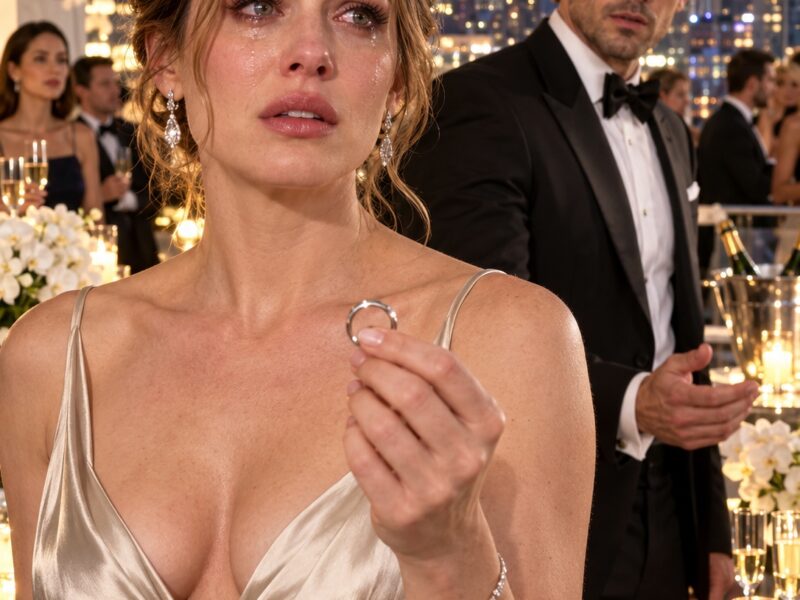
THE NIGHT BEFORE OUR WEDDING, MY FIANCÉ SAID HE’D LEAVE ME FOR HIS EX—THREE YEARS LATER, HIS FAMILY HIRED ME WITHOUT KNOWING WHO I’D BECOME
The music on the rooftop was loud enough to make the champagne tremble in its glasses when Victoria Preston looked directly at the man I was supposed to marry the next afternoon and asked one question.
“If I walked into that church tomorrow and asked you to leave with me, would you?”
There are moments when a life collapses loudly.
Cars crash.
Doors slam.
People scream.
Mine ended in three seconds of silence.
James Hudson looked at Victoria.
One second.
Two.
Three.
Then he said, “Yes.”
Not drunkenly.
Not as a joke.
Not after looking at me for permission to laugh.
He said it clearly enough that the people closest to us stopped breathing.
And in that instant, standing thirty-seven stories above Manhattan in the dress I had spent too much money pretending I could afford, I understood something that would take me years to put into words.
You can be loved by someone and still not be chosen by them.
Sometimes those are two entirely different things.
The Hudson Club rooftop glittered around us as if nothing had happened. White orchids climbed the glass railings. Black bowls held floating candles. Beyond the edge of the building, Manhattan stretched in every direction—cold, expensive, beautiful, and completely indifferent.
An hour earlier, everyone had been telling me how lucky I was.
I had heard that word for two years.
Lucky.
Lucky that a nurse from Ohio had somehow caught the attention of James Hudson, only son of Hudson Development.
Lucky that he had canceled the socially convenient engagement his family had once imagined for him.
Lucky that he took me to charity dinners and kissed my temple when photographers were watching.
Lucky that tomorrow, in a Park Avenue church filled with people whose watches cost more than my nursing degree, I would become Emily Hudson.
At thirty-two, I was old enough to recognize contempt when it wore pearls.
But apparently I was still young enough to believe love could outlast it.
James had made that belief easy in private.
He made coffee before my early shifts.
He remembered the anniversary of my mother’s death without being reminded.
Once, after I worked a double during a winter storm, he drove forty minutes through sleet to pick me up because he knew the subway would be miserable. When I opened the passenger door, the seat heater was already on.
That was James too.
That was the problem.
Betrayal is easier when the person who hurts you has always been cruel.
James had not.
He had been kind often enough to make me doubt every instinct that warned me kindness was not the same thing as character.
When his mother called our relationship “a phase,” James kissed my temple in front of her.
“Then I hope temporary lasts forever.”
I had lived on sentences like that.
I had used them to cover all the places where reality showed through.
The jokes from his friends about Cinderella.
His aunt asking whether I really intended to continue nursing “after marrying into a family like ours.”
His father explaining philanthropy to me as though poor people had no concept of generosity.
And Victoria Preston.
Victoria had been the part of James’s history nobody discussed directly.
Five years earlier, she had been his appropriate future.
Old money.
Private schools.
European summers.
Family name printed on museum walls.
She and James had been expected to marry until some spectacular public fight ended the relationship. Victoria left for Europe, married a wealthy cosmetic surgeon in Milan, divorced him quietly, and eventually returned to New York with a foundation, a townhouse, and the particular kind of sadness rich people sometimes mistake for sophistication.
I had met her twice before.
Both times, she looked through me as though I were the staff member assigned to hold James’s coat.
That night, she arrived in burgundy velvet.
The conversations nearest the bar softened first.
Then James saw her.
His smile disappeared.
I noticed because brides notice everything the night before their weddings.
A loose thread.
A missing place card.
A look that lasts half a second too long.
Victoria crossed the rooftop without acknowledging me and stopped directly in front of him.
“So,” she said. “Tomorrow is really happening.”
James said nothing.
Someone turned the music down.
Maybe accidentally.
Maybe not.
Victoria tilted her head.
“Answer me honestly.”
James finally glanced at me.
For one foolish second, I thought that meant I was safe.
Then Victoria asked the question.
“If I walked into that church tomorrow and asked you to leave with me, would you?”
A smart man would have laughed.
A kind man would have shut it down.
A man ready to marry me would have said no before she finished speaking.
James looked at her for three seconds.
“Yes.”
The rooftop became so quiet I could hear wind moving along the glass.
Victoria’s expression barely changed.
That was how I knew she had expected the answer.
James seemed to remember I existed only afterward.
His face turned toward me, the longing vanishing so quickly it would almost have been funny.
“Emily—”
I placed my champagne flute on the nearest table.
Very carefully.
My hand was shaking, and I refused to give anyone the satisfaction of watching me drop it.
“Emily, listen to me.”
I took out my phone.
He stepped closer.
“I didn’t mean it like that.”
That sentence almost made me laugh.
There are only so many interpretations of yes.
I texted my best friend.
Caitlyn. Can you get me in ten minutes?
Her reply came almost instantly.
Nine.
Then:
Stay where cameras can see you.
I looked up.
James was still talking.
Something about history.
Something about pressure.
Something about Victoria knowing how to push his buttons.
I heard every word and believed none of them.
Because beneath his explanations was the one fact he could not erase.
He had answered before he remembered there would be consequences.
That was the honest part.
“Please,” James said quietly. “Can we go somewhere private?”
“No.”
“Emily.”
“You already answered in public.”
His face tightened.
Victoria stood six feet away, watching us with one hand loosely wrapped around the stem of her champagne glass.
She had won something.
I wasn’t sure yet whether it was James or simply the satisfaction of proving she still could.
Then I remembered the bracelet.
That morning, while reviewing seating charts in James’s office, I had seen an invoice beneath a stack of papers.
Cartier.
A bracelet expensive enough to pay for most of my first year of nursing school.
Victoria’s name had been written on the gift card.
When I asked James about it, he said her foundation was coordinating with Hudson Development on a donor project.
I had wanted to believe him.
That was the humiliating part.
People often describe betrayal as the moment you discover another person’s lie.
They rarely talk about the moment you discover all the lies you told yourself to keep loving them.
The private elevator opened behind me.
Caitlyn Vanderbilt stepped out before the doors had fully separated.
She wore jeans, a silk blouse, diamond studs, and the expression of a woman who had arrived prepared to commit at least one misdemeanor on behalf of friendship.
She looked at James.
Then Victoria.
Then me.
“Oh,” she said softly. “We’re doing this version of the apocalypse.”
James exhaled.
“Caitlyn, please. This is between Emily and me.”
“No,” Caitlyn said. “It was between you and Emily until you invited the rooftop.”
She grabbed my hand.
“Come on.”
James moved in front of us.
“Emily, don’t leave like this.”
I stared at him.
“How would you prefer I leave?”
He had no answer.
Caitlyn did.
“Preferably before dessert.”
We walked toward the elevator.
Behind us, James called my name.
Then again.
He followed us downstairs, through the lobby, and out beneath the Hudson Club marquee, where the valet had just pulled around Caitlyn’s silver Porsche.
I got into the passenger seat.
James slapped one hand against the window.
“Emily, please.”
Caitlyn put the car in gear.
“Hands off the German engineering, Hudson.”
I looked down at my left hand.
A simple silver band sat beside my engagement ring.
I had bought it for James.
Not his family’s antique emerald.
Not the tasteful heirloom his mother expected him to wear after the wedding.
A plain band from a jeweler in the Village.
I had paid for it with overtime shifts, vending-machine dinners, and several months of pretending I wasn’t exhausted.
I wanted one piece of our wedding to come from me.
I twisted the ring off my finger.
My skin beneath it was pale.
At the next red light, I lowered the window.
Caitlyn glanced over.
“Oh, I support whatever you’re about to do.”
I threw the ring.
It flashed once beneath a streetlight, hit the curb, and disappeared through the metal mouth of a storm drain.
Behind us, somewhere past the horns and city noise, James was still shouting my name.
For a second, it sounded like something precious had been stolen from him.
He was wrong.
I had simply stopped carrying it.
Caitlyn drove me to her family’s estate in Connecticut because, in her words, Manhattan contained “an unsafe number of Hudsons per square mile.”
We arrived after two in the morning.
The Vanderbilt house sat beyond stone pillars and a long drive lined with oak trees turning gold at the edges.
Every downstairs light came on when we pulled up.
Rich houses, I discovered, wake politely during emergencies.
Caitlyn’s father, Henry Vanderbilt, appeared in a cashmere cardigan holding a glass of bourbon.
He looked at me.
Not at my dress.
Not at my bare ring finger.
At me.
“Emily, sweetheart,” he said. “You look frozen.”
That nearly broke me.
For months, I had been evaluated.
By James’s relatives.
By society women.
By men with family offices and women who could identify inherited money from across a ballroom.
Henry did not ask what I had done wrong.
He did not ask whether there had been a misunderstanding.
He took a blanket from the back of a chair and wrapped it around my shoulders.
“Martin,” he called toward the hallway. “Could you prepare the blue guest room? And hot chocolate, please.”
A voice floated down from the second-floor landing.
“Why does this family treat crisis like a dinner party?”
Matthew Vanderbilt leaned against the railing.
Caitlyn’s older brother.
Orthopedic surgeon.
Professional enemy of unnecessary emotion.
He wore gray drawstring pants and a white T-shirt, his dark-blond hair pushed in the wrong direction from sleep. Reading glasses sat on top of his head.
In one hand he held a surgical training scalpel.
I stared at it.
He looked down.
“This is less alarming than it appears.”
“It appears extremely alarming,” I said.
His mouth almost moved.
Almost.
Then his eyes landed on my face.
“This is the bride.”
“Former bride,” Caitlyn corrected. “Temporary refugee. Be human.”
“I am human. That’s why I object to being awake.”
“Matthew.”
Henry’s voice contained warning.
Matthew came down a few steps.
He looked at me again.
Not cruelly.
Clinically.
As if he were assessing a fracture.
“Crying for a man at three in the morning is bad for your skin,” he said, “and worse for your judgment.”
“Try compassion,” Henry said.
Matthew’s expression didn’t change.
“This is compassion.”
He looked directly at me.
“If a man humiliates you publicly the night before your wedding, he isn’t confused. He is showing you who he becomes when nobody is forcing him to be decent.”
The sentence cut cleanly.
I wanted to hate him.
Instead, relief moved through me.
Because somebody had said the thing everyone else would spend the next several weeks trying to soften.
“I know,” I whispered.
Matthew looked faintly surprised.
Then he nodded.
“Good.”
He turned toward the stairs.
“Drink the cocoa. Sleep. Make no decisions before noon except blocking phone numbers.”
Caitlyn made an obscene gesture at his back.
Henry raised his bourbon glass to hide a smile.
I slept three hours.
At eight in the morning, I woke to sunlight on expensive sheets, a canceled wedding, and seventy-three missed calls.
Then Caitlyn screamed from the hallway.
That was how I learned Victoria had posted the photograph.
James was asleep shirtless in a hotel bed.
One arm lay across his face.
Morning washed the skyline behind him in pale gray.
The caption read:
Five years and the moon finally comes home to my harbor.
The location was tagged.
The St. Regis.
Our wedding suite had been reserved at the Pierre.
I stared at the image so long the words stopped becoming language.
“She staged this,” Caitlyn said. “She absolutely staged it.”
“He still got in the bed.”
Caitlyn went silent.
That was the thing about betrayal.
Other people rush toward the missing context.
Maybe the photograph is misleading.
Maybe the room is not what it looks like.
Maybe nothing happened.
But the person who has been betrayed already knows which detail matters.
He entered the room.
He stayed.
Whatever happened afterward was merely architecture.
My old hospital phone rang on the nightstand.
James.
Caitlyn reached for it.
Matthew got there first.
He had appeared in the doorway wearing hospital pants and a white dress shirt, half buttoned, apparently on his way to morning rounds.
He answered.
“James, this is Dr. Vanderbilt.”
A pause.
“No, she is not available.”
Another pause.
“No, I genuinely do not care what happened at the hotel.”
I sat up.
“Matthew.”
He raised one finger.
“She requires rest, hydration, and distance from whatever emotional circus you’re currently operating.”
The voice on the other end became loud enough that I could hear James without understanding the words.
Matthew’s expression cooled.
“Threatening to come here would be unwise. This property has gates, cameras, and a father who funds an irritating percentage of police charities in Fairfield County.”
Henry called from downstairs.
“Not half.”
Matthew covered the receiver.
“Helpful, Dad.”
Then he returned to James.
“Call again and I will recommend Emily direct all communication through counsel.”
He hung up.
I stared at him.
“You cannot answer people’s phones.”
“You can thank me after electrolytes.”
“I’m a nurse. I know what electrolytes are.”
“Then your recovery should be remarkably efficient.”
He left before I decided whether he was arrogant or useful.
He turned out to be both.
The first week after my wedding didn’t happen was a strange fog of canceled vendors, forwarded mail, returned gifts, and strangers on social media debating whether I had overreacted.
Caitlyn canceled arrangements with the intensity of a prosecutor dismantling organized crime.
Henry made sure I ate.
Matthew appeared at odd hours in scrubs, usually carrying coffee and an opinion I had not requested.
One afternoon he found me staring at my wedding dress hanging in its garment bag.
He followed my gaze.
“Fabric is not a memory.”
I looked at him.
“Excuse me?”
“Donate it. Burn it. Alter it. Store it. Just don’t worship it.”
“You make grief sound like laundry.”
“At least laundry gets done.”
I laughed.
It surprised both of us.
A few nights later, Caitlyn shoved her phone in my face.
“My emotionally constipated brother posted on Instagram.”
Matthew had barely posted anything in ten years.
A medical conference.
A charity race.
A ski slope.
Three X-rays no normal person wanted appearing between breakfast photographs.
The newest image showed a man’s hand resting beside a glass of milk on a cream-colored breakfast table.
At the edge of the photograph was the sleeve of a cream robe.
My robe.
The caption said:
Hope the milk helped.
Heat rushed into my face.
“He didn’t show me.”
“That,” Caitlyn said delightedly, “is completely beside the point.”
“What is the point?”
“James follows him.”
I looked toward the doorway.
Matthew stood there drinking coffee.
“Delete it.”
“Make me.”
“Matthew.”
He raised an eyebrow.
“Your face isn’t visible.”
“That’s not—”
Henry lowered his newspaper.
“For what it’s worth, Matthew has never posted milk for anyone.”
Caitlyn closed her eyes.
“Dad, that may be the worst sentence ever spoken inside this house.”
I should have been embarrassed.
I was.
But beneath the embarrassment sat something warmer.
Matthew had noticed me without displaying me.
At that moment, I didn’t understand how rare that would feel.
I returned to the hospital because work knew what to do with me.
Hospitals are merciful that way.
Nobody cared who almost married me when Mrs. Alvarez needed help standing after knee replacement surgery.
Mr. Green still refused to use his walker unless I referred to it as “sports equipment.”
Medication schedules remained medication schedules.
Pain remained pain.
For four hours at a time, I remembered I had existed before James Hudson.
Then he appeared at the nurses’ station carrying pastries from the bakery near my old apartment.
He looked terrible.
Unshaven.
Hollow-eyed.
His expensive suit wrinkled in a way that once would have made me reach over and smooth his sleeve.
“Emily.”
Several nurses became extremely interested in their computer screens.
“Please,” James said.
I kept writing in the chart.
“Victoria manipulated the entire situation.”
I looked up.
“Did she move your mouth on the rooftop?”
His face tightened.
“I panicked.”
“You answered.”
“I was drunk.”
“You weren’t.”
His eyes filled.
“I love you.”
Once, those words could have changed my day.
That morning they sounded like mail delivered to a demolished house.
“You love the version of me who forgives you before you have to change.”
“That’s not fair.”
“Neither was the rooftop.”
He stepped closer.
“Come home.”
“No.”
“We can postpone everything. Go somewhere private. Talk. No families. No press.”
Something white landed over my shoulders.
A doctor’s coat.
Matthew stood beside me.
His hospital badge was clipped neatly to his pocket.
“Nurse Walker is assisting me with an urgent orthopedic consult.”
James stared at him.
“This is between me and my fiancée.”
“Former fiancée.”
“Stay out of this.”
“This is a hospital. She is working. She has asked you for distance.”
James reached around him toward me.
Matthew picked up a metal tray and brought it down on the counter with a crack that silenced the entire station.
The scalpel in his other hand never touched James.
It didn’t need to.
“Touch my staff again,” Matthew said softly, “and you will leave with security instead of closure.”
James’s jaw tightened.
“You always wanted what was mine.”
Something changed in Matthew’s face.
Not anger.
Disgust.
“Women are not property, Mr. Hudson. That confusion may explain more than you realize.”
Security arrived seconds later.
As they escorted James away, he turned toward me.
“I’ll fix this!”
Everyone who has broken something beyond repair says that eventually.
James tried to fix it loudly.
Ten thousand roses arrived at the hospital until our charge nurse threatened to file a formal complaint because the lobby had become a botanical fire hazard.
A small plane dragged an apology banner over Manhattan and violated air restrictions near the hospital landing zone.
A message reading EMILY, PLEASE COME HOME was projected onto the side of a building across the street and caused traffic to slow so badly that local news covered the honking.
Letters came.
Voicemails.
Photographs.
Donations.
He even sent a golden retriever puppy.
I returned the dog immediately.
Living things should not become emotional invoices.
For roughly six hours, social media called James’s behavior romantic.
Then the FAA incident became public.
The word changed to harassment.
I didn’t laugh with everyone else.
Every grand gesture proved James had learned nothing.
He still believed scale could replace listening.
Then Victoria sent me a message from a blocked number.
Do you really think Matthew wants you?
Another arrived.
He hates me because I left him.
Then:
You’re not a woman to him. You’re revenge.
I read that message twice inside a supply closet.
Matthew and Victoria.
I knew their families overlapped socially.
I did not know their history did.
I found him that afternoon on the hospital roof, standing near the railing with coffee in one hand.
“Did you date Victoria Preston?”
He didn’t pretend confusion.
“Yes.”
“Were you serious?”
“For longer than good judgment permitted.”
“Did she leave you?”
“She married a surgeon in Italy with more money, more years, and less interest in fidelity.”
I folded my arms.
“Are you helping me because of her?”
Matthew studied me.
“At first?”
The word hurt more than I expected.
He continued.
“For approximately ten minutes, I enjoyed knowing my involvement irritated her.”
“At least you’re honest.”
“You asked.”
“And then?”
“You corrected my discharge instructions in front of a resident.”
I blinked.
“What?”
“He was wrong. You corrected him. He tried to dismiss you. You made him check the chart. Then you made him thank you.”
“That made you interested?”
“Respectful.”
“That’s not romantic.”
“Good. Romance appears to have done enough damage this month.”
A smile escaped me.
Matthew saw it.
He didn’t move closer.
Didn’t touch me.
Didn’t turn the moment into anything I hadn’t asked for.
And strangely, that restraint frightened me more than flirting would have.
Because it made trust possible.
Two days later, Victoria cornered me on the same hospital roof.
She had no visitor badge.
Which meant somebody downstairs had either been charmed or intimidated.
Her heels were absurdly delicate against the concrete.
Mine were hospital clogs.
Ugly.
Steady.
She looked at them before looking at me.
“You’re enjoying this.”
“I’m on break.”
“The poor little nurse being adopted by the Vanderbilts.”
I said nothing.
“Matthew is using you.”
“That’s interesting. He told me you would say that.”
Her mouth tightened.
Then she stepped closer and placed the toe of one red-soled shoe against the ID badge clipped near my pocket.
“He was obsessed with me,” she said. “James was obsessed with me. Men like them don’t suddenly develop taste for women like you.”
I looked down at her shoe.
Then at her face.
“Move.”
“Or what?”
“I document workplace harassment and trespassing and send it to your foundation board.”
Her smile flickered.
A door opened behind us.
Matthew stepped onto the roof.
His hair moved in the wind.
“Victoria.”
She turned.
His expression stayed neutral.
“Three years ago, you told me surgeons were emotionally unavailable and beneath your ambition. Then you married one old enough to remember disco.”
Her face went white.
“Did the European residency improve your opinion of medicine?”
“You’re cruel.”
“No. I’m specific.”
She looked at me.
“You think she’s different? She’ll leave when she discovers the ice under your skin.”
I waited.
Some primitive part of me expected Matthew to claim me.
To say I belonged with him.
That Victoria had lost.
That he had won.
James’s world had taught me men demonstrated affection through possession.
Matthew merely looked at me.
“Maybe she would,” he said.
Victoria stared.
Matthew continued.
“That would be her right.”
I will never forget that moment.
He gave me the dignity of being undecided.
Victoria had no weapon for it.
She left.
By the end of October, I understood that staying in New York meant living permanently inside other people’s reactions.
James apologized publicly.
Victoria attacked privately.
Matthew helped in ways that sounded like criticism if you didn’t know how to translate him.
Caitlyn wanted me to move into the Vanderbilt estate indefinitely and date three men simultaneously “for statistical perspective.”
Henry offered to fund a year off.
I loved them for wanting to rescue me.
But I was tired of rescue.
For too long, people had looked at me and seen a woman moving between rich families.
Hudson.
Vanderbilt.
Someone’s almost-wife.
Someone’s friend.
Someone’s project.
I needed something no man had given me.
Something nobody could take credit for.
One night, digging through old boxes, I found a brochure I had kept for years.
California Institute of the Arts.
Environmental and spatial design.
Before nursing, before my mother’s illness, before hospital bills forced practicality onto every dream I had, I wanted to design spaces.
Not buildings for magazine covers.
Places that helped people breathe.
Clinics that didn’t feel punitive.
Hotels where older women traveling alone didn’t feel invisible.
Waiting rooms designed for frightened families rather than architects’ portfolios.
During my mother’s chemotherapy, I had filled sketchbooks with ideas.
Lighting.
Seating.
Wayfinding.
Privacy.
I had abandoned the dream because survival arrived first.
Now, for the first time, I wondered whether survival had brought me back to it.
I applied.
My portfolio consisted of old sketches, photographs of patient education boards I had redesigned during night shifts, break-room layouts, accessibility concepts, and ideas I had never been brave enough to show anyone.
I refused to use money from James.
So I sold the diamond cuff links he had given me for our engagement party.
The buyer was Alex Carter.
He owned a small Chelsea gallery and had the kind of eyes that studied objects as if they had private weather.
He examined the cuff links beneath a jeweler’s loupe.
“These are worth more than most pawn shops will tell you.”
“I need a tuition deposit, not sentiment.”
His eyes moved to the sketchbook on the counter.
“May I?”
I almost said no.
Then I nodded.
Alex turned the pages without touching the graphite.
When he finished, he looked at me differently.
“You understand how people move through fear.”
I laughed nervously.
“What does that mean?”
“It means these aren’t decoration sketches.”
He pointed to a waiting-room design.
“You moved the family seating away from the direct sightline of the treatment corridor.”
“Families stare at those doors.”
“Exactly.”
He looked at another drawing.
“You widened this corner.”
“Wheelchairs turn badly there in most hospitals.”
“You notice where people struggle.”
“No one has ever called that design.”
“It is when you know what to do with it.”
Alex knew a professor involved in a museum project.
He made an introduction.
Nothing more.
He didn’t flirt.
He didn’t rescue me.
He opened a door and allowed me to decide whether I wanted to walk through it.
In January, I left New York with two suitcases, a scholarship, and a phone filled with messages I no longer answered.
California did not heal me.
That sentence matters.
Places do not heal people.
Distance is not medicine.
Sunlight cannot perform emotional surgery.
California simply gave me enough space to stop reopening the wound every morning.
Valencia felt offensively bright at first.
The sun had no respect for sadness.
It poured across studio tables, parking lots, eucalyptus trees, and twenty-year-old students who called thirty-two “inspiring.”
I worked harder than almost everyone.
Fear had trained me for long shifts.
I learned materials.
Lighting.
Accessibility codes.
Hospitality planning.
Digital modeling.
And, hardest of all, how to defend an idea without apologizing for having one.
Healing did not happen beautifully.
Once, six months after leaving New York, a song from my abandoned wedding playlist played in a grocery store between the avocados and cereal.
I abandoned my cart.
Sat inside my car.
And cried so hard I couldn’t breathe.
I called Caitlyn.
“If I need to fly to California and assault the produce department, I will,” she said.
I laughed through tears.
That evening, Matthew sent a message.
Caitlyn says you didn’t let the visiting architect talk over you.
Then one word.
Good.
I stared at it longer than I should have.
That was Matthew’s version of praise.
Small.
Solid.
We messaged occasionally.
Then less.
Then almost not at all.
There was no argument.
No great farewell.
Some people belong to the bridge that carries you out of a fire.
They are not necessarily meant to live inside the house you build afterward.
Alex came to Los Angeles for art fairs.
We had coffee.
Then dinner.
Then long walks after studio days.
He remembered I took coffee black but switched to tea after four.
He listened when I complained about glossy floors making older patients afraid of falling.
He didn’t ask about James.
Months later, walking along Venice Beach, I finally asked why.
“Why don’t you ever ask if I still love him?”
Alex watched the water.
“If you do, you’ll tell me when it matters.”
“And if I don’t?”
“Then asking gives him a chair at our table.”
That was when I began trusting Alex.
Love came later.
Quietly.
Without violins.
Without public gestures.
Without anybody saying I was lucky.
It arrived while we argued over tile samples for a senior center renovation and Alex admitted I was right about reflected glare.
Three years passed.
I became Emily Walker again.
On invoices.
Design boards.
Contracts.
And eventually on the glass door of a small studio near Culver City.
My work developed a reputation.
I designed expensive spaces while remembering working-class bodies.
I knew where exhausted women looked for somewhere to set a purse.
I knew older guests sometimes pretended they could read signs because asking embarrassed them.
I knew beauty meant very little if a room made the person inside it feel stupid.
A boutique hotel hired us.
Then a medical retreat.
Then an Ohio resort won an award with an absurdly long name.
One Tuesday morning in May, an email arrived through a procurement portal.
Hudson Development.
I stared at the screen.
They wanted proposals for the redesign of a coastal wellness resort in Maine.
Three firms had failed.
The project was intended primarily for women over fifty recovering from major life transitions.
Divorce.
Illness.
Grief.
Retirement.
Caregiving.
Burnout.
Their brief called for comfort without condescension.
Elegance without intimidation.
Privacy without isolation.
In other words, they wanted the thing I had spent three years learning to create.
Alex found me staring.
“Is that his company?”
“His family’s.”
“You want to delete it?”
“Yes.”
He waited.
I kept reading.
“Do you want to win?”
I looked at the attached renderings.
Cold marble.
Hard furniture.
A lobby that resembled a bank attempting meditation.
“Also yes.”
Alex smiled.
“Then we’re going to New York.”
“We?”
“Unless you prefer entering the lion’s den alone with unresolved trauma and a laptop bag.”
“That was my original plan.”
“Terrible spatial planning. No emotional exits.”
I laughed.
And the sound didn’t hurt.
Returning to Manhattan felt like walking into a photograph of someone else’s life.
The Hudson Development presentation happened twelve blocks from the rooftop where mine had once split open.
James stood when I entered the boardroom.
He was thirty-eight.
Still handsome.
Less polished around the eyes.
His hand tightened around the back of his chair.
Victoria sat two seats away.
Cream suit.
Perfect hair.
Familiar smile.
She had somehow become a consultant to Hudson’s hospitality division.
Old-money circles punish scandal only until scandal becomes inconvenient.
Alex entered beside me carrying material samples.
James looked at him.
Then at me.
“Emily.”
“Mr. Hudson.”
That was all I gave him.
Then I presented.
I told the board their existing concept made recovery look like an expensive spa package.
“What people rebuilding their lives need,” I said, “is agency.”
I showed seating that permitted conversation without forcing it.
Lighting designed for aging eyes.
Garden paths that looped safely back toward the main building.
Rooms where a woman could sit alone without feeling lonely.
Clear signs.
Quiet corners.
Bathrooms designed around dignity instead of photography.
Something changed in the room.
Older women on the advisory board leaned forward.
Finance executives stopped checking phones.
Even James forgot to look devastated.
Victoria waited until the end.
Then she smiled.
“It’s moving.”
I knew that tone.
“Thank you.”
“It’s also familiar.”
I closed my laptop.
“To what?”
She slid a printed image across the table.
My stomach tightened.
It showed a recovery room.
Garden-facing.
Bench near the window.
Lighting marked in pencil.
Notes written in my handwriting.
Victoria looked toward the board.
“This concept appeared in James’s office years before Emily’s California career.”
James stared at the image.
“Victoria.”
She widened her eyes.
“I’m merely raising an intellectual-property concern.”
Three years earlier, the accusation might have destroyed me.
Now it bored me.
I opened my portfolio case.
Placed three documents on the table.
“Original sketchbook scans.”
Another.
“My CalArts critique archive.”
Another.
“A notarized digital portfolio record created during my application process.”
The advisory board chair, a silver-haired woman in her sixties, examined the dates.
I looked directly at Victoria.
“I drew that room in Ohio while my mother was receiving chemotherapy.”
Victoria’s face changed.
“The copy in James’s office existed because I once brought a binder of my work to his apartment.”
I turned toward James.
“When I still believed he cared what I made.”
He looked at the sketch differently then.
Not as evidence against me.
As proof of everything he had never bothered to see.
The board chair looked at Victoria.
“Miss Preston, did you verify this accusation before raising it?”
Victoria’s smile tightened.
“I believed—”
“Belief is not diligence.”
We won the project.
Everyone expected me to feel victorious.
Mostly, I felt tired in old places.
Working beside Alex in New York created a new problem I hadn’t expected.
Good relationships are not automatically perfect simply because the last one was terrible.
One evening, over dinner, Alex casually mentioned he had declined a speaking invitation on my behalf.
I stopped eating.
“You what?”
“It was a small conference. We’re buried in the Maine project. I thought—”
“You thought you could decide.”
His expression changed.
“I was protecting your time.”
“I don’t need protection from opportunities.”
“Emily—”
“I need to be asked.”
He looked genuinely surprised.
Not defensive.
That almost made it worse.
Because Alex was a good man.
And a good man could still cross a boundary while believing he was helping.
He apologized.
Then spent twenty minutes trying to persuade me to accept the invitation anyway.
Which, of course, completely missed the point.
I contacted the conference myself the next morning.
Accepted.
Alex learned something about my schedule.
I learned something about the danger of turning gratitude into permission.
Love did not mean nobody would ever cross a line again.
It meant you could show them the line and see what they did afterward.
Alex listened.
He changed.
That mattered.
Matthew appeared unexpectedly in the lobby of my Manhattan hotel a few days later.
His dress shirt was untucked.
Reading glasses hung from the collar of his scrubs.
“Conference at NYU,” he said.
“Coincidence?”
“No.”
I smiled.
“At least you’ve improved.”
“I’ve always been honest. People simply dislike my timing.”
We sat in the lobby.
I told him about Victoria’s plagiarism accusation.
He listened.
Then said, “She’s going to do something stupid.”
I looked at him.
“What does that mean?”
“Victoria doesn’t lose gracefully.”
That was the first time someone named the danger I had been sensing.
Matthew did not offer security.
He didn’t say he would protect me.
He simply saw the same storm clouds.
Before leaving, he stopped near the elevator.
“I never made a move on you.”
I stared.
“That’s an abrupt subject change.”
“Not really.”
He adjusted his glasses.
“I didn’t stay away because I didn’t want you.”
My breath caught.
“I stayed away because you needed to be the person who decided what happened next.”
Then the elevator opened.
Matthew stepped inside.
“That’s incredibly unfair.”
“What is?”
“You can’t say something like that and leave.”
The doors began closing.
“For once,” he said, “my timing is excellent.”
Six weeks passed.
Alex and I worked from a temporary Soho studio and traveled repeatedly to Maine.
James found reasons to appear at site meetings.
He brought coffee I didn’t drink.
Apologies I didn’t request.
One rainy evening, he found me alone beneath scaffolding outside the project office.
“I read your old portfolio.”
I stopped.
“You kept it?”
“You left it at my apartment.”
“That isn’t romantic, James. That’s poor boundaries.”
He almost smiled.
Then didn’t.
“I never knew your mother was sick that long.”
“You never asked why I became a nurse.”
His eyes dropped.
“I thought I knew you.”
“No.”
Rain ran from the scaffolding in silver threads.
“You knew how I made you feel when you were tired of being yourself.”
He absorbed that quietly.
“I’ve replayed that night every day.”
“I hope eventually you find something better to do.”
“Emily.”
His voice broke.
“I loved you.”
“Maybe.”
He looked up sharply.
“But you loved yourself wounded more.”
The rain grew harder.
“Victoria was an addiction,” he said. “Not to her. To the person I thought I was supposed to be when I was with her.”
I said nothing.
“You were real,” he continued. “And I punished you for making me choose.”
“You did choose.”
His eyes closed.
“Wrong.”
“Yes.”
He laughed once without humor.
“Yes.”
Then he asked the question I knew had lived inside him for three years.
“Is there any life where you forgive me?”
I thought about the ring falling through the storm drain.
The hotel photograph.
The roses.
The banner.
My first month in California when I kept my phone in another room because his regret still had the power to ruin sleep.
“I’ve forgiven you enough that I don’t organize my life around hating you.”
His face changed.
“That is all you get.”
Alex stepped outside the building.
He saw us.
Stopped.
And stayed several yards away.
James noticed.
The space Alex gave me said more than any confrontation could have.
“He’s good to you,” James said.
“He’s good.”
I looked toward Alex.
“That matters more.”
James nodded.
He wasn’t glad.
But for the first time, he was trying to behave decently without demanding recognition for the effort.
Then Victoria stopped trying to humiliate me and started trying to destroy me.
Blind items appeared online.
Unnamed “sources” described me as unstable.
Anonymous complaints were sent to professional licensing boards that didn’t even regulate my field.
Donors heard rumors that Alex had purchased my career.
One lifestyle site published a piece about women who “weaponize heartbreak.”
Strangers filled my inbox with opinions about my body, my class, and whether leaving James at the altar had been justified.
At first, I treated it like noise.
Then the gray sedan appeared.
It parked across from our Soho studio three afternoons in a row.
Engine running.
Nobody got out.
A package arrived under my name from a company I had never heard of.
A contractor called asking why I had sent an inspector to the project without notice.
I hadn’t.
Alex suggested cameras.
Caitlyn wanted a private investigator.
I did not tell Matthew because he would have flown to New York and somehow made overreaction sound medically necessary.
After a week, the sedan disappeared.
I told myself I had become paranoid.
Later, tied to a metal chair inside an unfinished warehouse, I would remember that car and wonder whether danger always announces itself first as inconvenience.
The kidnapping happened two nights after dinner with Caitlyn and Matthew.
I left the Soho studio late.
The street smelled of rain and cardboard.
A delivery van sat near the curb.
A man stepped toward me.
“Emily Walker?”
I turned.
A hand covered my mouth.
Something struck my shoulder.
Then the world became fragments.
Rubber flooring.
Wet fabric.
A chemical smell.
My own heartbeat.
When I woke, my wrists were tied behind a metal chair.
Plastic sheeting hung from the ceiling.
Industrial lights buzzed overhead.
I recognized the place slowly.
The Hudson resort mockup warehouse.
An unfinished New York staging facility we had used to test furniture layouts.
A man paced near the door.
Owen Price.
James’s former assistant.
I had met him dozens of times years earlier.
He looked worse now.
Sweating.
Hands shaking.
“This was supposed to be simple.”
My mouth was dry.
“What was?”
He stopped.
“You weren’t supposed to make everything worse.”
I tested the knot on my right wrist.
Slight movement.
“Victoria hired you.”
He looked at me.
That was confirmation enough.
“She said nobody would get hurt.”
“People who say that have already decided somebody else will.”
“Shut up.”
I did.
Fear can be useful when you make it collect information.
Two exits.
A stack of metal framing against the west wall.
Owen’s phone on a table.
My right-hand knot loosening each time I rotated my thumb.
Then a car door slammed outside.
Owen froze.
A voice echoed from beyond the plastic.
“Let her go.”
James.
For one second, I wondered if terror had made me hallucinate him.
Then he stepped into the work lights.
No jacket.
Shirt sleeves rolled.
Hands raised.
Owen lifted a metal bar.
“Stay back.”
James stopped.
“This has gone too far,” Owen shouted. “Victoria said you’d understand.”
“I understand you’re about to destroy your life for a woman who will tell police she barely remembers your name.”
“She promised—”
“Untie Emily.”
I worked my wrist.
Once.
Twice.
The rope shifted.
James saw it.
His eyes flicked toward my hand for less than a second.
Then away.
He didn’t expose me.
It might have been the smartest thing he had ever done.
Owen’s breathing changed.
“You ruined everything.”
“No,” James said quietly. “I did plenty of ruining myself. Don’t add yours.”
My hand slipped free.
Owen saw movement.
Everything after that happened too quickly.
He raised the metal bar.
James lunged.
My chair tipped sideways.
Plastic sheeting ripped.
I hit the floor.
James grabbed my arm.
“Move!”
The stack of steel framing beside us began to fall.
He shoved me toward the open section of the warehouse.
I turned.
“James!”
The metal came down.
One beam struck across his back.
The sound was sickening.
James collapsed.
He did not scream.
That was worse.
Police sirens washed the warehouse windows red and blue.
I crawled toward him.
He was conscious.
Barely.
“Don’t move,” I said automatically.
Once a nurse, always a nurse.
His eyes found mine.
“Are you hurt?”
“No.”
He closed his eyes.
“Good.”
Then the pain took him.
Alex reached me near the ambulance with Caitlyn half a step behind.
Matthew was already arguing with paramedics in the tone of a surgeon who considered normal professional boundaries optional during emergencies.
Victoria was arrested the following morning while attempting to board a flight to Paris.
Owen had recordings.
Payment transfers.
Messages.
Enough evidence to become cooperative before his first coffee.
The scandal tore through Manhattan faster than news of my canceled wedding ever had.
This time I didn’t read a single comment.
I sat in a hospital waiting room wearing Alex’s jacket.
Matthew emerged from surgery looking more exhausted than I had ever seen him.
I stood.
“He’s alive.”
My knees weakened.
Matthew continued.
“The spinal injury is severe.”
I closed my eyes.
“Will he walk?”
A pause.
“It’s too early to know everything.”
Then Matthew gave me the answer.
“But he will not walk out of this hospital.”
Relief and horror moved through me simultaneously.
James had saved my life.
That did not erase the rooftop.
It did not erase Victoria’s hotel room.
It did not erase harassment disguised as romance.
People desperately want stories to become simple when something dramatic happens.
Villain.
Hero.
Victim.
Redemption.
Real people refuse those categories.
James Hudson had betrayed me.
James Hudson had frightened me with his refusal to accept my no.
James Hudson had also placed his body between mine and falling steel.
All of those things were true.
And that was harder than hatred.
I visited him once after surgery.
Alex waited outside.
The Hudson family attorney remained inside the room.
James looked pale against the white sheets.
Machines surrounded him.
For once, money could not make the room beautiful.
“I signed the statement,” he said.
“What statement?”
The attorney handed me a document.
James had withdrawn every objection related to my Hudson Development contract.
He formally confirmed my designs were original.
Acknowledged his harassment after the canceled wedding.
Requested all future communication with me occur only through professional project channels.
He had also agreed to cooperate fully with Victoria’s prosecution.
I lowered the pages.
“You don’t owe me gratitude,” he said.
“For the warehouse, I do.”
He looked at me.
“For everything else?”
“No.”
A faint movement touched his mouth.
“Fair.”
We sat in silence.
Hospitals had always made more sense to me than ballrooms.
Pain removes performance.
Sometimes it reveals character.
Sometimes it reveals only pain.
“I thought saving you would feel like redemption,” James whispered.
I looked at him.
“It doesn’t?”
“It feels smaller.”
“Real things usually do.”
His eyes filled.
“I’m sorry, Emily.”
I waited.
“For the rooftop. For the hotel. For the flowers. For every time I made my regret your emergency.”
I looked at him and saw every version at once.
The man who made coffee before my hospital shifts.
The man who answered yes to Victoria.
The man pounding on Caitlyn’s car window.
The man beneath falling steel.
None canceled the others.
That was the hardest truth.
“I hope you become someone who can live with what you did.”
His eyes stayed on mine.
“Is that forgiveness?”
“It’s the only kind I can give you.”
He looked toward the window.
“Are you going back to California?”
“Yes.”
“With Alex?”
“Yes.”
He nodded.
“Good.”
I didn’t ask whether he meant it.
At the doorway, James said my name.
I turned.
“You were never lucky to have me.”
My throat tightened.
He swallowed.
“I was lucky you loved me at all.”
I left before tenderness could confuse me.
Alex stood in the hallway.
He didn’t ask what James had said.
He simply held out his hand.
I took it.
Victoria eventually pleaded guilty to conspiracy, kidnapping, and related charges.
Owen testified.
Her sentence was long enough to matter and not long enough to satisfy people who believe justice should feel mathematical.
James spent months in rehabilitation.
The press followed his wheelchair for a while.
Then another scandal arrived and Manhattan remembered how quickly it could become bored.
To his credit, James never turned his injury into sainthood.
He funded accessibility renovations in several public clinics.
Then allowed other people to manage the programs without attaching his face to every brochure.
He wrote me twice.
I answered neither letter.
I kept them in a drawer.
Not because I wanted him back.
Because throwing them away felt like pretending the past contained no complicated rooms.
The Maine resort opened the following summer.
On opening night, I stood in the main lobby watching guests arrive.
Near the garden window, a woman in her sixties sat alone in one of the reading chairs.
Her luggage was modest.
Her posture tight.
For twenty minutes, she barely moved.
Then she noticed the shelf beside the chair.
She selected a large-print book.
Exactly where I had designed it to be.
No request.
No embarrassment.
No need for her to admit she needed larger text.
She simply opened the book.
And read.
I sat across the lobby watching her turn pages until the house lights dimmed.
Several weeks later, her daughter emailed me.
Thank you for giving my mother somewhere she didn’t have to pretend she was fine. She isn’t fine. But she slept through the night for the first time in months.
I printed the email.
Taped it above my desk.
Beside another review from a divorced woman who had written that she slept six uninterrupted hours for the first time since leaving her marriage.
That was my victory.
Not James’s regret.
Not Victoria’s sentence.
Not surviving New York.
A woman reading quietly in a chair I had designed because I knew what it felt like to be too exhausted to ask for what you needed.
That fall, Alex and I opened our own studio in Santa Monica.
We specialized in recovery spaces.
Boutique hotels.
Clinics.
Libraries.
Homes designed for people beginning again with more courage than money.
Caitlyn invested and demanded an official title.
We made her Unofficial Minister of Dramatic Exits.
Matthew sent a housewarming gift.
A framed X-ray of a perfectly aligned femur.
The note read:
Structure matters.
Unfortunately, he was right.
Six months later, on a clear November evening, Alex and I closed the studio and walked down toward Santa Monica Beach.
The sky burned orange at the edges.
The Pacific moved in slow silver lines.
Alex stopped near the water.
He reached into his pocket.
My chest tightened.
He took out a plain gold band.
“No audience,” he said.
I looked at him.
“No rooftop.”
He continued.
“No family board. No cameras. Nobody waiting for you to perform an answer.”
I narrowed my eyes.
“You practiced that.”
“Several versions.”
“How many?”
“This was the least embarrassing.”
I laughed.
Alex smiled the way he always did when my happiness surprised me before it surprised him.
Then he held the ring between us.
“Emily Walker.”
The ocean moved behind him.
“Will you build the next room with me?”
I looked at the ring.
Then at the water.
Then at a man who had never once asked to become the hero of my rescue story.
“Yes.”
His shoulders dropped with relief.
“But I get final say on the windows.”
“You always do.”
He slid the ring onto my finger.
It felt nothing like the silver band I had thrown into a Manhattan storm drain years earlier.
That ring had been a promise I made almost entirely by myself.
This one felt like a door being opened from both sides.
Behind us, Santa Monica’s lights began coming on.
Ahead, the tide erased our footprints almost as quickly as we made them.
Once, that would have frightened me.
I used to believe evidence had to remain.
Rings.
Photographs.
Last names.
Promises.
Scars.
I thought pain mattered only if it left something permanent behind.
I was wrong.
Some marks are not supposed to survive the tide.
Some people are not measured by how long they hurt.
James Hudson chose his past the night before our wedding.
For a long time, I believed his choice had destroyed my future.
It hadn’t.
It destroyed the version of me who believed being chosen by a powerful man was the same thing as becoming powerful.
It ended the woman who mistook grand gestures for devotion.
The woman who thought forgiveness meant reopening the door.
The woman who believed love was proved by what she could survive.
What came afterward was quieter.
A sketchbook.
A classroom.
A studio.
A woman reading beneath a lamp.
A man who asked instead of deciding.
A gold ring beside the Pacific.
And somewhere beneath a Manhattan street, perhaps still caught beneath rusted metal and years of rain, there was another ring I had once believed represented my whole future.
I never went back for it.
I never needed to.
Because the most important thing I lost that night was not James Hudson.
It was the belief that losing him meant losing myself.
And the most important thing I found afterward was not another man.
It was the woman who finally understood that no locked room, no family name, no apology, no beautiful wedding, and no one else’s regret could ever again decide the size of her life.









