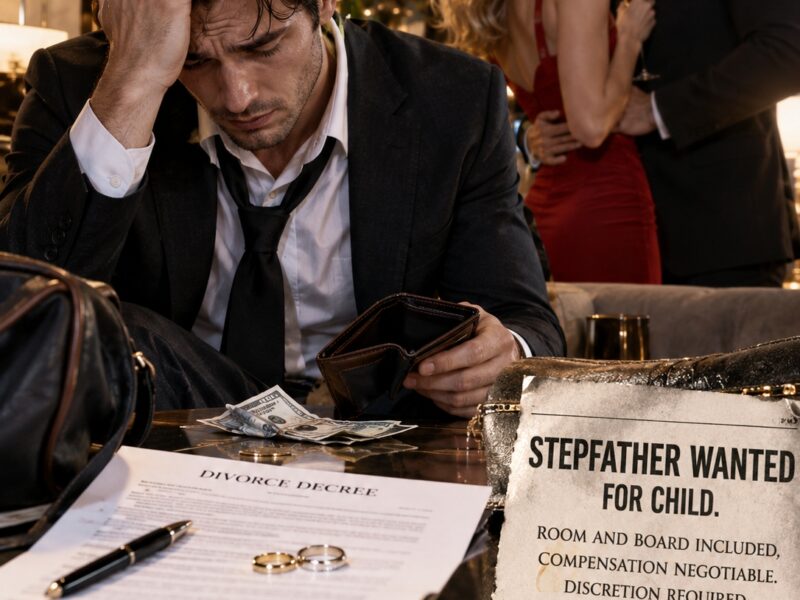
THE NIGHT MY WIFE THREW ME OUT WITH $36, I ANSWERED A STRANGE AD—THREE DAYS LATER, I MARRIED THE MOST FEARED WOMAN IN NEW YORK

Eight hours after I signed my divorce papers, I was standing in the rain with thirty-six dollars, one duffel bag, and nowhere to sleep.
By midnight, I was inside the mansion of the most feared woman in New York.
Three days later, she became my wife.
And the strangest part?
She hadn’t been looking for a husband.
She’d been looking for a father.
For her four-year-old son.
The rain had started before I left the lawyer’s office and followed me for six blocks.
I didn’t have an umbrella. Carmela had bought me one once, a black Italian thing that cost more than my first car, but apparently it belonged to the Vitali household along with everything else I’d touched during our marriage.
So I walked.
My duffel bag dug into my shoulder. Water ran down the back of my shirt. In my wallet were my driver’s license, two bank cards connected to accounts that were basically empty, and thirty-six dollars in cash.
Three years of marriage.
Thirty-six dollars.
That was the math of my life.
I stopped beneath the awning of a closed bakery somewhere on the Upper East Side and laughed.
Not because anything was funny.
Sometimes a man reaches a point where laughing and crying come from the same damaged place.
Across the street, headlights smeared across wet pavement. Couples hurried beneath umbrellas. A delivery cyclist cursed at a cab.
New York kept moving.
Nobody knew Lucas Greco’s marriage had ended.
Nobody cared.
I looked down at my phone.
There were no messages from Carmela.
That shouldn’t have hurt.
It did.
My wife—my ex-wife now—had kissed another man outside our house, told me it was “business,” disappeared for three days when I objected, and then allowed her family to call me a parasite for being upset about it.
I had still spent the afternoon wondering whether she would call.
That was humiliation in its purest form.
Not loving someone who hurt you.
Waiting for them to notice that they had.
I shoved my phone into my pocket and started walking again.
That’s when I saw the flyer.
It had been taped crookedly to a utility pole, protected from the rain by a plastic sleeve.
At first, I thought it was an advertisement for childcare.
Then I read it twice.
STEPFATHER WANTED FOR CHILD.
ROOM AND BOARD INCLUDED.
COMPENSATION NEGOTIABLE.
DISCRETION REQUIRED.
There was a phone number beneath it.
I stared at the paper.
“Sure,” I muttered. “Why not?”
I’d made worse decisions sober.
I called.
A man answered on the second ring.
“Name.”
No hello.
“Lucas Greco.”
“Age?”
“Thirty-one.”
“Children?”
“No.”
“Criminal record?”
“No.”
“Experience with children?”
I hesitated.
“I helped raise my wife’s nephew for almost two years.”
There was silence.
Then the man said, “Former wife.”
I looked at the divorce papers sticking out of my bag.
“Yeah.”
“Former wife.”
He gave me an address.
I almost hung up when I recognized the neighborhood.
Then I almost hung up again when a black sedan appeared twenty minutes later to collect me.
The driver didn’t speak.
That should have been warning number one.
The armed men at the gate should have been warning number two.
The mansion itself should have sent me running.
It sat behind stone walls and iron gates on several acres of property that shouldn’t have existed inside New York City. Security cameras tracked the car as we approached. Men in dark suits stood beneath covered entryways, some with the unmistakable posture of people carrying weapons.
I looked at the driver.
“What exactly does this family do?”
He looked at me in the mirror.
“You weren’t hired to ask questions.”
“I haven’t been hired at all.”
“Then this would be an excellent time to practice.”
The gates closed behind us.
That sound stayed with me.
Heavy iron meeting heavy iron.
Like the world I’d known had just been locked outside.
An elderly butler named Pietro met me at the entrance.
His silver hair was perfectly combed, his suit immaculate.
His eyes moved over my soaked clothes and battered duffel bag without judgment.
“Mr. Greco.”
“Lucas is fine.”
“No.”
I blinked.
“Okay.”
He took my coat.
“Before you meet the family, there is something you must understand. Miss Corleone is seeking a father for her child. She is not seeking companionship for herself.”
“That’s fine.”
“Romantic expectations would be dangerous.”
“Trust me. Eight hours ago I got divorced. Romance is somewhere below food poisoning on my list of interests.”
For the first time, Pietro almost smiled.
“Good.”
He turned.
“Follow me.”
The hallway seemed to stretch forever.
Dark wood. Old paintings. Marble floors polished enough to reflect the chandeliers.
I was wondering what kind of person advertised for a stepfather instead of hiring a nanny when something cracked somewhere ahead.
It sounded like a gunshot.
I froze.
Pietro didn’t.
A second later, a man stumbled through an open doorway, crashed into me, and nearly knocked me backward.
Before I could ask what was happening, a pistol appeared beneath my chin.
Cold steel touched my skin.
I stopped breathing.
The woman holding it was perhaps thirty-two or thirty-three, tall in heels, dressed in a fitted black skirt and white blouse with the sleeves rolled to her elbows.
Dark hair.
Dark eyes.
No visible fear.
She looked at me the way a surgeon might inspect an unfamiliar instrument.
Then she moved the barrel lightly along my jaw.
Once.
Twice.
My pulse hammered.
“You lost?” she asked.
“No.”
Her eyes narrowed.
“Pietro?”
“The applicant, Donna.”
Something changed in her expression.
Not softness.
Interest, perhaps.
She lowered the gun.
Then she walked away without another word.
I watched her disappear through the doorway.
“I know her,” I whispered.
Pietro continued walking.
“Most people do.”
Seraphina Corleone.
The face from business magazines, society columns, charity galas and whispered stories nobody printed.
The Corleone family controlled legitimate holdings in real estate, logistics, private equity and construction.
According to rumors, they controlled considerably more than that.
And Seraphina was the head of it.
I looked back toward the room she’d entered.
“What happened to the guy who ran into me?”
“Business.”
“Is he alive?”
Pietro stopped.
“Would the answer improve your evening?”
“No.”
“Then don’t ask.”
That was when I realized the flyer hadn’t been a joke.
I should have left.
Instead, Pietro handed me dry clothes.
Because sometimes desperation makes danger look surprisingly similar to shelter.
Twenty minutes later, I entered the dining room.
The table could have seated twenty people.
Only two were there.
Seraphina sat at one end.
Across from her was a small boy with dark curls and enormous brown eyes.
His arms were folded.
His plate was untouched.
Seraphina held a fork.
“One bite.”
The boy shook his head.
“Marco.”
“No.”
“One small bite.”
“No.”
“You cannot survive entirely on crackers.”
“I can try.”
I bit the inside of my cheek.
Seraphina noticed.
“You find this funny?”
“No, ma’am.”
Marco looked at me.
“Who are you?”
“Lucas.”
“Are you scared of my mom?”
I glanced at Seraphina.
“Currently?”
“Yes.”
“A little.”
Marco smiled.
It was tiny.
But Seraphina saw it.
So did Pietro.
Something passed silently between them.
Seraphina set down the fork.
“Sit.”
I sat.
She opened a folder.
My folder.
“You went to Columbia.”
“Yes.”
“Economics.”
“Yes.”
“You worked in financial analysis for four years.”
“Three and a half.”
“Then you quit.”
“My wife asked me to.”
“Why?”
I looked toward Marco.
Seraphina understood.
“Marco. Pietro.”
“No.”
“Marco.”
The boy slid out of his chair reluctantly.
As he passed me, he whispered, “Don’t take the job.”
“Why?”
“She’s bossy.”
Seraphina’s eyes lifted.
Marco ran.
I couldn’t help laughing.
Seraphina waited until he disappeared.
Then she asked again.
“Why did you quit?”
I looked at my hands.
“Carmela’s family said my salary wasn’t worth the inconvenience. Her parents needed help. Her sister had a son. They fired their nanny. Someone had to take care of things.”
“So you became domestic staff.”
“I became a husband.”
“Those are not the same thing.”
“They were in my marriage.”
Something sharpened in her eyes.
“And they called you a freeloader?”
I looked up.
“You read everything.”
“I read what matters.”
“My ex-wife’s family has money. Status. Connections. My parents died when I was young. I didn’t bring anything useful into their world except myself.”
“And apparently they decided that wasn’t enough.”
I didn’t answer.
She closed the folder.
“You understand what I want?”
“A stepfather.”
“For Marco. Not a husband for me.”
“Crystal clear.”
“He was frightened badly when he was younger. I won’t discuss the circumstances tonight. He distrusts strangers. He rarely leaves this house. Crowds can trigger panic attacks.”
Her voice remained controlled, but her fingers tightened almost imperceptibly around her whiskey glass.
That was the first time I saw the mother beneath the Donna.
“I work long hours,” she continued. “I have enemies. I can hire security. Tutors. Doctors. Drivers. I cannot hire what he actually needs.”
“A dad.”
Her eyes met mine.
“Yes.”
I sat back.
“Then why marriage?”
“Stability.”
“You could hire me.”
“Employees leave.”
“So do husbands.”
Her expression went still.
I immediately regretted saying it.
Then she surprised me.
“Apparently.”
I looked down.
“Sorry.”
“Don’t be.”
She stood and walked toward the fireplace.
“Marriage is a contract people understand. Marco needs to know that when he wakes tomorrow, next month, next year, the same person will be there.”
“I just got divorced.”
“I know.”
“I’m not looking for another wife.”
“I’m not offering to become one in any meaningful sense.”
That should have made things easier.
Strangely, it didn’t.
She turned.
“You will have the second floor. Marco’s rooms are there. I occupy the third floor. You do not enter my bedroom. You do not involve yourself in family business. You do not attempt to use my name for personal advantage.”
“Fair.”
“You receive one hundred thousand dollars a month for household and personal expenses.”
I stared at her.
“I’m sorry?”
“One hundred thousand.”
“A year?”
“A month.”
I laughed because I assumed she was joking.
She wasn’t.
“That’s insane.”
“It’s irrelevant to me.”
“It isn’t irrelevant to me.”
“Then save it.”
I thought of thirty-six dollars in my wallet.
Then I thought of the divorce agreement.
“If this ends someday…”
Her gaze hardened slightly.
“What?”
“The money you’ve paid me. Does it stay mine?”
“Of course.”
“You won’t claim I owe you?”
“No.”
“You won’t tell a lawyer I lived off you?”
Something changed in her face.
She understood then that I wasn’t negotiating.
I was afraid.
“Lucas,” she said quietly, “anything I give you becomes yours.”
I swallowed.
“Okay.”
“As for intimacy, I expect none.”
“Good.”
One eyebrow rose.
“Good?”
“Very good.”
For the first time, Seraphina Corleone laughed.
It was quiet and brief and transformed her face so completely that I stared.
She noticed.
The smile disappeared.
“Three days,” she said.
“For what?”
“The paperwork.”
And three days after my first marriage ended, I got married again.
There were no flowers.
No music.
No vows beneath an arch.
Just signatures, witnesses and a lawyer who looked like he’d helped bury more secrets than bodies.
Afterward, we ate dinner.
Marco pushed peas around his plate.
I was cutting chicken when Seraphina placed a small black box beside my hand.
I opened it.
Inside was a heavy signet ring.
The Corleone crest.
I stared at it.
“No.”
Seraphina looked up.
“No?”
“I don’t need this.”
“My husband wears the family ring.”
“I’m not really—”
Her gaze stopped me.
Marco was watching.
I understood.
This wasn’t about me.
I picked up the ring.
Carmela had never wanted me wearing anything connected to the Vitali family.
She’d once told me people might misunderstand my position.
Seraphina had known me for three days.
She was putting her family’s crest in my hand.
“I’ll keep it safe,” I said.
Marco grinned.
That night, my bedroom door creaked open.
I sat up.
Marco stood there holding a picture book.
“What’s wrong?”
“Nothing.”
“Nightmare?”
“No.”
“Then why are you awake?”
He hugged the book.
“Can you read?”
“Usually.”
“To me.”
I smiled.
“Come on.”
He climbed into the bed.
Then he said very seriously, “If you read the whole thing, I’ll make Mom pay you extra.”
I laughed so hard I had to cover my mouth.
“You’re four.”
“I’m almost five.”
“That changes everything.”
Halfway through the story, Marco fell asleep against my shoulder.
I looked down at him.
His small fist was curled into my shirt.
I didn’t move for a long time.
I’d spent two years raising Carmela’s nephew.
Packing lunches.
Helping with homework.
Sitting beside his bed when he had the flu.
On the day of my divorce, he’d stood beside his mother and repeated the word he’d heard adults use about me.
Leech.
Now another child was sleeping against my chest after knowing me three days.
I turned off the lamp.
“Good night, buddy.”
The next morning, Pietro reported the sleeping arrangement at breakfast.
Seraphina nearly dropped her coffee.
“He stayed in your room?”
“Apparently my storytelling is irresistible.”
Marco nodded.
“He does voices.”
Seraphina stared at her son.
Then at me.
“I’ll increase your allowance to one hundred fifty thousand.”
I nearly choked.
“For reading?”
“For doing your job.”
“That’s not a hundred-and-fifty-thousand-dollar job.”
“To me it is.”
“Seraphina—”
Her eyes narrowed.
It was the first time I’d accidentally used her first name.
Neither of us mentioned it.
“Lucas,” she said, “the men before you didn’t care about Marco. They cared about proximity to me.”
Her voice lowered.
“They saw my son as a door.”
Marco was eating cereal, oblivious.
I looked at him.
Then back at her.
“I’m not a door guy.”
“I noticed.”
“Keep the money.”
“No.”
“Seraphina.”
“One hundred fifty thousand.”
“That’s ridiculous.”
“Not negotiable.”
Marco looked between us.
“Mom always wins.”
I sighed.
“I’ve noticed.”
From that morning forward, Marco became my shadow.
At first, he followed me from room to room.
Then he began helping.
Badly.
If I cooked, he stirred.
If I fixed something, he handed me the wrong tool.
If I went into the garden, he wore rubber boots even when it wasn’t raining.
Seraphina remained mostly absent.
She left before breakfast some mornings and returned after midnight.
Sometimes I heard cars at the gate.
Sometimes men entered her office and emerged looking several years older.
I never asked.
That was our agreement.
But the house changed.
Marco started eating.
Then sleeping through the night.
Then laughing loudly enough that the sound traveled upstairs.
One afternoon, I had a follow-up appointment at the hospital.
Nothing dramatic. My health had been poor for a while. Years of skipping meals, stress and untreated depression had done more damage than I liked admitting.
Marco watched me put on my coat.
“Where are you going?”
“Doctor.”
His face changed.
“I’ll be back in an hour.”
“No.”
“Buddy—”
“No.”
Pietro appeared behind him.
“Young Master, perhaps you could accompany Mr. Greco.”
I looked at Pietro.
“He’s not comfortable outside.”
“Perhaps,” Pietro said softly, “that is changing.”
Marco’s fingers closed around mine.
We went.
He barely spoke in the car.
At the hospital, he clutched a stuffed lion against his chest and stayed so close our shoulders touched.
But he went inside.
That alone felt enormous.
After my appointment, I found him waiting with Pietro.
“Lucas?”
“Yeah?”
“Are you sick?”
“A little.”
“Does it hurt?”
“Sometimes.”
He reached into his pocket.
A wrapped candy.
He held it out.
“You can have this.”
I stared at it.
“It’s your last one.”
“I know.”
My throat tightened.
“I used to skip meals,” I told him. “Don’t ever do that. You need to grow strong.”
“Why?”
“So you can protect people you love.”
He considered this.
Then pushed the candy harder into my palm.
“I’m going to eat every meal.”
“Good.”
“Then I’ll get big.”
“That’s generally how it works.”
“And I’ll protect you.”
I looked away.
My eyes burned.
There are moments when kindness hurts more than cruelty.
Cruelty confirms what you’re already afraid of.
Kindness shows you what you’ve been missing.
When we walked outside, a black sedan was waiting.
Seraphina sat behind the wheel.
I stopped.
“What are you doing here?”
Marco ran to the car.
“Mom! I went to the hospital.”
Her face went pale.
“You left the house?”
“With Lucas.”
He climbed into the back seat.
Then said the sentence that changed something in her.
“As long as I’m with Lucas, you don’t have to worry.”
Seraphina looked at me.
For once, the woman who always knew what to say had nothing.
That evening, she offered me a black credit card.
“No.”
Her eyebrows lifted.
“No?”
“I already have everything.”
“There must be something you want.”
I thought about it.
“Actually…”
“Name it.”
“A truck.”
She blinked.
“A truck.”
“Used.”
Another blink.
“Five thousand maximum.”
“Lucas, there are twelve cars in the garage.”
“I want one I won’t have a heart attack scratching.”
The next morning, an old blue pickup sat beside a line of vehicles worth several million dollars.
It had faded paint.
A dented tailgate.
And ninety thousand miles.
I loved it immediately.
Seraphina stood on the front steps.
“Happy?”
“Very.”
She shook her head as though I were the strangest man she’d ever met.
Maybe I was.
The following week, I took Marco to an amusement park.
Then a public market by the harbor.
He hated holding a bag containing live crabs.
“Lucas.”
“What?”
“It’s moving.”
“They tend to.”
“I don’t want it.”
“My hands are full.”
“It looked at me.”
“Marco, it’s a crab.”
“It knows things.”
I was laughing when I heard my name.
“Lucas?”
My entire body tightened.
Carmela stood ten feet away.
Five weeks since the divorce.
She looked exactly as she always did—expensive coat, perfect hair, expression arranged somewhere between disappointment and superiority.
Her eyes moved from me to Marco.
Then to my battered truck.
“What are you doing?”
“Buying dinner.”
“With a child?”
Marco whispered, “Who’s she?”
“My ex-wife.”
His nose wrinkled.
I almost smiled.
Carmela crossed her arms.
“So it’s true.”
“What?”
“You’re a nanny now.”
“I’m not discussing my life with you.”
She laughed.
“Lucas, don’t be childish.”
That word.
Childish.
Emotional.
Dramatic.
Those had been the three tools Carmela used whenever my feelings became inconvenient.
I remembered college.
How fiercely she’d once defended me.
How she’d married me against her family’s wishes.
I thought that meant she’d chosen me.
What I didn’t understand was that eventually she expected me to earn the choice every day.
I quit my job because her parents needed help.
I drove her sister’s son to school.
I cooked.
Cleaned.
Fixed the roof.
Mowed the lawn.
Handled appointments.
Paid bills.
When Carmela came home exhausted, I rubbed her shoulders and listened to stories about deals I was no longer important enough to understand.
Then one night, I watched her step out of another man’s car.
He kissed her.
She kissed him back.
At our front door.
The next morning, I confronted her.
She barely looked embarrassed.
“It was business.”
“You kissed him.”
“You don’t understand how these relationships work.”
“Apparently not.”
Her mother told me successful people sometimes blurred boundaries.
Her sister called me naive.
Carmela disappeared for three days.
So I filed for divorce.
She thought I was bluffing.
I wasn’t.
Now she stood in front of me at a seafood market as though I were the one who had made a mistake.
“You look terrible,” she said.
“I’m fine.”
“You’re driving that?”
“I like it.”
She looked at Marco.
“And babysitting.”
“Goodbye, Carmela.”
She stepped closer.
“You know people still ask about you. It’s embarrassing.”
I stopped.
“For whom?”
“For me. For the family.”
“We’re divorced.”
“You’re still my ex-husband.”
“Exactly. Ex.”
Her jaw tightened.
“Stop being emotional.”
I laughed once.
Something inside me broke loose.
Not anger.
Freedom.
“Take care, Carmela.”
I walked away.
That should have been the end.
It wasn’t.
My phone rang twenty minutes later.
Her mother.
I answered because apparently I hadn’t suffered enough.
“Lucas.”
“Mrs. Vitali.”
“Carmela tells me you’re working as domestic help.”
I closed my eyes.
Marco was beside me in the truck, examining the crab bag suspiciously.
“That’s none of your concern.”
“Have you thought about what you’re doing to her reputation?”
I almost couldn’t believe it.
“My employment is damaging Carmela?”
“You were always selfish in this way.”
I gripped the steering wheel.
“Anything else?”
“You’ll never rise above where you came from, Lucas. You can put trash in fine clothes, but—”
I hung up.
Blocked the number.
Pulled the truck onto a quiet side street.
Then I broke.
My forehead hit the steering wheel.
Three years came out of me at once.
Every insult I’d swallowed.
Every night I’d told myself to try harder.
Every meal I’d cooked for people who mocked me.
Every time I’d apologized for wanting basic respect.
I cried until my chest hurt.
Then a tiny hand touched my arm.
I froze.
Marco held out a tissue.
“Sorry.”
“For what?”
“I didn’t know you were watching.”
“I’m watching.”
“Did I scare you?”
He shook his head.
“You can cry.”
I stared at him.
“I can?”
“Grown-ups cry.”
“Who told you that?”
He shrugged.
“I know things.”
Despite everything, I laughed.
He put the tissue into my hand.
“I won’t laugh at you.”
That nearly destroyed me again.
Instead, I wiped my face.
“Thanks, buddy.”
“Are you done?”
“For now.”
“Good. The crab is trying to escape.”
That night, I went to bed without dinner.
A knock came around ten.
“Lucas?”
Seraphina.
I sat up.
“Come in.”
She entered and closed the door.
She wasn’t dressed like the Donna.
No suit.
No gun visible.
Just dark trousers and a soft sweater.
She sat in the chair beside my bed.
“I heard what happened.”
“Marco?”
“Marco tells me everything.”
“Traitor.”
“He’s four.”
“Youngest informant in New York.”
Her mouth twitched.
Then her expression changed.
“I know who Carmela Vitali is.”
“Congratulations.”
“She’s an idiot.”
I looked at her.
“You can’t say that.”
“I just did.”
I laughed.
Seraphina’s gaze moved toward my closet.
“The clothes I bought you are still hanging there.”
“They’re too expensive.”
“They’re clothes.”
“I spend my days with Marco.”
“Do expensive clothes prevent childcare?”
“Possibly. I haven’t studied it.”
She leaned back.
“Ask me for something.”
“I don’t need anything.”
“Everyone needs something.”
“I’m serious.”
“So am I.”
Her voice lowered.
“I can give you almost anything.”
I knew what she meant.
Money.
Influence.
Access.
Revenge.
And perhaps that was why my answer mattered.
“I want to sleep.”
She stared at me.
Then laughed softly.
“You’re impossible.”
“Good night, Seraphina.”
She reached the doorway and stopped.
“Lucas.”
“Yeah?”
“If your ex-wife bothers you again, tell me.”
“Why?”
Her face became perfectly calm.
“Because I can arrange for her to stop.”
I stared.
“Stop calling?”
Seraphina smiled.
She did not answer.
Then she left.
For the next two weeks, something strange happened.
Seraphina started coming home.
Not just sleeping there.
Coming home.
Dinner at seven.
Movies with Marco.
Board games.
One evening, I watched one of the most feared women in New York accuse her four-year-old son of cheating at Candy Land.
“I saw you move twice.”
“No.”
“Marco.”
“No evidence.”
I nearly fell off the couch.
Another night, she helped him build a cardboard castle.
Then she stayed after he went upstairs.
We sat opposite each other in silence.
“You don’t have to rearrange your schedule,” I finally said.
“I know.”
“Marco’s doing well.”
“I know.”
“So…”
“The doctor says you need family.”
I looked at her.
“What?”
“Your doctor.”
“You spoke to my doctor?”
“I speak to everyone.”
“That’s deeply concerning.”
“Lucas.”
Her tone softened.
“Marco and I are your family now.”
Something inside me went still.
Nobody had said that to me in years.
Maybe ever.
I looked down at my coffee.
“Marco’s enough.”
Seraphina didn’t answer.
The next evening she announced there was a charity gala.
“Spouses and children are expected.”
I immediately said no.
She stared.
“I don’t know how to behave around your people.”
“My people?”
“Billionaires. Politicians. Men who disappear into basements.”
“Stand beside me.”
“I’ll embarrass you.”
Her expression hardened.
“Why do you keep saying that?”
“Because—”
“Lucas.”
She leaned forward.
“The only woman who should be embarrassed by her husband is a woman ashamed of him.”
Silence.
“I’m not ashamed of you.”
The next afternoon, five stylists invaded the mansion.
By seven, I barely recognized myself.
Black tuxedo.
Custom shoes.
A watch I refused to ask the price of.
Marco wore a miniature suit and complained about the tie.
When Seraphina descended the stairs, I forgot what I was saying.
Black gown.
Bare shoulders.
Diamond earrings.
Her hair swept back.
She stopped when she saw me.
For a moment, neither of us spoke.
Marco sighed dramatically.
“You guys are weird.”
The gala occupied the ballroom of one of Manhattan’s grandest hotels.
Crystal chandeliers.
Champagne towers.
Money everywhere, disguised as taste.
People turned when Seraphina entered.
Then they noticed me.
“Miss Corleone.”
“Donna.”
“And this gentleman?”
I opened my mouth.
“I’m a friend—”
Seraphina took my hand.
“My husband.”
The room changed.
Not loudly.
Power rarely needs volume.
Eyes widened.
Conversations paused.
People suddenly wanted introductions.
I leaned toward her.
“You didn’t have to do that.”
Her fingers tightened around mine.
“Do what?”
“Say it like that.”
“Like what?”
“Like you’re proud.”
She stared at me.
“Lucas, is being my husband embarrassing?”
“No.”
“Then stop behaving as though you’re an apology.”
I needed a drink after that.
I escaped toward the champagne.
And found Carmela.
She stared at me.
For several seconds, she genuinely didn’t recognize me.
Then her mouth opened.
“Lucas?”
I turned away.
She caught my arm.
“Wait.”
“Don’t touch me.”
Her hand dropped.
“I need to explain.”
“No.”
“That phone call from my mother wasn’t authorized.”
“I don’t care.”
“I only agreed to the divorce because I thought it would teach you a lesson.”
I stared at her.
“What?”
“I thought you’d come back.”
“Carmela—”
“I wanted you to understand how much you needed me.”
Something cold moved through me.
“You thought destroying our marriage would make me obedient.”
Her face tightened.
“You always make everything sound ugly.”
“It was ugly.”
“My sister is getting married. She’s moving out. Things will be different.”
“No.”
“Vitali Capital is having problems.”
There it was.
Not love.
Need.
“We can start over,” she said. “You were good to me.”
I laughed quietly.
“You don’t miss me.”
“Of course I do.”
“You miss what I did.”
Her expression hardened.
“You haven’t changed.”
“I have.”
“No. You’re still stubborn.”
“And you’re still confusing obedience with love.”
I stepped closer.
“Listen carefully. I’d rather sleep under a bridge in Brooklyn than become your husband again.”
Her face went white.
“You’ll crawl back eventually.”
“No.”
“When this little fantasy ends, you will.”
A voice behind us said, “What fantasy?”
Carmela froze.
Seraphina stood there.
One hand around a champagne glass.
Calm.
Dangerously calm.
Carmela recovered quickly.
“Miss Corleone.”
“Mrs. Vitali.”
“Carmela.”
“Mrs. Vitali.”
That correction landed exactly as intended.
Carmela straightened.
“I’ve actually been trying to speak with you. Vitali Capital handled several Corleone Holdings accounts for five years. The mandate was terminated last week.”
“I know.”
“We’d like the opportunity to correct whatever went wrong.”
Seraphina looked at me.
“Lucas?”
Carmela frowned.
“What?”
Seraphina ignored her.
“Should I give them another chance?”
The blood drained from Carmela’s face.
“Why are you asking him?”
Seraphina took a sip.
“Why wouldn’t I?”
“Because this is business.”
“And?”
Carmela looked at me.
Then laughed.
A bad decision.
“Miss Corleone, perhaps you don’t know. Lucas is my ex-husband.”
“I know.”
“He doesn’t understand finance at this level anymore.”
I almost smiled.
I had a degree from Columbia and had worked in finance before Carmela convinced me to quit.
But I said nothing.
Carmela continued.
“He’s good around the house. Repairs. Children. Things like that.”
Seraphina’s expression didn’t move.
Carmela mistook silence for permission.
“He has no family standing. No useful connections. Frankly, I don’t know how he got into an event like this.”
Seraphina set down her glass.
“Lucas?”
“Yes?”
“Mrs. Vitali asked you not to interfere in her business conversation.”
“Apparently.”
“Then we should respect her wishes.”
I knew that tone now.
I almost felt sorry for Carmela.
Almost.
Seraphina turned to her.
“My husband doesn’t appear impressed with Vitali Capital.”
Carmela blinked.
“Your what?”
“My husband.”
Silence spread outward.
People nearby had started listening.
Carmela looked at me.
Then Seraphina.
Then our joined hands.
“No.”
Seraphina tilted her head.
“No?”
“That’s impossible.”
“Marriage records are surprisingly easy to verify.”
“Lucas is…”
Carmela couldn’t finish.
“Your former husband,” Seraphina supplied. “My current one.”
Carmela’s face twisted.
“You married him?”
“Three days after you divorced him.”
That sentence hit harder than any revenge I could have designed.
Carmela looked at me as though seeing me for the first time.
Not because I had changed.
Because someone powerful had assigned value to the man she’d thrown away.
And suddenly she wanted to reconsider the price.
Seraphina turned to me.
“Shall we?”
I nodded.
As we walked away, I heard someone behind Carmela whisper, “She just insulted Seraphina Corleone’s husband.”
Another voice answered, “God help Vitali Capital.”
I stopped.
Seraphina looked at me.
“Don’t.”
“What?”
“Destroy them because of me.”
“They insulted you.”
“I survived.”
Her eyes studied mine.
“You don’t want revenge?”
“No.”
“Why?”
I looked across the ballroom at Carmela.
“Because then I’m still living my life around them.”
Something softened in Seraphina’s face.
She slipped her hand into mine.
“Fine.”
“Fine?”
“I won’t destroy them.”
I exhaled.
“Thank you.”
“I simply won’t save them.”
I looked at her.
She smiled.
That night, she spent an absurd amount of money at the charity auction.
A modern sketch.
Three pieces of historic jewelry.
By the time the total crossed a hundred million dollars, I leaned toward her.
“Are you drunk?”
“No.”
“Then why are you doing this?”
She signed the final bid.
“Children’s hospital.”
The donation was placed in my name.
I stared at the paperwork.
“Seraphina.”
“What?”
“Why?”
“Because I wanted to.”
Afterward, people approached me differently.
Not because of the tuxedo.
Not even because of the Corleone ring.
Because Seraphina had publicly placed me beside her.
For years, I’d believed respect was something I had to earn by becoming useful enough.
That night, I began to understand something terrifying.
People who love you don’t require you to audition for dignity.
By the time we got into the car, I’d had three glasses of champagne.
Seraphina had probably had more.
Carmela stood outside the hotel.
She watched us leave.
Her expression wasn’t anger anymore.
It looked closer to grief.
I turned away.
“Thank you,” I told Seraphina.
She sighed.
“Stop thanking me.”
“For tonight.”
“We’re married.”
“On paper.”
The car went quiet.
Seraphina turned toward me.
“What if I don’t want that anymore?”
My pulse jumped.
“What?”
She moved closer.
Her arm slipped around my neck.
Her breath smelled faintly of gin.
“Lucas.”
I couldn’t move.
“What if I don’t want a marriage that’s only paper?”
Her face was inches from mine.
“Kiss me.”
Every part of me wanted to.
That frightened me more than the gun she’d once held under my chin.
I put my hands around her waist.
Her eyes closed.
Then I gently moved her backward.
“You’ve been drinking.”
Her eyes opened.
Clear instantly.
Pain flashed there before she buried it.
“I see.”
“Seraphina—”
“I told you to call me Seraphina.”
“I am.”
She turned toward the window.
Neither of us spoke for the rest of the ride.
At the mansion, Marco saved me.
He came running with a picture book.
“Lucas!”
I scooped him up.
“Emergency bedtime story?”
“Yes.”
“Perfect.”
I escaped upstairs.
But after Marco fell asleep, I didn’t.
I opened my laptop.
Job listings.
Financial analyst.
Portfolio associate.
Research manager.
Carmela had been wrong about almost everything.
But she’d accidentally reminded me of something true.
I had abandoned part of myself.
Not because caring for a family was beneath me.
It wasn’t.
But because I had allowed one family to convince me that my usefulness was my identity.
I didn’t want to make that mistake again.
Around midnight, my phone buzzed.
A message from Pietro.
Donna requests coffee.
I stared at it.
Coffee was Pietro’s job.
Then I remembered the first rule.
Never go to the third floor.
I made espresso anyway.
At the bottom of the stairs, I hesitated.
Maybe this was a test.
Maybe I’d misunderstood everything.
Maybe the basement story had been exaggerated.
Probably not.
“Come in,” Seraphina called before I knocked.
Her bedroom was enormous.
She had just showered.
Black silk robe.
Wet hair loose around her shoulders.
Bare feet.
I stared very carefully at the coffee cup.
“You summoned me.”
“Summoned?”
“Pietro’s word.”
“I asked for coffee.”
“You have staff.”
“I wanted you to bring it.”
“Why?”
She approached.
“Are you afraid of me?”
“Sometimes.”
“Still?”
“You threatened to make my ex-wife stop speaking.”
“She was annoying you.”
“Most people block numbers.”
“I have different resources.”
I laughed.
She took the cup.
Then gestured around the room.
“From now on, you can come upstairs.”
I looked at her.
“What happened to the rule?”
“I changed it.”
“Why?”
Seraphina held my gaze.
“Because this is your home too.”
I didn’t sleep much that night.
The next morning, I woke sick.
Sore throat.
Fever.
Sneezing.
Seraphina found me downstairs.
“You’re ill.”
“I’m fine.”
She touched my forehead.
I went rigid.
“What?”
“Nothing.”
“You have a fever.”
“I’ll take medicine.”
“Sit.”
“Seraphina—”
“Sit.”
I sat.
Five minutes later, the woman who terrified half of New York was standing in the kitchen stirring cold medicine into a mug.
I watched her.
“What?”
“Nothing.”
“You’re staring.”
“I’m trying to reconcile this with the gun.”
She handed me the mug.
“Drink.”
My phone rang.
Carmela.
I declined it.
She called again.
Then again.
Finally I answered.
“What?”
“Don’t hang up.”
“I’m hanging up.”
“I’m outside.”
I stood.
“What?”
“At the gate.”
I looked toward the windows.
“Get out here, Lucas, or I’ll come to the door.”
The call ended.
Seraphina had heard everything.
“Stay inside.”
“I can handle her.”
“You’re sick.”
“I’ll survive.”
She frowned.
“Put on something warmer.”
That sentence stopped me.
It was so ordinary.
So absurdly domestic.
For a second, neither of us seemed to know what to do with it.
“Okay,” I said.
Carmela waited outside her car beyond the gates.
The moment she saw me, she laughed.
“How long are you planning to keep this act going?”
“What act?”
“Seraphina Corleone’s husband.”
“It’s not an act.”
“You expect me to believe she married you?”
“I don’t care what you believe.”
“You wore that tuxedo to make me jealous.”
“Believe it or not, my wardrobe decisions no longer involve you.”
Her mouth tightened.
“Fine.”
She crossed her arms.
“I missed you.”
I said nothing.
“A little,” she added.
There it was again.
Even her vulnerability needed protection.
“Here’s my offer,” she said. “Apologize to Mom and my sister. We’ll remarry.”
I stared.
“What am I apologizing for?”
“For humiliating us.”
“By divorcing you after you cheated?”
“It was one kiss.”
“Then marry the man you kissed.”
“Lucas.”
Her voice sharpened.
“You still haven’t been humbled enough.”
A small voice came from behind me.
“My dad didn’t do anything wrong.”
I turned.
Marco stood inside the gate.
Seraphina was several steps behind him.
My heart stopped.
“Marco.”
He marched forward.
“My dad is the best dad in the world.”
Carmela stared at him.
“What did you call him?”
“My dad.”
“He’s not your father.”
Marco grabbed my hand.
“Yes, he is.”
Then he looked up at me.
For the first time, there was uncertainty in his face.
“Right?”
My chest tightened.
“Right what?”
“You’ll be my dad?”
His voice became smaller.
“I’ll be good.”
That sentence broke my heart.
As if love required good behavior.
As if adults stayed only when children earned them.
I crouched.
“Marco.”
He looked at me.
“I’m already your dad.”
His lip trembled.
“And you’re my best buddy.”
He threw his arms around my neck.
I closed my eyes.
Behind us, Carmela laughed bitterly.
“Now I understand.”
I stood.
“What?”
“You’re using him.”
Seraphina’s face changed.
Carmela didn’t notice.
“You’re playing the long game. Get close to the kid, get access to Seraphina, get her money.”
“Stop.”
“You always needed someone to support you.”
“Carmela.”
“If she finds out what you’re doing, she’ll throw you into the East River herself.”
Seraphina stepped forward.
“Mrs. Vitali.”
Carmela froze.
“Last time we spoke, you insulted my husband.”
Seraphina’s voice was quiet.
“That is why I removed the Vitali mandate.”
Carmela’s mouth opened.
“I had intended to make it clear to other firms that the matter was personal. That way, they could continue doing business with you without concern.”
Carmela’s face lost color.
Seraphina continued.
“After today, I no longer feel obligated to provide that clarification.”
“Miss Corleone—”
“You came to my home.”
“I was speaking to Lucas.”
“You insulted him.”
“He was my husband.”
“Was.”
One word.
Absolute.
Carmela looked at me desperately.
“Lucas, tell her.”
“Tell her what?”
“That I’m right.”
I almost felt sadness.
Not love.
Not satisfaction.
Just sadness.
Carmela still couldn’t understand.
She believed I needed to lose for her to be right.
Seraphina moved beside me.
Carmela pointed toward the mansion.
“He’s living off you.”
Seraphina’s expression remained calm.
“Is that so?”
“He has nothing.”
Seraphina looked at me.
Then at Marco holding my hand.
Then back at Carmela.
“Interesting.”
“What?”
“Because from where I’m standing, Lucas brought the one thing into this house I couldn’t buy.”
Carmela said nothing.
Seraphina placed a hand on Marco’s shoulder.
“Peace.”
Silence.
“My son sleeps.”
Another beat.
“He eats.”
Her voice nearly cracked, but she controlled it.
“He leaves the house.”
Marco squeezed my fingers.
Seraphina’s eyes stayed on Carmela.
“And when he’s frightened, he asks for Lucas.”
Carmela looked away.
“You never learned what this man was worth because you were too busy calculating what he earned.”
That landed even on me.
Seraphina turned.
“Come inside, Lucas. You’re sick.”
Carmela’s voice followed us.
“You’ll regret this!”
Seraphina stopped.
I touched her arm.
“Don’t.”
She looked at me.
“Please.”
Her shoulders relaxed.
We walked inside.
Marco remained attached to my hand.
At the doorway, Seraphina said quietly, “The wedding is next month.”
I nearly tripped.
“What wedding?”
“Our wedding.”
“We’re already married.”
“Legally.”
I stared.
She looked almost amused.
“Marco deserves a ceremony.”
“Marco does?”
“Yes.”
From beside us came a suspiciously cheerful voice.
“I do.”
I looked down.
“You knew?”
He nodded.
“Mom said there’d be cake.”
“Of course she did.”
I turned back to Seraphina.
“When did you decide this?”
For once, she looked uncertain.
The woman who could order armed men into rooms without blinking suddenly couldn’t meet my eyes.
“That night.”
“What night?”
“In the car.”
My heartbeat changed.
“When I asked you to kiss me.”
“Seraphina…”
“I was drinking.”
“I know.”
“But I wasn’t confused.”
The hallway went silent.
Marco looked between us.
I wished desperately that four-year-olds had an off switch.
Seraphina continued.
“I knew exactly what I was asking.”
I swallowed.
“And when you refused?”
“I was furious.”
“At me?”
“At myself.”
“Why?”
“Because I’d broken our agreement.”
She finally looked at me.
“And because I realized I wanted to.”
Marco tugged my sleeve.
“Can I have cake now?”
“No,” we both said.
He sighed and wandered toward the kitchen.
Seraphina and I remained in the hallway.
“You don’t owe me anything,” she said.
Her voice had changed.
No Donna.
No authority.
Just a woman.
“The legal marriage can remain exactly what it is. You can take the job you’re looking for. You can have your own money, your own life. You can leave if you decide this isn’t what you want.”
I stared.
“You know about the job applications.”
“I know everything that happens in my house.”
“That’s creepy.”
“Lucas.”
“Sorry.”
She almost smiled.
Then grew serious.
“I will never ask you to disappear inside my life.”
That sentence found the deepest wound Carmela had left.
I looked away.
Seraphina stepped closer.
“Your work matters.”
Another step.
“Being Marco’s father matters.”
Another.
“And what you want matters.”
I couldn’t speak.
“But if we’re going to have a real wedding,” she said, “I need to know you’re choosing it.”
For most of my adult life, I’d confused being needed with being loved.
Carmela needed someone to maintain her home.
Her parents needed someone available.
Her sister needed free childcare.
Everyone had needed something.
Seraphina needed something too.
She needed a father for Marco.
That’s how this had begun.
But standing in that hallway, I finally understood what had changed.
She wasn’t asking me to be useful anymore.
She was asking me to choose.
So I did something I hadn’t done enough in my life.
I told the truth.
“I’m scared.”
Her eyes softened.
“Of me?”
“Of this.”
I gestured between us.
“I spent three years convincing myself that if I gave enough, somebody would eventually love me enough.”
Seraphina said nothing.
“I don’t know how to do this without losing myself.”
“Then don’t.”
“That’s easy to say.”
“No.”
She shook her head.
“It isn’t.”
Her voice dropped.
“I’ve spent my whole life believing that if I controlled everything, nobody could take anything from me.”
Her eyes moved toward the kitchen where Marco had disappeared.
“Then I had a son.”
A sad smile touched her lips.
“And discovered fear anyway.”
I understood then.
We weren’t opposites.
We had simply built different defenses around the same wound.
I disappeared into people.
Seraphina kept people out.
Marco had somehow found the door between us.
I laughed quietly.
“What?”
“Your ridiculous flyer.”
She frowned.
“What about it?”
“Stepfather wanted.”
“Effective advertising.”
“It looked like a kidnapping trap.”
“You came.”
“I had thirty-six dollars.”
She smiled.
“Best thirty-six dollars you ever had.”
“Technically, I still had it when I arrived.”
“Then you’re welcome.”
I shook my head.
And kissed her.
Not because she’d ordered me to.
Not because she was Seraphina Corleone.
Not because of the mansion, the money, the ring or the name.
I kissed her because for the first time in years, I wanted something without asking whether I deserved it.
She froze.
For perhaps half a second.
Then her hand touched my cheek.
The kiss remained soft.
Careful.
Almost painfully so.
When we separated, she looked stunned.
That might have been my favorite expression I’d ever seen on her.
“Lucas.”
“Yeah?”
“You rejected me in the car.”
“You were drunk.”
“I’m sober now.”
“I noticed.”
“So?”
“So what?”
Her eyes narrowed.
“Don’t become irritating just because I love you.”
Everything stopped.
She stopped too.
Neither of us moved.
“You what?”
Seraphina Corleone—the woman who could stare down armed men without blinking—looked genuinely alarmed.
“I said nothing.”
“You absolutely said something.”
“I have a meeting.”
“It’s Sunday.”
“I have many meetings.”
She turned.
I caught her hand.
She looked back.
“Say it again.”
“No.”
“Seraphina.”
“No.”
I smiled.
“You’re scared.”
Her expression turned dangerous.
“Lucas.”
“You’re terrified.”
“I own several buildings with basements.”
“That threat doesn’t work anymore.”
“It should.”
“It doesn’t.”
She stared at me.
Then finally exhaled.
“I love you.”
Three words.
No orchestra.
No dramatic thunder.
Just three words in a quiet hallway.
And somehow they meant more to me than every expensive thing in that house.
“I love you too.”
A scream came from the kitchen.
“YOU GUYS KISSED!”
We jumped apart.
Marco stood in the doorway holding a cookie.
Pietro was behind him.
Pietro looked toward the ceiling as though asking God for patience.
“Young Master.”
“I’m telling everybody.”
“Marco.”
He ran.
“EVERYBODY!”
I covered my face.
Seraphina closed her eyes.
“Pietro.”
“Yes, Donna?”
“Catch him.”
Pietro sighed.
“I am seventy-one.”
The wedding happened six weeks later.
Not because we needed another certificate.
Because Marco wanted pictures.
And because, although I didn’t admit it until much later, I did too.
I wanted proof of one day in my life when I wasn’t hidden.
The ceremony took place in the garden behind the estate.
Small by Corleone standards.
Which meant only a hundred people.
Marco carried the rings.
He dropped one.
Twice.
Seraphina wore ivory.
I wore the family signet ring she’d given me after our courthouse marriage.
When she reached me, she didn’t look like the Donna.
She looked nervous.
That made me love her more.
The officiant asked for vows.
Seraphina had written hers.
Of course she had.
Probably reviewed by counsel.
Mine were on a card in my pocket.
I never took it out.
Instead, I looked at her.
“When I met you, I had thirty-six dollars.”
Someone laughed quietly.
Seraphina smiled.
“I thought I had lost everything,” I continued. “My marriage. My home. My place in the world.”
Marco stood beside us, unusually still.
“But I hadn’t lost everything. I’d only lost the places where I had been trying too hard to belong.”
Seraphina’s eyes filled.
“I spent years thinking love meant making yourself useful enough that people couldn’t throw you away.”
My voice tightened.
“Then your son handed me his last piece of candy.”
Marco smiled proudly.
“And you gave me something harder.”
I looked at her.
“Room.”
Her lips trembled.
“Room to work. Room to be a father. Room to be angry. Room to be afraid. Room to be myself.”
I took her hands.
“You never saved me, Seraphina.”
The garden went quiet.
“You gave me somewhere safe enough to save myself.”
She cried then.
Only one tear.
She looked annoyed about it.
I wiped it away.
“And I’ll probably spend the rest of my life pretending I didn’t see that.”
“Smart man,” she whispered.
Months later, I went back to work.
Not because I needed the money.
Because I wanted to.
Seraphina never questioned it.
Marco started school.
The first morning, he stood at the gate wearing a backpack almost as big as he was.
His hand trembled in mine.
“You coming inside?”
“As far as they’ll let me.”
“What if I get scared?”
“Then you get scared.”
“What do I do?”
“You breathe.”
“And then?”
“You keep going.”
He thought about it.
“Will you be here after?”
“Every day.”
“Promise?”
I crouched in front of him.
“Promise.”
He hugged me.
Then walked through the gate.
Halfway to the door, he turned.
For a second, I saw the frightened little boy who had once refused to leave a mansion surrounded by guards.
Then he lifted one hand.
I waved.
He went inside.
Seraphina stood beside me.
“You okay?”
“No.”
“Me neither.”
We stayed there several minutes after the door closed.
Neither of us wanted to be the first to leave.
Eventually, she slipped her fingers through mine.
There was something I had learned about families.
The wrong one can make you feel lonely while sitting at a table full of people.
The right one can find you on the worst night of your life through a rain-soaked flyer taped crookedly to a telephone pole.
Years later, I still kept the thirty-six dollars.
Not in my wallet.
In a small frame inside my desk.
Seraphina thought it was ridiculous.
Marco thought it was a family artifact.
Maybe both were right.
Sometimes I’d look at those bills after a difficult day and remember the man walking through the rain with one duffel bag.
He thought he had nothing.
He thought his life had ended because one woman had decided he wasn’t worth keeping.
He didn’t know a frightened little boy was waiting in a mansion across the city.
He didn’t know that boy would call him Dad.
He didn’t know that somewhere behind locked gates was a woman with a pistol, a terrified heart, and absolutely no idea how to ask someone to stay.
Most of all, he didn’t know that losing everything and being left with nothing were not the same thing.
Because sometimes what leaves your life isn’t your future.
Sometimes it’s only the thing blocking the door.
And on the other side of mine were Marco and Seraphina.
A son who taught me that tenderness wasn’t weakness.
A woman who taught me that love wasn’t servitude.
And a home where nobody ever asked me what I could provide before deciding whether I deserved a seat at the table.
I had walked into that house believing I was taking a job.
Seraphina believed she was hiring a father.
Marco believed he was getting someone to read bedtime stories.
All three of us were wrong.
We were building a family.
We just didn’t know it yet.
And whenever Marco asks me now how his mother and I fell in love, Seraphina gives him the elegant version.
She tells him we met at a difficult time in both our lives.
She says we became friends.
Then partners.
Then something more.
I let her finish.
Then I tell him the truth.
“Your mother pointed a gun at me five minutes after we met.”
Marco laughs every time.
Seraphina glares at me.
“That detail is unnecessary.”
“It’s historically important.”
“It was not pointed at you.”
“It was under my chin.”
“Temporarily.”
Marco laughs harder.
Then Seraphina looks at me with the same dark eyes that once terrified me.
Only now I know what lives behind them.
And sometimes, when the house has gone quiet and Marco is asleep, she takes my hand beneath the dinner table.
No audience.
No contracts.
No cameras.
No one to impress.
Just her fingers between mine.
Those are the moments I understand how completely my life changed.
Not when she put the Corleone ring on my hand.
Not when she introduced me to a ballroom as her husband.
Not when Carmela finally understood what she’d thrown away.
Not even when Seraphina said she loved me.
It changed much earlier.
In a hospital lobby.
A frightened four-year-old boy had one piece of candy left.
He looked at a man who believed he was worthless.
And without knowing anything about divorce, status, money or pride, he held out his tiny hand and said:
“If it hurts, you can have mine.”
That was the first moment I belonged somewhere.
Everything after that was just us finally realizing it.









