THE NIGHT THEY LOCKED A SINGLE FATHER OUT OF THE KITCHEN—HE FOUND OUT WHO REALLY OWNED THE MISSING MONEY

The account should have contained enough money to feed eighteen families for another month.
It contained $184.62.
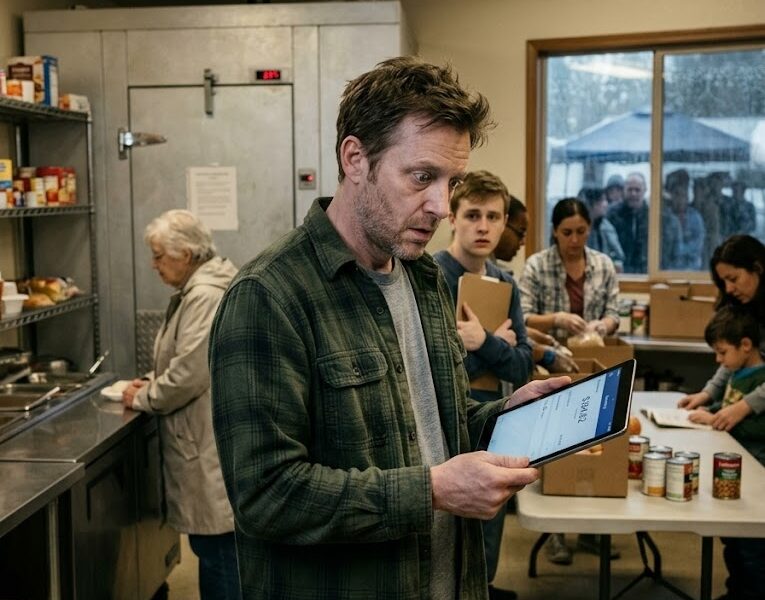
Evan Cole stared at the number beneath the humming fluorescent lights of Harbor House Community Kitchen, certain he had missed a digit.
He refreshed the battered tablet.
$184.62.
He closed the banking app and reopened it.
$184.62.
Behind him, someone laughed softly at one of the children’s homework tables. A metal spoon struck the rim of a stockpot. Tomato sauce simmered on the industrial stove, filling the kitchen with garlic, oregano, and the comforting lie that everything was normal.
Evan looked at the red notices beneath the balance.
GROCERY SUPPLIER — PAST DUE.
UTILITIES — FINAL NOTICE.
LEASE RENEWAL DEPOSIT — DUE IN 21 DAYS.
He stopped breathing for a second.
“Tell me that’s wrong.”
The voice came from behind him.
Evan turned.
Quinton Ror stood beside the walk-in refrigerator with a blue folder pressed against his chest. At forty-seven, Quinton had spent enough years chairing neighborhood committees to make almost any crisis look manageable.
Not this one.
His face had gone gray.
“The fund was full last month,” Evan said.
Quinton looked toward the volunteers.
Seven people were sorting canned beans, rice, dented soup tins and bruised apples into plastic bins. Beyond them, children bent over homework while parents waited for take-home meals before heading to night shifts.
Nobody seemed to have heard.
Quinton lowered his voice.
“How much?”
Evan turned the tablet around.
Quinton stared at the screen.
Then at Evan.
Then back at the screen.
“That’s impossible.”
“Apparently not.”
“The supplier?”
“Friday.”
“The lease?”
“Twenty-one days.”
Quinton swallowed.
“And food?”
Evan looked toward the pantry shelves.
“Three dinners.”
Neither man spoke.
Three dinners.
That was how long eighteen households had before a number on a screen became empty refrigerators in real apartments.
At the nearest table sat Evan’s ten-year-old daughter, Winona.
Her brown hair was pulled into the crooked ponytail she insisted on doing herself. A math worksheet lay beneath one elbow, but she wasn’t looking at the numbers anymore.
She was watching her father.
“Dad?”
Evan locked the tablet.
He crossed the room and crouched beside her.
“Everything okay?”
Behind Winona, two brothers were quietly splitting an orange. At another table, a woman still wearing her hospital housekeeping uniform helped her son sound out words from a library book.
Evan looked at them.
Then he smiled at his daughter.
“For tonight.”
Winona knew him too well.
“That means no.”
“It means tonight is handled.”
“And tomorrow?”
He hesitated.
That was when the side door opened.
Naen Hart walked in carrying a black binder.
At thirty-nine, Naen had the unsettling habit of entering a room as though she’d already identified every exit, every weakness and every decision that would eventually have to be made.
She wore a dark wool coat buttoned to the throat.
Rain glistened across her shoulders.
She placed the binder on the stainless-steel prep counter.
RESTRUCTURING PLAN.
Quinton saw the title and cursed under his breath.
Naen opened the binder.
“We cannot operate on hope.”
Evan slowly stood.
Naen continued.
“The numbers require immediate action.”
“Which means?” Quinton asked.
“Reduced service hours. Fewer deliveries. Enrollment caps. Centralized purchasing. Revised volunteer schedules.”
One by one, the people sorting food stopped moving.
Evan looked at the families.
Then at Naen.
She wasn’t smiling.
That almost made it worse.
There was no cruelty in her face. No satisfaction. She genuinely believed she was describing the least painful way to amputate a limb.
“We’re not cutting the children first,” Evan said.
Naen met his eyes.
“Then somebody needs to explain where the money went.”
The kitchen became silent.
Even the children seemed to feel it.
Evan glanced toward Quinton.
Quinton looked away.
And for the first time that night, Evan understood something far more frightening than being broke.
Someone in that building already knew the answer.
The refrigerator died at 4:52 the next morning.
Evan heard the compressor scream from the hallway.
A violent metallic groan rolled through Harbor House, followed by a sharp pop and the smell of burning insulation.
He ran.
By the time he reached the walk-in, frost was sliding from the ceiling panels.
The temperature display blinked red.
58°F.
Milk.
Eggs.
Vegetables.
Prepared meals.
Thousands of dollars in food were beginning to warm.
Naen appeared thirty seconds later.
“Doors shut,” she ordered. “Move perishables. Call the auditor. Find refrigerated transport.”
Evan stared at her.
“You sleep here?”
“I slept forty-three minutes in my car.”
“That isn’t sleeping.”
“It met the legal definition.”
Despite himself, he almost smiled.
Then Winona appeared at the loading entrance holding a paper bag against her chest.
“Dad?”
Evan’s smile disappeared.
Naen checked her phone.
“The food-safety audit is Thursday.”
“That’s three days.”
“Yes.”
“To replace a commercial refrigerator?”
“To prove this operation can survive.”
Outside, rain had begun turning the parking lot black.
Families were already arriving.
Some carried toddlers.
Some wore warehouse uniforms.
Some checked phones crowded with school messages, work schedules and overdue-bill notifications.
The refrigerator didn’t care.
Hunger didn’t care either.
Naen grabbed a clipboard.
“One household every ten minutes. Fixed pickup windows. No exceptions.”
Evan turned.
“No.”
Her eyes lifted.
“No?”
“Some parents work double shifts.”
“They can send someone else.”
“Some don’t have someone else.”
“This is a food-safety emergency.”
“And they’re still hungry.”
“If this becomes chaotic and we fail Thursday’s audit, everybody loses the kitchen.”
Evan looked through the glass doors.
A delivery driver stood beneath the awning beside an elderly woman using a cane.
A young mother held a sleeping little girl against her shoulder while repeatedly checking the time.
He uncapped a marker.
“Then we don’t make them come here.”
Naen frowned.
Evan walked to the whiteboard.
“Mobile service. Three routes.”
He wrote quickly.
LIBRARY.
BUS DEPOT.
MASON AVENUE APARTMENTS.
“Borrow the refrigerated truck from St. Matthew’s. Evening distribution for parents working late. We move the food instead of making the families fit our emergency.”
Naen stared at the board.
“That creates three inventory points.”
“Correct.”
“Three temperature logs.”
“Yes.”
“Three opportunities for error.”
“Three opportunities to feed people.”
Their eyes locked.
Quinton emerged from the storage room carrying a wrench.
Naen turned toward him.
“Driver?”
“Evan.”
“Loading?”
“Florence and me.”
“Route tracking?”
Evan nodded toward Winona.
“My terrifyingly organized daughter.”
Winona raised her hand.
“I use spreadsheets.”
Naen looked at her.
For the first time, the edge of Naen’s mouth moved.
Barely.
Then it vanished.
“Two-hour windows,” she said. “No missed stops.”
Evan capped the marker.
“No abandoned families.”
“That isn’t measurable.”
“It is if you count people instead of appointments.”
Naen said nothing.
But she drew a line beneath his route plan.
Approved.
For now.
The first truck rolled out at 12:40.
Rain washed the streets silver.
Evan drove.
Naen sat in the passenger seat with a clipboard balanced against one knee.
At Mason Avenue, a father arrived twelve minutes after his assigned window.
His warehouse vest was soaked.
“I ran from the bus,” he said. “Please. I’ve got two kids upstairs.”
Naen looked at her watch.
Evan opened the truck.
“Two meals?”
The man nodded.
“Three,” Naen said.
Evan looked at her.
She didn’t look back.
“One for tomorrow morning.”
They completed every route.
No food spoiled.
Nobody was turned away.
When they returned after dark, Evan handed Naen the clipboard.
“Not bad for inefficient.”
“Tomorrow,” she said, “the schedule gets stricter.”
He looked across the parking lot at families carrying food through the rain.
“Tomorrow it gets kinder.”
Naen’s gaze stayed on him a moment longer than necessary.
“Those are not mutually exclusive concepts, Mr. Cole.”
“Then we’re making progress.”
He walked away.
Naen remained beneath the loading light, watching him help Winona into their aging pickup truck.
She did not yet know that Evan had noticed her hands shaking.
And Evan did not know that before sunrise, Naen would save the kitchen without telling anyone.
Winona found him carrying canned peaches the next morning.
“She stayed all night.”
“Who?”
“Ms. Hart.”
Evan stopped.
“Doing what?”
“Calling the landlord.”
Winona unfolded a printed email.
The lease would not be terminated.
Not yet.
Naen had documented every family served, every emergency expense, every volunteer hour and every dollar raised.
She had bought Harbor House thirty days.
Evan looked through the doorway.
Naen sat alone at a folding table.
Her coat was still buttoned.
Her hair was damp.
A cold paper cup of black coffee stood untouched beside her.
Her phone kept lighting up.
Donors.
Reporters.
Board members.
People demanding answers from the woman who had spent the night preventing them from losing the building.
“She saved it,” Evan said.
Winona shook her head.
“She saved tomorrow.”
Evan looked down at her.
In Winona’s hand was a crooked red paper heart.
Three words had been written across it in blue marker.
THANK YOU FOR STAYING.
“Valentine’s Day is tomorrow,” she said.
Evan already knew where this was going.
“No.”
“Flowers.”
“No.”
“She needs flowers.”
“Your father currently has a romantic budget of approximately negative four hundred dollars.”
“Not romantic flowers.”
“Those are somehow more expensive.”
Winona frowned.
“Kind flowers.”
Evan looked across the room.
Naen pressed two fingers against her temple, then answered another call.
“No name,” Winona said.
Evan glanced at his daughter.
“Why?”
“Because sometimes when people know who was nice to them, they think they owe something back.”
He stared at her.
There were moments when children revealed how closely they had been watching the adults around them.
Those moments frightened him.
An hour later, he bought twelve white tulips and red carnations from a grocery store on Main Street.
Nothing expensive.
Some stems were bent.
Winona tied them with kitchen twine.
She attached the heart.
No signature.
No receipt.
Naen received them beside the copier that afternoon.
“These are for you,” Winona said.
Naen stared at the bouquet.
“From whom?”
Winona pointed to the card.
Naen read it.
Thank you for staying.
Something changed in her face.
Not dramatically.
Naen Hart didn’t do anything dramatically.
Her fingers simply tightened around the stems.
Then she closed her eyes.
Only for a second.
But Evan saw it.
So did Quinton.
“We should check where they came from,” Quinton said. “If somebody’s trying to influence the lease review—”
“No.”
Quinton blinked.
Naen folded the tag gently against the flowers.
“No photographs. No donor post. No public thank-you. No investigation.”
“You don’t know the sender’s intention.”
“Then let one kind thing in this building exist without becoming evidence.”
She walked away carrying the flowers against her chest.
Evan said nothing.
Neither did Winona.
But his daughter slipped her hand into his.
And squeezed.
Two days later, Quinton challenged Naen in front of the entire volunteer staff.
Her restructuring proposal lay across a folding table.
“You want shorter service hours.”
“The current schedule loses money.”
“You want contractors replacing volunteers.”
“For delivery and compliance.”
“You want every family categorized, tracked and measured.”
“The grant requires documentation.”
Quinton gave a humorless laugh.
“There it is. The grant.”
Naen’s expression hardened.
Quinton lifted the packet.
“A mother arrives twelve minutes late because her bus breaks down? Your system calls her a missed appointment. A kid needs an extra meal because there’s nothing at home? Your spreadsheet calls it a budget variance. A grandmother can’t use an online form? She disappears.”
“That is not the intention.”
“Intentions don’t feed people.”
Several volunteers murmured agreement.
Evan was sorting cans near the pantry.
Quinton pointed toward him.
“Evan. You’ve worked this line longer than anybody. Tell her.”
Every face turned.
Evan slowly put down the can.
“The evening line will fail.”
Quinton nodded triumphantly.
Naen didn’t react.
Evan continued.
“The evening crew can’t do intake, cooking, cleanup and delivery checks in two hours. Volunteers will burn out. Families will wait longer. Eventually the numbers will look better because people will stop coming.”
“Exactly,” Quinton said.
“But.”
Quinton turned.
Evan looked around the room.
“Throwing out everything she proposed would be stupid.”
Silence.
“The kitchen needs reliable purchasing. Safer storage. Better records. If we can’t prove what we’re doing, funding disappears anyway.”
Naen folded her arms.
“What would you keep?”
“Central purchasing. Full service hours. Paper intake stays available. Put one volunteer on forms. And measure meals actually served, not appointments completed.”
“That costs more,” Quinton said.
“Less than closing.”
Naen picked up a pen.
“Six-week pilot.”
Quinton stared at her.
She began writing.
“Full hours remain. Centralized purchasing. Paper and digital intake. Weekly review.”
Evan added, “Families get seats at those reviews.”
Naen paused.
“Two.”
“Three,” Quinton said.
She looked at him.
“Three.”
Nobody applauded.
Trust wasn’t restored that easily.
But people returned to work.
And for the first time, Naen Hart had changed a plan because Evan Cole had challenged her.
What Evan didn’t see was Naen touching the anonymous paper heart inside her coat pocket.
The next crisis arrived in a rainstorm.
A delivery truck stalled two blocks from Franklin Avenue Community Church.
Eighty families were expected.
Nearly one hundred forty appeared.
Inside the mobile kitchen van, crates were stacked almost to the ceiling.
Steam fogged the windows.
Naen climbed inside.
Evan followed carrying soup.
“Under the counter,” she said.
“Blocks the propane valve.”
“Move the water.”
“Water’s keeping the floor from flooding.”
“Stack the soup higher.”
“It falls.”
“Not if it’s balanced.”
Evan laughed once.
“Balance isn’t our problem.”
Naen looked at him.
“What is?”
He almost answered.
You think people are problems that can be organized until they stop being inconvenient.
Instead he said, “Nothing.”
Twenty minutes later, Naen reached into the cooler and began removing fresh vegetables.
Evan caught her wrist.
Not hard.
Just enough to stop her.
“Those stay.”
“They’ll spoil if distribution slows.”
“Then children get them first.”
“That creates a bottleneck.”
“Then explain to a six-year-old why we’re throwing vegetables away while handing him canned beans.”
Naen pulled her wrist free.
“Emotional pressure is not a distribution plan.”
“No. It’s noticing who’s standing in front of you.”
Rain hammered the roof.
Neither moved.
Finally Evan opened the cooler.
“Half portions. More bags. Nothing wasted.”
Naen watched him.
“The numbers don’t recommend that.”
“Numbers don’t carry hungry kids up basement stairs.”
Something flashed behind her eyes.
“Dependence creates weakness.”
Evan stopped.
The sentence sounded rehearsed.
Older than this argument.
Older than Harbor House.
He lowered his voice.
“Sometimes dependence is just trust with a different name.”
Naen stared at him.
Then she reached for an empty bag.
She began dividing vegetables.
They worked shoulder to shoulder.
Neither apologized.
Neither admitted the other had changed their mind.
But outside, the line started moving.
Naen discovered the truth about the flowers three days later.
A different bouquet—white lilies this time—sat beside the reception desk, moved there from her office.
The little brown tag was attached with blue thread.
She recognized the handwriting.
She had seen the same rounded letters on a paper butterfly Winona had made for the children’s room.
Naen touched the card.
Then she understood.
Evan.
Not a donor.
Not Quinton.
Not somebody hoping for access.
Evan.
The man who argued with nearly every policy she proposed.
The man who fixed the pantry van without invoicing anyone.
The man who left coffee beside her files and walked away before she could thank him.
The man who apparently believed kindness became less pure the moment somebody demanded credit for it.
Footsteps approached.
Naen turned the card inward.
Evan entered carrying bottled water.
“Loading dock’s flooded.”
“Use the side entrance.”
“Someone’s going to trip.”
“Then put down mats.”
He looked at her.
“You know, for someone who hates improvising, you’re getting suspiciously good at it.”
Naen almost smiled.
Almost.
Later that afternoon, Quinton suggested closing the kitchen at six.
Naen looked at Evan.
“Would that work?”
He checked the bus schedule.
“Last bus reaches Mason Avenue at 6:45. You’d cut off working families.”
Naen nodded.
“Then we stay open.”
Quinton stared.
“That wasn’t the recommendation.”
“No,” Naen said. “It was a question.”
Evan looked at her.
Something had shifted.
He didn’t know why.
She didn’t tell him.
And perhaps that was why it mattered.
The video went online at 3:17 on a Thursday afternoon.
By 3:38, three local television stations had it.
By four, every Harbor House board member had watched it.
Florence Upton called Evan into the maintenance office.
The blinds were closed.
Naen stood beside the conference table.
Quinton was near the door.
On the largest monitor, Naen appeared beside a food distribution line.
Her voice played over the footage.
“We need their stories documented.”
Cut.
Families waiting.
Cut.
Evan carrying boxes.
A caption appeared.
SECRET SPOKESPERSON FOR NAEN HART’S PRIVATE OUTREACH OPERATION.
Cut.
Naen discussing donor confidence.
Cut.
Evan talking about delivery schedules.
Cut.
A mother describing unpaid rent.
The clips were real.
The sequence wasn’t.
Compassion had been edited to resemble exploitation.
Emergency work looked like a publicity operation.
Evan stared at the screen.
“Who made this?”
Nobody answered.
A volunteer coordinator stood near the wall clutching a tablet.
“The public deserves transparency.”
Evan turned.
“That footage was altered.”
“Every word is authentic.”
“Not in that order.”
Silence.
Naen’s face had gone pale.
Evan looked at her.
“Say something.”
She didn’t.
“Naen.”
Her eyes met his.
Still nothing.
The board meeting began eleven minutes later.
Printed screenshots covered the table.
Receipts appeared.
Emergency purchases.
Text messages.
Private conversations about families who needed temporary housing, transportation, groceries.
Everything ordinary became suspicious once somebody framed it correctly.
The chairwoman pushed a stack of pages toward Naen.
“Why was Mr. Cole involved in decisions beyond his formal authority?”
“Because I was standing there when things broke,” Evan said.
The chairwoman ignored him.
“Ms. Hart?”
Naen looked down.
Silence.
Evan waited.
He had seen her stand between frightened families and eviction notices.
He had seen her argue with landlords at two in the morning.
He had seen her work until her hands shook.
But when his name was being dragged through the room, she said nothing.
Something cold settled inside him.
Maybe he’d misunderstood her.
Maybe protecting Harbor House mattered more than protecting him.
The board suspended all joint decision-making pending investigation.
Nobody was convicted of anything.
No final ruling was issued.
It didn’t matter.
Trust had already been sentenced.
When Naen left, she didn’t look at Evan.
Inside her coat was the anonymous tag she’d protected from everyone.
Evan couldn’t see it.
All he saw was her walking away.
At 2:15 the following afternoon, Quinton handed him a suspension notice.
“Effective immediately, you’re removed from all kitchen operations.”
Evan read it.
“No building access. No volunteer contact. No authority over meal distribution.”
“Correct.”
“On what grounds?”
“Conflict of interest. Unauthorized decisions. Conduct exposing the cooperative to reputational and financial risk.”
Evan laughed quietly.
“Reputational risk.”
Across the table, Naen sat rigidly.
Evan looked at her.
Nothing.
Florence pushed another document forward.
“Naen’s emergency funding authorization is also canceled.”
Naen looked up.
“The community meal is tonight.”
“Not anymore.”
“The food has already been ordered.”
“The account is frozen.”
A chair scraped behind Evan.
Someone whispered, “Families are outside.”
Evan turned toward Quinton.
“You’re closing a community kitchen hours before dinner?”
“We’re protecting the cooperative.”
“No.”
Everyone looked at Naen.
She finally lifted her head.
“You’re protecting the board.”
Quinton’s face changed.
It was the first time Evan saw genuine anger crack through his careful professionalism.
“Both of you leave.”
Rain was pouring when Evan reached the entrance.
Families stood beneath the awning.
Children held empty containers.
Winona was near the front.
She looked at the dark kitchen.
Then at her father.
“Dad?”
The lights were off.
No burners.
No steam.
No smell of onions in oil.
Nothing.
Evan had planned to sneak supplies through the side entrance.
Naen had quietly arranged a donor to pay for dinner.
Both plans were now useless.
He stared through the glass.
“We can’t keep doing this.”
Naen stood beside him.
“Doing what?”
“Saving this place in secret.”
Her face was wet from rain.
Or perhaps something else.
Evan didn’t ask.
“Every time there’s a crisis, one person makes a call. Somebody moves money. Somebody bends a rule. Somebody decides what’s best.”
Naen looked at the families.
“Then the problem isn’t who’s in charge.”
“No.”
“It is that somebody is.”
A little boy pressed his palm against the glass.
Evan stared at that tiny hand.
Then he understood.
He pulled a yellow legal pad from the office supply cabinet accessible from the lobby.
Naen found a marker.
“What are you doing?”
“Writing us out.”
For the first time in days, she smiled.
“Move over.”
They placed the pad on a folding table beneath the dark serving window.
COMMUNITY TRUST CHARTER.
Every donation publicly recorded.
Every expenditure visible.
Families receiving services granted voting representation.
Volunteers electing kitchen coordinators.
No private executive override.
No closed financial committee.
No single person controlling purchasing, hiring or distribution.
Evan wrote another clause.
Quinton, watching from inside, read it through the glass.
“What does that say?”
Evan held it up.
NO EXECUTIVE POSITION MAY CONTROL EMERGENCY FUNDS WITHOUT COMMUNITY REVIEW.
Then Evan signed beneath it.
Naen stared at his signature.
“You understand what that costs?”
“Control.”
“Your position.”
He looked at the suspension paper.
“I think they handled that part.”
Naen took the pen.
She signed too.
One mother stepped forward.
Then a volunteer.
Then an elderly man whose hand shook so badly Evan had to steady the paper.
Naen turned toward the crowd.
“This kitchen cannot belong to two people making private decisions, even when those decisions are good.”
Her voice carried beneath the awning.
“If Harbor House exists to serve this neighborhood, then this neighborhood should have the power to question it.”
More people stepped forward.
Florence appeared inside.
Quinton stood beside her.
Neither spoke.
Then Florence unlocked the door.
The missing money was discovered that evening.
Not stolen.
Moved.
Quinton had authorized an emergency transfer into a restricted reserve account after learning that Harbor House’s insurer might cancel coverage over unresolved building repairs.
He had intended to move it back.
Then the refrigerator failed.
Then the lease crisis exploded.
Then the edited video appeared.
Fear had turned a temporary decision into a secret.
The same disease infecting everything else.
People with good intentions had begun believing transparency was optional when the stakes were high enough.
Quinton placed the transfer documents on the table.
“I thought I was protecting the kitchen.”
Evan looked at him.
“You should’ve told us.”
“I knew you’d spend it on food.”
“Yes.”
“And if the insurance had lapsed?”
“We would’ve argued about it.”
Quinton gave a bitter laugh.
“That was what I was trying to avoid.”
Naen looked around the crowded hall.
“That may be the problem.”
Everyone turned.
“We have spent weeks treating disagreement like failure.”
She closed the binder containing her original restructuring proposal.
“Maybe disagreement is what keeps power honest.”
Nobody said anything.
Quinton sat down.
For once, he had no answer.
Harbor House reopened before sunset.
Not because a billionaire appeared.
Not because a miracle donation landed in the account.
Not because one heroic person saved everyone.
The locks were changed.
Inventory was counted in public.
Bank access required multiple elected signatories.
Financial reports went on the wall beside the meal schedule.
Three family representatives joined the governing committee.
Volunteers received votes.
The kitchen became harder to control.
That was exactly the point.
Naen signed the document surrendering her executive authority.
She placed her key on the table.
“No hidden influence.”
Evan nodded.
“No hidden rescues.”
Winona raised her hand.
Everyone looked at her.
“And nobody closes before the last bus.”
Laughter broke across the room.
Naen smiled.
“Put it in the charter.”
Winona did.
In blue marker.
Several weeks later, the work had become ordinary again.
Evan repaired a loose cabinet hinge.
Florence checked invoices.
Quinton fixed the old freezer and posted the repair cost where everyone could see it.
Winona helped younger children with homework.
Naen sat at a folding table drinking coffee while it was still hot.
That might have been the greatest miracle of all.
Nobody commanded the room.
People simply worked.
One evening, Evan stepped outside.
Rain had softened to mist.
Streetlights reflected across the wet pavement.
Behind him, the kitchen smelled of bread, onions and tomato soup.
The door opened.
Naen came outside.
She wasn’t wearing her formal coat.
In her hands was a small brown box tied with dark green string.
Evan looked at it.
“That looks suspiciously like an undisclosed donation.”
“Very funny.”
She stopped beside him.
“The flowers.”
His expression changed.
Naen continued.
“The handwriting on the tag. The blue thread. The crooked corner.”
Evan looked toward the parking lot.
“Winona can’t cut a straight line to save her life.”
“I know.”
“So you knew.”
“Eventually.”
“How long?”
“Long enough.”
He nodded.
For some reason, that embarrassed him more than being accused in front of the board.
“I wasn’t trying to—”
“I know.”
“Winona thought you needed them.”
Naen looked through the window.
Winona was laughing with another child inside.
“She was right.”
Evan glanced at her.
Naen held out the box.
“Take it.”
He opened it.
Dark chocolate.
He smiled.
“Is this repayment?”
“No.”
“Influence?”
“No.”
“Attempted corruption?”
“Definitely.”
He laughed.
Naen did too.
Then the laughter faded.
For a moment they stood beneath the mist without needing to fill the silence.
Evan finally said, “Why didn’t you defend me?”
Naen’s eyes dropped.
There it was.
The question neither of them had been able to outrun.
“I was trying to identify who leaked the footage.”
“You could have told me.”
“If I accused the wrong person, the evidence would’ve disappeared.”
“So you let me think you didn’t trust me.”
“Yes.”
The answer hurt because it was honest.
Naen looked at him.
“I made the same mistake Quinton made.”
Evan waited.
“I decided that because my reason was good, I didn’t need to explain my choice.”
Rain gathered on the railing.
“And was it worth it?” he asked.
“No.”
She didn’t hesitate.
“That is the part I learned too late.”
Evan looked through the window.
Families were entering through the side door carrying pans, notebooks and folded aprons.
No executive waited to tell them where to stand.
No donor’s name hung above the stove.
Nobody in that room possessed enough power to secretly save it anymore.
Which meant nobody possessed enough power to secretly destroy it either.
Naen moved toward the door, then stopped.
“Evan.”
“Yeah?”
“Thank you for staying.”
He looked at her.
The same words Winona had written on that crooked paper heart.
Only now they meant something different.
He nodded toward the kitchen.
“So did you.”
Naen opened the door.
Warm light spilled onto the wet pavement.
Inside, Winona was setting bowls along a table. Florence was arguing with Quinton about whether he’d overpaid six dollars for a replacement valve. A tired mother had arrived late from work, and nobody pointed at a clock.
Evan remained outside for one more second.
Years earlier, after his wife died, he had believed strength meant becoming the person who never needed anyone.
He worked two jobs.
Fixed his own truck.
Learned to braid Winona’s hair badly.
Skipped meals without admitting he was hungry.
He had mistaken endurance for independence because grief made dependence feel dangerous.
Naen had made the same mistake differently.
She built systems because systems didn’t abandon you.
Quinton hid decisions because arguments frightened him more than secrecy.
And Harbor House nearly died because too many good people had convinced themselves that carrying everything alone was the same thing as caring.
Evan looked at the kitchen.
Maybe a community wasn’t a place where nobody fell.
Maybe it was a place where falling didn’t mean falling alone.
He stepped inside.
Naen was already tying on an apron.
“You cook?” he asked.
“No.”
“That worries me.”
“It should.”
Winona appeared between them carrying a wooden spoon.
“Dad, we’re out of tomatoes.”
Evan looked toward the pantry.
“No, we’re not.”
He opened a cabinet.
Three cans remained.
For a moment he remembered another night beneath those same fluorescent lights.
$184.62.
Three dinners left.
A missing account.
Eighteen families about to lose the one room where nobody asked them to be ashamed of needing help.
Now a handwritten financial report hung beside the cabinet.
Every dollar was visible.
Every decision had a name.
Every person had the right to ask why.
Evan handed Winona the tomatoes.
She carried them toward the stove.
The first can opened with a metallic click.
Then another.
Around them, chairs scraped, children laughed and someone turned on an old radio near the sink.
Nothing about the sound was extraordinary.
That was what made Evan close his eyes for a moment.
The kitchen had survived.
But not because he saved it.
Not because Naen saved it.
They had finally stopped trying to.
Outside, the last of the rain slid from the windows.
Inside, the soup began to simmer.
And taped beside the new community charter was an old, crooked paper heart nobody had thrown away.
Three words remained written across it in a child’s uneven blue handwriting:
THANK YOU FOR STAYING.









