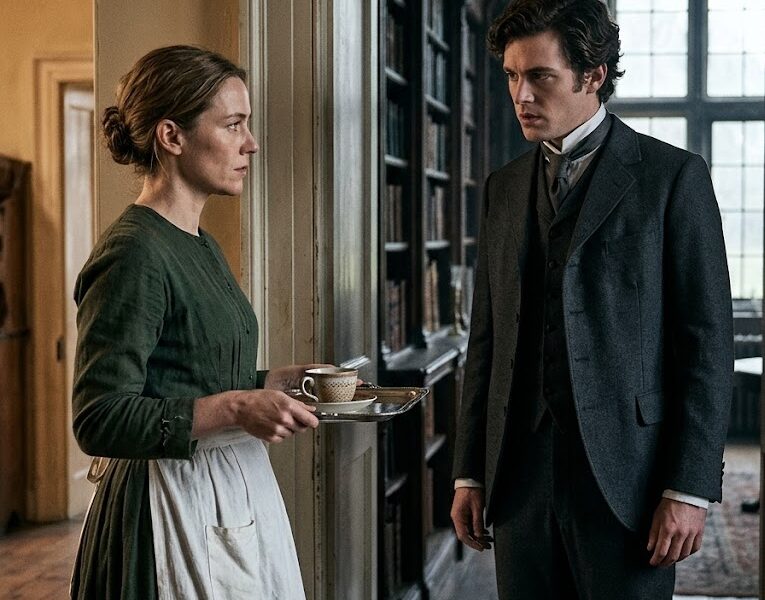
The Old Duke Told His Widowed Cook to Marry His Cold-Hearted Son—But When She Walked Away, the Duke Learned What It Meant to Beg for Love
The old duke laughed when he told his widowed cook that she ought to marry his son.
His son, standing in the doorway, looked at her with contempt and warned her never to entertain such ambitions.
Months later, that same proud man would stand before London’s finest society, offering her everything he possessed—only to hear her tell him that his title could not purchase her trust.
The carriage wheels crunched along the neglected gravel drive, and Margaret Harrow pressed her gloved hands together to keep them from trembling.
Beyond the windows, ancient oak trees stood beneath the heavy green weight of late summer. Their branches formed a shadowed passage toward Ashkam Hall, whose gray stone walls rose against the Sussex sky with the solemn dignity of a house that had forgotten how to welcome visitors.
Beside her, seven-year-old Nell leaned toward the window, leaving a small cloud of breath upon the glass.
“Is that where we’re going to live, Mama?”
“For a little while, darling.”
“It looks like a castle.”
Margaret followed her daughter’s gaze. The house was immense, its tall windows reflecting a sky already gathering clouds. Yet several shutters hung crookedly, and weeds had begun to conquer the edges of the driveway.
“It is somebody’s home,” she said. “And we must remember that.”
Nell turned toward her.
“Will they be kind?”
Margaret could not bring herself to promise something she did not know.
“We shall be kind first,” she answered.
It was a lesson she had repeated often during the three years since her husband’s death. Sometimes she wondered whether she believed it herself anymore.
At thirty-two, Margaret had learned how swiftly kindness could disappear when a woman lost the protection of a husband’s name and income. She had worked in a merchant’s household in Lewes, endured the quiet judgment of servants who considered her too young to remain alone and too attractive to escape suspicion.
She had kept her head down, her accounts exact, and her kitchen immaculate.
The advertisement in the county newspaper had promised fair wages, accommodation for one child, and a quiet household. Margaret had answered because quiet was something she desperately needed.
When the carriage stopped, she straightened Nell’s bonnet, gathered their modest belongings, and stepped into the courtyard.
A housekeeper was waiting beneath the servants’ entrance.
Mrs. Kraock was a thin woman whose severe black dress seemed as rigid as her expression. Her pale eyes passed over Margaret’s neat traveling clothes before settling upon Nell.
“The child is to remain out of the principal rooms.”
“Of course.”
“And you are to understand that this is a household of considerable standing.”
Margaret glanced briefly at the cracked stone step beneath the woman’s feet.
“I understand the importance of a household being properly maintained.”
Mrs. Kraock’s mouth tightened.
“Come with me.”
They passed through narrow corridors where cold air lingered despite the warmth outside. The carpets were expensive but worn, the curtains heavy with dust. Portraits stared down from paneled walls, their gilded frames dull beneath years of neglect.
Ashkam Hall was not merely old.
It was lonely.
Margaret recognized the difference. She had lived inside that kind of silence herself.
In a small downstairs parlor, Mrs. Kraock explained her duties.
“You will prepare meals for His Grace, the elder Duke of Ashkam. His son, Lord Julian, takes his meals privately in the study and is not to be disturbed. You will not address him unless he addresses you first.”
“I understand.”
“You will not involve yourself in family matters.”
“Nor would I wish to.”
The housekeeper studied her, perhaps searching for some sign of nervous submission.
Margaret simply waited.
At last, Mrs. Kraock led them to the kitchen.
It was a magnificent room, with a stone hearth large enough to roast an entire ox, long preparation tables, and windows overlooking an enclosed garden. Copper pots hung above the stove, though several had lost their shine. The cupboards were generous, but their contents revealed the unmistakable signs of a household that had stopped taking pleasure in its meals.
Their sleeping quarters consisted of a narrow room above the scullery.
There was one bed, a small washstand, and a window overlooking the garden.
Nell walked straight to the window.
“Mama, there are roses.”
Margaret set their valise upon the floor and looked outside.
The garden was tangled, neglected, and beautiful despite itself.
“Yes,” she said softly. “There are.”
That evening, after Nell had fallen asleep, Margaret sat at the edge of the bed and counted the coins remaining in her purse.
She had enough to pay for a physician if Nell fell ill, enough for a few small necessities, and very little else.
She closed the purse and placed it beneath her pillow.
Tomorrow, she would begin again.
Three days later, the elder Duke of Ashkam found her kneading bread in the kitchen.
“You are the new cook, I believe.”
Margaret turned with flour dusting her wrists.
The gentleman standing behind her was older than she had imagined. His white hair had thinned, deep lines marked his face, and he leaned upon a polished walking stick. Yet there was something lively in his eyes, a glimmer of amusement that age had apparently failed to extinguish.
“I am, Your Grace.”
She wiped her hands upon her apron and curtsied.
Edward Ashkam nodded toward the dough.
“Does your bread have a name?”
Margaret blinked.
“A name, Your Grace?”
“My mother named her loaves. Claimed it made them rise better. Agatha was always the difficult one. Stubborn creature, apparently, but dependable in the end.”
Margaret looked down at the dough beneath her hands.
“This one might be called Harold.”
“Harold?”
“He has been giving me trouble all morning.”
For a moment, the old gentleman stared at her.
Then he laughed.
It was a wonderfully rusty laugh, as though it had been waiting years to escape his chest.
“Harold,” he repeated. “An excellent name for a troublesome loaf.”
Margaret smiled despite herself.
The duke stepped farther into the kitchen.
“Would you bring me tea at four o’clock? I find that hour particularly disagreeable.”
“Certainly, Your Grace.”
“And perhaps you might stay a little while. My son is forever occupied with the serious business of being important.”
Margaret hesitated.
A cook did not take tea with a duke. There were rules, invisible but fiercely guarded, that separated people like her from people like him.
Yet she saw something behind his humor.
Loneliness.
The kind that made even an enormous house feel unbearably small.
“I can bring your tea, Your Grace,” she said. “But I ought not to sit.”
“We shall begin there, then.”
And so they did.
Every afternoon at four, Margaret carried a silver tray into Edward’s sitting room. At first, she remained standing beside the doorway, answering his questions politely while he drank his tea.
Where had she learned to cook?
From her mother.
Was Nell settling comfortably?
As comfortably as a little girl could settle anywhere unfamiliar.
Did Margaret believe in ghosts?
“I believe houses remember the people who lived in them, Your Grace.”
Edward’s expression changed at that answer.
He looked toward the portrait of a dark-haired woman above the fireplace.
“So do I,” he said.
Her name had been Eleanor.
His wife had died many years before, leaving him with a twelve-year-old son and a grief he had never learned to carry properly.
Sometimes Edward spoke of her with affection. Sometimes he said very little, turning the handle of his teacup between his fingers while Margaret waited without pressing him.
Eventually, he began asking about Margaret’s husband.
She told him that Thomas had been a decent man with a gentle disposition and an unfortunate tendency to believe that every problem could be repaired through hard work.
When illness had taken him, she had discovered how little the world cared for his good intentions.
“He left me a daughter,” Margaret said one afternoon. “That was more than enough to make the marriage worth remembering.”
Edward looked at her for a long moment.
“You loved him.”
“I did.”
“And you miss him?”
She considered the question.
“Sometimes I miss the person I was when he was alive.”
The duke did not answer immediately.
Then he nodded.
“I understand that rather well.”
As September passed into October, something began changing inside Ashkam Hall.
The kitchen smelled of warm bread again.
Fresh flowers appeared in rooms that had stood forgotten for years. Edward began eating with greater appetite, requesting dishes he remembered from childhood and complaining cheerfully when Margaret refused to give him a second helping of pudding.
Nell occasionally encountered him in the garden, and he discovered that the little girl enjoyed drawing animals.
He bought her a proper sketchbook.
Margaret protested.
“It was gathering dust in a shop,” Edward replied. “Far better that it should be used.”
She accepted only after he agreed that the gift would not become a habit.
One evening, Margaret found him in the library, a glass of brandy beside his elbow.
He had been reading a letter from an old friend, but the page lay forgotten upon his lap.
“You are wasted in that kitchen, Mrs. Harrow.”
She placed his supper tray on the table.
“I have a daughter to feed, Your Grace. A lively mind does not pay a butcher.”
“No,” he agreed. “But it makes life considerably more interesting.”
She smiled and began arranging the dishes.
Then Edward said something so unexpected that her hand stopped above the silverware.
“You ought to marry my son.”
Margaret stared at him.
“I beg your pardon?”
“Julian. You should marry Julian.”
“Your Grace—”
“He is intelligent, capable, and entirely too proud for his own good. He needs someone who will not bow whenever he enters a room.”
Margaret shook her head.
“I am your cook.”
“You are a woman with courage. I have known plenty of titled ladies who could not claim as much.”
“Your son would never consider—”
“I would never consider what?”
The voice came from the library doorway.
Margaret turned.
Julian Ashkam stood beneath the carved arch, one hand resting against the dark wood.
He was tall and broad-shouldered, with dark hair and a face whose severe beauty seemed almost deliberate. His black coat was perfectly fitted, his posture impeccable, and his eyes moved between his father and Margaret with an expression that made her skin grow cold.
Edward appeared entirely untroubled.
“I was suggesting that Mrs. Harrow ought to marry you.”
Julian’s gaze settled upon her.
“Were you?”
His tone made the words sound less like a question than an accusation.
Margaret straightened.
“Your father was teasing, my lord. I have no such ambitions.”
Julian studied her a moment longer.
“See that you do not.”
The silence that followed was absolute.
Then he turned and walked away.
Margaret remained beside the supper tray, her face burning.
Edward sighed.
“Do not mind him. He has forgotten that manners are useful even when one possesses a title.”
Margaret folded her hands before her.
“With respect, Your Grace, I would prefer that the subject not be raised again.”
For the first time that evening, the old duke looked ashamed.
“You are quite right.”
She curtsied and left the room.
In the corridor, she stopped long enough to steady her breathing.
She had endured whispered insults, unpaid wages, and the condescending generosity of people who believed poverty made a woman grateful for any scrap of attention.
She had never imagined that simple companionship with an elderly gentleman could make her appear ambitious.
By morning, she had decided to avoid his son whenever possible.
Unfortunately, Julian Ashkam had made a different decision.
He intended to watch her.
Julian had learned distrust early.
After his mother died, his father had withdrawn into grief, leaving the boy to inherit responsibilities long before he possessed the knowledge to bear them. Estate managers had spoken to him as though he were a child until money was at stake, then expected the judgment of a grown man.
He had learned to read accounts, negotiate with tenants, and recognize flattery.
He had also learned that affection could become another form of demand.
His father, however, seemed to have forgotten every hard lesson life had taught them.
The new cook laughed with him.
He gave her books.
He spoke of her with the warmth he rarely showed his own son.
Julian could not decide which part troubled him most.
One morning, he entered the kitchen without announcing himself.
Margaret was kneading dough. Nell sat nearby, carefully drawing a horse with a piece of charcoal.
“Young lady,” Julian said. “What is your name?”
Nell looked up.
“Nell, my lord.”
“Go upstairs.”
The child glanced at her mother.
Margaret put down the dough.
“Go on, darling. I shall be there shortly.”
When the little girl had gone, Margaret turned back to him.
“Was there something you required?”
“You spend a considerable amount of time with my father.”
“He asks for my company.”
“And you have found it difficult to refuse?”
“I have found no reason to refuse.”
Julian stepped closer.
“My father is elderly. He is lonely. He is also a wealthy man.”
Margaret’s hands became still.
“A woman in your circumstances might see certain opportunities.”
She regarded him without speaking.
For the first time, Julian noticed how tired she looked.
There were faint shadows beneath her eyes, and a small burn marked one wrist.
Yet her voice, when she answered, remained perfectly steady.
“A woman in my circumstances has spent the last three years making certain her daughter does not go hungry. I have had neither the time nor the inclination to hunt for fortunes.”
“My father is generous.”
“He has been kind.”
“Kindness can be exploited.”
“Yes,” Margaret said. “It can.”
Something in her expression made him uneasy.
She removed her apron, folded it carefully, and placed it upon the table.
“I cook your meals. I maintain the kitchen. I accept the wages agreed upon when I came here. If you believe I have done otherwise, you are welcome to examine the accounts.”
“And if I discover something?”
“Then you may dismiss me.”
He looked at her for several seconds.
“And if I discover nothing?”
“Then I should hope you might allow me to work in peace.”
Julian’s jaw tightened.
“Your bread is burning.”
He turned and left.
Only after his footsteps faded did Margaret hurry to the oven.
The bread was not burning.
She stared at the perfectly golden loaves and felt a small, bitter laugh rise in her throat.
Over the following weeks, Julian made himself an increasingly unpleasant presence.
He demanded meals at irregular hours, returned dishes without explanation, and questioned Mrs. Kraock about Margaret’s conduct.
The housekeeper seemed delighted by the attention.
She examined every account, checked the pantry stores, and asked questions about Margaret’s references.
Nothing was amiss.
Margaret worked from dawn until late evening.
Nell remained polite and quiet.
The kitchen was cleaner than it had been in years.
And every afternoon, Edward still laughed during his tea.
Sometimes Julian heard that laughter through the library door.
He would pause in the corridor, intending to continue toward his study, and find himself listening.
His father’s voice sounded younger.
Margaret’s replies were lively but never ingratiating.
The ease between them was something Julian had not experienced with Edward since childhood.
He told himself he resented the intimacy.
Privately, he began to understand that he envied it.
One chilly afternoon, he found them in the kitchen garden.
Edward sat on a bench with a blanket over his knees. Margaret stood beside the roses, pruning the last exhausted blooms of the season.
They were discussing a novel Edward had lent her.
“The fellow was a fool,” Edward declared. “He should have confessed his feelings.”
“Perhaps he was frightened,” Margaret replied.
“Frightened of what?”
“Of discovering that the woman did not love him.”
“Then he ought to have risked it.”
Margaret clipped a dead rose from its stem.
“Fear makes fools of us all, Your Grace.”
Edward chuckled.
“And what would you have done in the lady’s position?”
“I would have walked away.”
“Even if you loved him?”
“Especially then. A woman who spends her life begging for affection eventually forgets that she deserves to receive it freely.”
“That is a cold philosophy,” Julian said from behind them.
Margaret’s shears paused.
Edward looked up.
“Julian. How delightful. Come and disagree with us properly.”
“I came to tell you Lord Percy Whitmore will arrive tomorrow.”
Edward brightened.
“Percy! Excellent fellow. A little too fond of hearing himself speak, but excellent nonetheless.”
Margaret returned her attention to the roses.
“I shall prepare a suitable dinner.”
“Lord Percy has particular tastes,” Julian said. “I trust you will not disappoint him.”
She looked at him.
“I have never disappointed a guest in my kitchen, my lord. I do not intend to begin tomorrow.”
Julian felt that familiar irritation.
And beneath it, an increasingly uncomfortable admiration.
He left without another word.
But long after he returned to his study, her earlier words remained with him.
A woman who spends her life begging for affection eventually forgets that she deserves to receive it freely.
He had never begged for affection.
He had spent most of his adult life persuading himself that he did not require it.
Lord Percy Whitmore arrived the next afternoon beneath a clear autumn sky.
He was a handsome, golden-haired gentleman, three years younger than Julian, with an easy laugh and a habit of making strangers feel immediately welcome.
He embraced Edward, greeted Julian warmly, and insisted upon visiting the kitchen to compliment the person responsible for the delicious smells drifting through the house.
“You must be Mrs. Harrow.”
Margaret turned from the stove.
“I am, my lord.”
“I have heard extraordinary things about your cooking. I hope you understand that I have traveled here with expectations bordering on unreasonable.”
She smiled.
“I shall do my best not to send you home disappointed.”
Percy laughed and bowed over her hand.
“I am already reassured.”
Julian stood in the doorway.
He watched Percy’s fingers close around Margaret’s hand and felt an absurd urge to pull his friend away.
The realization astonished him.
Percy was charming with everyone. His friendliness was so habitual that it had long ceased to mean anything.
Yet Julian suddenly found it unbearable.
Dinner was exquisite.
Margaret prepared a clear soup, roast pheasant with truffles, and a lemon tart whose delicate filling brought Percy to an appreciative silence.
When she entered the dining room to receive the gentlemen’s compliments, Percy rose.
“Mrs. Harrow, I have dined at some of London’s finest establishments, and I assure you that your tart would put many of their kitchens to shame.”
“You are very kind, my lord.”
“I am being entirely selfish, I assure you.”
He smiled.
“In fact, I have been seeking someone capable of managing my household at Greystone. The position includes a comfortable cottage, generous wages, and considerable independence.”
Margaret’s expression changed.
Percy noticed.
“The estate is near Lewes,” he continued. “There is an excellent school. Your daughter would be most welcome.”
Before Margaret could answer, Edward leaned forward.
“Percy, are you attempting to steal my cook?”
“I am offering her an opportunity.”
“She is content here.”
“Perhaps. But contentment is not the same as security.”
Julian set down his glass.
“Mrs. Harrow is employed at Ashkam Hall.”
Percy glanced at him.
“Yes, Julian. I had gathered as much.”
“If you require household staff, I can recommend several suitable candidates.”
“How generous. Yet I believe I have already found one.”
Margaret felt her cheeks warm.
“Gentlemen, I appreciate Lord Percy’s offer, but I am satisfied with my present position.”
Julian turned toward her.
“Then the matter is settled.”
Her expression cooled.
“I believe that is what I have just said, my lord.”
Edward began laughing.
“Do you see, Percy? She is the only person in this house who can correct my son without raising her voice.”
“She has my admiration,” Percy replied.
Edward smiled mischievously.
“I have already informed her that she ought to marry him.”
Julian’s expression hardened.
“Father.”
“What? A man is permitted to recognize a good match.”
Percy gave Margaret a thoughtful glance.
“Even stubborn gentlemen have been persuaded to change their minds.”
Julian rose.
“I shall leave you to your amusement.”
He walked out before anyone could answer.
Margaret kept her gaze upon the table.
She did not look after him.
But Percy noticed that her fingers had tightened around the folded napkin she carried.
He said nothing.
Three days later, Edward collapsed in the garden.
A footman found him lying beside the rose bushes, his walking stick fallen across the path.
Margaret heard the shouting from the kitchen and ran outside before she had time to remove her apron.
Edward was conscious but pale, his breathing shallow.
She knelt beside him and took his cold hand.
“Your Grace?”
His eyes opened slightly.
“Margaret,” he whispered. “I seem to have made rather a nuisance of myself.”
She managed a fragile smile.
“You shall have to do better than this if you wish to escape your supper.”
He tried to laugh, but the effort made him wince.
By evening, three physicians had examined him.
Their conclusions were cautious and troubling.
His heart was failing.
The strain of his years had finally begun demanding payment.
Julian spent hours outside the sickroom, speaking to doctors, sending instructions to servants, and reviewing arrangements he could scarcely bear to contemplate.
He appeared composed.
Only his hands betrayed him.
They remained clasped so tightly behind his back that the knuckles turned white.
Late that night, Margaret found him alone in the library.
A single candle burned upon the desk.
He sat in an armchair beside the window, staring into the darkness.
She carried a tray of tea.
“You should rest, my lord.”
“Rest?”
He gave a humorless laugh.
“My father is eighty-three years old, Mrs. Harrow. The physicians seem determined to remind me of that.”
She set down the tray.
“He is stronger than they know.”
“He is the only family I have.”
The words came out harshly.
Julian looked away, ashamed of the weakness he had allowed her to hear.
Margaret did not hurry to comfort him.
She knew that grief sometimes needed silence more than reassurance.
After a while, Julian spoke again.
“I have not been fair to you.”
She remained standing.
“No, my lord.”
He looked up, startled by her honesty.
“I believed you wanted something from him.”
“I know.”
“I watched the two of you. You made him laugh.”
Margaret lowered her eyes.
“He has been good to Nell and me.”
“He has barely laughed in years.”
Julian leaned forward, resting his elbows upon his knees.
“I resented you for something I could not give him.”
The confession seemed to cost him more than he had expected.
Margaret studied him.
For the first time, she saw beyond his cold manners and impeccable clothes.
There was a frightened man sitting before her.
A man who had spent twenty years mistaking control for safety.
“I am not your enemy,” she said.
“I know that now.”
He stood.
For a moment, neither moved.
Then Julian crossed the small distance between them and lifted one hand toward her face.
Margaret could have stepped away.
She ought to have.
Every practical instinct she possessed warned her of the danger.
A gentleman of his standing could survive a moment of indiscretion.
A widowed cook with a young daughter might lose everything.
Yet when his fingertips touched her cheek, she discovered that her heart had already made a decision her mind refused to acknowledge.
“I want to know you,” Julian said quietly.
She looked into his eyes.
“Then you must learn to speak to me as though I am someone worth knowing.”
Something changed in his expression.
He bent toward her.
And kissed her.
It was gentle, uncertain, and astonishingly brief.
For one suspended moment, the silence of Ashkam Hall seemed to disappear.
Then Julian drew back.
His face changed.
Margaret saw the fear enter his eyes before he spoke.
“I cannot do this.”
She became very still.
“Cannot?”
He stepped away.
“It would be impossible. My position, your employment, the household—”
“Of course.”
“Margaret—”
“Please do not.”
Her voice was remarkably composed.
That composure seemed to wound him more than anger would have.
“I did not intend—”
“No,” she said. “I do not think you did.”
She turned toward the tray, carefully adjusting a teaspoon that needed no adjustment.
“I shall submit my resignation in the morning.”
Julian stared at her.
“There is no need for that.”
“There is every need.”
“Mrs. Harrow—”
“I will not remain here to become an embarrassment to you.”
He opened his mouth, but nothing came.
Margaret curtsied.
“Good night, my lord.”
She walked out of the library without looking back.
Only after reaching the servants’ staircase did she press a hand against her mouth.
For a terrible moment, she could not breathe.
She had thought herself wiser than this.
She had mistaken his loneliness for tenderness, his confession for courage, and one brief kiss for the beginning of something that could never exist.
Upstairs, Nell was sleeping.
Margaret sat beside her, smoothing a strand of dark hair away from her forehead.
Then she took out her writing paper.
She had a friend in London named Sarah, a woman who had known her before Thomas died and who would understand the things Margaret could not say aloud.
She wrote until the candle burned low.
She told Sarah about Edward’s kindness, about the strange happiness she had found at Ashkam Hall, and about Julian.
She admitted what she had not admitted to herself.
That she loved him.
Not because he was handsome or titled or wealthy, but because she had glimpsed a lonely, frightened man beneath his pride and imagined that he might one day be brave enough to let himself be loved.
Then she wrote the words that brought tears to her eyes.
I loved him, Sarah. I loved him, and when he stepped away from me, I felt as though I had suddenly become something shameful. Perhaps I was foolish to imagine that I could ever be enough for a man like him. But I will not make myself smaller to earn another person’s affection. I will not beg.
She folded the letter, sealed it, and left it upon the hall table for the morning post.
She never saw it leave Ashkam Hall.
Edward found the letter the following morning.
He had begun recovering, though the physicians still insisted upon rest. He was crossing the hall with the help of his cane when he noticed Margaret’s handwriting.
Recognizing Sarah’s London address, he intended to ask whether Margaret needed assistance arranging the post.
Then he saw her resignation lying beside it.
Alarmed, he carried both papers into his sitting room.
He opened the letter.
It was an intrusion he would later regret, but by the time he understood what he was reading, the damage had already been done.
He rang for his son.
Julian arrived to find Edward sitting beside the fire, the letter trembling in his hands.
“You are a fool,” Edward said.
Julian frowned.
“Good morning to you as well, Father.”
“Do not attempt to be clever.”
Edward held out the letter.
“Read that.”
Julian glanced at the envelope.
“It is addressed to someone else.”
“I am aware of that. I have already committed the discourtesy of opening it, and I shall apologize to Mrs. Harrow. But you must understand what your cowardice has done.”
Julian took the paper.
As he read, the color drained from his face.
He reached the final lines and stopped.
Then he read them again.
“I did not know,” he whispered.
Edward’s expression tightened.
“Of course you did not. You have spent your life refusing to ask anyone what they feel.”
Julian lowered the letter.
“Father—”
“She made this house a home again. She made an old man remember that he was still alive. And you repaid her by treating her affection as something beneath you.”
“I never thought she was beneath me.”
“Then why did you behave as though she were?”
Julian could not answer.
Edward leaned back against his pillows.
“I have made mistakes with you, my boy. I know that. When your mother died, I left you alone with responsibilities no child should have carried.”
His voice shook.
“I cannot recover those years. But I had hoped you might learn, before it was too late, that loving someone is not the same as surrendering yourself.”
Julian looked down at the letter again.
His hands were trembling.
“Where is she?”
Edward closed his eyes.
“She was to leave this morning.”
Julian turned and hurried from the room.
By the time he reached the servants’ quarters, Margaret and Nell were gone.
The small room above the scullery had been swept clean.
The bed was made.
On the washstand stood the sketchbook Edward had given Nell, with a little drawing tucked inside.
It showed Ashkam Hall surrounded by roses.
Margaret had left everything in order.
Even her departure had been conducted with the quiet consideration that Julian had mistaken for calculation.
He rode to London that evening, searching for Sarah at the address on the letter.
She could tell him only that Margaret had accepted employment in Bath.
She did not know the household’s address.
Or perhaps she had decided that Julian did not deserve to know it.
He returned to his London club and found Percy Whitmore there.
His friend listened without interruption.
When Julian finished, Percy regarded him with an expression close to pity.
“She has begun making a new life,” Percy said.
“Where?”
“In Bath.”
“With whom?”
Percy paused.
“There is a respectable widower who has shown her interest. A good man, from everything I understand.”
Julian gripped the back of a chair.
“Does she love him?”
“That is hardly your concern now.”
“She cannot love him.”
Percy’s eyes narrowed.
“You have an extraordinary talent for deciding what Mrs. Harrow is permitted to feel.”
Julian looked away.
Percy continued more gently.
“She deserves peace, Julian. Something you seem incapable of offering her.”
“I love her.”
“Then I am sorry for you.”
Julian looked back.
“She loved me.”
“Yes,” Percy said. “I believe she did.”
The past tense struck harder than any accusation.
Julian returned to Ashkam Hall with Margaret’s letter folded inside his coat.
For days, he scarcely spoke.
He walked through the kitchen garden where she had pruned roses. He passed the library chair where she had stood with his father’s tea. He found himself listening for footsteps that would never come.
He began to understand that he had spent years protecting himself from the possibility of loss.
And in doing so, he had created it.
Several weeks later, Lord and Lady Ashford held a ball at their London residence.
Margaret attended as Percy’s guest.
After leaving Bath, she had accepted his renewed courtship. He had been considerate, patient, and completely honest about his intentions.
He offered companionship, financial security, and a home where Nell would be cherished.
Margaret knew that such an offer deserved serious consideration.
She also knew she could not manufacture affection simply because someone had earned her respect.
That evening, she wore a modest blue gown Percy had persuaded her to accept as a gift.
The fabric was lovely, but she felt strangely unlike herself.
The ballroom shimmered beneath chandeliers. Music rose above the conversations of women in silk and men whose family names carried more weight than their accomplishments.
Margaret stood beside Percy, conscious of the curious glances directed toward a widow whose origins did not belong in such company.
“You needn’t be frightened,” Percy murmured.
“I am not frightened.”
“Then you are remarkably skilled at looking uncomfortable.”
She smiled faintly.
“I am afraid I have never learned to enjoy being observed.”
Percy offered his hand.
“Then dance with me. Everyone will have something else to discuss.”
She accepted.
He was an excellent partner.
He guided her gently, never allowing the unfamiliar steps to make her feel foolish.
For several minutes, Margaret managed to forget the anxious pressure beneath her ribs.
Then the ballroom doors opened.
Julian Ashkam entered.
She felt the change before she understood it.
Nearby conversations faltered. Heads turned. A murmur passed through the room as Julian crossed the polished floor with a determination that made even the most distinguished guests step aside.
Margaret stopped moving.
Percy followed her gaze.
“Oh, Julian,” he murmured. “Please do not.”
But Julian was already standing before them.
“Mrs. Harrow.”
Margaret lowered her eyes.
“My lord.”
“I have come to apologize.”
The musicians continued playing, but the conversations nearest them had fallen silent.
Margaret felt heat rise beneath her collar.
“This is neither the time nor the place.”
“I know.”
“Then please leave.”
Julian drew a breath.
“I have been cruel to you. I judged your character without cause, insulted your dignity, and treated your affection as though it were a burden.”
The silence around them deepened.
“I will not make excuses. I was afraid.”
Margaret’s fingers tightened around her fan.
“Please.”
“I am offering you my name, my title, my home, and whatever life we might make together. Not because my father wants it. Because I love you.”
Percy stepped forward.
“Julian, you are making a spectacle of her.”
Julian barely seemed to hear him.
“I cannot imagine another life without you, Margaret. I have tried.”
She looked directly into his face.
For one painful instant, she saw the man from the library again.
The man who had touched her cheek with such tenderness before withdrawing as though ashamed.
And she felt the old wound reopen.
“Stop.”
Julian fell silent.
“You are asking me to trust you.”
“Yes.”
“But I do not.”
He stared at her.
Margaret’s eyes filled with tears.
“You kissed me and then pushed me away. You let me leave that house believing I had become something you regretted.”
“I was afraid.”
“You were a coward.”
The word traveled through the surrounding silence.
Julian flinched.
Margaret continued, her voice shaking now.
“I have spent years surviving men who were frightened of being responsible for someone else’s happiness. I will not spend the rest of my life waiting for one to learn courage.”
“I have changed.”
“Perhaps you have.”
She swallowed.
“But you cannot wound someone and expect forgiveness simply because you have finally discovered how much the wound hurts.”
Julian’s face had gone pale.
Margaret stepped back.
“Good evening, my lord.”
She turned and walked away.
Percy followed, leaving Julian standing alone beneath the chandeliers while society’s whispers began to gather around him.
For the first time in his adult life, Julian understood the humiliation of asking for something he could not command.
He did not pursue her.
He had finally learned that loving Margaret meant respecting her decision, even when it broke his heart.
A week later, Margaret returned to Ashkam Hall.
She had not accepted Percy’s proposal.
When she explained that she could offer him gratitude and affection but not the love he deserved, he listened quietly.
Then he took her hand.
“I had hoped you might come to love me,” he admitted.
“I know.”
“But I should not wish to be chosen merely because another man failed you.”
She lowered her eyes.
“You have been extraordinarily good to us.”
“And I mean to remain your friend, if you will permit it.”
Margaret squeezed his hand.
“I would like that very much.”
Now, accompanied by Nell, she had returned to collect the few belongings she had left behind.
Edward had written to ask whether they might visit him before departing.
He remained fragile, but his health had improved.
Margaret intended to see him, thank him properly, and then continue the life she had begun rebuilding.
She did not expect to find Julian in the kitchen garden.
But there he was.
Kneeling among the rose beds, with his sleeves rolled to his elbows and dark soil covering his hands.
A small pile of freshly dug earth lay beside him.
He looked up when he heard her approach.
For a moment, neither spoke.
Then Julian set down his trowel.
“My father tells me I am a fool.”
Margaret folded her arms.
“He has always been an excellent judge of character.”
Julian smiled faintly.
“I suspect he has been trying to tell me for years.”
She looked at the crooked row of young rose bushes.
“What are you doing?”
“Planting roses.”
“I can see that.”
“I am not very good at it.”
“No,” she said. “You are not.”
He glanced down at his work.
“The gardener has been remarkably patient.”
Margaret stepped closer despite herself.
“Those roots are buried much too deeply.”
“So he tells me.”
“Then why have you continued?”
Julian brushed soil from his fingers.
“Because I wanted to learn something I could not simply instruct another person to do.”
She looked at him.
He continued quietly.
“I read your letter.”
Margaret stiffened.
“My letter?”
“The one you wrote to Sarah. My father found it. I should have told you sooner.”
A flush rose into her cheeks.
“He had no right.”
“No,” Julian agreed. “He did not. Nor did I have the right to keep it. I shall return it to you.”
He reached into his coat and handed her the folded pages.
Margaret took them slowly.
“I am sorry,” he said. “For that intrusion, and for everything that came before it.”
She studied his face.
There was no crowd to impress now.
No audience waiting to applaud a grand confession.
He was simply a tired man kneeling in a garden, holding nothing that could guarantee her forgiveness.
Julian lowered his eyes.
“You wrote that you would not beg for love.”
“Yes.”
“You were right.”
Margaret looked away.
“I thought I could protect myself by refusing to need anyone,” he continued. “When I discovered that I needed you, I was terrified. So I pushed you away before you had the chance to leave.”
“And you expect me to believe that you have changed because you have learned to plant roses?”
“No.”
The answer surprised her.
Julian looked up.
“I expect you to believe that I am trying. I do not ask you to marry me today. I do not even ask you to forgive me.”
He paused.
“I only ask that you judge what I do from now on, rather than what I promise.”
The garden was quiet except for the faint rustle of leaves.
Margaret looked at the small, badly planted rosebushes.
Then she lowered herself carefully onto the earth beside him.
Julian watched, astonished.
She took the trowel from his hand.
“You have buried the crown too deeply,” she explained. “It must sit just above the soil.”
He leaned forward to watch.
Her gloved fingers moved with the practiced patience he remembered from the kitchen.
“Like that?” he asked.
“Not quite.”
She adjusted the plant.
“There. Now it has a chance.”
Julian looked at the rosebush, then at her.
“Will you teach me?”
Margaret’s eyes shone.
“I might.”
He waited.
“But you must understand something, Julian.”
It was the first time she had spoken his name without a title.
He went very still.
“Yes?”
“I will not be hidden away when it is convenient. I will not be expected to forget that I was a cook, or apologize for having worked to feed my daughter.”
“Nor should you.”
“And Nell comes first.”
“I know.”
“If she does not feel safe in this house, we leave.”
Julian nodded.
“You will always be free to leave.”
She studied him for a long moment.
Then she looked back at the little rosebush.
“I do not trust you yet.”
“I understand.”
“And I am not promising to marry you.”
“I know.”
She pushed a little earth around the roots.
“But perhaps you may visit Nell and me when we are settled.”
Julian’s breath caught.
“I should like that very much.”
A familiar chuckle came from the garden doorway.
Edward stood beneath the arch, leaning upon his cane.
“I have been telling everyone for months that she ought to marry my son.”
Margaret turned.
“Your Grace, you are incorrigible.”
“I have been called worse.”
Julian shook his head.
“Father, please.”
Edward grinned.
“Very well. I shall leave you two to your gardening. Though I should warn you, Margaret, he has murdered three rosebushes already.”
“Then he is fortunate I arrived before he murdered a fourth.”
The old duke laughed and disappeared back into the house.
For the first time, Julian did not resent the sound.
He looked toward Margaret, who had begun clearing the loose soil around another plant.
“Would you truly come back?” he asked.
She did not answer immediately.
Beyond the garden walls, the late afternoon sun fell across the windows of Ashkam Hall.
For years, Margaret had believed survival meant holding tightly to whatever little security she possessed.
Now she understood that safety could not be built upon fear alone.
It required honesty, patience, and the freedom to choose.
“I might,” she said softly. “But you will have to earn it.”
Julian nodded.
“I intend to.”
Margaret handed him the trowel.
“Then begin by planting that one properly.”
He smiled.
And obeyed.
As the sun sank behind the old stone house, Margaret Harrow remained in the garden beside the man who had once been too proud to admit that he loved her.
She did not promise him forever.
She did not tell him she loved him.
Not yet.
But when the evening grew colder, and Julian offered to walk her back to the house, she took his arm.
And for that evening, she stayed.









