THE ORPHAN GIRL INHERITED A STRANGER’S HOUSE—THEN SHE FOUND 23 UNOPENED BIRTHDAY CARDS BENEATH A LOCKED GAZEBO
Three days before William Hayes died, Daisy Carter made a birthday wish she had been making since she was eight years old.
She did not wish for money.
She did not wish for love, exactly.
She wished for proof.
Just one piece of proof that somewhere in the world, there was a person who had once looked at her existence and thought, I’m glad she was born.
Across the street from Miller’s Diner, an old man sat alone inside a silver sedan and watched her blow out twenty-three candles through the restaurant window.
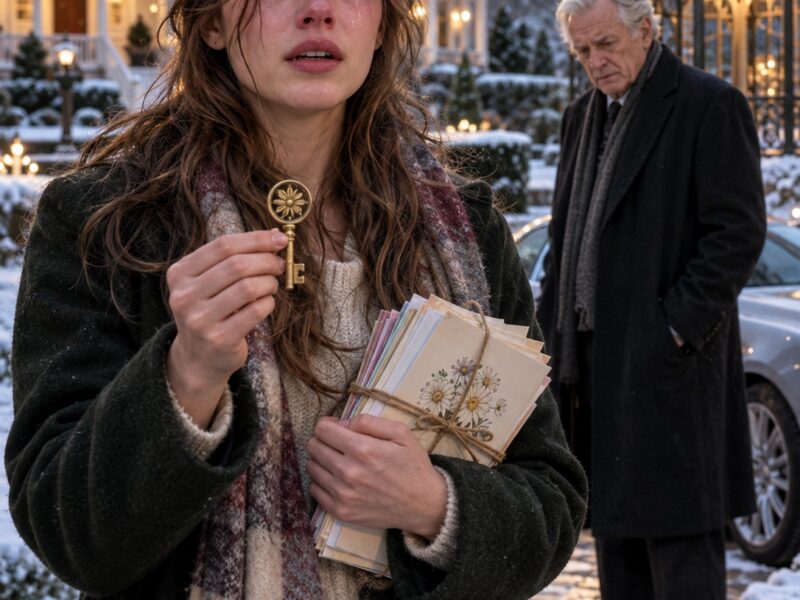
On the passenger seat beside him lay twenty-three birthday cards.
One for every year of Daisy’s life.
Not one had ever been mailed.
William Hayes pressed a trembling hand over his mouth as Daisy laughed at something one of the waitresses said. Through the fogged glass, she looked happy.
That was the cruelest part.
She had learned how to look happy without him.
He reached toward the top envelope.
DAISY — AGE 23.
His fingers stopped before touching it.
For more than two decades, William had convinced himself that staying away was an act of mercy.
That night, watching the granddaughter who did not know his name, he finally understood what it had really been.
Cowardice.
He started the car.
Then he turned it off again.
He sat there until Daisy left.
Three days later, he was dead.
And Daisy Carter inherited everything.
Everyone in Willow Creek knew Daisy.
Not because she was rich, important, beautiful in the way people wrote articles about, or born into one of the families whose names appeared on plaques outside banks and libraries.
They knew her because Daisy remembered things.
She remembered that Mr. Brennan took his coffee black but needed the cup filled only three-quarters because his hands shook.
She remembered that Mrs. Alvarez hated cinnamon.
She remembered which customers had grandchildren graduating, whose husband had surgery, whose daughter was getting divorced, and which elderly man pretended he ordered two slices of pie because he was hungry when everyone knew the second slice was for the stray cat behind the pharmacy.
At twenty-three, Daisy worked six days a week at Miller’s Diner.
She rented a small apartment above a laundromat where the dryers rattled the floor until almost midnight.
Her furniture did not match.
Her car made a clicking noise whenever she turned left.
Her dog Lucky had one white paw, one crooked ear, and the stubborn belief that Daisy’s bed belonged entirely to him.
Daisy did not have much.
But what she had, she gave away easily.
Every Thursday, she drove to St. Mary’s Children’s Home carrying cookies.
She told people it was because the kids liked them.
That was true.
It just wasn’t the whole truth.
St. Mary’s was where Daisy had grown up.
She had been left there as an infant wrapped in an old towel, with no note, no birth certificate in the bundle, no photograph, no explanation.
Sister Margaret had named her.
“Daisy,” the nun once told her, “because those stubborn little flowers come back after storms.”
For years, Daisy pretended that story was enough.
Usually, it was.
Then birthdays came.
Birthdays had a way of turning absence into something with a shape.
At eight, Daisy had watched another girl leave St. Mary’s holding the hands of her new parents.
At twelve, she had wondered whether she had inherited her laugh from somebody.
At sixteen, she had secretly searched adoption websites.
At eighteen, she had stopped.
By twenty-three, she had learned the adult trick of pretending that questions no longer hurt simply because you had stopped asking them aloud.
But on the night of her birthday, after the diner closed, her friends pushed a chocolate cake toward her.
“Make it good,” her coworker Jenna said.
Daisy laughed.
“At twenty-three? I’m supposed to be wishing for lower rent.”
“You’re supposed to shut up and blow.”
Everyone laughed.
Daisy closed her eyes.
And underneath the laughter, underneath twenty-three years of practiced independence, the little girl inside her whispered the same humiliating prayer.
Please.
Let there have been one person.
Just one.
Someone who was glad I was born.
She blew out the candles.
When she opened her eyes, she happened to glance through the front window.
A silver sedan was parked across the street.
For a second, Daisy thought someone was sitting inside.
Then a truck passed between them.
When it was gone, the sedan was pulling away.
She forgot about it before she reached home.
Three mornings later, Daisy was folding napkins behind the counter when the bell above Miller’s front door chimed.
A man in a charcoal suit walked in.
He was perhaps sixty, silver-haired, carrying a leather briefcase that looked more expensive than everything Daisy was wearing.
He scanned the diner.
His eyes found her.
Something in his expression changed.
Daisy straightened.
“Table for one?”
The man did not answer immediately.
“Miss Daisy Carter?”
Her smile weakened.
“Depends. Am I in trouble?”
“No.”
He almost smiled.
“My name is Henry Lawson. I’m an attorney.”
“Okay. That usually means somebody’s in trouble.”
This time he did smile, but sadness remained in his eyes.
He opened the briefcase.
“I’m here because of William Hayes.”
Daisy waited.
Henry waited too.
Finally she said, “Should that name mean something to me?”
His expression told her the answer mattered.
“No,” he said quietly. “I suppose it wouldn’t.”
He placed a cream envelope on the counter.
Daisy stared at her name written across it.
Nobody sent her letters.
Bills, advertisements, coupons from the grocery store—yes.
Letters, no.
“William Hayes died three days ago.”
“I’m sorry.”
“He left you his estate.”
Daisy blinked.
Then laughed.
Henry didn’t.
Her laughter stopped.
“What?”
“His house. The property. His personal possessions. His financial accounts after expenses and specified charitable distributions.”
“I think you’ve got the wrong Daisy Carter.”
“I don’t.”
“I don’t know any William Hayes.”
“I know.”
“Then why would he leave me a house?”
Henry’s eyes lowered briefly toward the envelope.
“He hoped you’d understand eventually.”
“Understand what?”
Henry picked up his briefcase.
“Read the letter.”
Then he left Daisy standing behind the counter with a stack of napkins in one hand and an inheritance from a dead stranger in the other.
That night, Daisy read William’s letter four times.
It contained only a few lines.
Daisy,
If you are reading this, then I am gone.
I have left my home, my belongings, and everything I own to you.
I know I have no right to ask anything of you.
But if you can, please come home.
William Hayes.
Daisy sat on the edge of her bed.
Lucky rested his chin on her knee.
“Home,” she whispered.
The word irritated her.
You could not invite someone “home” to a place she had never been.
You could not die, leave her a mystery, and expect a dead man’s sentimentality to make sense.
She considered refusing everything.
She even called Henry the next morning intending to do exactly that.
Instead she heard herself say, “When can I see the house?”
An hour later, she was sitting beside him as his car traveled beyond Willow Creek’s familiar streets.
Stores disappeared.
Then neighborhoods.
Then sidewalks.
Winter fields stretched beneath a colorless sky.
Finally Henry turned onto a narrow road lined with bare trees.
At the end stood a sprawling white farmhouse.
Daisy stepped out.
The place was beautiful in the exhausted way old things sometimes were.
Paint peeled from the siding.
Dark shutters framed tall windows.
The wraparound porch sagged slightly on one side.
Vines climbed one wall like veins.
It should have looked abandoned.
Instead, Daisy had the uncomfortable impression that the house had been waiting.
“For me?” she whispered.
Henry heard.
“Yes.”
“Why?”
Again, that hesitation.
Again, the answer withheld.
“I think William wanted the house to tell you.”
Daisy looked at him.
“Houses don’t talk.”
Henry glanced toward the second-floor windows.
“This one might.”
Inside, everything appeared recently touched.
Reading glasses beside an armchair.
A half-finished crossword.
A mug beside the kitchen sink.
A cardigan hanging over the back of a chair.
William Hayes had died, yet the house seemed unaware.
Daisy wandered into the living room.
Photographs covered the walls.
Birds.
Mountains.
Willow Creek in winter.
Children playing near a lake.
St. Mary’s in spring.
Daisy stopped.
“That’s the orphanage.”
Henry said nothing.
She moved closer.
The photograph was old.
Children ran through the grass beneath the same oak tree Daisy remembered climbing.
Something cold moved through her stomach.
“Why did he have this?”
“I can’t answer every question for you.”
“Can’t or won’t?”
“Both.”
Daisy turned sharply.
“What exactly did this man want from me?”
“Nothing.”
“Nobody gives a stranger a house for nothing.”
Henry looked at her for several seconds.
“William spent much of his life believing there are some debts money cannot repay.”
Before Daisy could ask what that meant, she noticed the clocks.
There were six she could see from where she stood.
Mantel clock.
Wall clock.
Small brass clock on a shelf.
All had stopped.
8:17.
“Power surge?”
Henry shook his head.
“William collected mechanical clocks.”
“Then why are they all stopped?”
Henry’s voice softened.
“Eight seventeen was the time he died.”
Daisy suddenly wanted fresh air.
She walked outside.
Lucky bounded through the snow while she followed a stone path around the house.
That was when she saw the gazebo.
It stood beyond the orchard.
At first glance, it looked ordinary: circular roof, weathered wood, ivy twisted around its posts.
Then Daisy came closer.
There was a door.
A heavy iron door.
Locked from the outside.
“That’s not creepy at all,” she muttered.
Lucky stopped several feet away.
His ears lowered.
Daisy approached alone.
Above the doorway hung a rusted plaque.
She wiped snow and dirt from it.
There were words underneath.
ONLY OPEN WHEN YOU’RE READY TO KNOW HOW DEEPLY YOU WERE LOVED.
Daisy forgot the cold.
Loved.
She stared at the word until it became almost meaningless.
“By who?”
No answer.
She laughed bitterly.
“Very funny, William.”
The padlock was old.
Around it someone had tied a faded red ribbon.
Daisy touched it.
Something hard shifted inside the fabric.
She untied the ribbon.
A small brass key fell into her palm.
Engraved on its handle was a tiny flower.
A daisy.
She stopped breathing.
William Hayes hadn’t merely known her name.
He had known what it meant.
That night Daisy stayed in the farmhouse.
She told herself it was because snow had begun falling too heavily to drive.
The truth was that she could not leave.
She sat in William’s study with the brass key on the desk.
Lucky slept near the fireplace.
She kept thinking about the plaque.
How deeply you were loved.
It made her angry.
People who loved children didn’t leave them in orphanages.
They showed up.
They stayed.
They answered questions.
They attended graduations.
They sat beside hospital beds.
They taught you to drive.
They embarrassed you in front of your friends.
They called on birthdays.
They didn’t become mysterious inheritances after dying.
At two in the morning, Daisy picked up the key.
“I don’t care,” she whispered.
But tears had already filled her eyes.
Because the truth was much more dangerous.
She cared desperately.
If William was lying, she would survive it.
She had survived twenty-three years believing nobody had wanted her.
But if the words on that plaque were true?
If someone really had loved her?
Then Daisy would have to confront a question she had never prepared herself to answer.
Why hadn’t they come?
By sunrise, she knew she had to open the door.
Snow crunched beneath her boots as she crossed the yard.
Lucky followed until they reached the gazebo.
Then he stopped.
“Seriously?”
The dog whimpered.
“That’s reassuring.”
Daisy inserted the key.
It turned.
The padlock dropped open with a metallic crack that echoed through the frozen yard.
Her hand closed around the iron handle.
And suddenly, without warning, Daisy remembered being eight years old.
Snow outside St. Mary’s.
Her birthday.
A silver car across the street.
An old man inside.
Watching.
She had waved.
He had raised one hand.
Then he had cried.
Daisy’s heart began pounding.
“No.”
She opened the door.
There was no gazebo inside.
There was a staircase.
A narrow spiral staircase descended beneath the ground.
Daisy stood motionless.
“What did you build, William?”
She turned on her phone flashlight and went down.
The air smelled of cedar and old paper.
At the bottom, her light swept across shelves.
Hundreds of wooden boxes filled the underground chamber.
Each carried a name and a year.
MARTHA REED — 1968.
JAMES MILLER — 1974.
SARAH COLLINS — 1982.
Children.
Adults.
Families.
Lives.
Daisy walked between them, afraid to touch anything.
Then her flashlight reached the far wall.
There was another door.
Unlike everything else underground, it had been painted white.
Two words were carved into the wood.
DAISY CARTER.
Her knees nearly gave out.
“No.”
She approached.
Small paper stars covered the door.
Each carried a date.
December 14, 2009.
December 14, 2012.
December 14, 2015.
Her birthdays.
Every one of them.
“Who were you?”
Her hand closed around the knob.
She opened the door.
Warm yellow light came on automatically.
And Daisy Carter saw her entire life.
Photographs covered the walls.
Daisy at five, carrying a backpack.
Daisy at seven, sitting alone after a school performance.
Daisy at eleven, holding a pumpkin.
Daisy at sixteen, reading beneath a tree.
Daisy graduating high school.
Daisy feeding stray cats.
Daisy adopting Lucky.
Daisy laughing.
Daisy crying.
Daisy living twenty-three years she had believed nobody was watching.
At the center stood a table.
Twenty-three envelopes were stacked upon it.
One for every birthday.
Daisy walked toward them as if approaching a grave.
Beside the cards stood a framed photograph.
An old man inside a silver sedan.
St. Mary’s visible through the windshield.
Snow falling.
His face wet with tears.
Daisy covered her mouth.
She remembered him.
Not clearly.
But enough.
The man across the street.
The man who had watched her blow out candles.
The man who had never walked through the door.
She sat on the floor.
For several minutes, she could only cry.
Finally she reached for the first card.
AGE ONE.
The handwriting trembled across the page.
My little Daisy,
Today you are one.
I don’t know whether you like cake yet. I don’t know if thunder frightens you. I don’t know whether you have your mother’s smile.
I only know that I miss you every day.
And I have no right to.
Daisy froze.
“Mother?”
She tore open another.
Then another.
Every birthday.
Every year.
William had written.
William had remembered.
William had said nothing.
At the bottom of the stack lay a larger envelope.
FOR WHEN YOU’RE READY.
Daisy almost didn’t open it.
Almost.
Then she broke the seal.
Daisy,
If you are reading this, I have finally run out of time.
My name is William Hayes.
And I am your grandfather.
Daisy stopped breathing.
She read it again.
Then again.
The letters blurred.
Grandfather.
A word she had never been able to attach to a face suddenly belonged to the dead man whose coffee mug remained beside the kitchen sink.
Her hands shook as she continued.
Your mother was my only child.
Her name was Emily.
Daisy pressed her fingertips to her lips.
Emily.
Her mother had a name.
She laughed too loudly. She loved too quickly. She forgave people more easily than I did. And when she was twenty, she fell in love with a young mechanic named Michael.
William had hated him.
He thought Michael was poor, unreliable, beneath his daughter.
Father and daughter fought.
William told Emily that if she walked out, she should not expect him to welcome her back.
Emily walked out.
William waited for an apology.
Emily waited too.
Pride turned days into weeks.
Weeks into months.
Then the letter changed.
The handwriting became uneven.
Pride is a cruel thing, Daisy. It convinces you that tomorrow belongs to you.
Daisy’s throat tightened.
Emily died giving birth to you.
“No.”
The word escaped before Daisy could stop it.
She shook her head.
“No.”
But ink did not change because a daughter begged it to.
Emily had died on March 8.
Daisy’s birthday.
William had lost his daughter on the same day Daisy entered the world.
Three months later, grief and exhaustion contributed to a stroke that left him unable to care for an infant.
His sister persuaded him to place Daisy temporarily at St. Mary’s.
Temporary became months.
His recovery was slow.
Then shame took over.
By the time he was physically capable of reclaiming her, Daisy had begun attaching herself to the sisters and other children.
William convinced himself he would only disrupt her life.
Then another year passed.
And another.
The longer he waited, the more impossible the truth became.
Daisy lowered the letter.
Anger arrived so suddenly she stood.
“You coward.”
Her voice echoed.
“You should’ve come.”
The photographs watched her.
“You should’ve told me!”
She threw the letter onto the table.
“I didn’t need your money!”
Her voice cracked.
“I needed someone at Christmas!”
She knocked one birthday card onto the floor.
“I needed somebody when I was eight!”
Then she saw the next paragraph.
On your eighth birthday, I stood outside St. Mary’s.
Daisy went still.
I saw you blow out your candles.
Her knees weakened.
Sister Margaret later told me your wish.
Daisy knew what came next before reading it.
You asked God to let there be one person who was glad you had been born.
She sank into the chair.
Daisy, I wanted to run through that door.
I wanted to tell you there had never been a day when I wasn’t grateful you were born.
But I was ashamed.
And cowards sometimes mistake silence for love.
Daisy pressed the letter against her chest.
She cried for the childhood she had lost.
Then she cried for an old man sitting inside a car, apparently unable to cross a street.
Neither pain canceled the other.
That was what made it unbearable.
William had loved her.
William had abandoned her.
Both things were true.
And Daisy had no idea what to do with a love that had arrived twenty-three years too late.
She remained underground until sunset.
The following day she returned.
This time, she opened the other boxes.
Aiden Brooks.
Sarah Wittman.
Noah Reed.
Emily Foster.
Most had once lived at St. Mary’s.
Inside one box she found ballet shoes, school records, and receipts.
Tuition.
Medical treatment.
Winter clothing.
Paid anonymously.
Another box contained scholarship documents.
Another held receipts for dental surgery.
College textbooks.
A bicycle.
A violin.
Daisy opened box after box.
William Hayes had been helping children from St. Mary’s for decades.
Quietly.
No plaques.
No newspaper photographs.
No public foundation carrying his name.
He had failed one child he loved.
Then spent the rest of his life trying not to fail strangers.
That realization did not absolve him.
But it complicated Daisy’s anger.
And complicated anger is much harder to hold.
She went to Henry Lawson’s office.
“You knew.”
Henry looked at her.
“You found the room.”
“He’s my grandfather.”
“Yes.”
“You knew.”
“Yes.”
Daisy’s palms hit his desk.
“Why didn’t anyone tell me?”
“William forbade me from doing so while he was alive.”
“Why?”
Henry removed his glasses.
“Because he hated himself.”
“That’s not an answer.”
“No. But it’s the truth.”
Daisy turned away.
Henry continued quietly.
“He went to St. Mary’s every month.”
She closed her eyes.
“He watched your graduation.”
Her shoulders tightened.
“He paid for your braces.”
Daisy turned.
“What?”
“He arranged it anonymously.”
Henry smiled faintly.
“And Lucky’s vaccinations.”
Her anger faltered.
“The shelter paid those.”
“No.”
Last year Lucky had nearly died from an infection.
Daisy had cried in the veterinary office because she couldn’t afford the treatment.
Someone had paid the bill.
She had never learned who.
“William?”
Henry nodded.
Daisy sat down.
“He knew I worked at Miller’s?”
Henry looked almost amused.
“He ate there every Tuesday.”
“No.”
“Corner booth.”
The room seemed to shrink.
Daisy remembered.
Gray coat.
Black coffee.
An old man who always tipped too much.
A man who never asked personal questions but somehow always looked relieved when she smiled.
Once, after watching an angry customer insult her, he had left money beneath his cup and said, “You have a kind heart. Don’t let the world harden it.”
Daisy had forgotten him by dinner.
William had probably remembered the conversation until he died.
“Why didn’t he just say it?” she whispered.
Henry looked toward the window.
“Because people can survive grief and still be destroyed by guilt.”
That evening Daisy returned to the farmhouse.
For the first time, it no longer felt empty.
It felt crowded with everything William had failed to say.
She touched his reading glasses.
His chair.
The coffee mug.
Then she walked to the gazebo.
Lucky curled beside her on the steps.
“I don’t forgive you,” she said.
The winter trees remained silent.
“Not yet.”
Her voice shook.
“But I don’t hate you anymore.”
The wind moved through the orchard.
Daisy wiped her face.
It wasn’t forgiveness.
It was simply the first unlocked door.
The next morning she called Henry.
“I’m keeping the house.”
He paused.
“I thought you might.”
“I’m keeping the records too.”
“What will you do with them?”
Daisy looked through the gazebo doorway.
“I don’t know yet.”
Then she saw the boxes bearing hundreds of names.
“But nobody should feel forgotten.”
Winter slowly loosened its grip on Willow Creek.
Daisy moved into the farmhouse.
Every morning she opened curtains William had kept closed.
Every afternoon she cleaned.
Every evening she read another birthday card.
Sometimes she loved him.
Sometimes she hated him.
Usually she did both.
Healing, Daisy discovered, did not move in a straight line.
Then people began appearing.
An elderly woman brought cookies and told Daisy William had paid for her grandson’s surgery.
A retired teacher produced a scholarship check from twenty-eight years earlier.
A young mother left flowers.
“He helped me when nobody else would,” she said.
Each story changed Daisy’s picture of William.
But one question remained.
Why had a man capable of so much compassion been incapable of walking through the door for his own granddaughter?
Then, one rainy afternoon, Daisy found a metal box hidden behind a shelf in William’s study.
Four words were written across its lid.
DO NOT OPEN YET.
She nearly laughed.
“Of course.”
The box was locked.
There was no key.
That night Daisy dreamed of a woman she had never met.
Emily.
She stood beneath the gazebo, dark hair moving in the wind.
She looked exactly enough like Daisy to hurt.
Then Emily pointed toward the orchard.
“Not everything is buried underground.”
Daisy woke crying.
By eight the next morning, she was walking through the orchard with Lucky and a shovel.
She found nothing for almost an hour.
Then she noticed an enormous oak near the field.
Two initials had been carved into the trunk.
W + E.
William and Emily.
Beneath the tree stood a weathered bench.
Daisy knelt.
Underneath was a rusted tin box.
Unlocked.
Inside lay a photograph.
Daisy forgot how to breathe.
William was young.
Beside him stood a dark-haired woman, perhaps twenty.
Emily.
And Emily was holding a newborn.
Daisy.
It was the first photograph Daisy had ever seen of herself as a baby.
The first time she had seen her mother’s face.
Emily wasn’t looking at the camera.
She was looking down at Daisy.
The expression on her face destroyed twenty-three years of imagined rejection in a single second.
Daisy had wondered all her life whether her mother had wanted her.
Now she knew.
Emily held her like something precious.
Daisy traced her mother’s face.
“I look like you.”
Beneath the photograph lay a journal.
Emily’s.
Daisy read.
June 14.
Dad says I’m making the biggest mistake of my life. Maybe he’s right. But I’ve never loved anyone the way I love Michael.
Later:
Dad hasn’t called.
I pretend it doesn’t hurt.
It does.
Then:
The baby kicked today. I wish Dad could have felt it.
Page after page revealed something Daisy had never expected.
Emily had never hated William.
She missed him.
Loved him.
Wanted reconciliation.
Then Daisy reached the final entry.
March 8.
Her birthday.
If something happens to me, tell Dad I never blamed him.
Tell him I was stubborn too.
Tell him I hope he forgives himself.
Daisy closed her eyes.
At the bottom of the box lay an envelope.
WILLIAM HAYES.
Still sealed.
William had never read it.
Perhaps he had never known it existed.
Daisy opened it.
There was only one sentence.
Dad, Daisy isn’t your punishment. She’s your second chance.
Daisy stared at the words.
Then she began to sob.
William had spent twenty-three years believing Daisy represented the daughter he had failed.
Emily had believed the opposite.
Daisy was supposed to be the bridge back.
Not the punishment.
The second chance.
And William had been too buried beneath guilt to take it.
For the first time, Daisy felt something other than anger.
Compassion.
Not absolution.
Not yet.
But compassion for a frightened old man who had punished himself so thoroughly that he had accidentally punished her too.
Daisy looked toward the gazebo.
Hundreds of boxes waited beneath it.
Hundreds of people carrying unfinished stories.
And suddenly she understood what she wanted to do.
Spring arrived.
The orchard bloomed.
So did the daisies beside the porch.
One Saturday morning, Daisy carried a wooden sign across the yard.
She planted it beside the gazebo.
Lucky watched from the grass.
The sign read:
THE HOUSE OF SECOND CHANCES
There was no grand opening.
No reporters.
No ceremony.
Daisy simply opened the door.
Three days later, someone knocked.
An elderly woman stood outside holding a shoebox.
“My name is Martha.”
Daisy invited her in.
Martha opened the box.
Photographs.
A wedding ring.
Letters.
Dozens of them.
“I haven’t spoken to my daughter in eighteen years.”
Daisy listened.
“I don’t know how to fix it.”
Once, Daisy might have thought eighteen years meant the relationship was dead.
Now she knew better.
“Maybe,” she said, “it’s not too late.”
Martha cried.
And after Martha came others.
A widower carrying his wife’s scarf.
A retired soldier carrying memories he had hidden for fifty years.
A mother grieving a son lost to addiction.
Two brothers separated by pride.
A woman who wanted to apologize to a sister before cancer took away the chance.
Daisy did not become a therapist.
She did not pretend she could repair people’s lives.
She listened.
Sometimes she helped them write letters.
Sometimes she helped them make phone calls.
Sometimes she simply sat with them while they cried.
Because William had taught her something without ever meaning to.
Everyone had a locked room.
A place where apologies, shame, grief, and love waited in darkness.
And sometimes healing began with nothing more dramatic than opening the door.
One evening Sister Margaret arrived.
She moved more slowly now.
Daisy met her on the porch.
The old nun looked across the yard.
Children were laughing near the orchard.
Martha was drinking tea with her daughter beneath a tree.
Lantern light glowed inside the gazebo.
Sister Margaret’s eyes filled.
“Oh, sweetheart.”
Daisy hugged her.
Sister Margaret looked at the house again.
“You finally found your family.”
Once, those words would have broken Daisy.
Now she smiled.
“No.”
Margaret looked surprised.
Daisy glanced toward the people in the yard.
“I think I finally learned what family means.”
That night, after everyone left, Daisy walked alone to the oak.
She sat beneath William and Emily’s initials.
The farmhouse windows glowed behind her.
For a long time she said nothing.
Then she looked upward.
“I wish we’d had more time.”
The branches moved.
“I was angry.”
She smiled sadly.
“Some days I still am.”
A tear ran down her cheek.
“But I’m not angry enough to forget that you loved me.”
She looked at Emily’s photograph in her hands.
“You just didn’t know how to come home.”
Daisy laughed quietly.
“You know what’s ridiculous?”
Silence.
“When I was eight, I wished for one person.”
Her voice cracked.
“One person who was glad I was born.”
For twenty-three years, Daisy had believed nobody answered that prayer.
But across a street, inside a silver sedan, an old man had heard about it and cried because he desperately wanted to tell her the truth.
He had been flawed.
Proud.
Frightened.
Cowardly when courage mattered most.
His love did not erase the damage his silence caused.
But the damage did not erase his love either.
Daisy finally understood that both truths could live in the same heart.
“I got my wish,” she whispered.
She sat beneath the oak until the stars appeared.
When she finally walked back toward the house, the lantern inside the gazebo glowed through the darkness.
Daisy stopped at the gate.
For a second, she could almost see herself at eight years old again.
A little girl standing beside an orphanage window.
Waiting.
Waiting for footsteps in the hallway.
Waiting for a car to stop.
Waiting for someone to choose her.
That girl would always exist somewhere inside Daisy.
But she was no longer standing alone.
Behind Daisy was a house full of letters.
Before her was a life full of people learning to say the things they had once been too frightened to say.
And somewhere between those two worlds stood William Hayes.
A man who had loved too silently and regretted too loudly.
Daisy looked toward the gazebo.
Then she went inside.
Years later, one object remained on the mantel above the fireplace.
Not William’s money.
Not the deed to the property.
Not even Emily’s journal.
It was the twenty-third birthday card.
The last card William had written.
Daisy had kept it unopened longer than all the others.
When she finally read it, she discovered there was no confession inside.
No new secret.
No explanation.
Only a few sentences from an old man who knew he was running out of time.
Happy birthday, Daisy.
There are twenty-three years of things I should have said to you.
But if I am allowed only one, let it be this.
I am glad you were born.
Whenever Daisy read those words, they still hurt.
Maybe they always would.
But the hurt had changed.
It was no longer the pain of believing nobody had loved her.
It was the bittersweet ache of knowing someone had loved her deeply, imperfectly, desperately—and had wasted too much time being afraid to say so.
That became the lesson Daisy carried into every conversation at the House of Second Chances.
Don’t wait until courage feels comfortable.
Don’t assume silence communicates love.
Don’t let pride turn one bad day into twenty-three lost years.
Say the apology.
Make the call.
Knock on the door.
Tell the person.
Because sometimes the tragedy isn’t that love was absent.
Sometimes the tragedy is that love was there the entire time—
sitting across the street,
holding twenty-three birthday cards,
waiting until it was too late to come home.









