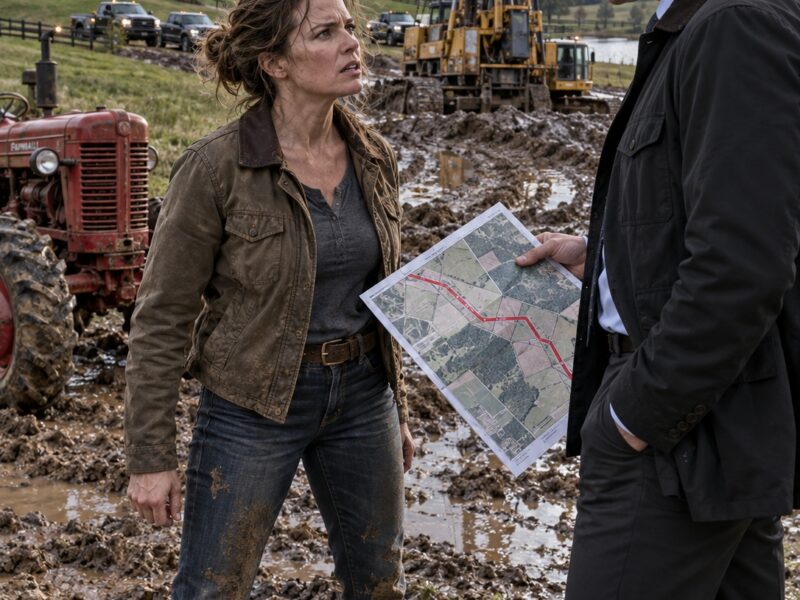
The Pipeline Company Told Me to Sign Away My Father’s Land—Then Their 76,000-Pound Rig Sank Into the One Field They Never Had the Right to Enter
The first thing Grant Mercer did was put a contract on the hood of his truck.
The second thing he did was threaten me with lawyers.
The third thing he did was send a seventy-six-thousand-pound drilling rig onto my father’s land after I told him not to.
By sunset, the machine was buried to its axles in Missouri mud.
Three professional recovery companies had failed to move it.
A few of Grant’s men were laughing at the seventy-six-year-old tractor sitting inside my barn.
And I was beginning to realize the most important thing about that entire morning.
The rig had not gotten stuck where Horizon Pipeline Group claimed it had a right to be.
It had gotten stuck somewhere else.
Somewhere Grant Mercer had deliberately sent it.
And once I understood why, the fight stopped being about a muddy field.
It became a fight over something my father had apparently spent more than ten years protecting without ever telling me.
My name is Claire Bennett.
I was forty-two years old when my father died, and until that spring, I had spent almost eighteen years convincing myself that leaving Bennett Farm had been the right decision.
Maybe it had been.
That was the uncomfortable part.
People like to tell stories about returning home as if home is a magnet. As if the person who leaves spends every day secretly wishing to return.
That wasn’t true for me.
I had built a life in Minneapolis.
I had an apartment with windows that looked over rooftops instead of soybean fields. I had work that required clean shoes. I bought coffee from a shop downstairs and complained about traffic like everyone else.
I had friends who knew almost nothing about the girl who had once been able to tell whether rain was coming by the smell of dirt.
For years, Bennett Farm became something I called home only when people asked where I grew up.
Then my father died in March.
Quietly.
In the farmhouse where he had been born.
Thomas Bennett had never been a man who explained himself if he could accomplish the same thing with silence.
He repaired equipment other farmers would have replaced.
He kept handwritten ledgers.
He walked the fields before sunrise.
He believed fences should be straight, tools should be returned to the place they came from, and anyone who borrowed a wrench twice should probably buy his own wrench.
His affection worked the same way.
My father rarely said he missed me.
Instead, when I visited, there would be coffee already made before I came downstairs.
The tires on my car would somehow have been checked.
If winter was coming, there would be an ice scraper in my trunk that I had not put there.
That was Thomas Bennett.
He loved people by preparing them for weather.
When I got the call that he was gone, I drove south with one suitcase because I thought I would stay two weeks.
Three at most.
There was a funeral.
There were papers.
There was equipment to inventory and grain contracts to understand and a lifetime of objects that suddenly belonged to me simply because the person who had touched them last could no longer do so.
People in the county assumed I would sell.
Nobody was cruel about it.
That almost made it worse.
A neighbor named Mrs. Talbot brought a casserole after the funeral and stood in the kitchen looking toward the fields.
“Beautiful place,” she said.
“It is.”
“A lot for one person.”
There it was.
Not a question.
Not exactly advice.
Just arithmetic.
I smiled.
“I know.”
Even the attorney who read Dad’s will seemed to expect the same outcome.
Bennett Farm had been operating on thin margins for years. Equipment needed work. Some drainage needed maintenance. Grain storage was outdated.
And I had a life seven hours away.
Selling made sense.
Then I walked into the barn.
Dad’s old Farmall was sitting where it had been for as long as I could remember.
Red paint faded almost brown in places.
Metal scarred.
Seat cracked.
One headlight slightly crooked.
It was a 1950 model, older than most of the people who came to my father’s funeral.
I put my hand on the steering wheel.
For a moment, I was nine years old again, sitting beside Dad while he explained that machines did not care whether you were angry.
“Angry people pull harder,” he had told me.
I remembered asking, “Isn’t harder better?”
“No.”
“Why?”
“Because sometimes the thing holding you isn’t stronger than you. You’re just fighting it wrong.”
At nine, I had rolled my eyes.
At forty-two, standing alone in that barn, I remembered every word.
I called Minneapolis the next morning.
I told them I wasn’t coming back yet.
Six weeks after the funeral, Grant Mercer arrived.
It had rained for four days.
The fields were dark with water, and the north pasture was soft enough that my boots sank half an inch with every step.
At 8:17 Tuesday morning, I heard diesel engines on the county road.
Two white Horizon trucks.
A survey vehicle.
Then a massive rig waiting behind them.
Grant walked toward the farmhouse alone.
He was probably in his late forties. Expensive waterproof jacket. Clean boots that told me somebody else usually walked the muddy parts for him.
He introduced himself.
“Good morning, Miss Bennett. Grant Mercer. Horizon Pipeline Group.”
“I know who you are.”
That seemed to surprise him.
Only slightly.
He recovered quickly.
“I’m sorry about your father.”
“Thank you.”
He glanced toward his trucks.
He wasn’t here to talk about my father.
“Can we take a look at something?”
Grant spread a laminated map across the hood of his truck.
A red line crossed the northern section of Bennett Farm.
“We have a historic access corridor through this property.”
I studied the map.
“What does historic mean?”
“It predates the current phase of the project.”
“That isn’t what I asked.”
His eyes lifted.
For the first time, he looked at me rather than through me.
“Horizon has documentation supporting access.”
“What documentation?”
“Our legal department can provide everything relevant.”
“Then provide it.”
He exhaled softly.
Not quite irritation.
More like a man discovering that an appointment scheduled for ten minutes might take twenty.
“We’re on a construction timeline, Claire.”
He had already switched to my first name.
“We have permits. Engineering is complete. Equipment needs to move through this section today.”
“No.”
He blinked.
“No?”
“Not until my attorney reviews whatever you think gives you the right to cross my land.”
Grant looked down at the map.
Then at his watch.
That watch bothered me more than his words.
It was such a small gesture.
But it said everything.
I was not a landowner to him.
I was a delay.
“Your father was aware of Horizon’s claim.”
“Then my father can explain it to you.”
Silence.
I regretted the sentence as soon as it came out.
Not because it was rude.
Because for half a second, I had forgotten Dad was dead.
Grant lowered his voice.
“I understand this is a difficult time.”
“Don’t.”
“I’m simply saying—”
“You don’t know anything about my difficult time. Show me the document giving you permanent access.”
“I don’t carry the full legal file in my truck.”
“Then your rig doesn’t cross my property.”
His jaw tightened.
“Claire, you have two options here. We resolve this reasonably, or our attorneys resolve it.”
I looked at the red line.
Then at him.
“Those sound like your two options.”
I folded my arms.
“Mine is no.”
For the first time, Grant stopped pretending we were having a friendly conversation.
He rolled up the map.
“All right.”
That was all he said.
He walked toward the road.
I should have known it wasn’t over.
Twenty minutes later, the rig moved.
I was standing near the machine shed when I heard it.
At first, just diesel.
Then the heavy vibration of machinery crossing wet ground.
I stepped outside.
The rig had turned off the county road.
North.
Onto Bennett land.
“Hey!”
Nobody stopped.
I started across the field.
“STOP!”
One worker looked toward me.
The rig continued.
I pulled out my phone.
Before I could decide whether to call the sheriff, an attorney, or God, the machine made a sound I felt in my ribs.
A deep mechanical groan.
Then nothing.
The engine was still running.
But the rig was no longer moving.
By the time I reached it, the rear axles were buried in mud.
One side had sunk lower than the other.
The driver climbed down.
Grant appeared several minutes later.
He stared at the machine.
Then at the ground.
Then at me.
I said, “Get it off my land.”
His face did not move.
“We will.”
“You shouldn’t have put it here.”
“We’ll address that.”
“You were already addressing it when you drove it onto my property.”
He ignored me and started making calls.
The first recovery truck arrived less than an hour later.
I watched from the edge of the field.
The operator knew his business.
Heavy wrecker.
Outriggers.
Winch cable.
Everything professional.
Everything expensive.
He connected to the rig, tensioned the line, and started pulling.
The outrigger feet sank.
He stopped.
Repositioned.
Tried again.
Same result.
Twenty minutes later, he packed up.
Grant walked after him.
“What are you doing?”
The operator pointed at the field.
“I’m not burying my truck next to yours.”
Then he left.
The second company brought two recovery vehicles.
Their coordinator spent twenty minutes walking around the rig.
They tried pulling from opposing angles.
The trailer moved maybe six inches.
Then stopped.
The coordinator called it.
Grant’s voice rose.
“You have two trucks.”
“And you have one trailer sitting on soup.”
“Try again.”
“No.”
The coordinator pointed toward the left side.
“If I keep loading it from this angle, best case, we drive it deeper. Worst case, we deform the frame.”
“I’ll sign a release.”
“No, you won’t. Your legal department will spend three years explaining why your signature didn’t cover whatever happens next.”
That crew left too.
The third recovery company did not even attach a cable.
Their site manager walked the perimeter, looked at the ruts and said, “Excavation.”
Grant rubbed his forehead.
“Fine.”
“We’ll need matting, crawler equipment, probably dig around the axles.”
“Do it.”
“No,” I said.
Everyone turned.
The site manager looked at me.
Grant’s expression hardened.
“Claire.”
“My father spent years rebuilding the drainage under this field.”
“We’ll restore it.”
“You didn’t ask before destroying the surface. I’m not letting you dig up what’s underneath.”
“This machine has to come out.”
“I agree.”
“Then allow us to remove it.”
“You can remove it without excavating my drainage system.”
The site manager lifted both hands.
“I’m not getting in the middle of a property dispute.”
He packed up.
That was when one of the Horizon workers looked toward the barn.
The Farmall was visible through the open doors.
He laughed.
“Maybe she can pull it out with that.”
Two men smiled.
I heard him.
I didn’t answer.
Because I was looking at the ruts.
Something about them bothered me.
At first, I couldn’t say what.
The tracks curved through the field, deep and black, water collecting inside them.
I followed them with my eyes toward the road.
Then I heard Dad’s voice in my memory.
Not sentimental.
Not comforting.
Just practical.
When mud wins, don’t fight the weight.
Fight what’s holding it.
I walked toward the barn.
Grant followed.
“What are you doing?”
I didn’t answer.
“Claire.”
I climbed onto the Farmall.
He stared at me.
“You cannot be serious.”
The tractor started on the third attempt.
Exactly as it always had.
The engine coughed.
Complained.
Then settled into its uneven idle.
A few workers took out their phones.
Grant stepped closer.
“Don’t make this worse.”
I looked at him.
“Your seventy-six-thousand-pound rig is buried in my field after three recovery companies failed to move it.”
I put the tractor into gear.
“I’m struggling to imagine worse.”
The workers laughed.
Grant didn’t.
I drove toward the rig, then stopped beside its driver.
“Which way did you enter?”
He pointed southeast.
I climbed down.
Then I walked.
Not to the rig.
Away from it.
Back along the tracks.
Grant called after me.
“What are you doing?”
“Trying to figure out what everyone else didn’t.”
I followed the ruts from the beginning.
That was when I saw it.
Every recovery attempt had followed essentially the same axis the rig had used coming in.
Straight backward.
They had been pulling the tires into the trenches the tires themselves had created.
The weight had compressed the wet earth beneath the axles until the mud behaved less like loose soil and more like suction.
They were fighting seventy-six thousand pounds.
Dad would have fought six inches of mud.
I turned toward the northwest corner.
There.
Almost invisible under the grass was an old diagonal farm lane.
Dad had built it decades earlier.
Packed limestone beneath topsoil.
I remembered riding over it as a child.
Most people wouldn’t even know it existed.
But Dad never removed something that still worked.
I drove the Farmall onto it.
The tires immediately felt different.
Firm.
Then I ignored the rig’s standard recovery points.
I crawled underneath, found a lower mounting point on the underframe, and attached the chain.
One of the recovery men who had stayed to watch frowned.
“You’re pulling sideways.”
“I know.”
“You need to pull it back out.”
“No.”
I climbed onto the tractor.
“I need to make the mud let go.”
Grant said, “Claire, if you damage that equipment—”
I looked over my shoulder.
“You drove it here.”
Then I took the slack out.
Not hard.
Just tension.
Release.
Tension.
Release.
Nothing happened.
Someone behind me laughed.
Again.
Tension.
Release.
Fourth attempt.
Nothing.
Fifth.
A sound came from underneath the rig.
Wet.
Low.
Like the ground exhaling.
Everyone stopped talking.
One side of the trailer rose less than an inch.
I kept going.
Tension.
Release.
The rear wheels shifted sideways.
Not backward.
Sideways.
The driver saw it too.
He climbed into the cab without being asked.
Another pull.
Another release.
He gave the rig a little throttle.
The wheels moved.
One foot.
Then two.
The mud broke its grip.
The trailer climbed.
Suddenly, seventy-six thousand pounds of steel was moving under its own power.
The chain went slack.
Eight minutes.
That was all.
Eight minutes after three professional recovery companies had failed.
Nobody laughed at the Farmall anymore.
I shut off the engine.
Climbed down.
Removed the chain.
Coiled it the way Dad had taught me.
Right to left.
Loop over loop.
No kinks.
I carried it back to the barn and hung it on its hook.
When I returned, Grant was standing beside his truck.
“Get the rig off my land,” I said.
He looked at me for a long moment.
Then nodded.
I could have stopped there.
Maybe I should have.
But something kept bothering me.
The ruts.
I went back.
Started at the road.
Followed them again.
This time I wasn’t looking at how the machine had gotten stuck.
I was looking at why it had been there at all.
The answer was visible in the dirt.
The entry point was wrong.
Grant’s laminated map had shown Horizon’s supposed corridor farther east.
The rig had entered well west of it.
Not a few feet.
Not a mistake someone could blame on GPS.
The tracks curved deliberately into my field, then arced back toward the corridor.
I stood there until my skin went cold.
The rig getting stuck had been an accident.
The route wasn’t.
I found the driver beside his cab.
“Can I ask you something?”
He looked uncomfortable.
“Sure.”
“Who told you to enter here?”
He looked toward Grant.
That was enough.
But I waited.
“I was given a route.”
“By whom?”
Silence.
“Please.”
His eyes dropped.
“Mercer.”
“Grant Mercer?”
“Yes.”
“Before you entered the property?”
“Yes.”
“Did he tell you to follow the red corridor on his map?”
The driver hesitated.
“No.”
“What did he tell you?”
“To take the line through the field and join the corridor farther north.”
My heartbeat slowed.
Not because I was calm.
Because sometimes anger becomes so precise it stops feeling like anger.
I looked toward Grant.
He was talking on his phone.
Suddenly, his hurry that morning made sense.
His watch.
The legal threat.
The rig moving before I could call an attorney.
Horizon had wanted physical use of the property on record before I formally challenged their access claim.
They needed tire tracks.
They needed activity.
They needed to be able to say they had used the route.
But one question remained.
Why?
Why did a company with lawyers, engineers, permits, and millions of dollars care so much about one strip of a struggling Missouri farm?
I called Rebecca Sloan.
Rebecca had handled a few legal matters for Dad over the years. She was the kind of attorney who never sounded impressed by money.
I told her everything.
She was silent for several seconds.
Then she said, “Do not sign anything.”
“I wasn’t planning to.”
“Don’t agree to anything verbally either.”
“Rebecca—”
“Nothing, Claire.”
Her tone changed.
“And photograph every track before it rains again.”
I did.
The next three days were quiet.
Too quiet.
Then Rebecca called.
“Are you sitting down?”
“No.”
“Sit.”
I sat at Dad’s kitchen table.
“What did you find?”
“Horizon’s regional project filings.”
“And?”
“The Bennett corridor isn’t convenient.”
I waited.
“They built the project around it.”
I didn’t understand.
Rebecca continued.
“The northern boundary of your property sits next to a major connection point. Their engineering assumes access across Bennett Farm.”
“How much does it matter?”
“Without it?”
She paused.
“They may need to redesign significant sections of the route. New engineering. Permit modifications across multiple jurisdictions. Construction delays.”
“How long?”
“Months, potentially.”
“And money?”
“Millions.”
I looked out the kitchen window.
The Farmall was visible through the barn doors.
“So they don’t want the land.”
“No.”
Rebecca’s voice became very quiet.
“They need it.”
That changed everything.
For approximately twenty-four hours.
Then Horizon sent us the signature.
It was Dad’s.
Thomas Bennett.
Signed beneath a survey map from years earlier.
I knew the handwriting instantly.
Rebecca didn’t need to tell me the signature appeared genuine.
I had spent my childhood looking at that handwriting on feed schedules, invoices, repair lists, birthday cards.
Dad had signed something with Horizon.
My stomach dropped.
“What is it?”
“Their attorneys claim it proves your father accepted the corridor.”
“Does it?”
“I need time.”
After the call, I sat alone in the kitchen.
That hurt more than Grant’s threats.
More than the rig.
More than the legal bills beginning to arrive.
Dad knew.
He had known Horizon wanted access.
And he had never told me.
I thought about all the phone calls over the years.
How’s the farm?
Fine.
Need anything?
No.
You sure?
Yep.
That was Thomas Bennett.
One syllable could hide a decade.
Harvest was approaching.
Legal costs were growing.
Then a collector called about the Farmall.
He had heard I owned a 1950 model.
He offered enough money to cover a meaningful portion of the immediate legal expenses.
I told him I would think about it.
That evening, I stood in the barn looking at the tractor.
For the first time since returning home, I wondered if I had misunderstood Dad completely.
Maybe the farm had never been a gift.
Maybe it was an obligation he had been too stubborn to sell.
Maybe the Farmall was just old machinery.
Maybe memory was making everything heavier than it deserved to be.
I decided to clear the workshop.
At least, that was what I told myself.
The collector was coming at the end of the week.
The workshop contained forty years of Dad’s life.
Sockets.
Bearings.
Old invoices.
Coffee cans filled with bolts.
Parts for machines we no longer owned.
I started at the back wall.
Two hours later, dusty and exhausted, I moved a cabinet Dad had built sometime in the eighties.
Behind it was a metal box.
Not forgotten.
Hidden.
I knew the difference immediately.
Dad did not accidentally place things flush against walls behind furniture.
I pulled it out.
Inside were deeds.
Survey maps.
Attorney letters.
And a thick folder labeled:
HORIZON.
My hands stopped.
The first letter was more than a decade old.
Horizon had offered Dad money for an easement.
A substantial amount.
He declined.
One paragraph.
Polite.
No explanation.
They offered again.
More money.
He declined.
Same language.
Then I found the third offer.
I read the number twice.
Dad could have paid every significant farm obligation.
He could have replaced equipment.
He could have retired.
He could have lived comfortably for the rest of his life.
He said no.
At the back of the folder was another letter.
Dad’s handwriting.
There was a yellowed sticky note on the outside.
One word.
Claire.
I sat down.
The workshop was so quiet I could hear the refrigerator compressor inside the farmhouse cycling on and off through the open door.
I unfolded the letter.
Most of it was practical.
Property.
Horizon.
Future ownership.
Then I reached two sentences.
If I sell the easement, Claire inherits money.
There was a blank space.
Then:
If I keep the land, she inherits a choice.
I read it again.
And again.
I had spent weeks wondering why my father had left me a problem.
He hadn’t.
He had left me the one thing money would have taken away.
Leverage.
He could have made the decision for me.
He could have taken the check.
Instead, for more than ten years, Thomas Bennett had kept saying no so that one day his daughter could say yes.
Or no.
Or something in between.
The decision would be mine.
That was why he had never explained it.
Dad wasn’t asking me to protect the farm exactly as he had.
He was refusing to decide what protecting it would mean after he was gone.
I cried then.
Not dramatically.
No collapsing.
No screaming.
I sat on an overturned bucket with his letter in my hands and cried so quietly that for several minutes I didn’t notice I was doing it.
Then I put everything back into the box.
Except the collector’s number.
I tore that in half.
The next morning, I carried the metal box into Rebecca Sloan’s office.
She looked at it.
Then at me.
“What is this?”
“My father.”
Rebecca spent two days going through the documents.
On Thursday afternoon, she called.
“Claire.”
Something in her voice made me stand.
“What?”
“We have it.”
“What do we have?”
“The signature Horizon submitted.”
My stomach tightened.
“It’s genuine.”
“I know.”
“The notarization is genuine.”
I closed my eyes.
Then Rebecca said:
“But it isn’t an easement.”
I opened them.
“What?”
“It isn’t a permanent right-of-way. It isn’t a corridor agreement.”
She almost sounded amused now.
“It’s a temporary survey-access permit.”
I didn’t speak.
“One season,” Rebecca continued. “Specific portion of the northern field. Measurement purposes only.”
“So they can’t use it for construction?”
“They can’t use it for anything anymore. It expired years ago.”
I sat down.
Rebecca wasn’t finished.
“There’s more.”
Of course there was.
“The agreement contains an explicit clause stating that survey authorization does not create or imply future right-of-way, permanent access, or any claim against the property.”
I stared at the wall.
“Horizon sent us that document.”
“Yes.”
“To prove they had rights.”
“Yes.”
“But it proves they don’t.”
Rebecca laughed once.
“That’s my reading.”
Suddenly I understood why Dad had kept every page.
Thomas Bennett had signed exactly what he intended to sign.
Nothing more.
Horizon had taken temporary permission and built years of assumptions on top of it.
They had mistaken silence for surrender.
Worse, they had mistaken an old farmer for a man who hadn’t read the fine print.
Rebecca requested a meeting.
Not at Horizon headquarters.
Not at her office.
At Bennett Farm.
Grant Mercer arrived with two attorneys.
No convoy this time.
No rig.
No laminated map.
He looked tired.
I almost felt sorry for him.
Almost.
We sat around Dad’s kitchen table.
One of Horizon’s attorneys arranged his papers.
Grant began.
“I think everyone agrees this situation has become unnecessarily adversarial.”
I looked at Rebecca.
She looked down so he wouldn’t see her expression.
Grant continued.
“Horizon would prefer a reasonable compromise.”
I let him finish.
Then I placed the temporary survey permit on the table.
His eyes moved toward it.
I placed the project engineering documents beside it.
Then the recovery reports documenting the rig’s actual route.
Finally, photographs of the tire tracks.
I folded my hands.
“Your company told me it had the right to cross my land.”
Nobody answered.
“It didn’t.”
One attorney leaned forward.
“There are historical circumstances—”
I raised my hand.
“I listened to Mr. Mercer. You can listen to me.”
He stopped.
“Horizon does not have the right to cross Bennett Farm.”
I looked at Grant.
“But Horizon does need to cross Bennett Farm.”
His eyes changed.
That was the moment.
Not when the Farmall pulled the rig free.
Not when Rebecca found the clause.
That moment.
Because Grant understood that I understood.
Having a right and needing permission are not the same thing.
“Those,” I said, “are very different positions.”
Horizon’s lead attorney opened another folder.
“We anticipated that interpretation.”
“I’m sure you did.”
He slid an offer across the table.
The number was enormous.
A year earlier, it would have changed my life.
Six months earlier, I might have signed before they could reconsider.
I looked at the number.
Then at Dad’s kitchen.
The scratches on the table.
The doorway where he used to mark my height in pencil until I was fourteen and told him to stop.
The window overlooking the north field.
I thought about the sentence in his letter.
If I sell the easement, Claire inherits money.
If I keep the land, she inherits a choice.
I pushed the offer back.
Grant stared at me.
“The land isn’t for sale.”
His shoulders dropped almost imperceptibly.
“Claire, that’s a very significant offer.”
“I know.”
“Then I’m not sure you understand—”
“I understand exactly what it is.”
“Your father rejected similar offers.”
“I know.”
That silenced him.
I took another document from Rebecca’s folder.
“But access can be negotiated.”
Grant looked at the paper.
Then at me.
“What are you proposing?”
“My terms.”
The next two hours were the longest negotiation of my life.
Horizon wanted a permanent easement.
No.
They wanted broad construction access.
No.
They wanted discretion over restoration.
Absolutely not.
Every time they said impossible, Rebecca asked whether rerouting the project was preferable.
Every time they said industry standard, I asked whether their industry standard included sending seventy-six-thousand-pound rigs onto disputed property.
Grant stopped speaking for long stretches.
Eventually, we reached terms.
Limited use.
A corridor measured precisely.
A substantial upfront payment.
Every dollar of my documented legal fees reimbursed.
Crop damage compensated.
Drainage restored.
Topsoil restored.
Construction damage remediated entirely at Horizon’s expense.
No ownership transferred.
No ambiguous future rights.
No expansion without new consent.
Title to every square foot of Bennett Farm remained exactly where it had always been.
Mine.
Horizon’s alternative was redesign.
New permits.
New engineering.
Months of delay.
Millions of dollars.
They signed.
When the last attorney closed his folder, Grant remained seated.
He looked toward the field through the kitchen window.
“Your father was a difficult man to negotiate with.”
I smiled.
“You didn’t know him.”
“No.”
Grant stood.
Then he paused.
“But I think I understand him better now.”
I looked at the signed agreement.
“So do I.”
After they left, Rebecca stayed behind.
We stood on the porch.
“You realize you probably could have pushed for more money,” she said.
“I know.”
“You could have sold outright and walked away very comfortable.”
“I know.”
“Any regrets?”
I looked toward the north field.
The scars from the rig were still visible.
“No.”
Then I thought about Dad.
“Ask me again in twenty years.”
Rebecca smiled.
“That sounds like something Thomas would say.”
“No.”
I shook my head.
“He would have said, ‘Nope.’”
Four years later, Bennett Farm looked different.
Not unrecognizable.
That mattered to me.
Different.
The fields were more productive.
The drainage was better than it had been before Horizon arrived because their agreement required complete restoration.
I expanded grain storage.
Then I built a repair workshop on the eastern edge of the property.
At first it was supposed to service our equipment.
Then neighbors started bringing theirs.
Then neighboring counties.
Eventually, six people worked there.
Some of them belonged to the same families who had watched Horizon’s rig disappear into my north field and assumed I would lose the farm before harvest.
I started an apprenticeship program too.
Nothing large.
A few young people at a time.
Kids from farming families who wanted to understand machinery, soil management, repair, and the business side of keeping land alive in a world where land increasingly looked like numbers on someone else’s spreadsheet.
The pipeline was there.
You could not see most of it.
That was part of the agreement.
Horizon got what it actually needed.
I kept what mattered.
Sometimes compromise means both sides surrender something.
Sometimes it means finally understanding what each side was actually trying to buy.
The Farmall stayed in the barn.
I never restored it.
People asked why.
Collectors offered money.
One man drove almost four hundred miles just to look at it and spent twenty minutes explaining what he would replace.
Paint.
Seat.
Wiring.
Headlight.
Decals.
When he finished, I said, “Then it wouldn’t be Dad’s tractor anymore.”
He didn’t buy it.
That was fine.
The Farmall wasn’t for sale.
One October afternoon, an apprentice named Dana was standing in the barn doorway.
She was eighteen.
Smart.
Curious.
The kind of person who asked questions because she wanted the answer rather than because she wanted to show you she already knew it.
She stared at the Farmall.
“Can I ask you something?”
“Sure.”
“Why do you still use that?”
I laughed.
“What’s wrong with it?”
She pointed outside.
A row of modern equipment sat in the yard.
Machines with climate-controlled cabs, GPS guidance, computerized diagnostics.
“That stuff is probably a hundred times better.”
“Some of it is.”
“So why keep using this?”
I walked toward the tractor.
Ran my hand over the steering wheel.
For years, I thought Dad had left me an old machine.
Then I thought he had left me land.
Then I thought he had left me a legal fight.
I had been wrong every time.
“My father didn’t leave me something old,” I said.
Dana frowned.
I looked at her.
“He left me something nobody else knew the value of.”
She glanced at the tractor.
“The Farmall?”
I smiled.
“The choice.”
She didn’t understand.
Not yet.
That was all right.
Some things take years.
I climbed onto the seat.
Turned the key.
The engine cranked once.
Twice.
On the third attempt, the old motor caught.
Exactly the way it always had.
It coughed.
Shuddered.
Then settled.
Dana stepped aside as I eased the tractor out of the barn.
Late October sunlight spread across Bennett Farm.
The north field rolled toward the horizon, green beginning to fade into gold.
Somewhere beneath part of that land ran a pipeline belonging to a company that once arrived believing ownership and leverage were the same thing.
They weren’t.
Dad had known that.
Maybe that was why he never told me what decision to make.
He had spent his life teaching me to repair things without realizing that the lesson I needed most had nothing to do with machines.
Don’t fight the weight.
Fight what’s holding it.
For years, what held me wasn’t Horizon.
It wasn’t Minneapolis.
It wasn’t money.
It wasn’t even grief.
It was the belief that inheritance meant receiving the answer someone before you had chosen.
Dad left me something harder.
He left me the right to choose for myself.
I drove the Farmall toward the field.
I didn’t look back at the barn.
I didn’t need to.
Everything my father had protected was still there.
And everything he had refused to decide for me was still ahead.









