The Police K9 Refused Every Handler in the Hospital—Then He Saw the Quiet Nurse Everyone Had Underestimated
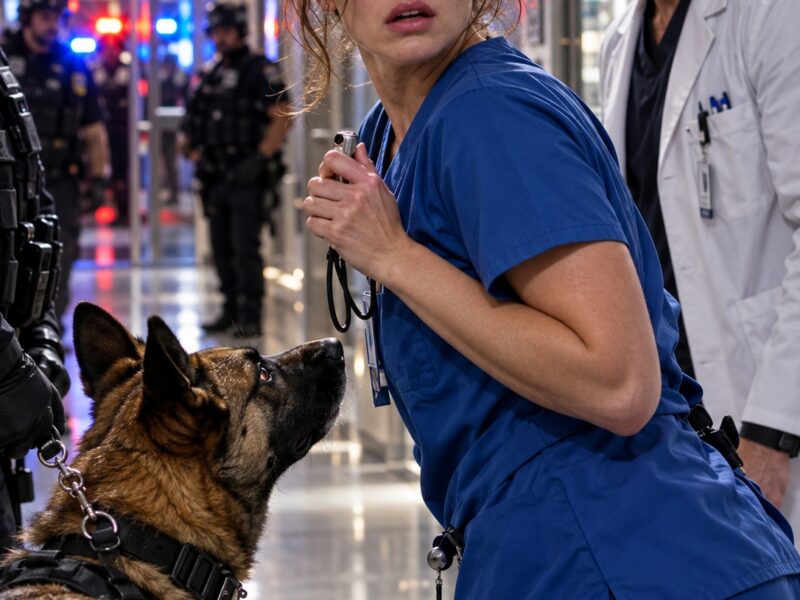
The police dog refused to move.
Officer Reyes pulled once on the leash.
“Duke. Forward.”
Nothing.
Around them, Fairview VA Medical Center was under lockdown.
Somewhere inside the building was an armed man.
Forty patients on the west wing could not run.
A stairwell had not been cleared.
And every second they stood there was another second the gunman had to disappear deeper into a hospital full of veterans, nurses, doctors, visitors, and people trapped in beds.
“Duke.”
Reyes gave the command again.
The Belgian Malinois planted all four paws against the polished floor.
His ears flattened.
His body went rigid.
Then his head turned.
Not toward the stairwell.
Not toward the armed officers.
Not toward his handler.
Toward Emily Hart.
The quiet nurse.
Twenty feet away, Emily stood frozen in cobalt-blue scrubs, one hand still wrapped around the hospital radio clipped to her waist.
For eight months, most people at Fairview had barely noticed her.
Dr. Roland Preston talked over her.
Other nurses called her the Ghost.
Patients knew her as the young woman who spoke softly, worked late, and never volunteered anything about herself.
She was twenty-eight.
She lived alone.
She rarely joined anyone for lunch.
She never talked about where she had been before nursing school.
And now a trained police K9 was staring at her as if every other human being in the hallway had suddenly ceased to exist.
Reyes tugged the leash again.
“Come on, Duke. Move.”
Duke barked once.
Sharp.
Urgent.
Then he strained toward Emily.
Every officer in the staging area looked at her.
Emily felt something cold open beneath her ribs.
She knew that posture.
She knew the angle of the ears.
She knew the tension running from the dog’s shoulders through his hind legs.
Most of all, she knew what it meant when a working dog ignored noise, authority, unfamiliar voices—and chose one person.
She had seen it before.
Half a world away.
Before the cobalt scrubs.
Before nursing school.
Before she learned how to make herself small enough that nobody would ask what she had survived.
An officer glanced between Emily and the dog.
“Ma’am?”
Emily said nothing.
“Do you know this dog?”
“No.”
The answer came too quickly.
Behind her, a man’s voice cut through the hallway.
“Emily.”
She closed her eyes for half a second.
Commander Marcus Cole was standing outside his hospital room when he had absolutely no business being there.
He was forty-one, retired Navy, officially admitted four days earlier after a fall at home.
He was also the only person in Fairview who had spent the past week looking at Emily as if he already knew that “quiet nurse” was only the cover story.
Cole watched Duke.
Then Emily.
“That dog doesn’t know you,” he said.
Emily swallowed.
“No.”
“But he recognizes something.”
Officer Reyes crouched beside Duke.
“He’s never done this. Not once. Two years together and he has never refused me like this.”
Emily could hear her own breathing.
For one impossible second, the hallway disappeared.
She smelled dust.
Hot metal.
Jet fuel.
She heard a voice laughing through a headset.
Danny.
Then the jingle of a collar.
Bishop.
Then—
No.
Not here.
She forced herself back into the hospital.
Officer Reyes was still waiting.
Duke was still staring.
Cole’s voice softened.
“Emily.”
She looked at him.
He didn’t ask the question.
He didn’t need to.
And for the first time in eight months, Emily Hart understood that hiding and surviving were no longer the same thing.
She stepped forward.
Then she dropped to one knee.
The officers around her went silent.
Emily looked directly at Duke.
And gave a low whistle.
Two tones.
Short.
Precise.
A pattern she had not used in years.
Duke changed instantly.
His ears snapped forward.
His weight shifted.
His entire body transformed from resistance into focus.
Ready.
Waiting.
Emily’s throat tightened.
For one terrible heartbeat, she wasn’t looking at Duke anymore.
She was looking at another Belgian Malinois beneath another sky.
She could almost see Danny’s gloved hand wrapped around the leash.
Almost hear him saying, You trust the dog before you trust the road.
Emily forced the memory down.
“Search.”
Duke moved.
Officer Reyes nearly stumbled as the leash went taut.
Someone behind Emily whispered, “What the hell?”
Reyes stared at her.
“What did you just do?”
Emily stood.
“Gave him a command.”
“That isn’t a civilian command.”
“No.”
“Where did you learn it?”
Her hands had started shaking.
Nobody noticed except Marcus Cole.
And he knew enough not to ask again.
Not yet.
Because less than thirty minutes earlier, the doctors and nurses of Fairview VA Medical Center had thought Emily Hart was simply the quietest nurse in the building.
None of them knew she had once called air strikes onto targets from hundreds of meters away.
None of them knew she had worked beside men and dogs trained to walk toward things everyone else ran from.
And nobody knew that the reason she had abandoned that life was buried inside the name of a dog who never came home.
Until that morning, Emily had believed she could keep it buried forever.
She had been wrong.
Eight months earlier, Emily had arrived at Fairview with almost nothing anyone could use to understand her.
Her résumé was clean.
Her nursing credentials were current.
Her references were good.
Her answers during orientation were polite and short.
She volunteered for difficult shifts.
She never complained.
She showed up early enough that Carla Bennett, one of the senior nurses, once asked whether Emily slept in the parking garage.
Emily had almost smiled.
Almost.
Instead, she said, “Traffic’s better before six.”
That was how she handled most questions.
Give people enough truth that they stopped looking for the rest.
The other nurses eventually called her the Ghost.
It wasn’t cruel.
Not exactly.
Emily simply had a talent for being present without taking up space.
She could enter a room, change an IV, adjust a monitor, calm a frightened patient and disappear before anyone thought to ask about her weekend.
It suited her.
Being noticed led to questions.
Questions led backward.
And backward was somewhere Emily had spent years trying not to go.
On a Tuesday morning in March, Dr. Roland Preston stood at the nurses’ station holding a chart like it had personally offended him.
“Hart.”
Emily looked up.
“This patient’s vitals are wrong.”
“They’re not wrong.”
Preston’s eyes narrowed.
Emily immediately knew she had already said too much.
“He’s tachycardic from pain,” she continued. “I flagged it an hour ago.”
“I didn’t ask for your opinion.”
Carla, standing six feet away, stopped typing.
Preston tapped the chart.
“I asked why the numbers don’t match my orders.”
Emily felt the familiar instinct.
Not fear.
Calculation.
There were battles worth fighting.
There were battles that existed only because somebody needed another person to lose.
She lowered her eyes.
“Understood.”
Preston walked away.
Carla waited until he disappeared around the corner.
Then she stared at Emily.
“You let him talk to you like that.”
Emily picked up her tablet.
“It’s easier.”
“Easier isn’t the same as right.”
“No.”
“Then why do you do it?”
Emily started down the hall.
Carla followed.
“You know he does that because you let him.”
“Pushing back gets you written up.”
“Pushing back gets you respected.”
Emily stopped beside the medication cart.
Carla folded her arms.
“There’s a difference.”
For a moment neither woman spoke.
Then Carla’s expression changed.
“You weren’t always this quiet, were you?”
Emily felt something tighten behind her sternum.
“I don’t know what you mean.”
“Yes, you do.”
Carla lowered her voice.
“Code blue in 306 last week.”
Emily said nothing.
“I watched you.”
“So?”
“So most nurses freeze the first time a patient crashes in front of them. Even good nurses. There’s a second where the brain has to catch up.”
Carla leaned closer.
“You didn’t have that second.”
Emily shrugged.
“I read manuals.”
Carla laughed.
“Sure you do, Hart.”
Emily walked away.
The joke stayed behind.
The question followed her.
Room 209 belonged to Mr. Alvarez, seventy-three, Vietnam-era veteran, chronic heart disease, failing kidneys and a nervous system that still believed some doors were explosions.
Three times since his admission, he had called Emily by another woman’s name.
Each time he caught himself.
Each time she pretended not to notice.
That morning, she adjusted his IV while he watched her hands.
“You’ve got steady hands.”
“Thank you.”
“Steadier than most.”
Emily checked the tubing.
Mr. Alvarez studied her.
“You ever serve?”
Her fingers stopped for less than a second.
But for Emily, a second could contain an entire country.
“No, sir.”
He kept looking at her.
“Just nursing school.”
His eyes narrowed slightly.
Older veterans sometimes looked at people differently.
As though they were listening for a frequency civilians could not hear.
Mr. Alvarez seemed to hear something in her silence.
But he had survived long enough to know when not to force open a locked door.
He nodded.
Emily finished the IV and left.
Room 214 was next.
The chart said:
COLE, MARCUS. AGE 41. RETIRED NAVY COMMANDER.
Admitted following a fall at home.
Possible concussion.
Observation recommended.
Emily knocked once.
“Come in.”
She pushed open the door.
Marcus Cole was already looking directly at it.
Not at her.
At the door.
At the opening.
At the hallway behind her.
He had tracked the entry before she crossed the threshold.
Emily noticed.
So did he.
“Morning,” he said.
She approached the bed.
“You’re the quiet one.”
“I’m the one checking your blood pressure.”
He extended his arm before she asked.
His pulse was steady.
No flinch when the cuff tightened.
No anxious questions.
His eyes moved down briefly.
Then back to her face.
“You’ve got a runner’s stance.”
Emily looked at him.
“Excuse me?”
“Weight forward. Balls of your feet.”
He nodded toward her shoes.
“Most nurses stand flat.”
“Most patients don’t analyze their nurses’ feet.”
“Most patients aren’t me.”
She finished the reading.
“118 over 76.”
“Good?”
“Better than most of the staff.”
That earned a faint smile.
Emily entered the number into her tablet.
Then, before she could stop herself, she said, “You don’t need to be here.”
Cole’s smile disappeared.
“Neither do you, probably.”
Emily looked up.
Something passed between them.
Recognition without evidence.
She turned toward the door.
“Hey.”
She stopped.
Cole hesitated, as though the next sentence embarrassed him more than discussing combat ever could.
“Can I sit with you?”
Emily stared at him.
“What?”
“Lunch.”
He gestured vaguely toward the hallway.
“Cafeteria. Courtyard. Wherever nurses disappear to.”
“I don’t—”
“I’ve been in this building four days. I’ve had exactly one conversation that didn’t involve a diagnosis.”
Emily almost told him no.
Patients asked nurses for medication.
Blankets.
Water.
Remotes.
Reassurance.
They did not usually ask whether they could sit beside them as if the nurse might need company too.
“I have fifteen minutes at one.”
Cole nodded.
“I’ll take fifteen.”
Emily left telling herself she would cancel.
At one o’clock, she went to the cafeteria.
Cole was waiting in a wheelchair he clearly did not need.
Two coffees sat on the table.
“I didn’t know what you drink,” he said. “Black seemed like a safe guess for somebody who barely talks.”
“Black is fine.”
She sat.
For almost a minute, neither spoke.
Strangely, it wasn’t uncomfortable.
Some silences demanded to be filled.
Others felt like shelter.
Cole eventually lifted his coffee.
“You don’t ask questions.”
“About what?”
“Me.”
“You’re a patient.”
“Exactly. Most people read ‘Navy’ on the chart and start asking where I served, what unit, how many deployments, whether I killed anybody.”
Emily looked at him.
“People ask that?”
“You’d be amazed.”
“I don’t need to know what you did to take your blood pressure.”
“Charts don’t say what a person actually did.”
“No.”
Cole watched her.
“You know that better than most, don’t you?”
Emily’s expression stayed neutral.
Then his eyes dropped to her wrist.
“You have a scar.”
Her hand moved automatically.
She pulled her sleeve lower.
“Kitchen accident.”
Cole nodded slowly.
“Sure.”
Emily stared at him.
“What?”
“I’ve seen a lot of kitchen accidents.”
He took another drink.
“They don’t usually look like chemical burns.”
Emily stood.
“My break’s over.”
Cole checked the clock.
“Six minutes left.”
“Close enough.”
She walked away.
Cole didn’t call after her.
That bothered her more.
Because disbelief she could resist.
Recognition was harder.
Two days later, he found her in the courtyard behind physical therapy.
“You’re persistent,” Emily said.
“I’ve been called worse.”
“I bet.”
He smiled.
A real smile this time.
Then he told her the VA kept offering him a therapy-dog program.
He kept refusing.
“Why?”
The question escaped before Emily could stop it.
Cole looked toward the trees.
“The last dog I worked with didn’t come home.”
Emily’s face changed.
Barely.
A twitch near the eye.
A breath held half a second too long.
Cole saw it.
“You lost one too.”
Emily stood.
“I need to get back.”
“Emily.”
Her first name stopped her.
“You don’t have to tell me anything.”
She remained facing away.
“But whatever happened to you is why you check exits before you check vitals.”
Her shoulders went rigid.
Cole continued.
“And one day, something in this building may need exactly that instinct.”
Emily turned.
“I’m a nurse.”
“I know.”
“You don’t know anything else.”
“No.”
Cole held her gaze.
“But I know what hiding looks like.”
That night Emily sat in her car for eleven minutes before starting the engine.
She did that most nights.
Some memories had doors.
If you opened them too quickly, they didn’t stay in the past.
That night, the door opened anyway.
Bishop.
Ninety pounds of Belgian Malinois muscle, discipline and instinct.
The best working dog Emily had ever seen.
His handler, Staff Sergeant Danny Reyes, had been her closest friend through six years of deployments.
Danny talked too much.
Bishop barely made a sound unless he needed to.
Emily used to joke that the dog was the smarter half of the team.
Danny always answered, “That’s why he outranks me emotionally.”
They had cleared roads together.
Coordinated close air support.
Moved through places where one wrong patch of dirt could turn a convoy into names carved into stone.
Emily had learned to make decisions while bullets cut through walls.
She had learned to speak calmly into a radio while men screamed around her.
She had learned that fear was information, not an instruction.
Then came the compound outside Albab.
The intelligence said clear.
The intelligence was wrong.
Danny was fifty meters ahead.
Bishop had begun pulling toward a truck.
Something bothered him.
Emily remembered the radio.
The coordinates.
Her own voice.
Then the sound.
For years afterward, the sound came first in her dreams.
Before Danny.
Before Bishop.
Before the dust.
A detonation had a way of changing silence forever.
Emily remembered running.
She remembered reaching the truck.
She remembered knowing before anyone told her.
They found Bishop’s collar intact.
Almost nothing else.
Emily carried it back to base in a bag.
The debrief lasted six hours.
Investigators made her repeat the coordinates.
Again.
Again.
Again.
The intelligence had come from above her.
It had been cleared.
Verified.
The official report said the outcome was unforeseeable.
The report said Emily had followed protocol.
The report said no action of hers constituted negligence.
None of those sentences brought Danny Reyes back.
None gave Bishop another thirty seconds to finish the search he had been trying to make.
Four months later, Emily left the Air Force.
Staff Sergeant Emily Hart disappeared.
Civilian Emily Hart enrolled in nursing school.
Night classes.
Clinical rotations.
Scrubs.
Medication charts.
Quiet.
She told herself she had changed careers.
The truth was uglier.
She had changed identities.
Then Thursday came.
At 7:42 a.m., the hospital speakers crackled.
“Attention all staff. This is a lockdown. Secure your area. This is not a drill.”
A tray hit the floor.
Someone gasped.
A nursing student whispered, “What’s happening?”
Most people froze.
Emily didn’t.
Her world narrowed.
Doors.
Sight lines.
Windows.
Cover.
Three exits.
One stairwell.
Forty patients who could not run.
Old instinct did not ask whether it was welcome.
It simply returned.
“Get patients in 210 through 212 and 218 into bathrooms,” Emily said.
The student stared at her.
“Stay low. Lock the doors. Lights off.”
Still nothing.
Emily’s voice changed.
“Now.”
The student ran.
At the nurses’ station, Preston stood with his phone in his hand.
“We should wait for security.”
“Security is four floors away.”
“Who told you that?”
“The elevator bank is locked.”
Emily pointed toward the rooms.
“Move patients away from exterior windows.”
“Who put you in charge?”
“Nobody.”
She looked directly at him.
“But somebody has to be.”
Preston’s face reddened.
“What if you’re wrong?”
Emily stepped closer.
“What if I’m right?”
He had no answer.
Crisis had stripped away the hierarchy he relied on.
Degrees mattered.
Titles mattered.
Experience mattered.
But none of them mattered as much as the ability to make the next correct decision while everybody else was still deciding whether the emergency was real.
Priya, a younger nurse, clutched several charts to her chest.
“Should I call families?”
“Not yet.”
Emily softened her voice.
“Help Carla. Two patients per room if necessary. Doors locked. Lights off. Nobody answers anyone outside unless the all-clear code comes over the speakers.”
Priya nodded.
“Can you do that?”
“Yes.”
“Then go.”
Down the hall, Marcus Cole had pulled himself out of bed.
“Hart.”
Emily turned.
“What do you see?”
“A hospital that wasn’t built for this.”
“That’s not what I asked.”
For the first time, Emily stopped pretending.
“I see three exits. One unsecured stairwell. Bad visibility from the west corner. Forty patients who can’t run.”
Cole nodded.
“Then we don’t run.”
The radio crackled.
An armed individual had entered through the loading dock.
Former employee.
Possible grievance.
Location unknown.
Police arrived minutes later.
Then the K9 unit came in.
Officer Reyes.
And Duke.
The dog who would force Emily Hart’s past into the light.
When Duke obeyed her whistle and pulled toward the stairwell, Emily followed.
Nobody stopped her.
The stairwell was dim.
Emergency lights threw weak yellow pools across the concrete landings.
Duke moved quickly at first.
Then slowed near the second landing.
Emily watched his body.
His tail.
His nose.
The change was subtle.
But she knew.
“Stop.”
Reyes looked at her.
“What?”
“He’s got something.”
“The shooter?”
“No.”
Duke shifted again.
Emily’s blood went cold.
“Something else.”
Reyes watched his dog.
Emily took one step backward.
“Get everyone away from this landing.”
“Why?”
She looked at him.
“Explosive odor.”
The words seemed to alter the air.
“You think there’s a bomb?”
“I think your dog is alerting.”
Reyes hesitated.
Emily’s voice sharpened.
“Clear the stairwell.”
“I can’t evacuate a floor based on—”
“If I’m wrong, we lose ten minutes.”
She pointed at Duke.
“If I’m right and you ignore him, we lose people.”
Reyes made the call.
Officers began clearing the area.
Patients were redirected through the far corridor Emily had identified earlier.
Twenty minutes after people started listening to the nurse everyone called the Ghost, an explosion tore through a maintenance area near the loading dock.
The blast was small compared with what Emily remembered from Albab.
But buildings did not measure explosions by memory.
Glass shattered.
Metal screamed.
The floor trembled.
Two security guards were caught near the dock.
One escaped with minor injuries.
Walt Grimes did not.
Emily heard the blast two floors away.
And ran toward it.
“Emily!”
Cole followed.
She spun around.
“Stay here.”
“Not happening.”
“You’re a patient.”
“And you’re apparently a nurse who knows military K9 commands.”
“This isn’t funny.”
“I’m not laughing.”
She ran.
Cole followed.
Walt Grimes lay on the concrete.
Blood was spreading beneath his leg.
His abdomen was already beginning to swell.
Two hospital employees stood nearby, terrified and useless.
Emily dropped beside him.
Everything inside her became still.
Not emotionally.
Operationally.
The part of Emily Hart she had spent years trying to kill had returned completely.
And it knew exactly what to do.
“Walt, look at me.”
His eyes fluttered.
“Stay with me.”
She cut open the pant leg.
Severe lower-extremity trauma.
Possible arterial bleed.
Abdominal injury.
Blast overpressure.
“Get me a strap. Belt. Anything.”
Someone moved.
Emily packed the wound.
Applied pressure.
Checked his breathing.
His pulse was rapid and thin.
“He needs surgery.”
“The OR is on lockdown protocol,” someone said.
Emily didn’t look up.
“Then break protocol.”
Silence.
She raised her head.
“He does not have ten minutes for your paperwork to catch up with his bleeding.”
Cole dropped beside her.
“Tell me what you need.”
“Pressure here.”
She guided his hand.
“Do not release it.”
Cole obeyed immediately.
Walt shivered.
Emily leaned closer.
“Talk to me. Daughter? Son? Wife?”
His lips moved.
“Abby.”
“Your daughter?”
He nodded faintly.
“Good.”
Emily kept her voice steady.
“Abby is going to want to see her father tonight.”
Walt’s eyes began closing.
“No. Walt.”
She tapped his cheek.
“Stay with me.”
His abdomen was becoming more distended.
Emily looked at Cole.
“Internal bleed. Faster than the leg explains.”
Cole’s expression hardened.
“What do you need?”
“Two large-bore lines. Fluids.”
He moved.
No hesitation.
No questions.
For a few minutes, the loading dock became somewhere else.
Emily could hear helicopters that weren’t there.
Men calling coordinates that belonged to another continent.
She smelled blood and dust instead of disinfectant and concrete.
But her hands stayed in the present.
That was new.
Cole returned.
They worked together.
Walt’s color improved by a fraction.
Then Cole looked at Emily.
“You’ve done this before.”
It wasn’t a question.
Emily’s hands were covered in blood.
Sirens screamed outside.
For eight months she had looked away whenever someone came too close.
This time she didn’t.
“Yes.”
Cole waited.
“More times than I can count.”
His eyes narrowed.
Emily exhaled.
“Two countries. Six years.”
Cole went still.
“I called close air support from four hundred meters out. Pulled men off worse ground than this.”
“CCT?”
Emily stared at him.
“How did you know?”
“I’ve worked beside your kind.”
“My kind?”
“Combat controllers.”
Something almost like respect moved across his face.
“You people never explain yourselves. You just do the impossible and assume everybody else will eventually catch up.”
The trauma team arrived.
Emily gave the surgeon a report so precise that he stopped halfway through issuing an order.
“Where did you train?”
“Nursing school.”
The surgeon stared at her.
“That isn’t what I asked.”
For once, Emily didn’t feel the need to lie.
She simply had no time to answer.
Walt Grimes survived.
Later, the surgeon would write that the nurse who stabilized him before the trauma team arrived had performed far beyond what her listed credentials suggested.
The gunman surrendered.
Police discovered he had planted another device as part of his escape plan.
He wasn’t some legendary assassin.
He was a former contractor who believed the hospital owed him something and had decided strangers should pay for his grievance.
By early afternoon, the lockdown ended.
Fairview exhaled.
Emily sat on a supply crate near the loading dock.
Her hands had finally stopped shaking.
Cole lowered himself beside her.
“You want to tell me the rest?”
“No.”
“Fair.”
A few seconds passed.
“Want me to guess?”
She glanced at him.
“You seem to enjoy that.”
“Staff Sergeant. Combat Control. Joint operations. K9 handlers. IED routes.”
Emily looked at the floor.
“There was a dog.”
Cole waited.
“Bishop.”
Her voice almost broke on the name.
“Belgian Malinois. Best working dog I ever saw.”
“And the handler?”
“Danny Reyes.”
Cole glanced toward the corridor where Officer Reyes had disappeared with Duke.
“No relation?”
“No.”
Emily gave a humorless smile.
“Apparently the universe has a strange sense of humor.”
“What happened?”
She could have stopped.
Instead, she opened the door.
“Compound outside Albab. Bad intelligence.”
Cole’s face changed.
“I called the coordinates.”
“Emily—”
“Danny was fifty meters ahead. Bishop had started pulling toward a truck. Intelligence said clear.”
She looked at her hands.
“They didn’t make it.”
Cole didn’t tell her everything happened for a reason.
He didn’t tell her to forgive herself.
Men like Marcus Cole knew how insulting easy comfort could sound to someone who had spent years waking at three in the morning with dead people in the room.
“That wasn’t your failure,” he said.
Emily laughed once.
Quietly.
“You read the report?”
“No.”
“Then you don’t know.”
“I know bad intelligence.”
She looked at him.
“And I know the difference between responsibility and guilt.”
Emily swallowed.
“Do you?”
Something dark moved behind Cole’s eyes.
“Yes.”
That answer carried a story of its own.
But he continued before she could ask.
“You followed information that had been verified.”
“I still made the call.”
“And you’ve been sentencing yourself for it ever since.”
Emily looked away.
“I left four months later.”
“Why nursing?”
She thought about it.
“Because I told myself if I couldn’t save the people I was trained to save, maybe I could save whoever was in front of me.”
Cole looked toward the loading dock where Walt’s blood still stained the concrete.
“And today?”
Emily followed his gaze.
“Today I remembered I was good at it.”
“That’s supposed to be bad?”
Her eyes filled, but she refused to let the tears fall.
“It scared me more than the gunman.”
Cole understood.
Because sometimes the most frightening thing wasn’t discovering you had changed.
It was discovering the person you had buried was still alive.
When Emily returned to the nurses’ station, people looked at her differently.
She hated it immediately.
Whispers stopped when she approached.
Carla stared at her like she wanted to ask a hundred questions and knew enough to ask none.
Preston stood with his arms crossed.
“I heard you gave field commands to police.”
“I made a recommendation.”
“You commanded a K9.”
Emily almost smiled.
“The dog made his own decision.”
Preston’s jaw tightened.
“That isn’t something a nurse just happens to know.”
For eight months, Emily would have looked down.
This time she met his eyes.
“No.”
The single word unsettled him more than an argument would have.
“No, it isn’t.”
Before Preston could respond, hospital administrator Diane Whitfield entered with two men wearing dark suits.
Emily recognized them immediately.
Not their faces.
Their posture.
The details civilians missed.
One of them looked directly at her.
“Staff Sergeant Hart.”
The nurses’ station went silent.
Emily felt the old rank land against her skin like a uniform she had forgotten she still owned.
Whitfield looked confused.
“Staff Sergeant?”
“United States Air Force Combat Control,” the taller man said. “Six years.”
Preston’s face changed.
The officer continued.
“Two Bronze Stars. One with Valor.”
Emily closed her eyes briefly.
She hadn’t wanted this.
Not the medals.
Not the reveal.
Not people measuring her differently because they finally understood she had once worn a uniform.
The officer glanced at Preston.
“Some details remain need-to-know. But she coordinated close air support under conditions most civilian medical teams would consider unsurvivable.”
His tone remained professional.
“I would reconsider how you address her.”
Preston said nothing.
Emily looked at the officer.
“That wasn’t necessary.”
“Maybe not.”
“No. Definitely not.”
The officer nodded.
“Fair enough.”
That mattered to her.
She didn’t need Preston humiliated.
She needed him to understand that respect should never have required medals in the first place.
Colonel Briggs, the shorter officer, turned toward Marcus Cole.
His expression changed.
“Commander.”
Cole went still.
“Briggs.”
“Didn’t expect to find you here.”
“Neither did I.”
“Word about your fall reached a few desks.”
Emily looked between them.
Briggs continued carefully.
“Some people wondered whether it was really an accident.”
Cole’s jaw tightened.
“We’ll discuss that later.”
The tone ended the conversation.
But Emily understood.
Marcus Cole had recognized her because he was hiding too.
His fall wasn’t simply a fall.
His silence wasn’t simply privacy.
Two damaged people had recognized each other before either was willing to recognize themselves.
The Air Force liaison officers had technically come because Emily’s specialized military training had become relevant during a civilian active-threat incident.
The paperwork should have been routine.
It wasn’t.
“There’s an initiative being developed,” Briggs explained later in a quiet office. “Veteran medical personnel. Tactical K9 teams. Civilian hospitals.”
Emily listened.
“Most hospitals have almost no coordinated protocol for what happened today.”
He placed a folder on the desk.
“You demonstrated why they need one.”
“I’m a nurse.”
“We know.”
“I’m not reenlisting.”
“Nobody is asking you to.”
Emily stared at the folder.
“Then what are you asking?”
Briggs leaned back.
“Design it.”
She didn’t move.
“Train civilian medical teams and K9 units to work together during active threats. Build the response model.”
Emily looked through the glass panel in the office door.
Duke was outside with Officer Reyes.
The dog sat at his handler’s side.
Calm now.
Ordinary.
She thought about Bishop.
For years, Bishop had existed only in the worst moment of her life.
A collar in a bag.
A truck.
Dust.
Danny’s mother standing in a kitchen in Ohio.
Maybe memory didn’t have to remain a grave.
Maybe it could become architecture.
“I have conditions.”
Briggs nodded.
“I assumed you would.”
“Officer Reyes and Duke are involved.”
“Done.”
“And the program isn’t named after me.”
“What do you want to call it?”
Emily looked at Duke.
Then beyond him.
Somewhere much farther away.
“Bishop’s Line.”
Briggs waited.
“After a dog who never got the chance to finish his last search.”
The room was quiet.
Then Briggs nodded.
“Bishop’s Line.”
That evening, Marcus Cole waited near the hospital entrance.
His discharge papers were in his hand.
The wheelchair sat beside him, unused.
“They’re throwing you out?” Emily asked.
“Apparently refusing medical advice repeatedly makes you unpopular.”
“I’m shocked.”
He smiled.
Then it disappeared.
“My fall wasn’t an accident.”
Emily stopped.
Cole looked through the glass doors.
“Two years ago, I lost three men on an operation.”
He spoke without looking at her.
“Command called it successful because the objective was achieved.”
His mouth tightened.
“I call it three coffins and a promotion I didn’t want.”
Emily said nothing.
“I spent two years telling everybody I was fine.”
He gave a quiet laugh.
“Turns out if you repeat a lie at three in the morning often enough, it still doesn’t become true.”
“The stairs?”
“Bottle of whiskey I don’t remember opening.”
He finally looked at her.
“That isn’t an accident.”
“No.”
“It’s a cry for help nobody answered.”
Emily considered him.
“Takes one to know one.”
“Staff Sergeant.”
She almost smiled.
“Don’t call me that.”
“Why?”
“I’m not that anymore.”
Cole shook his head.
“Some things you don’t stop being.”
He nodded toward the hospital behind them.
“You just stop hiding them.”
Emily looked through the glass.
Late afternoon sunlight stretched across the parking lot.
Golden.
Ordinary.
There had been years when ordinary evenings made her angry.
How could grocery stores stay open?
How could traffic lights change?
How could strangers argue over parking spaces after Danny and Bishop had vanished from the world?
Eventually she understood.
The world continuing wasn’t an insult to the dead.
It was what the dead had been trying to protect.
“I used to think surviving meant disappearing,” Emily said.
Cole listened.
“I thought if I became small enough, quiet enough, ordinary enough, nothing could find me.”
“The memories?”
“The guilt.”
She paused.
“Myself.”
Cole nodded.
“And now?”
Emily looked back toward the hospital.
“Now I think surviving means using whatever is left of you so the next person doesn’t lose what you lost.”
Neither spoke for a while.
Then Cole said, “I still owe you lunch.”
Emily looked at him.
“A real one.”
He smiled.
“No hospital coffee. No wheelchairs I don’t need. No pretending either of us is less complicated than we are.”
Emily considered the offer.
“I might take you up on that.”
“Good.”
He started toward the exit.
Then glanced back.
“Besides, Duke likes you more than his actual handler.”
Emily laughed.
It was small.
Brief.
But real.
The first completely unguarded sound anyone at Fairview had heard from her in eight months.
Three weeks later, Bishop’s Line launched as a pilot program at two VA hospitals.
Officer Reyes and Duke became its first certified team.
Emily led the training.
She refused podiums whenever possible.
She preferred floors, corridors, stairwells and simulated emergencies.
She taught nurses how fear narrowed vision.
She taught officers how medical priorities changed tactical movement.
She taught hospital administrators that emergency plans written in conference rooms often failed when frightened human beings had to execute them.
Most importantly, she taught people what Danny had taught her years before.
Trust wasn’t rank.
It wasn’t volume.
It wasn’t who had the biggest title printed beneath their name.
Trust was consistency under pressure.
Officer Reyes struggled after the lockdown.
Duke’s refusal had shaken him.
One Friday he brought Emily coffee.
“He still listens to you first.”
Emily scratched Duke behind one ear.
“No.”
“He does.”
“He listens to whoever earns his trust fastest in the moment.”
Reyes frowned.
“That sounds like the polite version of what I said.”
Emily smiled.
“The point of the training is that tomorrow it should be you.”
Duke leaned against Reyes’s leg as if to settle the argument himself.
Marcus Cole began attending sessions too.
At first as a volunteer.
Then regularly.
He was good at simulated crisis scenarios.
Nobody who had watched him hold pressure on Walt Grimes’s wound was surprised.
Slowly, Cole began sleeping better.
Not perfectly.
Healing, Emily discovered, was rarely cinematic.
There was no morning when someone woke up and found the past had politely moved out.
There were simply more nights when sleep lasted until dawn.
More mornings when the bottle remained closed.
More days when remembering three dead men didn’t require punishing the fourth who came home.
Cole never fell down his stairs again.
Dr. Preston never offered Emily a dramatic apology.
That would have been too easy.
But he stopped correcting her publicly just to establish authority.
He began asking instead of ordering.
Then one afternoon he caught her alone in a hallway.
“Hart.”
Emily turned.
Preston looked profoundly uncomfortable.
“I was wrong about you.”
Emily waited.
He seemed to want to add something.
He couldn’t.
So he walked away.
Emily watched him go.
It wasn’t redemption.
But it was movement.
Sometimes that was enough.
Mr. Alvarez remained at Fairview longer than expected.
One afternoon, he spotted Emily.
“Knew it.”
She stopped.
“Knew what?”
He pointed a shaking finger.
“There was more to you.”
Emily smiled.
“You caught me.”
“Of course I did.”
His expression softened.
“Takes one to know one.”
Then the old man looked down.
“Wish somebody had told me that thirty years ago.”
Emily understood.
“Might’ve saved me some bad nights,” he said.
“It’s never too late to say it out loud.”
Mr. Alvarez nodded.
And for the first time since his admission, he did not accidentally call her by somebody else’s name.
“Thank you, Emily.”
Her own name sounded different coming from him.
Not a cover.
Not a civilian identity.
Not the person who replaced Staff Sergeant Hart.
Just Emily.
Whole enough to contain both.
Carla found her weeks later beside the same medication cart where they had argued about Preston.
“I always knew there was a story behind that quiet.”
Emily raised an eyebrow.
“You did?”
“Absolutely.”
Carla grinned.
“Didn’t predict the part where you started training half the hospital security department.”
“Neither did I.”
Carla studied her.
“You good?”
Emily gave the automatic answer.
“I’m good.”
“No.”
Carla shook her head.
“Really good.”
Emily went quiet.
Months earlier, she would have changed the subject.
Now she considered the question honestly.
“Better.”
“Better isn’t good.”
“It’s closer.”
Carla waited.
Emily looked down the corridor.
“I still think about Danny.”
She swallowed.
“And Bishop.”
“Every night?”
“Not every night anymore.”
That sentence surprised her.
She had not realized it until she said it.
“Sometimes I still wonder whether I could have called it differently. Whether I should’ve stopped everything when Bishop pulled toward that truck.”
Carla didn’t interrupt.
“But then I think about Walt going home to Abby.”
Emily looked toward the security desk.
“And Duke. And Reyes.”
A faint smile.
“And a Navy commander who finally stopped falling down stairs.”
“That sounds like progress.”
Emily nodded.
“It’s not nothing.”
“No.”
Carla squeezed her shoulder.
“That’s definitely not nothing.”
One year after the lockdown, Fairview held a small ceremony near the loading dock.
Emily almost refused to attend.
Then she saw the plaque.
Simple.
No medals.
No rank.
No mention of Emily Hart.
Exactly as she wanted.
It read:
In memory of Bishop and all who serve without asking for recognition.
Officer Reyes brought Duke.
For once, the dog was off leash.
He walked to the plaque and sat beside it.
Quiet.
Alert.
Emily knew better than to romanticize working dogs.
Duke couldn’t read the plaque.
He didn’t understand memorial ceremonies.
He didn’t know Bishop.
But watching him sit there, perfectly still, Emily allowed herself one irrational thought.
Maybe some things did not need language to be understood.
Then she heard footsteps.
Walt Grimes was walking toward her.
No cane.
His daughter Abby held his hand.
Emily had seen photographs during his recovery, but never the two of them together.
Walt stopped in front of her.
For a moment he couldn’t speak.
Emily rescued him.
“You look better than the last time I saw you on that loading dock.”
He laughed.
Then his eyes filled.
“Yeah.”
Abby looked up at Emily.
“My dad says you saved him.”
Emily glanced at Walt.
“Your dad had a lot of people working on him.”
“He says you saved him.”
Emily could have corrected the story.
Once, she would have.
Instead she crouched slightly so she was closer to Abby’s height.
“He worked very hard to stay.”
Abby squeezed her father’s hand.
“I’m glad.”
“So am I.”
Walt held out his hand.
Emily took it.
He didn’t say thank you.
He didn’t need to.
He simply held on a second longer than a handshake required.
Emily understood.
After everyone left, she remained near the plaque.
Cole found her there.
“You planning to sleep here?”
“Considering it.”
“Bad mattress.”
“I’ve slept on worse.”
“I believe you.”
They stood beside each other.
Duke lay several feet away, head on his paws.
The hospital moved around them.
Carts rolled.
Elevator doors opened.
Someone laughed down the corridor.
A monitor sounded somewhere upstairs.
Life continuing.
Cole read the plaque.
“You okay?”
Emily considered the question.
Then nodded.
“Yes.”
Not cured.
Not absolved.
Not finished.
Just yes.
She touched the edge of the plaque.
For years, when Emily remembered Bishop, she remembered the explosion.
Now other images came too.
Duke refusing the stairwell.
Walt opening his eyes.
Reyes learning to trust himself again.
Nurses practicing evacuation routes.
Cole drinking coffee instead of whiskey at three in the morning.
Danny’s death had not become meaningful because good things happened afterward.
Emily refused to believe grief worked that way.
Loss did not become fair because someone learned from it.
Bishop and Danny still deserved to come home.
Nothing changed that.
But Emily had finally stopped demanding that her own life end simply because theirs had.
That was the difference.
She had spent years believing survival was a verdict.
One person came home.
Two didn’t.
Therefore the one who returned must explain herself forever.
Must shrink.
Must apologize.
Must become harmless enough to justify still breathing.
She understood now that survival was not a verdict.
It was an obligation.
Not to suffer forever.
To carry something forward.
A lesson.
A name.
A warning.
A better way to bring somebody else home.
Months passed.
Bishop’s Line expanded.
Emily remained a nurse.
That surprised people.
Some assumed the program would pull her into administration or federal consulting full-time.
She refused.
She still wanted rooms like 209.
She wanted ordinary mornings.
Medication carts.
Blood-pressure cuffs.
Patients complaining about hospital food.
She wanted to save people without needing the world to be ending first.
One morning she entered Mr. Alvarez’s room with his discharge papers.
He looked at the wheelchair.
Then at her.
“I can walk.”
“Hospital policy.”
“Policy is stupid.”
“Frequently.”
He laughed.
“You always this agreeable?”
“Only with difficult patients.”
As she helped him into the chair, he looked at her wrist.
The scar was visible.
Emily noticed him notice.
This time she did not pull down her sleeve.
Alvarez said nothing.
Neither did she.
They had both learned something about questions.
Sometimes respect meant asking.
Sometimes it meant allowing an answer to arrive in its own time.
At the entrance, his daughter waited.
Before leaving, Alvarez looked back at Emily.
“You know what I think?”
“That sounds dangerous.”
“I think people like us make a mistake.”
Emily leaned against the wheelchair handle.
“What mistake?”
“We think if nobody can see the war anymore, then it must be over.”
His smile faded.
“But we can see it.”
Emily nodded.
“Yeah.”
“So maybe hiding from people who understand is the stupid part.”
Emily looked across the lobby.
Marcus Cole had just entered carrying two coffees.
He raised one when he saw her.
Alvarez followed her gaze.
A slow grin appeared.
“Oh.”
Emily sighed.
“Don’t.”
“I didn’t say anything.”
“You were about to.”
“I’m seventy-three. Let me have something.”
Emily laughed.
Alvarez’s daughter wheeled him toward the doors.
Before they opened, he turned.
“Emily?”
“Yes?”
“Glad you came home.”
The words hit harder than she expected.
He disappeared through the doors.
Cole approached.
“What did he say?”
“Nothing.”
“Your face says otherwise.”
“My face needs better operational security.”
“That’s what I’ve been telling you.”
He handed her coffee.
Black.
He had remembered.
Emily took it.
Outside, morning sunlight spread across the parking lot.
A year earlier, light like that would have reminded her of waiting after a strike.
Now it reminded her that her shift ended at seven.
That Cole wanted dinner.
That Duke had training on Friday.
That Officer Reyes still owed her a corrected response protocol.
That Abby Grimes had mailed the program a crayon drawing of her father standing beside a dog approximately the size of a horse.
Small things.
Ordinary things.
The kind Emily once believed she no longer deserved.
She looked down at her coffee.
Cole watched her.
“What?”
“Nothing.”
“You’re smiling.”
“No, I’m not.”
“You definitely are.”
“Commander.”
“Staff Sergeant.”
She gave him a look.
He grinned.
And somewhere down the corridor, a dog barked once.
Emily turned instinctively.
Duke came around the corner beside Reyes.
His ears lifted when he saw her.
For a moment, Emily saw two dogs at once.
Duke beneath the fluorescent lights.
Bishop beneath a white, brutal sky.
The memory hurt.
It probably always would.
But pain was no longer the only thing attached to it.
Emily crouched as Duke approached.
The Malinois pressed his head briefly against her hand.
She scratched behind his ear.
“Good boy.”
Reyes shook his head.
“See? Still likes you better.”
Emily looked up.
“No.”
“What?”
“He trusts you.”
Duke moved back to Reyes’s side without a command.
Emily smiled.
“See?”
Reyes looked down at his partner.
Then back at Emily.
“Guess the training works.”
“That’s the idea.”
They walked away.
Emily remained where she was.
Cole waited beside her.
Neither hurried.
On the wall behind them, the plaque near the loading dock caught a strip of morning light.
In memory of Bishop and all who serve without asking for recognition.
Emily had spent years thinking she needed permission to become herself again.
Permission from Danny.
From Bishop.
From the military.
From the investigators who cleared her.
From some impossible version of the past in which she made one different decision and everybody lived.
The permission never came.
Because permission had never been what she needed.
She needed a reason.
Sometimes a reason arrives as an emergency.
Sometimes as a wounded man bleeding on concrete.
Sometimes as another broken person who looks at you and recognizes the shape of what you are hiding.
And sometimes it arrives on four paws, plants itself in the middle of a hospital hallway, refuses every voice around it, and waits until you finally remember your own.
Emily stood.
She looked once more at Bishop’s name.
Then she followed Cole toward the doors.
She did not look back again.
Not because she had forgotten.
Because, finally, she knew there was a difference between leaving something behind and carrying it forward.









