The Poor Milliner Was Humiliated Over Two Pennies—Until the Coldest Duke in England Spoke Five Words That Changed Both Their Lives
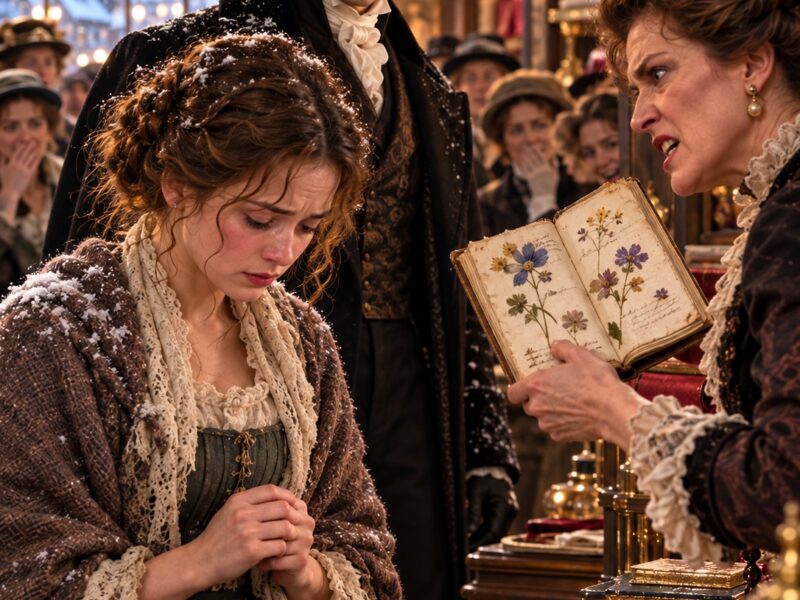
The shopkeeper held up Eleanor Whitcomb’s precious book of pressed flowers and began reading the most painful memory of her childhood aloud.
A few customers laughed. Eleanor stood motionless, her last shilling on the counter, unable to afford the two pennies that stood between her and the ribbon she needed.
Then a quiet voice came from the other end of the shop.
“Put it on my account.”
The man who spoke was Lord Adrian Blackwood, Duke of Wintermere, a nobleman so reserved that people had begun to call him the coldest duke in Somerset.
He had no idea that his small act of kindness would reopen an old wound. Nor could he imagine that the young woman standing before him would eventually discover the secret he had spent his entire life trying to hide.
December 1818 arrived in the little Somerset village of Coldmere beneath three days of unbroken snowfall.
White fields stretched beyond the cottages, hedgerows disappeared beneath heavy drifts, and the narrow road leading toward Ravenswick had become a winding track of ice and mud. At the far end of that road stood a small thatched cottage, its chimney sending a thin ribbon of smoke into the gray morning sky.
Inside, Eleanor Whitcomb sat beside a modest fire, sewing a straw bonnet by the weak winter light.
Her fingers were stiff with cold, but her stitches remained fine and even. The bonnet belonged to the miller’s daughter, who was to be married on Christmas Eve, and Eleanor had promised to make it beautiful enough for the happiest day of her life.
She was a talented milliner, though few people beyond the neighboring villages knew her name. She had learned her trade during an apprenticeship in Bath, and while poverty had forced her to work from her kitchen, it had never diminished the care she gave her craft.
Beside her lay the object she valued more than any of her sewing tools.
It was a small, worn book with a cracked cover and a spine repaired twice with ordinary thread. Between its pages lay flowers Eleanor had gathered and pressed over the years, each accompanied by a date, a place, and a memory written in her careful hand.
There were buttercups from a meadow near her childhood home, forget-me-nots from the churchyard, bluebells gathered after spring rain, and delicate apple blossoms she had rescued from a fallen branch.
To someone else, it might have seemed a sentimental little collection.
To Eleanor, it was a record of the world as she remembered it, a treasury of color more reliable than the finest pattern books.
She could distinguish a dozen shades of ivory in candlelight. She knew which blues softened a pale complexion, which greens made brown eyes warmer, and how the slightest change in ribbon could transform a plain bonnet into something unforgettable.
The miller’s daughter had fair hair and gentle gray eyes. Eleanor had already shaped the bonnet, but its final ribbon needed to be the delicate yellow of a primrose opening in early spring.
She knew exactly where to find it.
Mrs. Beatrice Harrow’s fashionable shop in Ravenswick carried the finest ribbons in the district. Eleanor had seen the perfect shade displayed there the previous week, folded neatly beneath the glass counter.
She set aside her needle and crossed to the mantelpiece.
A small tin box stood behind a chipped pottery vase. Inside was the money she had saved from selling eggs and completing small sewing commissions.
Eleanor opened it and counted.
One shilling.
She counted again, although she knew perfectly well that the result would not change.
The ribbon cost one shilling and two pennies.
For several moments she remained standing beside the mantelpiece, listening to the fire crackle.
The egg merchant would not pay her until Saturday. The finished bonnet had to reach the miller’s house by Friday evening. Without the ribbon, the work would be incomplete, and Eleanor had never broken a promise to a customer.
She considered using another color, but the thought troubled her.
The bride deserved the bonnet Eleanor had promised.
At last, she placed the shilling inside her purse, wrapped herself in her thickest shawl, and made a decision that left her deeply uneasy.
She would ask Mrs. Harrow for two days’ credit.
It was only two pennies.
Yet to Eleanor, those two small coins carried the weight of a promise she had made long ago.
The journey to Ravenswick took nearly an hour.
Snow soaked through her worn boots, and icy wind found its way beneath her shawl. By the time she reached the high street, her fingers were numb and her shoulders dusted white.
Mrs. Harrow’s shop glowed warmly behind its broad windows.
Inside stood fashionable ladies examining gloves, two farmers’ wives comparing buttons, and a pair of young girls admiring silk trimmings. Near the far end of the counter, a tall gentleman in a dark riding coat appeared to be waiting for an attendant.
Eleanor took little notice of him.
She moved toward the ribbons, opened her flower book, and carefully removed a pressed yellow primrose.
The shopgirl watched as Eleanor held it beside a length of silk.
The colors matched almost perfectly.
“I’ll take this, please,” Eleanor said.
The shopgirl measured the ribbon, cut it neatly, and named the price.
Eleanor placed her shilling on the counter.
“I have a small favor to ask,” she said, keeping her voice low. “Might I bring the remaining two pennies on Saturday? I shall have the money then.”
The shopgirl hesitated.
Before she could answer, Mrs. Harrow emerged from behind a display of gloves.
“Two pennies?” she repeated.
Eleanor turned toward her.
“Yes, ma’am. I would not ask if the bonnet were not promised for Friday.”
Mrs. Harrow glanced at the open flower book and then at the length of ribbon.
Her expression hardened.
For the past year, she had watched more and more women praise the bonnets made by the young woman who worked in a village kitchen. Customers who once admired her own carefully arranged displays had begun speaking of Eleanor Whitcomb’s unusual talent.
Mrs. Harrow had built her business through years of difficult work following her husband’s death. Her reputation mattered enormously to her, and she had come to resent the admiration Eleanor received so effortlessly.
Now the young milliner stood before her, unable to pay two pennies.
Mrs. Harrow raised her voice.
“This establishment does not provide charity to girls who fancy themselves fashionable milliners.”
Conversation stopped.
Eleanor felt the attention of the entire shop settle upon her.
“I am not asking for charity,” she replied quietly. “Only until Saturday.”
Mrs. Harrow gave a short, humorless laugh.
“And how are we to run a respectable business if every kitchen seamstress expects us to finance her ambitions?”
One of the farmers’ wives looked away.
Eleanor reached for her flower book, intending to close it and leave.
But Mrs. Harrow took it first.
“What is this peculiar little collection?”
“Please,” Eleanor said. “That belongs to me.”
Mrs. Harrow turned the pages.
The brittle flowers trembled between the paper sheets.
Then she found a pressed blue forget-me-not, its delicate petals faded with age.
Beneath it was a short note.
Mrs. Harrow read the words aloud.
The flower had been gathered beside Eleanor’s father’s grave on the day of his funeral.
For one terrible moment, the shop was utterly quiet.
Then one of the young girls near the gloves let out a nervous giggle.
Eleanor felt heat rush into her cheeks.
She had endured cold winters, unpaid bills, hunger, and the humiliation of wearing mended dresses among women who could afford new ones.
But no stranger had ever taken her father’s memory from her hands and displayed it for amusement.
“May I have my book back?” she asked.
Her voice was steady, although her fingers trembled.
Mrs. Harrow opened her mouth to reply.
A man’s voice interrupted her.
“Put it on my account.”
Every head turned.
The tall gentleman at the far end of the counter had stepped forward.
He was perhaps in his early thirties, broad-shouldered and pale from the winter cold. His riding coat was beautifully cut, but there was nothing ostentatious about his appearance.
Mrs. Harrow recognized him immediately.
“Your Grace.”
Lord Adrian Blackwood, Duke of Wintermere, stood looking at the small book in her hands.
“I believe the young lady asked you to return her property,” he said.
Mrs. Harrow’s expression changed.
“Of course, Your Grace. I had no intention—”
“The book, Mrs. Harrow.”
She placed it on the counter.
Adrian looked toward Eleanor.
“The remaining cost of the ribbon may be charged to my account.”
He intended nothing more than to end an unnecessary cruelty.
But Eleanor’s expression told him he had misunderstood something important.
Her face had gone very pale.
“Thank you, Your Grace,” she said with perfect courtesy. “But I cannot accept.”
His brow tightened slightly.
“It is merely two pennies.”
“Yes,” Eleanor answered.
There was something in that single word that made him fall silent.
She closed her book, then seemed suddenly unable to bear the watching faces around her.
Without another word, she turned and walked toward the door.
Her shilling remained on the counter.
So did the ribbon.
And in her distress, she left behind the little book she had carried since childhood.
The bell above the door rang sharply as she stepped into the snow.
Adrian remained where he stood.
He had expected gratitude, or perhaps embarrassment followed by relief.
Instead, the young woman had looked at him as though he had joined in her humiliation.
For the first time that morning, he began to understand how much damage a kindness could do when it deprived someone of the dignity they were struggling to preserve.
He picked up the forgotten book.
Its cover was warm from Eleanor’s hands.
Outside, snow drifted past the shop windows, quickly covering the footprints she had left behind.
Eleanor walked until the houses of Ravenswick disappeared.
Only then did she stop beneath a bare willow tree.
She placed one hand against the frozen trunk, trying to steady her breathing.
She was not angry with the duke.
That was the worst of it.
He had spoken gently, and she believed he had meant well.
But she had seen herself reflected in the eyes of the shop’s customers: a poor girl receiving charity from a powerful man, expected to be grateful because the sum was too small to matter to him.
Two pennies.
The memory carried her backward to a different winter.
Her father had been a peat cutter, a quiet, broad-shouldered man whose work depended on the weather and the condition of the moors. During a particularly brutal season, the ground had frozen so hard that he could not earn enough to support his family.
He had borrowed money to carry them through until spring.
At first, the creditor had been sympathetic.
Later came the interest.
Then the visits.
Eleanor remembered standing near the kitchen hearth while a man in a fine coat waited for payment her father could not provide.
She remembered watching her father remove his cap.
He had lowered his head in his own home.
That sight had frightened her more than the man’s threats.
The debt had taken something from her father that no repayment could restore.
Years later, as he lay dying, he had gripped Eleanor’s wrist.
“Debt is like a noose,” he whispered. “A man may place it around your neck gently enough. But the other end remains in his hands.”
He made her promise never to place herself in debt to a man.
She had kept that promise through every difficult season.
Until that morning, she had never even considered breaking it.
Now she stood beside a frozen road, ashamed that two pennies had nearly undone the rule by which she had lived.
Across the white fields, Adrian Blackwood rode toward Ashborne Hall.
The house rose beyond a long avenue of elms, its stone walls and tall windows standing pale against the snow. He had inherited the dukedom only months earlier, following his father’s death, and the estate still felt more like an obligation than a home.
People in the district called him cold.
He attended church but seldom remained afterward. He declined dinner invitations and avoided the easy conversation expected of a duke.
His neighbors mistook his reserve for arrogance.
They did not know that many of the ordinary activities of polite society filled him with a quiet dread.
Since childhood, Adrian had struggled to read.
Letters seemed to shift on the page. Words he recognized one moment became unfamiliar the next. A short letter could take him so long to decipher that afterward his temples ached and his eyes burned.
His father had brought in expensive tutors from London and Oxford.
Each had promised improvement.
Each had eventually departed, frustrated by a boy who could remember complex figures and understand difficult estate matters but could not read a simple passage fluently.
Adrian had learned to conceal the struggle.
His steward read correspondence aloud. Financial matters were discussed verbally. At social gatherings, he avoided being asked to read anything in public.
He had become skilled at steering conversations away from the one weakness he feared would destroy people’s respect for him.
Only his aunt, Lady Margaret Blackwood, knew the full truth.
That evening, Adrian sat alone in the library with Eleanor’s book open upon his knees.
He could not make out all the small handwritten notes.
But the flowers held his attention.
Someone had arranged them with extraordinary patience. The colors followed one another with a subtle harmony he could appreciate without understanding a single word.
He turned a page.
Then another.
Lady Margaret entered leaning on her cane.
“What have you found, Adrian?”
He looked up.
“A book that belongs to a young woman in Ravenswick.”
Lady Margaret settled into the chair opposite him.
“May I see?”
He passed it across the table.
She examined the flowers, then began reading their notes aloud.
A primrose gathered by a stream.
Apple blossoms rescued after a storm.
Forget-me-nots picked beside a grave.
Lady Margaret’s expression softened.
“This must belong to Miss Whitcomb.”
“You know her?”
“Every woman in the district seems to know her work. She makes extraordinary bonnets.”
Adrian looked toward the fire.
“I met her today.”
Something in his voice made Lady Margaret study him more closely.
After he told her what had happened in Mrs. Harrow’s shop, his aunt remained silent for a moment.
Then she turned the flower book over in her hands.
“Your mother would have loved this.”
Adrian’s eyes lifted.
Lady Margaret smiled sadly.
“She had a tradition, you remember. Every Christmas she arranged for new bonnets to be made for the women who worked on the estate. She wanted each woman to have something beautiful chosen especially for her.”
Adrian remembered.
He remembered his mother sitting with ribbons spread across her lap, laughing as she tried to match colors to the faces of women she knew by name.
The custom had ended with her death three years earlier.
Lady Margaret touched a faded primrose.
“It would please me to see that tradition restored.”
Adrian stared at the flower.
For the first time since entering Mrs. Harrow’s shop, he saw a way to approach Eleanor that did not require charity.
He could offer her something that recognized her talent.
An honest commission.
And perhaps, if she would allow it, he could begin to repair the damage he had done.
The following morning, Adrian rode through the snow toward the cottage at the end of the lane.
He carried Eleanor’s book and a small parcel wrapped in brown paper.
When she opened the door and saw him standing outside, her expression grew guarded.
“Your Grace.”
“Miss Whitcomb.”
He held out the book first.
“I believe this belongs to you.”
Eleanor’s eyes widened.
She took it carefully, running her thumb over the familiar worn cover.
“I thought I had lost it.”
“The shopkeeper had it after you left.”
He offered the parcel.
“And this is the ribbon you selected.”
Eleanor looked at him.
“I cannot accept it.”
“You left a shilling on the counter. That paid most of the cost.”
She hesitated.
“The other two pennies?”
“Charged to my account.”
Her shoulders stiffened.
“Then I owe you two pennies, Your Grace. I shall repay them on Saturday.”
Adrian nodded.
“Very well.”
Eleanor blinked.
He continued, “You may leave them with the gatekeeper at Ashborne Hall.”
He did not laugh.
He did not tell her how little the money mattered.
He simply accepted her terms.
For several seconds, Eleanor examined his face, as though searching for some trace of amusement.
Finding none, she stepped aside.
“Would you care to come in? The fire is small, but it is warm.”
Adrian entered the cottage.
His gaze passed over the modest furniture, the sewing basket, the bundles of straw, and the unfinished wedding bonnet resting upon the table.
There was no luxury anywhere.
But everything had its proper place.
Eleanor set the flower book beside her tools and waited.
“I have come on another matter,” Adrian said.
He explained his mother’s Christmas tradition and Lady Margaret’s wish to revive it.
Thirty women worked on the estate.
He wanted Eleanor to make a bonnet for each of them.
Not identical bonnets chosen for convenience, but individual pieces designed for the women who would wear them.
Eleanor listened carefully.
When he finished, she folded her hands.
“Your Grace, that sounds remarkably like charity wearing a more expensive coat.”
Adrian glanced at the unfinished bonnet.
“I cannot pretend to know much about millinery.”
“That much is obvious.”
The words escaped before she could stop them.
To her surprise, the corner of his mouth moved.
“But I know exceptional work when I see it,” he replied. “And I believe yours is exceptional.”
Eleanor looked down at her hands.
No one of his rank had ever spoken to her that way.
Still, she was cautious.
“If I accept, there will be conditions.”
“Name them.”
“I shall be paid a proper weekly wage, in coin. No advances. No gifts disguised as wages.”
“Agreed.”
“And I must meet Lady Margaret before making any promise.”
“Of course.”
Eleanor studied him.
“You agree rather easily, Your Grace.”
“I see no reason to object to fair conditions.”
For the first time, she smiled.
It was a small smile, quickly hidden.
But Adrian noticed.
Lady Margaret visited the cottage that afternoon.
Wrapped in furs and leaning heavily on her cane, she entered with the composure of a woman who had spent her life in great drawing rooms and could find equal comfort beside a cottage hearth.
Eleanor gave her the only good chair.
The elderly lady asked to see the wedding bonnet.
She turned it slowly, examining the careful stitches and the pale yellow ribbon.
Her fingers lingered upon the brim.
Then her eyes filled with tears.
“My dear,” she said, “Adrian’s mother would have adored this.”
Eleanor felt something loosen inside her chest.
She accepted the commission.
That night, she finished the miller’s daughter’s bonnet.
She delivered it on Friday, exactly as promised.
And when Saturday came, she wrapped two pennies in a twist of paper and sent them to Ashborne Hall.
She had kept her promise.
She did not know that another promise was beginning to take shape.
The following week, Eleanor arrived at Ashborne Hall carrying her sewing basket.
Lady Margaret had prepared the east room for her work.
It was a spacious chamber with tall windows overlooking the winter gardens. Pale light entered even on cloudy mornings, and a broad table stood near the hearth.
Upon it were treasures Eleanor could scarcely believe.
Silk ribbons in every color.
Fine straw.
Wooden bonnet blocks.
Artificial flowers made from silk so delicate they seemed real.
Lady Margaret explained that many of the materials had belonged to Adrian’s mother.
“Use whatever you need, my dear.”
Eleanor touched a length of pale blue ribbon with reverent fingers.
“I shall take excellent care of everything.”
That afternoon, Adrian appeared in the doorway.
He carried the little twist of paper she had sent on Saturday.
He held it out.
Eleanor unfolded it.
The two pennies were gone.
Beneath the words she had written, a single word appeared in large, uneven letters.
Paid.
She looked up.
“Thank you, Your Grace.”
Adrian inclined his head and left.
Eleanor stood looking at the word for several moments.
She had no way of knowing that it had taken him nearly fifteen minutes to write those four letters.
She knew only that the duke had acknowledged the debt exactly as she wished.
And for the first time in years, she had accepted help from a man without feeling that a part of herself had been surrendered.
Work began in earnest.
The women of Ashborne Hall came one by one to the east room.
Eleanor measured their heads, examined their faces, and asked gentle questions about the colors they liked.
There was the laundry maid, whose hands were cracked from winter water.
There was the gardener’s elderly wife, who confessed she had never owned a new bonnet.
There was a young dairy girl who lowered her eyes whenever anyone spoke to her.
Eleanor listened to each of them.
She noticed things they did not know could be noticed.
The laundry maid had beautiful dark eyes that would be brought out by a soft green ribbon.
The gardener’s wife had a dignified profile that needed no elaborate decoration.
The dairy girl loved blue but dreaded attracting attention.
Eleanor chose a narrow band of pale blue silk for her, delicate enough to make her feel lovely without making her feel exposed.
Every bonnet was different.
Every woman mattered.
Lady Margaret often sat beside the fire, her stiff fingers sorting ribbons while she told Eleanor stories about Adrian’s mother.
She spoke of her laughter, her impatience, and the way she sang while she sewed.
Eleanor began to feel the absence of the late duchess almost as keenly as the affection that still surrounded her memory.
Adrian started visiting the east room.
At first, he always brought a reason.
A parcel of materials from town.
A message from his steward.
A branch of holly he thought Eleanor might find useful.
Eventually, he stopped inventing excuses.
He would stand near the window, watching her work while the pale afternoon light fell across the table.
One day, as Eleanor adjusted a stubborn brim, he asked, “How do you know when a bonnet is finished?”
She considered the question.
“Do you mean when the stitches are done?”
“No. When you know there is nothing left to improve.”
Eleanor turned the bonnet in her hands.
“When everything is right,” she said, “it stops fighting the hand that makes it.”
Adrian was quiet.
He remembered those words long after he returned to his library.
He had spent much of his life trying to force himself into the shape other people expected.
With Eleanor, for reasons he did not yet understand, the effort seemed less necessary.
Their conversations grew longer.
She spoke of her apprenticeship in Bath, the crowded shop on Milsom Street, and the excitement of making her first bonnet without her employer’s supervision.
He spoke of the estate, the difficult responsibilities that had followed his father’s death, and the strange loneliness of living in a house filled with people.
Eleanor discovered that he remembered the names of his servants and the small details of their lives.
He listened more than he spoke.
When he did not understand something, he admitted it.
There was little in him of the cold, proud duke described by the people of Ravenswick.
Yet one thing continued to puzzle her.
Whenever a letter arrived, Adrian handed it to his steward.
When bills were presented, he asked for their figures to be spoken aloud.
Once, Eleanor saw him turn a printed notice facedown almost as soon as he looked at it.
She wondered about these habits.
But she did not ask.
Then, one snowy evening, the question answered itself.
Eleanor was working near the hearth, holding a half-finished bonnet in one hand and a needle in the other.
Her flower book lay open on the table.
“Your Grace,” she said, “would you read the note beside that pale blue flower? I want to remember where I found it.”
Adrian took the book.
He looked down.
The fire crackled.
Snow tapped softly against the windowpanes.
Eleanor waited.
Adrian said nothing.
His fingers tightened around the cover.
At last, he closed the book carefully.
“I cannot,” he said.
Eleanor lowered her needle.
He stared at the closed pages.
“Not quickly. Not while someone is waiting.”
She looked at his bowed head and the tension in his jaw.
Suddenly, many small things began to make sense.
The letters.
The bills.
The printed notice.
Even the single awkward word he had written upon her repayment note.
Eleanor set her sewing aside.
She did not ask him to explain.
She simply waited.
And because she did not hurry him, Adrian found the courage to speak.
He told her about the tutors who had arrived at Ashborne Hall when he was a boy, confident that they could solve his difficulties.
He described the way letters changed places before his eyes.
He told her how his father had grown increasingly silent each time another tutor left.
“I could remember anything they told me,” he said. “I could calculate figures. I understood the estate accounts when they were explained aloud. But place a simple page before me, and I became a child who could do nothing.”
Eleanor sat very still.
“It is not that I cannot read at all,” he continued. “I can. Slowly. One word at a time. But when someone waits for me, the letters seem to become strangers.”
He gave a small, bitter smile.
“A duke who struggles with the reading lessons of a schoolboy. My father never quite knew what to do with me.”
Eleanor felt a quiet ache beneath her ribs.
Adrian had spent years being judged for something he could not control.
The shame was familiar.
It was different from hers, but she recognized its shape.
“Is that why you were studying my flower book?” she asked gently.
He looked at her.
“Yes.”
He paused.
“I could not read all your notes. So I looked at the flowers.”
He opened the book again.
“I saw how carefully you had chosen each one. The shades of yellow. The blue beside the gray. The way you had preserved things other people would scarcely have noticed.”
His voice softened.
“I have spent much of my life searching for words that refuse to stay where I need them. You seemed to have found a way to keep the things you loved.”
Eleanor moved from her chair.
She sat beside him on the settle.
Then she opened the book to the first page.
“Shall I read them to you?”
Adrian looked at her.
There was no pity in her expression.
No embarrassment.
Only an invitation.
“I should like that very much.”
She read to him.
Page after page.
Flower after flower.
The room grew quiet around them.
When she reached the blue forget-me-not from the churchyard, her voice faltered.
Adrian noticed.
Eleanor told him about her father.
She spoke of the peat cutting, the winter when no work could be found, the creditor who came to the house, and the promise her father had asked her to make before he died.
She described the shame of watching a good man bow his head because he owed another man money.
Only then did Adrian understand what had happened in Mrs. Harrow’s shop.
His offer had not merely embarrassed Eleanor.
It had brought her face-to-face with the memory she feared most.
“I am sorry,” he said.
She looked at him.
“I thought I was helping you. I did not understand that I was taking away the one thing you were trying to preserve.”
Eleanor closed the book.
“You could not have known.”
“I might have asked.”
She considered him for a moment.
“Yes,” she said softly. “You might have.”
He accepted the gentle rebuke.
Then Eleanor placed her hand over his.
Neither spoke.
Outside, snow fell across the gardens.
Inside, two people who had spent much of their lives hiding their most painful vulnerabilities began, for the first time, to feel understood.
From that evening onward, Adrian brought his correspondence to the east room.
Eleanor read letters aloud and wrote down his replies as he dictated them.
She never made decisions for him.
The words were always his.
She merely helped them reach the page.
Sometimes he practiced writing difficult words while she worked on a bonnet beside him.
At other times, he asked her to teach him something of her craft.
His first attempts to weave softened straw were disastrous.
He pulled too tightly, bent the wrong strands, and produced an uneven edge that Eleanor examined with exaggerated seriousness.
“I fear Your Grace has created a new fashion.”
“What shall we call it?”
“An unfortunate accident.”
Adrian laughed.
The sound surprised them both.
It had been years since laughter came to him so easily.
Gradually, he began recognizing words that had always troubled him.
Gradually, Eleanor ceased expecting every kindness to conceal a demand.
They became accustomed to each other’s presence.
She noticed when he was tired before he admitted it.
He noticed when she worked too long without eating.
He began bringing her tea in the evenings.
She learned to recognize the nearly invisible smile that appeared when he was amused.
Neither spoke of love.
But something had begun growing between them, quietly and steadily, like a flower pressing upward beneath winter soil.
Unfortunately, Ravenswick was not a town that left happiness undisturbed.
Mrs. Harrow soon learned that Eleanor Whitcomb had been employed at Ashborne Hall.
Then she heard that the duke frequently visited the room where Eleanor worked.
The news passed from her shop to the market and from the market to the church porch.
At first, the remarks were merely unpleasant.
Then they became cruel.
People began whispering that the poor milliner had secured her position through her appearance rather than her talent.
Some suggested that a young woman working inside a duke’s residence must surely have expectations beyond an honest wage.
Within a week, two customers canceled their bonnet orders.
Eleanor received the letters at her cottage.
She read them slowly, one after the other.
Neither woman accused her openly.
They simply regretted that circumstances made it impossible to continue their arrangement.
Eleanor knew precisely what those circumstances were.
She sat beside the little fire, holding the letters in her lap, and felt the old humiliation returning.
When Adrian learned what had happened, his face hardened.
He reached for his coat.
“I shall speak to Mrs. Harrow.”
Eleanor stood.
“No.”
He turned.
“She has been spreading lies about you.”
“And if the Duke of Wintermere rides into town to defend me, what will people think?”
“They will know the accusations are false.”
“They will think I have persuaded you to protect me.”
Adrian’s jaw tightened.
Eleanor moved closer.
“I know you wish to help. But this is something I must do myself.”
“How?”
She looked toward the half-finished bonnets arranged along the table.
“At Christmas, thirty women will enter church wearing my work. Every person in Ravenswick will see what I have made.”
She lifted one bonnet carefully.
“Let them judge me by that.”
Adrian wanted to argue.
He wanted to use his title and influence to silence the gossip immediately.
But he remembered the morning in Mrs. Harrow’s shop.
He remembered what Eleanor had taught him about the difference between giving someone help and taking away their choice.
Slowly, he removed his hand from his coat.
“Very well.”
Eleanor’s expression softened.
“Thank you.”
The final days before Christmas were exhausting.
Eleanor worked from before dawn until long after midnight.
She shaped straw, sewed silk flowers, and adjusted ribbons beneath the candlelight.
Lady Margaret helped as long as her aching joints allowed.
Adrian brought tea and candles.
One evening, he fell asleep in the armchair by the hearth while Eleanor worked beside him.
She looked over at him, the firelight touching his tired face, and felt an affection so deep that it frightened her.
Without telling anyone, she made one additional bonnet.
It was for Lady Margaret.
She chose dove-gray silk and trimmed it with tiny blue forget-me-nots, remembering that the elderly woman had once mentioned loving those flowers as a girl.
On Christmas morning, the women of Ashborne Hall gathered outside the great house.
Thirty bonnets.
Thirty different designs.
Thirty women who had been seen and understood by the person who made them.
Together, they walked through the snow toward the village church.
As they entered, conversations faltered.
Heads turned.
The laundry maid held herself straighter than anyone had ever seen.
The dairy girl kept her eyes raised instead of watching her feet.
The gardener’s elderly wife walked with such quiet pride that her husband had to turn away and blink hard.
People noticed the bonnets, of course.
But what they noticed most were the women wearing them.
They seemed transformed.
Not by wealth or extravagant decorations, but by the simple pleasure of possessing something beautiful that had been made specifically for them.
Eleanor watched from her pew.
That was exactly what she had hoped to achieve.
When Lady Margaret opened her own Christmas gift and saw the little forget-me-nots, tears filled her eyes.
She reached for Eleanor’s hand.
“You remembered.”
Eleanor smiled.
“Of course.”
Adrian sat beside his aunt.
He barely noticed the bonnets during the service.
His attention kept returning to Eleanor.
The young woman who had been humiliated over two pennies had given thirty women something no amount of money alone could purchase.
She had helped them feel worthy of being admired.
After the service, the congregation gathered outside in the churchyard.
A lady approached Eleanor.
It was the same woman who had stood near the gloves in Mrs. Harrow’s shop.
One of her daughters followed a step behind, her eyes lowered.
“Miss Whitcomb,” the lady began, “I wonder whether you might have time to make a bonnet for my daughter this spring.”
The girl glanced up briefly.
Her cheeks were pink with embarrassment.
Eleanor recognized her.
She was the young lady who had laughed when Mrs. Harrow read the note about her father’s funeral.
For a moment, Eleanor remembered the hot shame of that morning.
Then she smiled politely.
“I should be delighted.”
The lady thanked her.
No apology was spoken.
But the request carried an acknowledgment that everyone nearby understood.
Eleanor had not needed to defend herself with anger.
Her work had spoken for her.
Later that evening, Ashborne Hall opened its great hall for the Christmas feast.
Candles burned along the walls.
A fiddler played beside the enormous fireplace.
The tables were crowded with roast goose, plum pudding, warm bread, and spiced cider.
Laughter filled the room.
Eleanor danced twice.
Lady Margaret watched from her chair, smiling at the sight of Adrian speaking easily with people he had once avoided.
After a while, Eleanor slipped outside to escape the heat.
The old garden was quiet beneath the moon.
Snow covered the paths, and the bare apple branches gleamed silver.
At the far end of the walk, beneath the oldest tree, stood Adrian.
He turned when he heard her approaching.
“Miss Whitcomb.”
“Your Grace.”
He smiled.
“The bonnets were beautiful.”
Eleanor folded her hands beneath her shawl.
“How could you know? I saw you in church, and you scarcely looked at them.”
Adrian’s expression changed.
“I was looking at you.”
The words settled between them.
Eleanor felt her breath catch.
For several moments, neither moved.
Then Adrian stepped closer.
“I have been trying for days to find the right words.”
His voice was low.
“You know better than anyone how difficult words can be for me. I have turned them over in my mind, trying to arrange them properly, and still they seem inadequate.”
Eleanor’s fingers tightened together.
“You needn’t explain.”
“I think I must.”
He looked directly into her eyes.
“I love you, Eleanor.”
Her face softened.
He continued before courage deserted him.
“I love the way you see people. I love the patience you bring to things the rest of the world overlooks. I love that you have never once made me feel ashamed of what I cannot do.”
Snow moved silently through the branches above them.
“I want you to remain at Ashborne Hall,” he said. “Not as my aunt’s milliner. As my wife.”
Eleanor stood motionless.
Adrian reached for her hand.
“I want to spend the rest of my life watching you search for the perfect shade of yellow.”
Tears rose in her eyes.
She lifted her gloved hand and touched his cheek.
He bent toward her.
Their kiss was tender and uncertain at first, then full of everything they had been too careful to say.
For a brief moment, Eleanor allowed herself to imagine a future she had never dared to want.
A home filled with warmth.
Evenings beside the fire.
A man who respected her mind and loved the hands that had sustained her through years of hardship.
Then the old fear returned.
She stepped back.
Adrian saw the change in her face.
“Eleanor?”
She shook her head.
“I cannot marry you.”
The words seemed to hurt her as much as they hurt him.
He released her hand.
“May I ask why?”
Eleanor looked toward the distant windows of Ashborne Hall.
“A duchess lives in her husband’s house. She wears gowns bought with his money. Everything she possesses comes from him.”
“That need not be so.”
“Perhaps not to you.”
She swallowed.
“But I have spent my life making certain that no man could decide my future because I depended upon him.”
Adrian remained silent.
Eleanor continued, her voice breaking.
“And if I marry you now, Mrs. Harrow will say every rumor was true. Everyone will think I sought employment here because I wanted your fortune.”
“I do not care what Mrs. Harrow thinks.”
“I know.”
She looked at him.
“But I care about what it would mean to surrender the independence my father taught me to protect. And I will not have your name dragged through the town because of me.”
Adrian’s face showed his pain.
Yet he did not try to persuade her.
He had come to understand that love could not be offered as another obligation.
“If asking makes you feel trapped,” he said, “I shall not ask again.”
Eleanor wanted him to stay.
Instead, she watched him bow to her with the same respect he would have shown a duchess.
Then he walked back toward the house.
She remained beneath the apple tree long after his footsteps disappeared.
A few days later, a letter arrived from Bath.
It was from the milliner who had trained Eleanor during her apprenticeship on Milsom Street.
The woman was offering her the position of head milliner, with a generous wage and a private room above the shop.
Eleanor read the letter again and again.
She had wanted such a position since she was sixteen.
It promised everything she had once believed would make her secure.
An honest income.
Professional recognition.
A life in which she would answer to no wealthy benefactor.
She accepted.
Adrian did not try to change her mind.
He asked only whether she truly wanted the work, or whether she was leaving because of the rumors.
Eleanor assured him that the position represented a dream she had held long before arriving at Ashborne Hall.
Lady Margaret said little.
But one afternoon, while they sorted ribbons by the fire, she told Eleanor a story.
Many years earlier, she had made a promise to her own father.
Keeping it had cost her the only man she had ever loved.
“I thought obedience was the same as honor,” she said.
Eleanor looked up.
Lady Margaret kept her eyes on the ribbons.
“I have spent thirty years wondering whether my father would truly have wanted me to sacrifice my happiness for something he said when I was young.”
Neither woman spoke for a long time.
That night, Eleanor packed her sewing tools.
Before leaving, she placed her flower book in the library.
Inside the front cover, she tucked a note written in large, carefully spaced letters.
She wanted Adrian to be able to read every word himself.
She thanked him for treating her as an equal.
She asked him to continue practicing with the flowers.
And she told him she would never forget the evenings they had spent beside the fire.
On a gray morning at the end of December, Eleanor left Ashborne Hall before sunrise.
Her possessions filled one small trunk and a sewing basket.
She wore her old straw bonnet.
Snow covered the long drive.
She did not look back at the east room.
She knew that if she saw its windows once more, she might lose the courage to leave.
The coach departed from Ravenswick shortly afterward.
As it rolled through the high street, Mrs. Harrow watched from her shop window.
Her arms were folded.
There was a satisfaction in her face that Eleanor, hidden inside the coach, did not see.
Several hours later, Adrian found the flower book.
He sat at the library table and opened Eleanor’s note.
Slowly, he began to read.
One word.
Then another.
The letters were large and familiar, just as she had promised.
He imagined her sitting beside him, patient and unhurried.
By the time he finished, the room seemed unbearably empty.
Lady Margaret entered quietly.
She saw the book in his hands.
Then she saw his face.
“She has gone,” he said.
His aunt sat down.
For a moment, she studied the flowers.
“Adrian, that girl loves you.”
“She has chosen Bath.”
“She has chosen what she believes will keep her safe.”
He looked toward the window.
Lady Margaret’s voice softened.
“Her father wished to protect her. But a promise made from fear should not be allowed to govern two lives forever.”
Adrian said nothing.
The following morning, he rode into Ravenswick.
He intended to close his family’s account at Mrs. Harrow’s shop and never conduct business there again.
The widow greeted him with rigid politeness.
As he settled the outstanding balance, she mentioned Eleanor.
With a small, satisfied smile, she remarked that Miss Whitcomb would hardly receive the welcome she expected in Bath.
Adrian looked up.
“What do you mean?”
Mrs. Harrow adjusted the ledger.
“I felt it my duty to write to her former employer on Milsom Street. A respectable establishment ought to be warned about a young woman’s reputation.”
The room seemed to grow cold around him.
Adrian placed his hand flat upon the counter.
“You wrote to them?”
“Naturally, Your Grace.”
“And what did you say?”
Mrs. Harrow hesitated.
Only then did she seem to understand the seriousness of what she had admitted.
Adrian’s voice remained quiet.
“Why do you hate that young woman so much?”
For several moments, Mrs. Harrow said nothing.
Then her carefully maintained expression began to crumble.
She spoke of the fifteen years she had spent making bonnets.
Every seam straight.
Every trimming fashionable.
Every design correct.
Yet customers had never looked at her work with the wonder they showed when Eleanor Whitcomb entered a room carrying something she had made.
“She is better than I am,” Mrs. Harrow said bitterly.
The admission seemed to surprise even her.
“And she does not even seem to know it.”
Adrian studied the woman before him.
Her cruelty had grown out of an envy she could neither conquer nor confess until that moment.
He did not attempt to comfort her.
“Sit down, Mrs. Harrow.”
She stared at him.
“You will write a letter to Miss Whitcomb’s employer immediately. You will state that she worked at Ashborne Hall honorably and that every rumor concerning her conduct was false.”
Mrs. Harrow opened her mouth.
Adrian continued.
“And you will write it while I am standing here.”
The widow slowly took up her pen.
She wrote.
When she finished, she handed the letter across the counter.
Adrian looked down at it.
The familiar fear rose inside him.
The handwriting was small.
The lines were close together.
He could attempt to read it, but he could not be certain he would recognize every word correctly.
He knew how easily a single sentence could be altered.
He could not carry the letter to Bath without knowing precisely what it contained.
Several customers had gathered near the door.
They were watching.
He looked toward the shopgirl.
“Would you read this aloud, please?”
She hesitated.
“Your Grace?”
“Read every word, clearly.”
The customers exchanged glances.
Adrian felt the old shame rising, the shame of lessons failed, of silent disappointment, of years spent pretending.
Then he remembered Eleanor sitting beside him with the book of flowers.
He remembered her patient voice.
And he realized that the fear which had governed him for so long was far less important than the woman who had taught him he need not be ashamed.
“I cannot read it reliably myself,” he said calmly.
The words seemed to stop the room.
A duke had admitted, before strangers, the secret he had guarded his entire life.
The shopgirl began reading.
She read every sentence.
The letter acknowledged that Eleanor had conducted herself with complete propriety at Ashborne Hall.
It confirmed that the rumors were false.
Adrian listened carefully.
When she finished, he folded the paper and placed it inside his coat.
“Thank you.”
Then he walked out into the snow.
He mounted his horse and turned toward Bath.
Eleanor had already reached the city.
By the time she stepped from the coach, darkness had settled over the pale stone terraces.
Lamps burned along the streets, and carriages rattled past through the winter cold.
She made her way to the familiar shop on Milsom Street.
For the first time in days, she felt hopeful.
She imagined returning to the workroom where she had learned her trade.
She imagined the satisfaction of leading a shop through her own knowledge and experience.
Then the door opened.
Her former employer stood before her holding a letter.
The woman’s expression was closed.
“Eleanor, I am afraid circumstances have changed.”
Eleanor’s heart began to sink.
“What circumstances?”
“I have received information concerning your conduct in Somerset.”
Eleanor stared at her.
“The claims are untrue.”
“Perhaps.”
The woman glanced toward the shop behind her.
“But I cannot risk my clients’ confidence. I am sorry.”
The door closed.
Eleanor stood on the snowy pavement.
She had left the man she loved.
She had refused a future that might have made her happy.
She had traveled to Bath because she believed she must prove she could stand alone.
And now the work she had chosen no longer existed.
She returned to the coaching inn and paid for a small room with the wages she had earned at Ashborne Hall.
But the walls seemed too narrow.
She went downstairs again.
Outside, beneath a single lantern in the inn yard, she sat on a wooden bench and wrapped her shawl tightly around herself.
The cold gradually entered her hands.
She barely noticed.
Her thoughts returned to her father.
For years, she had remembered his warning as a rule that must never be questioned.
Never owe a man anything.
Never accept help that might place your future in his hands.
Yet as she sat alone in the darkness, she began to understand something she had missed.
Her father had not feared kindness.
He had feared control.
He had wanted to protect her from men who used money to make others obedient.
Adrian had never treated her that way.
He had allowed her to repay the two pennies.
He had paid her honest wages.
He had respected every condition she placed upon the commission.
When she refused his proposal, he had not threatened or persuaded or punished her.
He had simply let her choose.
Eleanor closed her eyes.
She had been so afraid of surrendering her freedom that she had failed to recognize the man who had always protected it.
A sudden sound broke the stillness.
Hooves struck the cobblestones.
Eleanor opened her eyes.
A horse entered the yard, breathing hard, its coat damp with exertion.
A tall man swung down from the saddle.
Snow covered his dark riding coat.
His face was pale and exhausted.
“Adrian?”
He turned.
For a moment, they simply looked at one another.
Then he crossed the yard.
“I went to Mrs. Harrow’s shop,” he said.
Eleanor rose slowly.
“Why?”
“To close my account. While I was there, she told me what she had done.”
Eleanor’s expression changed.
“She wrote to Bath.”
“Yes.”
Adrian drew a folded letter from his coat.
“She has admitted that the rumors were false. This letter will restore your reputation with your former employer.”
Eleanor looked at the paper.
He held it toward her.
“I have not come to ask you to return to Ashborne Hall.”
She lifted her eyes.
“I wanted you to know the truth. If you still wish to work in Bath, you may take this letter and continue with the life you chose.”
His voice remained gentle.
“If you want something else, I will respect that, too.”
Eleanor’s hands trembled as she accepted the letter.
Then Adrian drew out another object.
Her flower book.
“I believe this is yours.”
She took it with a small, broken breath.
The familiar cover rested against her fingers.
Adrian hesitated.
“I added something.”
Eleanor opened the book.
On its final page lay a small sprig of winter evergreen, pressed between two sheets of paper.
Beneath it was a note.
The letters were large.
Uneven.
Written with painful care.
He had recorded the night beneath the apple tree, its date and place, following the habit she had used for years.
Then came a simple confession.
He loved her.
Eleanor traced the crooked writing with one finger.
She knew how difficult every letter had been for him.
She knew how long he must have sat alone, struggling to place the words upon the page.
Tears began slipping down her cheeks.
Adrian did not interrupt.
At last, Eleanor looked up.
“I do not want to return to the shop on Milsom Street.”
He remained still.
“I want to open a millinery of my own in Ravenswick. With money I have earned.”
She swallowed.
“And I want to marry you.”
Adrian seemed almost unable to believe what he had heard.
Eleanor stepped closer.
“Not because you are a duke. Not because you can give me a grand house or beautiful gowns.”
Her voice trembled.
“But because you are the only man who has ever made me feel completely free to choose my own life.”
Adrian reached for her hands.
“Eleanor.”
She smiled through her tears.
“Yes.”
He kissed her beneath the lantern.
For a moment, the cold inn yard seemed to disappear.
Then the innkeeper’s wife came bustling outside, wiping her hands upon her apron.
“Sir, someone must settle the charge for that poor horse. Stabling, feed, and whatever else the creature needs after such a ride.”
Adrian stepped back.
“Certainly.”
He reached into his coat.
Then the other side.
He searched one pocket, then another.
His expression changed.
Eleanor watched him.
“What is it?”
Adrian looked at her with genuine dismay.
“I left my purse in Ravenswick.”
For a second, neither spoke.
Then Eleanor began to laugh.
She opened her own purse, filled with the wages she had earned by her own skill.
She paid the innkeeper’s wife every shilling owed.
Then she slipped her arm through Adrian’s.
He looked down at her.
There was a brightness in his eyes she had never seen before.
Eleanor smiled.
“Put it on my account.”
Adrian laughed.
And in that small, ordinary moment, they understood something neither had known when they first met.
Accepting help did not always make a person smaller.
Sometimes it simply meant trusting someone enough to let them stand beside you.
They were married on an ordinary weekday in early January.
The ceremony took place in the small stone church near Ashborne Hall.
Eleanor wanted no grand London wedding.
No vast crowd of strangers.
No elaborate spectacle intended to impress people who had never known her.
She wanted the day to belong to the two of them.
The women of the estate attended, each wearing the bonnet she had made.
Lady Margaret sat in the front pew, her dove-gray bonnet adorned with tiny blue forget-me-nots.
Eleanor had fashioned her own wedding bonnet, delicate and elegant.
But as she walked toward Adrian, no one thought chiefly about what she wore.
They saw the happiness in her face.
And they saw the duke waiting for her with a tenderness he no longer attempted to hide.
The following winter, a new shop opened in Ravenswick.
It stood directly across the street from Mrs. Harrow’s establishment.
Above the door hung a painted sign bearing Eleanor’s family name.
Whitcomb Millinery.
Although she was now the Duchess of Wintermere, Eleanor kept her father’s name upon the shop.
She had the satisfaction of building the business with money she had earned.
She worked there two days each week and employed a clever young woman from the estate as her assistant.
Lady Margaret often visited, sitting beside the window and sorting ribbons while she talked with customers.
The elderly lady seemed happier than she had been in decades.
Gradually, women who had once purchased their bonnets from Mrs. Harrow began crossing the street.
Mrs. Harrow kept her shop.
She never apologized.
Eleanor never asked her to.
The widow’s bitterness no longer held any power over her future.
At Ashborne Hall, Adrian continued practicing his reading.
He no longer concealed his difficulty as though it were a disgrace.
People came to know a duke who was patient, thoughtful, and far warmer than the rumors had suggested.
On winter evenings, he sat beside Eleanor with the flower book open on his knees.
Sometimes he read aloud.
Sometimes he struggled.
Sometimes she helped him find a word.
Neither treated the other’s assistance as a debt.
Their life together was not free from difficulty, but the difficulties no longer had to be faced alone.
Then, one snowy morning, a young woman entered Whitcomb Millinery.
She wore a thin cloak and carried a straw bonnet that was clearly the work of her own hands.
She wanted a length of blue ribbon to finish it.
Eleanor measured the silk and placed it upon the counter.
The girl opened her purse.
She counted her coins.
Then she counted again.
Her cheeks began to burn.
“I am so sorry,” she whispered. “I seem to be short two pennies.”
The shop was crowded.
Several customers turned.
The girl lowered her head.
Eleanor remembered another winter morning, standing at Mrs. Harrow’s counter with a worn flower book and a single shilling in her hand.
She remembered the laughter.
The shame.
The quiet voice that had spoken from the end of the shop.
Eleanor looked at the young woman and smiled gently.
“Put it on my account.”
The girl’s eyes widened.
“Your Grace, I could bring the money later—”
“There is no need.”
Eleanor wrapped the ribbon and placed it in her hands.
The young woman left with a bewildered expression, clutching the parcel as though it were something precious.
When the shop grew quiet, Eleanor opened the small ledger beside the till.
She wrote one simple entry.
Two pennies owing. Nothing.
That evening, she returned to Ashborne Hall.
Snow fell steadily beyond the tall windows of the east room.
Bundles of straw lay soaking on the worktable, and lengths of ribbon waited beside a half-finished bonnet.
Adrian sat near the hearth.
Her old book of flowers rested open upon his knees.
He was reading one of the notes aloud, slowly and carefully.
When Eleanor entered, he looked up and smiled.
She crossed the room and sat beside him.
Outside, winter had settled over the silent fields.
Inside, a duke who had once feared the letters on a page and a milliner who had once feared owing anyone two pennies had found a happiness neither rank nor money could purchase.
Their love had no creditor.
No debtor.
Only two people, free at last to choose each other.









