The Poor Milliner Was Humiliated Over Two Pennies—Until the Coldest Duke in England Spoke Six Words That Changed Both Their Lives
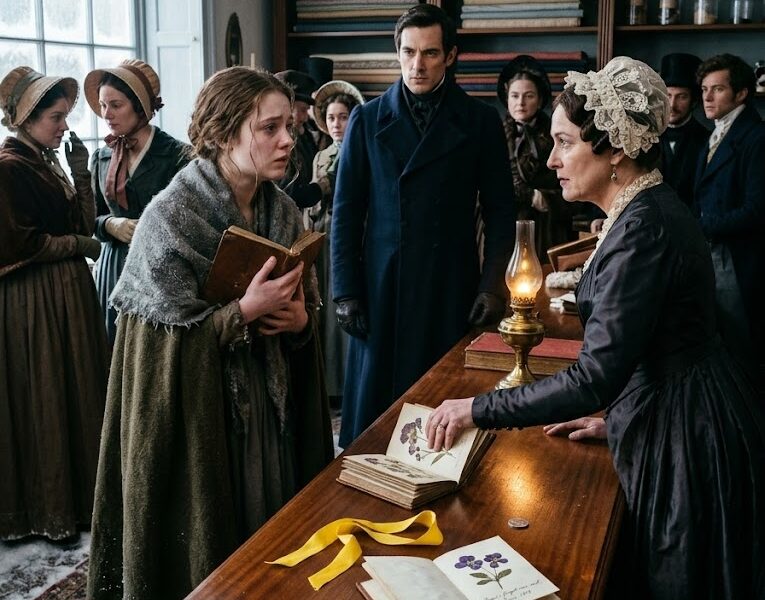
The shopkeeper held up Eleanor Wickham’s most precious possession and began reading from it aloud, while the customers laughed.
Eleanor had walked nearly an hour through the snow for a ribbon she could not quite afford. Now a memory of her dead father was being turned into entertainment for strangers.
Then a man at the far end of the counter spoke, quietly enough that no one expected the entire room to fall silent.
“Put it on my account.”
December 1818 had buried the Somerset countryside beneath three days of snow. The fields around Coldmir were white and silent, their hedgerows nearly swallowed by drifts, and the road leading toward Ravenswick had become a narrow passage between walls of frozen earth. At the end of a lonely lane stood a thatched cottage with a crooked chimney and a small garden sleeping beneath the winter.
Inside, Eleanor Wickham sat beside a modest fire, sewing a straw bonnet.
The bonnet was for the miller’s daughter, who was to be married on Christmas Eve. Eleanor had promised that it would be the loveliest thing the young woman had ever worn, and she intended to keep that promise even though the commission would leave her very little profit.
She was a gifted milliner, though few people beyond the neighboring villages understood just how gifted. She could distinguish shades of ivory that appeared identical to everyone else, and she could look at a woman’s face and know almost instinctively which colors would make her appear more beautiful without overwhelming her.
But her most valuable tool was not a needle, a wooden block, or a pair of scissors.
It was an old book of pressed flowers.
The leather cover had softened from years of handling, and its spine had been repaired twice with thread. Between the pages lay primroses, buttercups, forget-me-nots, and pale apple blossoms, carefully flattened and labeled in Eleanor’s delicate handwriting.
Each flower carried a date, a place, and sometimes a memory.
The book was part keepsake and part working reference, an ordinary-looking object that contained nearly everything Eleanor knew about color.
That morning, she was searching for the precise shade of yellow that would suit the bride’s fair hair and gray eyes. She found it in a primrose gathered beside a stream several springs earlier.
She had seen a ribbon of exactly that color in Mrs. Harrow’s shop in Ravenswick.
There was only one difficulty.
The ribbon cost one shilling and two pennies.
Eleanor opened the small tin box on her mantelpiece and counted her money. She had one shilling, and not another coin in the cottage. The woman who purchased her eggs would not return until Saturday, while the wedding bonnet had to be delivered on Friday evening.
For a long time, Eleanor stood looking at the coin.
She had never asked to owe money before.
At last, she wrapped her shawl around her shoulders, placed the flower book in her basket, and went out into the snow.
By the time Eleanor reached Ravenswick, her boots were wet and the hem of her skirt was stiff with ice. She stopped outside Mrs. Beatrice Harrow’s shop to brush the snow from her sleeves before entering.
Mrs. Harrow was a widow of about forty, a capable businesswoman who had built a respectable establishment after her husband’s death. Her window displays were admired throughout the district, and her fashionable bonnets attracted customers from several neighboring villages.
But over the previous year, the widow had developed an increasingly bitter dislike of Eleanor.
It was not because Eleanor had ever insulted her or behaved dishonestly.
It was because women had begun talking about the extraordinary bonnets made in a poor girl’s kitchen, and they spoke about them with an admiration Mrs. Harrow had never managed to inspire.
The shop was busy that morning. Two farmers’ wives examined buttons near the counter, while a well-dressed lady and her daughters stood beside a display of gloves. At the far end of the room, a tall gentleman in a dark riding coat appeared to be waiting for a purchase.
Eleanor approached the ribbons.
She opened her book, removed the pressed primrose, and held it beside a length of soft yellow silk. The colors matched so perfectly that she felt a small surge of happiness.
When the assistant told her the price, Eleanor placed her shilling on the counter.
“I have the remainder coming on Saturday,” she said softly. “Might I bring you the other two pennies then?”
The assistant hesitated.
Before she could answer, Mrs. Harrow appeared beside her.
“Two pennies?” the widow repeated, raising her voice.
Eleanor felt the first stirrings of dread.
“Yes, ma’am. I shall bring them on Saturday without fail.”
Mrs. Harrow looked from the shilling to the ribbon, then toward the other customers.
“This establishment does not extend charity to kitchen milliners who cannot afford the things they fancy.”
The conversation around them stopped.
Eleanor swallowed. “I was not asking for charity. Only a little time.”
But Mrs. Harrow was not finished.
She reached across the counter, picked up Eleanor’s flower book, and opened it beneath the light.
“What have we here?”
“Please,” Eleanor said, stretching out her hand. “That belongs to me.”
The widow turned a page.
Her gaze fell upon a small blue forget-me-not, pressed so carefully that its delicate petals had survived for years.
She read the inscription aloud.
The flower had been gathered in the churchyard on the day of Eleanor’s father’s funeral.
A young girl near the gloves gave a startled giggle behind her hand.
Mrs. Harrow smiled faintly.
Eleanor stood motionless, her cheeks burning. It was not merely the laughter that hurt her. It was the sight of a stranger holding her father’s memory as though it were some amusing curiosity.
She reached for the book again.
“Please give it back.”
Then a man’s voice came from the other end of the counter.
“Put it on my account.”
Mrs. Harrow looked up.
The tall gentleman had turned to face them, and in the sudden silence Eleanor noticed the way the widow’s expression changed.
The man was Lord Adrien Blackwood, Duke of Wintermere, the new master of Ashborne Hall.
His family had held estates in Somerset for generations. He was wealthy, powerful, and known throughout the county for a manner so reserved that many considered him incapable of warmth.
Now he stood looking at Mrs. Harrow with quiet displeasure.
“Her ribbon,” he said. “Add the remaining amount to my account.”
No one laughed.
Eleanor’s heart beat painfully against her ribs. She knew he meant to help, but every eye in the shop had moved toward her, and his intervention had made her feel more helpless than before.
She had entered as a working woman asking for two days of credit.
Now she appeared to be a poor girl accepting the charity of a duke.
“Your Grace,” she said, controlling her voice with considerable effort, “you are very kind. But I cannot accept.”
Adrien studied her face.
“I meant no offense.”
“I understand.”
She gave him a small, respectful curtsy.
Then she turned and walked out into the snow, leaving her shilling, the ribbon, and her precious book behind.
Adrien watched the door close.
For the first time in years, he had tried to offer kindness to a stranger. Yet the expression on Eleanor’s face told him that he had somehow caused another wound.
He remained standing beside the counter long after she was gone.
Eleanor walked home with the wind striking her face. Halfway along the lane, she stopped beside a bare willow because her legs had begun to tremble.
She leaned against its frozen trunk and closed her eyes.
Her father’s voice returned to her as clearly as if he were standing beside her.
He had been a peat cutter, a quiet, hardworking man who spent his days digging fuel from the wet Somerset moors. During one particularly savage winter, the ground had frozen so deeply that he could not work for months.
He had borrowed money to keep his family fed until spring.
But spring had not brought freedom.
The interest grew. Every payment seemed to make the debt no smaller, and the creditor eventually began appearing at their cottage whenever he pleased.
Eleanor remembered standing in the kitchen as a little girl, watching her father remove his cap and lower his head before a man who behaved as though he owned the family.
Her father had never feared hard work.
But debt had made him afraid inside his own home.
Years later, when he lay dying, he had taken Eleanor’s wrist in a trembling hand.
“Debt is a noose, my girl,” he whispered. “It slips around your neck so gently that you scarcely feel it. But the man holding the other end can pull whenever he chooses.”
He made her promise never to put herself in debt to a man.
Eleanor had kept that promise through winters without enough firewood, through poor harvests, through weeks when she had survived on bread and tea.
That morning, she had nearly broken it for two pennies.
And the Duke’s kindness, offered before an entire shop, had made her feel that the rope was being placed around her neck again.
Far across the snow-covered fields, Adrien Blackwood returned to Ashborne Hall carrying Eleanor’s flower book.
He had inherited his title only a few months earlier, after his father’s death. The great house was now his responsibility, along with its tenants, servants, farms, and enormous collection of family obligations.
To the people of Somerset, he was a strange duke.
He rarely attended dinners. He spoke little at church, avoided unnecessary conversation, and preferred the company of his steward to that of the neighboring aristocracy.
Most attributed his reserve to pride.
But Adrien had carried a secret since childhood.
He struggled desperately to read.
Letters changed places before his eyes. A word that he recognized on one line became unfamiliar on the next. Written sentences exhausted him, and long passages could leave his temples aching.
He was not unintelligent.
He remembered figures with astonishing accuracy, made sound decisions about the estate, and could judge a complicated situation with remarkable speed. But words on a page often defeated him.
His father had brought tutors from London and Oxford. They arrived confident that discipline would correct the problem and departed disappointed, sometimes leaving the boy more ashamed than they had found him.
Only one person knew the full truth.
His aunt, Lady Margaret Blackwood.
That evening, she entered the library leaning on her cane and found Adrien sitting beside the fire with the old flower book resting on his knees.
“What have you discovered now?” she asked.
Adrien looked up.
“A young woman’s work.”
He handed her the book.
Lady Margaret began turning its pages. She read several inscriptions aloud, pausing over the dates and the careful descriptions of color.
“Why, this must belong to Miss Wickham,” she said. “The young milliner everyone has been praising.”
Adrien nodded.
Lady Margaret continued studying the flowers. Then her expression changed.
“Your mother would have loved this.”
Adrien looked toward her.
His aunt told him of a Christmas custom his late mother had maintained at Ashborne Hall. Each year, she arranged for new bonnets to be made for the women who worked on the estate.
No two were quite alike.
The Duchess had enjoyed choosing colors and decorations for each woman, and the gifts had been treasured long after the holidays passed.
But after her death three years earlier, the tradition had disappeared.
Adrien looked down at the faded primrose between the pages.
An idea came to him.
The next morning, he rode to Eleanor’s cottage.
She was sewing beside the fire when she heard the horse outside. After setting down her needle, she opened the door and found the Duke standing in the snow with a small parcel beneath one arm.
For a moment, neither spoke.
Then Adrien held out her book.
“I believe this belongs to you.”
Eleanor took it carefully.
He offered the second parcel.
“The ribbon, too. Your shilling covered most of the cost.”
She unwrapped it just enough to recognize the primrose-yellow silk.
Her expression tightened.
“I still owe you two pennies, Your Grace.”
“Yes.”
“I shall repay them on Saturday.”
“Then you may leave them with the gatekeeper at Ashborne Hall.”
He did not smile indulgently. He did not tell her that two pennies were beneath his notice.
He simply accepted her promise as though it were an ordinary business arrangement.
Eleanor looked at him for a long moment.
Then she stepped aside.
“Would you care to come in, Your Grace?”
Adrien entered the small cottage and stood near the hearth while Eleanor cleared a chair.
He explained his mother’s Christmas tradition and Lady Margaret’s wish to restore it.
There were thirty women employed across the estate. Each would need a bonnet made especially for her.
“I should like to commission you to undertake the work,” he said.
Eleanor stared at him.
“That is a very considerable amount of work.”
“I understand.”
“And very expensive.”
“I have no intention of asking you to work for nothing.”
She folded her hands.
“With respect, Your Grace, this sounds remarkably like charity dressed in a finer coat.”
Adrien did not take offense.
“I know little about millinery,” he admitted. “But I know exceptional craftsmanship when I see it. Your work is exceptional, Miss Wickham. That is why I wish to employ you.”
Eleanor studied him.
She had expected him to insist that she ought to be grateful. Instead, he had spoken to her as though she were a professional whose judgment deserved respect.
“I have two conditions,” she said.
“Name them.”
“I will be paid weekly, in coin, for the work I complete. No advances. No favors.”
“Agreed.”
“And before I accept, I wish to meet Lady Margaret.”
“Of course.”
His answer was so immediate that Eleanor almost smiled.
Lady Margaret arrived that afternoon in a closed carriage, wrapped in furs and carrying her cane. She settled into Eleanor’s only good chair and asked to examine the wedding bonnet.
Eleanor placed it in her hands.
The elderly lady turned it slowly, inspecting the stitching and the shape of the brim. She touched the pale yellow ribbon, then looked at Eleanor with eyes suddenly bright.
“Adrien’s mother would have adored this.”
There was no condescension in her voice.
Only genuine admiration.
Eleanor accepted the commission.
She finished the miller’s daughter’s bonnet that evening and delivered it on Friday as promised. When Saturday came, she wrapped two pennies in a small piece of paper, wrote a note on the outside, and sent them to Ashborne Hall.
The following week, she carried her sewing tools up the long drive to the great house.
She was given the east room, a spacious chamber with tall windows and abundant winter light.
Inside were silk ribbons, boxes of artificial flowers, lengths of fine straw, and wooden bonnet blocks that had belonged to the late Duchess.
Eleanor stood in the doorway, scarcely daring to touch anything.
Lady Margaret told her that every material in the room was available for her work.
That afternoon, Adrien appeared with a small piece of paper.
It was the wrapping Eleanor had used for the two pennies.
The coins were gone, but beneath her note he had written one word in large, careful letters.
Paid.
She did not know that he had spent almost fifteen minutes forming those four letters.
She knew only that he had accepted her repayment.
For the first time since meeting him, Eleanor felt entirely at ease.
Work began in earnest.
Each day, women from the estate entered the east room to have their heads measured and their features studied.
There was the laundry maid, whose hands were rough and red from winter washing. There was the gardener’s elderly wife, who had never possessed a new bonnet of her own. And there was the shy dairy girl, who grew visibly uncomfortable whenever anyone looked at her for too long.
Eleanor did not choose designs to display her own cleverness.
She chose them to give each woman a quiet confidence.
For the laundry maid, she created a handsome bonnet that suited her strong features. For the gardener’s wife, she selected a warm color that softened her complexion. For the dairy girl, she made something delicate enough to be beautiful without attracting unwanted attention.
Lady Margaret often sat beside the fire sorting ribbons, her stiff fingers moving more slowly than Eleanor’s but with considerable determination.
She talked about Adrien’s mother, recalling her singing, her laughter, and the way she used to become impatient when a difficult stitch refused to cooperate.
Sometimes Eleanor caught Adrien standing in the doorway.
At first, he brought practical things: a delivery of material, a message from his steward, or news about one of the estate workers.
Then he began arriving with branches of holly or frosted ivy that he thought might inspire her.
Eventually, he stopped inventing excuses.
He simply came to watch her work.
One afternoon, while Eleanor was adjusting a brim, he asked, “How do you know when it is finished?”
She considered the question carefully.
“When everything is right,” she said, “it stops fighting the hand that makes it.”
Adrien was silent.
Later, alone in his library, he found himself thinking about her answer.
He had spent much of his life fighting the things he could not change, particularly the difficulty that made a written page feel like an enemy.
Yet Eleanor approached her work with patience rather than force.
She did not punish the straw for bending incorrectly.
She learned how it wished to bend.
As the days passed, their conversations grew longer.
She told him about her apprenticeship in Bath, where she had learned her trade from a successful milliner on Milsom Street. He told her about the responsibilities of Ashborne Hall and how unexpectedly lonely the house had become after his father’s death.
Eleanor gradually discovered that the supposedly cold Duke listened more carefully than most people she had known.
He remembered the names of servants and tenants. He noticed small changes in the household. He treated questions seriously, even when they came from people who held no position of importance.
But she began noticing something else.
Whenever letters arrived, Adrien gave them to his steward. Whenever a bill needed attention, he asked for the figures to be spoken aloud.
Once, Eleanor watched him turn a printed notice face down upon a table with an expression of unmistakable discomfort.
She wondered about it, but she did not ask.
Then one evening, while she was holding a needle and a half-finished brim, she needed to consult a note in her flower book.
“Your Grace,” she said, “would you be kind enough to read that line beside the pale blue flower? My hands are rather occupied.”
Adrien took the book.
He opened it to the page she indicated.
Then he became completely still.
The fire crackled.
Snow tapped softly against the tall windows.
Eleanor waited.
Adrien looked at the words, but they refused to settle into anything he could easily understand. His fingers tightened around the cover until the knuckles turned white.
At last, he closed the book.
“I cannot read it,” he said quietly.
Eleanor lowered her needle.
“Not quickly,” he added. “Not when someone is waiting.”
She looked at his bowed head, then at the old book in his hands.
Suddenly, all the small things she had noticed began to make sense.
She did not offer consolation.
She did not tell him that his difficulty was unimportant.
She simply remained quiet and allowed him to decide how much he wished to say.
Adrien began speaking about the tutors who had filled his childhood with disappointment. He described letters moving across pages, his father’s disapproving silences, and the humiliation of being heir to a dukedom while struggling to perform a task that seemed effortless to everyone around him.
“I can read,” he explained. “But slowly. One word at a time. And only when I am alone.”
Eleanor listened.
Then he admitted something that surprised her.
It was her book of flowers that had first made him curious about her.
Unable to read the notes easily, he had looked closely at the flowers themselves. He had noticed the care with which she arranged them, the precision of their colors, and the thought hidden in every page.
“You searched for the right shade of yellow,” he said. “I think I have spent much of my life searching for words in much the same way.”
Eleanor laid down her work.
She crossed the room, sat beside him, and took his hand.
Then she opened the book and began reading the inscriptions aloud.
They moved from flower to flower while the fire burned lower.
When she reached the forget-me-not gathered on the day of her father’s funeral, she paused.
And for the first time, she told Adrien the story of her father’s debt.
She described the creditor standing in their kitchen, the humiliation her father had endured, and the promise she had made beside his deathbed.
Adrien listened without interruption.
Only when she had finished did he speak.
“I understand now,” he said. “Why my offer at the shop hurt you.”
Eleanor looked at him.
“I meant to help,” he continued, “but I gave everyone in that room another reason to look down upon you.”
“You could not have known.”
“No. But I know now. And I am sorry.”
The simplicity of his apology touched her more deeply than any elaborate declaration could have done.
She accepted it.
After that evening, something changed between them.
Adrien began bringing letters to the east room. Eleanor read them aloud and wrote down his replies as he dictated them. She helped him practice troublesome words, tracing their shapes patiently.
But she never made decisions in his place.
The answers were always his, and he signed each letter himself.
In return, Adrien asked her to teach him something of millinery.
She showed him how straw was softened, how a brim could be shaped, and how the angle of a ribbon could alter the appearance of a face.
His hands, so accustomed to reins and estate ledgers, were hopelessly clumsy with delicate materials.
One afternoon, he managed to produce a brim so crooked that Eleanor burst into laughter.
Adrien looked at his handiwork, then began laughing too.
The sound carried into the corridor.
A passing servant stopped in astonishment.
Few people at Ashborne Hall could remember the last time they had heard the Duke laugh so freely.
The evenings became the part of Eleanor’s day she cherished most.
They worked beside the fire, sometimes talking, sometimes sitting in comfortable silence.
Adrien slowly learned to approach written words without the same terror he had felt since boyhood.
Eleanor slowly discovered that being close to another person did not always mean surrendering something of herself.
Neither spoke of love.
But it was growing between them.
Then the gossip began.
Mrs. Harrow learned that Eleanor had been employed at Ashborne Hall and spent long hours working in the Duke’s house.
Soon, whispers circulated through Ravenswick.
People claimed that Eleanor had used her appearance to win Adrien’s favor. Others suggested that no poor milliner could have obtained such a commission by honest means.
The rumors spread through shops, the marketplace, and the church porch.
Two customers canceled their orders.
Eleanor sat in her cottage holding their letters, feeling the old humiliation return.
She knew that if she allowed the rumors to define her, everything she had achieved through years of labor would be dismissed as the consequence of a duke’s generosity.
When Adrien heard what was being said, he reached immediately for his coat.
“I shall speak to Mrs. Harrow.”
Eleanor caught his sleeve.
“No, Your Grace.”
He turned.
“She cannot be allowed to continue.”
“If you defend me publicly, they will take it as proof.”
Adrien’s expression darkened.
“You expect me to do nothing?”
“I expect you to let me defend my own name.”
She spoke gently, but there was a firmness in her voice he recognized.
“On Christmas morning, thirty women will walk into church wearing bonnets I have made. Let Ravenswick see my work. Let them judge me by that.”
Adrien wanted to argue.
Every instinct urged him to use his position to silence those who had injured her.
But looking at Eleanor, he understood that doing so would take from her the very independence she had fought to protect.
He slowly released his coat.
“As you wish, Miss Wickham.”
During the days before Christmas, Eleanor worked almost without rest.
The east room remained bright long after midnight, its tables crowded with ribbons, straw, silk roses, and unfinished bonnets.
Lady Margaret helped whenever her aching joints permitted. Adrien brought candles, tea, and anything else Eleanor required.
One night, exhausted from watching over the work, he fell asleep in the armchair beside the hearth.
Eleanor noticed his head resting awkwardly against the upholstery and quietly placed a folded shawl beneath it.
Then she returned to her sewing.
In secret, she made a thirty-first bonnet.
It was for Lady Margaret, fashioned from dove-gray material and trimmed with tiny blue forget-me-nots.
She remembered the elderly woman’s casual remark that forget-me-nots had been her favorite flowers as a girl.
On Christmas morning, thirty women from Ashborne Hall walked together through the snow toward the village church.
The congregation turned to look at them.
But the bonnets did not merely attract admiration for their fine stitching.
They changed the way the women carried themselves.
The laundry maid held her head high. The shy dairy girl walked without staring at her boots. The gardener’s elderly wife entered beside her husband with such quiet happiness that he had to look away and blink several times.
Eleanor watched from her place in the church.
For the first time, she felt that her work had said everything she had been unable to put into words.
When Lady Margaret opened her Christmas gift, she began to cry.
She touched the tiny blue flowers, then reached for Eleanor’s hand.
Adrien sat beside his aunt.
But throughout the service, he scarcely looked at the beautiful bonnets.
His attention kept returning to the young woman who had made them.
After the service, as the congregation gathered in the snow-covered churchyard, a well-dressed lady approached Eleanor.
She was the same woman who had stood in Mrs. Harrow’s shop on the morning of the humiliation.
Her daughter, who had laughed behind her glove, stood beside her.
“Miss Wickham,” the lady began, “I wonder whether you might make a bonnet for my daughter this coming spring.”
The girl looked down, her cheeks flushed.
Eleanor studied them briefly.
Then she accepted the commission with perfect composure.
There was no spoken apology.
But everyone nearby understood what had just happened.
By the time the household returned to Ashborne Hall for Christmas dinner, Adrien knew something that frightened him more than any difficult letter ever had.
He loved Eleanor Wickham.
The Christmas celebration filled the great hall with warmth and laughter. Candles burned above long tables crowded with roast goose, plum pudding, and hot spiced cider.
A fiddler played near the fireplace, and servants who had spent the year working quietly through the estate danced together beneath the high ceiling.
Eleanor danced twice.
She laughed more freely than she could remember doing in years.
But after a while, the warmth and noise became overwhelming. She slipped through a side door and walked into the old garden.
Snow rested upon the bare branches of the apple trees. Moonlight silvered the paths.
Beneath the oldest tree stood Adrien.
He turned as she approached.
“Miss Wickham.”
“Your Grace.”
For a moment, they stood facing each other in the stillness.
Then he said, “All thirty bonnets were beautiful.”
Eleanor smiled.
“How can you be certain? I saw you in church. You scarcely looked at a single one.”
Adrien’s expression softened.
“I was looking at you.”
The smile faded from her lips.
He stepped closer.
“I have been trying for several days to find the words I need. They seem to escape me whenever I think I have them.”
Eleanor could hear the difficulty in his voice.
“Then perhaps,” she whispered, “you need not search so hard.”
He looked at her steadily.
“I love you, Eleanor.”
Her breath caught.
“I love the way you work. I love the way you see people. I love that you have never asked me to pretend to be something I am not.”
He paused.
“I should like to spend the rest of my life watching you search for the perfect shade of yellow.”
Eleanor’s eyes filled with tears.
“Will you marry me?” he asked. “Not as my aunt’s milliner, but as my wife?”
She raised one gloved hand and rested it against his cheek.
Adrien bent toward her.
Their first kiss was gentle, almost hesitant, beneath the snow-laden branches.
For one extraordinary moment, Eleanor believed that happiness could be as simple as remaining beside him.
Then the old fear returned.
She stepped away.
“I cannot.”
Adrien went still.
Eleanor tried to steady her breathing.
“A duchess lives beneath her husband’s roof,” she said. “She wears clothes purchased with his money. She carries his name. Everything she possesses comes from him.”
“That is not how I would wish you to live.”
“I know.”
Her voice broke.
“But the world will see it differently. Mrs. Harrow will say I schemed my way into your household, and everyone who believed her before will believe her again.”
Adrien’s face showed his pain.
Eleanor continued, struggling through her tears.
“I have fought too long to be independent. I cannot risk becoming someone who survives only because a powerful man has chosen to love her.”
Adrien was silent for a long time.
Then he bowed his head.
“I will not ask you again if asking makes you feel you have no freedom to refuse.”
He took one step backward.
And he bowed to Eleanor with the same respect he would have shown any duchess in England.
Then he returned to the house.
Eleanor remained beneath the apple tree, watching his figure disappear into the warm light.
A few days later, a letter arrived from Bath.
It came from the milliner on Milsom Street who had trained Eleanor when she was younger.
The woman offered her the position of head milliner, with generous wages and a room above the shop.
It was the opportunity Eleanor had dreamed of since she was sixteen.
She accepted.
When she told Adrien, he made no attempt to prevent her leaving.
He asked only whether she truly wanted the work or was choosing it to escape the rumors in Ravenswick.
Eleanor assured him she wanted to go.
Lady Margaret did not argue, either.
But one afternoon, while they sorted ribbons together, she spoke quietly about her own youth.
She had once loved a man her father did not approve of.
She had made a promise to obey her father’s wishes, and she had kept it even when it cost her the only man she had ever wanted to marry.
For thirty years, she said, she had wondered whether her father would truly have wished her to spend her life regretting it.
Eleanor listened without answering.
That evening, she packed her belongings.
Before leaving, she placed her flower book in Adrien’s library with a note written in large, widely spaced letters.
She wanted him to be able to read every word.
She thanked him for treating her as an equal. She told him to continue practicing his reading. And she promised that she would never forget their evenings together beside the fire.
Before sunrise on a gray December morning, Eleanor left Ashborne Hall.
She carried her tools, a small trunk, and her old straw bonnet.
As the carriage rolled down the snow-covered drive, she kept her face turned toward the road.
She did not dare look back at the east room.
The stagecoach departed from the inn at Ravenswick.
Mrs. Harrow stood in her shop window as it passed, watching Eleanor leave the town.
At Ashborne Hall, Adrien discovered the flower book later that morning.
He sat at the library table and opened Eleanor’s note.
The handwriting was large and clear, with plenty of space between the words.
Slowly, patiently, he read it.
Every sentence reminded him of the woman who had taught him that difficulty was not shameful and that kindness need not make another person small.
Lady Margaret found him sitting alone.
She read the note, then looked at her nephew.
“She is frightened,” she said.
Adrien closed the book.
“She wishes to make her own life.”
“Perhaps. But there is a difference between making one’s own life and fleeing from the possibility of sharing it.”
Adrien looked down at the pressed flowers.
Lady Margaret rested her hand on his shoulder.
“Do not let a promise made to the dead decide the future of the living.”
The following morning, Adrien rode into Ravenswick.
He went directly to Mrs. Harrow’s shop, intending to settle his family’s account and end all further dealings with her establishment.
The widow greeted him with stiff politeness.
He paid the outstanding balance.
Then she made a remark that stopped him cold.
She had written to the shop on Milsom Street in Bath, she informed him, warning Eleanor’s prospective employer about the young woman’s supposed reputation.
Adrien slowly lifted his head.
“What have you done?”
Mrs. Harrow maintained her smile.
“I considered it my duty to warn another respectable businesswoman.”
Adrien understood.
Eleanor was already on the road to Bath, unaware that the position she had accepted might no longer exist.
For several seconds, he said nothing.
Then he asked in a voice so quiet that the shop assistant stopped moving, “Why do you hate her so much?”
Mrs. Harrow’s smile vanished.
She tried to answer with another remark about propriety.
But Adrien continued looking at her.
At last, the truth emerged.
For fifteen years, Mrs. Harrow had worked diligently to create fashionable, respectable bonnets. Her seams were straight. Her materials were expensive. Her designs followed every rule of good taste.
Yet no one had ever looked at her work with the wonder they showed Eleanor’s.
The younger woman possessed a gift that Mrs. Harrow could neither purchase nor imitate.
And the knowledge had consumed her.
“She is better than I am,” the widow admitted bitterly. “And she does not even seem to know it.”
Adrien listened without sympathy.
Then he told her to take out a sheet of paper.
She was to write immediately to the shop in Bath, acknowledging that the rumors about Eleanor were false and confirming that she had conducted herself with complete honor while working at Ashborne Hall.
Mrs. Harrow obeyed.
When she finished, she held out the letter.
Adrien took it.
He looked at the words.
And the familiar terror returned.
He could not verify the letter quickly enough to be certain of its contents.
Several customers had gathered nearby.
For most of his life, Adrien would have concealed his difficulty at any cost.
But now Eleanor’s good name depended upon that letter.
He turned to the assistant.
“Read this aloud, please.”
The girl looked startled.
“Your Grace?”
“I wish to hear every word.”
She hesitated.
Adrien met her gaze.
“I cannot read it myself quickly enough to check it.”
A silence fell across the shop.
He had just acknowledged, before strangers, the secret he had spent his entire life protecting.
But Adrien no longer cared what they thought.
The assistant read the letter aloud.
It was correct.
He folded it, placed it inside his coat, and hurried outside to his horse.
Then he rode toward Bath.
By the time Eleanor arrived in the city, darkness had fallen.
The pale stone buildings glowed beneath the streetlamps, and carriages moved through streets dusted with snow.
She found the familiar shop on Milsom Street and knocked.
For one hopeful moment, she was sixteen again, standing before the doorway where she had first learned the craft she loved.
Her former employer opened the door.
But the woman’s face was cold.
She held a letter in her hand.
“I am sorry, Miss Wickham,” she said. “I cannot employ a young woman whose reputation has been called into question.”
Eleanor stared at her.
“There must be some mistake.”
“My customers would not approve.”
The door closed.
Eleanor remained on the step.
She had left the man she loved.
She had surrendered a position she had earned through her own work.
She had traveled to Bath believing she was securing the independence her father had wanted for her.
And now she had no employment at all.
She returned to the coaching inn and rented a small room with the wages she had saved.
But the room felt unbearably close.
She went downstairs, stepped outside, and sat alone on a bench beneath a lantern in the inn yard.
The air was bitterly cold.
She pulled her shawl tightly around herself and thought of her father.
She remembered his hand around her wrist, his fear, and his warning about debt.
And for the first time, she began to understand that she had mistaken the meaning of his promise.
Her father had not been warning her against kindness.
He had been warning her against control.
He had feared men who used money to purchase obedience.
Adrien had never attempted to do that.
He had allowed her to repay the two pennies. He had paid her fair wages. He had respected her decisions, even when those decisions caused him pain.
He had never held a rope around her neck.
And he had never asked her to surrender her freedom in exchange for his love.
Eleanor covered her mouth with one hand.
The realization hurt almost as much as leaving him had.
Then she heard hoofbeats.
A horse entered the yard, exhausted and steaming in the frozen air.
Its rider dismounted heavily.
Eleanor rose from the bench.
“Adrien?”
He turned toward her.
Snow covered his shoulders. His face was gray with weariness, and the horse behind him stood trembling after the long journey.
He carried her flower book and a folded letter.
“I have come from Ravenswick,” he said.
Eleanor could scarcely speak.
Adrien handed her the letter.
“Mrs. Harrow wrote to your employer. She attempted to ruin your chance of working here. This is her written acknowledgment that the rumors were false.”
Eleanor looked at the paper.
“I did not come to make you return with me,” he continued.
His voice was tired but steady.
“If you still wish to work in Bath, you should have the opportunity to do so. If you wish to go somewhere else, that is your decision as well.”
He held out her flower book.
“I only wanted you to know the truth before you chose.”
Eleanor took the familiar volume.
As she opened it, a new pressed sprig caught her eye.
It was a small piece of winter evergreen, carefully arranged between the final pages.
Beneath it, in large, uneven handwriting, Adrien had written a note.
It recorded the date and place of their conversation beneath the snowy apple tree, exactly as Eleanor recorded the memories beside her flowers.
At the end were simple words expressing his love for her.
The letters were awkward.
Some leaned too far to one side.
Others were separated by spaces larger than necessary.
Eleanor knew how difficult they had been for him to write.
She touched the page with trembling fingers.
Then tears began falling onto her gloves.
“I do not wish to return to the shop on Milsom Street,” she whispered.
Adrien remained still.
“I wish to open a shop of my own in Ravenswick. With money I have earned.”
He nodded slowly.
“I should like to see it.”
“And I wish to marry you.”
Adrien stared at her.
Eleanor closed the book.
“Not because you are a duke. Not because you can give me a grand house or expensive clothes. I wish to marry you because you are the only man who has ever made me feel that my choices truly belonged to me.”
For a moment, Adrien seemed unable to find his voice.
Then he stepped forward and kissed her beneath the lantern, while the snow fell quietly around them.
The innkeeper’s wife chose that very moment to emerge from the building.
She glanced at the exhausted horse.
Then she informed the gentleman that he would need to pay for the animal’s stabling, feed, and care.
Adrien reached into his coat.
His expression changed.
He searched another pocket.
Then another.
In his haste to leave Ravenswick, he had forgotten his purse.
Eleanor looked at him.
Here stood one of the wealthiest men in Somerset, unable to produce a single penny.
For a moment, neither moved.
Then Eleanor began to laugh.
She opened her own purse, took out money she had earned by her own hands, and paid the innkeeper’s wife.
Afterward, she slipped her arm through Adrien’s.
“Put it on my account,” she said.
Adrien looked down at her.
And this time, there was no shame in accepting the kindness.
They were married on an ordinary weekday in early January, in the small stone church near Ashborne Hall.
Eleanor wanted no elaborate London ceremony, no fashionable crowd, and no celebration designed to impress strangers.
She wanted to marry Adrien among the people who knew them.
The women of the estate attended wearing their Christmas bonnets.
Lady Margaret sat in the front pew beneath her dove-gray bonnet trimmed with tiny blue forget-me-nots.
Eleanor had made her own wedding bonnet, naturally.
But as she walked down the aisle, no one noticed only the fine workmanship or the lovely ribbons.
They noticed her face.
She was smiling with a happiness that contained no fear.
The following winter, Eleanor opened a millinery shop in Ravenswick.
It stood directly opposite Mrs. Harrow’s establishment.
Above the door hung a painted sign bearing her family’s name:
Wickham Millinery.
Although she was now the Duchess of Wintermere, Eleanor continued to use the name her father had carried.
She worked in the shop two days each week and employed a talented young woman from the estate as her assistant.
Lady Margaret frequently came to sit near the window, sorting ribbons and speaking with customers.
The elderly lady enjoyed those afternoons more than she had enjoyed any fashionable gathering in decades.
Slowly, customers began crossing the street from Mrs. Harrow’s shop to Eleanor’s.
Mrs. Harrow remained in business.
But she no longer possessed any power over Eleanor’s reputation or future.
She never apologized.
Eleanor never asked her to.
At Ashborne Hall, Adrien continued practicing his reading.
He no longer concealed his difficulty as though it were evidence of stupidity or failure.
He became known throughout the county as a patient and conscientious duke, far warmer than the man people had once believed him to be.
Often, on winter evenings, he sat beside the fire reading aloud from Eleanor’s flower book while she sewed.
Sometimes a word defeated him.
Sometimes he stopped and began again.
Eleanor never hurried him.
They built a marriage in which love was not a debt to be collected but a kindness offered freely.
Then, one snowy morning, a young woman entered Wickham Millinery.
She wanted a length of blue ribbon to finish a bonnet of her own.
Eleanor measured it carefully and placed it upon the counter.
The girl counted out her coins.
Then her face fell.
She was short exactly two pennies.
The shop was crowded, and several customers had turned toward her.
The young woman’s cheeks reddened.
“I am sorry,” she whispered. “I thought I had enough.”
Eleanor looked at the coins.
For an instant, she was standing again at Mrs. Harrow’s counter, holding a pressed primrose while strangers laughed at the memory of her father.
She remembered the cold, the shame, and the quiet voice that had spoken from the far end of the room.
Then she smiled.
“Put it on my account.”
The girl stared at her.
Eleanor wrapped the ribbon and placed it in her hands.
The young woman thanked her and left the shop looking bewildered by the unexpected kindness.
After she had gone, Eleanor opened the little ledger beside the till.
She wrote a single entry.
Two pennies owing. Nothing.
That evening, Eleanor returned to Ashborne Hall.
Snow drifted beyond the windows of the east room, where fresh bundles of straw lay soaking in preparation for another day’s work.
Adrien was sitting beside the fire with her old flower book open upon his knees.
When she entered, he looked up and smiled.
Eleanor went to him.
There was no longer shame in the man who had once feared the words on a page.
There was no longer fear in the woman who had once believed that accepting help meant losing her freedom.
Outside, the fields lay silent beneath the snow.
Inside, two people had discovered something neither rank nor wealth could purchase.
A love with no creditor.
And no debtor.









