THE RANCH HANDS LAUGHED AT THE MAIL-ORDER BRIDE—UNTIL SHE OPENED ONE LEDGER AND DISCOVERED WHY THE RANCH WAS REALLY DYING
The twelve men at Hartley Ranch laughed when Caleb told them he had ordered himself a wife.
They laughed harder when they learned she was coming all the way from Omaha.
But the loudest laughter came when they finally saw her.
She was too small, Pike said.
Too quiet.
Too clean.
Too soft-handed.
Not the kind of woman who could last through one Wyoming winter, much less save a cattle ranch already halfway into its grave.
By the end of her first evening, the men had decided exactly what Adeline Burke was good for.
Cooking their beans.
Washing their plates.
Mending their shirts.
Maybe giving Caleb a little company after dark.
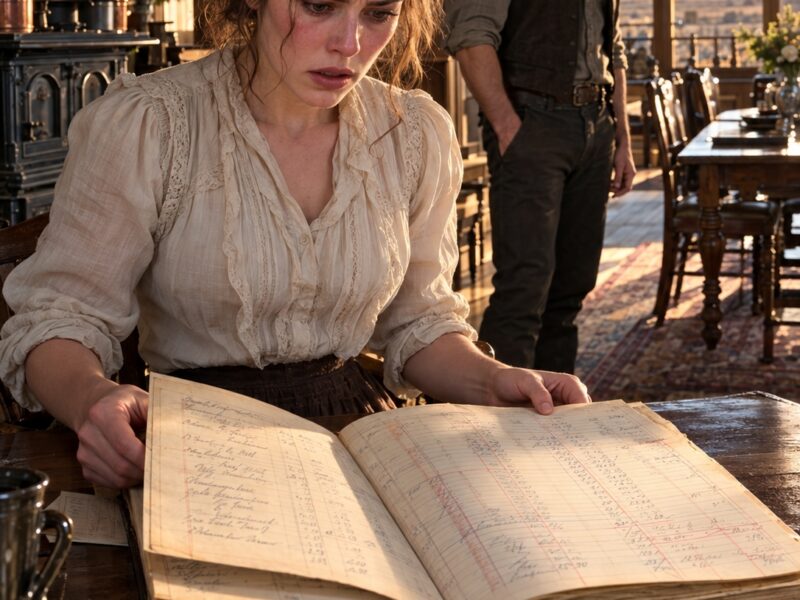
What none of them knew was that while they slept, the woman they had mocked was sitting alone beneath a dying candle with Caleb Hartley’s financial ledgers spread across the kitchen table.
And by sunrise, she knew two things.
The first was that Hartley Ranch was going bankrupt.
The second was that almost everyone on the property had been staring at the thing that might save it without recognizing what they were seeing.
Adeline did.
And that frightened Caleb more than bankruptcy ever had.
Because sometimes the person who saves your life is also the person who forces you to admit how badly you have failed.
Bitterroot Junction, Wyoming.
Spring, 1887.
The wind struck Adeline the moment she stepped from the passenger train.
It came racing across the open country with nothing to slow it down, lifting dust from beneath the platform and snapping the hem of her traveling coat against her ankles.
For several seconds, she simply stood there.
Twenty-eight years old.
One battered trunk beside her.
A marriage contract folded inside her glove.
And enough money hidden in the lining of her bag to survive perhaps four days if the man waiting for her turned out to be cruel, drunk, dishonest—or simply absent.
The train hissed behind her.
Steam rolled across the platform.
Adeline looked down its length.
A few railroad men moved crates near the freight car.
An elderly woman hurried toward a wagon.
A boy chased a scrap of newspaper tumbling through the dust.
Then Adeline saw him.
Caleb Hartley stood beside a weathered wagon near the edge of the station.
She knew immediately.
Not because he resembled the description in his letter.
Because he looked like a man waiting for something he had already convinced himself would disappoint him.
He was tall and broad through the shoulders, perhaps thirty-five, though exhaustion made him seem older. His coat was clean but worn shiny at the elbows. His boots had been repaired more than once.
His face had the hard brown coloring of someone who lived beneath an unforgiving sky.
But it was his eyes Adeline noticed.
Gray.
Tired.
Not unfriendly.
Just tired in a way sleep probably could not cure.
He approached and removed his hat.
“Miss Burke?”
“Adeline,” she said.
A pause.
Then he nodded.
“Caleb Hartley.”
He offered his hand.
“Welcome to Wyoming.”
There should have been something more.
Adeline wasn’t sure what.
Perhaps a smile.
Perhaps relief.
Perhaps the strange nervous warmth one might expect when two people who had agreed to marry without ever meeting finally stood face-to-face.
Instead there was only the handshake.
Firm.
Brief.
Businesslike.
Adeline told herself she preferred that.
She had not traveled hundreds of miles expecting romance.
Romance was a luxury women without practical concerns could afford.
She wanted honesty.
A roof.
Work that mattered.
A future that belonged at least partly to her.
Back in Omaha, she had spent too many years watching respectable men explain to unmarried women exactly how small their lives were supposed to remain.
Caleb Hartley had offered something different.
Marriage, yes.
But also partnership.
At least that was the word he had used in his advertisement.
She would soon discover they had very different definitions of it.
Caleb lifted her trunk into the wagon.
“That all you brought?”
“That depends.”
“On what?”
“Whether you’re disappointed.”
His eyes flicked toward her.
“Why would I be disappointed?”
Adeline climbed into the wagon.
“You haven’t smiled yet.”
For one second, Caleb looked genuinely startled.
Then he climbed up beside her.
“I don’t smile much.”
“I noticed.”
He clicked his tongue at the horses.
The wagon rolled away from the station.
Adeline looked back only once.
The train stood behind them in a cloud of smoke.
It represented Omaha.
Everything familiar.
Everything she had left.
Then the wagon turned.
The station disappeared.
And there was no easy road backward anymore.
During the first mile, Caleb spoke about weather.
During the second, roads.
During the third, cattle.
None of it sounded like conversation.
It sounded like a man carefully walking around every subject that mattered.
Adeline let him.
She watched the country instead.
At first, Wyoming seemed almost impossibly large.
Rolling grassland stretched beneath a pale sky. Snow remained on distant mountains. Cottonwoods followed the low places where water cut through the land.
It should have been beautiful.
Then Adeline began noticing details.
The cattle along the Hartley range were thin.
Too thin.
Several fence lines sagged.
One gate was being held shut by rope.
A hay wagon stood abandoned beside a field with one wheel missing.
The closer they came to the ranch, the more neglect she saw.
Not laziness.
Something else.
Something worse.
A property could survive lazy men.
What Adeline saw looked like exhaustion.
“Hard winter?” she asked.
Caleb kept his eyes on the road.
“Hard few years.”
That answer stayed with her.
Eventually the ranch house appeared.
It was much larger than she expected.
Two stories.
Wide porch.
Several chimneys.
A barn and multiple outbuildings spread behind it.
It had clearly been built during better years, when the Hartley name meant something and the rooms had probably been full.
Now paint peeled from the porch columns.
One shutter hung crooked.
Part of the barn roof sagged.
The house wasn’t abandoned.
It looked defeated.
Caleb stopped the wagon.
For the first time, embarrassment crossed his face.
“It’s not much.”
Adeline studied the large house.
Then the tired man beside her.
“I’ve lived with less.”
He looked at her as though unsure whether she meant to comfort him.
Perhaps she wasn’t sure either.
Inside, the house smelled faintly of wood smoke, leather, dust and old cooking grease.
A long dining table occupied the main room.
Enough chairs surrounded it for a small army.
Adeline ran one finger across the back of a chair.
“You feed everyone here?”
“Twelve hands.”
“Every day?”
“Usually.”
Then Caleb opened the kitchen door.
Adeline stopped.
A massive cast-iron stove dominated one wall.
Pans hung from hooks in various stages of ruin.
Cracked dishes were stacked wherever someone had found space.
A sack of flour stood open near the pantry door.
Something had chewed a hole through one corner.
Grease coated the stovetop.
Adeline stared.
Caleb waited.
Finally she asked, “Does someone cook in here?”
His expression changed just enough to tell her he understood the insult.
“Twelve ranch hands. Three meals a day.”
“Who cooks?”
“The men take turns.”
Adeline picked up a frying pan.
The bottom was black.
“I see.”
“Mostly beans.”
She looked inside a pot.
“Yes. I can tell.”
“Salt pork when we can afford it.”
Adeline replaced the pan.
Caleb remained near the doorway.
“My wife used to handle the house.”
Adeline turned.
His voice had changed.
“My first wife,” he added.
She said nothing.
“She died two winters ago.”
There it was.
The thing behind his eyes.
Not fatigue.
Not entirely.
Grief.
Old enough that other people had probably stopped asking about it.
Fresh enough that he hadn’t.
“She kept everything running,” Caleb continued. “After she was gone…”
His gaze moved across the kitchen.
He didn’t finish.
He didn’t need to.
Adeline softened.
“I’m sorry.”
He nodded.
She looked back at the pans.
“Although I suspect your cookware has also been grieving.”
Silence.
Then something happened.
One corner of Caleb Hartley’s mouth moved.
Barely.
But it moved.
Adeline pretended not to notice.
That evening, she met the twelve ranch hands.
Old Henry had a white beard nearly to his chest and eyes that missed nothing.
Russ was lean, quiet and watchful.
Tully was seventeen and looked at food with the devotion other young men reserved for pretty girls.
Then there was Pike.
Pike was barrel-chested, loud and apparently convinced God had created every room so he could be the loudest person inside it.
When Adeline entered the dining room, twelve men looked at her.
Nobody stood.
Nobody welcomed her.
Pike leaned back.
“Well, boys. Look what the boss brought home.”
A few men chuckled.
Adeline kept walking.
“A real bride,” Pike continued. “Two working hands and everything.”
More laughter.
Tully tried not to smile.
Failed.
Pike pointed toward the kitchen.
“Reckon she’ll make those beans taste better?”
“Couldn’t make ’em worse,” someone said.
The table erupted.
Pike slapped his palm against the wood.
“There it is! Caleb finally figured out how to save Hartley Ranch. Didn’t need rain. Didn’t need cattle prices to rise. Just needed himself a woman with a frying pan.”
This time the laughter was louder.
Adeline looked at Caleb.
He said nothing.
That hurt more than Pike’s words.
She had expected crude men.
She had not expected silence from the man who had asked her to cross three states to become his wife.
But she did not embarrass him.
Not yet.
Instead she studied the men.
Worn shirts.
Cracked hands.
Hollow cheeks.
Empty plates.
These weren’t prosperous cowboys amusing themselves at a woman’s expense.
These were frightened men laughing because laughter was cheaper than admitting they could see the ranch dying too.
Adeline smiled.
Just a little.
Pike’s laughter faded first.
“Well,” she said, “I suppose we’ll see what I can do.”
Pike grinned.
“That’s the spirit.”
Adeline sat down.
She did not argue.
There were times when defending yourself only gave foolish people more words to throw back at you.
She preferred results.
And before the next sunrise, she would find the first one.
The house became quiet after ten.
Adeline should have been sleeping.
Her wedding dress remained folded inside her trunk.
She and Caleb had not discussed when the ceremony would happen.
They had barely discussed anything personal.
But sometime after midnight, unable to sleep, she returned downstairs for water.
That was when she saw the papers.
A stack of overdue bills sat beneath a leather ledger on the sideboard.
Adeline knew she shouldn’t look.
She looked anyway.
The first few pages confused her.
Then the pattern became clear.
Flour had been purchased in bulk, then ruined because sacks were stored improperly.
Coffee cost nearly twice what Adeline remembered Omaha merchants paying because Caleb bought small shipments and never negotiated freight.
Tools were repeatedly repaired instead of replaced, costing more over time.
Then she found the livestock records.
Adeline frowned.
Healthy cattle had been slaughtered to feed ranch hands.
Breeding animals had been transferred to creditors.
Young stock had been sold too early because immediate cash was needed.
She checked the figures again.
And again.
The room seemed to grow colder.
Hartley Ranch was not suffering through one bad year.
It was consuming itself.
Every emergency created another emergency.
Every short-term solution damaged the ranch’s ability to recover.
Adeline slowly sat back.
Now she understood the fence.
The barn.
The cattle.
Caleb’s coat.
His silence.
He had not invited her into a stable household.
He had invited her aboard a sinking ship.
Her first emotion was anger.
He should have told her.
She had specifically asked for honesty.
She closed the ledger.
For several minutes, Adeline simply listened to the wind.
She could leave.
The thought came without drama.
The train ran through Bitterroot Junction again in three days.
She still had enough money.
Nobody could reasonably blame her.
Caleb had concealed the seriousness of his situation.
The contract was not yet a marriage.
She could pack before dawn.
Then she imagined herself back in Omaha explaining why she had returned.
Not because of humiliation.
She could survive humiliation.
But because she knew herself.
For the rest of her life she would wonder whether there had been something she could have done.
So she opened the ledger again.
That was when she found the note.
It was written beside several ordinary expenses.
Railroad grading camp—40 men.
No cook.
Pay $1 a plate for hot meals.
Too far to bother.
Adeline stared at it.
Forty men.
She whispered the number.
“Forty.”
One dollar a plate.
She looked toward the stove.
Then back at the ledger.
Forty men.
One dollar.
Even one meal per man represented cash.
Actual cash.
Not cattle promised against debt.
Not credit.
Not another delayed payment.
Cash.
She stood and walked through the kitchen.
Large stove.
Storage room.
Worktables.
Wagon outside.
Twelve ranch hands who already had to be fed.
Livestock.
Milk.
Eggs.
Flour.
Beans.
And miles away, forty men performing brutal physical labor who were apparently willing to pay a dollar for something hot.
Caleb had seen distance.
Adeline saw customers.
Caleb had seen a kitchen.
Adeline saw a storefront.
Suddenly she remembered the elderly railroad agent in Omaha.
He had tapped the ticket counter and said, “Most people look at a kitchen and see supper. Smart people look at a kitchen and see a storefront.”
At the time, she had smiled politely.
Now she understood.
Adeline pulled out a sheet of paper.
Ingredients.
Portions.
Labor.
Fuel.
Transport.
Waste.
She calculated.
Then recalculated.
She reduced the menu.
Recalculated again.
Stew could travel.
Bread could be baked early.
Coffee could be carried in covered cans.
Beans were cheap but needed flavor.
Beef scraps unsuitable for market could enrich stock without slaughtering saleable animals.
Forty meals became forty dollars.
Then eighty.
Then more.
Her pencil stopped.
What if the railroad camp bought breakfast too?
What if another crew arrived?
What if the ranch kitchen didn’t merely reduce expenses?
What if it produced revenue?
Adeline’s heart began beating faster.
She continued until dawn.
When Caleb entered the kitchen, the candle beside her was almost gone.
He froze.
The ledger was open.
His bills were exposed.
Her calculations covered an entire page.
“Adeline?”
She looked up.
“Good morning.”
“What are you doing?”
“Trying to understand our situation.”
His face hardened.
“Those are ranch accounts.”
“I know.”
“They’re private.”
“So is bankruptcy, apparently.”
Caleb stared at her.
The silence sharpened.
Adeline immediately knew she had struck deeper than she intended.
But she refused to retreat.
“You should have told me.”
“Told you what?”
“That you’re losing this place.”
His jaw tightened.
“You’ve been here less than a day.”
“And it took less than a day to see it.”
“You don’t know ranching.”
“No.”
She pushed the ledger toward him.
“But I know arithmetic.”
His face darkened.
“You think arithmetic explains a ranch?”
“No. But when expenses remain larger than income long enough, arithmetic eventually owns the ranch.”
Caleb’s eyes flashed.
For a moment Adeline wondered whether she had badly misjudged him.
Then he looked away.
That told her more than shouting would have.
He knew she was right.
“How much did you read?”
“Enough.”
“You had no right.”
“You asked me to come here and build a life with you.”
“I asked you to be my wife.”
Adeline stood.
“Then perhaps you should decide whether those are supposed to mean different things.”
That landed.
Caleb said nothing.
Adeline took a breath and turned the calculation sheet toward him.
“I think there’s a way to bring money in.”
His expression shifted from anger to suspicion.
She pointed to his own note.
“The railroad grading camp.”
“No.”
“You haven’t even heard—”
“I know what you’re thinking.”
“Do you?”
“It’s miles away.”
“Yes.”
“Road’s terrible.”
“Yes.”
“We don’t have spare men.”
“You have twelve.”
“I need twelve.”
“You’re going to have fewer than twelve if you can’t pay them.”
His eyes narrowed.
Adeline continued.
“Forty workers. One dollar per hot meal.”
“We can barely feed ourselves.”
“That’s exactly the problem. Everything coming out of this kitchen is an expense.”
She touched the page.
“I want to turn part of it into income.”
Caleb read her figures.
At first he looked irritated.
Then puzzled.
Then silent.
His eyes returned to the final number.
He read it twice.
“That’s assuming forty meals sell.”
“Yes.”
“And nothing spoils.”
“I included waste.”
“Fuel?”
“Second column.”
“Feed?”
“Third.”
“Transport?”
“Bottom.”
His gaze moved slowly upward.
For the first time since she met him, Adeline saw something other than exhaustion.
Fear.
Not fear that she was wrong.
Fear that she might be right.
“Do you understand what you’re suggesting?” he asked.
“Yes.”
“We don’t have money to gamble.”
“Caleb, you’re already gambling.”
“On what?”
“That doing the same thing tomorrow will somehow produce a different result.”
Heavy footsteps approached.
Pike’s voice boomed from the hallway.
“Morning, boss! What’s our new bride cooking today?”
Adeline looked at Caleb.
Then toward the door.
“Apparently,” she said quietly, “the future of Hartley Ranch.”
Pike entered.
He looked from Adeline to the ledgers.
Then to Caleb.
His grin widened.
“Well, this looks serious.”
“It is,” Adeline said.
Pike pulled out a chair.
“What’s for breakfast?”
“Nothing yet.”
His smile vanished.
Tully appeared behind him.
“Nothing?”
“Not until we have a conversation.”
Within ten minutes, all twelve men were seated around the table.
Adeline stood at one end.
Caleb stood at the other.
Pike looked delighted.
“So the new Mrs. Hartley is holding breakfast hostage?”
“Not Mrs. Hartley yet,” Adeline said.
Pike glanced at Caleb.
“That bad already?”
A few men laughed.
Caleb didn’t.
Adeline placed the paper on the table.
“There are forty railroad workers several miles east of here willing to pay for hot meals.”
Old Henry’s eyebrows lifted.
Russ leaned forward.
Pike laughed.
Of course he did.
“You’re planning to run a restaurant now?”
“No.”
“What would you call it?”
“Survival.”
That silenced several men.
Adeline explained the numbers.
Not every detail.
Enough.
When she finished, Pike leaned back.
“Sounds pretty on paper.”
“So does your paycheck.”
His face changed.
Adeline continued.
“But paper isn’t the problem, is it?”
Pike looked at Caleb.
“Boss?”
Caleb rubbed his jaw.
“I told her it was risky.”
“Risky?” Pike barked. “It’s foolish. We got cattle work stacked to our necks, fences down on the north side, spring calves coming, and she wants us hauling biscuits to railroad men?”
“I want one wagon,” Adeline said. “One delivery. One test.”
“And who’s cooking?”
“I am.”
“Forty meals?”
“Fifty-two.”
Pike blinked.
“What?”
“Forty railroad men and twelve ranch hands. Unless you’ve decided not to eat.”
Tully whispered, “I haven’t.”
Old Henry coughed to hide a laugh.
Pike’s cheeks reddened.
“And who’s hauling it?”
Adeline looked around the table.
“I need one driver.”
Nobody moved.
Then Tully raised his hand.
Pike turned.
“Put that down.”
Tully slowly lowered it.
Russ spoke.
“I’ll drive.”
Everyone looked at him.
Russ shrugged.
“Road’s passable if we use the south cut.”
Pike shook his head.
“This is madness.”
Old Henry scratched his beard.
“Maybe.”
He looked at Adeline.
“But we’ve tried sensible for two years.”
Caleb’s expression tightened.
The words hurt.
Old Henry knew it.
So did everyone else.
Adeline watched Caleb carefully.
His pride was fighting his desperation.
Finally he said, “One delivery.”
Pike swore beneath his breath.
Caleb looked at Adeline.
“One. You use what we already have. No borrowing. No buying anything on credit.”
“Agreed.”
“If it fails—”
“I stop.”
Caleb held her gaze.
“And if it works?”
Adeline glanced around at the men who had laughed at her less than twelve hours earlier.
“Then tomorrow,” she said, “we make twice as much.”
The kitchen changed before breakfast ended.
Adeline threw away almost nothing.
That was the first thing the men noticed.
Fat became cooking grease.
Bones became stock.
Stale bread became thickener.
Flour was moved into sealed bins.
The damaged sack was sifted and salvaged where possible.
She counted eggs.
Measured coffee.
Portioned meat.
Pike wandered through twice, offering opinions nobody requested.
On his third visit, Adeline handed him a sack of potatoes.
“What is this?”
“Your opinion.”
He frowned.
“What?”
“You’ve brought so many into my kitchen I assumed you wanted employment. Peel those.”
Tully laughed so hard he nearly dropped a bucket.
Even Caleb smiled.
This time Adeline saw it.
By ten o’clock, the ranch smelled different.
Not like burned beans.
Like bread.
Beef.
Onions.
Coffee.
Men began inventing reasons to pass through the kitchen.
Adeline drove them out.
At noon, Russ helped load covered pots into the wagon.
Caleb stood near the porch.
“You don’t have to go yourself.”
“Yes, I do.”
“Russ can handle it.”
“Russ can deliver food. I need to meet the people buying it.”
Caleb frowned.
“Why?”
“Because customers tell you what they’ll pay for if you listen.”
He stared at her.
“Where did you learn all this?”
Adeline paused.
“My mother took in laundry after my father died. Everyone called her poor. She called herself busy.”
Something softened in Caleb’s face.
“She taught you?”
“She taught me that work and money are different things. You can work yourself to death and still starve if nobody thinks about where the money comes from.”
Caleb looked toward his ranch.
The implication hung between them.
Adeline regretted it immediately.
But he merely said, “Be back before dark.”
It almost sounded like concern.
Almost.
The railroad grading camp was uglier than she imagined.
Mud.
Smoke.
Canvas tents.
Men covered in dirt.
The metallic hammering of construction echoed across the valley.
When the wagon rolled in, heads turned.
A foreman named Samuel Crowley approached.
He looked at Russ.
Then Adeline.
“You lost?”
“No.”
Adeline lifted the lid from one pot.
Steam rolled upward.
Every nearby conversation stopped.
Crowley inhaled.
“What is that?”
“Beef stew.”
“How much?”
“One dollar.”
He laughed.
“Lady, you know what a dollar buys?”
“Yes.”
“You expect these men to spend it on stew?”
Adeline picked up a tin bowl.
“No.”
Crowley looked confused.
“I expect you to taste it first.”
She handed him the bowl.
He hesitated.
Then tasted.
Behind him, forty hungry men watched.
Crowley took another spoonful.
“How much did you bring?”
“Forty portions.”
Russ cleared his throat.
“Forty-two.”
Adeline looked at him.
“For breakage.”
Crowley smiled.
“You’re going to need more bowls.”
They sold every portion.
Then three men tried to pay for whatever remained stuck to the bottom of the pot.
Adeline returned to Hartley Ranch with forty dollars in cash.
She placed the coins on the dining table.
One by one.
Pike stopped chewing.
Tully counted under his breath.
Old Henry removed his hat.
Caleb stared.
Adeline placed the final coin down.
“Forty.”
Nobody laughed.
She looked at Pike.
He looked away.
Caleb touched one coin as though testing whether it was real.
“How much did it cost?”
Adeline gave him the figure.
His head came up.
“You’re sure?”
“I counted twice.”
Old Henry whistled.
Russ sat back.
“And Crowley wants sixty meals tomorrow.”
Caleb looked at Adeline.
“Sixty?”
“Another crew arrived this afternoon.”
Pike finally spoke.
“We can’t cook sixty.”
Adeline looked at him.
“No.”
She smiled.
“We’re cooking seventy-two.”
The next week nearly broke them.
Success created problems faster than failure had.
They needed more flour.
More coffee.
More containers.
More firewood.
The stove ran from before dawn until afternoon.
Adeline slept perhaps four hours a night.
Tully became her unofficial kitchen assistant after she discovered he could knead bread faster than men twice his size.
Old Henry repaired shelves.
Russ handled deliveries.
Even Pike eventually found himself chopping onions after Adeline threatened to feed him according to the amount of work he contributed.
But Caleb remained cautious.
Every evening, he counted the cash.
Every evening, Adeline recorded expenses.
And every evening, the pile left over became slightly larger.
For the first time in months, Caleb paid all twelve men on time.
Nobody celebrated.
That was what made the moment powerful.
The men simply stood in line and accepted their wages.
Old Henry looked at the coins in his palm for a long time.
Then he looked toward the kitchen.
Adeline pretended not to notice.
Three days later, she discovered a jar on the kitchen shelf.
Wildflowers.
No note.
She never learned which ranch hand put them there.
By the second week, the railroad camp had grown to nearly ninety men.
Samuel Crowley asked whether she could provide breakfast twice a week.
Adeline said yes before Caleb could say no.
That evening, they argued.
“You can’t keep saying yes.”
“Why?”
“Because there’s a limit.”
“To what?”
“To everything!”
Caleb struck the table with his palm.
Adeline froze.
He immediately stepped back.
“I didn’t mean—”
“I know.”
But the room had changed.
Caleb lowered his voice.
“We’re ranchers.”
“You’re ranchers.”
“This is Hartley Ranch.”
“Yes.”
“Not Hartley Eating House.”
Adeline stared at him.
“Do you care what saves it?”
His expression hardened.
“Of course I do.”
“No. I asked whether you care what saves it.”
Caleb went silent.
There was the truth.
He wanted salvation.
But he wanted it to look like the salvation he had imagined.
Strong cattle.
High prices.
Good rain.
A successful rancher rebuilding his father’s land.
He had never imagined salvation arriving in the form of a woman with flour on her dress selling stew to railroad workers.
Adeline stepped closer.
“You think this makes you less of a rancher.”
“That isn’t what I said.”
“You didn’t need to.”
Caleb looked toward the window.
“My father built this place from nothing.”
“And you’re trying to keep it.”
“With cattle.”
“With whatever works.”
His jaw tightened.
Adeline lowered her voice.
“Pride is expensive, Caleb.”
He looked at her sharply.
“So is failure.”
That ended the conversation.
But not the argument.
Because two mornings later, a man arrived in a black coat.
His name was Silas Mercer.
And the moment Caleb saw him step down from his horse, all the color disappeared from his face.
Adeline noticed.
So did Old Henry.
Mercer removed his gloves.
“Morning, Hartley.”
Caleb walked off the porch.
“You weren’t due until June.”
“I changed my schedule.”
Mercer smiled.
Adeline disliked him instantly.
His clothes were too clean for the ranch.
His boots had never touched manure.
His smile reached no part of his eyes.
Then he saw Adeline.
“And who’s this?”
“Adeline Burke.”
Mercer’s eyebrows rose.
“The bride.”
Adeline didn’t like the way he said it.
Caleb’s voice became colder.
“What do you want?”
Mercer pulled a folded paper from inside his coat.
“Same thing I’ve wanted for eighteen months.”
The wind moved between them.
Adeline watched Caleb take the document.
His eyes moved across it.
“What is it?” she asked.
“Nothing.”
Mercer smiled.
“Oh, I wouldn’t say that.”
Caleb shot him a warning look.
Mercer ignored it.
“Mr. Hartley has thirty days.”
Adeline felt something tighten in her stomach.
“Thirty days for what?”
“Mercer.”
Caleb’s voice was low now.
But Mercer was enjoying himself.
“To settle the outstanding note.”
Adeline looked at Caleb.
“How much?”
He didn’t answer.
Mercer did.
The amount was larger than Adeline had calculated from the ordinary ledgers.
Much larger.
For one second, she thought she had misheard.
“You borrowed that much?”
Caleb stared at Mercer.
Not her.
“When?”
“After Ellen died.”
The name hung there.
His first wife.
Mercer buttoned his coat.
“Thirty days.”
Then he looked toward the barn.
“Otherwise the security transfers.”
Adeline went cold.
“The ranch?”
Mercer’s smile returned.
“Most of it.”
He mounted his horse.
Before leaving, he glanced toward the kitchen chimney, where smoke was already rising.
“Heard you’ve become quite the cook, Miss Burke.”
Adeline met his gaze.
Mercer tipped his hat.
“Better bake a great many pies.”
Then he rode away.
For several seconds, nobody spoke.
Adeline turned to Caleb.
“You lied to me.”
“I didn’t lie.”
“You let me calculate a future using incomplete numbers.”
“I was going to tell you.”
“When?”
Caleb looked at her.
She laughed once.
There was no humor in it.
“After the wedding?”
“No.”
“After thirty days?”
“Adeline—”
“You brought me here knowing this place could be taken.”
“I brought you here because I thought I could fix it.”
“You brought me here because you were drowning and didn’t want anyone to see the water.”
Caleb flinched.
Good, she thought.
Then hated herself for thinking it.
“I didn’t expect you to save the ranch,” he said.
“No.”
Her voice shook now.
“You expected me to keep house while you lost it.”
She walked inside.
Caleb didn’t follow.
That frightened her more than if he had.
That night, Adeline packed.
Not everything.
Just enough.
Her traveling dress.
Money.
Marriage contract.
She sat beside the trunk for nearly an hour.
Then someone knocked.
“Adeline?”
Old Henry.
She opened the door.
His eyes went to the trunk.
“You leaving?”
“I don’t know.”
He nodded.
Didn’t try to stop her.
That made her trust him.
After a moment he said, “Caleb should’ve told you.”
“Yes.”
“He’s ashamed.”
“That doesn’t make dishonesty honest.”
“No, ma’am.”
Henry looked down the hallway.
“Ellen died during the worst winter we’d had in twenty years. Caleb buried her, then lost a third of the herd. Following spring, disease took more. He borrowed because twelve families depended on wages from this place.”
Adeline looked at him.
“Twelve families?”
“Some. Others got nobody. But this ranch is home either way.”
“That doesn’t excuse him.”
“No.”
Henry looked at the trunk again.
“Just thought you should know what you’re leaving.”
The words angered her.
“Are you trying to make me feel guilty?”
“No.”
He turned.
“I’m too old to waste time manipulating women smarter than me.”
Despite herself, Adeline almost smiled.
Henry stopped at the door.
“Pike laughed at you because Pike laughs at anything that scares him.”
“What does that have to do with Caleb?”
“Nothing.”
Henry glanced back.
“Just thought you ought to know Pike’s terrified of you now.”
This time she did smile.
Barely.
When Henry left, Adeline unpacked one dress.
Not all of them.
One.
The next morning, she found Caleb in the barn.
“I may still leave.”
He nodded.
“I know.”
“If I stay, no more hidden debts.”
“Agreed.”
“No financial decision affecting this ranch gets hidden from me.”
His eyes lifted.
“We aren’t married.”
“Then perhaps you’d better decide whether you still want to marry me.”
Caleb stared at her.
Adeline’s heart pounded.
She had not intended to say it that way.
Finally he asked, “Do you still want to marry me?”
“That wasn’t my question.”
“No.”
He stepped closer.
“It wasn’t.”
He removed his hat.
For once, there was no rancher in front of her.
No employer.
No exhausted widower hiding behind silence.
Just a man.
“I wrote that advertisement because this house was empty,” he said. “I told myself I needed someone to cook and manage things. That was easier than admitting I couldn’t stand coming home to silence anymore.”
Adeline said nothing.
“I didn’t expect you.”
“What did you expect?”
“Someone who needed me more than I needed her.”
The honesty struck her.
Caleb looked ashamed.
“Then you stepped off that train.”
“And disappointed you?”
“No.”
His answer came immediately.
“You frightened me.”
Adeline blinked.
“Why?”
“Because you looked like someone who would notice everything.”
She almost laughed.
“You were correct.”
“I know.”
Silence.
Then Caleb said, “Yes.”
“Yes what?”
“I still want to marry you.”
He swallowed.
“But not because of the kitchen.”
“Good.”
“Not because of the money.”
“Better.”
“And if you leave, I’ll understand.”
Adeline looked toward the ranch house.
Smoke rose from the kitchen chimney.
Tully was carrying firewood.
Russ was hitching the wagon.
Pike was pretending not to watch them.
Thirty days.
A debt larger than she had known.
A ranch on the edge.
A man who had finally told her the truth only after being caught.
None of it resembled security.
Yet for the first time since arriving, Adeline felt she was standing inside something real.
Damaged.
Frightening.
But real.
She looked at Caleb.
“Twenty-nine days.”
His brow furrowed.
“What?”
“Mercer said thirty yesterday.”
Understanding entered his face.
Adeline walked toward the house.
“We’ve already wasted one.”
They attacked the debt differently after that.
No more pretending.
Every expense went onto the table.
Every creditor.
Every animal.
Every bag of flour.
Adeline discovered something surprising.
The food business could not save them alone.
Not in twenty-nine days.
It could stabilize cash flow.
Pay wages.
Reduce slaughter.
Prevent further losses.
But Mercer’s note was too large.
They needed something more.
So Adeline asked a question Caleb had never seriously considered.
“What happens if the railroad keeps coming?”
Caleb frowned.
“It comes.”
“Through whose land?”
He stared at her.
The grading camp lay east.
The planned line curved north.
Adeline spread a rough survey map across the table.
Russ joined them.
Then Old Henry.
A section of Hartley property sat near the most practical supply route to the expanding camps.
Caleb had regarded the railroad as an inconvenience.
Noise.
Workers.
Fences needing gates.
Strangers crossing nearby country.
Adeline saw traffic.
People.
Horses.
Freight.
Money.
The kitchen had not been the opportunity.
It had merely taught her where to look.
“What if we don’t carry every meal to them?” she asked.
Caleb stared.
“What are you suggesting?”
“We make them come closer.”
Within a week, a disused shed near the southern boundary had been cleaned and repaired.
Russ built tables.
Tully painted a crude sign.
Pike complained that no respectable ranch had a lunch counter.
Then he spent six hours repairing its roof.
Adeline said nothing about that.
Railroad workers began stopping there.
Then freight drivers.
Then surveyors.
Coffee first.
Bread.
Stew.
Cold meat.
Eggs.
Men paid.
More importantly, they talked.
They told Adeline when new crews were coming.
Which supplies were scarce.
Which camps had no cook.
Which foremen needed beef.
That was the second transformation.
Hartley Ranch stopped selling only meals.
It began selling cattle intelligently.
Instead of slaughtering good animals for the ranch table, Caleb negotiated beef deliveries to railroad camps.
Instead of accepting whatever local buyers offered, he found customers through the very men Adeline fed.
Cash began moving through the ranch.
Not enough.
But faster.
Twenty days remained.
Then fifteen.
Mercer’s deadline approached.
They were still short.
One evening, Caleb sat at the kitchen table looking at the total.
“We’re not going to make it.”
Adeline stood beside the stove.
“Not yet.”
“We’re short.”
“I can see that.”
“Adeline.”
Something in his voice made her turn.
Caleb looked older again.
Like the man at the station.
“I won’t let you put your money into this.”
“My money wouldn’t cover it.”
“I know.”
“I wasn’t offering.”
That surprised him.
Adeline sat opposite him.
“You’re doing it again.”
“What?”
“Deciding the ending before it arrives.”
He gave a tired laugh.
“Numbers have endings.”
“Yes.”
She turned the ledger around.
“And these numbers aren’t finished.”
The next morning Samuel Crowley rode into the ranch.
He wanted to speak to Adeline.
Caleb joined them.
Crowley removed his hat.
“Company’s bringing in another hundred and twenty men.”
Adeline’s pulse jumped.
“When?”
“Six days.”
Caleb immediately began calculating.
Crowley wasn’t finished.
“They need a regular food supplier for at least six weeks.”
Adeline stared.
“How regular?”
“Breakfast and supper.”
Caleb stood.
“We can’t feed two hundred men twice a day.”
Crowley smiled.
“Didn’t say you had to cook all of it.”
He placed a paper on the table.
The railroad wanted beef.
Bread.
Eggs.
Coffee service.
Some prepared meals.
And they were willing to advance part of the payment to secure supply.
Adeline read the number.
Then handed it to Caleb.
He read it.
Sat down.
Read it again.
“How soon is the advance paid?”
Crowley smiled.
“Sign today.”
For several seconds, Caleb didn’t move.
Adeline could hear the clock.
Then Pike appeared at the kitchen door.
“What happened?”
Nobody answered.
He looked at Caleb.
Then Adeline.
“Are we ruined?”
Adeline looked down at the contract.
“No.”
Pike frowned.
“Then what?”
She raised her eyes.
“I think we’re about to become very busy.”
Mercer returned on the thirtieth day.
This time nobody feared the sound of his horse.
He entered the house without removing his gloves.
Caleb waited at the dining table.
Adeline stood beside him.
Mercer smiled.
“I assume you’ve considered my terms.”
“I have.”
“Then I’ll have my attorney begin transfer paperwork.”
“No need.”
Caleb placed a leather pouch on the table.
Mercer’s smile weakened.
He looked inside.
Cash.
Not all of it.
Then Caleb placed the railroad advance beside it.
Receipts.
Payments.
Documents.
Mercer began counting.
His expression changed.
Adeline watched quietly.
The man who had mocked her pies counted twice.
Then a third time.
“This settles the note,” Caleb said.
Mercer looked up.
“Where did you get it?”
Caleb’s eyes moved toward Adeline.
She shook her head slightly.
This was his moment.
He understood.
“We earned it.”
Mercer looked toward the kitchen.
Then outside, where wagons were being loaded for the railroad crews.
He seemed almost offended.
“You turned the ranch into a cookhouse.”
Caleb’s expression remained calm.
“No.”
He looked through the window at his cattle.
“We turned customers into customers.”
Adeline smiled.
It was not elegant.
But it was Caleb.
Mercer gathered the documents.
At the door he stopped.
“Railroad won’t last forever.”
Adeline answered.
“Neither will winter.”
Mercer glanced at her.
“Everything ends, Miss Burke.”
“Yes.”
She held his gaze.
“That’s why you build the next thing before it does.”
He left.
Pike waited until the horse disappeared.
Then shouted so loudly the windows rattled.
Tully threw his hat into the air.
Russ actually laughed.
Old Henry sat down and covered his eyes with one hand.
For a second, Adeline thought something was wrong.
Then she realized the old man was crying.
Caleb saw it too.
Nobody embarrassed Henry by mentioning it.
Instead Pike turned toward Adeline.
“Well.”
She folded her arms.
“Well what?”
He cleared his throat.
The other men became suspiciously quiet.
Pike looked as though someone had asked him to swallow a horseshoe.
“I may have…”
He stopped.
Tully grinned.
“Go on.”
Pike glared at him.
Then faced Adeline again.
“I may have been mistaken about you.”
Adeline raised an eyebrow.
“About what?”
Several men laughed.
Pike groaned.
“You’re going to make me say it?”
“Yes.”
Old Henry muttered, “Smart woman.”
Pike took a breath.
“I thought Caleb brought home a woman to cook our beans.”
Adeline waited.
“And?”
Pike looked around.
“And it appears you did somewhat more than that.”
“Somewhat?”
Russ turned away to hide his smile.
Pike threw both hands up.
“You saved the damned ranch!”
The room exploded with laughter.
Adeline laughed too.
It was the first time she had laughed without caution since arriving in Wyoming.
Then Caleb spoke.
“No.”
Everyone quieted.
He was looking at Adeline.
“She showed us how to save it.”
There was a difference.
Adeline understood it.
So did Caleb.
And that difference mattered more to her than Pike’s apology.
They married six days later.
There was no grand church.
No expensive dress beyond the one Adeline had carried from Omaha.
No orchestra.
No flowers except the wild ones Tully and Russ collected from the edge of a creek.
Old Henry stood beside Caleb.
Pike polished his boots.
Tully cried and denied it.
Samuel Crowley came from the railroad camp and brought coffee so terrible Adeline threatened to send him home.
Caleb waited for her beneath the cottonwoods near the ranch house.
This time, when she walked toward him, he smiled.
Not almost.
Not briefly.
He smiled.
“You learned,” she whispered.
“About what?”
“Smiling.”
“I’ve had practice.”
The ceremony was short.
The promise was not.
Life afterward did not become easy.
That would have been another kind of lie.
The railroad eventually moved west.
The camps disappeared.
Cattle prices rose, then fell again.
Storms destroyed fences.
One winter killed calves.
Another year brought drought.
Tully eventually left to start a small freight business.
Russ married a schoolteacher.
Old Henry grew too stiff to ride but refused to stop giving everyone instructions.
Pike remained Pike.
He simply learned to peel potatoes very well.
The little food shed near the southern boundary changed over time.
First it became a supply stop.
Then a proper store.
Years later, travelers passing through Bitterroot Junction knew they could get coffee, bread and a hot plate near Hartley Ranch.
But Adeline never allowed anyone to tell the story as though she had arrived with some miraculous plan.
She hadn’t.
She had arrived frightened.
She had considered leaving.
She had been lied to.
She had made mistakes.
She had burned bread during the third week because she was so tired she fell asleep sitting upright beside the stove.
She had argued with Caleb.
Often.
Sometimes loudly.
Their marriage was not built from rescue.
It was built from learning how not to hide disaster from each other.
That proved harder.
And more valuable.
Years later, on a cold evening, Adeline found Caleb sitting alone at the kitchen table.
His hair had begun to gray.
The old ledger lay open before him.
She recognized it immediately.
“What are you doing with that?”
Caleb smiled.
“Remembering.”
She came closer.
The pages were brittle now.
There were the old expenses.
The ruined flour.
The desperate cattle sales.
Mercer’s payments.
Then Caleb turned to the page that had changed everything.
The small note was still there in his handwriting.
Railroad grading camp—40 men.
No cook.
Pay $1 a plate for hot meals.
Too far to bother.
Adeline laughed softly.
“You nearly ignored forty customers because the road was inconvenient.”
“I was an idiot.”
“You were tired.”
“I can be both.”
She sat beside him.
Outside, evening settled over the ranch.
The barn had been rebuilt years earlier.
The fences stood straight.
Healthy cattle moved as dark shapes across the fading grass.
From another room came voices.
Life.
A house that no longer sounded empty.
Caleb touched the old note.
“Do you ever wonder what would’ve happened if you hadn’t opened this?”
“Yes.”
“What do you think?”
Adeline looked toward the stove.
It wasn’t the same stove anymore.
That old cast-iron monster had finally cracked one winter and been replaced.
But she could still remember the grease.
The black pans.
The smell of burned beans.
Twelve men laughing.
A candle burning almost to nothing.
A sheet of paper covered in calculations.
“I think you would’ve lost the ranch,” she said.
Caleb nodded.
“And you?”
She considered that.
“I would’ve gone back to Omaha.”
“Married someone sensible?”
“Probably.”
He looked offended.
“I can be sensible.”
She gave him a look.
“Caleb.”
“All right.”
She smiled.
Then her expression softened.
“But I don’t think opening the ledger was the thing that changed my life.”
“What was?”
Adeline looked at the old page.
“Staying after I opened it.”
Caleb became quiet.
Because both of them knew how close she had come to leaving.
The train.
The packed trunk.
The money hidden in her bag.
The marriage contract that had once been nothing more than folded paper inside a glove.
All those years ago, Adeline Burke had traveled to Wyoming because she wanted security.
Instead she found a ranch drowning in debt.
A widower drowning in grief.
Twelve exhausted men who laughed at the only new thing that had happened to them in years because hope frightened them more than disappointment.
And a kitchen everyone considered a burden.
She had thought she was coming west to find a future someone else had already built.
In fact, she had arrived precisely because the future had not been built yet.
That was the secret none of them understood when she stepped from the train.
The ranch was not saved because Adeline knew how to cook.
It was not saved because she was smarter than twelve ranch hands.
It was not even saved because forty railroad workers happened to be hungry.
It survived because, in a house full of people staring at what they were losing, one person finally looked at what they still had.
A stove.
A wagon.
A little food.
Some exhausted men.
A road everyone else thought was too long.
And one chance nobody had bothered to take.
Caleb closed the ledger.
“Adeline?”
“Yes?”
“I’m glad you stayed.”
She rested her hand over his.
Outside, the Wyoming wind struck the house exactly as it had on her first night.
Only now the shutters did not rattle.
Someone had repaired them years ago.
Adeline couldn’t remember who.
Maybe Caleb.
Maybe Russ.
Maybe Pike.
It no longer mattered.
She looked through the window toward the darkening fields and remembered a frightened twenty-eight-year-old woman stepping off a train with one battered trunk and enough money to run away.
Everyone at Hartley Ranch had believed Caleb was bringing home a wife.
A woman who would cook.
Clean.
Keep quiet.
Make their lives easier.
They had laughed because they thought they understood exactly what she was worth.
Adeline smiled at the memory.
Then she looked around the warm kitchen, at the old ledger beneath Caleb’s hand, at the ranch beyond the glass, and at the life that had grown from one impossible decision after another.
Those men had been wrong about many things.
But they had been right about one.
Caleb Hartley had brought home the woman who would save Hartley Ranch.
They simply hadn’t understood that saving it would begin with her refusing to stay in the place they had assigned her.
And years later, whenever Pike told the story to newcomers, he always began the same way.
“We laughed when she got off that train.”
Then he would pause, shake his head and glance toward Adeline.
“And boys, that was the last time any of us made that mistake.”









