The Rancher Hadn’t Smiled in Seven Years—Until a Five-Year-Old Girl Looked at Him and Said, “My Mama Can Fix That.”
The first thing Nell Poole noticed about Emmett Cross was not that he was tall, or that he carried himself like a man who had spent most of his life wrestling stubborn animals and worse weather.
It was that he did not wave.
Their wagon had barely stopped beside the abandoned twelve-acre property outside Harrow Falls when the five-year-old stood on the bench, one hand gripping the wooden rail, and stared across the fence.
A man was driving a post into the earth on the neighboring ranch.
He looked up once.
That was all.
No smile.
No greeting.
Not even the small lift of two fingers from the brim of his hat that people in rural Colorado offered strangers out of habit.
Nell watched him with grave concentration.
“Mama,” she whispered, “he didn’t wave.”
Vivian Poole climbed down from the wagon more slowly.
Three days on the road had settled into her bones. Dust clung to the hem of her dress. Her dark hair had escaped its pins. Her shoulders ached from sleeping badly, and every part of her body seemed to be reminding her that starting over was easier to imagine than to actually do.
Still, she followed her daughter’s gaze.
Across the fence, Emmett Cross had already returned to his work.
“Some people forget how,” Vivian said.
Nell considered that.
She had a way of considering things that made adults uncomfortable, because she did not rush to fill silence just because silence existed.
Then she nodded.
“We could remind him.”
Across the yard, Emmett’s hammer stopped halfway down.
Vivian saw it.
So did Nell.
Neither of them said anything.
After a moment, the hammer came down again.
Hard.
Once.
Twice.
Three times.
As if a fence post had suddenly become responsible for something.
Vivian turned toward the property her brother Caleb had left her after his death the previous winter.
Twelve acres.
A sagging cabin.
Two broken shutters.
Grass high enough to hide a child.
A goat pen whose latch hung sideways.
A roof that looked as though one serious storm might convince it to give up.
And somewhere behind the cabin, a goat appeared from the weeds and stared at them as if they were trespassing.
Nell brightened.
“We have a goat.”
Vivian closed her eyes for one second.
“Apparently.”
She had arrived in Harrow Falls with one daughter, one mule, two trunks, thirty-eight dollars in cash, a sewing tin that had belonged to her mother, and the stubborn belief that humiliation did not have to be hereditary.
That belief was about to be tested.
Because Vivian Poole had spent the previous two years being watched.
Watched after Thomas left.
Watched in church.
Watched at the market.
Watched when she stretched coins across the kitchen table.
Watched when Nell’s dresses became too short and Vivian let the hems down once, then twice, then a third time.
People rarely insulted Vivian directly.
They were kinder than that.
They said things like, “You’re very brave.”
Or, “I don’t know how you manage.”
Or, “A girl needs her father.”
Cruelty was easier when it wore concern.
Thomas had been different.
He had not hit her.
Had not screamed.
Had not broken furniture or come home drunk.
Sometimes Vivian wished he had.
A cruel man gave you something clean to hate.
Thomas simply came home one Wednesday evening, removed his coat, sat across from her at the kitchen table, and told her he had realized he wanted a different life.
Not a different argument.
Not a different house.
A different life.
One that apparently did not contain Vivian.
Or Nell.
He packed before sunrise.
Nell kept one wooden button that had fallen from his coat.
For two years, she carried it everywhere.
Vivian never asked her to throw it away.
Then Caleb died and left Vivian the neglected land in Harrow Falls.
She packed.
She bought the mule after saving for eleven months.
And she left the town that had watched her become abandoned.
Now, standing on twelve acres of weeds and broken wood, Vivian placed both hands on her hips.
“Well,” she said.
Nell looked up.
“Well what?”
“We start.”
The goat chose that exact moment to escape.
It walked through the broken latch, crossed the property line, and entered Emmett Cross’s vegetable garden with the confidence of an animal answering a personal invitation.
Vivian stared.
“No.”
The goat bit into a cabbage.
“No, no, no.”
Nell pointed.
“Mama, he likes vegetables.”
“I can see that.”
Vivian gathered her skirt and hurried after it.
By the time she crossed the fence, the goat had eaten half a cabbage and was evaluating a second.
Emmett stood at the edge of the garden.
His expression was unreadable.
Up close, he looked somewhere in his late thirties, though grief had added years in places time had not earned. His face was weathered, his jaw rough with dark stubble, his eyes a gray-blue that seemed permanently fixed on some point farther away than whoever stood in front of him.
He looked at the goat.
Then Vivian.
“That yours?”
“It was on my property when I arrived.”
“Caleb’s.”
“That explains ownership. Not behavior.”
Emmett said nothing.
Vivian grabbed the goat by its back leg.
The goat objected with a scream so dramatic that two birds flew from a nearby tree.
Vivian wrestled it upright.
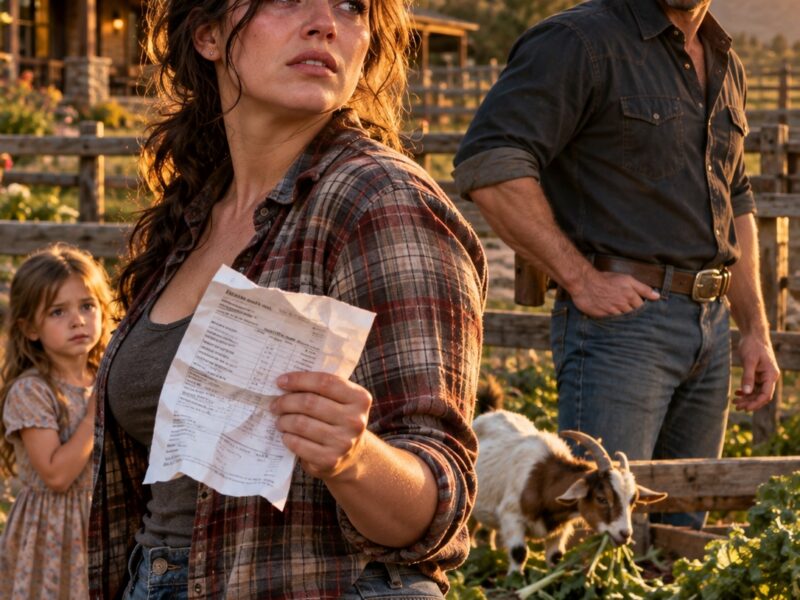
When she finally straightened, breathing hard, Emmett was holding out a piece of paper.
She stared at it.
“What’s that?”
“A bill.”
“A what?”
“Two cabbages. Half a row of early lettuce.”
Vivian looked at the paper.
Then at him.
“I’ve been here less than an hour.”
Emmett folded the bill once and put it into her hand.
“That goat works fast.”
For half a second, Vivian wondered if it was a joke.
His face suggested otherwise.
He turned toward his house.
“Mr. Cross?”
He stopped.
She held up the paper.
“Does everyone in Harrow Falls greet new neighbors with invoices?”
“No.”
He looked over one shoulder.
“Most people secure their goats.”
Then he walked inside.
The door closed.
Vivian remained in the garden, goat under one arm, bill in the other.
From across the fence, Nell called, “Mama?”
“Yes?”
“I don’t think he likes us.”
Vivian looked at Emmett’s closed door.
Then she looked at the goat trying to eat the invoice.
“He doesn’t know us yet.”
She carried the goat home.
That should have been the end of it.
Instead, it was the beginning.
By the second morning, Nell had named the goat Biscuit.
By the third, Biscuit had eaten through two ropes.
By the fourth, Vivian had discovered that Caleb’s chickens knew precisely where the gap in the eastern fence was.
The mule, meanwhile, had fallen passionately in love with Emmett’s mare and spent entire afternoons staring through the fence with the solemn devotion of a man composing poetry.
Nell assessed the situation.
“Biscuit doesn’t like rope.”
“I gathered that.”
“The chickens want to live next door.”
“No.”
“And Henry is in love.”
Vivian stopped hammering a board into the chicken enclosure.
“Our mule is named Henry now?”
“He needed a name.”
“Of course he did.”
“I’m going to talk to them.”
“Nell—”
But Nell was already crouching in front of Biscuit.
She spoke quietly for several minutes, pointing occasionally toward the fence.
Biscuit appeared attentive.
The conversation accomplished nothing.
Except afterward Biscuit began escaping only when Nell was distracted, which suggested the goat had understood everything and simply disagreed.
Emmett’s ranch hands found the entire situation hilarious.
Vivian heard their suppressed laughter one afternoon while chasing Biscuit through uneven grass with her skirts gathered in both fists.
She stopped.
Turned.
Two young men near Emmett’s bunkhouse immediately became deeply interested in a bucket.
Vivian looked toward the barn.
Emmett was standing there.
He had seen everything.
His mouth did not smile.
But his shoulders moved once.
Very slightly.
Vivian narrowed her eyes.
He turned away.
She almost laughed.
Almost.
The next afternoon, Nell crossed the fence for the first time.
Not because of the goat.
Not because of the mule.
Because of a butterfly.
Yellow.
Large.
It landed on a fence post, lifted again, and drifted into Emmett’s pasture.
Nell followed.
Vivian looked up from repairing a shutter and froze.
“Nell.”
Her daughter stood twenty feet inside Emmett’s property, one hand extended.
The butterfly had landed on her finger.
And Emmett Cross stood nearby.
He was repairing a barn wall.
But he was not looking at the wall.
He was looking at Nell.
Something in his face had changed.
Not softened exactly.
Softness suggested ease.
This looked painful.
He watched the little girl as though looking at her cost him something.
Vivian started toward them.
Then stopped.
The butterfly flew away.
Nell watched it disappear.
Then she noticed Emmett.
“There was a butterfly.”
“I saw it.”
“Yellow.”
“I know.”
Nell nodded.
Her eyes moved to the barn.
“What’s wrong with that?”
Emmett followed her gaze.
“Board’s rotten.”
She pointed.
“The one next to it looks rotten too.”
He examined it.
A pause.
“You’re right.”
Nell looked satisfied.
Then she stood there.
No conversation.
No performance.
Just silence.
Children had not yet learned that adults believed silence needed fixing.
Emmett returned to his work.
He did not tell her to leave.
Vivian remained by the fence, watching her daughter stand beside a man Harrow Falls had apparently learned not to approach.
She lowered her hand from the wire.
And for reasons she could not explain, she did not call Nell home.
Later, Vivian learned why the town gave Emmett space.
Seven years earlier, his wife had gone into labor during a winter storm.
Neither she nor the baby survived.
After the funeral, Emmett put away his wife’s cup.
He removed the second chair from the table.
He stopped attending gatherings unless ranch business required it.
He stopped laughing.
Eventually, people stopped asking him to.
Grief became his reputation.
Silence became his address.
And Emmett arranged his life around everything that was missing until absence began to look like order.
Then Vivian Poole arrived next door with a runaway goat, a lovesick mule, a fearless child, and absolutely no respect for the boundaries he had spent seven years constructing.
The first true crack came over breakfast.
Vivian woke to discover the gate open.
Again.
She followed hoofprints across the yard, crossed the property line, and heard herself praying before she even reached Emmett’s house.
“Please don’t be in the kitchen.”
Biscuit was in the kitchen.
Sitting on Emmett’s chair.
His breakfast was gone.
Two eggs.
Bread.
Everything.
Emmett stood beside the table staring at the empty plate.
Vivian stopped in the doorway.
Her hair was half pinned. She wore one boot improperly fastened. A useless rope hung from one hand.
“I am so sorry.”
Emmett lifted the plate.
“The gate—”
“Two eggs.”
“I’ll replace them.”
“It’s fine.”
“It is absolutely not fine.”
“Leave it.”
“Mr. Cross—”
Outside, Nell shouted, “Biscuit! Come here right now!”
The goat hopped off the chair and walked past Vivian with the offended dignity of a bank president falsely accused of fraud.
Emmett carried his plate to the sink.
Vivian saw it then.
The corner of his mouth moved.
Barely.
But it moved.
She stared.
Emmett noticed her staring.
His face immediately closed.
Vivian bit the inside of her cheek.
“Was that almost a smile?”
“No.”
“I think it was.”
“You’re mistaken.”
“Seven days in Harrow Falls and I’ve already witnessed a miracle.”
“Good morning, Mrs. Poole.”
He opened the door.
She laughed all the way home.
That evening Nell sat beside her while Vivian repaired a dress hem.
“Mama?”
“Yes?”
“Mr. Emmett almost had a feeling today.”
Vivian nearly stabbed her finger with the needle.
“A feeling?”
“He almost smiled.”
Vivian continued sewing.
Nell stared through the window toward the lamp burning in Emmett’s house.
“He looks at things like he’s checking if they’re still there.”
Vivian’s hands slowed.
“What do you mean?”
“Like he thinks they might go away.”
The needle stopped.
Nell looked down at her lap.
“Like me waiting for Papa to come back.”
Vivian set the dress aside.
She took her daughter’s hand.
“Some people lose things,” she said carefully, “and afterward they keep expecting everything else to leave too.”
Nell thought about that.
Then she looked toward Emmett’s light.
“Maybe we should stay.”
Vivian swallowed.
“Stay?”
“So he can stop waiting.”
That night, Vivian found Nell standing at the window in her nightgown, checking whether Emmett’s lamp was still burning.
She carried her daughter back to bed.
Across the fence, Emmett sat alone at his kitchen table.
In his palm was a smooth stone Nell had left on the fence post.
He did not know why he had picked it up.
He only knew he had.
Then, just after midnight, his mare went into labor.
Badly.
Vivian noticed the moving lantern in his barn.
She lay in bed for two minutes arguing with herself.
Then she got up.
She woke Nell, wrapped her in a blanket, and crossed the fence.
Emmett turned when they entered.
His sleeves were rolled. Sweat darkened his shirt despite the cold.
“You should go back.”
Vivian looked at the mare.
“Tell me what to do.”
“This isn’t your problem.”
“No.”
She stepped closer.
“But you need another pair of hands.”
His eyes met hers.
Something passed between them.
Not affection.
Not yet.
Recognition.
“Come here,” he said. “And do exactly what I tell you.”
“I can do that.”
She was terrified.
She did it anyway.
Hours later, just before dawn, the foal arrived.
It lay trembling in the straw before struggling onto impossible legs.
Vivian remained on her knees, filthy and exhausted, staring at the tiny animal as though she had witnessed the world being invented.
Across from her, Emmett was not watching the foal.
He was looking toward the corner.
Nell had fallen asleep on a hay bale.
Blanket tucked under her chin.
Hair full of straw.
Alive.
Breathing.
Emmett stared at her.
Vivian understood without being told.
The child he had lost had never opened her eyes.
This one had.
The realization was so intimate Vivian almost looked away.
But Emmett finally spoke.
“I had a daughter.”
Vivian did not move.
“She would have been seven.”
The barn became very quiet.
“I’m sorry.”
His jaw tightened.
“I don’t want you to be.”
Vivian understood that too.
Some grief becomes unbearable when strangers turn it into ceremony.
So she only nodded.
Later, they sat in the barn doorway.
Nell still slept behind them.
“I didn’t know what I was doing,” Vivian admitted.
“I know.”
She looked at him.
“I was terrified.”
“I know that too.”
“You’re very encouraging.”
A pause.
Then Emmett said, “You didn’t show it.”
Vivian looked toward the pale horizon.
“I’ve learned not to.”
Emmett was silent.
“So have I.”
It was the first truly honest thing they ever gave each other.
By evening, a storm was coming.
Emmett appeared at Vivian’s fence.
“Bring the child.”
She looked up from securing a shutter.
“What?”
“Storm’s going to be bad.”
“We’ll manage.”
He glanced at her roof.
“My house is solid.”
Then at hers.
“Yours isn’t.”
Vivian should have been offended.
Instead, thunder rolled somewhere beyond the mountains.
She looked at Nell.
“Get your blanket.”
Emmett’s house was warmer than she expected.
Orderly.
Clean.
Painfully controlled.
One chair at the table.
One cup on the shelf.
One life preserved exactly as grief had arranged it.
Vivian noticed everything.
She commented on nothing.
That night, she woke near the stove when she heard Nell cry from the small guest room.
“Don’t leave.”
Emmett was moving before Vivian fully opened her eyes.
He sat beside Nell.
The little girl was still mostly asleep.
“Please stay.”
Emmett took her hand.
“I’m here.”
Nell’s breathing slowed.
Emmett stayed.
Vivian stood in the doorway and watched a man who had lost a child hold the hand of one who was terrified of being abandoned.
She had never seen anything more fragile.
Or more dangerous.
Because hope was dangerous.
Especially to people who had survived by expecting nothing.
In the morning, Vivian walked into the kitchen.
Then stopped.
The table was set for three.
Three plates.
Three chairs.
Three cups.
For seven years there had been one.
Emmett did not explain.
Nell did not ask.
She simply climbed into her chair and started eating.
Vivian sat slowly.
Something inside her whispered a warning.
Do not mistake shelter for permanence.
Do not mistake kindness for love.
Do not mistake one breakfast for a home.
She should have listened.
Because that afternoon, Emmett hurt her.
Badly.
Vivian was standing on a ladder examining storm damage when he approached.
“You need proper help with that roof.”
“I’m managing.”
“You’ve been managing for weeks.”
She looked down.
“And?”
“It’s worse.”
Her spine stiffened.
“I appreciate the observation.”
“This isn’t sewing a hem, Vivian.”
Her face changed.
Emmett kept going.
Maybe because fear sometimes disguises itself as authority.
“This land isn’t something you learn as you go. Not with a child depending on you.”
“Stop.”
“Caleb should have left it to someone who understood what they were taking on.”
Silence.
The words were ordinary.
That was what made them devastating.
Thomas had said different words carrying the same message.
People in her old town had said it.
Women at church had said it with sympathetic eyes.
You are not enough.
You cannot manage.
Your daughter deserves something better than you can provide.
Vivian climbed down.
Emmett saw the damage before she spoke.
Not anger.
Recognition.
She had heard this voice before.
And he had become it.
Vivian picked up her tools.
“Good afternoon, Mr. Cross.”
“Vivian—”
She went inside.
The door closed softly.
That softness hurt more than a slam.
For days afterward, nothing crossed the fence.
No eggs.
No stones.
No runaway conversations.
Nell stopped visiting.
Vivian became polite.
Emmett discovered that politeness could be colder than hatred.
One morning, he repaired her broken south fence.
Three hours.
New posts.
No bill.
No note.
Nell watched from the window.
He looked up once.
She did not wave.
That hurt.
Two days later, Emmett found Vivian’s sewing tin in the grass.
He had seen her carry it enough times to understand that it mattered.
He picked it up.
Put it carefully in his coat.
Beside Nell’s stone.
That night, he sat on his porch with both objects in his pockets and stared at the empty fence post.
He had spent seven years believing loneliness was safer than loss.
Now he was discovering loneliness could also be a loss.
And he had chosen it himself.
Meanwhile, Harrow Falls had begun talking.
Vivian noticed at the general store.
Conversation weakened when she entered.
Eyes shifted.
Smiles became careful.
She knew the pattern.
Then Margaret Hail visited.
She arrived carrying a casserole and concern.
Concern, Vivian had learned, was sometimes cruelty wearing perfume.
Margaret inspected the cabin while pretending not to.
The repaired curtains.
The small stove.
Nell’s dress with its repeatedly lowered hem.
“What a serious little girl,” Margaret said.
Then she turned to Vivian.
“It must be terribly difficult doing all this alone.”
Vivian smiled politely.
“We manage.”
“I’m sure you do.”
There it was.
That tiny pause.
“But a child needs stability.”
Vivian’s stomach tightened.
“A proper foundation. Guidance. We sometimes wonder whether this environment is really what’s best for Nell.”
The room became still.
Vivian looked at Margaret.
She wanted to shout.
Instead, she opened the door.
“Thank you for the casserole.”
Margaret blinked.
“I only meant—”
“I’ll return the dish when it’s washed.”
After Margaret left, Vivian sat on the floor.
She did not cry.
That would have been easier.
She pressed both palms against the boards and concentrated on breathing.
Nell came inside.
She sat beside her mother.
“They don’t like us.”
Vivian stared ahead.
“They don’t know us.”
Nell considered this.
“Mr. Emmett didn’t know us.”
Vivian closed her eyes.
“He kept my stone.”
That evening, Vivian sat on her porch.
Across the fence, Emmett sat on his.
Neither spoke for a long time.
Then Emmett said, “South post on your enclosure will give before winter.”
“I know.”
“I’ll bring one tomorrow.”
Vivian nodded.
Silence returned.
Different now.
Not comfortable.
But not empty.
After a while, Emmett asked, “What was Caleb like when you were children?”
Vivian looked toward the dark fields.
“Quiet.”
Emmett almost smiled.
“He stayed that way.”
“He always showed up when it mattered.”
“That too.”
Vivian rubbed her hands together.
“I should have visited.”
Emmett looked at her.
“I kept meaning to.”
Something inside him went still.
Vivian continued.
“I thought there was time.”
Emmett stopped breathing for one beat.
Those words.
He knew them.
He had said them in his own head for seven years.
I thought there was time.
Time to say more.
Time to notice.
Time to change.
Time to become the husband he imagined he would become eventually.
Grief had taught him that eventually was not a place anyone was promised.
He stood.
“The post will be there by noon.”
“Emmett.”
He paused.
She could tell he had almost told her something.
Instead, he went inside.
That night Nell developed a fever.
By midnight, Vivian’s hands had begun to shake.
She tried everything she knew.
Cool cloths.
Water.
Tea.
Holding Nell against her chest.
Whispering stories.
But fear grows differently after midnight.
At two in the morning, someone knocked.
Vivian opened the door.
Emmett stood there.
Hat in his hands.
He looked past her.
“How bad?”
Vivian swallowed.
“Bad enough.”
He entered.
He did not take over.
Did not tell her she had done anything wrong.
Did not offer empty promises.
He simply sat across the room.
Stayed.
At three seventeen, Nell’s fever finally broke.
Her eyes opened.
She saw Vivian.
Then Emmett.
“You came.”
Emmett’s face changed.
For one naked second, seven years disappeared.
Vivian saw the father he might have been.
The father he had been for only the length of a pregnancy.
The man who had once waited for a child to open her eyes.
And watched her never do it.
Now Nell had opened hers.
“You came,” she repeated.
Emmett leaned forward.
“Yes.”
Nell closed her eyes again.
But this time she was sleeping.
Not burning.
Not afraid.
Vivian sat on the floor beside her.
Emmett remained until sunrise.
Neither of them discussed the fence.
By the last Friday in October, the entire town seemed to have decided Vivian Poole was a subject.
The gathering hall was crowded.
Vivian almost stayed home.
Then she understood what staying home would mean.
It would mean allowing other people to define where she belonged.
So she wore her best dress.
She brushed Nell’s hair until it shone.
And she entered with her shoulders straight.
Margaret Hail was near the refreshments.
Her voice carried.
“I simply worry about that child.”
Vivian heard it before Margaret realized she had arrived.
“No father. Rough property. A mother doing her best, certainly, but sometimes love isn’t enough. We have to consider what is best for the little one.”
The room changed.
Vivian knew this room.
Not literally.
But she knew its architecture.
People pretending not to stare.
Silence disguised as neutrality.
A woman being measured while everyone congratulated themselves for not holding the ruler.
Vivian stood still.
She would not shrink.
Not again.
Then Nell released her hand.
Vivian looked down.
“Nell?”
The little girl crossed the room.
Straight toward Emmett.
He stood near the door holding a cup of coffee he had not touched.
Nell stopped beside him.
Then she looked up.
She nodded once toward her mother.
Emmett understood.
He put down the cup.
When he spoke, he did not raise his voice.
He did not need to.
A man who had spent seven years saying almost nothing had accumulated authority in every unused word.
“Vivian Poole came here with twelve acres nobody else wanted.”
The room fell silent.
“She found broken fences, a failing roof, neglected animals and land that had been left alone too long.”
Margaret shifted.
Emmett continued.
“She repaired what she could. Learned what she didn’t know. Worked before sunrise and after dark. Her daughter has never gone hungry. Never gone uncared for. Never gone unloved.”
Vivian could not move.
Emmett looked around the room.
“Not one person here offered that woman an hour of help.”
Margaret opened her mouth.
Emmett looked directly at her.
She closed it.
“She learned not to ask,” he said. “That isn’t her failure.”
He paused.
“That is ours.”
Nothing moved.
Vivian felt something inside her break.
But not in the old way.
This was the breaking of a lock.
Emmett looked at her.
Not pity.
Not rescue.
Witness.
I see you.
I know what it cost.
I am not looking away.
Vivian had spent years defending herself.
For once, someone had stood beside her without asking her to become smaller first.
They left together.
Nell walked between them.
One hand in Vivian’s.
One in Emmett’s.
Outside, the October air was sharp.
At the fence, Emmett stopped.
The gate stood between their properties.
The same gate Nell had been using for weeks.
Emmett opened it.
Stepped through.
Vivian looked at him.
“You know Nell’s been using that gate.”
“I know.”
“You could have locked it.”
“I know.”
Something moved at the corner of his mouth.
Vivian stared.
Then Nell shouted from farther ahead.
“Mama!”
They turned.
Nell was pointing at Emmett.
“There it is!”
Emmett frowned.
“What?”
“I told her we could remind you!”
And then it happened.
The smile.
Not large.
Not theatrical.
It arrived slowly, like sunrise over land that had forgotten warmth.
Then fully.
Seven years of silence cracked open on one man’s face.
Vivian laughed.
Nell ran back and wrapped her arms around Emmett’s leg.
He froze.
For one frightening second, Vivian thought he might pull away.
Instead, his hand lowered.
It rested against Nell’s back.
Carefully.
Like touching something sacred.
Like holding something he had finally admitted he wanted.
Like a man making a promise without knowing yet whether he was brave enough to say it aloud.
Vivian turned her face away.
She needed a moment.
That evening, she found two things on her porch.
The first was her mother’s sewing tin.
She picked it up with both hands.
Emmett had found it.
Recognized it.
Protected it.
Returned it.
Beside the tin lay folded fabric.
Good cotton.
Enough for a child’s dress.
No note.
None was necessary.
Vivian ran her fingers over the cloth.
I noticed.
That was what it said.
I saw what you were doing.
I saw what you needed.
Then Nell appeared.
“Mama?”
Vivian looked up.
Her daughter was holding something in her fist.
“What is it?”
Nell opened her hand.
A small wooden button.
Vivian’s breath caught.
Thomas’s coat.
The button Nell had kept since the night her father walked away.
She had carried it through two years of waiting.
Through the wagon journey.
Through every new room.
Every uncertain night.
Every time she looked toward a door hoping someone might come back.
Vivian crouched.
“Why are you giving me this?”
Nell looked toward the open gate.
“I don’t need it anymore.”
Vivian could barely speak.
“Why?”
Nell’s answer came without hesitation.
“I found someone who stays.”
Vivian sat down hard on the porch step.
And cried.
Not beautifully.
Not quietly.
Not the dignified tears women shed when they know someone is watching.
She cried from somewhere deep and exhausted.
From the place where Thomas had left her.
From the place where strangers had measured her.
From the place where she had spent two years telling Nell they would be fine while privately wondering whether fine was another word for surviving.
Nell sat beside her.
“It’s okay, Mama.”
Vivian pulled her close.
For a long time, they stayed there.
Later, after Nell had fallen asleep, Vivian returned to the porch.
Two lamps burned in the darkness.
One in her window.
One in Emmett’s.
Between the two properties, the gate stood open.
Vivian looked at it.
For months, she had thought the story was about crossing that fence.
It wasn’t.
It was about what people built fences around.
Grief.
Shame.
Fear.
Pride.
The belief that if you needed nobody, nobody could abandon you.
She had built hers differently from Emmett.
But she had built one too.
Across the field, a light moved inside his kitchen.
Emmett Cross stood before the cabinet he had avoided for seven years.
Inside was the cup.
His wife’s cup.
He had kept it because throwing it away felt like betrayal.
He had hidden it because looking at it felt like punishment.
For seven years, he had believed grief required loyalty to emptiness.
That morning had changed something.
A table set for three had not erased his wife.
Holding Nell’s hand had not replaced his daughter.
Smiling had not meant he loved the dead less.
Maybe that was what he had misunderstood.
Love was not a room with one chair.
Memory did not require starvation.
The dead did not ask the living to become ghosts.
Emmett reached into the cabinet.
He took down the second cup.
Dust had gathered around its rim.
He washed it.
Dried it.
Then placed it beside his own.
He stood there looking at the two cups.
Tomorrow, perhaps, Vivian would come over.
Maybe she would not.
Maybe Nell would arrive first with some urgent report about a butterfly or a goat or a cloud shaped like a horse.
Maybe Biscuit would eat breakfast again.
Nothing was promised.
That mattered.
Because home was not the promise that nobody would ever leave.
It was the decision to stay while you could.
Across the fence, Vivian unfolded the cotton fabric once more.
Tomorrow she would make Nell a new dress.
She would use her mother’s needles.
Emmett’s fabric.
Her own hands.
Ordinary things.
That was how lives were rebuilt.
Not in speeches.
Not in miracles.
In breakfasts.
Fence posts.
Cool cloths at three in the morning.
A chair added to a table.
A man knocking because he saw a lamp burning.
A woman crossing a yard because she saw another lamp moving urgently in a barn.
A child leaving stones where someone lonely might find them.
Small things repeated until they became trust.
Vivian looked toward the gate.
Still open.
Inside, Nell murmured in her sleep.
Vivian rose and went to check on her.
Biscuit had somehow gotten into the bedroom.
“Absolutely not,” Vivian whispered.
The goat stared at her.
Nell opened one sleepy eye.
“He gets scared alone.”
“Biscuit is not sleeping in your bed.”
“He’s family.”
Vivian put a hand over her face.
From somewhere outside came a sound.
Low.
Unexpected.
Laughter.
Vivian turned toward the window.
Across the fence, Emmett stood on his porch.
He had heard everything.
And he was laughing.
Not almost.
Not secretly.
Laughing.
Vivian opened the window.
“You think this is funny?”
He folded his arms.
“Yes.”
“Would you like your goat back?”
“Not my goat.”
“He prefers your vegetables.”
“Then he has poor judgment.”
Nell sat up.
“Mr. Emmett?”
“Yes?”
“You’re doing it again.”
A pause.
“What?”
“Having feelings.”
Vivian laughed.
Emmett shook his head.
But he did not stop smiling.
The following morning, Nell woke before her mother.
She dressed herself badly, pulled on her boots, and went outside.
The first frost silvered the grass.
She walked toward the fence.
Then stopped.
The gate was already open.
Emmett stood on the other side holding three cups.
One for himself.
One for Vivian.
One smaller tin cup for Nell.
Nell stared at them.
Then at him.
“You knew we were coming?”
Emmett looked toward Vivian’s cabin.
“No.”
Nell smiled.
“But you made room anyway.”
Emmett looked at the open gate.
At the child.
At the light appearing in Vivian’s window.
Then back at the table visible through his kitchen doorway.
Three places.
Not because anyone had promised forever.
Because today they were here.
And sometimes courage was no grander than that.
Vivian came onto the porch wrapping a shawl around her shoulders.
She saw Nell.
Saw Emmett.
Saw the cups.
For a moment, nobody moved.
Then Nell turned toward her.
“Mama?”
“Yes?”
“Is this ours?”
Vivian remembered the first morning.
The wagon.
The ruined property.
The broken shutters.
The wild grass.
Her daughter’s small voice asking the same question.
Back then Vivian had thought Nell meant the land.
Now she understood.
She crossed the yard.
Emmett held the gate wider.
Vivian stepped through.
Nell took her hand.
The sun rose over Harrow Falls behind them, touching broken fences, repaired roofs, frost-covered grass and two neighboring houses that no longer looked quite separate.
Vivian looked at Emmett.
He did not promise never to leave.
She did not ask him to.
Some promises become lies the moment frightened people make them too large.
Instead, he handed her a cup of coffee.
“Morning.”
She wrapped both hands around it.
“Morning.”
Nell climbed into the chair that had quietly become hers.
Biscuit appeared at the doorway.
Emmett pointed at him.
“No.”
Biscuit entered anyway.
Nell smiled.
Vivian laughed.
And Emmett Cross—who had spent seven years believing that surviving loss meant keeping every door closed—looked around his kitchen at the woman who had refused to disappear, the little girl who had never learned to fear his silence, and the impossible goat chewing something beneath the table.
Then he smiled again.
Not because the grief was gone.
It never would be.
Not because Vivian had fixed him.
People were not broken fences.
And not because Nell had replaced what he lost.
No one could.
He smiled because grief and love had finally been allowed to occupy the same room.
Because Vivian had discovered that accepting a hand did not make her weak.
Because Nell had stopped waiting for a man who left and started trusting the people who stayed.
And because between two pieces of land stood an open gate.
Nothing extraordinary.
Wood.
Hinges.
A latch.
Yet for three people who had spent years expecting abandonment, it was enough.
That night, two lamps burned again.
But nobody checked anxiously to see whether the other was still there.
They already knew.
And on Vivian’s bedside table, beside her mother’s sewing tin, lay a small wooden button from Thomas’s old coat.
She had not thrown it away.
Healing did not require pretending something had never mattered.
She simply placed it inside the tin.
Closed the lid.
And for the first time, Nell did not ask where it was.
Outside, the wind moved gently through the open gate.
And it stayed open.
Not because nobody feared loss anymore.
But because they had finally learned something harder than protecting themselves.
They had learned that sometimes the bravest thing a wounded person can do is leave enough room for someone else to come through.
And sometimes the bravest answer is to walk through when they do.









