THE SINGLE MOM PUT THE BABY FORMULA BACK BECAUSE SHE WAS $5.46 SHORT—THEN THE STRANGER BEHIND HER FOLLOWED HER INTO THE PARKING LOT
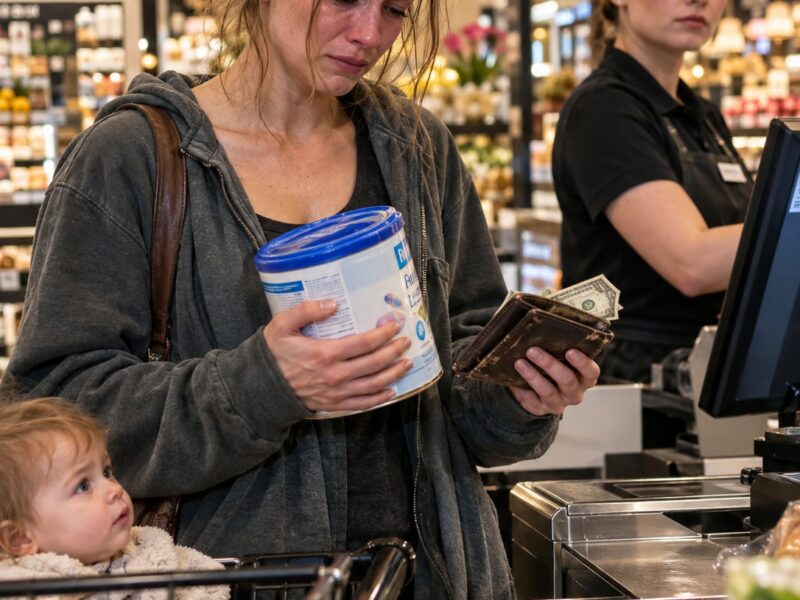
The baby formula trembled in Emily Carter’s hands before she ever started crying.
She stood beneath the unforgiving fluorescent lights of a grocery store in suburban Chicago, staring at the glowing number on the checkout screen as if staring long enough might somehow change it.
$28.46.
Emily opened her wallet again.
She already knew what was inside.
Two ten-dollar bills.
Three singles.
A faded pharmacy receipt.
A photograph of her six-month-old daughter, Lily, sleeping with one tiny fist curled beneath her cheek.
Twenty-three dollars.
That was all.
Behind her, a shopping cart rolled over a cracked floor tile with a soft clack.
Somewhere near the produce section, a child laughed.
The automatic doors opened and closed, letting in a breath of cold afternoon air.
Life kept moving.
Emily couldn’t.
The cashier waited.
Emily counted the bills again, although there was nothing left to count.
“I’m sorry,” she whispered.
The cashier leaned forward. “Ma’am?”
Emily swallowed.
“I don’t have enough.”
Her fingers tightened around the little container of formula.
It was ridiculous, she thought, that something so ordinary could feel so heavy.
She had carried her daughter through nights of screaming, fevers, doctor’s appointments, unpaid bills, and the hollow silence left by a husband who had decided fatherhood wasn’t the life he wanted.
Yet somehow this small container nearly broke her.
“Could you maybe take something off?” Emily asked.
The cashier looked at the few items beside the register.
A loaf of bread.
Two cans of soup.
A package of diapers.
The formula.
There wasn’t much to remove.
“You could put the formula back.”
Emily stared at her.
For one terrible second, she wondered whether she’d heard correctly.
Then she looked down at the groceries.
The bread could wait.
She could skip dinner.
The soup wasn’t necessary.
But Lily needed the formula.
Emily’s mouth opened.
Nothing came out.
Behind her, a man in a dark wool coat quietly stopped looking at his phone.
Emily didn’t notice him.
She didn’t notice anyone anymore.
“I need that,” she finally said.
The cashier’s expression softened.
“I’m sorry.”
Emily closed her eyes.
Five dollars and forty-six cents.
That was the distance between being a mother who could feed her baby tonight and being a mother who couldn’t.
“I’ll come back tomorrow,” she said.
She slowly pushed the formula across the counter.
Then she turned away before anyone could watch her cry.
But someone already had.
His name was Daniel Brooks.
And neither of them knew it yet, but what happened during the next sixty seconds would eventually reach hundreds of families.
Months later, Emily would keep one small piece of paper from that afternoon.
Daniel would spend $50,000 because of it.
And both of them would remember the exact moment a stranger decided not to look away.
It began with $5.46.
Emily Carter was twenty-nine years old, although lately she felt much older.
A year earlier, her life had been painfully ordinary.
She worked full-time at a small medical office, answering phones, scheduling appointments, processing insurance forms, and occasionally bringing coffee to the nurses when the waiting room became chaotic.
She wasn’t wealthy.
She didn’t need to be.
She had a modest apartment, a reliable car, groceries in the refrigerator, and enough left after payday to order pizza on Friday nights without calculating whether the cheese topping would interfere with the electric bill.
Back then, ordinary had seemed boring.
Now she would have given almost anything to have it back.
When Emily became pregnant, she and her husband had talked about names.
Nursery colors.
Daycare.
Whether their daughter would inherit Emily’s green eyes or his crooked smile.
They had made plans the way young couples often do—as if planning something guaranteed it would happen.
Then Lily was born.
And shortly afterward, Emily’s husband left.
There wasn’t one dramatic explosion.
No shattered dishes.
No screaming neighbors.
That almost made it worse.
There were arguments, apologies, promises, silences.
Then there was a suitcase.
Emily remembered standing near Lily’s crib while her husband zipped it closed.
“You’re really going?”
He wouldn’t meet her eyes.
“I can’t do this anymore.”
Emily had stared at him.
“Do what?”
“This.”
She looked toward the crib.
Lily was sleeping.
“This has a name,” Emily said. “Her name is Lily.”
He flinched.
But he still left.
For several weeks afterward, Emily operated on pure stubbornness.
She returned to work.
She learned to function on four hours of sleep.
She washed bottles at two in the morning and answered office calls at eight.
Whenever anyone asked how she was doing, Emily smiled.
“Fine.”
Fine became her favorite lie.
Then Lily developed a serious feeding problem.
At first, Emily thought it was ordinary fussiness.
Then came the crying.
The weight concerns.
The appointments.
The conversations with doctors.
The special feeding routine.
Emily began missing work.
Her supervisor tried to be understanding, but a medical office couldn’t schedule itself around the unpredictable needs of a six-month-old baby.
Emily reduced her hours.
Her paycheck shrank.
Her rent didn’t.
Neither did electricity.
Insurance.
Gas.
Diapers.
Formula.
The numbers began closing around her.
Emily became an expert at postponement.
She paid one bill late so another could be paid on time.
She learned exactly how far she could drive after the gas light came on.
She stopped buying coffee.
Then lunches.
Then almost anything for herself.
At night, after Lily finally fell asleep, Emily sat at the kitchen table with a calculator and envelopes spread around her.
She would move numbers from one column to another as though rearranging them might somehow create money.
It never did.
That Tuesday afternoon was worse than usual.
Emily stood in her kitchen holding the formula container upside down.
Nothing came out.
She shook it.
A faint dusting collected near the opening.
“No,” she whispered.
Lily stirred in her infant seat.
Emily checked her purse.
Twenty-three dollars.
Payday wasn’t until tomorrow.
Her checking account had almost nothing in it, and she needed enough gas to get to work.
She considered calling someone.
Then immediately rejected the idea.
Her mother had already helped with the previous month’s electric bill.
One friend had bought diapers two weeks earlier.
Emily hated the growing list of people she owed.
Not because anyone had made her feel ashamed.
Because she had always been the person who handled things herself.
She looked at Lily.
“Mommy’s going to figure it out.”
Lily kicked her feet.
Emily smiled despite herself.
“That’s right. We always figure it out.”
She bundled Lily up, drove to the grocery store, and spent most of the trip convincing herself twenty-three dollars would somehow be enough.
Maybe there would be a sale.
Maybe she remembered the price incorrectly.
Maybe the smaller container was cheaper.
Maybe.
The word had become another kind of currency.
Inside the store, Emily pushed Lily’s stroller slowly through the aisles.
She picked up the smallest container she could find.
Then diapers.
Bread.
Two cans of soup.
She calculated in her head.
Recalculated.
Removed one can.
Put it back.
Removed it again.
An older woman passed her and smiled at Lily.
“She’s beautiful.”
“Thank you.”
“How old?”
“Six months.”
“Best age.”
Emily smiled.
“Yeah.”
The woman continued walking.
Emily looked down at her daughter.
Best age.
Emily wished she could enjoy it without every moment being shadowed by arithmetic.
At the register, she unloaded her few items.
The cashier scanned them.
Beep.
Beep.
Beep.
Then the formula.
Beep.
“$28.46.”
Emily froze.
She looked at the display.
“No, I’m sorry. Could you say that again?”
“$28.46.”
Emily opened her wallet.
Twenty-three dollars.
She counted anyway.
Once.
Twice.
The line behind her grew.
Someone shifted impatiently.
Emily felt heat rising into her face.
“Could you maybe take something off?”
The cashier looked at the groceries.
Emily put the soup aside.
Then the bread.
It still wasn’t enough once the essentials were totaled.
Her eyes moved between the diapers and formula.
The cashier gestured toward the formula.
“You could put that back.”
Emily didn’t answer.
Lily made a soft sound from the stroller.
Emily looked down.
Her daughter was awake.
Those tiny eyes were staring up at her.
Something inside Emily collapsed.
Not loudly.
Quietly.
That was the worst kind.
She pushed the formula back.
“I’m sorry. I can’t pay for it.”
She gathered what she could afford.
“I’ll come back tomorrow.”
Her voice cracked on the last word.
Emily turned quickly and walked toward the exit.
She never saw the man behind her step forward.
Daniel Brooks had spent most of his adult life learning how to solve problems.
At forty-one, he was CEO of a rapidly growing technology company headquartered downtown.
Investors called him disciplined.
Employees called him demanding but fair.
Business magazines occasionally described him as self-made.
Daniel didn’t particularly like that phrase.
Nobody was self-made.
Someone taught you something.
Someone opened a door.
Someone gave you your first chance.
Someone believed you when there wasn’t much evidence that they should.
Daniel understood that better than most people knew.
Success had changed the scenery of his life.
Private meetings.
Luxury cars.
Restaurants where menus didn’t list prices.
Assistants arranging flights he barely remembered taking.
People laughing slightly too hard at jokes that weren’t particularly funny.
But money had also insulated Daniel.
Problems increasingly arrived to him as spreadsheets.
Percentages.
Charts.
Projected losses.
Head counts.
That afternoon, Daniel had entered the grocery store for one mundane reason.
He needed a few things before an evening meeting.
No assistant.
No driver.
No agenda.
He had been standing behind Emily answering an email when he heard her say:
“I can’t pay for it.”
At first, Daniel didn’t look up.
Then he heard:
“I’ll come back tomorrow.”
Something about her voice made him stop typing.
He watched Emily walk away.
Then his eyes dropped to the formula sitting beside the register.
“Sir?”
Daniel looked at the cashier.
“Her order.”
“I’m sorry?”
“The woman who just left.”
The cashier nodded toward the doors.
“She already paid for what she could.”
“I know.”
Daniel picked up the formula.
“What else did she put back?”
The cashier pointed toward the bread and soup.
Daniel looked toward the automatic doors.
Emily was almost outside.
“I’ll take all of it.”
The cashier blinked.
“Sir?”
“The formula. The groceries. The diapers.”
Daniel glanced at a nearby display of baby supplies.
“And those wipes.”
He picked up two packages.
Then hesitated.
“Actually, add another package of diapers.”
The cashier began scanning.
Daniel checked the doors again.
Emily disappeared.
“Can we hurry?”
The cashier did.
Daniel paid, took the bags, and headed outside.
Cold air hit his face.
He scanned the parking lot.
For a moment he thought he’d missed her.
Then he saw Emily beside an aging silver sedan several rows away.
She was standing near the driver’s door.
Her shoulders were shaking.
Daniel slowed.
He suddenly realized how strange this might look.
A man she’d never met following her through a parking lot.
He stopped several yards away.
“Excuse me.”
Emily spun around.
Her hand tightened around her purse.
Daniel lifted the grocery bag slightly.
“I think you left something.”
Emily wiped her cheek quickly.
“No, I didn’t.”
Daniel approached carefully.
“I think you did.”
He held out the bag.
Emily looked inside.
Formula.
Diapers.
Bread.
Soup.
Wipes.
Her face changed.
Confusion came first.
Then realization.
Then embarrassment.
“I can’t take this.”
Daniel expected gratitude.
The refusal surprised him.
“Why not?”
“Because I can’t pay you back.”
“You don’t need to.”
Emily shook her head.
“I don’t accept charity.”
Daniel said nothing.
For the first time, he looked at her properly.
Not as the woman who couldn’t afford groceries.
As a person desperately trying to protect the last piece of dignity life hadn’t taken from her.
Daniel understood.
So he changed his answer.
“Then don’t call it charity.”
Emily looked at him.
“What?”
Daniel glanced toward Lily’s stroller.
“Think of it as one parent helping another.”
Emily’s expression softened slightly.
“You have kids?”
Daniel nodded.
“Yeah.”
A silence passed between them.
Emily looked into the bag again.
“I don’t know you.”
“That’s probably why this is easier.”
A tiny laugh escaped her before she could stop it.
Daniel smiled.
Emily touched the container of formula.
Her fingers trembled.
“I’m just having a hard time right now.”
Fourteen words.
Daniel would remember them for years.
Not because they were extraordinary.
Because they weren’t.
Millions of people could have said them.
Most never did.
Daniel nodded.
“I can see that.”
Emily wiped another tear.
She looked embarrassed by it.
“I’m sorry.”
“Don’t apologize.”
“I don’t normally—”
“I know.”
She looked at him sharply.
Daniel gestured toward the groceries.
“People who normally ask strangers to buy their groceries don’t usually spend five minutes trying not to accept groceries from a stranger.”
Emily stared at him.
Then she laughed through her tears.
It was small.
But real.
“Fair point.”
Daniel handed her the bag.
This time she accepted it.
“Thank you.”
“You’re welcome.”
“What’s your name?”
Daniel hesitated.
For reasons he couldn’t entirely explain, he didn’t want the moment to become a transaction.
No business card.
No LinkedIn connection.
No debt.
No story about the generous CEO.
Just a bag.
Just help.
“Daniel.”
“Emily.”
He nodded toward Lily.
“And?”
“Lily.”
Daniel smiled.
“Take care of Lily.”
Emily hugged the bag against her chest.
“I will.”
Daniel turned and walked away.
He didn’t tell her his last name.
He didn’t tell her what he did.
And Emily didn’t know that the man disappearing between the parked cars could have purchased every container of formula in the store without noticing the money missing from his account.
She only knew that tonight her daughter would eat.
She stood beside the car for several seconds after he left.
Then she looked inside the bag again.
Under the diapers was the receipt.
Emily pulled it out.
She stared at the total.
Something about seeing the numbers made her cry harder.
Not because the amount was large.
Because someone had seen her worst five minutes and hadn’t used them to make her feel smaller.
Emily folded the receipt.
Carefully.
Then she slipped it into her wallet behind Lily’s photograph.
She would keep it much longer than she expected.
That night, Daniel sat inside a glass conference room thirty floors above Chicago.
A presentation glowed on the wall.
One of his executives was talking about quarterly projections.
Daniel should have been listening.
Instead, he kept seeing a woman pushing baby formula back across a grocery counter.
“Daniel?”
He blinked.
Everyone was looking at him.
“Sorry. Continue.”
The executive resumed.
Daniel tried to focus.
Revenue.
Expansion.
Margins.
Market share.
Numbers.
But another number kept appearing in his mind.
$28.46.
Then another.
$23.
A difference of $5.46.
Five dollars and forty-six cents had humiliated someone.
Five dollars and forty-six cents had decided whether a baby had formula that evening.
Daniel had spent more than that on bottled water in conference rooms.
The realization bothered him.
After the meeting, his chief financial officer caught up with him.
“You okay?”
“Yeah.”
“You were somewhere else in there.”
Daniel buttoned his coat.
“I saw something today.”
“What?”
Daniel considered explaining.
Instead, he said, “Nothing.”
But it wasn’t nothing.
The next morning, Daniel woke before his alarm.
He made coffee and stood near the kitchen window.
The city was still gray.
He thought about Emily’s sentence.
I’m just having a hard time right now.
How many people said that silently?
How many mothers calculated ounces of formula against gallons of gasoline?
How many fathers put diapers back because rent was due?
How many people reached the register and discovered they were six dollars short?
Daniel had donated to charities before.
Large ones.
Formal ones.
His company sponsored events.
There were photographs.
Press releases.
Annual reports.
But this felt different.
Because Emily had never asked him for anything.
Daniel picked up his phone.
By 9:15 that morning, he was calling the grocery store.
The manager assumed it was a complaint.
“Mr. Brooks, I’m sorry if something happened during your visit—”
“Nothing happened to me.”
Daniel paused.
“Actually, something did. But not the way you mean.”
He explained what he’d seen.
The manager listened.
“That happens more often than you’d think,” she finally said.
Daniel went quiet.
“How often?”
Another pause.
“Often enough.”
That answer stayed with him.
Daniel leaned back in his chair.
“What happens when someone can’t afford formula?”
“Sometimes they put it back.”
“And then?”
“I don’t know.”
There it was.
The part nobody saw.
Everyone saw the item return to the shelf.
Nobody saw the drive home.
Daniel looked through the glass wall of his office.
People moved through hallways carrying laptops and coffee.
“What if there were an emergency fund?”
The manager hesitated.
“For what?”
“Baby essentials. Formula. Diapers. Basic food.”
“You’re talking about some kind of assistance program?”
“Something simple.”
“Programs aren’t always simple.”
“Then we’ll make this one as simple as possible.”
The manager laughed softly.
“You sound like a man who’s never dealt with corporate compliance.”
Daniel smiled.
“I run a technology company. Compliance is practically a relative.”
She laughed.
Then Daniel became serious.
“I don’t want families filling out ten pages while their baby is hungry.”
The manager thought about it.
“We’d need safeguards.”
“Fine.”
“Guidelines.”
“Fine.”
“Funding.”
Daniel looked at the framed financial report on his desk.
“How much?”
“To start?”
“Yes.”
The manager gave a cautious estimate.
Daniel interrupted.
“I’ll put in fifty thousand.”
Silence.
“Fifty thousand dollars?”
“Yes.”
“Mr. Brooks—”
“One condition.”
The manager waited.
“My name stays off it.”
That surprised her more than the amount.
“You don’t want recognition?”
“No.”
“Why?”
Daniel thought about Emily refusing the bag.
Because I can’t pay you back.
“If someone’s already embarrassed about needing help, I don’t want them feeling indebted to some CEO they’ve never met.”
The manager was quiet.
“What do you want to call it?”
Daniel looked at his hands.
He remembered Lily’s tiny fingers gripping the edge of her stroller blanket.
“Little Hands.”
“Little Hands?”
“The Little Hands Fund.”
And that was how it began.
Not with a foundation.
Not with a gala.
Not with a press conference.
With one grocery store.
One manager.
One donor.
And one memory of a woman who had been five dollars and forty-six cents short.
The first weeks were imperfect.
Daniel expected that.
The store created a discreet process for qualifying emergency purchases of formula, diapers, and essential baby supplies.
The goal wasn’t to solve poverty.
It couldn’t.
The goal was smaller.
Nobody with a hungry infant should have to stand at a checkout counter deciding which necessity to abandon.
Daniel asked for monthly numbers.
Not names.
Never names.
Just families helped.
Seven.
Then nineteen.
Then thirty-four.
The fund expanded.
Another store joined.
Then another.
Daniel contributed more quietly.
A few business associates learned about the program and asked to help.
He let them.
But he insisted on one thing.
No publicity campaign.
One evening, his communications director approached him.
“This could be good for the company.”
Daniel looked up.
“What could?”
“The Little Hands Fund.”
His expression changed.
“How do you know about that?”
“It’s difficult to move this kind of money without someone noticing.”
She smiled.
“We could build a campaign around it. Community engagement. Human-interest pieces. Local news.”
“No.”
She blinked.
“Daniel, I’m not suggesting we exploit anyone.”
“Then don’t turn it into marketing.”
“We could help it grow.”
Daniel considered that.
She wasn’t entirely wrong.
Publicity could attract donors.
More donors meant more families.
But Daniel remembered the parking lot.
Emily’s red eyes.
Her instinctive refusal.
“I don’t want a camera anywhere near someone who can’t afford formula.”
His communications director studied him.
“This is personal.”
Daniel looked away.
“No.”
She smiled faintly.
“That’s not convincing.”
He didn’t answer.
The program grew anyway.
Quietly.
Months passed.
Emily knew none of this.
Her life didn’t magically transform after meeting Daniel.
The next morning, bills still waited.
Her car still made an alarming sound when she turned left.
Lily still woke at night.
Emily still went to work exhausted.
Kindness hadn’t fixed her life.
It had done something more realistic.
It had given her enough room to survive one terrible day.
And sometimes one day was exactly what a person needed.
Emily began applying for jobs.
She did it late at night after Lily fell asleep.
Some applications disappeared into silence.
Two interviews went nowhere.
A third company offered more money but impossible hours.
Emily refused.
For three days afterward, she questioned whether she’d made a mistake.
Then another medical group contacted her.
Flexible scheduling.
Better pay.
Benefits.
Emily interviewed on a Thursday.
The office manager called Friday.
“We’d like to offer you the position.”
Emily sat on the edge of her bed.
“Really?”
“Really.”
After ending the call, she covered her mouth and cried.
Lily, sitting nearby with a plastic toy, stared at her.
Emily laughed.
“These are good tears.”
Slowly, life became less frightening.
Not easy.
Just less frightening.
Emily paid rent without holding her breath.
She filled her gas tank completely for the first time in months.
She bought Lily a yellow sweater she didn’t technically need.
At the register, Emily almost cried again.
Because buying something unnecessary had become a luxury.
She began saving.
Five dollars one week.
Ten the next.
Sometimes nothing.
But she kept trying.
And every time Emily opened her wallet, she saw the folded grocery receipt behind Lily’s photograph.
Daniel.
She knew only his first name.
For months, that was enough.
Then one afternoon Emily returned to the grocery store.
Lily was bigger now.
She sat in the cart, babbling at cereal boxes.
Emily noticed a small sign near customer service.
LITTLE HANDS FUND
Emergency support for families purchasing essential infant supplies.
Emily stopped.
Something about the name made her curious.
The store manager happened to be nearby.
“Excuse me,” Emily said. “When did this start?”
“A few months ago.”
Emily read the sign again.
“Who started it?”
The manager hesitated.
“The donor prefers to remain anonymous.”
Emily smiled.
“Of course.”
She started to walk away.
Then stopped.
“This is going to sound strange.”
The manager waited.
“Did it start after a man paid for someone’s baby formula here?”
The manager’s face revealed the answer before she spoke.
Emily felt her heartbeat change.
“It did, didn’t it?”
The manager sighed.
“I’m really not supposed to discuss donors.”
“His name was Daniel.”
The manager looked at her carefully.
“You’re Emily?”
Now it was Emily’s turn to freeze.
“You know my name?”
“Only because he mentioned the situation. Never in any public records.”
Emily stared at the Little Hands sign.
“Who is he?”
The manager smiled.
“Daniel Brooks.”
The name meant nothing for several seconds.
Then Emily searched it on her phone.
Her mouth fell open.
Photographs appeared.
Daniel in a suit.
Daniel on a business stage.
Daniel standing beside executives.
Daniel Brooks, CEO.
Emily looked from the phone to the manager.
“That’s him.”
“Yes.”
Emily stared at the screen.
The man who had followed her into the parking lot had never mentioned any of it.
No title.
No company.
No money.
Just Daniel.
One parent helping another.
Emily’s eyes filled.
“He did this because of that day?”
The manager nodded.
“He called the next morning.”
Emily looked toward the register where it had happened.
People moved through the checkout lines.
A woman loaded groceries.
A teenager stared at his phone.
A cashier handed someone change.
Everything looked ordinary.
But somewhere inside that ordinary place, Emily’s worst moment had become something she never imagined.
“How many people?”
“What?”
“How many families has it helped?”
The manager smiled.
“Hundreds.”
Emily couldn’t speak.
Hundreds.
She had believed that afternoon was a story about her failure.
She had been wrong.
It was becoming a story about what happened when one person noticed another.
That night, Emily sat at her kitchen table.
Lily was asleep.
The apartment was quiet except for the hum of the refrigerator.
Emily took out a sheet of paper.
She started writing.
Stopped.
Crumpled it.
Started again.
Dear Mr. Brooks,
She stared at the words.
Too formal.
She crossed them out.
Dear Daniel,
Better.
She wrote slowly.
She told him she had found a better job.
She told him Lily was doing well.
She told him she was saving money.
She almost told him she’d paid the electric bill on time three months in a row.
Then laughed at herself.
But she wrote it anyway.
Because Daniel had met her when such a thing had felt impossible.
Then Emily removed the old receipt from her wallet.
The folds were soft now.
She placed it beside the letter.
She considered mailing it.
Then changed her mind.
The receipt stayed with her.
But she wrote one final paragraph.
Daniel received the envelope several days later.
His assistant placed it on his desk.
“Personal mail.”
Daniel nearly left it unopened until evening.
Then he noticed the return name.
Emily Carter.
For a moment, he couldn’t place it.
Then he remembered the parking lot.
The formula.
Lily.
Daniel opened the envelope.
He read.
Emily explained that she had discovered the Little Hands Fund.
She thanked him for what he’d done.
Not the money.
Not even the groceries.
Something else.
Daniel reached the final lines.
He read them once.
Then again.
Then a third time.
“You didn’t just feed my baby that day. You reminded me that people can still be kind when life feels impossible.”
Daniel leaned back.
Outside his office, Chicago stretched toward the horizon.
On his computer was the latest Little Hands report.
Hundreds of families.
Thousands of essential items.
More stores interested in participating.
All because of a moment he could easily have ignored.
Daniel had almost stayed on his phone that afternoon.
That thought disturbed him.
He could have answered the email.
Emily could have walked outside alone.
The formula could have remained behind the register.
Nobody would have accused Daniel of doing anything wrong.
He wasn’t responsible for her bills.
He didn’t know her.
He owed her nothing.
And perhaps that was precisely why the moment mattered.
Kindness wasn’t always repayment.
Sometimes there was no obligation at all.
Daniel folded Emily’s letter and placed it inside his desk.
Years passed.
The Little Hands Fund continued.
Emily’s life moved forward.
Lily grew from a baby into a bright little girl who asked too many questions and hated peas.
Emily eventually told her the story.
Not when she was six months old, of course.
Years later.
They were cleaning a drawer when Lily found the faded receipt.
“Mom, why do you still have this?”
Emily took it from her.
For a moment, she was twenty-nine again.
She could smell the grocery store.
Feel the worn wallet.
Hear the scanner.
$28.46.
She remembered pushing the formula away.
Then she remembered Daniel standing in the parking lot.
I think you left something.
Emily smiled.
“Because somebody bought groceries for us once.”
Lily frowned.
“Why?”
“Because we needed help.”
“Did you know him?”
“No.”
“Then why did he help?”
Emily looked at her daughter.
There were complicated answers.
She could have explained generosity.
Empathy.
Privilege.
Hardship.
She could have talked about how life sometimes crushes good people beneath ordinary expenses.
Instead, she gave Lily the simplest answer.
“Because he noticed.”
Lily thought about that.
Then she asked, “Did you pay him back?”
Emily’s throat tightened.
“No.”
Lily looked confused.
Emily smiled.
“At least, not directly.”
Because Emily had eventually begun contributing small amounts to the Little Hands Fund herself.
Nothing close to Daniel’s first $50,000.
Twenty dollars.
Sometimes fifty.
Whatever she could afford.
She never considered those donations repayment.
They were continuation.
Someone had carried her across one difficult moment.
Now she could help carry someone else.
Daniel had once believed success could be measured.
Revenue.
Valuation.
Growth.
Market share.
Those things still mattered.
Businesses needed numbers.
Employees needed salaries.
Investors expected results.
But that afternoon in the grocery store had taught him something numbers couldn’t.
Money could create distance from hardship so gradually that a person might forget what five dollars meant.
To Daniel, five dollars was almost invisible.
To Emily, it had been the difference between walking home with formula and walking home without it.
That difference stayed with him.
So did something else.
Emily hadn’t needed him to rescue her.
She had eventually rescued herself.
She found the job.
She raised Lily.
She paid the bills.
She rebuilt.
Daniel had merely made one awful afternoon slightly less awful.
And perhaps that was enough.
Years later, the receipt remained tucked inside Emily’s keepsake box.
The ink faded.
The paper yellowed.
Its monetary value was nothing.
Emily could have thrown it away a hundred times.
She never did.
Because whenever life became difficult again—and it did—she would occasionally find that receipt.
She would unfold it.
And remember.
Not that a wealthy CEO once bought formula.
Not that someone donated $50,000 afterward.
Not even that hundreds of families eventually received help.
She remembered standing beside an old silver car, ashamed and exhausted, believing she was completely alone.
Then hearing footsteps.
A stranger’s voice.
“I think you left something.”
Emily had believed kindness would feel grand.
Instead, it arrived carrying a grocery bag.
It didn’t erase her debts.
It didn’t bring her husband back.
It didn’t guarantee tomorrow would be easier.
It simply said:
You don’t have to survive this particular moment by yourself.
Sometimes that is the difference.
Sometimes the person standing beside you doesn’t need their entire life repaired.
They need dinner.
A ride.
A phone call.
Five dollars.
Someone willing to listen without judging.
Someone willing to notice.
The world remembered Daniel Brooks as a successful businessman.
Emily remembered him differently.
She remembered the man who saw a mother putting back her baby’s formula—and refused to look away.
And somewhere years later, another exhausted parent would stand beneath another set of fluorescent lights, staring helplessly at a grocery total they couldn’t afford.
Perhaps they would quietly begin removing items.
Perhaps embarrassment would burn across their face.
But this time, someone at the store would tell them about the Little Hands Fund.
They would leave carrying what their baby needed.
They might never know Emily Carter’s name.
They might never know Daniel Brooks’s name.
They might never know that their groceries could be traced back to one rainy afternoon, one worn wallet, and a woman who was exactly $5.46 short.
That was the strange thing about kindness.
You rarely knew where it ended.
Because sometimes the smallest thing you gave someone wasn’t the end of their story.
It was the beginning of what they would someday give to someone else.









