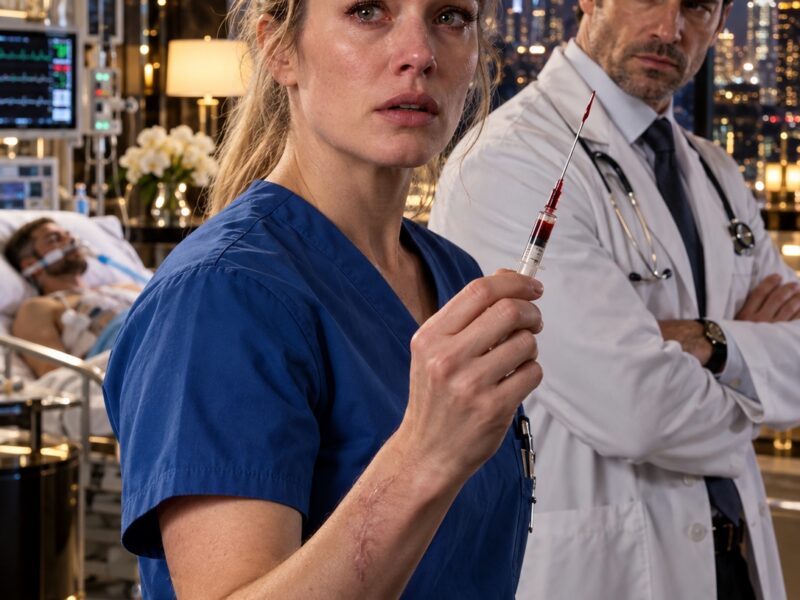
THE SIX-YEAR-OLD WHISPERED, “DON’T LEAVE MY DAD ALONE”—THEN THE NURSE DID SOMETHING NO ORDINARY RN SHOULD KNOW

The first person at Cedar Point Hospital to realize Captain Ethan Ward was in danger was six years old.
Nobody listened to him.
Not the doctors.
Not the night nurses.
Not the specialists who had spent years learning how to interpret numbers on monitors and symptoms written neatly into charts.
Only Reese Callaway listened.
And by the time everyone else understood what Eli Ward had been trying to tell them, his father had less than two minutes before his heart could stop.
But that wasn’t the part that would leave Dr. Nathaniel Pierce staring at Reese as if he’d never seen her before.
The impossible part came later.
Because when Reese put her hands on the dying Navy SEAL captain, she moved with the calm precision of someone who had done this before.
Not in a hospital.
Not under supervision.
Somewhere much worse.
And when Ethan finally opened his eyes, he stared at the ordinary nurse in cobalt-blue scrubs and whispered five words that nearly destroyed the life she had spent three years building.
“I know that voice.”
Hours earlier, none of that had happened yet.
Reese was crouched beside Bed 204, checking a blood pressure cuff that did not need checking, when a small hand caught the sleeve of her scrubs.
She looked down.
Eli Ward stood beside her.
Six years old.
Dark circles beneath his eyes.
Hair flattened on one side from sleeping in the vinyl family recliner beside his father’s hospital bed for four nights.
He leaned close enough that Reese could feel his breath against her ear.
“He hurts Daddy when you leave.”
Reese went still.
“Who does?”
Eli glanced toward the bed.
His father lay beneath a thin hospital blanket, chest rising and falling beneath the gown. A surgical dressing disappeared beneath the fabric.
“No one.”
The answer made Reese look at him more carefully.
Eli swallowed.
“The bad place.”
Across the room, the monitor kept pulsing.
Beep.
Beep.
Beep.
Ordinary sounds.
Safe sounds.
But Eli’s face was not ordinary.
“He goes there when he sleeps,” the boy whispered. “The other nurses tell him he’s in the hospital, but he doesn’t hear them. Then they get scared.”
Reese lowered herself until they were eye level.
“And what happens when I’m here?”
“He hears you.”
That should have been comforting.
It wasn’t.
“Every time?”
Eli nodded.
Then he gripped her sleeve harder.
“You have to stay.”
Something tightened behind Reese’s ribs.
It wasn’t fear exactly.
It was recognition.
The dangerous kind.
The kind that arrived before your mind understood what your body had already noticed.
She covered Eli’s hand with hers.
“I’m not going anywhere right now, buddy.”
“Promise?”
Reese hesitated.
Promises had once meant something very different in her life.
Sometimes they meant getting six men off a ridge before an aircraft ran out of fuel.
Sometimes they meant keeping pressure on a wound while telling a stranger he wasn’t going to die, even when you weren’t sure that was true.
Sometimes promises were the last thing someone heard.
So Reese had learned to be careful with them.
But Eli was six.
And he had been sleeping beside a wounded father for four nights.
“I promise I’ll keep watching him.”
Eli studied her face.
Then he nodded as if accepting terms in a negotiation.
From behind them came a man’s voice.
“Miss Callaway.”
Reese didn’t have to turn around.
Dr. Nathaniel Pierce had a way of saying her name that made two syllables sound like an accusation.
She stood.
Pierce waited near the curtain with his arms folded.
Early forties. Immaculate white coat. Controlled posture.
Johns Hopkins.
Two fellowships.
A reputation for being brilliant.
And an even stronger reputation for making sure everyone knew it.
“Doctor.”
“A word.”
Reese followed him several steps away from the bed.
Not far.
Eli could still see her.
Pierce noticed that.
Of course he did.
“Captain Ward’s vitals have been unstable for four nights.”
“I know.”
“The psychiatric episodes are worsening.”
“They’re not psychiatric episodes in isolation.”
Pierce’s expression tightened.
“You’ve reviewed my notes?”
“I’ve been taking care of him.”
“That wasn’t what I asked.”
Reese said nothing.
Pierce lowered his voice.
“The medication isn’t stabilizing him. My orders aren’t stabilizing him. Behavioral techniques haven’t consistently stabilized him.”
He paused.
“You have.”
Reese’s face remained neutral.
“I talk to him.”
“No.”
Pierce leaned slightly closer.
“You do something else.”
For the first time, Reese felt a cold flicker at the base of her neck.
“What exactly are you suggesting?”
“I don’t know. That’s the problem.”
Pierce pulled a folded sheet from the chart.
“I reviewed your personnel file.”
Of course he had.
“Associate nursing degree. Community college. Basic trauma certification. No specialty credentials. No military service. No previous clinical employment worth mentioning.”
He looked toward Bed 204.
“And somehow you’re the only person on this floor who can bring a decorated Navy SEAL captain back from wherever his mind goes at three in the morning.”
Reese met his eyes.
“Maybe I’m good at my job.”
“Nobody is that good at a job they were never trained to do.”
The words hit closer than Pierce knew.
Reese gave him nothing.
That, more than anything, seemed to irritate him.
“Captain Ward needs psychiatric evaluation in a controlled setting,” Pierce continued. “I’m requesting transfer tomorrow.”
“No.”
The word came too quickly.
Pierce’s eyebrows lifted.
Reese corrected herself.
“He’s five days post-op from a partial thoracotomy. He’s finally becoming accustomed to this environment. Moving him now could destabilize him physically and psychologically.”
“That decision isn’t yours.”
“I understand.”
“Do you?”
Reese held his gaze.
An old instinct whispered inside her.
Never break eye contact first.
Never let the other person know you’ve lost the thread.
She hated that the instinct was still there.
She looked down.
Half a second too late.
Pierce saw it.
Before either could speak, Nurse Priya Anand appeared around the curtain.
“Dr. Pierce?”
Something in her voice changed the room.
“Bed 204’s monitor is doing something weird.”
Reese was already moving.
She reached Ethan first.
Forty-five years old.
Nine deployments.
A man whose chart made younger staff members lower their voices instinctively.
His eyes were open.
That was the first bad sign.
Not awake.
Open.
His right hand clamped around the bed rail.
His breathing came in short, sharp bursts.
The monitor climbed.
“Captain Ward.”
Nothing.
Reese moved closer.
“Captain, you’re at Cedar Point Hospital.”
His fingers tightened.
His pupils weren’t tracking her.
He wasn’t seeing the hospital.
“Eli, step back for me.”
The boy obeyed instantly.
Priya caught his shoulders and moved him toward the doorway.
Pierce reached for the rapid-response button.
“He’s severely tachycardic.”
“Wait.”
Pierce stopped.
“Excuse me?”
Reese wasn’t looking at him.
She was looking at Ethan’s hand.
His fingers moved against the rail.
Three taps.
Pause.
Two taps.
Pause.
Three.
Pause.
Two.
Anyone else might have seen tremors.
Reese knew better.
Her stomach dropped.
It was patterned.
Deliberate.
A distress signal buried so deeply in trained muscle memory that the body could repeat it even when the conscious mind was somewhere else.
And suddenly Bed 204 didn’t feel like a hospital bed anymore.
For half a heartbeat, Reese smelled dust.
Burning metal.
Jet fuel.
Then she forced it away.
“Captain Ward.”
She placed her palm firmly against Ethan’s sternum.
Pierce’s voice sharpened.
“Miss Callaway—”
“Status check.”
The words came from Reese before she could stop them.
Ethan’s head turned.
Pierce fell silent.
Reese leaned closer.
“You are not in the field. I need your eyes on me.”
Something changed in Ethan’s face.
Not recognition.
Something older.
Deeper.
His nervous system knew the cadence even if his conscious mind didn’t.
“Breathe with me.”
Reese kept her palm steady.
“In for four.”
She counted.
One.
Two.
Three.
Four.
His chest rose.
“Hold.”
Pierce stood frozen behind her.
“Out for four.”
Ethan exhaled.
The monitor dropped.
Not enough.
But moving in the right direction.
Again.
“In for four.”
Ethan’s eyes finally found hers.
For one second, something moved through them.
Recognition.
Not of Reese Callaway.
Of something behind her.
Then it disappeared.
His body sagged into the pillows.
“You’re at Cedar Point,” Reese said quietly. “Your son’s here. You’re safe.”
Ethan closed his eyes.
Reese removed her hand.
Only then did she realize everyone in the room was staring at her.
Especially Pierce.
“That,” he said slowly, “was not a de-escalation technique I’ve ever seen used on this unit.”
“It worked.”
“That isn’t an answer.”
“It is tonight.”
Reese adjusted Ethan’s blanket.
“Your patient needs rest.”
She walked toward the door.
Her hands didn’t shake.
They never shook when it mattered.
Only afterward.
Eli caught her sleeve again.
“You did the breathing thing.”
“It’s just a technique.”
“Where did you learn it?”
Reese crouched.
“A long time ago.”
“From a doctor?”
A ghost of something almost like a smile touched her mouth.
“No.”
“Who?”
Reese looked back at Ethan.
“People who needed it more than most.”
It was the truth.
Just not enough of it to destroy anything.
Yet.
Behind her, Pierce was still watching.
By morning, he had made his decision.
“Psychiatric transfer effective this afternoon.”
He announced it during rounds.
Reese stood beside the medication cart, drawing a syringe with hands far steadier than she felt.
Pierce continued.
“Captain Ward’s episodes are escalating. He needs a controlled behavioral-health environment.”
“He’s five days out from thoracic surgery.”
Pierce turned.
“So you’ve mentioned.”
“Moving him introduces a new physiological stressor.”
“Following protocol reduces another.”
“Protocol doesn’t know him.”
The hallway went quiet.
Pierce took two steps toward her.
“And you do?”
There it was.
The question beneath every other question.
Reese capped the syringe.
“I know what I’ve observed.”
“No, Miss Callaway. You know more than you’ve observed.”
His voice dropped.
“You’ve become that patient’s primary point of stability, and I don’t understand why.”
Reese said nothing.
“Things I don’t understand on my unit make me nervous.”
She almost laughed.
Not because it was funny.
Because nine years earlier, men with far more dangerous jobs than Nathaniel Pierce’s had said almost exactly the same thing about things they couldn’t explain.
Nine years earlier, Reese Callaway hadn’t existed in the way Cedar Point knew her.
There had been another Reese.
A cockpit.
An F-22.
A call sign painted beneath the canopy.
Three combat zones.
Then four seconds that ended everything.
A compressor stall.
Warning lights.
A bad ejection over hostile terrain.
The violent snap of a parachute opening.
Ground coming up too fast.
A flare burning close enough to her forearm to leave a scar she would carry forever.
She remembered lying on the ground unable to catch her breath.
And she remembered a rescue medic.
Not his face.
His voice.
Low.
Steady.
Count with me.
In for four.
Hold.
Out for four.
That voice had kept her from disappearing inside her own panic.
Later, when flying was no longer possible, Reese had spent two years cross-training.
Combat search and rescue liaison work.
Field trauma.
Extraction.
Keeping people alive in places where an ambulance was not coming.
She learned to read hands before faces.
To recognize shock before a monitor could.
To find a pulse under gunfire.
To make decisions in seconds that people in hospitals sometimes had minutes to debate.
She learned that calm was not a personality trait.
It was equipment.
Then came the last extraction.
Everyone came home.
But not everyone came home whole.
Neither did Reese.
Three years ago, she walked away.
She put down the uniform.
Changed the shape of her life.
Entered nursing school.
The coursework felt almost absurdly simple after what she’d done, but simplicity was what she wanted.
Medication rounds.
IV bags.
Blood-pressure cuffs.
Charting.
Ordinary people with ordinary injuries.
A life where nobody called her by a name over encrypted radio.
A life where nobody expected her to decide who lived in ninety seconds.
She became Nurse Reese Callaway.
Quiet.
Useful.
Forgettable.
She had thought becoming smaller would make the memories smaller too.
It hadn’t.
Now a six-year-old boy was staring at her across Room 204 as if he knew that.
When Reese entered to check Ethan’s blood pressure, Eli’s coloring book was open on his lap.
Nothing had been colored.
“They’re moving Daddy.”
“Nothing’s final yet.”
“You said you’d stay.”
“I’m trying.”
Eli looked toward the hallway.
“The other nurses are scared of him.”
“They aren’t scared.”
“Yes, they are.”
He pointed.
“They stand by the door when he does the bad thing.”
Reese didn’t answer.
“You don’t.”
“No.”
“Why?”
She glanced at Ethan.
Sleeping.
One hand curled loosely at his side as though around a weapon that hadn’t been there for years.
“Because I’ve seen it before.”
The sentence escaped before she could stop it.
Eli’s eyes sharpened.
“Seen what?”
Reese reached for the blood-pressure cuff.
“Help me with this.”
It was a terrible distraction.
Fortunately, Eli was six.
He climbed down immediately.
“What do I do?”
“Press this button when I tell you.”
His face became serious.
Reese wrapped the cuff around Ethan’s arm.
“Now.”
Eli pressed it.
The machine hummed.
For twenty seconds, the room became almost normal.
A nurse.
A father.
A son.
Then Eli spoke.
“He says a name.”
Reese’s hands stopped.
“What?”
“When he’s in the bad place.”
Eli frowned.
“It’s not really a name.”
Reese slowly turned.
“What does he say?”
“It’s like a code word.”
The room suddenly felt colder.
“Tell me.”
Eli did.
One word.
A call sign.
Reese felt the floor disappear beneath her.
She kept her expression perfectly still.
She had practiced that skill in classified debriefings, after-action reviews and conversations where one wrong reaction could reveal something that was never supposed to leave the room.
But inside, nine years collapsed into one second.
She knew that word.
She had answered to it.
Wraith.
“Do you know what it means?” Eli asked.
Reese looked at Ethan.
A man she was almost certain she had never met.
Except perhaps she had.
Not here.
Not like this.
Maybe in smoke.
Maybe under rotor wash.
Maybe with blood on her gloves and encrypted voices screaming coordinates into her headset.
“I don’t know,” she lied.
Eli frowned.
“You looked like you knew.”
“Sometimes dreams make strange words.”
“But you’re going to find out, right?”
Reese swallowed.
“Yes.”
That answer, at least, was true.
At 2:00 a.m., the transfer paperwork was still sitting unsigned at the nurses’ station.
At 2:03, Bed 204’s monitor began screaming.
Reese was three rooms away.
Her body reacted before her mind did.
By the second alarm tone, she was running.
She hit the curtain at full speed.
Ethan was half out of bed.
His IV had torn loose.
Blood streaked his hand.
Fresh red spread through the dressing over his chest.
One hand clawed at his sternum.
The other swung violently at an enemy no one else could see.
“Security!” someone shouted.
“No.”
Reese’s voice cut through the room.
“Get saline. Call the surgical resident. Now.”
Ethan swung.
Instead of backing away, Reese stepped inside his reach.
She caught his wrist.
Turned with his momentum.
Controlled the arm without fighting it.
Pierce would later remember that movement more clearly than anything else.
Because nurses didn’t move like that.
Most doctors didn’t.
“Ethan.”
Not Captain.
Not Mr. Ward.
Ethan.
“Look at me.”
Nothing.
His breathing tore in and out.
Reese put one hand against his shoulder.
Something was wrong beyond panic.
Very wrong.
“BP falling,” Priya called.
“What’s the number?”
“Ninety-two over fifty-eight.”
Seconds later—
“Eighty-six systolic.”
Priya pressed a stethoscope to his chest.
Her face changed.
“Heart sounds are muffled.”
Reese looked at Ethan’s neck.
Jugular veins distended.
Falling pressure.
Muffled heart sounds.
Post-thoracotomy.
Fresh bleeding.
The pattern assembled itself in her mind with horrifying clarity.
Cardiac tamponade.
Blood was collecting inside the sac around Ethan’s heart, compressing it until the chambers could no longer fill properly.
He wasn’t simply panicking.
He was dying.
And Reese had seen this once before.
On a mountainside.
A different man.
A different wound.
The same arithmetic.
“He needs decompression.”
The night nurse stared at her.
“The resident’s coming.”
“He doesn’t have time.”
“You can’t—”
“Get me a pericardiocentesis tray.”
Nobody moved.
Reese turned.
“Now.”
Priya moved.
Betadine.
Spinal needle.
Ultrasound.
The doors burst open.
Pierce entered in scrubs beneath a half-buttoned white coat.
“What the hell is happening?”
“Post-thoracotomy cardiac tamponade. Rapid decompensation.”
Pierce looked at the monitor.
Then at Reese preparing the tray.
His face hardened.
“Step away.”
“No.”
“You are not authorized to perform an invasive cardiac procedure.”
“Then do it.”
Pierce froze.
Reese looked directly at him.
“Do it right now.”
The blood-pressure alarm screamed again.
“Or stand back and let me.”
“Miss Callaway—”
“He has maybe ninety seconds before his heart stops.”
The room became silent except for the machines.
Pierce looked at Ethan.
Gray skin.
Struggling breaths.
Falling numbers.
Then he looked at Reese’s hands.
They were completely steady.
His weren’t.
Not yet.
“Do it,” Pierce said.
Someone inhaled sharply.
“I’ll supervise. Talk me through everything.”
It wasn’t trust.
It was arithmetic.
Reese swabbed the site beneath Ethan’s sternum.
Priya positioned the ultrasound.
Reese found the angle.
Her body remembered.
That was the terrible miracle of training.
Your mind could spend years begging to forget.
Your hands didn’t care.
Needle in.
Angle toward the left shoulder.
Advance.
Aspirate.
Dark blood entered the syringe.
Twenty milliliters.
Forty.
Sixty.
The monitor changed.
Blood pressure rose.
Barely.
Then more.
Ethan’s breathing began to slow.
His hand, which had been locked around Reese’s wrist, loosened.
The color returned slowly to his face.
“Stay with me.”
His eyes opened.
This time they focused.
On her.
Not the ceiling.
Not the battlefield.
Her.
“You’re okay, Ethan.”
He stared.
Reese knew that look.
A mind searching through locked rooms.
Then his lips moved.
“I know that voice.”
Reese stopped breathing.
Pierce heard it.
So did Priya.
Ethan swallowed.
“I know that voice from somewhere I can’t remember.”
And for the first time in three years, Reese Callaway was afraid not of someone dying—
but of someone remembering.
By seven that morning, she was sitting inside Clinical Compliance.
Grant Ashworth, director of patient safety, sat at the head of the table.
Pierce sat beside him.
A folder rested in front of him.
Incident report.
Reese recognized the format.
Ashworth folded his hands.
“Ms. Callaway, last night you performed an invasive cardiac procedure without documented authorization or credentialing.”
“Yes.”
“Your intervention appears to have saved Captain Ward’s life.”
“Yes.”
“That doesn’t make the first statement disappear.”
“I understand.”
Pierce leaned forward.
“Do you?”
Reese looked at him.
His contempt was gone.
Something else had replaced it.
Confusion.
Maybe even unease.
“I pulled your complete personnel file,” he said. “Associate nursing degree. No advanced trauma certification. No surgical experience. No military history.”
Reese said nothing.
“And yet last night you performed an emergency pericardiocentesis with a precision I’ve watched fellows struggle to achieve.”
Silence.
“You’ve done it before.”
Not a question.
Reese’s eyes dropped to the table.
Pierce continued.
“You didn’t hesitate.”
Still nothing.
“You recognized tamponade before half the room did.”
Reese’s jaw tightened.
“You controlled a combative Navy SEAL with a technique I’ve never seen taught in nursing.”
Ashworth glanced toward Pierce.
Pierce didn’t stop.
“And four nights ago, you recognized a distress pattern in his hand that everyone else thought was tremor.”
He sat back.
“So I’ll ask once.”
His voice softened.
“Who are you?”
Reese had spent three years preparing answers to that question.
None felt useful anymore.
She thought of Eli.
A child whispering a warning nobody believed.
She thought of Ethan saying Wraith in his sleep.
She thought of a mountainside seven years earlier.
Smoke.
Dust.
Six operators.
One man with shrapnel in his chest.
A face she never clearly saw.
Her hands working inside chaos.
Her voice counting breaths.
She remembered the extraction aircraft lifting away.
She remembered asking later if everyone survived.
She remembered being told she didn’t have clearance to know.
You did your job.
Move on.
People who had never done the job loved those two words.
Move on.
As though memory followed orders.
Reese looked at Ashworth.
“Before I was a nurse, I served in the United States Air Force.”
Pierce’s expression changed.
“I was a fighter pilot.”
Silence.
“An ejection ended my flying status. After that, I transitioned into combat search and rescue liaison work and cross-trained in field trauma.”
Ashworth’s pen stopped.
“How extensive?”
Reese almost smiled.
“Extensive enough that last night wasn’t the worst place I’ve had to drain pressure from around someone’s heart.”
Pierce stared.
“Why isn’t any of this in your background file?”
“Parts of my separation record remain sealed under classification review.”
“You’re telling us your military trauma training is classified?”
“I’m telling you the details of some operations are.”
Ashworth studied her.
“And you deliberately omitted your history?”
“I didn’t falsify anything.”
“No. But you certainly didn’t volunteer it.”
“No.”
“Why?”
That was harder.
Reese looked at her hands.
“Because I wanted it gone.”
Pierce frowned.
“The career?”
“The person.”
Nobody spoke.
“My last extraction didn’t end the way I needed it to.”
Reese’s voice remained controlled.
“I got everyone out.”
She paused.
“I didn’t get everyone out whole.”
The room blurred for half a second.
She forced it back into focus.
“I spent two years believing if I put down every piece of that life, eventually my body would understand the war was over.”
She looked at her cobalt-blue sleeve.
“Nursing was close enough to the work to let me still be useful. But quiet enough that nobody needed Wraith.”
Pierce’s eyes sharpened.
“What did you say?”
Reese realized her mistake.
Too late.
Before she could answer, Ashworth spoke.
“Captain Ward has been asking for you.”
Her pulse changed.
“He’s awake?”
“For an hour.”
“Stable?”
“Yes.”
Ashworth watched her carefully.
“He says he remembers something.”
Reese felt the old scar on her forearm begin to ache.
“He specifically requested you.”
Down the hall, Ethan Ward was sitting upright for the first time in five days.
Eli was curled against his side.
The moment Reese entered, the boy straightened.
“There she is.”
He looked triumphantly at his father.
“I told you.”
Reese stopped beside the bed.
Ethan looked different awake.
Older.
Tired.
But fully present.
“Close the curtain,” he said.
She did.
Eli stayed.
Ethan didn’t ask him to leave.
After everything the boy had noticed when adults hadn’t, he had earned his place in the room.
Ethan took a slow breath.
“Seven years ago, my team was pinned down on a ridgeline we weren’t supposed to be anywhere near.”
Reese’s heartbeat slowed.
Not because she was calm.
Because part of her already knew what was coming.
“I took shrapnel through the chest.”
Ethan touched the edge of his surgical dressing.
“My corpsman went down before he could reach me. I remember losing sensation in my fingers.”
He looked toward the window.
“I remember thinking, very clearly, that I was going to die there.”
Reese could smell scorched rock.
Not really.
Memory.
“And then someone came.”
Ethan looked at her.
“A woman.”
Reese said nothing.
“I couldn’t see her face. Smoke everywhere. Dust. Blood in my eyes.”
His voice became quieter.
“But I heard her.”
Reese’s throat tightened.
“She kept counting my breaths.”
Ethan tapped four fingers against the blanket.
“In for four.”
Reese closed her eyes for half a second.
“Hold for four.”
The mountainside came back.
Rotor blades somewhere beyond the ridge.
Static in her headset.
A pulse beneath her fingers disappearing.
Four minutes to extraction.
Three.
Ninety seconds.
Ethan’s voice brought her back.
“She kept telling me I was safe.”
He gave a humorless laugh.
“Nothing about that place was safe.”
Eli looked from his father to Reese.
“But I believed her.”
Ethan’s eyes never left Reese now.
“I never saw her face.”
He paused.
“They called her Wraith.”
The room disappeared.
For seven years, Reese had carried that ridgeline as an unfinished sentence.
Six men extracted.
No names.
No outcomes.
No closure.
Ethan continued.
“I tried to find her.”
Reese stared at him.
“For years.”
“Why?”
The question escaped before she could stop it.
Ethan almost looked offended.
“Because she saved my life.”
His voice cracked slightly.
“And because I never knew if she knew it.”
Reese couldn’t answer.
“Every request I made came back sealed. Eventually I stopped asking.”
He swallowed.
“I told myself it didn’t matter who she was.”
His eyes dropped to her hands.
“Then last night I heard that voice again.”
Eli whispered, “The breathing thing.”
Ethan nodded.
“The exact cadence.”
He looked at Reese.
“And this morning, I remembered something else.”
His hand moved to his own forearm.
“The woman on that ridge had a burn scar here.”
Reese stopped breathing.
“I saw it when her sleeve pulled back while she checked my pulse.”
Slowly, Ethan’s gaze moved toward Reese’s left arm.
She didn’t hide it.
Not this time.
She rolled up her sleeve.
The scar was pale now.
Irregular.
Old.
But unmistakable.
Ethan stared at it.
Seven years disappeared from his face.
“Jesus.”
Eli climbed off the bed.
“What?”
Nobody answered him.
Ethan looked up.
“You called me Ethan last night.”
Reese nodded.
“Say it again.”
She knew what he was asking.
Not for his name.
For proof.
“Ethan.”
His eyes filled.
Not dramatically.
Not tears spilling down his face.
Just the quiet collapse of a question a man had carried for seven years.
Reese lowered her arm.
“Wraith was a call sign.”
Ethan’s jaw tightened.
“I don’t use it anymore.”
“Was it you?”
Reese looked at him.
“Yes.”
Eli went perfectly still.
“The ridgeline?”
“Yes.”
“The woman who kept me breathing?”
Reese nodded.
“That was me.”
Silence filled the room.
Eli looked between them.
Then he said the simplest thing anyone could have said.
“You saved my dad twice.”
Reese looked down at him.
“The first time I helped a team get off a mountain.”
“You saved him.”
“I didn’t even know which one he was.”
Ethan reached for her hand.
His grip was strong now.
Alive.
“I’ve spent seven years wondering whether the person who kept me breathing knew what happened afterward.”
Reese looked at their joined hands.
“I didn’t.”
“You never knew?”
“Until about thirty seconds ago.”
Something in Ethan broke.
Not weakness.
Relief.
“I made it.”
Reese’s eyes burned.
“Yes.”
“You got me home.”
She tried to pull her hand away.
He held on.
“You need to hear this.”
“Ethan—”
“No.”
For the first time, his voice carried the authority of the captain everyone at Cedar Point knew from the chart.
“You need to hear it.”
Reese stopped.
“It mattered.”
Three words.
Nothing more.
But they reached somewhere medals and citations never had.
It mattered.
Reese looked away.
That was when footsteps stopped outside the curtain.
Pierce entered.
He wasn’t alone.
A man in Air Force dress uniform stood beside him.
Reese recognized the insignia immediately.
Her body straightened before she could stop it.
Old habits.
The officer noticed.
So did Pierce.
“Ms. Callaway.”
The officer’s formality carried a trace of something else.
Recognition.
“Command received a records inquiry from Cedar Point this morning.”
Reese glanced at Pierce.
“Once your name became associated with a call sign documented in Captain Ward’s statement, I was asked to verify your service history personally.”
Pierce folded his arms.
“And?”
The officer turned toward him.
“Captain Reese Callaway, United States Air Force, retired.”
Pierce’s arms slowly lowered.
“Former fighter pilot. Combat search and rescue liaison. Six confirmed extractions under direct fire. Distinguished Flying Cross before transition out of fighter operations.”
Eli’s mouth fell open.
Reese closed her eyes.
The officer continued.
“Her record confirms Captain Ward’s account, including the operation.”
Pierce looked at Reese.
For once, he had absolutely nothing to say.
The officer glanced toward Ethan.
“Some operational details remain classified.”
Then back to Pierce.
“But if you’re asking whether Nurse Callaway possessed the field training necessary to recognize and intervene in Captain Ward’s emergency, the answer is yes.”
A beat.
“I’d trust her hands over most surgeons I’ve worked beside.”
The statement hung there.
Pierce looked down.
When he finally spoke, his voice was quiet.
“I owe you an apology.”
Reese hadn’t expected that.
Neither, apparently, had Priya, who was standing just beyond the curtain pretending not to listen.
Pierce continued.
“I spent a week assuming the gap between your credentials and your competence meant something was wrong.”
Reese said nothing.
“It never occurred to me that the gap existed because the truth was hidden.”
“You weren’t wrong to question what you couldn’t explain.”
“I was wrong about something.”
Pierce met her eyes.
“I thought credentials and competence were the same thing.”
Eli tugged Reese’s sleeve.
Everyone looked down.
“You’re not just a nurse.”
The room became very still.
Three years earlier, those words would have terrified her.
Now Reese found herself smiling.
“No.”
Eli waited.
Reese looked at Ethan.
At Pierce.
At the uniformed officer.
Then back at the boy who had started all of this because he refused to stop noticing.
“No,” she said softly. “I guess I never really was.”
“Why did you pretend?”
Reese thought about it.
“I needed somewhere quiet to stand for a while.”
Eli seemed to understand that better than most adults would have.
The Board of Nursing review lasted three weeks.
In the end, the facts were difficult to argue with.
Grant Ashworth documented the emergency circumstances.
The Air Force confirmed Reese’s training.
Ethan submitted his own statement.
It was characteristically blunt.
The nurse under review had saved his life twice.
Once on a mountainside seven years earlier.
Once in a hospital room three weeks before the hearing.
Reese was cleared without formal reprimand.
But Cedar Point did something nobody expected afterward.
They created a position.
Clinical liaison for veteran and operator trauma care.
Reese would continue carrying patients, but when combat veterans, first responders or trauma patients arrived whose reactions didn’t fit neatly inside standard protocols, she would be called.
She would report jointly to nursing administration and Dr. Nathaniel Pierce.
The surprising part wasn’t that Pierce accepted the arrangement.
He had proposed it.
“You’ll still have regular nursing responsibilities,” he told Reese after the decision.
They stood in the same hallway where he’d once confronted her about Ethan.
“But cases like Ward come to you first.”
Reese raised an eyebrow.
“First?”
Pierce gave her a tired smile.
“I should have called you first from the beginning.”
“That might have wounded your ego.”
“It survived.”
“Barely.”
He almost laughed.
Then his expression became serious.
“I’ve spent fifteen years believing competence could be measured by credentials.”
Reese waited.
“You didn’t fit the equation. Instead of questioning the equation, I assumed you were the problem.”
“That happens.”
“It shouldn’t.”
“No.”
Pierce nodded.
“I’ll be more careful.”
It wasn’t dramatic redemption.
There was no grand speech.
No applause.
Just a proud man admitting his certainty had been incomplete.
Reese decided that was enough.
Sometimes people didn’t need to become someone new.
They just needed to begin moving in the right direction.
Ethan was discharged on a bright Tuesday morning.
No storm.
No dramatic soundtrack.
Just ordinary sunlight coming through the hospital windows.
He wore civilian clothes.
His surgical wound was healing.
He walked without assistance.
And Eli’s hand was locked around his.
They stopped at the nurses’ station.
Reese looked up from a chart.
Ethan smiled.
“I looked you up.”
She sighed.
“Of course you did.”
“Once I finally had a name.”
Eli grinned.
“Daddy found the jet stuff.”
“The jet stuff?”
“Distinguished Flying Cross,” Ethan said. “Six extractions under fire.”
Reese looked back at her chart.
“You really went digging.”
“You spent seven years making yourself impossible to find.”
“I had help.”
Ethan shook his head.
“You never told anyone here.”
“It wasn’t relevant to changing IV bags.”
“It was relevant to everything.”
“No.”
Reese looked at him.
“It wasn’t.”
Ethan understood.
That surprised her.
After a moment, he nodded.
“Maybe not.”
He held out his hand.
“But I’ve spent seven years trying to thank a voice.”
Reese looked at it.
“I never thought I’d get to attach a face to it.”
“You don’t owe me anything.”
“I know.”
His hand remained extended.
“I’m thanking you anyway.”
Reese took it.
No battlefield.
No blood.
No classified radio.
Just two people standing beneath fluorescent lights in a hospital corridor.
For the first time, the ending of that mission felt real.
Ethan released her hand.
“There’s something else.”
He looked at Eli.
The boy was pretending to examine a poster on the wall.
Poorly.
“He hasn’t slept through the night in months.”
Reese’s smile vanished.
Ethan lowered his voice.
“He’s watched too many of my nightmares.”
Reese looked at Eli.
“He started having his own. Not about combat. About me.”
Ethan swallowed.
“About not being able to wake me up.”
Reese understood immediately.
“Last night,” Ethan said, “he slept eight hours.”
Her eyes returned to him.
“First time in months.”
“Why?”
“He told me he knew someone would catch it.”
Reese looked away.
That hurt more than she expected.
Ethan continued quietly.
“I don’t think you understand what you gave him.”
Reese watched Eli.
A six-year-old who had spent four nights sleeping in a hospital recliner because he believed vigilance was the only thing keeping his father alive.
A child who had learned to study adult faces for danger.
A boy who should have been worrying about cartoons and cereal and whether he could stay up thirty minutes past bedtime.
Instead he’d become a sentry.
“I understand more than you think,” Reese said.
Ethan waited.
“I know what it’s like to need someone to catch it.”
She didn’t explain further.
She didn’t need to.
Eli suddenly turned around.
“You’re still working here, right?”
Reese smiled.
“Yes.”
“In case Daddy needs the breathing thing?”
“I’m not going anywhere.”
“You promised that before.”
“I remember.”
Eli crossed his arms in an almost perfect imitation of Pierce.
Reese nearly laughed.
“You also didn’t tell me you flew fighter jets.”
“Apparently we’re holding a grudge about that.”
“Yes.”
Ethan covered his mouth.
Reese crouched until she was eye level with Eli.
“What do you want to know?”
“Everything.”
“That’s going to be difficult.”
“Why?”
“Some of it is classified.”
Eli groaned.
“That’s what Daddy says when he doesn’t want to tell me cool stuff.”
Ethan protested.
“That is not what classified means.”
Eli ignored him.
“Tell me the important part.”
Reese looked at him.
She knew exactly what the important part was.
“The important part is about a six-year-old boy.”
Eli’s expression changed.
“He noticed something was wrong when a room full of adults didn’t.”
A smile began to form.
“And even when nobody listened, he kept paying attention.”
Eli glanced at his father.
“So I helped save Daddy?”
Reese shook her head.
“You did more than help.”
His smile vanished in surprise.
“You were the first person who understood that something wasn’t right.”
“But I’m just a kid.”
“Exactly.”
Reese rested a hand lightly on his shoulder.
“Don’t ever let someone convince you that being the youngest person in a room means you’re the person who sees the least.”
Eli considered that.
Then he smiled.
And suddenly he looked six again.
Not like a frightened child keeping watch beside a hospital bed.
Not like a little sentry listening for his father’s screams.
Just a boy.
Ethan squeezed Reese’s shoulder once.
Then father and son turned toward the sliding doors.
Reese remained at the nurses’ station.
She watched them walk away together.
Ethan moved slowly but steadily.
Eli bounced beside him, talking with both hands.
The doors opened.
Ordinary daylight poured through.
And something inside Reese finally loosened.
Seven years earlier, she had watched a helicopter disappear from a mountainside carrying six men whose names she was not allowed to know.
She had never learned who survived.
She had never known whether the hands she’d held belonged to men who later held their children again.
She had been trained not to ask.
Complete the extraction.
Return to base.
Debrief.
Move on.
Except human beings were not built like missions.
There was no checkbox for what remained afterward.
No official form for the questions that woke you at three in the morning.
Reese had spent years believing that if she changed enough external things, the internal ones would eventually follow.
Uniform for scrubs.
Captain for nurse.
Wraith for Reese.
Combat zone for hospital corridor.
She had believed disappearing was the same thing as healing.
It wasn’t.
She understood that now.
She had never put down the training.
She had only buried the person who carried it.
And perhaps the strangest thing was that it hadn’t been a general, a doctor or some decorated officer who dug her back out.
It had been a six-year-old boy.
A boy tugging her sleeve.
A boy everyone else thought was frightened.
A boy who kept saying the same thing until someone finally listened.
Reese watched Ethan and Eli disappear beyond the glass doors.
Then she looked down at her own hands.
They were ordinary hands.
No blood.
No gloves.
No tremor.
For years she’d hated that they remembered things she wanted to forget.
Now she wondered whether remembering had ever been the enemy.
Maybe the problem had been believing that survival required becoming someone else.
Behind her, another monitor sounded.
Nothing urgent.
Just a call from another room.
Another patient.
Another ordinary day.
“Reese?”
Priya leaned out of a doorway.
“Can you give me a hand?”
Reese glanced once more through the glass.
Ethan and Eli were almost at the parking lot.
Eli suddenly turned.
Even from that distance, Reese saw him wave.
She raised one hand.
He waved harder.
Then Ethan placed a hand on his son’s shoulder, and together they disappeared into the bright morning.
Reese lowered her arm.
She straightened her cobalt-blue scrubs.
Her ID badge faced outward.
REESE CALLAWAY, RN.
Nothing beneath it about fighter jets.
Nothing about combat.
Nothing about six extractions under fire.
Nothing about Wraith.
For the first time, that didn’t feel like hiding.
A badge didn’t have to contain everything a person had survived.
A title didn’t have to explain everything someone was capable of.
And a past didn’t have to disappear before you could build a future.
Reese turned toward Priya.
“Coming.”
She walked down the hallway beneath her own name.
Not Wraith.
Not Captain.
Not the woman she’d tried to bury.
Not merely the nurse people had underestimated.
Just Reese.
And maybe that was finally enough.
Because some warnings never arrive through intelligence channels.
Some truths never appear in personnel files.
Some heroes don’t look like heroes when you first meet them.
Sometimes the person who saves your life is wearing a flight suit on a burning ridgeline.
Sometimes she’s wearing cobalt-blue scrubs beside a hospital bed seven years later.
And sometimes the bravest person in the entire room is a six-year-old boy who keeps tugging on someone’s sleeve, repeating the one true thing every adult has been too busy to hear.
Reese reached the next patient’s doorway and paused.
For just a second, she thought she could still feel Ethan’s hand gripping hers.
Still hear the rotor blades from that distant mountain.
Still hear Eli whispering—
You have to stay.
Three years ago, those words might have frightened her.
Now Reese stepped into the room.
And stayed.









