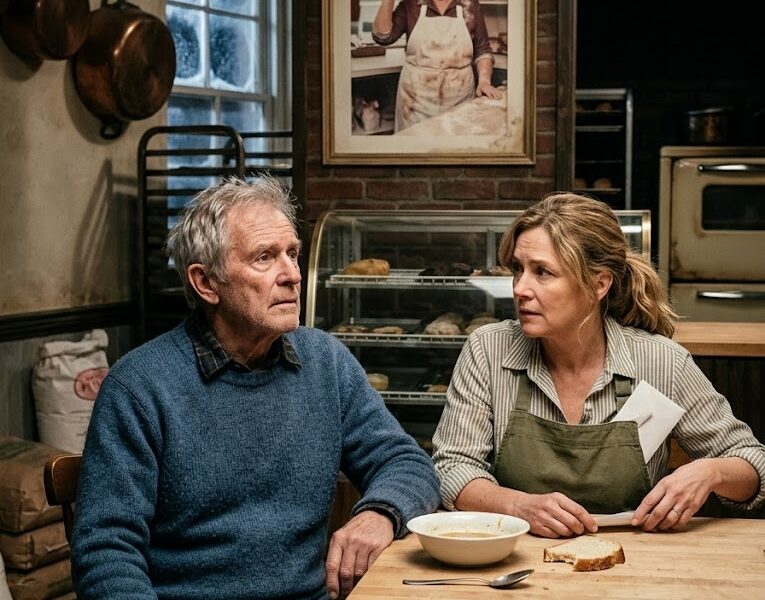
THE STRANGER I DRAGGED OUT OF A BLIZZARD HAD NO MONEY AND NOWHERE TO GO—DAYS LATER, I LEARNED WHY HE COULDN’T STOP STARING AT MY GRANDMOTHER’S PHOTOGRAPH
The night Emily Carter was told she had three weeks left to save her family’s bakery, she found a dying stranger outside its back door.
At least, she thought he was dying.
Snow had already buried the alley behind Carter’s Bakery beneath six inches of white when Emily heard the sound.
Not a knock.
Not exactly.
It was more like something heavy scraping against the brick wall, followed by a weak voice that almost disappeared beneath the wind.
“Please…”
Emily froze with one hand on the light switch.
It was nearly eleven. The bakery had been closed for hours, the register counted twice because she had been hoping the numbers might somehow change the second time, and an overdue notice from the bank sat folded inside her apron pocket.
Outside, the temperature had dropped below freezing.
The voice came again.
“Somebody…”
Emily moved before fear had time to argue.
She grabbed her coat from the hook beside the kitchen door and stepped into the storm.
Snow struck her face instantly.
“Hello?”
Nothing.
Then she saw him.
An older man was slumped beside the dumpster twenty feet from the bakery, one shoulder pressed against the wall as though the bricks were the only thing keeping him upright.
His coat was soaked.
Snow had collected in his gray hair.
Emily ran toward him.
“Oh my God. Sir?”
His eyes opened, but only halfway.
“Can you hear me?”
He tried to answer.
His knees buckled.
Emily caught his arm.
He was heavier than he looked, and for one frightening second she thought they were both going down.
“Stay with me.”
“I’m… all right.”
“No, you’re not.”
A strange little smile crossed his face.
“You sound very certain.”
“I own a bakery. Certainty is ninety percent of the job.”
He almost laughed.
Then his legs gave out again.
Emily tightened her grip.
“Come on. Just a few steps.”
“Don’t leave me out here.”
Something about the way he said it made her stop.
Not the words.
The fear behind them.
For an instant he didn’t sound like an older man caught in bad weather.
He sounded young.
Terrified.
Alone.
Emily pulled his arm over her shoulders.
“I’m not leaving you.”
They struggled toward the glowing rectangle of the bakery door.
When she finally got him inside, warm air hit them with the smell of cinnamon, coffee, flour, and the sourdough starter Emily’s mother had kept alive for seventeen years.
The stranger stopped.
Completely.
Emily nearly collided with him.
“What is it?”
His gaze moved across the kitchen.
The scarred maple worktable.
The copper pans hanging above the sink.
The old cream-colored oven built into the far wall.
And finally the framed photograph above the pastry case.
His face changed.
Emily noticed.
But before she could ask, he shivered so violently his teeth clicked.
“Sit.”
“I’m fine.”
“That sentence has officially lost all credibility.”
She pulled out a chair.
He obeyed.
Emily wrapped two clean kitchen towels around his shoulders before disappearing upstairs to the small apartment over the bakery. She returned with an old wool sweater and a pair of sweatpants that had belonged to her father.
“Bathroom’s there.”
The stranger looked at the clothes.
Then at her.
“You’re giving me these?”
“Temporarily.”
“I don’t have money.”
Emily frowned.
“I didn’t ask for any.”
“For the clothes. Or the food. Or—”
“Sir.”
He stopped.
“You’re freezing in my kitchen during a blizzard. This isn’t a business transaction.”
He stared at her for a moment.
Emily pointed toward the bathroom.
“Change.”
When he returned, the sweater was slightly too large through the shoulders, but at least he wasn’t dripping onto the floor anymore.
Emily had reheated soup and put two thick slices of bread beside it.
The stranger sat.
He lifted the spoon.
Then stopped again.
His eyes had returned to the photograph.
It showed a woman in her late forties standing outside the bakery decades earlier, smiling beneath a striped awning that no longer existed.
Emily followed his gaze.
“My grandmother.”
The spoon trembled slightly in his hand.
“What was her name?”
“Rose.”
He looked down.
Emily noticed his knuckles whiten around the spoon.
“Rose Carter,” she added. “She started this place forty years ago.”
The stranger whispered the name as though testing whether it was real.
“Rose.”
Emily’s smile faded.
“Did you know her?”
He looked toward the photograph again.
“Maybe.”
“Maybe?”
“Sometimes you recognize a place before you understand why.”
That wasn’t an answer.
Emily knew it.
He knew she knew it.
But he lowered his gaze to the soup.
Emily let it go.
For the moment.
“You must be hungry.”
“I am.”
“Then eat.”
He took one spoonful.
His eyes closed briefly.
Something about that small reaction unsettled her more than his questions had.
“What’s your name?” Emily asked.
“William.”
“William what?”
A pause.
“Harrison.”
“I’m Emily Carter.”
“I know.”
She raised an eyebrow.
“You told me outside.”
“Oh.”
William smiled faintly.
“Right.”
He ate slowly.
Not like a man enjoying dinner.
Like someone remembering one.
Emily busied herself wiping counters that were already clean.
When she turned around again, William was staring at the old oven.
“Is that original?”
“Mostly.”
“Still works?”
“Better than I do some mornings.”
A tiny smile appeared.
Then disappeared.
“You said your grandmother started the bakery?”
“Forty years ago.”
“And your mother?”
“Took over after her.”
“And now you.”
Emily nodded.
William glanced toward the dark dining room.
“She must have been proud.”
Emily swallowed.
“My mother?”
“Both of them.”
“My mom died two years ago.”
The words still felt wrong in her mouth.
Two years should have been long enough for them to become ordinary.
They hadn’t.
“I’m sorry,” William said.
Emily shrugged because the alternative was crying in front of a stranger.
“She left me the bakery.”
“And you kept it going.”
“I’m trying.”
The folded bank notice in her apron suddenly felt heavier.
William noticed the movement of her hand toward the pocket.
He said nothing.
Instead, he looked at Rose’s photograph.
“Your grandmother built this from nothing?”
“Pretty much.”
“What kind of woman was she?”
Emily smiled despite herself.
“Stubborn.”
William laughed softly.
“That sounds right.”
Emily looked at him sharply.
“You really did know her.”
His expression closed.
“I knew someone like her.”
Before Emily could press him, wind slammed against the windows.
The glass rattled.
William glanced toward the door.
“You should stay,” Emily said.
He looked surprised.
“The storm’s getting worse.”
“I can find somewhere.”
“Where?”
He didn’t answer.
“Exactly.”
“Emily, you’ve already done enough.”
“My grandmother had a rule.”
William went very still.
“Nobody pays for kindness here.”
The color drained from his face.
Emily noticed.
“What?”
“Nothing.”
“You keep saying that.”
“I’m tired.”
She studied him.
There was something about William Harrison she couldn’t read.
His clothes had been good quality beneath the snow, she realized now. His shoes, though ruined by slush, were handmade leather. His hands weren’t those of someone who had lived outdoors for years.
But he had been alone in a blizzard.
And he’d said he couldn’t pay her.
Maybe he’d lost everything recently.
Maybe pride was all he had left.
Emily knew something about that.
She pointed toward the small office behind the kitchen.
“There’s a couch.”
“You would let a stranger sleep here?”
“You don’t look dangerous.”
“That seems like a terrible system for evaluating strangers.”
“It hasn’t killed me yet.”
William laughed.
This time it was real.
Emily handed him a blanket.
“You’re safe here.”
His smile vanished.
For several seconds he couldn’t seem to speak.
Finally he said, “Thank you.”
Emily turned off the kitchen lights one by one.
As she climbed the stairs to her apartment, she glanced back.
William wasn’t looking at her.
He was standing alone in the dark bakery.
Facing Rose Carter’s photograph.
And with nobody watching, the old man lifted one trembling hand toward the frame.
“Forty years,” he whispered.
Emily didn’t hear him.
But if she had, she might not have slept at all.
Morning arrived smelling like yeast and coffee.
Emily came downstairs at five-thirty expecting to find William asleep.
Instead, he was sweeping.
Badly.
“You missed an entire section.”
He turned.
“I’ve been awake for thirty minutes and you’re already criticizing my work.”
“You’re holding the broom backward.”
William looked down.
“So I am.”
Emily laughed.
The sound surprised her.
There hadn’t been much laughter in the bakery lately.
By six-thirty, the storm had weakened enough for regular customers to appear.
Margaret Bell was first.
Margaret had worked beside Emily’s mother for twenty-three years and had unofficially appointed herself Emily’s second mother after the funeral.
She walked inside carrying a handbag large enough to survive a natural disaster.
“Morning, sweetheart.”
“Morning.”
Margaret stopped.
William was carrying a tray of mugs toward the counter.
Her eyebrows climbed.
“Emily.”
“Yes?”
“Who’s the man wearing your father’s sweater?”
Emily lowered her voice.
“I found him outside last night.”
Margaret stared.
“You found him?”
“He was freezing.”
“People find stray cats, Emily.”
William approached.
“I’ve been called worse.”
Margaret immediately softened.
“Oh, honey. You poor thing.”
She took the tray from him.
William blinked.
“I was carrying that.”
“And now you’re not.”
Margaret turned to Emily.
“Feed him.”
“I already did.”
“Again.”
William smiled.
“I like her.”
“You won’t after noon,” Emily said.
Margaret swatted her arm.
The bakery slowly filled.
For a few hours, things almost felt normal.
William cleared tables.
He carried boxes.
He attempted to shape dough and produced something resembling a damaged football.
Emily laughed so hard she had to lean against the counter.
William looked offended.
“I was told this was bread.”
“It was supposed to be.”
“Harsh.”
“You’re making bread, not bricks.”
“I’m learning.”
“You’re terrible.”
“You’re a good teacher.”
Emily paused.
The compliment was simple.
But she hadn’t realized how long it had been since someone had said something kind without wanting something from her.
Then the phone rang.
She saw the bank’s number.
Her smile disappeared.
William saw that too.
Emily turned away.
“Carter’s Bakery.”
She listened.
“Yes.”
Another pause.
“I understand.”
Her fingers tightened around the receiver.
“Yes. Three weeks.”
She hung up.
Margaret had heard enough.
“Again?”
Emily nodded.
William was wiping a table nearby.
She knew he could hear them.
“What did they say?” Margaret whispered.
“Nothing new.”
“Emily.”
“Three weeks.”
Margaret’s face fell.
William stopped wiping.
Emily lowered her voice.
“If I can’t bring the account current, they start proceedings.”
“We’ll figure it out.”
“With what?”
“We always do.”
“No, Mom always did.”
The sentence slipped out.
Emily immediately regretted it.
Margaret’s eyes softened.
“Your mother would tell you to keep fighting.”
Emily looked around.
At the counter where she’d done homework as a child.
At the oven beside which her mother had taught her to knead dough.
At Rose’s photograph.
“I can’t lose this place.”
“You won’t.”
Emily wished confidence could pay debt.
The bell over the front door rang.
Margaret’s expression hardened instantly.
“Oh, no.”
Emily didn’t need to turn.
She knew who it was.
Richard Cole walked in wearing a charcoal overcoat untouched by snow.
Richard had been trying to buy the bakery for six months.
More accurately, he had been trying to buy the building.
The neighborhood had changed quickly. Old hardware stores had become cocktail bars. Family diners had become luxury condominiums. Carter’s Bakery occupied a corner lot worth far more to a developer than it ever could be selling cinnamon rolls.
Richard placed a leather folder on the counter.
“Good morning, Emily.”
“No.”
He smiled.
“I haven’t asked anything yet.”
“You brought the folder.”
“A revised offer.”
“No.”
“Perhaps you should read it.”
“This bakery isn’t for sale.”
Richard glanced around.
“Everything is for sale.”
“Not this.”
“Your bank appears to have a different opinion.”
Emily’s jaw tightened.
Margaret stepped forward.
“That’s enough.”
Richard ignored her.
“Three weeks, Emily.”
William had stopped cleaning.
Richard continued.
“After that, you could lose the property without receiving anything close to what I’m offering.”
“Then I’ll take my chances.”
“That’s emotional thinking.”
“It’s my family’s bakery. I’m allowed to be emotional.”
“Sentiment doesn’t service debt.”
Emily pushed the folder back.
“Leave.”
Richard didn’t touch it.
“Your mother understood business.”
That did it.
Emily’s face changed.
“Do not talk about my mother.”
Richard raised his hands.
“I meant no disrespect.”
“You’ve been waiting for me to fail since her funeral.”
“I’ve been offering you an exit.”
“I don’t want your exit.”
Richard finally noticed William.
His eyes traveled over the borrowed sweater and old sweatpants.
“And who exactly are you?”
William met his gaze.
“Someone Emily helped.”
Richard gave a short laugh.
“You’re running a bakery, Emily. Not a homeless shelter.”
The room went silent.
Emily came around the counter.
“Don’t you dare.”
Richard looked surprised.
“He deserves more respect than you’ve shown anyone since you walked in.”
“Emily—”
“Take your offer.”
She shoved the folder into his chest.
“And leave.”
Richard’s expression hardened.
“You’ll regret turning me down.”
“Maybe.”
“Three weeks.”
He opened the door.
“Remember that.”
The bell rang behind him.
Emily stood trembling.
William watched through the window as Richard disappeared down the sidewalk.
Then he said quietly, “Interesting.”
Emily turned.
“What?”
“Nothing.”
“That’s your favorite answer.”
He picked up a tray.
“Looks like you’ve got plenty to do.”
She stared at him.
“You’re not going to ask about any of that?”
“Would you answer?”
“No.”
“Then no.”
He nodded toward the kitchen.
“Where do these go?”
Something in Emily relaxed.
“Back shelf.”
“Good.”
“And William?”
“Yes?”
“Thank you.”
“For what?”
“For not looking at me like I’m about to break.”
His expression softened.
“I don’t think you are.”
But later, while Emily was helping a customer, William slipped Richard’s abandoned business card off the counter and read the company name printed beneath it.
His eyes narrowed.
He put it back exactly where he’d found it.
That afternoon, Emily tied an apron around William’s waist.
He stared down at it.
“This feels humiliating.”
“It should.”
“Do I look like I belong here?”
“Absolutely not.”
“Encouraging.”
She showed him how to shape bread.
His first attempt collapsed.
His second was worse.
By the third, flour covered his sweater, the counter, his hair, and somehow one eyebrow.
Emily laughed.
“You’ve done this before?” he asked.
“Since I could reach the counter.”
She pointed toward a corner near the oven.
“My mom used to put a little wooden stool there.”
William followed her gaze.
“I’d stand beside her every Saturday morning. She taught me to measure flour with my hands before she taught me multiplication.”
“Sounds like home.”
“It was.”
The past tense hung between them.
William looked toward Rose’s photograph.
“Why won’t you sell?”
Emily wiped flour from her fingers.
“You heard Richard.”
“I heard what you told Richard. I’m asking what you tell yourself when nobody’s listening.”
Emily studied him.
“That’s annoyingly perceptive.”
“Age.”
She leaned against the table.
“My grandmother built this place. My mom spent her whole life keeping it alive. When Mom got sick, she kept coming downstairs even on days she could barely stand.”
William said nothing.
“She died upstairs.”
His face changed.
“In the apartment?”
Emily nodded.
“Two years ago.”
“I’m sorry.”
“Everyone says that.”
“Because there’s nothing useful to say.”
She looked at him.
“That may be the first sensible version I’ve heard.”
William smiled sadly.
Emily rubbed flour between her fingers.
“The last week Mom was alive, she asked me if I’d keep the bakery open. I told her yes.”
“Did she ask you to destroy yourself doing it?”
Emily looked away.
“No.”
“Then perhaps those aren’t the same promise.”
Her eyes flashed.
“You think I should sell?”
“I didn’t say that.”
“You asked why I won’t.”
“Because understanding what you’re fighting for matters.”
Emily looked around the kitchen.
“This room is the only place where they’re still here.”
William understood immediately.
Not intellectually.
Personally.
His voice lowered.
“I know what it’s like to lose everything.”
Emily turned.
“Everything?”
“Everything that mattered.”
There was no performance in his face now.
Only an old wound.
“What happened?”
He looked toward the window.
“Another lifetime.”
“Convenient answer.”
“Yes.”
“You know an awful lot about me for somebody who won’t tell me anything.”
“That seems unfair.”
“It is unfair.”
He smiled.
Then Emily caught him staring at Rose again.
“William.”
His smile disappeared.
“You knew her.”
He didn’t answer.
“You keep looking at that picture.”
“Some faces stay with you.”
“How?”
William’s eyes seemed suddenly far away.
And then, without warning, memory swallowed him.
He was twenty-four again.
No money.
No home.
A winter coat too thin for the cold.
Snow inside his shoes.
He remembered stumbling through an alley after midnight.
Remembered seeing a yellow light.
Remembered knocking on a bakery door because it was either knock or freeze.
A woman had opened it.
“Good Lord, you’re freezing.”
“I’m sorry,” young William had said. “I didn’t know where else to go.”
“Come inside.”
“I can’t pay.”
“I didn’t ask you to.”
She had fed him.
She had let him sleep beside the oven.
In the morning, he’d tried to give her the last three dollars in his pocket.
She refused.
“Rose,” he had said, embarrassed by the tears burning behind his eyes, “I’ll repay you someday.”
“You don’t owe me anything.”
“I won’t forget.”
“Then don’t repay me.”
She had smiled.
“Help someone else when you can.”
William returned to the present with Emily standing in front of him.
“William?”
He blinked.
“You okay?”
“Fine.”
“You went somewhere.”
“Old memory.”
“Someone you knew?”
He looked at Rose’s photograph.
“A long time ago.”
Emily followed his eyes.
But before she could ask another question, Margaret called from the front.
“Emily!”
They both turned.
Margaret was holding an old recipe notebook.
“The cinnamon roll batch needs checking.”
Emily took the book.
William stared.
The cover was cracked brown leather, edges softened by decades of flour and fingerprints.
Emily opened it.
William moved closer.
His breath caught.
“Where did you get that?”
Emily frowned.
“This?”
“Yes.”
“It was Grandma’s.”
He touched the edge of one page without quite touching the ink.
“I know this handwriting.”
Emily stared at him.
“You recognize it?”
“I’ve seen it before.”
“Where?”
William looked at her.
Too slowly.
Emily’s heartbeat changed.
“These were her specialty,” she said, pointing to the recipe. “Cinnamon rolls.”
“I remember.”
The words escaped before he could stop them.
Emily froze.
William did too.
“You remember?”
Silence.
Emily picked up one of the rolls cooling on the rack.
“Try it.”
“Emily—”
“Try it.”
He did.
One bite.
His eyes closed.
The kitchen disappeared again.
Rose.
Snow.
A chipped ceramic plate.
Warm cinnamon.
The first safe room he’d slept in for months.
William opened his eyes.
Emily was watching him.
“Same taste,” he whispered.
“Same as what?”
William looked at Rose’s photograph.
“Is she still alive?”
“No.”
His shoulders sank.
“She died years ago. I was young.”
“I’m sorry.”
“Mom kept her stories alive.”
“I’m glad.”
Emily put the tray down.
“Who are you?”
William looked at her.
Before he could answer, Margaret appeared carrying an envelope.
“Emily.”
The fear in her voice changed everything.
Emily took it.
Bank letter.
She tore it open.
Read the first paragraph.
Then read it again.
“No.”
Margaret stepped closer.
“What?”
“They moved the deadline.”
William stood.
Emily kept reading.
Her hands began shaking.
“How long?” Margaret asked.
Emily looked up.
“Days.”
The kitchen seemed to lose all sound.
“What do you mean days?”
“They accelerated the timeline.”
“Can they do that?”
“Apparently.”
Emily sat down.
For the first time since William had met her, she looked defeated.
Not tired.
Not frightened.
Defeated.
“I tried everything.”
Margaret crouched beside her.
“We’ll call them.”
“I already have.”
“We’ll ask for another extension.”
“They said no.”
William stepped closer.
“Emily.”
She stared at the letter.
“I may have to close.”
Saying it aloud made it real.
Her eyes filled.
She looked toward the oven.
The stool wasn’t there anymore.
But she could see herself on it.
Seven years old.
Her mother laughing.
Rose’s recipes spread across the table.
Christmas mornings.
Birthday cakes.
Her mother’s last winter.
All of it reduced to numbers printed on a page.
William sat across from her.
“Is there anything I can do?”
Emily wiped her eyes immediately.
“No.”
“Emily—”
“I don’t want charity.”
His expression shifted.
“I didn’t offer charity.”
“I know what people do when they see someone drowning. They offer enough to feel good about themselves and then they own a piece of you forever.”
William absorbed that.
“I understand.”
“I have to save this myself.”
“All right.”
She expected an argument.
Instead he stood.
“Then don’t rush.”
“What?”
“Don’t give this place away because someone frightened you.”
“The bank isn’t frightening me. They’re taking it.”
“Not yet.”
“I have days.”
“Days are still time.”
Emily stared at him.
There was something different in his voice.
Authority.
Not hope.
Not comfort.
Certainty.
“Who are you?” she asked again.
William looked at her for a long moment.
Then the front bell rang.
Richard Cole walked in.
He was smiling.
Emily’s stomach turned.
“I heard the bank moved things up.”
“How?”
Richard ignored the question and placed another folder on the counter.
“So I made you another offer.”
Emily opened it.
Her face hardened.
“This is lower.”
“Circumstances changed.”
“You lowered it because you know I’m desperate.”
“I adjusted it to market risk.”
“Get out.”
“Think carefully.”
“I said no.”
“The bank won’t wait.”
“Neither will I.”
Richard glanced at William.
“And neither, apparently, will your guests.”
Emily turned.
William wasn’t there.
The kitchen door was open.
“William?”
No answer.
She walked into the back room.
Empty.
“William?”
She checked the office.
The couch.
The rear door.
His wet coat was gone.
The borrowed clothes had been folded neatly on a chair.
On top sat the apron.
And beneath it was a small note.
Emily picked it up.
Thank you for opening the door.
Nothing else.
No phone number.
No address.
No explanation.
Margaret came behind her.
“He left?”
Emily stared at the note.
“He could’ve said goodbye.”
“You liked having him here.”
“He was strange.”
Margaret smiled gently.
“You liked him.”
Emily folded the note.
“He asked too many questions.”
“So do you.”
“He stared at Grandma like he’d seen a ghost.”
Margaret’s smile disappeared.
“Maybe he had.”
Emily looked toward the empty back door.
For reasons she couldn’t explain, William’s disappearance hurt.
Perhaps because everything else was disappearing too.
Her mother.
Her security.
Her bakery.
And now a stranger she’d known for only a few days had become one more person who could leave without warning.
She placed his note beside Rose’s photograph.
“Goodbye, William.”
But William Harrison wasn’t leaving.
He was going home.
At 8:02 the following morning, the elevator opened onto the forty-third floor of Harrison Enterprises.
Three executives stood when William walked through the glass doors.
“Good morning, Mr. Harrison.”
His borrowed sweater was gone.
So were the sweatpants.
He wore a dark tailored suit, polished shoes, and a watch worth more than Emily’s bakery earned in several months.
His assistant hurried beside him.
“Mr. Harrison, we moved the Chicago call to eleven. Legal is waiting on the Westlake acquisition, and the board wants—”
“Cancel the first hour.”
She stopped.
“Sir?”
“I need everything you can find on Carter’s Bakery.”
She blinked.
“The bakery?”
“Property ownership. Debt. Liens. Loan holder. Any pending transfers.”
“How quickly?”
“Now.”
Twenty-three minutes later, a folder was on his desk.
William opened it.
The numbers were worse than he’d expected.
Heavy debt.
Building at risk.
Multiple overdue obligations.
He saw Emily Carter’s signature.
Then Rose Carter’s name in the chain of title.
He touched it with one finger.
Forty years earlier, Rose had saved a freezing young man nobody believed would amount to anything.
She had never known what happened afterward.
She hadn’t seen the first company.
The first million.
The first skyscraper with his name on it.
She hadn’t known that the frightened young man sleeping beside her oven would one day become William Harrison, founder and owner of Harrison Enterprises.
William had searched for her once.
Too late.
The bakery had changed hands within the family, and life had swept him onward.
But he’d never forgotten.
His assistant waited.
“Mr. Harrison?”
William closed the folder.
“Acquire the debt.”
She hesitated.
“All of it?”
“All of it.”
“And the property?”
“Acquire that too.”
“Under Harrison Enterprises?”
William looked toward the snow falling beyond the glass.
“Yes.”
She started toward the door.
“And don’t contact Emily Carter.”
His assistant turned.
“Sir?”
“Not yet.”
Meanwhile, Emily was losing.
She sold extra holiday orders.
Called old customers.
Cut every expense she could cut.
She slept four hours a night.
She stopped paying herself.
Margaret caught her calculating numbers on the back of a flour invoice.
“You need sleep.”
“I need money.”
“You can’t bake if you collapse.”
“Then prop me against the mixer.”
“Emily.”
Emily looked at the bank letter.
“What else am I supposed to do?”
Margaret had no answer.
Neither did Emily.
Richard returned twice.
She refused him twice.
The second time, he didn’t bother pretending sympathy.
“When the bank takes it, you won’t control who gets this property.”
“Then I suppose you’ll have to stand in line.”
“You’re making a mistake.”
“Maybe.”
“You could walk away with something.”
Emily looked around the bakery.
“That’s what you don’t understand.”
“What?”
“If I sign that paper, I don’t walk away with something.”
She looked at Rose’s photograph.
“I walk away from everything.”
Richard shook his head.
“Sentimentality is expensive.”
“So is greed.”
He left.
That evening Emily turned the sign to CLOSED.
The bakery was silent.
No customers.
No Margaret.
No William making terrible bread.
She stood behind the counter and listened to the old refrigerator hum.
Tomorrow might be the last day.
She removed Rose’s photograph from the wall.
For the first time in years.
Dust outlined the frame.
“I’m sorry,” she whispered.
The front bell rang.
Emily didn’t turn.
“We’re closed.”
No answer.
She wiped her face.
“I said we’re—”
She looked up.
William stood inside the door.
But he wasn’t the William she remembered.
The old sweater was gone.
So was the exhausted man she’d pulled from the snow.
He wore a perfectly fitted charcoal suit beneath a long black coat.
Beside him stood a woman carrying a leather portfolio.
Behind them, a black sedan waited at the curb.
Emily stared.
“William?”
He removed his gloves.
“Hello, Emily.”
She looked from him to the woman.
“What is this?”
The woman stepped forward.
“Ms. Carter, I’m—”
William raised a hand.
“I’ll explain.”
Emily’s suspicion rose immediately.
“Explain what?”
“First, I owe you an apology.”
“For disappearing?”
“For several things.”
The woman opened the portfolio.
Emily looked at William.
“Who are you?”
He held her gaze.
“William Harrison.”
The name meant nothing for half a second.
Then Margaret’s voice came from the kitchen doorway.
“Oh my God.”
Emily turned.
Margaret was staring at him.
“What?”
Margaret looked at Emily.
“Harrison Enterprises.”
Emily looked back at William.
Her face emptied.
“You own Harrison Enterprises?”
“Yes.”
The room seemed suddenly too small.
“You’re…”
William waited.
“A billionaire.”
He looked almost embarrassed by the word.
Emily’s shock became anger.
“Then why were you outside?”
“My car broke down in the storm. There was no signal. I walked until I saw your light.”
“You told me you couldn’t pay me.”
“I said I didn’t have money to pay you for what you were doing.”
“That was a lie.”
“No.”
“It was misleading.”
“Yes.”
Emily crossed her arms.
“Why?”
William looked at Rose’s photograph, now sitting on the counter.
“Because forty years ago, I came through that same door.”
Emily stopped breathing.
William walked toward the photograph.
“I was twenty-four.”
His voice had changed.
“I had almost nothing. I’d lost my job. I’d spent the last money I had trying to get somewhere I thought I could start over.”
He touched the frame.
“That winter was brutal.”
Emily stared at him.
“One night I got caught outside in weather almost exactly like the storm last week.”
William swallowed.
“I found this bakery.”
Emily’s eyes widened.
“No.”
“I knocked on the door.”
His voice cracked slightly.
“Rose answered.”
Emily looked at her grandmother’s face.
William continued.
“I told her I couldn’t pay.”
Emily remembered herself saying almost the same words.
William smiled.
“She said she hadn’t asked me to.”
Emily covered her mouth.
“She fed me.”
He glanced toward the old oven.
“Let me sleep beside that oven.”
Margaret was crying now.
Emily couldn’t move.
“In the morning,” William said, “I promised I’d repay her.”
He closed his eyes briefly.
“She refused.”
Emily already knew what came next.
She whispered it before he could.
“Help someone else when you can.”
William looked at her.
“Exactly.”
Silence filled the bakery.
Emily remembered William freezing when she’d said nobody paid for kindness there.
His stare at the photograph.
The cinnamon roll.
The handwriting.
Everything made sense.
“You knew Grandma.”
“She saved my life.”
“And you never told me.”
“I wasn’t certain at first.”
“But once you were?”
William looked ashamed.
“I didn’t know how.”
Emily laughed once, but there was no humor in it.
“You run a billion-dollar company and couldn’t figure out how to say, ‘I knew your grandmother’?”
“No.”
That answer disarmed her.
William stepped closer.
“I’ve spent most of my life solving problems with money. Rose taught me there were things money couldn’t measure.”
He looked around.
“When you opened that door, you didn’t know my name. You didn’t know whether I could ever repay you. You didn’t know if helping me would cost you something.”
Emily’s eyes burned.
“You just did it.”
“Because that’s what people are supposed to do.”
“Yes.”
William smiled sadly.
“That is exactly what Rose believed.”
The woman beside him cleared her throat gently.
Emily looked at the portfolio.
“What is that?”
William’s expression became serious.
“Everything is finalized.”
Emily’s stomach dropped.
“What is finalized?”
“Your bakery.”
Fear replaced confusion.
“What did you do?”
William nodded toward the woman.
She removed several documents.
“The outstanding debt has been settled.”
Emily stared.
“Settled?”
“Every dollar,” William said.
“You paid it?”
“Yes.”
Emily stepped backward.
“No.”
“Emily—”
“No. I told you I didn’t want charity.”
“This isn’t—”
“You had no right.”
“There is more.”
The woman placed another document on the counter.
Emily looked down.
Property acquisition.
Her face drained.
“You bought the building.”
William didn’t answer quickly enough.
Emily looked up.
“You bought my building.”
“Yes.”
She stared at him as though he’d struck her.
“So I still lost it.”
“No.”
“Of course I did.”
“Emily.”
“All this talk about my grandmother, and you did exactly what Richard wanted to do.”
“Emily, listen.”
“You own it now.”
“Yes.”
Her eyes filled.
“Then I lost it.”
William stepped toward her.
“No.”
She shook her head.
“Didn’t I?”
“No, Emily.”
He turned the final document toward her.
She looked down.
Transfer of ownership.
Recipient:
Emily Carter.
She stared at the name.
Once.
Twice.
“What is this?”
“Yours.”
“I don’t understand.”
“The property.”
William pushed the document gently toward her.
“The bakery.”
Emily looked up.
“I’m giving it to you.”
The room became perfectly still.
Margaret put one hand over her heart.
Emily shook her head.
“You can’t.”
“I can.”
“William—”
“The debt is gone. The building is yours. Completely.”
“Why?”
He looked almost surprised.
“Because forty years ago a woman named Rose Carter opened a door.”
Emily’s face crumpled.
William continued softly.
“She gave a young man food when he couldn’t pay. She gave him warmth when he had nowhere to sleep. She treated him like he mattered when the world had convinced him he didn’t.”
He looked at the photograph.
“She asked for nothing.”
Emily wiped her cheek.
“So this is repayment.”
“No.”
She frowned.
William smiled.
“She specifically told me not to repay her.”
He looked at Emily.
“She told me to help someone else when I could.”
Emily lowered her eyes to the documents.
“You did.”
“No.”
William shook his head.
“You did.”
She looked up.
“What?”
“When you opened the door.”
His eyes glistened.
“You didn’t know you were helping a wealthy man.”
Emily couldn’t speak.
“You thought you were helping someone who had nothing.”
He paused.
“That’s why this matters.”
Margaret came around the counter and took Emily’s hand.
“It’s safe, honey.”
Emily looked at her.
Margaret was crying and smiling at once.
“We saved it.”
That broke something inside Emily.
Months of fear.
Two years of grief.
Every sleepless night.
Every bank call.
Every moment she’d stood in the kitchen wondering whether she’d failed her mother.
Emily covered her face.
Margaret wrapped her arms around her.
William turned away, giving her the dignity of pretending he wasn’t watching.
After a moment Emily wiped her eyes.
“I don’t know how to thank you.”
William looked at her.
“You already did.”
She laughed through tears.
“Apparently my family has a terrible habit of feeding strangers.”
“Please don’t change it.”
Emily looked at Rose.
“You really think I remind you of her?”
“I don’t think.”
William smiled.
“I know.”
Emily touched the transfer document.
“I won’t let this place disappear.”
“I know.”
“I’ll keep what she started alive.”
William’s gaze moved to Rose’s photograph.
“She’d be proud.”
Months later, Carter’s Bakery looked almost exactly the same.
That had been intentional.
Emily repaired what needed repairing but refused to erase the history.
The maple table remained scarred.
The old oven stayed.
Rose’s photograph returned to the wall.
The cinnamon rolls still came from the same handwritten recipe.
There was one difference.
Beside the register sat a small wooden sign Emily had made herself.
It didn’t advertise prices.
It simply read:
IF YOU’RE HUNGRY AND CAN’T PAY, TELL US.
One snowy morning, the bell rang.
William walked inside.
No entourage.
No assistant.
No expensive overcoat this time.
Just William.
Emily looked up from the counter.
“You came.”
“Wouldn’t miss it.”
She placed a cinnamon roll in front of him.
“Your favorite.”
He inspected it.
“Still her recipe?”
“Always.”
William took one bite.
“Perfect.”
Margaret leaned over.
“He says that every time.”
“Because it is.”
The bell rang again.
A young man entered.
His coat was thin.
His shoes were wet.
He stood awkwardly near the door, looking at the menu.
Emily noticed.
She knew that look.
The calculation.
How much money was in his pocket.
How hungry he was.
Which mattered more.
He approached the counter.
“What’s your cheapest thing?”
Emily saw William stop eating.
For a second, nobody moved.
Forty years collapsed into one moment.
Rose opening a door.
William standing in the snow.
Emily dragging an older stranger inside.
Kindness traveling through people who might never fully understand how far it had gone.
The young man started pulling coins from his pocket.
Emily placed her hand over them.
“Put those away.”
He looked up.
“What?”
“Your meal’s on me.”
“I can’t—”
“You can.”
He stared at her.
“Why?”
Emily glanced toward William.
William was looking at Rose’s photograph.
There were tears in his eyes.
Emily smiled at the young man.
“Because somebody once taught my family something important.”
She put a warm plate in front of him.
“You don’t have to repay kindness.”
The young man hesitated.
Emily finished the sentence her grandmother had spoken decades before.
“You just pass it on when you can.”
Outside, snow began falling over the street.
Inside, the oven hummed.
Coffee poured.
The bell above the door kept ringing.
And Rose Carter’s bakery remained exactly what she had intended it to be long before anyone knew how valuable the building would become.
Not an investment.
Not a legacy measured in property deeds.
Not even a bakery, really.
It was a door.
One Rose had opened for William forty years earlier.
One Emily had opened for him again without knowing his name.
And now, as another freezing stranger sat beneath the same warm lights with food he could not afford placed before him, William finally understood something that all his money had taken a lifetime to teach him.
Rose had never asked him to repay a debt.
Because kindness wasn’t a debt.
A debt ended when it was paid.
Kindness was supposed to keep moving.
From one frightened stranger to another.
From one generation to the next.
From a woman who had been gone for years to a granddaughter who still carried her voice without realizing it.
William looked across the bakery.
Emily was laughing with Margaret as flour dusted her cheek. A fresh tray of cinnamon rolls cooled beside the old recipe book. The young man near the window held both hands around a hot cup of coffee, slowly beginning to believe he was allowed to stay.
Above them all, Rose smiled from a photograph taken forty years ago.
William raised his coffee toward her.
Nobody noticed.
Nobody except Emily.
Their eyes met.
She didn’t ask what he was doing.
She already knew.
And somewhere beneath the ordinary sounds of plates, conversation, the oven door opening, and the little brass bell announcing another customer, the promise William Harrison had made as a penniless young man finally felt complete.
Not because he had saved Rose Carter’s bakery.
But because the bakery was still saving people.









