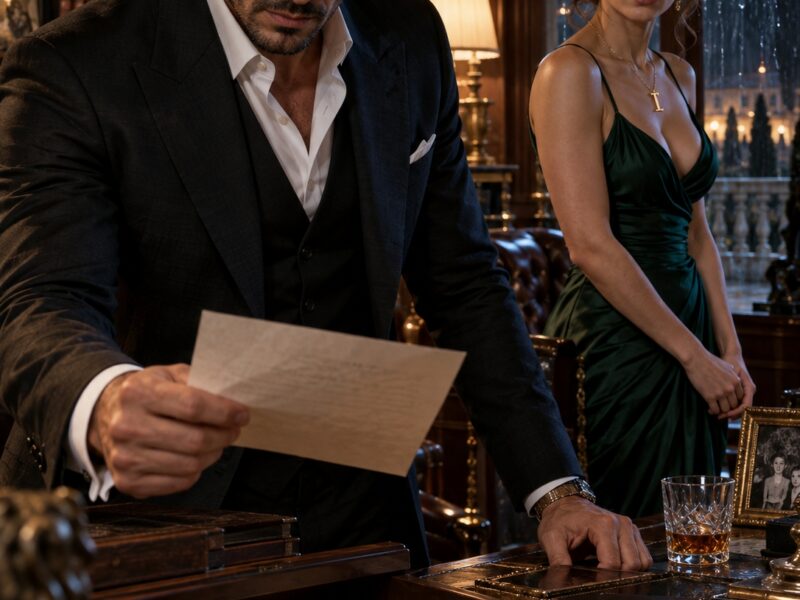
The Three-Year-Old Called His Fiancée a Thief—By Midnight, the Mafia Boss Knew Someone Inside His House Wanted His Throne

“Uncle Dante, your fiancée is a thief.”
The words came from a three-year-old girl.
That was the first reason Dante Moretti almost ignored them.
The second was that nobody in his house would have been stupid enough to steal from him.
For three full seconds, he did not move.
His fountain pen hovered above the shipping contract spread across the mahogany desk. A bead of black ink gathered at the nib, grew heavy, then fell directly across the signature line.
Dante watched it spread.
Behind him, November rain hammered the French windows of the third-floor study, turning the hills of northern New Jersey into a black mirror.
The room smelled of leather, old books, and dying firewood.
Above the cold fireplace hung an oil portrait of Dante’s father, Lorenzo Moretti, wearing the same expression Dante had learned to wear before he was old enough to shave.
Calm.
Unreadable.
Dangerous mostly because it never needed to look dangerous.
Dante slowly lowered the pen.
Then he turned.
Sophia Vasquez stood two steps inside the doorway.
She wore a pale blue dress and white tights stained green at one knee. One patent-leather shoe was scuffed. Her ribbon had come loose, leaving strands of dark hair across her forehead.
Under one arm she held a gray stuffed cat with one bent ear.
Mr. Whiskers.
She hugged it against her chest as if she had just announced something perfectly ordinary.
Dante studied her.
“What did you say, little miss?”
Before Sophia could answer, footsteps pounded in the hallway.
“Sophia?”
Elena Vasquez appeared in the doorway.
She was breathing hard. Flour dusted both forearms, and her kitchen apron had twisted sideways from running up two flights of stairs.
Her eyes found her daughter.
Then Dante.
Then the spreading black stain across his contract.
The color left Elena’s face.
“Mr. Moretti, sir, I’m sorry. The daycare closed early and I only turned my back for one minute. She knows she isn’t allowed upstairs. I swear she’s never—”
“Elena.”
His voice was quiet.
That made her stop faster than shouting would have.
She crossed the room, lifted Sophia into her arms, and pulled the child against her shoulder.
“Forgive us.”
Dante looked at Sophia over Elena’s shoulder.
“She’s three,” Elena whispered.
“I know how old she is.”
Something changed in Elena’s eyes.
Not relief.
Something closer to fear.
She carried Sophia out.
At the top of the stairs, Elena began whispering urgently in Spanish. Sophia twisted in her mother’s arms to look backward.
Her expression remained calm.
Curious.
Certain.
The gray stuffed cat dangled from one hand.
Then the door closed.
Dante sat alone.
Rain against glass.
Clock ticking.
Ink bleeding into paper.
Children said foolish things.
They confused dreams with memories. They repeated things overheard from television. They announced that the moon followed the car home.
He told himself that once.
Then twice.
His right hand moved toward the hidden brass release beneath his desk.
And stopped.
In the Moretti family, paranoia had buried men.
But ignoring small details had buried more.
So Dante pressed the release.
And the hidden drawer opened.
The Moretti estate had been built in 1928 by a steel magnate who lost his fortune in the crash.
Lorenzo Moretti bought it in 1973.
Three stories.
Eighteen rooms.
Slate roof.
Stone walls.
A rose garden behind the west wing.
Four guards rotating across the property, all trained to look like gardeners or drivers whenever outsiders approached.
From the road, it looked like old money.
From above, if you understood what you were looking at, it looked like a fortress.
Dante had lived there for forty-two years.
For the last ten, he had ruled from it.
When Lorenzo died at the dinner table with a wineglass still in his hand, Dante inherited more than the house.
He inherited five families held together by old loyalties, older grudges, money, fear, and the Moretti name.
He had been thirty-two.
Seven years later, his younger brother Marco walked out of a Little Italy restaurant and never made it to the corner.
Two shots.
Close range.
A stolen sedan.
The car was found burning in Queens before sunrise.
No one was ever charged.
Dante buried Marco on Tuesday.
On Wednesday, he signed a ceasefire with the Russo family because his father had taught him one rule above all others:
Never confuse grief with proof.
Dante had followed that rule ever since.
Which was why he did not accuse Isabella Costa that night.
He checked the drawer instead.
Inside, resting on dark green felt, lay the Moretti family seal.
Yellow bronze.
Four ounces.
A hawk clutching grapes, wings half spread.
A hair-thin scratch crossed the upper edge of the right wing, a mark generations of Morettis had deliberately refused to polish away.
Dante stared.
Nothing seemed missing.
But something was wrong.
The seal had rested on that felt for so many years that the bronze had left a faint rectangular impression.
Tonight it was sitting slightly outside that impression.
Not much.
Three millimeters, perhaps.
The hawk’s beak pointed farther left than it had that morning.
Dante opened the enamel box beside it.
A sable brush rested inside.
He examined the powder along the felt.
Someone had touched it.
Someone other than him.
He straightened.
For the first time since Sophia had spoken, the child’s words no longer sounded childish.
Dante crossed to the security panel.
The study camera showed black.
Six years earlier, he had ordered it disabled because even a man like him wanted one room in his house where nobody watched him.
Standing in the darkness now, he understood what privacy cost.
He remembered dinner the previous night.
Isabella wearing cream silk.
Her gold necklace resting against her throat.
“Darling, one moment.”
She had left the table.
Ten minutes later she returned with refreshed lipstick and perfume.
Ten minutes.
Dante looked back at the hidden drawer.
Ten minutes was enough.
And suddenly the woman sleeping down the hall from him became a stranger.
Isabella Costa had moved into the east wing eleven months earlier.
Thirty-one.
Boston-born.
Only daughter of Salvatore Costa, who controlled enough of the North End to make a Moretti-Costa marriage useful to everyone.
She was beautiful with almost mathematical precision.
Never late.
Never loud.
Never visibly afraid.
Dante had mistaken that control for strength.
Now, for the first time, he wondered if it had been rehearsal.
At two in the morning, he sat at the edge of his bed and watched the thin strip of light beneath Isabella’s door.
At 11:45, it disappeared.
He did not sleep.
Neither did Elena Vasquez.
Downstairs, in the staff quarters beside the kitchen, Elena lay beside Sophia and counted everything she could lose by morning.
Her job.
Her room.
Her reputation.
Possibly much more.
Sophia slept with Mr. Whiskers wedged beneath her chin.
Elena stared into darkness and wished her daughter had learned one adult skill earlier than she should have:
Sometimes the safest thing to say was nothing.
At seven, Elena made breakfast as usual.
Eggs.
Bread.
Grapefruit for Isabella.
Black coffee with two sugars for Dante, the same way Lorenzo had taken it.
At 8:20, Carlo Richi entered the kitchen.
Nineteen years with the family.
Marco’s closest friend.
Now head of security.
He passed Elena and briefly touched her shoulder.
“Boss wants you upstairs.”
The frying pan hissed.
Elena did not turn.
“Now?”
“When you’re free.”
They both knew she was free now.
Minutes later, she stood inside Dante’s study with her hands clasped so tightly her knuckles had whitened.
“Sit.”
“Sir, I’d rather stand.”
“Sit, Elena.”
She sat.
Dante’s coffee remained untouched.
“I’m not angry.”
Elena looked at him.
Men like Dante Moretti did not need anger to frighten people.
“I need to know what Sophia saw.”
“She’s only three.”
“That makes her young. It doesn’t make her blind.”
Elena swallowed.
“My quarrel is not with you. It is not with your daughter. Tell me the truth, and neither of you has anything to fear from me.”
The last two words mattered.
From me.
Elena heard the distinction.
“Last night she lost Mr. Whiskers,” Elena said. “She went looking for him. I thought she was in the laundry room.”
“But she came here.”
“Yes.”
“What did she see?”
“A woman.”
Dante waited.
Elena looked toward the window.
“A pretty woman. Gold necklace. Sophia said she was opening drawers.”
“Did she touch this desk?”
“Yes.”
“What else?”
Elena hesitated.
Dante saw it.
“Elena.”
“She said the woman looked angry when she couldn’t find what she wanted.”
Dante’s face did not change.
That frightened Elena more than surprise would have.
“Thank you.”
“That’s all?”
“That’s all I need from you.”
Elena stood.
“Keep Sophia with you today.”
Her fingers tightened around the chair.
“Why?”
“Because I’m asking you to.”
“Is she in danger?”
Dante looked directly at her.
“I don’t know yet.”
It was the most frightening answer he could have given.
Then he added, “Say nothing to anyone. Not the staff. Not Isabella.”
A pause.
“Especially not Victor.”
Elena’s eyes flickered.
Victor Serno had served three generations of Morettis.
He had been in this house longer than Elena had been alive.
“Why Victor?”
Dante leaned back.
“I didn’t say there was a reason.”
Elena understood that the conversation was over.
She left.
In the stairwell, she pressed her forehead against the cold plaster.
For four years she had believed the dangerous people in the Moretti house were easy to identify.
That morning she realized something worse.
The dangerous person might be the one everyone trusted.
Twenty minutes later, Dante entered the kitchen.
He had removed his jacket.
Sophia sat on the long oak worktable arranging raisins into a smiling face on buttered toast.
Mr. Whiskers leaned against the pepper mill.
Dante pulled over a wooden stool.
“Good morning.”
Sophia offered him a raisin.
He accepted it.
“May I ask you something?”
“Yes.”
“The woman you saw upstairs. What did she do?”
Sophia frowned in concentration.
“She opened the drawer with the bird.”
Dante’s breathing slowed.
“The bird?”
“The sharp bird.”
“The hawk?”
“Mama says it’s a hawk.”
Elena’s back remained toward them at the stove.
The butter stopped sizzling.
Sophia continued.
“She took the bird thing out and put it on paper. Then she put it back.”
“Did she say anything?”
“A bad word.”
“What bad word?”
“The one Mama says when eggs fall.”
Elena closed her eyes.
Dante almost smiled.
Almost.
Instead he asked, “Did the lady have something around her neck?”
Sophia nodded.
“A necklace?”
Another nod.
“Anything on it?”
Sophia touched the hollow of her throat.
“A letter.”
“What letter?”
“I.”
The kitchen became silent.
Isabella.
Dante did not need the child to say the name.
Sophia watched his face.
Then she picked up Mr. Whiskers and held him toward Dante.
“He makes me brave.”
Dante stared at the worn gray cat.
“He does?”
“Yes.”
She pushed it closer.
“He can make you brave, too.”
For reasons Dante could not explain, that nearly undid him more than the accusation had.
He accepted the toy.
“Thank you, little miss.”
He slipped Mr. Whiskers into his vest pocket.
The stuffed cat rested directly over his heart.
Elena finally turned from the stove.
Dante met her eyes.
“Rosemary with the lamb tonight.”
She understood.
The conversation was finished.
“Yes, sir.”
Dante walked upstairs carrying a three-year-old’s stuffed cat like a saint’s medal.
And by four that afternoon, he had decided to set a trap for the woman he was supposed to marry.
Carlo listened without interrupting.
The shifted seal.
The necklace.
The hidden drawer.
Sophia’s description.
When Dante finished, Carlo leaned forward.
“Isabella.”
It was not a question.
“If I confront her,” Dante said, “I get Isabella.”
“And you think there’s someone behind her.”
“If she wanted the seal, she would have stolen it.”
“She copied it.”
“Yes.”
Carlo’s expression hardened.
“To forge it.”
Dante nodded.
“And I want to know why.”
They sat in silence.
Finally Dante said, “Jeppe Falcone.”
Carlo raised an eyebrow.
“He’s still working?”
“He cut the original dies for my grandfather. He can make me a twin.”
“A fake seal?”
“Perfect enough to fool the person who already photographed the real one.”
Carlo understood.
“You leave the fake here.”
“The original goes to the lakehouse.”
“And when she comes back?”
“We watch.”
That night, Dante sat across from Isabella at dinner.
She wore a dark green dress.
Pearl earrings.
At her throat hung the gold letter I.
Dante looked at it once.
Then smiled.
Isabella smiled back.
“Darling, you seem unusually cheerful.”
“I feel unusually cheerful.”
He lifted the salt cellar.
“Would you like some?”
She laughed.
Dante watched her laugh and wondered how many versions of that sound she had practiced before she moved into his home.
Two nights later, the trap closed its first finger.
At 11:32 p.m., Isabella entered the study.
Dante watched from a tablet in the basement gym.
She wore a black silk robe.
No slippers.
Gloves.
She crossed directly to the desk.
No searching.
No hesitation.
She knew exactly where the release was.
Dante stopped breathing for a moment.
He had never shown her.
She pressed the stud.
The hidden drawer opened.
Isabella lifted the false seal.
Photographed it.
Measured the wingspan.
Measured the base.
Pressed it into softened red sealing wax.
Then she raised a phone to her ear.
The hidden microphone carried every whisper downstairs.
“I have it.”
Dante stood motionless beside the heavy bag.
“The pattern. The dimensions.”
A pause.
Then Isabella said:
“Tell him we move Friday.”
Him.
Not my father.
Not Salvatore.
Him.
Dante watched her restore the seal to the felt.
She even replaced it three millimeters left of center.
Exactly where she had left the original.
She was careful.
But careful people made one dangerous mistake.
They believed nobody else noticed details.
When the study door closed behind her, Dante removed one boxing glove.
He touched the frozen image on the tablet.
“Who is he, Isabella?”
He was no longer investigating whether his fiancée had betrayed him.
He was investigating who had taught her how.
The answer began to emerge in pieces.
Burner phones.
Missing mileage on Isabella’s Tuesday yoga trips.
Unexplained stops after her Friday spa appointments.
A surveillance team with no ties to the Moretti organization followed her.
Dante did nothing visible.
Instead, he bought Isabella a diamond necklace for their first anniversary.
Nineteen stones in white gold.
She opened the box at dinner.
Her mouth formed surprise.
Her eyes formed gratitude.
She stood and kissed his cheek.
“You spoil me.”
“You deserve it.”
Later, alone in the bathroom, Dante scrubbed the place her lips had touched until his skin turned red.
Then he went downstairs and hit the heavy bag.
Three punches.
Four.
Five.
“Why do you look sad, Uncle Dante?”
He froze.
Sophia stood in the gym doorway wearing a pink robe.
One slipper.
One bare foot.
Mr. Whiskers in her hand.
Dante lowered his fists.
“Does your mother know you’re here?”
“No.”
“I suspected as much.”
She looked at him.
“Are you sad because of the pretty lady?”
Dante’s jaw tightened.
“Children ask too many questions.”
“Mama says questions are how you learn.”
“Your mother is becoming inconveniently wise.”
Sophia smiled.
Dante crouched and tied her loose shoe.
He did not answer the question.
He did not need to.
Days later, he found Sophia in his mother’s rose garden pulling lavender from the soil.
“I’m helping,” she announced.
“I see that.”
He knelt beside her.
“This is lavender.”
She stared at the uprooted plants.
“Is that bad?”
“Matteas planted them.”
“How do I know what I can pull?”
Dante showed her the rose canes.
“These have thorns.”
“Why?”
“To protect themselves.”
“From what?”
“People who want to take them.”
Sophia considered that.
Then she said, “But if somebody takes the flower anyway, the thorns hurt the flower too.”
Dante became still.
For ten years, he had made himself into a wall of thorns.
Nobody came close enough to hurt him.
Nobody came close enough to love him either.
A three-year-old had reduced his entire philosophy of survival to one sentence.
“Yes,” he said softly.
“They do.”
Sophia walked to the yellow rosebush near the sundial.
It was the bush Dante’s mother had planted when Marco was born.
One late bloom remained.
Nobody had cut a flower from that bush in sixteen years.
Sophia reached up.
Snap.
Dante opened his mouth.
Too late.
She brought him the rose.
“For your sad face.”
He looked at the flower in her hand.
Then at Sophia.
Then toward the kitchen doorway, where Elena stood watching.
Elena gave the smallest nod.
Dante accepted the rose.
That night, he placed it beside Marco’s photograph.
By morning, it had opened.
And that was the morning Victor Serno made his first mistake.
Victor entered the study at four carrying the quarterly reports.
Sixty-eight.
Tall.
White hair.
Gray flannel.
He had served Dante’s grandfather, father, and now Dante.
He had taught Dante to shoot.
To read a balance sheet.
To read a liar’s hands.
At sixteen, Victor had told him:
“A traitor always leaves one tell. Your job is knowing which tell belongs to which man.”
They reviewed shipping.
Construction.
Legal expenses.
Then Victor removed his glasses.
“A woman and child in the house too often changes a man.”
Dante looked up.
“Does it?”
“The capos notice.”
“What exactly do they notice?”
“Men who smile at breakfast are not thought of the same way as men who don’t.”
Dante’s expression remained neutral.
Victor smiled faintly.
“Only an old man observing.”
They finished the meeting.
Victor rose.
Crossed the carpet.
Then paused.
Barely.
His eyes dropped toward the right pedestal of Dante’s desk.
Toward the hidden drawer.
One second.
Perhaps less.
But Dante had been trained to notice such things.
Trained by Victor.
After the door closed, Dante remained completely still.
His father’s voice returned from twenty-three years earlier.
Only you.
No one else.
Not even Victor.
Dante lifted the phone.
“Carlo.”
“Boss?”
“Change of plans.”
A pause.
“Take the surveillance off Isabella.”
“Off?”
“Redirect it.”
“To who?”
Dante looked at the closed door.
“Victor.”
Forty-eight hours later, Dante announced at dinner that he was leaving for Chicago.
Three nights.
Isabella’s shoulders relaxed by half an inch.
Victor offered to accompany him.
Dante refused.
“I need you here.”
Victor nodded.
“If you’re certain.”
“I am. You’re the man I trust most.”
Dante smiled as he said it.
The old man smiled back.
Neither believed the sentence anymore.
Friday morning, Dante’s jet left Teterboro.
Two hours later, after an elaborate return designed to make everyone believe he remained hundreds of miles away, Dante was inside a thirty-eighth-floor apartment with long-range optics trained on his own estate.
That night, a black Audi arrived.
Isabella greeted a woman in a camel coat.
Surveillance identified her.
Diana Costanza.
Victor Serno’s personal assistant.
The betrayal narrowed.
Then, at two the following morning, it finally acquired a voice.
Victor entered the rose garden.
Isabella followed.
Dante placed headphones over his ears.
Across the distance, beneath the sundial where Sophia had given him the yellow rose, Victor asked:
“Did you get the dimensions?”
“Yes.”
“Exact?”
“Yes.”
Isabella gave him the measurements.
Victor nodded.
“He can replicate it in four days.”
Dante’s hand tightened around the scope.
Then Victor explained everything.
Once they possessed a working duplicate of the Moretti seal, forged orders would go to the Russo and Lombardi families.
First small provocations.
A hijacked truck.
A burned garage.
Then something larger.
Each family would believe Dante had ordered attacks against the other.
War would follow.
The commission would blame Dante.
They would declare him incapable of controlling the families.
Victor would become acting head.
Six months temporary.
Then permanent.
Dante listened without moving.
Then Isabella asked:
“And me?”
Something about her voice changed.
For the first time, she did not sound like a conspirator.
She sounded like property.
Victor answered without warmth.
“You marry whoever I tell you to marry next.”
Silence.
“The Lombardi boy, probably.”
“You promised—”
“You agreed to this when your father put you in my car in Boston.”
Another silence.
Then Victor said something Dante never forgot.
“Do not develop feelings now. It is unbecoming.”
Dante closed his eyes.
So Isabella had betrayed him.
But Isabella had also been used.
Both things could be true.
The world became more dangerous when truth refused to stay simple.
He had enough evidence to destroy Victor that morning.
He did not.
Victor had taught him patience.
Dante would repay the lesson.
He needed the forged seal in Victor’s hands.
He needed witnesses.
He needed a betrayal so complete that no man could later turn it into rumor.
Carlo entered the apartment before dawn carrying coffee.
For several minutes, neither man spoke.
Finally Carlo said, “You don’t have to carry this alone.”
Dante stared at the untouched whiskey bottle on the table.
“My brother died because I trusted too easily.”
Carlo said nothing.
“Now I find out I can’t trust the man who taught me not to trust.”
“Then trust the people who already proved themselves.”
“Who?”
“Me.”
Dante waited.
“Elena.”
Another pause.
“Sophia.”
Dante looked toward his jacket.
Inside it rested Mr. Whiskers.
A gray stuffed cat.
One bent ear.
Resewn belly.
Button eyes.
He placed the toy beside the whiskey.
Then he said, “Nobody touches the child.”
“Nobody will.”
“Not Victor. Not Isabella. Not anyone they paid. Not today. Not ten years from now when some debt remembers her name.”
Carlo nodded.
“I understand.”
“We move the schedule up.”
The next danger came before Dante was ready.
Sophia followed a yellow butterfly into the rose garden.
Behind a trellis, she heard Isabella speaking on the phone.
“The brat has been in his office twice.”
Sophia stopped.
“She draws him pictures,” Isabella continued. “He laughs at them.”
Victor’s voice answered through the phone.
“What is your point?”
“He’s attached to her.”
A pause.
“If she sees anything else, we handle it.”
“How?”
Silence.
Then Isabella answered:
“The pond is deep. Children fall.”
Sophia did not understand conspiracy.
She did not understand power.
She understood pond.
She understood fall.
She wet herself where she stood.
But she did not scream.
Elena found her trembling behind the trellis.
“What happened?”
Sophia clung to her neck.
“The lady with the I.”
“What about her?”
“She wants me to fall in the water.”
Within minutes, Dante heard the words over the phone.
Something opened inside him that had remained locked since Marco’s death.
Fear.
Not for himself.
For someone else.
“Elena.”
“Yes?”
“Pack one bag.”
Her breath caught.
“For both of you.”
“Where are we going?”
“Somewhere they cannot reach her.”
That night, Dante returned secretly to the estate.
Elena and Sophia waited inside the detached garage beside a dark SUV.
Elena looked at him.
“I’m scared.”
“I know.”
“If something happens to her—”
“It won’t.”
“You can’t promise that.”
Dante stared at her.
“No. I can’t promise the world.”
He looked at Sophia.
“But I can promise what I’ll do.”
Elena’s eyes filled.
Dante lowered his voice.
“I failed to protect my brother. I will not fail her.”
Sophia crossed the garage in pink pajamas, yellow boots, and a winter coat.
She wrapped both arms around Dante’s leg.
He knelt.
“You’re not coming?”
“I have work to finish.”
“Then you come later?”
“Yes.”
“Promise?”
“Yes.”
“Pinky promise.”
Dante Moretti had made promises on contracts.
On graves.
On blood.
Never on a finger.
He held out his hand.
Sophia wrapped her tiny pinky around his.
“Pinky promise.”
Then she handed him Mr. Whiskers.
“He stays with you.”
“I thought he was going with you.”
“He makes you brave.”
Dante looked at the stuffed cat.
“He’s done a great deal of that lately.”
The SUV disappeared into the night.
Dante stood alone beneath the garage bulb.
Then he slipped Mr. Whiskers into his jacket.
At midnight, he walked into the library as though he had just returned from Chicago.
Isabella smiled.
“You’re back early.”
“The meeting ended.”
“How wonderful.”
“Elena had a family emergency. Carlo drove her and Sophia away.”
For half a second, Isabella’s face relaxed.
Just half a second.
But Dante saw it.
The same relief she had shown when he announced Chicago.
“Poor Elena,” she said. “I hope everything is all right.”
“So do I.”
Dante raised his whiskey without drinking.
And inside himself, he thought:
Now I know exactly what you are willing to let happen.
Monday morning, he called Victor into the study.
“I’m moving the western routes to Enzo Lombardi.”
Victor’s eyebrows rose.
“That is substantial.”
“I want the transfer public. Signed and sealed Friday morning.”
Victor thought.
Or pretended to.
“Then Thursday night, place the document and seal together in the safe. No last-minute confusion.”
Dante nodded.
“Sensible.”
Victor smiled.
“I’m only an old man organizing an old man’s house.”
By Thursday night, four capos sat secretly inside a windowless room behind the library.
Pietro Russo.
Enzo Lombardi.
Little Dom Ferrara.
Sal Marchetti.
On the television before them appeared the infrared image of Dante’s study safe.
A folder.
A seal.
Waiting.
Dante stood behind them.
Pietro looked up.
“What are we watching?”
“The inside of my safe.”
“Why?”
“Because before this night ends, two people will open it and replace what you see with forgeries.”
Enzo frowned.
“Who?”
“One is my fiancée.”
Silence.
“And the other?”
Dante looked at the screen.
“Watch.”
At 1:01 a.m., the study door opened.
Isabella entered.
Victor followed.
No one in the sitting room spoke.
Victor approached the safe.
Turned the combination.
Opened it.
Isabella removed the seal.
Victor removed the folder.
Then they produced replacements.
Little Dom closed his eyes.
Victor Serno had stood at his baptism.
Pietro leaned forward.
Enzo stopped breathing.
Dante watched until there could be no misunderstanding.
Then he said:
“Now.”
At 1:11, Dante opened the study door.
Carlo entered behind him.
The four capos followed.
Isabella dropped the seal.
It struck the desk and rolled toward the lamp.
Victor slowly placed both hands on the mahogany.
“Dante.”
Dante almost smiled.
“Victor.”
“We can explain.”
“Please do.”
Victor glanced toward the four men behind Dante.
He understood immediately.
But even then, the old teacher tried to teach.
“The family has drifted.”
Dante said nothing.
“Your father would never have allowed a cook’s child to sit in this room.”
Something changed in Dante’s eyes.
Victor continued.
“The capos see you laughing. They see softness. A boss cannot become sentimental.”
Dante stepped closer.
“So this was for me?”
“For the family.”
“You forged my seal for the family.”
“I was restoring order.”
“You planned to start a war.”
“A controlled conflict.”
“You planned to remove me.”
“A transition.”
Victor’s voice grew almost pleading.
“Your father would understand.”
That sentence killed whatever remained between them.
Dante walked around the desk.
“My father once told me betrayal from inside hurts worst because we are the ones who opened the door.”
Victor’s jaw tightened.
“The seal Isabella is holding was made for me.”
Silence.
“The document you removed is a draft.”
Victor stared at him.
“The real seal has been at the lakehouse for nine days.”
Isabella’s breathing broke.
“And everything you did tonight was watched by four men whose word you cannot erase.”
Victor closed his eyes.
Very briefly.
Then opened them.
Dante looked at him.
“The man who taught me how to recognize betrayal forgot one thing.”
“What?”
“The student was listening.”
Isabella collapsed to her knees.
“Dante, please.”
He looked down at her.
“I was forced.”
“Were you?”
“He threatened my father. My sister. He said he would kill her.”
Dante’s expression remained unreadable.
“I had no choice.”
Dante thought about Marco.
About excuses whispered too late.
About how often frightened people called a terrible choice no choice at all.
He also remembered Isabella in the rose garden asking Victor what would happen to her.
Both truths remained.
She had been used.
And Sophia had still heard her say the pond was deep.
Pietro stepped forward.
“The ruling?”
Dante shook his head.
“Not mine.”
Pietro frowned.
“You’re the head.”
“And I’m the injured man. I won’t pretend those are the same chair tonight.”
He looked at all four capos.
“You decide.”
They had already decided.
Pietro faced Victor.
“You served three generations.”
Victor straightened.
“For that reason, there will be no bullet.”
Something almost like relief crossed Victor’s face.
It vanished when Pietro continued.
“You leave tomorrow for Palermo. From there, you go to your mother’s village. You remain there under supervision for the rest of your life.”
Victor’s face became stone.
“No calls. No letters. No New York. No Boston. No Philadelphia. No Chicago.”
Pietro stepped closer.
“You wanted Dante’s chair.”
His voice lowered.
“Now you will spend what remains of your life sitting somewhere nobody important can hear your name.”
Victor nodded once.
Then Pietro turned toward Isabella.
Dante spoke first.
“No.”
Everyone looked at him.
“I won’t kill a woman at my table.”
Isabella began crying.
“You have seventy-two hours to leave the United States.”
She stared at him.
“Anywhere except Italy.”
“Dante—”
“Do not say my name.”
Her mouth closed.
“If you are still on this continent at one Monday morning, you will join Victor.”
She nodded.
Carlo helped her stand.
Within minutes, the room emptied.
Dante remained behind.
The hidden drawer stood open.
The felt inside was bare.
The real Moretti seal rested inside his trouser pocket.
For generations, men had treated that piece of bronze as though it carried the family’s power.
Dante finally understood something.
It had never been the seal.
The seal had nearly destroyed them.
A three-year-old had saved them.
Saturday morning, Dante drove north.
On the passenger seat sat a bakery box tied with red string.
Twelve fresh cannoli.
Beside it sat Mr. Whiskers.
The gray cat’s bent ear caught the morning sunlight.
At 9:15, Dante reached the cedar cabin above the lake.
Sophia was near the water throwing stones.
The sedan stopped.
She turned.
Saw him.
Dropped the stone in her hand.
And ran.
Dante barely had time to kneel.
She hit him at full speed.
He caught her.
Sophia buried her face against his neck.
Dante held her without speaking.
From the cabin porch, Elena watched with a kitchen towel pressed against her mouth.
“Little miss,” Dante finally whispered.
“You came.”
“I promised.”
“With pinky.”
“With pinky.”
He opened his coat.
Mr. Whiskers appeared.
Sophia gasped.
“He has been very brave,” Dante said. “But I believe he wants to come home.”
She took the cat and squeezed him.
Then her expression became serious.
“Are the bad guys gone?”
Dante looked toward the lake.
“The ones that mattered.”
“All of them?”
“The ones that mattered,” he repeated.
Sophia accepted this.
“Good.”
Elena made lunch.
Frittata.
Fresh bread.
The last basil of the season.
Carlo ate outside to give them privacy.
When the plates were almost empty, Dante put down his fork.
“Elena.”
“Yes, boss?”
“Not boss.”
She looked up.
“I’d like you and Sophia to come home.”
Her face closed slightly.
“As staff?”
“No.”
“Then as what?”
Dante looked at Sophia, who was drawing something blue on a napkin.
“Family.”
Elena stared at him.
“Sophia gets her own room. Second floor. Facing the roses.”
“Dante—”
“You get your own salary. Your own car. Whatever schooling she needs when she’s older. A life that belongs to you, not to the house.”
Elena looked down.
“We are not like you.”
“No.”
The answer surprised her.
Dante continued.
“And perhaps that is why I need you there.”
He nodded toward Sophia.
“She saw what trained men missed.”
Sophia looked up.
“I see lots of things.”
Dante smiled.
“Yes. That is becoming a problem.”
She returned to her drawing.
Dante looked back at Elena.
“She saved my family.”
Elena was silent for a long time.
Then she placed both palms on the table.
“One condition.”
“Name it.”
“No guns inside the house where my daughter lives.”
Carlo, outside on the porch, stopped chewing.
Dante Moretti had spent his life around armed men.
His father had taught him to shoot before Victor taught him algebra.
Weapons had lived in drawers, jackets, glove compartments, bedside tables.
Dante looked at Elena.
Then at Sophia.
“Agreed.”
Spring came late.
Then it came all at once.
By May, every rosebush behind the west wing had produced buds.
The climbers.
The hybrids.
The old damasks.
And the yellow bush Dante’s mother had planted when Marco was born.
Matteas walked through the garden one morning, crossed himself, and told Elena the roses must have been waiting for a reason.
Sophia now slept in a second-floor bedroom overlooking them.
She chose butterflies for the walls.
Yellow ones.
Blue ones.
One red butterfly on the ceiling because, according to Sophia, red butterflies protected sleeping people.
Mr. Whiskers guarded the center of her pillow.
Elena remained head cook because she chose to.
Dante offered her a bakery.
A café.
Culinary school.
She thought for one day.
Then said:
“My kitchen is here.”
Her salary quadrupled.
She received her own car.
And nobody in the house called her “the cook” again.
They called her Elena.
Carlo became consigliere on December first.
He still carried his pistol outside the estate.
At the gate, he locked it away before entering.
A promise made at a pine table in the Catskills was still a promise.
Dante did not marry.
He did not replace Isabella.
Over the winter, he learned that not every relationship required a name.
Some people simply changed the shape of a house by being inside it.
Late one Sunday afternoon in May, Dante sat on the teak bench beside the sundial.
The garden smelled of roses warmed by sunlight.
Sophia had spent an hour chasing a pale yellow butterfly.
Eventually she climbed into Dante’s lap.
Minutes later, she fell asleep.
Her cheek rested against his hand.
One fist remained loosely closed around a yellow rose.
Elena came down the path carrying lemonade.
She placed the glass beside him.
Neither spoke.
She touched Sophia’s hair.
Then walked back toward the kitchen.
Dante watched her go.
Then he looked down at the sleeping child.
Forty-two years.
That was how long he had spent building walls.
Money.
Men.
Stone.
Locks.
Weapons.
A name people were afraid to say carelessly.
He had believed those things kept him safe.
In the end, none of them had discovered the conspiracy inside his own home.
None had noticed Isabella opening the drawer.
None had seen Victor’s betrayal soon enough.
The person who had seen it was three years old.
A little girl with a stained knee.
A crooked ribbon.
And a stuffed cat with one bent ear.
She had walked into his study on a rainy night and spoken six words she barely understood.
Uncle Dante, your fiancée is a thief.
The adults had possessed guns, cameras, money, alliances, guards, codes, and decades of experience.
Sophia had possessed only innocence.
Maybe that was why nobody had thought to defend against her.
Conspirators watched powerful men.
They watched locked doors.
They watched weapons.
They watched bank accounts and telephones and black cars moving through gates.
They did not watch the child sitting on the kitchen counter making a face out of raisins.
They did not watch the little girl wandering upstairs because she had lost her stuffed cat.
They did not imagine that the smallest person in the house might notice the thing every important person had missed.
Sophia shifted in Dante’s lap.
Her fingers loosened.
The yellow rose nearly fell.
Dante caught it before it touched the gravel.
For a moment, he stared at the petals.
Once, he had believed thorns were what kept a flower alive.
Sophia had taught him differently.
Sometimes thorns only made the flower bleed along with the hand trying to take it.
So Dante did something the man he had been a year earlier would never have done.
He stopped looking toward the gates.
Stopped counting footsteps.
Stopped listening for engines.
He leaned back against the bench.
Sophia slept against him.
Somewhere behind them, Elena was opening a kitchen window.
Carlo was arguing with Matteas about where to park a delivery truck.
A screen door slammed.
Someone laughed.
The sound drifted across the roses.
And for once, Dante Moretti did not wonder whether the laughter made him look weak.
He looked down at Sophia.
At the yellow flower in her sleeping hand.
At Mr. Whiskers waiting upstairs on a lemon-colored quilt.
Then he looked across the garden his mother had planted and his grief had almost turned into a cemetery.
Every bush was blooming.
For the first time in sixteen years, not one of them had failed.
Dante rested his hand lightly against Sophia’s back.
He had once inherited a house full of secrets.
Somehow, without intending to, he had turned it into a home.
And in a home built by men who had spent generations teaching one another never to trust anyone, the deepest truth had arrived in the smallest voice.
Sometimes the person who saves you is not the strongest person in the room.
Sometimes she is the one nobody thought was listening.









