The Town Called Her Too Wild to Be a Wife—Then the River Took Their Children
By the time Marin Doyle arrived in Pilot Butte to marry a man she had never met, half the town had already decided she was a mistake.
It took her less than thirty seconds to prove them right.
The stagecoach had barely stopped when one of the team horses panicked.
A leather trace had twisted beneath the animal’s flank. The gelding kicked sideways, nearly knocking the driver from his box, then reared hard enough to send a woman in the crowd screaming backward.
“Hold him!”
“Get clear!”
“Somebody grab that horse!”
Men rushed forward.
Marin moved faster.
Before the coach wheels had stopped turning, she swung herself down from the step.
Not delicately.
Not with the careful ankle-first descent expected of a bride arriving to meet her future husband.
She jumped.
Her boots struck Wyoming dust.
A collective gasp followed.
That was when everyone noticed the trousers.
Men’s trousers.
Brown, worn at the knees, tucked into scarred riding boots beneath a long traveling coat.
Marin didn’t notice the horrified faces.
She was already at the horse.
“Easy.”
The gelding jerked his head.
A man reached for the bridle.
“Don’t,” Marin snapped.
He froze.
She approached from the shoulder instead, one hand low, her voice changing instantly from command to something quiet enough that the nearest people had to lean forward to hear.
“Easy, boy. I see it.”
The horse’s nostrils flared.
“I know. Hurts, doesn’t it?”
Another kick.
Marin stepped inside its arc as naturally as another woman might cross a parlor.
Someone shouted for her to move.
She ignored him.
“There you go.”
Her fingers found the twisted leather.
“That’s it. Nobody’s going to hurt you.”
The gelding shuddered.
Marin loosened the trace, pulled the strap free, then laid her palm against the animal’s trembling neck.
Within moments, the horse stood quietly.
The driver was still climbing down.
Silence spread through the crowd.
Marin pushed her hat back.
Dust streaked one cheek. A strand of dark hair had escaped its pins. Her coat hung open enough to make the trousers impossible to misunderstand.
She looked around.
“What?”
Someone whispered behind a gloved hand.
“That’s the bride?”
Another voice answered.
“Good Lord.”
A third was less charitable.
“That is no proper bride.”
Marin heard it.
Of course she did.
She had been hearing variations of that sentence since she was old enough to understand words.
Too loud.
Too rough.
Too capable.
Too opinionated.
Too comfortable around men.
Too comfortable alone.
Too good with horses.
Too unwilling to pretend she wasn’t.
Too much.
Always too much.
Her grin disappeared.
For one foolish moment on the long journey west, she had allowed herself to imagine this arrival differently.
Perhaps Idris Vaughn would be waiting alone.
Perhaps he would smile.
Perhaps the man whose letters had been so unlike every other man she had known would look at her and see exactly what she had told him she was.
But Pilot Butte had apparently turned out to inspect the merchandise.
And somewhere among them stood the man who had ordered himself a bride through a matrimonial agency.
Marin straightened.
She had survived worse things than public humiliation.
She could survive one more rejection.
Then a man stepped through the crowd.
He was taller than she had imagined.
Not handsome in the polished way of men in catalog illustrations. His face had been worked on by weather, silence, and years spent squinting into Wyoming sun. His coat was plain. His boots needed polishing. A few threads of gray showed at his temples.
But his eyes were steady.
That mattered to Marin.
Steady eyes usually belonged to steady men.
Usually.
He stopped in front of her.
“Miss Doyle?”
Her throat tightened.
“Mr. Vaughn?”
“Yes.”
There it was.
The moment.
Marin knew it well.
The pause before embarrassment.
The glance at the trousers.
The recalculation.
The polite search for words that meant I didn’t realize you were actually like that.
She decided to save him the trouble.
“I expect I’m not what the town was hoping for.”
A few people laughed nervously.
Idris glanced at them.
Then back at her.
“I’ve never had much use for what this town hopes for.”
Marin blinked.
His gaze moved toward the horse she had just calmed.
“You did that?”
“The trace was twisted.”
“I saw.”
“It wasn’t difficult.”
“The three men standing there seemed to think otherwise.”
One of the men cleared his throat.
Idris almost smiled.
Then he looked directly at Marin.
“You’re exactly what I was hoping for, Miss Doyle.”
She stared at him.
He bent, picked up her battered saddlebag, and walked toward his wagon.
After several steps, he realized she had not followed.
He turned.
“Coming?”
Marin looked at the wagon.
Then at the town.
Then at him.
“You’re not embarrassed?”
“About what?”
She gestured down at herself.
Idris considered her trousers with exaggerated seriousness.
“Are they stolen?”
“No.”
“Then I expect we can survive them.”
A laugh escaped her before she could stop it.
And that was the first dangerous thing Idris Vaughn gave Marin Doyle.
Not a home.
Not yet.
Hope.
Because hope was far more frightening to a woman who had learned to live without it.
She climbed onto the wagon beside him.
Behind them, Pilot Butte began talking.
It would not stop for months.
But as the town disappeared behind the rolling land and the Wind River country opened ahead of them, Marin felt something she had not felt since her father died.
Not safety.
She did not trust safety yet.
Something smaller.
The possibility that she might have arrived somewhere she would not immediately be asked to leave.
She had no idea how hard the town would work to prove her wrong.
Idris Vaughn had been disappointing Pilot Butte for most of his adult life.
He did not attend enough socials.
He did not court the correct women.
He read books when other ranchers drank.
He listened more than he spoke, which made people suspicious because quiet men gave gossip too little material to work with.
His ranch was respectable but small.
His cattle were sound but not numerous.
His house was sturdy but plain.
And after years of being introduced to suitable daughters, widows, cousins, and visiting nieces without showing sufficient enthusiasm for any of them, Pilot Butte had quietly concluded that something about Idris Vaughn was peculiar.
Idris had concluded much the same about Pilot Butte.
So he stopped caring.
Mostly.
Then came a winter when snow buried the fences and darkness settled over the ranch before supper.
His foreman, Ballard, had gone home.
The hands slept in the bunkhouse.
Idris sat alone at his kitchen table with a book open before him and realized he had read the same paragraph six times because the silence in the house had become louder than the words.
A matrimonial agency advertisement lay folded inside the newspaper.
He laughed when he first saw it.
Then he read it again.
Three nights later, he wrote.
He refused to advertise himself as anything he was not.
I am not a rich man.
He nearly stopped there.
Instead, he continued.
My ranch is small and my ways are quiet. I am unlikely to become important. I prefer honesty to charm and work to appearances. I cannot promise luxury. I can promise that any woman who comes here will be treated as a partner rather than hired help.
He posted it before he could reconsider.
The replies began weeks later.
Some praised his character.
Some inquired delicately about acreage.
Several asked whether expansion might be expected.
One asked how many servants he employed.
Then he opened Marin Doyle’s letter.
Mr. Vaughn,
I should tell you immediately that I am probably not the sort of woman you meant to ask for.
Idris smiled.
He kept reading.
I am not a lady, and I cannot pretend to be one convincingly.
His smile widened.
My father traded horses. I grew up with him. I can break a colt, mend fence, rope stock, shoot a snake, sleep outdoors, and tell a lame horse before most men have finished admiring its color.
Idris laughed aloud.
Ballard looked up from across the room.
“What?”
“Nothing.”
“Doesn’t sound like nothing.”
Idris continued reading.
I cannot embroider. I dislike calling cards. I have never sat sidesaddle in my life and do not intend to begin unless threatened at gunpoint.
Idris laughed harder.
Ballard frowned.
“You drinking?”
“No.”
“Woman, then?”
Idris ignored him.
The letter ended simply.
If you want a proper wife, write to someone else.
If you want a partner who works hard and tells the truth even when it costs her, you may write back.
Marin Doyle.
Idris read it twice.
Then a third time.
Finally he took out paper.
Miss Doyle,
I would not change one word.
Write again.
She did.
For months, two people whom the world had independently judged unsuitable began recognizing each other across four hundred miles of paper.
Marin told him about horses.
Idris told her about the ranch.
She told him she hated church socials.
He confessed that church socials appeared to hate him equally.
She warned him that she was stubborn.
He wrote back that he owned cattle and was familiar with the condition.
She told him she had a temper.
He asked whether it was justified.
She wrote:
Usually.
He answered:
Then I see no difficulty.
That was when she began frightening herself.
Because Idris did not seem to want the improved version of her.
He seemed to want the version she had spent twenty-four years being told was unacceptable.
And Marin had no experience trusting such a thing.
Her mother had died before Marin could remember her.
Her father, Patrick Doyle, had never figured out what to do with a daughter except love her the way he understood love.
So he took her with him.
She grew up in camps, corrals, trading yards, and mountain passes.
Men who could barely write their own names taught her how to judge tendon injuries, tie knots in darkness, find water by watching cattle, and sleep through thunderstorms.
Her father taught her horses.
“A horse tells you before he does anything,” he said when she was eight. “Most folks just don’t listen.”
“With their ears?”
“With their hands.”
She frowned.
Patrick laughed.
“You’ll understand.”
By twelve, she did.
By fifteen, Marin could ride horses grown men refused.
By seventeen, she could look at a nervous animal from thirty feet away and tell which direction it would bolt.
Her father bragged about her shamelessly.
“Best hand in the outfit.”
Then one morning when Marin was nineteen, Patrick Doyle climbed onto a green colt.
By sunset, Marin was kneeling beside his body.
The world changed immediately.
The same men who had treated her like a younger brother became careful around her.
A grown woman traveling among horse traders without father, brother, or husband created questions no one wanted to answer.
Respectable women did not want her.
Respectable men wanted the wrong things.
For five years, Marin drifted.
She worked ranches until wives complained.
She trained horses until owners decided her presence created gossip.
She wore dresses when necessary and hated every minute.
She learned that skill could earn admiration without earning belonging.
Eventually, she found Idris Vaughn’s advertisement.
She wrote him the truth because she expected the truth to frighten him away.
Better rejection by mail than rejection face-to-face.
But Idris kept writing.
Then he invited her west.
And now, sitting beside him in his wagon, Marin found herself wondering whether she had made the most reckless decision of her life.
Not because Idris frightened her.
Because he didn’t.
The Vaughn ranch sat beneath an enormous Wyoming sky, backed by country that rose toward the Wind River Range.
It was not prosperous.
Marin saw that immediately.
One barn needed roofing.
Several fence lines were tired.
The house had been painted once and had since negotiated an uneasy truce with weather.
But the horses were healthy.
The cattle were well managed.
Tools were maintained.
Nothing was neglected through laziness.
This was a place being held together by a man with too much work and not enough money.
Marin understood places like that.
Idris carried her saddlebag inside.
“You can have the room upstairs.”
She looked at him.
“Until?”
“Until what?”
“The wedding.”
His ears reddened.
“Yes. Obviously.”
Marin smiled.
“You’re shy.”
“I am not.”
“You absolutely are.”
“I have known you for approximately two hours.”
“And you’re already lying to me.”
He looked offended.
Then she laughed.
After a moment, he did too.
That first evening, Marin stood alone in the small upstairs room.
There was a quilt on the bed.
A pitcher of water.
A sprig of dried lavender on the windowsill.
Someone had cleaned carefully.
Prepared.
Expected her.
She touched the quilt.
Her smile faded.
Because beneath the happiness came the old voice.
Wait.
People always like you at first.
Wait until he sees enough.
Wait until he becomes embarrassed.
Wait until someone explains what a wife should be.
Wait until he sends you away.
Marin sat on the edge of the bed.
For the first time since arriving, she was afraid.
They married three weeks later.
The ceremony should have been simple.
Pilot Butte refused to allow that.
The church filled.
Women who had never invited Idris to supper suddenly found themselves deeply interested in his happiness.
Men who had mocked matrimonial advertisements arrived wearing their Sunday coats.
Mrs. Abigail Selby, wife of Reverend Selby and unofficial commander of Pilot Butte respectability, watched Marin enter the church with an expression usually reserved for structural damage.
Marin wore a dress.
She hated it.
Idris saw immediately.
“You all right?” he whispered.
“Can’t breathe.”
“Emotion?”
“Corset.”
He looked alarmed.
“Can you remove it?”
“Not without creating a different kind of ceremony.”
His mouth twitched.
Marin nearly laughed at the altar.
Mrs. Selby noticed.
Her lips tightened.
The vows began.
Marin looked at Idris.
Something settled inside her.
This quiet, strange rancher was promising his life to her in front of every person who believed he had made a mistake.
And he did not look uncertain.
Not once.
When Reverend Selby pronounced them husband and wife, Idris kissed her gently.
The church erupted into whispers.
Marin ignored them.
For almost twelve minutes.
Then she heard Mrs. Selby behind her.
“Someone must help that poor girl.”
Another woman murmured agreement.
“She simply hasn’t been taught.”
“She can be improved.”
Marin went still.
Idris was speaking to Ballard and did not hear.
Mrs. Selby continued.
“We shall make a proper wife of her.”
That sentence lodged inside Marin like a splinter.
Because Mrs. Selby had unknowingly spoken the fear Marin herself carried.
Maybe Idris meant what he said now.
But how long before he realized what marriage to Marin Doyle actually meant?
How long before the novelty faded?
How long before he wished she knew how to behave?
Marin looked across the room at her husband.
He caught her eye and smiled.
She smiled back.
And made the worst decision of her new marriage.
She decided to change.
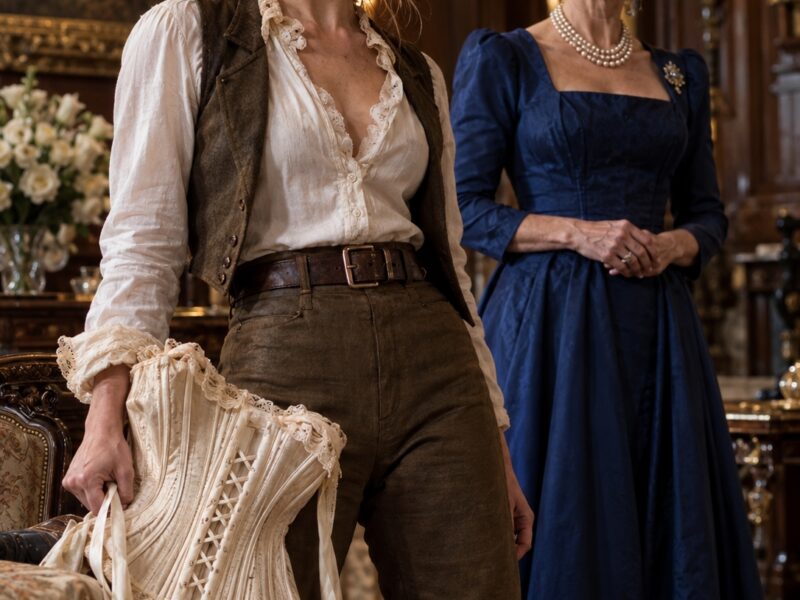
Mrs. Selby arrived the following Tuesday with three women, two boxes, a book on etiquette, calling cards, embroidery hoops, and a corset that looked capable of restraining livestock.
Marin stared at the collection.
“What is all this?”
“Help,” Mrs. Selby said brightly.
Marin should have closed the door.
Instead she stepped aside.
The campaign began.
“A lady does not stride.”
“I walk.”
“A lady glides.”
“Why?”
Mrs. Selby blinked.
“Because she is a lady.”
That answer seemed to explain many things in respectable society.
Marin learned forks.
Or attempted to.
She learned calling hours.
She learned that a married woman could apparently insult another married woman by arriving at three-fifteen when etiquette demanded three-thirty.
She learned embroidery.
Badly.
She learned to sit with her knees together.
She learned not to swear when needles entered her fingers.
Mostly.
And she put away her trousers.
That hurt most.
Every morning, she watched ranch hands ride out while she remained behind in skirts.
Sometimes she heard Idris working horses near the barn.
Her body responded automatically.
She could tell from the rhythm of hoofbeats when a horse resisted pressure.
She could hear when a rider had poor hands.
Once she reached the door before remembering what she wore.
Mrs. Selby called from behind her.
“Mrs. Vaughn?”
Marin stopped.
“Yes?”
“Your embroidery.”
She returned to the chair.
Weeks passed.
Idris watched his wife disappear.
At first he misunderstood.
He thought she wanted this.
He saw her practicing table settings.
Saw her struggling through church calls.
Saw dresses replacing work clothes.
Perhaps, he thought, she had missed feminine companionship during those years among horse traders.
So he kept quiet.
Then her laughter became rare.
That changed things.
One evening, Idris came inside and found Marin staring at an embroidery hoop.
Her jaw was tight.
Her eyes were wet.
He stopped.
“Marin?”
She jerked the needle.
The thread knotted.
“Damn it.”
She looked horrified.
“I’m sorry.”
“For what?”
“The language.”
“I’ve heard worse.”
“Mrs. Selby says—”
“Mrs. Selby is not here.”
Marin stared at the ruined stitching.
“I can’t do it.”
Idris approached.
“Do what?”
“This.”
He looked at the cloth.
“What is it?”
“It was supposed to be a flower.”
He studied the shape.
“Could be.”
“It looks like a dead spider.”
“Could also be that.”
She glared at him.
He smiled.
She didn’t.
That frightened him.
“I ruined it.”
“So?”
“So Mrs. Selby said I was finally improving.”
Idris’s expression changed.
Marin tried to pull the embroidery away.
He took it gently.
“Idris—”
He crossed to the fireplace.
And dropped it into the flames.
Marin gasped.
“What are you doing?”
“Correcting a problem.”
“That took me three days!”
“That is exactly why I burned it.”
She stared at him.
Idris turned.
“I did not send four hundred miles for a woman who could embroider.”
Marin said nothing.
“This valley is full of women who can embroider. I did not marry any of them.”
Her face tightened.
“You say that now.”
The words came out before she could stop them.
Idris went still.
Marin looked away.
There it was.
The thing she had been hiding.
“You think I’ll change my mind.”
She swallowed.
“People do.”
“Have I?”
“Not yet.”
He absorbed the answer.
It hurt more than he expected.
But he understood suddenly that this was not about him alone.
He was arguing against twenty-four years of evidence.
So he lowered his voice.
“Look at me.”
She didn’t.
“Marin.”
Slowly, she did.
“I wanted the woman who wrote me that she could break a colt and shoot a snake.”
Her eyes filled.
“Letters aren’t life.”
“No. They’re not.”
“You didn’t see how people look at me.”
“I saw them the day you arrived.”
“You didn’t have to live with it.”
“I’ve lived with this town longer than you have.”
“Not like me.”
“No,” Idris said. “Not like you.”
That answer stopped her.
He stepped closer.
“I don’t know what it feels like to be you. But I know what I see happening.”
“What?”
“You’re disappearing.”
Marin flinched.
Idris continued.
“You came here with one saddlebag and enough nerve to jump off a moving coach because a horse needed help. Now you’re afraid to walk across your own kitchen because someone might think your steps are too large.”
A tear escaped.
She wiped it angrily.
“I thought you deserved a proper wife.”
“I chose my wife.”
“You chose letters.”
“I chose the woman who wrote them.”
“What if she embarrasses you?”
“Then I expect I’ll survive.”
“What if people laugh?”
“They already do.”
Despite herself, Marin gave a broken laugh.
Idris moved closer.
“Mrs. Selby doesn’t live here.”
“No.”
“You do.”
“Yes.”
“And unless I have badly misunderstood the institution, so do I.”
Another laugh.
Small.
But real.
Idris pointed toward the stairs.
“Tomorrow, put your trousers back on.”
Her eyes widened.
“You truly don’t mind them?”
“Marin.”
“What?”
“I may have fallen in love with the trousers.”
She stared.
“Metaphorically.”
“That is the worst romantic statement I’ve ever heard.”
“I warned you I wasn’t charming.”
This time she laughed properly.
Idris felt something in his chest loosen.
But when the laughter ended, she whispered, “What if I don’t know how to stop trying?”
His expression softened.
“Then I’ll remind you.”
“For how long?”
“As long as it takes.”
Marin looked at him.
Hope returned.
More dangerous than before.
Because now she wanted to believe him.
The next morning, Ballard nearly dropped his coffee when Marin walked into the barn wearing trousers and boots.
“Well.”
Marin stopped.
“Well what?”
The old foreman looked toward Idris.
Idris raised an eyebrow.
Ballard understood.
He cleared his throat.
“Well… boss has been making a damned mess of that bay gelding.”
Idris frowned.
“I have not.”
“You have.”
Marin smiled.
“Let me see him.”
The transformation was immediate.
The moment Marin put her hands on a horse again, her body seemed to remember itself.
Idris watched from the rail.
Her shoulders loosened.
Her voice changed.
Her confidence returned not dramatically but naturally, like circulation returning to a numb hand.
Within twenty minutes, she had identified the gelding’s problem.
“You’re asking too much too soon.”
Idris folded his arms.
“Are you criticizing my horsemanship?”
“Yes.”
“In front of my employees?”
“Yes.”
Ballard coughed to hide a laugh.
Idris looked at Marin.
“There she is.”
She froze.
His voice had no mockery in it.
Only affection.
Something warm moved through her.
From then on, they worked together.
And the ranch changed.
Marin knew horses better than anyone Idris had ever employed.
Idris understood land, cattle, accounts, and patience.
Where she rushed, he steadied her.
Where he hesitated, she pushed.
They argued.
They laughed.
They learned each other.
Their marriage became what their letters had promised: not rescue, but partnership.
Then Idris received the bank notice.
And everything changed again.
He hid it for four days.
Marin knew by the second.
On the fourth evening, she placed his coffee in front of him.
“How bad?”
Idris looked up.
“What?”
“The ranch.”
His face betrayed him.
“Marin—”
“I grew up around horse traders. I can read a balance sheet in a man’s shoulders.”
He sighed.
“The note comes due in eight weeks.”
“How much?”
He told her.
Marin sat down.
It was worse than she expected.
“Two bad seasons,” Idris said. “Feed costs. Repairs. Cattle prices.”
“And the bank won’t extend?”
“They might if they thought there was enough value here.”
“But?”
“But several men in town have made it clear they’d be interested in the land after foreclosure.”
Marin’s eyes hardened.
“They’re waiting for you to fail.”
“Yes.”
“And you weren’t going to tell me?”
“I was.”
“When?”
He didn’t answer.
She leaned back.
“You think this is your ranch.”
“Legally—”
“Don’t.”
Idris stopped.
“You married me as a partner.”
“I did.”
“Then don’t protect me by making me useless.”
That landed.
Idris rubbed a hand over his face.
“You’re right.”
“I know.”
He almost smiled.
Then Marin looked toward the window.
Beyond the ranch, the mountains darkened beneath the evening sky.
Something had been forming in her mind for weeks.
Now it sharpened.
“Come with me tomorrow.”
“Where?”
“High country.”
“For what?”
She looked at him.
“Our money.”
They rode for hours.
Eventually Marin led him onto a ridge.
Below them, moving across a broad mountain meadow, was a band of wild mustangs.
Forty, perhaps more.
Idris frowned.
“Marin.”
“Look at them.”
“I am.”
“No. Look.”
She pointed.
“Good shoulders. Strong feet. Mountain lungs. Those aren’t worthless scrub horses.”
“They’re wild.”
“So was I, according to Pilot Butte.”
“That’s different.”
“Is it?”
Idris studied the herd.
Marin continued.
“Gentled properly, the army remount buyers would take some. Freight companies would take the heavier animals. Ranchers would buy the rest.”
“Gathering them is dangerous.”
“I know.”
“Breaking them is worse.”
“Not if you don’t break them.”
He looked at her.
“You gentle them.”
“Marin—”
“I can do it.”
“I know you can.”
“Then what’s the argument?”
“That I don’t intend to save my ranch by getting my wife killed.”
Her expression changed.
“Our ranch.”
Idris closed his eyes briefly.
“Our ranch.”
“Good.”
“Still no.”
She dismounted.
He followed.
“Forty head,” she said. “Maybe more. Even if we lose some, even if prices run low, there’s enough money moving across that meadow to clear the note.”
“You can’t know that.”
“I can.”
“How?”
“My father taught me.”
The mention of Patrick Doyle silenced him.
Marin watched the herd.
“For five years after he died, I kept asking myself what all of it had been for.”
“All what?”
“My childhood. The camps. The horses. Never fitting anywhere.”
She turned toward Idris.
“Every proper thing this town tried to teach me is useless up here.”
Her voice trembled now, but not from fear.
“Calling cards won’t save this ranch. Embroidery won’t save it. Knowing which fork to use won’t save it.”
“Marin—”
“But the thing they hate about me might.”
He said nothing.
She stepped closer.
“You told me to be what I am.”
“Yes.”
“Then let me.”
He looked down at the herd.
Then back at the woman beside him.
He was afraid.
That surprised him.
Not of losing the ranch.
Of losing her.
Marin seemed to understand.
Her voice softened.
“You married the wild one on purpose.”
A reluctant smile touched his face.
“I did.”
“Well.”
She looked toward the mustangs.
“This is what the wild one is for.”
The first gather nearly killed Ballard.
The second nearly killed Marin.
By the third, the Vaughn crew stopped questioning her methods.
For six weeks, Marin worked harder than any person on the ranch.
She studied the mustangs from a distance before moving them.
She learned the lead mare.
She identified the stallion.
She mapped escape routes.
She refused to chase when patience would move them.
When the first group finally entered the temporary corral, Ballard removed his hat.
“I’ll be damned.”
Marin slid from her saddle.
“Probably.”
The old man stared at the horses.
“I’ve worked stock sixty years.”
“And?”
“Never seen anything like that.”
Marin smiled.
“My pa had.”
Ballard nodded.
“He must’ve been something.”
“He was.”
Then came the gentling.
Marin would stand inside a corral with a wild horse and wait.
No whip.
No violence.
No spectacle.
Pressure.
Release.
Movement.
Patience.
She watched ears, nostrils, shoulders, breathing.
She listened with her hands.
Exactly as Patrick Doyle had taught her.
One by one, the mustangs changed.
Not broken.
Trusting.
Word reached Pilot Butte.
People came to watch from the road.
Some mocked.
Fewer each week.
The wild bride had become difficult to dismiss.
Especially when men who had called her unwomanly began asking Idris whether she might train one of their horses.
Idris enjoyed those conversations more than Christian charity probably permitted.
Then the storm came.
It began high in the mountains.
Clouds gathered before noon.
By two, the sky had turned nearly black.
Marin was working a young mustang when thunder rolled across the valley.
The horse jerked.
She looked toward the mountains.
Something about the storm bothered her.
Not the lightning.
The rain.
Too much.
Too fast.
She stepped onto the fence.
Ballard called from the barn.
“Mrs. Vaughn!”
“Creek.”
“What?”
Marin jumped down.
“The schoolhouse creek.”
Ballard’s face changed.
The schoolhouse sat near a normally shallow crossing.
Marin ran for her horse.
“Where are you going?”
“Pilot Butte.”
Idris emerged from the barn.
“Marin?”
She was already mounting.
“Cloudburst.”
He looked toward the mountains.
Then understood.
“I’m coming.”
“No. Get ropes and men. Follow.”
She kicked the mustang forward.
“Marin!”
But she was already gone.
The creek had become a river.
Brown water roared through cottonwoods, carrying branches, fence posts, mud, and entire sections of bank.
On one side stood most of Pilot Butte.
On the other, trapped on a shrinking rise of ground, stood twelve children and their young teacher.
Mrs. Selby’s three children were among them.
Her youngest was six.
“My babies!”
Men held Mrs. Selby back from the water.
“Someone help them!”
“We’re trying!”
“Then try harder!”
Several men had attempted to enter the flood.
Their horses refused.
One animal had nearly gone over backward.
The current was too violent.
A rope would not reach.
The children were crying.
The teacher had gathered them together, but water was climbing around their feet.
Then someone heard hoofbeats.
Marin came down the road at a gallop.
People turned.
Her hair had come loose.
Mud covered her trousers.
Beneath her was one of the mountain mustangs.
Not fully trained.
Not by anyone else’s standards.
But Marin trusted him.
And he trusted her.
She pulled up at the bank.
“What happened?”
A man pointed.
“Bank washed out. They can’t cross.”
Marin looked once.
That was enough.
She saw the current.
The debris.
The angle.
The narrowing bar.
Mrs. Selby grabbed her arm.
“Marin.”
There was no judgment in her face now.
No etiquette.
No superiority.
Only a mother.
“My children.”
Marin looked across the water.
The six-year-old was crying.
Marin swung back into the saddle.
A man caught the bridle.
“Mrs. Vaughn, no.”
“Move.”
“That water will kill you.”
“Move.”
“No horse will take it.”
Marin looked down at him.
“This one will.”
“How do you know?”
She gathered the reins.
“Because nobody ever told him he was supposed to be afraid.”
Then she put the mustang into the river.
Someone screamed.
The horse plunged.
Water struck his chest.
Then his shoulders.
Marin leaned upstream, giving him his head.
“Come on, boy.”
The mustang fought.
A log spun past.
People shouted from the bank.
Marin heard none of them.
She felt the horse beneath her.
His balance.
His fear.
His power.
“That’s it.”
The current pushed them downstream.
“Come on.”
The horse found footing.
Lost it.
Found it again.
Marin adjusted.
Ten feet.
Twenty.
Thirty.
Then the mustang lunged onto the far bank.
The children screamed with relief.
Marin dismounted.
“Listen to me!”
They quieted.
“We’re going one at a time.”
The teacher stared at her.
“You can’t make twelve trips.”
“I can.”
“The water is rising.”
“Then we’d better stop talking.”
She pointed at the smallest boy.
“You first.”
He shook his head.
“I’m scared.”
“So am I.”
That surprised him.
Marin crouched.
“Being scared doesn’t mean we stay here.”
She lifted him onto the saddle.
“Hold my coat.”
“What if I fall?”
“You won’t.”
“How do you know?”
Marin looked into his terrified face.
“Because I’m not letting you.”
They entered the river.
Pilot Butte watched.
The first crossing succeeded.
Then the second.
Then the third.
Each time Marin returned, the current was worse.
On the fifth crossing, debris struck the mustang’s flank.
He stumbled.
The crowd screamed.
Marin nearly went under.
She recovered.
On the seventh, the water reached higher.
On the ninth, Idris arrived.
He saw his wife in the middle of the river with a child clinging to her.
Every part of him stopped.
“Dear God.”
Ballard rode up behind him.
“Boss—”
“How many?”
“Don’t know.”
Idris dismounted and ran toward the bank.
Marin reached shore.
He grabbed the child from her.
“What are you doing?”
“What does it look like?”
“You can’t keep crossing.”
“There are four left.”
“Marin.”
She saw his face.
For half a second, everything around them disappeared.
The water.
The town.
The screaming.
He was terrified.
Not angry.
Terrified.
Marin touched his cheek.
“I know.”
Then she turned the horse.
Idris caught her wrist.
“If that horse goes down—”
“I know.”
“I can’t lose you.”
Her expression softened.
“You won’t.”
“You cannot promise me that.”
“No.”
The truth hung between them.
Then another child screamed from across the river.
Marin pulled her hand free.
“But I promised them.”
She rode back into the flood.
The eleventh child was Mrs. Selby’s middle son.
The twelfth was her six-year-old daughter.
By then Marin could barely feel her hands.
The mustang shook violently beneath her.
The teacher remained on the far bank.
Marin looked at her.
“You next.”
“The girl.”
“I’ll take her first.”
“No. Take her and don’t come back for me if it gets worse.”
Marin stared at her.
“I am coming back.”
“Mrs. Vaughn—”
“I said I am coming back.”
She lifted the little girl.
The child wrapped both arms around Marin’s waist.
“Mama?”
“She’s waiting.”
“I want her.”
“I know.”
“Are we going to die?”
Marin closed her eyes for half a second.
“No.”
Then she whispered against the child’s wet hair.
“Not today.”
They entered the water.
Halfway across, the mustang slipped.
Marin heard Idris shout her name.
The river turned sideways.
For one terrible instant, horse, woman, and child disappeared behind brown water.
Mrs. Selby screamed.
Then the mustang’s head surfaced.
Marin was still there.
One arm held the saddle.
The other held the child.
“Come on!”
The horse lunged.
“Come on, boy!”
His hooves struck bottom.
He surged forward.
Men rushed into the shallows.
Idris reached them first.
He tore the child from Marin’s arms.
Mrs. Selby collapsed around her daughter.
Marin slid from the saddle.
Her knees buckled.
Idris caught her.
“Teacher,” Marin gasped.
“What?”
“The teacher.”
“No.”
She tried to stand.
Idris held her.
“Marin, no.”
“One more.”
“The horse is finished.”
“So am I.”
“Exactly.”
She looked across the river.
The teacher stood alone.
Water reached her knees.
Marin whispered, “One more.”
Idris stared at her.
He knew then that nothing he said would stop her.
So he did the only thing he could.
He helped her back onto the horse.
Then he pressed his forehead briefly against hers.
“Come back to me.”
Marin’s eyes filled.
“I will try.”
It was the most honest promise she could give.
She crossed again.
Years later, people would disagree about details.
How high the water was.
How many logs passed within inches of Marin.
Whether the mustang swam the deepest section or somehow found bottom.
But everyone agreed about the final crossing.
Marin returned with the teacher behind her.
The mustang staggered onto the bank.
Men caught him.
Marin slid down.
Idris reached her before she hit the ground.
For several seconds, nobody spoke.
Twelve children cried in their parents’ arms.
The teacher was alive.
Mrs. Selby knelt in the mud clutching her youngest daughter.
And Marin Doyle Vaughn—the woman Pilot Butte had spent months trying to make respectable—lay exhausted in her husband’s arms wearing muddy trousers.
Mrs. Selby stood.
She approached slowly.
Marin tried to rise.
“Don’t.”
Mrs. Selby dropped to her knees.
Her face was streaked with rain and tears.
“You saved them.”
Marin said nothing.
“You saved all of them.”
Behind Mrs. Selby, the town stood silent.
These were the same people who had laughed when Marin stepped off the stagecoach.
The same women who had whispered about trousers.
The same men who had called her wild.
Now their children were alive because she had been exactly the woman they had asked her not to be.
Marin looked around.
Nobody met her eyes.
And for the first time, their silence did not make her feel ashamed.
It made them ashamed.
The apology came three days later.
Mrs. Selby arrived at the Vaughn ranch alone.
Marin opened the door.
For a moment, neither woman spoke.
Then Mrs. Selby held out a box.
Marin eyed it suspiciously.
“If that’s another corset, I’m setting it on fire.”
Mrs. Selby laughed.
Then, unexpectedly, began crying.
“No.”
She wiped her face.
“It isn’t.”
Inside was Marin’s old pair of riding gloves.
Mrs. Selby had found them at the church months earlier and apparently kept them.
“I owe you an apology.”
Marin leaned against the doorway.
“A large one.”
“Yes.”
Mrs. Selby nodded.
“A very large one.”
Marin waited.
“I thought I was helping you.”
“That made it worse.”
“I know that now.”
Mrs. Selby’s voice broke.
“I tried to teach you how to become the kind of woman I understood.”
Marin said nothing.
“And when the river came, every lesson I gave you became ridiculous.”
She looked down.
“My forks would not have saved my daughter.”
Marin’s expression softened.
“My calling cards would not have crossed that river.”
“No.”
“My corset certainly would not have improved matters.”
Marin nearly smiled.
Mrs. Selby looked at her.
“But you did.”
She swallowed.
“Exactly as you were.”
Marin’s eyes stung.
Mrs. Selby continued.
“I tried to reform a woman who turned out to be worth ten of me.”
“Don’t do that.”
“What?”
“Make yourself smaller to make me larger.”
Mrs. Selby blinked.
Marin looked toward the barn.
“I’ve had enough of women being told they have to become less.”
For a long moment, Mrs. Selby said nothing.
Then she smiled.
“Perhaps you could teach me to ride.”
Marin stared.
“You?”
“Yes.”
“Properly?”
“I don’t know what that means anymore.”
Marin laughed.
“Tomorrow morning. Wear trousers.”
Mrs. Selby’s face went pale.
“Marin.”
“Those are my terms.”
“You are enjoying this.”
“Immensely.”
Mrs. Selby sighed.
“Heaven help Pilot Butte.”
The mustangs sold better than Marin predicted.
Army buyers took the strongest.
Freight outfits purchased several.
Ranchers who had once dismissed the animals as worthless began bidding against one another.
Idris and Marin went to the bank together.
The banker examined the payment twice.
Then he looked up.
“Mr. Vaughn.”
Idris said nothing.
“Mrs. Vaughn.”
Marin smiled.
“Yes?”
“Your note is paid in full.”
Idris exhaled.
Marin reached under the table and took his hand.
The banker continued speaking.
Neither heard him.
Outside, Idris stopped on the boardwalk.
For several seconds he simply stared at the street.
Marin nudged him.
“You all right?”
“We kept it.”
“We did.”
“The ranch.”
“Yes.”
He looked at her.
“You saved it.”
“We saved it.”
“No.”
Idris shook his head.
“You were right. The wild horses did it.”
“The horses helped.”
“The wild woman did it.”
Marin smiled.
But something inside her suddenly cracked.
She covered her mouth.
Idris’s expression changed.
“Marin?”
She began crying.
Not delicately.
Not attractively.
She cried with her whole body.
Idris pulled her against him.
People passed on the street.
Neither cared.
“I kept waiting,” she whispered.
“For what?”
“For it to end.”
Idris held her tighter.
“For you to realize.”
“Realize what?”
“That they were right.”
His jaw tightened.
“About me.”
“Marin—”
“I kept waiting to be sent back.”
He pulled away just enough to see her face.
She was trembling.
Not from the flood now.
Not from exhaustion.
From twenty-four years of waiting for rejection.
“I thought if I worked hard enough, maybe you’d keep me.”
His face broke.
“Keep you?”
“I know how it sounds.”
“No. You don’t.”
She wiped her face.
“When Mrs. Selby came with those dresses, I thought maybe she understood something I didn’t. Maybe you were too kind to say it.”
“Say what?”
“That I embarrassed you.”
“Never.”
“That you’d made a mistake.”
“Never.”
“That if I could just become quieter and prettier and more—”
“Stop.”
His voice was gentle but absolute.
Marin stopped.
Idris took both her hands.
“Listen to me.”
She looked at him.
“Really listen.”
His thumbs brushed the scars across her knuckles.
“You are not too much.”
Her eyes closed.
“You never were.”
A tear slipped down her cheek.
“The world was too small for you.”
She opened her eyes.
Idris continued.
“And it blamed you for its own smallness.”
Marin stared at him.
“I loved your first letter because it was the first honest thing I’d read in months. I loved the woman who told a stranger she could shoot a snake but couldn’t pour tea gracefully.”
She laughed through tears.
“I can pour tea.”
“Poorly.”
“Idris.”
“I love the woman who jumped off that coach because a horse was frightened. I love the woman who argued with me about my own ranch. I love the woman who rode into a river because children needed her.”
His voice broke now.
“And I even love the damned trousers.”
She laughed again.
He stepped closer.
“I did not marry you in spite of the wildness.”
The street seemed to disappear.
The town disappeared.
Everything disappeared except his face.
“I married you because of it.”
Marin’s breath caught.
Idris touched her cheek.
“Do you understand?”
She nodded.
“Say it.”
“Because of it.”
“Again.”
“Because of it.”
He kissed her forehead.
And something Marin had carried since childhood finally loosened.
The expectation of the flinch.
The certainty that affection had conditions.
The belief that every home came with an invisible door through which she might eventually be pushed.
For the first time in her life, Marin stopped waiting to be sent back.
Years passed.
The Vaughn ranch grew.
So did its reputation.
Horsemen came from neighboring counties, then neighboring states, to see Marin’s methods.
Some arrived skeptical.
Most left humbled.
She taught anyone willing to learn.
But she took particular interest in girls.
Whenever a father brought a daughter who was “too stubborn,” Marin smiled.
Whenever a mother apologized because her girl preferred barns to parlors, Marin’s eyes sharpened.
Whenever someone said, “She’s a little wild,” Marin answered the same way.
“Good.”
Girls learned to ride at the Vaughn ranch.
They learned horses first.
But Marin taught other things without naming them.
How to trust capable hands.
How to fall without being ashamed.
How to get back into the saddle.
How to recognize fear without obeying it.
How to take up the space their bodies required.
Mrs. Selby became Marin’s fiercest defender.
She never became an elegant rider.
She became an enthusiastic one.
Once, after falling into a mud puddle at fifty-three, she stood dripping before half the county and announced that anyone who laughed would be removed from the church Christmas committee.
Marin laughed hardest.
Mrs. Selby forgave her eventually.
The children from the flood grew up.
Some moved away.
Some stayed.
All remembered.
Every few years, somebody told the story again.
The water grew deeper with each telling.
The mustang grew larger.
Marin became faster.
Idris complained that by the time they were old, people would claim she had flown across the river.
Marin said that sounded reasonable.
They had daughters.
Marin never forced them into dresses.
Idris never forced them into anything except chores.
One loved horses.
The other preferred books.
Marin celebrated both with equal ferocity.
Once, when their younger daughter came home crying because another girl had called her strange, Marin sat beside her on the porch.
“Am I strange?” the child asked.
“Yes.”
Her daughter stared at her.
Marin smiled.
“So am I.”
“Is that bad?”
Marin looked across the ranch.
At the barn.
At the mountains.
At Idris walking toward them carrying three mugs.
“No.”
She pulled her daughter close.
“Sometimes strange is just what ordinary people call something they haven’t learned how to value yet.”
Idris handed her a mug.
“What are we discussing?”
“Being strange.”
“Ah.”
He sat beside them.
“A family specialty.”
The girl laughed.
Marin looked at her husband.
His hair had gone mostly gray.
Lines had deepened around his eyes.
But those eyes were still steady.
They had been steady the first day.
She remembered the dust.
The frightened horse.
The whispers.
No proper bride.
Wild.
Unwomanly.
Too much.
She remembered how desperately she had once wanted those voices to become quiet.
Age had taught her something better.
You did not need the voices to become quiet.
You needed to stop mistaking them for truth.
Late one autumn evening, Marin and Idris rode into the high country together.
They were older now.
Slower.
The ranch could function without them for a day, which Idris considered evidence of successful management and Marin considered suspicious.
They stopped on the same ridge where Marin had first shown him the mustangs.
A small wild band grazed below.
Idris looked at them.
“Money running loose on the mountain?”
Marin smiled.
“You remembered.”
“I remember everything you say.”
“That sounds exhausting.”
“It is.”
She nudged his boot with hers.
They sat in silence.
After a while, Marin said, “Do you ever think about what would’ve happened if you hadn’t answered my letter?”
“Yes.”
She looked at him.
He continued watching the horses.
“I would have been alone.”
“You might’ve married someone else.”
“No.”
“How can you know?”
“Because I had already met women who fit what everyone thought I needed.”
Marin smiled faintly.
“And?”
“I didn’t need proper.”
He turned toward her.
“I needed you.”
Even after all those years, the words reached the same bruised place.
Only it was no longer bruised.
Not really.
Scarred, perhaps.
But healed.
Marin looked toward the mustangs.
“I almost didn’t write.”
Idris went still.
“What?”
“I wrote the letter and kept it three days.”
“You never told me that.”
“I figured you’d reject me.”
“Why?”
She gave him a look.
“Did you read the letter?”
“Yes. Repeatedly.”
“I practically warned you away.”
“I found that appealing.”
“You are a peculiar man.”
“So I’ve been told.”
She laughed.
Then became quiet.
“I thought if I wrote everything wrong with me, you could reject me before I started hoping.”
Idris studied her.
“And instead?”
“You wrote back.”
“I did.”
“You said you wouldn’t change one word.”
“I meant it.”
“I know.”
That was the miracle.
Not that he had meant it then.
That she knew it now.
Marin watched a young mustang break from the herd and run across the meadow.
No bridle.
No saddle.
No fence.
For years, people had called animals like that useless because usefulness, to them, required submission.
Marin knew better.
Wildness was not the absence of value.
Sometimes it was power waiting for someone wise enough not to destroy it.
Idris reached for her hand.
She gave it to him.
Far below, the horses ran.
Long after Marin Doyle and Idris Vaughn were gone, Pilot Butte still told their story.
People remembered the strange rancher who sent four hundred miles for a bride nobody else would have chosen.
They remembered the woman who arrived wearing trousers and frightened respectable society before her boots had been in town five minutes.
They remembered the corsets.
The scandal.
The wild horses.
The bank note.
And, most of all, the flood.
Old men who had been boys that day told grandchildren about brown water swallowing fences.
Women who had once been trapped children remembered strong arms lifting them onto a mustang.
Mrs. Selby’s descendants kept the story alive long after nobody could agree exactly where the old schoolhouse had stood.
But somewhere along the way, the story changed.
People stopped saying Idris Vaughn had married Marin Doyle anyway.
That word disappeared.
Because anyway had always been the wrong word.
It suggested that Marin’s wildness had been a flaw Idris graciously overlooked.
It suggested love had required forgiveness.
It suggested the best thing about her had been something to endure.
Idris had understood what the town did not.
He had not married Marin despite what she was.
He had recognized what she was.
There was a difference.
And perhaps that was why, of all the stories told about the Vaughn ranch, one small story survived longest.
It was not about the flood.
Not about the mustangs.
Not even about the day the bank note was paid.
It was about an old woman sitting on the porch of a ranch beneath the Wind River mountains while several young girls practiced riding in the field.
One girl fell.
She got up angry and embarrassed.
“I can’t do it!” she shouted.
The old woman rose from her chair.
Her hair was silver then.
Her hands were bent by age.
But she still wore trousers.
She walked down from the porch and stopped beside the girl.
“You scared?”
The girl nodded.
“Good.”
The child frowned.
“Why is that good?”
“Means you’re paying attention.”
Marin held out her hand.
“Now get back on.”
“What if I fall again?”
“You probably will.”
The girl stared at her.
Marin smiled.
“And then?”
The child thought about it.
“I get up?”
“Exactly.”
The girl took her hand.
Behind Marin, an old man leaned against the porch rail, watching her with the same steady eyes he had possessed decades earlier.
Marin helped the girl mount.
Then she looked toward Idris.
He smiled.
“There she is,” he said softly.
Marin heard him.
She always did.
And for just a moment she was twenty-four again, standing in the dust of Pilot Butte while an entire town decided she was too wild, too rough, too much to become anybody’s proper wife.
They had been wrong.
But that was no longer the important part.
The important part was that Marin had finally stopped needing them to know it.
She tipped her face toward the mountain wind.
Somewhere beyond the fences, a horse called.
Marin smiled.
She had spent the first half of her life believing love would arrive only after she learned how to become less.
Instead, love had found her in trousers, dust, stubbornness, scars, and all.
And the man who loved her had never asked her to become tame.
He had only asked her to come home.









