THE TWO CHILDREN AT MY RED GATE CARRIED A LETTER FROM THE WOMAN I BURIED TWO YEARS AGO
The first thing Cassius Reeve noticed was that the children were not moving.
The second was the note pinned to the boy’s coat.
And the third was the handwriting.
That was the thing that nearly put him on his knees.
Because Cassius knew that handwriting.
He had loved it for a year.
He had mourned the woman who wrote it for two.
And according to every man who had ridden out to the wreck on Powder River Road, she was dead.
Yet just after dawn on a bitter Wyoming morning, with frost whitening the fence posts and the eastern sky barely beginning to pale, two half-frozen children were sleeping beneath the red gate of his ranch.
One of them carried a message from a dead woman.
Cassius stopped the wagon so abruptly that the harness chains snapped tight.
For several seconds he simply sat there.
His breath steamed in front of him.
The horses shifted uneasily.
A thin wind came off the open country and moved snow dust across the road like smoke.
Cassius stared at the gate.
He had painted it red three years earlier for a woman he had never met.
A foolish thing, people had called it.
A lonely man’s foolishness.
He had spent a dollar he could not comfortably spare on the paint because Ada Van had once written that she was afraid she would pass his ranch in the dark when she finally came west.
Then I’ll paint the gate red, he had written back. You won’t miss me.
She never arrived.
Now two children had.
Cassius climbed down.
The taller child looked eight, perhaps nine if hunger had stolen years from his face. His coat was too thin for the weather. One arm was wrapped around a little girl who could not have been more than five.
Frost had gathered in her hair.
Cassius crouched.
He was thirty-four years old, broad across the shoulders from twelve years of ranch work, with hands strong enough to pull a frightened steer out of wire.
Those hands trembled now.
He reached toward the boy.
Stopped.
For one irrational moment he feared that if he touched them, they would disappear.
Then the boy opened his eyes.
They were dark, exhausted eyes.
Not frightened at first.
Only searching.
His gaze traveled past Cassius to the gate.
“Is this…” His voice broke.
Cassius leaned closer.
“What?”
“The ranch with the red gate?”
Something tightened inside Cassius.
“Yes.”
The boy stared at him.
“Reeve?”
Cassius swallowed.
“Yes.”
“Cassius Reeve?”
This time the answer barely came.
“Yes.”
The boy nodded once.
It was not the relieved nod of a child.
It was the exhausted acknowledgment of someone who had carried a responsibility too large for him and had finally reached the place where he was allowed to put it down.
“Good,” he whispered.
Then his eyes rolled backward.
Cassius caught him before his head struck the frozen mud.
That was when he saw the folded paper.
It was pinned to the boy’s coat with a bent sewing needle.
Cassius stared at it.
He did not touch it.
Not yet.
The girl whimpered.
That broke whatever spell had taken him.
He lifted the boy under one arm and the little girl under the other.
They weighed almost nothing.
That frightened him more than the note.
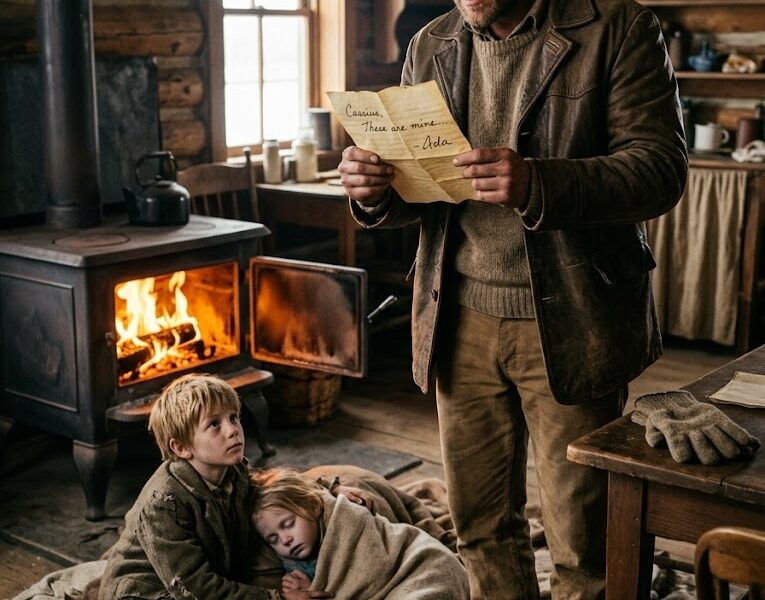
He carried them into the ranch house and laid them on the rug beside the stove. He built the fire until the iron began ticking with heat. He wrapped the children in blankets, warmed milk, found the last of yesterday’s bread and cut it into pieces.
The girl woke first.
Her eyes flew open.
She scrambled backward so violently that her heel struck the stove.
Cassius caught her before she burned herself.
She screamed.
The boy woke instantly.
He lunged between them.
“Don’t touch her!”
Cassius released the girl and raised both hands.
“All right.”
The boy was shaking.
“Don’t touch her.”
“I won’t.”
“You promise?”
“Yes.”
The boy studied his face.
Cassius understood something then.
The child did not believe promises because he was eight.
He evaluated them because somewhere along the road he had learned promises could be dangerous.
Cassius backed away.
“There’s milk.”
Neither child moved.
“Bread too.”
Still nothing.
Cassius sat on the floor several feet away.
“I’m Cassius.”
The boy’s eyes narrowed.
“I know.”
“How?”
“Mama told us.”
The room became very quiet.
Cassius looked at the note.
The boy followed his gaze.
“She said only you.”
Cassius felt his heartbeat in his throat.
“Only me what?”
“If we got here.”
The boy stopped.
His jaw tightened.
“If we got here, we were supposed to give it only to you.”
Cassius reached for the paper.
His fingers felt numb.
He removed the sewing needle carefully.
The paper had been folded and unfolded so many times that the creases had turned soft.
Then he opened it.
He knew the handwriting before he read the first word.
The letters leaned forward slightly.
The capital C was narrow.
The tail of every lowercase g curled backward.
He had spent nearly a year reading those letters beside a lamp.
He had kept one of Ada’s pages in his shirt pocket until the folds tore through.
He had once believed he would recognize her handwriting anywhere.
Apparently death had not changed that.
The note said:
Cassius,
These are mine, and I am asking you to make them yours.
Tad is eight. Lark is five.
They are good. They are so good. You will see.
I cannot come.
Do not try to find me.
God keep you for the man I believe you are.
Ada.
Cassius read it again.
Then again.
On the fourth reading, he placed one palm against the floor because the room seemed to tilt.
Ada Van was dead.
She had died in November of 1882 when the stagecoach carrying her west had gone over the Powder River grade during an early winter storm.
The stage company had said so.
The marshal had said so.
Two men who helped dig through the wreck had said no one could have survived the cold.
Cassius himself had ridden out there.
He had seen the broken timber.
The blood.
The torn luggage.
He had found a woman’s glove frozen into the ice.
He had taken it home because grief makes fools of people, and because there had been nothing else of Ada to bury.
For two years that glove had remained in the drawer beside his bed.
Two years.
And now her handwriting lay in his hands.
Cassius looked across the room.
The little girl had finally accepted the milk.
Tad watched him over the rim of his cup.
“Where is your mother?”
The cup stopped.
Tad lowered it.
“She said not to tell.”
Cassius looked at the note.
Do not try to find me.
That sentence no longer sounded like a request.
It sounded like fear.
And suddenly Cassius understood something that frightened him more than death ever had.
Ada had not failed to reach the red gate.
Something had stopped her.
—
Before Ada, Cassius Reeve had never considered himself lonely.
Loneliness was a word people used when they wanted sympathy.
Cassius had cattle.
Land.
Work.
A roof that did not leak badly enough to justify repairing it.
He had neighbors within several miles and a town within half a day.
What else was a man supposed to need?
Then, during the winter of 1881, the silence in his house changed.
It began to feel occupied.
He would eat supper and hear only the scrape of his fork.
He would look toward the chair across from him.
Empty.
He would wake before dawn and realize there was no voice in the world that expected him to come home.
A neighbor’s wife noticed before he did.
One afternoon she handed him a newspaper advertisement for a matrimonial correspondence agency in Missouri.
Cassius laughed.
Then he took the paper home.
Three nights later, he wrote.
His first letter was terrible.
He mentioned acreage.
Water rights.
The number of cattle he expected to winter successfully.
He sounded like a man selling land.
He almost burned it.
Instead, embarrassed even though no one was watching, he mailed it.
Ada Van answered.
She was twenty-six.
She had spent three years nursing her father until his death.
She had little money.
She disliked people who confused softness with goodness.
And instead of asking Cassius how many acres he owned, she asked:
What does your land smell like in the morning?
He stared at that question for half an hour.
Then she asked:
Are you kind to your animals when no one is watching?
That question bothered him even more.
He wrote back.
He told her the grass smelled silver with frost before sunrise.
He told her about elk descending from the hills at dusk.
He admitted that once, during a terrible winter, he had slept in the barn beside a sick mare because he did not want her to die alone.
Ada replied:
That tells me more about you than the acreage.
After that, the letters became easier.
Weeks became months.
Cassius learned she hummed when nervous.
Ada learned he hated coffee that had boiled too long but drank it anyway.
He learned she preferred thunderstorms to clear skies.
She learned he had once broken his nose fighting a man who kicked a dog.
He confessed that the house felt empty.
She confessed that Missouri no longer felt like home.
Somewhere between spring and autumn, they stopped writing like strangers considering marriage.
They began writing like two people already building one.
Cassius repaired the spare room.
Then felt ridiculous because there would be no spare room if she became his wife.
He bought curtains.
Hid them before anyone could see.
He painted the gate red.
When he told Ada what he had done, she wrote:
A man who spends money he cannot spare making himself easier for me to find is either very foolish or very kind.
He wrote back:
Could be both.
Her next letter contained only one line about it.
Then perhaps I am foolish enough to come.
She left Missouri in November.
Cassius rode to Ash Fork with a new wool coat folded beside him.
He had deliberately bought it too large.
He imagined she would laugh.
The stage never arrived.
Cassius waited the entire day.
Then the next.
On the third morning, men came with news.
There had been a wreck.
He rode out with them.
For years afterward, he remembered fragments rather than the whole.
A broken wheel.
Snow inside an overturned passenger compartment.
A trunk split open.
A Bible lying facedown in mud.
Blood frozen black against wood.
And the glove.
Small.
Brown.
A woman’s glove.
“No soul walked away from this,” one man said.
Cassius stood in the snow holding it.
Something inside him became very quiet.
He returned to the ranch with the wool coat still folded in the wagon.
He never returned it.
And for two winters he lived as though a future had died before he had been allowed to touch it.
Until two children appeared beneath the red gate.
—
Tad and Lark slept through most of their first day.
When they woke, Cassius learned quickly what not to do.
Do not approach suddenly.
Do not raise your voice.
Do not reach over Tad’s head.
Do not stand between the children and a door.
Most importantly, never waste food in front of them.
Lark began following Cassius around the house by the second evening.
She did not speak much.
She simply attached herself to him.
Sometimes she held the back of his shirt in one fist while he cooked.
The first time it happened, Cassius froze.
He looked down.
Her little hand was knotted in the fabric.
She looked up at him as though daring him to object.
He did not.
Tad was different.
Tad watched.
Doors.
Windows.
Knives.
Horses.
Visitors.
Cassius.
Especially Cassius.
At supper on the fourth night, Tad finally spoke about their journey.
“Mama made us memorize it.”
“What?”
“The way.”
Cassius stopped eating.
Tad recited it mechanically.
“Big Horn Road. Red gate. Ask for Reeve. Cassius Reeve. Kind to animals.”
Cassius looked down.
That last detail nearly undid him.
“She said if we forgot everything else, remember the red gate.”
“How far did you walk?”
Tad shrugged.
“How did you get here?”
“Some wagons.”
“Your mother put you on one?”
“No.”
“Then who?”
Tad’s expression closed.
Cassius recognized the boundary.
He did not push.
A few minutes passed.
Then Tad asked, “Did she tell the truth?”
“About what?”
“You.”
Cassius frowned.
Tad stared into his bowl.
“She said you’d take us.”
Lark stopped eating.
The room waited.
“Even though you never saw us,” Tad continued. “She said you would.”
There was something almost angry in his voice.
A challenge.
As though Cassius had been handed the last surviving piece of his mother’s faith and the boy intended to see whether it broke.
Cassius put down his fork.
“Tad.”
The boy looked up.
“Your mother was right.”
No reaction.
“This is my house.”
Cassius looked at Lark.
Then back at him.
“It’s yours now too.”
Tad blinked.
“No one is taking you out of here.”
“Ever?”
Cassius thought about promises.
The easy kind.
The impossible kind.
Then he thought of Ada sending her children into winter toward a man she had never seen because she believed his letters.
“Not while I’m alive.”
Tad lowered his head.
He did not cry.
Later that night, Cassius passed the children’s room and heard whispering.
Lark sounded frightened.
Then Tad answered.
“It’s all right.”
A pause.
“We’re done walking.”
Cassius stood alone in the hallway.
He closed his eyes.
Because Tad believed they were done.
Cassius no longer did.
Their mother was alive.
And somewhere, she was still afraid.
—
He waited until the children could spend several hours with his neighbor, Mrs. Bell.
Then he rode to Ash Fork.
The stage office had changed hands.
The new agent knew nothing useful.
Cassius was leaving when an old stableman named Henry Pike called after him.
“You asking about that wreck from two winters back?”
Cassius turned.
Pike did not look comfortable.
“Yes.”
“You the fellow who waited for the Missouri woman?”
Cassius felt cold.
“Yes.”
Pike rubbed a bridle strap between his fingers.
“I remember you.”
“What do you know?”
“Maybe nothing.”
“What do you know?”
The old man glanced toward the stage office.
Then lowered his voice.
“The company lied.”
Cassius did not move.
Pike continued.
“Coach went over the grade. That part’s true.”
“And?”
“It wasn’t just weather.”
Cassius stared at him.
“There were road agents working that stretch.”
Pike looked ashamed now.
“They’d stop coaches when weather was bad. Help was slow. Fewer witnesses.”
Cassius felt his jaw tighten.
“The coach was robbed?”
“Stopped first.”
“And the passengers?”
“Two died in the wreck.”
Cassius took one step closer.
“The others?”
Pike looked away.
“Walked off.”
The world seemed to narrow.
Cassius heard horses shifting in the stable.
Someone laughing across the street.
A hammer striking metal.
Ordinary sounds.
Impossible sounds.
“There was a woman?”
Pike said nothing.
Cassius grabbed his coat.
“There was a woman?”
“Yes.”
“From Missouri?”
“I heard so.”
“Why in God’s name didn’t you tell me?”
“Because I didn’t know she lived another day.”
“You knew she walked away.”
“I knew somebody said she did.”
“I came here every week for a month.”
“I know.”
“You watched me.”
Pike’s face hardened defensively.
“What would you have had me tell you? That maybe the woman you loved had been dragged into outlaw country? That maybe she was alive? Maybe dead? Maybe worse? With no name, no trail, nothing?”
“Yes.”
Pike looked at him then.
Really looked.
“Yes,” Cassius repeated.
The old man exhaled.
“There’s a place beyond Ten Sleep Road.”
Cassius waited.
“A roadhouse.”
“Whose?”
“Deacon Sallow.”
Cassius had heard the name.
Everyone had.
Sallow ran freight.
Gambling.
Whiskey.
And whatever else produced money without receipts.
Pike lowered his voice further.
“Sallow collects people.”
“What does that mean?”
“Exactly what it sounds like.”
Pike explained.
A man stranded on a road might receive a loan.
A woman without money might receive shelter.
A traveler might wake after an injury to discover that food, medicine, transportation and lodging had all been recorded as debt.
Then came the contracts.
Work until the debt was paid.
Except the debt never shrank.
Food cost money.
Beds cost money.
Clothes cost money.
Interest cost money.
Leaving cost more.
Paper transformed captivity into bookkeeping.
And Sallow knew which sheriff to drink with.
“If that woman survived,” Pike said, “and Sallow got hold of her…”
He did not finish.
He did not need to.
Cassius rode home beneath a darkening sky.
For two years he had believed Ada’s suffering ended on Powder River Road.
Now he understood that his grief had been a luxury.
He had sat beside a warm stove mourning her.
She might have been two days away, surviving.
Working.
Protecting Tad and Lark.
Teaching them the road to a red gate.
The thought made him sick.
He reached home after dark.
Tad was awake.
The boy sat at the kitchen table.
“You found out.”
It was not a question.
Cassius removed his gloves.
“I found something.”
“Is she dead?”
Cassius looked at him.
“No.”
Tad’s face did not change.
But his shoulders dropped.
Only slightly.
“Where is she?”
“I don’t know for certain.”
“Yes, you do.”
Cassius pulled out a chair.
“Tad—”
“Sallow.”
Cassius stopped.
The boy’s eyes were suddenly older than eight.
“She’s still there.”
Cassius sat slowly.
“You know that?”
Tad nodded.
“Why didn’t you tell me?”
“Mama said not to.”
“She also told me not to find her.”
“Yes.”
“Do you know why?”
Tad looked toward the room where Lark slept.
Then whispered:
“Because men who try to leave Sallow get buried behind the barn.”
—
By morning, half the town knew Cassius was asking questions.
That was his first mistake.
People meant well.
Good intentions simply traveled faster than secrets.
The banker, Samuel Price, asked Cassius to sit down.
Price was not a coward.
Nor was he cruel.
That made his warning harder to dismiss.
“You’ve never met this woman.”
“I know.”
“You have two children who claim she’s their mother.”
“They don’t claim anything. They’re children.”
“You have a note.”
“In her handwriting.”
“So you say.”
Cassius leaned back.
Price sighed.
“I’m trying to keep you alive.”
“Then help me.”
“I am helping you.”
“No. You’re explaining why I should do nothing.”
“Sometimes nothing is what keeps a man breathing.”
Cassius stood.
Price raised his voice.
“Think.”
Cassius turned.
“That’s all I’m asking.”
Price pointed toward him.
“You ride to Sallow’s place with money, he’ll take it. Then he’ll produce a debt twice as large. You argue, he gets the sheriff. You fight, you become the criminal. You threaten him, you disappear.”
Cassius said nothing.
“He’s done versions of this before.”
That caught him.
“What versions?”
“Ranchers signing property to settle debts. Freight men losing wagons. A widow losing land after borrowing against winter feed.”
“And nobody stopped him?”
“Not legally.”
Price lowered his hands.
“You have two children in your house now.”
Cassius’s anger faltered.
“That matters.”
“I know.”
“If you die chasing a woman you have never even touched, what happens to them?”
That question followed Cassius home.
He hated Price for asking it.
Mostly because it deserved an answer.
That evening he sat with Tad.
“I need you to tell me about your mother.”
Tad stiffened.
“Not where she is.”
Cassius leaned forward.
“Tell me things nobody else would know.”
“Why?”
“Because I need to know whether what I believe is true.”
Tad studied him.
Then began.
Their mother hummed a lullaby but forgot one verse, so she hummed through the missing words.
She hated onions but ate them when there was nothing else.
She taught Tad letters with a stick behind the washhouse.
She had once told him that knowing how to read meant another person could not easily put lies on paper and call them truth.
Then Tad said:
“She has a scar.”
Cassius went still.
“Where?”
“Back of her left hand.”
“What kind?”
“Thin.”
Tad traced a line across his own hand.
“From the coach.”
Cassius stared.
The glove in his drawer.
The wreck.
Ada’s handwriting.
Her children.
The scar.
He no longer needed certainty.
He needed strategy.
—
Three days later, Cassius Reeve rode into Sallow’s roadhouse pretending to be interested in freight contracts.
He left his anger outside.
That was the hardest thing he had ever done.
Deacon Sallow was not the monster Cassius had imagined.
Monsters would have been easier.
Sallow was neat.
Gray-haired.
Polite.
He wore a clean vest.
His fingernails were trimmed.
He spoke softly.
Men listened when he spoke.
That was worse.
“Mr. Reeve.”
Sallow poured coffee.
“Been told you’re expanding.”
“Trying.”
“Heard you need hauling.”
“Maybe.”
They discussed rates.
Routes.
Winter losses.
Cassius nodded at appropriate moments.
Then a woman entered carrying firewood.
And the world stopped.
Cassius had never seen Ada Van.
Not once.
He had invented her face a thousand times.
Sometimes from her handwriting.
Sometimes from the rhythm of her sentences.
Sometimes from nothing more than hope.
Every imagined version had been wrong.
She was thinner.
Smaller.
Older than twenty-eight should look.
Her dress had been patched so many times that Cassius could barely identify the original cloth.
Her hair was pulled tightly back.
Her face held the blank expression of someone who had learned that showing emotion invited attention.
She did not look at him.
She did not look at any man in the room.
She knelt beside the stove.
Placed the wood inside.
And Cassius saw her left hand.
A white scar crossed the back of it.
Thin as thread.
His coffee cup shook.
He tightened his fingers around it.
Sallow glanced at him.
“Cold?”
“Long ride.”
Sallow smiled.
“Winter does humble a man.”
Cassius looked into his coffee.
He thought:
If I stand up now, she dies.
So he stayed seated.
He talked freight for another hour.
Near dusk, he stepped outside.
Ada was behind the building splitting kindling.
Cassius approached without looking directly at her.
He waited until the building blocked them from the windows.
Then he said one word.
“Ada.”
The axe stopped in midair.
She did not breathe.
Cassius had spoken her name inside his own head ten thousand times.
Never like this.
Slowly she turned.
Her eyes found him.
Hope appeared.
Raw.
Instant.
Terrifying.
Then she killed it.
“You shouldn’t be here.”
Her voice was barely audible.
Cassius could not speak for a moment.
“You’re alive.”
Her expression twisted.
“Leave.”
“Ada—”
“Leave.”
“I have Tad and Lark.”
Everything changed.
The axe slipped from her hand.
Cassius caught it before it struck her foot.
She covered her mouth.
“They’re safe,” he whispered.
Her eyes filled.
“They’re warm.”
She made a broken sound.
“Lark follows me everywhere. Tad watches every door, but less now.”
Ada turned away.
Her shoulders shook once.
Only once.
“He got them there?”
“Yes.”
“My God.”
“They found the gate.”
She pressed both hands against her face.
Cassius wanted to touch her.
He did not.
Not yet.
After a moment she whispered, “Then go home.”
“No.”
She spun toward him.
“You don’t understand.”
“I understand enough.”
“No, you don’t.”
“He keeps you here.”
“He owns paper that says he does.”
“Paper doesn’t own people.”
“You haven’t met the sheriff.”
“I don’t care about the sheriff.”
“You should.”
Her voice sharpened.
“Men have come here angry before.”
Cassius watched her.
“They leave?”
She looked toward the ground behind the barn.
That was answer enough.
“Take the children,” she said. “Raise them. Tell them I—”
“No.”
“Cassius.”
“No.”
Her eyes widened.
He stepped closer.
Not touching.
Never touching.
“I did not spend a year loving your handwriting so I could abandon the woman who wrote it.”
Tears filled her eyes.
“You don’t love me.”
“I don’t know.”
That startled her.
Cassius swallowed.
“I loved the woman in those letters. Maybe you’re different now.”
“I am.”
“So am I.”
Silence.
“But I know this.”
He looked directly at her.
“I didn’t come across winter country for two children so I could leave their mother splitting wood behind Sallow’s house.”
“Cassius—”
“I’m going home with the whole of you.”
For one dangerous second, Ada looked as though she wanted to believe him.
Then footsteps sounded inside.
She shoved him backward.
“Go.”
Cassius obeyed.
But this time, obedience was only part of the plan.
—
Ada had signed Sallow’s contract one week after the wreck.
She had been half frozen.
Injured.
Starving.
She barely understood what she signed.
The document listed transportation.
Medical care.
Food.
Lodging.
Clothing.
Protection.
Every item carried a price.
Every day of work reduced the debt.
Every day of survival increased it faster.
When Tad became old enough to work, Sallow began calculating his food separately.
That was when Ada understood the children would inherit her prison.
So she planned.
For almost a year she saved pennies.
She memorized freight routes.
She learned which drivers drank and which had daughters of their own.
Finally she found one willing to take the children partway.
From there, Tad had carried the directions.
Big Horn Road.
Red gate.
Reeve.
Kind to animals.
Ada had given away the only two things keeping her alive because she understood that keeping them beside her would eventually destroy them too.
And then she wrote:
Do not try to find me.
Not because she did not want Cassius.
Because she believed wanting him would kill him.
Cassius rode through the night.
At dawn he entered the federal marshal’s office in Ash Fork.
Marshal Elias Boone remembered the wreck.
More importantly, he had never believed the official story.
Cassius put Ada’s note on the desk.
Then he told him everything.
Boone listened without interrupting.
When Cassius finished, the marshal took a long breath.
“If the coach was stopped by road agents before the wreck…”
“It was.”
“If Sallow received passengers from those agents…”
“He did.”
“And if he made a surviving passenger sign debt for a rescue made necessary by the robbery itself…”
Cassius waited.
Boone looked at him.
“Then that contract is not his protection.”
“What is it?”
“Evidence.”
Cassius felt something inside him move.
Boone stood.
“A contract entered under force or fraud doesn’t turn kidnapping into commerce.”
“He has the county sheriff.”
“I’m federal.”
Cassius almost smiled.
Boone did not.
“Don’t celebrate.”
He walked to the window.
“If we ride directly to Sallow’s, he’ll know why.”
“He could hide Ada.”
“Or kill her.”
Cassius’s face hardened.
“So what do we do?”
Boone turned.
“We make him believe nothing has changed.”
—
Cassius returned to the roadhouse two days later.
Still the freight buyer.
Still negotiating.
Still drinking terrible coffee.
Sallow suspected nothing.
Greed made men careless in ways fear never did.
They arranged to inspect the freight barn the following afternoon.
That morning Cassius passed Ada near the woodpile.
He never stopped walking.
He whispered six words.
“Second wagon. Kitchen door. Don’t look back.”
Ada gave no sign she heard.
The afternoon arrived gray and cold.
Cassius and Sallow stood inside the freight barn arguing over rates.
Then came the sound.
Wagon wheels.
Sallow barely noticed.
Cassius did.
One wagon passed the bend.
Then another sound followed.
A second wagon.
Cassius’s heart began hammering.
Inside the roadhouse, a kitchen door opened.
Ada stepped outside.
For two years she had learned to obey without hope.
Now she had to trust hope enough to walk.
She crossed the yard.
One step.
Then another.
She did not run.
Running would attract attention.
She kept walking.
Sallow heard the wagon.
His head turned.
Something changed in his face.
He started toward the barn door.
Cassius stepped into his path.
Sallow stopped.
For one long second, neither man spoke.
Then Sallow understood.
“You.”
His hand moved toward his pistol.
Cassius moved first.
They hit the ground hard.
Sallow was quicker than Cassius expected.
Cassius was stronger than Sallow expected.
A fist caught Cassius across the jaw.
A boot drove into his ribs.
Cassius tasted blood.
Sallow reached for the gun again.
Cassius seized his wrist.
They rolled through straw and mud.
Outside, horses shouted.
Men yelled.
Sallow drove a knee into Cassius’s stomach.
Cassius nearly lost him.
Then he saw Ada through the barn doorway.
Standing in the wagon ruts.
Free.
Only twenty yards away.
And Cassius found strength he did not know he had.
He drove Sallow face-first into the straw.
Pinned his arm behind him.
Sallow screamed.
“I’ll own your ranch!”
Cassius tightened his grip.
“You couldn’t afford the gate.”
Boots entered the barn.
Marshal Boone appeared with two deputies.
Sallow went still.
“You have no jurisdiction.”
Boone unfolded a warrant.
Then began reading.
Robbery.
Kidnapping.
Fraudulent imprisonment.
Conspiracy.
The transportation and unlawful detention of passengers taken from the Powder River stage.
Sallow’s face slowly lost color.
“My contracts are lawful.”
Boone looked down at him.
“We’ll let a federal judge enjoy them.”
The irons closed around Sallow’s wrists.
Outside, the roadhouse workers watched.
No one intervened.
Men like Sallow often appear powerful because everyone around them believes everyone else is afraid.
A warrant has a way of revealing how lonely that kind of power really is.
Ada stood in the yard.
Her patched dress moved in the wind.
Her scarred hand hung at her side.
Sallow was marched past her.
He stopped.
“You think you’re free?”
Ada looked at him.
For two years he had trained her to lower her eyes.
She did not lower them now.
“Yes.”
One word.
Nothing more.
Sallow was taken away.
Ada did not smile.
She did not cry.
She simply watched the wagon disappear.
Like a woman watching a wall collapse and realizing the horizon had been behind it the entire time.
—
The ride to Cassius’s ranch should have felt triumphant.
It did not.
Freedom is not the same thing as knowing what to do with it.
Ada sat beside Cassius on the wagon seat with her hands folded tightly in her lap.
He did not ask her questions.
She did not thank him.
Neither mentioned the letters.
They were, in the strangest way, intimate strangers.
Cassius knew what Ada believed about marriage.
He knew which season she loved.
He knew she liked storms.
He knew how she described grief.
But he did not know whether she snored.
Whether she liked eggs.
Whether silence comforted or frightened her.
Ada knew his childhood.
His ranch.
His fear of failing people.
But she did not know the sound of his footsteps in a hallway.
They reached Powder River grade near sunset.
Ada stared down toward the place where the stage had gone over.
Cassius slowed the horses.
“You want to stop?”
“No.”
He nodded.
They continued.
Several minutes later, her hand moved.
Just slightly.
It rested beside his.
Cassius did nothing.
Then Ada crossed the final inch.
Her scarred hand settled over his.
Cassius looked ahead.
So did she.
Neither spoke.
They did not need to.
—
When the red gate appeared in the distance, Ada stopped breathing.
Cassius noticed.
He pulled the wagon to a halt.
She stared at it.
The paint had faded.
One hinge sagged.
It was not beautiful.
It was real.
“You actually painted it,” she whispered.
Cassius looked embarrassed.
“I told you I would.”
“I thought…”
She laughed once, but the sound broke.
“I thought maybe that was just something a lonely man wrote to make a woman feel wanted.”
Cassius looked at her.
“I was a lonely man.”
Ada wiped her cheek.
“And?”
“You were wanted.”
Before she could answer, the ranch door opened.
A small figure appeared.
Lark.
For one heartbeat, nobody moved.
Then the child screamed.
“Mama!”
Ada fell from the wagon more than climbed.
Lark ran.
Tad appeared behind her.
He stopped on the porch.
His face changed.
He had carried his sister through winter.
He had memorized roads.
He had delivered the note.
He had behaved like a man because nobody had given him permission to remain a child.
Now his mother was standing at the gate.
Tad’s mouth opened.
Nothing came out.
Ada dropped to her knees.
Lark hit her first.
Then Tad ran.
Cassius turned away.
Not because he did not want to see.
Because some moments belong first to the people who survived them.
He stood beside the horses and listened to Ada cry.
Listened to Lark laugh and sob at once.
Then heard Tad say the words he had whispered to his sister on their fourth night at the ranch.
“We’re done walking, Mama.”
Cassius closed his eyes.
Behind him, Ada broke completely.
—
Healing was less dramatic than rescue.
And far more difficult.
Ada did not become the woman from the letters the moment she crossed the red gate.
Some nights she woke fighting.
The first time Cassius entered the room too quickly, she struck him with a lamp.
The base caught his shoulder.
She stared at him in horror.
“I’m sorry.”
Cassius picked up the lamp.
“Didn’t break.”
“I hit you.”
“Shoulder’s still attached.”
“That isn’t funny.”
“No.”
He placed the lamp back on the table.
Then moved toward the door.
“Cassius.”
He stopped.
“I didn’t know it was you.”
“I know.”
“I thought—”
“You don’t have to explain.”
Her eyes filled.
He left the door open.
After that, he knocked.
Even when the door was already open.
Ada hoarded bread.
Cassius discovered pieces wrapped in cloth beneath the mattress.
He never confronted her.
He simply made sure the bread box remained full.
Weeks later, the hidden bread disappeared.
She flinched when men raised their voices.
So Cassius stopped shouting across the yard.
He walked closer instead.
She mistrusted gifts.
So he stopped calling them gifts.
When he bought her boots, he claimed he had ordered the wrong size.
Ada looked at his enormous feet.
Then at the boots.
Then at him.
“You are a terrible liar.”
“I’m improving.”
For the first time, she smiled.
A real smile.
Small.
But his.
No.
Not his.
Hers.
That distinction mattered.
Cassius had rescued her body.
He refused to make the mistake of believing that entitled him to the rest.
Months passed.
The children changed first.
Lark stopped holding food in her cheeks.
Tad stopped checking the front door before sleeping.
Then one evening Ada laughed.
Cassius had been repairing a chair and somehow managed to sit on it before replacing the final support.
The chair collapsed.
He disappeared behind the table.
Lark shrieked with delight.
Tad laughed.
And Ada—
Ada laughed so loudly she startled herself.
Tad stopped.
His expression went strange.
“What?”
Ada asked.
He stared at her.
“I forgot.”
“Forgot what?”
“What you sounded like.”
The room fell silent.
Ada covered her mouth.
Tad crossed the room.
She pulled him into her arms.
Cassius quietly carried the broken chair outside.
He sat on the porch for a long time.
Some victories did not need witnesses.
—
The federal investigation spread beyond Sallow.
Records were seized.
Names appeared.
Freight operators.
Road agents.
A county deputy.
Then the sheriff himself.
The debt contracts Sallow had used against workers and stranded travelers were invalidated.
Some had cost people years.
Others land.
A federal judge ordered the fraudulent notes destroyed.
The county sheriff lost his office.
The banker, Samuel Price, visited the ranch one afternoon.
Cassius found him at the red gate.
Price removed his hat.
“I owe you an apology.”
“No.”
“Yes.”
“You gave me good advice.”
Price frowned.
“I told you not to go.”
“You told me not to go stupid.”
Price considered that.
“That isn’t exactly what I said.”
“It’s what I heard.”
The banker smiled.
Then saw Ada approaching from the house.
His expression changed.
Not pity.
Something better.
Respect.
“I’m glad I was wrong,” he said.
Ada stood beside Cassius.
“So am I.”
—
Cassius never formally proposed.
Not in the way he had imagined before the wreck.
There was no moonlight.
No speech.
No ring hidden in a pocket.
One evening Ada found him repairing the red gate.
She leaned against the fence.
“You know the paint is fading.”
“I know.”
“You going to repaint it?”
“Probably.”
“Why?”
Cassius looked at her.
“In case somebody needs to find us.”
Ada was quiet.
Then she said, “I found you.”
“Yes.”
“My children found you.”
“Yes.”
She walked closer.
“What happens if I stay?”
Cassius set down the brush.
“As long as you want.”
“And if that’s forever?”
He looked at her.
Ada smiled faintly.
Cassius finally understood.
“Oh.”
She laughed.
“Oh?”
“I had a better speech in Missouri.”
“You had two years to improve it.”
“Apparently I wasted them.”
She stepped closer.
“Cassius.”
“Yes?”
“Ask me.”
So he did.
They married that spring in the front room.
Marshal Boone performed the ceremony.
Mrs. Bell cried before anyone said a word.
Samuel Price stood in the back looking both embarrassed and delighted.
Tad stood beside Cassius.
Eight years old.
Serious as a judge.
Lark held the ring.
And refused to release it.
“Lark,” Ada whispered.
The child closed her fist tighter.
Cassius crouched.
“What’s wrong?”
Lark looked at the ring.
“Precious things get taken.”
Cassius felt something inside him ache.
He opened his palm.
“Then you can hold it until your mama needs it.”
Lark considered this.
Finally she placed the ring in his hand.
Cassius slid it onto Ada’s finger.
He looked at the scar on the back of her hand.
The scar from the wreck.
The scar that had proved she was alive.
Ada looked at him.
“What?”
“Nothing.”
“You’re staring.”
“I waited a long time to see your hands.”
Her eyes softened.
“You have them now.”
“No.”
Cassius shook his head.
“You have them.”
And Ada understood.
That was why she kissed him first.
—
Years later, the old Sallow roadhouse became a school.
That was Ada’s idea.
Cassius initially thought she would want the building burned.
She did not.
“Fire would make it disappear,” she said.
“And?”
“I don’t want it to disappear.”
Cassius looked at her.
“I want it changed.”
So they changed it.
The room where Sallow had kept ledgers became a classroom.
The wall against which Tad had once been punished for practicing letters held a blackboard.
Children sat where frightened workers once ate in silence.
Ada taught them to read.
She started with letters.
Then words.
Then contracts.
Especially contracts.
“A person who can read what is placed in front of them,” she told her students, “is harder to own with a lie.”
Cassius sometimes stood outside and listened.
He never interrupted.
He knew enough by then to recognize sacred things.
—
The ranch grew.
Tad grew taller than Ada.
Lark became fearless around horses.
The red gate was repainted so many times that Cassius eventually forgot which layer had been the first.
But Ada remembered.
She remembered everything.
Not because the past controlled her.
Because forgetting was not the price of being free.
Years later, when their children were grown and the ranch carried more cattle than Cassius had ever imagined owning, Ada kept two objects in the bedside drawer.
The first was a brown glove.
Old.
Stiff.
The leather cracked with age.
The glove Cassius had carried home from Powder River Road when he believed there was nothing else of her left to save.
The second was a square of butcher paper.
Its folds had nearly worn through.
The ink had faded.
But the words remained.
These are mine, and I am asking you to make them yours.
One winter night, long after Sallow was dead and the old roadhouse was filled with schoolchildren instead of frightened workers, Cassius found Ada sitting beside the bed with the note in her hands.
Snow tapped softly against the window.
“What are you doing?” he asked.
“Remembering.”
He sat beside her.
She handed him the paper.
“You disobeyed me.”
Cassius smiled.
“Frequently.”
“I told you not to find me.”
“You did.”
“You could have been killed.”
“Yes.”
“You had every sensible reason to stay home.”
“Yes.”
Ada looked at him.
“Why didn’t you?”
Cassius unfolded the note carefully.
He studied the handwriting that had once crossed hundreds of miles to reach a lonely rancher.
Then he looked at the woman beside him.
Age had silvered her hair.
The scar still crossed her hand.
He took that hand.
“Because I believed you.”
Ada frowned.
“I told you not to come.”
“That part wasn’t you.”
“What was it?”
“Fear.”
Her eyes filled.
Cassius touched the old paper.
“This was you.”
God keep you for the man I believe you are.
Ada leaned her head against his shoulder.
Outside, beyond the window, the red gate stood against the snow.
Once, Cassius had painted it because he wanted one woman to be able to find him.
Instead, two frightened children found it first.
Then a truth he had buried.
Then a family.
And perhaps that was what neither of them understood when they began writing letters to a stranger.
Sometimes home is not the place where nothing terrible can reach you.
Sometimes home is simply the place where, after the terrible thing has happened, someone still leaves the gate painted bright enough for you to find your way back.
Ada had been wrong only once in the letter that changed all of their lives.
She had asked Cassius to take her children.
She had told him to leave her behind.
He had done the first.
He had refused the second.
And for the rest of her long life, whenever she passed through that red gate, Ada Reeve knew exactly what that refusal had given her.
Not rescue.
Not debt.
Not ownership.
Something far more difficult.
A life in which she belonged to no one—
and was loved anyway.









