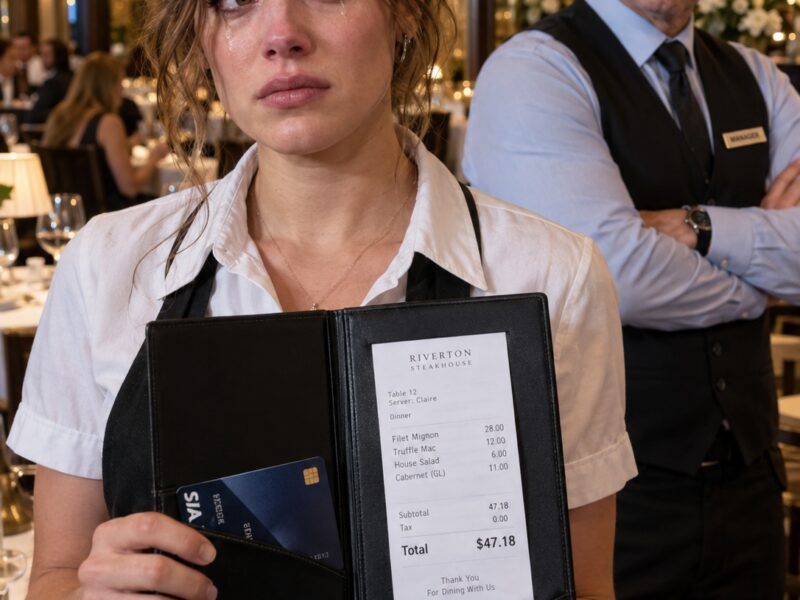
The Waitress Paid a Stranger’s $47 Bill—By Morning, She Had Lost Her Job… But She Had No Idea Who He Really Was

Claire Bennett had exactly eighty-three dollars left in her checking account when she paid a stranger’s forty-seven-dollar dinner bill.
She knew the number because she had checked her banking app during her break twenty minutes earlier, standing beside a humming commercial freezer with one shoe half-off because the back of her heel was bleeding.
Eighty-three dollars.
That was supposed to last until Friday.
Gas. Groceries. The electric bill she had promised her father she would handle.
And yet, when Claire saw the man standing beside table twelve while the restaurant manager questioned him like a thief in front of half the dining room, she reached into the pocket of her black apron and made a decision that would cost her almost everything she had left.
“Put his dinner on my card.”
The restaurant went strangely quiet.
The man turned toward her.
He was tall, maybe late thirties, wearing a dark suit that looked expensive even to someone who knew nothing about expensive suits. His tie was slightly loosened. His expression, until that moment, had been controlled.
But his eyes changed when he looked at her.
Not relieved.
Not exactly.
More like stunned.
“Claire,” her manager said sharply, “stay out of this.”
She didn’t.
And less than an hour later, she was standing in his office being fired.
What Claire did not know was that the embarrassed stranger she had just spent nearly sixty percent of her remaining money to help was Adrien Blackwood.
The Adrien Blackwood.
The billionaire whose company owned luxury hotels, office towers, residential developments, and enough commercial property to reshape entire sections of the city skyline.
A man who could have purchased the restaurant without noticing the money missing.
And before the next morning was over, that was exactly what he decided to do.
But when Claire walked out of the restaurant that night carrying her belongings in a paper grocery bag, she didn’t know any of that.
All she knew was that kindness had just gotten her fired.
And the worst part was that, even then, she still didn’t regret it.
Three hours earlier, Adrien Blackwood had been sitting in the back of a black Mercedes outside the Grand Meridian Hotel while half a dozen photographers waited beyond the glass doors.
“Mr. Blackwood!”
“Adrien, are the restructuring rumors true?”
“Are you selling the waterfront project?”
“Who are you meeting tonight?”
Camera flashes reflected across the tinted windows.
Adrien stared through them without expression.
His assistant, Marcus Reed, sat across from him, scrolling through messages on a tablet.
“You have dinner with Halpern at eight,” Marcus said. “Then the conference call with Singapore at ten-thirty.”
Adrien rubbed a hand over his face.
“Cancel dinner.”
Marcus looked up. “You postponed Halpern twice.”
“Make it three.”
“What about Singapore?”
“Keep it.”
Marcus waited.
Adrien could feel him waiting.
They had worked together long enough for Marcus to recognize the difference between Adrien being annoyed and Adrien being exhausted.
Tonight, it was exhaustion.
Not physical exhaustion.
Something worse.
For years, Adrien had built a life most people would have called extraordinary.
At thirty-nine, he controlled Blackwood Holdings, a private investment and development empire founded by his grandfather and expanded aggressively under Adrien’s leadership. Business magazines put his face on covers. Financial networks analyzed his decisions. Journalists photographed the restaurants where he ate and the women who happened to stand beside him.
He owned homes he rarely slept in.
Cars he rarely drove.
A jet he sometimes wished he could board without knowing where it was going.
He could make one call and have a private dining room cleared in any luxury restaurant in the city.
That evening, the thought made him tired.
“I want to eat somewhere nobody cares who I am,” he said.
Marcus lowered the tablet.
“That could be difficult.”
Adrien looked at him.
Marcus smiled slightly. “Occupational hazard.”
“I’m serious.”
“I know.”
Adrien loosened his tie.
“No security. No reservation. No assistant.”
Marcus frowned. “Adrien.”
“For two hours.”
“You have received three credible threats in the last eighteen months.”
“And survived all three.”
“That is not an argument.”
“It is tonight.”
Marcus studied him.
There were very few people who still called Adrien by his first name.
Marcus was one of them.
Finally, he exhaled.
“At least take your phone.”
Adrien reached for the door handle.
“I always have my phone.”
That would have been true on almost any other night.
But an hour earlier, after changing jackets at home, Adrien had set his wallet and phone on the marble console beside the front door while looking for his keys.
Then he had walked out without either one.
It would take him another two hours to discover the mistake.
By then, everything would already be changing.
Claire Bennett had been working at Bellamy’s for four days.
It was not the job she had imagined herself having at twenty-nine.
Two years earlier, she had been assistant manager at a neighborhood café owned by an older couple who treated employees like family. Then the building had been sold to developers, the rent tripled, and the café closed within six months.
After that came temporary jobs.
Catering.
Reception work.
A bakery.
Three months helping a friend manage a bookstore café.
Nothing lasted.
Bellamy’s was supposed to be stability.
It wasn’t glamorous, but it was busy, the tips were decent, and it was fifteen minutes from the small house Claire shared with her father.
Her father, Thomas Bennett, had been a high school history teacher for thirty-four years before retiring.
He was the kind of man who kept handwritten thank-you cards in a shoebox and still returned shopping carts even in heavy rain.
When Claire was nine, he once drove forty minutes back to a grocery store because the cashier had accidentally given him twenty dollars too much change.
“You know they’ll never know,” Claire had said from the passenger seat.
Thomas had smiled.
“That’s not the point.”
“What is the point?”
“The point is I’ll know.”
Claire remembered that sentence more often than she admitted.
Especially on difficult days.
And her fourth day at Bellamy’s had definitely become one of those.
At six-thirty, the restaurant was full.
Glasses clinked.
Silverware moved over white porcelain.
A jazz playlist played softly beneath conversations.
Claire balanced three plates along one arm while her manager, Gregory Wells, stood near the bar watching the dining room like a prison warden.
Gregory had explained his philosophy on Claire’s first day.
“Guests are numbers,” he had told her. “Tables need to turn. Complaints cost money. Mistakes cost money. Sentiment costs money. If you remember that, you’ll do fine.”
Claire had smiled politely.
She already suspected they would not like each other.
At seven-twenty, a man entered alone.
No reservation.
No visible phone.
No entourage.
Claire noticed him because almost everyone else did.
He carried himself with the quiet confidence of someone accustomed to entering rooms where people moved out of his way.
But he didn’t seem arrogant.
He seemed tired.
“Good evening,” Claire said, approaching him. “Table for one?”
“Yes.”
She picked up a menu.
“Window or quieter section?”
He glanced toward the crowded bar.
“Quieter.”
“Good choice.”
Something in her tone made him smile.
It was small, but genuine.
She led him to table twelve.
“My name’s Claire. I’ll be taking care of you tonight.”
He looked at the menu without opening it.
“Claire.”
“That’s me.”
“What do you recommend?”
She pointed toward the specials.
“The short rib is good, but if you want something less heavy, the roasted chicken is better than it sounds on paper.”
“Why does that sound like an apology for the chicken?”
Claire smiled.
“Because whoever wrote our menu has a talent for making good food sound boring.”
He laughed.
Actually laughed.
It caught him by surprise.
Claire noticed.
“So,” she said, “chicken?”
“Surprise me.”
“That is dangerous information to give a waitress you’ve known for thirty seconds.”
“I’ll take the risk.”
She turned to leave.
“Claire.”
She looked back.
“Nothing complicated.”
“That narrows it down.”
When she walked away, Adrien watched her weave between tables.
Something about the exchange had felt unusually easy.
No one had asked what company he owned.
No one had looked at him twice.
No one had tried to impress him.
For the first time that day, Adrien relaxed.
That, more than the food, was what he had come looking for.
Claire brought him the roasted chicken with garlic potatoes and grilled vegetables.
“Nothing complicated,” she said.
Adrien looked at the plate.
“It smells better than the dinner I canceled.”
“Don’t tell whoever cooked your canceled dinner.”
“I won’t.”
She poured water.
“Long day?”
Adrien hesitated.
Most people who asked him questions wanted something from the answer.
Claire sounded like she was simply asking.
“Yes.”
“That obvious?”
“Only a little.”
“What gave me away?”
“The tie.”
Adrien looked down.
“What about it?”
“It looks like you’ve been trying not to rip it off for at least an hour.”
He smiled.
“Accurate.”
Claire stepped away.
“Enjoy your dinner.”
For the next forty minutes, Adrien did.
No calls.
No meetings.
No questions about acquisitions.
No photographers.
At the table beside him, an elderly couple quietly argued about dessert.
Across the room, a mother cut spaghetti for a little boy.
Someone dropped a fork.
A server laughed near the kitchen.
Ordinary life moved around Adrien without paying attention to him.
He had forgotten how peaceful anonymity could feel.
When Claire returned, she gestured toward his empty plate.
“Either you liked it or you were extremely hungry.”
“Both.”
“I’ll tell the chef.”
“You should.”
She placed the bill folder on the table.
“No rush.”
Adrien nodded.
Then he opened it.
Forty-seven dollars and eighteen cents.
He almost smiled.
Forty-seven dollars.
He had once spent more than that on bottled water during a twelve-minute board meeting.
He reached into his jacket.
Nothing.
Adrien frowned.
Checked the other side.
Nothing.
He reached into his pants pocket.
Keys.
No wallet.
His expression changed.
He checked again.
Then every pocket a third time.
“No.”
He remembered the marble console.
His phone beside his wallet.
He reached inside his jacket again even though he already knew.
Nothing.
For a few seconds, Adrien sat very still.
It was almost funny.
Almost.
Then Gregory Wells appeared beside the table.
“Sir, is there a problem?”
Adrien looked up.
“I left my wallet at home.”
Gregory’s face hardened just slightly.
“And your phone?”
“That too.”
“Convenient.”
Adrien stared at him.
“Excuse me?”
Gregory crossed his arms.
“People occasionally discover they’ve forgotten their wallets when the bill arrives.”
“I’m sure they do.”
“And we have procedures.”
“I can return home, get my wallet, and come back.”
“We don’t allow unpaid guests to leave.”
Adrien felt several nearby conversations beginning to quiet.
He lowered his voice.
“I’m not attempting to avoid a forty-seven-dollar bill.”
Gregory’s expression didn’t change.
“Then pay it.”
“I just explained why I can’t.”
A couple at the next table glanced over.
Adrien could feel heat climbing into his face.
It had been decades since anyone had treated him as though he were trying to steal something.
Gregory extended a hand.
“Do you have identification?”
“In my wallet.”
“Of course.”
Adrien’s jaw tightened.
“Be careful.”
Gregory leaned closer.
“With what?”
“With deciding what kind of person someone is before you know anything about him.”
Gregory gave a humorless smile.
“I know you ordered forty-seven dollars’ worth of food you currently can’t pay for.”
A young server walking past slowed.
Someone whispered.
Adrien heard one sentence clearly.
“Maybe the suit is rented.”
Another person laughed.
The humiliation surprised him.
Not because it was catastrophic.
Adrien had survived lawsuits, public scandals, hostile negotiations, and reporters accusing him of things far worse.
But this felt different.
For the first time in years, he had no name to hide behind.
No assistant.
No security.
No corporate card.
He had wanted to be treated like an ordinary man.
Now he was discovering what that actually meant.
Gregory turned toward the hostess.
“Call security.”
“That won’t be necessary.”
Claire’s voice came from behind him.
Gregory looked over.
“Claire, stay out of this.”
She approached the table.
“What happened?”
Gregory sighed impatiently.
“Our guest forgot both his wallet and phone.”
Claire looked at Adrien.
“Did you?”
“Yes.”
There was no performance in his answer.
Only embarrassment.
Claire watched his face for several seconds.
“You really did, didn’t you?”
Adrien almost laughed.
“Yes.”
Gregory shook his head.
“You cannot possibly know that.”
“No,” Claire said. “I can’t.”
“Then don’t interfere.”
She looked around the room.
People were staring.
Adrien sat rigidly in his chair.
Claire had seen that look before.
Not the rich-man part.
She didn’t know about that.
The look of someone being publicly judged while trying not to show how deeply it was affecting him.
Her father used to say humiliation was cruelty performed for an audience.
Claire hated audiences.
She picked up the bill.
“I’ll pay it.”
Gregory blinked.
“What?”
Adrien stood.
“No.”
Claire turned toward him.
“You don’t have to.”
“That makes two of us.”
“It’s forty-seven dollars.”
“That is not the point.”
“Maybe not to you.”
Her voice softened.
“But right now you need a solution more than you need a point.”
Adrien stared at her.
“You don’t know me.”
“No.”
“I could be lying.”
“You could.”
“I could walk out that door and never come back.”
“You could do that too.”
“Then why?”
Claire looked briefly toward Gregory.
Then back at Adrien.
“Because everybody in this room has already decided the worst thing about you based on one mistake.”
Adrien said nothing.
Claire reached into her apron.
“And somebody should decide something better.”
Gregory stepped forward.
“Claire.”
She handed him her debit card.
“Put his check on this.”
“Absolutely not,” Adrien said.
She gave him a look.
“Do you want this conversation to continue for another twenty minutes?”
“No.”
“Then let me do one kind thing without turning it into a negotiation.”
“I negotiate for a living.”
“That explains a lot.”
Despite everything, Adrien smiled.
Gregory looked furious.
“This is against procedure.”
“No,” Claire replied. “The bill is being paid.”
“With your money.”
“Yes.”
“You have been employed here four days.”
“I’m aware.”
Gregory took the card.
The machine beeped.
Approved.
Forty-seven dollars and eighteen cents disappeared from Claire’s account.
Adrien watched the receipt print.
Something unexpectedly heavy settled in his chest.
He had received gifts worth millions.
Paintings.
Cars.
Watches.
Investment opportunities.
But he could not remember the last time someone had given him something while genuinely expecting nothing back.
Claire signed the receipt.
Adrien reached for it.
“Your last name.”
She frowned.
“What?”
“What’s your last name?”
“Bennett.”
“Claire Bennett.”
“Yes.”
“I’m going to pay you back.”
“You can if you want.”
“I will.”
She smiled.
“But don’t make it weird.”
Adrien stared at her.
“Make what weird?”
“Showing up here with some giant flower arrangement or something.”
He nearly laughed.
“I wasn’t planning flowers.”
“Good.”
She picked up the folder.
“Then just get home safely.”
Adrien hesitated.
“Claire.”
She paused.
“Thank you.”
Her expression changed.
Less joking now.
“You’re welcome.”
Then she turned away.
Adrien walked out of Bellamy’s believing the strangest part of his night was over.
He was wrong.
It had barely begun.
Claire finished her last table at nine forty-five.
Her feet hurt.
Her head hurt.
She kept thinking about the stranger.
Not because of his suit.
Not because he seemed important.
Because of the look on his face when Gregory had demanded proof that he wasn’t lying.
There had been anger in it.
But beneath the anger, something else.
A kind of exhaustion Claire recognized.
She hoped he had made it home.
At nine fifty-two, Gregory appeared beside the service station.
“My office.”
Claire looked up.
“Now?”
“Yes.”
The tone told her everything.
She followed him through the kitchen and down a short hallway.
Gregory closed the office door.
A printed employee handbook sat on his desk.
That was never a good sign.
He folded his hands.
“What you did tonight was inappropriate.”
Claire remained standing.
“I paid a customer’s bill.”
“You interfered with management.”
“There was nothing left to manage. The bill was paid.”
“You undermined me in front of customers.”
Claire stared at him.
“Is that what this is about?”
“This is about policy.”
“What policy says employees can’t pay a customer’s bill?”
“The policy that says staff members do not insert themselves into disputes between management and guests.”
“You were about to call security on a man because he forgot his wallet.”
“He could have been lying.”
“So could anybody.”
Gregory leaned back.
“This is exactly the problem.”
“What problem?”
“You believe your personal feelings override procedure.”
“I believe people deserve dignity.”
“This is a restaurant, Claire. Not a charity.”
“I didn’t ask the restaurant to pay.”
“You made us look foolish.”
Claire realized it then.
Not policy.
Pride.
Gregory had felt embarrassed because she solved the problem he had chosen to escalate.
And now someone had to pay for that embarrassment.
Apparently, it would be her.
Gregory slid a paper across the desk.
“Your employment is terminated effective immediately.”
For several seconds Claire simply looked at it.
Then at him.
“You’re firing me.”
“Yes.”
“Because I paid forty-seven dollars for someone’s dinner.”
“Because you disregarded instructions.”
Claire swallowed.
The electric bill flashed through her mind.
Her checking account.
Gas.
Groceries.
The résumé applications she had spent weeks sending.
Four days.
She had lasted four days.
A small, frightened part of her wanted to apologize.
To say she understood.
To ask for another chance.
Then she remembered Adrien sitting at the table while strangers laughed.
Claire picked up the termination paper.
“If the exact same thing happened tomorrow,” she said quietly, “I’d probably do it again.”
Gregory frowned.
“That attitude is precisely why this isn’t going to work.”
“Maybe.”
She opened the door.
“Claire.”
She looked back.
“You’ll need to return your apron.”
She untied it slowly.
Placed it on the desk.
Then walked away.
The other servers avoided her eyes as she cleaned out her locker.
Claire put a hairbrush, phone charger, water bottle, and spare pair of flats into a brown grocery bag.
No one said goodbye.
Outside, the night air was cold enough to sting.
She stood beneath the restaurant awning and looked through the windows at the tables she had been serving less than an hour earlier.
Four days.
Gone.
Her phone vibrated.
A text from her father.
Need anything from the store?
Claire stared at the screen.
Then typed:
No. Coming home.
She did not tell him about the job.
Not yet.
As she walked toward her car, Claire whispered to herself the same question she knew everyone else would ask.
Was helping one stranger really worth losing a paycheck?
The answer came faster than she expected.
“Yes.”
And somewhere across the city, the man she had helped had just discovered exactly what he had left behind.
Adrien stepped into his penthouse shortly after ten.
The foyer lights came on automatically.
And there, on the marble console beside the door, sat his wallet.
His phone was beside it.
Adrien stopped.
For two seconds he simply stared.
Then he laughed.
Not happily.
“You have got to be kidding me.”
He picked up the phone.
Forty-three missed notifications.
Eight calls from Marcus.
Two from legal counsel.
One from his sister.
Adrien ignored all of them.
Instead, he opened his wallet.
Cash.
Corporate cards.
Personal cards.
Enough purchasing power to buy the building he had just been publicly accused of trying to steal dinner from.
He thought of Claire.
Her debit card.
The small hesitation before she handed it over.
The way she had said, Somebody should decide something better.
Adrien called Marcus.
Marcus answered immediately.
“Do you know how many people have been trying to reach you?”
“I forgot my phone.”
Silence.
“And my wallet.”
Longer silence.
“You did what?”
“I need you to find someone.”
Marcus sighed.
“Of course you do.”
“Claire Bennett.”
“Who is Claire Bennett?”
“A waitress at Bellamy’s.”
Marcus paused.
“I’m going to need considerably more context.”
Adrien walked toward the windows.
The city glittered forty floors below him.
“She paid my dinner bill.”
“Why?”
“Because I couldn’t.”
“You couldn’t pay for dinner?”
“I forgot my wallet.”
Marcus made a sound Adrien had never heard from him before.
It might have been laughter.
“Are you enjoying this?”
“A little.”
“Find her.”
“What exactly am I finding?”
“Her contact information. And find out who owns Bellamy’s.”
Marcus became quiet.
That shift was immediate.
Business.
“Why?”
Adrien remembered Gregory’s face.
The whispering customers.
Claire handing over her card.
“I want to make sure she isn’t punished for what happened.”
Marcus stopped joking.
“I’ll look into it.”
Adrien ended the call.
He should have gone upstairs.
Showered.
Prepared for Singapore.
Instead, he stood beside the glass for a long time thinking about a woman who had known nothing about him.
That was the part he could not stop replaying.
Claire had not helped Adrien Blackwood.
She had helped a stranger everyone else had decided not to trust.
And Adrien couldn’t remember the last time anyone had done something for him without knowing what his name could buy.
At eleven thirty-eight, Marcus called back.
Adrien answered immediately.
“That was fast.”
“You told me to find her.”
“And?”
Marcus hesitated.
“She was fired tonight.”
Adrien’s expression went still.
“What?”
“Bellamy’s terminated her after closing.”
“Why?”
“According to someone on staff, she violated policy by interfering with management.”
Adrien looked toward the city.
“She was fired because she paid my bill.”
“That appears to be what happened.”
“Who owns Bellamy’s?”
“A small hospitality group. Langford Dining Partners. They have six properties. Bellamy’s is the weakest performer.”
“Value?”
Marcus knew that question.
“Adrien.”
“Value.”
“Property included?”
“Yes.”
“I’d need numbers.”
“Estimate.”
Marcus exhaled.
“Several million.”
“Buy it.”
Silence.
Then:
“I’m sorry?”
“Buy Bellamy’s.”
“You want to purchase a restaurant because a waitress bought you dinner?”
“It isn’t about dinner.”
“It is currently midnight and you have instructed me to purchase an entire restaurant after losing your wallet.”
Adrien’s voice lowered.
“They fired her for being decent when they had every opportunity to be decent themselves.”
Marcus was quiet.
Adrien continued.
“I want the property. The operating company. Everything.”
“And after you own it?”
Adrien stared at the reflection of himself in the glass.
For years, money had solved problems before he even knew they existed.
But most solutions left him feeling nothing.
This felt different.
“We give it to Claire.”
Marcus laughed once, then realized Adrien was serious.
“You want to give a multimillion-dollar restaurant to a woman because she spent forty-seven dollars on you.”
“No.”
“Then explain it.”
Adrien turned away from the window.
“I want to give something meaningful to someone who showed me kindness when she believed I had absolutely nothing to offer her.”
Marcus said nothing.
Adrien added quietly:
“There’s a difference.”
Claire’s father was still awake when she arrived home.
Thomas Bennett sat at the kitchen table in flannel pajama pants and an old university sweatshirt, reading a mystery novel beneath the yellow pendant light.
He looked over his glasses.
“You’re early.”
Claire set the grocery bag on the counter.
“Sort of.”
Thomas closed the book.
“What happened?”
“Nothing.”
“Claire.”
She leaned against the refrigerator.
Her father had always possessed an irritating ability to detect lies that involved the word nothing.
She sighed.
“I got fired.”
Thomas stared at her.
“Four days?”
“Technically.”
“What did you do?”
Claire told him.
The forgotten wallet.
The manager.
The customers staring.
Forty-seven dollars.
The office.
When she finished, Thomas was silent.
Claire opened the refrigerator although she wasn’t hungry.
“You can say it.”
“Say what?”
“That I was irresponsible.”
“I was going to ask if he got home safely.”
Claire turned.
“What?”
“The man.”
Thomas shrugged.
“He sounded embarrassed.”
Claire stared at him.
Then laughed softly.
“I knew you were going to be impossible about this.”
“Do you regret paying?”
“No.”
“Do you regret being fired?”
“Yes.”
Thomas smiled.
“Those are two different questions.”
Claire closed the refrigerator.
“I have eighty-three dollars.”
“Had.”
“Thank you for the correction.”
“You live here.”
“I’m twenty-nine, Dad.”
“You say that every time you need help.”
“Because it’s embarrassing.”
“No. Asking strangers for forty-seven-dollar dinners is embarrassing.”
Claire laughed despite herself.
Thomas became serious.
“You did something kind.”
“And got punished for it.”
“That happens.”
“That’s comforting.”
“I didn’t say kindness always gets rewarded.”
“Then what are you saying?”
Thomas folded his hands.
“That doing the right thing only when it rewards you isn’t kindness. It’s a transaction.”
Claire looked down.
“I really needed that job.”
“I know.”
For a moment neither spoke.
Then Thomas stood and kissed the top of her head.
“You’ll find another one.”
Claire wanted to believe him.
At that exact moment, her old manager’s phone was ringing.
And on the other end of the call was a lawyer representing the man Claire had helped.
By morning, Bellamy’s would no longer belong to the people who had fired her.
The acquisition was completed with the kind of speed only wealthy people and very motivated lawyers could produce.
Langford Dining Partners had been considering selling Bellamy’s for months.
Revenue was declining.
The building needed renovations.
The owners were carrying debt.
When Blackwood Holdings made a cash offer significantly above market value with a forty-eight-hour closing condition, Langford accepted before lunch.
Marcus called Adrien from his office.
“It’s done.”
Adrien looked up from a financial report.
“All of it?”
“Building. Brand. Operating assets.”
“Good.”
“I assume now comes the unreasonable part.”
Adrien leaned back.
“Claire will never accept it if she knows it came from me.”
Marcus stared through the video call.
“You’re giving her a restaurant. She is likely to notice.”
“Not immediately.”
“What are you proposing?”
“A promotional employee ownership raffle.”
Marcus removed his glasses.
“That sounds legally complicated.”
“That is why we employ lawyers.”
“And morally?”
Adrien’s expression shifted.
“I’m not trying to manipulate her.”
“You are concealing the giver.”
“Because I don’t want gratitude.”
Marcus studied him.
Adrien continued.
“If I hand her keys to a restaurant and say I bought it because she helped me, she’ll feel obligated.”
“So instead you want her to believe she won.”
“At first.”
“You know she will eventually find out.”
“Yes.”
“And then?”
“I’ll explain.”
Marcus sighed.
“I have worked for you thirteen years.”
“I know.”
“This is easily in the top five strangest things you have ever done.”
“Only top five?”
“I’m including the vineyard.”
“The vineyard was a sound investment.”
“You bought it because the owner insulted your wine.”
Adrien smiled.
“Still profitable.”
Marcus shook his head.
“All right. I’ll structure it properly.”
“And Gregory Wells?”
“The manager?”
“Yes.”
“What about him?”
Adrien thought carefully.
Firing Gregory immediately would be easy.
Too easy.
“Leave him for now.”
Marcus raised an eyebrow.
“You don’t want revenge?”
“No.”
“What do you want?”
Adrien looked down at the desk.
“For him to see what he misjudged.”
The call reached Claire at eleven fourteen the next morning.
She was at the dining room table filling out an application for a hotel café when her phone rang from an unknown number.
“Hello?”
“May I speak with Claire Bennett?”
“This is Claire.”
“Ms. Bennett, I’m calling on behalf of Bellamy’s ownership administration.”
Claire sat straighter.
“If this is about my termination—”
“It isn’t.”
“Oh.”
“Actually, I’m calling with some unusual news.”
Claire glanced toward her father, who was watering a plant by the window.
“What kind of news?”
“Your name was selected as the recipient of Bellamy’s employee ownership promotion.”
Claire frowned.
“I’m sorry. What?”
“You’ve won ownership of the restaurant.”
She stared at the wall.
“I think you have the wrong Claire Bennett.”
“We don’t.”
“I worked there four days.”
“That does not affect eligibility.”
“I was fired.”
“The selection occurred based on the employee roster before termination.”
Claire stood.
“What exactly did I win?”
“The business and property.”
Her mouth went dry.
“The building?”
“Yes.”
“The restaurant?”
“Yes.”
“All of it?”
“Yes.”
Claire started laughing.
Not because anything was funny.
Because the alternative was screaming.
“This is a scam.”
“It is not.”
“You’re telling me I won a restaurant worth millions in a raffle I don’t remember entering.”
“There was no purchase required. Employees were automatically included.”
“I need the name of your lawyer.”
“Of course.”
The caller provided it.
Then an address.
Documents.
A time to meet the following morning.
When Claire hung up, Thomas looked at her.
“Who died?”
“No one.”
“You look like someone died.”
Claire slowly lowered the phone.
“Apparently I won a restaurant.”
Thomas blinked.
“The one that fired you?”
“Yes.”
“The whole restaurant?”
“Yes.”
Thomas considered this.
“Well.”
“Well what?”
“That’s unusual.”
Claire stared at him.
“That is your response?”
“I’m retired. I’m allowed to underreact.”
“This is not real.”
“Probably not.”
“They gave me a law firm.”
“Could still be fake.”
“They knew my employment dates.”
“Still suspicious.”
“They want me there tomorrow.”
Thomas set down the watering can.
“Then we verify everything.”
Claire nodded.
Her instincts were screaming.
Something was wrong.
She just had no idea how wrong.
The next morning, Claire returned to Bellamy’s wearing jeans, a navy blouse, and the only blazer she owned.
The restaurant was closed.
A sign on the door read:
PRIVATE EVENT
Marcus Reed waited inside.
Claire recognized immediately that he did not belong to Bellamy’s.
Everything about him seemed controlled.
Suit.
Posture.
Watch.
Even the way he offered his hand.
“Claire Bennett?”
“Yes.”
“Marcus Reed.”
“You called me?”
“My office did.”
“What exactly is happening?”
Marcus gestured toward a table.
“Sit down.”
“I’d rather stand.”
He almost smiled.
“All right.”
Claire folded her arms.
“I had an attorney review the documents you sent.”
“That was smart.”
“He says they’re real.”
“They are.”
“He also says someone purchased this business two days ago.”
Marcus said nothing.
Claire stepped closer.
“So this raffle story is nonsense.”
“Not exactly.”
“Don’t do that.”
“Do what?”
“Answer half of a question and hope I don’t notice.”
Marcus considered her.
Adrien had described Claire as direct.
He had underestimated her.
Claire placed a copy of the ownership transfer on the table.
“The previous company sold Bellamy’s. Twenty-four hours later, I somehow win it.”
“Yes.”
“The odds of that being random are ridiculous.”
Marcus stayed silent.
Claire’s voice tightened.
“Who bought the restaurant?”
“I’m not authorized to disclose that.”
“Then I’m not signing anything.”
Marcus looked surprised.
“You would walk away from ownership?”
“If I don’t understand why I’m being given it.”
“Most people wouldn’t ask.”
“I’m not most people.”
“No,” Marcus said quietly. “You are apparently not.”
Claire caught the phrasing.
“Apparently?”
Marcus looked toward the entrance.
Then back at her.
“There is someone who can answer your questions.”
“Who?”
“A person you’ve already met.”
Claire felt something cold move through her stomach.
“Who?”
Marcus paused.
“The man whose dinner you paid for.”
Claire stared.
“What does he have to do with this?”
“Everything.”
The front door opened.
Claire turned.
And the stranger from table twelve walked into the restaurant.
This time, he wasn’t alone.
Two men in dark suits remained discreetly outside.
Claire looked from them to Adrien.
Then back to Marcus.
The room suddenly felt much smaller.
Adrien stopped several feet away.
“Hello, Claire.”
She stared at him.
“You.”
“That’s usually how people greet me after I disappear owing them forty-seven dollars.”
She didn’t smile.
“What is happening?”
Adrien looked at Marcus.
“Give us a minute.”
Marcus nodded and walked toward the bar.
Claire’s arms remained crossed.
“You bought this place.”
“Yes.”
“You bought an entire restaurant.”
“Yes.”
“After I paid your dinner bill.”
“Yes.”
She laughed once.
“You’re insane.”
“That is not the first time someone has suggested it.”
“I’m serious.”
“So am I.”
“Who are you?”
Adrien reached into his pocket and placed a business card on the table.
Claire looked down.
ADRIEN BLACKWOOD
BLACKWOOD HOLDINGS
CHAIRMAN & CEO
She read it twice.
Then looked at him.
“Blackwood.”
“Yes.”
“Blackwood Holdings.”
“Yes.”
“The hotels?”
“Yes.”
“The towers?”
“Some of them.”
Claire stared at him.
“You’re a billionaire.”
Adrien looked uncomfortable for the first time.
“I usually avoid introducing myself that way.”
“You let them accuse you of trying to steal a forty-seven-dollar meal.”
“I didn’t exactly have documentation proving otherwise.”
“You could have said who you were.”
“I did tell Gregory he didn’t know who he was speaking to.”
Claire gave him a flat look.
“That sounds exactly like something a man pretending to be rich would say.”
Adrien laughed.
She didn’t.
“You bought this place because I paid forty-seven dollars?”
“No.”
“That is literally what happened.”
“I bought this place because they fired you for doing it.”
Claire’s expression shifted.
Adrien stepped closer.
“You were kind to me when you believed I had nothing.”
“I thought you forgot your wallet.”
“You didn’t know if I was telling the truth.”
“No.”
“You helped anyway.”
“That doesn’t mean I deserve a restaurant.”
“I didn’t say you deserved it because you paid my bill.”
“Then why?”
Adrien looked around the empty room.
“When I walked into this place that night, I wanted to be nobody.”
Claire frowned.
He continued.
“I spend most of my life around people who know exactly who I am before I say a word. They know my company. My properties. My money. They know what they want from me.”
His voice softened.
“For two hours, you didn’t.”
Claire stopped moving.
“You treated me like a person.”
“You were a person.”
“To you.”
The sentence hung between them.
Adrien glanced toward table twelve.
“When the bill came, everyone else suddenly saw me as something less.”
Claire followed his eyes.
“And you didn’t.”
“I only paid your dinner.”
“No.”
Adrien looked at her.
“You protected my dignity.”
Claire’s throat tightened.
She hated how sincere he sounded.
Because sincerity made it harder to refuse.
“I can’t take this.”
“Yes, you can.”
“No.”
“Claire—”
“No.”
She stepped away.
“You spent millions of dollars because I spent forty-seven.”
“I spend millions on things that mean less every day.”
“That doesn’t make this normal.”
“I’m not claiming it is.”
“I don’t want to owe you.”
“You don’t.”
“I would.”
“You don’t.”
“You cannot give someone a restaurant and pretend there are no strings.”
Adrien’s expression hardened slightly.
“There are no strings.”
“There are always strings with money.”
He went quiet.
Claire realized she had touched something deeper than the argument.
Adrien looked toward the windows.
“You’re probably right.”
She hadn’t expected that.
He continued.
“That’s why I tried the raffle.”
Claire stared at him.
“You lied to me.”
“I concealed the source.”
“That is a very expensive way to spell lied.”
A reluctant smile crossed his face.
She ignored it.
Adrien nodded.
“All right. I lied.”
“Why?”
“Because I knew you wouldn’t take it.”
“You were correct.”
“I also didn’t want you feeling like you had to thank me.”
Claire shook her head.
“This is unbelievable.”
Adrien moved toward the table.
“The ownership is yours whether you sign today or next month. No debt. No hidden agreement. No obligation to Blackwood Holdings.”
“And if I refuse?”
“I’ll respect it.”
“You won’t keep trying?”
“No.”
“You won’t suddenly appear with a hotel?”
“Probably not.”
“Adrien.”
“No.”
She studied him.
He seemed almost amused, but there was nervousness beneath it.
A billionaire nervous that a waitress might reject his gift.
The absurdity almost made her smile.
Almost.
“I need time.”
“Take it.”
“I mean real time.”
“I understand.”
“You’re not going to call every day.”
“No.”
“Send Marcus.”
Adrien looked offended.
Marcus, standing thirty feet away, muttered, “Thank you.”
Claire finally smiled.
It disappeared quickly.
She picked up the documents.
“I’m leaving.”
Adrien nodded.
When she reached the door, he spoke.
“Claire.”
She turned.
“I meant what I said.”
“Which part?”
“The restaurant isn’t payment.”
“Then what is it?”
Adrien thought for a moment.
“A chance for what happened here not to be the end of the story.”
Claire looked at him.
Then walked out.
For the first time in years, Adrien Blackwood had made an offer he desperately wanted someone to accept.
And money gave him no control over the answer.
Thomas read every page.
Twice.
Claire sat across from him at the kitchen table.
“I can’t do it.”
Thomas kept reading.
“It’s legal.”
“I know.”
“No debt.”
“I know.”
“The taxes are covered for the first year through the transfer structure.”
“I know.”
“Operating reserve included.”
“Dad.”
He lowered the papers.
“What?”
“Tell me this is ridiculous.”
“It is ridiculous.”
“Thank you.”
“So was paying a stranger’s dinner when you only had eighty-three dollars.”
“That is not comparable.”
“No.”
Thomas smiled.
“Yours was proportionally more generous.”
Claire groaned.
“Please don’t make this sentimental.”
“I’m not.”
“Yes, you are.”
Thomas leaned back.
“What are you actually afraid of?”
Claire looked toward the window.
“That it changes me.”
“A restaurant?”
“Money.”
“Does money automatically change people?”
“I don’t know.”
Thomas thought.
“Maybe it removes excuses.”
Claire frowned.
“What does that mean?”
“When people have nothing, they can blame survival for their choices. When they have something, you start seeing what they really value.”
Claire looked down at the documents.
“He shouldn’t have done this.”
“Probably not.”
“I barely know him.”
“True.”
“What if he expects something later?”
“Then you tell him no.”
“What if I fail?”
Thomas smiled gently.
There it was.
The real question.
Claire’s voice became quieter.
“I’ve never owned anything.”
“You’ve managed restaurants.”
“Cafés.”
“You understand people.”
“That does not make me an owner.”
“No. Work does.”
She looked at him.
Thomas tapped the papers.
“If you accept this, you don’t owe Adrien Blackwood obedience.”
“What do I owe?”
“Responsibility.”
“To him?”
“No.”
Thomas pointed toward the restaurant documents.
“To every person who walks through those doors.”
Claire’s eyes filled unexpectedly.
Her father continued.
“You got fired because someone thought kindness made you weak.”
He pushed the papers toward her.
“Maybe you should show them what happens when kindness is put in charge.”
Claire stared at the signature line for a long time.
Then reached for a pen.
Adrien returned to Bellamy’s three days later.
No press.
No formal meeting.
No security visible inside.
Claire was standing behind the bar with a contractor reviewing renovation estimates.
She looked up.
“You came back.”
Adrien slipped his hands into his coat pockets.
“I heard there’s a new owner.”
Claire raised an eyebrow.
“She hasn’t thrown you out yet?”
“Not yet.”
The contractor excused himself.
Adrien looked around.
Several tables had been moved.
The harsh overhead lighting near the bar was gone.
A wall had been painted a warmer color.
“You’re changing it.”
“I thought that was the point.”
“What are you changing first?”
“Management.”
Adrien looked at her.
“Gregory?”
“I fired him this morning.”
He waited.
“Are you disappointed?”
“No.”
“You wanted to do it yourself.”
Adrien smiled.
“Maybe.”
Claire leaned against the bar.
“I didn’t fire him because of me.”
“Why did you?”
“I talked to the staff.”
Her expression became serious.
“He’d been docking breaks. Manipulating schedules when people complained. Cutting tips for mistakes.”
Adrien’s face tightened.
“Did Langford know?”
“They didn’t ask.”
“What did you tell him?”
Claire picked up a glass and polished it.
“That humiliating people is not a management strategy.”
Adrien laughed.
“He took it badly?”
“He said I was too emotional to run a restaurant.”
“And?”
“I told him he was right. Then I asked security to walk him out.”
Adrien looked impressed.
“Remind me never to upset you.”
“You already gave me a building without asking.”
“Fair.”
Claire set down the glass.
“I hired two people back.”
“Who?”
“A dishwasher he fired last month and a server who quit after he cut her hours.”
Adrien nodded.
“You’ve been busy.”
“I haven’t slept.”
“That sounds familiar.”
“You should try owning a restaurant.”
“I hear it’s exhausting.”
Claire looked at him.
For several seconds neither said anything.
Then Adrien pointed toward table twelve.
“Is my table available?”
“Your table?”
“I suffered there.”
“You ate chicken.”
“I was publicly humiliated.”
“You survived.”
“Barely.”
Claire sighed theatrically.
“Fine.”
Adrien sat.
She handed him a menu.
“What can I get you?”
“Surprise me.”
Claire paused.
Then smiled.
“Nothing complicated?”
“Please.”
And just like that, something began.
Not romance.
Not yet.
Something quieter.
A familiarity.
A ritual.
Adrien started coming to Bellamy’s once a week.
Then twice.
Sometimes for lunch.
Sometimes late enough that Claire was closing.
At first, he insisted he was checking on his “investment.”
Claire reminded him repeatedly that he no longer owned it.
Then he claimed the food was exceptional.
Claire pointed out that he owned three restaurants with Michelin stars through various partnerships.
“None of them have your chicken,” he said.
“It’s not my chicken.”
“It’s emotionally yours.”
“That sentence makes no sense.”
“I’m wealthy. People usually pretend my sentences make sense.”
“I can see how that became a problem.”
He laughed more around Claire than he did almost anywhere else.
Marcus noticed first.
“You have been eating an alarming amount of roasted chicken.”
Adrien looked up from his desk.
“It’s good.”
“You own a chef.”
“No human being owns a chef.”
“You employ one full-time.”
“That is different.”
Marcus folded his arms.
“You like her.”
Adrien returned to his papers.
“Don’t.”
“I didn’t say anything.”
“You were about to.”
“I was going to say you have developed a strong emotional attachment to poultry.”
Adrien ignored him.
Marcus smiled.
The truth was simpler and more complicated.
Adrien liked being around Claire because she did not behave differently when he arrived.
She argued with him.
Made fun of his suits.
Refused to let him reserve the restaurant for himself.
Once, he asked if she would close Bellamy’s for an evening so he could bring investors.
“No.”
Adrien blinked.
“No?”
“We have seventeen reservations.”
“I’ll cover the revenue.”
“Those people already made plans.”
“They can come another night.”
“So can your investors.”
Adrien stared at her.
Nobody spoke to him that way.
Claire smiled.
“See you Tuesday.”
Strangely, he did.
Then the photographs appeared.
Adrien arrived for lunch on a Thursday afternoon.
Claire sat across from him during her break.
They were laughing about one of Thomas Bennett’s increasingly blunt opinions about restaurant ownership when camera flashes exploded outside the window.
Claire turned.
Three photographers stood on the sidewalk.
“What is that?”
Adrien’s expression changed instantly.
“Stay here.”
He stood.
More flashes.
Claire looked around.
Customers were beginning to notice.
A reporter shouted through the glass.
“Adrien! Who’s the woman?”
Claire froze.
“What?”
Adrien moved toward the window.
Security appeared almost immediately from a vehicle parked across the street.
Claire stared at him.
“You brought security?”
“They stay outside.”
“You said you came alone.”
“I said I came in alone.”
Another flash.
A photographer pointed directly at Claire.
She instinctively stepped backward.
Adrien moved between her and the window.
“Don’t photograph her.”
The photographers shouted louder.
“Is she your girlfriend?”
“Is this the waitress?”
“Did Blackwood buy Bellamy’s for her?”
Claire’s stomach dropped.
She looked at Adrien.
“How do they know?”
“I don’t know.”
“Adrien.”
“I don’t.”
His jaw tightened.
Security blocked the entrance.
For the first time, Claire saw the other side of his life.
Not the money.
The exposure.
Everyone wanting a piece.
Everyone interpreting ordinary moments before they happened.
Adrien turned toward her.
“I’m sorry.”
“Why?”
“You never asked for this.”
Claire looked toward the window.
One photographer pressed his camera against the glass.
“Does this happen every time you go somewhere?”
“Not every time.”
“Most times?”
Adrien didn’t answer.
That was answer enough.
Claire looked at him.
Suddenly the man who had come to Bellamy’s alone made more sense.
“You really were running away that night.”
Adrien looked at her.
“I wasn’t running away from people.”
“Then what?”
He glanced toward the cameras.
“Being watched.”
That sentence stayed with Claire long after security cleared the sidewalk.
By evening, the story was everywhere.
BILLIONAIRE ADRIEN BLACKWOOD SPOTTED WITH MYSTERY WOMAN
Another headline went further.
THE $47 WAITRESS WHO WON A MILLIONAIRE’S ATTENTION
Claire stared at her phone.
“Millionaire?”
Thomas looked over her shoulder.
“That’s inaccurate.”
“Dad.”
“He’s a billionaire.”
“That is not the issue.”
Thomas read another headline.
“‘Cinderella waitress.’ That’s insulting.”
“Thank you.”
“You’re almost thirty.”
Claire slowly turned.
“That is the part you find insulting?”
“I’m trying to support you.”
She threw a dish towel at him.
But underneath the humor was fear.
Within days, strangers found her social media accounts.
Old photographs were reposted.
Comments appeared beneath pictures from college.
Some called her a gold digger.
Others claimed Adrien had bought the restaurant because they were secretly dating.
One website estimated the value of every piece of clothing Claire had worn in public.
Most of the estimates were wrong.
Her coat was from Target.
No one guessed that.
Claire hated it.
She hated feeling observed in the grocery store.
Hated wondering whether phones were pointed at her.
Hated reading stories about a version of herself she didn’t recognize.
Adrien stopped coming to Bellamy’s.
Five days passed.
Then seven.
Claire told herself she preferred it.
The restaurant needed her attention.
There were payroll issues.
Supplier contracts.
Hiring.
Renovations.
She had plenty to do.
But every time the door opened around lunchtime, she looked up.
On the eighth day, she called him.
Adrien answered after one ring.
“Claire.”
“You stopped coming.”
A pause.
“I thought it would make things easier.”
“Did I ask you to?”
“No.”
“So why did you decide for me?”
Adrien exhaled.
“The attention is because of me.”
“I know.”
“I didn’t want your life becoming collateral damage.”
Claire sat at table twelve.
“You don’t have to protect me by disappearing.”
He was quiet.
“That is a very specific sentence.”
“Maybe because somebody needs to say it to you.”
Adrien didn’t respond.
Claire continued.
“I don’t like the cameras.”
“I know.”
“I hate the articles.”
“I know.”
“I especially hate being called Cinderella.”
He laughed softly.
“But?”
“But I can decide what I can handle.”
Adrien went quiet again.
Finally:
“Are you telling me I can come back?”
“I’m telling you your favorite chicken is getting cold.”
He arrived twenty-three minutes later.
Their friendship changed after that.
Not dramatically.
No grand confession.
No cinematic kiss in the rain.
It changed in small places.
Adrien began staying after closing.
He would remove his jacket, roll up his sleeves, and sit at the bar while Claire finished paperwork.
Sometimes they talked.
Sometimes they didn’t.
Claire learned that Adrien hated television interviews.
Adrien learned that Claire sang badly when she thought nobody was listening.
Claire learned that he remembered the birthdays of almost everyone who worked directly for him but rarely remembered his own plans outside work.
Adrien learned that she still checked restaurant receipts herself because she didn’t trust the new accounting software.
One night, at almost midnight, Claire caught him staring at an empty dining room.
“What?”
Adrien shook his head.
“Nothing.”
“That means something.”
He smiled.
“You sound like your father.”
“Don’t insult me.”
“I like your father.”
“My father thinks you’re emotionally repressed.”
Adrien looked offended.
“He told you that?”
“He told you that.”
Adrien remembered.
Thomas had indeed said it during dinner.
“What does your father not say?”
“Very little.”
Claire sat on the stool beside him.
“Seriously.”
Adrien looked toward table twelve.
“I was thinking about that first night.”
“The night you forgot everything an adult is supposed to carry?”
“Yes.”
“Memorable.”
“I was furious.”
“At Gregory?”
“At everyone.”
Claire waited.
“And embarrassed.”
“That too.”
Adrien traced one finger around the rim of his water glass.
“I wanted to be anonymous.”
“You got your wish.”
“Yes.”
His smile faded.
“And it taught me something I didn’t particularly enjoy learning.”
“What?”
“That a great deal of the respect I receive belongs to my name.”
Claire considered this.
“Not all of it.”
“How would you know?”
“Because Marcus respects you.”
Adrien smiled.
“Marcus is paid.”
“He also tells you when you’re being stupid. That’s more expensive.”
Adrien laughed.
Claire continued.
“And your employees don’t look terrified when you walk into a room.”
“Some do.”
“Then stop buying companies.”
“No.”
She smiled.
Adrien’s expression softened.
“You didn’t know who I was.”
“No.”
“You still helped.”
“Yes.”
“Why?”
Claire leaned back.
“You’ve asked me that before.”
“I didn’t believe the answer.”
She thought for a moment.
Then said:
“Because you looked alone.”
Adrien’s smile disappeared.
Claire immediately wondered if she had gone too far.
He looked down at his hands.
“Was it that obvious?”
“Only to someone who knows the feeling.”
Adrien looked at her.
For the first time, Claire wished she could take the sentence back.
Not because it wasn’t true.
Because it was.
After her mother died when Claire was twenty-one, she and Thomas had learned that grief could make a house feel crowded and empty at the same time.
Years later, loneliness still appeared unexpectedly.
On birthdays.
At weddings.
During quiet drives home.
Adrien seemed to understand without asking.
He didn’t reach for her.
Didn’t say he was sorry.
He simply sat beside her.
Sometimes that was better.
After several minutes, Claire smiled faintly.
“You still owe me forty-seven dollars.”
Adrien turned.
“I gave you a restaurant.”
“That was unsolicited.”
He stared at her.
“You are never letting this go.”
“Absolutely not.”
The next morning, Claire found a plain white envelope taped beneath table twelve.
Inside were forty-seven one-dollar bills.
No note.
She laughed so hard one of the cooks came out of the kitchen to check on her.
Months passed.
Bellamy’s changed.
Claire changed it slowly.
Not into something trendy.
Into something warmer.
She removed the rigid reservation rules that had once kept families waiting despite empty tables.
She created a staff meal before evening service.
She added paid emergency days.
She established a small fund employees could use for transportation or unexpected expenses.
She promoted people who understood customers rather than simply controlling them.
Revenue increased.
Reviews improved.
The dining room became busier.
One Friday afternoon, Marcus walked in carrying a folder.
Claire looked up.
“Is Adrien okay?”
Marcus smiled.
“Why is that your first question?”
“Because you never come without him.”
“I’m offended.”
“You should visit more.”
He handed her the folder.
“What is this?”
“Your quarterly financials.”
“I already have them.”
“These are comparative.”
Claire opened the folder.
Her eyes widened.
“We’re up twenty-eight percent?”
“Thirty-one if you normalize renovation closure days.”
Claire stared at the page.
Marcus leaned against the bar.
“Adrien was right.”
“About what?”
“You.”
Claire closed the folder.
“Don’t tell him that.”
“I definitely will.”
“He’ll become impossible.”
“He already is.”
Claire smiled.
Marcus started toward the door.
“Marcus.”
He turned.
“Why did he really buy this place?”
Marcus considered lying.
Then didn’t.
“The reason he told you.”
“That’s not what I’m asking.”
Marcus studied her face.
Claire continued.
“Adrien could have gotten me another job. Could have paid me back. Could have complained to the old owners.”
“Yes.”
“He bought the building.”
“Yes.”
“Why?”
Marcus looked out the window.
“When Adrien’s mother died, he was twenty-four.”
Claire knew vaguely that Adrien’s parents were gone, but not details.
Marcus continued.
“His father handled grief by working. Adrien handled it by becoming like his father.”
“What does that mean?”
“He built things.”
Marcus gestured toward the skyline.
“Hotels. Towers. Companies.”
Claire listened.
“He spent fifteen years solving every problem with scale.”
“And?”
Marcus looked at her.
“You were the first person I’d seen in a very long time who made him wonder whether something small might matter more.”
Claire felt the words land somewhere she wasn’t prepared to examine.
Marcus smiled gently.
“That is why he bought the restaurant.”
Then he left.
That evening, Adrien arrived at eight.
Claire looked at him differently.
He noticed immediately.
“What did Marcus tell you?”
She blinked.
“How do you know Marcus told me something?”
“Because he was here and you’re looking at me like I’m emotionally complicated.”
“You are emotionally complicated.”
“I’m firing Marcus.”
“You can’t fire everyone who tells me things.”
“Watch me.”
Claire smiled.
Adrien sat at his usual table.
She joined him.
“You know you didn’t have to buy Bellamy’s.”
“I know.”
“You could have just said thank you.”
“I did.”
“A normal thank-you.”
“I’m unfamiliar with normal.”
“I noticed.”
Adrien smiled.
Then Claire became serious.
“I understand now.”
His expression changed.
“Understand what?”
“Why you did it.”
Adrien looked away.
“I told you why.”
“Part of it.”
He didn’t ask what Marcus had said.
He probably already knew.
Claire placed her hand on the table between them.
Not touching his.
Close.
“For what it’s worth,” she said, “I’m glad you walked in that night.”
Adrien looked at her.
“You were fired.”
“I’ve recovered.”
“You lost forty-seven dollars.”
“You paid it back one dollar at a time like a psychopath.”
“You laughed.”
“I did.”
Adrien’s eyes stayed on hers.
“Claire.”
Something in his voice made the room around them seem suddenly distant.
She knew what was coming.
Or thought she did.
Then a flash exploded against the window.
They both turned.
A photographer stood outside.
Claire groaned.
“You have got to be kidding me.”
Adrien laughed.
And the moment passed.
But neither of them forgot it.
The real turning point came two weeks later.
Claire arrived at Bellamy’s at six in the morning and found Adrien sitting outside on the sidewalk bench.
No security visible.
No suit.
Dark jeans.
Gray sweater.
Coffee in one hand.
Claire stopped.
“You know we’re closed.”
“I was told the owner occasionally arrives early.”
“Who told you?”
“Your father.”
“Traitor.”
She unlocked the door.
Adrien didn’t move.
“You coming in?”
“In a minute.”
Claire noticed then that something was wrong.
She sat beside him.
“What happened?”
Adrien looked at the coffee.
“Board meeting.”
“That bad?”
“I’ve had worse.”
“Then what?”
He was quiet.
Claire waited.
Finally he said:
“Blackwood Holdings closed the acquisition we’ve been working on for eleven months.”
Claire frowned.
“That sounds good.”
“It is.”
“How much?”
Adrien gave her a number.
Claire stared.
“That is not a number. That is the GDP of a small island.”
He smiled faintly.
“But?”
Adrien looked toward the empty street.
“Everyone congratulated me.”
“Still sounds normal.”
“I felt nothing.”
Claire said nothing.
Adrien continued.
“I spent eleven months on it.”
His jaw tightened.
“Teams in four countries. Thousands of hours. Everyone said it would be one of the most important deals we’ve ever done.”
“And?”
“And I felt more when you handed over forty-seven dollars.”
Claire looked at him.
Cars moved through the intersection.
A delivery truck stopped across the street.
The city was waking.
Adrien turned toward her.
“That scares me.”
“Why?”
“Because I know how to measure companies.”
He smiled without humor.
“I know how to value real estate. Debt. Revenue. Risk.”
His voice dropped.
“I have no idea how to measure this.”
“This?”
He looked at her.
Claire stopped breathing for half a second.
“This.”
There was no dramatic music.
No crowd.
No perfect sentence.
Just Adrien Blackwood sitting on a sidewalk bench before sunrise, admitting that the one thing he could not control terrified him.
Claire looked down.
“You don’t have to measure everything.”
“I know.”
“Do you?”
“I’m learning.”
She smiled slightly.
Adrien reached toward her hand, then stopped.
That hesitation mattered.
Claire closed the distance herself.
Their fingers touched.
Adrien looked down at them.
Then at her.
“You’re sure?”
Claire smiled.
“About holding your hand?”
“About anything involving me.”
She thought about the photographers.
The money.
The headlines.
The strange first night.
The restaurant.
The impossible gift.
Then she thought about Adrien sitting beside her after closing, listening more than he spoke.
“I’m sure enough.”
Adrien laughed softly.
“I’ll take it.”
And for once, he did not try to turn uncertainty into a contract.
Their first real date happened at a diner forty minutes outside the city.
Claire chose it.
“No photographers.”
Adrien looked around.
“Probably because no one knows this place exists.”
“Exactly.”
The waitress called him honey.
Claire nearly choked laughing.
Adrien ordered pancakes.
The billionaire who owned multiple luxury hotels spent twenty minutes trying to get maple syrup out of a sticky glass dispenser.
Claire took a picture.
“If that appears online, I’ll deny everything.”
“I’m framing it.”
“You’re cruel.”
“You bought me a restaurant.”
“That remains your answer to everything.”
“It’s effective.”
Later, while driving back toward the city, Adrien asked:
“Do you ever wish none of this happened?”
Claire looked out the passenger window.
“What part?”
“Losing the job.”
“No.”
“The media?”
“Yes.”
“The restaurant?”
“No.”
“Me?”
Claire turned.
Adrien kept his eyes on the road, but she saw the tension in his jaw.
She smiled.
“Ask me again when you forget your wallet on our date.”
“I now carry three.”
“That is deeply unhealthy.”
“I learn from trauma.”
Claire laughed.
Then reached over and took his hand.
Adrien relaxed.
No answer was needed.
Six months after the night of the forgotten wallet, Bellamy’s hosted an employee appreciation dinner.
Claire refused to call it a gala.
Adrien had suggested one.
She threatened to ban him from the restaurant.
So there were no photographers.
No champagne towers.
No red carpet.
Just employees, families, food, and music.
Thomas sat near the window telling Marcus an unnecessarily long story about Claire getting suspended in tenth grade for arguing with a substitute teacher.
“I was defending another student,” Claire protested.
Thomas raised his glass.
“Exactly.”
Adrien leaned toward her.
“You’ve always been difficult.”
“I prefer principled.”
“Of course you do.”
At nine, Claire stood near the center of the dining room holding a microphone.
She hated microphones.
Everyone knew.
That made the applause louder.
“I’m not giving a speech.”
More applause.
She rolled her eyes.
“Six months ago, I worked here for four days.”
Laughter.
“Then I got fired.”
More laughter.
“Please stop enjoying that.”
Adrien smiled from table twelve.
Claire continued.
“I thought losing that job was one of the worst things that could happen to me.”
Her voice softened.
“Turns out I was wrong.”
The room quieted.
“I used to believe kindness was something simple. You helped someone because it was right. You didn’t keep score.”
She looked toward Thomas.
“My dad taught me that.”
Thomas lowered his eyes.
Claire swallowed.
“But this place taught me something else.”
She looked around the dining room.
“Kindness isn’t weakness. It isn’t bad management. It isn’t naïve.”
Her gaze moved toward the cooks, servers, bartenders, hosts.
“It’s a decision about what kind of place you want to build.”
Adrien watched her.
Claire’s eyes found his.
“And sometimes one small decision changes more than you could ever predict.”
After the dinner, everyone slowly left.
Marcus drove Thomas home.
The staff finished cleaning.
By midnight, Claire and Adrien were alone.
They sat at table twelve.
The same table.
Adrien looked toward the seat where he had sat that first night.
“I hated this table.”
Claire laughed.
“You keep coming back.”
“I have better memories now.”
Claire leaned back.
“Do you remember exactly what you said?”
“When?”
“When you realized you forgot your wallet.”
Adrien frowned.
“I probably said something elegant.”
“You said, ‘No. It can’t be.’”
“That sounds elegant.”
“You checked the same pocket four times.”
“I was being thorough.”
“You panicked.”
“I do not panic.”
“You absolutely panicked.”
Adrien smiled.
Then his expression softened.
“I remember what you said.”
Claire tilted her head.
“What?”
“Right now, you just need someone to believe you.”
She looked down.
“I barely remember saying it.”
“I do.”
The restaurant was quiet.
Lights from the street reflected across the windows.
Adrien reached across the table.
Claire put her hand in his.
“I spent most of my life thinking the biggest things mattered most,” he said.
“Buildings.”
“Companies.”
“Deals.”
“Numbers.”
Claire smiled.
“You do like numbers.”
“I hate one number now.”
“What number?”
“Forty-seven.”
She laughed.
Adrien looked at her.
“No, actually.”
His voice became quieter.
“I love that number.”
Claire squeezed his hand.
“Why?”
“Because it was the first time in years somebody gave me something I couldn’t buy.”
Her eyes softened.
“You could absolutely buy dinner.”
“That isn’t what you gave me.”
“What did I give you?”
Adrien looked around Bellamy’s.
Then back at Claire.
“A reason to believe being seen and being known weren’t the same thing.”
Claire said nothing.
For a moment, Adrien looked almost embarrassed by his own honesty.
She smiled.
“You’ve been spending too much time with my father.”
“Possibly.”
“And what was the restaurant?”
Adrien thought.
“A very excessive thank-you.”
“Finally.”
“I never denied that.”
“You absolutely denied it.”
“I said it was meaningful.”
“You bought real estate because your feelings got hurt.”
Adrien laughed.
“Are you ever going to let me sound romantic?”
“Probably not.”
“Good.”
He stood.
Claire looked up.
“Where are you going?”
Adrien walked around the table.
He held out his hand.
She took it.
“What?”
“There’s something I should have done months ago.”
Claire narrowed her eyes.
“If you bought another building—”
“I didn’t.”
“A car?”
“No.”
“Jewelry?”
“No.”
“Adrien.”
He pulled her gently closer.
“For once, there’s no money involved.”
“That’s reassuring.”
He looked at her.
“Claire Bennett.”
“Yes?”
“Can I kiss you?”
She stared at him for two seconds.
Then smiled.
“You negotiate for a living and that’s your opening?”
“I’m nervous.”
“You?”
“Apparently.”
Claire placed a hand against his chest.
“Good.”
“Good?”
“It keeps you human.”
Then she kissed him.
No cameras flashed.
No headlines appeared.
No one applauded.
The restaurant was empty except for two people standing beside the table where everything had started.
And that was exactly how Adrien wanted it.
A year later, Bellamy’s no longer looked like the restaurant Claire had first walked into wearing a cheap black apron and hoping she could make enough tips to survive the month.
The walls were warmer.
The staff stayed longer.
Families returned.
People knew Claire’s name.
Not because she was the billionaire’s girlfriend.
Not because of the articles.
Because she was there.
Every day.
Opening doors.
Checking tables.
Talking to cooks.
Remembering which employees had children graduating.
Asking customers whether they actually liked the food instead of pretending reviews didn’t matter.
Near the entrance, Claire eventually installed a small framed sign.
No explanation.
No dramatic plaque.
Just seven words.
KINDNESS IS NEVER WASTED. — THOMAS BENNETT
Her father complained that his name was too large.
Claire ignored him.
Adrien loved it.
One rainy evening, a young couple came into Bellamy’s near closing.
They ate quickly.
Then the man reached into his jacket.
His expression changed.
He checked again.
Then looked at the woman across from him.
“I left my wallet in the car.”
The server hesitated.
The man stood.
“I’ll get it.”
Outside, rain poured against the windows.
Before he could move, Claire appeared beside the table.
“It’s fine.”
He looked embarrassed.
“I’m not trying to leave.”
“I know.”
“I can run out.”
“You’ll be soaked.”
Claire took the bill folder.
“Finish your coffee.”
The man looked at her.
“You trust me?”
Claire smiled.
There had once been a time when that question would have sounded ordinary.
Now it carried an entire history inside it.
“Yeah,” she said.
“I do.”
From across the restaurant, Adrien watched.
He was sitting at table twelve.
His wallet was in his pocket.
His phone was beside his plate.
He had checked both before leaving home.
Twice.
Claire walked back toward him.
“Don’t say it.”
Adrien smiled.
“I wasn’t going to.”
“You were.”
“Possibly.”
She sat across from him.
Outside, the rain continued.
Inside, the restaurant glowed beneath warm lights.
Adrien reached across the table.
Claire took his hand.
Neither of them mentioned the forty-seven dollars.
They didn’t need to anymore.
Because the money had never been the part that mattered.
Not really.
Forty-seven dollars had not transformed Claire’s life because it made a billionaire grateful.
And Adrien’s life had not changed because he bought a restaurant.
Everything changed because, for one uncomfortable moment in a crowded dining room, a man had lost the protection of his name, his money, and his power.
And a woman who had almost nothing to spare had looked at him without any of those things and decided he was still worth helping.
Claire had lost her job that night.
Adrien had lost his anonymity.
But somewhere between a forgotten wallet, a public humiliation, and a debit card Claire could barely afford to use, they had both found something far rarer than money.
They had found a person who saw them clearly.
Years later, Adrien would still remember the skyscrapers he built.
Claire would still remember the restaurant she saved.
There would be bigger deals.
Harder years.
Arguments.
Headlines.
Successes neither of them could yet imagine.
But when people eventually asked Adrien Blackwood which investment had changed his life most, he never mentioned a company.
He never mentioned a hotel.
He never mentioned the towers carrying his family name.
He would simply smile and say:
“Forty-seven dollars.”
And Claire, standing close enough to hear him, would always roll her eyes.
Because she knew the truth.
It had never been about forty-seven dollars.
It had been about the one thing money could imitate but never truly purchase.
Someone choosing to believe in you when they had absolutely nothing to gain.
And sometimes, that was enough to change everything.









