THE WAITRESS SPOKE ONE SENTENCE IN GERMAN—AND THE MAFIA BOSS STOPPED SIGNING HIS OWN DEATH WARRANT
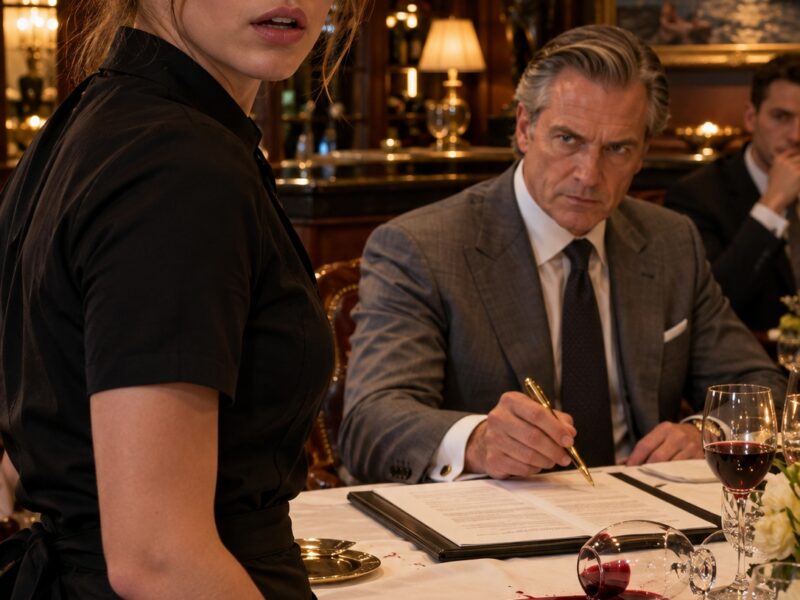
Blair Mercer knew a man was about to die three seconds before he uncapped the gold pen.
Nobody else in the private dining room seemed to know it.
Not the two German businessmen sitting beneath the amber pendant lights with their pale, patient smiles. Not Dieter Vogel, the sweating translator whose expensive gray suit had begun to darken beneath the arms. Not the massive bodyguard standing silently against the paneled wall with both hands folded in front of him.
And certainly not Leo Castiglione.
Leo sat at the head of the mahogany table with a contract worth tens of millions open beneath his scarred hands, listening calmly while Dieter translated the words of the men who had just arranged his execution.
Blair stood twelve feet away holding a bottle of 2009 Barolo.
She was supposed to be invisible.
That was the first rule of the private rooms at Osteria Vero.
You entered quietly. You kept your eyes low. You remembered who wanted sparkling water and who wanted still. You replaced silverware before anyone had to ask. You heard nothing, saw nothing, and forgot every name before your shift ended.
Rich men liked service workers best when they resembled furniture.
Blair had spent almost six years becoming very good furniture.
Tonight, that talent might get a man killed.
Klaus Brenner leaned slightly toward his associate and spoke in German, his voice low enough that he clearly believed no one on Leo’s side of the table could understand him.
“Wenn er unterschreibt, ist es vorbei.”
Once he signs, it’s over.
Blair’s fingers tightened around the wine bottle.
Henrik gave a faint nod.
Then Klaus said the sentence that made every hair on her arms rise.
“Die Scharfschützen sind Donnerstag auf den Kränen. Er kommt lebend nicht vom Dock.”
The snipers will be on the cranes Thursday.
He does not leave the dock alive.
Dieter turned toward Leo.
He smiled.
“My clients appreciate your flexibility,” he translated smoothly. “They believe Thursday’s transfer will establish a long and profitable relationship between our organizations.”
Blair stared at him.
For one absurd second, she wondered if exhaustion had finally broken something inside her head.
She had been awake since six that morning. It was nearly midnight. Her right heel had been bleeding inside her discount black pump for almost two hours, and she had eaten exactly half a dinner roll while hiding beside the kitchen freezer at nine-thirty.
Maybe she had misunderstood.
Except she hadn’t.
She knew German.
Not the clean German taught in universities.
Not the German of language apps and business conferences.
Blair knew the kind spoken behind train stations at two in the morning, in bars where nobody asked why your passport was missing, in cheap apartments where rent changed depending on who was asking.
She had lived in Frankfurt for four years.
Long enough to understand exactly what Scharfschützen meant.
Snipers.
Leo lowered his gaze to the contract.
Blair felt something cold spread beneath her ribs.
Just leave.
The thought came hard and clear.
Walk out.
Bring the bottle back to the sommelier station. Cash out. Take the Red Line home. Feed Barnaby. Put ointment on the blister. Sleep until noon.
Leo Castiglione was not her problem.
Everyone in the city knew enough about the Castiglione name to lower their voices when they said it.
Restaurants paid for “security.”
Bookmakers disappeared.
Construction permits appeared mysteriously after months of delays.
Politicians who publicly condemned organized crime somehow attended the same charity galas as Leo.
Blair had no illusions about the man sitting ten feet away.
He was not a misunderstood businessman.
He was dangerous.
Maybe he deserved whatever was coming.
Then Dieter slid the gold pen toward him.
And Blair saw his hand shaking.
Not Leo’s.
Dieter’s.
It was small. Barely visible. A faint tremor in two fingers before he tucked his hand beneath the table.
Blair looked at Klaus.
Klaus was watching Leo with the expression of a man observing an animal walk toward a trap.
Not anger.
Not fear.
Contempt.
That was what changed everything.
Blair knew that look.
She had seen it on the face of the man she had followed to Germany at nineteen, three weeks before he emptied her savings account and disappeared with her passport.
She had seen it on landlords who realized a foreign girl had nowhere else to sleep.
She had seen it on drunk customers who snapped their fingers at waitresses and laughed when the women flinched.
It was the look of someone convinced another human being was too stupid, too weak, or too insignificant to matter.
Blair hated that look.
Leo picked up the pen.
Klaus murmured something else.
“Lass den Idioten unterschreiben.”
Let the idiot sign.
Blair stopped breathing.
Dieter translated, “Mr. Brenner says he’s pleased we’ve reached an understanding.”
The gold nib hovered over the paper.
Blair’s brain screamed at her to stay quiet.
Her body made a different decision.
She stepped toward the table.
Her heel caught the edge of the rug.
This part was intentional.
The gasp she made was not.
The bottle tipped.
Dark red Barolo surged across the table and directly into Dieter Vogel’s lap.
Dieter shrieked.
The chair flew backward.
“What the hell is wrong with you?”
Klaus and Henrik rose instantly.
So did Leo’s bodyguard.
A black pistol appeared in his hand with such speed Blair never saw him draw it.
For half a second every person in the room froze.
Then Leo said one word.
“Easy.”
His voice was quiet.
The room obeyed him.
Blair dropped to her knees.
“I’m sorry. God, I’m so sorry.”
Her hands shook as she grabbed linen napkins and began blotting wine from the table.
Dieter cursed above her. “You stupid little—do you know what this suit costs?”
“No, sir.”
“More than you make in a year.”
“That seems financially irresponsible.”
The words escaped before she could stop them.
Dieter stared down at her.
Leo’s bodyguard made a strange sound that might have been a cough.
Blair lowered her head.
Great.
She was going to die sarcastic.
She shifted closer to Leo’s chair while pretending to wipe the table.
Three inches.
Maybe four.
Close enough to smell cedar, expensive soap, and the faintest trace of gun oil.
Leo remained perfectly still.
Blair wiped harder.
“Don’t sign it,” she whispered.
No reaction.
Her heart struck her ribs.
“Your translator is lying.”
Leo’s fingers stopped moving.
That was all.
Blair swallowed.
“Klaus said there’ll be snipers Thursday. On the cranes at the docks.”
Silence.
She kept wiping.
“He said you won’t leave alive.”
Still nothing.
Then Leo calmly placed the cap back onto his pen.
“Enough.”
Blair recoiled as though he were scolding her for the spill.
She stood.
Dieter was still dabbing frantically at his trousers. “Mr. Castiglione, I apologize for the interruption. Obviously the staff here—”
“I’ve changed my mind.”
Dieter stopped.
Leo leaned back.
Across the table, Klaus’s expression changed by perhaps half a degree.
It was enough.
“About what?” Dieter asked.
“Thursday.”
“But we agreed—”
“I no longer like Thursday.”
Dieter blinked. “Why?”
Leo looked directly at Klaus.
“Because now it feels rushed.”
The quiet became suffocating.
Klaus spoke sharply in German. “Was ist das?”
What is this?
Dieter replied too quickly.
Leo watched them.
Then his gaze shifted to Blair.
For the first time that night, he truly looked at her.
Blair had served powerful men before.
Most looked through her.
Some looked at her body.
Leo looked as though he were taking apart a machine he had never seen before, studying every component to decide whether it was useful or dangerous.
Possibly both.
“Mr. Brenner,” Leo said, “we’ll continue tomorrow.”
Klaus didn’t move.
“We have a deal.”
“We almost had a deal.”
Klaus’s eyes narrowed.
Leo’s bodyguard took one step away from the wall.
The message was unmistakable.
Klaus buttoned his coat.
“This is insulting.”
Leo’s mouth barely moved.
“Then imagine how insulted I’ll be if you’re still here thirty seconds from now.”
Henrik muttered a curse.
Klaus said something vicious under his breath as both men headed for the door.
Blair understood every word.
She wished she didn’t.
The oak door closed behind them.
The click sounded louder than a gunshot.
Dieter stood by the table, his wine-soaked pants forgotten.
Blair remained beside the service cart.
Leo sat perfectly still for several seconds.
Then he looked at his bodyguard.
“Rocco.”
The giant locked the door.
Dieter went white.
“Leo.”
Leo rose.
“Sit down.”
“Leo, listen—”
“Sit.”
Dieter sat.
Blair looked toward the door.
Rocco noticed.
He said nothing.
He didn’t need to.
Leo walked slowly around the table and stopped in front of Blair.
Up close, he looked older than she had first thought.
Early forties, perhaps.
The scar along his eyebrow was pale enough to have been there for years. His nose had been broken more than once. Exhaustion sat beneath his eyes like bruises.
He held out his hand.
Blair stared at it.
“The bottle.”
“Oh.”
She gave it to him.
Leo placed the nearly empty Barolo on the table.
“What’s your name?”
“Blair.”
“Last name.”
“Mercer.”
“Where did you learn German, Blair Mercer?”
She hesitated.
“Frankfurt.”
“How long?”
“Four years.”
“School?”
“No.”
Something flickered in his face.
“What, then?”
“Bad decisions.”
Rocco glanced at her.
Leo almost smiled.
Almost.
He turned toward Dieter.
“Tell me exactly what Klaus said.”
Dieter swallowed. “Leo, this is insane. You’re taking the word of a waitress?”
“No.”
Leo moved to the chair opposite him.
“I’m giving my translator the opportunity to explain why my waitress understands German better than he does.”
Dieter’s jaw tightened.
“She misunderstood.”
Blair felt the old instinct return.
Stay silent.
Men like Dieter survived by making people like Blair doubt themselves.
Maybe that was why she spoke.
“He said Scharfschützen.”
Dieter’s eyes snapped toward her.
Blair continued, “He said they’d be positioned Thursday on the cranes. Then he said Leo wouldn’t leave the dock alive.”
“She’s lying.”
“He called him an idiot too.”
Dieter stood.
“You ignorant little—”
Rocco moved.
One second Dieter was standing.
The next he was back in the chair, shocked into silence after Rocco struck him once across the face.
Blair recoiled.
Leo didn’t.
“Stay seated,” Leo said.
Blood appeared beneath Dieter’s nose.
The sight turned Blair’s stomach.
This was the moment the night stopped feeling like an accident.
Everything before it—the German, the wine, the contract—could almost be folded into a story she might someday tell herself differently.
This could not.
She was standing in a locked room with men who did not call police.
Dieter pressed a napkin under his nose.
“They threatened my family.”
Nobody spoke.
His breathing grew ragged.
“Klaus knows about my gambling. He knows what I owe. He said if I didn’t make the translations favorable, he’d go after my wife. My daughters.”
Leo studied him.
“How many men?”
Dieter hesitated.
Rocco shifted.
“Two hundred,” Dieter whispered.
Leo’s expression did not change.
“Where?”
“The old foundry near Route 9.”
“Armed?”
“Yes.”
“What kind of personnel?”
“Former military. Private contractors. Some local.”
“How many at the docks Thursday?”
“I don’t know.”
Rocco moved closer.
Dieter corrected himself immediately. “Thirty, maybe forty. Snipers, assault teams, drivers. Klaus wanted the transfer codes before he killed you. Once he controls gate access, he controls the incoming freight.”
Leo stared at him for a long moment.
Then he stood.
“Rocco.”
Dieter’s face collapsed.
“No. Leo. Please.”
“Take him downstairs.”
“I told you everything.”
“You told me after you were caught.”
“My daughters—”
Leo’s face hardened.
“Your daughters are precisely why you should have come to me before you sold mine.”
Dieter froze.
Blair caught the word.
Mine.
Not business.
Not territory.
Mine.
There were people behind the word.
Drivers. Dockworkers. Families. Men who would be standing beside Leo when the bullets came.
Dieter looked at Blair.
Hatred filled his face.
“You.”
Rocco gripped his shoulder.
“You did this.”
Blair’s mouth went dry.
Dieter pointed at her.
“He’ll kill you too. You think you saved him? You think men like him let witnesses go home?”
Rocco dragged him toward the private exit.
Dieter fought now.
His expensive shoes scraped desperately against the carpet.
“Ask her, Leo! Ask her if she thinks she walks away!”
The door slammed.
Silence rushed in.
Blair stared at it.
Then at Leo.
Her pulse was so hard she could see it in the edge of her vision.
“I’d like to leave.”
Leo poured himself water.
“I imagine you would.”
“I have another shift tomorrow.”
He drank.
Blair stared.
“What?”
She could hear hysteria entering her own voice.
“I’m trying to remain employed.”
“Your commitment is admirable.”
“Are you making fun of me?”
“A little.”
She stepped backward.
“I didn’t see anything. I don’t know anyone. I spilled a bottle. That’s it.”
Leo set down the glass.
“You understood a murder plot.”
“I’m prepared to forget.”
“Klaus isn’t.”
Her hand stopped halfway toward the door.
Leo’s voice softened.
“He saw when you spilled the wine.”
“That was an accident.”
“We both know it wasn’t.”
“Klaus doesn’t.”
Leo said nothing.
Blair’s stomach sank.
“He does?”
“He may not know what you heard. But he knows the timing changed immediately after you touched the table. Men who survive as long as Klaus do not dismiss coincidences.”
“He dismissed me all night.”
“That was before I canceled the deal.”
She felt cold.
Leo walked to the sideboard, picked up her order pad, and flipped through it.
Two espressos.
One amaro.
No onions table twelve.
Pick up dry cleaning.
Call landlord about radiator again.
A whole ordinary life squeezed into pencil marks.
He looked at her.
“If you walk out the front door tonight, Klaus will know your name before breakfast.”
Blair tried to laugh.
Nothing came out.
“He’ll get the employee roster,” Leo continued. “Then payroll. Then your address. Your phone. Anyone you call regularly.”
Barnaby.
The thought hit her absurdly hard.
She pictured the orange cat sleeping on the back of her couch beside the broken radiator.
“What are you saying?”
“I’m saying you stopped being invisible.”
Blair’s throat tightened.
“So what now?”
Leo met her eyes.
“Now you come with me.”
“No.”
“Yes.”
“No.”
“Blair.”
“I saved you. That does not make me your employee.”
“No. But understanding what Klaus is saying makes you useful.”
“I quit.”
“You haven’t started.”
“I pre-quit.”
Something almost human appeared in Leo’s eyes.
Then it vanished.
“Tomorrow, Klaus will request another meeting. He needs my access codes. That means he cannot kill me yet unless he believes the deal is lost.”
“Sounds like you have it handled.”
“I need to know what he tells his own men.”
“You have people.”
“I have people who speak German.”
“Then use them.”
“They speak embassy German.”
Blair folded her arms.
“Embassy German?”
“They’ll understand invoices. Klaus’s men will speak in shorthand, dialect, street language. Tonight you caught something Dieter thought nobody else in the room could catch.”
Leo stepped closer.
“I need that again.”
Blair stared at him.
“I wait tables.”
“So did you six hours ago.”
“I still wait tables.”
“Not tomorrow.”
Anger finally beat fear.
“You don’t get to decide that.”
Leo’s eyes sharpened.
“You are correct.”
Blair blinked.
He continued, “Klaus decided it for both of us when he heard you breathe in that room.”
That landed harder.
Leo took his phone from his pocket.
“I can protect you while this is happening.”
“And after?”
A pause.
“After, you make your own choices.”
She almost believed him.
That frightened her more than the threat.
“I want money.”
Leo’s eyebrows lifted.
Blair swallowed.
“If you’re kidnapping me into international organized crime, I want hazard pay.”
“You think this is kidnapping?”
“You locked the door.”
“That was Rocco.”
“He works for you.”
“Fair.”
“Fifty percent up front.”
“Of what amount?”
Blair had no idea.
She thought of her overdrawn checking account.
Her landlord.
The collection letters she hid in a kitchen drawer.
“Fifty thousand.”
Leo stared at her.
Blair’s face heated.
Too much.
Then he said, “Done.”
Her mouth opened.
He reached for his coat.
“You should have asked for more.”
That was the first moment Blair fully understood how far from her old life she had already fallen.
Twenty minutes later, she was standing in the alley behind Osteria Vero while rain darkened the shoulders of her cheap wool coat.
A black armored SUV idled beside a dumpster.
Blair looked at it.
Then at Leo.
“Where are we going?”
“Somewhere Klaus can’t reach you.”
“That is not an address.”
“It’s the one you’re getting.”
She glanced toward the mouth of the alley.
Freedom was maybe fifty yards away.
A train station.
Streetlights.
People.
Normal people.
Leo opened the SUV door.
Blair didn’t move.
He looked at her.
“If you run, I will not chase you.”
She searched his face.
“Really?”
“Yes.”
“Why?”
“Because Klaus will.”
The rain slid down the back of her neck.
Blair got into the car.
The interior smelled of leather and peppermint.
She sat as far from Leo as possible.
He opened a tablet.
For several minutes neither spoke.
The SUV moved through downtown, rain turning neon signs into streaks of red and electric blue.
Blair watched people under umbrellas.
A couple arguing beside a bus shelter.
A delivery cyclist swearing at a taxi.
A woman carrying grocery bags.
It felt impossible that their night belonged to the same universe as hers.
Leo tossed a black phone onto the seat between them.
“Use this.”
“Where’s mine?”
“Disposed of.”
Blair whipped toward him.
“You threw away my phone?”
“Klaus can track it.”
“You could have told me before you destroyed my property.”
“You can invoice me.”
“My entire life was in that phone.”
“That is a modern tragedy.”
She glared at him.
“My photos.”
“Cloud backup?”
“Yes.”
“Then your life survives.”
She hated that he had an answer.
Then she remembered.
“My cat.”
Leo looked up.
“What?”
“My cat is at my apartment.”
He stared as though waiting for the rest.
“That’s the whole sentence.”
“You want me to retrieve your cat.”
“Barnaby has asthma.”
Leo slowly closed his eyes.
Blair pressed on.
“He needs medication in the bathroom cabinet. Top shelf. And his food is the pâté kind, not shreds.”
Leo looked toward the driver.
“Marco.”
“Yes, boss.”
“Send two men.”
Blair leaned forward.
“Two?”
Leo looked at her.
“One to secure the apartment. One to retrieve the cat.”
“That seems excessive.”
“So does naming a cat Barnaby.”
“He came with the name.”
“Of course he did.”
Blair sat back.
The smallest laugh escaped her.
She covered it immediately.
Leo looked out the window.
For a moment, the room with the contract felt far away.
Then Blair noticed dried blood on the cuff of his shirt.
Not his.
Her amusement vanished.
“Is Dieter dead?”
Leo’s jaw tightened.
“Do you want the answer?”
She looked at the rain.
“No.”
“Then don’t ask questions whose answers you can’t carry.”
The sentence stayed with her for the rest of the drive.
The safe house was not a house.
It was a penthouse hidden inside the top three floors of an unmarked building overlooking the river.
There were cameras in the elevator, armed men behind discreet doors, and windows that could disappear behind steel shutters at the touch of a button.
Blair entered wearing a thirty-dollar coat with a hole in one pocket.
Nobody laughed.
That somehow made her feel worse.
A woman named Sofia showed her to a bedroom.
“Everything you need is inside.”
“I need my cat.”
Sofia barely blinked.
“He is coming.”
Of course everyone knew.
Blair sat on the edge of a bed larger than her entire first apartment in Frankfurt.
For the first time since she heard Klaus whisper Thursday, nobody was speaking to her.
Nobody needed anything.
The silence cracked her open.
Her hands began shaking.
Then her shoulders.
She pressed both palms against her face.
What had she done?
Dieter had looked at her when Rocco dragged him away.
You did this.
Maybe he was right.
She had watched men lie before.
She had watched people hurt each other.
She had learned early that survival often meant minding your own business.
Tonight she had violated the only rule that had ever reliably protected her.
Stay invisible.
Her bedroom door opened a fraction.
Blair shot upright.
A giant orange head appeared.
“Barnaby?”
The cat trotted inside with the irritated confidence of an animal who had apparently accepted organized crime without philosophical difficulty.
Blair dropped to the floor.
Barnaby wheezed, sneezed once, and head-butted her chin.
She buried her face in his fur and began crying.
Not elegantly.
Not one cinematic tear.
She cried so hard she had to bite the sleeve of her coat to stay quiet.
A shadow passed the doorway.
Blair looked up.
Leo stood there.
He had removed his jacket.
His black shirt sleeves were rolled to his forearms.
For several seconds he said nothing.
Blair wiped her face.
“Don’t.”
“I didn’t say anything.”
“You were thinking something.”
“I was thinking the cat is larger than expected.”
Barnaby glared at him.
“He’s sensitive.”
“He looks like he collects debts.”
Despite herself, Blair laughed through the tears.
Leo rested one hand against the doorframe.
“Sleep.”
“I don’t think I can.”
“You can.”
“How?”
His expression changed.
The tiredness returned.
“You close your eyes and allow tomorrow to be tomorrow.”
“That work for you?”
“No.”
“Then terrible advice.”
“Probably.”
He started to leave.
“Leo.”
He stopped.
It was the first time she had used his name.
“What happens tomorrow?”
He looked back at her.
“Tomorrow Klaus believes I still don’t understand him.”
“And if he realizes you do?”
Leo’s face emptied of warmth.
“Then tomorrow becomes very short.”
Blair did not sleep for a long time.
When she finally did, she dreamed in German.
She woke to Barnaby wheezing beside her face and a woman with a blond bob wheeling twelve thousand dollars’ worth of clothing into the room.
“Absolutely not.”
The woman ignored her.
“Mr. Castiglione wants you in the study in forty-five minutes.”
“I’m not wearing any of that.”
“Then you can explain that to Mr. Castiglione.”
“Gladly.”
Forty minutes later, Blair stood before a mirror wearing a charcoal silk pantsuit and heels that felt specifically designed to punish women for having toes.
Her hair had been pulled into a sleek knot.
Makeup erased the exhaustion beneath her eyes.
She barely recognized herself.
The waitress was gone.
In her place stood a woman who looked like she billed corporations by the hour.
Blair hated her immediately.
Leo was in the study loading a magazine into a handgun.
The metallic click stopped her in the doorway.
He looked up.
His gaze traveled over the suit.
“Good.”
“These shoes are crimes against humanity.”
“You’ll survive.”
“I’m less certain every minute I know you.”
Leo tucked the gun beneath his jacket.
“Klaus moved the meeting.”
Blair’s irritation vanished.
“Where?”
“Pier Forty-Two.”
“That sounds bad.”
“It is.”
“Then don’t go.”
Leo gave her a look.
“Right. Mafia. Ego. Territory.”
“Something like that.”
He picked up a silver pen from the desk.
“Klaus believes the new location gives him control.”
“Does it?”
“For twelve minutes.”
“That is very specific.”
“It needs to be.”
Leo held out the pen.
Blair took it.
It was heavier than expected.
“What’s this?”
“A signal.”
He moved closer.
“You stay one step behind my right shoulder.”
“I remember.”
“You hear Klaus order movement against us, you drop the pen.”
“That’s it?”
“That’s it.”
“And then?”
“Get down.”
Blair stared at him.
“You’re planning a shootout.”
“I’m planning to survive one if Klaus starts it.”
“He has two hundred men.”
“Not at the pier.”
“How many do you have?”
“Enough.”
“I hate answers like that.”
“They are easier to remember.”
Blair looked at the pen.
Then at the gun beneath his jacket.
“Why are you doing this?”
Leo tilted his head.
“Going to the meeting.”
“Because if I disappear now, Klaus moves immediately against the docks. People who have no idea this war exists get caught in it.”
“You mean your people.”
“Yes.”
There was no performance in the word.
Blair thought again about the way Leo had said mine.
She lowered her voice.
“You could leave.”
“So could you.”
“That’s different.”
“Why?”
“Because I don’t own half the city.”
“No.”
Leo’s eyes held hers.
“But you still walked back into that room.”
The argument died in her throat.
Pier Forty-Two was colder than Blair expected.
Harbor wind cut through silk like paper.
The warehouse sat beside black water beneath a sky the color of dirty steel.
Leo walked ahead of her.
Rocco flanked his left side.
Three men followed.
Blair carried a leather folio under one arm and the silver pen in the other hand.
She had never been more aware of her fingers.
They entered Warehouse Seven.
Klaus waited beside a folding table.
Henrik stood behind him.
Ten armed men were visible.
Blair immediately assumed there were more who weren’t.
Klaus smiled.
“Leo.”
“Klaus.”
His eyes shifted toward Blair.
For half a second she was sure he recognized her.
Then he looked away.
Nothing.
Leo had been right.
Klaus had never seen the waitress.
He had seen a uniform carrying a bottle.
Blair felt something inside her settle.
It was not courage.
It was anger with a purpose.
Klaus opened the leather folder.
“The Rotterdam vessel arrives Friday morning.”
“I’m aware.”
“You delayed once already.”
“I reconsider things when my translator disappears.”
Klaus gave a sympathetic smile.
“Unfortunate.”
“Very.”
“Dieter was weak.”
“So I’ve discovered.”
Klaus glanced toward Henrik.
German followed.
Fast.
Blair listened.
Nothing dangerous yet.
Just annoyance.
Leo is suspicious.
Keep him talking.
She remained still.
Klaus pushed the contract forward.
“Gate access codes.”
Leo didn’t touch it.
Klaus’s smile tightened.
“You have a problem?”
“I dislike revised language.”
“It protects both parties.”
“Then explain paragraph fourteen.”
Klaus sighed theatrically.
He turned to Henrik.
The German changed.
Blair felt the first twist in her stomach.
“He’s stalling.”
Henrik murmured, “Then do it.”
Klaus glanced toward the upper catwalks.
“Not yet.”
Blair did not move.
Her fingers became damp around the pen.
Leo asked another question about storage fees.
Klaus answered in English.
Then, without looking away from Leo, he spoke from the side of his mouth.
“Die Schützen sollen ihn erfassen.”
Have the shooters acquire him.
Blair’s lungs locked.
Not fire.
Acquire.
She waited.
Leo turned one page.
Klaus tapped two fingers against the table.
“Wenn er den Stift nicht nimmt, schießen.”
If he doesn’t take the pen, shoot.
Blair opened her hand.
The silver Montblanc struck the concrete.
Clack.
Leo moved instantly.
His arm drove across Blair’s chest as he threw both of them sideways.
They hit the floor.
A shot cracked from above.
The chair behind Leo exploded into fragments.
Then the warehouse erupted.
Blair covered her head.
Gunfire hammered through the cavernous space.
She could not tell where anything was coming from.
Concrete dust filled her mouth.
Leo pressed her behind the thick base of a steel column.
“Stay down.”
Someone shouted in German.
Blair heard it despite the ringing in her ears.
“Left!”
She grabbed Leo’s sleeve.
“What?”
“They’re moving left. Loading doors.”
Leo shouted toward Rocco.
“West bay!”
His men changed direction.
Seconds later another burst of gunfire came from the loading area.
Blair curled tighter.
This was no longer about language.
These were bullets.
Real ones.
She could smell hot metal and dust.
A man screamed somewhere beyond the table.
Then someone yelled, “Move!”
German.
Blair lifted her head.
Klaus and Henrik were crouched behind a forklift twenty yards away.
Henrik pointed toward the side door.
“Boss, he’s running.”
Leo glanced.
Klaus slipped toward the exit.
Leo rose.
Blair grabbed his jacket.
“Don’t.”
He looked down.
Something in her face stopped him.
Not fear for herself.
Fear for him.
It surprised them both.
Then another shot struck the column.
Leo dropped again.
Rocco’s voice thundered through the warehouse.
“Catwalk clear!”
The return fire slowed.
Henrik bolted through the side door.
Klaus tried to follow.
One of Leo’s men cut off the route.
Klaus stumbled behind a steel support and raised a pistol.
“Drop it!” Rocco shouted.
Klaus fired.
Rocco answered.
Klaus spun and fell against the pillar.
Silence arrived in pieces.
First the automatic fire stopped.
Then the echoes.
Then the shouting.
All that remained was Blair’s breathing.
Leo touched her shoulder.
“Look at me.”
She couldn’t.
“Blair.”
She lifted her head.
“Are you hit?”
“I don’t know.”
“Check.”
Her hands moved over her arms and torso.
Nothing.
“My shoulder hurts.”
“You landed on it.”
“I’m okay.”
Leo exhaled.
It was the first time she had seen him look frightened.
Not at Klaus.
At her.
“You dropped it at the right moment.”
“I almost waited.”
“You didn’t.”
He held out his hand.
Blair took it.
He pulled her upright.
Across the warehouse, Klaus was still alive.
He sat against the pillar, one hand pressed to his shoulder.
His eyes found Blair.
Recognition moved slowly across his face.
She watched the waitress return to his memory.
The wine bottle.
The lowered head.
The woman he had never bothered to see.
“You,” he whispered.
Blair said nothing.
Klaus looked at Leo.
“She told you.”
Leo stepped between them.
“Yes.”
Klaus laughed once.
Pain twisted the sound.
“All this because of a waitress?”
Leo’s face became very still.
“No.”
He looked back at Blair for half a second.
“All this because you thought a waitress wasn’t a person.”
Klaus’s eyes hardened.
“You think you won?”
“This was never about winning.”
“It’s always about winning.”
“That’s why you’re bleeding on a warehouse floor.”
Klaus smiled through clenched teeth.
“You kill me and Berlin sends someone worse.”
“Maybe.”
“You spare me, we negotiate.”
Leo studied him.
Klaus saw the hesitation and leaned into it.
“I give you the names. The accounts. Every man I brought into the city.”
Blair watched Leo.
A night ago she would have expected him to execute Klaus without blinking.
Now she knew enough to understand that hesitation was not mercy.
It was calculation.
Leo looked toward Rocco.
“Secure him.”
Klaus’s confidence returned slightly.
Then Leo added, “Alive.”
Rocco nodded.
Klaus smiled.
“You’re smarter than I thought.”
Leo crouched in front of him.
“No. I simply learned something yesterday.”
“What?”
Leo’s eyes shifted toward Blair.
“The person everyone ignores usually hears the most.”
Klaus’s smile disappeared.
The ride back was silent.
Blair sat beside Leo with a blanket around her shoulders.
Her expensive suit was torn at the knee.
One heel was gone.
Her hair had fallen loose.
There was dust in her eyelashes.
She looked more like herself again.
She wasn’t sure that was comforting.
Leo held an ice pack against his ribs.
“You’re hurt.”
“Bruised.”
“You tackled me.”
“I recall.”
“You could’ve moved without me.”
“Yes.”
“Why didn’t you?”
Leo stared ahead.
Blair waited.
Finally he said, “You saved my life first.”
“That isn’t an answer.”
“It’s the one you get tonight.”
She turned toward the window.
The city lights slipped across the dark glass.
After a minute Leo said, “Fifty thousand has been transferred to an account in your name.”
Blair looked back.
“You already paid me?”
“I keep agreements.”
“What happens now?”
“Klaus talks.”
“And me?”
Leo was quiet.
“You decide.”
Blair laughed softly.
“That simple?”
“No.”
At least he didn’t lie.
“You can leave the safe house tomorrow. I’ll arrange protection until the remaining threat is cleared.”
“And then I go back to Osteria?”
“If you want.”
The idea should have felt like rescue.
Instead Blair imagined carrying plates into the same private room.
Eyes lowered.
Invisible again.
Something had changed.
She didn’t know whether it was good.
Leo seemed to understand.
“You don’t have to become part of my world.”
“I already am.”
“For two days.”
“That was enough.”
He turned toward her.
“Blair.”
She looked at him.
“Do not mistake surviving one night beside me for belonging beside me.”
The warning was sincere.
That was what made it hurt.
“You think I want this?”
“No.”
“Then why say it?”
“Because danger can feel like meaning when your old life has disappointed you.”
Blair went still.
Leo continued quietly.
“I have seen people confuse adrenaline for purpose. Gratitude for loyalty. Fear for love.”
The last word hung between them.
Blair looked away first.
“You give terrible motivational speeches.”
“I’ve been told.”
“By people who are still alive?”
“Some.”
She laughed despite herself.
When they returned to the penthouse, Barnaby was asleep on the back of a cream-colored sofa that probably cost more than Blair’s annual rent.
Leo stopped.
“Your cat has destroyed a cushion.”
Blair examined the loose threads.
“He’s adjusting.”
“That cushion is Italian.”
“So is he, spiritually.”
Leo stared at the animal.
Barnaby opened one eye.
The two regarded each other with mutual suspicion.
Blair laughed.
It came out louder than expected.
The sound startled her.
Two hours ago she had been lying on concrete beneath gunfire.
Now she was laughing because a mafia boss was losing a territorial dispute to an asthmatic cat.
The absurdity broke whatever restraint remained.
She sat on the floor beside the sofa and began to cry.
Leo didn’t touch her.
He sat in the chair opposite.
That mattered.
He did not tell her to calm down.
He did not say she was safe.
He did not promise anything he could not guarantee.
He simply stayed.
Blair cried until there was nothing graceful left inside her.
When she finished, she wiped her face with both hands.
“I hate you.”
Leo nodded.
“Reasonable.”
“You ruined my life.”
“That is less clear.”
“I can never unsee today.”
“No.”
“Does it ever stop?”
“What?”
“The shaking.”
Leo looked at his hands.
For the first time, Blair noticed one thumb moving slowly against the side of his index finger.
Again.
Again.
A tiny repetitive motion.
His version of shaking.
“No,” he said.
“But you learn when it matters.”
That answer followed Blair into sleep.
Three days later, she went home.
Her apartment looked smaller.
The radiator still hissed.
A stack of mail waited beneath the door.
Her work shoes sat exactly where she had left them.
The old life had preserved itself with insulting loyalty.
Sal had called seventeen times.
She listened to the first voicemail.
“Blair, where the hell are you? You disappeared in the middle of service.”
The second sounded angry.
The fifth sounded worried.
The tenth mentioned police.
Blair turned the phone off.
Barnaby explored the kitchen as if he had returned from a diplomatic mission.
Blair sat at her tiny table.
A bank statement lay open on the screen of her new phone.
$50,000.00.
She stared at it.
Freedom.
That was what the number should mean.
Pay the debt.
Fix the car.
Move somewhere with functioning heat.
Take a month off.
Maybe finish the degree she had abandoned years ago.
Instead it looked like blood money.
She closed the app.
A knock came at the door.
Three soft taps.
Blair froze.
Barnaby disappeared beneath the couch.
She approached quietly.
“Who is it?”
“Delivery.”
She knew the voice.
Blair opened the door.
Leo stood in the hallway.
Alone.
No suit.
No bodyguards visible.
Dark coat. Black sweater. Exhaustion under his eyes.
He held a paper grocery bag.
Blair stared.
“What are you doing here?”
“You said Barnaby eats pâté.”
She looked at the bag.
“You came to my apartment to bring cat food?”
“The security team bought shreds.”
Blair blinked.
“That is unacceptable.”
“I gathered.”
She stepped aside.
Leo entered.
He looked around.
The cracked paint.
The old radiator.
The secondhand furniture.
He said nothing.
Blair appreciated that more than she expected.
“Coffee?”
“Yes.”
She filled the dented kettle.
Leo sat at the kitchen table.
He looked profoundly out of place.
A man rumored to own half the waterfront sitting beneath a coupon magnet shaped like a strawberry.
Blair poured two cups.
“What happened to Klaus?”
“He gave us names.”
“And?”
“He will never be in a position to hurt you.”
She stared at him.
“That is intentionally vague.”
“Yes.”
“Is he dead?”
Leo met her eyes.
Blair remembered his warning.
Don’t ask questions whose answers you can’t carry.
She changed it.
“Is the threat over?”
“For you, yes.”
“For you?”
“Threats are rarely over for me.”
She wrapped both hands around the mug.
“So this is goodbye.”
Leo said nothing.
It hurt more than she expected.
Blair hated herself for that.
“You were right,” she said.
“About?”
“Danger feeling like meaning.”
Leo looked at her.
“I came home and everything feels…”
She searched for the word.
“Small?”
“No.”
She shook her head.
“Quiet.”
“That’s good.”
“Is it?”
“It can be.”
Blair studied him.
“What would you do if you could leave?”
Leo smiled faintly.
“Questions like that belong to people who believe they can.”
“You can.”
“No.”
“You have money.”
“That isn’t the same as freedom.”
“You have people.”
“That is exactly why.”
Blair understood.
Leaving would not mean abandoning a job.
It would mean abandoning everyone whose safety depended on his name carrying weight.
She thought about the warehouse.
His body over hers.
His fear when he asked whether she had been hit.
“You said I should make my own choice.”
“Yes.”
“I’m making one.”
Something changed in his expression.
Blair reached into the drawer beside the refrigerator.
She pulled out the silver Montblanc.
Leo looked at it.
“You kept that?”
“I found it in my coat pocket.”
“I thought Rocco lost it.”
“He loses a lot for a professional.”
Leo’s mouth moved.
Blair placed the pen between them.
“I’m not joining your organization.”
“Good.”
“I’m not carrying a gun.”
“Better.”
“I’m not laundering money, threatening restaurant owners, or helping you disappear bodies.”
“That eliminates several openings.”
“Leo.”
His eyes warmed.
“Continue.”
“I speak German, French, conversational Polish, and enough Russian to know when someone is insulting my mother.”
“You never mentioned French.”
“You never asked.”
He leaned back.
Blair’s heartbeat accelerated.
“I spent years thinking the worst thing that ever happened to me was getting stranded overseas,” she said. “I thought those years were wasted. I waited tables. I cleaned bars. I learned languages from people I never wanted to become.”
Leo listened.
“But then one sentence saved your life.”
“Yes.”
“And mine.”
His expression changed.
Blair pushed the pen toward him.
“So maybe I’m done pretending the only useful thing about me is that I can carry three steaks at once.”
Leo looked at the pen.
Then her.
“What exactly are you proposing?”
“I don’t know yet.”
“That is not usually how proposals work.”
“I want legitimate work.”
He almost smiled.
“Define legitimate.”
“Legal.”
“That narrows things considerably.”
“International logistics. Translation. Compliance. Negotiation. Something that uses my brain and doesn’t involve bullets.”
Leo was silent.
“You own legal companies.”
“Yes.”
“Give me an interview.”
“An interview.”
“A real one.”
“References?”
“Osteria.”
“They’ll mention you vanished mid-shift.”
“Hostile workplace.”
Leo laughed.
A genuine laugh this time.
It transformed his face.
For one second Blair saw the man he might have been in a different life.
Then the expression faded.
“I have a shipping company.”
“Of course you do.”
“It operates legitimately.”
“Mostly?”
“Blair.”
“Sorry.”
“It has offices in four countries. We need someone for European vendor negotiations.”
She tried to keep her expression neutral.
“What does it pay?”
Leo named a number.
Blair choked on her coffee.
“You’re terrible at negotiating.”
“I’m aware of your previous salary.”
“That’s insulting.”
“It’s data.”
“Double it.”
Leo stared at her.
Blair stared back.
“Why?”
“Hazard pay.”
“There are no snipers in the legal division.”
“You’re the owner.”
A slow smile appeared.
“Fine.”
“Double?”
“Seventy-five percent.”
“Ninety.”
“Eighty.”
“Health insurance?”
“Yes.”
“Dental?”
Leo sighed.
“Yes.”
“Barnaby coverage?”
“That is not a thing.”
“It should be.”
“Eighty percent and comprehensive health.”
Blair held out her hand.
Leo looked at it.
Then took it.
His palm was warm and rough.
“Deal.”
Neither released immediately.
The apartment seemed to become very quiet.
Leo’s gaze dropped to their joined hands.
Then returned to her face.
“Blair.”
“I know.”
“No, you don’t.”
His voice was lower now.
She felt the warning before he spoke it.
“I am not a clean man because I protected you.”
“I know.”
“I am not good because I paid you.”
“I know.”
“You saw what my world is.”
“Yes.”
“And you should never romanticize it.”
“I’m not.”
Leo studied her carefully.
Blair squeezed his hand once.
“But I also saw you.”
That silenced him.
Outside, a siren moved through the neighborhood.
The radiator hissed.
Barnaby emerged from beneath the couch, sniffed Leo’s grocery bag, and sneezed.
The ordinary world continued.
Blair realized she had spent most of her life believing safety meant remaining unseen.
Keep your head down.
Don’t challenge the wrong man.
Don’t ask why someone lied.
Don’t make yourself memorable.
Invisible girls survived.
That had been her religion.
Then she had walked into a private dining room carrying a bottle of wine and discovered the terrible flaw in it.
Invisible people hear everything.
They notice everything.
They see the danger everyone important is too proud to see.
And sometimes invisibility is not weakness.
Sometimes it is the only reason you are still alive when powerful men finally realize you were standing in the room all along.
Six months later, Blair stood inside a glass conference room forty stories above the river.
No uniform.
No blistered feet.
No apron.
A German logistics executive sat across from her complaining about customs exposure in Hamburg.
Blair listened patiently.
Leo sat at the far end of the table.
He said nothing.
He didn’t need to.
The executive switched briefly into German and muttered to his attorney, assuming Blair could not understand.
She almost smiled.
Some men never learned.
Blair closed the folder in front of her.
Then answered him in flawless German.
The man went pale.
Across the table, Leo lowered his eyes to hide his amusement.
After the meeting, the executive left without argument.
Blair gathered her papers.
Leo remained seated.
“You enjoyed that.”
“A little.”
“You waited until the end.”
“Timing matters.”
“I believe I taught you that.”
“You taught me to drop a pen.”
“And it worked.”
She walked toward the door.
Leo followed.
Outside the conference room, employees moved through the bright offices, carrying laptops and coffee.
Nobody lowered their eyes when Leo passed.
That had been Blair’s condition when she accepted the job.
No fear culture.
No threats.
No “family business” inside the building.
To her surprise, Leo had agreed.
Maybe because she had asked.
Maybe because somewhere beneath the scar tissue and violence, he was tired of being feared by everyone who entered a room.
They reached the elevators.
Leo pressed the button.
“You coming to dinner?”
Blair looked at him.
“Is that my boss asking?”
“No.”
“The terrifying crime lord?”
“No.”
“Then who?”
The elevator doors opened.
Leo stood there for a moment.
Just a man in a dark suit with tired eyes and too much history.
“Leo.”
Blair smiled.
“That guy can ask.”
“Dinner?”
“Depends.”
“On?”
“Barnaby likes you now.”
“That sounds positive.”
“It means he expects pâté.”
Leo stepped into the elevator.
“So do I.”
Blair joined him.
The doors began closing.
Her phone buzzed.
A photograph from Sofia.
Barnaby sprawled across Leo’s cream-colored Italian sofa, one claw buried deeply in the upholstery.
Blair showed him.
Leo stared at the screen.
“No.”
She laughed.
“Absolutely not.”
“He missed you.”
“That animal is banned from my home.”
“He lives there three nights a week.”
“He is banned starting tomorrow.”
“Sure.”
“I’m serious.”
The elevator descended.
Leo continued complaining.
Blair listened, smiling despite herself.
She knew what he was.
She knew what she had seen.
There were no fairy tales here.
No magical transformation in which a dangerous man became harmless because one woman loved him enough.
Leo still carried darkness.
Blair still carried fear.
Some nights she woke hearing gunfire that was no longer there.
Some nights Leo stared through windows longer than any man should, thinking about names he never spoke aloud.
They did not save each other.
That was too easy a story.
What they did was harder.
They saw each other.
The waitress everyone ignored had seen the trap.
The feared man everyone reduced to violence had seen a woman who had spent years hiding her intelligence behind lowered eyes.
Neither mistook seeing for salvation.
But sometimes, Blair learned, being truly seen was where a different life began.
The elevator reached the lobby.
Rain silvered the streets outside, the same cold autumn rain that had fallen the night she climbed into Leo’s armored SUV believing her normal life was over.
Maybe it had ended.
Maybe that wasn’t always a tragedy.
Leo held the door for her.
Blair stepped into the rain.
For years she had survived by making herself small enough that dangerous men never noticed her.
Now she walked beside one without lowering her eyes.
And somewhere behind them, in a forgotten private dining room, there was probably still a faint wine stain buried deep in an expensive carpet—a dark red mark from the exact second an invisible waitress decided she would rather risk being seen than stand quietly and watch another human being sign his own death warrant.
She never tried to remove that memory.
Some stains were warnings.
Others were proof.
That one was both.









