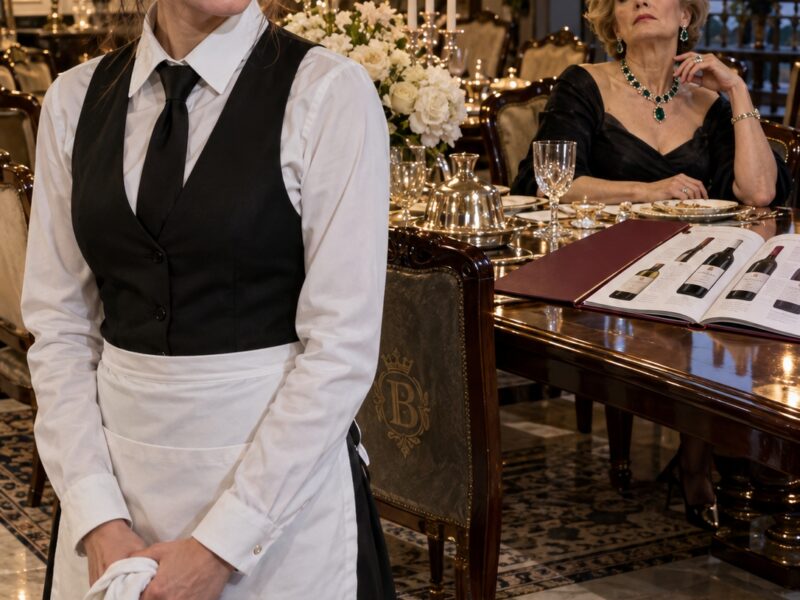
The Waitress They Laughed At Knew More Than Anyone in the Room—Five Minutes Later, Nobody Was Smiling
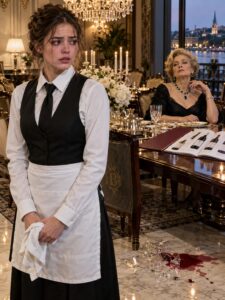
The crystal wine glass struck the marble floor with a sound so sharp that every conversation in the Grand Belmont Hotel seemed to stop at once.
For one long, humiliating second, twenty-five-year-old Lily Carter stood frozen beside the Whitmore family’s private dining table, a silver tray trembling in her hands while red wine spread across the pale Italian marble beneath her shoes.
Then someone laughed.
Not everyone.
That almost made it worse.
A man near the far end of the table covered his mouth with his napkin. Another guest glanced down as though suddenly fascinated by his cuff links. A woman in pearls shifted uncomfortably in her chair.
But Eleanor Whitmore did not look uncomfortable.
She looked entertained.
“Maybe,” Eleanor said, lifting one perfectly shaped eyebrow, “you should learn to read before serving people like us.”
The words landed more quietly than the glass had.
Yet somehow they cut deeper.
Lily felt twelve pairs of eyes turn toward her.
Her cheeks burned.
Her throat tightened.
She could hear the low hum of the hotel’s air-conditioning, the soft piano from the ballroom beyond the double doors, even the tiny crackling sound of a candle burning between two silver centerpieces.
What she could not hear was anyone defending her.
And that silence hurt more than Eleanor’s insult.
Lily lowered her gaze toward the broken glass.
“Of course, ma’am,” she said.
Her voice did not shake.
That seemed to annoy Eleanor more.
The sixty-two-year-old Savannah socialite leaned back in her chair, emeralds gleaming at her throat beneath the chandelier light.
“That wasn’t a compliment.”
“I understood.”
Eleanor’s husband, Richard Whitmore, finally looked up from his phone.
Their daughter, Amelia, went still.
The laughter died.
Lily bent to reach for the larger pieces of glass, but the dining-room captain hurried toward her.
“I’ll get that,” Marcus whispered. “Just go.”
He meant the service corridor.
He meant disappear until the wealthy guests forgot her face.
He meant survive the shift.
Lily understood because restaurant workers developed a private language for humiliation.
Go refill water.
Go check the kitchen.
Go take five.
Go breathe somewhere customers cannot see you cry.
She straightened slowly.
Eleanor had already turned back toward her guests as though Lily had ceased to exist.
That should have been the end of it.
Instead, Lily picked up the wine menu from the side table.
“I’ll return with your bottle in a moment.”
Eleanor looked at her and smiled.
It was not a kind smile.
“I certainly hope you can find it.”
Lily walked out.
Behind her, another small ripple of laughter traveled around the table.
She made it all the way through the service doors before her hands began to shake.
She stopped beside a stainless-steel counter and closed her eyes.
Marcus followed.
“Lily.”
“I’m fine.”
“You’re not.”
“I need the wine.”
“Forget the wine.”
“I can’t.”
Marcus glanced toward the doors.
“That woman wants a reason to complain. Let me send Daniel.”
Lily shook her head.
“If someone else serves the table now, she wins.”
“This is a hotel, Lily. Not a war.”
She looked at him.
“Then why does it feel like I just lost something?”
Marcus had no answer.
Neither did Lily.
Not yet.
She turned and walked toward the narrow reference room at the end of the corridor.
And less than five minutes later, she would return carrying something Eleanor Whitmore had never expected a waitress to possess.
Not anger.
Not revenge.
Knowledge.
And before the night was over, the entire room would understand exactly how badly they had misjudged her.
Savannah had been beautiful when Lily first arrived.
That was almost cruel.
She had stepped off a bus eleven months earlier with two suitcases, three hundred eighty-seven dollars, and a scholarship letter folded carefully inside a paperback copy of The Great Gatsby.
Spanish moss hung from oak trees like silver curtains. Brick sidewalks curved past historic homes. Tourists took photographs of horse-drawn carriages while sunlight glittered on the Savannah River.
Lily remembered thinking that a city that beautiful had to contain a place for her.
At twenty-four, she had believed life was finally beginning.
She had been accepted into a business program at a small private college outside Savannah. The scholarship did not cover everything, but it covered enough.
Her father, Thomas Carter, had called her the night the acceptance letter arrived.
“You did it, Lil.”
“We did it.”
“No. You did.”
“You taught me.”
“I taught you how to change a tire.”
“And how to keep going when something breaks.”
There had been laughter in his voice.
Three weeks later, he was dead.
A heart attack in the parking lot of the machine shop where he had worked for twenty-seven years.
No warning.
No goodbye.
Just a phone call from Lily’s younger brother, Evan, at 6:18 on a Tuesday morning.
“Lily,” he had whispered.
She still remembered the way he said her name.
Before he explained anything, she knew.
Their mother had died when Lily was sixteen. After that, Thomas had raised Lily and Evan alone in the small Kentucky town where nearly everyone knew which church you attended, what truck your father drove, and whether your family paid bills on time.
Thomas had never been rich.
He had never pretended otherwise.
But he had kept the refrigerator full.
The electricity stayed on.
School shoes appeared when the old ones wore through.
Only after his death did Lily discover how carefully he had been balancing everything.
The mortgage.
Medical bills from an old back injury.
A loan against his truck.
Two credit cards he had used to cover Evan’s dental surgery.
The scholarship letter on Lily’s dresser suddenly looked less like a doorway and more like an accusation.
Evan was nineteen.
He had just started community college.
Their father’s life-insurance payment was small.
Their savings were smaller.
Lily made the decision in forty-eight hours.
She deferred college.
She sold her car.
She packed.
She promised Evan it was temporary.
“You can’t do this because of me,” he argued.
“I’m not doing it because of you.”
“Yes, you are.”
“I’m doing it because we’re family.”
“Dad wanted you in school.”
“Dad also wanted you to eat.”
“I can work.”
“You are working.”
“Then let me handle myself.”
Lily had looked at her brother across the chipped kitchen table where their father used to drink coffee every morning before dawn.
“You think this is me giving up?”
Evan looked away.
“I think if you leave school now, you might never go back.”
Lily swallowed.
She had thought the same thing.
Then she said, “Watch me.”
That promise followed her to Savannah.
It followed her into the tiny apartment she rented above a laundromat.
It followed her to the coffee shop where she started work at five thirty each morning.
It followed her to the Grand Belmont, where she served wealthy guests until nearly midnight.
And on weeks when the numbers still did not work, it followed her into downtown office buildings where she cleaned conference rooms after everyone else had gone home.
Her life became a schedule measured in uniforms.
Black polo shirt at sunrise.
White blouse and hotel vest at night.
Old jeans and rubber gloves after midnight.
Some days Lily changed clothes in public restrooms because going home would cost forty minutes she did not have.
She learned to eat quickly.
Sleep lightly.
Cry privately.
But there was one habit she refused to surrender.
Books.
Every night, even if she could barely keep her eyes open, Lily read.
Sometimes ten pages.
Sometimes two.
Sometimes she woke at three in the morning with a book across her chest and the lamp still burning.
Her collection came mostly from thrift stores.
History with coffee stains.
Economics with underlined paragraphs from students she would never meet.
Psychology textbooks three editions out of date.
Biographies with cracked spines.
Marketing books filled with someone else’s yellow highlights.
Lily loved them all.
She had grown up around people who thought education happened inside buildings.
Her father had taught her differently.
When she was twelve, she once complained that she hated school because a teacher had made her feel stupid.
Thomas had taken her to the public library.
He walked between the shelves and spread his arms.
“See this?”
“Books?”
“No. Doors.”
She had rolled her eyes.
He tapped her forehead.
“Nobody gets to decide how much goes in there except you.”
Years later, when Lily could not afford a classroom, she remembered those words.
So she built one wherever she could.
On buses.
During lunch breaks.
In the hotel’s quiet reference room.
On the floor of her apartment while clothes turned in the laundromat dryers downstairs.
Knowledge became the one luxury she could afford.
That was why Eleanor Whitmore’s comment had cut so deeply.
Not because Lily believed it.
Because Lily knew exactly what it had cost her to make it untrue.
The Whitmore dinner had been marked on the hotel calendar for three weeks.
PRIVATE DINING ROOM A.
TWELVE GUESTS.
ELEANOR WHITMORE—62ND BIRTHDAY.
The name mattered in Savannah.
Richard Whitmore had built Whitmore Development from a regional construction company into one of the most influential real-estate firms in Georgia and South Carolina.
Hotels.
Luxury apartments.
Commercial developments.
Restored historic properties.
The Whitmores donated to museums, hospitals, scholarship funds and preservation projects.
Their photographs appeared at charity galas so often that even people who had never met them recognized Eleanor’s silver-blond hair.
She was elegant.
Sharp.
Impossibly composed.
And according to the staff at the Grand Belmont, exhausting.
“She once sent back sparkling water because the bubbles were too aggressive,” Marcus told Lily before the dinner.
Lily laughed.
“You’re making that up.”
“I wish.”
“What exactly is an aggressive bubble?”
“Apparently one that knows its worth.”
He adjusted his tie.
“Seriously. Be careful.”
“I’m always careful.”
“With normal people.”
Lily looked toward the private dining-room doors.
“And with rich people?”
Marcus sighed.
“With rich people, be invisible until they need you and perfect when they do.”
Lily smiled.
“That sounds healthy.”
“It pays the rent.”
“Unfortunately, so does caffeine.”
Marcus pointed at her.
“No heroics tonight.”
“I’m serving wine, Marcus. What heroics could possibly happen?”
Twenty minutes later, the glass shattered.
It had started with Eleanor ordering a bottle from the hotel’s reserve list.
“I’ll have the Château Montclair,” she said without looking up.
Lily checked the menu.
There were several vintages under nearly identical estate labels.
Hotel policy required confirmation before opening any reserve bottle, especially one that cost more than Lily earned in two weeks.
“Certainly, Mrs. Whitmore. May I confirm the bottle number or vintage?”
Eleanor stopped speaking to the woman beside her.
Slowly, she turned.
“The Château Montclair.”
“Yes, ma’am. We have several.”
“And you don’t know which one I mean?”
“I just want to make sure I bring exactly what you intended to order.”
One of the guests glanced up.
Amelia Whitmore put down her fork.
Eleanor’s smile appeared gradually.
“I see.”
Lily waited.
Eleanor turned toward the table.
“Apparently the hotel’s standards have changed.”
Richard murmured, “Eleanor.”
But there was no force behind it.
His eyes were still on an email.
Eleanor continued.
“I suppose they don’t require much education anymore.”
A man named Charles Bennett gave a nervous laugh.
Lily felt something tighten beneath her ribs.
She kept her voice polite.
“There are four bottles listed under that estate, ma’am. I’d rather confirm than make an assumption with a reserve wine.”
“That’s fascinating.”
Eleanor took the menu from Lily’s hand.
She pointed to an entry.
“Does this look difficult to you?”
Lily glanced down.
The label itself did not identify the exact cellar release.
“Mrs. Whitmore, that refers to—”
“Can you read?”
The table went silent.
Lily looked up.
“Excuse me?”
“I asked whether you can read.”
Amelia whispered, “Mom.”
Eleanor ignored her.
Lily had handled rude customers before.
People who snapped fingers.
People who left religious pamphlets instead of tips.
People who complained that she smiled too much or not enough.
People who acted as if her apron had erased her first name.
But there was something unusually personal in Eleanor’s gaze.
The pleasure of testing how much humiliation someone would tolerate because they needed a paycheck.
Lily knew that look.
She had seen smaller versions of it all her working life.
She took a breath.
“Yes, ma’am. I can read.”
“Then perhaps read the menu and bring the wine.”
Lily reached for the menu.
Her hand caught the stem of an empty glass.
It fell.
And when it shattered, Eleanor delivered the sentence that changed everything.
“Maybe you should learn to read before serving people like us.”
The reference room smelled like old paper, cork and dust.
Lily closed the door behind her.
Her heartbeat was still racing.
She placed both hands on the desk.
For several seconds she stared at the wall.
Then she whispered the words she wanted to say.
People like you?
What exactly does that mean?
People with money?
People who need another person to stand quietly while you prove you have it?
She imagined returning to the table without the wine.
She imagined removing her apron.
She imagined telling Eleanor exactly what she thought.
The fantasy lasted ten seconds.
Then Lily pictured Evan’s tuition payment due Friday.
She pictured rent.
Groceries.
Her father’s voice.
Never let somebody else’s behavior decide yours.
She exhaled.
“All right, Dad.”
On the shelves beside her stood the Grand Belmont’s wine reference collection.
Most servers ignored it.
Lily had not.
During slow winter shifts, she had read portions of the catalog because wine fascinated her.
Not the price.
The history.
Families growing the same grapes on the same land for generations.
Weather changing an entire vintage.
Wars, recessions and inheritance disputes reflected in bottles that eventually sat unopened behind restaurant glass.
The idea that soil could carry memory appealed to her.
She pulled out the Montclair volume.
The binding was burgundy.
She opened it.
Found the estate.
Then stopped.
There it was.
The 2016 vintage.
And beside it, a notation she remembered reading weeks earlier.
A disputed label transition.
Two nearly identical releases.
Different vineyard parcels.
Different bottle codes.
Lily stared.
Eleanor had not been wrong to ask for Château Montclair.
But Lily had been absolutely right to ask which bottle.
She read the page twice.
Then she carried the catalog back toward the dining room.
Marcus intercepted her.
“Please tell me you’re not about to correct her.”
“I’m about to serve her.”
“You’re holding a book like an attorney entering court.”
Lily almost smiled.
“She asked me to read.”
“Lily.”
“I won’t embarrass her.”
“She already embarrassed you.”
“That doesn’t mean I have to become her.”
Marcus studied her face.
“What are you going to do?”
“Answer the question she thought I was too stupid to ask.”
Then Lily opened the doors.
The room had moved on.
Or pretended to.
Eleanor was telling a story about a charity auction.
Richard was scrolling through his phone.
Amelia looked miserable.
When Lily approached, conversation faded.
Not completely.
Enough.
She placed the burgundy catalog beside Eleanor’s plate.
“I believe you’re referring to the 2016 Montclair Reserve.”
Eleanor’s eyes moved to the book.
Her mouth tightened.
“I believe that is what I said.”
“Yes, ma’am. I wanted to confirm because the estate released two bottles under extremely similar labels that year.”
Richard looked up.
Lily opened the catalog.
“The standard 2016 came from the eastern parcels. The Reserve came from the older limestone plots on the north slope.”
Charles Bennett stopped cutting his duck.
Eleanor stared at her.
Lily continued calmly.
“The estate was established by the Delacroix family in the nineteenth century. Their vineyards are known for limestone-rich soil, which contributes to the mineral structure people associate with Montclair.”
No one moved.
“The 2016 growing season was unusually dry. The lower rainfall concentrated the fruit, but the cooler temperatures late in the season preserved acidity.”
Richard slowly set down his phone.
Lily turned the page.
“The Reserve received particularly strong reviews after release. And according to the Grand Belmont pairing notes, it works better with tonight’s roasted duck than the standard bottling because the acidity balances the richness of the cherry reduction.”
The room was completely silent now.
Lily looked at Eleanor.
“That’s why I asked for the bottle number.”
No smile.
No triumph.
No revenge.
Just an explanation.
She gently closed the catalog.
“I apologize if my question made it sound as though I didn’t understand your order. I wanted to make sure you received exactly what you were paying for.”
Eleanor’s face had changed.
The confidence was still there.
So was the pride.
But now something unfamiliar had appeared behind it.
Embarrassment.
Lily waited.
Eleanor opened her mouth.
Nothing came out.
Then Richard asked, “How do you know all that?”
The question surprised Lily.
She turned toward him.
“I read it.”
“All of it?”
“Not tonight.”
A few guests smiled.
Not mockingly this time.
Richard leaned forward.
“You already knew this?”
“Some of it.”
“Why?”
Lily hesitated.
“I like learning things.”
Eleanor gave a short breath.
“What, you’re studying to become a sommelier?”
There was still defensiveness in her voice.
Lily shook her head.
“No, ma’am.”
Richard asked, “Are you in school?”
That question was harder.
“I was supposed to be.”
Amelia looked at her.
“What happened?”
Lily could have refused to answer.
Part of her wanted to.
These people were strangers.
Her father’s death was not entertainment between appetizers and dessert.
But something in Richard’s expression had changed.
He was no longer looking at a waitress.
He was looking at her.
So Lily said, “My father died before I started.”
Richard’s face softened.
“I’m sorry.”
“Thank you.”
“I had a scholarship. After he died, my family needed help, so I deferred.”
“How long ago?”
“Almost a year.”
“And you’ve been working here?”
“And at a coffee shop.”
Marcus, standing discreetly near the doors, looked down.
Lily added, “Sometimes another job.”
Richard frowned.
“And you study wine?”
“I study everything.”
Amelia almost smiled.
“Everything?”
“Whatever I can get my hands on.”
“Why?”
Lily looked at her.
“Because I’m still planning to go back.”
Richard leaned back slowly.
“What do you want to study?”
“Business.”
“You’re working three jobs and studying business on your own?”
“Mostly two jobs now.”
“That wasn’t my question.”
Lily allowed herself a small smile.
“I read at night.”
Richard glanced toward the thick wine catalog.
“After working here?”
“Especially after working here.”
Something flickered across his face.
A memory, perhaps.
Lily would learn later that Richard Whitmore’s father had come to the United States at nineteen with sixty dollars and almost no English.
He had poured concrete during the day.
Washed restaurant dishes at night.
Signed contracts he could barely understand.
Lost money because people recognized his weakness before he recognized their dishonesty.
When Richard was a boy, his father made him promise something.
Never confuse education with intelligence.
And never confuse money with worth.
Richard had built his life on that promise.
Then success came.
Properties.
Boards.
Private dining rooms.
People standing when he entered.
Drivers.
Assistants.
Invitations.
Somewhere between becoming respected and becoming powerful, he had stopped noticing the difference between the two.
Until a waitress with tired eyes and secondhand books reminded him.
“Lily,” he said.
“Yes, sir?”
“How old are you?”
“Twenty-five.”
He looked at the wine catalog again.
Then at Eleanor.
Then back at Lily.
He stood.
Eleanor whispered, “Richard.”
He ignored her.
He walked around the table and stopped in front of Lily.
She instinctively stepped backward.
Richard extended his hand.
For a second she did not understand.
Then she shook it.
“I owe you an apology.”
“You don’t have to—”
“Yes, I do.”
Eleanor’s back stiffened.
Richard spoke quietly, which somehow made every word stronger.
“What my wife said to you was disrespectful. I heard it. I knew it was wrong. And I said almost nothing because stopping dinner felt inconvenient.”
Nobody at the table looked comfortable now.
Richard continued.
“That makes me responsible for my silence.”
Lily did not know what to say.
She had expected Eleanor to insult her again.
She had expected a complaint.
She had expected Marcus to apologize to the family and move her to another table.
She had not expected the most powerful person in the room to apologize for doing nothing.
Richard turned.
“Eleanor.”
“Don’t.”
“You know what I’m asking.”
Her eyes flashed.
“Not here.”
“Here is where it happened.”
For the first time that evening, Eleanor looked small.
Not physically.
Socially.
The room she had controlled had shifted away from her.
Amelia whispered, “Mom, please.”
Eleanor looked at her daughter.
Then Richard.
Then Lily.
Her jaw tightened.
Minutes earlier, Lily would have expected a sarcastic apology.
A performance.
A sentence designed to end discomfort without admitting wrongdoing.
Instead Eleanor stood.
She smoothed the front of her dress.
“Lily.”
“Yes, ma’am?”
Eleanor’s eyes held hers.
“I was rude to you.”
Lily waited.
Eleanor swallowed.
“What I said was unfair.”
A pause.
“And cruel.”
The last word nearly disappeared.
“I’m sorry.”
It was not eloquent.
It did not erase the laughter.
It did not repair every other time Eleanor had spoken to someone that way.
But Lily recognized how much pride it had cost her.
So she nodded.
“Thank you.”
That could have been the end of the evening.
It should have been.
The birthday cake arrived thirty minutes later.
Lily served coffee.
Eleanor spoke more quietly.
Richard asked about Lily’s brother.
Amelia left a folded note beneath her dessert plate that read, I’m sorry I didn’t say something sooner.
At 11:47 p.m., Lily changed out of her hotel vest, caught the last bus toward her apartment and fell asleep with an economics book open beside her.
She did not know that a guest at a neighboring table had captured ninety-seven seconds of the confrontation on a phone.
She did not know the recording began with Eleanor’s voice saying, “Maybe you should learn to read before serving people like us.”
She did not know it showed Lily disappearing from the room.
Then returning.
Then calmly explaining the wine.
And she had no idea that at 12:16 a.m., the stranger uploaded the clip with one sentence.
Never judge someone’s intelligence by the uniform they wear.
By sunrise, twenty-eight thousand people had watched it.
By lunch, it was three hundred thousand.
By midnight, more than a million.
And the next morning, Lily Carter walked into the Grand Belmont believing the hardest part of her week was over.
She was wrong.
“Why is everyone staring at me?”
Lily whispered the question while tying her apron.
Her coworker Jasmine nearly dropped a stack of menus.
“You don’t know?”
“Know what?”
Jasmine stared at her.
“Oh my God.”
“What?”
“You actually don’t know.”
“Jasmine, I’ve been awake since four forty-five. Please use nouns.”
Jasmine pulled out her phone.
“Look.”
Lily squinted.
The screen showed a video.
A woman in a dark uniform stood beside a dining table.
For several seconds Lily did not recognize herself.
Then she heard Eleanor’s voice.
Her stomach dropped.
“Where did you get this?”
“Where did I get it? Lily, it’s everywhere.”
She took the phone.
The caption.
Comments.
Shares.
Numbers climbing every time the screen refreshed.
Someone had added subtitles.
Someone else had reposted the clip beside a photograph of Lily carrying the wine catalog.
A teacher in Ohio wrote that she planned to show the video to her students.
A former dishwasher described becoming a surgeon.
A hotel housekeeper wrote, People look through us every day. Thank you for staying calm.
Another comment said, That waitress has more class than the entire table.
Then Lily saw the uglier posts.
People calling Eleanor names.
People threatening to boycott Whitmore businesses.
Someone had found Eleanor’s charity-board memberships.
Another person posted the Whitmores’ home address before the platform removed it.
Lily gave the phone back.
“I don’t like this.”
Jasmine blinked.
“You don’t like being famous?”
“I’m not famous.”
“Your face has four million views.”
“That’s not fame. That’s a workplace accident with Wi-Fi.”
Jasmine laughed.
Lily did not.
“I don’t want people attacking her.”
“After what she said?”
“She apologized.”
“After getting destroyed.”
“Before the video was online.”
Jasmine’s expression softened.
“You’re defending her?”
“No.”
Lily looked toward the dining room.
“I’m defending the idea that one bad moment shouldn’t become permission for millions of strangers to stop seeing someone as human.”
Jasmine shook her head.
“You are annoyingly decent.”
“I’ve been told worse.”
The hotel’s general manager called Lily into his office before breakfast service ended.
Mr. Holloway was usually calm.
That morning, two phones sat on his desk and both kept ringing.
He rubbed his forehead.
“We have reporters downstairs.”
Lily stared.
“Why?”
He gave her a look.
“Because of you.”
“I didn’t upload anything.”
“I know.”
“I was working.”
“I know.”
“I didn’t ask for this.”
“I know, Lily.”
She folded her hands in her lap.
“Am I in trouble?”
Mr. Holloway’s face changed.
“No.”
“Are you sure?”
“No employee should have been spoken to that way.”
She released a breath.
“We’re reviewing how the situation was handled.”
“Marcus handled it.”
“Marcus should not have needed to handle it alone.”
Lily looked down.
Mr. Holloway leaned forward.
“I also want you to understand something. You do not have to speak publicly.”
“Good.”
“But the hotel is being asked for a statement.”
“What are you going to say?”
“That we value every employee and that Mrs. Whitmore apologized privately.”
Lily looked up.
“Publicly.”
“What?”
“She apologized at the table.”
“Yes.”
“So don’t make it sound like she waited until the video embarrassed her.”
Mr. Holloway studied her.
“You want us to protect her?”
“I want you to tell the truth.”
He sat back.
That answer seemed to surprise him.
It was about to surprise many other people too.
Two days later, Lily agreed to speak briefly with a local television reporter outside the hotel.
She almost canceled.
Then she saw another threatening post aimed at Eleanor.
So she stood beneath an oak tree in her plain black work coat while cameras pointed at her.
The reporter asked, “What did you feel when Mrs. Whitmore insulted you?”
“Embarrassed.”
“Angry?”
“Yes.”
“What made you respond the way you did?”
Lily thought for a moment.
“My father used to say that you don’t prove another person is wrong by becoming the worst version of yourself.”
“Do you consider what happened a victory?”
“No.”
The reporter looked surprised.
“Why not?”
“Because I don’t think humiliating Mrs. Whitmore would have made what she did to me better.”
“But many people online feel she deserved the backlash.”
Lily chose her words carefully.
“She deserved to be corrected. She deserved to be asked to take responsibility. She apologized before she knew anyone was filming.”
The reporter paused.
“Have you forgiven her?”
Lily looked toward the hotel entrance.
“I accepted her apology.”
“That isn’t exactly the same answer.”
“No,” Lily said softly. “It isn’t.”
The clip from that interview spread almost as widely as the original video.
Then something unexpected happened.
The story stopped being entirely about Eleanor.
People became curious about Lily.
Journalists learned that she had postponed college after her father died.
Someone interviewed the owner of the Kentucky machine shop where Thomas Carter had worked.
A photograph appeared online of Lily at sixteen beside her father, both holding fishing poles and squinting into sunlight.
Lily hated that part.
Those memories belonged to her.
Not strangers.
She called Evan.
“I think I’m going to throw my phone into the river.”
“Before you do, can you send me a screenshot of the woman who said you should learn to read?”
“Evan.”
“What? I just want to know what confidence looks like right before impact.”
“Do not start.”
“I’m proud of you.”
The humor disappeared from his voice.
Lily sat on the edge of her bed.
“For what?”
“For not letting them make you small.”
Her eyes burned.
“Dad would hate all this attention.”
“Dad would pretend to hate it.”
“He’d complain for six hours.”
“Then he’d show the video to every person in town.”
Lily laughed through her tears.
Evan became quiet.
“You going back to school now?”
The question landed differently.
“I don’t know.”
“You promised.”
“I know.”
“You said watch me.”
“I remember.”
“So I’m watching.”
Three days after the original dinner, Richard Whitmore returned to the Grand Belmont.
He did not bring Eleanor.
He did not reserve a table.
He arrived at ten in the morning carrying a leather folder.
When Mr. Holloway told Lily that Richard wanted to see her privately, her first thought was that something had gone wrong.
Maybe Eleanor regretted the apology.
Maybe the Whitmores were angry about the interview.
Maybe lawyers were involved.
Lily entered a conference room near the hotel lobby.
Richard stood when she came in.
“Ms. Carter.”
“Mr. Whitmore.”
“Thank you for meeting me.”
She sat across from him.
He looked more tired than he had at dinner.
Without chandeliers and tailored evening clothes, he seemed less like a wealthy developer and more like a man in his late sixties carrying several nights of poor sleep.
He placed the folder on the table.
“I watched your interview.”
Lily’s stomach tightened.
“If this is about your wife, I tried to be fair.”
“I know.”
“I told them she apologized.”
“I know.”
“I don’t want people harassing your family.”
Richard nodded.
“Eleanor watched it too.”
Lily waited.
“What did she say?”
“That your kindness made the whole thing more embarrassing.”
Lily almost smiled.
“That sounds complicated.”
“It is.”
He pushed the folder toward her.
“This isn’t about Eleanor.”
“What is it?”
“Open it.”
Inside was a letter bearing the name of the Whitmore Family Foundation.
Beneath it were several pages describing an education program.
Lily read the first paragraph.
Then again.
Her hands stopped moving.
“This says—”
“I know what it says.”
She looked up.
“Full tuition?”
“Yes.”
“Books?”
“Yes.”
“Transportation?”
“Yes.”
“Living expenses?”
“Within the program allowance.”
She stared at him.
“I don’t understand.”
Richard folded his hands.
“Our foundation has funded scholarships for nearly eighteen years. One category is specifically for students whose education was interrupted by family hardship.”
Lily kept staring.
“I spoke with the board.”
“When?”
“The morning after the video went viral.”
Something cold entered her chest.
“So this is because of the video.”
Richard immediately shook his head.
“No.”
“Mr. Whitmore—”
“The video is why I learned enough about your situation to ask questions. It is not why you qualify.”
“You don’t know me.”
“No.”
“Then how can you give me this?”
“I’m not giving you a degree, Lily.”
He leaned forward.
“I’m giving you access to an opportunity our foundation was created to provide.”
“Because your wife insulted me.”
“No.”
She pushed the folder back.
“Then why?”
Richard looked at it.
For several seconds he said nothing.
When he finally spoke, his voice had changed.
“My father could barely read English when he came here.”
Lily went still.
Richard looked past her as if seeing another room.
“He worked construction. At night he washed dishes. Men cheated him on wages because he couldn’t read the paperwork well enough to challenge them.”
His jaw tightened.
“I watched him come home bleeding from his hands and still sit at the kitchen table trying to learn English from newspapers.”
Lily did not speak.
“He told me education was expensive, ignorance was more expensive, and arrogance was the most expensive thing of all.”
Richard gave a faint, humorless smile.
“I thought I remembered that.”
He glanced toward the window.
“Then I sat at a table while someone in my own family treated you as if your uniform made you less intelligent.”
Lily’s anger softened, but her caution remained.
“You apologized.”
“I apologized because it was the minimum decent thing to do.”
He tapped the scholarship folder.
“This is different.”
“How?”
“Because I looked at your academic record.”
Lily frowned.
“My academic record?”
“You signed a release yesterday when the foundation office contacted you.”
She remembered an email Mr. Holloway had told her was legitimate.
Richard continued.
“You graduated near the top of your class. You earned a competitive scholarship before your father died. Your professors from the two community-college courses you completed online both recommended you.”
Lily’s eyes burned.
“You checked all of that?”
“That is what scholarship committees do.”
She looked down.
Richard’s voice softened.
“I watched someone insult you in front of twelve people. You had every right to answer cruelty with cruelty. Instead you walked away, opened a book and came back better prepared than anyone in that room.”
He paused.
“That tells me something about your character. Your academic record tells me the rest.”
Lily touched the edge of the folder.
She had imagined returning to college so many times that the dream had become painful.
She imagined it cautiously now.
A classroom.
A desk.
Professors.
A student identification card with her photograph.
Time to read without watching a clock.
Then another thought came.
“Someone else applied for this money, didn’t they?”
Richard smiled slightly.
“There are multiple awards.”
“If I take one, someone else loses one.”
“No.”
“You promise?”
“Yes.”
Lily breathed out.
There was one more question.
The frightening one.
“What happens if the internet forgets me next week?”
Richard’s expression became serious.
“The scholarship remains.”
“What if your wife decides she hates me?”
“It remains.”
“What if I fail a class?”
“You follow the same academic policies as every recipient.”
“What if I disappoint you?”
Richard was quiet.
Then he said, “Lily, if you accept this, you owe me nothing except the effort you owe yourself.”
That broke her.
Not loudly.
Lily lowered her head and covered her mouth.
For months, she had survived by refusing to imagine rescue.
Hope was dangerous when rent was due.
Hope made exhaustion feel temporary, which meant disappointment could become unbearable.
She had built a life around not expecting anyone to help.
Now the folder in front of her offered something she had almost trained herself not to want.
Richard waited.
When Lily finally looked up, tears were running down her face.
“What am I supposed to study?”
He smiled.
“That is entirely your decision.”
She laughed weakly.
“That seems irresponsible.”
“What did you want before your father died?”
“Business.”
“Still?”
She thought about every restaurant where workers were treated as replaceable.
Every schedule written without considering the person beneath the uniform.
Every smart person she knew who had never been given the chance to sit at the right table.
“Yes.”
“Why?”
Lily wiped her face.
“Because I want to know how companies work.”
Richard nodded.
“And then?”
A small smile appeared.
“Maybe I’ll build one.”
Richard smiled back.
“I think you might.”
She stared at the signature line.
Then picked up the pen.
But before she signed, Lily looked at Richard one last time.
“I need one thing.”
“What?”
“No press release saying you rescued the poor waitress.”
Richard blinked.
Then laughed.
It was the first easy sound either of them had made.
“Deal.”
Lily signed.
And for the first time since her father’s death, the future stopped feeling like something she had to survive.
It became something she was allowed to enter.
She returned to college that fall.
The first morning, Lily stood outside a brick academic building twenty minutes early because she had been afraid of missing the bus.
Students moved around her carrying laptops and coffee.
A boy complained loudly that his parents had bought him the wrong MacBook.
Two women discussed spring break.
Someone rushed past Lily while arguing into wireless headphones.
For a moment, resentment rose in her.
They seemed so unaware of what it meant to be here.
Then she caught herself.
Maybe that was another kind of judgment.
She knew nothing about them.
Lily smiled.
Apparently the lesson worked both ways.
She entered the classroom.
Her professor, Dr. Patel, wrote two words on the board.
VALUE CREATION.
“What,” he asked, “makes something valuable?”
Hands went up.
Scarcity.
Demand.
Brand recognition.
Utility.
Lily listened.
Then Dr. Patel noticed her.
“Ms. Carter?”
She had not raised her hand.
“What do you think?”
Thirty students turned.
For one terrible second, Lily was back at the Whitmore table with twelve people staring.
Then she remembered the burgundy wine catalog.
She said, “Sometimes value is already there. People just fail to recognize it.”
Dr. Patel paused.
“Explain.”
Lily looked around the room.
“A worker can be valuable before a company promotes them. A product can be useful before marketing makes people notice it. Knowledge can exist before someone has a degree proving they have it.”
Dr. Patel smiled.
“That is a very good answer.”
Lily opened her notebook.
It was the beginning.
Not an easy beginning.
An honest one.
She continued working at the Grand Belmont while studying.
She cut back her coffee-shop hours.
She slept more.
Not enough.
But more.
She learned accounting, operations, organizational psychology and finance.
She discovered that some subjects she had romanticized were brutally difficult.
Statistics nearly destroyed her.
She called Evan one night after receiving a 68 on an exam.
“I’m dropping out.”
“No.”
“I have no idea what regression analysis is.”
“I don’t know what that is either.”
“Exactly.”
“That proves nothing.”
“I studied for sixteen hours.”
“And?”
“And apparently I became sixteen hours stupider.”
Evan laughed.
“Dad once rebuilt an entire transmission backward.”
“That is not inspiring.”
“He took it apart and did it again.”
“That took him three days.”
“Exactly.”
Lily groaned.
“You’re terrible at motivational speeches.”
“But you’re going back tomorrow.”
She looked at the textbook.
“Yes.”
“Then my work here is done.”
She got an 89 on the next exam.
Amelia Whitmore began visiting the hotel occasionally.
At first, Lily thought the visits were coincidence.
Then one afternoon Amelia appeared at the lobby café carrying two coffees and said, “I am officially done pretending I’m here for meetings.”
Lily looked at her.
“So you’ve been stalking me?”
“Very elegantly.”
“That seems genetic.”
Amelia winced.
“Fair.”
Lily smiled.
They sat near a window overlooking Madison Square.
Amelia was thirty-one, polished but less formal than her mother.
She worked in museum fundraising and had spent most of her life moving through rooms where someone else already knew her last name.
“I owe you an apology too,” Amelia said.
“You gave me a note.”
“A cowardly note.”
“It was handwritten. That’s almost vintage.”
“I should have stopped my mother.”
“So should everyone else.”
“I keep replaying it.”
Lily looked at her coffee.
“So do I.”
Amelia hesitated.
“Do you hate her?”
Lily considered the question.
“No.”
“Really?”
“I don’t know her well enough to hate her.”
“That might be worse.”
“Probably.”
Amelia laughed sadly.
“My mother isn’t usually…”
She stopped.
Lily raised an eyebrow.
“Usually what?”
“Okay. She is sometimes exactly like that.”
“At least you recovered.”
Amelia shook her head.
“She wasn’t born wealthy.”
Lily waited.
“Her father repaired farm equipment. They had very little money.”
That surprised Lily.
“She never talks about him,” Amelia continued. “I think she spent most of her life trying to prove she had escaped where she came from.”
“By looking down on people who are still there?”
Amelia met her eyes.
“I think so.”
“That’s sad.”
“Yes.”
“It’s also not an excuse.”
“No.”
Lily appreciated that Amelia did not try to turn explanation into absolution.
Their friendship began there.
Slowly.
Without sentimentality.
Amelia helped Lily navigate Savannah events where everyone seemed to know invisible social rules.
Lily helped Amelia recognize how often people around her softened their opinions because of her family name.
They argued.
They laughed.
They discovered they both hated raisins in desserts.
Eleanor remained absent.
For almost six months.
Then on a rainy Thursday afternoon, she appeared in the Grand Belmont lobby carrying a small cream-colored package.
Lily was finishing a shift.
Marcus saw Eleanor first.
“Oh no.”
Lily followed his gaze.
Eleanor stood beside the fireplace.
“She asked for you.”
“Did she look angry?”
“She always looks angry.”
“True.”
“Want me nearby?”
Lily thought about it.
“No.”
She approached.
“Mrs. Whitmore.”
“Lily.”
Eleanor looked uncomfortable.
That alone was startling.
“I heard you’re in school.”
“Yes.”
“How is it?”
“Statistics has attempted murder twice.”
Eleanor stared.
Then, unexpectedly, she laughed.
“Richard hated statistics.”
“I’m beginning to respect him less.”
Silence followed.
Eleanor held out the package.
“This is for you.”
Lily did not take it immediately.
“What is it?”
“A bomb would be excessive.”
Lily smiled despite herself.
She accepted the package.
Inside was a dark leather notebook, simple and expensive, with thick cream pages.
“My goodness.”
“I thought you might use it for school.”
“Thank you.”
Eleanor nodded.
Neither woman moved.
Lily sensed there was more.
Finally Eleanor said, “My father couldn’t read very well.”
Lily looked up.
Eleanor’s expression had changed.
No social smile.
No performance.
“My parents left school young. My father repaired tractors, machinery, anything people brought him. He had hands that never completely came clean.”
She looked toward the fireplace.
“When I was a girl, I hated when he came to school functions.”
Lily remained quiet.
“I thought people noticed his clothes. His hands. The way he pronounced certain words.”
Eleanor’s voice grew lower.
“I was ashamed of the person who worked six days a week so I would never have to be ashamed of anything.”
Lily closed the notebook.
Eleanor laughed once, bitterly.
“Life enjoys irony.”
“What happened to him?”
“He died when I was thirty-seven.”
“I’m sorry.”
“So am I.”
Eleanor looked directly at her.
“The night of my birthday, when I asked if you could read…”
Her jaw tightened.
“I heard my own voice afterward on that video.”
Lily waited.
“I sounded like every person I spent my childhood being afraid would look down on him.”
For the first time, Eleanor’s eyes filled.
She did not cry.
Not quite.
But the effort not to was visible.
“I don’t expect you to tell me I’m a good person because I realized something obvious at sixty-two.”
“I wasn’t going to.”
Eleanor laughed through the emotion.
“That is one thing I like about you.”
“I didn’t know you liked anything about me.”
“I didn’t at first.”
“Another excellent apology.”
“I’m still learning.”
The two women stood in silence.
Then Lily asked, “What did your father teach you?”
Eleanor’s face softened.
“That people are worth more than whatever they own.”
The hotel lobby seemed suddenly distant.
Lily thought of Thomas.
His work boots.
His cracked coffee mug.
The way he had counted money at the kitchen table without ever making his children feel poor.
She wondered how many people spent their lives running away from the very people who had taught them the most important things.
Eleanor took a breath.
“I forgot him for a while.”
“No,” Lily said.
Eleanor looked surprised.
“You remembered him badly.”
“What’s the difference?”
“Remembering badly means you can do it better.”
Eleanor stared at her.
Then nodded.
It was not forgiveness.
Not yet.
But it was the first conversation they had ever had in which neither woman stood above the other.
And sometimes that was where forgiveness began.
Two years later, Lily Carter graduated with honors.
The morning of commencement, she woke before her alarm.
For several seconds she lay in bed, staring at the ceiling of the apartment she had moved into during her second year.
Then she saw the graduation gown hanging from the closet door.
Her chest tightened.
Evan had flown in from Kentucky.
Richard and Amelia had seats near the front.
Eleanor was coming too.
Lily had not invited the internet.
She had not spoken publicly about the scholarship since that first year.
The viral video had faded from daily attention as viral things did.
Another scandal.
Another argument.
Another person having the worst minute of their life recorded by a stranger.
Lily was grateful to disappear from public conversation.
She had never wanted to be famous for being humiliated.
She wanted a life larger than one moment.
Now, standing beneath the stadium lights with hundreds of graduates, she finally had one.
When her name was called, Lily started across the stage.
“Lily Anne Carter, summa cum laude.”
Applause rose.
Then a voice shouted from the crowd.
“THAT’S MY SISTER!”
Lily stopped and closed her eyes.
The audience laughed.
She looked toward Evan.
He was standing with both arms raised.
Richard applauded beside him.
Amelia was crying.
And Eleanor Whitmore was on her feet.
For one strange instant, Lily saw another room.
Marble floor.
Broken glass.
An emerald necklace.
People laughing.
She remembered the shame burning in her cheeks.
She remembered wanting to disappear.
Then she looked down at the diploma in her hand.
What had felt like the moment that reduced her had instead become the moment that revealed her.
Not to the internet.
To herself.
She walked off the stage smiling.
Later, away from the crowd, Lily found a quiet place beneath an oak tree.
She took out her phone.
There was an old voicemail she had saved for years.
Her father’s voice filled her headphones.
“Hey, Lil. Just checking in. Call me when you get this. Proud of you, kid.”
Sixteen seconds.
That was all.
She had listened to it on birthdays.
Bad nights.
The day she signed her scholarship.
The night before her statistics final.
Now she listened again in her graduation gown.
“Proud of you, kid.”
Lily pressed the diploma to her chest and cried.
Not because he had missed the day.
Because somehow he had been present in every difficult step that brought her there.
Someone sat beside her.
Eleanor.
She did not speak at first.
She simply handed Lily a tissue.
“You always appear at my most glamorous moments,” Lily said.
“I have excellent timing.”
Lily wiped her eyes.
Eleanor glanced toward the phone.
“Your father?”
Lily nodded.
“Voicemail.”
Eleanor looked toward the trees.
“I would give almost anything to hear mine again.”
Lily said nothing.
After a moment, Eleanor added, “He would be proud.”
Lily smiled through tears.
“Both of them would.”
Eleanor looked at her.
Then slowly smiled too.
After graduation, Lily accepted a position with a growing regional hospitality company.
Not Whitmore Development.
That mattered to her.
Richard had offered advice, introductions and mentorship, but Lily insisted on interviewing without using his name whenever possible.
She began in operations.
She learned staffing.
Inventory.
Payroll.
Vendor negotiations.
Guest recovery.
Revenue management.
She learned that businesses could produce elegant mission statements and still fail the people cleaning their bathrooms at midnight.
She noticed the workers others overlooked because she had been one of them.
The dishwasher who taught himself coding on lunch breaks.
The housekeeper studying nursing.
The bartender raising two children while completing accounting classes online.
The banquet server who could repair almost anything in the building but had never been promoted because nobody thought to ask what he knew.
Five years after the night at the Grand Belmont, Lily proposed a company program called Open Door.
Its purpose was simple.
Employees who wanted further education could apply for scheduling flexibility, tuition assistance and professional mentorship without leaving their jobs.
The first executive meeting did not go well.
“It’s expensive,” one vice president said.
“So is turnover,” Lily replied.
“We’re not a university.”
“No. We’re an employer losing talented people because we treat education and employment like they can’t coexist.”
Another executive leaned forward.
“And what happens when we pay for someone’s degree and they leave?”
Lily had heard the question before.
She smiled.
“What happens if we don’t help them grow and they stay?”
The room became quiet.
Six months later, the pilot launched in three properties.
Thirty-two employees enrolled.
Twenty-seven completed the first year.
Absenteeism dropped.
Turnover declined.
Internal promotions increased.
Within three years, the program expanded across the company.
Lily became its director.
Then vice president of employee development.
Journalists occasionally rediscovered the old video and contacted her for anniversary interviews.
She declined most of them.
When she did speak, she corrected the story people preferred to tell.
They wanted a villain.
A victim.
A perfect comeback.
A rich family transformed by one poor waitress.
Lily knew life had been messier.
Eleanor had been cruel.
Then remorseful.
Then defensive.
Then thoughtful.
Then occasionally cruel again in smaller ways before catching herself.
Change did not move in a straight line.
Richard had been generous, but generosity did not make him a saint.
Lily had been patient, but patience had not meant she never lay awake furious about what happened.
Amelia became her friend, but their friendship survived arguments about money, privilege and the strange blindness wealth could produce.
Even Lily had changed in ways she did not always like.
Success made convenience seductive.
Assistants appeared.
Reservations became easier.
People returned her calls faster.
One evening, years later, Lily was checking into a luxury hotel in Atlanta before a conference.
A young front-desk employee struggled to locate her reservation.
Lily had been traveling for ten hours.
She was exhausted.
She had a presentation in the morning.
The employee typed nervously.
“I’m sorry, Ms. Carter. I’m still new.”
Lily glanced at the clock.
Her patience thinned.
“I made this reservation six weeks ago.”
“I know. I’m really sorry.”
“This shouldn’t be complicated.”
The young man’s face fell.
And Lily heard it.
Not Eleanor’s exact words.
Something more frightening.
Her tone.
Lily went silent.
The employee continued typing.
She saw his hands shaking.
Shame rushed through her.
“I’m sorry.”
He looked up.
“What?”
Lily took a breath.
“I’m frustrated, but I shouldn’t make you feel stupid because something went wrong.”
He relaxed slightly.
“Thank you.”
“Take your time.”
Three minutes later, the reservation appeared.
It had been booked under her middle initial.
In the elevator, Lily stared at her reflection.
She understood something she had missed years earlier.
Dignity was not a lesson you learned once.
It was a choice you had to keep making when power slowly changed which side of the table you sat on.
That realization stayed with her longer than the original humiliation.
The old Grand Belmont wine catalog stayed too.
Years passed.
Its burgundy cover faded.
Pages loosened from the binding.
The 2016 Montclair entry became outdated, then historic.
The hotel renovated the private dining room twice.
New carpets.
New lighting.
New menus.
The catalog remained on the shelf.
A young server named Noah noticed it one evening while training.
“Why do we still have this dinosaur?”
Marcus, older now and managing the entire dining department, looked over.
“That dinosaur is famous.”
Noah laughed.
“A wine book?”
Marcus pulled it from the shelf.
“Years ago, a waitress worked here.”
“What happened?”
“Rich customer treated her like she was stupid.”
“Sounds about right.”
Marcus gave him a look.
“Don’t get cynical at twenty-two. You’ll need somewhere to go by forty.”
Noah grinned.
“So what did the waitress do?”
Marcus opened the catalog to the worn page.
“She read.”
“That’s it?”
“She had already read more than anybody realized.”
Marcus told him the story.
Not the viral version.
The real one.
The broken glass.
The humiliation.
The reference room.
The apology.
The scholarship.
The years afterward.
Noah listened.
“What’s her name?”
Marcus closed the book.
“Lily Carter.”
Noah’s eyes widened.
“The executive who started Open Door?”
“The same.”
“No way.”
Marcus returned the catalog to the shelf.
“People carry more than plates.”
“What does that mean?”
“It means you should be careful about deciding who somebody is based on the five seconds they spend standing in front of you.”
Noah looked at the old book.
“Did she ever come back?”
Marcus smiled.
“Sometimes.”
The following December, Lily did.
She arrived at the Grand Belmont alone on a cold evening just before Christmas.
Savannah glowed with white lights.
Garlands wrapped the hotel columns.
A pianist played softly near the lobby tree.
Lily had spent the day speaking at a conference about workforce development.
Her flight home was the next morning.
She could have stayed upstairs.
Instead she walked toward the private dining room.
Marcus was finishing paperwork when he saw her.
“You always show up when I’m trying to leave.”
“You’re welcome.”
They hugged.
“You want to see it?”
“I don’t know.”
“Yes, you do.”
He led her inside.
The room looked different.
But not enough.
Lily stood beside the place where the Whitmore table had been.
For a moment, she saw the glass again.
Red wine spreading across marble.
Her twenty-five-year-old hands shaking.
The desperate calculation of rent, pride and employment.
“You okay?” Marcus asked.
“Yes.”
“You sure?”
“No.”
He smiled.
“Better answer.”
Lily walked to the reference shelf.
The old catalog was still there.
She pulled it out.
The binding cracked softly.
On the inside cover, someone had added a small brass plaque.
No photograph.
No mention of the viral video.
Just a sentence.
Knowledge is invisible until the moment someone needs it.
Lily touched the words.
“Who wrote this?”
Marcus shrugged.
“Management.”
“That sounds suspiciously thoughtful for management.”
“I helped.”
“Much more believable.”
She opened to the Montclair page.
Someone had circled the 2016 Reserve entry in pencil.
Lily laughed.
“You preserved my evidence.”
“It’s practically a museum artifact.”
“Meaning I’m old?”
“Ancient.”
Her phone vibrated.
A message from Amelia.
Mom wants to know if you’re still coming Sunday. She claims she is not making the horrible cranberry thing this year. I do not believe her.
Lily smiled.
Eleanor was seventy now.
Still formidable.
Still occasionally impossible.
But different.
She funded adult-literacy programs in her father’s hometown and never allowed her name to appear on the building.
Richard had retired from daily operations.
Evan had become an electrical engineer, married a woman who laughed louder than he did and gave Lily a niece who believed Aunt Lily’s primary purpose was buying books.
Life had moved forward.
Not perfectly.
Forward.
Marcus leaned against the table.
“Do you ever wish none of it happened?”
Lily looked at the catalog.
The question was harder than people imagined.
If Eleanor had not humiliated her, perhaps there would have been no video.
No Richard.
No scholarship.
No Open Door.
But Lily hated the idea that suffering needed to be justified by what came after it.
“No,” she said finally.
Marcus raised an eyebrow.
“No, you don’t wish it away?”
“I wish she hadn’t said it.”
“That sounds like yes.”
Lily shook her head.
“I wouldn’t choose the humiliation just because good things followed it.”
She looked around the room.
“But I wouldn’t erase the person I became after it either.”
Marcus nodded.
“That makes sense.”
“Does it?”
“Not really.”
She laughed.
They walked toward the door.
Lily stopped.
“One second.”
She returned to the table.
From her bag, she removed the leather notebook Eleanor had given her years earlier.
It was almost full.
Class notes filled the beginning.
Business plans filled the middle.
Names of employees filled later pages.
Ideas for Open Door.
Fragments of speeches.
Quotes from her father.
On the final unused page, Lily wrote one sentence.
She tore it out.
Placed it inside the old wine catalog.
Marcus watched from the doorway.
“What did you write?”
“Something for whoever opens it next.”
“You know I can read it as soon as you leave.”
“I know.”
“That doesn’t bother you?”
“No.”
Lily put the catalog back.
Then she walked out of the dining room.
After she disappeared into the lobby, Marcus returned to the shelf.
He opened the book.
The note rested beside the 2016 Montclair entry.
He read it once.
Then again.
The night they laughed at me, I thought dignity meant proving I was smarter than they believed. Years later, I understood something better: dignity is remembering that nobody else should have to prove their worth before you treat them like they have it.
Marcus stood silently.
Beyond the doors, plates clinked.
Guests laughed.
Servers moved quickly between tables.
A young dishwasher pushed a cart toward the kitchen.
A woman in housekeeping crossed the hallway carrying fresh linens.
A valet hurried through the cold toward a waiting car.
Hundreds of people passed through the Grand Belmont every day.
Some wore designer suits.
Some wore uniforms.
Some arrived in cars worth more than houses.
Some counted bus fare before clocking out.
Their circumstances were visible.
Their stories were not.
Years earlier, twelve people had looked at Lily Carter and seen a waitress who did not understand a wine menu.
They had not seen a grieving daughter.
They had not seen the scholarship letter hidden in an old novel.
They had not seen the exhausted young woman reading economics at one in the morning.
They had not seen the future business executive.
They had not seen the program that would eventually help hundreds of workers continue their education.
They had seen an apron and thought it told them everything.
That had been their mistake.
Lily never became respected because she destroyed Eleanor Whitmore in front of a dining room.
She never wanted that kind of victory.
She became respected because when someone tried to reduce her, she refused to reduce herself.
When the room expected anger, she brought knowledge.
When the internet demanded revenge, she insisted on truth.
When opportunity came, she accepted it without pretending she had been rescued.
And when success eventually gave her the power to look down on other people, she remembered how marble felt beneath a broken glass.
That memory became more valuable than the scholarship.
More valuable than the degree.
Perhaps even more valuable than everything that followed.
Because achievement changed Lily’s circumstances.
Dignity changed the way she moved through them.
Long after the video disappeared beneath millions of newer videos, the Grand Belmont continued serving expensive dinners beneath crystal chandeliers.
Guests celebrated engagements.
Birthdays.
Promotions.
Anniversaries.
Wine bottles were opened.
Glasses sometimes broke.
And every few months, some new employee wandered into the reference room, noticed the battered burgundy catalog and wondered why nobody had thrown it away.
Eventually someone would tell the story.
Not because the wine mattered.
Not because Eleanor’s insult deserved to be remembered forever.
But because people forget.
They forget that intelligence does not always come with credentials.
They forget that poverty is a circumstance, not a personality.
They forget that a uniform describes a job, not the person wearing it.
They forget that the employee clearing their plate may be supporting a family, studying after midnight, rebuilding a life, grieving someone they loved, or quietly preparing for a future nobody else can see.
And sometimes they need an old wine catalog to remind them.
Years after that December visit, Lily was speaking to a group of hospitality employees when a young woman approached her afterward.
The woman wore a housekeeping uniform.
She looked nervous.
“Ms. Carter?”
“Lily is fine.”
“I wanted to say thank you.”
“For what?”
“The tuition program.”
Lily smiled.
“You’re enrolled?”
“Nursing.”
“That’s wonderful.”
The woman looked down.
“I almost didn’t apply.”
“Why?”
“People kept telling me it was unrealistic. I have a daughter. I work full time.”
Lily’s chest tightened.
“What changed your mind?”
The woman smiled shyly.
“There’s this story people tell during orientation.”
Lily already knew.
“The waitress?”
“Yes.”
Lily laughed softly.
“That story follows me everywhere.”
The woman’s expression became serious.
“They said she was tired and broke and studying anyway. And somebody treated her like she was stupid.”
“That part is unfortunately accurate.”
“They said she went back to school.”
“She did.”
“So I thought…”
The woman hesitated.
“If she could keep going before she knew how things would turn out, maybe I could start before I knew how mine would turn out.”
For a moment Lily could not answer.
This, she realized, was the part nobody had captured on video.
The real consequence had never been Eleanor’s embarrassment.
It had never been millions of views.
It had never even been the scholarship.
It was this.
One person seeing another person’s persistence and borrowing enough courage to begin.
Lily reached into her bag and pulled out a business card.
“If you ever need help navigating the program, email me.”
The woman stared at the card.
“You mean directly?”
“Directly.”
“Thank you.”
She started to walk away.
Lily called after her.
“Wait.”
The woman turned.
“What’s your name?”
“Rachel.”
Lily smiled.
“Rachel, don’t let anybody make you believe you need a dramatic moment to prove you belong somewhere.”
Rachel nodded.
Then Lily added, “And when you become a nurse, remember the people cleaning your hospital room.”
Rachel smiled.
“I will.”
Lily watched her disappear into the crowd.
For a second she thought of Thomas again.
A public library.
A twelve-year-old girl angry because someone had made her feel stupid.
Rows and rows of books.
Her father spreading his arms and saying, Doors.
She finally understood.
He had never been talking only about books.
He had been talking about people too.
Every person was a door into a story you could not understand by standing outside it.
Eleanor had looked at Lily’s uniform and decided she already knew what was behind hers.
Lily could have spent the rest of her life proving Eleanor wrong.
Instead she chose something larger.
She learned to stop making the same mistake in reverse.
That was why, decades after the broken glass, the part Lily remembered most clearly was not Eleanor’s insult.
It was the silence immediately afterward.
The moment when everyone at the table knew something cruel had happened, yet almost nobody spoke.
For years Lily had thought courage belonged to the person being mistreated.
Eventually she understood that the witnesses had a choice too.
Richard learned it.
Amelia learned it.
Perhaps Eleanor did as well.
And Lily carried that lesson into every company, classroom and conference room she entered.
You did not need to make a speech every time someone was diminished.
Sometimes courage was smaller.
A correction.
A question.
A seat offered.
A name remembered.
A refusal to laugh.
A quiet sentence spoken before humiliation had time to become entertainment.
Those choices rarely went viral.
They were still the ones that mattered.
One spring morning, long after Lily had stopped working for anyone else, she stood inside the headquarters of the education nonprofit she had finally founded.
The organization occupied a renovated brick warehouse near the Savannah River.
Its purpose was written discreetly beside the entrance:
Work should not be the place where dreams go to wait.
Inside were classrooms.
Career counselors.
Computer labs.
Child-care rooms.
Partnership offices for employers willing to fund employee education.
On one wall hung photographs of graduates.
Housekeepers who became nurses.
Line cooks who became accountants.
Security guards who became teachers.
Servers who became business owners.
Beside the photographs stood a glass display case.
Inside was a battered burgundy wine catalog.
The Grand Belmont had donated it when the hotel replaced its reference library.
Lily had resisted displaying it.
She worried that it turned one painful night into mythology.
Eventually Amelia convinced her.
“People aren’t looking at the book because your life started there,” she had said. “They’re looking at it because you didn’t let your life end there.”
So Lily agreed.
But beneath the catalog she placed no photograph of Eleanor.
No screenshot from the video.
No headline about the waitress who embarrassed a socialite.
Instead, the plaque said only:
A reminder that human potential is often present long before recognition arrives.
On the morning the center officially opened, Lily arrived before anyone else.
Sunlight came through the high warehouse windows.
She walked past empty classrooms.
Fresh notebooks waited on desks.
Coffee brewed in the staff kitchen.
Soon the building would be loud.
For now it belonged to silence.
Lily stopped before the wine catalog.
Her reflection appeared faintly in the glass.
She was no longer twenty-five.
There were lines beside her eyes.
A few strands of silver at her temples.
She had spent years becoming someone her younger self would barely recognize.
Yet in the reflection, she could still see the waitress.
Tired.
Embarrassed.
Holding a tray.
Trying not to cry.
Lily placed her hand against the glass.
“I know,” she whispered.
She was not sure whether she was speaking to that younger woman or to her father.
Maybe both.
Behind her, the front door opened.
A young receptionist entered carrying coffee.
“Good morning, Ms. Carter.”
Lily turned.
“Good morning.”
The woman hurried toward the desk, then stopped.
“Today’s the big day.”
“Yes.”
“Nervous?”
“Terrified.”
The receptionist smiled.
“I thought successful people stopped getting terrified.”
Lily picked up her bag.
“Never trust anybody who tells you that.”
Outside, people had begun gathering for the opening.
Students.
Workers.
Employers.
Families.
Richard was arriving with a cane now.
Amelia walked beside him.
Eleanor had died quietly the previous winter.
At her funeral, Lily had stood beside Amelia and listened as people described a woman who had become more generous in the final decade of her life than she had been in the six before it.
Change had come late.
Lily no longer believed late meant meaningless.
A week before Eleanor died, a package had arrived at Lily’s home.
Inside was the same leather notebook Eleanor had once given her, except this one was new.
On the first page Eleanor had written:
For whatever you still have left to learn.
Below it:
My father would have liked you.
Lily had cried harder reading that sentence than she expected.
Now the notebook rested inside her office.
Not as proof that cruelty always became kindness.
It did not.
Not as proof that everyone changed.
They did not.
It reminded her of something more difficult.
Human beings were rarely only the worst thing they had done.
And forgiveness, when it came, did not require pretending the worst thing had never happened.
Outside the building, applause began.
Someone opened the door.
“Lily? They’re ready.”
She looked once more at the wine catalog.
The object that had once helped her survive a humiliating dinner now sat in a building created so that other people might never have to wait for humiliation before someone recognized their potential.
Lily smiled.
“I’m coming.”
She walked toward the light beyond the doorway.
And somewhere in the building, behind rows of new books and open classroom doors, the life her father once imagined for her was no longer waiting.
She was already living it.
The broken glass had been swept away decades ago.
The laughter had disappeared almost as quickly.
Even the video had become difficult to find beneath the endless noise of the internet.
But the lesson remained.
You never know who is standing in front of you.
You never know what they survived before arriving at your table.
You never know what they study after their shift ends.
You never know whose dreams are temporarily hidden beneath an apron, a uniform, work boots or tired eyes.
And you never know how close someone may be to becoming the person the world will someday listen to.
So be careful with the five seconds in which you decide what another human being is worth.
Lily Carter learned that lesson while standing beside broken crystal on a marble floor.
Eleanor Whitmore learned it too late to erase what she had said, but not too late to become someone who would never say it again.
And everyone who eventually heard their story was left with the same uncomfortable truth.
The person carrying your plate may know something you do not.
The person cleaning your table may be building a future larger than the room you are sitting in.
The person whose job makes them invisible to you may only be invisible because you never bothered to look.
Years ago, Eleanor Whitmore had asked Lily Carter whether she could read.
Lily spent the rest of her life answering a far more important question.
Could people learn to see?
Sometimes they could.
And sometimes, one broken glass was enough to make an entire room finally open its eyes.









