THE WHOLE TOWN TOLD THEM TO SIT DOWN—THEN ONE DANCE EXPOSED THE SECRET EVERYONE WANTED BURIED
At 10:40 on a Saturday night, Carrie Lambert walked across a ballroom full of people who knew exactly who Jordan Rhodes was, took the untouched whiskey from his hand, set it on a windowsill, and said four words that would change both their lives.
“Dance with me. Once.”
Jordan stared at her as if she had asked him to step off a roof.
“I don’t really dance.”
“I know.”
That made him look at her.
Around them, the ballroom at Canfield Casino glowed beneath crystal chandeliers and strands of tiny white lights. The wedding had reached that hour when ties loosened, shoes came off beneath tables, and people who had promised themselves they would leave by ten ordered one more drink.
Jordan had done none of those things.
For almost an hour, he had stood at the edge of the dance floor holding the same glass.
Not drinking.
Not talking.
Watching.
Carrie had noticed because Erica Brandt had made sure she noticed.
“He’s the groomsman by the windows,” Erica had whispered twenty minutes earlier.
Carrie had followed her gaze.
Tall. Dark suit. Early forties, maybe. Quiet in a way that didn’t look shy.
“He looks fine.”
“He isn’t.”
There had been something in Erica’s voice that stopped Carrie from making a joke.
“That’s Tracy’s husband.”
Carrie knew the name.
Everybody who had been Erica Kowalski’s college roommate knew Tracy.
The older sister.
The funny one.
The one who had gotten sick.
The one who hadn’t made it.
Erica looked toward Jordan again.
“He hasn’t danced since she died.”
Carrie had frowned. “And you want me to fix that?”
“No.” Erica’s eyes had filled, but she smiled anyway. “I just want somebody to ask.”
So Carrie did.
Jordan’s fingers were stiff when she took his hand.
For three steps, he moved like a man remembering instructions from another lifetime.
Then something changed.
His hand closed around hers.
Not tightly.
Just enough.
Three years earlier, in a hospital cafeteria that smelled like burnt coffee and disinfectant, Jordan had made a promise to a dying woman’s younger sister.
Erica had been twenty-nine, exhausted, and trying not to cry because everybody else was already crying enough.
“When I get married,” she had said, “you’re dancing.”
Jordan had looked through the cafeteria window toward the oncology wing.
“Erica—”
“I’m serious.”
“You don’t even have a boyfriend.”
“I’ll find one.”
Despite himself, Jordan had smiled.
Then Erica had pointed at him.
“And when I do, you don’t get to stand against a wall looking tragic all night.”
That was the kind of promise people made in hospitals.
Small promises.
Ridiculous promises.
Promises about birthdays and Christmas dinners and future weddings because the large promises had already become impossible.
Tracy died that November.
Jordan never danced again.
Until Carrie Lambert took his hand.
The first song ended.
Neither stepped away.
A second began.
Then a third.
Carrie didn’t ask about Tracy.
Jordan noticed that.
Most people did.
They asked carefully, softly, with their faces already arranged into sympathy.
Carrie asked what he did for work.
“I teach chemistry.”
“High school?”
“Saratoga Springs.”
“Do they hate chemistry?”
“They mostly hate me before Thanksgiving.”
She smiled.
“And after?”
“After Thanksgiving, they hate stoichiometry.”
Carrie laughed.
Jordan almost did.
A few minutes later, he actually did.
The sound startled him.
Carrie saw it happen.
So did Erica from across the room.
She turned away before Jordan could catch her watching.
They talked about ordinary things.
Bad coffee.
Weather.
Horses.
Carrie told him she ran Lambert Farm outside Greenfield.
Jordan admitted he knew almost nothing about racing.
She told him that was probably good for his blood pressure.
He asked whether horses had personalities.
She looked offended.
“Do teenagers?”
“Unfortunately.”
“Then horses definitely do.”
Another song began.
They stayed.
Earlier that evening, a broad-shouldered man with silver hair had stopped beside Carrie’s table and kissed her cheek.
Dr. Ron Gaffney had been treating Lambert horses since Carrie was young enough to follow her father through the barns in rubber boots two sizes too large.
He was one of those men who seemed permanent.
Presidents changed.
Trainers retired.
Owners sold farms.
Ron Gaffney remained.
“How’s Hudson Mile?” Carrie had asked.
“Better every week.”
Ron had smiled.
“He’s on my joint-support formula now. Give it another month. You’ll see the difference in August.”
Across the room, the groom, Dave Brandt, had looked up.
Only for a second.
But his expression had changed.
Carrie hadn’t noticed.
Jordan hadn’t noticed.
Erica hadn’t noticed.
And Dave had said nothing.
That silence would matter later.
But that night belonged to music.
At midnight, Jordan lifted his nine-year-old daughter from two chairs pushed together beside the family table.
Katie had fallen asleep in her flower-girl dress, her shoes lined neatly underneath as if even unconscious she worried somebody might trip over them.
Carrie held the ballroom door open.
Outside, the night was warm.
Crickets screamed from the grass.
Jordan adjusted Katie against his shoulder.
“Thank you.”
Carrie leaned against the door.
“For what?”
He looked back through the glass at the dance floor.
Then at her.
He didn’t answer.
He just nodded and carried his daughter toward the parking lot.
They hadn’t exchanged numbers.
Carrie told herself she was relieved.
Ten minutes later, Erica pressed a folded cocktail napkin into her hand.
Carrie unfolded it.
A phone number.
She looked at Erica.
“Seriously?”
Erica lifted one shoulder.
“In case.”
“In case what?”
Erica smiled.
“That part is none of my business.”
Carrie put the napkin in her purse.
By Sunday morning, it was in the top drawer of her farm office.
By Monday, she had nearly forgotten it.
At 7:12 Tuesday morning, everything changed.
Bobby Carrigan called before Carrie had finished her first coffee.
He had trained horses for the Lambert family for eleven years.
Bobby was sixty-two, spoke only when he had something worth saying, and considered most emotions a private inconvenience.
That morning his voice sounded empty.
“Carrie.”
She stopped walking.
“What happened?”
“They found something.”
She stared through the office window toward the shed row.
“In what?”
A pause.
“Hudson.”
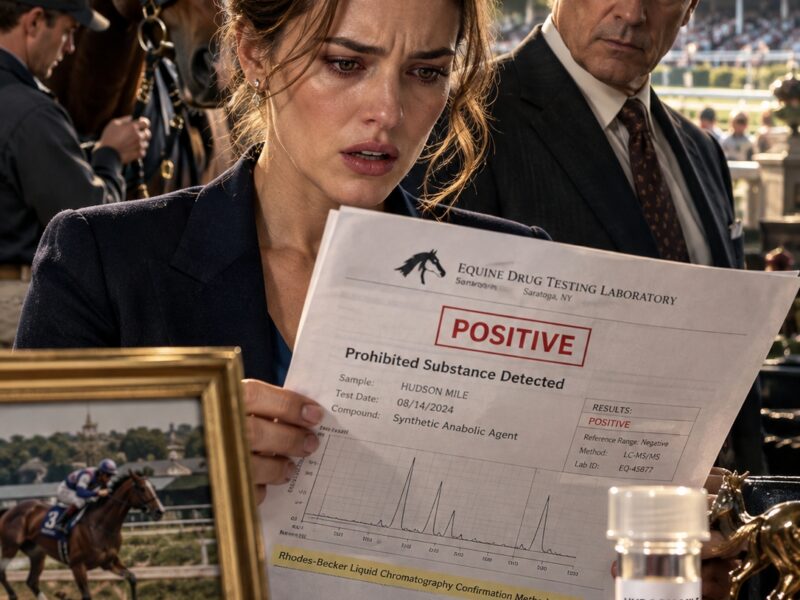
By nine, the official notice sat on her desk.
Hudson Mile, winner of a major prep stakes ten days earlier and one of the most talked-about three-year-old colts heading toward the Travers, had tested positive for a synthetic compound.
Not a contaminated vitamin.
Not a commonly used therapeutic drug outside its permitted window.
A synthetic compound never approved for use in any animal.
Under the trainer-responsibility rule, Bobby was provisionally suspended.
The purse was frozen.
Hudson Mile could not race.
And by afternoon, the horse whose name had appeared in glowing Travers previews would appear beneath another kind of headline.
Carrie read the notice twice.
Then a third time.
Bobby stood across from her desk.
“I didn’t give him anything.”
“I know.”
“You don’t know.”
His voice cracked on the last word.
Carrie looked up.
Bobby’s eyes were red.
That frightened her more than the letter.
“I know you,” she said.
He swallowed.
“That’s not the same thing.”
Maybe it wasn’t.
And that was the first terrible thing about accusations.
They didn’t need to prove themselves immediately.
They only needed to make certainty expensive.
At eleven, Ron Gaffney arrived without calling.
He had been entering Lambert barns unannounced for thirty years, so nobody stopped him.
He sat across from Carrie.
“I heard.”
“Everybody heard.”
“Not everybody.”
“Give them twenty minutes.”
Ron sighed sympathetically.
“I know how this feels.”
“No, you don’t.”
He allowed that.
Then he leaned forward.
“Carrie, listen to me carefully. You have a decision to make before emotion makes it for you.”
She said nothing.
“You can request the split sample. You can challenge the finding. You can drag this through weeks of hearings while reporters camp outside your gate and every horse in this barn becomes part of the story.”
“Or?”
“You accept it.”
Her eyes hardened.
“Accept that Bobby cheated?”
“Accept the rule.”
“That’s not what I asked.”
Ron folded his hands.
“Bobby takes the suspension. You move Hudson to another trainer. I know someone clean and discreet. By September, people have moved on.”
“Bobby didn’t do this.”
“Maybe not intentionally.”
Carrie stared at him.
Ron’s tone stayed gentle.
“Trainers get careless. Supplements get mixed. Barns are chaotic. You know that.”
“Our barn isn’t.”
“No barn is perfect.”
He stood.
At the door, he turned back.
“Your father would tell you the same thing.”
That landed exactly where he intended.
Carrie’s father had spent forty years building the Lambert name into something that could open doors in Saratoga with one phone call.
Protect the farm.
Protect the name.
Protect what generations before you built.
Ron nodded toward the notice.
“Don’t burn down the house proving one room wasn’t dirty.”
Then he left.
Carrie sat alone.
For twenty minutes, she almost listened to him.
Then she opened the laboratory packet.
Forty pages.
Chain-of-custody forms.
Sample identifiers.
Chromatograms.
Technical language that might as well have been written in code.
Carrie understood horses.
She understood breeding contracts, bloodlines, training schedules, land, employees, feed invoices and the delicate economics of keeping an expensive animal healthy long enough to become valuable.
She did not understand analytical chemistry.
But she kept reading.
Because reading was something she could do.
On page thirty-one, a line caught her eye.
Rhodes-Becker Liquid Chromatography Confirmation Method, 2019.
Rhodes.
Carrie stared at the name.
Then at her desk drawer.
The cocktail napkin was still there.
She told herself not to be ridiculous.
Jordan Rhodes taught high-school chemistry.
Plenty of people had the same last name.
She picked up the napkin anyway.
He answered on the second ring.
“Hello?”
“Jordan?”
A pause.
“Yes?”
“It’s Carrie. From the wedding.”
Another pause.
Different this time.
“Oh.”
She almost smiled.
“I have a strange question.”
“I teach teenagers. My standards for strange are high.”
She looked down at the laboratory report.
“Is there a chemist named Rhodes who helped develop a testing method for racehorses?”
Silence.
Carrie checked the screen to make sure the call had not dropped.
“Jordan?”
“Yes.”
Her fingers tightened around the phone.
“Yes, you know him?”
“No.”
His voice changed.
“That’s me.”
He arrived at Lambert Farm after school.
No suit this time.
Dark pants, rolled sleeves, a canvas messenger bag.
Carrie met him at the farmhouse kitchen.
Jordan saw the forty-page laboratory packet waiting on the table and stopped.
For a moment, something moved across his face.
Not fear.
Memory.
He sat.
“For nine years,” he said, “I directed the Upstate Equine Analytical Laboratory.”
Carrie stared at him.
“You told me you taught chemistry.”
“I do.”
“You left out a fairly significant middle chapter.”
“I didn’t think we’d see each other again.”
That answer was so plain she couldn’t argue with it.
Jordan looked at the packet.
“In spring 2023, national testing was consolidated into several contract laboratories. Ours closed.”
“And you just…became a teacher?”
“No.”
He looked toward the window.
“That was the same spring Tracy was diagnosed.”
Carrie went still.
“She died in November. Katie needed family. Erica’s parents were here. So I moved back.”
He rubbed his thumb against the edge of the packet.
“I didn’t go back to laboratory work.”
“Why?”
Jordan looked at her.
Carrie regretted asking.
Then he answered anyway.
“Because some rooms remember too much.”
She understood that more than he probably realized.
He opened the report.
For the next twenty minutes, the man from the wedding disappeared.
The quiet widower disappeared.
The high-school teacher disappeared.
Jordan Rhodes turned pages with a pencil in his hand, his eyes moving over charts and numbers with a concentration so complete Carrie barely breathed.
At page thirty-four, he stopped.
“Here.”
Carrie leaned closer.
He pointed to two peaks on the chromatogram.
“What am I looking at?”
“The parent compound is almost gone.”
“That sounds good.”
“It isn’t.”
He traced several smaller peaks.
“These are metabolites. Breakdown products. Look at the distribution.”
Carrie looked.
She understood nothing.
Jordan understood that immediately.
“One large dose gives you one kind of pattern. This doesn’t look like that.”
“What does it look like?”
He hesitated.
“Repeated low exposure.”
“How repeated?”
“Daily, maybe. Small amounts over weeks.”
Carrie’s stomach tightened.
“Injected?”
Jordan shook his head.
“Probably oral.”
“Meaning?”
“Nobody necessarily walked into Hudson’s stall the night before the race with a syringe.”
He looked toward the barns outside.
“This looks like something he was eating.”
“Every day?”
“Possibly.”
Carrie sat back.
“Bobby didn’t do this.”
“I don’t know Bobby.”
“I do.”
Jordan held her gaze.
“I can’t tell you who did it.”
Then he tapped the report.
“But this data does not look like a trainer trying to juice a horse before a race.”
For the first time since 7:12 that morning, Carrie could breathe all the way in.
The deadline for requesting the split sample was Friday.
She filed the request that evening.
Jordan was still at the kitchen table when her phone rang eleven minutes later.
Ron Gaffney.
Carrie answered.
“Hello?”
No greeting.
No sympathy.
No warm voice.
“Who told you to do that?”
Carrie slowly looked across the table at Jordan.
And something inside her shifted.
Until that moment, she had believed she was defending Bobby from a bad test.
Now she wondered whether someone was afraid of what a second test might prove.
Jordan arrived at five the next morning carrying two gas-station coffees, disposable gloves and a notebook.
Carrie met him at the barn.
“You sleep?”
“A little.”
“You always investigate horses before sunrise?”
“I usually investigate sophomores cheating on lab reports.”
He handed her a coffee.
Black.
She took a sip.
“Terrible.”
“Yes.”
They walked.
Hay supplier.
Grain mix.
Electrolytes.
Salt block.
Water.
Treats.
Medication.
Supplements.
Every bag.
Every bottle.
Every scoop.
Jordan asked the head groom when each item had arrived, where it was stored, who handled it, whether other horses received it.
By seven, his notebook held three pages.
By eight, he had crossed out most of them.
“The hay is local and shared with horses that tested clean.”
He drew a line.
“The grain comes from a mill supplying half of Saratoga.”
Another line.
“Electrolytes are national.”
Another.
Then he stopped.
On a shelf sat a white plastic jar.
GAFFNEY EQUINE ASSOCIATES
JOINT SUPPORT FORMULA
Jordan picked it up.
“One scoop daily?”
Carrie nodded.
“Ron’s used it for years.”
“With Hudson?”
“Since spring.”
“How many barns get this?”
Carrie thought.
“Thirty? Maybe more.”
Jordan looked at her.
Thirty barns.
Thirty trainers.
Hundreds of horses.
Suddenly the question was no longer who had contaminated Hudson Mile.
The question was how many animals might already be carrying the same compound.
Jordan sealed the jar in an evidence bag.
He called Anne Becker, the chemist who had co-developed the analytical method with him.
She now ran an independent laboratory outside Albany.
Carrie listened to one side of the conversation.
Jordan spoke for four minutes.
Anne interrupted only once.
“Bring it Thursday.”
Carrie reached for her checkbook.
Jordan shook his head.
“I’ll pay for the testing.”
“She won’t take your money.”
“Then she can take mine.”
“She won’t take yours either.”
“Why?”
Jordan slipped the phone into his pocket.
“Because some people still remember what laboratories are supposed to be for.”
Saturday morning, Jordan brought Katie to the farm.
Carrie had mentioned it once.
Not invited exactly.
Just said Katie might like the foals.
At ten, his car came up the drive.
Katie climbed out holding a plastic bag of carrots she had cut herself.
The girl stopped dead when Carrie led them to the far paddock.
Four mares stood beneath oak trees, foals tucked near their sides.
Katie whispered, “Oh my God.”
Jordan almost corrected her.
Carrie lifted a hand.
“This situation qualifies.”
Katie approached the fence.
“Can I touch one?”
“Maybe.”
Carrie crouched beside her.
“Don’t reach.”
Katie frowned.
“How do I pet it without reaching?”
“You wait.”
“For what?”
“For her to decide.”
Carrie showed her an open palm.
“Flat hand. Stay still.”
A chestnut foal lifted its head.
One step.
Then another.
Katie barely breathed.
The foal stretched its neck and blew warm air across her fingers.
Katie’s mouth opened.
No sound came.
“She likes me.”
Carrie smiled.
“She’s curious about you.”
“How do you know?”
“Because she came back.”
Jordan stood several feet behind them, forearms resting on the top rail.
Carrie looked at him.
His eyes were on Katie.
But there was something else there.
Something almost painful.
Later they ate sandwiches on the farmhouse porch.
Katie asked whether horses dreamed.
Whether they had best friends.
Whether the chestnut foal would remember her tomorrow.
Nobody talked about positive tests.
Nobody talked about Ron.
Nobody talked about Tracy.
When Carrie went inside, she returned with iced tea for herself and Katie and a mug of coffee for Jordan.
Black.
No sugar.
He looked at it.
Then at her.
“You remembered.”
Carrie sat down.
“I notice things.”
Jordan wrapped both hands around the mug.
That same afternoon, Ron Gaffney sat at a corner table inside the Saratoga Golf and Polo Club with two investors who controlled the largest stakes in the stallion syndicate Carrie had spent eighteen months assembling.
He never accused her of anything.
That would have been crude.
Ron was not crude.
“She’s a good woman,” he said.
The men listened.
“Smart. Loyal. Maybe too loyal.”
“What does that mean?” Lyall Hammond asked.
Ron sighed.
“She’s fighting the finding.”
“We know.”
“I worry she’s turning a regulatory matter into something personal.”
He lifted his glass.
“Once investigators start digging through barns, they don’t stop with one horse.”
One investor shifted.
“You think that could happen?”
“I’d hate to see either of you caught in the middle.”
That was all.
By Monday morning, Carrie’s phone rang.
Lyall Hammond.
He was polite.
That made it worse.
He and his partner were reviewing their position in the syndicate.
Closing was three weeks away.
If the regulatory matter remained unresolved, they might withdraw.
After the call, Carrie stood at her office window.
Hudson Mile was walking the shed row.
Healthy.
Bright-eyed.
Sound.
The best horse her family had bred in a decade.
He was still there.
But in the world outside those gates, he was already becoming something else.
Evidence.
Scandal.
Risk.
Tuesday night, sixty owners, trainers, grooms and veterinarians gathered for the regional horsemen’s association meeting.
Ron Gaffney stood at the front.
Of course he did.
He was president.
“We all know what’s happening at one of our barns,” he began.
Carrie sat in the third row beside Bobby.
Bobby’s cap rested between his hands.
Ron continued.
“And we feel for everyone involved. But when an owner chooses to fight a positive finding rather than accept responsibility, the consequences don’t remain in one barn.”
Several heads nodded.
“Investigators pull records. They test other horses. They question suppliers. Every honest horseman in this room can end up paying for one person’s pride.”
Now people looked at Carrie.
Some looked away.
Ron finally looked directly at her.
“I have asked Lambert Farm to think about everyone in this room.”
Silence.
Carrie could hear the coffee urn hissing behind her.
Bobby stared at the floor.
For half a second, Carrie remembered her father.
Protect the name.
Don’t embarrass people publicly.
Don’t create enemies you don’t need.
Then she thought of Ron’s phone call.
Who told you to do that?
Carrie stood.
Her chair scraped across the floor.
Every face turned.
“Bobby Carrigan has trained for my family for eleven years.”
Ron’s expression remained pleasant.
“He has never had a violation. Not one.”
Nobody moved.
“I am not fighting the rules.”
She looked around the room.
“I am using them.”
A few people shifted.
“The rules give me the right to request a split sample. So I requested it.”
Ron’s smile tightened.
Carrie continued.
“If that makes anyone here nervous…”
She let the silence stretch.
“…I think the more interesting question is why.”
Something scraped near the back.
Another chair.
Carrie looked.
Jordan was standing by the door.
He must have arrived late.
He said nothing.
He simply stood.
So Carrie remained standing too.
For three long seconds, Ron Gaffney looked at both of them.
Then he turned the page on his agenda.
Outside afterward, Carrie’s phone buzzed.
Anne Becker.
The laboratory report.
Carrie opened it.
Read once.
Then again.
Her stomach dropped.
“Clean.”
Jordan took the phone.
The tested joint formula contained no prohibited compound.
Carrie stared across the parking lot.
“So we were wrong.”
Jordan kept reading.
“No.”
She looked at him.
He enlarged the bottom of the report.
“Lot number.”
“What?”
“Your jar. I photographed the label.”
He pulled up the picture.
Then he compared the manufacturing code.
His face changed.
“Carrie.”
“What?”
“This jar was manufactured August sixth.”
She stared.
“That’s impossible.”
“When did Hudson test positive?”
“The sample was taken before that.”
“When did you get the notice?”
“August fourth.”
Jordan held the phone between them.
The jar currently sitting in her feed room had not existed when Hudson had been receiving the supplement.
Carrie’s mouth went dry.
“Ron’s people restock every Thursday.”
Jordan nodded.
“Then someone replaced the jar after you got the positive.”
“With a clean batch.”
Neither spoke.
Cars pulled out around them.
Finally Jordan said, “That isn’t contamination.”
Carrie looked toward the meeting hall where Ron was still inside.
“No.”
Her voice was barely audible.
“That’s cleanup.”
They ended up in a diner on Broadway.
Two coffees.
One slice of pie.
Neither finished anything.
At eleven, Jordan walked Carrie to her truck.
She unlocked the door but didn’t get in.
“You didn’t have to stand up tonight.”
Jordan looked confused.
“Yes.”
He said it as if the answer were obvious.
“I did.”
Friday afternoon, the split sample came back.
Confirmed.
Same compound.
Same horse.
Same problem.
Carrie read the email beside Hudson Mile’s stall.
The colt pushed his nose against her shoulder looking for peppermint.
She gave him one.
Jordan had warned her.
The second sample was almost certain to confirm the first.
The question was never whether Hudson had the compound inside him.
The question was how it got there.
But knowing something intellectually and seeing CONFIRMED written on an official document were two different experiences.
That evening, Jordan received his own notice.
A complaint had been filed with the Saratoga Springs School District.
It alleged that Jordan had used school laboratory equipment to perform private analytical work for a paying client.
The district was opening a review.
Until it concluded, he was asked to refrain from outside consulting.
Jordan read the complainant’s name.
Rick Fallon.
He didn’t recognize it.
So he searched.
Board of Education.
Jordan continued reading.
Another name appeared in the meeting minutes.
Dr. Ron Gaffney.
Board member.
Formally recused from discussion.
Jordan stared at those two words.
Formally recused.
Sometimes distance existed only on paper.
He drove to Lambert Farm at nine that night.
Carrie was waiting on the porch.
She had already heard.
Saratoga in August was a town where gossip could outrun a thoroughbred.
“You need to stop,” she said.
Jordan sat down.
“No.”
“Jordan.”
“No.”
“This is your job.”
“I know.”
“Ron sits on that board.”
“I know.”
“He can make this miserable.”
“He already is.”
“I can find another chemist.”
Jordan looked out toward the dark paddocks.
For a long time, he said nothing.
Then he spoke.
“When they closed my lab, I knew the consolidation was a mistake.”
Carrie sat beside him.
Jordan kept looking into the darkness.
“I had data showing what would happen. Samples sitting in trucks longer. Fewer specialists reviewing unusual results. Too much distance between regulators and laboratories.”
“Why didn’t you say anything?”
“Tracy.”
One word.
Enough.
“She was sick. Katie was scared. I was tired.”
He rubbed his hands together.
“There were hearings in Albany. I could have testified.”
“But you didn’t.”
“No.”
His voice was quiet.
“I told myself someone else would.”
Carrie understood before he said it.
“Nobody did.”
Jordan shook his head.
The barn lights clicked off one by one.
“I had good reasons.”
Carrie said nothing.
“That’s the worst part.”
He looked at her.
“Sometimes good reasons still leave you with something you wish you’d done differently.”
A cricket chirped beneath the porch.
“I’m not doing that again.”
Carrie wanted to tell him he didn’t owe her anything.
She wanted to tell him to protect Katie.
Protect his career.
Protect the life he had rebuilt.
Instead she remained beside him.
They sat there past midnight.
No promises.
No kiss.
No dramatic confession.
Just two people refusing to leave the porch while the dark settled around them.
The next morning, the hearing notice arrived.
August twenty-first.
The integrity agency listed its witnesses.
One name stood out.
Dr. Ron Gaffney — Expert Witness, Equine Medication Practices.
Carrie laid the paper on the kitchen table.
They had a confirmed positive.
They had evidence that the original supplement jar had been replaced.
They had Jordan’s interpretation of the chromatogram.
What they did not have was the one thing that mattered.
Proof.
Not suspicion.
Not timing.
Not motive.
Proof connecting Ron Gaffney’s formula to the substance inside Hudson Mile.
Two days later, Dave Brandt returned from his honeymoon early.
He told Erica he couldn’t sleep.
At nine that Tuesday night, his car came up the Lambert driveway.
Carrie and Jordan were at the kitchen table buried beneath laboratory reports.
Dave stood in the doorway.
He looked exhausted.
“I need to tell you something.”
Jordan set down his pencil.
Dave didn’t sit.
“And before I tell you, I need you to understand what I can and cannot legally give you.”
Carrie’s pulse quickened.
Dave was a pharmacist at Northway Compounding, a veterinary compounding pharmacy in Clifton Park.
Gaffney Equine Associates was one of its largest clients.
“In February,” Dave said, “I was assigned a batch of Ron’s joint-support formula.”
Carrie looked at Jordan.
Dave continued.
“The recipe included a botanical extract I’d never seen before.”
“What kind?”
“I don’t know.”
Carrie frowned.
“You’re the pharmacist.”
“That’s the problem.”
Dave looked ashamed.
“Normally we source ingredients ourselves. Approved supplier. Certificate of analysis. Documentation showing identity, purity, everything.”
“And this one?”
“Plain container.”
“From where?”
“The label said supplied by prescriber.”
Carrie’s voice dropped.
“Ron.”
“His practice.”
Dave rubbed his jaw.
“I requested the certificate twice.”
“What happened?”
“My supervisor told me to drop it.”
“Why?”
“Ron had been a client for twenty years.”
Jordan’s expression hardened.
“And you dropped it.”
Dave looked at him.
He didn’t defend himself.
“I had just gotten engaged to Erica.”
Jordan went still.
“I needed the job.”
The kitchen clock ticked.
Dave swallowed.
“At my own wedding, I heard Ron talking to Carrie about that formula.”
His eyes met Jordan’s.
“And I sat there.”
Jordan understood.
He understood too well.
Dave continued.
“I can’t steal pharmacy records. I can’t give you patient or client files. I could lose my license.”
“Then why are you here?” Carrie asked.
“Because there’s something you can get legally.”
Jordan leaned forward.
“Tell me.”
“Every compounded batch has a batch record.”
Dave’s voice steadied.
“And every lot has a reserve sample. We keep it for a year.”
Carrie stopped breathing.
“The June lot?”
Dave nodded.
“Sealed container. Cold room.”
Jordan stood.
“If the integrity agency subpoenas it—”
“Northway has to surrender it.”
“And nobody can replace it.”
Dave looked at him.
“Exactly.”
Carrie’s attorney filed the request at eight the next morning.
Investigators served the subpoena that afternoon.
By Thursday, the integrity agency had the June reserve sample.
The batch record.
And Dave’s two February emails requesting documentation for the mysterious ingredient.
A portion of the sealed sample went to Anne Becker’s independent laboratory.
Friday night, Anne called.
Jordan answered on speaker.
Carrie stood beside him.
Dave had returned for the call.
Anne did not waste words.
“It’s there.”
Nobody moved.
Carrie gripped the edge of the kitchen counter.
“The same compound?”
“Same compound.”
Jordan closed his eyes.
Anne continued.
“And the botanical extract explains your metabolic profile. Slow-release exposure. Daily oral dosing.”
Jordan opened his eyes.
“How close?”
“Jordan…”
Anne exhaled.
“It’s Hudson Mile’s chromatogram almost line for line.”
Silence filled the kitchen.
They had it.
The formula.
The sealed reserve sample.
The unauthorized ingredient.
The emails.
The analytical match.
Dave stood against the counter.
After a moment he said, “Tracy used to say you’d argue with a stop sign.”
Jordan almost smiled.
“She did.”
“She would’ve had plenty to say about me sitting on this for six months.”
Jordan looked at his brother-in-law.
Dave looked ready for anger.
Maybe he deserved some.
Maybe Jordan had spent enough of his life understanding how fear could make decent people silent.
He crossed the kitchen.
Placed one hand on Dave’s shoulder.
Nothing more.
After Dave left, Carrie and Jordan remained at the table.
Paper covered every inch.
The batch record.
Anne’s report.
Chromatograms.
Emails.
At midnight, both reached for the same page.
Their hands touched.
Neither moved.
Carrie looked down at their fingers.
Jordan looked at her.
Outside, a horse shifted in its stall.
The coffee went cold.
For weeks they had been moving toward the same truth.
Neither was ready to name the other thing growing beside it.
The hearing on August twenty-first took place in a windowless conference room at the Saratoga Race Office.
Fluorescent lights hummed overhead.
Bobby sat beside his attorney.
Carrie sat beside Bobby.
Jordan occupied the final chair at the table with one folder in front of him.
Behind the low rail, every row filled.
Trainers.
Owners.
Association members.
Rick Fallon from the school board.
People who had trusted Ron Gaffney for decades.
Ron testified first.
He was magnificent.
Calm.
Measured.
Concerned.
He called Bobby a good horseman.
Then explained why good horsemen sometimes made bad decisions.
“Too many horses,” Ron said. “Too little oversight.”
He described the synthetic compound.
Its availability through overseas channels.
Its potential performance effects.
Then he gave his professional opinion.
“The most likely explanation is a trainer seeking an edge.”
Several people nodded.
Carrie watched Bobby.
He did not look up.
Then the hearing officer said, “Ms. Lambert. Your witness.”
Jordan stood.
“Dr. Jordan Rhodes.”
A murmur moved through the room.
Jordan walked to the front.
He displayed one chart.
“From 2014 through 2023, I directed the Upstate Equine Analytical Laboratory.”
Ron’s attorney stopped writing.
“The confirmation method used to identify this compound in Hudson Mile’s sample is one I co-developed.”
Jordan turned toward the chromatogram.
“So I know what this method can show.”
A beat.
“And I know what it cannot.”
He explained the parent compound.
The metabolites.
The layered pattern.
He did not dramatize.
He did not need to.
“This is not consistent with a single administration.”
He pointed.
“This is consistent with low-dose oral exposure repeated over time.”
The hearing officer leaned forward.
“How long?”
“Weeks.”
“And method of administration?”
“Most likely through something consumed daily.”
Jordan placed the first document on the table.
“Batch record. Northway Compounding. June lot. Gaffney Equine Associates joint-support formula.”
The officer read.
Jordan pointed to one line.
Ingredient source: supplied by prescriber.
He placed down the second document.
“Independent analysis of the sealed reserve sample.”
Positive.
Same compound.
Matching metabolic profile.
Then the third.
Two emails from Dave requesting a certificate of analysis for the prescriber-supplied ingredient.
And beneath them, the response from Gaffney’s office.
Two words.
Not necessary.
Then:
Proceed as usual.
The initials were Ron Gaffney’s.
The room became so quiet Carrie could hear somebody breathing behind her.
Ron’s attorney stood.
“Dr. Rhodes is currently under review by the Saratoga Springs School District for alleged misuse of public laboratory equipment for private analytical work.”
Whispers moved through the room.
Jordan’s jaw tightened.
“I ask that his credibility be weighed accordingly.”
Carrie stood.
Her attorney whispered her name.
She ignored him.
She walked to the front.
Stopped beside Jordan.
Close enough that their shoulders nearly touched.
“Every test Dr. Rhodes has relied upon was performed by an independent laboratory outside Albany.”
The attorney started to interrupt.
Carrie kept going.
“Under seal.”
She looked at the hearing officer.
“With chain-of-custody documentation already in your agency’s possession.”
Then she turned toward Ron’s attorney.
“Jordan Rhodes has never touched a school beaker for this case.”
The room went silent again.
“And he has never accepted a dollar from me.”
She looked toward the audience.
Rick Fallon stared at his hands.
“The complaint against him was filed by a man who sits on the same school board as Dr. Gaffney.”
Ron leaned toward his microphone.
“I had no knowledge—”
The hearing officer looked down at the February email.
“Your initials are on this response, Dr. Gaffney.”
Ron stopped.
It was a small moment.
No confession.
No shouting.
No dramatic collapse.
Just a powerful man discovering that for once, the room was no longer waiting for him to explain reality.
The hearing officer closed the folder.
Bobby Carrigan’s case would be held for a no-fault determination.
The matter involving Gaffney Equine Associates and its joint-support formula would be referred immediately to the agency’s investigations unit.
Behind Carrie, a chair scraped.
Then another.
One by one, people who had arrived expecting to watch Ron Gaffney destroy Bobby’s reputation gathered their things.
They left without looking at Ron.
Within minutes, nearly four rows were empty.
Jordan and Carrie remained standing.
By Monday, investigators were collecting samples from horses in more than thirty barns supplied with Gaffney’s formula.
Ron was provisionally suspended from practicing at tracks under the agency’s authority.
The state pharmacy board opened an inspection of Northway Compounding.
Its owner hired an attorney.
Ron resigned as president of the horsemen’s association by letter.
He did not attend the meeting where it was read aloud.
Tuesday morning, Bobby received his determination.
No fault.
No negligence.
Suspension lifted.
The purse from Hudson’s earlier prep race remained forfeited because the prohibited substance had been present regardless of how it got there.
Bobby read the letter.
Folded it.
Put it in his pocket.
Then went back to work.
Carrie watched him walk away.
“You could look happier.”
Bobby shrugged.
“I lost a purse.”
“You got your name back.”
He stopped.
Looked at her.
“Names are funny things.”
Then he continued toward the barn.
That afternoon, Lyall Hammond called.
The stallion syndicate would close under the original terms.
He apologized twice.
Carrie allowed him to.
She did not tell him everything was fine.
Some apologies restored business.
They did not restore trust.
Wednesday, Jordan received a two-line email during his free period.
The district review was complete.
No evidence had been found that he had used school equipment for outside analytical work.
Complaint closed.
Jordan read the message once.
Turned his phone facedown.
Then resumed grading.
A student had written that sodium “gets angry” when placed in water.
Jordan circled it.
In the margin he wrote:
Scientifically imprecise. Emotionally fair.
For the first time in weeks, he smiled.
Saturday afternoon, Katie asked Carrie for a dance lesson.
“Why me?”
“Because Dad is terrible.”
Jordan, standing ten feet away, looked offended.
“I heard that.”
“You were good at the wedding,” Katie said. “But you looked scared.”
Carrie bit back a smile.
Jordan pointed at his daughter.
“You’re supposed to be on my side.”
“I am.”
Katie considered this.
“But you were scared.”
On the wide wooden porch, Carrie put an old song on her phone.
“Right foot back,” she instructed.
Katie copied her.
“Side.”
Katie stepped on Carrie’s toe.
“Sorry!”
“Again.”
Back.
Side.
Together.
Again.
Back.
Side.
Together.
On the third attempt, Katie completed the sequence without crushing anyone’s foot.
Her face lit up.
“I did it.”
“You did.”
“Again.”
They repeated it.
Below the porch, Jordan leaned against the paddock fence.
A foal wandered over and nudged his elbow.
Without looking, he scratched its neck.
His eyes remained on Carrie and Katie.
When the song ended, Katie waved both arms.
“Dad!”
Jordan lifted one hand.
Carrie looked across the yard at him.
Neither said anything.
They didn’t need to.
But one thing remained unfinished.
Hudson Mile still needed a clean test to enter the Travers.
His sample had been collected the day after the hearing.
The entry deadline was Wednesday at ten in the morning.
Sunday passed.
Monday.
Tuesday afternoon.
Nothing.
At 10:11 Tuesday night, Carrie’s phone buzzed on the kitchen table.
She didn’t touch it.
Jordan sat across from her.
“Open it.”
“You open it.”
“It’s your phone.”
She turned the screen toward him.
Jordan read.
Then read again.
Carrie searched his face.
“Well?”
He slid the phone back.
No prohibited substances detected.
Carrie closed her eyes.
The breath leaving her seemed to have been trapped inside her since August began.
The next morning at 9:40, twenty minutes before the deadline, Hudson Mile was entered in the Travers.
Travers Day arrived hot and hazy.
By noon, tens of thousands of people packed Saratoga Race Course.
The grandstand roared.
The air smelled of grass, sunscreen, cigar smoke and horses.
Carrie watched from the Lambert box.
Bobby stood at his usual place near the rail.
Katie sat with her grandparents holding a race program covered in stickers.
Two boxes away, one table remained empty.
For thirty years, it had belonged to Ron Gaffney.
His name card was still there.
Nobody removed it.
Nobody sat down.
Nobody looked at it.
Jordan arrived just before the post parade.
He stood beside Carrie’s chair.
“You made it.”
“I promised Katie.”
Carrie raised an eyebrow.
“Only Katie?”
Jordan looked toward the track.
“I’m learning not to answer dangerous questions before major sporting events.”
Then the gates opened.
Hudson Mile broke cleanly.
Fourth along the rail.
Down the backstretch, third.
Around the far turn, his jockey moved him outside.
Carrie stood.
So did Jordan.
Hudson accelerated.
The grandstand became a wall of sound.
A gray colt from Kentucky moved with him.
Side by side.
Quarter mile.
An eighth.
Carrie could no longer hear herself shouting.
Hudson stretched.
The gray stretched.
Finish.
The gray colt won by a neck.
The board flashed.
Second.
For one second, Carrie felt the old instinctive sting of losing.
Then she remembered that three weeks earlier people had wanted Hudson removed from the sport as evidence of cheating.
She turned.
Jordan wasn’t watching the board.
He was watching her.
Carrie reached down.
Took his hand.
Jordan closed his fingers around hers.
This time there was no stiffness.
Bobby met them at the barn.
He was grinning.
“Second in the Travers.”
He shook his head.
“After this month, I’ll take it.”
On the walk toward the parking lot, a woman from the integrity agency stopped Jordan.
She had been at the hearing.
“We’re reviewing testing procedures across several contract laboratories.”
Jordan listened.
“We need somebody who understands the methods from the inside.”
He glanced at Carrie.
“Consulting?”
“Part-time initially. You choose your hours.”
“I teach chemistry.”
“We know.”
“School starts in two weeks.”
“We’ll work around it.”
Jordan looked toward Katie, who was walking ahead with her sticker-covered program.
Then at Carrie.
Carrie said nothing.
That mattered.
Three years earlier, Jordan had believed life forced people into clean choices.
Laboratory or family.
Fight or survive.
Past or future.
Grief or happiness.
He had spent years discovering that life was rarely that tidy.
“Yes,” he said.
That night, Katie fell asleep in the back seat.
Jordan drove.
Carrie sat beside him.
Neither turned on the radio.
At one red light, their hands found each other on the center console.
Neither mentioned it.
One year later, the ballroom at Canfield Casino looked almost exactly the same.
Same chandeliers.
Same white lights.
Same polished wooden floor.
Erica and Dave had rented it for their first anniversary.
They called it a small party.
Ninety people came.
Dave worked at another pharmacy now, one where no ingredient entered a compounded formula without documentation carrying his signature.
Northway Compounding had closed in spring.
Ron Gaffney surrendered his veterinary license in March.
His case had been referred to federal prosecutors.
Nobody at the anniversary party spoke his name.
Some stories ended loudly.
Others ended when people simply stopped saving you a chair.
Jordan stood near the windows.
Glass in hand.
Untouched.
Some habits survived healing.
He now spent three days each week reviewing analytical procedures for the integrity agency and two days teaching sixteen-year-olds who remained deeply suspicious of the mole concept.
He had kept both worlds.
He had finally understood he was allowed to.
Carrie arrived late.
A filly had been born that morning at Lambert Farm from Hudson Mile’s family, and Carrie had refused to leave until both mare and foal were settled.
She found Jordan exactly where she expected.
At the edge.
“You’re doing it again.”
He turned.
“Doing what?”
“Standing where the room ends.”
“I like walls.”
“You like escape routes.”
“That too.”
Across the ballroom, Erica tapped her glass.
People quieted.
She thanked everyone.
Her parents.
Dave.
Then she mentioned Tracy.
The room became still.
Erica told a story about her sister that made half the room cry.
Then another that made them laugh through it.
Finally, she looked toward the windows.
“And you.”
Jordan froze.
Erica smiled.
“One year ago, I asked somebody for a favor.”
Carrie already knew what was coming.
Erica lifted her glass.
“Just one dance.”
The band started.
Katie, ten now and several inches taller, grabbed Dave before he could escape.
“Come on.”
“I’m the anniversary husband. Shouldn’t I dance with my wife?”
“Aunt Erica said I get the first one.”
“She absolutely did not.”
Katie was already pulling him onto the floor.
She began counting beneath her breath.
“Back. Side. Together.”
She didn’t step on his toes once.
Carrie turned toward Jordan.
Then held out her hand.
A year earlier, he had hesitated.
Three years before that, he would have refused.
This time, Jordan placed his glass on the windowsill.
And took her hand.
The first song ended.
They stayed.
The second ended.
They stayed.
A slow song.
A fast one.
Then something old enough to bring Erica’s parents onto the floor.
The ballroom filled and thinned and filled again.
At some point, Erica glanced toward Carrie and Jordan’s table.
Two chairs.
Two place cards.
Two untouched plates.
Nobody had sat there all night.
Near midnight, Katie fell asleep across two chairs at the family table.
Her shoes were lined neatly beneath them.
Exactly as they had been one year earlier.
Jordan noticed.
He slowed.
Carrie followed his gaze.
“You okay?”
He nodded.
Then looked at her.
“Yes.”
It was not the automatic yes people gave when they wanted a question to disappear.
It was quiet.
Certain.
Real.
The bandleader announced the last song.
Jordan’s hand settled at Carrie’s waist.
Carrie rested hers against his shoulder.
Around them, people laughed and danced beneath the chandeliers.
Somewhere beyond those walls were barns, laboratories, court files, lost purses, damaged reputations, empty chairs and people still learning what their silence had cost.
Nothing had been perfectly repaired.
Hudson Mile had never gotten back the race that was taken from him.
Bobby would always remember how quickly friends had looked away.
Dave would always know there had been a moment when he could have spoken sooner.
Jordan would always miss Tracy.
And Carrie would never again hear the words protect the name without wondering who might be sacrificed to protect it.
But perhaps that was what surviving the truth actually looked like.
Not getting everything back.
Not winning every race.
Not erasing grief.
Just refusing to let fear decide where you stood next.
Carrie looked across the room.
Erica was dancing with Dave.
Katie slept beneath the lights.
Jordan was no longer watching the exits.
A year earlier, Carrie had found him at the edge of this same floor holding a glass like a railing.
A whole town had spent one August telling them to sit down.
Accept the result.
Protect the reputation.
Stop asking questions.
Let somebody else fight.
Keep your job.
Keep quiet.
Know your place.
They had listened to none of it.
And now, beneath the same chandeliers where it had all begun, Jordan Rhodes was still dancing when the final song ended.
The band stopped.
For a moment, neither he nor Carrie moved.
Then Jordan smiled.
“Another?”
Carrie looked toward the silent instruments.
“There isn’t another song.”
“I know.”
She understood.
So they stayed on the floor anyway.









