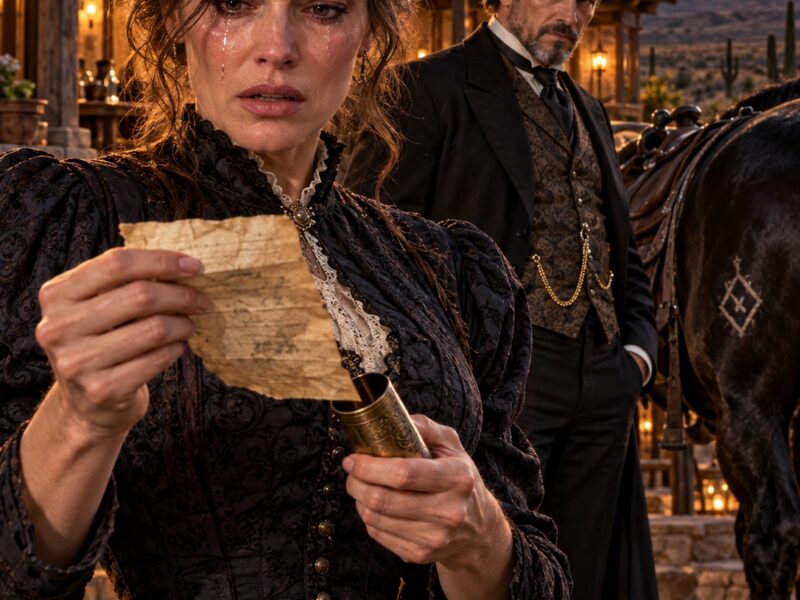
THE WIDOW SAW A RIFLE AIMED AT THE APACHE MAN SHE LOVED—THEN SHE LEARNED WHY HE HAD REALLY COME FOR HER HORSE
The first shot missed Jonah Two Rivers by less than a foot.
Evelyn Ashford knew because she saw the dust jump from the ridge beside his horse.
The second shot was different.
It was followed by a cry.
Not a man’s cry.
A horse’s.
Then Jonah vanished into the Arizona darkness.
“JONAH!”
Evelyn’s voice tore out of her throat as she ran toward the ridge with her dead husband’s shotgun clutched in both hands.
Wind ripped at her skirt.
Lightning split the sky over the Santa Catalina Mountains, turning the desert white for a fraction of a second.
In that flash, she saw three things.
Jonah’s dun stallion stumbling down the far slope.
A stranger on a sorrel horse raising his rifle again.
And the black gelding—the supposedly ordinary horse Evelyn had purchased in Tucson two days earlier—running between them with a severed lead rope snapping behind him.
Then darkness swallowed everything.
Evelyn kept running.
Five years earlier, she had watched her husband die while there was nothing she could do to save him.
She would not stand helplessly while death took another man from her.
Not this man.
Not Jonah.
The realization terrified her almost as much as the gunfire.
Because forty-eight hours earlier, Jonah Two Rivers had been nothing more than an arrogant stranger beside a Tucson watering trough.
And Evelyn Ashford had believed her heart was already buried.
Five years earlier, she had placed it in the frozen Arizona ground beside Henry Ashford.
She had been thirty-seven then.
Young enough for neighbors to assure her she would marry again.
Old enough to know they had no idea what they were talking about.
Henry had been forty-six when fever took him.
It happened during one of the coldest winters southern Arizona had seen in years. Rain had frozen along the fence rails. Ice formed in the water troughs overnight. Henry had come home coughing after spending two days helping a neighboring rancher rescue cattle stranded in a flooded wash.
Four days later, he could barely breathe.
Eight days later, Evelyn was holding his hand when his fingers stopped holding hers back.
Afterward, everyone seemed to know what she should do.
Sell the ranch.
Move into Tucson.
Stay with her sister in California.
Hire a foreman.
Remarry.
Stop wearing Henry’s wedding ring.
Start wearing brighter dresses.
Smile more.
Grieve less.
Evelyn did none of those things.
She kept Ashford Ranch.
She learned which fence posts rotted first after summer storms. She learned how to pull a breech calf at three in the morning. She learned to bargain over feed, repair harness leather, fire dishonest ranch hands and sleep alone while coyotes called beyond the windows.
People gradually stopped calling her poor Evelyn.
They started calling her Mrs. Ashford.
She preferred it that way.
By the spring of 1880, the ranch was profitable again.
It was not large by Arizona standards, but its horses had developed a reputation for strong legs and calm temperaments. Army buyers had begun asking about them. Freight companies wanted them.
Evelyn needed new breeding stock.
That was why she traveled to Tucson in April.
And that was how she met Virgil Pike.
Pike looked like the kind of man who wanted you to notice his success before you noticed him.
His boots were polished.
His vest was dark blue wool despite the heat.
A gold watch chain crossed his stomach, and every few minutes his fingers touched it unconsciously, as though checking that the world could still see it.
He owned Pike Livestock & Trading on the southern edge of Tucson.
Six corrals.
Two barns.
A respectable office with glass windows.
And, according to half the businessmen in town, one of the best horse operations in the territory.
“Mrs. Ashford.”
He removed his hat when she entered the yard.
“I’ve heard about you.”
“That worries me.”
Pike smiled.
“Only good things.”
“That worries me more.”
His smile paused.
Only for an instant.
Then it returned.
Evelyn noticed.
She noticed most things.
Henry used to say it was impossible to lie successfully to his wife because she paid more attention to what people did with their hands than what they did with their mouths.
Pike showed her twelve horses.
Evelyn selected six.
A gray mare.
Two chestnuts.
A broad-shouldered bay.
A young roan.
And finally a black gelding with one white stocking on his left hind leg.
The black horse was not the prettiest.
He was not the largest.
He stood slightly apart from the others, watching people with the suspicious intelligence of an animal that had learned human beings could not always be trusted.
When Evelyn approached, he pinned one ear.
She stopped.
Waited.
He studied her.
Then he lowered his head.
Evelyn smiled.
“You,” she whispered.
Behind her, Pike said, “I wouldn’t recommend that one.”
She turned.
That was the first time his confidence had disappeared.
Only briefly.
But she saw it.
“Why?”
“Temperamental.”
“He hasn’t done anything.”
“He will.”
Evelyn ran her palm slowly down the gelding’s neck.
“He looks sound.”
“Oh, he’s sound.”
“Good teeth.”
“Yes.”
“Strong legs.”
Pike cleared his throat.
“I have a dapple gray you’d like better.”
“I already selected my gray.”
“This one’s prettier.”
“I don’t buy horses for their opinions about mirrors.”
Pike laughed louder than the joke deserved.
“I’ll exchange them at no additional cost.”
Evelyn looked at him.
A businessman offering a prettier animal for free was like a rattlesnake offering directions.
“Why?”
“Customer satisfaction.”
“I haven’t complained.”
Another pause.
His fingers touched the gold watch chain.
“Consider it professional courtesy.”
“No.”
The word changed something in his face.
Not anger exactly.
Calculation.
Evelyn paid for all six horses.
As Pike counted the money, the black gelding shifted behind her.
Pike looked past Evelyn toward the animal.
For one strange moment, there was fear in his eyes.
Not dislike.
Fear.
Then he smiled again.
“Safe journey, Mrs. Ashford.”
She should have remembered that look.
She would remember it later.
Transportation became her next problem.
Six unfamiliar horses meant three difficult days across open country, and the ranch hand who had been supposed to accompany her had broken his wrist the previous week.
An elderly stableman named Amos recommended a scout.
“Fellow calls himself Jonah Two Rivers,” Amos said.
“I’ve heard another name.”
“Lobo.”
“Wolf?”
Amos shrugged.
“Freight drivers started calling him that. Says he can track a horse over rock.”
“Men say many impressive things when women aren’t present to verify them.”
Amos laughed.
“You’ll like him.”
“I need a horseman, not entertainment.”
“You’ll probably get both.”
She found Jonah beside a watering trough.
He was repairing a rawhide rope.
He did not look up immediately when she approached.
That irritated her.
Most men in Tucson recognized Evelyn Ashford. Those who did not still recognized a woman who had walked directly toward them and was clearly waiting to speak.
Jonah continued working.
“Mr. Two Rivers?”
“Depends who’s asking.”
“Evelyn Ashford.”
Now he looked up.
He was younger than she expected.
Twenty-nine, she would later learn.
Thirteen years younger than her.
His black hair reached his shoulders, tied loosely behind his neck. His face was lean and sun-browned, with high cheekbones and eyes that seemed amber when sunlight caught them.
He wore a faded blue shirt, dark trousers and boots that had clearly traveled farther than Pike’s polished pair ever had.
His gaze moved over her once.
Not crudely.
Carefully.
“So you’re the widow who argues with everyone.”
Evelyn stared at him.
“And you’re apparently the man who needs lessons in manners.”
The corner of his mouth moved.
“Perhaps we’ll both learn something.”
“I need six horses taken to Ashford Ranch.”
“I know where it is.”
“How?”
“I know most ranches between here and Oracle.”
“I was told you’re a scout.”
“Sometimes.”
“Sometimes?”
“Sometimes people need a scout. Sometimes they need a tracker. Sometimes they need someone who knows when they’re being cheated.”
Something about the last sentence made her pause.
“Are you suggesting I’m being cheated?”
“I haven’t seen your horses.”
“Then don’t suggest anything.”
His smile widened.
“You really do argue with everyone.”
Evelyn should have walked away.
Instead, she hired him.
They left Tucson shortly after sunrise.
Within two hours, she understood why Amos had recommended him.
Jonah barely seemed to command horses at all.
He communicated with them.
A whistle.
A touch.
A change in posture.
When the black gelding suddenly jerked away from the group and bolted toward a dry ravine, Evelyn expected Jonah to chase directly behind him.
He didn’t.
He angled his stallion left.
The gelding changed direction exactly where Jonah seemed to know he would.
Thirty seconds later, Jonah had him.
Evelyn rode up, irritated by how impressed she was.
“How did you know where he’d go?”
“He told me.”
“Horses don’t talk.”
“They do.”
She waited.
Jonah adjusted the gelding’s lead rope.
“If you know how to listen.”
“That sounds like something a man says when he wants to appear mysterious.”
“Is it working?”
“No.”
“You’re still staring at me.”
“I am staring at the horse.”
“Of course.”
She turned her mare away before he could see her smile.
That afternoon they crossed a shallow creek.
The sun was brutal, and Jonah removed his shirt to wash dust from his face and shoulders.
Evelyn was checking a saddle strap when she glanced toward him.
Then forgot about the saddle strap.
There was a long pale scar along his right side, beginning below his ribs and disappearing beneath his waistband.
Jonah turned.
Caught her looking.
“Something wrong, Mrs. Ashford?”
“Nothing whatsoever.”
“Then why are you looking at me?”
She lifted her chin.
“I was examining your scar.”
“That’s disappointing.”
“What is?”
“I thought perhaps you admired the rest.”
Heat rose instantly into her cheeks.
“You’re insufferable.”
“So I’ve been told.”
“Frequently, I imagine.”
“Mostly by you.”
She turned away.
Behind her, she heard him laugh.
And something happened that frightened Evelyn more than she wanted to admit.
She laughed too.
It was a small sound.
Almost nothing.
But she could not remember the last time a man had made her laugh that way.
That night they camped beneath cottonwoods.
The horses grazed nearby.
Jonah cooked beans with dried beef in a blackened pot.
Evelyn tasted them.
“These are terrible.”
“You’re welcome.”
“I didn’t thank you.”
“You ate them.”
“I was hungry.”
“Then hunger thanked me.”
She looked at him over the fire.
“You always need the last word?”
“Only when the other person keeps giving me opportunities.”
Later, the teasing faded.
The stars came out.
Without Tucson’s lanterns, the sky seemed impossibly deep.
Jonah sat with his back against a saddle, turning a small piece of wood between his fingers.
Evelyn noticed it was carved into the shape of a bird.
“You made that?”
“My father did.”
“Is he alive?”
Jonah’s thumb stopped moving.
“No.”
Evelyn understood the silence.
“I’m sorry.”
He nodded.
After a while, Jonah asked, “Henry?”
She looked at him sharply.
“You asked in town.”
“No.”
“Then how do you know his name?”
“People talk.”
That explanation should have satisfied her.
It didn’t.
But Jonah’s expression had softened.
So she answered.
“Fourteen years.”
“You were married fourteen years?”
“Yes.”
“You loved him.”
It was not a question.
Evelyn stared into the fire.
“Very much.”
Jonah said nothing.
That made it easier.
“He was kind,” she continued. “Not perfect. He could leave a gate open after being reminded twenty times. He snored. He believed coffee could repair almost any problem.”
“Wise man.”
“He was terrible at cards.”
“Less wise.”
She smiled.
Then the smile disappeared.
“He died in winter.”
Jonah waited.
“Fever.”
Her fingers tightened around her cup.
“For eight days I kept believing morning would come and he would be better. Every morning he was worse.”
The fire snapped.
“I remember thinking there must be something I could do. More blankets. Different medicine. Another doctor. More prayers.”
Her voice lowered.
“There wasn’t.”
Jonah looked at her.
Not with pity.
That mattered.
“After he died,” Evelyn said, “everyone kept telling me I had time.”
“For what?”
“To begin again.”
“And?”
“I didn’t want to.”
“Didn’t?”
She noticed the word.
“You’re very young to be interrogating me about grief.”
“I’m twenty-nine, not twelve.”
“You’re thirteen years younger than I am.”
“I know how to count, Evelyn.”
It was the first time he had used her first name.
Something shifted between them.
She felt it physically.
“Then you should know better.”
“About what?”
She looked directly at him.
“Whatever you’re doing.”
Jonah’s expression changed.
The teasing disappeared.
“Maybe I know exactly what I’m doing.”
Evelyn’s heart beat once, hard.
“I’ve already had my great love.”
Jonah looked into the fire.
“Maybe some people get two.”
“Life isn’t that generous.”
“No.”
His eyes returned to hers.
“But sometimes it surprises us.”
Evelyn stood.
“Good night, Jonah.”
She walked toward her blankets before he could see how badly her hands were trembling.
The following morning, everything was different because both of them pretended nothing had happened.
They discussed water.
Distances.
Weather.
Horses.
Anything except the fire.
Anything except Henry.
Anything except the possibility Jonah had placed between them.
By noon, Jonah had become unusually quiet.
He was examining the black gelding.
Again.
Evelyn watched from several yards away.
“What?”
Jonah ran his hand across the animal’s left hip.
“Nothing.”
“You’ve looked at that spot three times.”
“Twice.”
“Three.”
He glanced at her.
“You count everything?”
“When someone is hiding something.”
His hand moved through the black coat.
Hair grew irregularly over a patch roughly the size of Evelyn’s palm.
“What is it?”
“Scar tissue.”
“From an injury?”
“Maybe.”
She dismounted.
Jonah parted the hair.
Beneath it, Evelyn could see a faint pattern.
Not Pike’s fresh brand.
Something older.
Something that had been deliberately damaged.
“What does that mean?”
“I don’t know yet.”
“You’re lying.”
“No.”
“You recognize something.”
Jonah’s jaw tightened.
“Recognizing part of something isn’t the same as knowing what it means.”
“Then tell me the part.”
He stood.
“Not until I’m sure.”
“I hired you.”
“To move horses.”
“My horses.”
“Yes.”
“Which means if there’s something wrong with one, I deserve to know.”
Jonah looked at her for several seconds.
Then he said quietly, “Somebody burned over an older brand.”
“Pike?”
“I don’t know.”
“Why would anyone do that?”
“To make a horse look like it belonged to someone else.”
The desert suddenly felt less empty.
Evelyn looked back toward Tucson.
“How old?”
“The scar?”
“Yes.”
“At least a year. Maybe more.”
She remembered Pike offering the dapple gray.
No additional cost.
Customer satisfaction.
She remembered his fingers touching his gold watch.
And the fear in his eyes.
“Jonah.”
“Yes?”
“Do you know that brand?”
His face became unreadable.
“No.”
It was the first lie she caught him telling.
That evening, wind began rising from the west.
By sunset, dust had turned the horizon brown.
They sheltered beside a low rock formation while the horses were secured in a shallow basin.
Evelyn sat close to the fire, fighting a chill that had nothing to do with temperature.
Jonah came behind her.
A blanket settled over her shoulders.
“I don’t need—”
“You’re shivering.”
“I’m not.”
“You are.”
His fingers brushed the side of her neck.
Neither moved.
Evelyn could hear the wind.
The fire.
A horse shifting its weight.
Jonah’s breathing.
She turned.
He was close.
Far too close.
She should have stepped away.
She didn’t.
“Jonah.”
His eyes lowered briefly toward her mouth.
Then returned to her eyes.
“Don’t,” she whispered.
“Don’t what?”
“Make promises you cannot keep.”
His face softened.
“I haven’t made one yet.”
“That doesn’t make this safer.”
“No.”
“I’m forty-two.”
“I remember.”
“I had a husband.”
“I know.”
“I loved him.”
“I know that too.”
“And you’re—”
“Apache?”
The word stopped her.
“No.”
Jonah studied her.
“You were going to say younger.”
“Yes.”
“Good.”
“Why?”
“Because the first answer would have disappointed me.”
Evelyn’s eyes narrowed.
“You think you know me very well.”
“No.”
His voice dropped.
“I’d like to.”
For one suspended moment, Evelyn forgot how to breathe.
Jonah leaned closer.
A horse screamed.
Not whinnied.
Screamed.
Jonah turned instantly.
He was on his feet before Evelyn understood what had happened.
They ran toward the horses.
Five.
There were only five.
The black gelding was gone.
Jonah crouched beside the tether line.
“Cut.”
Evelyn felt cold.
“Could he have—”
“No.”
Jonah touched the severed rope.
“Knife.”
Then he looked into the darkness.
“Someone followed us.”
He reached for his rifle.
“Stay here.”
“No.”
“Evelyn.”
“That’s my horse.”
“This isn’t about your horse anymore.”
The sentence frightened her.
“What is it about?”
Jonah was already mounting.
“Stay with the others.”
Then he rode into the darkness.
Evelyn lasted perhaps thirty seconds.
She took Henry’s shotgun.
Mounted.
And followed.
Lightning showed her tracks in the dirt.
Jonah’s dun stallion.
The black gelding.
Another horse.
A sorrel.
She climbed the ridge.
Then saw them.
The thief was perhaps two hundred yards ahead.
Jonah was closing fast.
The black gelding ran between them.
Another flash.
Evelyn saw the sorrel’s left ear.
Split almost halfway down.
The rider turned.
Raised a rifle.
“JONAH!”
The wind swallowed her voice.
The rifle fired.
Dust erupted beside Jonah.
He kept riding.
The stranger fired again.
Jonah’s stallion screamed.
Horse and rider disappeared over the ridge.
Evelyn ran toward them.
By the time she reached the far slope, the thief was gone.
The black gelding stood twenty yards away, trembling.
Jonah’s stallion lay on its side.
And Jonah was nowhere.
“Jonah!”
Nothing.
She slid from her saddle.
Then heard breathing below her.
A steep wash cut through the ground.
Jonah lay at the bottom.
“Jonah!”
She scrambled down.
His eyes were closed.
Blood covered one side of his shirt.
For one terrible second, Evelyn was no longer in the desert.
She was beside Henry’s bed again.
Watching another man leave her.
“No.”
She dropped beside Jonah.
“No. No, no, no.”
His eyes opened.
“That’s a lot of no.”
She nearly sobbed.
“You bastard.”
“Good to see you too.”
She touched his chest, searching frantically.
“Where are you hit?”
“Shoulder.”
She tore open the shirt.
The bullet had passed through the flesh high along his left shoulder.
Bloody.
Painful.
But not fatal.
Evelyn closed her eyes.
Jonah watched her.
“You thought I was dead.”
“Be quiet.”
“You were crying.”
“I was not.”
“You are now.”
She wiped her face angrily.
“Blood loss has made you stupid.”
“It hasn’t changed me that much.”
She laughed and cried at the same time.
Then she hit him lightly in the uninjured shoulder.
“Never do that again.”
“I’ll discuss it with whoever shoots me next.”
Her hand remained against his chest.
Jonah looked at it.
Then at her.
The joke disappeared.
“Evelyn.”
She kissed him.
There was nothing careful about it.
Nothing sensible.
Five years of restraint broke in one terrified moment.
Jonah froze.
Then his good hand came behind her neck.
When they separated, Evelyn stared at him, horrified by herself.
“I shouldn’t have done that.”
“Why?”
“You’ve been shot.”
“I’ve had worse medicine.”
Despite everything, she laughed.
Then Jonah’s expression hardened.
“What?”
He was looking past her.
At the black gelding.
The animal had followed them down.
“Bring him here.”
“You need your wound—”
“Evelyn. Please.”
Something in his voice stopped her.
She brought the gelding.
Jonah struggled upright.
Then took his knife.
“What are you doing?”
“Finding out why a man was willing to kill me.”
He carefully shaved away a small patch of hair around the old scar.
More of the damaged brand emerged.
A curved line.
Two vertical marks.
A small circle.
Jonah stopped breathing.
Evelyn saw his face.
“You know it.”
This time, he didn’t deny it.
“Yes.”
“What is it?”
He looked up at her.
“My father’s brand.”
The wind moved between them.
Evelyn stared at him.
“What?”
“The horse came from my family’s herd.”
“You told me you didn’t recognize it.”
“I wasn’t certain.”
“You lied.”
“Yes.”
“Why?”
Jonah lowered his knife.
“Because twelve horses disappeared the night my father died.”
Evelyn felt the world narrow.
“How did he die?”
Jonah’s eyes turned toward the dark ridge where the gunman had vanished.
“He was murdered.”
They returned to camp before dawn.
Evelyn cleaned Jonah’s wound.
He told her the rest while she worked.
His father, Samuel Two Rivers, had bred horses north of the San Pedro River.
Not many.
Enough.
Samuel had worked with ranchers, freight companies and cavalry contractors. He had kept meticulous records because, as Jonah explained, a Native man selling horses to white businessmen needed twice as much proof to receive half as much trust.
Three years earlier, Samuel discovered horses disappearing from several small ranches and Native herds.
The stolen animals reappeared months later with altered brands.
Samuel started tracking them.
Then one night his barn burned.
Samuel was found outside it with a bullet in his back.
Twelve horses vanished.
The authorities called it a robbery.
No one was arrested.
Jonah never believed it was random.
“Why didn’t you tell me?”
Evelyn tied the bandage tighter.
Jonah winced.
“Because I didn’t know whether that horse was one of ours.”
“And now?”
“Now I do.”
“What does Pike have to do with it?”
“I don’t know.”
“You suspected him.”
Jonah hesitated.
“Yes.”
Evelyn stepped back.
The answer hurt more than she expected.
“You knew who Pike was before I hired you.”
“I knew his name.”
“You knew he might be involved.”
“Yes.”
“And you let me ride out of Tucson carrying evidence that could connect him to murder?”
“I didn’t know what you had.”
“But when you saw the horse—”
“I suspected.”
“And said nothing.”
“I needed proof.”
“You used me.”
Jonah stood despite the pain.
“No.”
“You took the job because of that horse.”
“At first.”
The words landed hard.
At first.
Evelyn looked away.
The kiss in the wash suddenly felt humiliating.
“You should sleep.”
“Evelyn—”
“Don’t.”
“I was going to tell you.”
“When?”
“When I knew.”
“When you had what you wanted?”
His jaw tightened.
“That isn’t fair.”
“Fair?”
She turned on him.
“You entered my journey knowing there might be men willing to kill for something I owned, and you decided I didn’t deserve to know.”
“I was trying to protect you.”
“Men have been protecting women with lies since God invented excuses.”
Jonah flinched.
Good.
She wanted him to.
But anger could not erase what had happened in the wash.
That was the worst part.
She was furious with him.
And still terrified of losing him.
At sunrise they found Jonah’s stallion alive.
The bullet had grazed its upper leg. The horse could walk but not carry a rider.
They redistributed supplies.
Jonah rode Evelyn’s mare.
Evelyn took one of the chestnuts.
The black gelding remained between them like a secret neither could ignore.
By afternoon, they found the sorrel’s tracks.
Jonah studied them.
“Rider’s heading south.”
“Back to Tucson?”
“Maybe.”
Evelyn crouched beside him.
“You recognized the horse.”
“The split ear.”
“Yes.”
Jonah’s face hardened.
“I’ve seen him before.”
“Where?”
“Pike’s stable.”
Evelyn felt anger rise.
“You’re certain?”
“I notice horses.”
“Who rides him?”
“A man named Clay Mercer. Works for Pike when Pike doesn’t want his own hands dirty.”
The implications settled between them.
Pike had sold Evelyn the horse.
Then tried desperately to exchange it.
When she refused, someone followed them.
Cut the rope.
Stole that specific gelding.
And tried to kill Jonah.
“Then we go to the sheriff.”
Jonah shook his head.
“With what?”
“A bullet hole in your shoulder.”
“Mercer will say he wasn’t there.”
“The horse.”
“Pike will say he bought it legally.”
“The old brand.”
“Damaged.”
“Your father’s records?”
“Gone in the fire.”
Evelyn stared at him.
“Then what do we have?”
Jonah looked toward the black gelding.
“Not enough.”
That changed the following morning.
They reached Ashford Ranch shortly before noon.
Evelyn’s foreman, Thomas Reed, came running when he saw Jonah’s bandage.
Within an hour, Jonah was lying in Evelyn’s spare room while Thomas sent a ranch hand for the doctor.
Evelyn should have been exhausted.
Instead, she walked directly to the barn.
The black gelding stood quietly inside.
She examined the scar again.
Something bothered her.
Pike had been afraid.
Not merely worried about an altered brand.
Afraid.
Why?
Jonah’s father had been dead three years.
A stolen horse could prove theft.
Possibly.
But murder?
No.
Not alone.
She ran her hand down the gelding’s neck.
Then noticed a small abrasion beneath his mane.
She parted the hair.
Leather had rubbed there repeatedly.
Not recently.
An old pattern.
Evelyn frowned.
Henry had once owned a cavalry horse trained to carry documents in a narrow leather pouch beneath its mane during field exercises.
She remembered laughing about it.
Nobody searches the horse, Henry had told her.
They search the rider.
Her pulse quickened.
She examined the gelding more carefully.
Nothing.
Then she lifted his left front hoof.
A horseshoe.
Ordinary.
Except one nail was copper.
The others were iron.
Evelyn stared.
She removed the shoe.
Beneath it, fitted into a shallow groove in the hoof, was a tiny flattened brass cylinder.
Her hands began shaking.
Inside was a rolled strip of oilskin.
On it were names.
Dates.
Numbers.
Horse descriptions.
Brands.
Payments.
And one name appearing repeatedly.
V. PIKE.
At the bottom was a sentence written in faded pencil.
If anything happens to me, take this to Marshal Caleb Warren in Tucson.
S. TWO RIVERS.
Evelyn sat on the barn floor.
Samuel had known.
He had known someone might kill him.
And he had hidden his evidence on one of the stolen horses.
Behind her, a voice said, “Mrs. Ashford?”
Evelyn spun around.
Thomas stood in the doorway.
She quickly closed her fist around the cylinder.
“What?”
“A rider just came in.”
“Who?”
Thomas’s expression was uneasy.
“Says he’s from Tucson.”
Evelyn stood.
“Name?”
“He wouldn’t give it.”
Her hand moved toward Henry’s shotgun.
Then Thomas added:
“He says Virgil Pike sent him.”
The rider was not Clay Mercer.
He was a thin man named Hollis with nervous eyes.
He held his hat against his chest.
“Mr. Pike believes a mistake was made in your purchase.”
“What kind of mistake?”
“The black gelding wasn’t intended for sale.”
Evelyn almost laughed.
“Strange. I remember paying for him.”
“Mr. Pike will refund three times the price.”
“No.”
“Five times.”
“No.”
Hollis swallowed.
“He strongly recommends reconsidering.”
“Is that a threat?”
“No, ma’am.”
“Good.”
She stepped closer.
“Then tell Mr. Pike the horse belongs to me.”
Hollis looked past her toward the barn.
Then back.
“He said you might say that.”
“And?”
“He told me to remind you that ranches are lonely places.”
Thomas moved forward.
Evelyn stopped him with one hand.
She looked directly at Hollis.
“Tell Virgil Pike something for me.”
The man waited.
“Widows are accustomed to lonely places.”
Hollis left.
That evening Jonah came downstairs against the doctor’s instructions.
Evelyn was sitting at the kitchen table.
The brass cylinder lay between them.
Jonah saw it.
Stopped.
“Where?”
“Under the shoe.”
His face lost color.
He opened the oilskin.
For several minutes he said nothing.
Then his finger touched his father’s handwriting.
Evelyn watched the anger leave him.
What replaced it was grief.
A son’s grief.
Three years old.
Still fresh.
Jonah sat down.
“He knew.”
“Yes.”
“He knew they were coming.”
His voice broke slightly.
Evelyn’s anger toward him did not disappear.
But it changed.
She placed her hand beside his.
Not touching.
Close.
“My father asked me to leave that week,” Jonah said.
“Why?”
“He said he needed me to deliver horses north.”
Jonah gave a hollow laugh.
“There were no horses.”
“He sent you away.”
“He was protecting me.”
Evelyn understood immediately.
“And you’ve spent three years thinking you should have been there.”
Jonah looked at her.
She knew that look.
Guilt had a language grief understood without translation.
“You couldn’t have saved him,” she said.
“You don’t know that.”
“No.”
Her voice softened.
“But I know what it is to spend years inventing ways you might have saved someone who died.”
Jonah’s eyes lowered.
“Henry?”
“I replayed those eight days for years.”
She swallowed.
“Maybe another doctor. Maybe I should have noticed the cough sooner. Maybe I should have stopped him going out in the storm.”
“Was it your fault?”
“No.”
“Then why—”
“Exactly.”
Jonah looked at her.
For the first time since the kiss, neither looked away.
The moment ended when a shot exploded outside.
The kitchen window shattered.
Jonah pulled Evelyn to the floor.
A second bullet struck the wall.
Thomas shouted from the bunkhouse.
Men ran.
Then came hoofbeats.
By the time the ranch hands reached the road, the shooter was gone.
But a note had been tied to the front gate.
Evelyn opened it.
One sentence.
GIVE BACK WHAT ISN’T YOURS.
Jonah looked at the paper.
“He knows.”
“About the horse?”
“Maybe the evidence.”
Evelyn folded the note.
“Then we take it to Marshal Warren.”
“Tonight.”
“No.”
Jonah stared at her.
“Evelyn—”
“That’s what Pike expects.”
She pointed toward the darkness.
“He wants us frightened enough to run straight to Tucson.”
Jonah understood.
“He’ll be waiting on the road.”
“Yes.”
“Then what?”
Evelyn looked toward the barn.
“We make him believe he won.”
The next morning, Thomas rode into Tucson carrying a message.
Mrs. Ashford had reconsidered.
Pike could have the black gelding.
He would be delivered at sundown.
Virgil Pike arrived himself.
That told Evelyn everything.
He came with Clay Mercer and two armed men.
Pike smiled as he entered the ranch yard.
“Mrs. Ashford.”
“Mr. Pike.”
“I knew reason would prevail.”
Evelyn stood on the porch.
Jonah was nowhere visible.
Neither was Thomas.
Pike glanced around.
“Your Apache guide?”
“Gone.”
“Really?”
“Yes.”
“That’s unfortunate.”
“Why?”
“No reason.”
Evelyn hated the satisfaction in his eyes.
The black gelding stood tied beside the barn.
Pike walked toward him.
“Money?”
Evelyn asked.
Pike laughed.
“You’re still negotiating?”
“You offered five times.”
“Yes.”
“I expect five times.”
His smile thinned.
“Of course.”
He removed an envelope.
Evelyn accepted it.
Pike reached for the horse.
“Before you leave,” she said, “I have a question.”
He stopped.
“Why did Samuel Two Rivers hide records beneath this horse’s shoe?”
Silence.
Clay Mercer’s hand moved toward his gun.
Pike’s face emptied.
The charming businessman vanished.
“Where is it?”
Evelyn smiled faintly.
“Thank you.”
“For what?”
“For confirming you know exactly what I’m talking about.”
Pike lunged.
A rifle cocked above them.
Jonah stood in the loft window.
Thomas and two ranch hands appeared behind the barn.
Pike’s men reached for their weapons.
“Don’t,” Jonah said.
Nobody moved.
Pike stared at him.
“You should have died with your father.”
The words hung in the yard.
Evelyn felt Jonah become still.
Not shocked.
Something colder.
“You killed him.”
Pike realized his mistake.
Too late.
A voice came from behind the house.
“I heard that too.”
Marshal Caleb Warren stepped into view with two deputies.
Pike’s face changed.
Thomas had not ridden to Tucson merely with a message.
He had taken Samuel’s evidence.
The marshal approached.
“Virgil Pike, put your hands where I can see them.”
Pike looked at Evelyn.
Then Jonah.
Then the black gelding.
For a moment, Evelyn thought it was over.
Then Clay Mercer drew.
The yard erupted.
A gunshot.
Thomas dove behind a trough.
One deputy fired.
A horse reared.
Pike grabbed Evelyn.
His arm locked around her throat.
A revolver pressed against her ribs.
“Drop it!” he shouted.
Jonah froze.
His rifle was aimed directly at Pike.
“Drop it, Lobo.”
Evelyn could feel Pike breathing against her hair.
Jonah’s eyes met hers.
“Do it,” Pike said.
Jonah lowered the rifle.
Evelyn saw something in his face.
Not surrender.
Trust.
Trust in her.
Pike didn’t know Evelyn Ashford.
He saw a widow.
A woman.
A hostage.
He did not see the woman who had run a ranch alone for five years.
Evelyn drove her heel backward into Pike’s knee.
He grunted.
She twisted.
Henry had taught her years earlier what to do if someone grabbed her from behind.
Never fight the arm.
Move the body.
She dropped her weight.
Pike lost balance.
The revolver fired into the dirt.
Jonah moved.
He crossed the distance between them with terrifying speed.
Pike hit the ground.
Jonah kicked the revolver away.
Then he was on top of him.
Once.
Twice.
His fist struck Pike’s face.
Again.
“Jonah!”
Evelyn grabbed his arm.
He looked at her.
She saw his father in his rage.
Three years of grief.
Three years of imagining revenge.
“Don’t,” she whispered.
“He killed him.”
“I know.”
“He burned our home.”
“I know.”
Jonah’s fist trembled.
Pike smiled through blood.
“Do it.”
Jonah stared down at him.
Pike wanted it.
A dead criminal could become a victim.
A living one had to answer questions.
Slowly, Jonah stood.
“No.”
Marshal Warren pulled Pike upright.
“You’ll answer for him.”
The investigation lasted months.
Samuel’s records opened doors no one expected.
The horse theft operation stretched across three counties.
Pike purchased stolen horses through intermediaries, altered brands, falsified bills of sale and resold the animals to freight companies, ranches and government contractors.
Those who discovered the operation were threatened.
Two disappeared.
One barn burned.
Samuel Two Rivers had been the first person to document enough of the network to destroy it.
That was why he had been killed.
Clay Mercer eventually talked.
Faced with murder charges, he testified that Pike ordered Samuel’s death.
He also admitted following Evelyn and Jonah.
He had been instructed to recover the gelding at any cost.
Even murder.
Virgil Pike was convicted.
His business disappeared.
His polished office was closed.
His corrals emptied.
The gold watch was taken from him when he entered prison.
But none of that solved the more difficult problem waiting at Ashford Ranch.
Jonah stayed while his shoulder healed.
Then another week.
Then another.
Neither discussed what would happen afterward.
They worked.
That was easier.
Jonah repaired fences.
Evelyn trained horses.
Sometimes they rode together.
Sometimes they ate in silence.
Sometimes she caught him watching her.
Sometimes he caught her doing the same.
The kiss in the wash remained between them like a door neither had opened again.
One evening in late May, Evelyn found Jonah packing.
Her stomach tightened.
“You’re leaving.”
He looked up.
“Yes.”
“When?”
“Morning.”
She nodded.
“Where?”
“North first.”
“For how long?”
“I don’t know.”
Evelyn hated the answer because it was reasonable.
Jonah had spent three years chasing his father’s killer.
Now that pursuit was over.
He had to discover who he was without it.
She understood.
Understanding did not make it hurt less.
“I see.”
Jonah tied his bedroll.
“Do you?”
“Yes.”
“Because you look angry.”
“I always look angry according to you.”
“Not like this.”
She folded her arms.
“What exactly would you like me to say?”
Jonah looked at her.
“The truth.”
Evelyn laughed once.
“You first.”
He became quiet.
Then crossed the room.
“I love you.”
Three words.
No performance.
No warning.
Evelyn stopped breathing.
Jonah continued.
“I didn’t intend to.”
“That’s flattering.”
“I mean it.”
“I know.”
“I took your job because I suspected that horse might connect Pike to my father.”
The old hurt returned.
“I remember.”
“But I stayed because of you.”
“Jonah—”
“I know Henry existed.”
His voice softened.
“I know you loved him. I’m not asking you to make him smaller so I can fit into your life.”
That sentence broke something open inside her.
For five years, every man who had shown interest had treated Henry like an obstacle.
A dead husband to be overcome.
A photograph to remove.
A chapter to close.
Jonah did not.
He stepped closer.
“I don’t want his place.”
Evelyn’s eyes filled.
“Then what do you want?”
“My own.”
She turned away.
“I don’t know if I can.”
“Can what?”
“Do this again.”
“Love someone?”
“Lose someone.”
There it was.
The truth beneath everything.
Not age.
Not gossip.
Not the difference between their worlds.
Fear.
She had survived Henry.
Barely.
Loving Jonah meant giving life another weapon.
Jonah stood behind her.
“You think not loving me means you can’t lose me?”
Evelyn closed her eyes.
He continued quietly.
“You rode into gunfire because you thought I’d been shot.”
She turned.
“That was stupidity.”
“Yes.”
Despite herself, she laughed through tears.
Jonah smiled.
Then his expression softened.
“You already care.”
“That doesn’t mean—”
“It means the dangerous part already happened.”
Evelyn stared at him.
He was right.
She hated him for being right.
“What if you leave?”
“I might.”
“What if I wake one morning and you’re gone?”
“You might.”
“What if something happens?”
“It might.”
She shook her head.
“That’s a terrible argument for love.”
“It’s the only honest one I have.”
He touched her cheek.
“Nothing I promise can make life safe.”
His thumb brushed away a tear.
“But I can promise not to lie about wanting you.”
Evelyn looked at him for a long time.
Then whispered, “I hate how young you are.”
Jonah smiled.
“I’ll work on getting older.”
She laughed.
And kissed him.
This kiss was different.
The first had come from terror.
This one came from choice.
Jonah did leave the following morning.
Evelyn let him.
That was part of loving him too.
He traveled north to settle what remained of his father’s affairs.
He found three of Samuel’s surviving horses.
He visited relatives he had avoided during the years of his obsession.
He returned to the land where the barn had burned.
And for the first time, he stood beside his father’s grave without promising revenge.
He simply said goodbye.
Six weeks later, Evelyn was repairing a gate when she heard hoofbeats.
She did not turn immediately.
She had learned not to build hope from sounds.
Then a familiar voice said:
“You’re doing that wrong.”
Evelyn closed her eyes.
Smiled.
Then turned.
Jonah sat on a new dun stallion.
His hair was longer.
His face darker from the sun.
A small bundle was tied behind his saddle.
“You came back.”
He dismounted.
“I said I might.”
“You also said you might not.”
“I changed my mind.”
“Why?”
Jonah walked toward her.
“There’s a widow here who argues with everyone.”
“I remember her.”
“I thought she might need help.”
“She doesn’t.”
“No.”
He stopped in front of her.
“But perhaps she’ll tolerate company.”
Evelyn looked at him.
Then past him.
“What is that?”
Another horse stood behind Jonah.
Black.
One white stocking.
The gelding.
Evelyn stared.
“I thought the marshal still had him.”
“Released yesterday.”
Jonah walked to the horse.
He touched the old scar.
The altered brand remained visible.
It always would.
“I’m keeping it,” Evelyn said.
Jonah nodded.
“I thought you would.”
“What should we call him?”
Jonah considered.
“Samuel.”
Evelyn looked at him.
“No.”
His eyebrows rose.
“No?”
“Your father deserves better than having his name shouted every time a horse breaks a fence.”
Jonah laughed.
“Fair.”
She studied the gelding.
“Second Chance.”
Jonah groaned.
“That’s terrible.”
“You don’t like it?”
“Too sentimental.”
“From the man carrying a wooden bird his father carved?”
“That is different.”
“Of course.”
They argued for ten minutes.
The horse became Chance.
By autumn, people around Tucson had begun talking.
Some disapproved of Evelyn Ashford living openly with an Apache man thirteen years younger than she was.
Some whispered.
Some stared.
A few stopped doing business with her.
More didn’t.
Evelyn discovered that scandal became surprisingly unimportant after you had survived grief, gunfire and Virgil Pike.
One afternoon, a neighboring rancher’s wife asked whether she worried what people said.
Evelyn considered the question.
Then looked across the corral.
Jonah was working with Chance.
He had one hand on the gelding’s neck.
No rope.
No whip.
Just patience.
The horse followed him.
“Yes,” Evelyn said.
The woman seemed surprised.
Evelyn smiled.
“I just don’t worry enough to obey them.”
Winter came.
Five years earlier, winter had meant Henry’s fever.
His empty chair.
The grave.
For years, Evelyn had hated the first cold morning.
That December, she woke before sunrise and discovered frost along the window.
For a moment, grief returned exactly as it always did.
Sharp.
Faithful.
Uninvited.
She walked into the kitchen.
Jonah was already there.
Coffee waited on the table.
He did not ask why she was quiet.
He knew.
Evelyn walked to the small shelf beside the fireplace.
Henry’s photograph stood there.
It had always stood there.
Jonah had never asked her to move it.
She touched the frame.
“Five years today,” she said.
Jonah nodded.
“I know.”
She looked at him.
“How?”
“You told me once.”
She had forgotten.
He hadn’t.
Jonah poured coffee.
Then left her alone with Henry for several minutes.
That kindness nearly undid her more than anything else.
When he returned, Evelyn was crying.
He did not tell her to stop.
He sat beside her.
She leaned against him.
“I still love him.”
“I know.”
“Does that hurt you?”
Jonah considered before answering.
“Sometimes.”
She looked up.
He smiled sadly.
“But I’d rather share your heart with a good dead man than own a heart that forgot how to love.”
Evelyn cried harder.
Jonah held her.
Outside, Chance moved through the frosted corral.
The damaged brand was still visible beneath his winter coat.
Evelyn had once suggested covering it with a new one.
Jonah refused.
“Why?”
“Because scars aren’t always things we need to hide.”
She had understood.
Years later, when people told the story of Virgil Pike, they usually told the exciting parts.
The stolen horses.
The hidden records.
The midnight gunfight.
The widow who trapped a criminal.
The Apache tracker who finally proved his father had been murdered.
People liked stories where justice arrived dramatically.
Reality was quieter.
Justice did not bring Samuel back.
Love did not bring Henry back.
Pike’s conviction did not erase Jonah’s childhood.
A new beginning did not destroy old grief.
It simply made room beside it.
Evelyn and Jonah never had the kind of love that erased what came before.
They had something more difficult.
A love that accepted it.
They fought.
Often.
Evelyn remained stubborn.
Jonah remained infuriating.
He left gates open.
She accused him of doing it deliberately because Henry had done the same thing.
Jonah claimed dead husbands were unfair competition because they could no longer make new mistakes.
She threw a dish towel at him.
He laughed.
She laughed too.
And every April, when desert flowers appeared between the rocks, they rode together toward the ridge where Jonah had once disappeared after the gunshot.
Chance usually went with them.
His old brand faded with age but never vanished.
Neither did theirs.
One evening many years later, Evelyn stood beside that ridge while sunset turned the Arizona sky red and gold.
Jonah was a few yards away adjusting a saddle.
There was gray in his hair now.
Evelyn liked pointing it out.
He liked reminding her that she had gotten there first.
She watched him and thought about the woman she had been at forty-two.
The woman who believed love happened once.
The woman who thought surviving loss meant never risking another.
She wished she could speak to her.
Not to tell her everything would be all right.
That would have been a lie.
She would tell her something harder.
Something Jonah had taught her.
Safety was never the same thing as living.
Jonah looked over.
“You staring at me again, Mrs. Ashford?”
Evelyn smiled.
“Your scar.”
“Of course.”
“It’s very distracting.”
“After all these years?”
“Some things don’t improve.”
He walked toward her.
The desert wind moved softly through the grass.
Somewhere below them, a horse called.
Jonah offered his hand.
Evelyn took it.
Once, she had believed Henry’s death was the ending of her great love story.
She had been wrong.
Henry had not been replaced.
He had been loved.
Remembered.
Carried.
And beside that love, impossibly, another had grown.
Different.
Dangerous.
Alive.
Evelyn looked down at their joined hands.
Then at the old black gelding waiting beneath the ridge—the horse one dishonest man had tried to erase by burning one mark over another.
But the first mark had remained underneath.
Hidden.
Scarred.
Still true.
Perhaps hearts were like that too.
What had been written deeply enough could never really be removed.
New love did not have to burn away the old.
Sometimes it simply appeared beside it.
Jonah squeezed her hand.
“Ready?”
Evelyn looked toward the long road home.
“Yes.”
And this time, when she said it, she meant far more than the ride.









