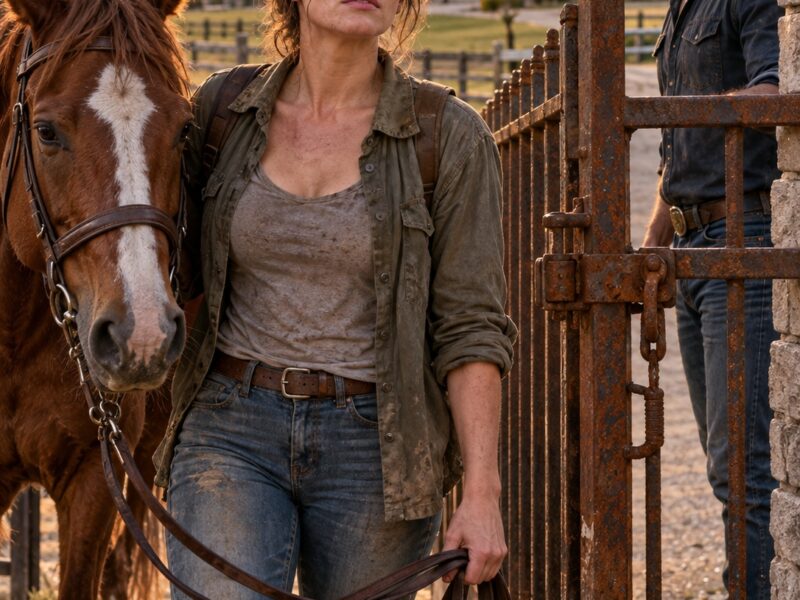
THE WIDOW WHO OPENED THE GATE HE HAD KEPT CLOSED FOR SIX YEARS
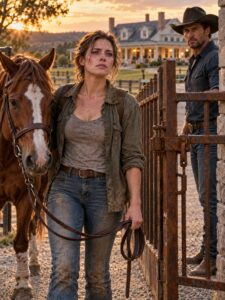
The first stranger to touch Thomas Reed’s gate in six years was an eight-year-old boy who had no idea the gate was supposed to mean something.
His small hand was already reaching for the rusted latch when his mother caught his wrist.
“Eli.”
The boy stopped.
“Not our gate to open.”
Thomas heard those words from inside the ranch house.
He had been standing over the kitchen sink with a chipped coffee cup in one hand, staring through the window at nothing in particular, the way a man learns to stare when he has lived alone long enough.
Then came the voices.
A woman.
A child.
And the restless bark of a dog.
Thomas went still.
Nobody came to Reed Ranch anymore unless they had business that could not be handled in town. Feed deliveries stopped at the road. Neighbors had learned not to drop by. Even Garrett Boyd, who owned the property north of his, preferred shouting across the boundary fence to stepping onto Thomas’s land.
That was how Thomas liked it.
Or at least that was what he had spent six years telling himself.
He set the cup down.
Outside, the October wind pushed dry grass against the porch steps.
Another voice drifted through.
“Is this the place, Mama?”
Thomas crossed the kitchen.
By the time he stepped onto the porch, he saw them.
A woman stood on the other side of the gate holding the reins of a limping chestnut horse.
His horse.
Samson.
Thomas stopped so abruptly that the porch board creaked beneath his boot.
The woman looked to be somewhere in her early thirties, though exhaustion had added years around her eyes. Dust streaked the hem of her faded brown skirt. Her dark hair had come loose from a practical knot at the back of her head, and there was nothing delicate about the way she held Samson’s reins.
She looked tired.
Not helpless.
There was a difference.
Beside her stood the boy, thin and sharp-eyed, with one boot tied together at the sole with a piece of twine.
And beside him—
Thomas stared.
A muddy little dog with half an ear missing was digging furiously at the base of his fence post.
The dog paused.
Looked at Thomas.
Then resumed digging.
The boy followed Thomas’s gaze.
“That’s Scrap.”
Thomas said nothing.
“He does that.”
“I can see.”
“Mama says he has poor judgment.”
The woman closed her eyes briefly.
“Eli.”
“I’m just explaining him.”
For the first time in a long while, Thomas almost smiled.
Almost.
Then Samson gave a low nicker.
Thomas’s attention snapped back to the horse.
He crossed the yard.
The woman watched him approach but did not retreat.
“Obliged,” he said when he reached the gate.
His voice sounded rough even to himself.
He cleared his throat.
“For bringing him back.”
The boy tilted his head.
“Mama said you’d look at us like we stole him.”
Thomas looked at the woman.
Her expression tightened.
“Eli.”
“She did.”
“Eli Bennett.”
The full name meant trouble.
The boy shrugged.
“She said men who keep their gates shut that long usually think the world owes them an apology first.”
Thomas stared at him.
The woman’s face reddened.
“I did not know whose horse he was,” she said quickly. “Not until I saw the brand.”
Thomas looked at Samson.
The old gelding stood calmly beside her.
Too calmly.
Samson disliked strangers.
Always had.
Yet he had his muzzle resting near the woman’s shoulder as though they had known each other for years.
“Where’d you find him?”
“About two miles west. Near the creek.”
“Fence must’ve gone down.”
“Storm took part of it.”
Thomas reached for the latch.
Rust resisted him.
For one absurd second, it felt as if the ranch itself were objecting.
Then the metal gave with a dry crack.
The gate swung inward.
For the first time in six years.
The woman did not know that.
The boy did not know that.
Thomas did.
And as Samson stepped through, followed by Eli and the ridiculous little dog, Thomas had the strange sensation that something far more dangerous than strangers had just entered his property.
Something he had spent six years keeping out.
Life.
Her name was Cora Bennett.
Her wagon had broken a mile up the road.
Thomas discovered that ten minutes later after Eli announced it before his mother had decided whether she wanted to ask for help.
“We can manage,” Cora said.
Thomas looked at the cracked wheel.
“No, ma’am.”
Her eyebrows lifted.
“That an insult?”
“Observation.”
Eli snorted.
Cora gave him a look.
Thomas crouched beside the wagon.
The spoke had split nearly through.
A trunk sat beneath a canvas cover along with blankets, cookware, tools, several sacks of grain, and nearly everything else a woman and child might own if they had learned not to own anything they could not carry.
Thomas noticed that.
He noticed too much.
It was one reason he preferred living alone.
Scrap immediately began digging beside the road.
“What’s he after?” Thomas asked.
“Nothing,” Cora said.
“You sure?”
“He never is.”
Eli crouched beside the dog.
“He buries things, too.”
“What things?”
“Important things.”
“Such as?”
Eli considered.
“Once, half a biscuit.”
Thomas nodded solemnly.
“Valuable.”
“And Mama’s hair ribbon.”
“Eli.”
“And a dead mouse.”
Cora sighed.
Thomas’s mouth betrayed him.
A smile appeared.
Small.
Brief.
But real.
Cora saw it.
For some reason, that bothered him.
He turned back to the wheel.
Once it was patched well enough to move, Cora told him they had claimed a small property a few miles east.
“House isn’t ready,” she admitted. “Roof leaks. Chimney’s worse. We planned to sleep in the wagon until I could make it livable.”
“With the boy?”
Her expression cooled.
“With my son.”
Thomas heard the warning.
He respected it.
He stood.
“There’s a line shack past my east pasture.”
Cora stared at him.
“Roof’s sound. Stove works. Mostly.”
“We can’t pay much.”
“Didn’t ask for much.”
“I don’t take charity.”
“Neither do I.”
Her eyes narrowed.
Thomas pointed toward the ranch.
“Work for lodging. Fence needs mending. Chickens need feeding. Barn always needs something done. Fair trade.”
Cora studied him long enough that another man might have become uncomfortable.
Thomas merely waited.
Finally she said, “Fair trade?”
“Fair trade.”
She held out her hand.
Thomas looked at it.
Then took it.
Her palm was callused.
Not the hand of a woman accustomed to being rescued.
“Then we accept.”
Something shifted inside him.
He released her hand too quickly.
That afternoon, Cora Bennett and her son moved into the old line shack.
Thomas told himself it was temporary.
He had no idea how many times Cora had told herself exactly the same thing.
That first night, after Eli fell asleep, Cora opened the little book.
It was bound in cracked brown leather and swollen with years of pressed leaves, flowers, and scraps of plants gathered from places she no longer lived.
Six towns in seven years.
Six addresses.
Six attempts at beginning again.
She placed a tiny white wildflower between two empty pages.
Underneath it she wrote:
Reed Ranch.
Then the date.
From the bed came Eli’s sleepy voice.
“You putting this place in the book?”
Cora looked over.
“I thought you were asleep.”
“I almost was.”
“That’s not the same thing.”
He rolled toward her.
“Why do you save flowers from everywhere?”
Cora ran one finger over the page.
“So things don’t disappear completely.”
“Even bad places?”
“Especially those.”
“Why?”
She considered lying.
Instead she said, “Because if you forget where you’ve been, you can start thinking the road never happened.”
Eli was quiet.
Then:
“Are we staying here?”
Cora looked at the flower.
“I don’t know.”
“How long?”
“I don’t know that either.”
“Mr. Reed seems lonely.”
Cora glanced up.
“That is none of our business.”
“He does.”
“Eli.”
“He smiles like it surprises him.”
Cora nearly laughed.
Instead she closed the book.
“Go to sleep.”
But after his breathing settled, she remained awake.
Outside, somewhere beyond the shack, a horse moved through the darkness.
And farther away, in the ranch house, a single lamp remained burning long after midnight.
Cora made coffee the next morning.
Thomas came into his kitchen before sunrise and found her standing beside his stove.
He stopped in the doorway.
She glanced over.
“Morning.”
“What are you doing?”
“Coffee.”
“I see that.”
“You sound offended.”
“I’m not.”
“You look offended.”
Thomas stared at his own kitchen.
She had cleaned the coffeepot.
He had not realized how dirty it was until that moment.
“You didn’t have to.”
“I know.”
She poured him a cup.
“Idle hands worry more than busy ones.”
He accepted it.
The coffee was better than his.
He did not tell her.
Four days became a week.
A week began to develop routines.
Eli fed chickens before breakfast.
Cora repaired a section of fence Thomas had ignored since spring.
Scrap stole one of Thomas’s gloves, two pieces of cornbread, and somehow an entire wooden spoon.
Thomas discovered the spoon buried beneath his porch.
“You have a criminal living with you,” he told Eli.
Eli scratched Scrap behind his remaining ear.
“He’s misunderstood.”
“So are bank robbers.”
“He’s never robbed a bank.”
“Yet.”
Eli laughed.
Thomas heard the sound carry across the yard.
He had forgotten children could make a place feel larger simply by being noisy inside it.
That realization frightened him more than he expected.
Because once a house remembered laughter, silence became harder to tolerate.
The first warning came from town.
Eli returned from the feed store quieter than usual.
Cora noticed immediately.
“What happened?”
“Nothing.”
“That answer has never once meant nothing.”
He stared at his plate.
“A man said Scrap shouldn’t be around other animals.”
Thomas looked up.
“Who?”
Eli shrugged.
“Big man. Gray beard.”
“Boyd,” Thomas said.
Cora’s knife stopped against the potato she was peeling.
“What exactly did he say?”
Eli hesitated.
“He said folks traveling with a stray dog ought to be careful whose animals they let it near.”
Thomas’s jaw hardened.
“He say anything about your mother?”
“No.”
Eli looked at Cora.
“Not then.”
Cora heard the two words.
“Not then?”
The boy lowered his eyes.
“He asked where Papa was.”
The room went still.
Thomas had never asked.
He realized suddenly that he knew almost nothing about them.
Cora returned to peeling the potato.
“Talk is cheap.”
Her voice was calm.
Too calm.
“Most of it forgets itself by morning.”
But Thomas saw the tension in her fingers.
He understood something then.
She had heard talk before.
And it had cost her something.
A few mornings later, Thomas noticed Eli’s boot.
The sole had split almost completely.
The boy had tied it with twine.
“That won’t last.”
Eli looked down.
“It’s lasted three days.”
“Miracle.”
Thomas crouched.
“I’ve got hide glue.”
Eli watched him suspiciously.
“You fix boots?”
“I fix things that need fixing.”
They sat outside the tack room that evening, Eli holding the boot while Thomas worked glue into the seam.
Scrap lay nearby, chewing something Thomas hoped did not belong to him.
“My pa had good boots,” Eli said suddenly.
Thomas kept working.
“Did he?”
“Leather ones.”
Thomas waited.
Children told truths differently than adults.
They often dropped them casually, not realizing how sharp they were.
“Scrap slept on them every night.”
Thomas pressed the sole together.
“Your father gone?”
“Two years.”
The answer came without emotion.
“Packed Wednesday morning.”
Thomas looked up.
Eli was picking at a splinter.
“Didn’t come back Thursday.”
Thomas said nothing.
“Or Friday.”
Still nothing.
“Or any day after.”
Thomas’s hands stopped.
Eli shrugged.
“Mama says some men run out of staying power partway through.”
The words hit somewhere Thomas had kept guarded.
“Your mother say that?”
“Yeah.”
“She sounds smarter than most people I know.”
Eli considered this.
“She is.”
Thomas went back to the boot.
They finished it in silence.
But it was no longer an uncomfortable silence.
When Eli walked away, Thomas watched him go.
The boy had learned too young not to expect men to stay.
Thomas knew something about expectations like that.
He just did not yet understand why the thought made him angry.
The freeze came without warning.
Thomas woke after midnight and checked the livestock.
On his way back, he saw the line shack.
Dark.
No chimney smoke.
He crossed the yard.
Cora opened the door wrapped in two blankets.
Eli stood behind her wearing his coat.
Scrap had wedged himself between them.
“What happened?”
“Stove won’t draw.”
“How long?”
“A few hours.”
Thomas stared at her.
“Why didn’t you come get me?”
“I thought I could fix it.”
“You planning to fix frostbite too?”
Her expression changed.
Thomas regretted the sharpness immediately.
He stepped aside.
“Bring what you need.”
“We can manage.”
“Cora.”
Something in his voice stopped her.
“You and the boy are sleeping in the house.”
She looked at him.
Thomas added, “Dog too, apparently.”
Scrap sneezed.
Twenty minutes later, Eli was eating reheated stew at Thomas’s kitchen table.
“This is good.”
“Eli,” Cora warned.
“Better than Mama’s sometimes.”
“Eli.”
Thomas looked down to hide his smile.
“Don’t tell her I said that,” Eli added.
“I am sitting right here.”
“I know.”
Thomas laughed.
It came out before he could stop it.
A full laugh.
Cora looked at him.
For half a second, Thomas felt exposed.
Then Eli laughed too.
And somehow the sound filled the kitchen.
That night, Eli slept near the hearth.
Cora took the upstairs room that had remained empty for six years.
Thomas did not sleep much.
Not because they were there.
Because he had discovered he liked that they were.
In the morning, Cora found the garden.
Scrap found it first.
He vanished behind the barn, and Cora followed until the weeds opened into a rectangle of earth almost completely reclaimed by wild grass.
She recognized the bones of what had once been carefully tended rows.
A collapsed trellis.
Dead rose stems.
A stone border disappearing into weeds.
Thomas stood in the barn doorway.
Cora turned.
Their eyes met.
She understood immediately.
She did not ask.
She called Scrap and walked away.
That evening Thomas found the dog asleep in the porch rocking chair.
His wife’s rocking chair.
For one instant, grief hit him so violently he could not breathe.
Then Scrap opened one eye.
Thomas stared at him.
“You have no respect.”
Scrap yawned.
Thomas attempted to move him.
The dog stiffened all four legs.
“No.”
Scrap growled softly.
Thomas stared.
“You’re threatening me on my own porch?”
Scrap shut his eye.
Thomas sat on the porch step instead.
He remained there until sunset.
The chair creaked gently behind him.
And for the first time in six years, the sound did not hurt quite as badly.
Then Samson became sick.
At first it was only heat beneath his jaw.
A little moisture at one nostril.
Thomas told himself it was nothing.
By midnight, he had checked the horse three times.
On the fourth, Cora found him in the barn.
“You’re worried.”
“Observation?”
She gave him a faint smile.
“Learned from you.”
Thomas looked at Samson.
“This was her horse.”
Cora waited.
“My wife’s.”
There it was.
The first piece.
“She broke him herself,” Thomas continued. “Nobody else could sit him.”
Cora ran her fingers gently beneath Samson’s jaw.
The swelling was unmistakable now.
Her face changed.
“What?”
“I’ve seen this before.”
“Bad?”
“Could be.”
Thomas’s stomach tightened.
“Separate him from every other horse.”
“You know what it is?”
“Not yet.”
“But you think you do.”
“Yes.”
“What?”
Cora met his eyes.
“Something contagious.”
By sunrise, fear had entered Reed Ranch.
By the next afternoon, it had entered the town.
And fear traveled faster than sickness ever could.
Garrett Boyd arrived with County Livestock Inspector Nathan Cutler.
Cutler carried paperwork instead of medicine.
Thomas disliked him immediately for that, though the man himself seemed neither cruel nor pleased to be there.
“We’ve received multiple reports of illness,” Cutler said.
Thomas folded his arms.
“So?”
“The complaints identify this property as a possible source.”
“Based on what?”
Boyd looked toward Scrap.
The dog sat beside Eli.
Thomas understood.
“No.”
Cutler opened his folder.
“Several witnesses reported a stray animal appeared on this ranch shortly before cases began.”
“That dog sleeps with my son,” Cora said. “He barely goes near the horses.”
“Strays can carry disease.”
“Not every disease.”
Boyd scoffed.
“You a veterinarian now?”
Cora looked at him.
“No.”
Her voice remained level.
“I’m a woman who has spent most of her life keeping animals alive because nobody else was coming to do it.”
Boyd smiled without warmth.
“That supposed to impress somebody?”
“No.”
Cora stepped closer.
“It’s supposed to make you stop talking long enough to listen.”
Thomas nearly smiled.
Cutler did not.
He closed his folder.
“County protocol gives us ten days.”
“For what?” Thomas asked.
“To establish the source.”
“And if you don’t?”
Cutler’s expression hardened with professional regret.
“Exposed animals may have to be surrendered and destroyed.”
Eli made a sound behind Cora.
Thomas felt something cold enter his chest.
“Samson?”
“If necessary.”
“No.”
“Mr. Reed—”
“No.”
Cutler held his gaze.
“Ten days.”
Then he left.
Boyd followed.
At the gate, he glanced back at Scrap.
And Thomas knew immediately that ten days would not only determine whether Samson lived.
They would determine whether the county decided Cora Bennett and her son were allowed to belong there at all.
Two men came the following morning.
They were polite.
Thomas disliked that more.
“Might be easier if the widow sent the dog away until this blows over.”
Cora went completely still.
“No.”
“Folks are frightened.”
“So?”
“Frightened people need reassurance.”
Eli came off the porch.
“You can’t take him.”
“Son—”
“He didn’t do anything!”
Scrap pressed against his leg.
The boy’s face crumpled.
Cora moved toward him.
“Eli.”
But he was already crying.
Not loudly.
That somehow made it worse.
“Everybody always finds a reason somebody has to leave.”
Thomas froze.
Eli gripped Scrap’s collar.
“I’m tired of it being true.”
The men looked away.
Cora knelt and pulled her son against her.
Scrap wedged himself between them.
Thomas stood several feet away.
Something inside him broke open.
He thought of the gate.
Six years closed.
Six years believing shutting people out prevented loss.
But Eli had learned the opposite lesson.
Never trust anyone to stay.
Thomas suddenly hated both lessons.
The men left without the dog.
That afternoon Boyd came.
This time, he did not pretend the problem was only livestock.
“Town’s asking questions.”
Thomas continued setting a fence post.
“What questions?”
“Widow living fifty yards off your porch.”
Thomas stopped.
“No husband. No papers anyone’s seen. Using your name at the store.”
“She’s not using my name.”
“Storekeeper says she bought supplies against your account.”
“I told her to.”
Boyd smiled.
“That right?”
Thomas set the post-hole digger down.
Slowly.
“They’re tenants.”
“That one word for it.”
Thomas walked to the fence.
Boyd remained mounted.
Smart man.
“Cora Bennett has not asked this county for one thing it didn’t owe her twice over already.”
Boyd’s smile disappeared.
Thomas stepped closer.
“And if I hear you carrying that kind of talk across my fence again, Garrett, I won’t stop at the fence when I settle it.”
They stared at each other.
Boyd looked away first.
That night Cora stood alone near the pasture.
Thomas joined her.
“You didn’t have to do that.”
“Yes.”
“You don’t know what people will say.”
“Already know.”
She turned.
“Being wrong has never stopped people from acting on it.”
Thomas heard something underneath the words.
“What happened before?”
Cora looked toward the horizon.
“Another town.”
“That all?”
“No.”
He waited.
She did not continue.
After a while, she said, “I watched people decide what kind of woman I was before they bothered learning my name. Thought moving far enough might leave that kind of thinking behind.”
“You didn’t.”
“No.”
Thomas looked toward the line shack.
Eli’s silhouette moved behind the curtain.
Scrap barked once.
“You’re not leaving.”
Cora looked at him.
He corrected himself.
“I mean because of them.”
“Thomas—”
“I won’t let them drive you off for something you didn’t cause.”
She studied his face.
“You cannot promise what an entire county will do.”
“No.”
He looked at her.
“But I can promise what happens on my land.”
Something passed between them.
Neither named it.
Not yet.
Instead Cora said, “Then help me prove them wrong.”
They covered Thomas’s kitchen table in paper.
Dates.
Ranches.
Symptoms.
Feed deliveries.
Water sources.
Traveling traders.
Cora wrote everything she remembered.
Thomas supplied names.
At midnight, they reached for the same sheet.
Their hands touched.
Neither moved immediately.
Cora looked at him.
Thomas felt the warmth of her fingers beneath his.
Six years of loneliness had taught him how to survive without touch.
It had not taught him what to do when touch returned.
He withdrew his hand.
Too fast.
Cora pretended not to notice.
“Boyd’s first mare got sick before Scrap arrived,” she said.
Thomas looked at the date.
“You sure?”
“Yes.”
“That matters.”
“It matters if we can prove it.”
For the first time, they had something resembling hope.
Then Samson’s fever worsened.
“Strangles,” Cora said.
Thomas stood beside the stall.
“You’re certain?”
“Certain enough.”
The swelling beneath Samson’s jaw had grown severe.
His breathing was labored.
Cora spent three nights in the barn.
Thomas told her to sleep.
She ignored him.
He told her again.
She ignored him again.
On the third night, he found her asleep against the stall wall.
Her head had fallen sideways.
Her hands were still stained from warm compresses and medicine.
Thomas stood looking at her.
She had arrived at his gate with nothing but a broken wagon, a stubborn boy, and a dog nobody wanted.
Now she was sleeping on cold boards trying to save the last living thing his wife had left behind.
Thomas went to the house.
He returned with a blanket.
He laid it over Cora.
Then he sat across from her.
He intended to remain only until the stove warmed the barn.
Instead he fell asleep sitting upright.
Cora woke an hour later.
A cup of tea sat beside her.
Cold now.
Across the aisle, Thomas slept with his arms folded.
She watched him.
There were deep lines around his eyes.
Lines grief had put there.
Cora knew those lines.
Not because she had lost a husband to death.
Sometimes she thought death might have been easier to explain to Eli.
Her husband had simply left.
No grave.
No funeral.
No final words.
Only an empty space where a promise had been.
She looked at Thomas.
Then at Samson.
For the first time in years, Cora felt something more frightening than abandonment.
She felt the desire to trust someone again.
The first lead failed.
A trader had passed through the county selling cheap tack and livestock.
Hollis had bought a trough from him.
Cora and Thomas rode out immediately.
Nothing.
No residue.
No connection.
On the ride home, Cora was silent.
“We lost a day.”
“We eliminated something.”
“Same thing if the deadline kills Samson.”
Thomas looked at her.
“You always this cheerful?”
She shot him a look.
Then Scrap exploded from behind a wagon and stole Thomas’s glove.
“Dog!”
Scrap ran.
Thomas chased him.
Eli doubled over laughing.
Cora tried not to.
Failed.
Thomas cornered Scrap beside the water trough.
The dog stood with the glove hanging from his mouth.
“Give it.”
Scrap backed away.
“I’m warning you.”
Cora laughed harder.
Thomas looked at her.
And then he started laughing too.
Not the restrained almost-smile she had seen before.
A real laugh.
Open.
Young.
For a few seconds, the sickness disappeared.
The town disappeared.
The deadline disappeared.
There was only a stubborn dog, an eight-year-old boy laughing in the grass, and a man remembering how happiness felt.
Cora watched him.
And that frightened her more than Boyd ever had.
Because now she knew what they stood to lose.
The breakthrough came from Eli.
He was eating breakfast when he said, “Tommy’s uncle bought a horse.”
Cora barely looked up.
“Lots of people buy horses.”
“From that trader.”
Her spoon stopped.
Thomas looked across the table.
“What trader?”
“The one you keep talking about.”
Cora stood so quickly her chair scraped the floor.
“When?”
“Couple weeks ago.”
“Where?”
“South road.”
Thomas was already reaching for his coat.
By sunset they had one ranch.
The next morning, two.
Then four.
Same trader.
Same timing.
Same symptoms.
And at three properties, Cora found residue in shared watering equipment.
She spread her notes across Thomas’s table.
Her hands were trembling from exhaustion.
“That’s it.”
Thomas stared at the pattern.
“You sure?”
“This isn’t coincidence.”
She pointed.
“Four ranches. Same trader. Same contamination pattern. Cases begin before Scrap ever crossed your gate.”
Thomas looked at her.
“That proves it.”
“It should.”
“Cora.”
She met his eyes.
“It proves it.”
For the first time in ten days, she allowed herself to believe him.
Cutler arrived before noon.
A deputy rode with him.
So did Boyd.
Thomas was waiting at the open gate.
Cora stood beside him holding her notes.
Eli stood behind them.
Scrap pressed against his legs.
Cutler reined in.
“Deadline stands.”
Thomas did not move.
“Before you cross onto my property, you’re going to read what she found.”
Cutler dismounted.
Cora laid the pages across the wagon seat.
She explained everything.
No theatrics.
No accusations.
Only dates.
Places.
Symptoms.
Evidence.
When she finished, Cutler remained silent.
Boyd shifted.
Finally Cutler said, “This is thorough.”
Cora waited.
“More thorough than the original complaint.”
Cutler turned toward Boyd.
“Did you verify any of your claims before naming Reed Ranch?”
Boyd’s face reddened.
“Everybody knew about the dog.”
“That wasn’t my question.”
Boyd looked away.
Cutler closed the folder.
“Destruction order rescinded.”
Eli gasped.
Cora shut her eyes.
Thomas did not.
He kept watching Cutler.
“Effective when?”
“Immediately.”
“And the dog?”
Cutler looked at Scrap.
Scrap was licking something off his paw.
“The dog is not considered a source.”
Eli dropped to his knees and wrapped both arms around him.
Thomas finally breathed.
Boyd remained after the others rode away.
He held his hat.
Cora waited.
“I was wrong.”
She said nothing.
“About the dog.”
Still nothing.
“About you too.”
Cora studied him.
She could have humiliated him.
Thomas almost wanted her to.
Instead she said, “Obliged for saying so.”
Then she walked away.
Thomas followed her with his eyes.
There was no victory in her face.
Because she understood something Thomas was only beginning to understand.
An official order could be canceled in a minute.
A town’s suspicion took longer.
And it did.
Samson recovered slowly.
But people still moved away from Cora at the store.
Women lowered their voices.
Men watched Scrap.
Cora pretended not to notice.
Thomas noticed every time.
Then Whitfield’s horse became sick.
Cora rode out before anyone asked.
She showed the young rancher how to isolate the animal.
How to use warm compresses.
How to clean shared water.
How to watch the swelling.
Three days later, Hollis called.
Then another family.
Then another.
Cora went every time.
Thomas rode with her.
“You don’t have to keep coming,” she said after the third call.
“No.”
“Then why do you?”
He looked down the road.
“Because I choose to.”
Cora said nothing for the rest of the ride.
But that night, she opened her flower book.
She stared at the Reed Ranch page for a long time.
She did not add anything.
Not yet.
Respect returned differently than suspicion had arrived.
Suspicion had been loud.
Respect came quietly.
Old Ferris spoke up at the feed store.
“I watched that woman keep a mare alive with steadier hands than half the men in this county.”
Someone stopped moving away from Cora’s wagon.
Someone else asked her opinion about a sick colt.
Whitfield sent over preserves.
The storekeeper extended credit without asking Thomas.
Nobody apologized properly.
Communities rarely did.
They simply began behaving as if they had always known better.
Cora understood the cowardice in that.
But she also understood survival.
Sometimes you accepted changed behavior even when changed hearts were impossible to verify.
Thomas watched her become part of the county despite herself.
And somewhere along the way, he realized she had become part of Reed Ranch too.
He bought Eli boots.
Plain brown leather.
Sturdy.
Thomas placed them on the porch.
No ribbon.
No speech.
Eli stared.
“These mine?”
“No. Bought them for Scrap.”
The dog immediately grabbed one.
Thomas cursed.
Eli chased him across the yard.
Cora laughed until tears appeared in her eyes.
Eventually Eli recovered the boot in exchange for jerky.
He pulled them on.
“They fit.”
“Good.”
“You didn’t have to.”
Thomas shrugged.
“You didn’t have to bring Samson home.”
“That was months ago.”
“Fair trade takes time.”
Eli looked down at his boots.
Then at Thomas.
“Thank you.”
Thomas nodded.
The boy wore them until bedtime.
That night Thomas saw them beside the door.
Beside his own.
He stood looking at the two pairs.
One large.
One small.
Something tightened in his throat.
He went outside before anyone could see.
The garden waited longer.
Cora never touched it.
Not until one afternoon when Thomas found her kneeling at its edge.
She held a small spade.
“That was hers,” he said.
Cora looked up.
“I know.”
“My wife.”
“I know that too.”
“Her name was Anna.”
Cora waited.
Thomas had not said the name aloud to another person in years.
“Anna Reed.”
The name moved through the air between them.
“She planted roses because she said cattle ranches had too much brown.”
Cora smiled faintly.
“Sounds sensible.”
“She wasn’t.”
“Sounds like you loved her.”
Thomas looked toward the dead rows.
“I did.”
Cora lowered the spade.
“I’m not trying to replace anything.”
“I know.”
“I thought maybe one row.”
Thomas looked at her.
“Just one?”
“For now.”
He knelt opposite her.
They worked without talking.
Pulled weeds.
Turned soil.
Found old stones.
At one point Thomas uncovered a rusted garden marker in Anna’s handwriting.
He stopped.
Cora saw it.
She did not touch him.
Did not say she was sorry.
She simply remained beside him.
Thomas realized that was exactly what he needed.
Not somebody to fix grief.
Someone willing to sit near it without running.
That night, in Samson’s barn, he finally told her everything.
Anna had died from fever six years earlier.
Fast.
Too fast.
The county had come afterward with food and sympathy and questions.
How are you holding up?
Do you need anything?
What will you do now?
Every kindness had felt like another hand touching a wound.
“So I shut the gate,” Thomas said.
Cora leaned against the stall.
“Thought if nobody came in, nobody could ask.”
“Did it help?”
“No.”
He laughed once without humor.
“But after enough years, habit starts pretending to be healing.”
Cora looked at Samson.
Thomas continued.
“When Cutler rode up that morning, I realized something.”
“What?”
“I wasn’t afraid of losing the horse.”
Cora looked at him.
“Not only the horse.”
Thomas met her eyes.
“I was afraid of losing what was standing behind me.”
Cora’s breath caught.
“You. Eli. Even that damned dog.”
She smiled.
Thomas did not.
“I spent six years believing grief was the worst thing that could happen to a man.”
He stepped closer.
“Then you showed up.”
Cora’s smile vanished.
“And?”
“And I remembered there’s something worse.”
“What?”
“Having something worth losing again.”
The barn went quiet.
Cora looked down.
“Six towns taught me the opposite lesson.”
Thomas waited.
“Leave first.”
Her voice was barely above a whisper.
“Before they ask you to.”
“Your husband?”
She nodded.
“He left. People decided there had to be a reason. Some decided the reason was me.”
Thomas’s jaw tightened.
“So I started moving whenever a place began feeling temporary.”
“And this place?”
Cora looked at him.
“That’s the problem.”
Thomas understood.
“It stopped feeling temporary.”
“Yes.”
Neither moved.
Samson breathed softly in the stall.
Thomas could have kissed her.
He wanted to.
Instead he said, “Good.”
Cora laughed through tears.
“That is a terrible response.”
“I’ve been alone six years. Conversation’s rusty.”
“That’s your excuse?”
“For now.”
And she smiled.
The first supper happened almost accidentally.
Cora invited Whitfield.
Then Ferris.
Then Hollis.
Someone brought children.
Someone brought pie.
By sunset, nearly a dozen people stood in Thomas Reed’s yard.
The yard that had been empty for six years.
Thomas remained near the barn.
Cora joined him.
“You can come closer.”
“I am close.”
“You are hiding behind architecture.”
“I own the architecture.”
She laughed.
Children chased Scrap across the grass.
Eli showed a little girl how to pet the dog.
“He doesn’t bite,” he explained. “He mostly just wants somebody to notice him.”
Cora looked at Thomas.
Thomas noticed.
“Don’t.”
“I didn’t say anything.”
“You were thinking it.”
“Maybe.”
The little girl scratched Scrap behind his damaged ear.
The dog collapsed theatrically against her feet.
Thomas watched the yard.
Lanterns.
Food.
Voices.
Life.
“You’re allowed to enjoy this,” Cora said.
“I’m out of practice.”
“Practice.”
Thomas looked at her.
“I am.”
She stayed beside him.
That was all.
And somehow it was everything.
A week later, Eli found Thomas repairing the corral.
“Can I ask something?”
“You usually do without permission.”
Eli ignored that.
“Are we staying?”
Thomas stopped hammering.
The boy stood very still.
“For real.”
Thomas looked toward the house.
Cora was hanging laundry.
Scrap slept beneath the porch.
Samson grazed beyond the fence.
Thomas chose his words carefully.
“I can’t promise nothing bad ever happens.”
Eli nodded.
“But if something does, we work it out here.”
“Here?”
“Here.”
“Nobody packs the wagon?”
Thomas’s chest tightened.
“Nobody packs the wagon because things get hard.”
Eli nodded.
“Okay.”
He turned away.
Three steps later he said, “Thanks, Pa.”
Thomas stopped breathing.
Eli stopped walking.
Slowly, the boy turned around.
His face had gone pale.
“I meant Thomas.”
Thomas stared at him.
“Sorry.”
Eli’s eyes dropped.
“I didn’t mean—”
“Thought you already knew.”
The boy looked up.
Thomas picked up his hammer.
“Fence isn’t going to mend itself.”
Eli remained frozen another second.
Then something changed in his face.
Something small.
Something enormous.
He picked up the spare nails.
“Yeah.”
And together they finished the fence.
That evening, Cora opened the flower book.
She picked a wildflower from the garden row.
Pressed it between the pages.
She wrote the date.
Nothing else.
Thomas found her near the window.
“Forgot the place.”
“No.”
She closed the book.
“I didn’t.”
Thomas placed something beside it.
A small wooden bird.
Roughly carved.
Carefully made.
Cora picked it up.
“What’s this?”
“Made it.”
“I gathered that.”
“From the old garden fence.”
She ran her thumb over the carved wing.
Thomas cleared his throat.
“Figured your book needed something from a place that meant to keep you.”
Cora looked at him.
“Is that what this is?”
“What?”
“A page for us?”
Thomas took her hand.
This time he did not pull away.
“Could be.”
“Could?”
“I’m working up to something.”
“Thomas Reed, are you nervous?”
“Terrified.”
She smiled.
He looked down at her hand.
Then back into her eyes.
“Marry me, Cora.”
Her smile disappeared.
Thomas continued before courage failed.
“Marry me so Eli never has to ask whether he’s staying again.”
Cora’s eyes filled.
“Marry me so that damned dog can steal my chair legally.”
She laughed through the tears.
“And marry me because six years ago I thought closing a gate could protect what was left of me.”
His voice lowered.
“Then you walked up to it with my horse and showed me I wasn’t protecting anything.”
Cora squeezed his hand.
Thomas swallowed.
“I don’t want your flower book to need another town.”
Silence.
“Unless you want one.”
Cora looked at the book.
Six towns.
Six departures.
Six versions of herself trying not to care when another place disappeared behind her.
Then she looked at Thomas.
“Yes.”
He blinked.
“Yes?”
“Yes.”
From the doorway came Eli’s voice.
“Does this mean Scrap gets his own bed?”
Cora closed her eyes.
Thomas laughed.
“No.”
Scrap barked.
Thomas reconsidered.
“Actually, he’ll probably take mine.”
They married three weeks later.
The county came.
Not everyone.
Enough.
Old Ferris stood near the front.
Whitfield brought his family.
The storekeeper’s wife cried and blamed dust.
Even Garrett Boyd came.
He stayed near the back.
When Thomas noticed him, Boyd gave one stiff nod.
Thomas returned it.
No friendship.
No absolution.
Just acknowledgment.
Sometimes that was enough.
Eli stood beside Thomas in his new boots.
Scrap wore a piece of ribbon around his neck for approximately four minutes before eating half of it.
Cora wore a simple cream dress.
No jewels.
No veil.
She carried flowers from Anna’s restored garden.
Before the ceremony, she had asked Thomas if that was all right.
Thomas had been unable to answer for a moment.
Then he said, “She would’ve liked you.”
Cora took his hand.
“No.”
Thomas looked at her.
“She would’ve liked that you came back to life.”
Thomas had to turn away.
When the vows were spoken, his voice broke only once.
Cora’s broke twice.
Eli cried openly and denied it afterward.
And when Thomas kissed his wife, the yard erupted in applause loud enough to startle Samson in the pasture.
That night, after the last wagon left, Thomas walked toward the front gate.
Cora followed.
“What are you doing?”
He lifted the gate off its hinges.
She stared.
“Thomas.”
“Don’t need it.”
“You need a gate.”
“Why?”
“Cattle.”
“Got fencing.”
“Strangers.”
Thomas looked down the road.
Six years ago, he had believed every stranger carried the possibility of pain.
Then one arrived holding the reins of a lost horse.
Another stood beside her in broken boots.
A third dug beneath his fence post.
Thomas leaned the gate against the barn.
“Let them knock.”
Cora slipped her hand into his.
Behind them, Eli called from the porch.
“Scrap stole cake!”
Thomas sighed.
“Marriage already feels expensive.”
Cora laughed.
They walked home together.
Later that night, Cora opened her book.
One last time.
She took a leaf from the newly restored garden.
Pressed it onto a clean page.
Then she wrote:
Reed Ranch.
No date.
Thomas watched from across the room.
“No date?”
Cora closed the book.
“No.”
“Why?”
“Dates are for places you leave.”
Thomas said nothing.
He understood.
Spring returned.
Samson’s coat regained its shine.
Eli braided crooked ribbons into his mane.
The new boots Thomas had bought him became scratched, muddy, and permanently abandoned beside Thomas’s own each evening.
Scrap continued stealing things.
Mostly food.
Occasionally gloves.
Once an entire roast that nobody ever proved he acted alone in acquiring.
The garden came back slowly.
Not exactly as Anna had planted it.
Cora refused to make it a copy.
Some of Anna’s roses remained.
Beside them grew herbs Cora preferred.
Eli planted sunflowers.
Thomas complained they were too tall.
Then built supports for them when the wind came.
The ranch became something none of them had planned.
Not Thomas’s old life restored.
Not Cora’s temporary refuge made permanent.
Something new.
That mattered.
Because healing, Thomas learned, was not returning to who you had been before the loss.
It was becoming someone who could carry the loss without letting it decide where every gate belonged.
One afternoon, a young couple passing through stopped along the road.
The man looked at the open entrance.
“Folks say this gate used to stay shut for years.”
Thomas was repairing a harness nearby.
He glanced toward the barn wall.
The old gate still leaned there.
Rusty.
Useless.
“Folks say a lot.”
The traveler smiled.
“They say the rancher wouldn’t let anybody through.”
Thomas looked toward the house.
Through the kitchen window, Cora was arguing with Eli.
“No.”
“But he’s hungry.”
“He already ate.”
Scrap sat between them wearing the expression of a dog who had not been fed in approximately three lifetimes.
“You gave him half your supper.”
“That was before he became hungry again.”
Thomas smiled.
The young traveler followed his gaze.
“So the story’s true?”
Thomas considered the question.
“Some of it.”
“What changed?”
Thomas looked at the empty place where the gate had once stood.
He could have said Cora.
He could have said Eli.
He could have said Samson getting lost.
Or Scrap.
Or Anna.
Or grief.
Or loneliness.
But none of those answers was complete.
So Thomas simply said, “One day somebody came along who needed it opened more than I needed it closed.”
The young couple thanked him and continued down the road.
Thomas watched until they disappeared.
Then he walked toward the house.
Scrap came charging from the porch carrying one of Thomas’s gloves.
“Dog.”
Scrap accelerated.
Eli burst through the door laughing.
“He’s going toward the garden!”
“Cut him off!”
“You cut him off!”
“I’m forty-two years old!”
“What’s that got to do with anything?”
Cora appeared in the doorway.
She leaned against the frame and watched Thomas chase the dog across the yard.
Her laughter followed him.
Samson lifted his head from the pasture.
Wind moved through the restored roses.
Near the barn wall, the old gate remained where Thomas had left it on his wedding night.
Rust gathered along its hinges.
Grass grew around its bottom rail.
No one bothered moving it.
There was no reason to.
That evening, when the sun sank low over the pasture, Eli left his muddy boots beside Thomas’s.
Cora placed her flower book on the shelf.
Scrap stole Thomas’s chair.
And nobody packed a wagon.
Nobody checked the road.
Nobody wondered which town would come next.
For once, nothing dramatic happened.
And perhaps that was the miracle.
Because after years of departures, suspicion, grief, sickness, accusations, and closed gates, three people who had each learned a different way to survive being left behind finally discovered something none of them had known how to trust.
Ordinary tomorrow.
Cora stood on the porch as darkness settled over Reed Ranch.
Thomas came beside her.
His shoulder touched hers.
Across the yard, Eli was still trying to convince Scrap that one dog did not require a second supper.
“You think he knows?” Cora asked.
“Who?”
“Eli.”
“Knows what?”
“That this is permanent.”
Thomas looked through the warm kitchen window.
At the boy.
At the dog.
At the boots by the door.
Then toward the garden that held flowers planted by two women who would never meet but who had both, in different ways, taught him how dangerous love could be.
“He knows.”
Cora leaned against him.
Thomas kissed the top of her head.
For a while neither spoke.
They did not need to.
The gate was gone.
The house was full.
And somewhere inside Cora’s closed flower book was a page without a date.
A page that did not mark where she had been.
A page that did not preserve another place she had survived.
It simply waited there beneath a pressed leaf, quiet and unfinished.
Because some stories were measured by the day you arrived.
Others by the day you left.
And then, if you were fortunate, there came one place you stopped measuring altogether.
Behind them, Eli laughed.
Scrap barked.
Cora reached for Thomas’s hand.
And Thomas Reed—the man who had spent six years believing a closed gate was the only thing standing between him and another unbearable loss—held on.
Not because he had finally learned how to guarantee that nothing would ever be taken from him again.
But because he had finally learned that love was never asking for that guarantee.
It was asking whether, knowing everything could someday hurt, you were willing to open the gate anyway.
Thomas had his answer.
The gate stayed open.









