THE WOMAN THEY DESTROYED RETURNED FIVE YEARS LATER WITH THREE CHILDREN—AND THE DUKE WHO SAVED HER HELD THE KEY TO A SECRET NO ONE DARED TO SPEAK

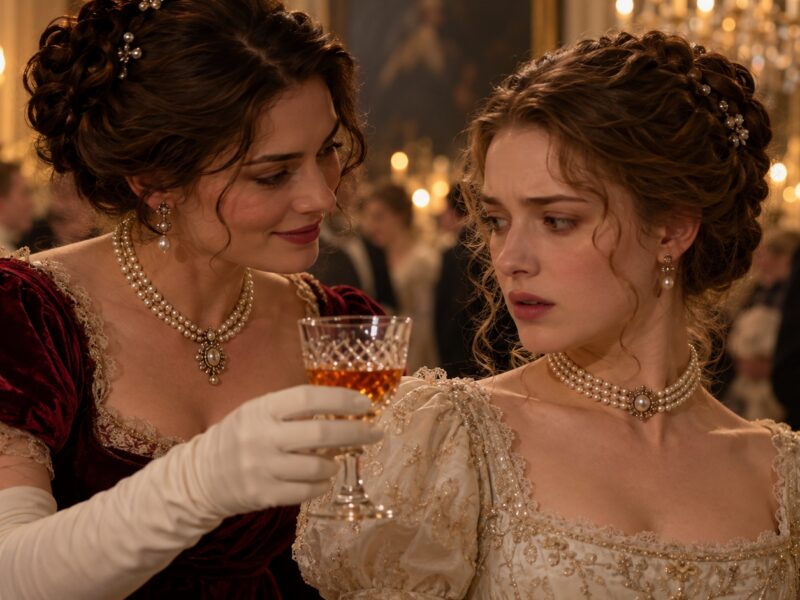
The last thing Eleanor Vale tasted before her world collapsed was bitter orange in a glass of wine.
Her closest friend had handed her that glass with a smile.
And somewhere beyond the ballroom, two people Eleanor trusted were waiting for her to lose everything.
The assembly at Brighton had been magnificent that evening. Hundreds of candles burned beneath the chandeliers, music drifted through the crowded rooms, and the polished floor reflected the movements of ladies dressed in silk and gentlemen wearing their finest coats. Eleanor had arrived believing that the night might finally bring clarity to her uncertain future.
Instead, it would become the night that divided her life into everything before and everything after.
Celia Harcourt had fastened the pearl clasp at Eleanor’s throat barely half an hour earlier. They had known each other since childhood, shared confidences through adolescence, and spoken of marriage and happiness as though both were things respectable young women could reasonably expect.
Now Celia stood beside her, watching with an expression Eleanor could not quite understand.
“Julian intends to announce the engagement before supper,” Celia whispered.
Eleanor’s heart gave an uncomfortable little movement.
“Are you certain?”
“Quite certain. You should drink something. You’re terribly pale.”
Eleanor accepted the glass.
The wine was sweeter than she expected, with an unpleasant bitterness beneath the orange. She swallowed, set the glass aside, and tried to concentrate on the musicians beginning another dance.
Within minutes, the room seemed to move independently of the floor.
She reached for a chair.
Celia caught her elbow.
“Perhaps you need somewhere quiet.”
Eleanor tried to answer, but her tongue felt heavy. The faces around her became indistinct, and even the bright chandeliers seemed to retreat into a distant yellow haze.
Celia guided her through a doorway and along a passage toward a private retiring room.
Only when the door closed behind them did Eleanor understand that something was terribly wrong.
Celia’s hand disappeared from her arm.
“You have a remarkable gift,” her friend said softly. “You make everyone believe goodness costs you nothing.”
Eleanor braced herself against a table.
“Send for Mrs. Bell. I am unwell.”
“You are inconvenient.”
The words were spoken without anger. Somehow that made them worse.
Eleanor lifted her head.
“What have you done?”
Celia crossed the room and turned the key in the door.
“Mr. Bexley will arrive shortly. By morning, everyone in Sussex will know you were discovered in a gentleman’s company under circumstances no respectable family can overlook.”
For a moment, Eleanor could only stare.
Then she understood.
“Julian will never believe—”
“Julian arranged the room.”
The silence that followed seemed to swallow every sound beyond the door.
“He arranged the room,” Celia repeated. “I arranged the witnesses. He cannot afford a wife whose settlements he cannot control.”
Eleanor’s fingers tightened around the edge of the table.
Suddenly, memories returned with dreadful clarity: Julian persuading her to dismiss her late mother’s solicitor, Julian insisting that the management of Vale House required a man’s attention, Celia offering reassuring explanations whenever letters from the bank failed to arrive.
The warning signs had been there all along.
Eleanor had mistaken manipulation for care because it had come from people she loved.
“Why?” she whispered.
Celia’s expression hardened.
“Because Julian understands ambition. And I understand Julian.”
Eleanor felt another wave of dizziness. Her knees weakened, and she struggled to remain upright.
Celia looked toward the door.
“You should lie down. It will be easier for everyone.”
Then she left.
Eleanor heard the key turn.
For several moments, she stood motionless, breathing carefully through the nausea. Her thoughts moved slowly, as though someone had placed thick glass between her mind and the world.
She knew that if she were found unconscious beside Mr. Bexley, explanations would mean very little.
A woman could lose her reputation without having done anything wrong.
She needed to escape before anyone arrived.
Her gaze moved across the room until it settled on a narrow door almost concealed behind a folding screen.
She stumbled toward it, pressed the handle, and found it unlocked.
The passage beyond was dark.
She followed the wall with one hand, holding the abandoned wineglass in the other, until another door gave way beneath her weight.
She entered a library.
A fire had burned low in the marble hearth. The shelves were crowded with books, and a solitary lamp illuminated a desk beside the window.
Eleanor took one more step.
Then her legs gave way.
Someone caught her before her head struck the hearth.
“Who is there?”
The voice was deep and controlled, edged with the sharp authority of a man accustomed to danger.
Eleanor tried to focus on the stranger’s face.
“A woman who needs a doctor,” she managed. “Not a rescuer with conditions.”
Something changed in his expression.
He looked at the glass still trembling in her hand, then at her unnaturally pale face.
“A doctor,” he said.
He rang for his valet.
When the servant appeared, the stranger ordered the household physician summoned immediately.
Then footsteps sounded outside the passage door.
Voices followed.
Eleanor recognized the eager impatience in them.
The witnesses had arrived.
The stranger moved between her and the door.
“They will say I am ruined,” she whispered.
His face remained still.
“They may say what they please. They shall not come through that door.”
He did not ask her to explain herself before offering help.
He did not demand gratitude.
He simply remained where he stood until the physician arrived.
Only then did Eleanor learn his name.
Nathaniel Blackwood.
The Duke of Ravensmere.
He had recently returned from the Peninsula, and something in his restrained manner suggested he had seen enough suffering to recognize it without requiring a performance.
The physician examined Eleanor and identified signs of a sedative in her wine.
She was in no condition to travel.
Nathaniel arranged for her to recover in the library’s adjoining sitting room under the supervision of his widowed aunt. The physician remained available, while the Duke withdrew to another part of the house.
By morning, however, several gentlemen had gathered outside the room.
They had come prepared for a scandal.
Instead, the door opened to reveal the Duke, his aunt, the physician, and Eleanor standing pale but upright behind them.
Nathaniel looked at the assembled men.
“I believe you have mistaken this room for a theater.”
One gentleman lifted his eyebrows.
“We were informed that a young lady had spent the night—”
“Under medical supervision,” Nathaniel interrupted, “with my aunt in attendance. You may repeat that account accurately.”
The man shifted uncomfortably.
“And if another account has already circulated?”
“I shall be pleased to correct it personally.”
No one challenged him.
When Eleanor was ready to leave, Nathaniel placed a plain silver watch in her hand.
The enamel face bore a small, carefully repaired mark.
“My aunt’s carriage will take you home. If anyone questions your departure, show them this. It belonged to my father. I shall answer for it.”
“I cannot accept something so personal.”
“Then return it when your difficulties are behind you.”
Eleanor closed her fingers around the watch.
For the first time since Celia had handed her the wine, she felt something other than fear.
But the Duke had underestimated one thing.
A malicious story could travel faster than any carriage.
By the time Eleanor reached her father’s house, Julian Ashcombe had already supplied society with a version of events that made her seem unstable, reckless, and morally compromised.
He called her a young woman who had been discovered in one gentleman’s room and rescued by another.
Her father refused to listen.
He owed Julian money, a fact Eleanor did not yet fully understand, and he preferred the assurances of his creditor to the testimony of his daughter.
Invitations stopped arriving.
Her publisher terminated the arrangement through which she had earned a modest income from anonymous translations.
The trustees responsible for her mother’s property became impossible to reach.
One afternoon, Celia appeared at the house dressed in delicate morning colors, looking as composed as though nothing extraordinary had occurred.
“It would be wise to disappear,” she advised.
Eleanor stared at her former friend.
“Is that what you came to tell me?”
“Society forgives many things, Eleanor. But it rarely forgives a woman who makes its favorite gentleman look ridiculous.”
Eleanor closed the door.
She did not slam it.
She simply refused to let Celia speak another word inside her home.
Weeks later, standing beside the cold Sussex sea, Eleanor learned that she was carrying a child.
Then the physician’s examination established something even more astonishing.
She was carrying three.
The sedative had clouded her recollection of the night at Brighton, and the physician could not confidently reconstruct every moment before she reached the Duke’s protection.
He refused to make claims the evidence could not support.
Other people were less careful.
Eleanor heard whispers about the father of her unborn children, about disgrace, about a mysterious gentleman whose identity she supposedly concealed.
She did not know how to answer them.
Her own memories had become unreliable, and fear had tangled together events that might never have been connected.
That evening, she sat on the shore until the incoming tide reached her boots.
She thought of her dead mother, the missing money, the home she could no longer trust, and the unborn children who would enter a world already prepared to judge them.
For a long time, she remained there.
Then she stood.
Others had already written the story of her disgrace.
They would not write the rest of her life.
Five years later, the woman who returned to Sussex no longer called herself Miss Eleanor Vale.
She was Mrs. Eleanor Bell.
The surname belonged to the schoolmistress who had sheltered her through her first desperate winter, when she had possessed very little money and even less hope.
Mrs. Bell had since died, leaving Eleanor a modest house, an extraordinary collection of books, and a final letter written in cramped handwriting.
Make a life worth keeping, not merely a life that proves somebody wrong.
Eleanor had read those words so often that the paper had softened along its folds.
She had taken work in Bath teaching French and drawing maps for a publisher. At night, after the children slept, she translated plays under a masculine pen name because the publishers offered better terms to a man they had never met than to a woman whose work they could examine.
The arrangements were exhausting.
Sometimes there had been enough money for coal or meat, but not both.
Sometimes Eleanor had surrendered her own supper without telling anyone.
Once she had sold her winter coat.
Yet her children had grown into three distinct, wonderfully troublesome little people.
Edmund was serious, observant, and unusually concerned with promises. He kept a small notebook in which he recorded statements he believed adults ought to honor.
Rose had a talent for finding the one question people least wished to answer.
Kit, the youngest by seven minutes, regarded every locked door as probable evidence of concealed cake.
They were triplets, born within the same hour, and their existence had transformed Eleanor’s understanding of what it meant to survive.
One afternoon, as their carriage approached the Sussex coast, Edmund looked up from his notebook.
“Mama, is a duke more important than a magistrate?”
“Socially, perhaps.”
“And legally?”
“Not in quite the way you imagine.”
“Could he have a gentleman arrested for bad manners?”
“Only by making a considerable fool of himself.”
Rose leaned against her mother’s arm.
“Then why do people behave as though dukes are kings?”
Eleanor glanced out at the approaching fields.
“Because too many people are afraid of being left outside the room.”
Kit, having listened for a moment, asked whether dukes employed particularly talented cooks.
That was the end of the conversation.
Eleanor smiled.
Then her fingers tightened around the leather portfolio resting beside her.
She had not returned to Sussex for Julian.
She had returned for her mother’s estate.
A solicitor in Bath had uncovered copies of an old marriage settlement and several letters suggesting that the trustees of Eleanor’s inheritance had been deceived.
Her mother had intended Eleanor to receive independent income from two farms and a small shipping investment.
Instead, significant payments appeared to have been diverted elsewhere.
Julian’s name appeared repeatedly.
So did her father’s.
The surviving documents were troubling but incomplete. The original accounts remained missing, and without them the solicitor could not determine the full extent of the wrongdoing.
Eleanor needed witnesses.
She needed records.
And she needed to return to the county where almost everyone believed her life had ended in disgrace.
The opportunity came through an invitation to Lady Fenwick’s musical evening.
Julian Ashcombe and Celia Harcourt were finally announcing their engagement.
Eleanor left the invitation unanswered.
Her companion Margot, formerly a maid and now one of the most reliable people in her life, placed the card on the breakfast table again the following morning.
“You cannot win a legal dispute merely by making a dramatic entrance,” Margot observed.
“I had gathered as much.”
“But some people in that room might finally be willing to speak when they discover you are alive.”
Eleanor lifted her teacup.
“I confess that I should also enjoy watching Celia struggle to remember how to breathe.”
“Both considerations may be perfectly reasonable.”
Eleanor laughed.
It was the first easy laugh she had allowed herself since crossing back into Sussex.
By the evening of the musical, she had arranged more than an appearance.
A former footman who had been involved in carrying the drugged wine was prepared to give evidence. He had preserved sealed instructions and could identify the man who had paid him.
A magistrate’s cousin had agreed to protect his attendance.
Eleanor intended to place the material before the appropriate people without exposing the servant to a room full of spectators.
Lady Fenwick’s drawing room glowed with candlelight.
Celia wore cream silk and a magnificent emerald necklace. Julian moved among the guests with the relaxed confidence of a gentleman who believed that five uninterrupted years of prosperity proved he had done nothing wrong.
Eleanor waited until the final note of a sonata faded.
Then she crossed the room.
“Miss Harcourt,” she said pleasantly. “How delightful to find you well. I had heard you were mourning me.”
A glass slipped from someone’s fingers.
Julian turned.
For an instant, his face lost every trace of color.
Celia stared as though the dead had entered the room.
“Eleanor,” Julian said at last. “What an extraordinary surprise.”
“Only because you have always found ordinary honesty so difficult.”
A whisper passed through the gathering.
Eleanor did not raise her voice.
She handed Lady Fenwick a copy of the physician’s statement and requested that the former footman’s testimony be heard privately by her solicitor and the magistrate.
Julian’s eyes followed the papers.
“What exactly are you trying to accomplish?”
“I brought evidence,” Eleanor replied. “Not a performance. You will learn the difference.”
The words spread through the room more effectively than any outburst.
For several minutes, Eleanor had the satisfaction of watching Julian struggle to maintain his composure.
But triumph proved less satisfying than she had imagined.
When she returned to the carriage, Edmund was gone.
Rose stood beside Margot, looking unusually unconcerned.
“Where is your brother?”
“He has gone to find the Duke.”
Eleanor stopped.
“What Duke?”
“The one whose watch you keep in the locked box.”
Her hands turned cold.
“Rose, what else did Edmund say?”
Her daughter considered the question.
“He said gentlemen ought to pay their debts.”
“That is not an explanation.”
Rose hesitated.
Then she delivered the words that made Eleanor forget every victory she had won that evening.
“He said we were going to find our father.”
Nathaniel Blackwood was not fond of unexpected visitors.
As Duke of Ravensmere, he endured a continual procession of people requesting leases, favors, money, introductions, and influence.
But three small children standing at his porter’s lodge presented an entirely different problem.
Edmund Bell stepped forward carrying a battered notebook.
“We require an interview,” he announced solemnly. “It concerns a matter of family importance.”
Nathaniel had come down the steps before his butler could turn the encounter into a formal negotiation.
“Do you indeed?”
Kit looked past him toward the house.
“Does your cook make seed cake?”
Rose examined the Duke’s face with disconcerting intensity.
Then she turned to Edmund.
“He has your eyebrows.”
Nathaniel felt something tighten in his chest.
The children had arrived with a stable boy who had taken pity on them and accompanied them along the private drive. They were safe, but their presence disturbed him in ways he could not immediately explain.
Edmund’s grave expression was strangely familiar.
Rose possessed a fearless manner of observation.
And Kit looked astonishingly like a little boy Nathaniel remembered from his own childhood portraits.
“Where is your mother?” he asked.
“Probably looking for us,” Edmund admitted.
“We left a note.”
“A sensible note?”
Rose looked embarrassed.
“It says we shall return by tea.”
Nathaniel knelt so he could speak without towering over them.
“Then we must send word immediately. No parent should spend an afternoon frightened for a child’s safety.”
Rose studied him.
“You know what being frightened feels like.”
He might once have answered such a personal observation with coldness.
Instead, he remembered the Peninsula, the friends he had lost, and the letters he had never found the courage to write.
“Yes,” he said quietly. “Rather more than I should like.”
He took them inside and ordered refreshments while a messenger was dispatched.
In the breakfast room, Kit discovered seed cake and declared it an excellent reason for becoming acquainted with a duke.
Edmund opened his notebook.
On one page was a carefully drawn silver watch with a distinctive repaired enamel face.
Nathaniel stared at it.
“Where did you see that?”
“In Mama’s box. She keeps it locked away.”
Edmund looked down at his drawing.
“She never sells it. Even when she needed money.”
Rose added, “Once she sold her winter coat instead.”
Nathaniel could not speak.
He knew the watch.
He had carried it through war.
He had placed it in the hand of a frightened young woman five years earlier and wondered afterward whether she had escaped the scandal that had nearly destroyed her.
Before he could ask another question, the door opened.
Eleanor entered, breathless and pale with fury.
She gathered all three children against her skirts, touching their shoulders and faces as though she could only believe they were safe after counting them herself.
“You are not permitted to frighten me into an early grave.”
Then she looked up.
Nathaniel stood beside the breakfast table.
Five years seemed to vanish between them.
He had grown broader, and there were lines of exhaustion near his eyes that she did not remember.
But his voice was unchanged.
“Miss Vale.”
She straightened.
“Mrs. Bell, if you please.”
His gaze briefly passed over her bare left hand.
He did not ask why she had changed her name.
“Your children are safe. I was about to send a messenger.”
“Thank you. I apologize for the intrusion.”
Rose lifted her head.
“But Mama, you always say we should never apologize for asking the right question.”
“And I also say you must never leave without telling the adult responsible for you.”
The Duke almost smiled.
Eleanor resented how much younger the expression made him look.
She opened her reticule and withdrew the silver watch.
“I should like to return this. I have kept it far too long.”
Nathaniel looked at it but made no attempt to take it.
He closed her fingers around the watch instead.
“I gave it to you as proof. Keep it until those who wronged you have answered for themselves.”
“You cannot know who wronged me.”
“Then perhaps,” he said, “you will tell me.”
Eleanor looked away.
Five years earlier, he had offered help when she was incapable of defending herself. He had used his authority to protect her reputation without demanding possession of her life in exchange.
That distinction mattered.
Still, she had learned too painfully what could happen when a woman trusted a powerful man.
She agreed to meet him the following day, with Margot and his aunt present.
That evening, Nathaniel opened his father’s old journal and examined the surviving household accounts from the night of the Brighton assembly.
He found the physician’s bill.
Beside it lay an entry in his own handwriting.
Miss Vale conveyed safely to Mrs. Bell’s care. No gentleman admitted to her room.
He read the words twice.
They answered one question.
But the faces of the three children had raised another, far more troubling one.
The following morning, Lady Augusta Blackwood welcomed Eleanor into a sitting room scented with beeswax and rosemary.
The formidable dowager looked her over.
“You appear exhausted.”
“I have been rather occupied.”
“Excellent. It suggests you have found something more useful to do than arranging flowers.”
Margot sat beside Eleanor.
Nathaniel remained near the window.
Lady Augusta gestured toward the chairs.
“Well, sit down. We have a great deal to discuss.”
Eleanor did not attempt to soften her intentions.
“I require a solicitor and access to the old records at Vale House. I do not require a husband.”
Lady Augusta’s mouth twitched.
“How fortunate. I have not brought one wrapped in paper.”
Nathaniel turned from the window.
“My solicitor, Mr. Pierce, will act only if you choose to retain him. You will owe me nothing for the introduction.”
Eleanor regarded him carefully.
“And if your family dislikes what the investigation uncovers?”
“Then my family must learn to bear disappointment.”
She wanted to believe him.
Instead, she asked Mr. Pierce to explain the proposed arrangement in detail before accepting anything.
The investigation began almost immediately.
Her mother’s trust had included income from two farms and a modest investment connected with coastal shipping.
Julian had been appointed merely to assist with correspondence during Eleanor’s first London season.
But letters sent to tenants described him as an authorized agent, and funds that should have remained under trustee supervision had been directed into accounts associated with Ashcombe.
Eleanor’s father’s signature appeared on several instructions.
The handwriting suggested he had signed documents prepared by someone else without examining them properly.
“He may not have understood the implications,” Mr. Pierce observed.
“Foolishness is not innocence,” Eleanor answered.
“No,” the solicitor admitted. “Nor is affection evidence of competence.”
The legal obstacles were substantial.
Because Eleanor had never married Julian, he had acquired no lawful ownership of her independent property through marriage.
Yet proving that trustees or agents had colluded to divert the income would require reliable records, corroborating testimony, and time.
The original account book was missing.
Nathaniel suggested inviting several old acquaintances to a gathering where questions could be asked discreetly.
Eleanor refused.
“I have spent five years being discussed in drawing rooms. I will not turn my life into another entertainment.”
“Where would you prefer to question them?”
“In a records room. With dates, receipts, and someone capable of distinguishing evidence from gossip.”
Nathaniel studied her for a moment.
“That seems entirely reasonable.”
So they worked.
For days, Eleanor sat with Mr. Pierce and Nathaniel in a small office behind the solicitor’s chambers, sorting correspondence, comparing signatures, and tracing payments.
Their acquaintance grew through ordinary discoveries.
Nathaniel learned that Eleanor preferred her toast slightly burned, folded letters with astonishing carelessness, and could calculate agricultural rents faster than many estate stewards.
Eleanor learned that he remembered the names of servants’ children and that his silences were not necessarily judgments.
Often, he was simply listening.
Once, while reaching across the table for an estate map, their hands touched.
Both withdrew at once.
Neither mentioned it.
One afternoon, as rain darkened the windows, Eleanor asked why he had never married.
Nathaniel continued examining a document for several seconds.
“After the war, I suffered a serious fever. A surgeon told me I would never father children.”
Eleanor went still.
The image of three small faces rose before her.
“Surgeons have been wrong,” she said.
“So I have begun to suspect.”
He looked at her.
Neither spoke the obvious possibility aloud.
Eleanor remembered the sedative, the gaps in her memory, and the uncertainty that had haunted her since the children were born.
Nathaniel remembered carrying her to safety.
But resemblance was not proof.
And neither of them was prepared to invent an explanation simply because it would make their lives easier.
That evening, Eleanor searched through old correspondence and found a letter written before the Brighton assembly.
On the back, in her own handwriting, was a sentence she had forgotten.
At the masked supper, the gentleman with the silver watch kissed my hand and asked whether I should like to see the sea by sunrise.
She read it again.
A memory surfaced.
A garden colonnade.
Moonlight.
A man whose voice she recognized.
And a feeling that had existed before the wine, before the locked room, before the ruin of her name.
She pressed the paper against the table.
There had been something between her and Nathaniel.
Something neither had yet fully acknowledged.
At Ravensmere, Edmund approached the matter with the seriousness of a barrister preparing an important case.
He divided a page in his notebook into two columns.
At the top of the first, he wrote, What We Know.
At the top of the second, What We Wish.
Beneath the first heading, he listed that their mother had met the Duke before they were born and that the Duke had given her a watch.
Beneath the second, in smaller letters, he wrote:
A father who stays.
Eleanor discovered the page while putting away his nightshirt.
She sat on the bed for a long time.
Edmund watched her.
“Have I done something wrong?”
“No, darling.”
She placed the notebook between them.
“Being a father is not merely resembling someone in a portrait. It means keeping promises, especially when keeping them is inconvenient.”
Edmund considered that.
“Did our father leave us?”
Eleanor swallowed.
“I do not know the entire truth. I wanted to protect you from not knowing. But I think I have made you carry that uncertainty by yourselves.”
“May I still ask the Duke questions?”
“Yes. But not without me.”
Meanwhile, Nathaniel had begun examining his own memories.
He recalled a masked supper weeks before the Brighton assembly.
A young woman had argued passionately that ladies ought to be allowed to choose professions rather than simply husbands.
They had spoken for nearly an hour.
Later, beneath a garden colonnade, he had kissed her.
He remembered withdrawing when she asked him to.
He remembered writing afterward.
And he remembered receiving his letter back unopened.
At the time, he had believed she wished no further acquaintance.
Now he wondered who had prevented their correspondence from reaching its destination.
The answer emerged unexpectedly at Lady Fenwick’s tea.
Celia made a careless remark about how easily ducal seals might be imitated.
Lady Augusta looked over her cup.
“What an unusual accomplishment for a young lady who claims to dislike correspondence.”
Within days, a former maid came forward with a packet of letters Celia had once ordered destroyed.
One was from Nathaniel, asking to meet Eleanor honorably.
Two were from Eleanor, wondering why he had disappeared.
Another contained instructions in Julian’s handwriting directing Celia not to deliver any of them.
Every letter had been written before the Brighton scandal.
Nathaniel stared at the pages.
Eleanor felt the old humiliation settle over her in a new form.
For five years, she had believed herself forgotten.
He had believed himself rejected.
Neither had known that someone else was making their choices.
Yet the letters did not prove the children’s parentage.
Eleanor insisted upon the distinction.
“We will not write a beautiful lie simply because it would make us comfortable.”
Nathaniel nodded.
“Then allow me to become their friend. They need not call me anything else.”
And slowly, without declarations, he began to earn their trust.
He accompanied Kit to the stables and patiently explained accounts the child had demanded to inspect before immediately becoming bored.
He took Rose through the greenhouse and allowed her to describe an expensive orchid as a sulking cabbage.
He worked through an estate drainage problem with Edmund, asking the boy what he thought before explaining the figures.
When Kit spilled ink across a valuable map, Nathaniel helped clean the table and calmly admitted that the document had been damaged.
When Rose refused to greet him one morning, he did not demand affection.
And when Edmund asked whether dukes always kept their promises, Nathaniel answered without hesitation.
“No. But I should like to become a man you can expect to keep his.”
Eleanor watched her children begin to trust him.
She was grateful.
She was frightened.
She knew how easily affection could become another reason to ignore the truth.
One evening, riding home together, she finally said what troubled her.
“I will not exchange one man’s protection for another man’s authority.”
“Nor should you.”
“And if the truth is unwelcome?”
“Then we shall have to be unhappy with the truth.”
She turned toward him.
“That sounds rather bleak.”
“It is preferable to being happy at your expense.”
Eleanor looked out at the darkening countryside.
For the first time in five years, she wanted to trust someone without feeling obliged to abandon her right to doubt him.
The missing ledger was discovered because Kit Bell refused to believe a loose floorboard was merely a loose floorboard.
Mr. Pierce had secured permission to inspect the old schoolroom at Vale House.
Eleanor brought the children along, believing that familiar surroundings might help her remember where household papers had once been kept.
Kit dropped a wooden horse.
It rolled beneath a cabinet and struck the floor with a peculiar hollow sound.
“A secret passage!” he whispered.
“Or a mouse,” Margot suggested.
The carpenter lifted the damaged plank.
Beneath it lay a tin dispatch box wrapped in oilcloth.
Inside were account books, receipts, inventories, and correspondence.
The missing records showed rents diverted into Julian’s accounts and shares sold without Eleanor’s authorization.
There was also a letter from Celia offering payment to Mr. Bexley if he would be discovered in Eleanor’s room at dawn.
Eleanor read it twice.
A final sentence appeared in different handwriting.
If she is unfit to answer questions, so much the better.
Mr. Pierce compared the ink and hand with another memorandum.
The addition appeared to have been written by Julian.
Eleanor sat on the schoolroom floor, the ledger open across her lap.
For five years, she had lived with the consequences of that night.
She had endured hunger, isolation, uncertainty, and the humiliation of hearing strangers confidently describe events they had never witnessed.
All of it had begun because people who claimed to care for her had calculated what they could gain from destroying her standing.
“We have them,” Margot whispered.
Eleanor looked at the papers.
“We have documents. Now we must discover whether the people responsible can be made to answer for them.”
Mr. Pierce obtained statements from the retired footman, the physician’s former assistant, and a clerk who had processed false instructions.
The magistrate examined the material privately.
Julian’s relations attempted to dismiss the dispute as a quarrel between families.
The financial records made that increasingly difficult.
Mr. Bexley admitted that he had been paid to enter Eleanor’s room at dawn and participate in the compromising scene.
He denied touching her.
The surviving medical notes supported the account that Eleanor had been protected and supervised while recovering from the drug.
The investigation was finally beginning to distinguish facts from the rumors that had destroyed her reputation.
But the most important discovery had not yet been made.
It waited inside Eleanor’s mother’s Bible.
Between its pages lay a letter she had written but never sent.
The date was three weeks before the Brighton assembly.
The intended recipient was Nathaniel Blackwood.
Eleanor sat down as she read.
The letter described a night by the sea following the masked supper.
Not the drugged night in Brighton.
An earlier night.
A night in which she had chosen to be with Nathaniel.
The words brought memories back in fragments.
Moonlight on a terrace.
An open door.
The sound of the sea.
Nathaniel’s hand reaching toward hers, waiting for her answer.
An intimacy that had belonged to them both.
She had feared afterward that he might regret the encounter. When their letters failed to reach one another, rejection had seemed to confirm her fears.
Later, the trauma of the Brighton scandal had confused the sequence of events in her mind.
She had come to associate the uncertainty surrounding her pregnancy with the night she was drugged, rather than the earlier intimacy she had hidden from herself.
The physician had never claimed that an unknown man had fathered her children.
Others had supplied that conclusion.
Eleanor held the letter against her chest.
Then she went to Nathaniel.
“There is something we must discuss.”
She told him what she remembered and what still remained uncertain.
He listened without interruption.
When she described the seaside terrace, he closed his eyes.
“I remember.”
Their recollections agreed.
They had spent that earlier night together willingly.
At dawn, they had parted with the understanding that they would write.
Both had kept that promise.
Both had been deceived into believing the other had not.
The timing and circumstances made Nathaniel a strong candidate to be the children’s father, though neither possessed a means of proving the matter absolutely.
For a long time, he stood beside the window.
“I lost five years,” he said.
Eleanor looked at him.
“So did they.”
He turned.
“May I tell them that I believe I am their father?”
“Tell them what we believe. Tell them why. Tell them what we cannot know with certainty.”
She stepped closer.
“Then show them what you intend to do.”
Nathaniel nodded.
He did not ask her to forget the past.
He did not promise that affection would solve every legal difficulty.
Instead, he began doing the only thing the children had always needed.
He stayed.
Lady Fenwick’s Midsummer Ball became the most anticipated gathering in Sussex.
By the time the guests assembled, rumors of Eleanor’s investigation had already spread through the county.
Julian arrived with Celia, determined to behave as though nothing had changed.
Eleanor entered in a blue silk gown purchased with money she had earned herself.
Rose had chosen the color.
“It makes you look like the sea before a storm,” her daughter had told her.
Mr. Pierce was already waiting with certified copies of the relevant documents.
The magistrate had no intention of conducting a legal proceeding in a ballroom. Lady Fenwick, however, had agreed to provide her drawing room for a formal statement addressing the accusations repeatedly circulated under her roof.
Eleanor stood before the assembled guests.
She remembered being a young woman who could scarcely hold herself upright while strangers prepared to ruin her.
Now she stood without trembling.
“I am not asking you to acquit me,” she said. “I am asking you to stop repeating a story that was manufactured for profit.”
Julian laughed uneasily.
“My dear Eleanor, surely you cannot intend—”
“You called me dear when you needed my mother’s money. You stopped when you believed that money was gone. Let us be economical with the word.”
Mr. Pierce presented the documentary trail.
He explained the false claims of authority, the diverted rents, the payments linked to the attempted compromising scene, the surviving physician’s evidence, and the testimony of servants Julian had assumed would never be believed.
Every allegation was limited to what the evidence could support.
Eleanor watched the guests listen.
Some appeared genuinely shocked.
Others looked uncomfortable in the manner of people beginning to understand that they had helped perpetuate an injustice because it was socially convenient.
Celia stood near the fireplace, her face drained of color.
“Julian promised me security,” she whispered.
For one fleeting moment, Eleanor felt something approaching pity.
Then she remembered the locked door.
“Security built upon another woman’s destruction is not security. You knew that when you chose it.”
Julian reached suddenly toward the documents.
Nathaniel stepped forward.
But Eleanor spoke before he could intervene.
“Do not touch my property again.”
Her voice was quiet.
Julian stopped.
It was not the Duke’s presence that finally silenced him.
It was Eleanor’s refusal to yield.
The consequences were neither immediate nor magically complete.
Julian faced a civil action concerning the trust, along with the prospect of criminal investigation into forged instructions and conspiracy.
Creditors began to withdraw their support.
Celia lost the protection of families who no longer wished to associate themselves with her conduct.
Eleanor did not demand dramatic punishments.
She asked for written retractions and restitution wherever the law could provide it.
Later that evening, Julian approached her beside an open window.
“You have ruined me.”
Eleanor looked toward the dark garden.
“No. I have stopped financing the fiction that you were respectable.”
He swallowed.
“You once loved me.”
“I once imagined you were a different man. That is not a debt I owe you.”
She turned away.
For years, she had dreamed of seeing him humiliated.
Now that he stood before her diminished, she discovered that revenge could not restore the younger woman who had believed him.
Justice mattered.
But justice would not erase five winters of hardship or undo the childhood fears her children had endured.
It could only make room for a different future.
Nathaniel approached and offered his arm.
He waited until she nodded before taking hers.
“I had thought I might propose tonight,” he said quietly.
Eleanor looked at him.
“Had you?”
“Then I saw what it cost you to stand before those people. I shall ask another day, when your answer can belong entirely to you.”
She smiled.
“You are learning, Your Grace.”
“Very slowly.”
“Most worthwhile things require patience.”
Behind them, the orchestra began another dance.
They went into the garden instead.
The summer that followed did not repair everything.
Eleanor’s father wrote a hesitant letter admitting he had signed documents without examining them and had chosen Julian’s assurances over his daughter’s testimony.
She replied without cruelty.
But she would not pretend that an apology, privately offered, repaired years of public harm.
If he wished to know his grandchildren, he would first have to tell the truth openly and learn to respect her boundaries.
The recovered trust income allowed Eleanor to purchase the house in Bath that had once belonged to Mrs. Bell.
She endowed two places at its school for girls whose families could not afford the fees.
Mr. Pierce arranged the funds so they could not easily be redirected by a future husband.
Eleanor continued translating.
Her inheritance could provide security, but her work gave her something different.
It reminded her that she possessed a mind and a life independent of any gentleman’s approval.
Nathaniel became a dependable presence in the children’s lives.
When Edmund fell ill, he rode through heavy rain and remained beside the boy’s bed reading a tedious history of Roman roads because Edmund insisted upon hearing it.
When Rose quarreled with another child, Nathaniel listened to both accounts rather than assuming she must be innocent.
And when Kit asked whether a family might belong to two houses, Nathaniel considered the question carefully.
“The fortunate ones may have as many rooms as they need,” he said, “provided everyone has somewhere they are welcome.”
One afternoon, Eleanor found him in the kitchen.
His sleeves were rolled up.
Flour covered the table.
An extraordinarily unsuccessful cake sat in the center of the room.
Kit stood beside it, studying the collapsed middle.
“It can hold cream,” he announced. “That is better than an ordinary cake.”
Eleanor leaned against the doorway.
“Your Grace, you are destroying your dignity.”
Nathaniel examined the flour on his hands.
“I find I have considerably more dignity than I require.”
Kit wandered away in search of Margot and the cream.
Nathaniel washed his hands.
Then he turned toward Eleanor with an expression she had never seen upon his face at any ball.
Uncertainty.
“I love you, Eleanor.”
She remained still.
“I loved the woman who argued with me about books. I love the woman who refused to let a room full of titled fools determine the shape of her life.”
He paused.
“I cannot return the years we lost. But I can offer you the years ahead.”
Eleanor looked at him for a long moment.
“There are conditions.”
“Naturally.”
“My income remains mine.”
“Agreed.”
“My work remains mine.”
“Of course.”
“The children are people, Nathaniel. They are not proof of your bloodline. If they choose to use your name, it must be when they understand what that choice means.”
“I understand.”
She tilted her head.
“You have not heard the final condition.”
“I tremble.”
“You must never pretend to enjoy my burnt toast.”
For a moment he simply stared.
Then he laughed.
When the laughter faded, he took her hand.
“I shall tell you the truth, even when it is inconvenient.”
Eleanor felt the old fear rise.
And then, slowly, she allowed it to pass.
“Then yes.”
Nathaniel drew a careful breath.
“Yes?”
“Not because you are a duke,” she said. “Because you have finally asked as a man who knows I may refuse.”
They married in a small parish church.
An independent legal adviser prepared the marriage settlement.
Lady Augusta wept discreetly and afterward denied having shed a tear.
Margot held Kit’s hand throughout the ceremony to prevent him from investigating the wedding cake.
Edmund carried the rings with the solemn pride of a child entrusted with a kingdom.
Rose, instructed not to criticize anyone’s hat, waited until the vows were completed before whispering that the vicar resembled an indignant goose.
No one invented a false record to make the children’s birth legitimate under the law.
No one pretended the marriage erased the uncertainties of the past.
Instead, Eleanor and Nathaniel made secure arrangements for their upbringing and future, spoke to them with age-appropriate honesty, and allowed their relationships to develop without demanding that affection resolve every legal question.
By autumn, Eleanor had begun writing a novel of her own.
Her heroine did not become a princess.
She did not discover an impossible fortune or defeat every enemy through some convenient catastrophe.
She reclaimed her name and learned to choose whom she trusted.
Some mornings, Eleanor wrote in perfect silence.
On others, Kit stood beside her chair describing the adventures of a heroic pudding.
One evening, Nathaniel found her watching the children run across the garden.
“Do you regret returning?” he asked.
Eleanor considered the question.
“Sometimes I regret what it cost.”
She watched Edmund attempt to persuade Kit that a wooden sword was an unsuitable tool for digging flowerbeds.
“But I no longer regret surviving it.”
Rose came running toward them and seized Nathaniel’s hand.
Edmund wanted permission to visit the estate office the following morning.
Kit announced, with considerable urgency, that the cook was concealing another cake.
Nathaniel smiled.
Eleanor looked at her children.
Then at the man who had learned to keep the door open.
For five years, she had imagined happiness would begin when everyone who had hurt her finally suffered.
She understood now that justice and restitution mattered deeply, but neither could replace the simple peace of belonging somewhere safe.
Happiness was an ordinary evening.
A house full of voices.
Children who expected the adults in their lives to keep their promises.
And a home in which no one had to be afraid.
Eleanor opened the garden door.
“Come inside,” she said. “Supper is ready.”
This time, everyone came.









